
survey design Dr. VIJAYALEKSHMI N S ASSISTANT
OM
Published · 25 slides · 0 views

1 / 1


Description
survey design Dr. VIJAYALEKSHMI N S ASSISTANT PROFESSOR M.Ed DEPARTMENT FATHIMA MEMORIAL TRAINING COLLEGE KOLLAM, KERALA STATE Survey design Survey design is used to collect information from different subjects within a given population
Related Topics
Share
Embed code
Download this presentation From Below
"survey design Dr. VIJAYALEKSHMI N S ASSISTANT" is the property of its rightful owner. Permission is granted to download and print the materials on this website for personal, non-commercial use only, and to display it on your personal computer provided you do not modify the materials and that you retain all copyright notices contained in the materials. By downloading content from our website, you accept the terms of this agreement.
Presentation Transcript
01
survey design Dr. VIJAYALEKSHMI N S
ASSISTANT PROFESSOR
M.Ed DEPARTMENT
FATHIMA MEMORIAL TRAINING COLLEGE
KOLLAM, KERALA STATE<br>
ASSISTANT PROFESSOR
M.Ed DEPARTMENT
FATHIMA MEMORIAL TRAINING COLLEGE
KOLLAM, KERALA STATE<br>
02
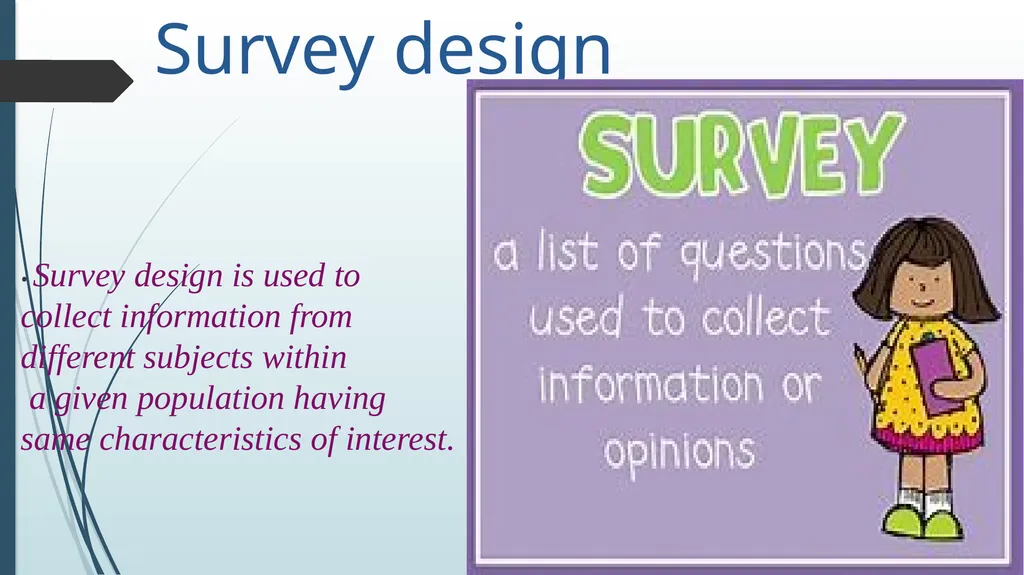
Survey design • Survey design is used to
collect information from
different subjects within
a given population having
same characteristics of interest.<br>
collect information from
different subjects within
a given population having
same characteristics of interest.<br>
03
contents Sur
Survey Design-Nature and Meaning
Survey Design-Definitions
Characteristics of Survey Design
Steps of Survey Design
Types of Survey Design
Advantages of Survey Design
Disadvantages of Survey Design
Ethical Concerns of Survey Research<br>
Survey Design-Nature and Meaning
Survey Design-Definitions
Characteristics of Survey Design
Steps of Survey Design
Types of Survey Design
Advantages of Survey Design
Disadvantages of Survey Design
Ethical Concerns of Survey Research<br>
04
LEARNING OBJECTIVES The student teachers will be able to
describe the nature and meaning of survey design
explain the characteristics of survey design
list different types of survey designs
elucidate the steps to carry out survey designs
identify the advantages and disadvantages of survey method
analyse the ethical concerns of survey designs<br>
describe the nature and meaning of survey design
explain the characteristics of survey design
list different types of survey designs
elucidate the steps to carry out survey designs
identify the advantages and disadvantages of survey method
analyse the ethical concerns of survey designs<br>
05
Survey design: Meaning and Nature Survey studies are usually used to find the fact by collecting the data directly from population or sample
. It is the most commonly used descriptive method in educational researches.
The researcher collects the data to describe the nature of existing condition or look forward the standards against existing condition or determine the relationships that exists between specific events. survey study intends to understand and explain the phenomena in a natural setting
compare different demographic groups or see the cause and effect relationship to make predictions.
it requires responses directly from respondents of large population in general
.Survey researches demands various tools to collect the data from samples. They are ranging from observation, interview to questionnaire.<br>
. It is the most commonly used descriptive method in educational researches.
The researcher collects the data to describe the nature of existing condition or look forward the standards against existing condition or determine the relationships that exists between specific events. survey study intends to understand and explain the phenomena in a natural setting
compare different demographic groups or see the cause and effect relationship to make predictions.
it requires responses directly from respondents of large population in general
.Survey researches demands various tools to collect the data from samples. They are ranging from observation, interview to questionnaire.<br>
06
survey designs:definitions The purpose of survey research design is to discover the relative incidence, distribution, and inter-relations of sociological and psychological variables –
(Kerlinger,1986)
Survey research is defined as "the collection of information from a sample of individuals through their responses to questions"
(Check & Schutt, 2012)
The survey method gathers data from relatively large number of cases at a particular time (Boudah,2011)<br>
(Kerlinger,1986)
Survey research is defined as "the collection of information from a sample of individuals through their responses to questions"
(Check & Schutt, 2012)
The survey method gathers data from relatively large number of cases at a particular time (Boudah,2011)<br>
07
Characteristics of Survey design Description. It can be used to describe phenomena and summarize them. Also, the usual goal is to get a precise measurement of such phenomena.
Causal Explanation. It measures associations between variables; e.g., school grades and self-esteem.
Evaluation. It can be useful for determining the degree to which a desired objective is attained as a result of a planned program, hence surveys after interventions.
Prediction. Survey data can be used to forecast future events.<br>
Causal Explanation. It measures associations between variables; e.g., school grades and self-esteem.
Evaluation. It can be useful for determining the degree to which a desired objective is attained as a result of a planned program, hence surveys after interventions.
Prediction. Survey data can be used to forecast future events.<br>
08
Steps in Survey Research design Defining the purpose and objective of the study i.e. the problem, why to conduct a research and what is its worth, the clear objectives formulation etc. are included in the first step of survey research.
Selecting and defining the target population, i.e. upon which the study is based.
Choosing and selecting techniques for data gathering. (i.e. the instrument like interview, questionnaire etc. to be used for data collection). The selection of instrument depends upon the cost, applicability and the research design.
A major and good representative (sample) of the population is to be taken (i.e. this is the step of sampling).<br>
Selecting and defining the target population, i.e. upon which the study is based.
Choosing and selecting techniques for data gathering. (i.e. the instrument like interview, questionnaire etc. to be used for data collection). The selection of instrument depends upon the cost, applicability and the research design.
A major and good representative (sample) of the population is to be taken (i.e. this is the step of sampling).<br>
09
Steps in Survey Research design 5.The process of data gathering (or simply the step of executing the research), where the interviews, questionnaires or any other instrument is used for which the questions are pre designed.
6.The questionnaire (if used) is then followed up. The questions asked from the interviewee are answered, evaluated and hence the process of data gathering is completed.
7.The data gathered is processed, analyzed, and interpreted, from which the results are concluded and the findings are then generalized.
8.The whole study is then presented in the form of research report (called survey report) for the purpose of transmission and further study.<br>
6.The questionnaire (if used) is then followed up. The questions asked from the interviewee are answered, evaluated and hence the process of data gathering is completed.
7.The data gathered is processed, analyzed, and interpreted, from which the results are concluded and the findings are then generalized.
8.The whole study is then presented in the form of research report (called survey report) for the purpose of transmission and further study.<br>
10
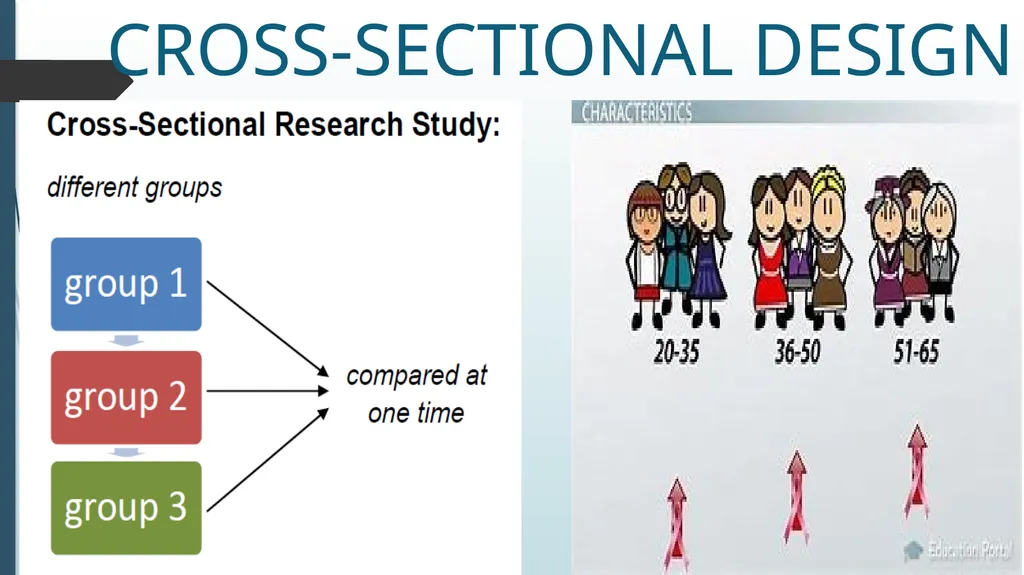
CROSS-SECTIONAL DESIGN<br>
11
TYPES OF SURVEY DESIGNS A) CROSS-SECTIONAL DESIGN
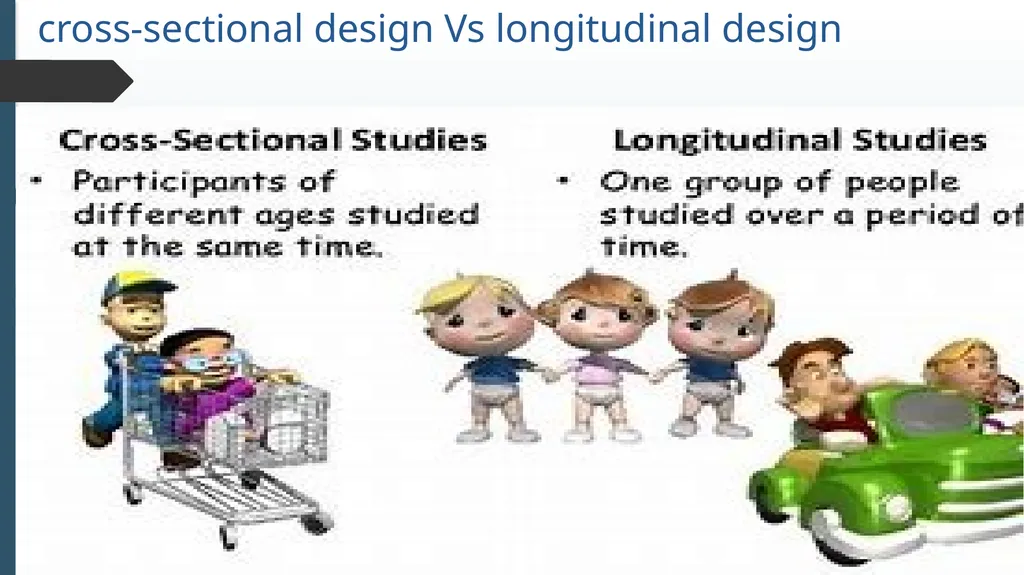
Cross-sectional studies, also known as one-shot or status studies
The most commonly used design in the social sciences.
This design is best suited to studies aimed at finding out the prevalence of a phenomenon, situation, problem, attitude or issue, by taking a cross-section of the population.
They are useful in obtaining an overall ‘picture’ as it stands at the time of the study.
They are ‘designed to study some phenomenon by taking a cross- section of it at one time’
Eg;The attitude of the community towards equity issues<br>
Cross-sectional studies, also known as one-shot or status studies
The most commonly used design in the social sciences.
This design is best suited to studies aimed at finding out the prevalence of a phenomenon, situation, problem, attitude or issue, by taking a cross-section of the population.
They are useful in obtaining an overall ‘picture’ as it stands at the time of the study.
They are ‘designed to study some phenomenon by taking a cross- section of it at one time’
Eg;The attitude of the community towards equity issues<br>
12
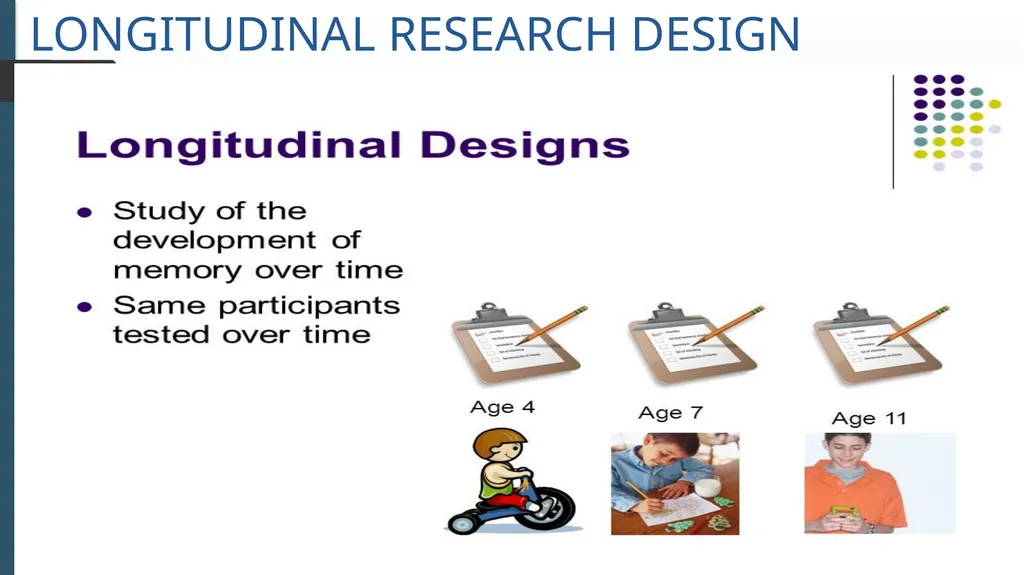
LONGITUDINAL RESEARCH DESIGN<br>
13
TYPES OF SURVEY DESIGNS B) LONGITUDINAL STUDY DESIGN
To determine the pattern of change in relation to time, a longitudinal design is used.
Longitudinal studies are also useful when to collect factual information on a continuing basis.
In longitudinal studies the study population is visited a number of times at regular intervals, usually over a long period, to collect the required information
These intervals are not fixed so their length may vary from study to study.
Intervals might be as short as a week or longer than a year.
. A longitudinal study can be seen as a series of repetitive cross-sectional studies.<br>
To determine the pattern of change in relation to time, a longitudinal design is used.
Longitudinal studies are also useful when to collect factual information on a continuing basis.
In longitudinal studies the study population is visited a number of times at regular intervals, usually over a long period, to collect the required information
These intervals are not fixed so their length may vary from study to study.
Intervals might be as short as a week or longer than a year.
. A longitudinal study can be seen as a series of repetitive cross-sectional studies.<br>
14
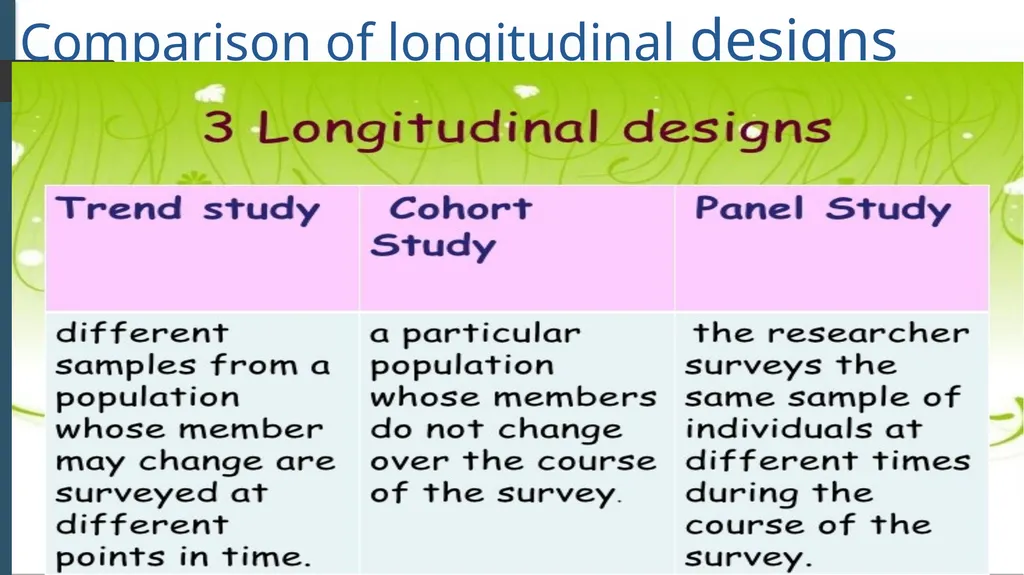
TYPES OF SURVEY DESIGNS Longitudinal surveys, can be further classified into three distinct types of longitudinal designs (trend, cohort, and panel).
a) Trend studies
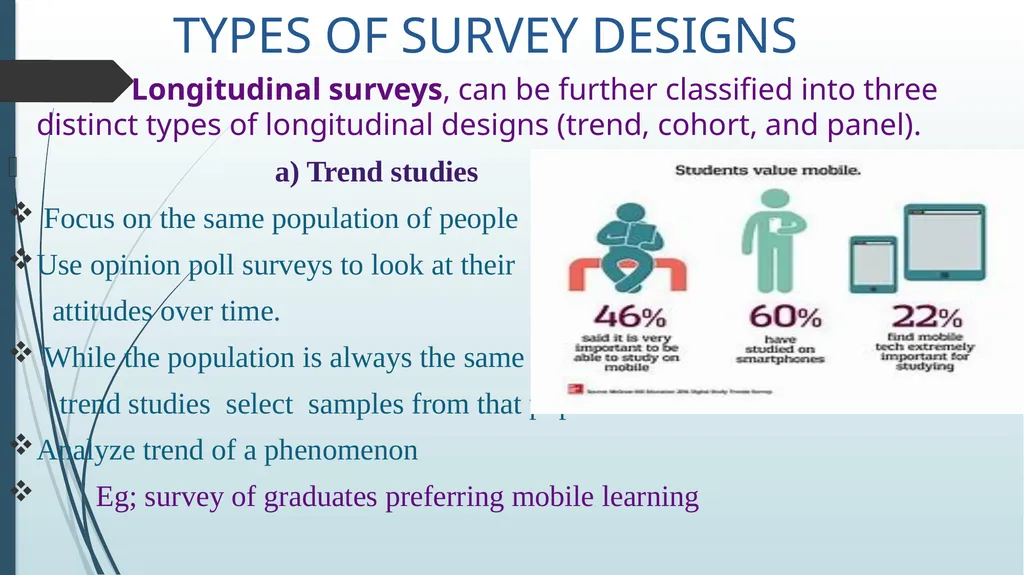
Focus on the same population of people
Use opinion poll surveys to look at their
attitudes over time.
While the population is always the same
trend studies select samples from that population.
Analyze trend of a phenomenon
Eg; survey of graduates preferring mobile learning<br>
a) Trend studies
Focus on the same population of people
Use opinion poll surveys to look at their
attitudes over time.
While the population is always the same
trend studies select samples from that population.
Analyze trend of a phenomenon
Eg; survey of graduates preferring mobile learning<br>
15
TYPES OF SURVEY DESIGNS b) Cohort research
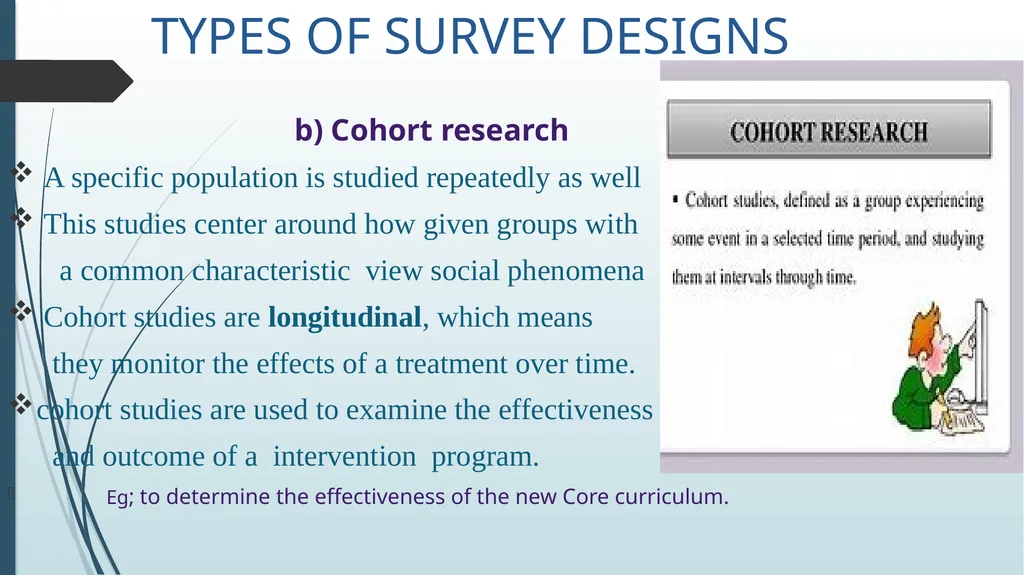
A specific population is studied repeatedly as well
This studies center around how given groups with
a common characteristic view social phenomena
Cohort studies are longitudinal, which means
they monitor the effects of a treatment over time.
cohort studies are used to examine the effectiveness
and outcome of a intervention program.
Eg; to determine the effectiveness of the new Core curriculum.<br>
A specific population is studied repeatedly as well
This studies center around how given groups with
a common characteristic view social phenomena
Cohort studies are longitudinal, which means
they monitor the effects of a treatment over time.
cohort studies are used to examine the effectiveness
and outcome of a intervention program.
Eg; to determine the effectiveness of the new Core curriculum.<br>
16
TYPES OF SURVEY DESIGNS c)Panel studies
This design utilize the same sample from the same population over time.
The more complicated and difficult to carry out
This is the best design to truly find out changes over time
Aim is to track opinions of the exact same respondents repeatedly.
They are more focused and specific
Eg;library usage trend among students,frequency of library usage habits and change in habits if any<br>
This design utilize the same sample from the same population over time.
The more complicated and difficult to carry out
This is the best design to truly find out changes over time
Aim is to track opinions of the exact same respondents repeatedly.
They are more focused and specific
Eg;library usage trend among students,frequency of library usage habits and change in habits if any<br>
17
Comparison of longitudinal designs<br>
18
cross-sectional design Vs longitudinal design<br>
19
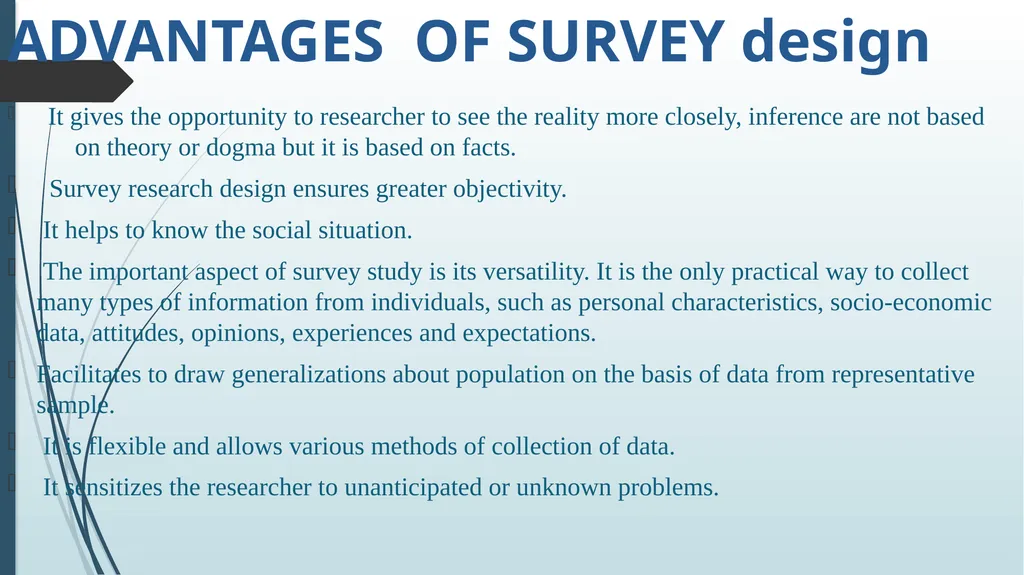
ADVANTAGES OF SURVEY design It gives the opportunity to researcher to see the reality more closely, inference are not based on theory or dogma but it is based on facts.
Survey research design ensures greater objectivity.
It helps to know the social situation.
The important aspect of survey study is its versatility. It is the only practical way to collect many types of information from individuals, such as personal characteristics, socio-economic data, attitudes, opinions, experiences and expectations.
Facilitates to draw generalizations about population on the basis of data from representative sample.
It is flexible and allows various methods of collection of data.
It sensitizes the researcher to unanticipated or unknown problems.<br>
Survey research design ensures greater objectivity.
It helps to know the social situation.
The important aspect of survey study is its versatility. It is the only practical way to collect many types of information from individuals, such as personal characteristics, socio-economic data, attitudes, opinions, experiences and expectations.
Facilitates to draw generalizations about population on the basis of data from representative sample.
It is flexible and allows various methods of collection of data.
It sensitizes the researcher to unanticipated or unknown problems.<br>
20
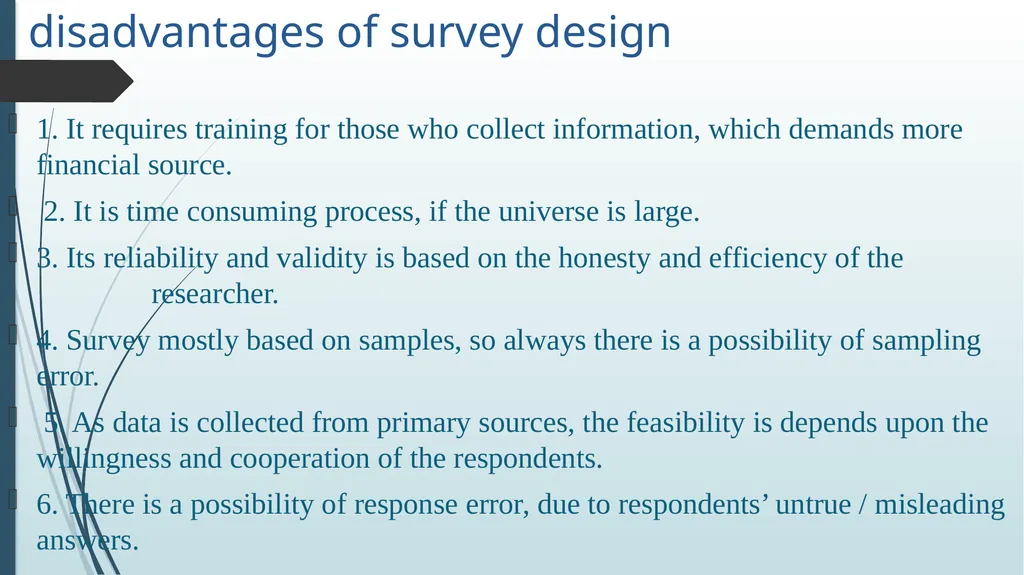
disadvantages of survey design 1. It requires training for those who collect information, which demands more financial source.
2. It is time consuming process, if the universe is large.
3. Its reliability and validity is based on the honesty and efficiency of the researcher.
4. Survey mostly based on samples, so always there is a possibility of sampling error.
5. As data is collected from primary sources, the feasibility is depends upon the willingness and cooperation of the respondents.
6. There is a possibility of response error, due to respondents’ untrue / misleading answers.<br>
2. It is time consuming process, if the universe is large.
3. Its reliability and validity is based on the honesty and efficiency of the researcher.
4. Survey mostly based on samples, so always there is a possibility of sampling error.
5. As data is collected from primary sources, the feasibility is depends upon the willingness and cooperation of the respondents.
6. There is a possibility of response error, due to respondents’ untrue / misleading answers.<br>
21
Privacy and ethics in survey research Researchers should:
• keep confidential private information about survey participants
• minimize the possibility of causing psychological discomfort or harm to respondents
• when possible use paper-based, self-administered questionnaires (SAQ) instead of face-to-face survey to elicit information of a sensitive nature.<br>
• keep confidential private information about survey participants
• minimize the possibility of causing psychological discomfort or harm to respondents
• when possible use paper-based, self-administered questionnaires (SAQ) instead of face-to-face survey to elicit information of a sensitive nature.<br>
22
Suggested readings Best, John W. and Kahn, J.V. (2007), Research in Education, New Delhi: Prentice Hall of India Private Ltd
Cohen, L; &Manion, L. (1994). Research Methods in Education (Fourth Edition).London: Routledge Krishnaswami, O.R. (1993). Methodology of Research in Social Sciences. Bombay: Himalaya Publishing House.
Neuman, W. L. (2011). Social research methods: Qualitative and quantitative approaches (7th ed.). Toronto: Pearson.
Reddy, C.R. (1987). Research Methodology in Social Sciences. New Delhi: Daya Publishing House<br>
Cohen, L; &Manion, L. (1994). Research Methods in Education (Fourth Edition).London: Routledge Krishnaswami, O.R. (1993). Methodology of Research in Social Sciences. Bombay: Himalaya Publishing House.
Neuman, W. L. (2011). Social research methods: Qualitative and quantitative approaches (7th ed.). Toronto: Pearson.
Reddy, C.R. (1987). Research Methodology in Social Sciences. New Delhi: Daya Publishing House<br>
23
summary Survey research is often used by researchers to explain trends or features of large groups
The key features of survey design are description, causal explanation , evaluation and prediction
Cross-sectional design and longitudinal designs are the two main types of survey design
Strengths of survey research include its cost effectiveness, generalizability, reliability, and versatility.
Weaknesses of survey research include inflexibility and issues with validity<br>
The key features of survey design are description, causal explanation , evaluation and prediction
Cross-sectional design and longitudinal designs are the two main types of survey design
Strengths of survey research include its cost effectiveness, generalizability, reliability, and versatility.
Weaknesses of survey research include inflexibility and issues with validity<br>