
Swine module husbandry and training module Adapted


Description: Swine module husbandry and training module Adapted from Guide for the care and use of agricultural animals in research and teaching, 3rd ed, Federation of Animal Science Societies, 2010 Microenvironment Air temperature, air movement,
Related Topics
Download Presentation
"Swine module husbandry and training module Adapted" is the property of its rightful owner. Permission is granted to download and print the materials on this website for personal, non-commercial use only, and to display it on your personal computer provided you do not modify the materials and that you retain all copyright notices contained in the materials. By downloading content from our website, you accept the terms of this agreement.
Presentation Transcript
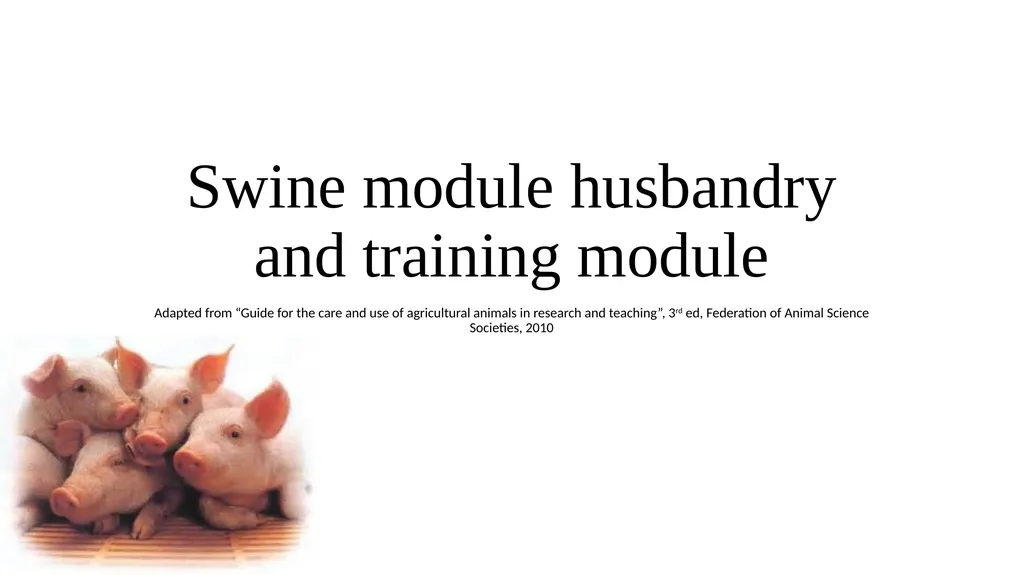
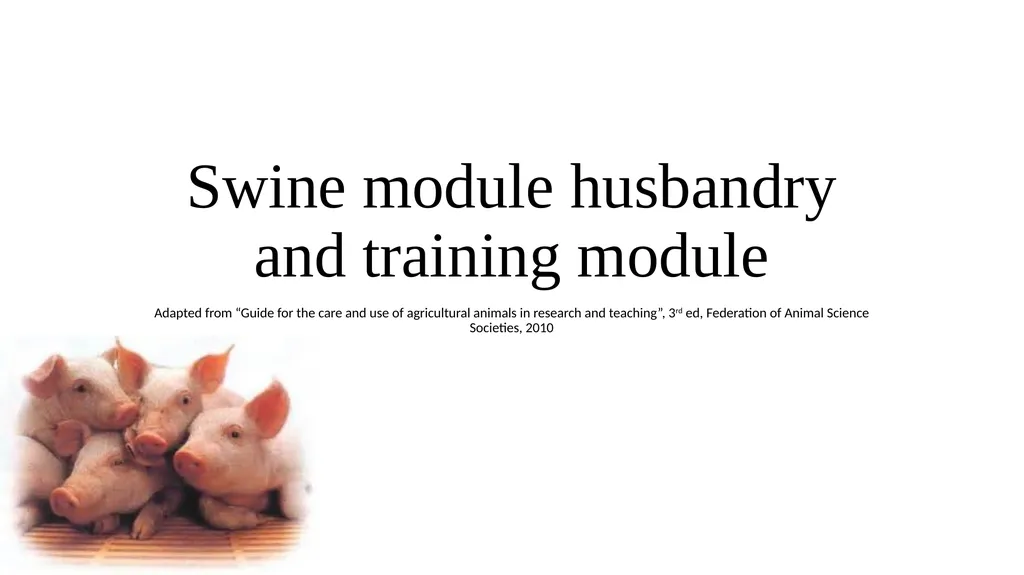
slide1. Swine module husbandry and training module Adapted from “Guide for the care and use of agricultural animals in research and teaching”, 3rd ed, Federation of Animal Science Societies, 2010<br>
slide2. Microenvironment Air temperature, air movement, moisture
Remain close to zone of thermal neutrality for age of pig housed
Air changes should not be less than 6/hour
Relative humidity
Pens, walls, floors
Social environment
Microbial environment<br>
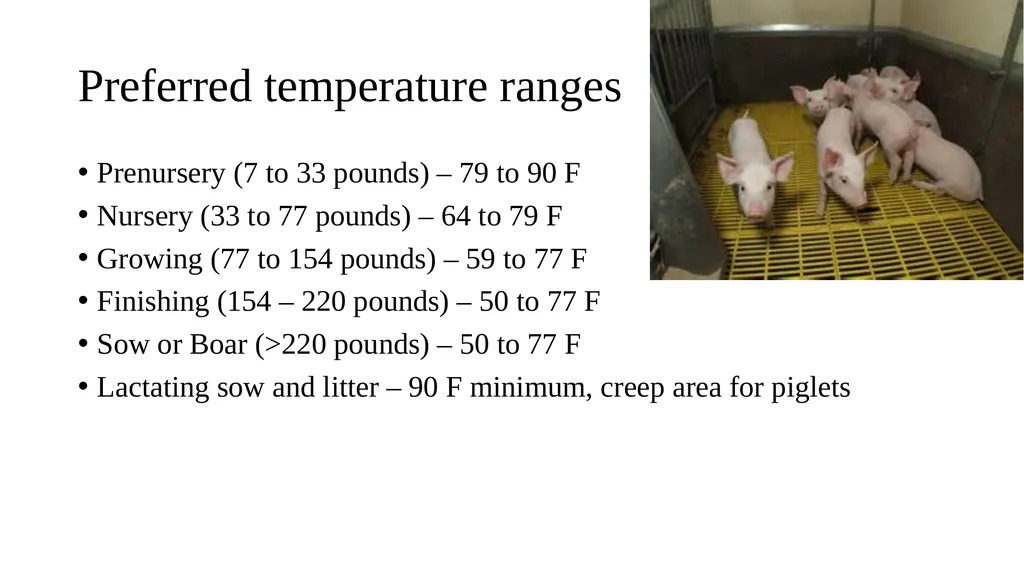
slide3. Preferred temperature ranges Prenursery (7 to 33 pounds) – 79 to 90 F
Nursery (33 to 77 pounds) – 64 to 79 F
Growing (77 to 154 pounds) – 59 to 77 F
Finishing (154 – 220 pounds) – 50 to 77 F
Sow or Boar (>220 pounds) – 50 to 77 F
Lactating sow and litter – 90 F minimum, creep area for piglets<br>
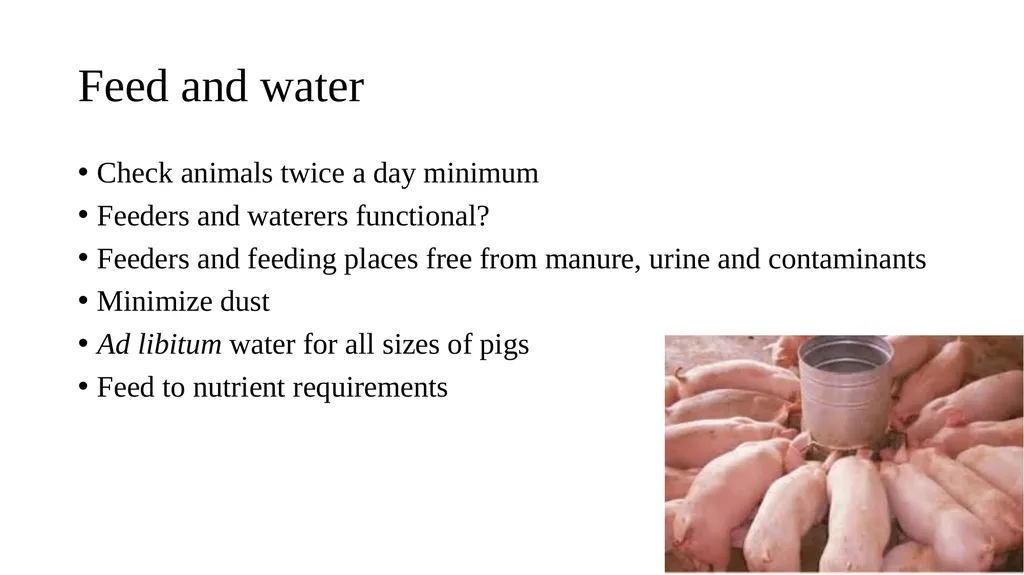
slide4. Feed and water Check animals twice a day minimum
Feeders and waterers functional?
Feeders and feeding places free from manure, urine and contaminants
Minimize dust
Ad libitum water for all sizes of pigs
Feed to nutrient requirements<br>
slide5. Photoperiod Lactating sows responded positively to 16 h of light and 8 h of darkness
Changing the photoperiod may affect pig reproduction in some ways, but changes in photoperiod have not been linked to sow or boar well-being.<br>
slide6. Husbandry Social environment
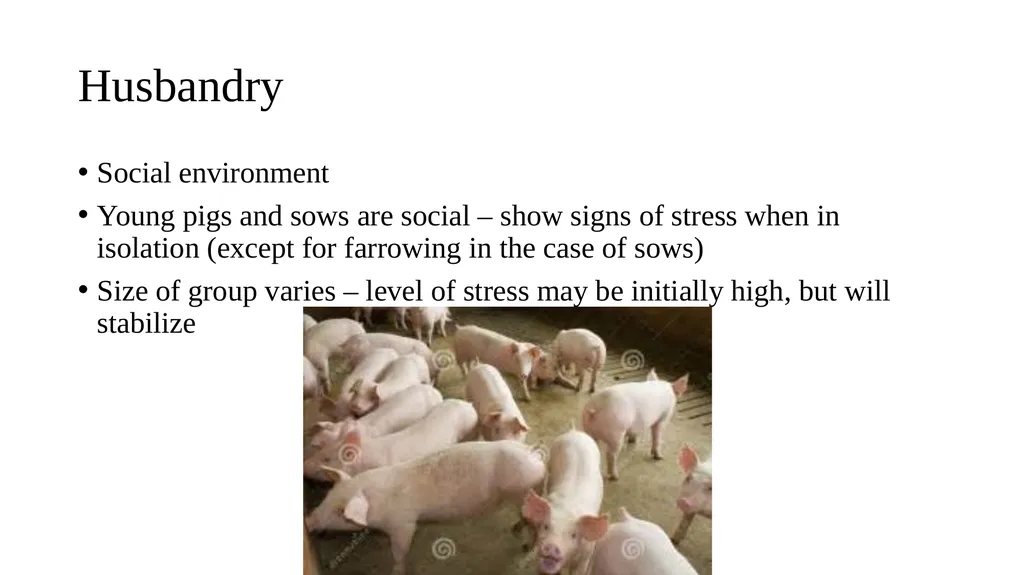
Young pigs and sows are social – show signs of stress when in isolation (except for farrowing in the case of sows)
Size of group varies – level of stress may be initially high, but will stabilize<br>
slide7. Husbandry Farrowing systems
Clean, disinfect and dry farrowing environment
Presence of caretaker during farrowing will increase neonatal survival
Sows have difficulty dissipating internal heat so may need to cool (misting, fans)<br>
slide8. Husbandry Confinement before farrowing
6 parts of maternal behavior
Isolation and next site seeking
Nest building
Farrowing
Nest occupation
Social integration
Weaning<br>
slide9. Husbandry Farrowing systems
Meet performance standards of:
minimizing preweaning piglet mortality
providing comfort for sow and piglets
providing a sanitary environment for sow and piglet
accommodating normal sow and piglet behaviors where possible
Restricting sow movement will improve piglet survival
Farrowing stall, farrowing pen, farrowing hut
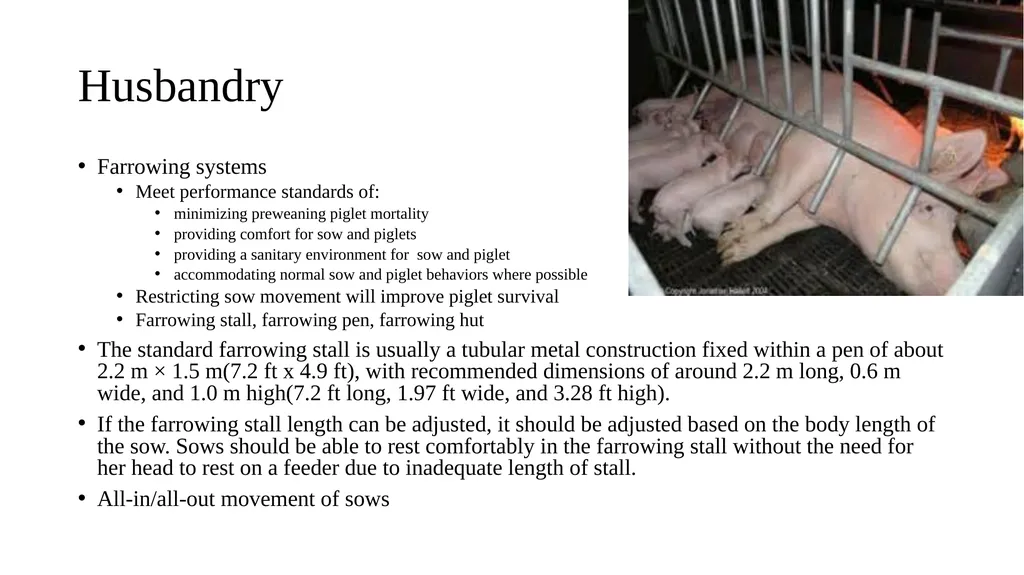
The standard farrowing stall is usually a tubular metal construction fixed within a pen of about 2.2 m × 1.5 m(7.2 ft x 4.9 ft), with recommended dimensions of around 2.2 m long, 0.6 m wide, and 1.0 m high(7.2 ft long, 1.97 ft wide, and 3.28 ft high).
If the farrowing stall length can be adjusted, it should be adjusted based on the body length of the sow. Sows should be able to rest comfortably in the farrowing stall without the need for her head to rest on a feeder due to inadequate length of stall.
All-in/all-out movement of sows<br>
slide10. Husbandry Farrowing systems
Slatted, non-porous, non-abrasive, non-slippery floor
Free of exposed or projecting materials
Floors
Support without slippage
No trapping of feet or legs
Clean environment – separate animals from manure
Provide thermal comfort
Must be able to sanitize
Nearby creep area with heat<br>
slide11. Husbandry Litter management
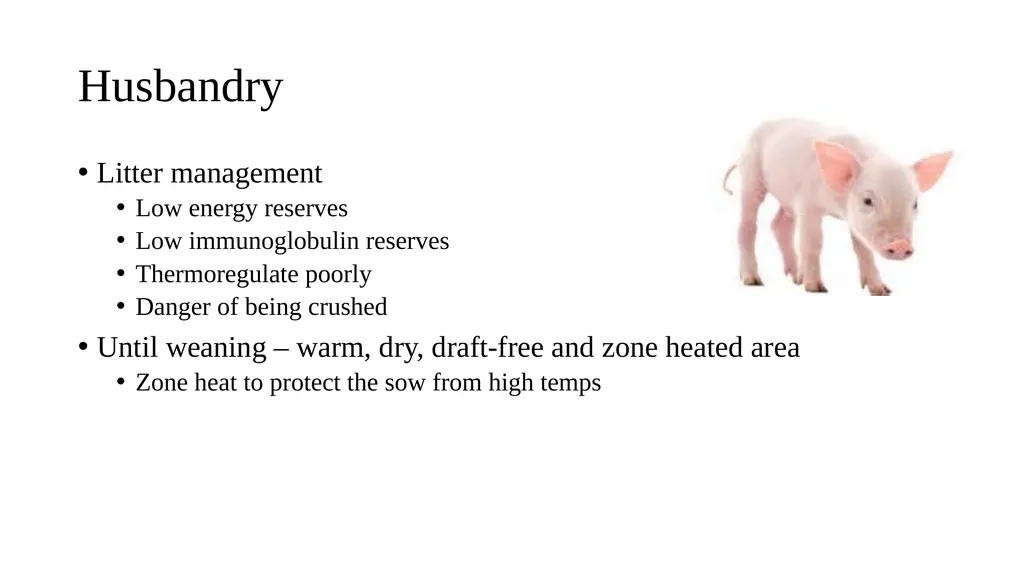
Low energy reserves
Low immunoglobulin reserves
Thermoregulate poorly
Danger of being crushed
Until weaning – warm, dry, draft-free and zone heated area
Zone heat to protect the sow from high temps<br>
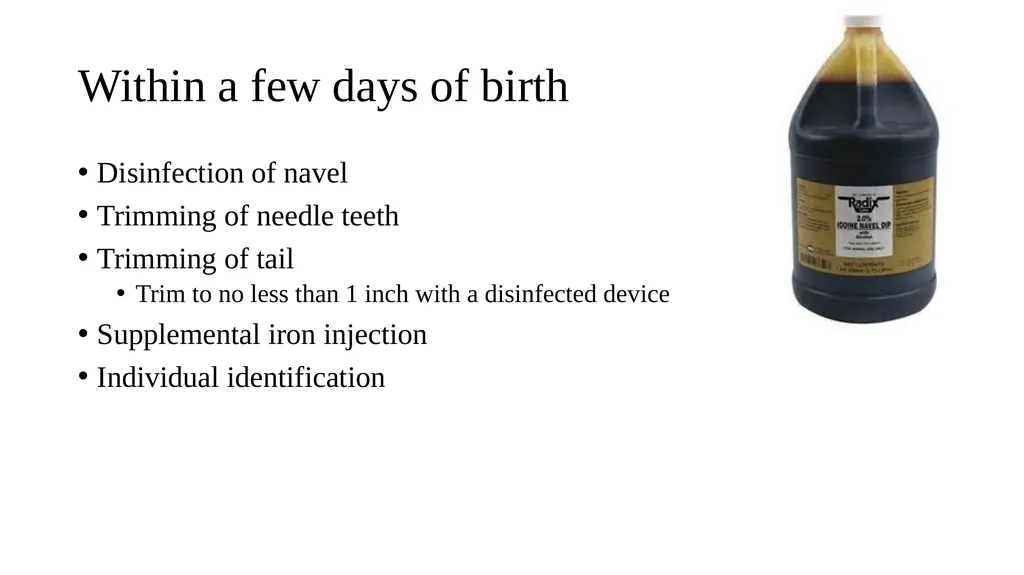
slide12. Within a few days of birth Disinfection of navel
Trimming of needle teeth
Trimming of tail
Trim to no less than 1 inch with a disinfected device
Supplemental iron injection
Individual identification<br>
slide13. Husbandry - Nursery systems Weaning
Segregated early weaning – wean at 10 to 20 days of age, relocate,
Weaning units may require supplemental heat
Ventilation
Higher degree of sanitation
All-in/all-out
Nutritionally balanced diet unless study dictates otherwise
Feeder space
Water ad libitum<br>
slide14. Husbandry – growing and finishing systems 8 to 9 weeks of age to 20 to 25 weeks
Finish is 250 to 300 pounds
Sanitation requirements not as stringent
Can have continuous flow management<br>
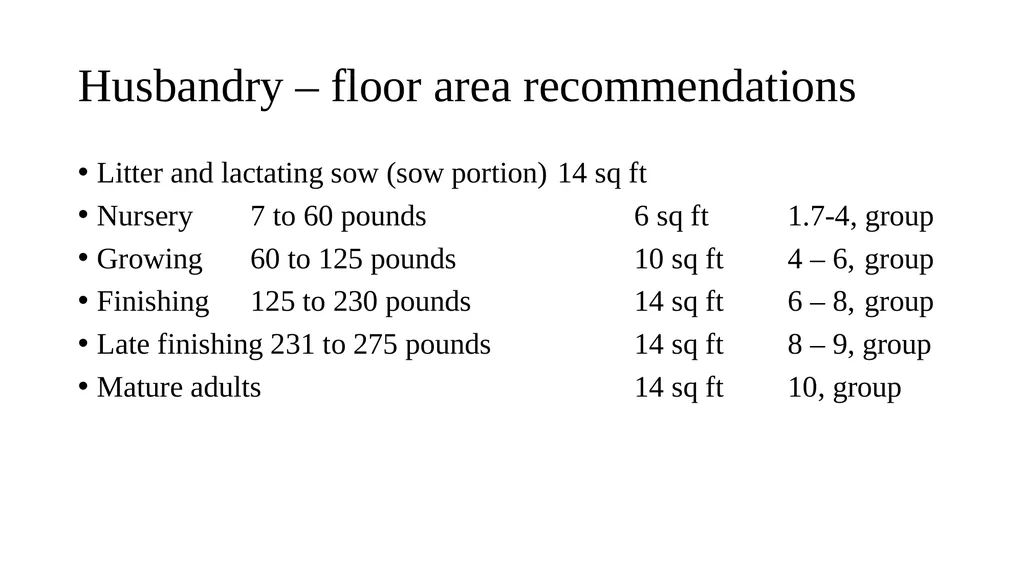
slide15. Husbandry – floor area recommendations Litter and lactating sow (sow portion) 14 sq ft
Nursery 7 to 60 pounds 6 sq ft 1.7-4, group
Growing 60 to 125 pounds 10 sq ft 4 – 6, group
Finishing 125 to 230 pounds 14 sq ft 6 – 8, group
Late finishing 231 to 275 pounds 14 sq ft 8 – 9, group
Mature adults 14 sq ft 10, group<br>
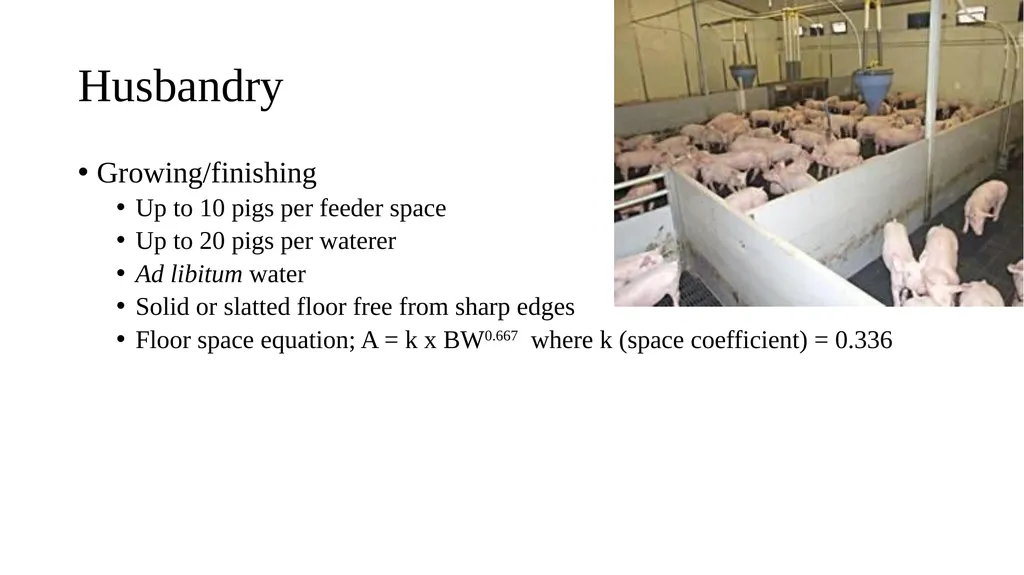
slide16. Husbandry Growing/finishing
Up to 10 pigs per feeder space
Up to 20 pigs per waterer
Ad libitum water
Solid or slatted floor free from sharp edges
Floor space equation; A = k x BW0.667 where k (space coefficient) = 0.336<br>
slide17. Husbandry Breeding and gestation systems
Sows can be housed individually or in groups
AVMA policy
All housing systems should attempt to minimize aggression and competition at mixing and feeding times
Provide sow protection from environmental extremes and hazards
Provide feed and water
Allow sows to express normal behavior<br>
slide18. Husbandry Environment for breeding and gestation
60 to 68 F
Consider air temperature, relative humidity, air speed, wall and ceiling temperature, floor characteristics, body weight, feed intake, huddling, number of animals housed together
Sows will experience heat stress at 84 F
Sows should be in a pen or stall that allows them to lay down without parts of their body (not including limbs) extending into the neighboring stall
Standing sows and gilts should not be forcibly in contact with the sides, ends or top of the stall
Should be able to lie down without heads lying on a raised feeding trough<br>
slide19. Husbandry Group housing depends on:
Group size
Floor space allowance
Group composition
Diet type
Method of feed delivery
Genetics
Sow temperament
Social interaction based on:
Number of sows per pen
Space per female
Variation in body size of females
Duration to time together
Method of feeding – aggression correlates with amount and availability of feed<br>
slide20. Husbandry Group management
Groups of up to 35 or 40 – static – sows in same production phase
Groups of 80 to 200 – dynamic – sows enter and leave the group every week
Minimizing social stress by keeping sows in individual stalls for the first 25 to 35 days post-breeding or grouping all sows at one time improves well-being
Floor space
16 sq ft per sow on partly slatted floors
19 sq ft for larger sows<br>
slide21. Husbandry Mating facilities
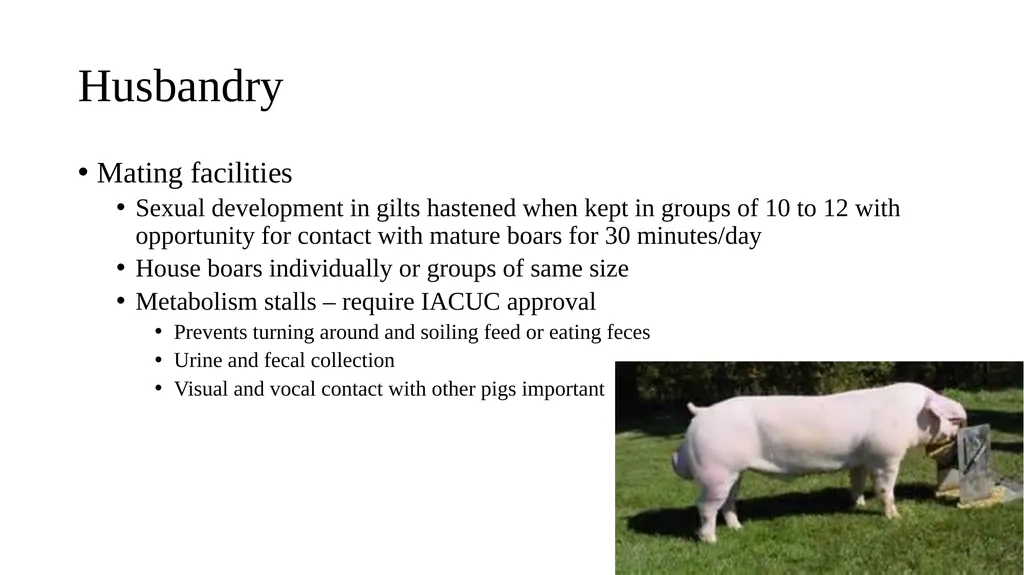
Sexual development in gilts hastened when kept in groups of 10 to 12 with opportunity for contact with mature boars for 30 minutes/day
House boars individually or groups of same size
Metabolism stalls – require IACUC approval
Prevents turning around and soiling feed or eating feces
Urine and fecal collection
Visual and vocal contact with other pigs important<br>
slide22. Castration Done from 1 to 14 days of age
Trained personnel
Disinfected instruments
Pre-castration disinfectant
Incision on ventral scrotum
Topical anesthetic<br>
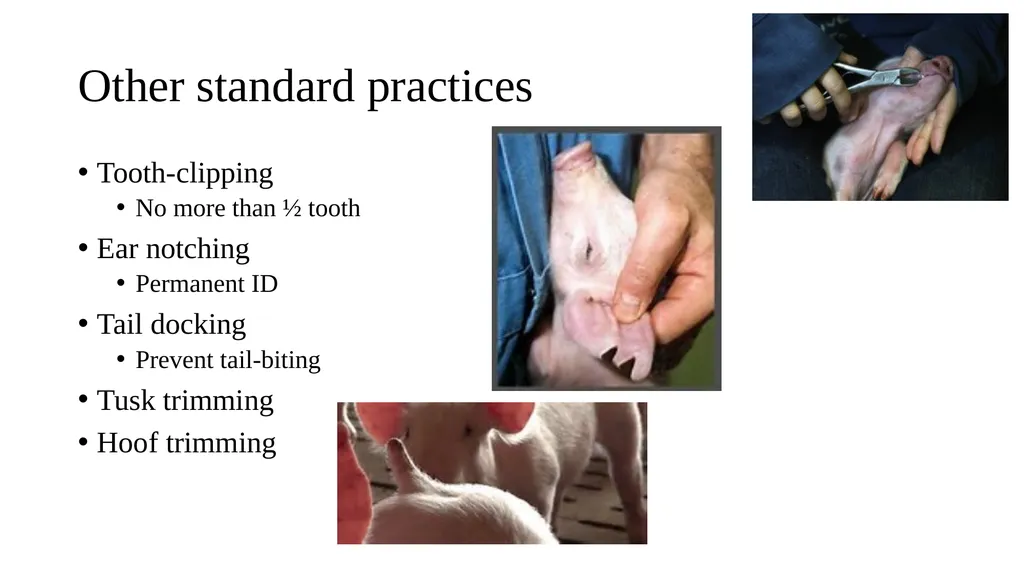
slide23. Other standard practices Tooth-clipping
No more than ½ tooth
Ear notching
Permanent ID
Tail docking
Prevent tail-biting
Tusk trimming
Hoof trimming<br>
slide24. Euthanasia Blunt trauma – pigs weighing less than 12 to 13 pounds
Carbon dioxide for pigs less than 10 weeks of age
Barbiturate overdose – special handling, licensing
Captive bolt followed by exsanguination for pigs weighing more than 12 pounds<br>
slide25. Quiz question #1 Potential problems to watch out for with piglets around farrowing are:
Low energy reserves
Low immunoglobulin reserves
Poor thermoregulation
Danger of being crushed
All of the above<br>
slide26. Quiz question #2 Disinfection of navel, trimming of needle teeth, trimming of tail and supplemental iron injections need to be done:
In the nursery unit
Within a few days of birth
In the grower unit
At finishing<br>
slide27. Quiz question #3 A good temperature for breeding and gestation would be:
48 F
58 F
68 F
78 F
88 F<br>
slide28. Quiz question #4 Gilts will mature sexually faster if kept in proximity with a boar for at least 30 minutes day
True
False<br>
slide29. Quiz question #5 Piglets weighing less than 10 pounds can be euthanized by blunt force trauma
True
False<br>
slide2. Microenvironment Air temperature, air movement, moisture
Remain close to zone of thermal neutrality for age of pig housed
Air changes should not be less than 6/hour
Relative humidity
Pens, walls, floors
Social environment
Microbial environment<br>
slide3. Preferred temperature ranges Prenursery (7 to 33 pounds) – 79 to 90 F
Nursery (33 to 77 pounds) – 64 to 79 F
Growing (77 to 154 pounds) – 59 to 77 F
Finishing (154 – 220 pounds) – 50 to 77 F
Sow or Boar (>220 pounds) – 50 to 77 F
Lactating sow and litter – 90 F minimum, creep area for piglets<br>
slide4. Feed and water Check animals twice a day minimum
Feeders and waterers functional?
Feeders and feeding places free from manure, urine and contaminants
Minimize dust
Ad libitum water for all sizes of pigs
Feed to nutrient requirements<br>
slide5. Photoperiod Lactating sows responded positively to 16 h of light and 8 h of darkness
Changing the photoperiod may affect pig reproduction in some ways, but changes in photoperiod have not been linked to sow or boar well-being.<br>
slide6. Husbandry Social environment
Young pigs and sows are social – show signs of stress when in isolation (except for farrowing in the case of sows)
Size of group varies – level of stress may be initially high, but will stabilize<br>
slide7. Husbandry Farrowing systems
Clean, disinfect and dry farrowing environment
Presence of caretaker during farrowing will increase neonatal survival
Sows have difficulty dissipating internal heat so may need to cool (misting, fans)<br>
slide8. Husbandry Confinement before farrowing
6 parts of maternal behavior
Isolation and next site seeking
Nest building
Farrowing
Nest occupation
Social integration
Weaning<br>
slide9. Husbandry Farrowing systems
Meet performance standards of:
minimizing preweaning piglet mortality
providing comfort for sow and piglets
providing a sanitary environment for sow and piglet
accommodating normal sow and piglet behaviors where possible
Restricting sow movement will improve piglet survival
Farrowing stall, farrowing pen, farrowing hut
The standard farrowing stall is usually a tubular metal construction fixed within a pen of about 2.2 m × 1.5 m(7.2 ft x 4.9 ft), with recommended dimensions of around 2.2 m long, 0.6 m wide, and 1.0 m high(7.2 ft long, 1.97 ft wide, and 3.28 ft high).
If the farrowing stall length can be adjusted, it should be adjusted based on the body length of the sow. Sows should be able to rest comfortably in the farrowing stall without the need for her head to rest on a feeder due to inadequate length of stall.
All-in/all-out movement of sows<br>
slide10. Husbandry Farrowing systems
Slatted, non-porous, non-abrasive, non-slippery floor
Free of exposed or projecting materials
Floors
Support without slippage
No trapping of feet or legs
Clean environment – separate animals from manure
Provide thermal comfort
Must be able to sanitize
Nearby creep area with heat<br>
slide11. Husbandry Litter management
Low energy reserves
Low immunoglobulin reserves
Thermoregulate poorly
Danger of being crushed
Until weaning – warm, dry, draft-free and zone heated area
Zone heat to protect the sow from high temps<br>
slide12. Within a few days of birth Disinfection of navel
Trimming of needle teeth
Trimming of tail
Trim to no less than 1 inch with a disinfected device
Supplemental iron injection
Individual identification<br>
slide13. Husbandry - Nursery systems Weaning
Segregated early weaning – wean at 10 to 20 days of age, relocate,
Weaning units may require supplemental heat
Ventilation
Higher degree of sanitation
All-in/all-out
Nutritionally balanced diet unless study dictates otherwise
Feeder space
Water ad libitum<br>
slide14. Husbandry – growing and finishing systems 8 to 9 weeks of age to 20 to 25 weeks
Finish is 250 to 300 pounds
Sanitation requirements not as stringent
Can have continuous flow management<br>
slide15. Husbandry – floor area recommendations Litter and lactating sow (sow portion) 14 sq ft
Nursery 7 to 60 pounds 6 sq ft 1.7-4, group
Growing 60 to 125 pounds 10 sq ft 4 – 6, group
Finishing 125 to 230 pounds 14 sq ft 6 – 8, group
Late finishing 231 to 275 pounds 14 sq ft 8 – 9, group
Mature adults 14 sq ft 10, group<br>
slide16. Husbandry Growing/finishing
Up to 10 pigs per feeder space
Up to 20 pigs per waterer
Ad libitum water
Solid or slatted floor free from sharp edges
Floor space equation; A = k x BW0.667 where k (space coefficient) = 0.336<br>
slide17. Husbandry Breeding and gestation systems
Sows can be housed individually or in groups
AVMA policy
All housing systems should attempt to minimize aggression and competition at mixing and feeding times
Provide sow protection from environmental extremes and hazards
Provide feed and water
Allow sows to express normal behavior<br>
slide18. Husbandry Environment for breeding and gestation
60 to 68 F
Consider air temperature, relative humidity, air speed, wall and ceiling temperature, floor characteristics, body weight, feed intake, huddling, number of animals housed together
Sows will experience heat stress at 84 F
Sows should be in a pen or stall that allows them to lay down without parts of their body (not including limbs) extending into the neighboring stall
Standing sows and gilts should not be forcibly in contact with the sides, ends or top of the stall
Should be able to lie down without heads lying on a raised feeding trough<br>
slide19. Husbandry Group housing depends on:
Group size
Floor space allowance
Group composition
Diet type
Method of feed delivery
Genetics
Sow temperament
Social interaction based on:
Number of sows per pen
Space per female
Variation in body size of females
Duration to time together
Method of feeding – aggression correlates with amount and availability of feed<br>
slide20. Husbandry Group management
Groups of up to 35 or 40 – static – sows in same production phase
Groups of 80 to 200 – dynamic – sows enter and leave the group every week
Minimizing social stress by keeping sows in individual stalls for the first 25 to 35 days post-breeding or grouping all sows at one time improves well-being
Floor space
16 sq ft per sow on partly slatted floors
19 sq ft for larger sows<br>
slide21. Husbandry Mating facilities
Sexual development in gilts hastened when kept in groups of 10 to 12 with opportunity for contact with mature boars for 30 minutes/day
House boars individually or groups of same size
Metabolism stalls – require IACUC approval
Prevents turning around and soiling feed or eating feces
Urine and fecal collection
Visual and vocal contact with other pigs important<br>
slide22. Castration Done from 1 to 14 days of age
Trained personnel
Disinfected instruments
Pre-castration disinfectant
Incision on ventral scrotum
Topical anesthetic<br>
slide23. Other standard practices Tooth-clipping
No more than ½ tooth
Ear notching
Permanent ID
Tail docking
Prevent tail-biting
Tusk trimming
Hoof trimming<br>
slide24. Euthanasia Blunt trauma – pigs weighing less than 12 to 13 pounds
Carbon dioxide for pigs less than 10 weeks of age
Barbiturate overdose – special handling, licensing
Captive bolt followed by exsanguination for pigs weighing more than 12 pounds<br>
slide25. Quiz question #1 Potential problems to watch out for with piglets around farrowing are:
Low energy reserves
Low immunoglobulin reserves
Poor thermoregulation
Danger of being crushed
All of the above<br>
slide26. Quiz question #2 Disinfection of navel, trimming of needle teeth, trimming of tail and supplemental iron injections need to be done:
In the nursery unit
Within a few days of birth
In the grower unit
At finishing<br>
slide27. Quiz question #3 A good temperature for breeding and gestation would be:
48 F
58 F
68 F
78 F
88 F<br>
slide28. Quiz question #4 Gilts will mature sexually faster if kept in proximity with a boar for at least 30 minutes day
True
False<br>
slide29. Quiz question #5 Piglets weighing less than 10 pounds can be euthanized by blunt force trauma
True
False<br>