
Syllabus statements for an inclusive classroom
FD
Published · 28 slides · 0 views

1 / 1



Description
Syllabus statements for an inclusive classroom Center for Professional Development Bemidji State University Jan 2021 What is this? Based on Jan 5, 2021 presentationdiscussion on diversity, equity and inclusion needs for students, we have
Related Topics
Share
Embed code
Download this presentation From Below
"Syllabus statements for an inclusive classroom" is the property of its rightful owner. Permission is granted to download and print the materials on this website for personal, non-commercial use only, and to display it on your personal computer provided you do not modify the materials and that you retain all copyright notices contained in the materials. By downloading content from our website, you accept the terms of this agreement.
Presentation Transcript
01
Syllabus statements for an inclusive classroom Center for Professional Development
Bemidji State University
Jan 2021<br>
Bemidji State University
Jan 2021<br>
02
What is this? Based on Jan 5, 2021 presentation/discussion on diversity, equity and inclusion needs for students, we have put together a list of statements that might be included in your syllabi to create a more welcoming and inclusive classroom for all students.
These statements have been put together as a resource for BSU faculty
Many of these statements are authored by BSU faculty who already include them in their syllabi.
Remember, the ultimate goal is to create a welcome, safe and inclusive classroom!<br>
These statements have been put together as a resource for BSU faculty
Many of these statements are authored by BSU faculty who already include them in their syllabi.
Remember, the ultimate goal is to create a welcome, safe and inclusive classroom!<br>
03
Required statements - BSU policies This section contains statements that we are required to include by BSU policy.<br>
04
Academic Integrity Academic integrity
BSU students are expected to practice the highest standards of ethics, honesty and integrity in all of their academic work. Any form of academic dishonesty (e.g., plagiarism, cheating and misrepresentation) may result in disciplinary action. Possible disciplinary actions may include failure for part or an entire course as well as suspension from the University. It is suggested that students review BSU’s statement on academic integrity found within the Student Code of Conduct.<br>
BSU students are expected to practice the highest standards of ethics, honesty and integrity in all of their academic work. Any form of academic dishonesty (e.g., plagiarism, cheating and misrepresentation) may result in disciplinary action. Possible disciplinary actions may include failure for part or an entire course as well as suspension from the University. It is suggested that students review BSU’s statement on academic integrity found within the Student Code of Conduct.<br>
05
Accessibility/Disability/Accommodations Statement on accessibility and accommodations (they do say feel free to convey it in your own voice)
BSU/NTC is committed to making all educational programs, course materials, services and activities sponsored by the College/University accessible to individuals with disabilities. Students requesting accommodations due to a disability or other need for access should contact Accessibility Services as soon as possible. Accessibility Services is located at Decker Hall 202. PH: 218.755.3883 or email: disabilityservices@bemidjistate.edu. This information is also available through Minnesota Relay Services at 800.627.3529.<br>
BSU/NTC is committed to making all educational programs, course materials, services and activities sponsored by the College/University accessible to individuals with disabilities. Students requesting accommodations due to a disability or other need for access should contact Accessibility Services as soon as possible. Accessibility Services is located at Decker Hall 202. PH: 218.755.3883 or email: disabilityservices@bemidjistate.edu. This information is also available through Minnesota Relay Services at 800.627.3529.<br>
06
Example of Disability Statement Students with Special Needs:
We would like to make sure that all the class materials discussions and activities that are part of the course are accessible to you. In order to request accommodations in this class, the request must be evaluated by and come through the Disability Services. If you would like to request accommodations or other services, please forward your request to Disability Services as soon as possible. It is possible to contact Disability Services located at Decker Hall 202 or Ph: (218) 755-3883. You may contact them at http://www.bemidjistate.edu/services/disability/<br>
We would like to make sure that all the class materials discussions and activities that are part of the course are accessible to you. In order to request accommodations in this class, the request must be evaluated by and come through the Disability Services. If you would like to request accommodations or other services, please forward your request to Disability Services as soon as possible. It is possible to contact Disability Services located at Decker Hall 202 or Ph: (218) 755-3883. You may contact them at http://www.bemidjistate.edu/services/disability/<br>
07
Writing Resource Center Writing Resource Center: Located in room 326 of the A.C. Clark Library, the Writing Resource Center offers free, one-on-one assistance with all types of writing assignments and projects. Our trained peer and faculty consultants provide constructive feedback to help you get started on a paper, organize your ideas, cite sources, develop revision strategies, polish final drafts, and more. Due to COVID-19, our services will be offered online in Fall 2020. To schedule an online consultation, visit https://www.bemidjistate.edu/services/wrc/for-students/online-tutoring/<br>
08
Other useful statements and policies Consider including these as policies that can help you make your classroom a more inclusive place!<br>
09
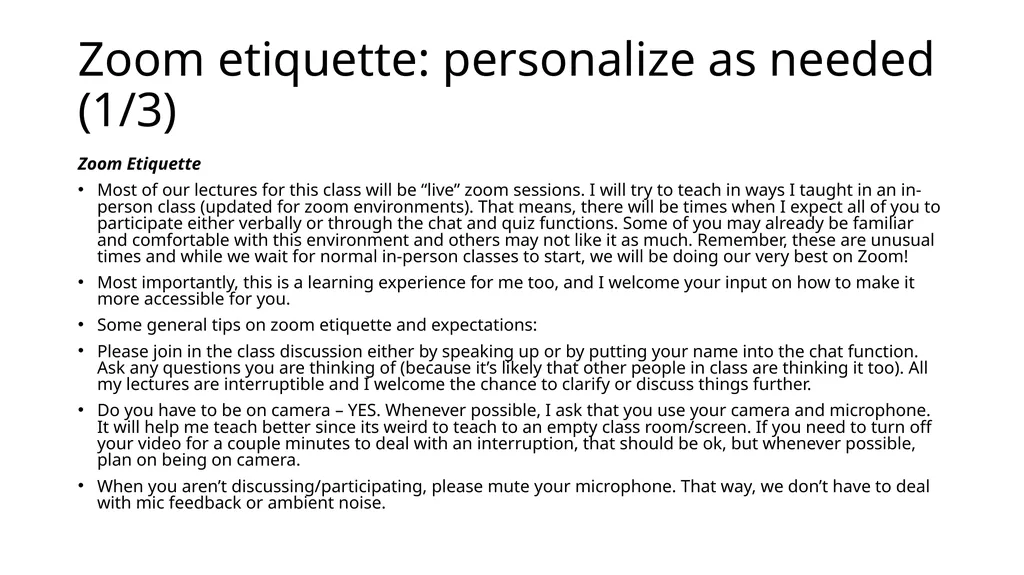
Zoom etiquette: personalize as needed (1/3) Zoom Etiquette
Most of our lectures for this class will be “live” zoom sessions. I will try to teach in ways I taught in an in-person class (updated for zoom environments). That means, there will be times when I expect all of you to participate either verbally or through the chat and quiz functions. Some of you may already be familiar and comfortable with this environment and others may not like it as much. Remember, these are unusual times and while we wait for normal in-person classes to start, we will be doing our very best on Zoom!
Most importantly, this is a learning experience for me too, and I welcome your input on how to make it more accessible for you.
Some general tips on zoom etiquette and expectations:
Please join in the class discussion either by speaking up or by putting your name into the chat function. Ask any questions you are thinking of (because it’s likely that other people in class are thinking it too). All my lectures are interruptible and I welcome the chance to clarify or discuss things further.
Do you have to be on camera – YES. Whenever possible, I ask that you use your camera and microphone. It will help me teach better since its weird to teach to an empty class room/screen. If you need to turn off your video for a couple minutes to deal with an interruption, that should be ok, but whenever possible, plan on being on camera.
When you aren’t discussing/participating, please mute your microphone. That way, we don’t have to deal with mic feedback or ambient noise.<br>
Most of our lectures for this class will be “live” zoom sessions. I will try to teach in ways I taught in an in-person class (updated for zoom environments). That means, there will be times when I expect all of you to participate either verbally or through the chat and quiz functions. Some of you may already be familiar and comfortable with this environment and others may not like it as much. Remember, these are unusual times and while we wait for normal in-person classes to start, we will be doing our very best on Zoom!
Most importantly, this is a learning experience for me too, and I welcome your input on how to make it more accessible for you.
Some general tips on zoom etiquette and expectations:
Please join in the class discussion either by speaking up or by putting your name into the chat function. Ask any questions you are thinking of (because it’s likely that other people in class are thinking it too). All my lectures are interruptible and I welcome the chance to clarify or discuss things further.
Do you have to be on camera – YES. Whenever possible, I ask that you use your camera and microphone. It will help me teach better since its weird to teach to an empty class room/screen. If you need to turn off your video for a couple minutes to deal with an interruption, that should be ok, but whenever possible, plan on being on camera.
When you aren’t discussing/participating, please mute your microphone. That way, we don’t have to deal with mic feedback or ambient noise.<br>
10
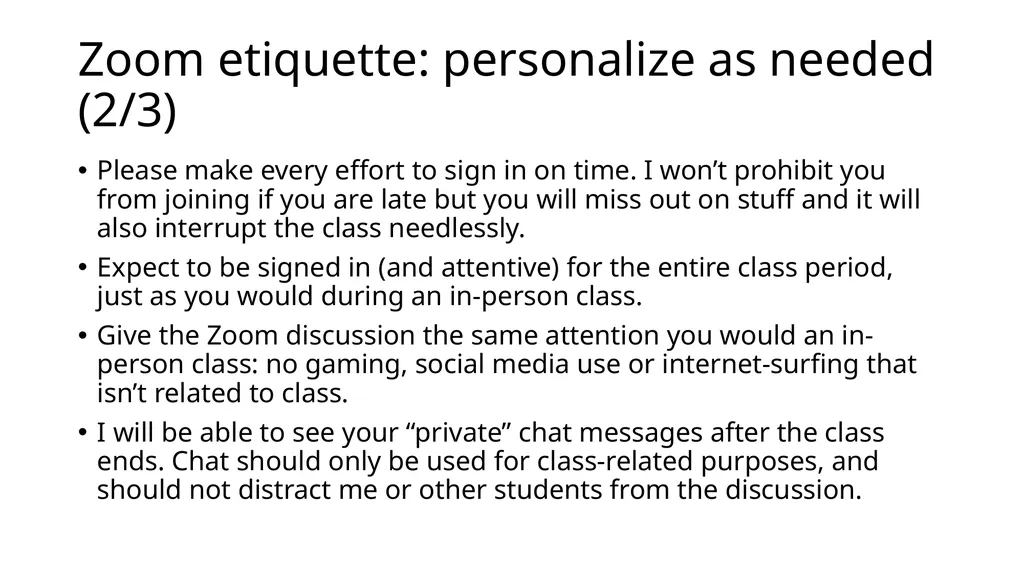
Zoom etiquette: personalize as needed (2/3) Please make every effort to sign in on time. I won’t prohibit you from joining if you are late but you will miss out on stuff and it will also interrupt the class needlessly.
Expect to be signed in (and attentive) for the entire class period, just as you would during an in-person class.
Give the Zoom discussion the same attention you would an in-person class: no gaming, social media use or internet-surfing that isn’t related to class.
I will be able to see your “private” chat messages after the class ends. Chat should only be used for class-related purposes, and should not distract me or other students from the discussion.<br>
Expect to be signed in (and attentive) for the entire class period, just as you would during an in-person class.
Give the Zoom discussion the same attention you would an in-person class: no gaming, social media use or internet-surfing that isn’t related to class.
I will be able to see your “private” chat messages after the class ends. Chat should only be used for class-related purposes, and should not distract me or other students from the discussion.<br>
11
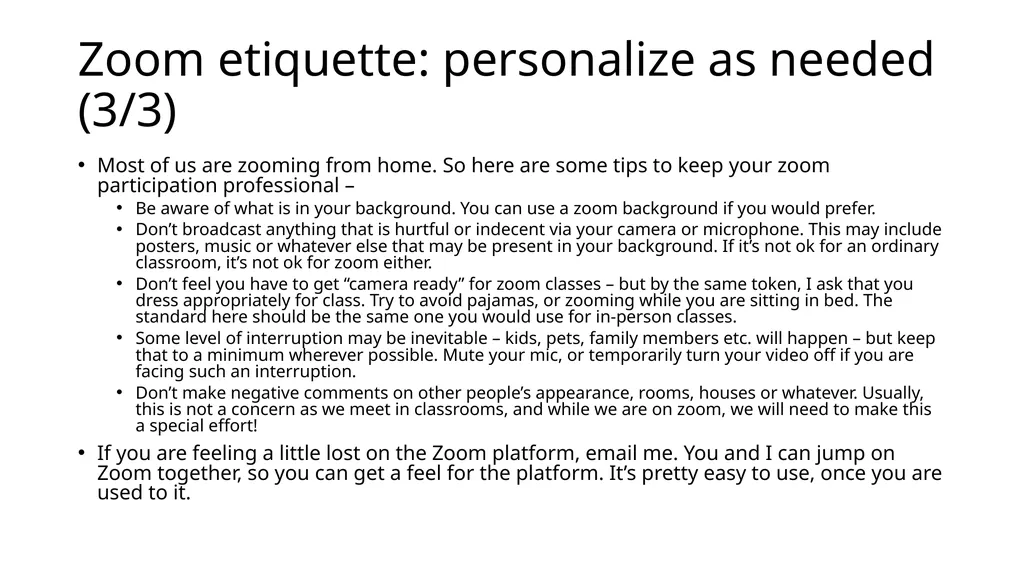
Zoom etiquette: personalize as needed (3/3) Most of us are zooming from home. So here are some tips to keep your zoom participation professional –
Be aware of what is in your background. You can use a zoom background if you would prefer.
Don’t broadcast anything that is hurtful or indecent via your camera or microphone. This may include posters, music or whatever else that may be present in your background. If it’s not ok for an ordinary classroom, it’s not ok for zoom either.
Don’t feel you have to get “camera ready” for zoom classes – but by the same token, I ask that you dress appropriately for class. Try to avoid pajamas, or zooming while you are sitting in bed. The standard here should be the same one you would use for in-person classes.
Some level of interruption may be inevitable – kids, pets, family members etc. will happen – but keep that to a minimum wherever possible. Mute your mic, or temporarily turn your video off if you are facing such an interruption.
Don’t make negative comments on other people’s appearance, rooms, houses or whatever. Usually, this is not a concern as we meet in classrooms, and while we are on zoom, we will need to make this a special effort!
If you are feeling a little lost on the Zoom platform, email me. You and I can jump on Zoom together, so you can get a feel for the platform. It’s pretty easy to use, once you are used to it.<br>
Be aware of what is in your background. You can use a zoom background if you would prefer.
Don’t broadcast anything that is hurtful or indecent via your camera or microphone. This may include posters, music or whatever else that may be present in your background. If it’s not ok for an ordinary classroom, it’s not ok for zoom either.
Don’t feel you have to get “camera ready” for zoom classes – but by the same token, I ask that you dress appropriately for class. Try to avoid pajamas, or zooming while you are sitting in bed. The standard here should be the same one you would use for in-person classes.
Some level of interruption may be inevitable – kids, pets, family members etc. will happen – but keep that to a minimum wherever possible. Mute your mic, or temporarily turn your video off if you are facing such an interruption.
Don’t make negative comments on other people’s appearance, rooms, houses or whatever. Usually, this is not a concern as we meet in classrooms, and while we are on zoom, we will need to make this a special effort!
If you are feeling a little lost on the Zoom platform, email me. You and I can jump on Zoom together, so you can get a feel for the platform. It’s pretty easy to use, once you are used to it.<br>
12
Professionalism in communication
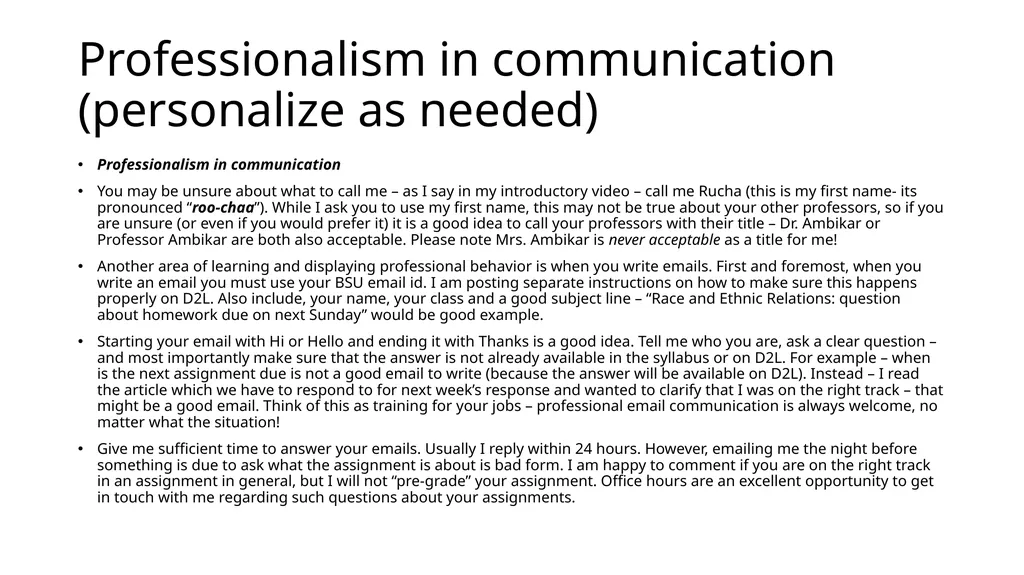
(personalize as needed) Professionalism in communication
You may be unsure about what to call me – as I say in my introductory video – call me Rucha (this is my first name- its pronounced “roo-chaa”). While I ask you to use my first name, this may not be true about your other professors, so if you are unsure (or even if you would prefer it) it is a good idea to call your professors with their title – Dr. Ambikar or Professor Ambikar are both also acceptable. Please note Mrs. Ambikar is never acceptable as a title for me!
Another area of learning and displaying professional behavior is when you write emails. First and foremost, when you write an email you must use your BSU email id. I am posting separate instructions on how to make sure this happens properly on D2L. Also include, your name, your class and a good subject line – “Race and Ethnic Relations: question about homework due on next Sunday” would be good example.
Starting your email with Hi or Hello and ending it with Thanks is a good idea. Tell me who you are, ask a clear question – and most importantly make sure that the answer is not already available in the syllabus or on D2L. For example – when is the next assignment due is not a good email to write (because the answer will be available on D2L). Instead – I read the article which we have to respond to for next week’s response and wanted to clarify that I was on the right track – that might be a good email. Think of this as training for your jobs – professional email communication is always welcome, no matter what the situation!
Give me sufficient time to answer your emails. Usually I reply within 24 hours. However, emailing me the night before something is due to ask what the assignment is about is bad form. I am happy to comment if you are on the right track in an assignment in general, but I will not “pre-grade” your assignment. Office hours are an excellent opportunity to get in touch with me regarding such questions about your assignments.<br>
You may be unsure about what to call me – as I say in my introductory video – call me Rucha (this is my first name- its pronounced “roo-chaa”). While I ask you to use my first name, this may not be true about your other professors, so if you are unsure (or even if you would prefer it) it is a good idea to call your professors with their title – Dr. Ambikar or Professor Ambikar are both also acceptable. Please note Mrs. Ambikar is never acceptable as a title for me!
Another area of learning and displaying professional behavior is when you write emails. First and foremost, when you write an email you must use your BSU email id. I am posting separate instructions on how to make sure this happens properly on D2L. Also include, your name, your class and a good subject line – “Race and Ethnic Relations: question about homework due on next Sunday” would be good example.
Starting your email with Hi or Hello and ending it with Thanks is a good idea. Tell me who you are, ask a clear question – and most importantly make sure that the answer is not already available in the syllabus or on D2L. For example – when is the next assignment due is not a good email to write (because the answer will be available on D2L). Instead – I read the article which we have to respond to for next week’s response and wanted to clarify that I was on the right track – that might be a good email. Think of this as training for your jobs – professional email communication is always welcome, no matter what the situation!
Give me sufficient time to answer your emails. Usually I reply within 24 hours. However, emailing me the night before something is due to ask what the assignment is about is bad form. I am happy to comment if you are on the right track in an assignment in general, but I will not “pre-grade” your assignment. Office hours are an excellent opportunity to get in touch with me regarding such questions about your assignments.<br>
13
BSU policy on disruptive behavior Disruptive Behavior in the Classroom - BSU official statement
We at Bemidji State University believe the classroom is an environment where civility, human dignity and respect is maintained. Any variation from this for example yelling or saying profanity at an instructor or another person in the classroom, or any other loud, lewd, belligerent or obnoxious behavior resulting in a disruption from teaching, and learning are violations of the Code of Conduct and will not be tolerated. If this occurs, you will be asked to leave the classroom not to return until you meet with the University Conduct Officer and you could be subject to a judicial hearing.<br>
We at Bemidji State University believe the classroom is an environment where civility, human dignity and respect is maintained. Any variation from this for example yelling or saying profanity at an instructor or another person in the classroom, or any other loud, lewd, belligerent or obnoxious behavior resulting in a disruption from teaching, and learning are violations of the Code of Conduct and will not be tolerated. If this occurs, you will be asked to leave the classroom not to return until you meet with the University Conduct Officer and you could be subject to a judicial hearing.<br>
14
Example of disruptive behavior Classroom civility and BSU’s Code of Conduct:
Because disrespectful behaviors have become an issue, the following policy has been established:
Students who display rude or disrespectful behaviors will be given a verbal warning.
Written documentation via email and cc’d to the Dean of Students may follow dependent on severity.
If the behavior continues, students will be asked to leave the class.
Written documentation in the form of a letter to the Dean of Students will follow. The student must meet with the Dean of Students before he/she can return to class.
Examples of problematic behaviors:
Disrespectful annoyances and minor disruptions—Arriving late and leaving early, looking at cell phone, working on material from another class, side conversations, sleeping in class, packing up noisily before end of class.
Dominating discussion—Not letting others answer questions or participate in class.
Aggressive challenges of professor<br>
Because disrespectful behaviors have become an issue, the following policy has been established:
Students who display rude or disrespectful behaviors will be given a verbal warning.
Written documentation via email and cc’d to the Dean of Students may follow dependent on severity.
If the behavior continues, students will be asked to leave the class.
Written documentation in the form of a letter to the Dean of Students will follow. The student must meet with the Dean of Students before he/she can return to class.
Examples of problematic behaviors:
Disrespectful annoyances and minor disruptions—Arriving late and leaving early, looking at cell phone, working on material from another class, side conversations, sleeping in class, packing up noisily before end of class.
Dominating discussion—Not letting others answer questions or participate in class.
Aggressive challenges of professor<br>
15
Extended leave procedure If student has to be away from class from an extended period of time (more than two class sessions) for medical emergencies or a funeral, you are asked to contact the Student Life and Success Office where a leave notice will be given to your faculty. This notice informs the faculty of your departure and return date back to campus. This leave does not absolve you from any assignment you have due during your leave. You are to make arrangements with your instructors of when to complete any assignments due during the leave period. You can complete a leave form as this website https://www.bemidjistate.edu/offices/student-life-success/extended-absence<br>
16
Mental Health and Counseling Students may experience mental health concerns or stressful events that may lead to diminished academic performance. This is particularly true during the current pandemic. The Student Center for Health & Counseling is available to assist you with concerns and can include stress relief services. They can be reached in Cedar Hall, First Floor. Phone: (218) 755-2053.
Please note that mental health and counseling services are available free of charge (or at very low cost) at BSU, regardless of your health insurance situation.
I encourage you to reach out to our excellent counseling team. These conversations are kept confidential and your medical information is not available to your teachers, peers etc.<br>
Please note that mental health and counseling services are available free of charge (or at very low cost) at BSU, regardless of your health insurance situation.
I encourage you to reach out to our excellent counseling team. These conversations are kept confidential and your medical information is not available to your teachers, peers etc.<br>
17
Children in the classroom policy Children – Taking care of young children should not keep you from participating in class. If you are a parent/guardian of young children, those children are welcome when you cannot find or afford child care. I only require that (a) they do not disrupt class and (b) you are able to care for them while still participating in class. I may ask you to step outside to care for a child who is becoming noisy, or to sit near the door so you can easily do so. (Let me know if you can’t get a convenient seat.) Otherwise, your children are welcome in my classroom. If they need food, toys or breastfeeding, that is also acceptable.
Please be aware that I prepare and deliver my lectures for an adult audience. I will not change the topics I discuss or the language I use, if children are in the room. Your fellow students are not required to do so, either. If you have questions about the material we will be covering on a given day, feel free to ask.<br>
Please be aware that I prepare and deliver my lectures for an adult audience. I will not change the topics I discuss or the language I use, if children are in the room. Your fellow students are not required to do so, either. If you have questions about the material we will be covering on a given day, feel free to ask.<br>
18
Links to useful forms and resources at BSU Consider including these in your syllabus to let students know what resources are available at BSU<br>
19
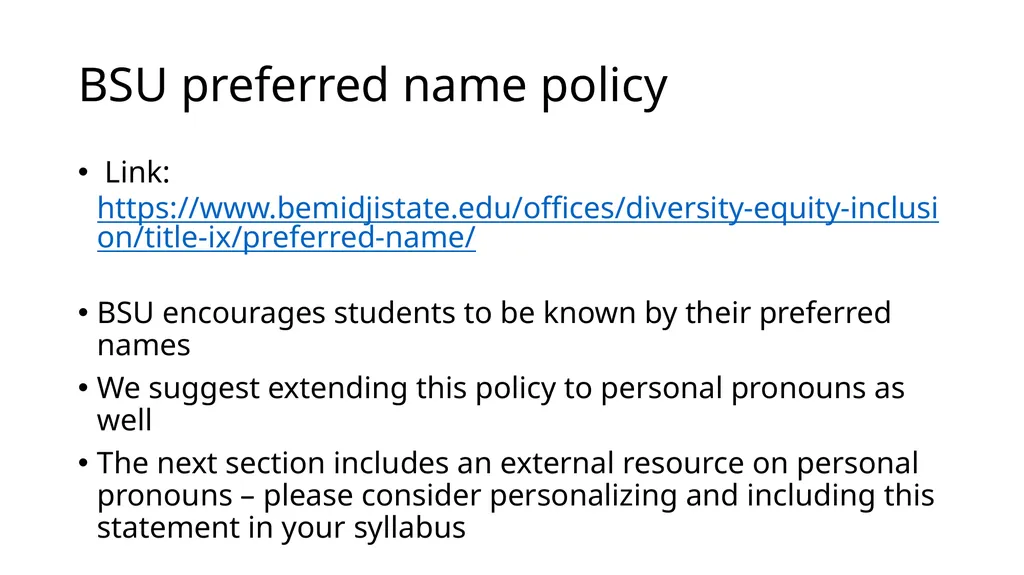
BSU preferred name policy Link: https://www.bemidjistate.edu/offices/diversity-equity-inclusion/title-ix/preferred-name/
BSU encourages students to be known by their preferred names
We suggest extending this policy to personal pronouns as well
The next section includes an external resource on personal pronouns – please consider personalizing and including this statement in your syllabus<br>
BSU encourages students to be known by their preferred names
We suggest extending this policy to personal pronouns as well
The next section includes an external resource on personal pronouns – please consider personalizing and including this statement in your syllabus<br>
20
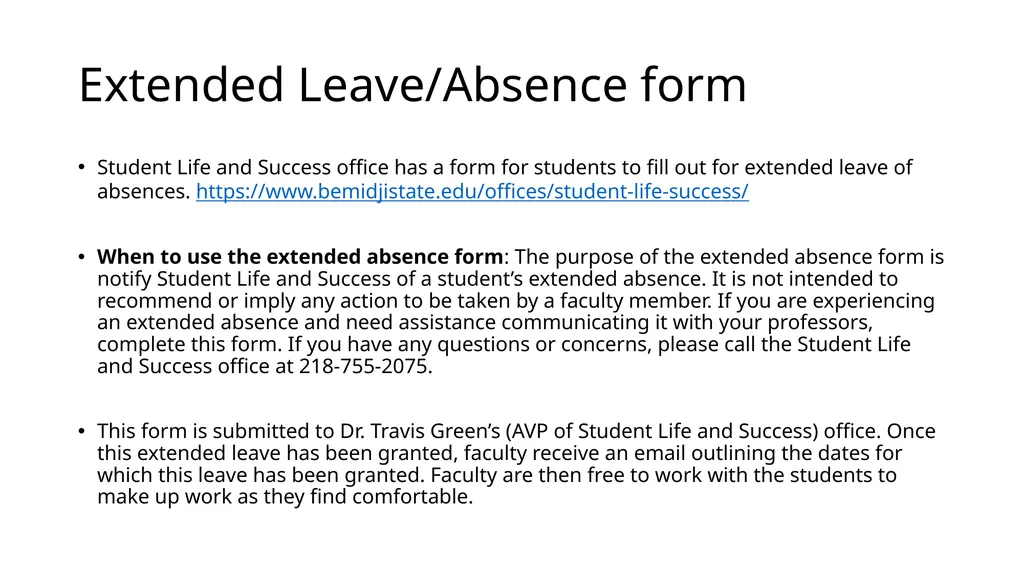
Extended Leave/Absence form Student Life and Success office has a form for students to fill out for extended leave of absences. https://www.bemidjistate.edu/offices/student-life-success/
When to use the extended absence form: The purpose of the extended absence form is notify Student Life and Success of a student’s extended absence. It is not intended to recommend or imply any action to be taken by a faculty member. If you are experiencing an extended absence and need assistance communicating it with your professors, complete this form. If you have any questions or concerns, please call the Student Life and Success office at 218-755-2075.
This form is submitted to Dr. Travis Green’s (AVP of Student Life and Success) office. Once this extended leave has been granted, faculty receive an email outlining the dates for which this leave has been granted. Faculty are then free to work with the students to make up work as they find comfortable.<br>
When to use the extended absence form: The purpose of the extended absence form is notify Student Life and Success of a student’s extended absence. It is not intended to recommend or imply any action to be taken by a faculty member. If you are experiencing an extended absence and need assistance communicating it with your professors, complete this form. If you have any questions or concerns, please call the Student Life and Success office at 218-755-2075.
This form is submitted to Dr. Travis Green’s (AVP of Student Life and Success) office. Once this extended leave has been granted, faculty receive an email outlining the dates for which this leave has been granted. Faculty are then free to work with the students to make up work as they find comfortable.<br>
21
Available health resources at BSU How to make an appointment at the BSU Student Health Service
https://bemidjistate.campuswell.com/1220-how-to-make-an-appointment-at-the-bsu-student-center-for-health/<br>
https://bemidjistate.campuswell.com/1220-how-to-make-an-appointment-at-the-bsu-student-center-for-health/<br>
22
External resources You may find some of these resources useful<br>
23
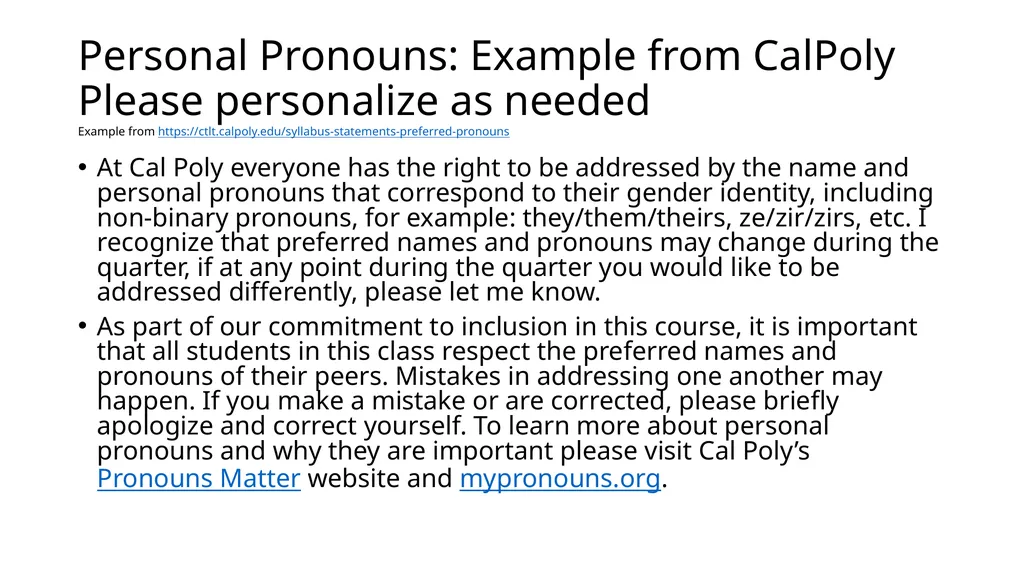
Personal Pronouns: Example from CalPoly
Please personalize as needed
Example from https://ctlt.calpoly.edu/syllabus-statements-preferred-pronouns At Cal Poly everyone has the right to be addressed by the name and personal pronouns that correspond to their gender identity, including non-binary pronouns, for example: they/them/theirs, ze/zir/zirs, etc. I recognize that preferred names and pronouns may change during the quarter, if at any point during the quarter you would like to be addressed differently, please let me know.
As part of our commitment to inclusion in this course, it is important that all students in this class respect the preferred names and pronouns of their peers. Mistakes in addressing one another may happen. If you make a mistake or are corrected, please briefly apologize and correct yourself. To learn more about personal pronouns and why they are important please visit Cal Poly’s Pronouns Matter website and mypronouns.org.<br>
As part of our commitment to inclusion in this course, it is important that all students in this class respect the preferred names and pronouns of their peers. Mistakes in addressing one another may happen. If you make a mistake or are corrected, please briefly apologize and correct yourself. To learn more about personal pronouns and why they are important please visit Cal Poly’s Pronouns Matter website and mypronouns.org.<br>
24
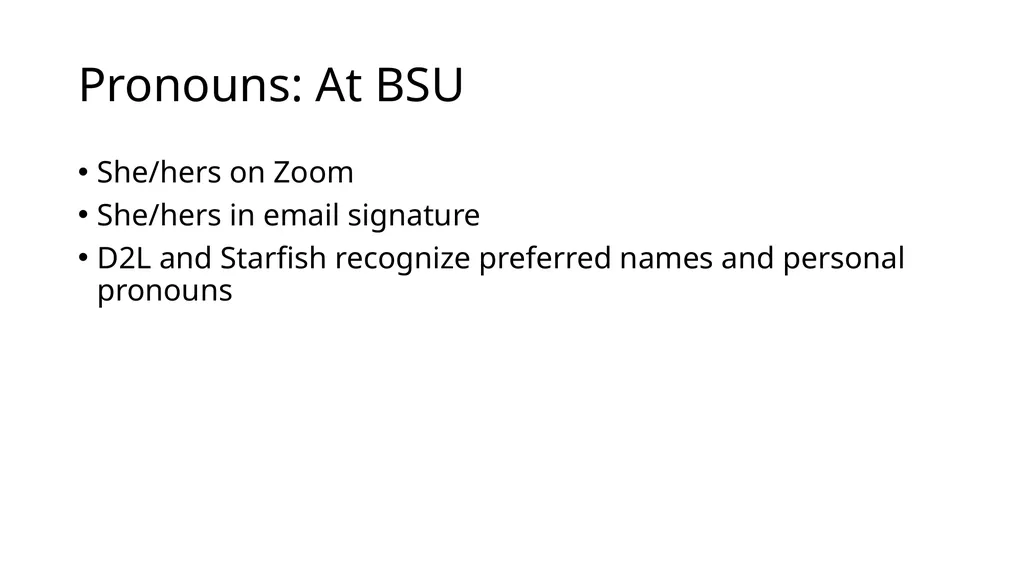
Pronouns: At BSU She/hers on Zoom
She/hers in email signature
D2L and Starfish recognize preferred names and personal pronouns<br>
She/hers in email signature
D2L and Starfish recognize preferred names and personal pronouns<br>
25
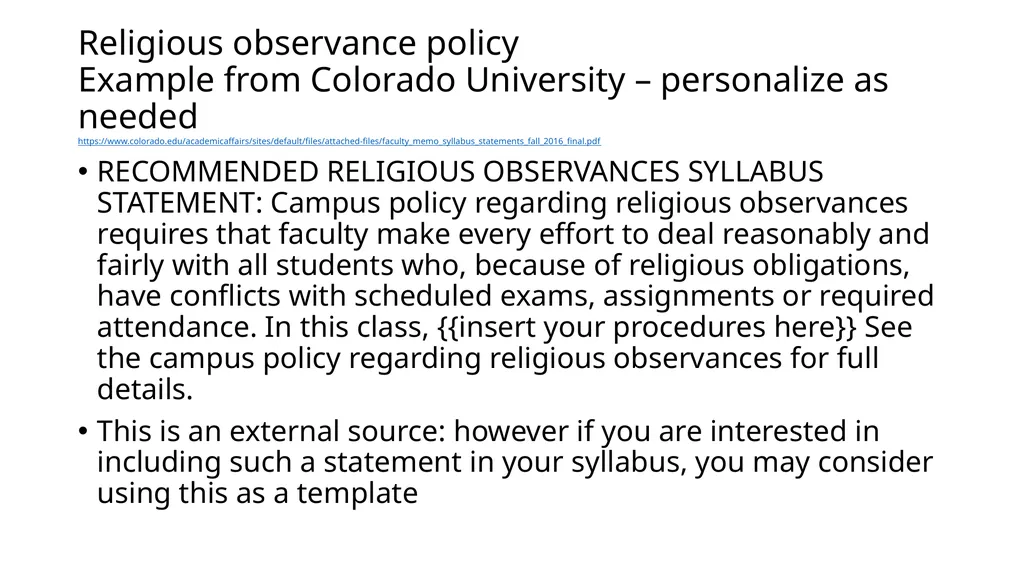
Religious observance policy
Example from Colorado University – personalize as needed
https://www.colorado.edu/academicaffairs/sites/default/files/attached-files/faculty_memo_syllabus_statements_fall_2016_final.pdf RECOMMENDED RELIGIOUS OBSERVANCES SYLLABUS STATEMENT: Campus policy regarding religious observances requires that faculty make every effort to deal reasonably and fairly with all students who, because of religious obligations, have conflicts with scheduled exams, assignments or required attendance. In this class, {{insert your procedures here}} See the campus policy regarding religious observances for full details.
This is an external source: however if you are interested in including such a statement in your syllabus, you may consider using this as a template<br>
This is an external source: however if you are interested in including such a statement in your syllabus, you may consider using this as a template<br>
26
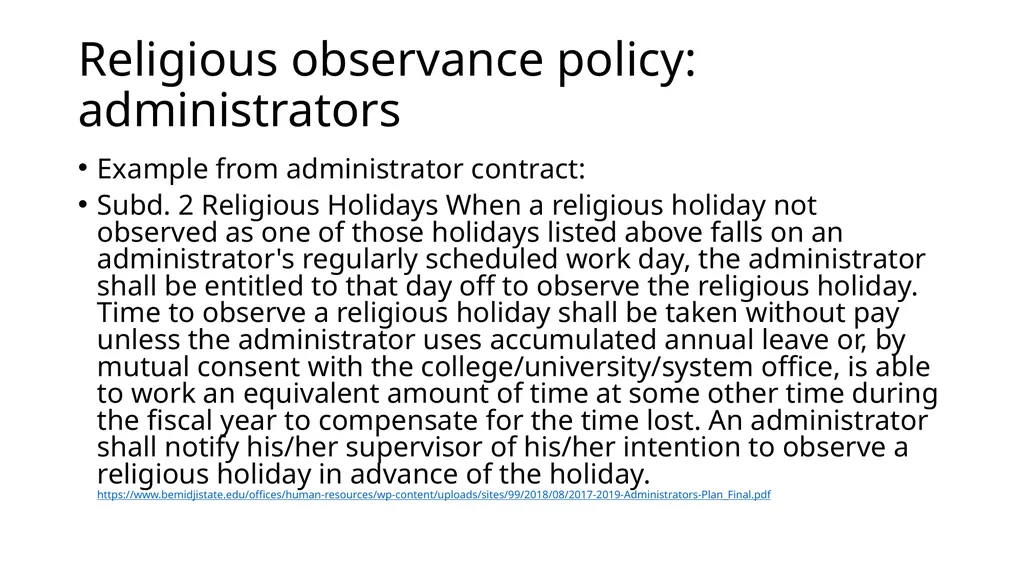
Religious observance policy: administrators Example from administrator contract:
Subd. 2 Religious Holidays When a religious holiday not observed as one of those holidays listed above falls on an administrator's regularly scheduled work day, the administrator shall be entitled to that day off to observe the religious holiday. Time to observe a religious holiday shall be taken without pay unless the administrator uses accumulated annual leave or, by mutual consent with the college/university/system office, is able to work an equivalent amount of time at some other time during the fiscal year to compensate for the time lost. An administrator shall notify his/her supervisor of his/her intention to observe a religious holiday in advance of the holiday. https://www.bemidjistate.edu/offices/human-resources/wp-content/uploads/sites/99/2018/08/2017-2019-Administrators-Plan_Final.pdf<br>
Subd. 2 Religious Holidays When a religious holiday not observed as one of those holidays listed above falls on an administrator's regularly scheduled work day, the administrator shall be entitled to that day off to observe the religious holiday. Time to observe a religious holiday shall be taken without pay unless the administrator uses accumulated annual leave or, by mutual consent with the college/university/system office, is able to work an equivalent amount of time at some other time during the fiscal year to compensate for the time lost. An administrator shall notify his/her supervisor of his/her intention to observe a religious holiday in advance of the holiday. https://www.bemidjistate.edu/offices/human-resources/wp-content/uploads/sites/99/2018/08/2017-2019-Administrators-Plan_Final.pdf<br>
27
External resource on religious observances University of Missouri list of cultural and religious events/observances:
https://diversity.missouri.edu/guide-to-religions/dates-practices-accomodations/<br>
https://diversity.missouri.edu/guide-to-religions/dates-practices-accomodations/<br>
28
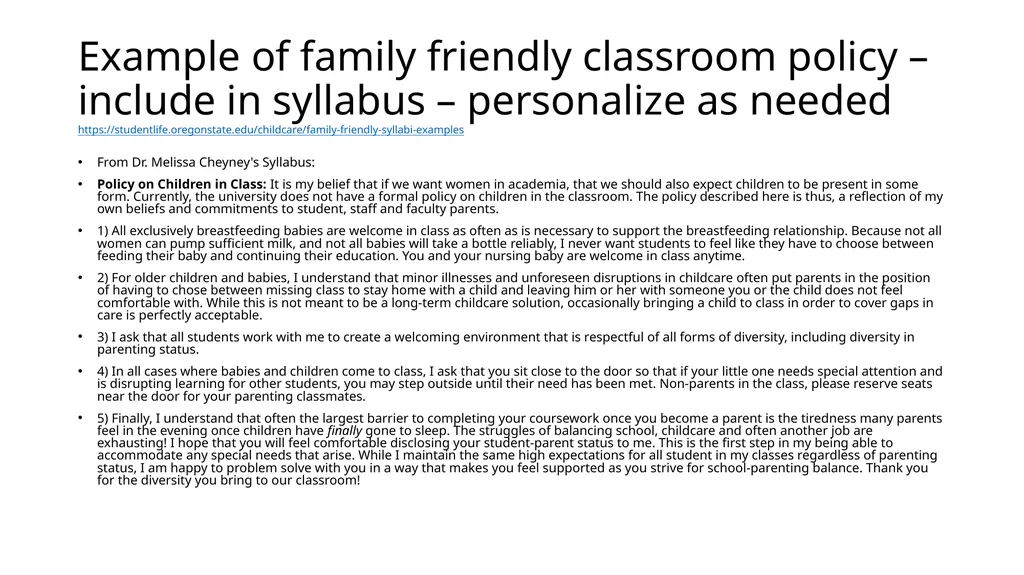
Example of family friendly classroom policy – include in syllabus – personalize as needed
https://studentlife.oregonstate.edu/childcare/family-friendly-syllabi-examples From Dr. Melissa Cheyney's Syllabus:
Policy on Children in Class: It is my belief that if we want women in academia, that we should also expect children to be present in some form. Currently, the university does not have a formal policy on children in the classroom. The policy described here is thus, a reflection of my own beliefs and commitments to student, staff and faculty parents.
1) All exclusively breastfeeding babies are welcome in class as often as is necessary to support the breastfeeding relationship. Because not all women can pump sufficient milk, and not all babies will take a bottle reliably, I never want students to feel like they have to choose between feeding their baby and continuing their education. You and your nursing baby are welcome in class anytime.
2) For older children and babies, I understand that minor illnesses and unforeseen disruptions in childcare often put parents in the position of having to chose between missing class to stay home with a child and leaving him or her with someone you or the child does not feel comfortable with. While this is not meant to be a long-term childcare solution, occasionally bringing a child to class in order to cover gaps in care is perfectly acceptable.
3) I ask that all students work with me to create a welcoming environment that is respectful of all forms of diversity, including diversity in parenting status.
4) In all cases where babies and children come to class, I ask that you sit close to the door so that if your little one needs special attention and is disrupting learning for other students, you may step outside until their need has been met. Non-parents in the class, please reserve seats near the door for your parenting classmates.
5) Finally, I understand that often the largest barrier to completing your coursework once you become a parent is the tiredness many parents feel in the evening once children have finally gone to sleep. The struggles of balancing school, childcare and often another job are exhausting! I hope that you will feel comfortable disclosing your student-parent status to me. This is the first step in my being able to accommodate any special needs that arise. While I maintain the same high expectations for all student in my classes regardless of parenting status, I am happy to problem solve with you in a way that makes you feel supported as you strive for school-parenting balance. Thank you for the diversity you bring to our classroom!<br>
Policy on Children in Class: It is my belief that if we want women in academia, that we should also expect children to be present in some form. Currently, the university does not have a formal policy on children in the classroom. The policy described here is thus, a reflection of my own beliefs and commitments to student, staff and faculty parents.
1) All exclusively breastfeeding babies are welcome in class as often as is necessary to support the breastfeeding relationship. Because not all women can pump sufficient milk, and not all babies will take a bottle reliably, I never want students to feel like they have to choose between feeding their baby and continuing their education. You and your nursing baby are welcome in class anytime.
2) For older children and babies, I understand that minor illnesses and unforeseen disruptions in childcare often put parents in the position of having to chose between missing class to stay home with a child and leaving him or her with someone you or the child does not feel comfortable with. While this is not meant to be a long-term childcare solution, occasionally bringing a child to class in order to cover gaps in care is perfectly acceptable.
3) I ask that all students work with me to create a welcoming environment that is respectful of all forms of diversity, including diversity in parenting status.
4) In all cases where babies and children come to class, I ask that you sit close to the door so that if your little one needs special attention and is disrupting learning for other students, you may step outside until their need has been met. Non-parents in the class, please reserve seats near the door for your parenting classmates.
5) Finally, I understand that often the largest barrier to completing your coursework once you become a parent is the tiredness many parents feel in the evening once children have finally gone to sleep. The struggles of balancing school, childcare and often another job are exhausting! I hope that you will feel comfortable disclosing your student-parent status to me. This is the first step in my being able to accommodate any special needs that arise. While I maintain the same high expectations for all student in my classes regardless of parenting status, I am happy to problem solve with you in a way that makes you feel supported as you strive for school-parenting balance. Thank you for the diversity you bring to our classroom!<br>