
Symbols to support learning Listen Class
CS
Published · 34 slides · 0 views
1 / 1
Description
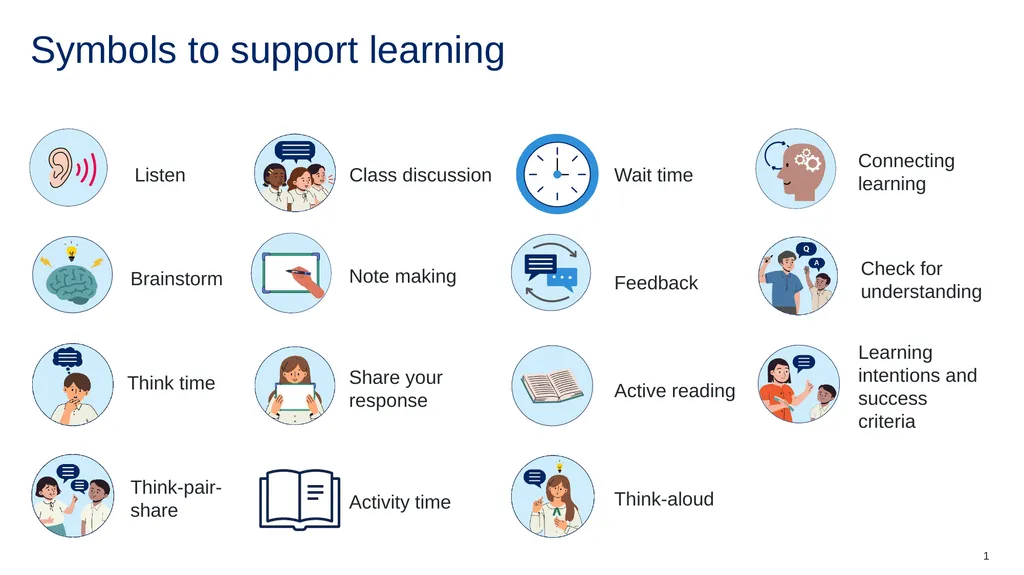
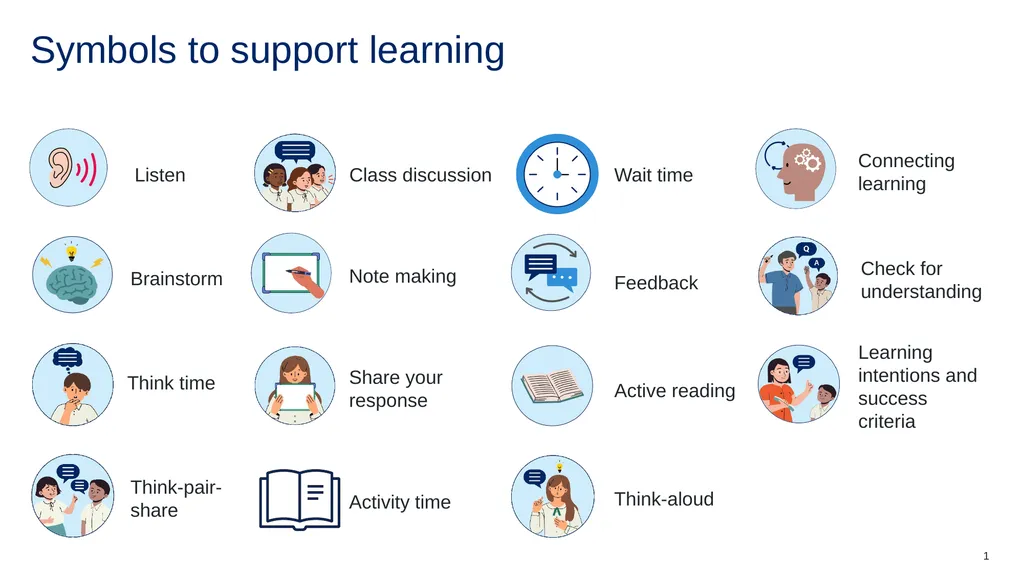
Symbols to support learning Listen Class discussion Wait time Connecting learning Brainstorm Note making Feedback Check for understanding Think time Share your response Active reading Learning intentions and success criteria
Related Topics
Share
Embed code
Download this presentation From Below
"Symbols to support learning Listen Class" is the property of its rightful owner. Permission is granted to download and print the materials on this website for personal, non-commercial use only, and to display it on your personal computer provided you do not modify the materials and that you retain all copyright notices contained in the materials. By downloading content from our website, you accept the terms of this agreement.
Presentation Transcript
01
Symbols to support learning Listen Class discussion Wait time Connecting learning Brainstorm Note making Feedback Check for understanding Think time Share your response Active reading Learning intentions and success criteria Think-pair-share Activity time Think-aloud 1<br>
02
Instructions for use This resource is not a teaching and learning program. It should be used in conjunction with 12.1 ‒ ‘Introduction to Literary worlds’ program, available on the English Extension page of Planning, programming and assessing English 11–12.
Classroom teachers are encouraged to add and adapt slides as required to meet the needs of their students.
Save a copy of the file to make changes to the slide deck. Go to File > Download a Copy (this downloads a copy to the computer to edit in the PowerPoint app).
To convert the PowerPoint to Google Slides:
Upload the file into Google Drive and open it
Go to File > Save as Google Slides.
(Note – conversion may cause formatting changes in the slides.) 2<br>
Classroom teachers are encouraged to add and adapt slides as required to meet the needs of their students.
Save a copy of the file to make changes to the slide deck. Go to File > Download a Copy (this downloads a copy to the computer to edit in the PowerPoint app).
To convert the PowerPoint to Google Slides:
Upload the file into Google Drive and open it
Go to File > Save as Google Slides.
(Note – conversion may cause formatting changes in the slides.) 2<br>
03
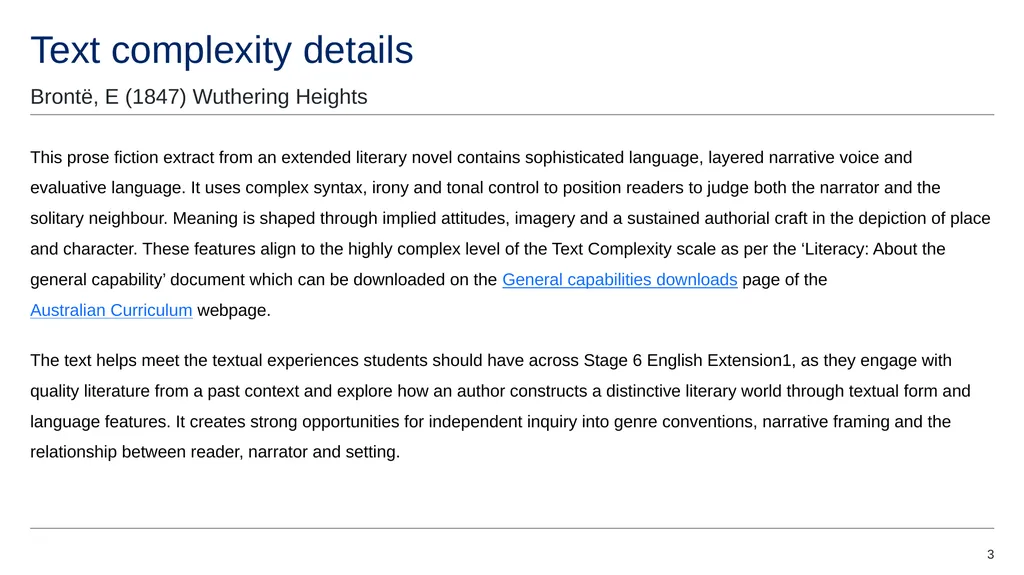
Text complexity details This prose fiction extract from an extended literary novel contains sophisticated language, layered narrative voice and evaluative language. It uses complex syntax, irony and tonal control to position readers to judge both the narrator and the solitary neighbour. Meaning is shaped through implied attitudes, imagery and a sustained authorial craft in the depiction of place and character. These features align to the highly complex level of the Text Complexity scale as per the ‘Literacy: About the general capability’ document which can be downloaded on the General capabilities downloads page of the Australian Curriculum webpage.
The text helps meet the textual experiences students should have across Stage 6 English Extension1, as they engage with quality literature from a past context and explore how an author constructs a distinctive literary world through textual form and language features. It creates strong opportunities for independent inquiry into genre conventions, narrative framing and the relationship between reader, narrator and setting. Brontë, E (1847) Wuthering Heights 3<br>
The text helps meet the textual experiences students should have across Stage 6 English Extension1, as they engage with quality literature from a past context and explore how an author constructs a distinctive literary world through textual form and language features. It creates strong opportunities for independent inquiry into genre conventions, narrative framing and the relationship between reader, narrator and setting. Brontë, E (1847) Wuthering Heights 3<br>
04
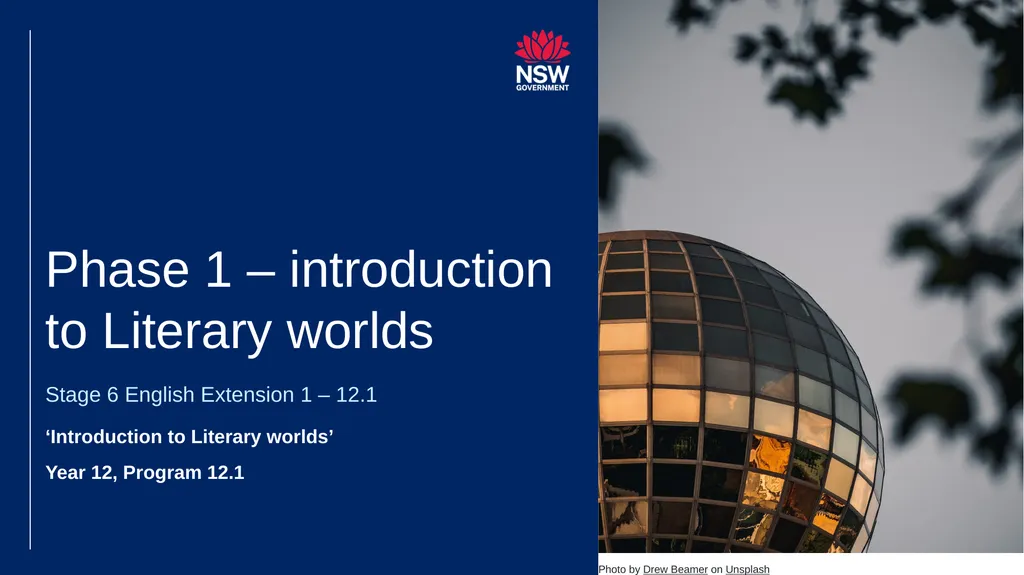
Phase 1 – introduction to Literary worlds Stage 6 English Extension 1 – 12.1 ‘Introduction to Literary worlds’ Year 12, Program 12.1 Photo by Drew Beamer on Unsplash<br>
05
Sharing learning intentions and success criteria 5<br>
06
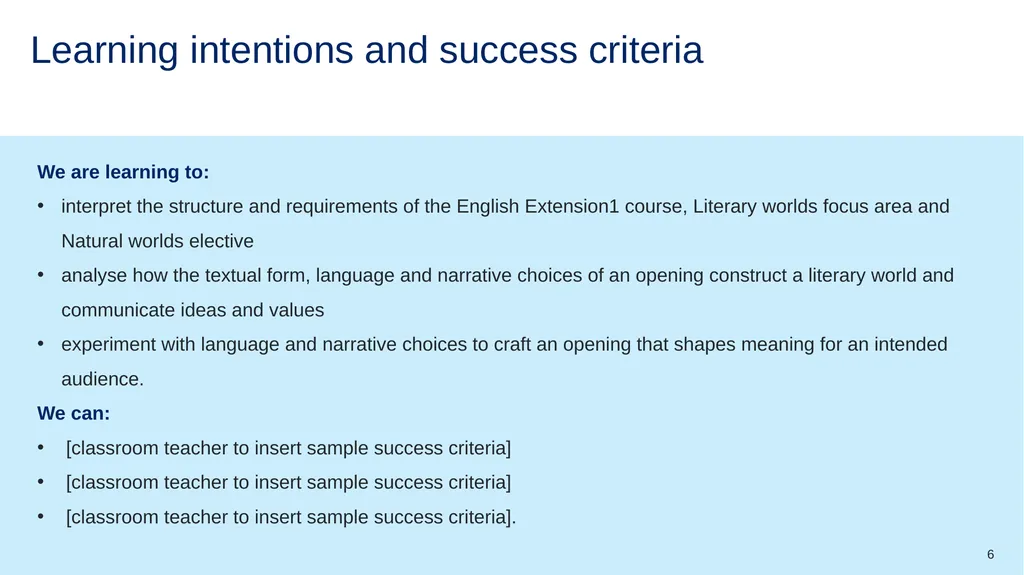
Learning intentions and success criteria We are learning to:
interpret the structure and requirements of the English Extension1 course, Literary worlds focus area and Natural worlds elective
analyse how the textual form, language and narrative choices of an opening construct a literary world and communicate ideas and values
experiment with language and narrative choices to craft an opening that shapes meaning for an intended audience.
We can:
[classroom teacher to insert sample success criteria]
[classroom teacher to insert sample success criteria]
[classroom teacher to insert sample success criteria]. 6<br>
interpret the structure and requirements of the English Extension1 course, Literary worlds focus area and Natural worlds elective
analyse how the textual form, language and narrative choices of an opening construct a literary world and communicate ideas and values
experiment with language and narrative choices to craft an opening that shapes meaning for an intended audience.
We can:
[classroom teacher to insert sample success criteria]
[classroom teacher to insert sample success criteria]
[classroom teacher to insert sample success criteria]. 6<br>
07
Phase 1, sequence 2 – understanding the English Extension 1 course and its requirements Section 1 Taking notes with a pencil by Thought Catalog on Unsplash<br>
08
Gradual release of responsibility 8<br>
09
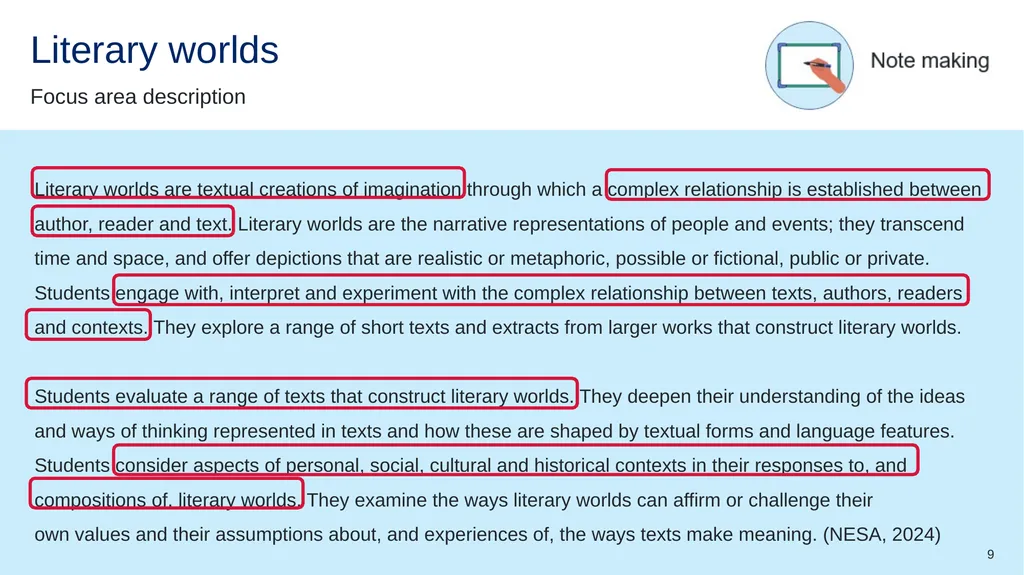
Literary worlds Focus area description Literary worlds are textual creations of imagination through which a complex relationship is established between author, reader and text. Literary worlds are the narrative representations of people and events; they transcend time and space, and offer depictions that are realistic or metaphoric, possible or fictional, public or private. Students engage with, interpret and experiment with the complex relationship between texts, authors, readers and contexts. They explore a range of short texts and extracts from larger works that construct literary worlds.
Students evaluate a range of texts that construct literary worlds. They deepen their understanding of the ideas and ways of thinking represented in texts and how these are shaped by textual forms and language features. Students consider aspects of personal, social, cultural and historical contexts in their responses to, and compositions of, literary worlds. They examine the ways literary worlds can affirm or challenge their own values and their assumptions about, and experiences of, the ways texts make meaning. (NESA, 2024) 9<br>
Students evaluate a range of texts that construct literary worlds. They deepen their understanding of the ideas and ways of thinking represented in texts and how these are shaped by textual forms and language features. Students consider aspects of personal, social, cultural and historical contexts in their responses to, and compositions of, literary worlds. They examine the ways literary worlds can affirm or challenge their own values and their assumptions about, and experiences of, the ways texts make meaning. (NESA, 2024) 9<br>
10
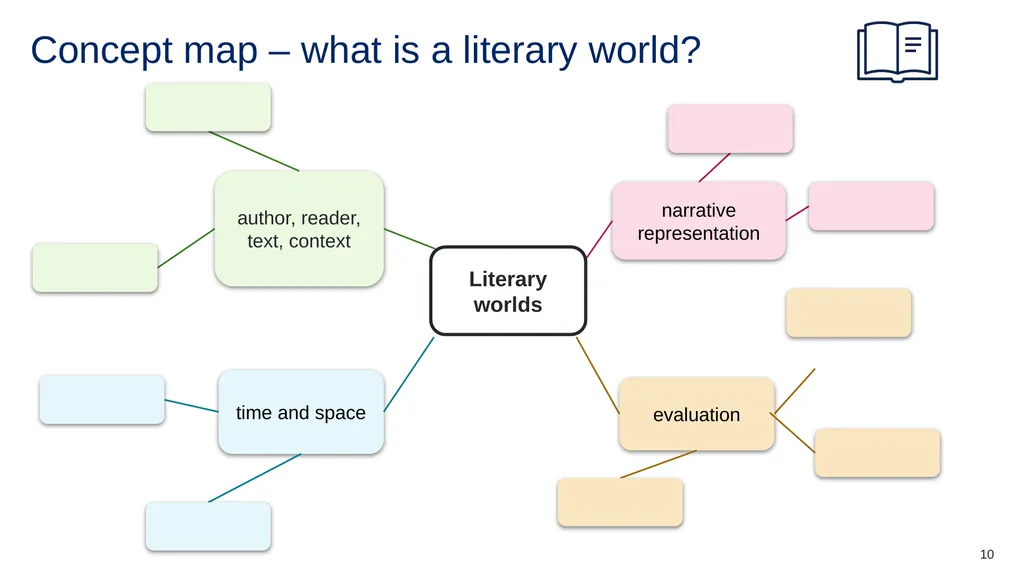
Concept map – what is a literary world? Literary worlds author, reader, text, context narrative representation time and space evaluation 10<br>
11
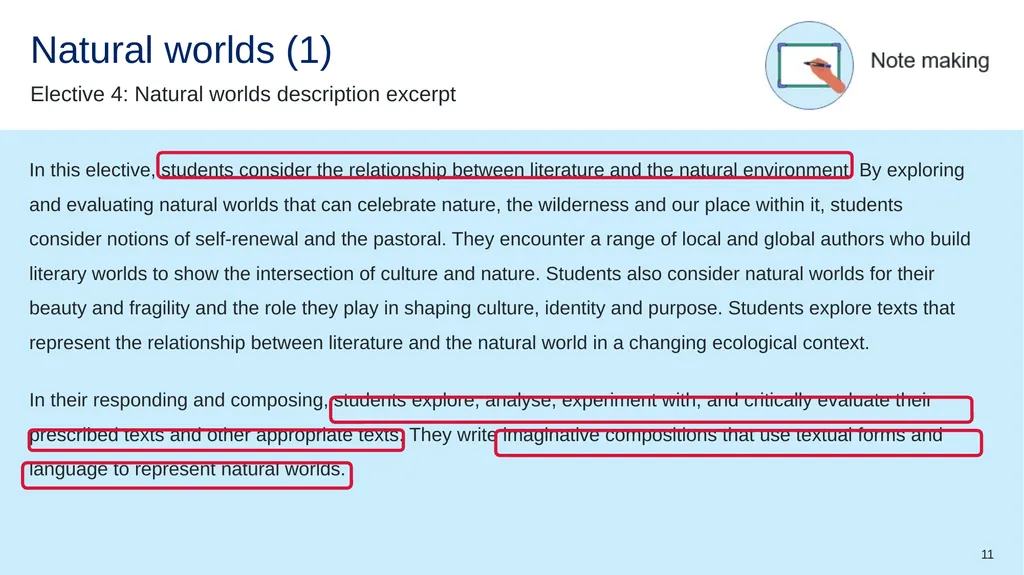
Natural worlds (1) Elective 4: Natural worlds description excerpt In this elective, students consider the relationship between literature and the natural environment. By exploring and evaluating natural worlds that can celebrate nature, the wilderness and our place within it, students consider notions of self-renewal and the pastoral. They encounter a range of local and global authors who build literary worlds to show the intersection of culture and nature. Students also consider natural worlds for their beauty and fragility and the role they play in shaping culture, identity and purpose. Students explore texts that represent the relationship between literature and the natural world in a changing ecological context.
In their responding and composing, students explore, analyse, experiment with, and critically evaluate their prescribed texts and other appropriate texts. They write imaginative compositions that use textual forms and language to represent natural worlds. 11<br>
In their responding and composing, students explore, analyse, experiment with, and critically evaluate their prescribed texts and other appropriate texts. They write imaginative compositions that use textual forms and language to represent natural worlds. 11<br>
12
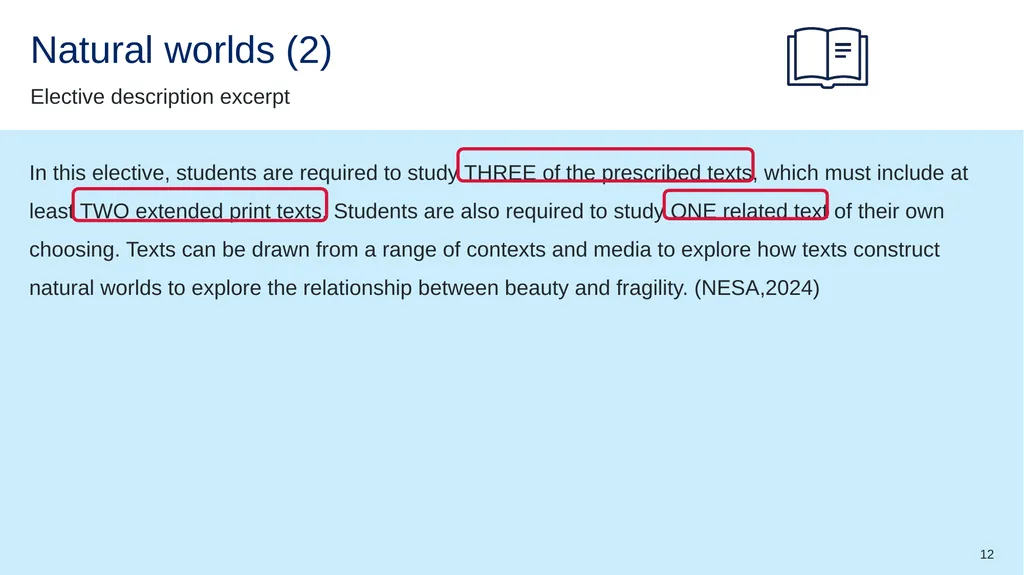
Natural worlds (2) Elective description excerpt In this elective, students are required to study THREE of the prescribed texts, which must include at least TWO extended print texts. Students are also required to study ONE related text of their own choosing. Texts can be drawn from a range of contexts and media to explore how texts construct natural worlds to explore the relationship between beauty and fragility. (NESA,2024) 12<br>
13
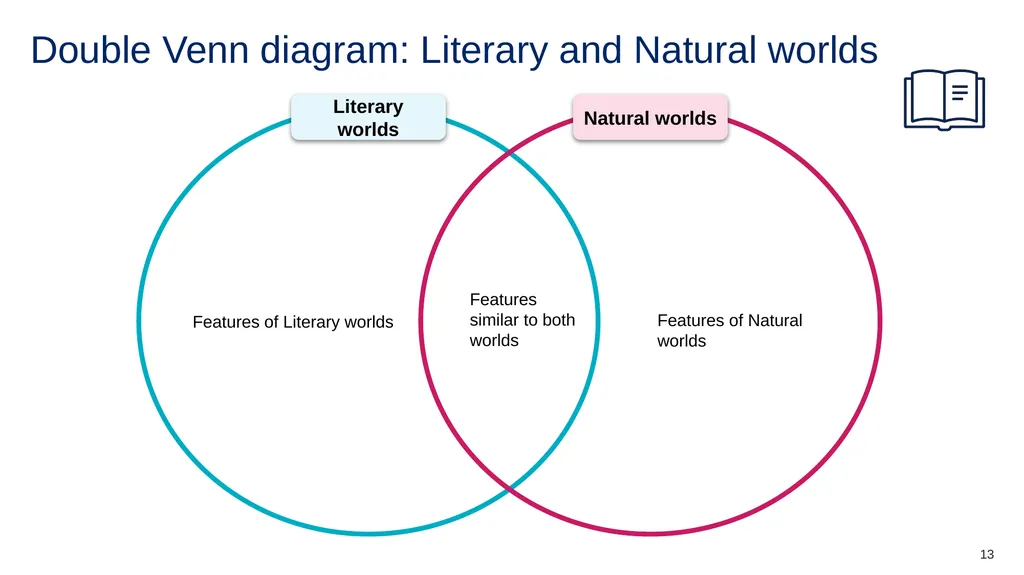
Double Venn diagram: Literary and Natural worlds Features similar to both worlds Features of Literary worlds Features of Natural worlds 13<br>
14
Phase 1, sequence 3 – exploring literary worlds in excerpts from quality literature Section 2 Taking notes with a pencil by Thought Catalog on Unsplash<br>
15
Chunking and sequencing learning 15<br>
16
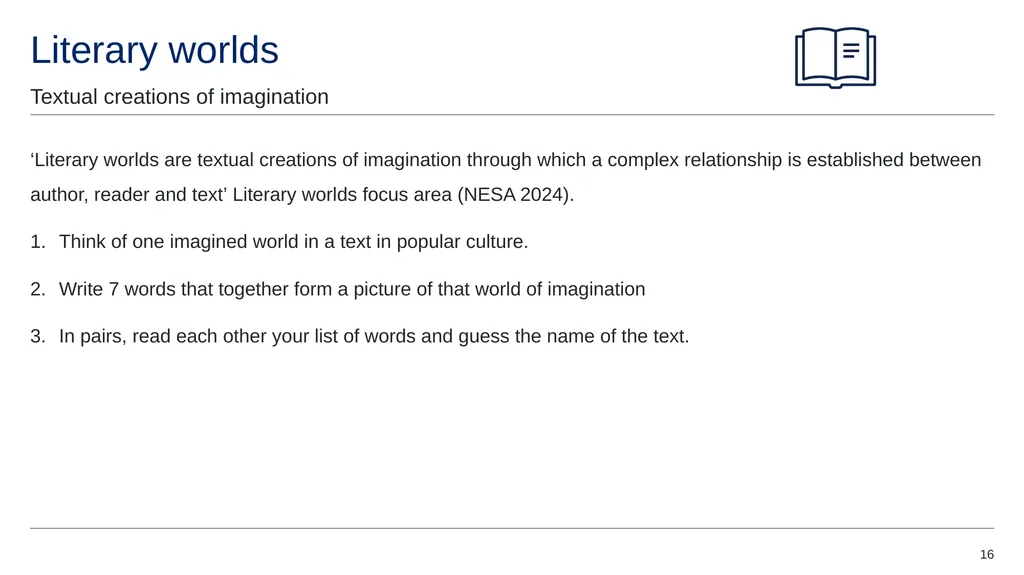
Literary worlds Textual creations of imagination ‘Literary worlds are textual creations of imagination through which a complex relationship is established between author, reader and text’ Literary worlds focus area (NESA 2024).
Think of one imagined world in a text in popular culture.
Write 7 words that together form a picture of that world of imagination
In pairs, read each other your list of words and guess the name of the text. 16<br>
Think of one imagined world in a text in popular culture.
Write 7 words that together form a picture of that world of imagination
In pairs, read each other your list of words and guess the name of the text. 16<br>
17
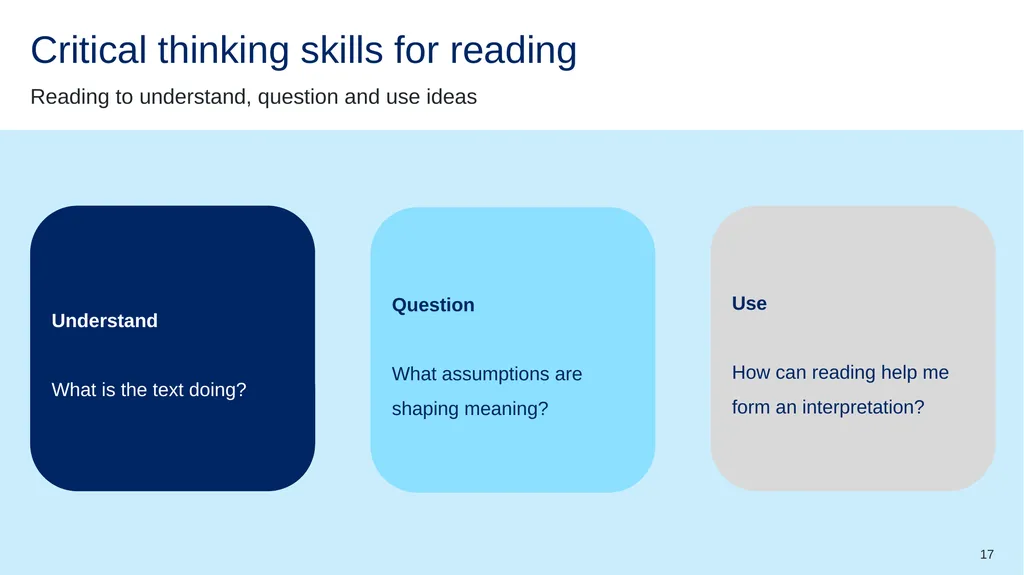
Critical thinking skills for reading Reading to understand, question and use ideas Understand
What is the text doing? Question
What assumptions are shaping meaning? Use
How can reading help me form an interpretation? 17<br>
What is the text doing? Question
What assumptions are shaping meaning? Use
How can reading help me form an interpretation? 17<br>
18
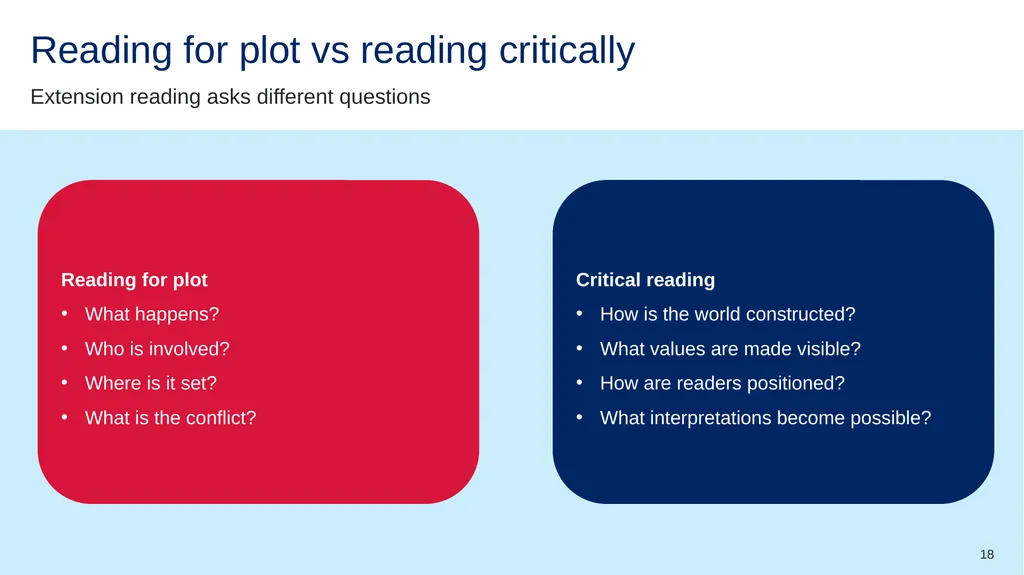
Reading for plot vs reading critically Extension reading asks different questions Reading for plot
What happens?
Who is involved?
Where is it set?
What is the conflict? Critical reading
How is the world constructed?
What values are made visible?
How are readers positioned?
What interpretations become possible? 18<br>
What happens?
Who is involved?
Where is it set?
What is the conflict? Critical reading
How is the world constructed?
What values are made visible?
How are readers positioned?
What interpretations become possible? 18<br>
19
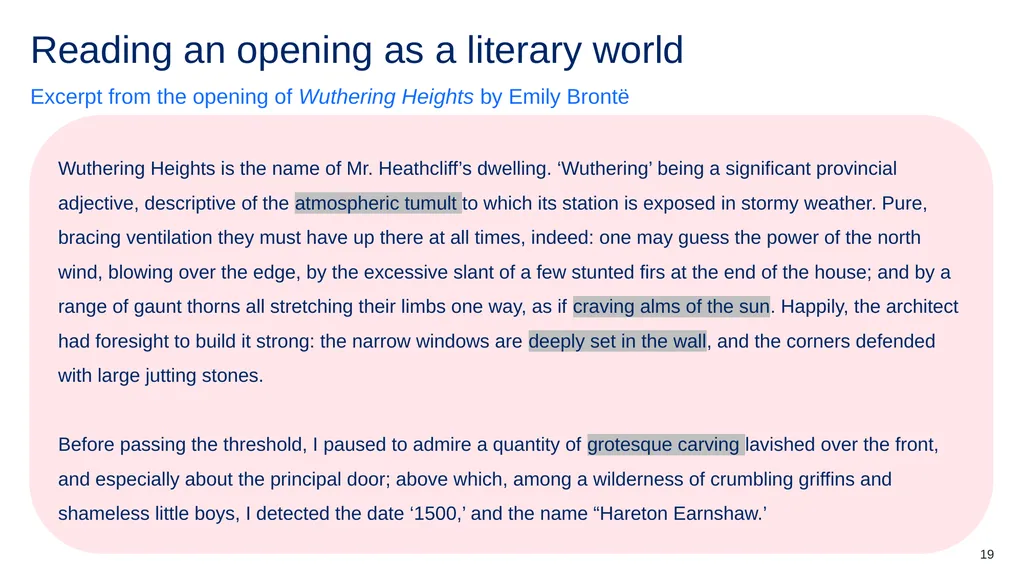
Reading an opening as a literary world Excerpt from the opening of Wuthering Heights by Emily Brontë Wuthering Heights is the name of Mr. Heathcliff’s dwelling. ‘Wuthering’ being a significant provincial adjective, descriptive of the atmospheric tumult to which its station is exposed in stormy weather. Pure, bracing ventilation they must have up there at all times, indeed: one may guess the power of the north wind, blowing over the edge, by the excessive slant of a few stunted firs at the end of the house; and by a range of gaunt thorns all stretching their limbs one way, as if craving alms of the sun. Happily, the architect had foresight to build it strong: the narrow windows are deeply set in the wall, and the corners defended with large jutting stones.
Before passing the threshold, I paused to admire a quantity of grotesque carving lavished over the front, and especially about the principal door; above which, among a wilderness of crumbling griffins and shameless little boys, I detected the date ‘1500,’ and the name “Hareton Earnshaw.’ 19<br>
Before passing the threshold, I paused to admire a quantity of grotesque carving lavished over the front, and especially about the principal door; above which, among a wilderness of crumbling griffins and shameless little boys, I detected the date ‘1500,’ and the name “Hareton Earnshaw.’ 19<br>
20
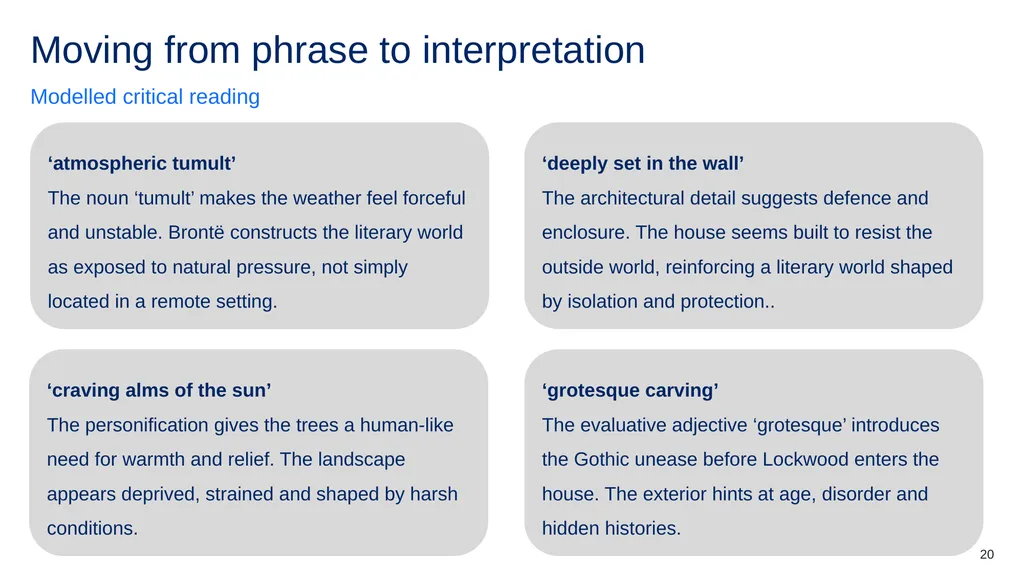
Moving from phrase to interpretation Modelled critical reading ‘atmospheric tumult’
The noun ‘tumult’ makes the weather feel forceful and unstable. Brontë constructs the literary world as exposed to natural pressure, not simply located in a remote setting. ‘deeply set in the wall’
The architectural detail suggests defence and enclosure. The house seems built to resist the outside world, reinforcing a literary world shaped by isolation and protection.. ‘craving alms of the sun’
The personification gives the trees a human-like need for warmth and relief. The landscape appears deprived, strained and shaped by harsh conditions. ‘grotesque carving’
The evaluative adjective ‘grotesque’ introduces the Gothic unease before Lockwood enters the house. The exterior hints at age, disorder and hidden histories. 20<br>
The noun ‘tumult’ makes the weather feel forceful and unstable. Brontë constructs the literary world as exposed to natural pressure, not simply located in a remote setting. ‘deeply set in the wall’
The architectural detail suggests defence and enclosure. The house seems built to resist the outside world, reinforcing a literary world shaped by isolation and protection.. ‘craving alms of the sun’
The personification gives the trees a human-like need for warmth and relief. The landscape appears deprived, strained and shaped by harsh conditions. ‘grotesque carving’
The evaluative adjective ‘grotesque’ introduces the Gothic unease before Lockwood enters the house. The exterior hints at age, disorder and hidden histories. 20<br>
21
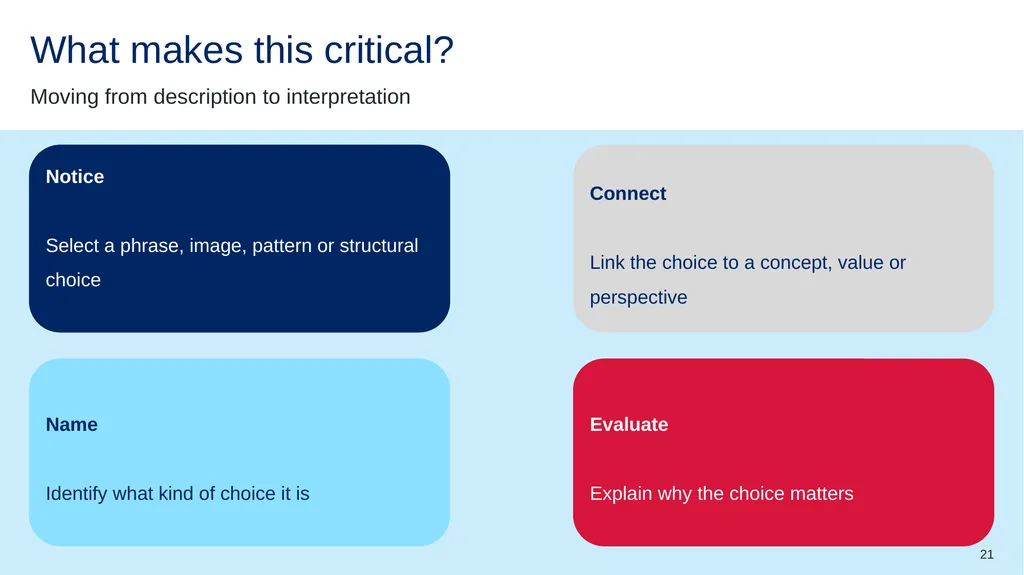
What makes this critical? Moving from description to interpretation Notice
Select a phrase, image, pattern or structural choice Connect
Link the choice to a concept, value or perspective Name
Identify what kind of choice it is Evaluate
Explain why the choice matters 21<br>
Select a phrase, image, pattern or structural choice Connect
Link the choice to a concept, value or perspective Name
Identify what kind of choice it is Evaluate
Explain why the choice matters 21<br>
22
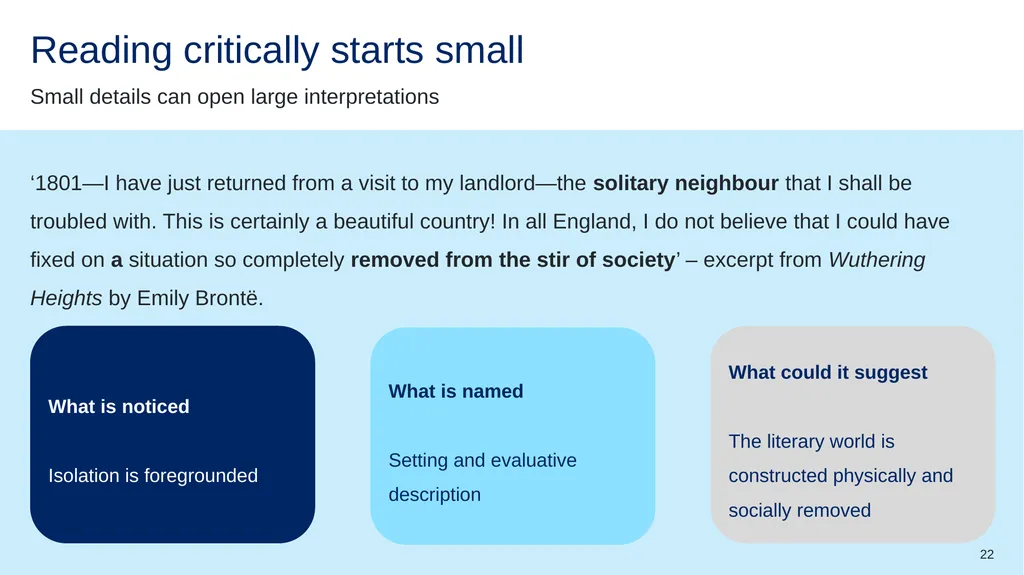
Reading critically starts small Small details can open large interpretations ‘1801—I have just returned from a visit to my landlord—the solitary neighbour that I shall be troubled with. This is certainly a beautiful country! In all England, I do not believe that I could have fixed on a situation so completely removed from the stir of society’ – excerpt from Wuthering Heights by Emily Brontë. What is noticed
Isolation is foregrounded What is named
Setting and evaluative description What could it suggest
The literary world is constructed physically and socially removed 22<br>
Isolation is foregrounded What is named
Setting and evaluative description What could it suggest
The literary world is constructed physically and socially removed 22<br>
23
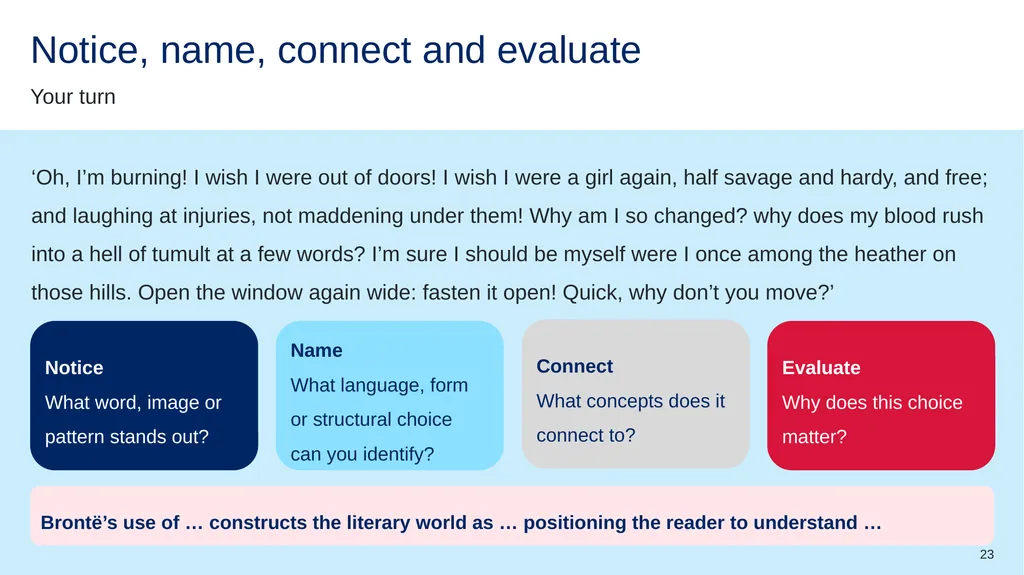
Notice, name, connect and evaluate Your turn ‘Oh, I’m burning! I wish I were out of doors! I wish I were a girl again, half savage and hardy, and free; and laughing at injuries, not maddening under them! Why am I so changed? why does my blood rush into a hell of tumult at a few words? I’m sure I should be myself were I once among the heather on those hills. Open the window again wide: fasten it open! Quick, why don’t you move?’ Notice
What word, image or pattern stands out? Name
What language, form or structural choice can you identify? Connect
What concepts does it connect to? Evaluate
Why does this choice matter? Brontë’s use of … constructs the literary world as … positioning the reader to understand … 23<br>
What word, image or pattern stands out? Name
What language, form or structural choice can you identify? Connect
What concepts does it connect to? Evaluate
Why does this choice matter? Brontë’s use of … constructs the literary world as … positioning the reader to understand … 23<br>
24
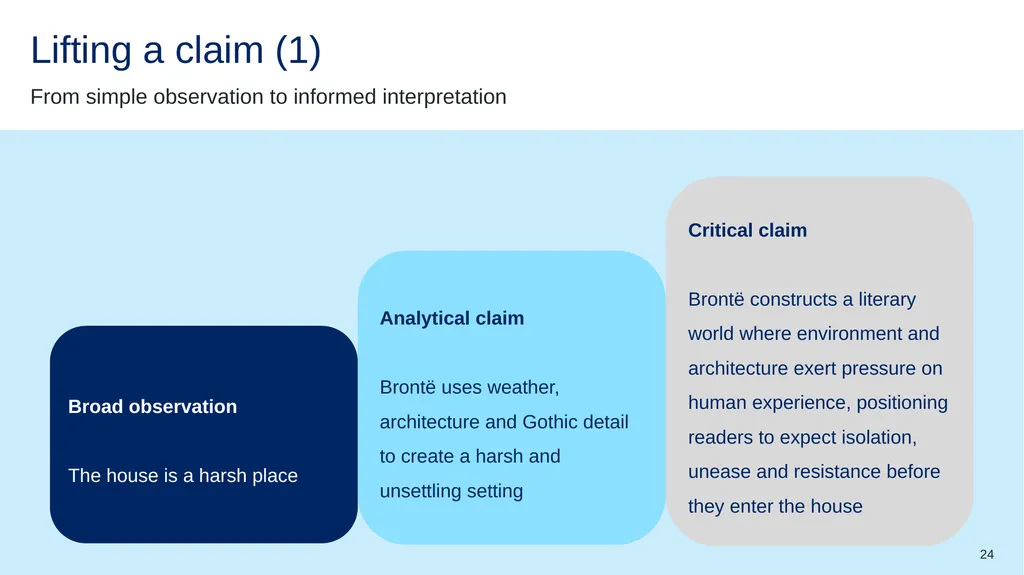
Lifting a claim (1) From simple observation to informed interpretation Broad observation
The house is a harsh place Analytical claim
Brontë uses weather, architecture and Gothic detail to create a harsh and unsettling setting Critical claim
Brontë constructs a literary world where environment and architecture exert pressure on human experience, positioning readers to expect isolation, unease and resistance before they enter the house 24<br>
The house is a harsh place Analytical claim
Brontë uses weather, architecture and Gothic detail to create a harsh and unsettling setting Critical claim
Brontë constructs a literary world where environment and architecture exert pressure on human experience, positioning readers to expect isolation, unease and resistance before they enter the house 24<br>
25
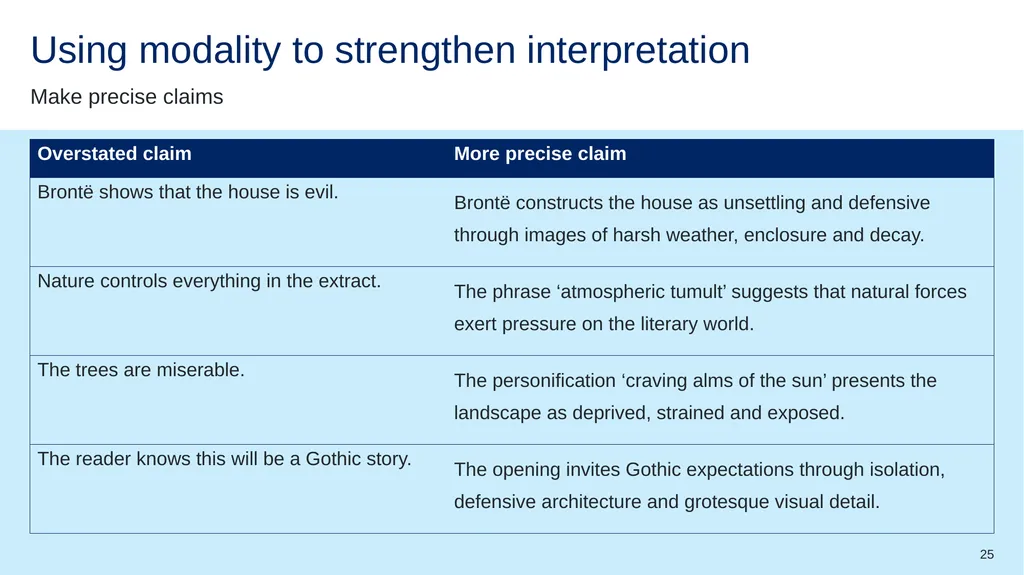
Using modality to strengthen interpretation Make precise claims 25<br>
26
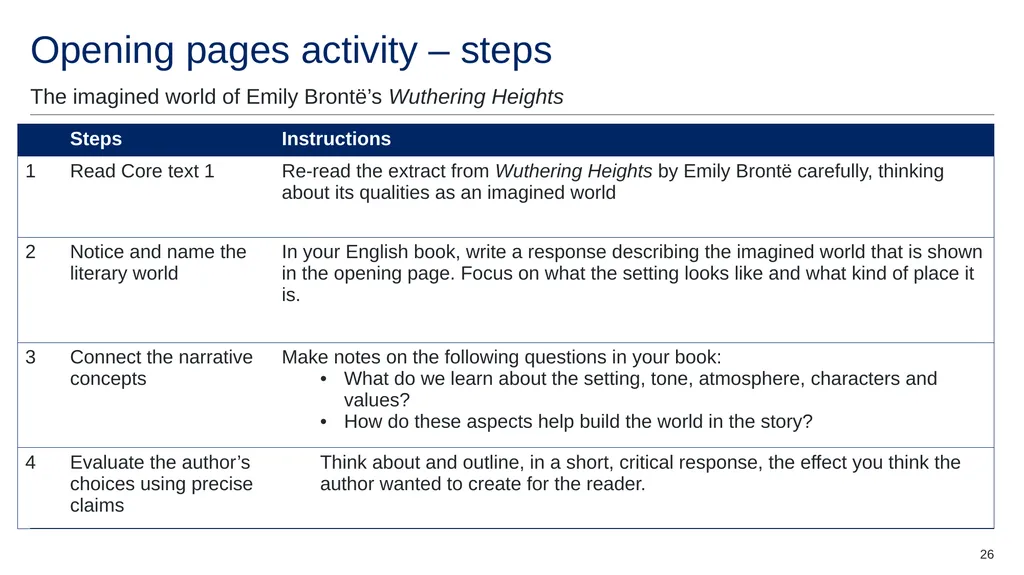
Opening pages activity – steps The imagined world of Emily Brontë’s Wuthering Heights 26<br>
27
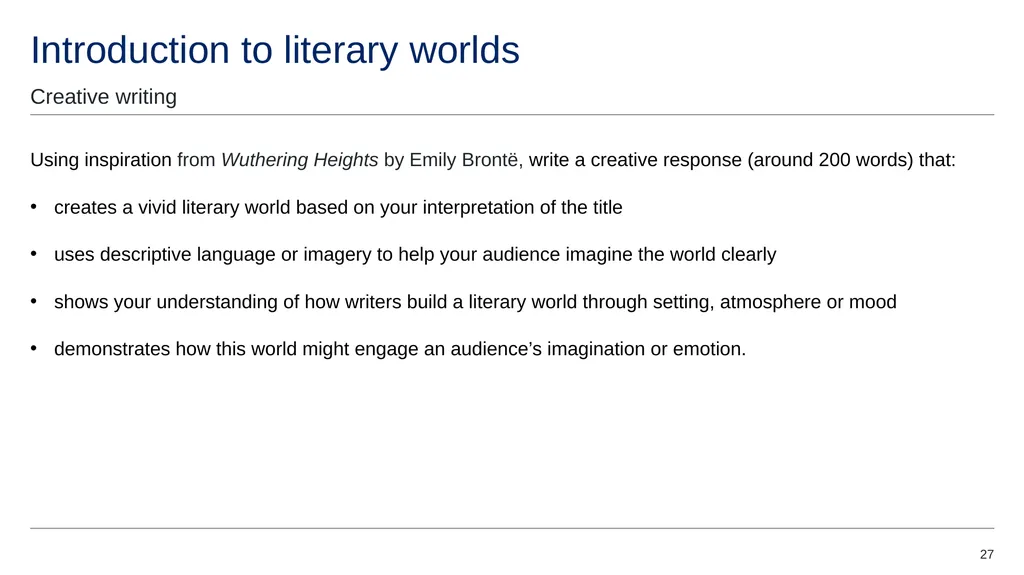
Introduction to literary worlds Creative writing Using inspiration from Wuthering Heights by Emily Brontë, write a creative response (around 200 words) that:
creates a vivid literary world based on your interpretation of the title
uses descriptive language or imagery to help your audience imagine the world clearly
shows your understanding of how writers build a literary world through setting, atmosphere or mood
demonstrates how this world might engage an audience’s imagination or emotion. 27<br>
creates a vivid literary world based on your interpretation of the title
uses descriptive language or imagery to help your audience imagine the world clearly
shows your understanding of how writers build a literary world through setting, atmosphere or mood
demonstrates how this world might engage an audience’s imagination or emotion. 27<br>
28
Phase 1, sequence 4 – introducing theoretical perspectives about literary worlds Section 3 Taking notes with a pencil by Thought Catalog on Unsplash<br>
29
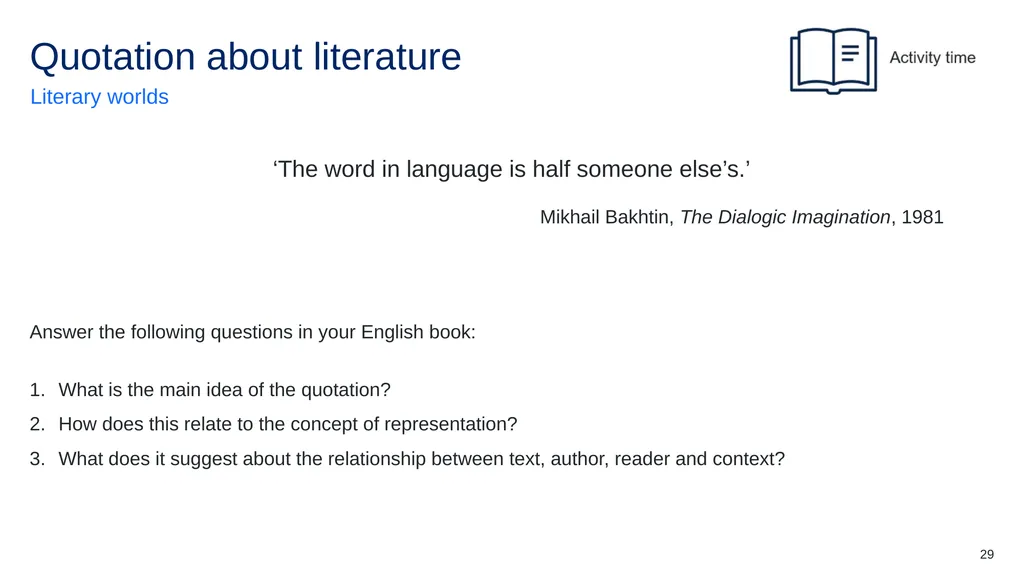
Quotation about literature Literary worlds ‘The word in language is half someone else’s.’
Mikhail Bakhtin, The Dialogic Imagination, 1981
Answer the following questions in your English book:
What is the main idea of the quotation?
How does this relate to the concept of representation?
What does it suggest about the relationship between text, author, reader and context? 29<br>
Mikhail Bakhtin, The Dialogic Imagination, 1981
Answer the following questions in your English book:
What is the main idea of the quotation?
How does this relate to the concept of representation?
What does it suggest about the relationship between text, author, reader and context? 29<br>
30
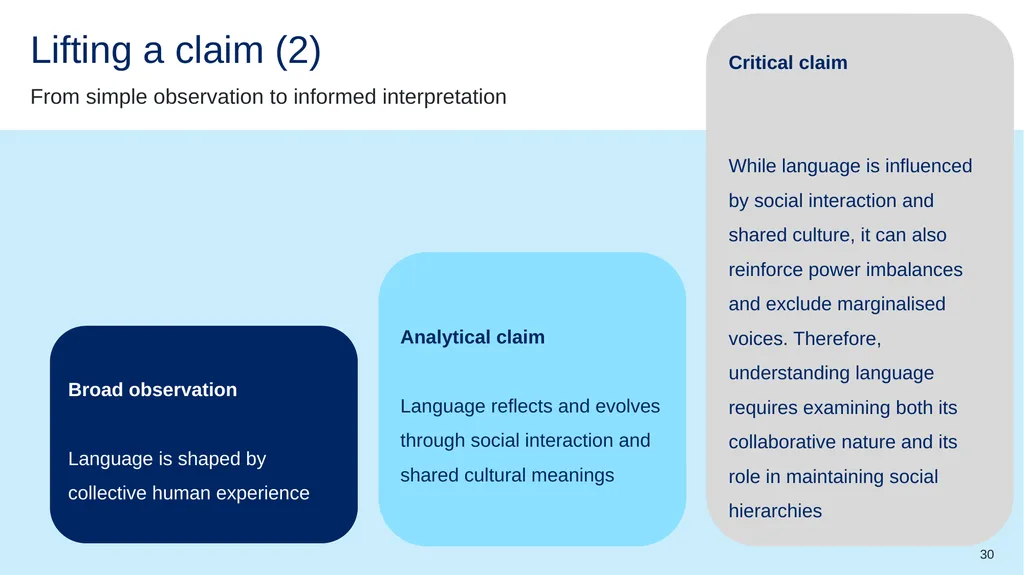
Lifting a claim (2) From simple observation to informed interpretation Broad observation
Language is shaped by collective human experience Analytical claim
Language reflects and evolves through social interaction and shared cultural meanings Critical claim
While language is influenced by social interaction and shared culture, it can also reinforce power imbalances and exclude marginalised voices. Therefore, understanding language requires examining both its collaborative nature and its role in maintaining social hierarchies 30<br>
Language is shaped by collective human experience Analytical claim
Language reflects and evolves through social interaction and shared cultural meanings Critical claim
While language is influenced by social interaction and shared culture, it can also reinforce power imbalances and exclude marginalised voices. Therefore, understanding language requires examining both its collaborative nature and its role in maintaining social hierarchies 30<br>
31
References (1) This presentation contains NSW Curriculum and syllabus content. The NSW Curriculum is developed by the NSW Education Standards Authority. This content is prepared by NESA for and on behalf of the Crown in the right of the State of New South Wales. The material is protected by Crown copyright.
Please refer to the NESA Copyright Disclaimer for more information https://educationstandards.nsw.edu.au/wps/portal/nesa/mini-footer/copyright.
NESA holds the only official and up-to-date versions of the NSW Curriculum and syllabus documents. Please visit the NSW Education Standards Authority (NESA) website https://educationstandards.nsw.edu.au/wps/portal/nesa/home and the NSW Curriculum website https://curriculum.nsw.edu.au. English Extension 11–12 Syllabus (2024) © Syllabus NSW Education Standards Authority (NESA) for and on behalf of the Crown in right of the State of New South Wales, [2024].
Australian Education Research Organisation (AERO) (2024a) Explain learning objectives, Practical guides, AERO, accessed 6 February 2026.
——(2024b) Why explicit instruction works, Explainers, AERO, accessed 21 January 2026.
Australian Institute for Teaching and School Leadership (AITSL) (n.d.) Learning intentions and success criteria strategy. AITSL website, accessed 6 February 2026.
Beamer D (2020) A glass ball with a tree in the background [photo] A glass ball with a tree in the background, accessed 6 February 2026.
Black P and Wiliam D (2018) Classroom assessment and pedagogy, Assessment in Education Principles Policy and Practice, 25(1):1–25, accessed 6 February 2026.
Brontë E (1847) Wuthering Heights The Project Gutenberg website. This work is in the public domain, accessed 24 June 2026.
Centre for Education Statistics and Evaluation (CESE) (2017) Cognitive load theory: Research that teachers really need to understand, NSW Department of Education, accessed 16 April 2024, accessed 6 February 2026. 31<br>
Please refer to the NESA Copyright Disclaimer for more information https://educationstandards.nsw.edu.au/wps/portal/nesa/mini-footer/copyright.
NESA holds the only official and up-to-date versions of the NSW Curriculum and syllabus documents. Please visit the NSW Education Standards Authority (NESA) website https://educationstandards.nsw.edu.au/wps/portal/nesa/home and the NSW Curriculum website https://curriculum.nsw.edu.au. English Extension 11–12 Syllabus (2024) © Syllabus NSW Education Standards Authority (NESA) for and on behalf of the Crown in right of the State of New South Wales, [2024].
Australian Education Research Organisation (AERO) (2024a) Explain learning objectives, Practical guides, AERO, accessed 6 February 2026.
——(2024b) Why explicit instruction works, Explainers, AERO, accessed 21 January 2026.
Australian Institute for Teaching and School Leadership (AITSL) (n.d.) Learning intentions and success criteria strategy. AITSL website, accessed 6 February 2026.
Beamer D (2020) A glass ball with a tree in the background [photo] A glass ball with a tree in the background, accessed 6 February 2026.
Black P and Wiliam D (2018) Classroom assessment and pedagogy, Assessment in Education Principles Policy and Practice, 25(1):1–25, accessed 6 February 2026.
Brontë E (1847) Wuthering Heights The Project Gutenberg website. This work is in the public domain, accessed 24 June 2026.
Centre for Education Statistics and Evaluation (CESE) (2017) Cognitive load theory: Research that teachers really need to understand, NSW Department of Education, accessed 16 April 2024, accessed 6 February 2026. 31<br>
32
References (2) This presentation contains NSW Curriculum and syllabus content. The NSW Curriculum is developed by the NSW Education Standards Authority. This content is prepared by NESA for and on behalf of the Crown in the right of the State of New South Wales. The material is protected by Crown copyright.
Please refer to the NESA Copyright Disclaimer for more information https://educationstandards.nsw.edu.au/wps/portal/nesa/mini-footer/copyright.
NESA holds the only official and up-to-date versions of the NSW Curriculum and syllabus documents. Please visit the NSW Education Standards Authority (NESA) website https://educationstandards.nsw.edu.au/wps/portal/nesa/home and the NSW Curriculum website https://curriculum.nsw.edu.au. Clarke S, Timperley H, Hattie J (2003) Unlocking formative assessment: Practical strategies for enhancing students’ learning in the primary and intermediate classroom, Hodder Moa Beckett, Auckland, New Zealand.
Griffin P (2018) Assessment for teaching, Cambridge University Press, Cambridge.
NESA (NSW Education Standards Authority) (n.d.) Collaborative curriculum planning, Special education, accessed 6 February 2026.
State of New South Wales (Department of Education) (n.d.) Digital Learning Selector, NSW Department of Education website, accessed 6 February 2026.
——(n.d.) State of New South Wales (Department of Education) (n.d.) Frayer diagrams, Digital learning selector, NSW Department of Education website, accessed 6 February 2026.
——(n.d.) Jigsaw, Digital learning selector, NSW Department of Education website, accessed 6 February 2026.
——(2024) Explicit teaching strategies, Explicit teaching, NSW Department of Education website, accessed 6 February 2026.
——(2024) Explicit teaching – Driving learning and engagement, What works best 2020 update, Centre for Education Statistics and Evaluation website, accessed 6 February 2026. 32<br>
Please refer to the NESA Copyright Disclaimer for more information https://educationstandards.nsw.edu.au/wps/portal/nesa/mini-footer/copyright.
NESA holds the only official and up-to-date versions of the NSW Curriculum and syllabus documents. Please visit the NSW Education Standards Authority (NESA) website https://educationstandards.nsw.edu.au/wps/portal/nesa/home and the NSW Curriculum website https://curriculum.nsw.edu.au. Clarke S, Timperley H, Hattie J (2003) Unlocking formative assessment: Practical strategies for enhancing students’ learning in the primary and intermediate classroom, Hodder Moa Beckett, Auckland, New Zealand.
Griffin P (2018) Assessment for teaching, Cambridge University Press, Cambridge.
NESA (NSW Education Standards Authority) (n.d.) Collaborative curriculum planning, Special education, accessed 6 February 2026.
State of New South Wales (Department of Education) (n.d.) Digital Learning Selector, NSW Department of Education website, accessed 6 February 2026.
——(n.d.) State of New South Wales (Department of Education) (n.d.) Frayer diagrams, Digital learning selector, NSW Department of Education website, accessed 6 February 2026.
——(n.d.) Jigsaw, Digital learning selector, NSW Department of Education website, accessed 6 February 2026.
——(2024) Explicit teaching strategies, Explicit teaching, NSW Department of Education website, accessed 6 February 2026.
——(2024) Explicit teaching – Driving learning and engagement, What works best 2020 update, Centre for Education Statistics and Evaluation website, accessed 6 February 2026. 32<br>
33
References (3) This presentation contains NSW Curriculum and syllabus content. The NSW Curriculum is developed by the NSW Education Standards Authority. This content is prepared by NESA for and on behalf of the Crown in the right of the State of New South Wales. The material is protected by Crown copyright.
Please refer to the NESA Copyright Disclaimer for more information https://educationstandards.nsw.edu.au/wps/portal/nesa/mini-footer/copyright.
NESA holds the only official and up-to-date versions of the NSW Curriculum and syllabus documents. Please visit the NSW Education Standards Authority (NESA) website https://educationstandards.nsw.edu.au/wps/portal/nesa/home and the NSW Curriculum website https://curriculum.nsw.edu.au. ——(2024) Sharing learning intentions, Explicit teaching, NSW Department of Education website, accessed 6 February 2026.
——(2024) Sharing success criteria, Explicit teaching, NSW Department of Education website, accessed 6 February 2026.
Wiliam D (2014) The right questions, the right way , Educational Leadership, 71(6), accessed 6 February 2026. 33<br>
Please refer to the NESA Copyright Disclaimer for more information https://educationstandards.nsw.edu.au/wps/portal/nesa/mini-footer/copyright.
NESA holds the only official and up-to-date versions of the NSW Curriculum and syllabus documents. Please visit the NSW Education Standards Authority (NESA) website https://educationstandards.nsw.edu.au/wps/portal/nesa/home and the NSW Curriculum website https://curriculum.nsw.edu.au. ——(2024) Sharing learning intentions, Explicit teaching, NSW Department of Education website, accessed 6 February 2026.
——(2024) Sharing success criteria, Explicit teaching, NSW Department of Education website, accessed 6 February 2026.
Wiliam D (2014) The right questions, the right way , Educational Leadership, 71(6), accessed 6 February 2026. 33<br>
34
Copyright © State of New South Wales (Department of Education), 2026 The copyright material published in this resource is subject to the Copyright Act 1968 (Cth) and is owned by the NSW Department of Education or, where indicated, by a party other than the NSW Department of Education (third-party material).
Copyright material available in this resource and owned by the NSW Department of Education is licensed under a Creative Commons Attribution 4.0 International (CC BY 4.0) license.
This license allows you to share and adapt the material for any purpose, even commercially.
Attribution should be given to © State of New South Wales (Department of Education), 2026.
Material in this resource not available under a Creative Commons license:
the NSW Department of Education logo, other logos and trademark-protected material
Material owned by a third party that has been reproduced with permission. You will need to obtain permission from the third party to reuse its material.
Links to third-party material and websites
Please note that the provided (reading/viewing material/list/links/texts) are a suggestion only and implies no endorsement, by the New South Wales Department of Education, of any author, publisher, or book title. School principals and teachers are best placed to assess the suitability of resources that would complement the curriculum and reflect the needs and interests of their students.
If you use the links provided in this document to access a third-party’s website, you acknowledge that the terms of use, including licence terms set out on the third-party’s website apply to the use which may be made of the materials on that third-party website or where permitted by the Copyright Act 1968 (Cth). The department accepts no responsibility for content on third-party websites.<br>
Copyright material available in this resource and owned by the NSW Department of Education is licensed under a Creative Commons Attribution 4.0 International (CC BY 4.0) license.
This license allows you to share and adapt the material for any purpose, even commercially.
Attribution should be given to © State of New South Wales (Department of Education), 2026.
Material in this resource not available under a Creative Commons license:
the NSW Department of Education logo, other logos and trademark-protected material
Material owned by a third party that has been reproduced with permission. You will need to obtain permission from the third party to reuse its material.
Links to third-party material and websites
Please note that the provided (reading/viewing material/list/links/texts) are a suggestion only and implies no endorsement, by the New South Wales Department of Education, of any author, publisher, or book title. School principals and teachers are best placed to assess the suitability of resources that would complement the curriculum and reflect the needs and interests of their students.
If you use the links provided in this document to access a third-party’s website, you acknowledge that the terms of use, including licence terms set out on the third-party’s website apply to the use which may be made of the materials on that third-party website or where permitted by the Copyright Act 1968 (Cth). The department accepts no responsibility for content on third-party websites.<br>