
syphilis Learning points INTRODUCTION ETIOLOGY
KB
Published · 75 slides · 0 views

1 / 1










Description
syphilis Learning points INTRODUCTION ETIOLOGY MICROBIOLOGY PATHOGENESIS CLASSIFICATION PRIMARY SYPHILIS SCONDARY SYPHILIS TERTIARY SYPHILIS CONGENITAL SYPHILIS LAB DIAGNOSIS AND TREATMENT Spirochetes Family spirochates Genera treponema.
Related Topics
Share
Embed code
Download this presentation From Below
"syphilis Learning points INTRODUCTION ETIOLOGY" is the property of its rightful owner. Permission is granted to download and print the materials on this website for personal, non-commercial use only, and to display it on your personal computer provided you do not modify the materials and that you retain all copyright notices contained in the materials. By downloading content from our website, you accept the terms of this agreement.
Presentation Transcript
01
syphilis<br>
02
Learning points INTRODUCTION
ETIOLOGY
MICROBIOLOGY
PATHOGENESIS
CLASSIFICATION
PRIMARY SYPHILIS
SCONDARY SYPHILIS
TERTIARY SYPHILIS
CONGENITAL SYPHILIS
LAB DIAGNOSIS AND TREATMENT<br>
ETIOLOGY
MICROBIOLOGY
PATHOGENESIS
CLASSIFICATION
PRIMARY SYPHILIS
SCONDARY SYPHILIS
TERTIARY SYPHILIS
CONGENITAL SYPHILIS
LAB DIAGNOSIS AND TREATMENT<br>
03
Spirochetes
Family spirochates
Genera treponema…. borrelia …..leptospira
Pathogenic
T.palladium ssp pertunue (yaws)
T.palladium ssp endemicum ( endemic syphilis)
T. palladium ssp palladium ( syphilis )<br>
Family spirochates
Genera treponema…. borrelia …..leptospira
Pathogenic
T.palladium ssp pertunue (yaws)
T.palladium ssp endemicum ( endemic syphilis)
T. palladium ssp palladium ( syphilis )<br>
04
Introduction “Great Imitator”
Sexually transmitted disease - spirochaete bacterium Treponema pallidum
Chronic systemic infectious disease - may affect any organ during its course..life threatening consequences in the CVS & CNS.<br>
Sexually transmitted disease - spirochaete bacterium Treponema pallidum
Chronic systemic infectious disease - may affect any organ during its course..life threatening consequences in the CVS & CNS.<br>
05
Name derived from a poem “syphilis sive morbus gallicus” written by a physician Girolamo Fracastoro,
….. syphilis happens to be the name of a shepherd who suffered this disease as a curse for insulting the god Apollo.<br>
….. syphilis happens to be the name of a shepherd who suffered this disease as a curse for insulting the god Apollo.<br>
06
ETIOLOGY
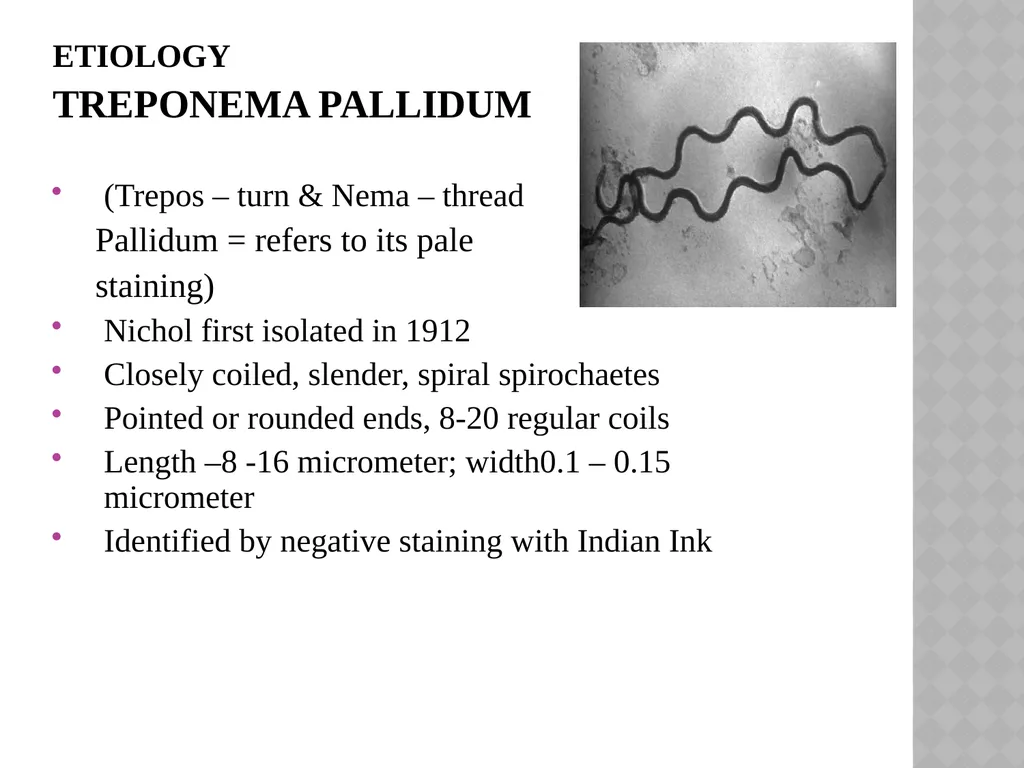
TREPONEMA PALLIDUM
(Trepos – turn & Nema – thread
Pallidum = refers to its pale
staining)
Nichol first isolated in 1912
Closely coiled, slender, spiral spirochaetes
Pointed or rounded ends, 8-20 regular coils
Length –8 -16 micrometer; width0.1 – 0.15 micrometer
Identified by negative staining with Indian Ink<br>
TREPONEMA PALLIDUM
(Trepos – turn & Nema – thread
Pallidum = refers to its pale
staining)
Nichol first isolated in 1912
Closely coiled, slender, spiral spirochaetes
Pointed or rounded ends, 8-20 regular coils
Length –8 -16 micrometer; width0.1 – 0.15 micrometer
Identified by negative staining with Indian Ink<br>
07
Morphology & motility – DARK GROUND MICROSCOPY
Virulent strain (Nichol’ s strain) – not cultured
Non virulent strain (Reiter’s strain)- Thioglycolate medium<br>
Virulent strain (Nichol’ s strain) – not cultured
Non virulent strain (Reiter’s strain)- Thioglycolate medium<br>
08
RISK FACTORS AND HIGH RISK GROUP Sexual promiscuity and prostitution – twin around which revolve others risk factors
Population explosion, migration of people from rural to urban areas seeking work, over crowding and low standards of living, low moral standards, ignorance and lack of sex education account for spread of disease.<br>
Population explosion, migration of people from rural to urban areas seeking work, over crowding and low standards of living, low moral standards, ignorance and lack of sex education account for spread of disease.<br>
09
TRANSMISSION OF SYPHILIS Direct sexual contact with an infected person
Vertical transmission from infected mother to fetus
Transfusion of infected blood – prenatal syphilis
Contact with exudates from chancre (highly contagious)<br>
Vertical transmission from infected mother to fetus
Transfusion of infected blood – prenatal syphilis
Contact with exudates from chancre (highly contagious)<br>
10
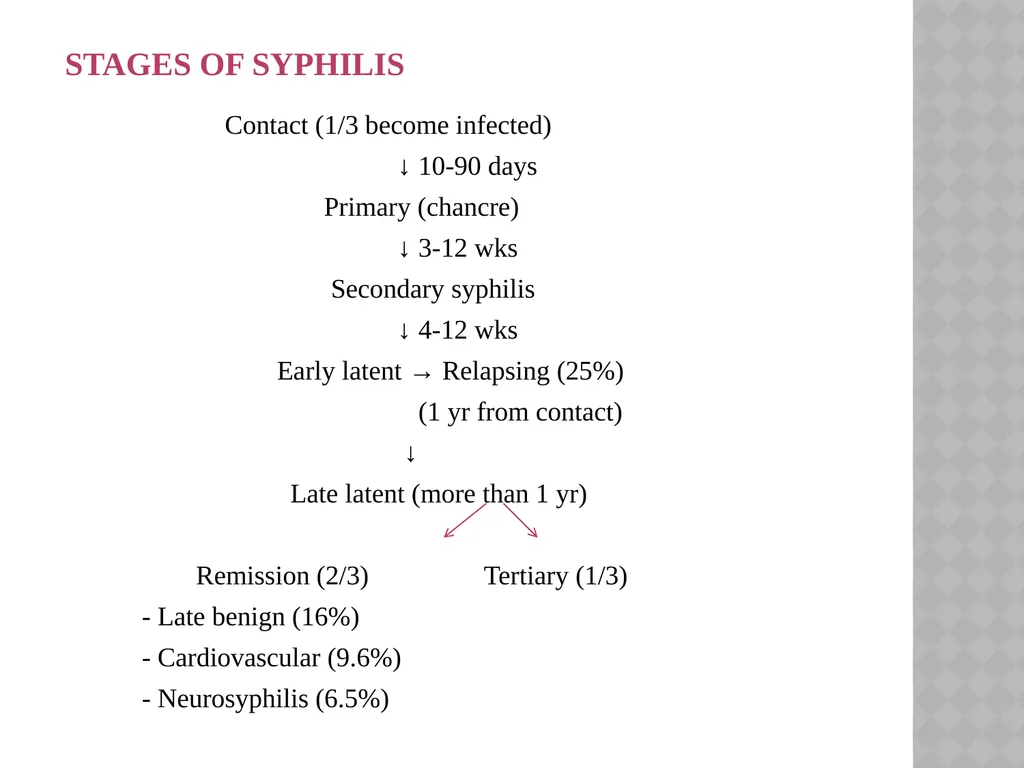
STAGES OF SYPHILIS Contact (1/3 become infected)
↓ 10-90 days
Primary (chancre)
↓ 3-12 wks
Secondary syphilis
↓ 4-12 wks
Early latent → Relapsing (25%)
(1 yr from contact)
↓
Late latent (more than 1 yr)
Remission (2/3) Tertiary (1/3)
- Late benign (16%)
- Cardiovascular (9.6%)
- Neurosyphilis (6.5%)<br>
↓ 10-90 days
Primary (chancre)
↓ 3-12 wks
Secondary syphilis
↓ 4-12 wks
Early latent → Relapsing (25%)
(1 yr from contact)
↓
Late latent (more than 1 yr)
Remission (2/3) Tertiary (1/3)
- Late benign (16%)
- Cardiovascular (9.6%)
- Neurosyphilis (6.5%)<br>
11
CLASSIFICATION Acquired syphilis:
Early syphilis (Infectious phase) <2yr
Primary syphilis
Secondary syphilis
Early latent syphilis
Late Syphilis (non infectious phase) >2yr
Late latent syphilis
Tertiary syphilis
Benign tertiary
Cardiovascular syphilis
Neurosyphilis<br>
Early syphilis (Infectious phase) <2yr
Primary syphilis
Secondary syphilis
Early latent syphilis
Late Syphilis (non infectious phase) >2yr
Late latent syphilis
Tertiary syphilis
Benign tertiary
Cardiovascular syphilis
Neurosyphilis<br>
12
Prenatal syphilis Early phase <2yr
Analogous to secondary syphilis
Late phase >2 yr
Analogous to tertiary syphilis
Stigmata
Scars and deformities<br>
Analogous to secondary syphilis
Late phase >2 yr
Analogous to tertiary syphilis
Stigmata
Scars and deformities<br>
13
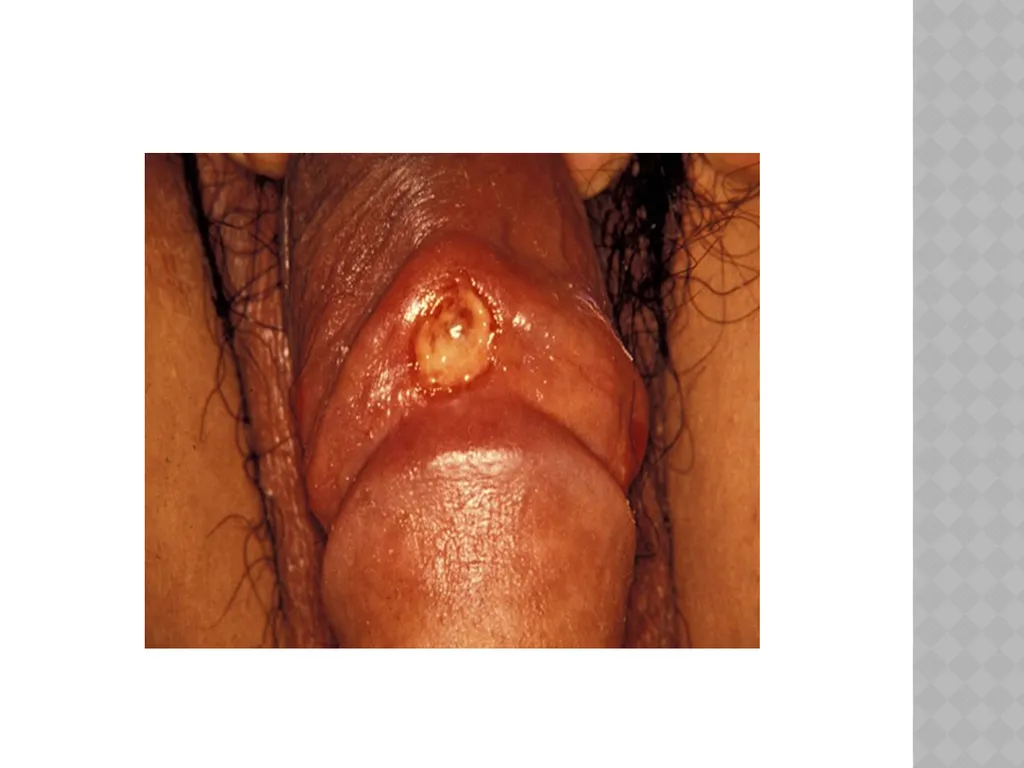
PRIMARY SYPHILIS After an IP of 10-90 days, a primary chancre develops at the site of inoculation (avg 21 days)
500-1000 organism
Small dull red macule →papule→ ulcerates (Chancre)- classical lesion of primary syphilis
The classic hunterian chancre is a single, painless, indurated ulcer, round to oval in shape, clearly defined with rolled borders<br>
500-1000 organism
Small dull red macule →papule→ ulcerates (Chancre)- classical lesion of primary syphilis
The classic hunterian chancre is a single, painless, indurated ulcer, round to oval in shape, clearly defined with rolled borders<br>
14
and ham coloured smooth base but sometimes may be covered with greyish slough or slightly haemorrhagic curst.
Size of the chancre - 0.3 to 3cm<br>
Size of the chancre - 0.3 to 3cm<br>
15
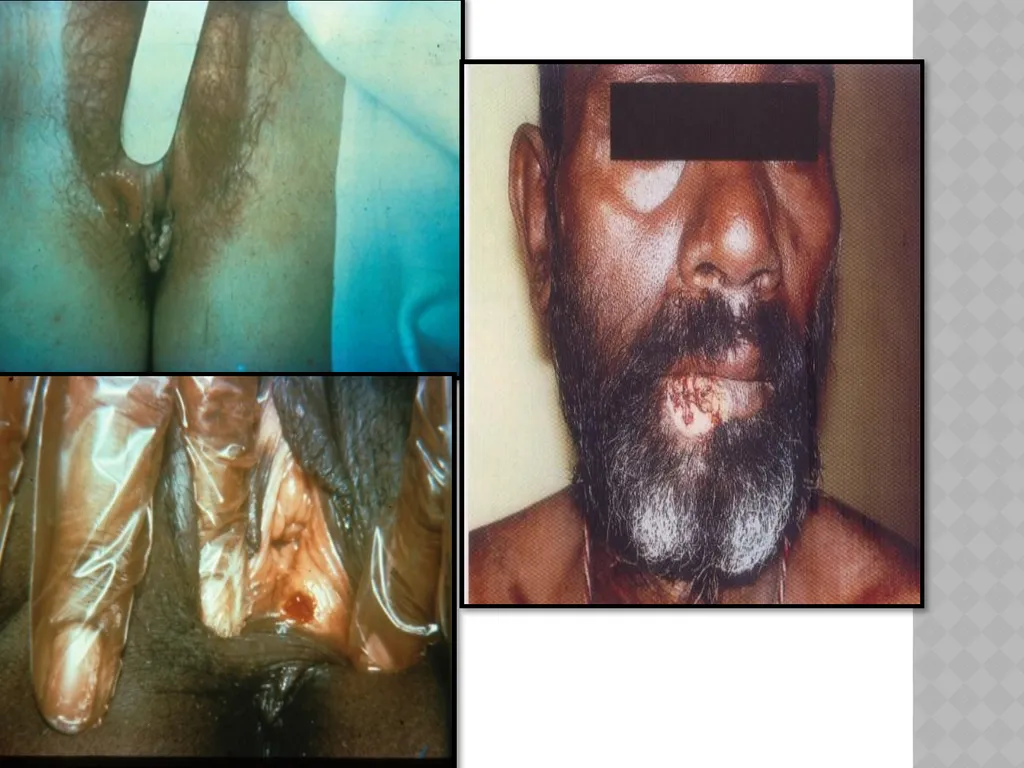
In men, the chancre on the genitalia is seen on the coronal sulcus (35%), glans (29%), shaft (22%) prepuce (19%) frenulum (10%) and urinary meatus (1%)
In women, the genital chancres are seen on the vulva, vagina or cervix
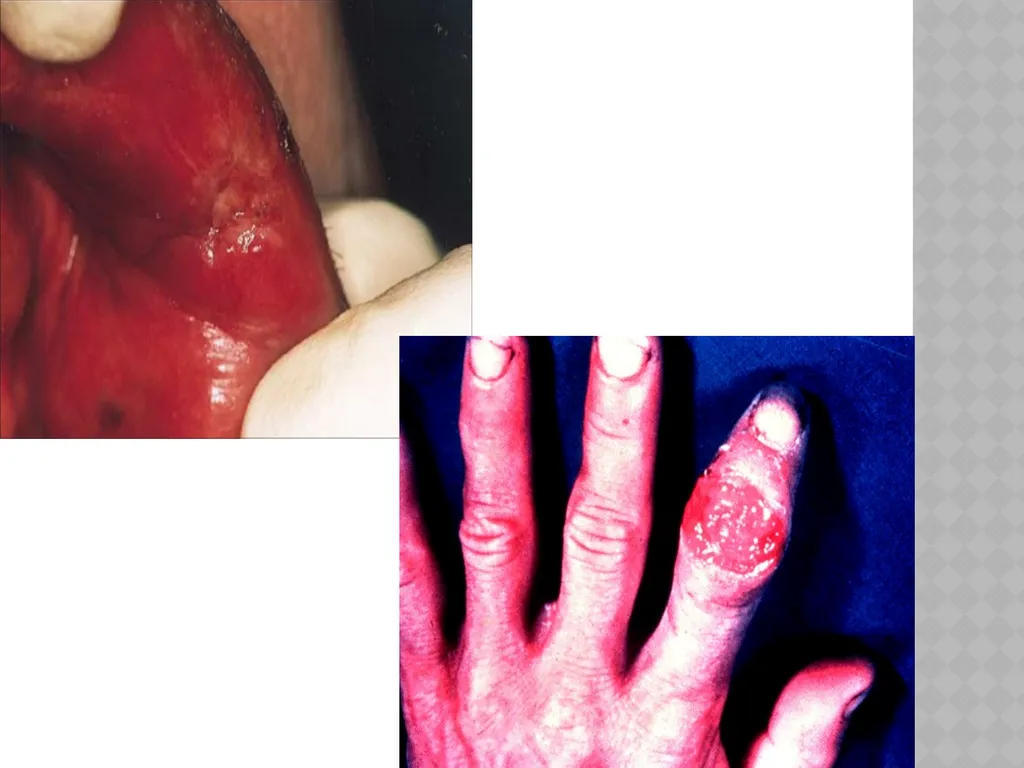
Extragenital chancres occur in 12-14% of the patients.
Related to oral / anal sex, 2/3 occur above neck ,½ on lips, perianal area or oral cavity .<br>
In women, the genital chancres are seen on the vulva, vagina or cervix
Extragenital chancres occur in 12-14% of the patients.
Related to oral / anal sex, 2/3 occur above neck ,½ on lips, perianal area or oral cavity .<br>
16
COMPLICATIONS Oedema
Phimosis
Erosive balanitis
Lymphangitis
Thrombophlebitis of the dorsal vein
Phagedenic chancre – due to co- infection with fusospirochaetes, characterized by necrotising perforation of prepuce, or gangrene<br>
Phimosis
Erosive balanitis
Lymphangitis
Thrombophlebitis of the dorsal vein
Phagedenic chancre – due to co- infection with fusospirochaetes, characterized by necrotising perforation of prepuce, or gangrene<br>
17
DIFFERENTIAL DIAGNOSIS Chancroid
Genital herpes
Granuloma inguinale
Traumatic ulcer
LGV
Behcet’s disease
Squamous cell carcinoma
Fixed drug eruption
Erosive candidial balanitis or vulvitis.<br>
Genital herpes
Granuloma inguinale
Traumatic ulcer
LGV
Behcet’s disease
Squamous cell carcinoma
Fixed drug eruption
Erosive candidial balanitis or vulvitis.<br>
18
treatment A single dose of benzathine penicillin G, 2.4 million units i.m
(1.2 million units i.m on each buttock)
Given after intradermal test dose.
Alternate:
Procaine penicillin G 1.2million units / day i.m X 10 days
PENICILLIN ALLERGY
Doxycycline 100 mg orally BD x 2 wks.
Tetracycline 500 mg orally QID x 2 wks.<br>
(1.2 million units i.m on each buttock)
Given after intradermal test dose.
Alternate:
Procaine penicillin G 1.2million units / day i.m X 10 days
PENICILLIN ALLERGY
Doxycycline 100 mg orally BD x 2 wks.
Tetracycline 500 mg orally QID x 2 wks.<br>
19
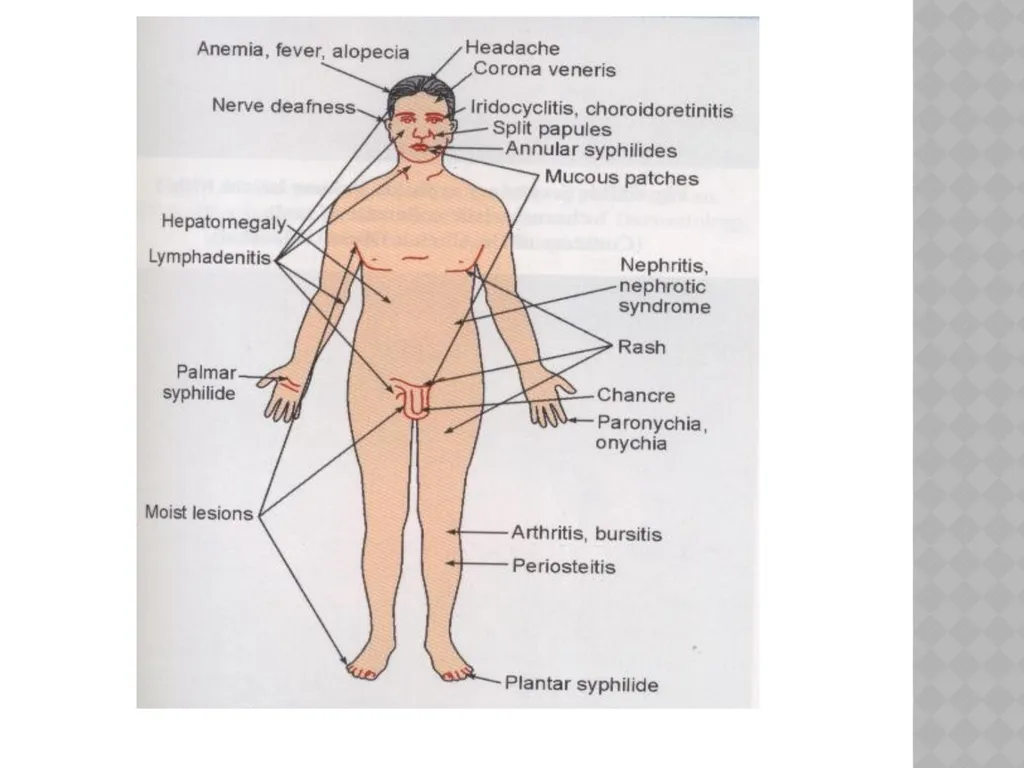
SECONDARY SYPHILIS The signs and symptoms of secondary syphilis usually develop 6-8 weeks after the appearance of the primary chancre
In 10-40% of the patients - chancre may persist even after appearance of the secondary rash
Constitutional symptoms like fever, malaise, headache, stiff neck, myalgia, arthralgia, wt loss may preceede or accompany the lesions<br>
In 10-40% of the patients - chancre may persist even after appearance of the secondary rash
Constitutional symptoms like fever, malaise, headache, stiff neck, myalgia, arthralgia, wt loss may preceede or accompany the lesions<br>
20
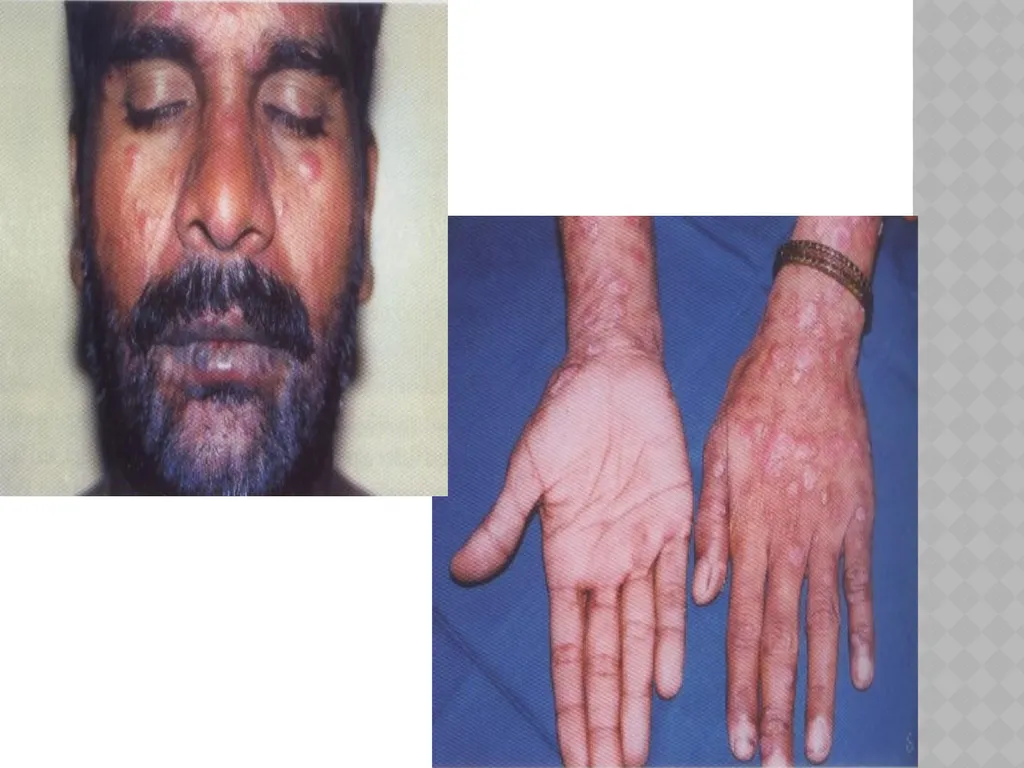
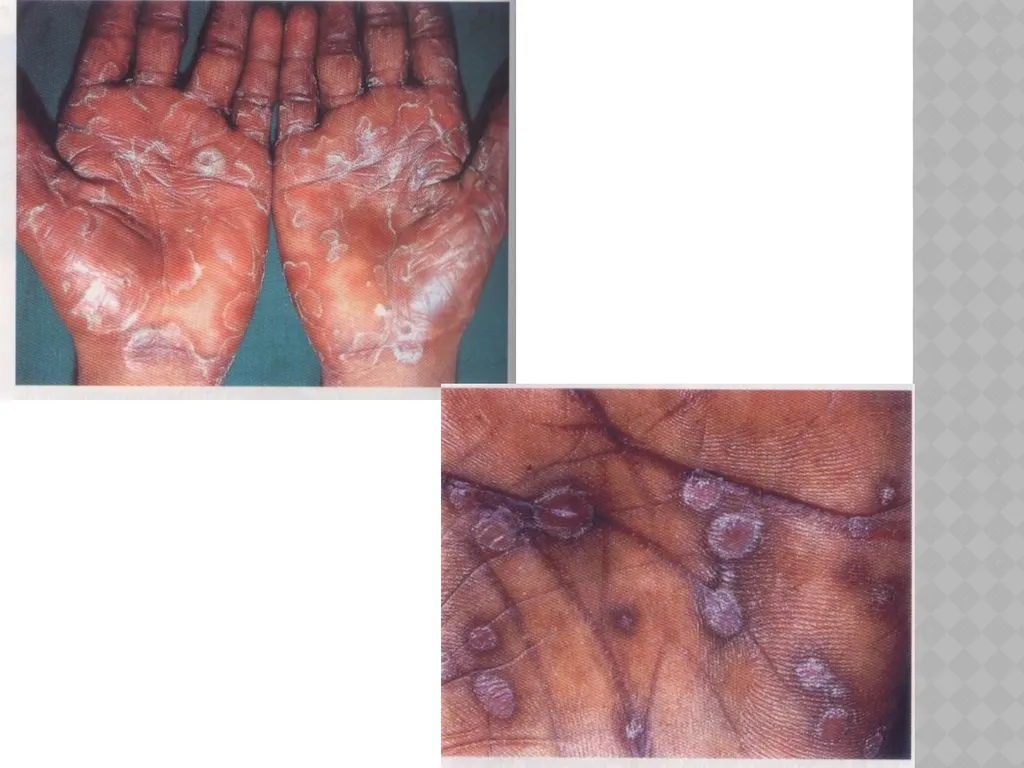
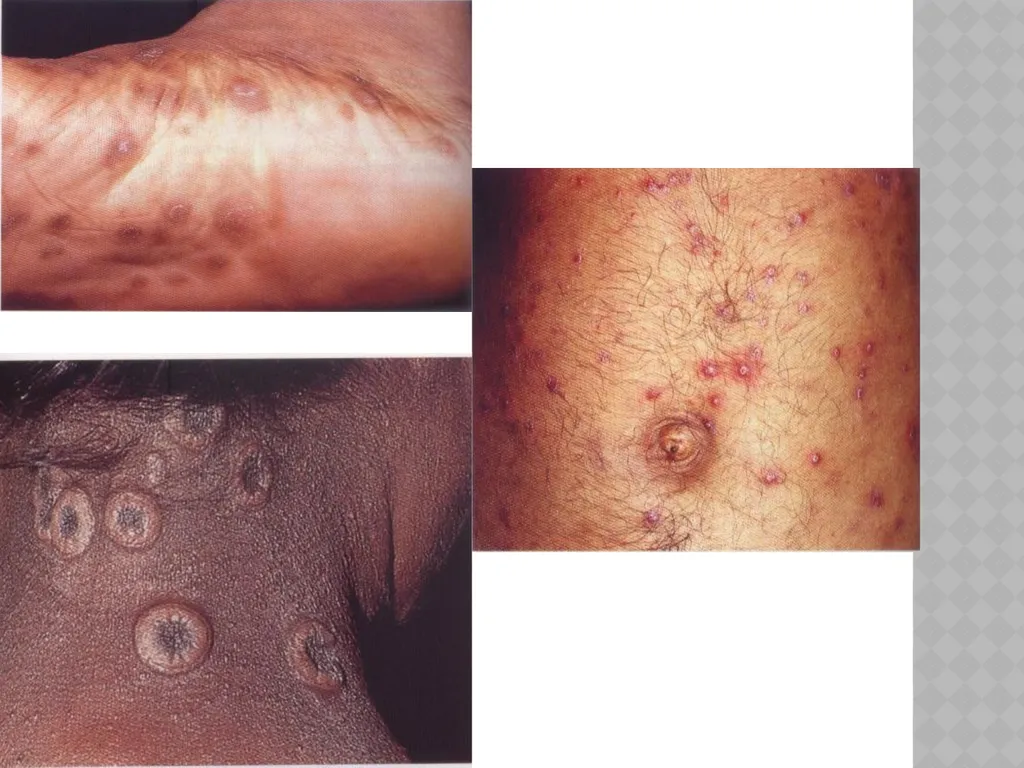
Cutaneous manifestations The cutaneous lesions may be macular, papular, maculopapular, papulosquamous, psoriasiform, annular, pustular or follicular.
Macular or maculopapular rash- commonest ( 50% of the pts)
The rash is usually distributed bilaterally and symmetrically<br>
Macular or maculopapular rash- commonest ( 50% of the pts)
The rash is usually distributed bilaterally and symmetrically<br>
21
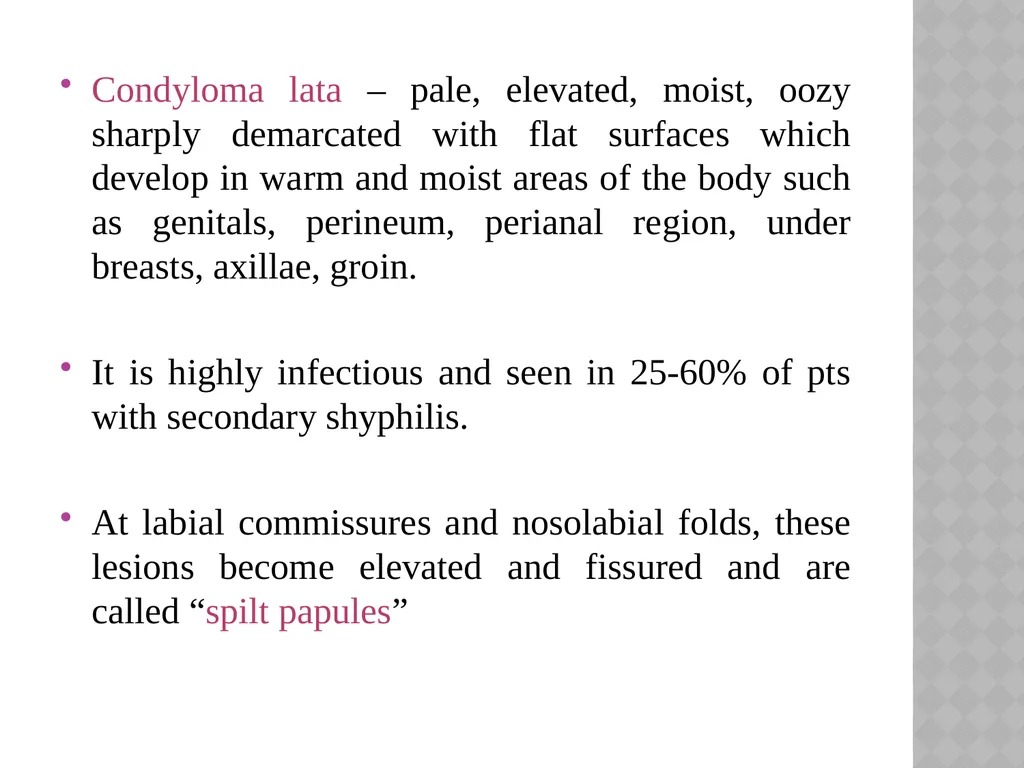
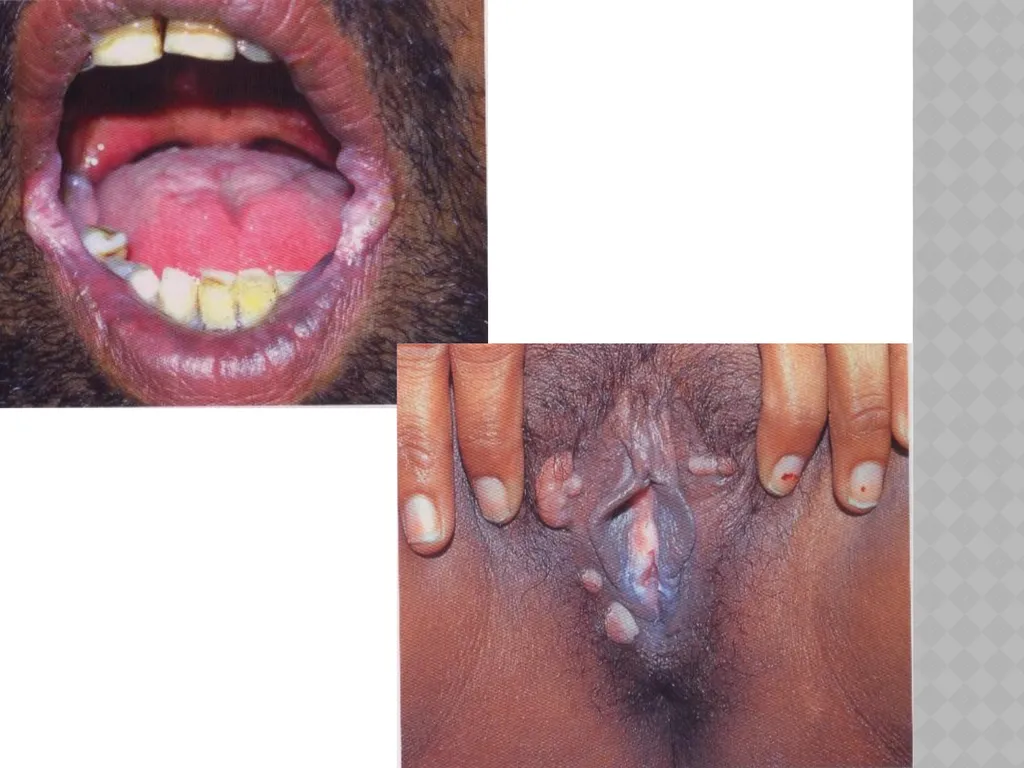
Condyloma lata – pale, elevated, moist, oozy sharply demarcated with flat surfaces which develop in warm and moist areas of the body such as genitals, perineum, perianal region, under breasts, axillae, groin.
It is highly infectious and seen in 25-60% of pts with secondary shyphilis.
At labial commissures and nosolabial folds, these lesions become elevated and fissured and are called “spilt papules”<br>
It is highly infectious and seen in 25-60% of pts with secondary shyphilis.
At labial commissures and nosolabial folds, these lesions become elevated and fissured and are called “spilt papules”<br>
22
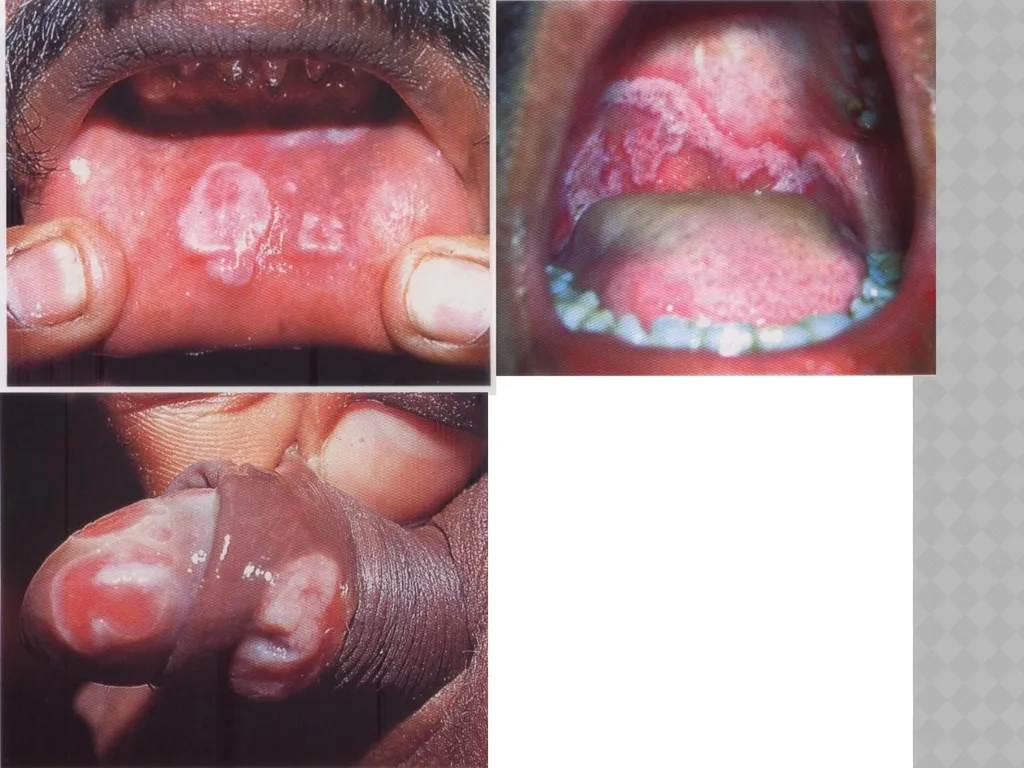
Mucous membrane involvement – mucous patches are painless, shallow lesions covered with gray macerated scaling that may appear anywhere in the mouth, more frequent along tongue and lips
Mucosal lesions are in the form of serpiginous ulcers- “snail track” ulcers, superficial erosions, papules, plaques.
The oral mucosa, tongue, lips palate, pharynx, larynx, tonsils, epiglottis may be affected.<br>
Mucosal lesions are in the form of serpiginous ulcers- “snail track” ulcers, superficial erosions, papules, plaques.
The oral mucosa, tongue, lips palate, pharynx, larynx, tonsils, epiglottis may be affected.<br>
23
Follicular rash on the scalp may give rise to 2 patterns of hair loss.
Irregular non-scarring
patchy alopecia –
“moth eaten alopecia”
It usually occurs at the margins of the scalp or rarely in the beard area, eyebrows<br>
Irregular non-scarring
patchy alopecia –
“moth eaten alopecia”
It usually occurs at the margins of the scalp or rarely in the beard area, eyebrows<br>
24
DIFFERENTIAL DIAGNOSIS: Macular – drug rash, P. versicolor, EM ,measles rubella
Papular – drug rash, LP ,acne vulgaris, papular urticaria
Papulosquamous – Psoriasis, seborrhoeic dermatitis
Annular – annular LP, granuloma annulare, impetigo, dermatophyte infection
Pustular – Acne vulgaris, ecthyma, eruptions due to bromides and iodides<br>
Papular – drug rash, LP ,acne vulgaris, papular urticaria
Papulosquamous – Psoriasis, seborrhoeic dermatitis
Annular – annular LP, granuloma annulare, impetigo, dermatophyte infection
Pustular – Acne vulgaris, ecthyma, eruptions due to bromides and iodides<br>
25
Follicular – Lichen scrofulosorum, PRP, lichen spinulosus
Alopecia – Alopecia areata, T.capitis
Leukoderma syphiliticum – P. versicolor
Condyloma lata – condyloma accuminata
Mucosal lesions over throat and tonsils – vincent’s angina, tonsillitis, diphtheria<br>
Alopecia – Alopecia areata, T.capitis
Leukoderma syphiliticum – P. versicolor
Condyloma lata – condyloma accuminata
Mucosal lesions over throat and tonsils – vincent’s angina, tonsillitis, diphtheria<br>
26
treatment A single dose of benzathine penicillin G, 2.4 million units i.m
(1.2 million units i.m on each buttock)
Given after intradermal test dose.
Alternate:
Procaine penicillin G 1.2million units / day i.m X 10 days
PENICILLIN ALLERGY
Doxycycline 100 mg orally BD x 2 wks.
Tetracycline 500 mg orally QID x 2 wks.<br>
(1.2 million units i.m on each buttock)
Given after intradermal test dose.
Alternate:
Procaine penicillin G 1.2million units / day i.m X 10 days
PENICILLIN ALLERGY
Doxycycline 100 mg orally BD x 2 wks.
Tetracycline 500 mg orally QID x 2 wks.<br>
27
LATENT STAGE Diagnosis depends on positive blood tests
Absence of clinical evidence – asymptomatic state – latency
Diagnosis:
Routine reagin test- VDRL slide test
Specific test – TPI, FTA –A BS, TPHA
Treatment :
Benzathine pencillin G 2.4 million units 1M single dose<br>
Absence of clinical evidence – asymptomatic state – latency
Diagnosis:
Routine reagin test- VDRL slide test
Specific test – TPI, FTA –A BS, TPHA
Treatment :
Benzathine pencillin G 2.4 million units 1M single dose<br>
28
Tertiary syphilis Three forms-
Benign tertiary syphilis
Cardiovascular syphilis
Neurosyphilis<br>
Benign tertiary syphilis
Cardiovascular syphilis
Neurosyphilis<br>
29
LATE BENIGN SYPHILIS
(GUMMATOUS SYPHILIS) First lesions seen – 3 – 10 yrs after primary & secondary stages
Painless nodules which ulcerates
Involves:Covering structures – skin, mucous membrane, subcutaneous & submucous tissues
Supporting structures – bones, joints, muscles ligaments
Viscera-Liver, stomach, lungs, testis<br>
Painless nodules which ulcerates
Involves:Covering structures – skin, mucous membrane, subcutaneous & submucous tissues
Supporting structures – bones, joints, muscles ligaments
Viscera-Liver, stomach, lungs, testis<br>
30
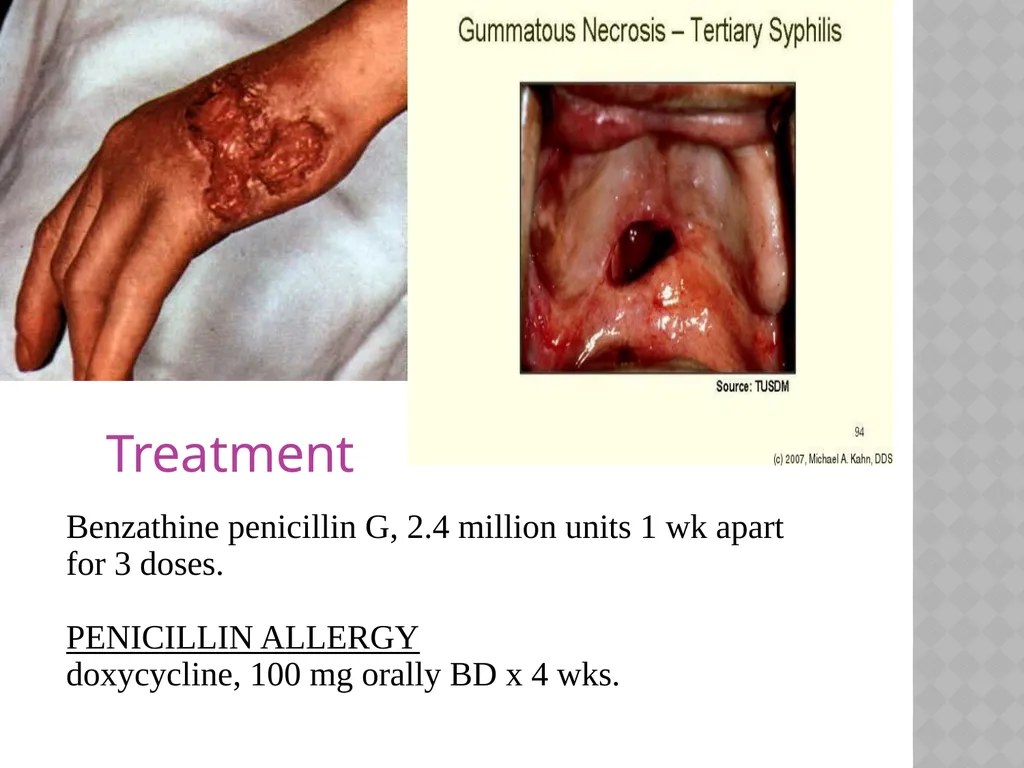
Treatment Benzathine penicillin G, 2.4 million units 1 wk apart for 3 doses.
PENICILLIN ALLERGY
doxycycline, 100 mg orally BD x 4 wks.<br>
PENICILLIN ALLERGY
doxycycline, 100 mg orally BD x 4 wks.<br>
31
Cardiovascular syphilis Manifestations include:
Aneurysms of the aorta
Aortic insuffuciency
Coronary stenosis
myocarditis<br>
Aneurysms of the aorta
Aortic insuffuciency
Coronary stenosis
myocarditis<br>
32
CLASSIFICATION
1.Asymptomatic neurosyphilis
Early
Late
2. Meningeal neurosyphylis
Acute syphilitic meningitis
Spinal syphilitic pachymeningitis
3. Meningovascular neurosyphilis
Cerebral form
Spinal form NEUROSYPHILIS<br>
1.Asymptomatic neurosyphilis
Early
Late
2. Meningeal neurosyphylis
Acute syphilitic meningitis
Spinal syphilitic pachymeningitis
3. Meningovascular neurosyphilis
Cerebral form
Spinal form NEUROSYPHILIS<br>
33
4. Parenchymatous neurosyphilis
General paresis
Tabes dorsalis
Taboparesis (mixed)
Optic atrophy
5. Gummatous neurosyphilis
Cerebral form
Spinal form<br>
General paresis
Tabes dorsalis
Taboparesis (mixed)
Optic atrophy
5. Gummatous neurosyphilis
Cerebral form
Spinal form<br>
34
Congenital syphilis Resemble secondary and tertiary syphilis
Vesicular or bullous lesions (syphilitic pemphigus)
Generalised papulosquamous eruptions
Palmoplantar eruptions
Perioral and perianal rhagades
Paronychias
Patchy alopecia
Nasal snuffles, saddle nose
Osteochondritis, periostitis, dactylitis, pseudoparalysis<br>
Vesicular or bullous lesions (syphilitic pemphigus)
Generalised papulosquamous eruptions
Palmoplantar eruptions
Perioral and perianal rhagades
Paronychias
Patchy alopecia
Nasal snuffles, saddle nose
Osteochondritis, periostitis, dactylitis, pseudoparalysis<br>
35
Wimberg’s sign or Cat Bite Sign : loss of density over the medial aspect of upper tibia. usually B/L<br>
36
LESIONS OF JOINTS :
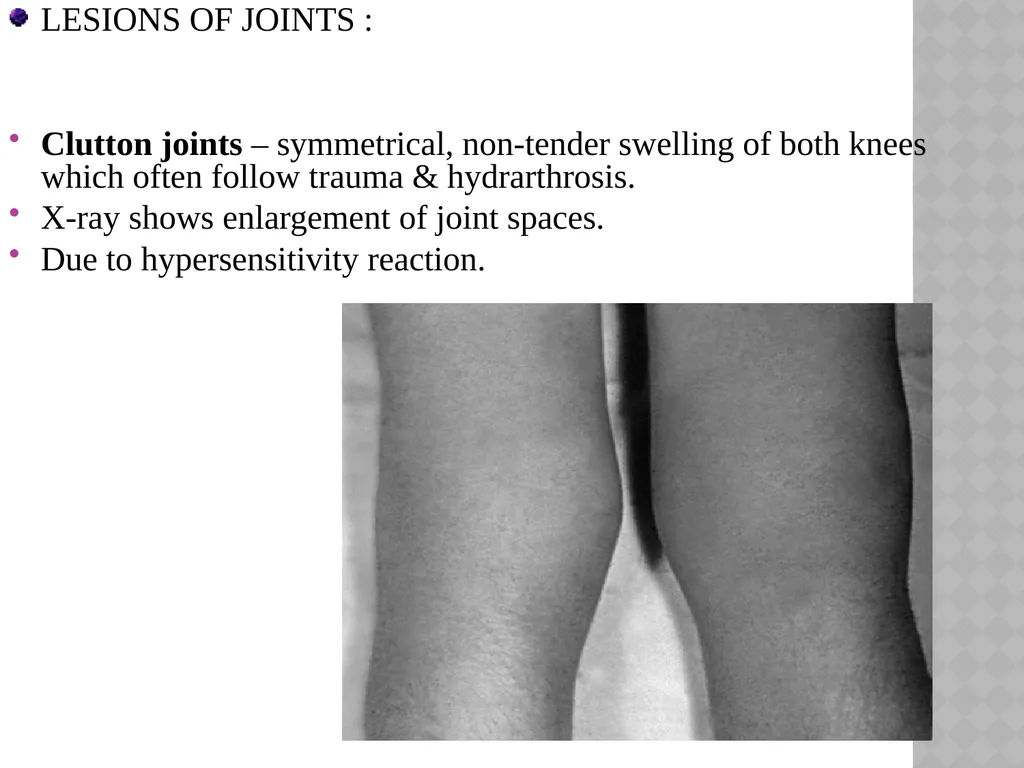
Clutton joints – symmetrical, non-tender swelling of both knees which often follow trauma & hydrarthrosis.
X-ray shows enlargement of joint spaces.
Due to hypersensitivity reaction.<br>
Clutton joints – symmetrical, non-tender swelling of both knees which often follow trauma & hydrarthrosis.
X-ray shows enlargement of joint spaces.
Due to hypersensitivity reaction.<br>
37
Systemic features – hepatosplenomegaly, lymphadenopathy, pneumonitis, anaemia, uveitis
Clinical manifestations in late prenatal stage (> 2yrs) are interstitial keratitis, deafness and hutchinson’s teeth - - hutchinson’s triad<br>
Clinical manifestations in late prenatal stage (> 2yrs) are interstitial keratitis, deafness and hutchinson’s teeth - - hutchinson’s triad<br>
38
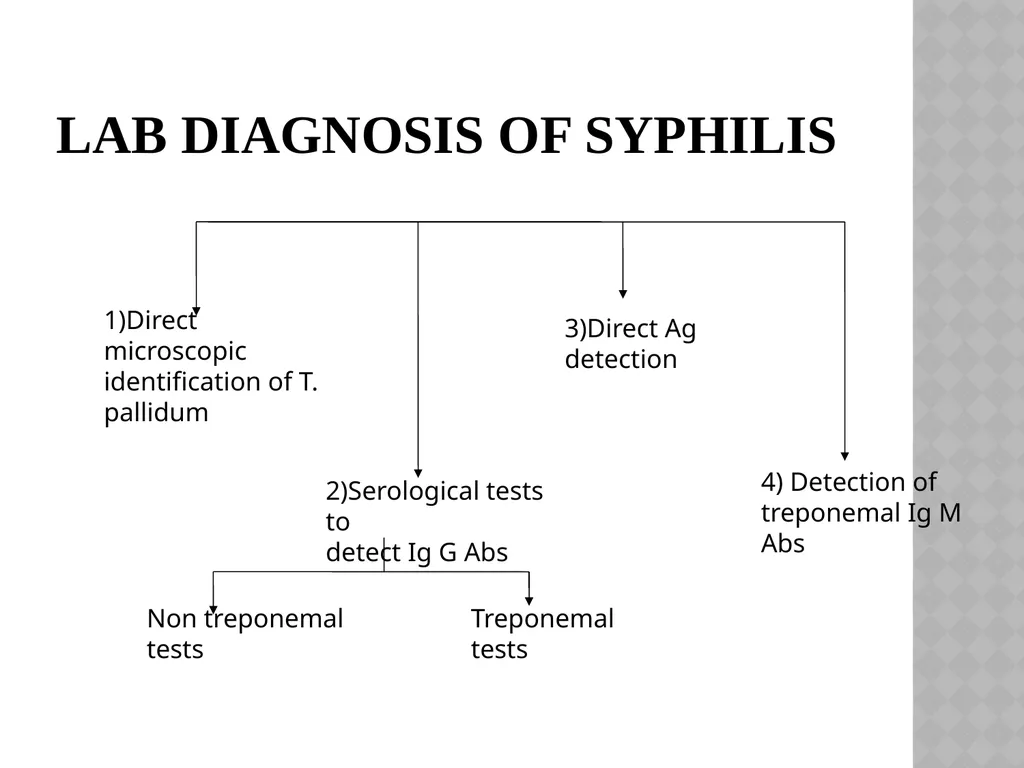
LAB diagnosis of syphilis 1)Direct microscopic identification of T. pallidum 2)Serological tests to detect Ig G Abs 3)Direct Ag detection 4) Detection of treponemal Ig M Abs Non treponemal tests Treponemal tests<br>
39
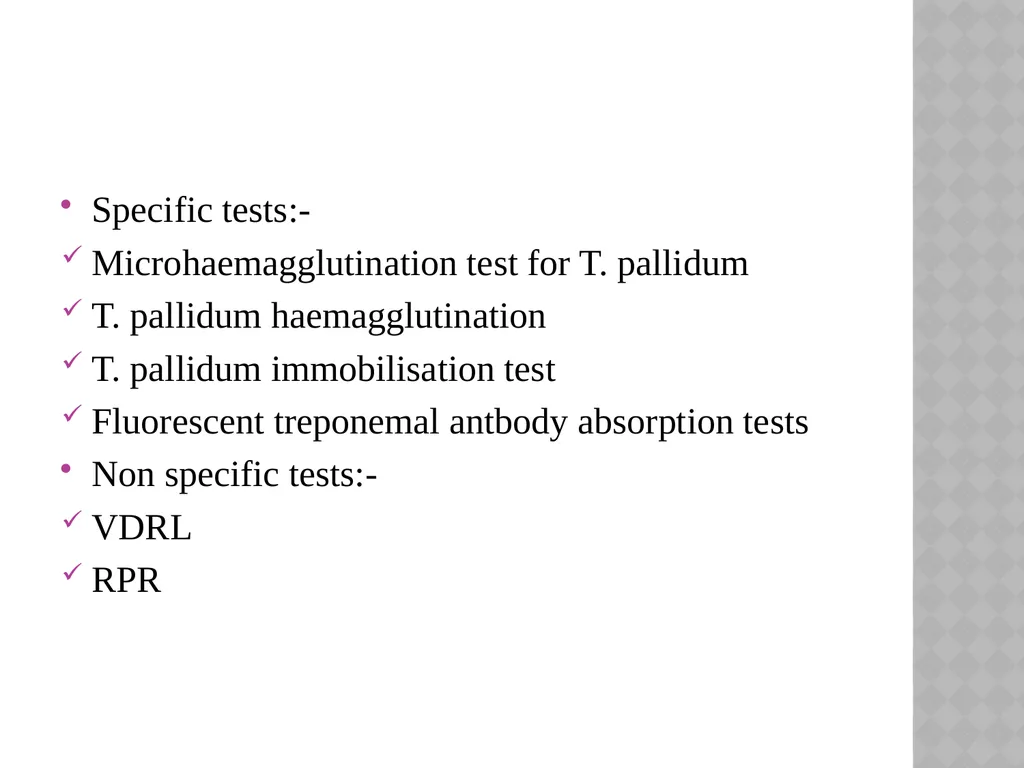
Specific tests:-
Microhaemagglutination test for T. pallidum
T. pallidum haemagglutination
T. pallidum immobilisation test
Fluorescent treponemal antbody absorption tests
Non specific tests:-
VDRL
RPR<br>
Microhaemagglutination test for T. pallidum
T. pallidum haemagglutination
T. pallidum immobilisation test
Fluorescent treponemal antbody absorption tests
Non specific tests:-
VDRL
RPR<br>
40
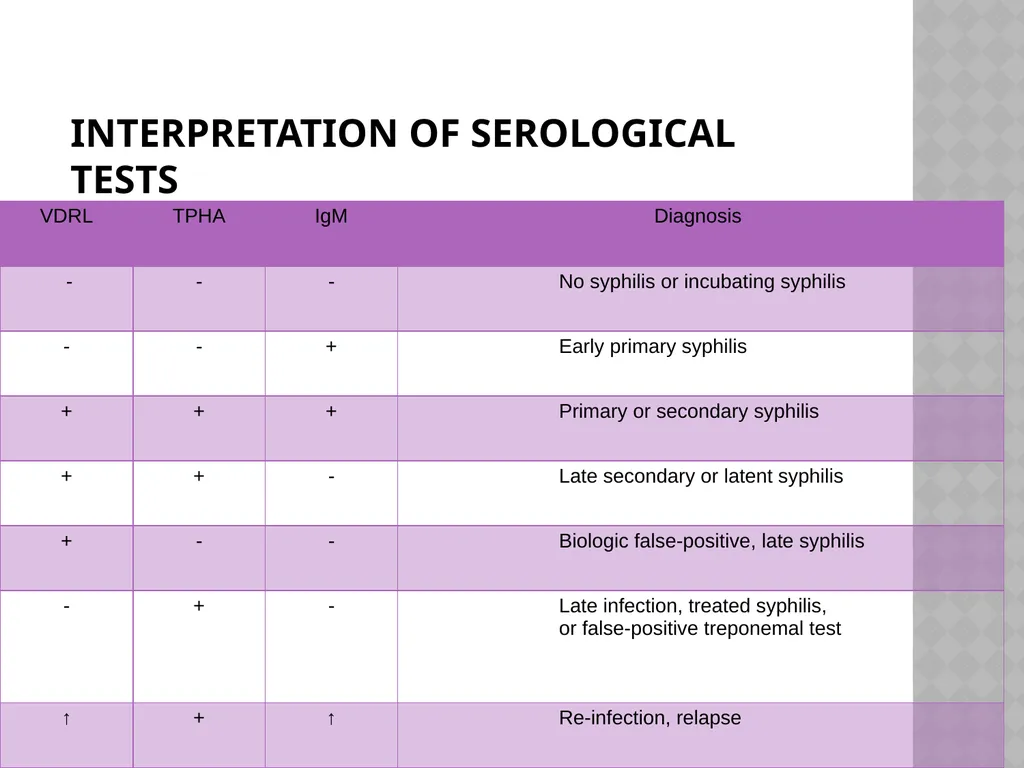
Interpretation of serological tests<br>
41
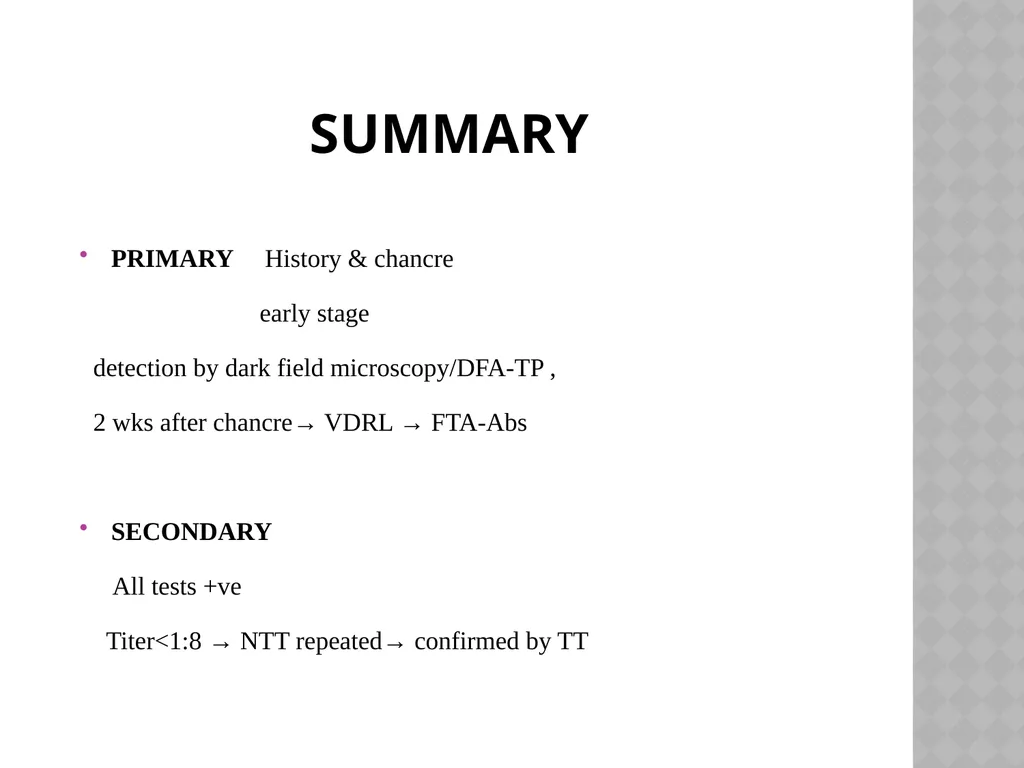
Summary PRIMARY History & chancre
early stage
detection by dark field microscopy/DFA-TP ,
2 wks after chancre→ VDRL → FTA-Abs
SECONDARY
All tests +ve
Titer<1:8 → NTT repeated→ confirmed by TT<br>
early stage
detection by dark field microscopy/DFA-TP ,
2 wks after chancre→ VDRL → FTA-Abs
SECONDARY
All tests +ve
Titer<1:8 → NTT repeated→ confirmed by TT<br>
42
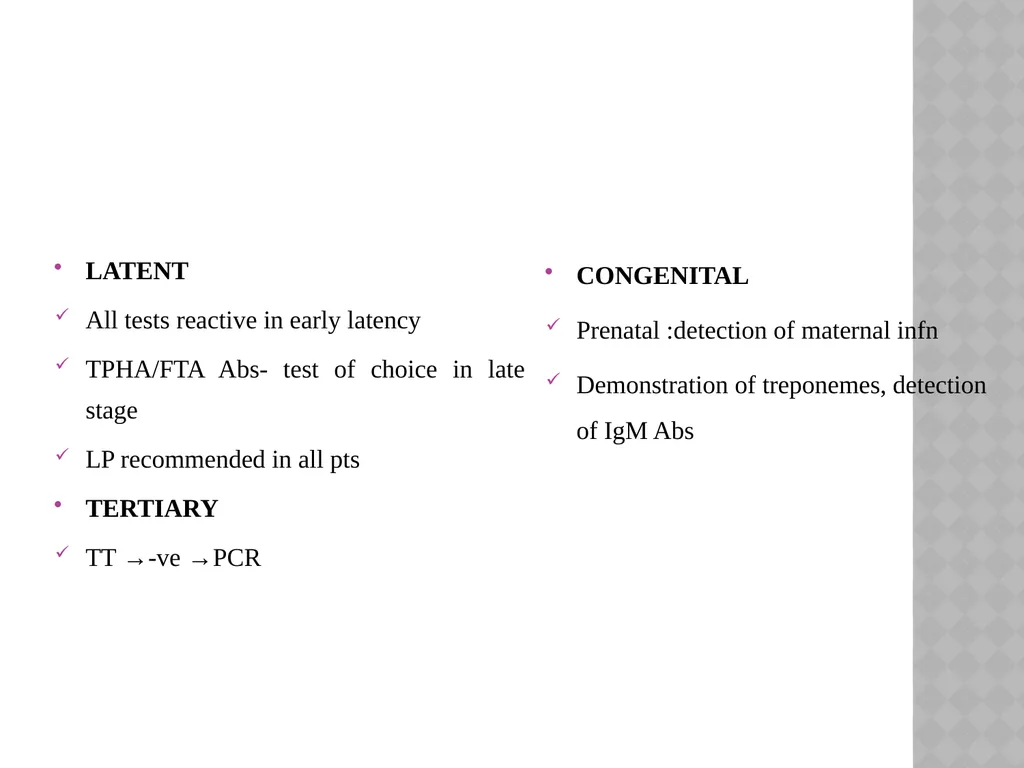
LATENT
All tests reactive in early latency
TPHA/FTA Abs- test of choice in late stage
LP recommended in all pts
TERTIARY
TT →-ve →PCR CONGENITAL
Prenatal :detection of maternal infn
Demonstration of treponemes, detection of IgM Abs<br>
All tests reactive in early latency
TPHA/FTA Abs- test of choice in late stage
LP recommended in all pts
TERTIARY
TT →-ve →PCR CONGENITAL
Prenatal :detection of maternal infn
Demonstration of treponemes, detection of IgM Abs<br>
43
Treatment of syphilis<br>
44
History Until early 20th century ….., MERCURY and ARSENIC were the only drugs available.
But its highly toxic nature limited its use.
Later..
Different forms of ARSENIC, “EHRLICH’S SOLUTION” & i.v. NEOARSPHENAMINE along with Bismuth were used for 9- 15 months.
POTASSIUM IODIDE – gummatous lesions<br>
But its highly toxic nature limited its use.
Later..
Different forms of ARSENIC, “EHRLICH’S SOLUTION” & i.v. NEOARSPHENAMINE along with Bismuth were used for 9- 15 months.
POTASSIUM IODIDE – gummatous lesions<br>
45
FEVER induced by mechanical means or by inoculation of infective agents eg: malaria has also been used
1943 PENICILLIN first used by MAHONEY, ARNOLD & HARRIS in Rx of syphilis.
Penicillin – G, F, X, K.<br>
1943 PENICILLIN first used by MAHONEY, ARNOLD & HARRIS in Rx of syphilis.
Penicillin – G, F, X, K.<br>
46
Parenteral penicillin is the treatment of choice for all stages of syphilis
Parenteral penicillin is the only treatment with documented efficacy in neurosyphilis, HIV infection, and pregnancy.<br>
Parenteral penicillin is the only treatment with documented efficacy in neurosyphilis, HIV infection, and pregnancy.<br>
47
Introduction of penicillin has simplified the management.
Parenteral penicillin is the preferred drug for treating all stages of syphilis.
Only drug efficacious for neurosyphilis and syphilis in pregnancy.
After >60yrs experience, results continue to be excellent, with no signs of resistance.<br>
Parenteral penicillin is the preferred drug for treating all stages of syphilis.
Only drug efficacious for neurosyphilis and syphilis in pregnancy.
After >60yrs experience, results continue to be excellent, with no signs of resistance.<br>
48
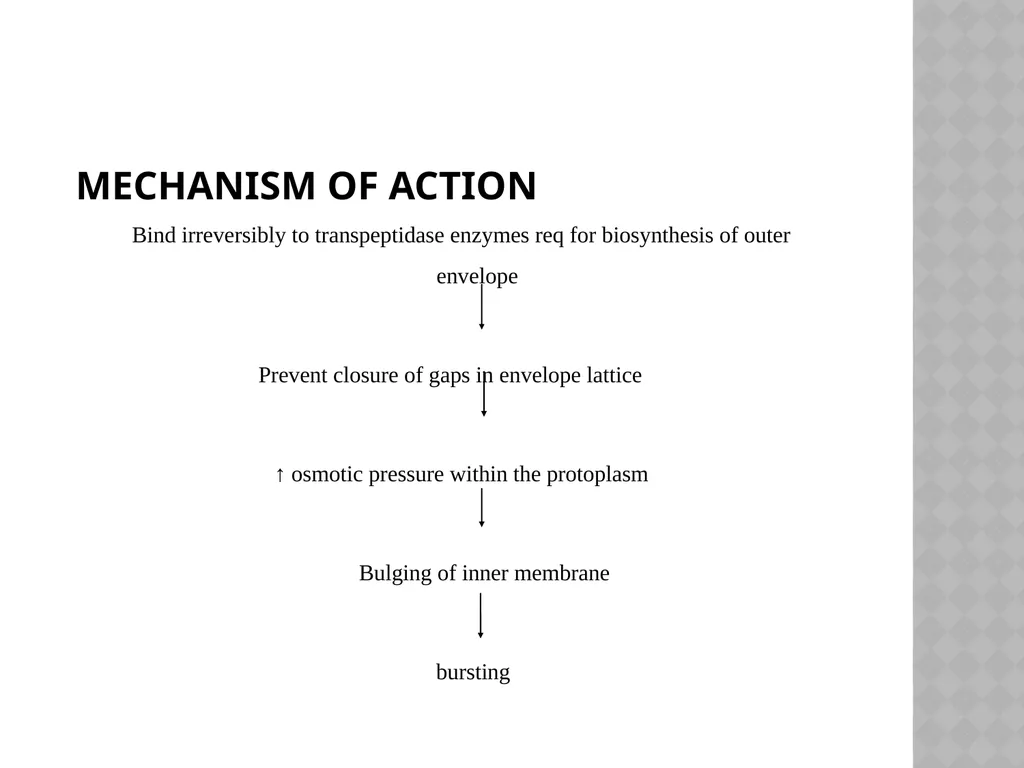
MECHANISM OF ACTION Bind irreversibly to transpeptidase enzymes req for biosynthesis of outer envelope
Prevent closure of gaps in envelope lattice
↑ osmotic pressure within the protoplasm
Bulging of inner membrane
bursting<br>
Prevent closure of gaps in envelope lattice
↑ osmotic pressure within the protoplasm
Bulging of inner membrane
bursting<br>
49
Complications of treatment Jarisch Herxheimer reaction
Therapeutic paradox
Hoigne syndrome (pseudoanaphylactic reaction)
Anaphylaxis<br>
Therapeutic paradox
Hoigne syndrome (pseudoanaphylactic reaction)
Anaphylaxis<br>
50
Jarisch Herxheimer reaction Clinical syndrome consisting of fever, headache, flare of mucocutaneous lesions, tender lymphadenopathy, pharyngitis, malaise, myalgias, and leukocytosis
Endotoxemia caused by the release of lipopolysaccharides from degenerating treponemes
Occurs within 24 hours of instituting therapy and subsides in 12-24 hours
The fever peaks in 6 to 8 hours usually around 39°C, but can go as high as 42°C
Patient should be warned about this reaction
Treatment
Bed rest
Aspirin, Corticosteroids<br>
Endotoxemia caused by the release of lipopolysaccharides from degenerating treponemes
Occurs within 24 hours of instituting therapy and subsides in 12-24 hours
The fever peaks in 6 to 8 hours usually around 39°C, but can go as high as 42°C
Patient should be warned about this reaction
Treatment
Bed rest
Aspirin, Corticosteroids<br>
51
Therapeutic paradox Deterioration of tertiary syphilis after therapy
Results from rapid decomposition of gummatous tissue
Worsening of the aortic insufficiency murmur has been reported from this complication<br>
Results from rapid decomposition of gummatous tissue
Worsening of the aortic insufficiency murmur has been reported from this complication<br>
52
Hoigne syndrome Complication associated with IM procaine penicillin treatment (1 case per 1000)secondary to crystals of procaine penicillin
Due to microembolism in brain
Reaction occurs immediately after the injection
Tachycardia, elevated BP, fear of imminent death, anxiety, violent combativeness, unusual taste sensation, auditory or visual hallucinations, neuromuscular twitching, occasional seizures, and even loss of consciousness
Does not last more than 30 minutes
Treatment
Observation
Sedatives or anticonvulsants<br>
Due to microembolism in brain
Reaction occurs immediately after the injection
Tachycardia, elevated BP, fear of imminent death, anxiety, violent combativeness, unusual taste sensation, auditory or visual hallucinations, neuromuscular twitching, occasional seizures, and even loss of consciousness
Does not last more than 30 minutes
Treatment
Observation
Sedatives or anticonvulsants<br>
53
Treatment of sex partners Examine the exposed person and do a serologic test
Treat the contact if there is clinical or serologic evidence of disease
Treat prophylactically for primary syphilis if
The exposure occurred within 90 days preceding the sex partner's diagnosis of early syphilis
The exposure occurred more than 90 days before the sex partner's diagnosis of early syphilis, but serologic tests are not immediately available, and reliability is uncertain
The evaluation of a long-term sex partner of a person with latent syphilis demonstrates possible transmission serologically or clinically<br>
Treat the contact if there is clinical or serologic evidence of disease
Treat prophylactically for primary syphilis if
The exposure occurred within 90 days preceding the sex partner's diagnosis of early syphilis
The exposure occurred more than 90 days before the sex partner's diagnosis of early syphilis, but serologic tests are not immediately available, and reliability is uncertain
The evaluation of a long-term sex partner of a person with latent syphilis demonstrates possible transmission serologically or clinically<br>
54
Epidemiological treatment Treat contacts prophylactically for primary syphilis if
The exposure occurred within 90 days preceding the sex partner's diagnosis of early syphilis
Living conditions are favourable to the spread of the disease
The patient will not return
The contact has evidence of infectious syphilis
The female partner is pregnant<br>
The exposure occurred within 90 days preceding the sex partner's diagnosis of early syphilis
Living conditions are favourable to the spread of the disease
The patient will not return
The contact has evidence of infectious syphilis
The female partner is pregnant<br>
55
Follow up of patients Treatment is incomplete if the patient is not followed up
VDRL/TPHA recommended at 1, 3, and 6 months after treatment
Then at every 6 months
For 2 years in early syphilis
For 3 years in late syphilis
If HIV infected then follow up is done every 3 months
Evaluation of sexual partners is necessary<br>
VDRL/TPHA recommended at 1, 3, and 6 months after treatment
Then at every 6 months
For 2 years in early syphilis
For 3 years in late syphilis
If HIV infected then follow up is done every 3 months
Evaluation of sexual partners is necessary<br>
56
Penicillin allergy / Anaphylaxis Penicillins are low molecular weight compounds that covalently bind to tissue carrier proteins and form drug-protein complexes or haptens which makes them immunogenic.
95% of tissue bound penicillin is haptenated as BENZYL PENICILLOYL – ‘’MAJOR ANTIGENIC DETERMINANT.’’
Remaining 5% molecules are termed as “minor antigenic determinants”
BENZYL PENICILLIN
BENZYLPENICILLOATE
BENZYL PENILLOATE
BENZYL PENILLOIC ACID<br>
95% of tissue bound penicillin is haptenated as BENZYL PENICILLOYL – ‘’MAJOR ANTIGENIC DETERMINANT.’’
Remaining 5% molecules are termed as “minor antigenic determinants”
BENZYL PENICILLIN
BENZYLPENICILLOATE
BENZYL PENILLOATE
BENZYL PENILLOIC ACID<br>
57
Skin testing with both major and minor antigenic determinants is gold standard for detecting penicillin allergy.
In USA the major antigenic determinants are commercially available as “BENZYL PENILLOYL POLYLYSINE” (PPL).
Many researches use penicillin G at a concentration of 10,000 U/ml as a partial source of minor determinants.<br>
In USA the major antigenic determinants are commercially available as “BENZYL PENILLOYL POLYLYSINE” (PPL).
Many researches use penicillin G at a concentration of 10,000 U/ml as a partial source of minor determinants.<br>
58
A commercial kit containing both these determinants – available in Europe (ALLERGOPEN) withdrawn from market in 2005.
New kit with both major and minor determinants is commercialized in Spain for skin testing (DIATER labs, Madrid, Spain)<br>
New kit with both major and minor determinants is commercialized in Spain for skin testing (DIATER labs, Madrid, Spain)<br>
59
PRICK TEST (EPICUTANEOUS) Duplicate drops of reagents for skin testing are placed on volar aspect of forearm, underlying epidermis is pierced with 26G needle. Reading is taken after 15mins.
POSITIVE- >4mm<br>
POSITIVE- >4mm<br>
60
Treatment of penicillin allergic reactions/anaphylaxis Acute reactions
Inj adrenaline 0.6ml of 1:1000 solution IM
Inj Hydrocortisone 250mg followed by 1000mg during succeeding 24 hours.
Inj amynophilline 250mg in 10ml strile water to relieve bronchospasm.
Delayed reactions
Antihistaminics or steroids<br>
Inj adrenaline 0.6ml of 1:1000 solution IM
Inj Hydrocortisone 250mg followed by 1000mg during succeeding 24 hours.
Inj amynophilline 250mg in 10ml strile water to relieve bronchospasm.
Delayed reactions
Antihistaminics or steroids<br>
61
Retreatment Serologies generally
Decrease fourfold at 3 months
Eightfold at 6 months
Return to normal
Within 6 to 12 months of treatment of primary syphilis
Within 12 to 18 months of treatment of secondary syphilis
Small proportion of patients will remain seropositive lifelong at a low titer – serofast state<br>
Decrease fourfold at 3 months
Eightfold at 6 months
Return to normal
Within 6 to 12 months of treatment of primary syphilis
Within 12 to 18 months of treatment of secondary syphilis
Small proportion of patients will remain seropositive lifelong at a low titer – serofast state<br>
62
Retreatment Retreatment (same treatment as for syphilis of >1 year duration) should be considered if
Clinical disease continues or recurs
The quantitative serologic titer measured at 3-month intervals does not decrease at least fourfold (two tube dilutions) within 1 year
The quantitative serologic titer increases fourfold (two tube dilutions), representing either relapse or reinfection<br>
Clinical disease continues or recurs
The quantitative serologic titer measured at 3-month intervals does not decrease at least fourfold (two tube dilutions) within 1 year
The quantitative serologic titer increases fourfold (two tube dilutions), representing either relapse or reinfection<br>
63
Summary Syphilis is a complex disease with various stages
Serological tests play an important role in diagnosis of the disease
Penicillin still remains the treatment of choice today<br>
Serological tests play an important role in diagnosis of the disease
Penicillin still remains the treatment of choice today<br>
64
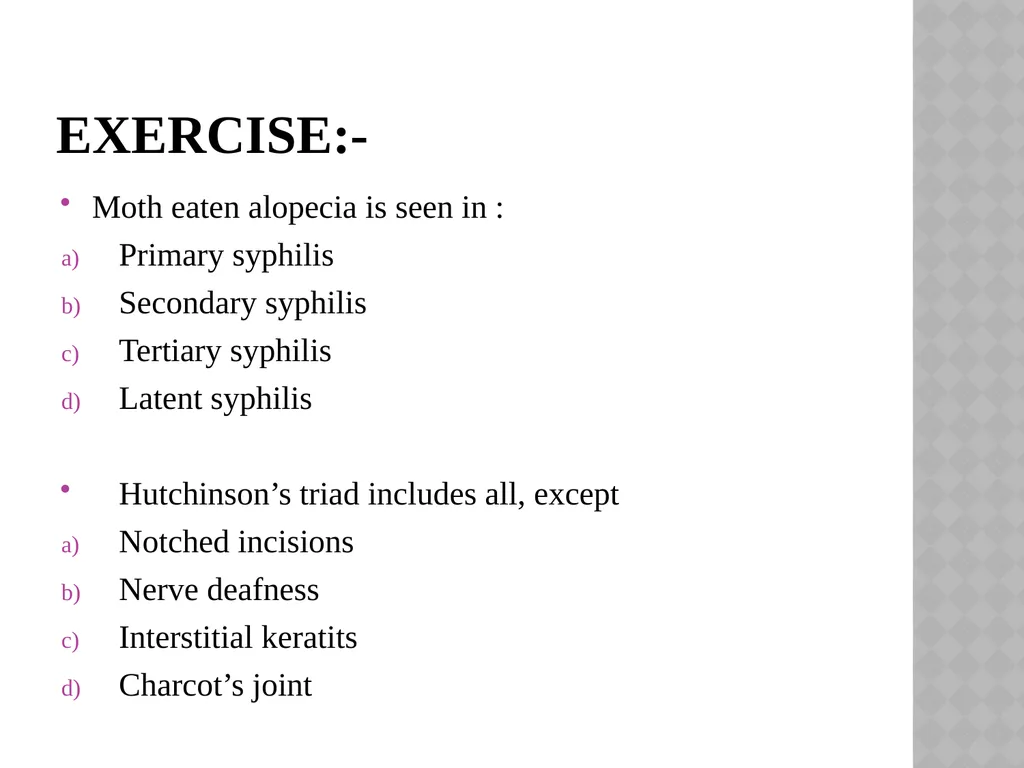
Exercise:- Moth eaten alopecia is seen in :
Primary syphilis
Secondary syphilis
Tertiary syphilis
Latent syphilis
Hutchinson’s triad includes all, except
Notched incisions
Nerve deafness
Interstitial keratits
Charcot’s joint<br>
Primary syphilis
Secondary syphilis
Tertiary syphilis
Latent syphilis
Hutchinson’s triad includes all, except
Notched incisions
Nerve deafness
Interstitial keratits
Charcot’s joint<br>
65
A 24 yr old male had an ulcer of size 0.2 x 2 cm over shaft of penis, painless, well circumscribed, round and indurated, with no tender inguinal lymphadenopathy. You suspect:
Syphilitic chancre
Chancroid
Herpes genitalis
LGV<br>
Syphilitic chancre
Chancroid
Herpes genitalis
LGV<br>