
Systematic Theology Lecture 3: The Attributes of
LD
Published · 24 slides · 0 views

1 / 1

Description
Systematic Theology Lecture 3: The Attributes of God Part 1 The Existence of God, The Knowability of God, The Names of God The Existence of God 1. All people have an inner sense of God Romans 1:18-25, 10:14-2 2. There is abundant reliable
Related Topics
Share
Embed code
Download this presentation From Below
"Systematic Theology Lecture 3: The Attributes of" is the property of its rightful owner. Permission is granted to download and print the materials on this website for personal, non-commercial use only, and to display it on your personal computer provided you do not modify the materials and that you retain all copyright notices contained in the materials. By downloading content from our website, you accept the terms of this agreement.
Presentation Transcript
01
Systematic Theology Lecture 3: The Attributes of God Part 1
The Existence of God, The Knowability of God, The Names of God<br>
02
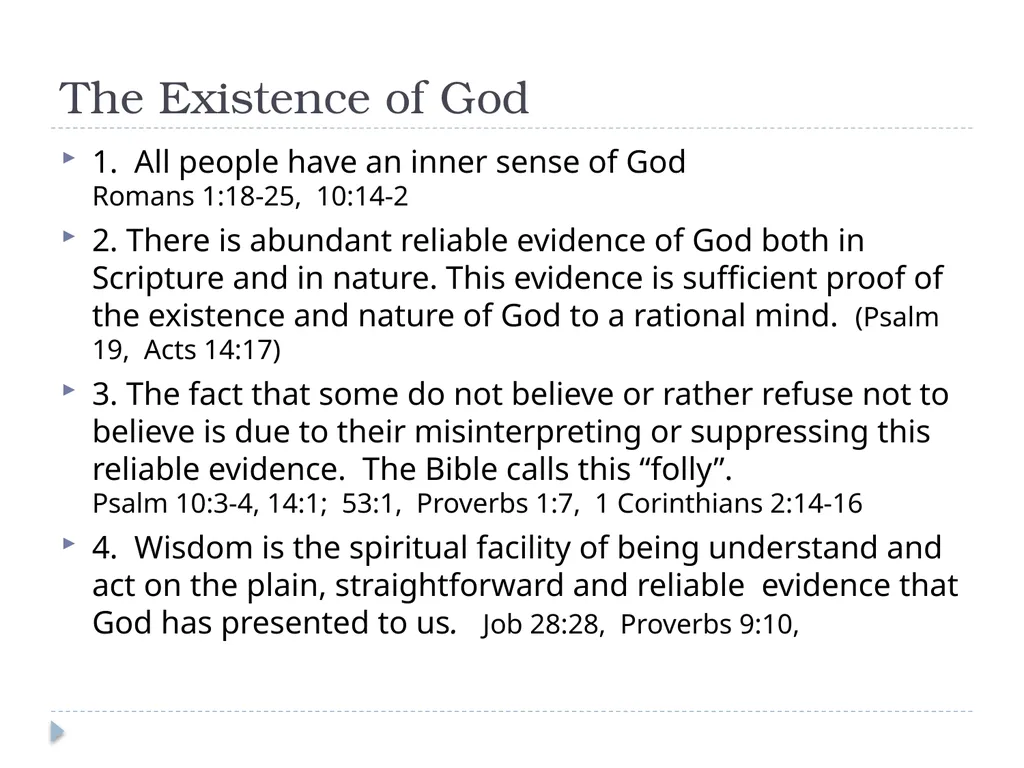
The Existence of God 1. All people have an inner sense of God
Romans 1:18-25, 10:14-2
2. There is abundant reliable evidence of God both in Scripture and in nature. This evidence is sufficient proof of the existence and nature of God to a rational mind. (Psalm 19, Acts 14:17)
3. The fact that some do not believe or rather refuse not to believe is due to their misinterpreting or suppressing this reliable evidence. The Bible calls this “folly”. Psalm 10:3-4, 14:1; 53:1, Proverbs 1:7, 1 Corinthians 2:14-16
4. Wisdom is the spiritual facility of being understand and act on the plain, straightforward and reliable evidence that God has presented to us. Job 28:28, Proverbs 9:10,<br>
2. There is abundant reliable evidence of God both in Scripture and in nature. This evidence is sufficient proof of the existence and nature of God to a rational mind. (Psalm 19, Acts 14:17)
3. The fact that some do not believe or rather refuse not to believe is due to their misinterpreting or suppressing this reliable evidence. The Bible calls this “folly”. Psalm 10:3-4, 14:1; 53:1, Proverbs 1:7, 1 Corinthians 2:14-16
4. Wisdom is the spiritual facility of being understand and act on the plain, straightforward and reliable evidence that God has presented to us. Job 28:28, Proverbs 9:10,<br>
03
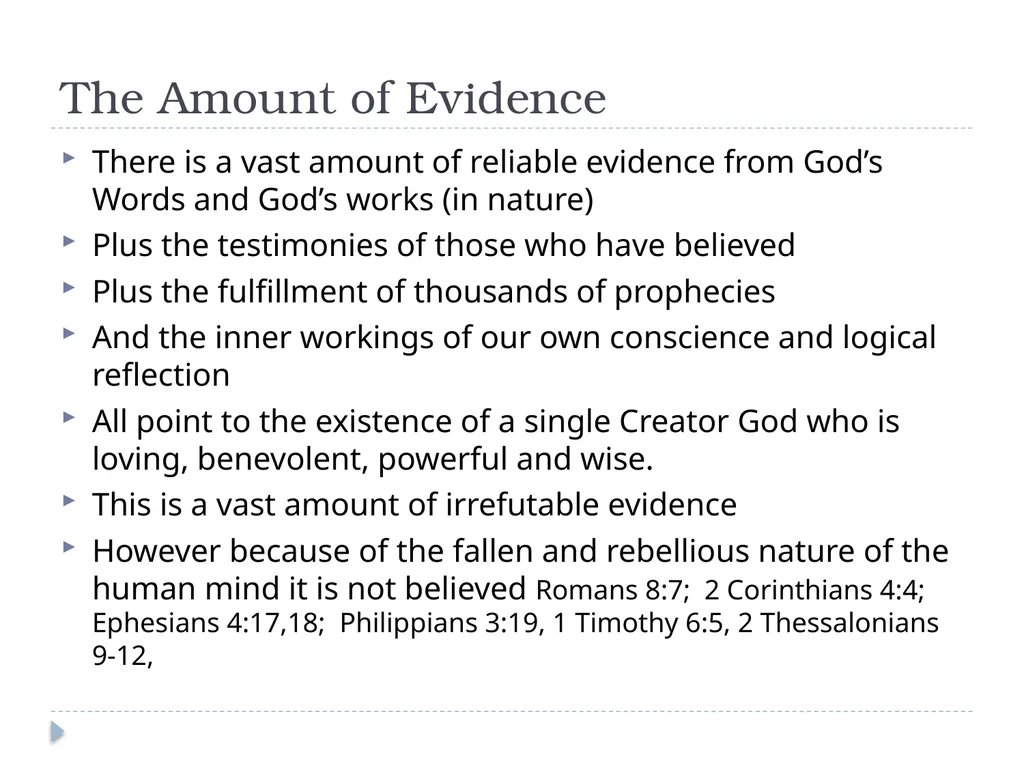
The Amount of Evidence There is a vast amount of reliable evidence from God’s Words and God’s works (in nature)
Plus the testimonies of those who have believed
Plus the fulfillment of thousands of prophecies
And the inner workings of our own conscience and logical reflection
All point to the existence of a single Creator God who is loving, benevolent, powerful and wise.
This is a vast amount of irrefutable evidence
However because of the fallen and rebellious nature of the human mind it is not believed Romans 8:7; 2 Corinthians 4:4; Ephesians 4:17,18; Philippians 3:19, 1 Timothy 6:5, 2 Thessalonians 9-12,<br>
Plus the testimonies of those who have believed
Plus the fulfillment of thousands of prophecies
And the inner workings of our own conscience and logical reflection
All point to the existence of a single Creator God who is loving, benevolent, powerful and wise.
This is a vast amount of irrefutable evidence
However because of the fallen and rebellious nature of the human mind it is not believed Romans 8:7; 2 Corinthians 4:4; Ephesians 4:17,18; Philippians 3:19, 1 Timothy 6:5, 2 Thessalonians 9-12,<br>
04
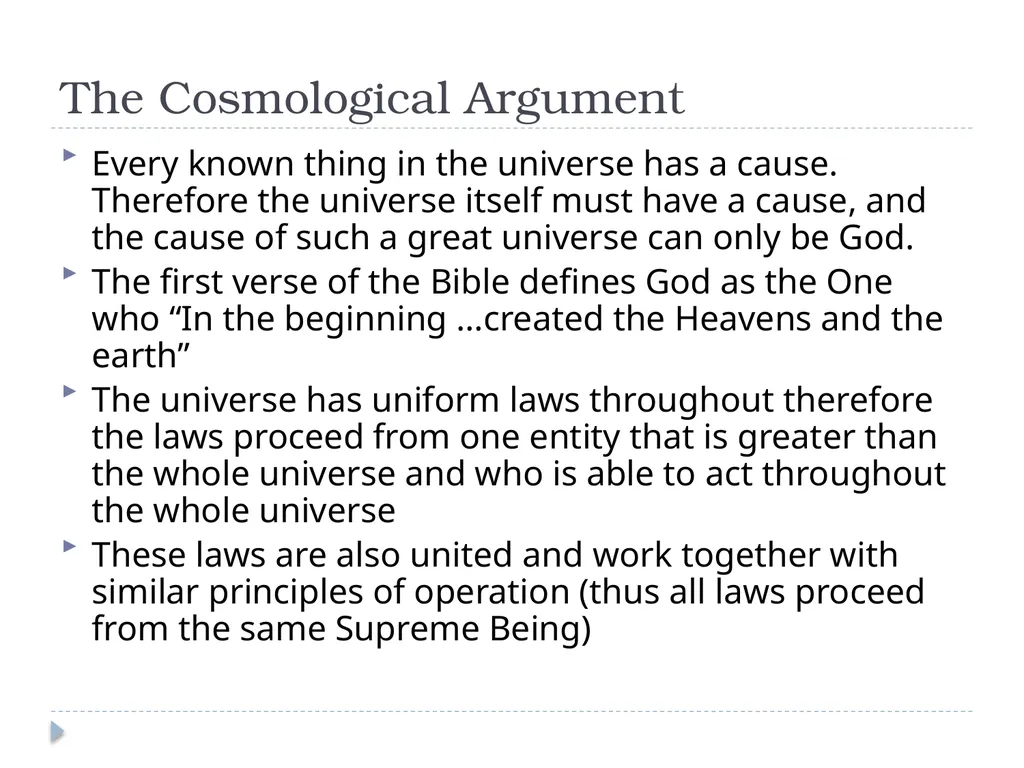
The Cosmological Argument Every known thing in the universe has a cause. Therefore the universe itself must have a cause, and the cause of such a great universe can only be God.
The first verse of the Bible defines God as the One who “In the beginning …created the Heavens and the earth”
The universe has uniform laws throughout therefore the laws proceed from one entity that is greater than the whole universe and who is able to act throughout the whole universe
These laws are also united and work together with similar principles of operation (thus all laws proceed from the same Supreme Being)<br>
The first verse of the Bible defines God as the One who “In the beginning …created the Heavens and the earth”
The universe has uniform laws throughout therefore the laws proceed from one entity that is greater than the whole universe and who is able to act throughout the whole universe
These laws are also united and work together with similar principles of operation (thus all laws proceed from the same Supreme Being)<br>
05
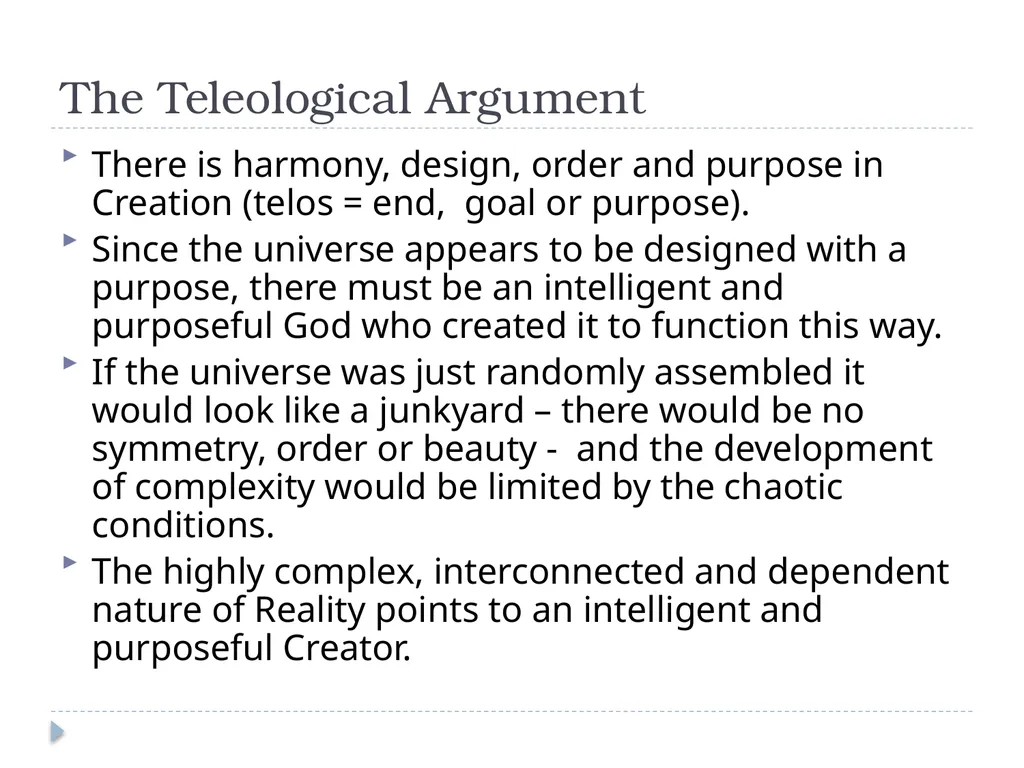
The Teleological Argument There is harmony, design, order and purpose in Creation (telos = end, goal or purpose).
Since the universe appears to be designed with a purpose, there must be an intelligent and purposeful God who created it to function this way.
If the universe was just randomly assembled it would look like a junkyard – there would be no symmetry, order or beauty - and the development of complexity would be limited by the chaotic conditions.
The highly complex, interconnected and dependent nature of Reality points to an intelligent and purposeful Creator.<br>
Since the universe appears to be designed with a purpose, there must be an intelligent and purposeful God who created it to function this way.
If the universe was just randomly assembled it would look like a junkyard – there would be no symmetry, order or beauty - and the development of complexity would be limited by the chaotic conditions.
The highly complex, interconnected and dependent nature of Reality points to an intelligent and purposeful Creator.<br>
06
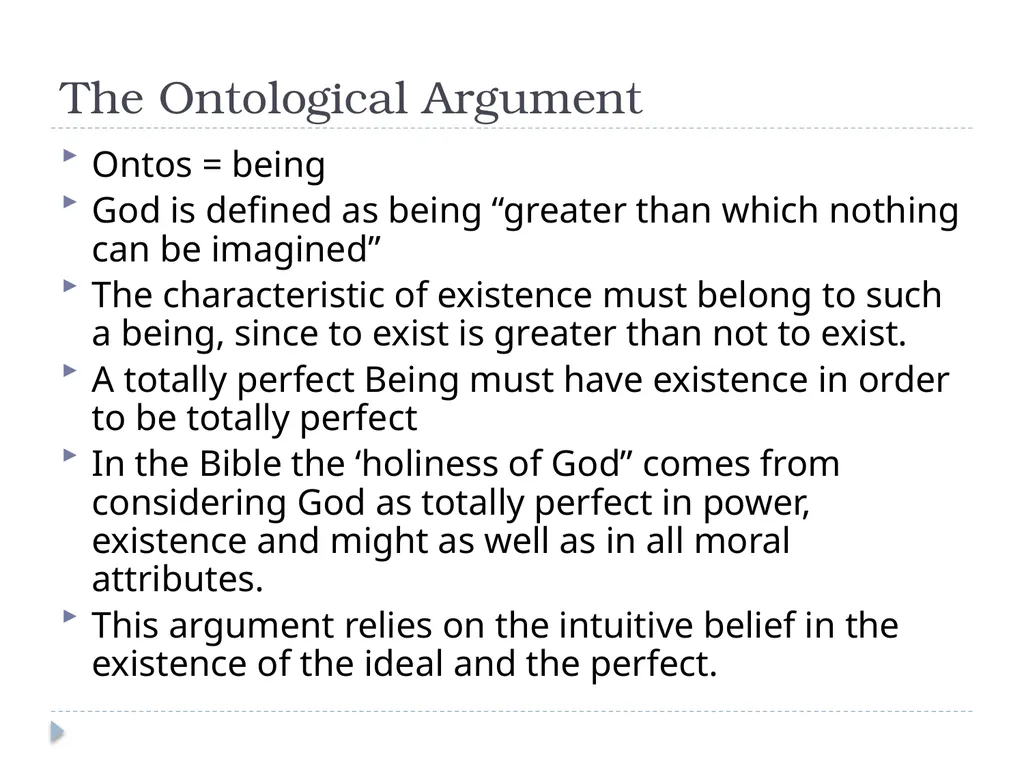
The Ontological Argument Ontos = being
God is defined as being “greater than which nothing can be imagined”
The characteristic of existence must belong to such a being, since to exist is greater than not to exist.
A totally perfect Being must have existence in order to be totally perfect
In the Bible the ‘holiness of God” comes from considering God as totally perfect in power, existence and might as well as in all moral attributes.
This argument relies on the intuitive belief in the existence of the ideal and the perfect.<br>
God is defined as being “greater than which nothing can be imagined”
The characteristic of existence must belong to such a being, since to exist is greater than not to exist.
A totally perfect Being must have existence in order to be totally perfect
In the Bible the ‘holiness of God” comes from considering God as totally perfect in power, existence and might as well as in all moral attributes.
This argument relies on the intuitive belief in the existence of the ideal and the perfect.<br>
07
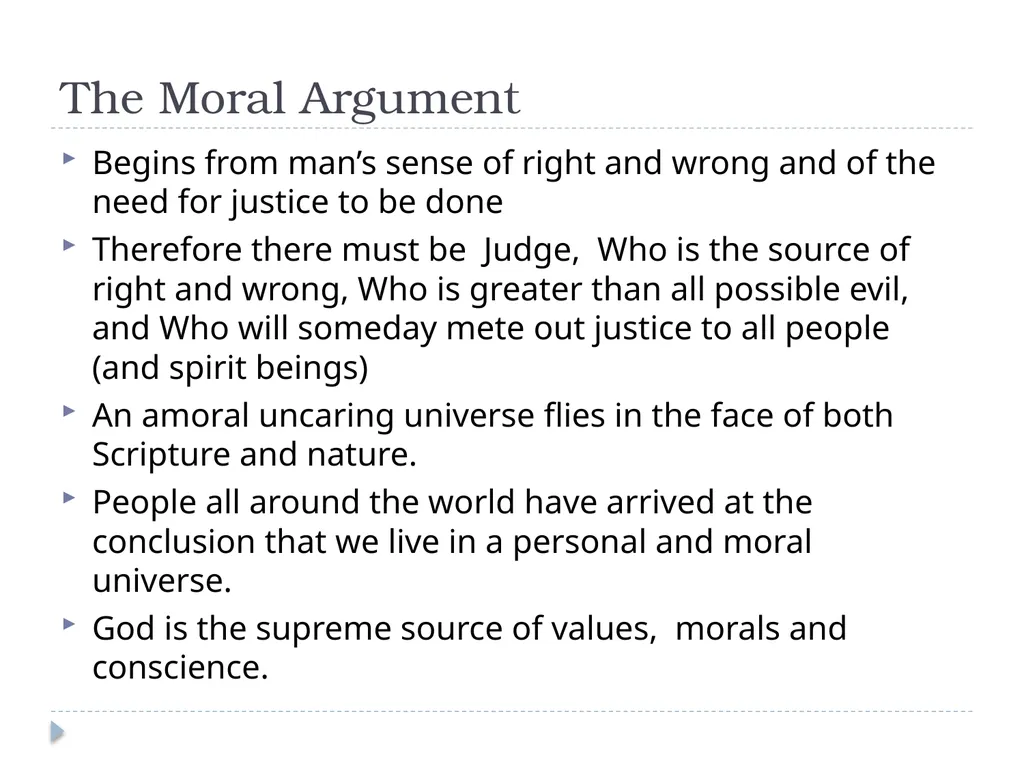
The Moral Argument Begins from man’s sense of right and wrong and of the need for justice to be done
Therefore there must be Judge, Who is the source of right and wrong, Who is greater than all possible evil, and Who will someday mete out justice to all people (and spirit beings)
An amoral uncaring universe flies in the face of both Scripture and nature.
People all around the world have arrived at the conclusion that we live in a personal and moral universe.
God is the supreme source of values, morals and conscience.<br>
Therefore there must be Judge, Who is the source of right and wrong, Who is greater than all possible evil, and Who will someday mete out justice to all people (and spirit beings)
An amoral uncaring universe flies in the face of both Scripture and nature.
People all around the world have arrived at the conclusion that we live in a personal and moral universe.
God is the supreme source of values, morals and conscience.<br>
08
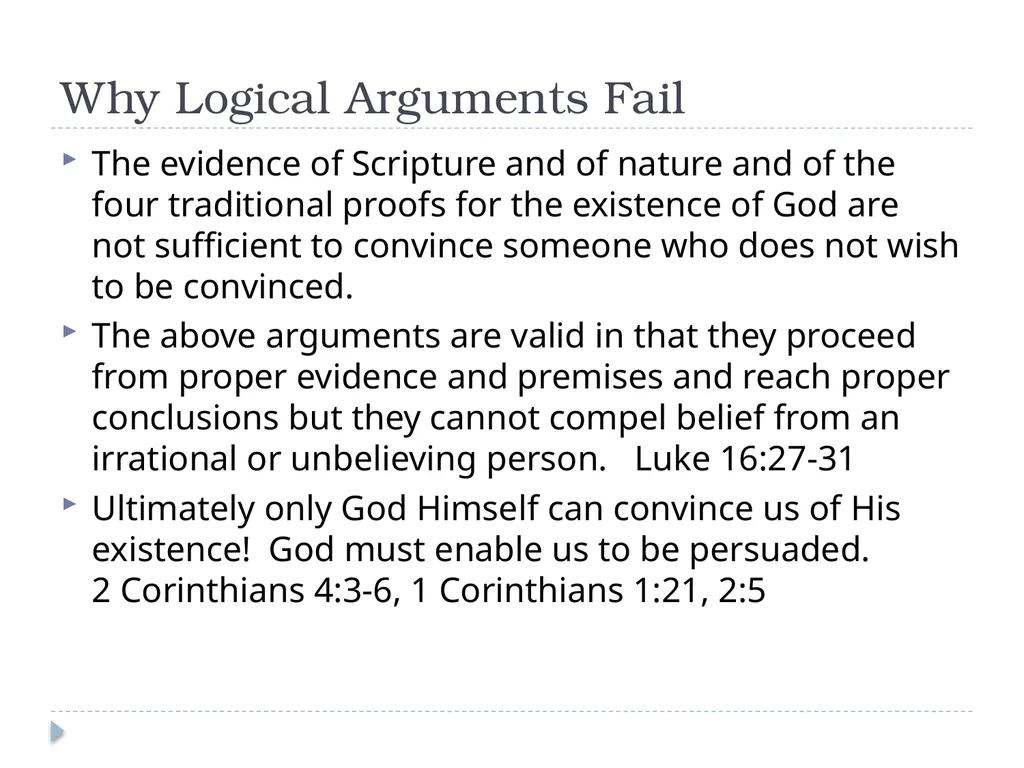
Why Logical Arguments Fail The evidence of Scripture and of nature and of the four traditional proofs for the existence of God are not sufficient to convince someone who does not wish to be convinced.
The above arguments are valid in that they proceed from proper evidence and premises and reach proper conclusions but they cannot compel belief from an irrational or unbelieving person. Luke 16:27-31
Ultimately only God Himself can convince us of His existence! God must enable us to be persuaded. 2 Corinthians 4:3-6, 1 Corinthians 1:21, 2:5<br>
The above arguments are valid in that they proceed from proper evidence and premises and reach proper conclusions but they cannot compel belief from an irrational or unbelieving person. Luke 16:27-31
Ultimately only God Himself can convince us of His existence! God must enable us to be persuaded. 2 Corinthians 4:3-6, 1 Corinthians 1:21, 2:5<br>
09
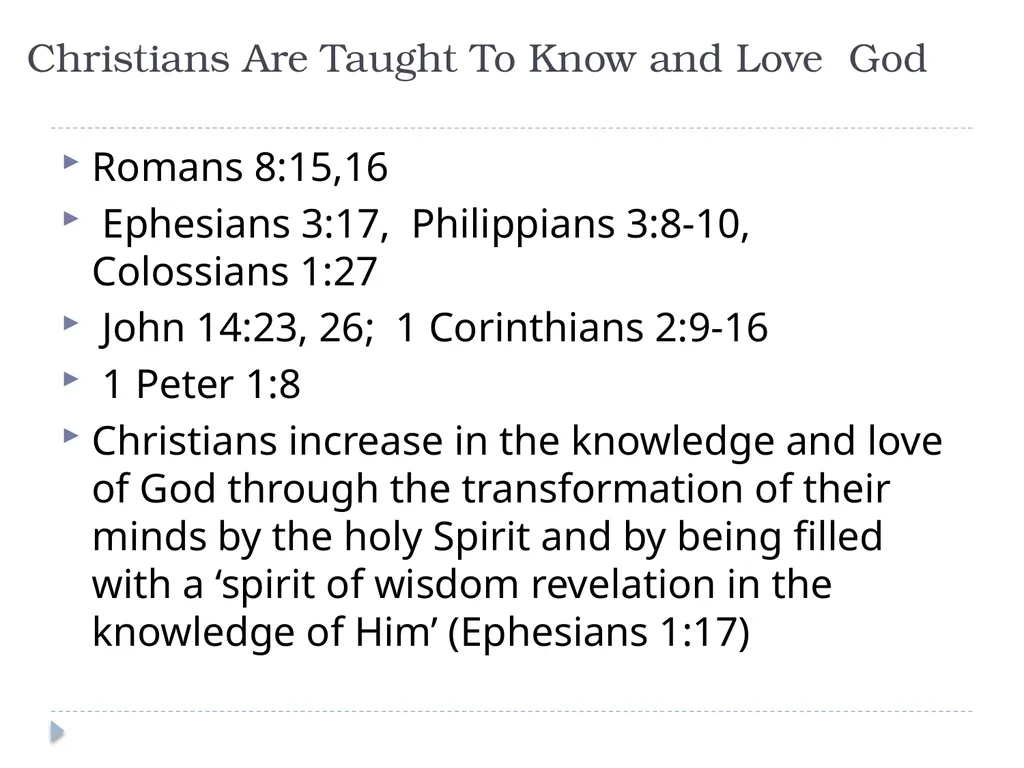
Christians Are Taught To Know and Love God Romans 8:15,16
Ephesians 3:17, Philippians 3:8-10, Colossians 1:27
John 14:23, 26; 1 Corinthians 2:9-16
1 Peter 1:8
Christians increase in the knowledge and love of God through the transformation of their minds by the holy Spirit and by being filled with a ‘spirit of wisdom revelation in the knowledge of Him’ (Ephesians 1:17)<br>
Ephesians 3:17, Philippians 3:8-10, Colossians 1:27
John 14:23, 26; 1 Corinthians 2:9-16
1 Peter 1:8
Christians increase in the knowledge and love of God through the transformation of their minds by the holy Spirit and by being filled with a ‘spirit of wisdom revelation in the knowledge of Him’ (Ephesians 1:17)<br>
10
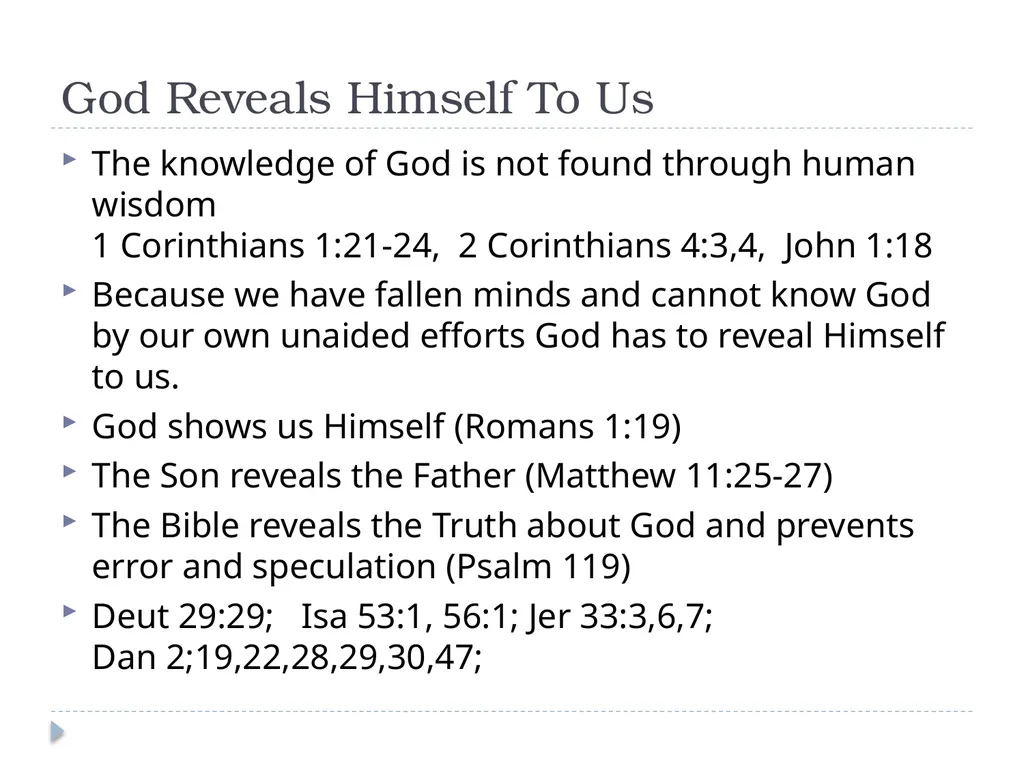
God Reveals Himself To Us The knowledge of God is not found through human wisdom
1 Corinthians 1:21-24, 2 Corinthians 4:3,4, John 1:18
Because we have fallen minds and cannot know God by our own unaided efforts God has to reveal Himself to us.
God shows us Himself (Romans 1:19)
The Son reveals the Father (Matthew 11:25-27)
The Bible reveals the Truth about God and prevents error and speculation (Psalm 119)
Deut 29:29; Isa 53:1, 56:1; Jer 33:3,6,7; Dan 2;19,22,28,29,30,47;<br>
Because we have fallen minds and cannot know God by our own unaided efforts God has to reveal Himself to us.
God shows us Himself (Romans 1:19)
The Son reveals the Father (Matthew 11:25-27)
The Bible reveals the Truth about God and prevents error and speculation (Psalm 119)
Deut 29:29; Isa 53:1, 56:1; Jer 33:3,6,7; Dan 2;19,22,28,29,30,47;<br>
11
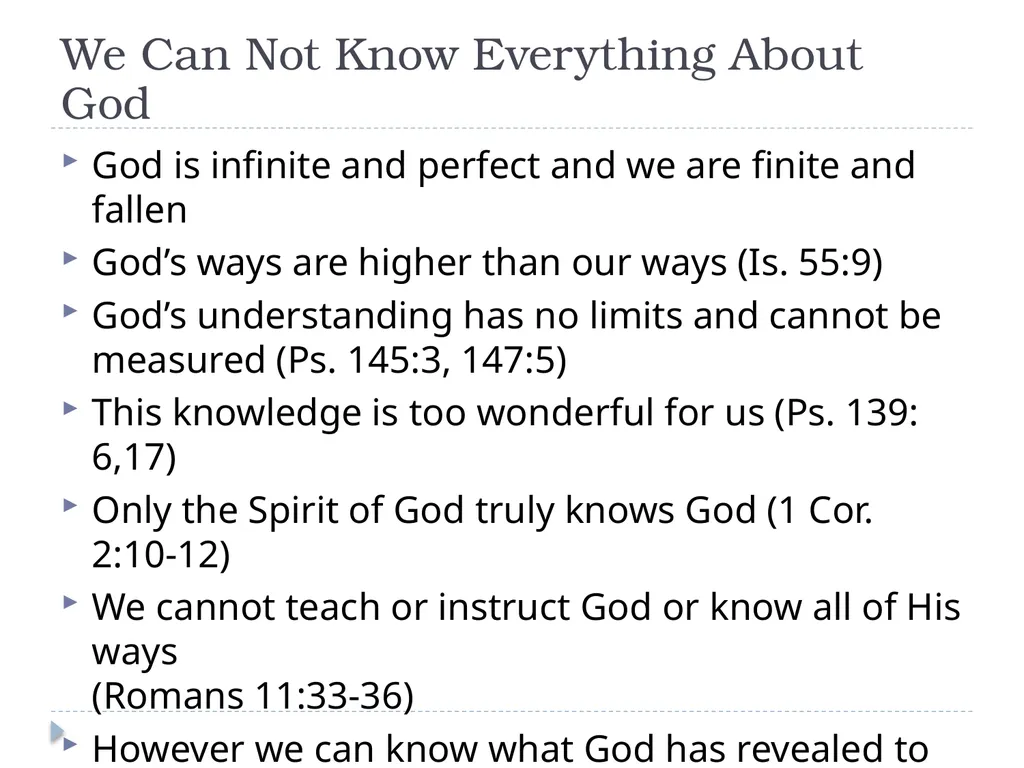
We Can Not Know Everything About God God is infinite and perfect and we are finite and fallen
God’s ways are higher than our ways (Is. 55:9)
God’s understanding has no limits and cannot be measured (Ps. 145:3, 147:5)
This knowledge is too wonderful for us (Ps. 139: 6,17)
Only the Spirit of God truly knows God (1 Cor. 2:10-12)
We cannot teach or instruct God or know all of His ways (Romans 11:33-36)
However we can know what God has revealed to us for our good (Deuteronomy 29:29) and we can increase in the knowledge of God (Colossians 1:10)<br>
God’s ways are higher than our ways (Is. 55:9)
God’s understanding has no limits and cannot be measured (Ps. 145:3, 147:5)
This knowledge is too wonderful for us (Ps. 139: 6,17)
Only the Spirit of God truly knows God (1 Cor. 2:10-12)
We cannot teach or instruct God or know all of His ways (Romans 11:33-36)
However we can know what God has revealed to us for our good (Deuteronomy 29:29) and we can increase in the knowledge of God (Colossians 1:10)<br>
12
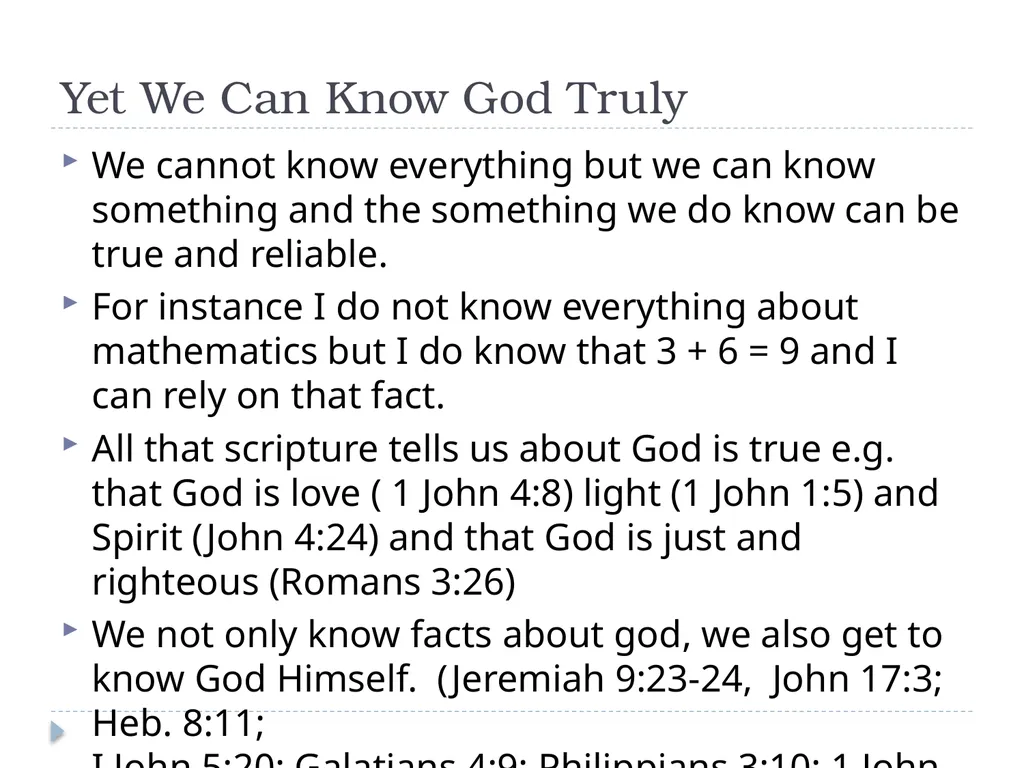
Yet We Can Know God Truly We cannot know everything but we can know something and the something we do know can be true and reliable.
For instance I do not know everything about mathematics but I do know that 3 + 6 = 9 and I can rely on that fact.
All that scripture tells us about God is true e.g. that God is love ( 1 John 4:8) light (1 John 1:5) and Spirit (John 4:24) and that God is just and righteous (Romans 3:26)
We not only know facts about god, we also get to know God Himself. (Jeremiah 9:23-24, John 17:3; Heb. 8:11; I John 5:20; Galatians 4:9; Philippians 3:10; 1 John 2:3, 4:8; we can even know the Father (1 John 2:13)<br>
For instance I do not know everything about mathematics but I do know that 3 + 6 = 9 and I can rely on that fact.
All that scripture tells us about God is true e.g. that God is love ( 1 John 4:8) light (1 John 1:5) and Spirit (John 4:24) and that God is just and righteous (Romans 3:26)
We not only know facts about god, we also get to know God Himself. (Jeremiah 9:23-24, John 17:3; Heb. 8:11; I John 5:20; Galatians 4:9; Philippians 3:10; 1 John 2:3, 4:8; we can even know the Father (1 John 2:13)<br>
13
The Incommunicable Attributes of God Incommunicable: Not communicated (passed on) to us, that is they are not shared by human beings (e.g. being uncreated, existing from all eternity, being all-powerful, present everywhere, all-knowing etc)
Communicable: Attributes of God that are passed on to us: righteousness, justice, wisdom, love, joy, peace, holiness, mercy, faithfulness, kindness.
There is some overlap between these two categories e.g. we will share eternity with God and God’s wisdom though communicated to us is not fully comprehended by us and is infinite.<br>
Communicable: Attributes of God that are passed on to us: righteousness, justice, wisdom, love, joy, peace, holiness, mercy, faithfulness, kindness.
There is some overlap between these two categories e.g. we will share eternity with God and God’s wisdom though communicated to us is not fully comprehended by us and is infinite.<br>
14
God’s Names In Scripture God’s Name: all that the Bible and Creation tells us about God
To honor and hallow God’s Name is to honor Him and His Name carries His authority
There are a large number of names of God and descriptions of God (Grudem p. 158-160)
Praying using God’s Names can be very powerful!
http://bible.org/article/names-god (see next few slides)
http://www.blueletterbible.org/study/misc/name_god.cfm
http://smilegodlovesyou.org/names.html (long list)<br>
To honor and hallow God’s Name is to honor Him and His Name carries His authority
There are a large number of names of God and descriptions of God (Grudem p. 158-160)
Praying using God’s Names can be very powerful!
http://bible.org/article/names-god (see next few slides)
http://www.blueletterbible.org/study/misc/name_god.cfm
http://smilegodlovesyou.org/names.html (long list)<br>
15
Many Names But Only One God A single person can have many names or titles
e.g. Prince Charles: His Royal Highness Prince Charles Philip Arthur George, Prince of Wales, KG, KT, GCB, OM, AK, QSO, PC, ADC, Earl of Chester, Duke of Cornwall, Duke of Rothesay, Earl of Carrick, Baron of Renfrew, Lord of the Isles and Prince and Great Steward of Scotland.
Thus Elohim is not a different God from YHWH or Adonai - they are all different names for the one God
The three persons in the Trinity (Father, Son and Holy Spirit) each have their own separate titles (e.g Christ – that is anointed one) but are united in one Supreme Being – God Almighty<br>
e.g. Prince Charles: His Royal Highness Prince Charles Philip Arthur George, Prince of Wales, KG, KT, GCB, OM, AK, QSO, PC, ADC, Earl of Chester, Duke of Cornwall, Duke of Rothesay, Earl of Carrick, Baron of Renfrew, Lord of the Isles and Prince and Great Steward of Scotland.
Thus Elohim is not a different God from YHWH or Adonai - they are all different names for the one God
The three persons in the Trinity (Father, Son and Holy Spirit) each have their own separate titles (e.g Christ – that is anointed one) but are united in one Supreme Being – God Almighty<br>
16
The Misuse of the Names of God Blasphemy – attributing evil to God or equating a sinful human being to be the same as God or using the name of God as a vulgarity Leviticus 24:11,16 Revelation 16:9
Profaned: by immoral conduct, bad examples Leviticus 18:21, 19;12, 20:3, 21:4-6, 21:9, Hebrews 12:16
Vanity – using the name of God lightly such as to swear an oath or vow that you have no intention of keeping. Exodus 2:7, Deuteronomy 5:11
Occult – using the names of God for magical or occult purposes e.g Kabbalah (sub-category of “vanity”)
Defiling – giving God’s glory to another Isaiah 48:11, Jeremiah 7:30, Ezekiel 20;39, 43:4-9<br>
Profaned: by immoral conduct, bad examples Leviticus 18:21, 19;12, 20:3, 21:4-6, 21:9, Hebrews 12:16
Vanity – using the name of God lightly such as to swear an oath or vow that you have no intention of keeping. Exodus 2:7, Deuteronomy 5:11
Occult – using the names of God for magical or occult purposes e.g Kabbalah (sub-category of “vanity”)
Defiling – giving God’s glory to another Isaiah 48:11, Jeremiah 7:30, Ezekiel 20;39, 43:4-9<br>
17
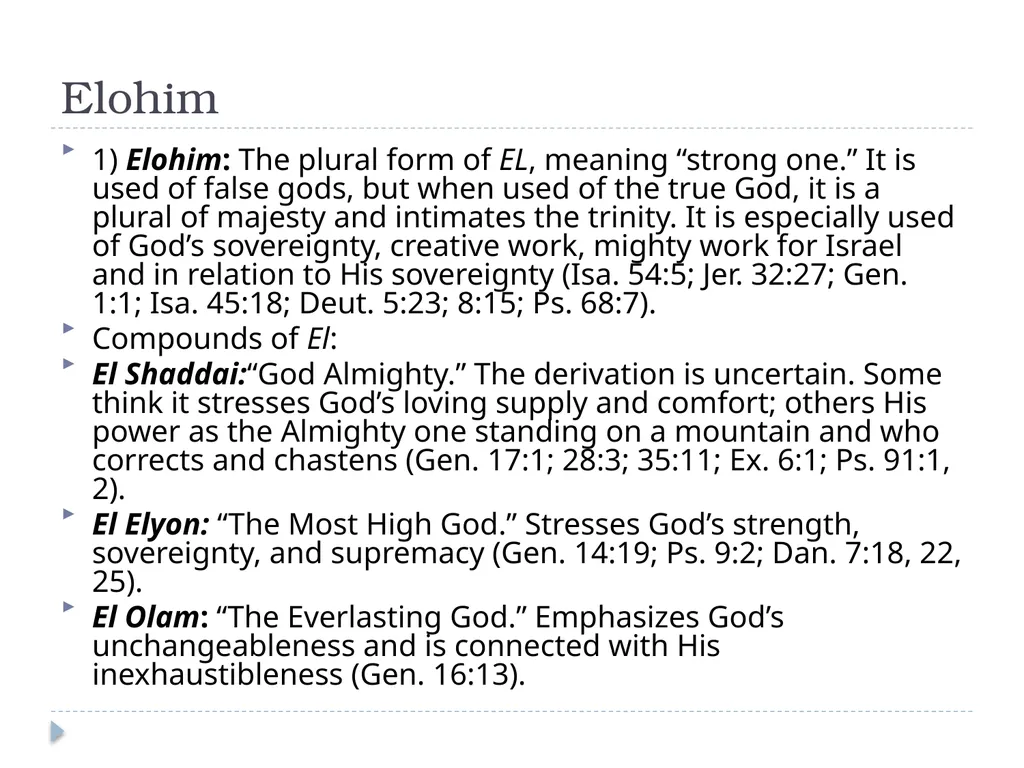
Elohim 1) Elohim: The plural form of EL, meaning “strong one.” It is used of false gods, but when used of the true God, it is a plural of majesty and intimates the trinity. It is especially used of God’s sovereignty, creative work, mighty work for Israel and in relation to His sovereignty (Isa. 54:5; Jer. 32:27; Gen. 1:1; Isa. 45:18; Deut. 5:23; 8:15; Ps. 68:7).
Compounds of El:
El Shaddai:“God Almighty.” The derivation is uncertain. Some think it stresses God’s loving supply and comfort; others His power as the Almighty one standing on a mountain and who corrects and chastens (Gen. 17:1; 28:3; 35:11; Ex. 6:1; Ps. 91:1, 2).
El Elyon: “The Most High God.” Stresses God’s strength, sovereignty, and supremacy (Gen. 14:19; Ps. 9:2; Dan. 7:18, 22, 25).
El Olam: “The Everlasting God.” Emphasizes God’s unchangeableness and is connected with His inexhaustibleness (Gen. 16:13).<br>
Compounds of El:
El Shaddai:“God Almighty.” The derivation is uncertain. Some think it stresses God’s loving supply and comfort; others His power as the Almighty one standing on a mountain and who corrects and chastens (Gen. 17:1; 28:3; 35:11; Ex. 6:1; Ps. 91:1, 2).
El Elyon: “The Most High God.” Stresses God’s strength, sovereignty, and supremacy (Gen. 14:19; Ps. 9:2; Dan. 7:18, 22, 25).
El Olam: “The Everlasting God.” Emphasizes God’s unchangeableness and is connected with His inexhaustibleness (Gen. 16:13).<br>
18
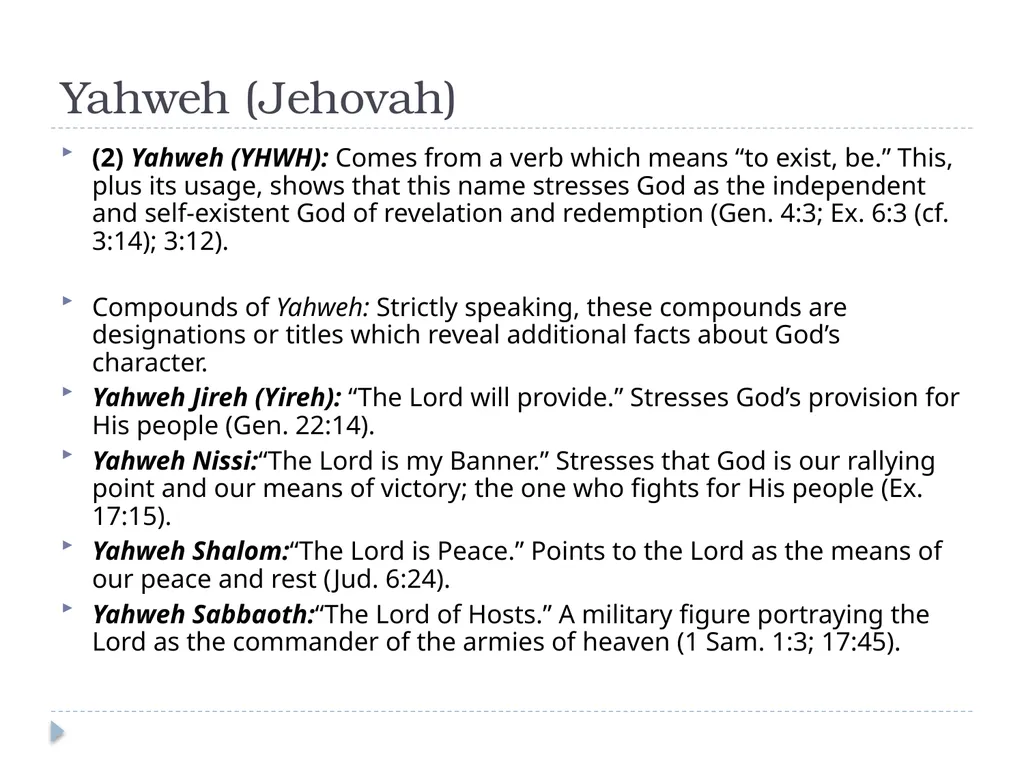
Yahweh (Jehovah) (2) Yahweh (YHWH): Comes from a verb which means “to exist, be.” This, plus its usage, shows that this name stresses God as the independent and self-existent God of revelation and redemption (Gen. 4:3; Ex. 6:3 (cf. 3:14); 3:12).
Compounds of Yahweh: Strictly speaking, these compounds are designations or titles which reveal additional facts about God’s character.
Yahweh Jireh (Yireh): “The Lord will provide.” Stresses God’s provision for His people (Gen. 22:14).
Yahweh Nissi:“The Lord is my Banner.” Stresses that God is our rallying point and our means of victory; the one who fights for His people (Ex. 17:15).
Yahweh Shalom:“The Lord is Peace.” Points to the Lord as the means of our peace and rest (Jud. 6:24).
Yahweh Sabbaoth:“The Lord of Hosts.” A military figure portraying the Lord as the commander of the armies of heaven (1 Sam. 1:3; 17:45).<br>
Compounds of Yahweh: Strictly speaking, these compounds are designations or titles which reveal additional facts about God’s character.
Yahweh Jireh (Yireh): “The Lord will provide.” Stresses God’s provision for His people (Gen. 22:14).
Yahweh Nissi:“The Lord is my Banner.” Stresses that God is our rallying point and our means of victory; the one who fights for His people (Ex. 17:15).
Yahweh Shalom:“The Lord is Peace.” Points to the Lord as the means of our peace and rest (Jud. 6:24).
Yahweh Sabbaoth:“The Lord of Hosts.” A military figure portraying the Lord as the commander of the armies of heaven (1 Sam. 1:3; 17:45).<br>
19
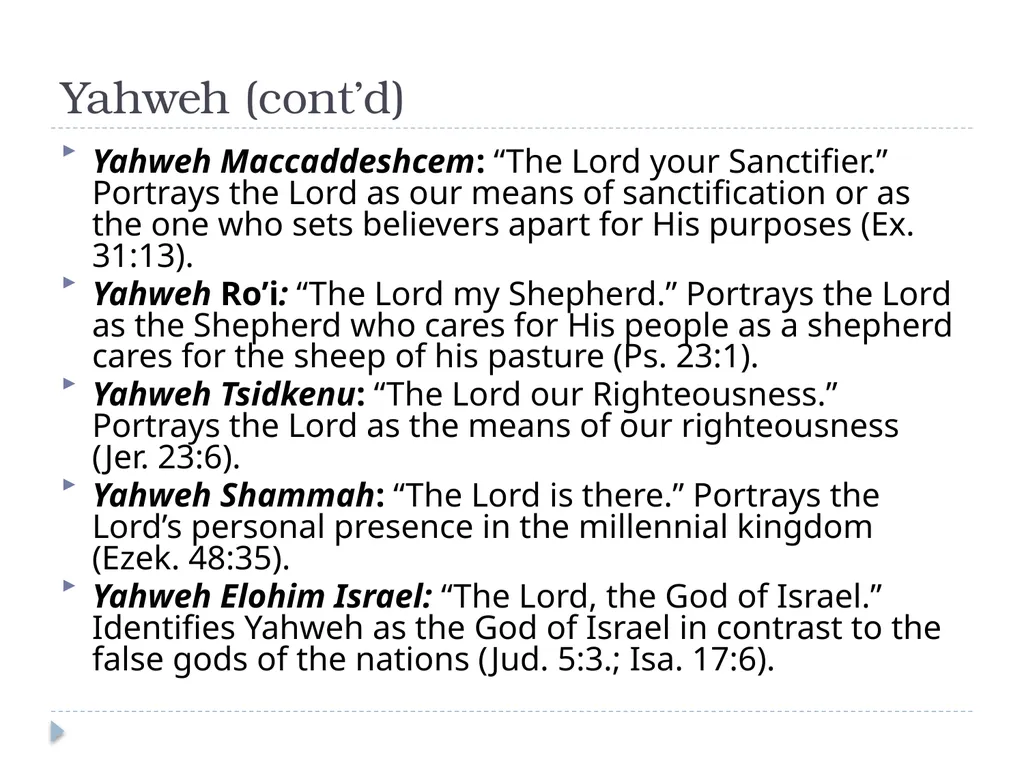
Yahweh (cont’d) Yahweh Maccaddeshcem: “The Lord your Sanctifier.” Portrays the Lord as our means of sanctification or as the one who sets believers apart for His purposes (Ex. 31:13).
Yahweh Ro’i: “The Lord my Shepherd.” Portrays the Lord as the Shepherd who cares for His people as a shepherd cares for the sheep of his pasture (Ps. 23:1).
Yahweh Tsidkenu: “The Lord our Righteousness.” Portrays the Lord as the means of our righteousness (Jer. 23:6).
Yahweh Shammah: “The Lord is there.” Portrays the Lord’s personal presence in the millennial kingdom (Ezek. 48:35).
Yahweh Elohim Israel: “The Lord, the God of Israel.” Identifies Yahweh as the God of Israel in contrast to the false gods of the nations (Jud. 5:3.; Isa. 17:6).<br>
Yahweh Ro’i: “The Lord my Shepherd.” Portrays the Lord as the Shepherd who cares for His people as a shepherd cares for the sheep of his pasture (Ps. 23:1).
Yahweh Tsidkenu: “The Lord our Righteousness.” Portrays the Lord as the means of our righteousness (Jer. 23:6).
Yahweh Shammah: “The Lord is there.” Portrays the Lord’s personal presence in the millennial kingdom (Ezek. 48:35).
Yahweh Elohim Israel: “The Lord, the God of Israel.” Identifies Yahweh as the God of Israel in contrast to the false gods of the nations (Jud. 5:3.; Isa. 17:6).<br>
20
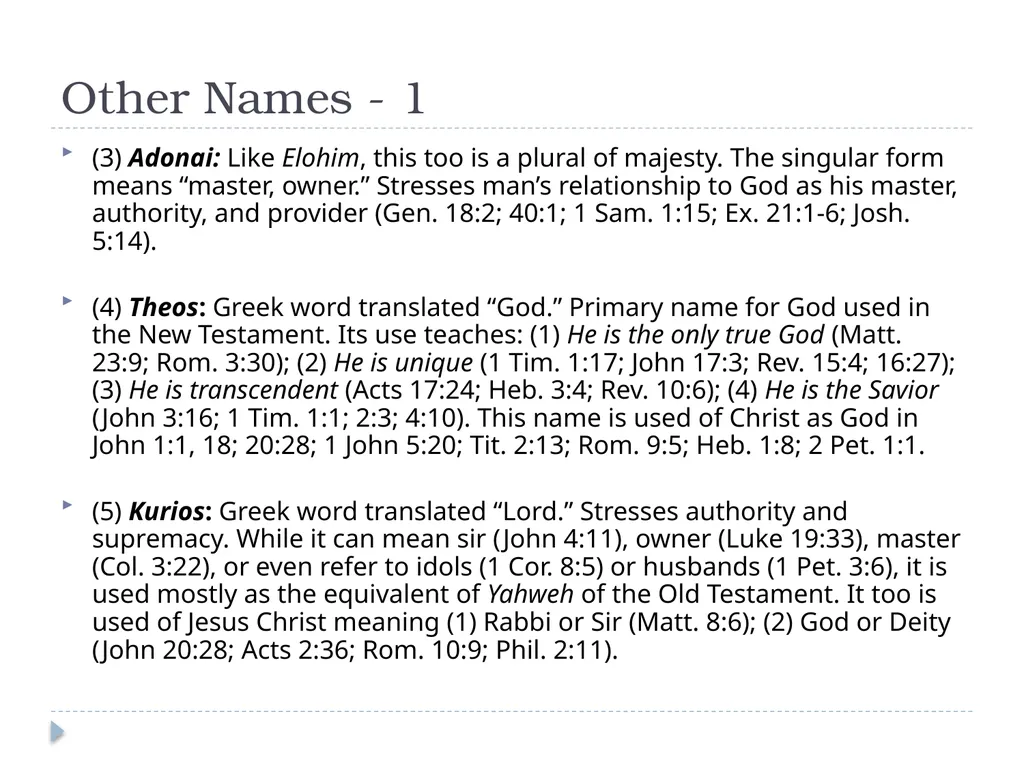
Other Names - 1 (3) Adonai: Like Elohim, this too is a plural of majesty. The singular form means “master, owner.” Stresses man’s relationship to God as his master, authority, and provider (Gen. 18:2; 40:1; 1 Sam. 1:15; Ex. 21:1-6; Josh. 5:14).
(4) Theos: Greek word translated “God.” Primary name for God used in the New Testament. Its use teaches: (1) He is the only true God (Matt. 23:9; Rom. 3:30); (2) He is unique (1 Tim. 1:17; John 17:3; Rev. 15:4; 16:27); (3) He is transcendent (Acts 17:24; Heb. 3:4; Rev. 10:6); (4) He is the Savior (John 3:16; 1 Tim. 1:1; 2:3; 4:10). This name is used of Christ as God in John 1:1, 18; 20:28; 1 John 5:20; Tit. 2:13; Rom. 9:5; Heb. 1:8; 2 Pet. 1:1.
(5) Kurios: Greek word translated “Lord.” Stresses authority and supremacy. While it can mean sir (John 4:11), owner (Luke 19:33), master (Col. 3:22), or even refer to idols (1 Cor. 8:5) or husbands (1 Pet. 3:6), it is used mostly as the equivalent of Yahweh of the Old Testament. It too is used of Jesus Christ meaning (1) Rabbi or Sir (Matt. 8:6); (2) God or Deity (John 20:28; Acts 2:36; Rom. 10:9; Phil. 2:11).<br>
(4) Theos: Greek word translated “God.” Primary name for God used in the New Testament. Its use teaches: (1) He is the only true God (Matt. 23:9; Rom. 3:30); (2) He is unique (1 Tim. 1:17; John 17:3; Rev. 15:4; 16:27); (3) He is transcendent (Acts 17:24; Heb. 3:4; Rev. 10:6); (4) He is the Savior (John 3:16; 1 Tim. 1:1; 2:3; 4:10). This name is used of Christ as God in John 1:1, 18; 20:28; 1 John 5:20; Tit. 2:13; Rom. 9:5; Heb. 1:8; 2 Pet. 1:1.
(5) Kurios: Greek word translated “Lord.” Stresses authority and supremacy. While it can mean sir (John 4:11), owner (Luke 19:33), master (Col. 3:22), or even refer to idols (1 Cor. 8:5) or husbands (1 Pet. 3:6), it is used mostly as the equivalent of Yahweh of the Old Testament. It too is used of Jesus Christ meaning (1) Rabbi or Sir (Matt. 8:6); (2) God or Deity (John 20:28; Acts 2:36; Rom. 10:9; Phil. 2:11).<br>
21
Other Names - 2 6) Despotes: Greek word translated “Master.” Carries the idea of ownership while kurios stressed supreme authority (Luke 2:29; Acts 4:24; Rev. 6:10; 2 Pet. 2:1; Jude 4).
(7) Father: A distinctive New Testament revelation is that through faith in Christ, God becomes our personal Father. Father is used of God in the Old Testament only 15 times while it is used of God 245 times in the New Testament. As a name of God, it stresses God’s loving care, provision, discipline, and the way we are to address God in prayer (Matt. 7:11; Jam. 1:17; Heb. 12:5-11; John 15:16; 16:23; Eph. 2:18; 3:15; 1 Thess. 3:11).<br>
(7) Father: A distinctive New Testament revelation is that through faith in Christ, God becomes our personal Father. Father is used of God in the Old Testament only 15 times while it is used of God 245 times in the New Testament. As a name of God, it stresses God’s loving care, provision, discipline, and the way we are to address God in prayer (Matt. 7:11; Jam. 1:17; Heb. 12:5-11; John 15:16; 16:23; Eph. 2:18; 3:15; 1 Thess. 3:11).<br>
22
Reverencing God’s Name Hallowed be Thy name…(Matthew 6:9) = authority
Fearing / reverencing / hallowing God’s Name puts us in the right position as creatures of the Creator and enables faith and grace to flow so that God’s Kingdoms comes and His will is done. “It re-connects Heaven and Earth”
We are to live in reverence and godly fear (Psalm 61:5, 86:11, Hebrews 12:28, Deuteronomy 28:58, Revelation 11:18))
Reverencing His Name is taking God’s being seriously
It is also involves taking His commandments as “orders” ad obeying them
In the NT those “under authority” (stewards, servants, husbandmen, citizens of a King etc) are judged by their attitude to their orders… (faithful, lazy, wicked, rebellious, asleep etc)
How we “take God’s Name” influences our whole Christian life!<br>
Fearing / reverencing / hallowing God’s Name puts us in the right position as creatures of the Creator and enables faith and grace to flow so that God’s Kingdoms comes and His will is done. “It re-connects Heaven and Earth”
We are to live in reverence and godly fear (Psalm 61:5, 86:11, Hebrews 12:28, Deuteronomy 28:58, Revelation 11:18))
Reverencing His Name is taking God’s being seriously
It is also involves taking His commandments as “orders” ad obeying them
In the NT those “under authority” (stewards, servants, husbandmen, citizens of a King etc) are judged by their attitude to their orders… (faithful, lazy, wicked, rebellious, asleep etc)
How we “take God’s Name” influences our whole Christian life!<br>
23
Calling On The Name of the Lord Those who call on the Name of the Lord will be saved. (Genesis 4:26, 12:8, Judges 15:8, 2 Samuel 22:1-7, 1 Kings 18:24, Acts 2:21, Romans 10:13)
God responds when we call upon His Name!
Call upon the name of the Lord relevant to your situation e.g Jehovah-Jireh for provision, YHWH-Raphah for healing
When you do this you call upon the very nature of God Himself and ask him to act consistently with who He is.
The names of God are thus “prayer fuel” that can lead us into worship, praise, confession, supplication and intercession<br>
God responds when we call upon His Name!
Call upon the name of the Lord relevant to your situation e.g Jehovah-Jireh for provision, YHWH-Raphah for healing
When you do this you call upon the very nature of God Himself and ask him to act consistently with who He is.
The names of God are thus “prayer fuel” that can lead us into worship, praise, confession, supplication and intercession<br>
24
Praising & Blessing God’s Name To “praise His Name” is to praise God for who He is in His inmost being… often an expression of gratitude
Genesis 29:32-35
Psalms 7:17 MKJV I will praise Jehovah according to His righteousness, and will sing praise to the name of Jehovah most high.
2 Samuel 22:47-51
1 Chronicles 29:10-13
Psalm 48:10, 52:8,9
Romans 15:9
Hebrews 13:15<br>
Genesis 29:32-35
Psalms 7:17 MKJV I will praise Jehovah according to His righteousness, and will sing praise to the name of Jehovah most high.
2 Samuel 22:47-51
1 Chronicles 29:10-13
Psalm 48:10, 52:8,9
Romans 15:9
Hebrews 13:15<br>