
Systolic Blood Pressure Intervention Trial
CP
Published · 31 slides · 0 views

1 / 1
Description
Systolic Blood Pressure Intervention Trial (SPRINT) Principal Results Paul K. Whelton, MB, MD, MSc Chair, SPRINT Steering Committee Tulane University School of Public Health and Tropical Medicine, and School of Medicine For the SPRINT
Related Topics
Share
Embed code
Download this presentation From Below
"Systolic Blood Pressure Intervention Trial" is the property of its rightful owner. Permission is granted to download and print the materials on this website for personal, non-commercial use only, and to display it on your personal computer provided you do not modify the materials and that you retain all copyright notices contained in the materials. By downloading content from our website, you accept the terms of this agreement.
Presentation Transcript
01
Systolic Blood Pressure Intervention Trial (SPRINT)
Principal Results Paul K. Whelton, MB, MD, MSc
Chair, SPRINT Steering Committee
Tulane University School of Public Health and Tropical Medicine, and School of Medicine
For the SPRINT Research Group<br>
Chair, SPRINT Steering Committee
Tulane University School of Public Health and Tropical Medicine, and School of Medicine
For the SPRINT Research Group<br>
02
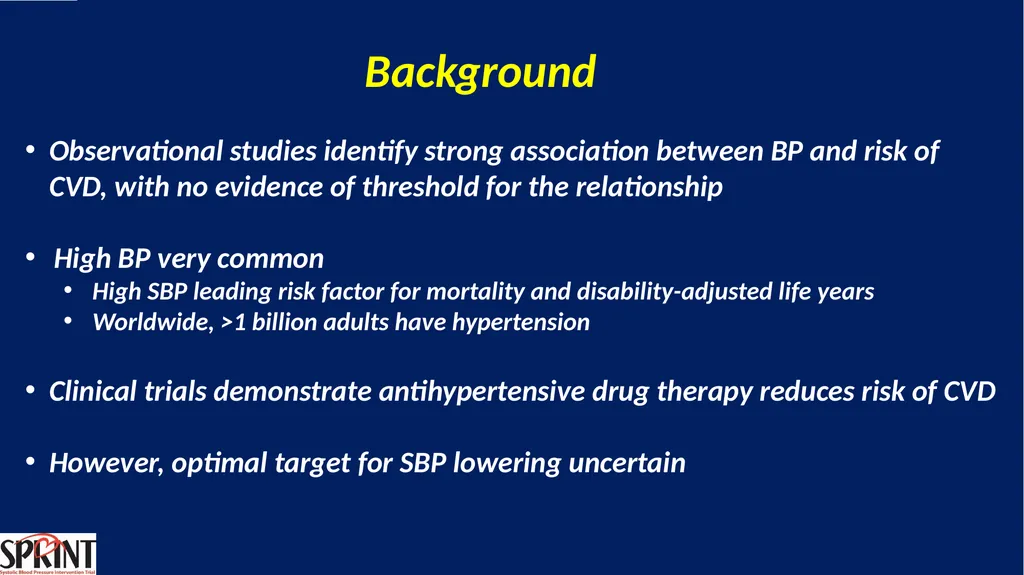
Observational studies identify strong association between BP and risk of CVD, with no evidence of threshold for the relationship
High BP very common
High SBP leading risk factor for mortality and disability-adjusted life years
Worldwide, >1 billion adults have hypertension
Clinical trials demonstrate antihypertensive drug therapy reduces risk of CVD
However, optimal target for SBP lowering uncertain Background<br>
High BP very common
High SBP leading risk factor for mortality and disability-adjusted life years
Worldwide, >1 billion adults have hypertension
Clinical trials demonstrate antihypertensive drug therapy reduces risk of CVD
However, optimal target for SBP lowering uncertain Background<br>
03
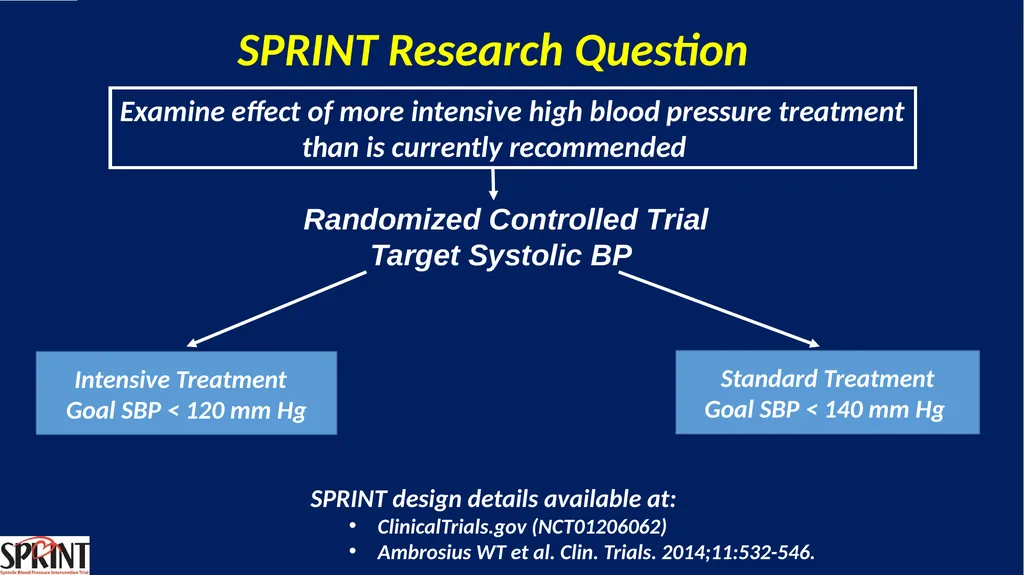
SPRINT Research Question Examine effect of more intensive high blood pressure treatment
than is currently recommended SPRINT design details available at:
ClinicalTrials.gov (NCT01206062)
Ambrosius WT et al. Clin. Trials. 2014;11:532-546.<br>
than is currently recommended SPRINT design details available at:
ClinicalTrials.gov (NCT01206062)
Ambrosius WT et al. Clin. Trials. 2014;11:532-546.<br>
04
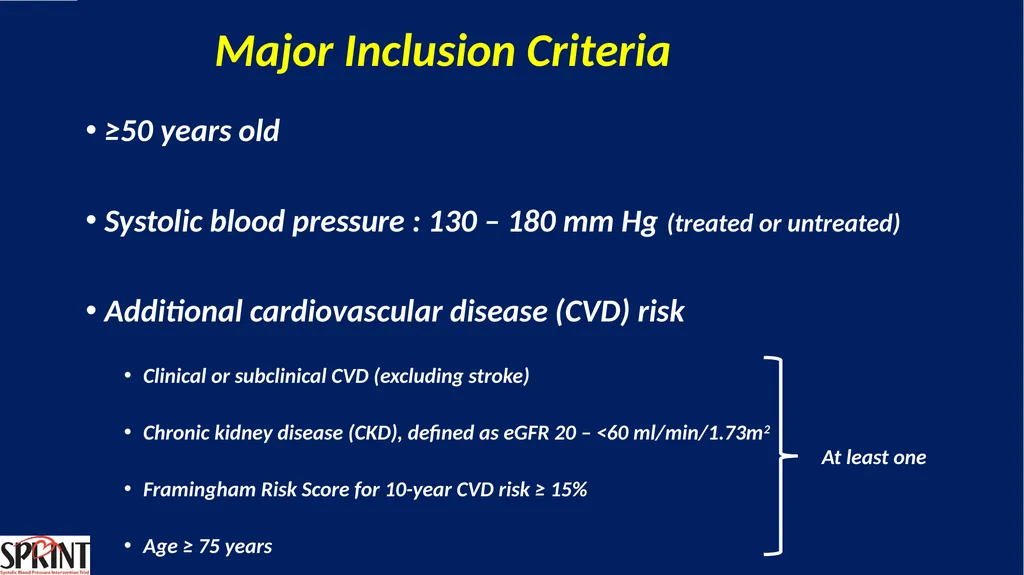
Major Inclusion Criteria ≥50 years old
Systolic blood pressure : 130 – 180 mm Hg (treated or untreated)
Additional cardiovascular disease (CVD) risk
Clinical or subclinical CVD (excluding stroke)
Chronic kidney disease (CKD), defined as eGFR 20 – <60 ml/min/1.73m2
Framingham Risk Score for 10-year CVD risk ≥ 15%
Age ≥ 75 years At least one<br>
Systolic blood pressure : 130 – 180 mm Hg (treated or untreated)
Additional cardiovascular disease (CVD) risk
Clinical or subclinical CVD (excluding stroke)
Chronic kidney disease (CKD), defined as eGFR 20 – <60 ml/min/1.73m2
Framingham Risk Score for 10-year CVD risk ≥ 15%
Age ≥ 75 years At least one<br>
05
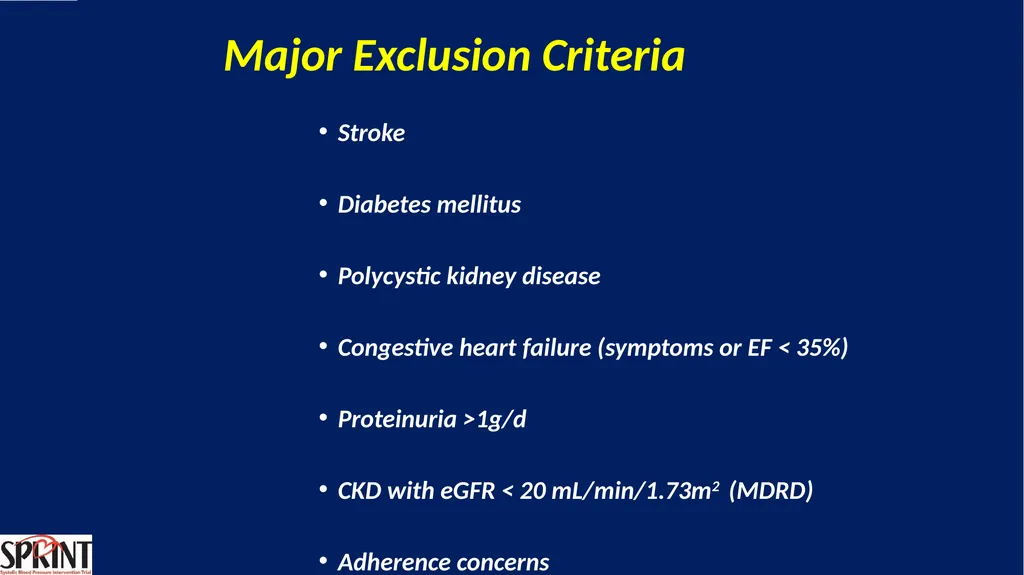
Major Exclusion Criteria Stroke
Diabetes mellitus
Polycystic kidney disease
Congestive heart failure (symptoms or EF < 35%)
Proteinuria >1g/d
CKD with eGFR < 20 mL/min/1.73m2 (MDRD)
Adherence concerns<br>
Diabetes mellitus
Polycystic kidney disease
Congestive heart failure (symptoms or EF < 35%)
Proteinuria >1g/d
CKD with eGFR < 20 mL/min/1.73m2 (MDRD)
Adherence concerns<br>
06
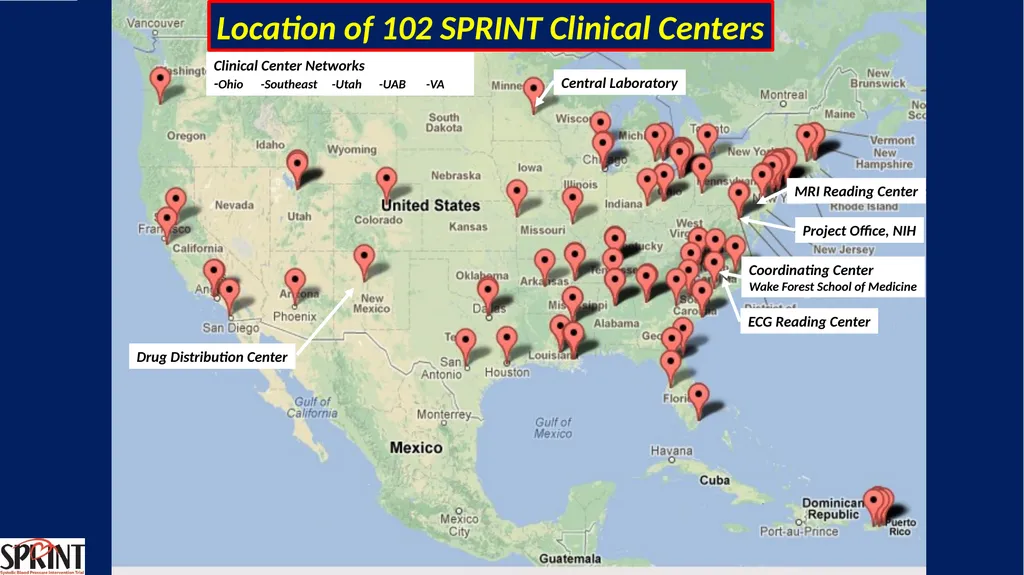
Location of 102 SPRINT Clinical Centers Project Office, NIH Coordinating Center
Wake Forest School of Medicine Clinical Center Networks
-Ohio -Southeast -Utah -UAB -VA Central Laboratory Drug Distribution Center MRI Reading Center ECG Reading Center<br>
Wake Forest School of Medicine Clinical Center Networks
-Ohio -Southeast -Utah -UAB -VA Central Laboratory Drug Distribution Center MRI Reading Center ECG Reading Center<br>
07
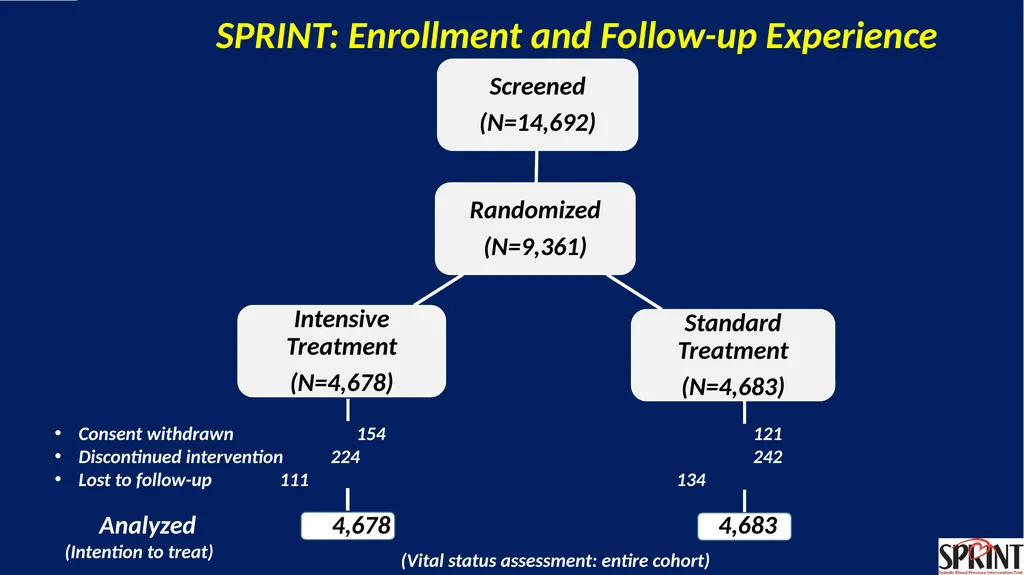
SPRINT: Enrollment and Follow-up Experience Consent withdrawn 154 121
Discontinued intervention 224 242
Lost to follow-up 111 134 (Vital status assessment: entire cohort) Analyzed 4,678 4,683
(Intention to treat)<br>
Discontinued intervention 224 242
Lost to follow-up 111 134 (Vital status assessment: entire cohort) Analyzed 4,678 4,683
(Intention to treat)<br>
08
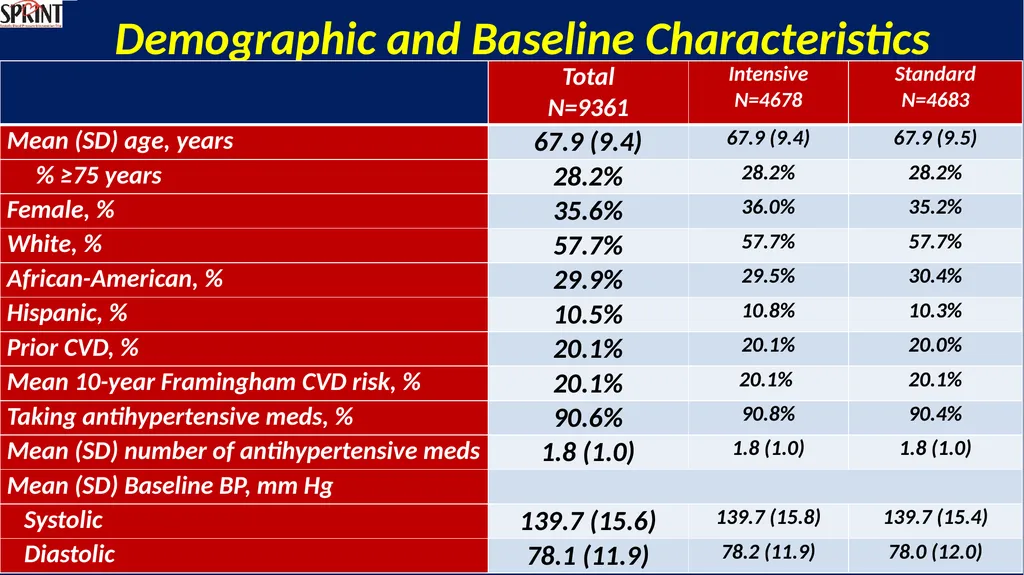
Demographic and Baseline Characteristics<br>
09
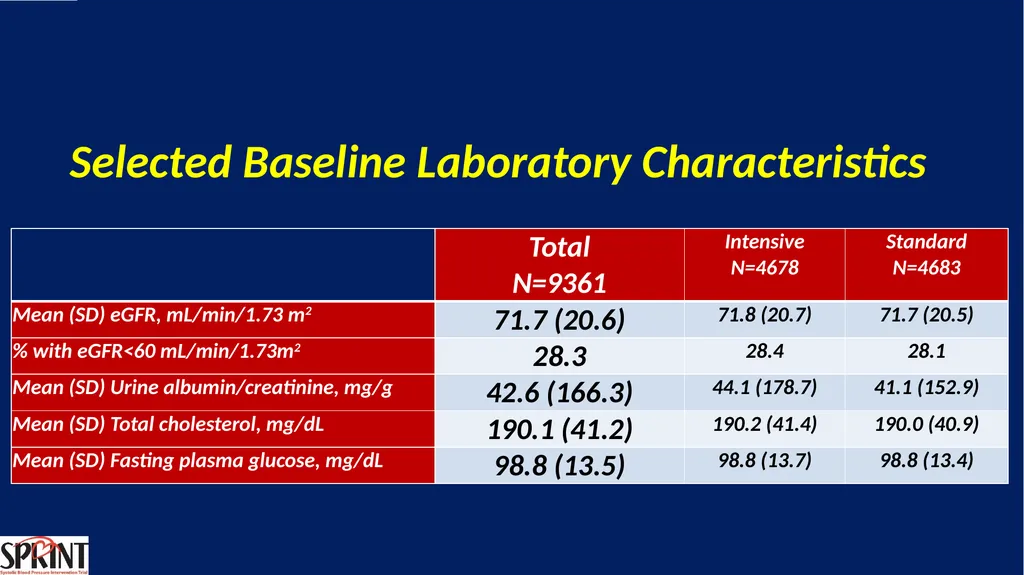
Selected Baseline Laboratory Characteristics<br>
10
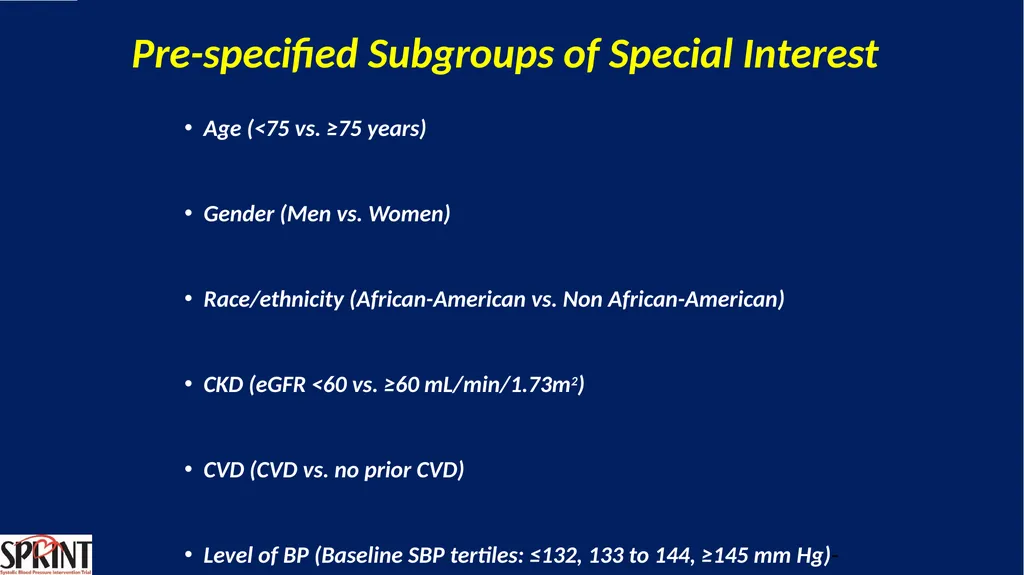
Pre-specified Subgroups of Special Interest Age (<75 vs. ≥75 years)
Gender (Men vs. Women)
Race/ethnicity (African-American vs. Non African-American)
CKD (eGFR <60 vs. ≥60 mL/min/1.73m2)
CVD (CVD vs. no prior CVD)
Level of BP (Baseline SBP tertiles: ≤132, 133 to 144, ≥145 mm Hg)-<br>
Gender (Men vs. Women)
Race/ethnicity (African-American vs. Non African-American)
CKD (eGFR <60 vs. ≥60 mL/min/1.73m2)
CVD (CVD vs. no prior CVD)
Level of BP (Baseline SBP tertiles: ≤132, 133 to 144, ≥145 mm Hg)-<br>
11
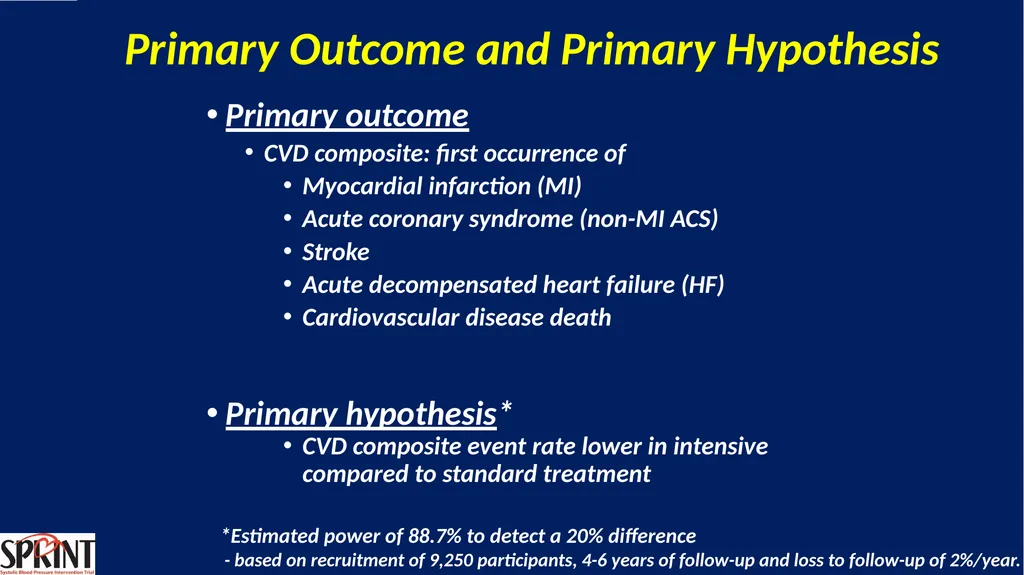
Primary Outcome and Primary Hypothesis Primary outcome
CVD composite: first occurrence of
Myocardial infarction (MI)
Acute coronary syndrome (non-MI ACS)
Stroke
Acute decompensated heart failure (HF)
Cardiovascular disease death
Primary hypothesis*
CVD composite event rate lower in intensive compared to standard treatment *Estimated power of 88.7% to detect a 20% difference
- based on recruitment of 9,250 participants, 4-6 years of follow-up and loss to follow-up of 2%/year.<br>
CVD composite: first occurrence of
Myocardial infarction (MI)
Acute coronary syndrome (non-MI ACS)
Stroke
Acute decompensated heart failure (HF)
Cardiovascular disease death
Primary hypothesis*
CVD composite event rate lower in intensive compared to standard treatment *Estimated power of 88.7% to detect a 20% difference
- based on recruitment of 9,250 participants, 4-6 years of follow-up and loss to follow-up of 2%/year.<br>
12
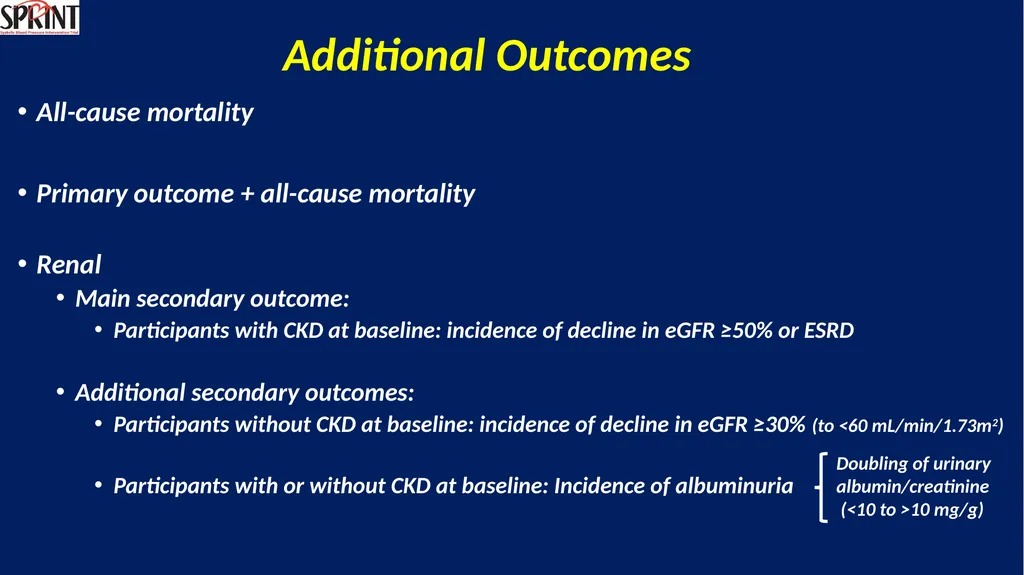
Additional Outcomes All-cause mortality
Primary outcome + all-cause mortality
Renal
Main secondary outcome:
Participants with CKD at baseline: incidence of decline in eGFR ≥50% or ESRD
Additional secondary outcomes:
Participants without CKD at baseline: incidence of decline in eGFR ≥30% (to <60 mL/min/1.73m2)
Participants with or without CKD at baseline: Incidence of albuminuria Doubling of urinary
albumin/creatinine
(<10 to >10 mg/g)<br>
Primary outcome + all-cause mortality
Renal
Main secondary outcome:
Participants with CKD at baseline: incidence of decline in eGFR ≥50% or ESRD
Additional secondary outcomes:
Participants without CKD at baseline: incidence of decline in eGFR ≥30% (to <60 mL/min/1.73m2)
Participants with or without CKD at baseline: Incidence of albuminuria Doubling of urinary
albumin/creatinine
(<10 to >10 mg/g)<br>
13
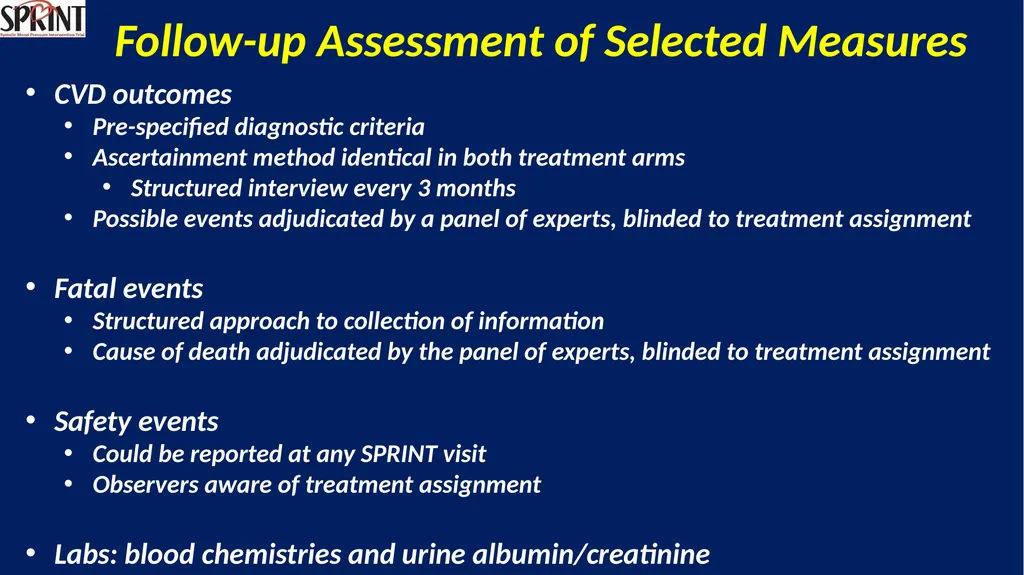
Follow-up Assessment of Selected Measures CVD outcomes
Pre-specified diagnostic criteria
Ascertainment method identical in both treatment arms
Structured interview every 3 months
Possible events adjudicated by a panel of experts, blinded to treatment assignment
Fatal events
Structured approach to collection of information
Cause of death adjudicated by the panel of experts, blinded to treatment assignment
Safety events
Could be reported at any SPRINT visit
Observers aware of treatment assignment
Labs: blood chemistries and urine albumin/creatinine<br>
Pre-specified diagnostic criteria
Ascertainment method identical in both treatment arms
Structured interview every 3 months
Possible events adjudicated by a panel of experts, blinded to treatment assignment
Fatal events
Structured approach to collection of information
Cause of death adjudicated by the panel of experts, blinded to treatment assignment
Safety events
Could be reported at any SPRINT visit
Observers aware of treatment assignment
Labs: blood chemistries and urine albumin/creatinine<br>
14
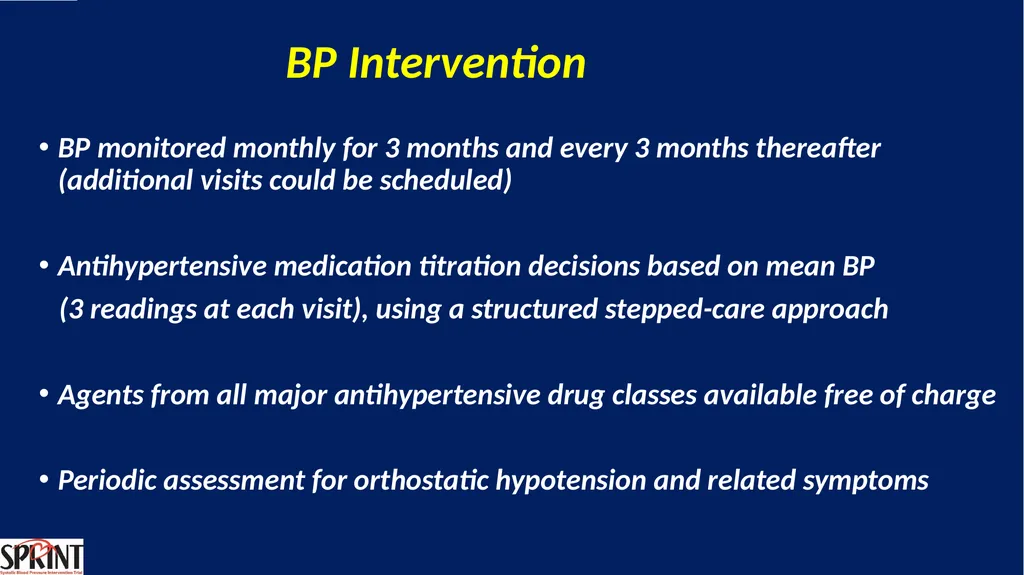
BP Intervention BP monitored monthly for 3 months and every 3 months thereafter (additional visits could be scheduled)
Antihypertensive medication titration decisions based on mean BP
(3 readings at each visit), using a structured stepped-care approach
Agents from all major antihypertensive drug classes available free of charge
Periodic assessment for orthostatic hypotension and related symptoms<br>
Antihypertensive medication titration decisions based on mean BP
(3 readings at each visit), using a structured stepped-care approach
Agents from all major antihypertensive drug classes available free of charge
Periodic assessment for orthostatic hypotension and related symptoms<br>
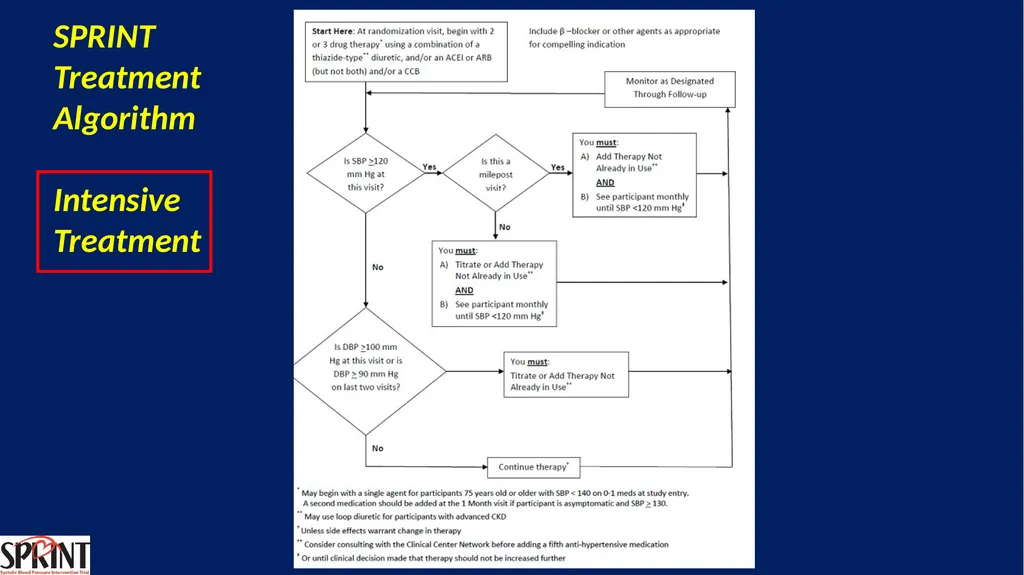
15
SPRINT
Treatment
Algorithm
Intensive
Treatment<br>
Treatment
Algorithm
Intensive
Treatment<br>
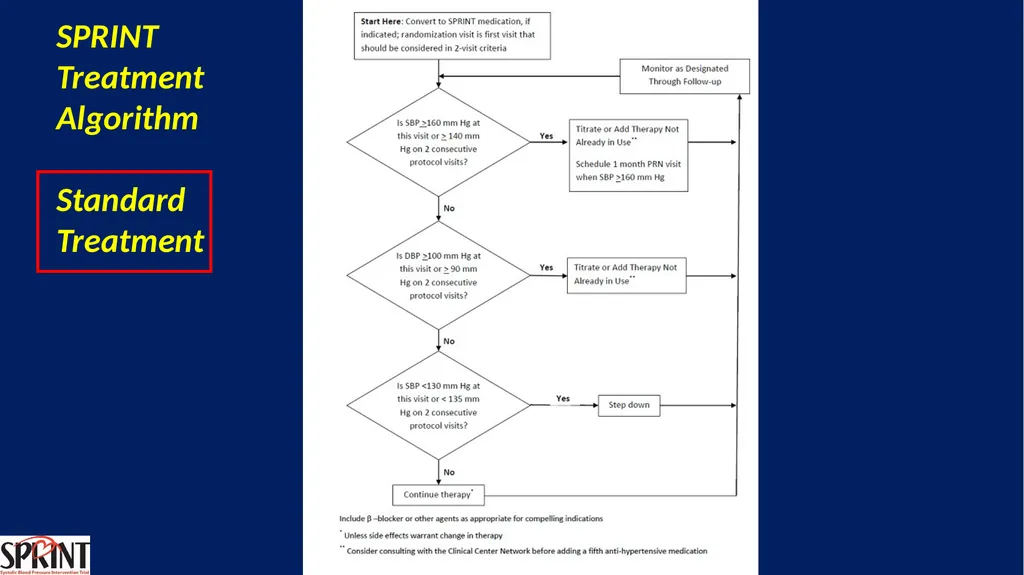
16
SPRINT
Treatment
Algorithm
Standard
Treatment<br>
Treatment
Algorithm
Standard
Treatment<br>
17
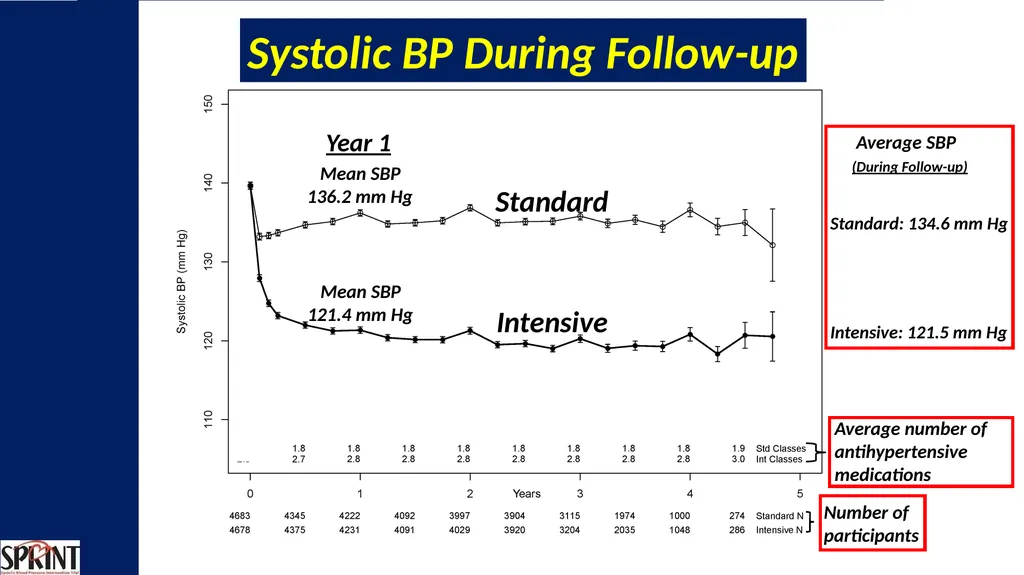
Systolic BP During Follow-up Mean SBP
136.2 mm Hg Mean SBP
121.4 mm Hg Average SBP
(During Follow-up)
Standard: 134.6 mm Hg
Intensive: 121.5 mm Hg Average number of
antihypertensive
medications Number of
participants Standard Intensive Year 1<br>
136.2 mm Hg Mean SBP
121.4 mm Hg Average SBP
(During Follow-up)
Standard: 134.6 mm Hg
Intensive: 121.5 mm Hg Average number of
antihypertensive
medications Number of
participants Standard Intensive Year 1<br>
18
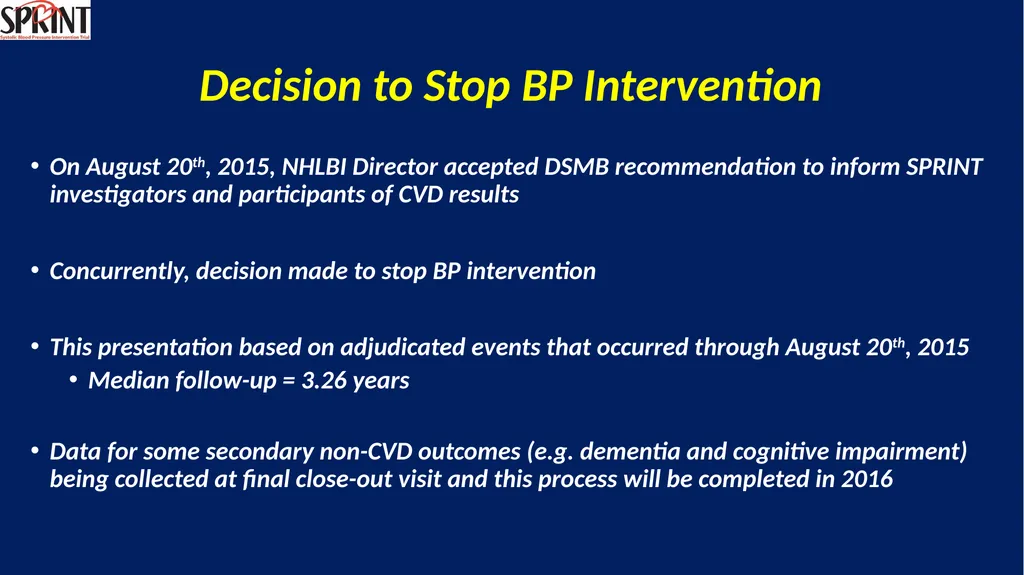
Decision to Stop BP Intervention On August 20th, 2015, NHLBI Director accepted DSMB recommendation to inform SPRINT investigators and participants of CVD results
Concurrently, decision made to stop BP intervention
This presentation based on adjudicated events that occurred through August 20th, 2015
Median follow-up = 3.26 years
Data for some secondary non-CVD outcomes (e.g. dementia and cognitive impairment) being collected at final close-out visit and this process will be completed in 2016<br>
Concurrently, decision made to stop BP intervention
This presentation based on adjudicated events that occurred through August 20th, 2015
Median follow-up = 3.26 years
Data for some secondary non-CVD outcomes (e.g. dementia and cognitive impairment) being collected at final close-out visit and this process will be completed in 2016<br>
19
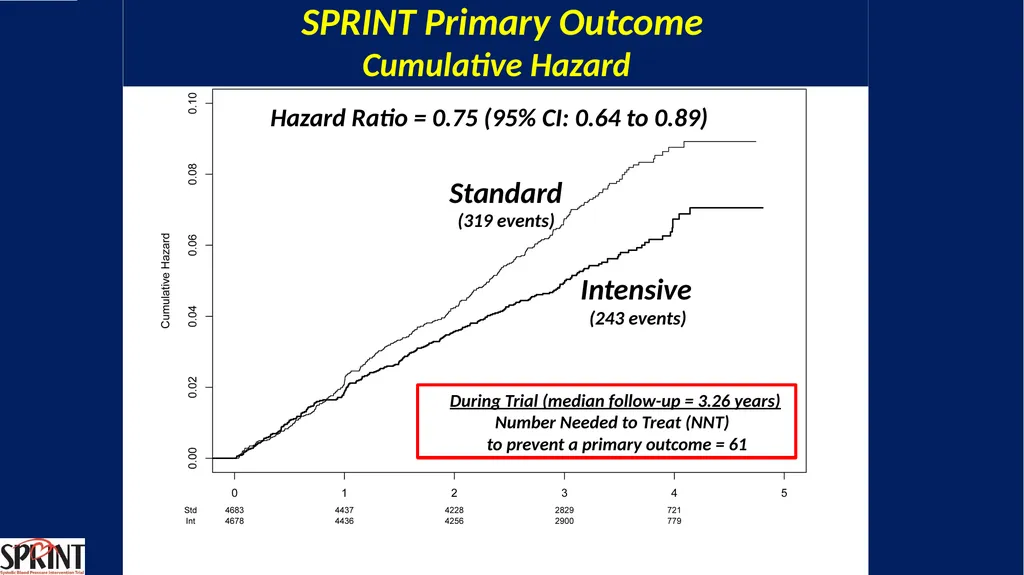
Number of
Participants Hazard Ratio = 0.75 (95% CI: 0.64 to 0.89) Standard Intensive
(243 events) During Trial (median follow-up = 3.26 years)
Number Needed to Treat (NNT)
to prevent a primary outcome = 61 SPRINT Primary Outcome Cumulative Hazard (319 events)<br>
Participants Hazard Ratio = 0.75 (95% CI: 0.64 to 0.89) Standard Intensive
(243 events) During Trial (median follow-up = 3.26 years)
Number Needed to Treat (NNT)
to prevent a primary outcome = 61 SPRINT Primary Outcome Cumulative Hazard (319 events)<br>
20
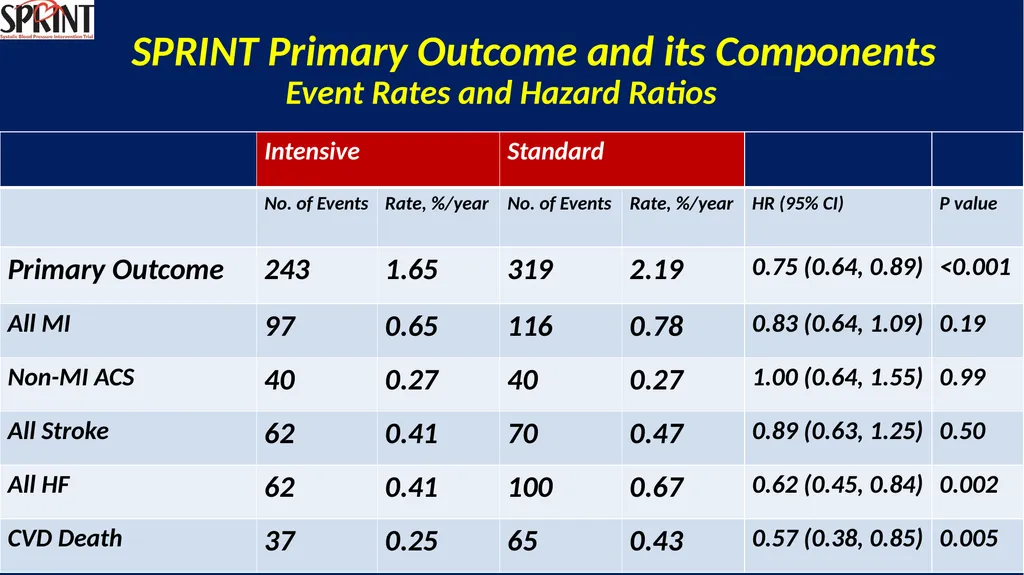
SPRINT Primary Outcome and its Components
Event Rates and Hazard Ratios<br>
21
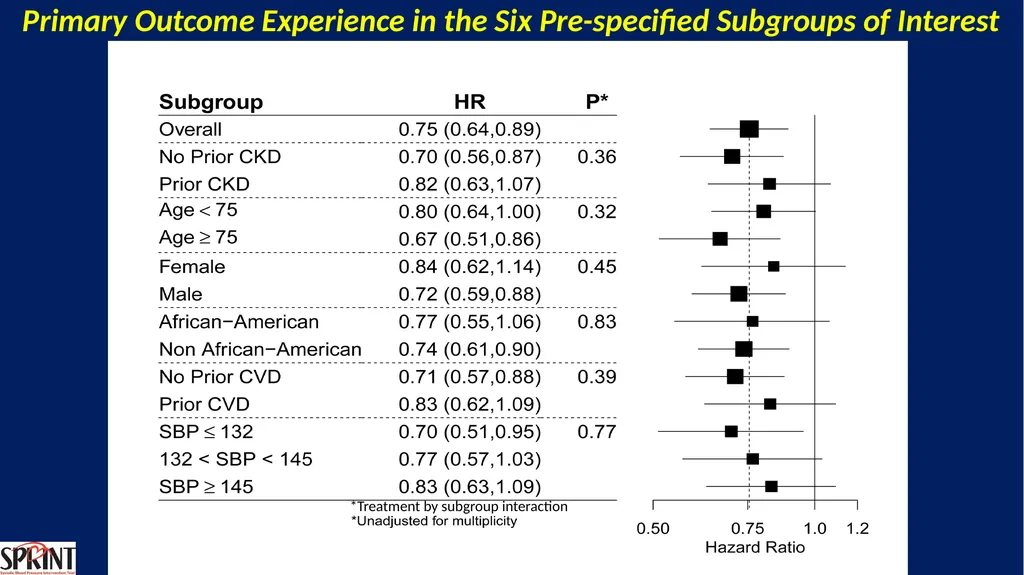
Primary Outcome Experience in the Six Pre-specified Subgroups of Interest *Treatment by subgroup interaction<br>
22
Adapt from Figure 2B in the N Engl J Med manuscript Include NNT All-cause Mortality
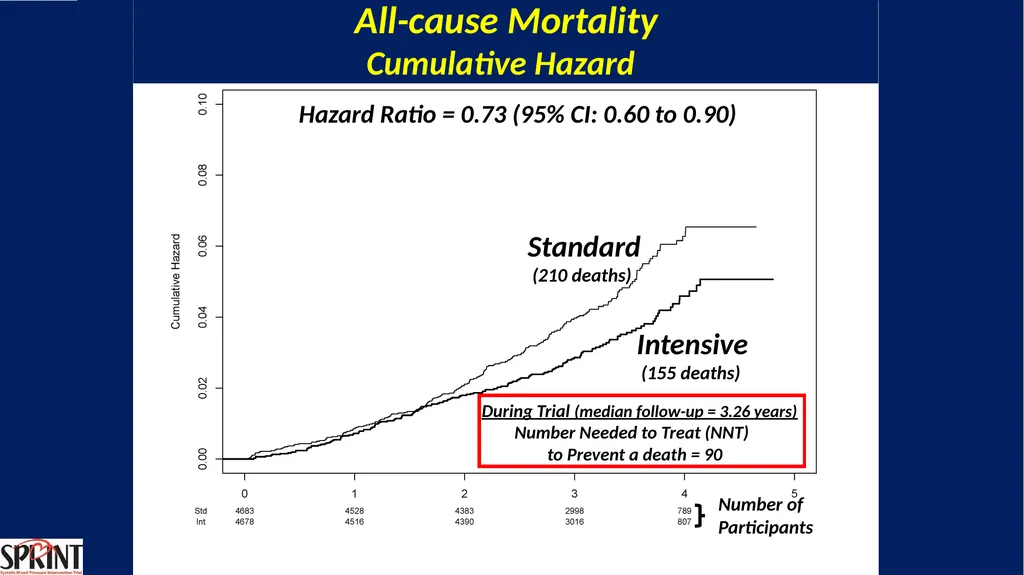
Cumulative Hazard Hazard Ratio = 0.73 (95% CI: 0.60 to 0.90) During Trial (median follow-up = 3.26 years)
Number Needed to Treat (NNT)
to Prevent a death = 90 Standard
(210 deaths) Intensive Intensive
(155 deaths) Number of
Participants<br>
Number Needed to Treat (NNT)
to Prevent a death = 90 Standard
(210 deaths) Intensive Intensive
(155 deaths) Number of
Participants<br>
23
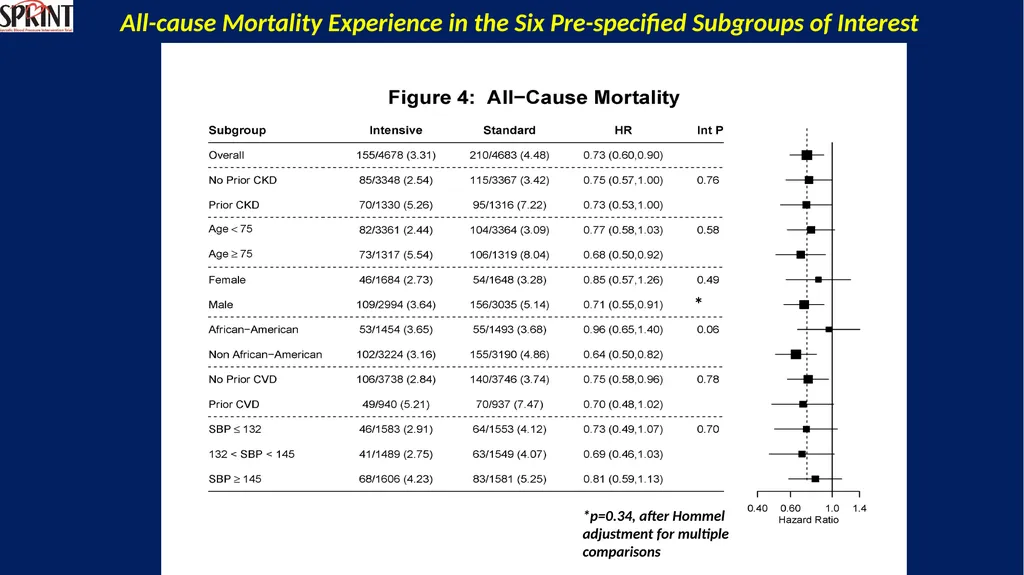
All-cause Mortality Experience in the Six Pre-specified Subgroups of Interest * *p=0.34, after Hommel
adjustment for multiple
comparisons<br>
adjustment for multiple
comparisons<br>
24
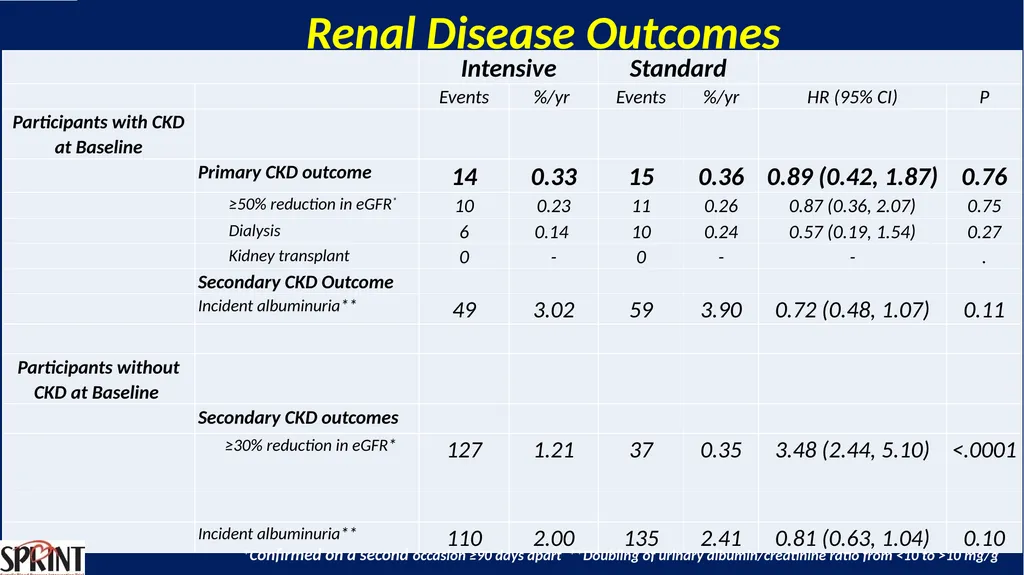
Renal Disease Outcomes *Confirmed on a second occasion ≥90 days apart **Doubling of urinary albumin/creatinine ratio from <10 to >10 mg/g<br>
25
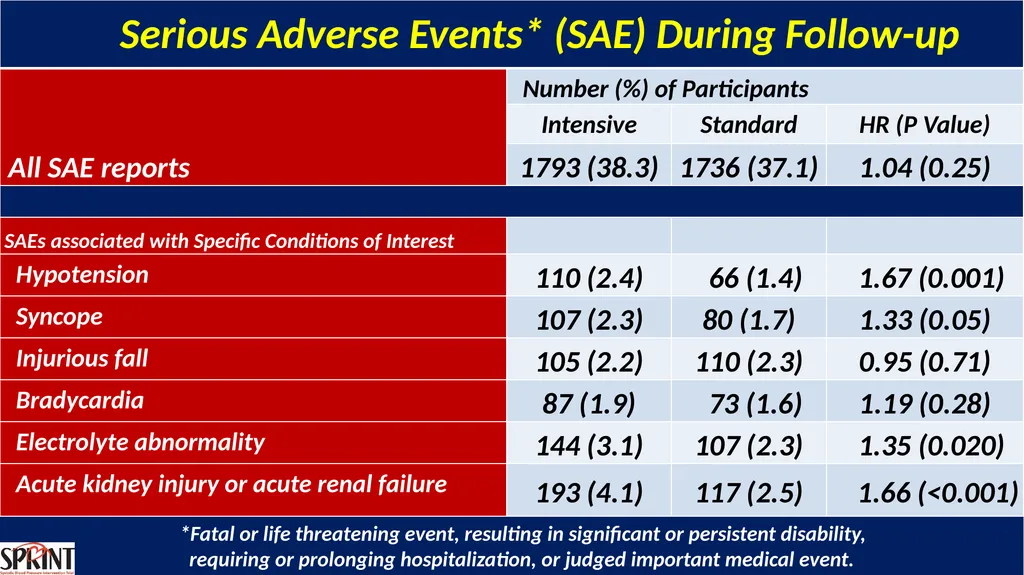
*Fatal or life threatening event, resulting in significant or persistent disability,
requiring or prolonging hospitalization, or judged important medical event.<br>
requiring or prolonging hospitalization, or judged important medical event.<br>
26
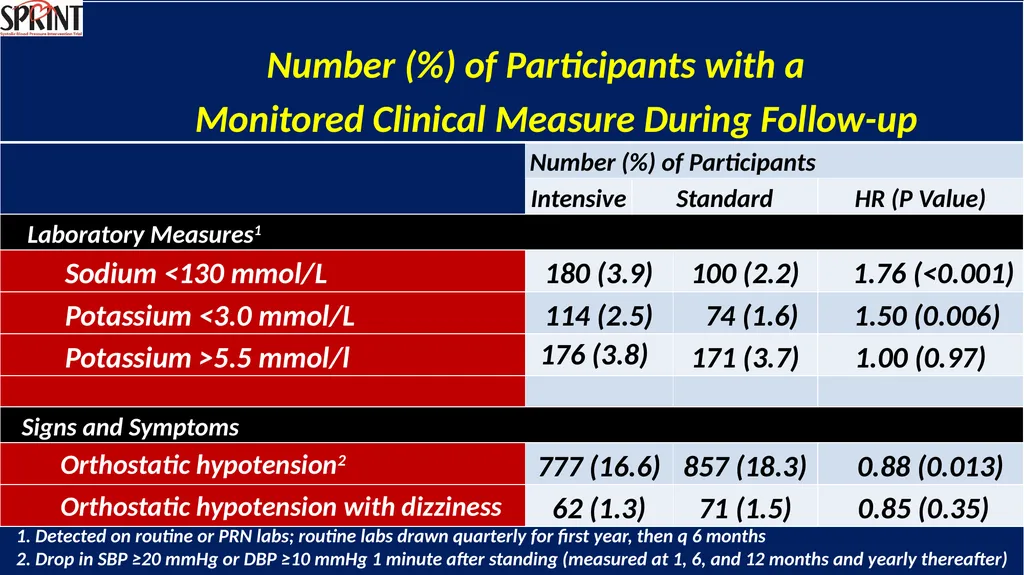
1. Detected on routine or PRN labs; routine labs drawn quarterly for first year, then q 6 months
2. Drop in SBP ≥20 mmHg or DBP ≥10 mmHg 1 minute after standing (measured at 1, 6, and 12 months and yearly thereafter)<br>
2. Drop in SBP ≥20 mmHg or DBP ≥10 mmHg 1 minute after standing (measured at 1, 6, and 12 months and yearly thereafter)<br>
27
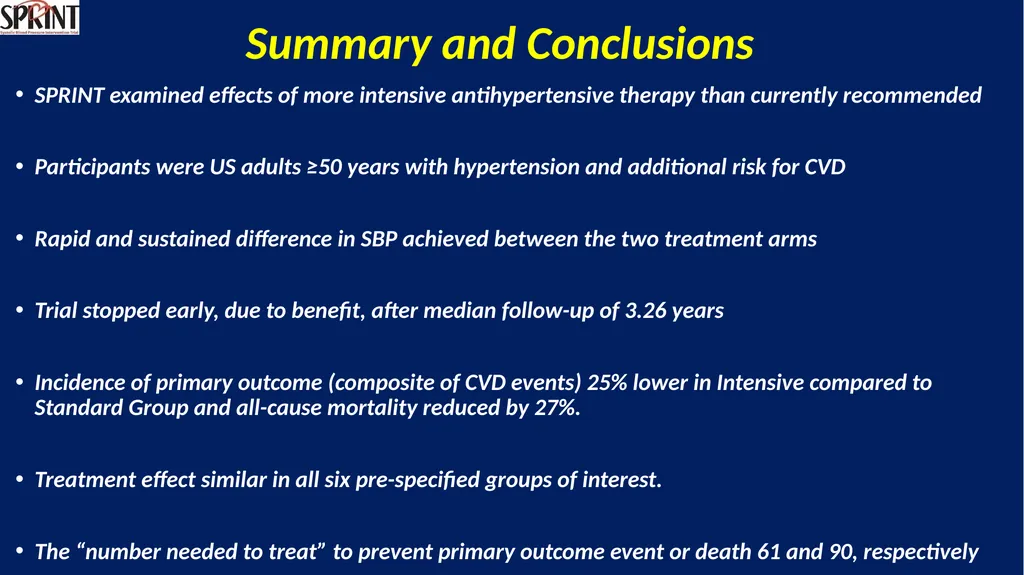
Summary and Conclusions SPRINT examined effects of more intensive antihypertensive therapy than currently recommended
Participants were US adults ≥50 years with hypertension and additional risk for CVD
Rapid and sustained difference in SBP achieved between the two treatment arms
Trial stopped early, due to benefit, after median follow-up of 3.26 years
Incidence of primary outcome (composite of CVD events) 25% lower in Intensive compared to Standard Group and all-cause mortality reduced by 27%.
Treatment effect similar in all six pre-specified groups of interest.
The “number needed to treat” to prevent primary outcome event or death 61 and 90, respectively<br>
Participants were US adults ≥50 years with hypertension and additional risk for CVD
Rapid and sustained difference in SBP achieved between the two treatment arms
Trial stopped early, due to benefit, after median follow-up of 3.26 years
Incidence of primary outcome (composite of CVD events) 25% lower in Intensive compared to Standard Group and all-cause mortality reduced by 27%.
Treatment effect similar in all six pre-specified groups of interest.
The “number needed to treat” to prevent primary outcome event or death 61 and 90, respectively<br>
28
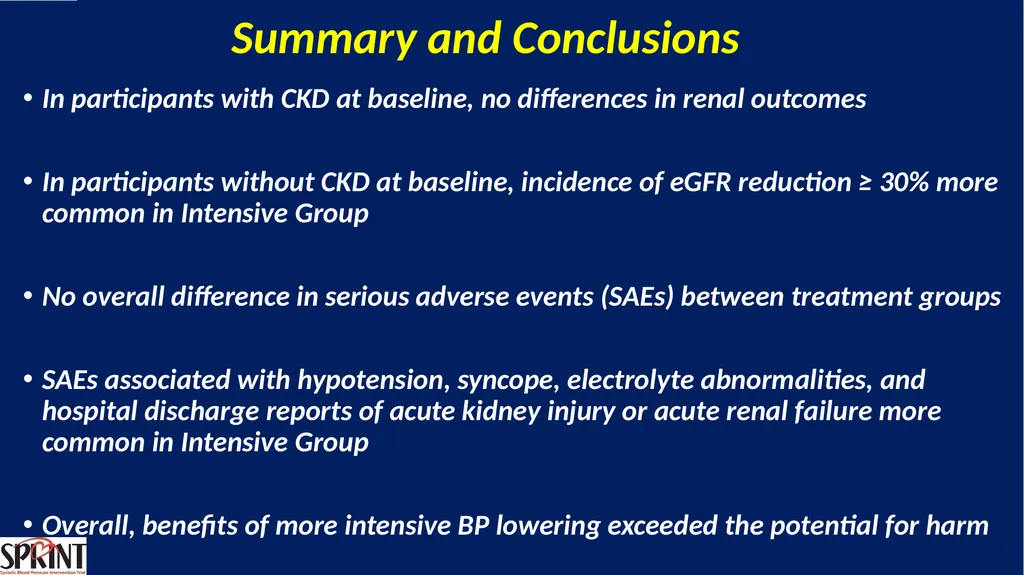
Summary and Conclusions In participants with CKD at baseline, no differences in renal outcomes
In participants without CKD at baseline, incidence of eGFR reduction ≥ 30% more common in Intensive Group
No overall difference in serious adverse events (SAEs) between treatment groups
SAEs associated with hypotension, syncope, electrolyte abnormalities, and hospital discharge reports of acute kidney injury or acute renal failure more common in Intensive Group
Overall, benefits of more intensive BP lowering exceeded the potential for harm<br>
In participants without CKD at baseline, incidence of eGFR reduction ≥ 30% more common in Intensive Group
No overall difference in serious adverse events (SAEs) between treatment groups
SAEs associated with hypotension, syncope, electrolyte abnormalities, and hospital discharge reports of acute kidney injury or acute renal failure more common in Intensive Group
Overall, benefits of more intensive BP lowering exceeded the potential for harm<br>
29
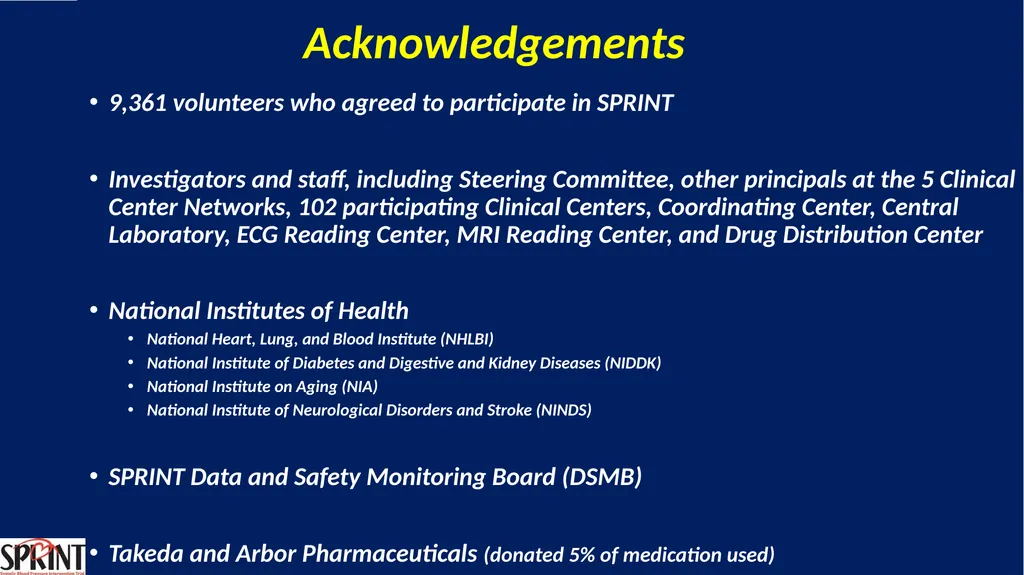
Acknowledgements 9,361 volunteers who agreed to participate in SPRINT
Investigators and staff, including Steering Committee, other principals at the 5 Clinical Center Networks, 102 participating Clinical Centers, Coordinating Center, Central Laboratory, ECG Reading Center, MRI Reading Center, and Drug Distribution Center
National Institutes of Health
National Heart, Lung, and Blood Institute (NHLBI)
National Institute of Diabetes and Digestive and Kidney Diseases (NIDDK)
National Institute on Aging (NIA)
National Institute of Neurological Disorders and Stroke (NINDS)
SPRINT Data and Safety Monitoring Board (DSMB)
Takeda and Arbor Pharmaceuticals (donated 5% of medication used)<br>
Investigators and staff, including Steering Committee, other principals at the 5 Clinical Center Networks, 102 participating Clinical Centers, Coordinating Center, Central Laboratory, ECG Reading Center, MRI Reading Center, and Drug Distribution Center
National Institutes of Health
National Heart, Lung, and Blood Institute (NHLBI)
National Institute of Diabetes and Digestive and Kidney Diseases (NIDDK)
National Institute on Aging (NIA)
National Institute of Neurological Disorders and Stroke (NINDS)
SPRINT Data and Safety Monitoring Board (DSMB)
Takeda and Arbor Pharmaceuticals (donated 5% of medication used)<br>
30
Thank You Additional details of the SPRINT principal results
The SPRINT Research Group
A Randomized Trial of Intensive versus Standard Blood-Pressure Control
N Engl J Med. DOI: 10.1056/NEJMoa 1511939
(simultaneous e publication)<br>
The SPRINT Research Group
A Randomized Trial of Intensive versus Standard Blood-Pressure Control
N Engl J Med. DOI: 10.1056/NEJMoa 1511939
(simultaneous e publication)<br>
31
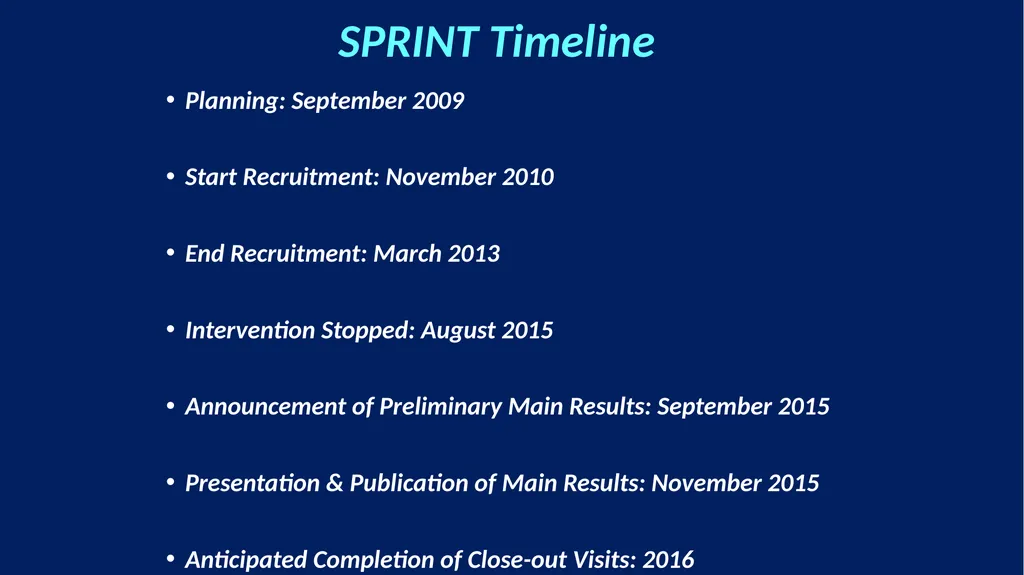
SPRINT Timeline Planning: September 2009
Start Recruitment: November 2010
End Recruitment: March 2013
Intervention Stopped: August 2015
Announcement of Preliminary Main Results: September 2015
Presentation & Publication of Main Results: November 2015
Anticipated Completion of Close-out Visits: 2016<br>
Start Recruitment: November 2010
End Recruitment: March 2013
Intervention Stopped: August 2015
Announcement of Preliminary Main Results: September 2015
Presentation & Publication of Main Results: November 2015
Anticipated Completion of Close-out Visits: 2016<br>