
T- SYSTEMS’ CLOUD BASED SOLUTIONS FOR BUSINESS

Description: T- SYSTEMS CLOUD BASED SOLUTIONS FOR BUSINESS APPLICATIONS It is one of the Europes largest ICT service providers It offers a wide range of IT, telecommunications and integrated ICT services It boasts extensive experiencing in managing
Related Topics
Download Presentation
"T- SYSTEMS’ CLOUD BASED SOLUTIONS FOR BUSINESS" is the property of its rightful owner. Permission is granted to download and print the materials on this website for personal, non-commercial use only, and to display it on your personal computer provided you do not modify the materials and that you retain all copyright notices contained in the materials. By downloading content from our website, you accept the terms of this agreement.
Presentation Transcript
slide1. T- SYSTEMS’ CLOUD BASED SOLUTIONS FOR BUSINESS APPLICATIONS<br>
slide2. It is one of the Europe’s largest ICT service providers
It offers a wide range of IT, telecommunications and integrated ICT services
It boasts extensive experiencing in managing complex outsourcing projects
It has 75 data centers with over 50,000 servers and over 125 MIPS – in Europe, Asia, America and Africa
Cloud computing is an opportunity for T-Systems to leverage its established concept for services delivered from data centers
It enables customers to use services and resources on demand INTRODUCTION<br>
slide3. Whether operated in-house or by an external provider, ICT is driven by two key factors : Cost pressure and market pressure. Both of these call for increases in productivity
Ref fig : 11.1 11.2 WHAT ENTERPRISES DEMAND OF CLOUD COMPUTING<br>
slide4. Today’s market are increasingly dynamic
Products and skills rapidly become obsolete, eroding competitiveness
So business people need to find and implement new ideas at an ever faster pace
The Internet offers the opportunity to implement new business models and integrate new stakeholders into processes. Example : automative industry(It integrates OEM’s , suppliers, dealers, customers on shared internet platform
Markets and Market participants are changing at an unpredicted pace
At the same time markets become more flexible. This not only enables the enterprises to move into new lines of business with greater ease and speed, it also changes common market condition 11.2.1 Changing Markets<br>
slide5. Customers respond faster to changes in the supply of goods and services , market shares shift , some supply –and- demand relationship vanish completely, and individual markets shrink or disappear
Against this background companies not only need to scale up , but also scale down
ICT resources
Required to keep their technology up to date
need to be quickly scaled up and scale down in line with changing requirements 11.2.1 Changing Markets ...<br>
slide6. Today , enterprise ICT and business processes are closely interdependent – so that the line between processes and technology becoming blurred
As a result , ICT is now a critical success factor:
It significantly influences competitiveness and value creation
The demands also increasing the teamwork and collaborations
Solutions not only have to deliver speed plus ease of use , they also have to support simultaneous work on the same documents , team meetings with different continents, provide necessary infrastructure.
That is no easy task in today’s environment 11.2.2 Increased Productivity<br>
slide7. Globalization opens up new markets with greater competitions
Prices for goods and services (power, staff, raw materials) are rising
So the market growth slowing or stagnating
To meet these challenges, companies have to improve their cost structures
Staff downsizing and divesment of loss making units are often preffered option
However Replacing fixed cost with variable cost: this improves liquidity
The resulting liquidity is used to increase equity, mitigating financial risk
Today’s business expect a great deal from their ICT. It is not only open up market opportunities , it also has to be secure and reliable
This means that ICT and associated services have to deliver speed, flexibility, scalability, security, cost effectiveness and transparency 11.2.3 Rising cost pressure<br>
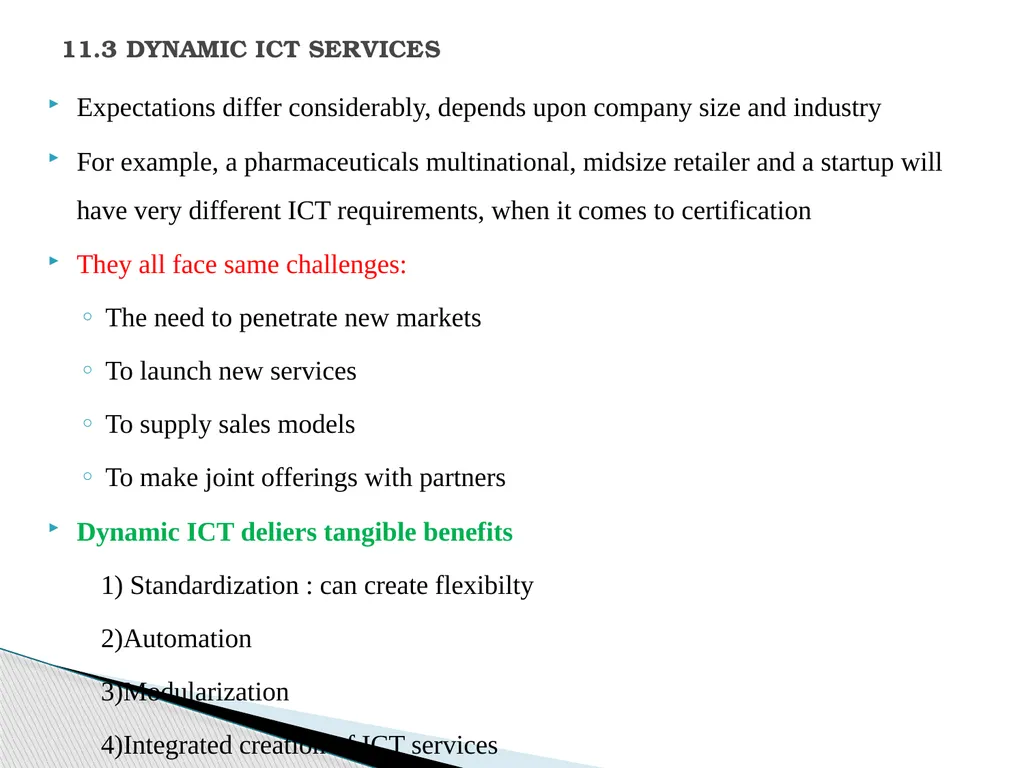
slide8. Expectations differ considerably, depends upon company size and industry
For example, a pharmaceuticals multinational, midsize retailer and a startup will have very different ICT requirements, when it comes to certification
They all face same challenges:
The need to penetrate new markets
To launch new services
To supply sales models
To make joint offerings with partners
Dynamic ICT deliers tangible benefits
1) Standardization : can create flexibilty
2)Automation
3)Modularization
4)Integrated creation of ICT services 11.3 DYNAMIC ICT SERVICES<br>
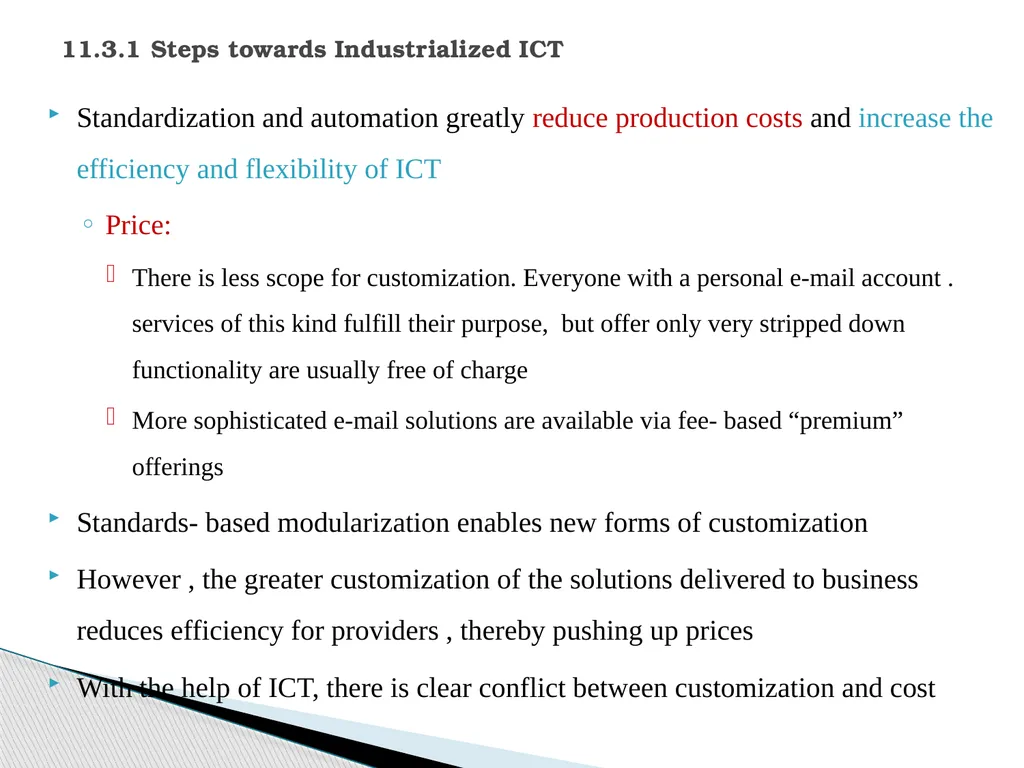
slide9. Standardization and automation greatly reduce production costs and increase the efficiency and flexibility of ICT
Price:
There is less scope for customization. Everyone with a personal e-mail account . services of this kind fulfill their purpose, but offer only very stripped down functionality are usually free of charge
More sophisticated e-mail solutions are available via fee- based “premium” offerings
Standards- based modularization enables new forms of customization
However , the greater customization of the solutions delivered to business reduces efficiency for providers , thereby pushing up prices
With the help of ICT, there is clear conflict between customization and cost 11.3.1 Steps towards Industrialized ICT<br>
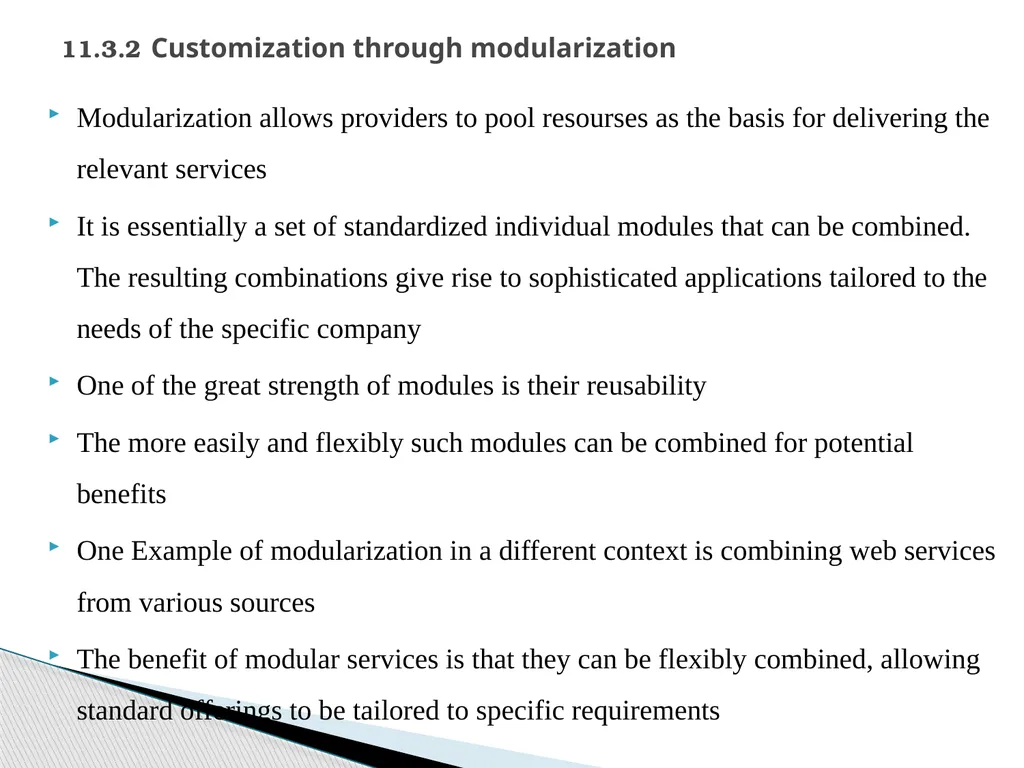
slide10. Modularization allows providers to pool resourses as the basis for delivering the relevant services
It is essentially a set of standardized individual modules that can be combined. The resulting combinations give rise to sophisticated applications tailored to the needs of the specific company
One of the great strength of modules is their reusability
The more easily and flexibly such modules can be combined for potential benefits
One Example of modularization in a different context is combining web services from various sources
The benefit of modular services is that they can be flexibly combined, allowing standard offerings to be tailored to specific requirements 11.3.2 Customization through modularization<br>
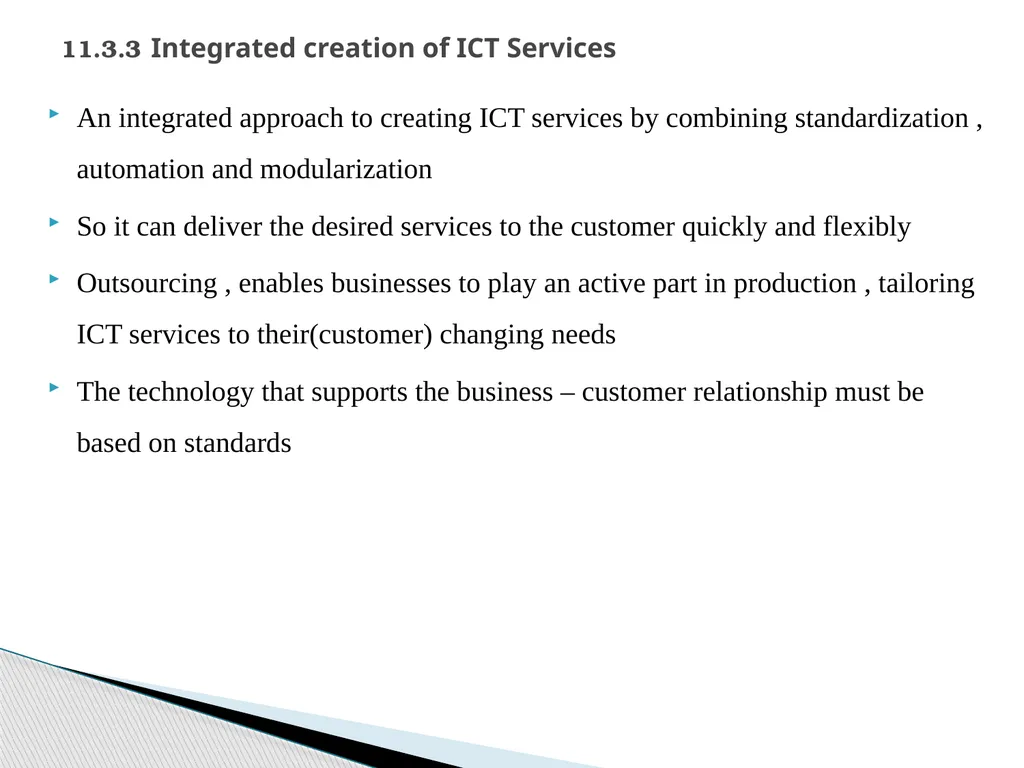
slide11. An integrated approach to creating ICT services by combining standardization , automation and modularization
So it can deliver the desired services to the customer quickly and flexibly
Outsourcing , enables businesses to play an active part in production , tailoring ICT services to their(customer) changing needs
The technology that supports the business – customer relationship must be based on standards 11.3.3 Integrated creation of ICT Services<br>
slide12. 11.4.1 Quality(End-to-End SLA’s)
If consumer’s Internet or ICT service are unavailable, or data access is slow , the consequences are rarely serious
But in business, the non availability of service will affect the entire business (lacking of production or preventing orders from being processed)
In such cases, quality is of the essence :- the user is aware of the performance of system as a whole , including network connectivity
Cloud service providers have to offer end –to-end availability , backed by clearly defined SLAs
The specific requirements are determined by weighing up risk against cost
The importance of a particular process and the corresponding IT solutions are assessed
The findings are then compared with the service levels on offer
As a rule, higher service levels come at a higher price
The quality question is not about combining the highest service levels, but about selecting the right levels for each service 11.4 Importance of quality and security in cloud<br>
slide13. 11.4.1 Compliance and Security
Compliance and Security are increasingly important for cloud computing providers
Surveys consistently point out the security is the greatest obstacle of cloud computing
In a 2008 cio.com study, It decision- makers cited security and loss of control over data as the key drawback of cloud computing
For Business looking to deploy a form of cloud computing , legal issues are considerably more important 11.4 Importance of quality and security in cloud...<br>
slide14. Consumer Cloud versus Enterprise Cloud:
The Internet has given rise to new forms of behaviour , when concluding contracts on-line
When presented with general terms and conditions , many consumers simply check the relevant box and click “OK” , not realizing that they are entering into a legally binding agreement
Cloud computing raises no legal issues, but it making existing ones more complex.
The increased complexity is due to two factors:
In a Cloud Computing, data no longer have to reside in a single location
Business scenarios involving multiple partners are now conceivable
It is therefore impossible to say exactly where data are stored and what national legislation applies.
And whwre data are handled by multiple providers from different countries, the issue of liability
becomes complex 11.4 Importance of quality and security in cloud...<br>
slide15. Cloud Computing from an Enterprise perspective :
With this in mind, businesses should insists on comprehensive, watertight contracts that include provisions for recovery and return of their data , even in the event of bankruptcy
They should establish the country where servers and storage systems are located
Cloud principles notwithstanding services still have to be performed and data stored at specific physical locations
Where data are located determines whose law applies and also determines which government agencies can access it. And also enterprises have to consider that data privacy cultures differ from country to country
Having the legal basis for liability claims is one thing. Successfully prosecuting them is quite another
Companies listed on the U.S stock exchange are subject to the Sarbanes- Oxley Act(SOX) , requiring complete data transparency and audit trails. This poses particular challenges for cloud providers
To comply with SOX 404, CEOs , CFOs, and external auditors have to report annually on the adequacy of internal control systems for financial reporting 11.4 Importance of quality and security in cloud ... Cont..<br>
slide16. ICT service providers are responsible for demonstrating the transparency of financial transactions
Service providers also have to ensure that are not lost and do not fall into the wrong hands
The EU has data-security regulations that apply for all European companies
Moreover , some industries and markets have their own statutory requirements
It is therefore essential that customers discuss their specific needs with the provider. And the provider should be familiar with industry-specific practices and acquire appropriate certification
Providers also have to safeguard data against loss, and business that use cloud services should seek a detailed breakdown of disaster – recovery and business – continuity plans
Other legal issues may arise directly from the technology behind cloud computing 11.4 Importance of quality and security in cloud ...<br>
slide17. What Enterprises Need :
Cloud Computing and applicable ICT legislation are based on diametrically opposed principles
The former is founded on liberalism and unfettered development in the case of technical opportunities
The latter imposes tight constraints on the handling of data and services , as well as on the relationship between customers and providers
These two perspectives will be reconciled in the near feature
Cloud providers have to meet the requirements of the law and of customers alike
Providers working for major corporations have to be dependable in the long term, particularly where they deliver made-to-measure solutions for paarticular business process
Before selecting a cloud provider , customers should take a long hard look at candidate’s services , ability to deliver on promises , and above all , how well SLAs meet their needs 11.4 Importance of quality and security in cloud ...<br>
slide18. 11.5.1 Flexibility across all modules :
Agility at the infrastructure level alone is not enough to provide fast, flexible ICT services
Other Dynamic levels and layers are also required
Ref . fig. 11.2
Adaptable processing and storage resources at the computing level must be supported by agile LAN and WAN infrastructures
Flexibility is also important when it comes to application delivery, scalability, and extensibility via functional modules
Management processes must allow for manual intervention ,where necessary , and automatically link with various layers. These factors enable the creation of end-to-end SLA across all components
Every Dynamic ICT service is based on a resource pool from which computing, data, and storage services can be delivered as required
Dynamic network and application services are also available . The applications are optimized for deployment with pooled resouces
When customer opt for a dynamic service, they require an SLA that covers not only individual components , but also the service as a whole , including any WAN elements 11.5 Dynamic Data Center- producing business ready , Dynamic ICT Services Cont..<br>
slide19. Toward Dynamic, Flexible ICT Services:
Step1: Standardize
To standardize the Customer’s existing environment . It systems running different software releases have to be migrated , often to a single operating system .
Hardware also has to be standardized
Eliminating disparate operating system and hardware platforms for easy automation
Step2: Technical Consolidation
It reduces physical servers and also slim down data storage
Identical backup and restore mechanisms are introduced at this stage
small and uneconomical centers are closed
Step 3: Virtualization
It means that services no longer depend on specific hardware
It enables server resources to be subdivided and allocated to different tasks Cont..<br>
slide20. Step 4: Automation
It slashes costs, improve efficiency and accelerates standard procedures
In the business world , automation must also support seamless integration of financial , accounting and ordering systems Cont..<br>
slide21. Computing :
The Computing pool is based on server farms located in different data centers
The logical server systems are created automatically at these farms
The server systems comply with predefined standards
They are equipped with the network interface cards required for communication and integration with storage systems
No internal hard drives or direct attached storage systems are deployed
The configuration management database(CMDB) plays a key role in computing resource pools (Ref : Fig. 11.3)
1.This selects and configures the required physical server
2.Once a server has been selected from the pool , virtualization technology is selected in line with the relevant application and the demand it has to meet
3. The configuration requirements are sent to the network configuration management system
4. It also sent to the storage configuration management system
5. Once all the necessary elements are in place, the storage systems are mounted on the servers, after which the operating system images are booted
The configuration database must be updated automatically to accurately reflect the current state of systems and configurations at all times Cont.. 11.5.2: T-Systems’ Core cloud modules : Computing , storage<br>
slide22. The CMDB also supports other tasks. These include
enhanced monitoring and reporting
Quality management
Resource Planning
Applications are also virtualized
Speed is one of the essence of cloud computing providers
Decoupling operating systems from applications plays a key role ,because it reduces both initial and subsequent application –provisioning time
Applications can quickly be moved from one server to another , and updates can be managed independently of operating systems
The full benefits can only be realized if there is a high degree of automation and standardization in the IT infrastructure and application themselves Cont..<br>
slide23. Storage :
IP based storage systems are deployed .
To reduce hardware configuration effort , the computing systems use neither SAN or direct attached storage
Using Fiber Channel(FC) cards in the servers and deploying an FC Network increases overall system complexity substantially
The IP storage systems are linked via Gbit Ethernet
Storage is automatically allocated to the server systems that require it
Storage resources are located in different zones as well as different data centers for preventing data loss in the event of a disaster
The Storage system handles replication of data between data centers and fire zones
So computing resources not needed for this purpose Cont..<br>
slide24. Ref . Fig. 11.4
Backup- integrated storage(BIS):
Backups are necessary to safeguard against data loss
Backup- integrated storage(BIS) is provided , along with full management functionality
To accelerate backup and reduce the volume of the data transferred , data are backed up on hard disks within the storage system in the forms of snapshotting
This simplifies the structure of the computing systems and minimizes the potential for temporal bottlenecks
Storage system normally provide 35-day storage period
Archive and other storage :
Archive systems are also available for long term data storage
Like BIS the Systems are hard disk based and linked via IP
Data for archiving is replicated within the archive system in a separate separate fire zone as well as at remote data center
Replication is handled by the archive system itself
Archive storage can be managed by two ways :
1. It can be initiated from application themselves
2. Document management System
Some systems require a hard disk cache Cont..<br>
slide25. Communications :
The computing and storage modules are integrated via an automatically configured LAN or corresponding Virtual Private Networks(VPN)
The servers used in the computing module are equipped with multiple network cards as standard
Depending on requirements , these are grouped to form the necessary networks
Networks are segregated from each other by VPN technology
BIS elimiates the need for a separate backup network
Customer Network
Access for customers is provided via Internet /VPN connections
Services are assigned to companies by unique IP address
Access to dynamic data centers is protected via redundant, clustered firewalls
Virtual firewalls are configured automatically
Access is entirely IP –based
Storage and Administration Network
A separate storage network is provided for accessing operating system images , applications, customer and archive data
Configuration is handled automatically Cont..<br>
slide26. The Dynamic Data center concept underlies all T-Systems Dynamic services
All the resources required by a given service are automatically provided by the data center
Dynamic Applications for Enterprise:
T-Systems has tailored its portfolio to fulfill these requirements:
Communication and Collaboration : These are the key components for any company. Work on projects often entails frequent changes in user numbers. As a result , enterprises need flexiblility for handling communications and collaboration
ERP and CRM
Development and Testing
Middleware
Front-Ends and Devices
Introducing New Services in a Dynamic Data Center:
The providers of cloud computing have to continuously review and extend their offerings
There is a standardized approach is key to ensuring that the services delivered meet business customer’s requirements
First, automatic mechanisms have to be developed for standardizing the installation of typical combinations of operating system, database , and application software
These mechanisms must also support automated procedures for starting and stopping applications Cont.. 11.5.3 Dynamic Services – A Brief Overview<br>
slide27. The software components and their automatic management functions are subject to release and patch management procedures agreed with the vendors
An operating manual is developed and its recommendations tested in a pilot installation before the production environment goes live
Next, a variety of quality options are developed.These can include redundant resources across multiple fire zones
A concept of segregatting applications from each other is also created Cont..<br>
slide28. T-Systems delivers Dynamic services from multiple data centers around the world. (Ref. Fig. 11.5)
These are mostly designed as twin-core facilities
All Dynamic Data centers are based on the original concept used for the first data center of this kind in frankfurt
These are currently facilities in the United States , Brazil, Germany,Singapore and Malasiya 11.5.4 Dynamic Data Centers across the Globe<br>
slide2. It is one of the Europe’s largest ICT service providers
It offers a wide range of IT, telecommunications and integrated ICT services
It boasts extensive experiencing in managing complex outsourcing projects
It has 75 data centers with over 50,000 servers and over 125 MIPS – in Europe, Asia, America and Africa
Cloud computing is an opportunity for T-Systems to leverage its established concept for services delivered from data centers
It enables customers to use services and resources on demand INTRODUCTION<br>
slide3. Whether operated in-house or by an external provider, ICT is driven by two key factors : Cost pressure and market pressure. Both of these call for increases in productivity
Ref fig : 11.1 11.2 WHAT ENTERPRISES DEMAND OF CLOUD COMPUTING<br>
slide4. Today’s market are increasingly dynamic
Products and skills rapidly become obsolete, eroding competitiveness
So business people need to find and implement new ideas at an ever faster pace
The Internet offers the opportunity to implement new business models and integrate new stakeholders into processes. Example : automative industry(It integrates OEM’s , suppliers, dealers, customers on shared internet platform
Markets and Market participants are changing at an unpredicted pace
At the same time markets become more flexible. This not only enables the enterprises to move into new lines of business with greater ease and speed, it also changes common market condition 11.2.1 Changing Markets<br>
slide5. Customers respond faster to changes in the supply of goods and services , market shares shift , some supply –and- demand relationship vanish completely, and individual markets shrink or disappear
Against this background companies not only need to scale up , but also scale down
ICT resources
Required to keep their technology up to date
need to be quickly scaled up and scale down in line with changing requirements 11.2.1 Changing Markets ...<br>
slide6. Today , enterprise ICT and business processes are closely interdependent – so that the line between processes and technology becoming blurred
As a result , ICT is now a critical success factor:
It significantly influences competitiveness and value creation
The demands also increasing the teamwork and collaborations
Solutions not only have to deliver speed plus ease of use , they also have to support simultaneous work on the same documents , team meetings with different continents, provide necessary infrastructure.
That is no easy task in today’s environment 11.2.2 Increased Productivity<br>
slide7. Globalization opens up new markets with greater competitions
Prices for goods and services (power, staff, raw materials) are rising
So the market growth slowing or stagnating
To meet these challenges, companies have to improve their cost structures
Staff downsizing and divesment of loss making units are often preffered option
However Replacing fixed cost with variable cost: this improves liquidity
The resulting liquidity is used to increase equity, mitigating financial risk
Today’s business expect a great deal from their ICT. It is not only open up market opportunities , it also has to be secure and reliable
This means that ICT and associated services have to deliver speed, flexibility, scalability, security, cost effectiveness and transparency 11.2.3 Rising cost pressure<br>
slide8. Expectations differ considerably, depends upon company size and industry
For example, a pharmaceuticals multinational, midsize retailer and a startup will have very different ICT requirements, when it comes to certification
They all face same challenges:
The need to penetrate new markets
To launch new services
To supply sales models
To make joint offerings with partners
Dynamic ICT deliers tangible benefits
1) Standardization : can create flexibilty
2)Automation
3)Modularization
4)Integrated creation of ICT services 11.3 DYNAMIC ICT SERVICES<br>
slide9. Standardization and automation greatly reduce production costs and increase the efficiency and flexibility of ICT
Price:
There is less scope for customization. Everyone with a personal e-mail account . services of this kind fulfill their purpose, but offer only very stripped down functionality are usually free of charge
More sophisticated e-mail solutions are available via fee- based “premium” offerings
Standards- based modularization enables new forms of customization
However , the greater customization of the solutions delivered to business reduces efficiency for providers , thereby pushing up prices
With the help of ICT, there is clear conflict between customization and cost 11.3.1 Steps towards Industrialized ICT<br>
slide10. Modularization allows providers to pool resourses as the basis for delivering the relevant services
It is essentially a set of standardized individual modules that can be combined. The resulting combinations give rise to sophisticated applications tailored to the needs of the specific company
One of the great strength of modules is their reusability
The more easily and flexibly such modules can be combined for potential benefits
One Example of modularization in a different context is combining web services from various sources
The benefit of modular services is that they can be flexibly combined, allowing standard offerings to be tailored to specific requirements 11.3.2 Customization through modularization<br>
slide11. An integrated approach to creating ICT services by combining standardization , automation and modularization
So it can deliver the desired services to the customer quickly and flexibly
Outsourcing , enables businesses to play an active part in production , tailoring ICT services to their(customer) changing needs
The technology that supports the business – customer relationship must be based on standards 11.3.3 Integrated creation of ICT Services<br>
slide12. 11.4.1 Quality(End-to-End SLA’s)
If consumer’s Internet or ICT service are unavailable, or data access is slow , the consequences are rarely serious
But in business, the non availability of service will affect the entire business (lacking of production or preventing orders from being processed)
In such cases, quality is of the essence :- the user is aware of the performance of system as a whole , including network connectivity
Cloud service providers have to offer end –to-end availability , backed by clearly defined SLAs
The specific requirements are determined by weighing up risk against cost
The importance of a particular process and the corresponding IT solutions are assessed
The findings are then compared with the service levels on offer
As a rule, higher service levels come at a higher price
The quality question is not about combining the highest service levels, but about selecting the right levels for each service 11.4 Importance of quality and security in cloud<br>
slide13. 11.4.1 Compliance and Security
Compliance and Security are increasingly important for cloud computing providers
Surveys consistently point out the security is the greatest obstacle of cloud computing
In a 2008 cio.com study, It decision- makers cited security and loss of control over data as the key drawback of cloud computing
For Business looking to deploy a form of cloud computing , legal issues are considerably more important 11.4 Importance of quality and security in cloud...<br>
slide14. Consumer Cloud versus Enterprise Cloud:
The Internet has given rise to new forms of behaviour , when concluding contracts on-line
When presented with general terms and conditions , many consumers simply check the relevant box and click “OK” , not realizing that they are entering into a legally binding agreement
Cloud computing raises no legal issues, but it making existing ones more complex.
The increased complexity is due to two factors:
In a Cloud Computing, data no longer have to reside in a single location
Business scenarios involving multiple partners are now conceivable
It is therefore impossible to say exactly where data are stored and what national legislation applies.
And whwre data are handled by multiple providers from different countries, the issue of liability
becomes complex 11.4 Importance of quality and security in cloud...<br>
slide15. Cloud Computing from an Enterprise perspective :
With this in mind, businesses should insists on comprehensive, watertight contracts that include provisions for recovery and return of their data , even in the event of bankruptcy
They should establish the country where servers and storage systems are located
Cloud principles notwithstanding services still have to be performed and data stored at specific physical locations
Where data are located determines whose law applies and also determines which government agencies can access it. And also enterprises have to consider that data privacy cultures differ from country to country
Having the legal basis for liability claims is one thing. Successfully prosecuting them is quite another
Companies listed on the U.S stock exchange are subject to the Sarbanes- Oxley Act(SOX) , requiring complete data transparency and audit trails. This poses particular challenges for cloud providers
To comply with SOX 404, CEOs , CFOs, and external auditors have to report annually on the adequacy of internal control systems for financial reporting 11.4 Importance of quality and security in cloud ... Cont..<br>
slide16. ICT service providers are responsible for demonstrating the transparency of financial transactions
Service providers also have to ensure that are not lost and do not fall into the wrong hands
The EU has data-security regulations that apply for all European companies
Moreover , some industries and markets have their own statutory requirements
It is therefore essential that customers discuss their specific needs with the provider. And the provider should be familiar with industry-specific practices and acquire appropriate certification
Providers also have to safeguard data against loss, and business that use cloud services should seek a detailed breakdown of disaster – recovery and business – continuity plans
Other legal issues may arise directly from the technology behind cloud computing 11.4 Importance of quality and security in cloud ...<br>
slide17. What Enterprises Need :
Cloud Computing and applicable ICT legislation are based on diametrically opposed principles
The former is founded on liberalism and unfettered development in the case of technical opportunities
The latter imposes tight constraints on the handling of data and services , as well as on the relationship between customers and providers
These two perspectives will be reconciled in the near feature
Cloud providers have to meet the requirements of the law and of customers alike
Providers working for major corporations have to be dependable in the long term, particularly where they deliver made-to-measure solutions for paarticular business process
Before selecting a cloud provider , customers should take a long hard look at candidate’s services , ability to deliver on promises , and above all , how well SLAs meet their needs 11.4 Importance of quality and security in cloud ...<br>
slide18. 11.5.1 Flexibility across all modules :
Agility at the infrastructure level alone is not enough to provide fast, flexible ICT services
Other Dynamic levels and layers are also required
Ref . fig. 11.2
Adaptable processing and storage resources at the computing level must be supported by agile LAN and WAN infrastructures
Flexibility is also important when it comes to application delivery, scalability, and extensibility via functional modules
Management processes must allow for manual intervention ,where necessary , and automatically link with various layers. These factors enable the creation of end-to-end SLA across all components
Every Dynamic ICT service is based on a resource pool from which computing, data, and storage services can be delivered as required
Dynamic network and application services are also available . The applications are optimized for deployment with pooled resouces
When customer opt for a dynamic service, they require an SLA that covers not only individual components , but also the service as a whole , including any WAN elements 11.5 Dynamic Data Center- producing business ready , Dynamic ICT Services Cont..<br>
slide19. Toward Dynamic, Flexible ICT Services:
Step1: Standardize
To standardize the Customer’s existing environment . It systems running different software releases have to be migrated , often to a single operating system .
Hardware also has to be standardized
Eliminating disparate operating system and hardware platforms for easy automation
Step2: Technical Consolidation
It reduces physical servers and also slim down data storage
Identical backup and restore mechanisms are introduced at this stage
small and uneconomical centers are closed
Step 3: Virtualization
It means that services no longer depend on specific hardware
It enables server resources to be subdivided and allocated to different tasks Cont..<br>
slide20. Step 4: Automation
It slashes costs, improve efficiency and accelerates standard procedures
In the business world , automation must also support seamless integration of financial , accounting and ordering systems Cont..<br>
slide21. Computing :
The Computing pool is based on server farms located in different data centers
The logical server systems are created automatically at these farms
The server systems comply with predefined standards
They are equipped with the network interface cards required for communication and integration with storage systems
No internal hard drives or direct attached storage systems are deployed
The configuration management database(CMDB) plays a key role in computing resource pools (Ref : Fig. 11.3)
1.This selects and configures the required physical server
2.Once a server has been selected from the pool , virtualization technology is selected in line with the relevant application and the demand it has to meet
3. The configuration requirements are sent to the network configuration management system
4. It also sent to the storage configuration management system
5. Once all the necessary elements are in place, the storage systems are mounted on the servers, after which the operating system images are booted
The configuration database must be updated automatically to accurately reflect the current state of systems and configurations at all times Cont.. 11.5.2: T-Systems’ Core cloud modules : Computing , storage<br>
slide22. The CMDB also supports other tasks. These include
enhanced monitoring and reporting
Quality management
Resource Planning
Applications are also virtualized
Speed is one of the essence of cloud computing providers
Decoupling operating systems from applications plays a key role ,because it reduces both initial and subsequent application –provisioning time
Applications can quickly be moved from one server to another , and updates can be managed independently of operating systems
The full benefits can only be realized if there is a high degree of automation and standardization in the IT infrastructure and application themselves Cont..<br>
slide23. Storage :
IP based storage systems are deployed .
To reduce hardware configuration effort , the computing systems use neither SAN or direct attached storage
Using Fiber Channel(FC) cards in the servers and deploying an FC Network increases overall system complexity substantially
The IP storage systems are linked via Gbit Ethernet
Storage is automatically allocated to the server systems that require it
Storage resources are located in different zones as well as different data centers for preventing data loss in the event of a disaster
The Storage system handles replication of data between data centers and fire zones
So computing resources not needed for this purpose Cont..<br>
slide24. Ref . Fig. 11.4
Backup- integrated storage(BIS):
Backups are necessary to safeguard against data loss
Backup- integrated storage(BIS) is provided , along with full management functionality
To accelerate backup and reduce the volume of the data transferred , data are backed up on hard disks within the storage system in the forms of snapshotting
This simplifies the structure of the computing systems and minimizes the potential for temporal bottlenecks
Storage system normally provide 35-day storage period
Archive and other storage :
Archive systems are also available for long term data storage
Like BIS the Systems are hard disk based and linked via IP
Data for archiving is replicated within the archive system in a separate separate fire zone as well as at remote data center
Replication is handled by the archive system itself
Archive storage can be managed by two ways :
1. It can be initiated from application themselves
2. Document management System
Some systems require a hard disk cache Cont..<br>
slide25. Communications :
The computing and storage modules are integrated via an automatically configured LAN or corresponding Virtual Private Networks(VPN)
The servers used in the computing module are equipped with multiple network cards as standard
Depending on requirements , these are grouped to form the necessary networks
Networks are segregated from each other by VPN technology
BIS elimiates the need for a separate backup network
Customer Network
Access for customers is provided via Internet /VPN connections
Services are assigned to companies by unique IP address
Access to dynamic data centers is protected via redundant, clustered firewalls
Virtual firewalls are configured automatically
Access is entirely IP –based
Storage and Administration Network
A separate storage network is provided for accessing operating system images , applications, customer and archive data
Configuration is handled automatically Cont..<br>
slide26. The Dynamic Data center concept underlies all T-Systems Dynamic services
All the resources required by a given service are automatically provided by the data center
Dynamic Applications for Enterprise:
T-Systems has tailored its portfolio to fulfill these requirements:
Communication and Collaboration : These are the key components for any company. Work on projects often entails frequent changes in user numbers. As a result , enterprises need flexiblility for handling communications and collaboration
ERP and CRM
Development and Testing
Middleware
Front-Ends and Devices
Introducing New Services in a Dynamic Data Center:
The providers of cloud computing have to continuously review and extend their offerings
There is a standardized approach is key to ensuring that the services delivered meet business customer’s requirements
First, automatic mechanisms have to be developed for standardizing the installation of typical combinations of operating system, database , and application software
These mechanisms must also support automated procedures for starting and stopping applications Cont.. 11.5.3 Dynamic Services – A Brief Overview<br>
slide27. The software components and their automatic management functions are subject to release and patch management procedures agreed with the vendors
An operating manual is developed and its recommendations tested in a pilot installation before the production environment goes live
Next, a variety of quality options are developed.These can include redundant resources across multiple fire zones
A concept of segregatting applications from each other is also created Cont..<br>
slide28. T-Systems delivers Dynamic services from multiple data centers around the world. (Ref. Fig. 11.5)
These are mostly designed as twin-core facilities
All Dynamic Data centers are based on the original concept used for the first data center of this kind in frankfurt
These are currently facilities in the United States , Brazil, Germany,Singapore and Malasiya 11.5.4 Dynamic Data Centers across the Globe<br>