TACTILE SENSORS FOR ROBOTIC APPLICATIONS Pedro Silva Girão, Pedro Miguel Pinto Ramos, Octavian Postolache José, Miguel Dias Pereira Journal of the International Measurement Confederation (IMEKO) - ELSEVIER Presented By: Abhinandan
"TACTILE SENSORS FOR ROBOTIC APPLICATIONS Pedro" is the property of its rightful owner. Permission is granted to
download and print the materials on this website for personal, non-commercial use only, and to display it
on your personal computer provided you do not modify the materials and that you retain all copyright
notices contained in the materials. By downloading content from our website, you accept the terms of this
agreement.
Presentation Transcript
01
TACTILE SENSORS FOR ROBOTIC APPLICATIONS Pedro Silva Girão, Pedro Miguel Pinto Ramos, Octavian Postolache José, Miguel Dias Pereira
Journal of the International Measurement Confederation (IMEKO) - ELSEVIER Presented By: Abhinandan Srinivasan (as5630)<br>
02
TACTILE SENSING Two main research areas:
Object manipulation tasks
Characterizing surface textures
Respond to contact forces – touch, tactile and slip sensing
Parameters that define the contact b/w sensor and an object – Localized Interaction
Array of a coordinated group of touch sensors
Haptic Perception – requires both sensory and motor systems
Human touch – 4 type of tactile receptors
Meissner corpuscles, Merkel cells, Ruffini endings, and Pacinian corpuscles.<br>
03
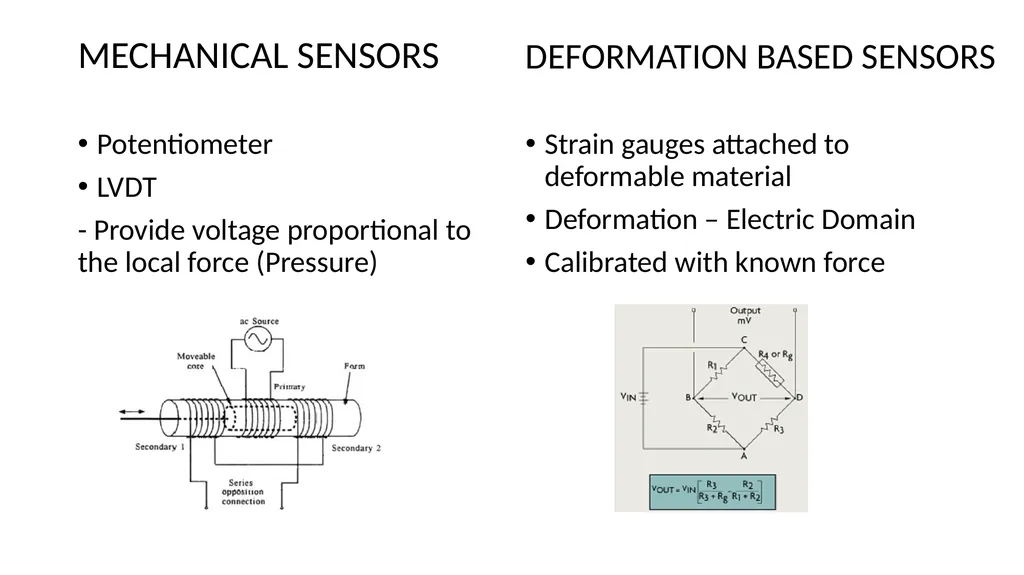
MECHANICAL SENSORS Potentiometer
LVDT
- Provide voltage proportional to the local force (Pressure) DEFORMATION BASED SENSORS Strain gauges attached to deformable material
Deformation – Electric Domain
Calibrated with known force<br>
04
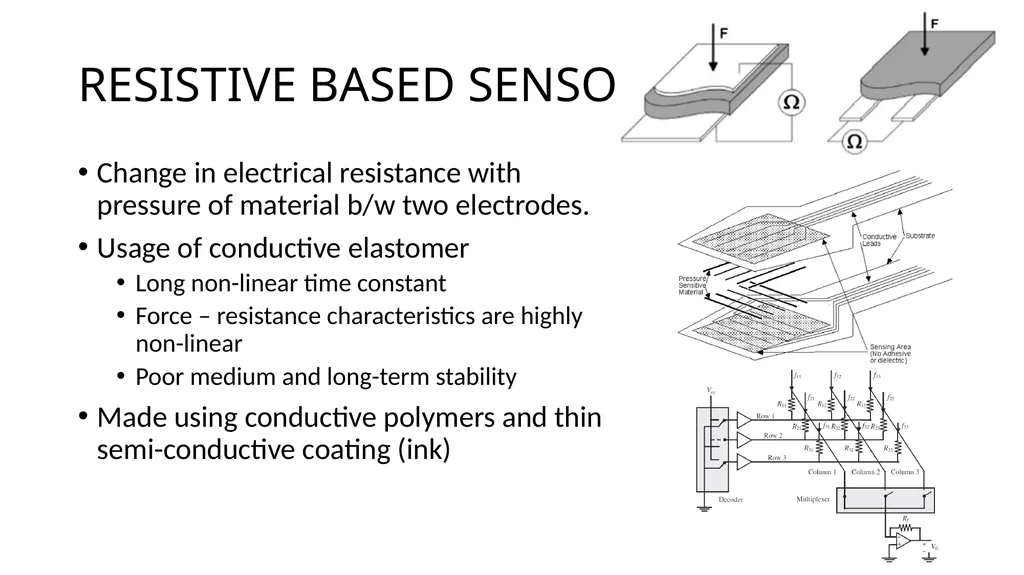
RESISTIVE BASED SENSORS Change in electrical resistance with pressure of material b/w two electrodes.
Usage of conductive elastomer
Long non-linear time constant
Force – resistance characteristics are highly non-linear
Poor medium and long-term stability
Made using conductive polymers and thin semi-conductive coating (ink)<br>
05
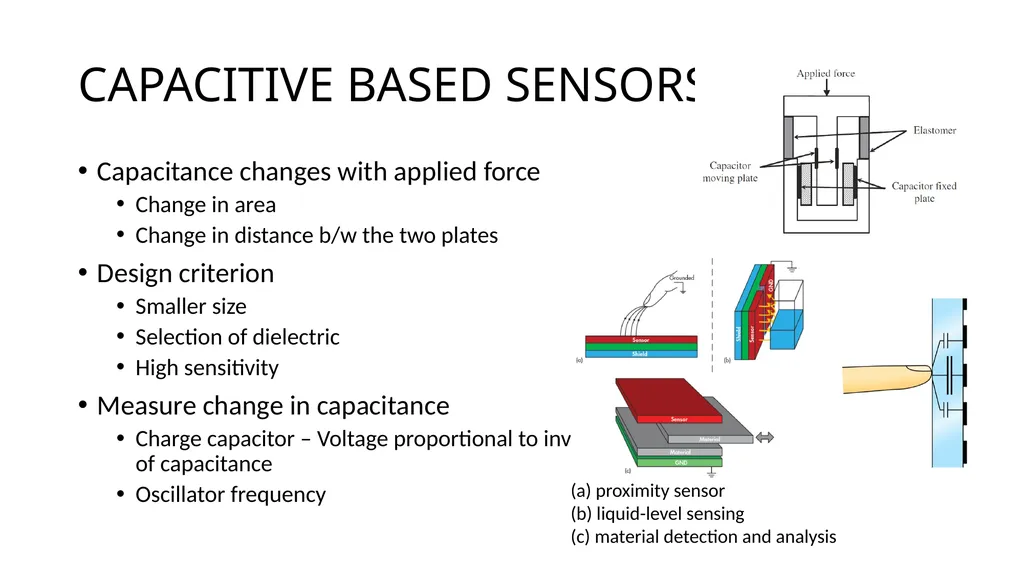
CAPACITIVE BASED SENSORS Capacitance changes with applied force
Change in area
Change in distance b/w the two plates
Design criterion
Smaller size
Selection of dielectric
High sensitivity
Measure change in capacitance
Charge capacitor – Voltage proportional to inverse of capacitance
Oscillator frequency (a) proximity sensor
(b) liquid-level sensing
(c) material detection and analysis<br>
06
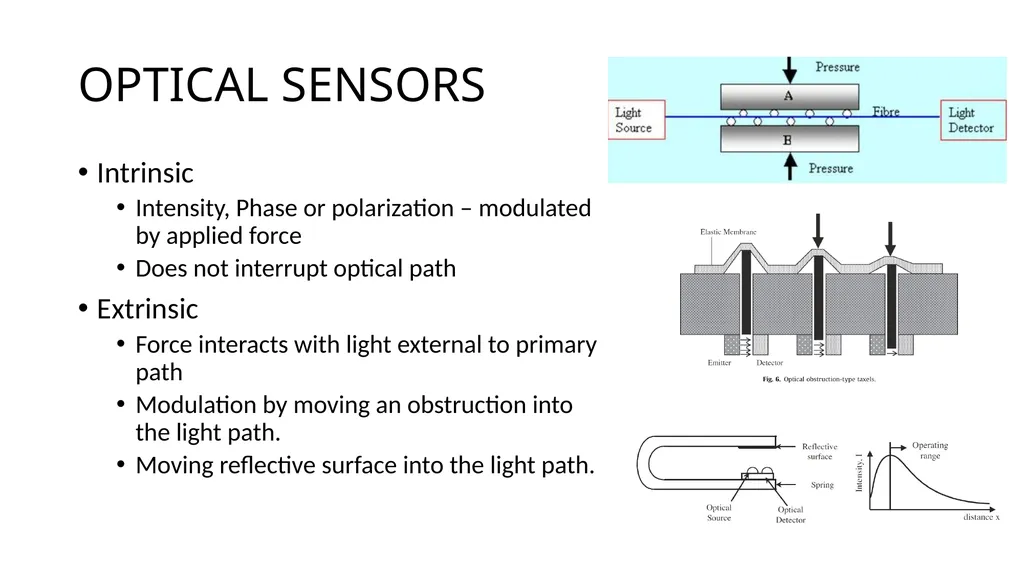
OPTICAL SENSORS Intrinsic
Intensity, Phase or polarization – modulated by applied force
Does not interrupt optical path
Extrinsic
Force interacts with light external to primary path
Modulation by moving an obstruction into the light path.
Moving reflective surface into the light path.<br>
07
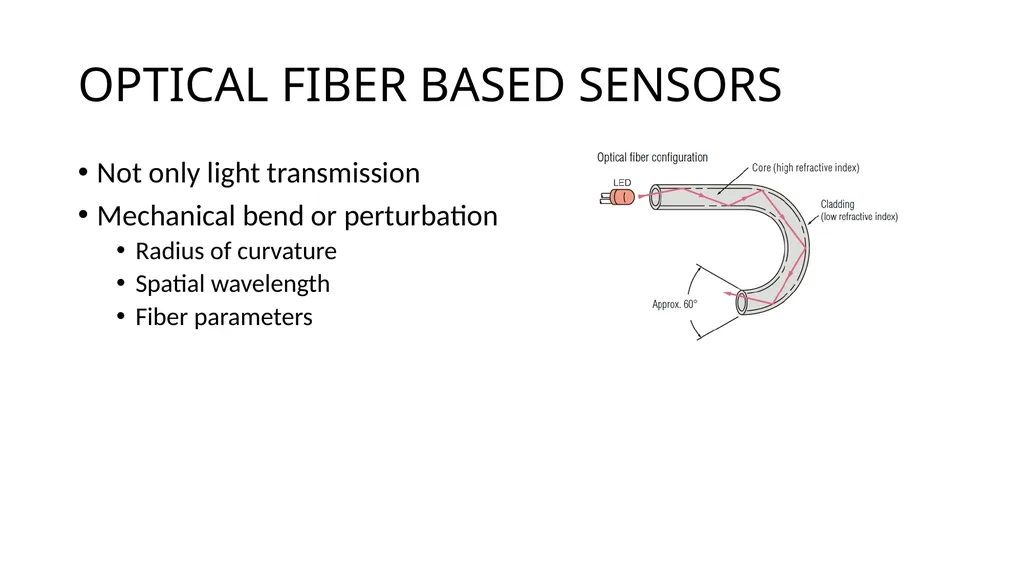
OPTICAL FIBER BASED SENSORS Not only light transmission
Mechanical bend or perturbation
Radius of curvature
Spatial wavelength
Fiber parameters<br>
08
PIEZOELECTRIC SENSORS Typical Materials:
Polymer polyvinylidene fluoride (PVDF)
Ceramic lead zirconium titanate
Not adequate for static force transduction
Vibrating sensor and calibrating vibration frequency with force<br>
09
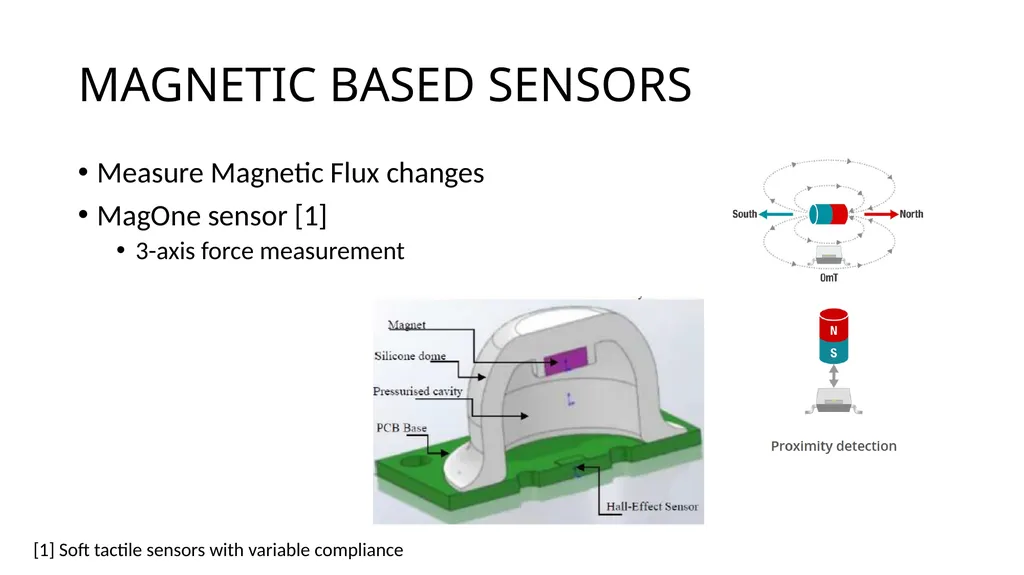
MAGNETIC BASED SENSORS Measure Magnetic Flux changes
MagOne sensor [1]
3-axis force measurement [1] Soft tactile sensors with variable compliance<br>
10
SIGNAL CONDITIONING PROCESSES Filtering – Removing Noise
Amplification – Suitable for ADC
Attenuation – Higher Voltages above ADC range
Excitation – External power input
Linearization – Voltage signals related to physical measurement<br>
11
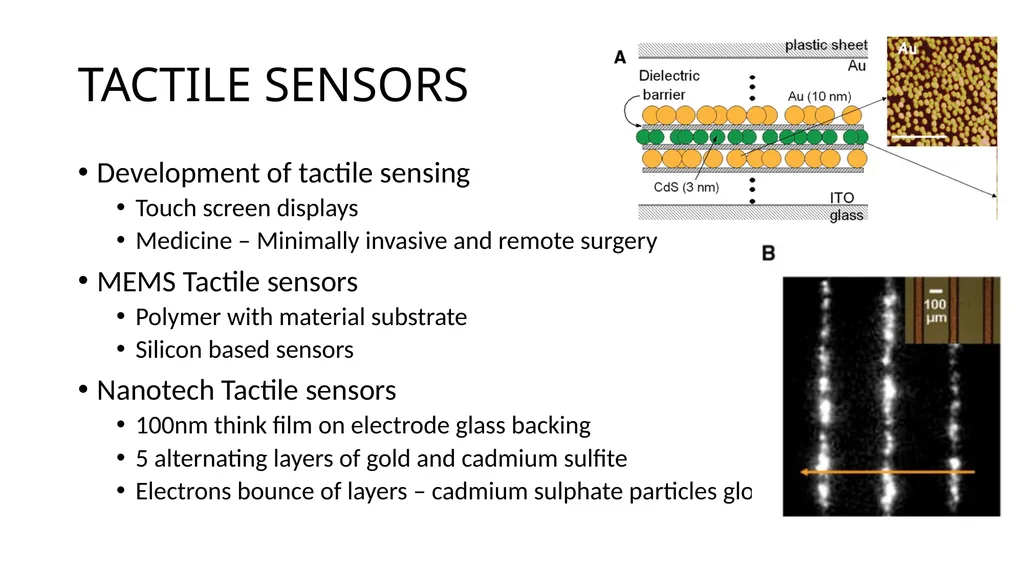
TACTILE SENSORS Development of tactile sensing
Touch screen displays
Medicine – Minimally invasive and remote surgery
MEMS Tactile sensors
Polymer with material substrate
Silicon based sensors
Nanotech Tactile sensors
100nm think film on electrode glass backing
5 alternating layers of gold and cadmium sulfite
Electrons bounce of layers – cadmium sulphate particles glow.<br>
12
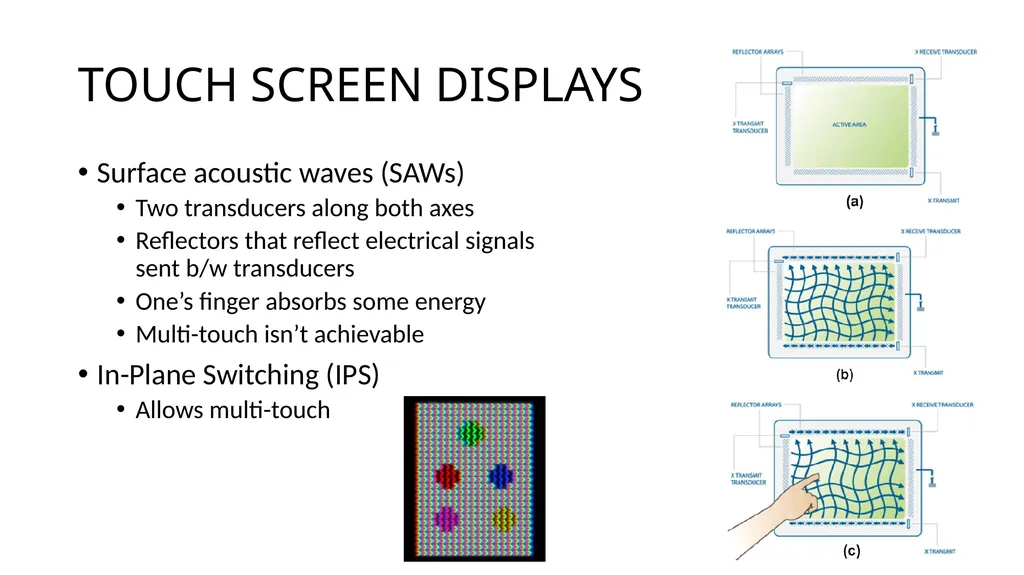
TOUCH SCREEN DISPLAYS Surface acoustic waves (SAWs)
Two transducers along both axes
Reflectors that reflect electrical signals sent b/w transducers
One’s finger absorbs some energy
Multi-touch isn’t achievable
In-Plane Switching (IPS)
Allows multi-touch<br>
13
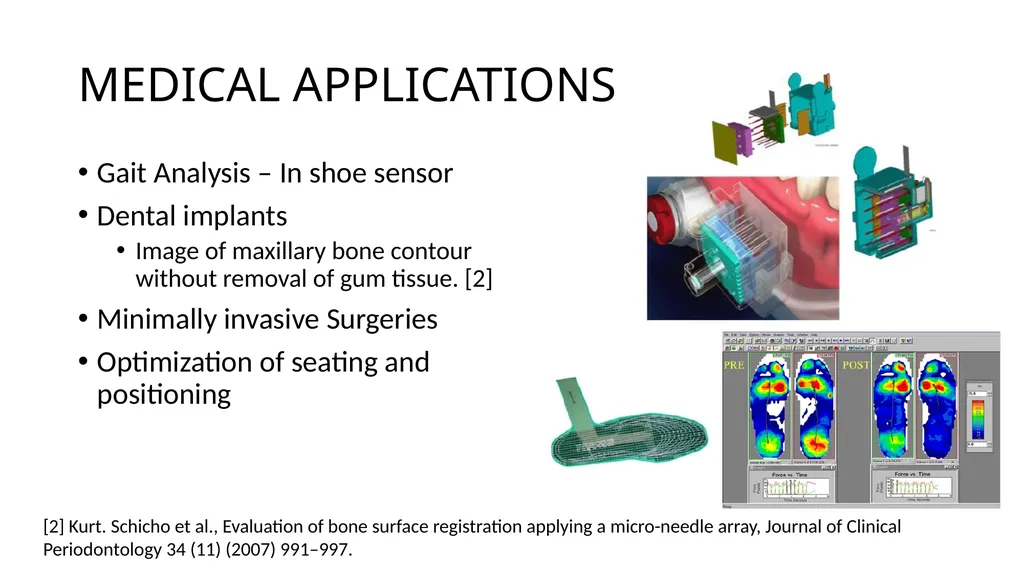
MEDICAL APPLICATIONS Gait Analysis – In shoe sensor
Dental implants
Image of maxillary bone contour without removal of gum tissue. [2]
Minimally invasive Surgeries
Optimization of seating and positioning [2] Kurt. Schicho et al., Evaluation of bone surface registration applying a micro-needle array, Journal of Clinical Periodontology 34 (11) (2007) 991–997.<br>
14
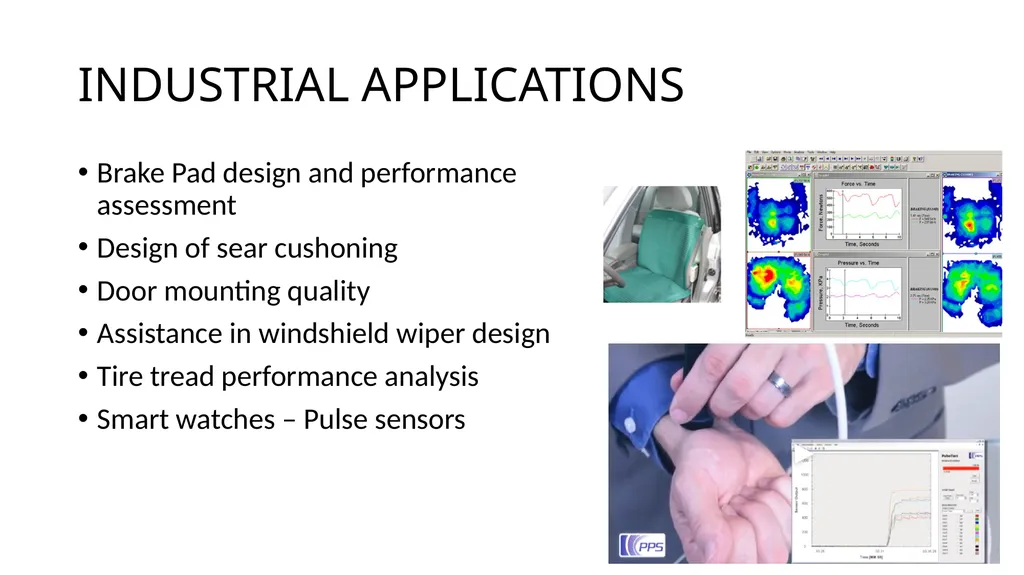
INDUSTRIAL APPLICATIONS Brake Pad design and performance assessment
Design of sear cushoning
Door mounting quality
Assistance in windshield wiper design
Tire tread performance analysis
Smart watches – Pulse sensors<br>
15
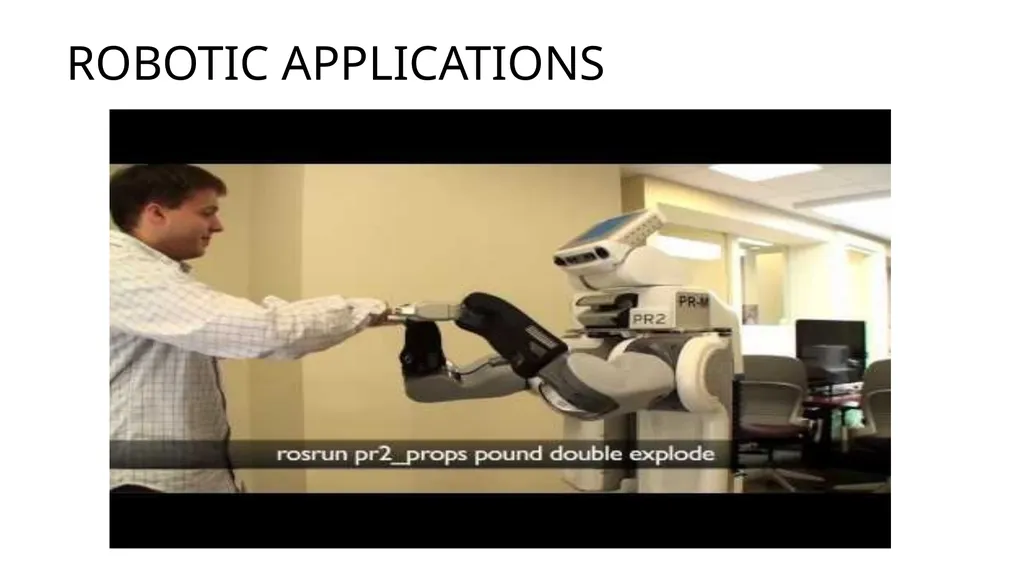
ROBOTIC APPLICATIONS<br>
16
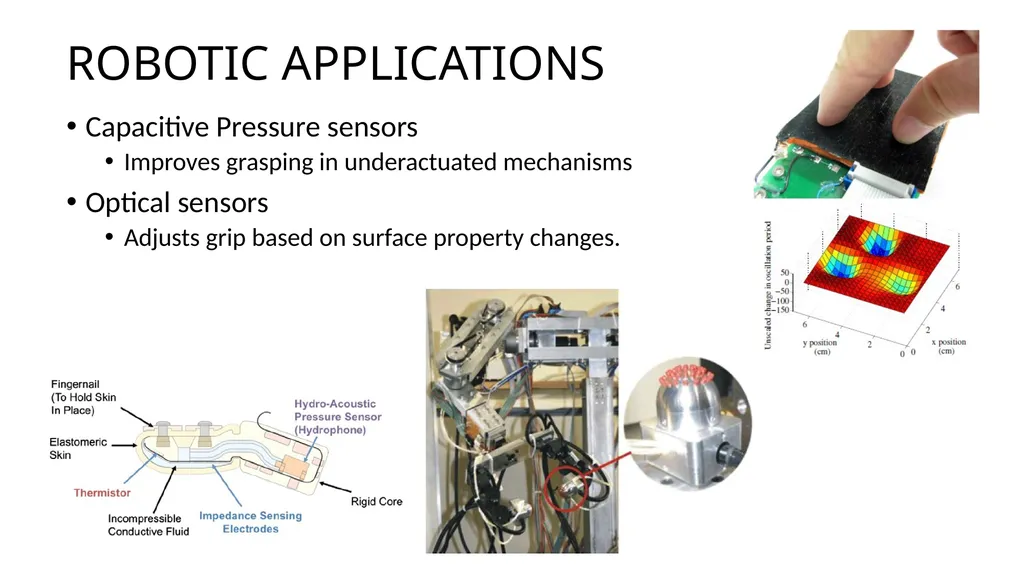
ROBOTIC APPLICATIONS Capacitive Pressure sensors
Improves grasping in underactuated mechanisms
Optical sensors
Adjusts grip based on surface property changes.<br>
17
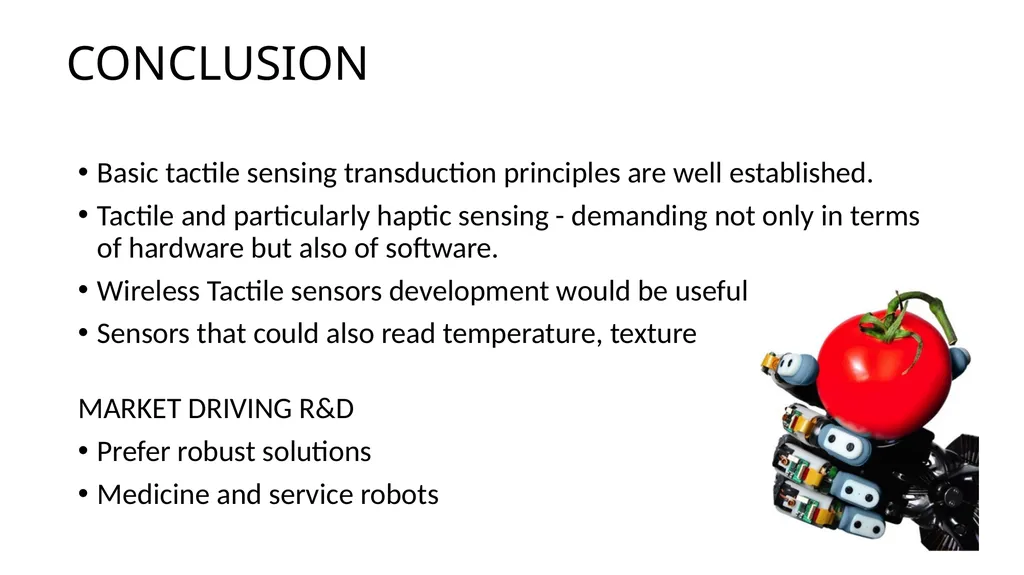
CONCLUSION Basic tactile sensing transduction principles are well established.
Tactile and particularly haptic sensing - demanding not only in terms of hardware but also of software.
Wireless Tactile sensors development would be useful
Sensors that could also read temperature, texture
MARKET DRIVING R&D
Prefer robust solutions
Medicine and service robots<br>