
Tax factsheet Schedule 3 Level Changes 2022 Rules
CB
Published · 27 slides · 0 views

1 / 1


Description
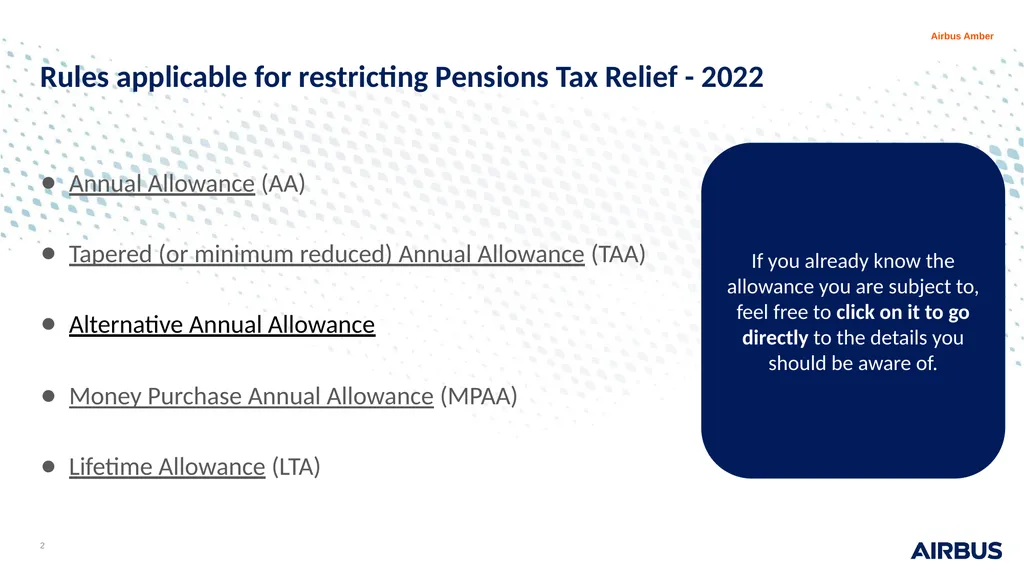
Tax factsheet Schedule 3 Level Changes 2022 Rules applicable for restricting Pensions Tax Relief - 2022 Annual Allowance (AA) Tapered (or minimum reduced) Annual Allowance (TAA) Alternative Annual Allowance Money Purchase Annual Allowance
Related Topics
Share
Embed code
Download this presentation From Below
"Tax factsheet Schedule 3 Level Changes 2022 Rules" is the property of its rightful owner. Permission is granted to download and print the materials on this website for personal, non-commercial use only, and to display it on your personal computer provided you do not modify the materials and that you retain all copyright notices contained in the materials. By downloading content from our website, you accept the terms of this agreement.
Presentation Transcript
01
Tax factsheet Schedule 3 Level Changes 2022<br>
02
Rules applicable for restricting Pensions Tax Relief - 2022 Annual Allowance (AA)
Tapered (or minimum reduced) Annual Allowance (TAA)
Alternative Annual Allowance
Money Purchase Annual Allowance (MPAA)
Lifetime Allowance (LTA) If you already know the allowance you are subject to, feel free to click on it to go directly to the details you should be aware of.<br>
Tapered (or minimum reduced) Annual Allowance (TAA)
Alternative Annual Allowance
Money Purchase Annual Allowance (MPAA)
Lifetime Allowance (LTA) If you already know the allowance you are subject to, feel free to click on it to go directly to the details you should be aware of.<br>
03
Allowances leaflet - What do you need to know? You might want to change your pension contributions level, and this little guide is designed to
✓ clarify the understanding of your pension schedule
✓ guide you to the key elements to take in consideration
✓ provide you with information you may need to make informed decisions
One of the best features of using a pension to save for retirement is tax relief.
When you pay into your pension, your money is deducted before any tax is calculated.
This can help reduce the amount of tax you pay and be used to help bolster your savings for the future.<br>
✓ clarify the understanding of your pension schedule
✓ guide you to the key elements to take in consideration
✓ provide you with information you may need to make informed decisions
One of the best features of using a pension to save for retirement is tax relief.
When you pay into your pension, your money is deducted before any tax is calculated.
This can help reduce the amount of tax you pay and be used to help bolster your savings for the future.<br>
04
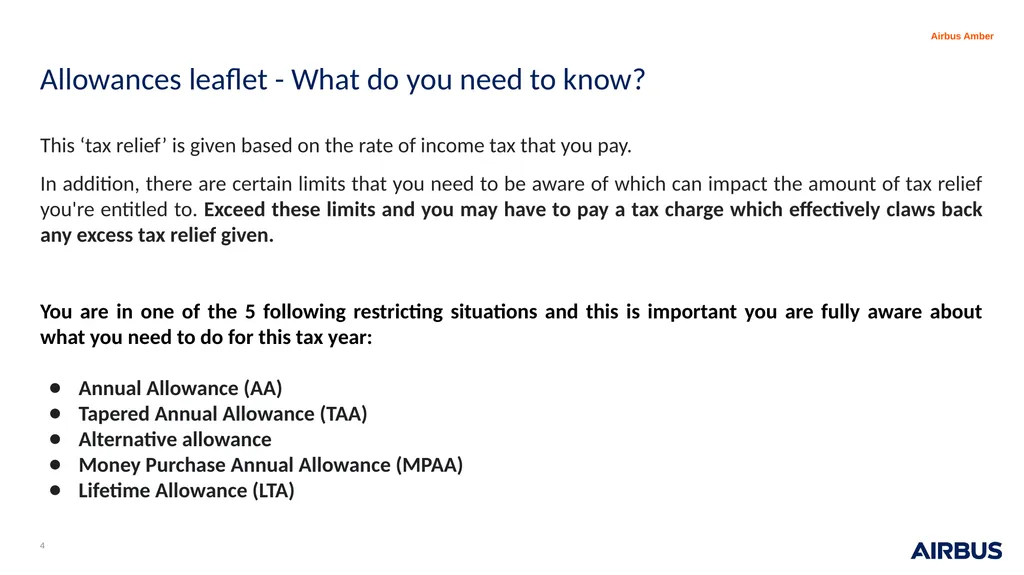
Allowances leaflet - What do you need to know? This ‘tax relief’ is given based on the rate of income tax that you pay.
In addition, there are certain limits that you need to be aware of which can impact the amount of tax relief you're entitled to. Exceed these limits and you may have to pay a tax charge which effectively claws back any excess tax relief given.
You are in one of the 5 following restricting situations and this is important you are fully aware about what you need to do for this tax year:
Annual Allowance (AA)
Tapered Annual Allowance (TAA)
Alternative allowance
Money Purchase Annual Allowance (MPAA)
Lifetime Allowance (LTA)<br>
In addition, there are certain limits that you need to be aware of which can impact the amount of tax relief you're entitled to. Exceed these limits and you may have to pay a tax charge which effectively claws back any excess tax relief given.
You are in one of the 5 following restricting situations and this is important you are fully aware about what you need to do for this tax year:
Annual Allowance (AA)
Tapered Annual Allowance (TAA)
Alternative allowance
Money Purchase Annual Allowance (MPAA)
Lifetime Allowance (LTA)<br>
05
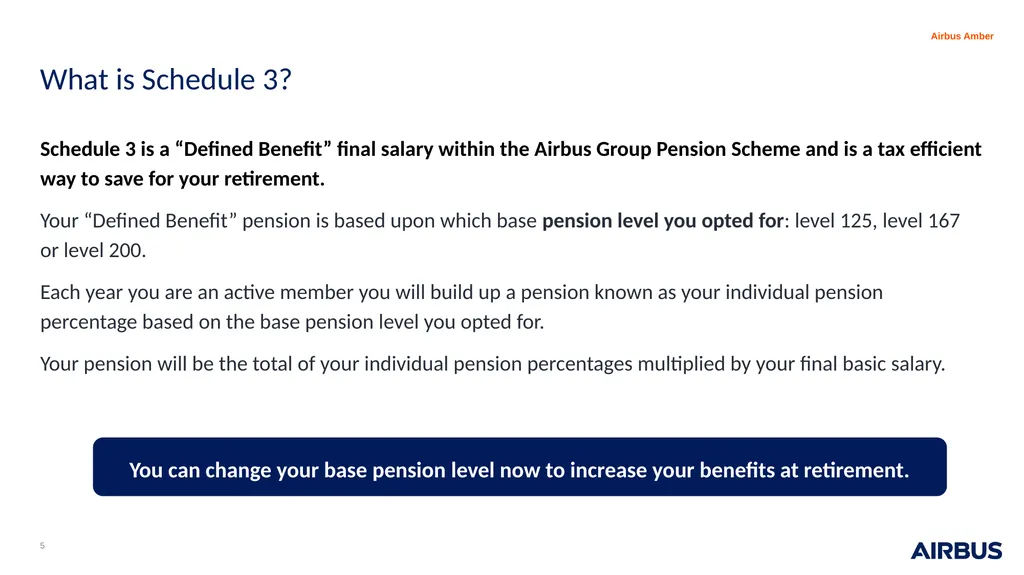
What is Schedule 3? Schedule 3 is a “Defined Benefit” final salary within the Airbus Group Pension Scheme and is a tax efficient way to save for your retirement.
Your “Defined Benefit” pension is based upon which base pension level you opted for: level 125, level 167 or level 200.
Each year you are an active member you will build up a pension known as your individual pension percentage based on the base pension level you opted for.
Your pension will be the total of your individual pension percentages multiplied by your final basic salary. You can change your base pension level now to increase your benefits at retirement.<br>
Your “Defined Benefit” pension is based upon which base pension level you opted for: level 125, level 167 or level 200.
Each year you are an active member you will build up a pension known as your individual pension percentage based on the base pension level you opted for.
Your pension will be the total of your individual pension percentages multiplied by your final basic salary. You can change your base pension level now to increase your benefits at retirement.<br>
06
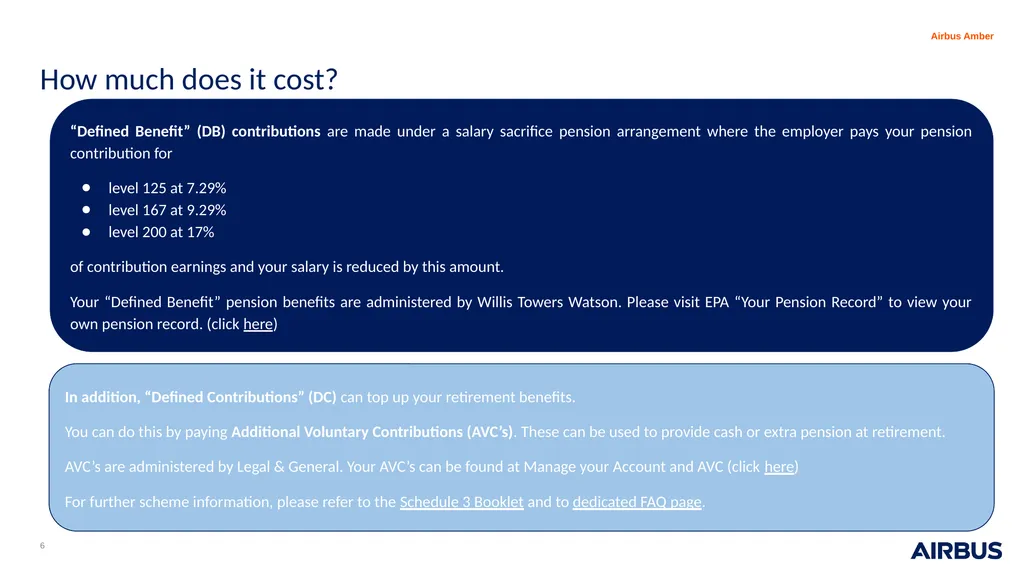
How much does it cost? “Defined Benefit” (DB) contributions are made under a salary sacrifice pension arrangement where the employer pays your pension contribution for
level 125 at 7.29%
level 167 at 9.29%
level 200 at 17%
of contribution earnings and your salary is reduced by this amount.
Your “Defined Benefit” pension benefits are administered by Willis Towers Watson. Please visit EPA “Your Pension Record” to view your own pension record. (click here) In addition, “Defined Contributions” (DC) can top up your retirement benefits.
You can do this by paying Additional Voluntary Contributions (AVC’s). These can be used to provide cash or extra pension at retirement.
AVC’s are administered by Legal & General. Your AVC’s can be found at Manage your Account and AVC (click here)
For further scheme information, please refer to the Schedule 3 Booklet and to dedicated FAQ page.<br>
level 125 at 7.29%
level 167 at 9.29%
level 200 at 17%
of contribution earnings and your salary is reduced by this amount.
Your “Defined Benefit” pension benefits are administered by Willis Towers Watson. Please visit EPA “Your Pension Record” to view your own pension record. (click here) In addition, “Defined Contributions” (DC) can top up your retirement benefits.
You can do this by paying Additional Voluntary Contributions (AVC’s). These can be used to provide cash or extra pension at retirement.
AVC’s are administered by Legal & General. Your AVC’s can be found at Manage your Account and AVC (click here)
For further scheme information, please refer to the Schedule 3 Booklet and to dedicated FAQ page.<br>
07
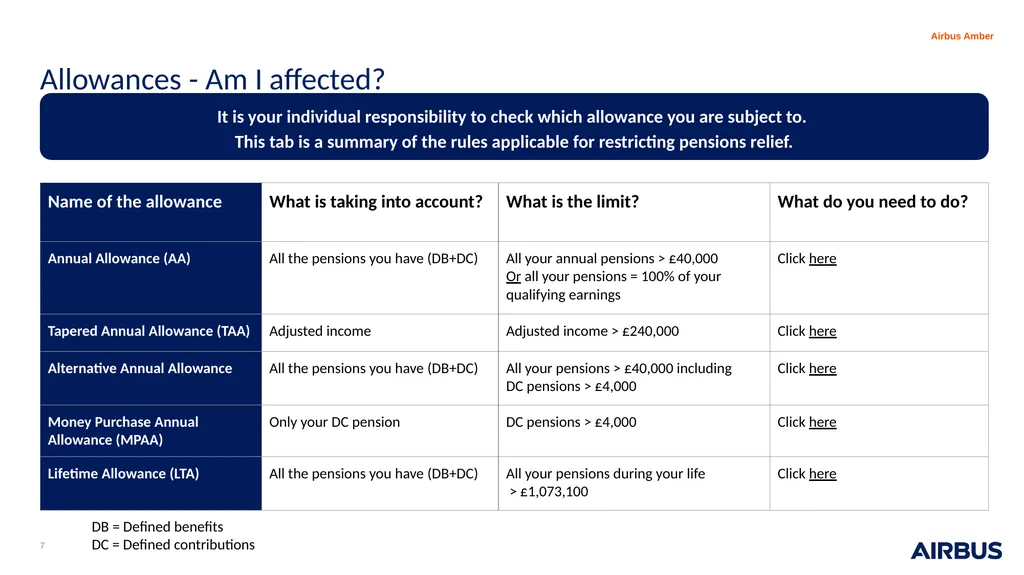
Allowances - Am I affected? DB = Defined benefits
DC = Defined contributions It is your individual responsibility to check which allowance you are subject to.
This tab is a summary of the rules applicable for restricting pensions relief.<br>
DC = Defined contributions It is your individual responsibility to check which allowance you are subject to.
This tab is a summary of the rules applicable for restricting pensions relief.<br>
08
Annual Allowance (AA) What is the Annual Allowance and am I affected?
What should I do?
Why is it important to check?<br>
What should I do?
Why is it important to check?<br>
09
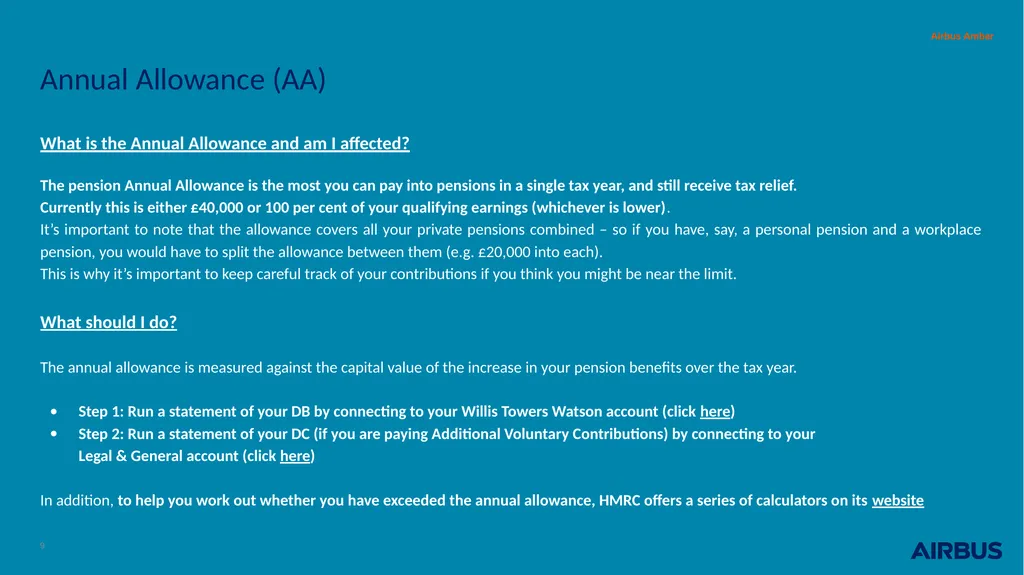
Annual Allowance (AA) What is the Annual Allowance and am I affected?
The pension Annual Allowance is the most you can pay into pensions in a single tax year, and still receive tax relief.
Currently this is either £40,000 or 100 per cent of your qualifying earnings (whichever is lower).
It’s important to note that the allowance covers all your private pensions combined – so if you have, say, a personal pension and a workplace pension, you would have to split the allowance between them (e.g. £20,000 into each).
This is why it’s important to keep careful track of your contributions if you think you might be near the limit.
What should I do?
The annual allowance is measured against the capital value of the increase in your pension benefits over the tax year.
Step 1: Run a statement of your DB by connecting to your Willis Towers Watson account (click here)
Step 2: Run a statement of your DC (if you are paying Additional Voluntary Contributions) by connecting to your
Legal & General account (click here)
In addition, to help you work out whether you have exceeded the annual allowance, HMRC offers a series of calculators on its website<br>
The pension Annual Allowance is the most you can pay into pensions in a single tax year, and still receive tax relief.
Currently this is either £40,000 or 100 per cent of your qualifying earnings (whichever is lower).
It’s important to note that the allowance covers all your private pensions combined – so if you have, say, a personal pension and a workplace pension, you would have to split the allowance between them (e.g. £20,000 into each).
This is why it’s important to keep careful track of your contributions if you think you might be near the limit.
What should I do?
The annual allowance is measured against the capital value of the increase in your pension benefits over the tax year.
Step 1: Run a statement of your DB by connecting to your Willis Towers Watson account (click here)
Step 2: Run a statement of your DC (if you are paying Additional Voluntary Contributions) by connecting to your
Legal & General account (click here)
In addition, to help you work out whether you have exceeded the annual allowance, HMRC offers a series of calculators on its website<br>
10
Annual Allowance (AA) Why is it important to check?
There are two main consequences of going over your annual allowance.
The first is that you won’t receive tax relief on the excess amount.
The second, more serious issue, is that you will face an addition to your tax bill for that year (called the annual allowance charge).
The excess contributions are added to your gross income for that year, and your income tax bill is re-calculated accordingly based on this higher figure.
If the charge is over £2,000 then you can ask for it to be deducted from your pension benefits instead.<br>
There are two main consequences of going over your annual allowance.
The first is that you won’t receive tax relief on the excess amount.
The second, more serious issue, is that you will face an addition to your tax bill for that year (called the annual allowance charge).
The excess contributions are added to your gross income for that year, and your income tax bill is re-calculated accordingly based on this higher figure.
If the charge is over £2,000 then you can ask for it to be deducted from your pension benefits instead.<br>
11
Tapered Annual Allowance (TAA) What is the Tapered Annual Allowance and am I affected?
What should I do?
Why is it important to check?<br>
What should I do?
Why is it important to check?<br>
12
Tapered Annual Allowance (TAA) What is the Tapered Annual Allowance and am I affected?
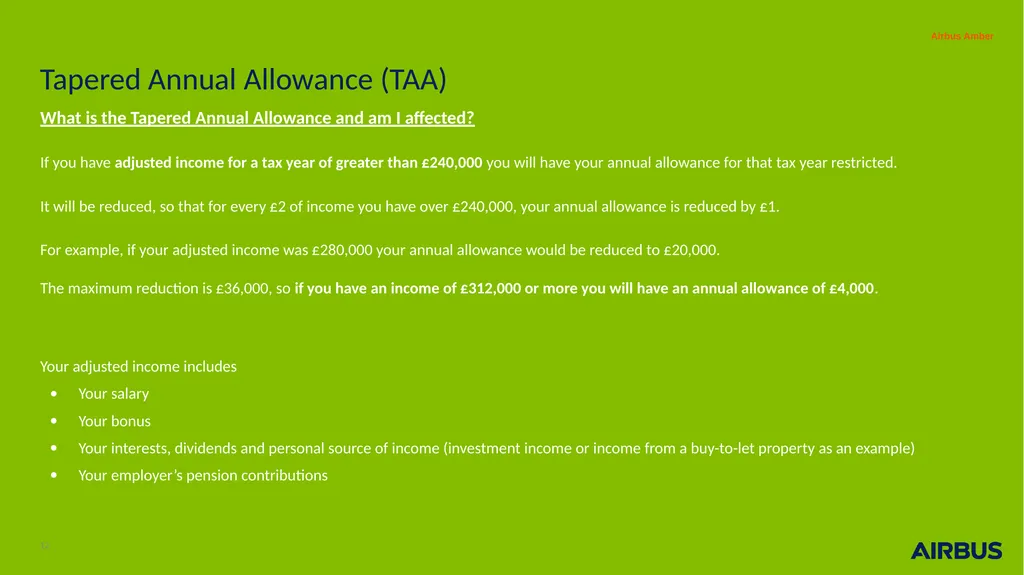
If you have adjusted income for a tax year of greater than £240,000 you will have your annual allowance for that tax year restricted.
It will be reduced, so that for every £2 of income you have over £240,000, your annual allowance is reduced by £1.
For example, if your adjusted income was £280,000 your annual allowance would be reduced to £20,000.
The maximum reduction is £36,000, so if you have an income of £312,000 or more you will have an annual allowance of £4,000.
Your adjusted income includes
Your salary
Your bonus
Your interests, dividends and personal source of income (investment income or income from a buy-to-let property as an example)
Your employer’s pension contributions<br>
If you have adjusted income for a tax year of greater than £240,000 you will have your annual allowance for that tax year restricted.
It will be reduced, so that for every £2 of income you have over £240,000, your annual allowance is reduced by £1.
For example, if your adjusted income was £280,000 your annual allowance would be reduced to £20,000.
The maximum reduction is £36,000, so if you have an income of £312,000 or more you will have an annual allowance of £4,000.
Your adjusted income includes
Your salary
Your bonus
Your interests, dividends and personal source of income (investment income or income from a buy-to-let property as an example)
Your employer’s pension contributions<br>
13
Tapered Annual Allowance (TAA) What should I do?
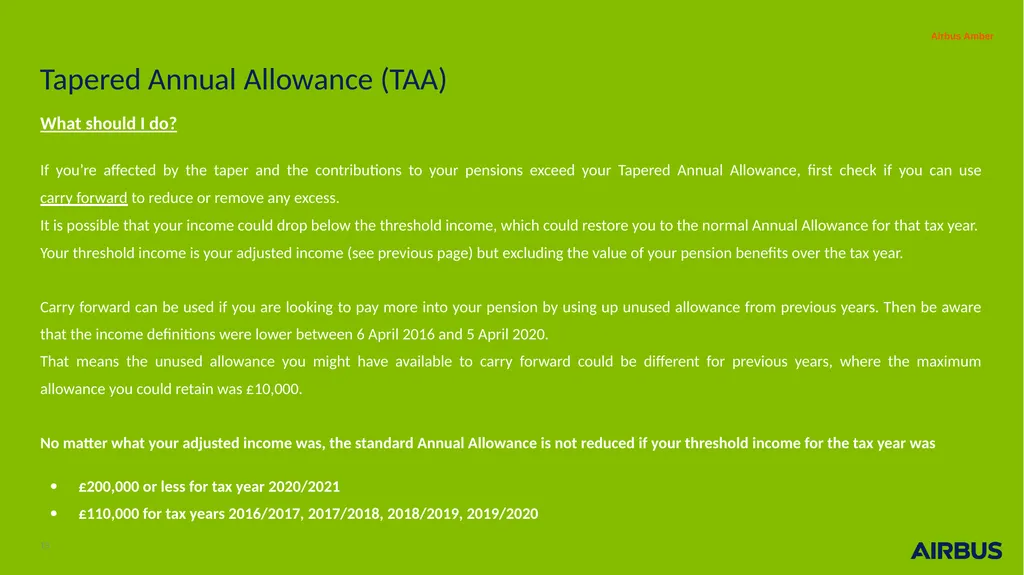
If you’re affected by the taper and the contributions to your pensions exceed your Tapered Annual Allowance, first check if you can use carry forward to reduce or remove any excess.
It is possible that your income could drop below the threshold income, which could restore you to the normal Annual Allowance for that tax year.
Your threshold income is your adjusted income (see previous page) but excluding the value of your pension benefits over the tax year.
Carry forward can be used if you are looking to pay more into your pension by using up unused allowance from previous years. Then be aware that the income definitions were lower between 6 April 2016 and 5 April 2020.
That means the unused allowance you might have available to carry forward could be different for previous years, where the maximum allowance you could retain was £10,000.
No matter what your adjusted income was, the standard Annual Allowance is not reduced if your threshold income for the tax year was
£200,000 or less for tax year 2020/2021
£110,000 for tax years 2016/2017, 2017/2018, 2018/2019, 2019/2020<br>
If you’re affected by the taper and the contributions to your pensions exceed your Tapered Annual Allowance, first check if you can use carry forward to reduce or remove any excess.
It is possible that your income could drop below the threshold income, which could restore you to the normal Annual Allowance for that tax year.
Your threshold income is your adjusted income (see previous page) but excluding the value of your pension benefits over the tax year.
Carry forward can be used if you are looking to pay more into your pension by using up unused allowance from previous years. Then be aware that the income definitions were lower between 6 April 2016 and 5 April 2020.
That means the unused allowance you might have available to carry forward could be different for previous years, where the maximum allowance you could retain was £10,000.
No matter what your adjusted income was, the standard Annual Allowance is not reduced if your threshold income for the tax year was
£200,000 or less for tax year 2020/2021
£110,000 for tax years 2016/2017, 2017/2018, 2018/2019, 2019/2020<br>
14
Tapered Annual Allowance (TAA) Why is it important to check?
If there’s still an excess amount after carrying forward, you will face a tax charge on this amount.
The amount will be added to your income and will be subject to Income Tax at your highest marginal rate.
The charge is normally declared and paid through the Income Tax self-assessment process (no later than 31 January of the following year), although it could be deducted directly from your pension savings if certain conditions are met. This is known as ‘Scheme Pays’.
You’ll have to make a formal request to your pension scheme provider if you want to apply for this, at airbuspensions@willistowerswatson.com.
If you think you might be getting close to your Annual Allowance, that it could be reduced, or you might have exceeded it, consider getting advice from a regulated financial adviser.
They can help you understand how much your Annual Allowance is including any unused amounts, whether you have exceeded your Annual Allowance, if there may be options to reduce any potential charge and look at your options for paying any tax charge that may be due.<br>
If there’s still an excess amount after carrying forward, you will face a tax charge on this amount.
The amount will be added to your income and will be subject to Income Tax at your highest marginal rate.
The charge is normally declared and paid through the Income Tax self-assessment process (no later than 31 January of the following year), although it could be deducted directly from your pension savings if certain conditions are met. This is known as ‘Scheme Pays’.
You’ll have to make a formal request to your pension scheme provider if you want to apply for this, at airbuspensions@willistowerswatson.com.
If you think you might be getting close to your Annual Allowance, that it could be reduced, or you might have exceeded it, consider getting advice from a regulated financial adviser.
They can help you understand how much your Annual Allowance is including any unused amounts, whether you have exceeded your Annual Allowance, if there may be options to reduce any potential charge and look at your options for paying any tax charge that may be due.<br>
15
Alternative Annual Allowance What is the Alternative Annual Allowance and am I affected?
What should I do?
Why is it important to check?<br>
What should I do?
Why is it important to check?<br>
16
Alternative Annual Allowance What is the Alternative Annual Allowance and am I affected?
The alternative annual allowance applies to all pension savings in
your Defined Benefits (DB) pension
your Defined Contributions (DC) pension before you flexibly accessed
As all your pensions are subject to the standard overall annual allowance of £40,000 for this tax year (click here to know more), DC pension of more than £4,000 could reduce the amount available for your DB scheme.
You can however, still build up benefits using the ‘Alternative Annual Allowance’.
The Alternative Annual Allowance is £36,000 in the 2020/21 tax year and
is only required where the Annual Allowance is breached (please click here to know more)
may be different if your adjusted income is over £240,000 in the current tax year (please click here to know more)<br>
The alternative annual allowance applies to all pension savings in
your Defined Benefits (DB) pension
your Defined Contributions (DC) pension before you flexibly accessed
As all your pensions are subject to the standard overall annual allowance of £40,000 for this tax year (click here to know more), DC pension of more than £4,000 could reduce the amount available for your DB scheme.
You can however, still build up benefits using the ‘Alternative Annual Allowance’.
The Alternative Annual Allowance is £36,000 in the 2020/21 tax year and
is only required where the Annual Allowance is breached (please click here to know more)
may be different if your adjusted income is over £240,000 in the current tax year (please click here to know more)<br>
17
Alternative Annual Allowance What should I do?
The Alternative Annual Allowance is measured against the capital value of the increase in your pension benefits over the tax year.
Step 1: Run a statement of your Defined Benefits (DB) by connecting to your Willis Towers Watson account (click here)
Step 2: Run a statement of your Defined Contributions (DC - if you are paying Additional Voluntary Contributions) by connecting to your Legal & General account (click here)
In addition, to help you work out whether you have exceeded the Alternative Annual Allowance, HMRC offers a series of calculators on its website<br>
The Alternative Annual Allowance is measured against the capital value of the increase in your pension benefits over the tax year.
Step 1: Run a statement of your Defined Benefits (DB) by connecting to your Willis Towers Watson account (click here)
Step 2: Run a statement of your Defined Contributions (DC - if you are paying Additional Voluntary Contributions) by connecting to your Legal & General account (click here)
In addition, to help you work out whether you have exceeded the Alternative Annual Allowance, HMRC offers a series of calculators on its website<br>
18
Alternative Annual Allowance Why is it important to check?
There are two main consequences of going over your alternative annual allowance.
The first is that you won’t receive tax relief on the excess amount.
The second, more serious issue, is that you will face an addition to your tax bill for that year (called the annual allowance charge).
The excess contributions are added to your gross income for that year, and your income tax bill is re-calculated accordingly based on this higher figure.
If the charge is over £2,000 then you can ask for it to be deducted from your pension benefits instead.<br>
There are two main consequences of going over your alternative annual allowance.
The first is that you won’t receive tax relief on the excess amount.
The second, more serious issue, is that you will face an addition to your tax bill for that year (called the annual allowance charge).
The excess contributions are added to your gross income for that year, and your income tax bill is re-calculated accordingly based on this higher figure.
If the charge is over £2,000 then you can ask for it to be deducted from your pension benefits instead.<br>
19
Money Purchase Annual Allowance (MPAA) What is the Money Purchase Annual Allowance and am I affected?
What should I do?
Why is it important to check?<br>
What should I do?
Why is it important to check?<br>
20
Money Purchase Annual Allowance (MPAA) What is the Money Purchase Annual Allowance and am I affected?
The MPAA limits how much can be paid into your Money Purchase pensions in any one tax year while still benefiting from tax relief.
The MPAA only applies to contributions to DC pension and not DB pension schemes.
It means that it only applies to your Additional Voluntary Contributions (AVCs), invested with Legal & General and accessible here.
It limits the amount of contributions that can be paid into your pension tax efficiently and applies to money put in by you, your employer or anybody else (transfers are ignored for this purpose).
It applies once you take taxable income from your pension pot using pension freedoms (i.e. more than the tax-free part).
You can normally do this from the age of 55. In the tax year 2020/21 the MPAA is £4,000 compared with the full annual allowance of £40,000 for most people.
The MPAA will only start to apply from the day after you’ve taken flexible benefits. This means any previous savings aren’t affected.
I<br>
The MPAA limits how much can be paid into your Money Purchase pensions in any one tax year while still benefiting from tax relief.
The MPAA only applies to contributions to DC pension and not DB pension schemes.
It means that it only applies to your Additional Voluntary Contributions (AVCs), invested with Legal & General and accessible here.
It limits the amount of contributions that can be paid into your pension tax efficiently and applies to money put in by you, your employer or anybody else (transfers are ignored for this purpose).
It applies once you take taxable income from your pension pot using pension freedoms (i.e. more than the tax-free part).
You can normally do this from the age of 55. In the tax year 2020/21 the MPAA is £4,000 compared with the full annual allowance of £40,000 for most people.
The MPAA will only start to apply from the day after you’ve taken flexible benefits. This means any previous savings aren’t affected.
I<br>
21
Money Purchase Annual Allowance (MPAA) What should I do?
Step 1: Run a statement of your DC pensions (if you are paying Additional Voluntary Contributions) by connecting to your Legal & General account (click here)
Step 2: If you have one, ask your private pension provider to provide a statement of your private DC pension
Why is important to check?
There are two main consequences of going over your MPAA.
The first is that you won’t receive tax relief on the excess amount.
The second, more serious issue, is that you will face an addition to your tax bill for that year (called the annual allowance charge).
The excess contributions are added to your gross income for that year, and your income tax bill is re-calculated accordingly based on this higher figure.
If the charge is over £2,000 then you can ask for it to be deducted from your pension benefits instead.<br>
Step 1: Run a statement of your DC pensions (if you are paying Additional Voluntary Contributions) by connecting to your Legal & General account (click here)
Step 2: If you have one, ask your private pension provider to provide a statement of your private DC pension
Why is important to check?
There are two main consequences of going over your MPAA.
The first is that you won’t receive tax relief on the excess amount.
The second, more serious issue, is that you will face an addition to your tax bill for that year (called the annual allowance charge).
The excess contributions are added to your gross income for that year, and your income tax bill is re-calculated accordingly based on this higher figure.
If the charge is over £2,000 then you can ask for it to be deducted from your pension benefits instead.<br>
22
Lifetime Allowance (LTA) What is the Lifetime Allowance and am I affected?
What should I do?
Why is it important to check?<br>
What should I do?
Why is it important to check?<br>
23
Lifetime Allowance (LTA) What is the Lifetime Allowance and am I affected?
The lifetime allowance for most people is £1,073,100 in the tax year 2022/23 and has been frozen at this level until the 2025/26 tax year.
This is equivalent to a total pension of approximately £53,655 a year.
The Lifetime Allowance applies to the total of all the pensions you have, including the value of pensions you have through:
all your Defined Benefits (DB) pensions
all your Defined Contributions (DC) pensions, but excluding your State Pension.<br>
The lifetime allowance for most people is £1,073,100 in the tax year 2022/23 and has been frozen at this level until the 2025/26 tax year.
This is equivalent to a total pension of approximately £53,655 a year.
The Lifetime Allowance applies to the total of all the pensions you have, including the value of pensions you have through:
all your Defined Benefits (DB) pensions
all your Defined Contributions (DC) pensions, but excluding your State Pension.<br>
24
Lifetime Allowance (LTA) What should I do?
You normally calculate the total value by multiplying your expected annual pension by 20.
You also need to add the amount of any separate tax-free cash lump sum.
All pension benefits (with Airbus UK or outside) are measured against this allowance.
For example, if the annual pension you will receive is £15,000 a year and you will get a tax-free lump sum of £30,000 as well, the value of that pension for Lifetime Allowance purposes is £330,000 (20 x £15,000 + £30,000).
If you are paying Additional Voluntary Contributions, you need to add the value of your defined contributions pot accessible in your Legal & General account (click here)
There’s no limit on how much you build up in pension benefits. But checks are carried out at certain times to see if the value of your pension benefits exceeds the lifetime allowance.<br>
You normally calculate the total value by multiplying your expected annual pension by 20.
You also need to add the amount of any separate tax-free cash lump sum.
All pension benefits (with Airbus UK or outside) are measured against this allowance.
For example, if the annual pension you will receive is £15,000 a year and you will get a tax-free lump sum of £30,000 as well, the value of that pension for Lifetime Allowance purposes is £330,000 (20 x £15,000 + £30,000).
If you are paying Additional Voluntary Contributions, you need to add the value of your defined contributions pot accessible in your Legal & General account (click here)
There’s no limit on how much you build up in pension benefits. But checks are carried out at certain times to see if the value of your pension benefits exceeds the lifetime allowance.<br>
25
Lifetime Allowance (LTA) Why is it important to check?
If you’ve built up more than the value of the lifetime allowance when a check is carried out, you might have to pay a tax charge.
Checks are typically carried out:
when you start drawing your defined benefit pension
when you take an income or lump sum from a defined contribution pension
if you transfer a pension overseas before age 75
if you reach your 75th birthday and have pension in drawdown or that you haven’t touched
if you die before age 75 and have pensions you haven’t touched.
After age 75, there are generally no further checks against the lifetime allowance.<br>
If you’ve built up more than the value of the lifetime allowance when a check is carried out, you might have to pay a tax charge.
Checks are typically carried out:
when you start drawing your defined benefit pension
when you take an income or lump sum from a defined contribution pension
if you transfer a pension overseas before age 75
if you reach your 75th birthday and have pension in drawdown or that you haven’t touched
if you die before age 75 and have pensions you haven’t touched.
After age 75, there are generally no further checks against the lifetime allowance.<br>
26
Further information Useful information on the various allowances and how they might affect you can be found by clicking here
The Pensions Advisory Service produces a range of leaflets, guides, forms and reports on various issues, including the above allowances. Please feel free to download them by clicking here
Pensions Awareness Live proposes individual appointments to give you free and impartial advices by clicking here
You can ask to an Independent Financial Advisor to help you in your pensions journey by clicking here<br>
The Pensions Advisory Service produces a range of leaflets, guides, forms and reports on various issues, including the above allowances. Please feel free to download them by clicking here
Pensions Awareness Live proposes individual appointments to give you free and impartial advices by clicking here
You can ask to an Independent Financial Advisor to help you in your pensions journey by clicking here<br>
27
Thank you This document and all information contained herein is the sole property of Airbus. No intellectual property rights are granted by the delivery of this document or the disclosure of its content. This document shall not be reproduced or disclosed to a third party without the expressed written consent of Airbus. This document and its content shall not be used for any purpose other than that for which it is supplied.
Airbus, its logo and product names are registered trademarks. © Copyright Airbus (Specify your Legal Entity YEAR) / Presentation title runs here<br>
Airbus, its logo and product names are registered trademarks. © Copyright Airbus (Specify your Legal Entity YEAR) / Presentation title runs here<br>