
Taylor D’Addario, LMHC, LCDP Dialectical Behavior
DP
Published · 96 slides · 0 views
1 / 1


Description
Taylor DAddario, LMHC, LCDP Dialectical Behavior Therapy: Skills for Individuals and Groups Disclosures The development of these training materials were supported by grant H79 TI080209 (PI: R. Martin) from the Center for Substance Abuse
Related Topics
Share
Embed code
Download this presentation From Below
"Taylor D’Addario, LMHC, LCDP Dialectical Behavior" is the property of its rightful owner. Permission is granted to download and print the materials on this website for personal, non-commercial use only, and to display it on your personal computer provided you do not modify the materials and that you retain all copyright notices contained in the materials. By downloading content from our website, you accept the terms of this agreement.
Presentation Transcript
01
Taylor D’Addario, LMHC, LCDP Dialectical Behavior Therapy: Skills for Individuals
and Groups<br>
02
Disclosures The development of these training materials were supported by grant H79 TI080209 (PI: R. Martin) from the Center for Substance Abuse Treatment, Substance Abuse and Mental Health Services Administration, United States Department of Health and Human Services. The views and opinions contained within this document do not necessarily reflect those of the US Department of Health and Human Services, and should not be construed as such.<br>
03
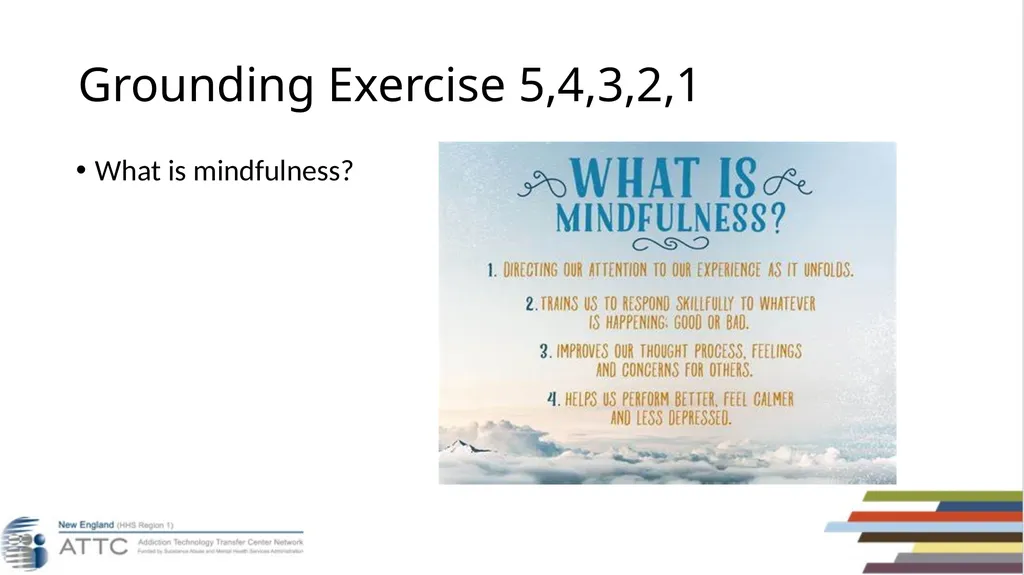
Grounding Exercise 5,4,3,2,1 What is mindfulness?<br>
04
Welcome Your Name
Your Job/Agency
What You Hope To Learn Today
How Familiar Are You With DBT ( 1-10 )<br>
Your Job/Agency
What You Hope To Learn Today
How Familiar Are You With DBT ( 1-10 )<br>
05
Goals of Todays Training Learn DBT skills for yourself
Learn how to use DBT with clients
Learn how to facilitate a DBT skill building group
Learn about the DBT manual
Learn about what behaviors DBT treats<br>
Learn how to use DBT with clients
Learn how to facilitate a DBT skill building group
Learn about the DBT manual
Learn about what behaviors DBT treats<br>
06
Dialectical Behavioral Therapy History Developed in the 1980’s by Marsha Linehan
Originally used to treat Borderline Personality Disorder
Combines standard CBT with emotional regulation, distress tolerance, acceptance and mindful awareness<br>
Originally used to treat Borderline Personality Disorder
Combines standard CBT with emotional regulation, distress tolerance, acceptance and mindful awareness<br>
07
What Behaviors Does DBT Treat Emotion Dysregulation
Affective lability, intense anger
Interpersonal Dysregulation
Fear of abandonment, idealization, & devaluation
Behavior Dysregulation
Suicidal behaviors, other self-injurious behaviors, & impulsivity
Self Dysregulation
Emptiness, identity disturbance
Cognitive Dysregulation
Dissociation & paranoia<br>
Affective lability, intense anger
Interpersonal Dysregulation
Fear of abandonment, idealization, & devaluation
Behavior Dysregulation
Suicidal behaviors, other self-injurious behaviors, & impulsivity
Self Dysregulation
Emptiness, identity disturbance
Cognitive Dysregulation
Dissociation & paranoia<br>
08
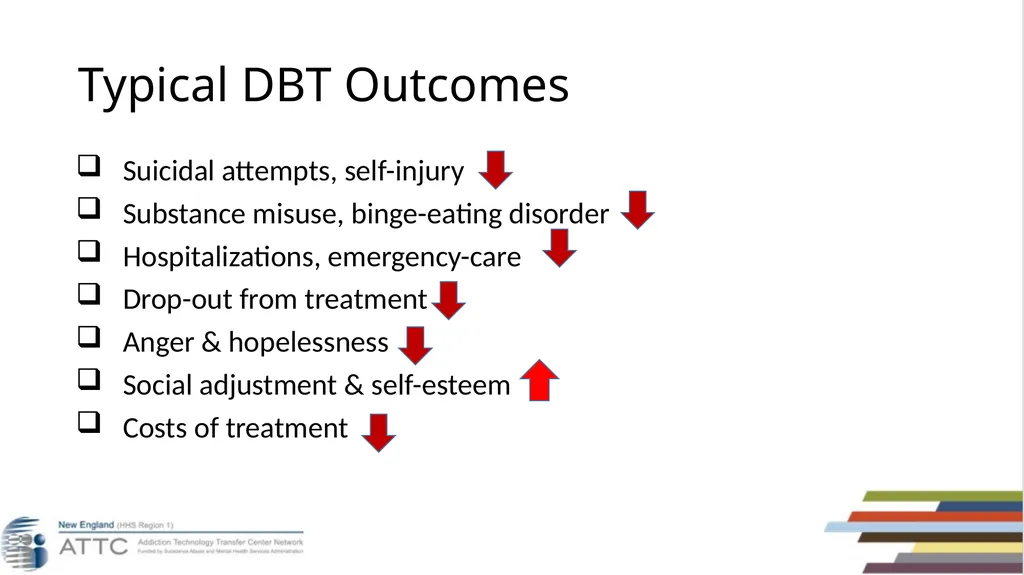
Typical DBT Outcomes Suicidal attempts, self-injury
Substance misuse, binge-eating disorder
Hospitalizations, emergency-care
Drop-out from treatment
Anger & hopelessness
Social adjustment & self-esteem
Costs of treatment<br>
Substance misuse, binge-eating disorder
Hospitalizations, emergency-care
Drop-out from treatment
Anger & hopelessness
Social adjustment & self-esteem
Costs of treatment<br>
09
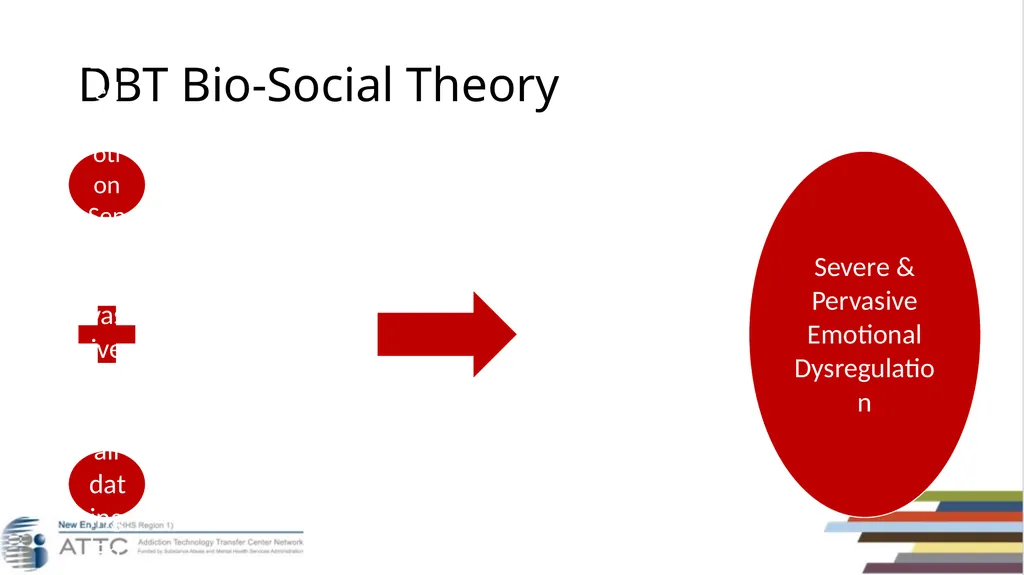
DBT Bio-Social Theory<br>
10
Set Up The Group Every client should have a notebook with handouts and assignment
Have extra pen & paper available
Sit around a table
Use a white board, black board or flip chart
Behavior, and elicit behavior, appropriate for a classroom setting<br>
Have extra pen & paper available
Sit around a table
Use a white board, black board or flip chart
Behavior, and elicit behavior, appropriate for a classroom setting<br>
11
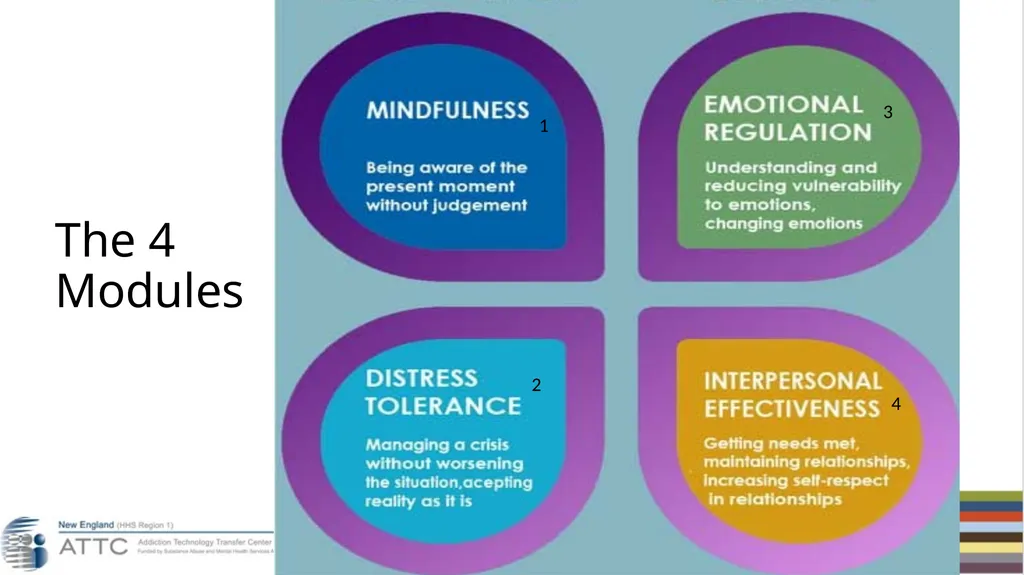
The 4
Modules 1 2 3 4<br>
12
ORIENTATION TO SKILLS TRAINING
(General Handout # 1) Mindfulness: the practice of being fully aware and present in this one moment.
Distress Tolerance: how to tolerate pain in difficult situations, not change it.
Emotion Regulation: how to change emotions that you want to change.
Interpersonal Effectiveness: how to ask for what you want and say no while maintaining self-respect and relationships with others.<br>
Distress Tolerance: how to tolerate pain in difficult situations, not change it.
Emotion Regulation: how to change emotions that you want to change.
Interpersonal Effectiveness: how to ask for what you want and say no while maintaining self-respect and relationships with others.<br>
13
ORIENTATION TO SKILLS TRAINING
(General Handout # 1) In the group context, explain the purpose of the first session is to introduce members to one another and to the skills training leaders.
Ask each participant to introduce herself with her name and a statement of why the member is here.
Leaders: introduce yourself and give information about yourself and why you are leading skills training.
Orient members to the structural aspects of the therapy (e.g. format, rules, and meeting times).<br>
Ask each participant to introduce herself with her name and a statement of why the member is here.
Leaders: introduce yourself and give information about yourself and why you are leading skills training.
Orient members to the structural aspects of the therapy (e.g. format, rules, and meeting times).<br>
14
ORIENTATION TO SKILLS TRAINING
(General Handout # 1) Mindfulness skill
Homework review
Teach new skill(s)
Lesson summary and assignment of homework<br>
Homework review
Teach new skill(s)
Lesson summary and assignment of homework<br>
15
ORIENTATION TO SKILLS TRAINING
(General Handout # 1) Describe order and length of modules
Describe use of session time (1/2 for homework practice 1/2 for learning new skills)
Make it clear that neither time or format allows for discussion of personal problems unrelated to using behavioral skills
Discuss use of telephone calls to skills trainer<br>
Describe use of session time (1/2 for homework practice 1/2 for learning new skills)
Make it clear that neither time or format allows for discussion of personal problems unrelated to using behavioral skills
Discuss use of telephone calls to skills trainer<br>
16
ORIENTATION TO SKILLS TRAINING
(General Handout # 1) Goals of skill training
Practice commitment (practice, practice, practice)<br>
Practice commitment (practice, practice, practice)<br>
17
GUIDE LINES FOR SKILLS TRAINING
(General Handout #3) Group Agreements
Sets boundaries<br>
Sets boundaries<br>
18
SKILLS TRAINING ASSUMPTIONS
(General Handout # 4) People are doing the best they can
People want to improve
People Need to be better, try harder and be more motivated to change
People may not have caused all their own problems. But they have to solve them anyway
New behaviors must be learned in all relevant contexts
All behaviors (actions, thought, emotions) are caused
Figuring out and changing the causes of behaviors work better than judging and blaming<br>
People want to improve
People Need to be better, try harder and be more motivated to change
People may not have caused all their own problems. But they have to solve them anyway
New behaviors must be learned in all relevant contexts
All behaviors (actions, thought, emotions) are caused
Figuring out and changing the causes of behaviors work better than judging and blaming<br>
19
Modules Teaching Notes
Client Handouts
Client Worksheets (for homework)<br>
Client Handouts
Client Worksheets (for homework)<br>
20
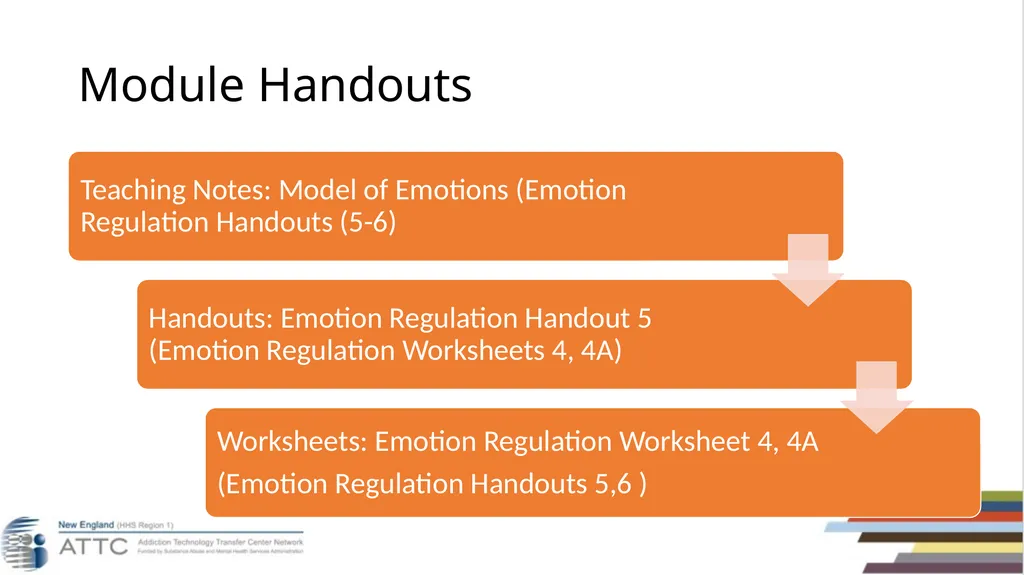
Module Handouts<br>
21
CORE MINDFULNESS SKILLS<br>
22
CORE MINDFULNESS: GOALS
(Mindfulness Handout # 1) To get in control of your mind
By enhancing awareness
By strengthen attention
By increasing presence
Not by controlling the contents of your mind
To find and activate WISE MIND<br>
By enhancing awareness
By strengthen attention
By increasing presence
Not by controlling the contents of your mind
To find and activate WISE MIND<br>
23
EMOTION MIND Hot Mind
Mood-dependent mind
When the mind is driven by emotions
Emotion mind is exaggerated by:
Imbalances in sleep, eating, exercise
Stress, loss, disruption
Poor self care re: medical problems
Some psychotropic medications<br>
Mood-dependent mind
When the mind is driven by emotions
Emotion mind is exaggerated by:
Imbalances in sleep, eating, exercise
Stress, loss, disruption
Poor self care re: medical problems
Some psychotropic medications<br>
24
REASONABLE MIND Cool mind
Logical Mind
Task-focused mind
Useful for soling a million logical problems:
Planning, timing, travel, sequencing
Predicting outcomes, weighing probabilities
Finances, logistics
By itself, can be too dry, colorless<br>
Logical Mind
Task-focused mind
Useful for soling a million logical problems:
Planning, timing, travel, sequencing
Predicting outcomes, weighing probabilities
Finances, logistics
By itself, can be too dry, colorless<br>
25
WISE MIND
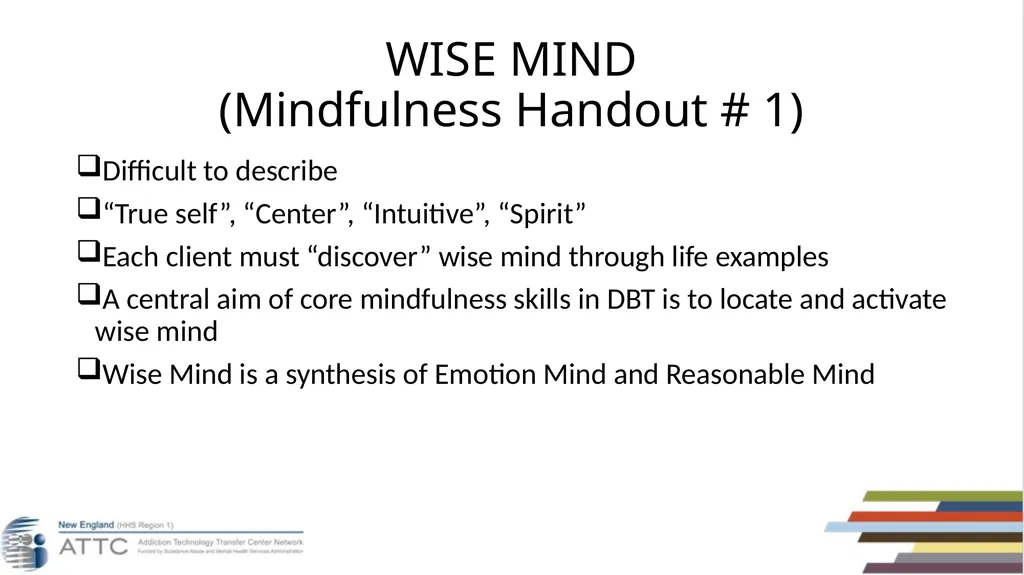
(Mindfulness Handout # 1) Difficult to describe
“True self”, “Center”, “Intuitive”, “Spirit”
Each client must “discover” wise mind through life examples
A central aim of core mindfulness skills in DBT is to locate and activate wise mind
Wise Mind is a synthesis of Emotion Mind and Reasonable Mind<br>
“True self”, “Center”, “Intuitive”, “Spirit”
Each client must “discover” wise mind through life examples
A central aim of core mindfulness skills in DBT is to locate and activate wise mind
Wise Mind is a synthesis of Emotion Mind and Reasonable Mind<br>
26
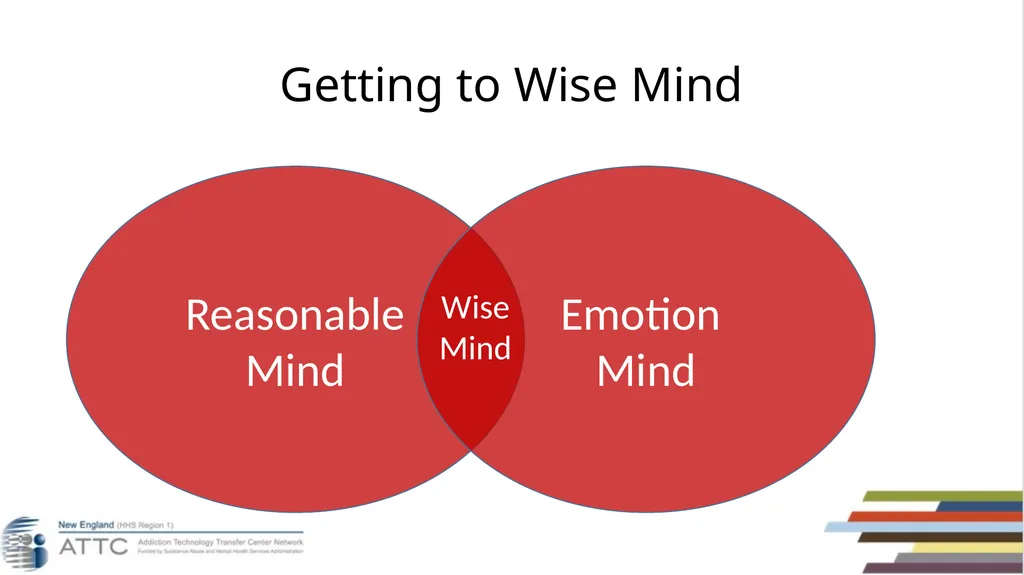
Getting to Wise Mind Reasonable Mind Emotion
Mind Wise
Mind<br>
Mind Wise
Mind<br>
27
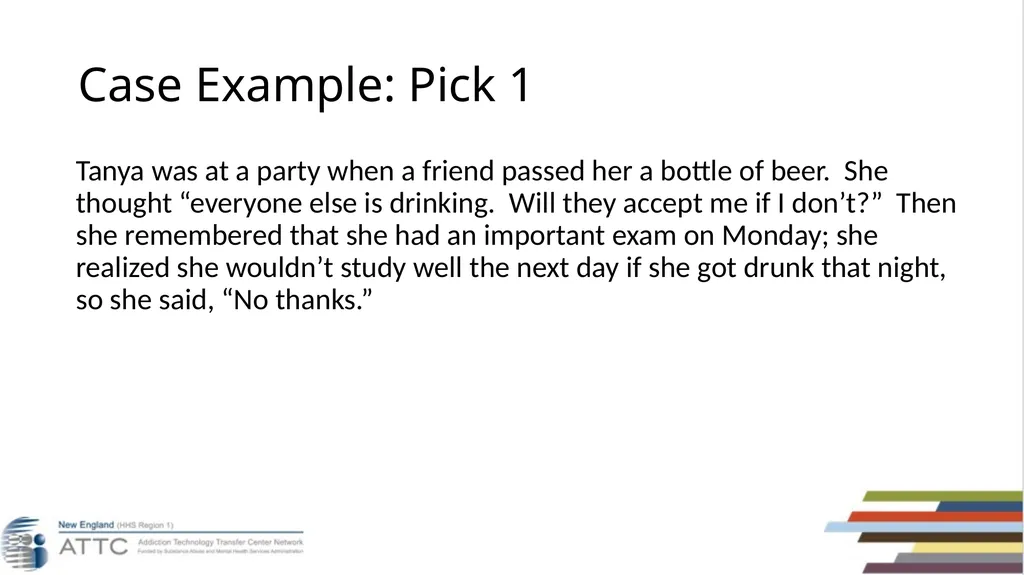
Case Example: Pick 1 Tanya was at a party when a friend passed her a bottle of beer. She thought “everyone else is drinking. Will they accept me if I don’t?” Then she remembered that she had an important exam on Monday; she realized she wouldn’t study well the next day if she got drunk that night, so she said, “No thanks.”<br>
28
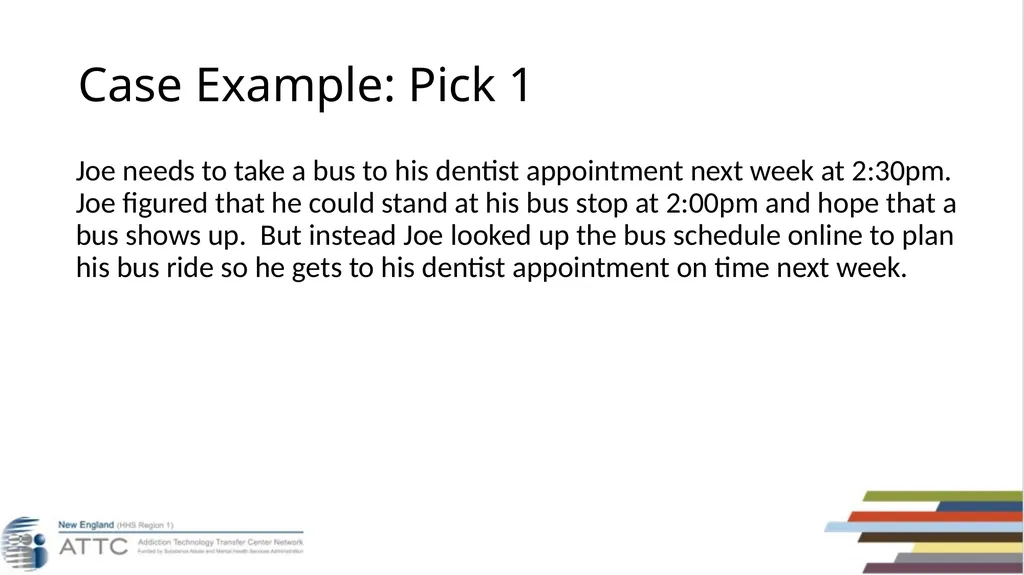
Case Example: Pick 1 Joe needs to take a bus to his dentist appointment next week at 2:30pm. Joe figured that he could stand at his bus stop at 2:00pm and hope that a bus shows up. But instead Joe looked up the bus schedule online to plan his bus ride so he gets to his dentist appointment on time next week.<br>
29
Case Example: Pick 1 Makenna was shopping for a specific jacket she saw online at Macys.com. When Makenna got to the store the sales person informed her that they were sold out. Makenna snapped at the sales person, yelling and screaming at them for ruining her life.<br>
30
Case Example: Pick 1 Catherine was sitting in class when a classmate tripped and knocked over her waterbottle spilling water all over the floor. Catherine was angry and embarrassed and wanted to punch her classmate for spilling her water. Catherine realized she didn’t want to create problems with her classmate so she went over to the sink to grab paper towels to help clean up.<br>
31
TEACHING CORE MINDFULNESS SKILLS After helping each client find “Wise Mind”…
Teach that there are six skills to “Wise Mind”.
Three “What Skills” (what you do)
Observe, Describe, Participate
Three “How” skills (how you do what you do)
Non-judgmentally, One-mindfully, Effectively<br>
Teach that there are six skills to “Wise Mind”.
Three “What Skills” (what you do)
Observe, Describe, Participate
Three “How” skills (how you do what you do)
Non-judgmentally, One-mindfully, Effectively<br>
32
OBSERVE
(Mindfulness Handout #4) Just noticing exactly what is
Being like a guard at the place gate
Alert to everything that comes and goes
Having a “Teflon Mind”
Just noticing without labeling, interpreting, judging, or finding patterns
Children do it all the time (looking at sky, water, fire, bugs, etc)<br>
Being like a guard at the place gate
Alert to everything that comes and goes
Having a “Teflon Mind”
Just noticing without labeling, interpreting, judging, or finding patterns
Children do it all the time (looking at sky, water, fire, bugs, etc)<br>
33
DESCRIBE
(Mindfulness Handout #4) Adding a label to an observed experience
Putting words on experience
Noting
Just the facts
You cannot describe something unless you observe it; be aware of assumptions
You cannot observe another person’s thoughts, emotions, or intentions<br>
Putting words on experience
Noting
Just the facts
You cannot describe something unless you observe it; be aware of assumptions
You cannot observe another person’s thoughts, emotions, or intentions<br>
34
PARTICIPATE
(Mindfulness Handout #4) To enter completely into what you are doing in the present moment
Responding spontaneously, without ruminating, without self-consciousness
Engaging completely, with immersion
Being in “the zone”, being one with the activity; no boundary between self and activity<br>
Responding spontaneously, without ruminating, without self-consciousness
Engaging completely, with immersion
Being in “the zone”, being one with the activity; no boundary between self and activity<br>
35
NON-JUDGMENTAL
(Mindful Handout #5) See reality exactly as it is, without judging it as either good or bad
Notice judgments as judgments, facts as facts
Evaluate, by discriminating and measuring, but without adding on judgments
Judgments are compact statements condensing valid events, reactions, consequences<br>
Notice judgments as judgments, facts as facts
Evaluate, by discriminating and measuring, but without adding on judgments
Judgments are compact statements condensing valid events, reactions, consequences<br>
36
ONE-MINDFULLY
(Mindfulness Handout #5) To do one thing at a time, with awareness
Bring your entire attention to this one moment
When overwhelmed by many things simply do one thing at a time, with total focus
Wash the dishes, one at a time, to wash the dishes (Thich Nhat Hanh)<br>
Bring your entire attention to this one moment
When overwhelmed by many things simply do one thing at a time, with total focus
Wash the dishes, one at a time, to wash the dishes (Thich Nhat Hanh)<br>
37
EFFECTIVELY
(Mindfulness Handout #5) To use skillful means
Focus on what works
Not what is right versus wrong
Play by life’s rule, just do what’s needed
Keep an eye on your goals and your values
It sometimes means letting go of your “ego”<br>
Focus on what works
Not what is right versus wrong
Play by life’s rule, just do what’s needed
Keep an eye on your goals and your values
It sometimes means letting go of your “ego”<br>
38
Diary Card- Practice Makes Perfect Progress To be completed every day
Review skills monitoring only<br>
Review skills monitoring only<br>
39
Getting through a painful moment without making
things worse. DISTRESS TOLERANCE SKILLS<br>
things worse. DISTRESS TOLERANCE SKILLS<br>
40
DISTRESS TOLERANCE:
Overview of Module Goals of the Module
When to Use Crisis Survival Strategies vs. Reality Acceptance Skills
Crisis Survival Skills
Reality Acceptance Skills<br>
When to Use Crisis Survival Strategies vs. Reality Acceptance Skills
Crisis Survival Skills
Reality Acceptance Skills<br>
41
GOALS OF THE MODULE
(Distress Tolerance Handout #1) Survive Crisis Situation w/o Making Them Worse
Accept Reality As It is In The Moment
Become Free
When we are free, we can look in the face of distress, cravings, and desires
Pain and distress are a part of life
Try to get rid of them can increase suffering<br>
Accept Reality As It is In The Moment
Become Free
When we are free, we can look in the face of distress, cravings, and desires
Pain and distress are a part of life
Try to get rid of them can increase suffering<br>
42
WHEN TO USE CRISIS SURVIVAL SKILLS When intense pain or problems that can’t be helped quickly
When acting on emotion mind would make things worse
When emotional distress threatens to be overwhelming
When feeling overwhelmed but needing to meet demands<br>
When acting on emotion mind would make things worse
When emotional distress threatens to be overwhelming
When feeling overwhelmed but needing to meet demands<br>
43
CRISIS SURVIVAL STRATEGIES
(Distress Tolerance Handout #2) The STOP Skill
Pros and Cons
TIPS Skills, for Changing Body Chemistry
Distracting Skills
Self-Soothing Skills
Improving the Moment Skills<br>
Pros and Cons
TIPS Skills, for Changing Body Chemistry
Distracting Skills
Self-Soothing Skills
Improving the Moment Skills<br>
44
CRISIS SURVIVAL SKILLS
(Distress Tolerance Handout #4) The STOP Skill
Stop
When emotions are about to take control, freeze!
Take a Step Back
Take a step back physically or in your mind; get unstuck
Observe
What is happening inside and around you
Proceed Mindfully
Ask Wise Mind how to deal with the problem<br>
Stop
When emotions are about to take control, freeze!
Take a Step Back
Take a step back physically or in your mind; get unstuck
Observe
What is happening inside and around you
Proceed Mindfully
Ask Wise Mind how to deal with the problem<br>
45
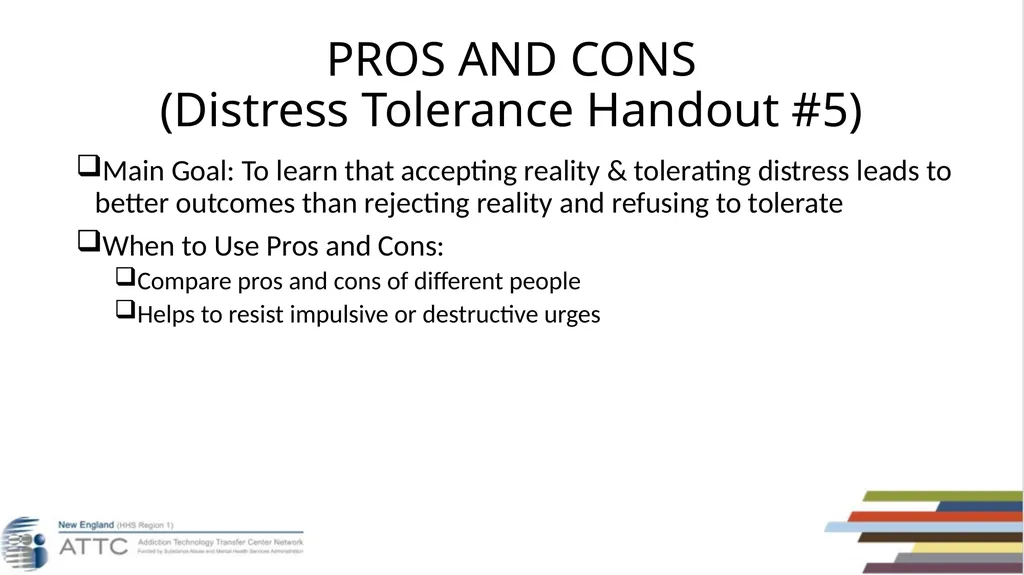
PROS AND CONS
(Distress Tolerance Handout #5) Main Goal: To learn that accepting reality & tolerating distress leads to better outcomes than rejecting reality and refusing to tolerate
When to Use Pros and Cons:
Compare pros and cons of different people
Helps to resist impulsive or destructive urges<br>
When to Use Pros and Cons:
Compare pros and cons of different people
Helps to resist impulsive or destructive urges<br>
46
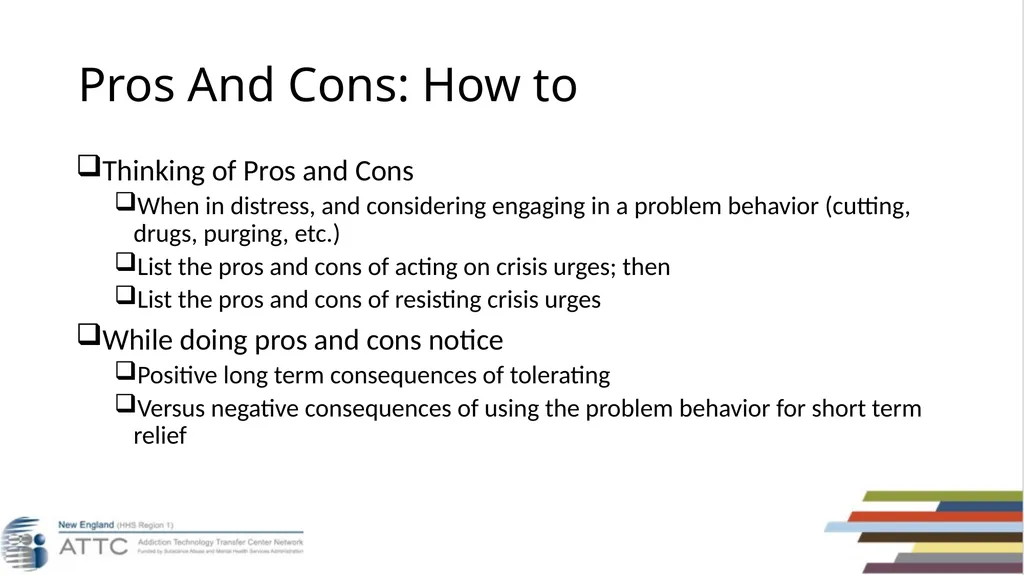
Pros And Cons: How to Thinking of Pros and Cons
When in distress, and considering engaging in a problem behavior (cutting, drugs, purging, etc.)
List the pros and cons of acting on crisis urges; then
List the pros and cons of resisting crisis urges
While doing pros and cons notice
Positive long term consequences of tolerating
Versus negative consequences of using the problem behavior for short term relief<br>
When in distress, and considering engaging in a problem behavior (cutting, drugs, purging, etc.)
List the pros and cons of acting on crisis urges; then
List the pros and cons of resisting crisis urges
While doing pros and cons notice
Positive long term consequences of tolerating
Versus negative consequences of using the problem behavior for short term relief<br>
47
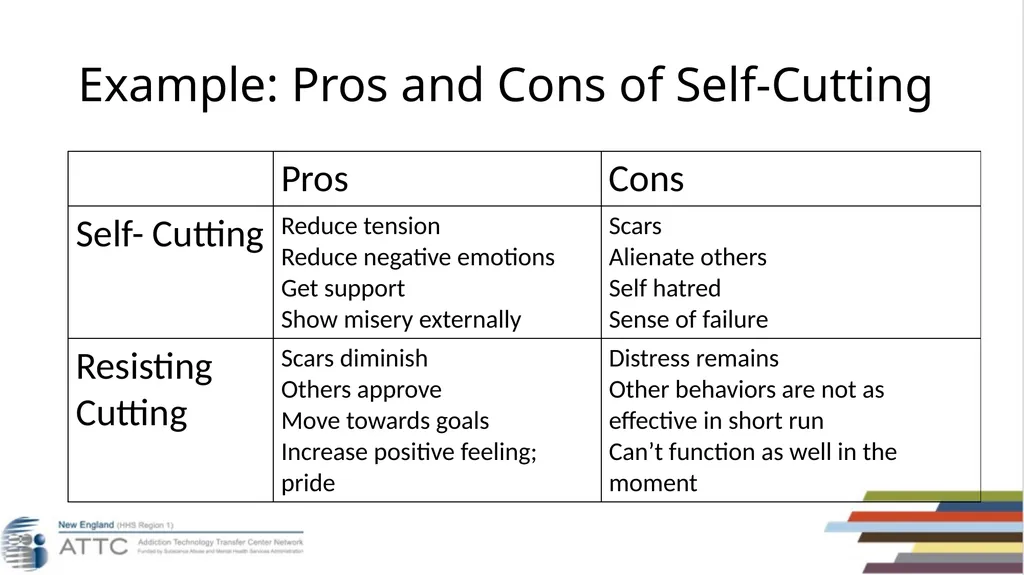
Example: Pros and Cons of Self-Cutting<br>
48
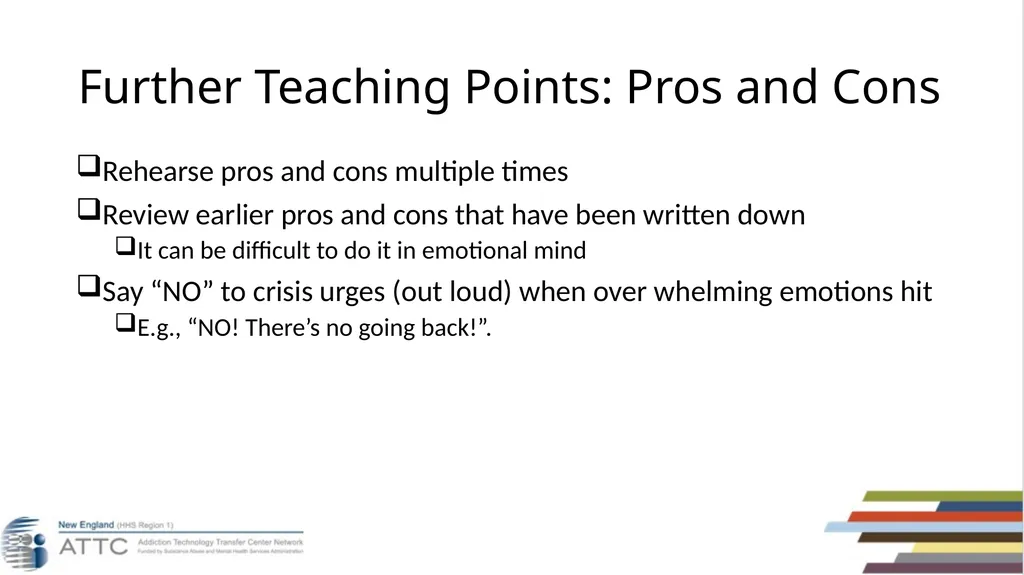
Further Teaching Points: Pros and Cons Rehearse pros and cons multiple times
Review earlier pros and cons that have been written down
It can be difficult to do it in emotional mind
Say “NO” to crisis urges (out loud) when over whelming emotions hit
E.g., “NO! There’s no going back!”.<br>
Review earlier pros and cons that have been written down
It can be difficult to do it in emotional mind
Say “NO” to crisis urges (out loud) when over whelming emotions hit
E.g., “NO! There’s no going back!”.<br>
49
TIP SKILLS TO MANAGE EXTREME AROUSAL
(Distress Tolerance Handout #6) Rapid ways to reduce arousal when very high
Work within seconds to minutes
4 Skills
Temperature
Use of cold water on face to elicit “diver response”
Intense Exercise
Paced Breathing
Paired Muscle Relaxation<br>
Work within seconds to minutes
4 Skills
Temperature
Use of cold water on face to elicit “diver response”
Intense Exercise
Paced Breathing
Paired Muscle Relaxation<br>
50
FACIAL TEMPERATURE
WITH COLD WATER Induce the “dive reflex” which activates para- sympathetic system, slows heart rate, etc.
Induce with
Bowl of cold water (30-60 seconds)
Ice pack over eyes and upper cheeks
Splash cold water on eyes and cheeks might work
Can try when cannot sleep, or when dissociate<br>
Induce with
Bowl of cold water (30-60 seconds)
Ice pack over eyes and upper cheeks
Splash cold water on eyes and cheeks might work
Can try when cannot sleep, or when dissociate<br>
51
INTENSE AEROBIC EXERCISE Why intense exercise?
State anxiety will increase if HR gets to 70% of Max.
Decrease in positive emotions if HR is up to 55-70%
Can re-regulate the body to a less emotional state
When to use intense exercise
Agitated, angry, ruminating
When you need to bring mood and willingness up to a higher level<br>
State anxiety will increase if HR gets to 70% of Max.
Decrease in positive emotions if HR is up to 55-70%
Can re-regulate the body to a less emotional state
When to use intense exercise
Agitated, angry, ruminating
When you need to bring mood and willingness up to a higher level<br>
52
PACED BREATHING Slowing the pace of inhaling and exhaling to an average of 5-6 breath cycles per minute
Breathing deeply from the abdomen
Breathing out slower than breathing in
This activates the parasympathetic nervous system and leads to decrease emotional arousal
Use a clock, to count seconds inhale, seconds exhale<br>
Breathing deeply from the abdomen
Breathing out slower than breathing in
This activates the parasympathetic nervous system and leads to decrease emotional arousal
Use a clock, to count seconds inhale, seconds exhale<br>
53
PAIRED MUSCLE RELAXATION Pairing muscles relaxing with breathing out
Tense muscle groups, notice sensation of tension while breathing in…
Then relax them by letting go of tension, notice sensations as tension goes down
Teach participants to notice tension and then relax muscles
Pair exhaling with word “relax”<br>
Tense muscle groups, notice sensation of tension while breathing in…
Then relax them by letting go of tension, notice sensations as tension goes down
Teach participants to notice tension and then relax muscles
Pair exhaling with word “relax”<br>
54
DISTRACTING SKILLS (ACCEPTS)
(Distress Tolerance Handout #7) Wise Mind ACCEPTS by focusing the mind on:
Activities
Contributing
Comparisons
Emotions (opposite action to the aversive emotions)
Push away
Thoughts
Sensations (intense sensations)<br>
Activities
Contributing
Comparisons
Emotions (opposite action to the aversive emotions)
Push away
Thoughts
Sensations (intense sensations)<br>
55
SELF SOOTHING SKILLS
(Distress Tolerance Handout #8) Get through difficult moments/episodes by focusing the mind on soothing stimuli, using each of the FIVE SENSES
Vision
Hearing
Smell
Taste
Touch<br>
Vision
Hearing
Smell
Taste
Touch<br>
56
IMPROVE SKILLS
(Distress Tolerance Handout #9) IMPROVE the moment by engaging in:
Imagery
Meaning
Prayer
Relaxation
One-mindfulness (one thing in the moment)
Vacation
Encouragement<br>
Imagery
Meaning
Prayer
Relaxation
One-mindfulness (one thing in the moment)
Vacation
Encouragement<br>
57
REALITY ACCEPTANCE SKILLS
(Distress Tolerance Handout #10) To decrease suffering and increase freedom
Skills for Accepting Your Life as it is Now
Six Skills
Radical Acceptance
Turning the Mind
Willingness
Half Smiling & Willing Hands
Allowing the mind: mindfulness of thoughts<br>
Skills for Accepting Your Life as it is Now
Six Skills
Radical Acceptance
Turning the Mind
Willingness
Half Smiling & Willing Hands
Allowing the mind: mindfulness of thoughts<br>
58
RADICAL ACCEPTANCE
(Distress Tolerance Handout #11) Acknowledge exactly what is, see the truth
Allow what is, allow the truth
Don’t push away realities, even painful ones
Not the same as approving, agreeing
Not a passive position
Once reality has been radically accepted, the door opens to using skillful strategies for tolerating<br>
Allow what is, allow the truth
Don’t push away realities, even painful ones
Not the same as approving, agreeing
Not a passive position
Once reality has been radically accepted, the door opens to using skillful strategies for tolerating<br>
59
TURNING THE MIND
(Distress Tolerance Handout #12) The act of choosing to accept what is
Again and again and again
Noticing that you are no long accepting
Then make an inner commitment to accept
Then do it again, over and over
Making a plan to catching yourself when you drift out of acceptance
What cues tell you that you are drifting?<br>
Again and again and again
Noticing that you are no long accepting
Then make an inner commitment to accept
Then do it again, over and over
Making a plan to catching yourself when you drift out of acceptance
What cues tell you that you are drifting?<br>
60
WILLINGNESS
(Distress Tolerance Handout #13) Willingness (over willfulness)
Readiness to respond to life's situations wisely, as needed, voluntarily, without grudge
Choosing to “go with” reality
Rather than to opposing it
Complete openness to the moment
Willfulness
Acting in opposite to the processes and rules of reality, in order to counter them, oppose then, control them, revers them, or overcome them.<br>
Readiness to respond to life's situations wisely, as needed, voluntarily, without grudge
Choosing to “go with” reality
Rather than to opposing it
Complete openness to the moment
Willfulness
Acting in opposite to the processes and rules of reality, in order to counter them, oppose then, control them, revers them, or overcome them.<br>
61
HALF-SMILE
(Distress Tolerance Handout #14) A Way of Accepting Reality with the Body
Adopt a serene facial expression
Relax face, neck, shoulder muscles
By letting go or tensing and letting go
Then, lift corner of lips, just slightly
Half Smile…
When you wake up, during free moments, while listening to music, when lying down, in sitting position
When irritated
When contemplating the person you hate or despise<br>
Adopt a serene facial expression
Relax face, neck, shoulder muscles
By letting go or tensing and letting go
Then, lift corner of lips, just slightly
Half Smile…
When you wake up, during free moments, while listening to music, when lying down, in sitting position
When irritated
When contemplating the person you hate or despise<br>
62
WILLING HANDS
(Distress Tolerance Handout #14) Another Way to Accept Reality with the Body
Hands unclenched, palms up, fingers relaxed
Clenched hands go with anger; opening up the hands acts opposite to anger
Acceptance rather than control
Practice
When you wake up, during free moments, while listening to music, when irritated, etc.<br>
Hands unclenched, palms up, fingers relaxed
Clenched hands go with anger; opening up the hands acts opposite to anger
Acceptance rather than control
Practice
When you wake up, during free moments, while listening to music, when irritated, etc.<br>
63
MINDFULNESS OF CURRENT THOUGHTS
(Distress Tolerance Handout #15) Let thoughts come and go; just notice them
Notice them, radically accept them
As thoughts, not facts
Reducing suffering caused by believing thoughts
Observe thoughts, adopt curious mind about thoughts
Remember: you are not your thoughts
Observing thoughts is the path to freedom<br>
Notice them, radically accept them
As thoughts, not facts
Reducing suffering caused by believing thoughts
Observe thoughts, adopt curious mind about thoughts
Remember: you are not your thoughts
Observing thoughts is the path to freedom<br>
64
Distress Tolerance Practices Every day: notice something difficult to accept
Turn the mind to radically accept it
Use the Crisis Survival Strategies
Observe your own willing responses
And observe your own willful responses
Replace willful ones with willing ones
Allow yourself to notice your connections
To a chair, to a person, to nature, to the universe<br>
Turn the mind to radically accept it
Use the Crisis Survival Strategies
Observe your own willing responses
And observe your own willful responses
Replace willful ones with willing ones
Allow yourself to notice your connections
To a chair, to a person, to nature, to the universe<br>
65
Reduce emotional vulnerability and suffering by
better regulation of emotions. EMOTION REGULATION SKILLS<br>
better regulation of emotions. EMOTION REGULATION SKILLS<br>
66
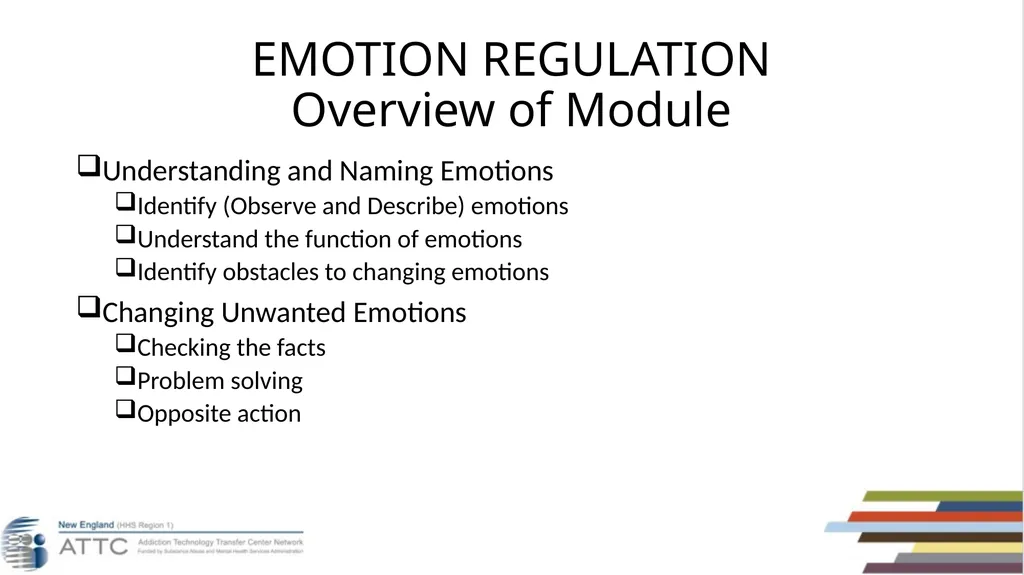
EMOTION REGULATION
Overview of Module Understanding and Naming Emotions
Identify (Observe and Describe) emotions
Understand the function of emotions
Identify obstacles to changing emotions
Changing Unwanted Emotions
Checking the facts
Problem solving
Opposite action<br>
Identify (Observe and Describe) emotions
Understand the function of emotions
Identify obstacles to changing emotions
Changing Unwanted Emotions
Checking the facts
Problem solving
Opposite action<br>
67
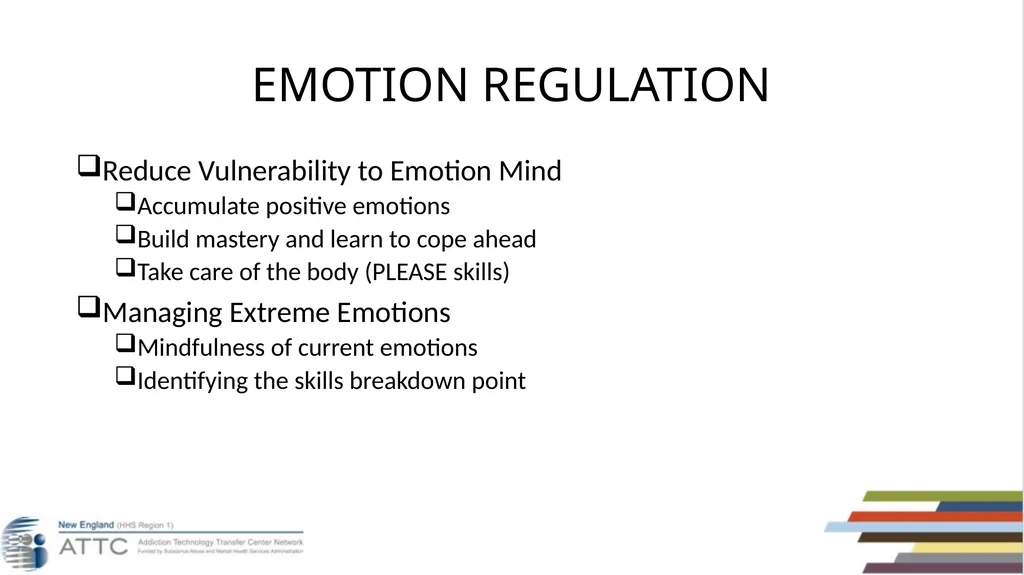
EMOTION REGULATION Reduce Vulnerability to Emotion Mind
Accumulate positive emotions
Build mastery and learn to cope ahead
Take care of the body (PLEASE skills)
Managing Extreme Emotions
Mindfulness of current emotions
Identifying the skills breakdown point<br>
Accumulate positive emotions
Build mastery and learn to cope ahead
Take care of the body (PLEASE skills)
Managing Extreme Emotions
Mindfulness of current emotions
Identifying the skills breakdown point<br>
68
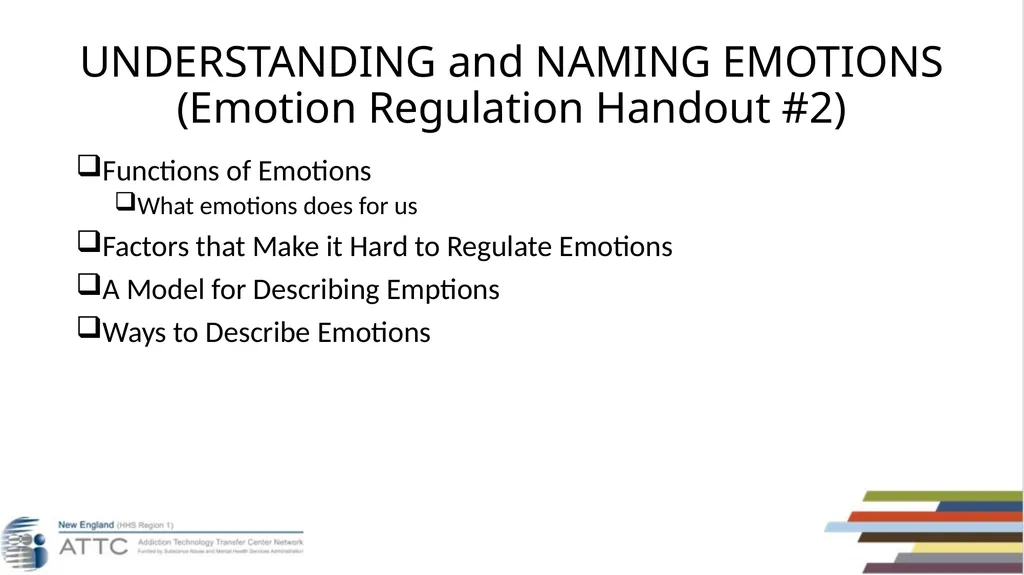
UNDERSTANDING and NAMING EMOTIONS
(Emotion Regulation Handout #2) Functions of Emotions
What emotions does for us
Factors that Make it Hard to Regulate Emotions
A Model for Describing Emptions
Ways to Describe Emotions<br>
What emotions does for us
Factors that Make it Hard to Regulate Emotions
A Model for Describing Emptions
Ways to Describe Emotions<br>
69
FUNCTION OF EMOTIONS
(Emotion Regulation Handout #3) Emotions Have Functions that Help Our Species Survive
Emotions Motivate and Organize US for Action
Emotions Communicate to (and influence) Others
Emotions Communicate to Ourselves<br>
Emotions Motivate and Organize US for Action
Emotions Communicate to (and influence) Others
Emotions Communicate to Ourselves<br>
70
FACTORS MAKING IT HARD TO REGULATE
(Emotion Regulation Handout #4) Biology
Lack of Skills
Reinforcement of Emotional Behaviors
Moodiness
Emotional Overload
Myths about Emotions<br>
Lack of Skills
Reinforcement of Emotional Behaviors
Moodiness
Emotional Overload
Myths about Emotions<br>
71
A MODEL OF EMOTIONS
(Emotion Regulation Handout #5) Characteristics of Emotions
Complex, Automatic, Can’t be Directly Changed
Sudden (rise and Fall), self perpetuating
Components of Emotions
See Emotion Regulation Handout # 5
Observe and Describe Emotions
See Emotion Regulation Handout 6<br>
Complex, Automatic, Can’t be Directly Changed
Sudden (rise and Fall), self perpetuating
Components of Emotions
See Emotion Regulation Handout # 5
Observe and Describe Emotions
See Emotion Regulation Handout 6<br>
72
CHANGING EMOTIONAL RESPONSES
(Emotion Regulation Handout #7) Check the Facts (Handout #8)
Opposite Action (Handout #9, 10, 11)
Problem Solve (Handout # 12)
The “Yes, BUT” Barrier to Changing Emotions<br>
Opposite Action (Handout #9, 10, 11)
Problem Solve (Handout # 12)
The “Yes, BUT” Barrier to Changing Emotions<br>
73
REDUCE VULNERABILITY TO EMOTION MIND
(Emotion Regulation Handout #14) Become Less Vulnerable to Painful Emotions
ABC Please Skills
Accumulate Positive Emotions
Build Mastery
Tacking Care of the Body
Nightmare Protocol
Sleeping Hygiene Protocol<br>
ABC Please Skills
Accumulate Positive Emotions
Build Mastery
Tacking Care of the Body
Nightmare Protocol
Sleeping Hygiene Protocol<br>
74
MANAGE REALLY DIFFICULT EMOTIONS
(Emotion Regulation Handout #21) Mindful of Current Emotions (Handout #22)
Manage Extreme Emotions (Handout #23)
Troubleshooting Emotion Regulation Skills (Handout #24)
Reviewing Skills (Handout #25)<br>
Manage Extreme Emotions (Handout #23)
Troubleshooting Emotion Regulation Skills (Handout #24)
Reviewing Skills (Handout #25)<br>
75
Getting Relationships in Order
Dealing with Conflict
Asserting Yourself INTERPERSONAL EFFECTIVENESS SKILLS<br>
Dealing with Conflict
Asserting Yourself INTERPERSONAL EFFECTIVENESS SKILLS<br>
76
INTERPERSONAL EFFECTIVENESS
Over of Module (Handout #1) Core Interpersonal Effectiveness Skills:
Obtaining objectives while maintaining relationships and self-respect
Skills for Building Relationships and Ending Destructive Ones
Finding potential friends
Mindfulness of others
How to end relationships
Walking the Middle Path
Dialectics
Validation
Strategies for changing behavior<br>
Obtaining objectives while maintaining relationships and self-respect
Skills for Building Relationships and Ending Destructive Ones
Finding potential friends
Mindfulness of others
How to end relationships
Walking the Middle Path
Dialectics
Validation
Strategies for changing behavior<br>
77
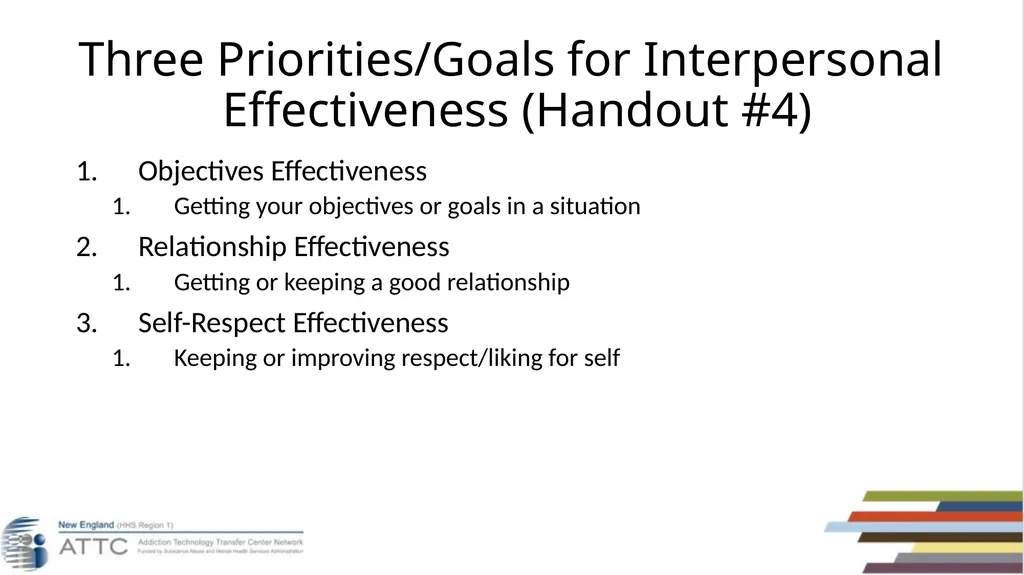
Three Priorities/Goals for Interpersonal Effectiveness (Handout #4) Objectives Effectiveness
Getting your objectives or goals in a situation
Relationship Effectiveness
Getting or keeping a good relationship
Self-Respect Effectiveness
Keeping or improving respect/liking for self<br>
Getting your objectives or goals in a situation
Relationship Effectiveness
Getting or keeping a good relationship
Self-Respect Effectiveness
Keeping or improving respect/liking for self<br>
78
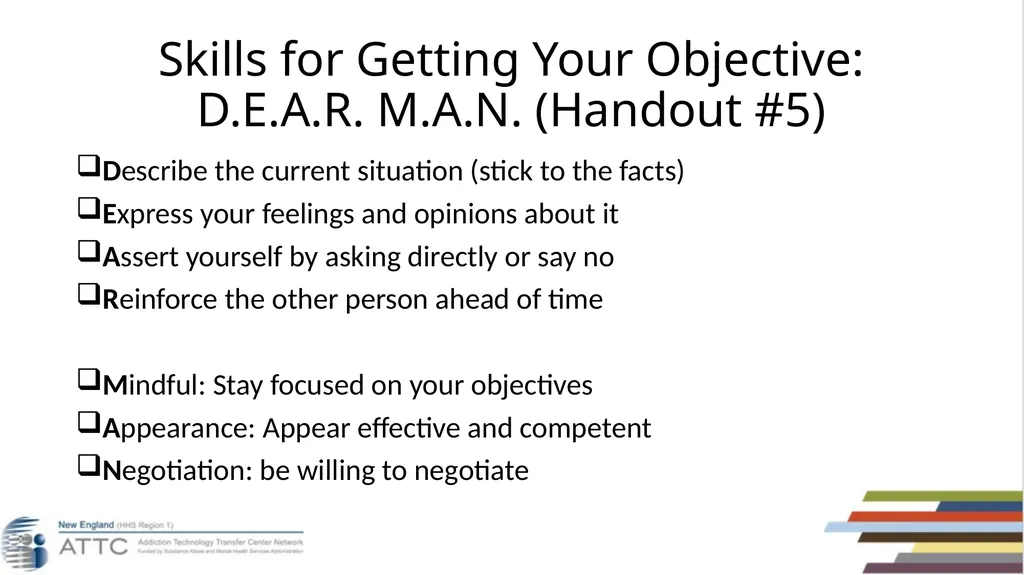
Skills for Getting Your Objective: D.E.A.R. M.A.N. (Handout #5) Describe the current situation (stick to the facts)
Express your feelings and opinions about it
Assert yourself by asking directly or say no
Reinforce the other person ahead of time
Mindful: Stay focused on your objectives
Appearance: Appear effective and competent
Negotiation: be willing to negotiate<br>
Express your feelings and opinions about it
Assert yourself by asking directly or say no
Reinforce the other person ahead of time
Mindful: Stay focused on your objectives
Appearance: Appear effective and competent
Negotiation: be willing to negotiate<br>
79
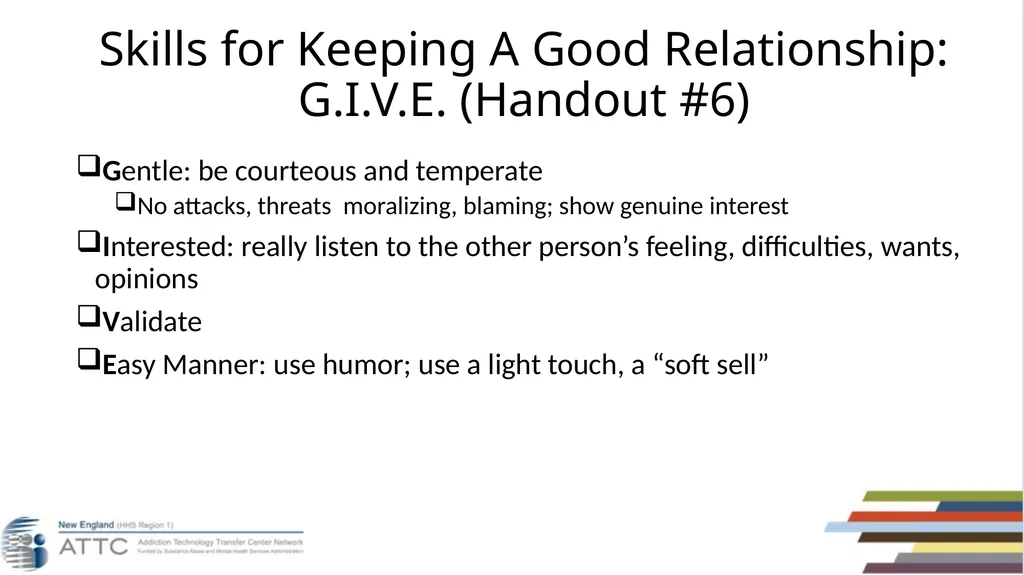
Skills for Keeping A Good Relationship: G.I.V.E. (Handout #6) Gentle: be courteous and temperate
No attacks, threats moralizing, blaming; show genuine interest
Interested: really listen to the other person’s feeling, difficulties, wants, opinions
Validate
Easy Manner: use humor; use a light touch, a “soft sell”<br>
No attacks, threats moralizing, blaming; show genuine interest
Interested: really listen to the other person’s feeling, difficulties, wants, opinions
Validate
Easy Manner: use humor; use a light touch, a “soft sell”<br>
80
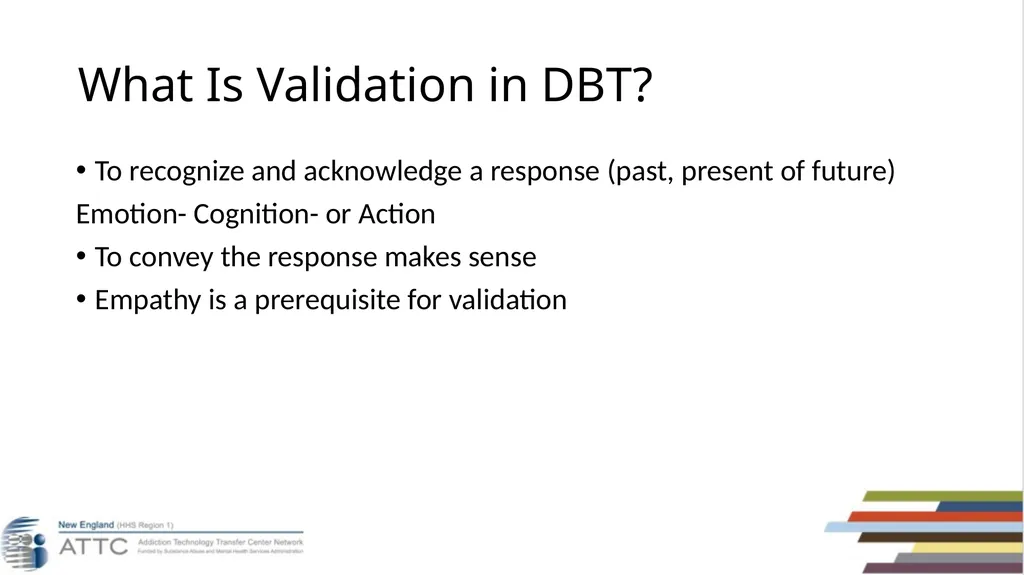
What Is Validation in DBT? To recognize and acknowledge a response (past, present of future)
Emotion- Cognition- or Action
To convey the response makes sense
Empathy is a prerequisite for validation<br>
Emotion- Cognition- or Action
To convey the response makes sense
Empathy is a prerequisite for validation<br>
81
Why Do We Validate? Reduce negative emotional arousal
Counter habitual self-invalidation
Strengthen the bond with the client
Strengthen clients capacity to problem solve
Strengthen clinical progress (reinforcement)<br>
Counter habitual self-invalidation
Strengthen the bond with the client
Strengthen clients capacity to problem solve
Strengthen clinical progress (reinforcement)<br>
82
6 levels of Validation Wide awake mindful listening
Accurately reflecting clients communications
Articulating clients non-verbal thoughts/emotions/behavior patterns
Making sense of clients behavior(past and biology)
Normalizing clients behavior in the current context
Radical genuineness<br>
Accurately reflecting clients communications
Articulating clients non-verbal thoughts/emotions/behavior patterns
Making sense of clients behavior(past and biology)
Normalizing clients behavior in the current context
Radical genuineness<br>
83
Skills for Improving Self-Respect:
F.A.S.T. (Handout #7). Fair:
Be fair to yourself and the other person
(No excessive) Apologies:
Don’t overly apologize for making a request; having an opinion, or being alive
Stick to Values:
Stick to your own values; don’t sell out
(Be) Truthful:
Don’t lie, act helpless, exaggerate, or make-up excuses<br>
Be fair to yourself and the other person
(No excessive) Apologies:
Don’t overly apologize for making a request; having an opinion, or being alive
Stick to Values:
Stick to your own values; don’t sell out
(Be) Truthful:
Don’t lie, act helpless, exaggerate, or make-up excuses<br>
84
Factors Reducing Interpersonal Effectiveness (Handout #2) Lack of Skill: not knowing what to say or do
Worry Thoughts: worries about bad consequences, badness, effectiveness
Emotions: negative emotions get in the way
Indecision: not being sure really what you want or what matters most
Environment (Reality): even if you are very skillful, sometimes reality blocks you<br>
Worry Thoughts: worries about bad consequences, badness, effectiveness
Emotions: negative emotions get in the way
Indecision: not being sure really what you want or what matters most
Environment (Reality): even if you are very skillful, sometimes reality blocks you<br>
85
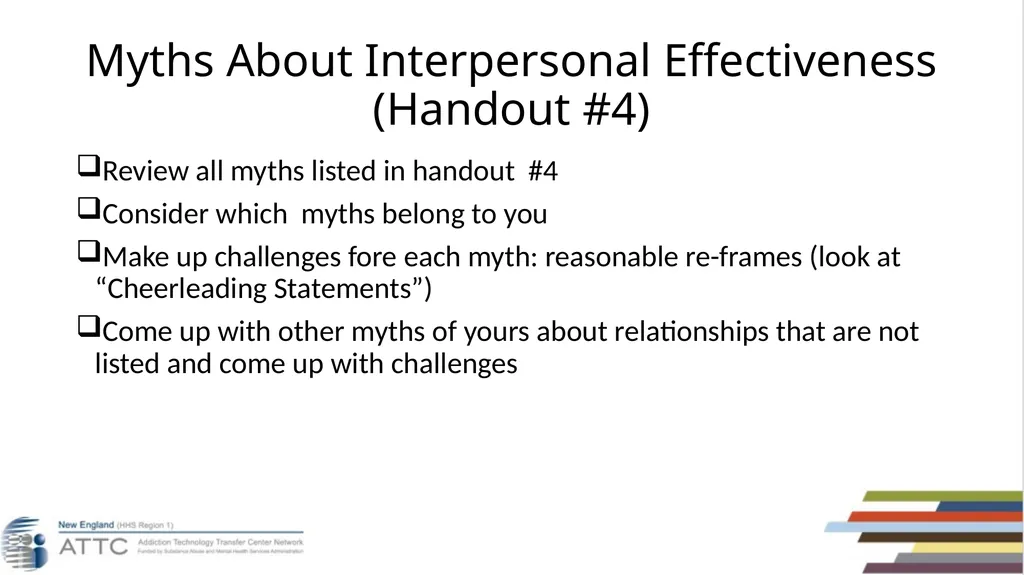
Myths About Interpersonal Effectiveness
(Handout #4) Review all myths listed in handout #4
Consider which myths belong to you
Make up challenges fore each myth: reasonable re-frames (look at “Cheerleading Statements”)
Come up with other myths of yours about relationships that are not listed and come up with challenges<br>
Consider which myths belong to you
Make up challenges fore each myth: reasonable re-frames (look at “Cheerleading Statements”)
Come up with other myths of yours about relationships that are not listed and come up with challenges<br>
86
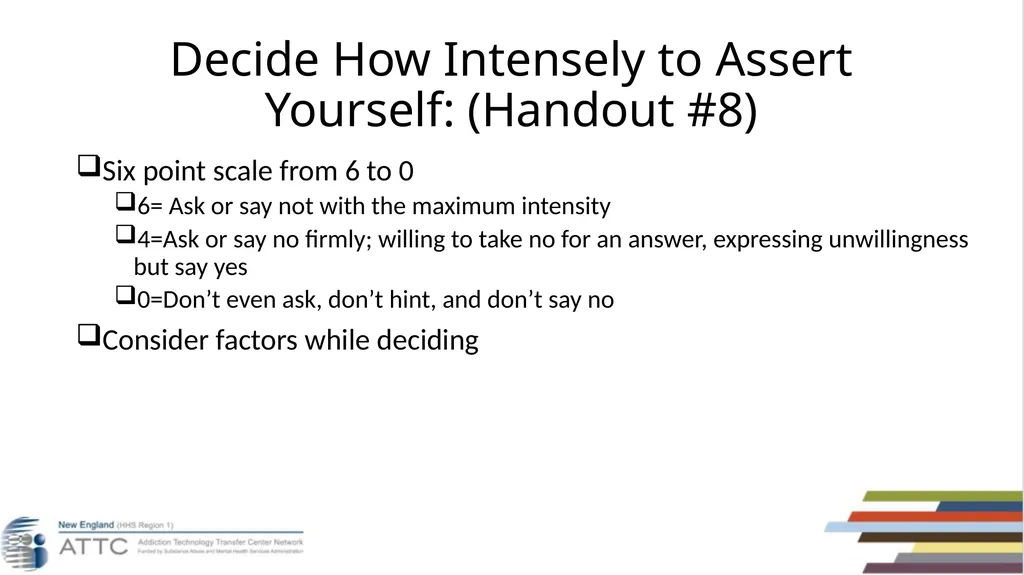
Decide How Intensely to Assert Yourself: (Handout #8) Six point scale from 6 to 0
6= Ask or say not with the maximum intensity
4=Ask or say no firmly; willing to take no for an answer, expressing unwillingness but say yes
0=Don’t even ask, don’t hint, and don’t say no
Consider factors while deciding<br>
6= Ask or say not with the maximum intensity
4=Ask or say no firmly; willing to take no for an answer, expressing unwillingness but say yes
0=Don’t even ask, don’t hint, and don’t say no
Consider factors while deciding<br>
87
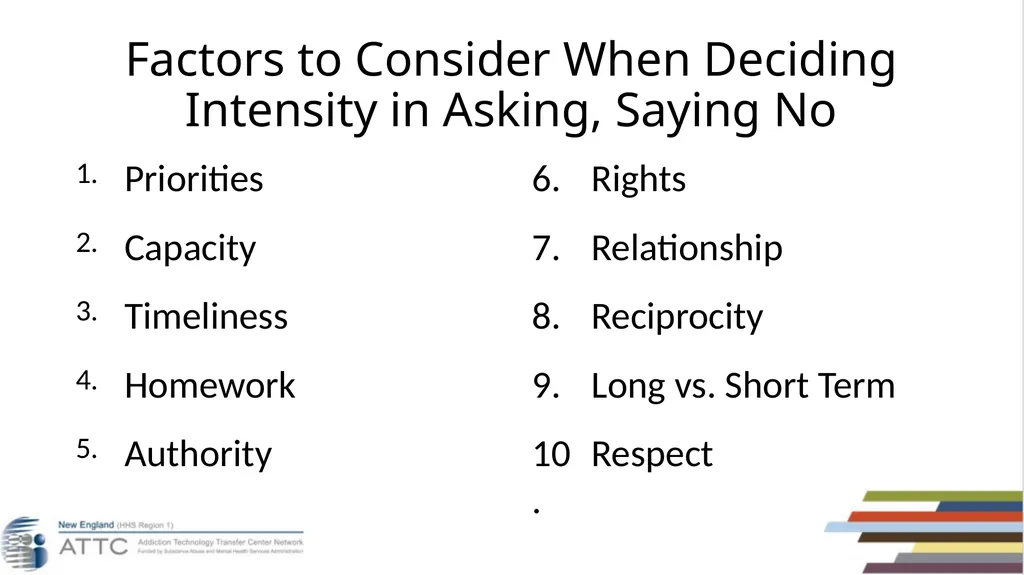
Factors to Consider When Deciding Intensity in Asking, Saying No<br>
88
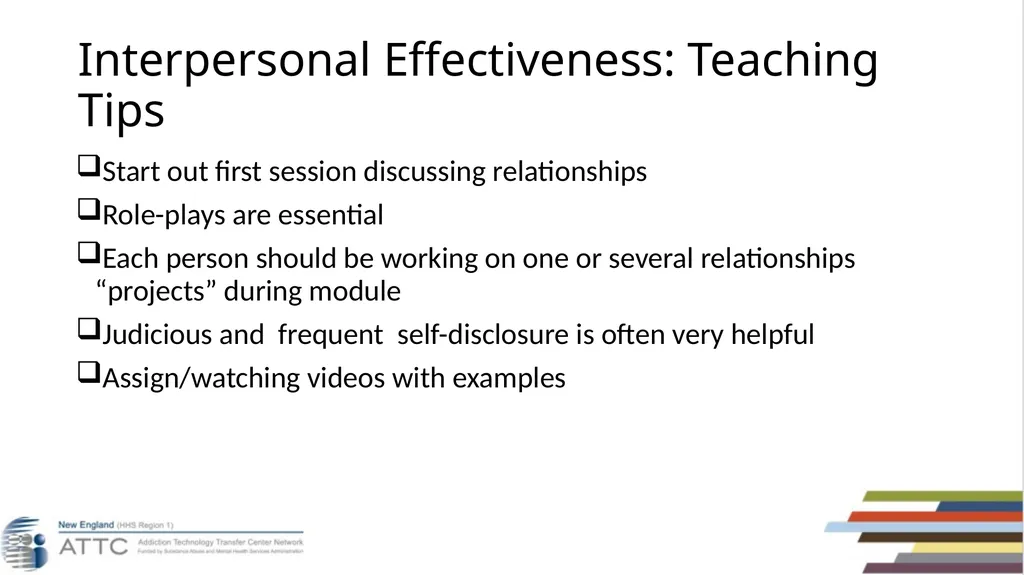
Interpersonal Effectiveness: Teaching Tips Start out first session discussing relationships
Role-plays are essential
Each person should be working on one or several relationships “projects” during module
Judicious and frequent self-disclosure is often very helpful
Assign/watching videos with examples<br>
Role-plays are essential
Each person should be working on one or several relationships “projects” during module
Judicious and frequent self-disclosure is often very helpful
Assign/watching videos with examples<br>
89
Using Role Plays in Group Role plays are essential in this module, but clients and therapists often avoid them
Suggestions:
Co-leaders can role play first
Start with simple ones in the first session
Round robin roleplays
At first, leader plays client
Two clients role play, leader coaches them
REINFOCE EVERYONE FOR ROLE PLAYS!<br>
Suggestions:
Co-leaders can role play first
Start with simple ones in the first session
Round robin roleplays
At first, leader plays client
Two clients role play, leader coaches them
REINFOCE EVERYONE FOR ROLE PLAYS!<br>
90
Building Relationships and Ending Destructive Ones (Handout #10) Building New Relationships (Handout #11):
Find Friends
Proximity Favors Friendship
Similarity Tend to Increase Liking
Conversation Skills are Important
Express Liking Selectively
Join Conversation Groups
Join Organized Groups<br>
Find Friends
Proximity Favors Friendship
Similarity Tend to Increase Liking
Conversation Skills are Important
Express Liking Selectively
Join Conversation Groups
Join Organized Groups<br>
91
Building Relationships and Ending Destructive Ones Mindfulness of Others, by Observing (Handout #12):
Paying attention with interest and curiosity
Being open to new information and others
Letting go of overly focusing on self
Staying in the present
Stopping multi-tasking
Giving up judgments and being right<br>
Paying attention with interest and curiosity
Being open to new information and others
Letting go of overly focusing on self
Staying in the present
Stopping multi-tasking
Giving up judgments and being right<br>
92
Building Relationships and Ending Destructive Ones Mindful of Others by Describing
Describe what you observe
Put aside judgmental thoughts and statements
Don’t make assumptions about others
Don’t question others’ motives and intent
Give others the benefit of the doubt
Allow others to earn your trust
Mindfulness of Others, by Participating
Throw yourself in, go with the flow<br>
Describe what you observe
Put aside judgmental thoughts and statements
Don’t make assumptions about others
Don’t question others’ motives and intent
Give others the benefit of the doubt
Allow others to earn your trust
Mindfulness of Others, by Participating
Throw yourself in, go with the flow<br>
93
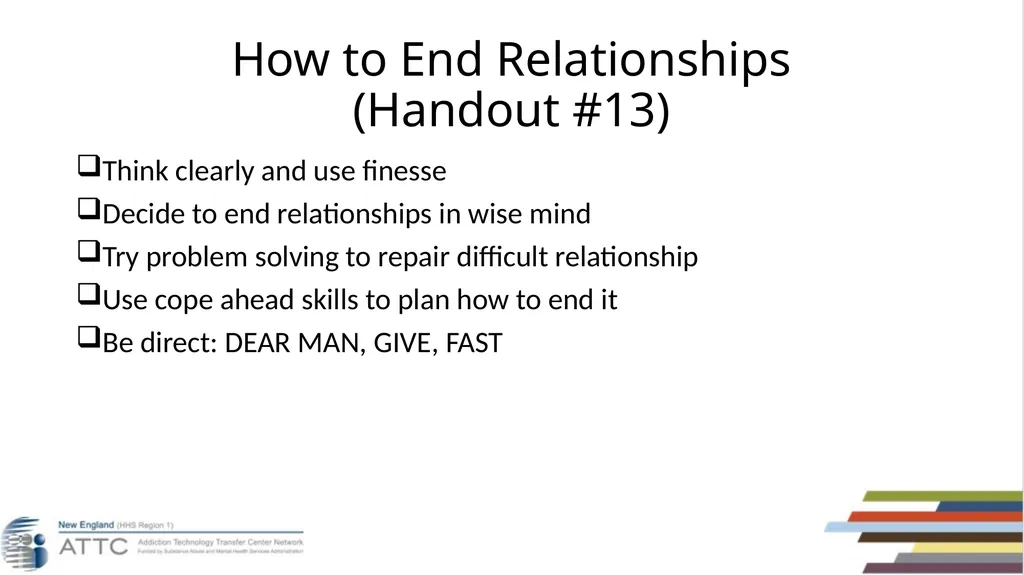
How to End Relationships
(Handout #13) Think clearly and use finesse
Decide to end relationships in wise mind
Try problem solving to repair difficult relationship
Use cope ahead skills to plan how to end it
Be direct: DEAR MAN, GIVE, FAST<br>
Decide to end relationships in wise mind
Try problem solving to repair difficult relationship
Use cope ahead skills to plan how to end it
Be direct: DEAR MAN, GIVE, FAST<br>
94
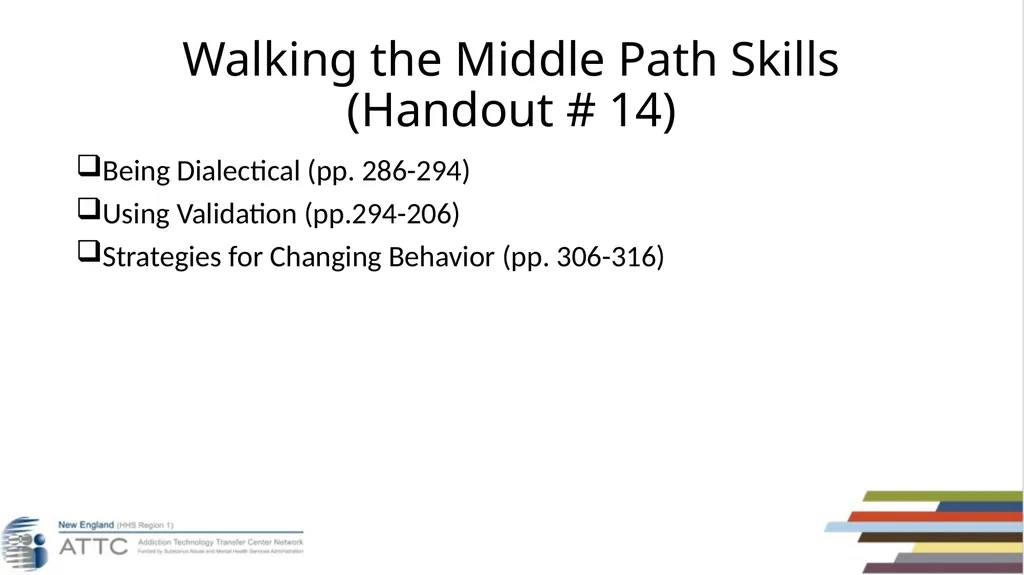
Walking the Middle Path Skills
(Handout # 14) Being Dialectical (pp. 286-294)
Using Validation (pp.294-206)
Strategies for Changing Behavior (pp. 306-316)<br>
Using Validation (pp.294-206)
Strategies for Changing Behavior (pp. 306-316)<br>
95
THANK YOU! Contact Information:
Taylor D’Addario
Taylor.daddario@salve.edu<br>
Taylor D’Addario
Taylor.daddario@salve.edu<br>