
TCM DOCUMENTATION TRAINING How to write TCM
PC
Published · 48 slides · 0 views

1 / 1














Description
TCM DOCUMENTATION TRAINING How to write TCM service notes What is Targeted Case Management? A Type of Service Supporting individuals in accessing needed services and supports (well get into the details in a bit). A Source of Funding We
Related Topics
Share
Embed code
Download this presentation From Below
"TCM DOCUMENTATION TRAINING How to write TCM" is the property of its rightful owner. Permission is granted to download and print the materials on this website for personal, non-commercial use only, and to display it on your personal computer provided you do not modify the materials and that you retain all copyright notices contained in the materials. By downloading content from our website, you accept the terms of this agreement.
Presentation Transcript
01
TCM DOCUMENTATION TRAINING How to write TCM service notes<br>
02
What is Targeted Case Management? A Type of Service
Supporting individuals in accessing needed services and supports (we’ll get into the details in a bit).
A Source of Funding
We provide many valuable services, but not all of them generate funding for our programs.
Medicaid will provide funding for specific services we provide (this helps make our programs sustainable).<br>
Supporting individuals in accessing needed services and supports (we’ll get into the details in a bit).
A Source of Funding
We provide many valuable services, but not all of them generate funding for our programs.
Medicaid will provide funding for specific services we provide (this helps make our programs sustainable).<br>
03
TCM Providers Qualified Providers must have
training,
experience
expertise
working with their target population.<br>
training,
experience
expertise
working with their target population.<br>
04
Documentation:
Why is it so important?<br>
05
What is
“Good Documentation”? Meets standards
Detailed
Specific to each service<br>
Detailed
Specific to each service<br>
06
Targeted Case Management Documentation Requirements Must meet Medicaid Program rules.
Reflects medical necessity
Current/active Recovery plan
Thorough and detailed
Correct billing codes<br>
Reflects medical necessity
Current/active Recovery plan
Thorough and detailed
Correct billing codes<br>
07
Golden Thread of Documentation Assessment
Needs and diagnosis
Recovery Plan
Clear, measurable goals
Encounter Note
Services match recovery plan<br>
Needs and diagnosis
Recovery Plan
Clear, measurable goals
Encounter Note
Services match recovery plan<br>
08
Difficulty Following The Golden Thread Assessment deficits
No recovery plan
No baseline for progress
Unrelated goals and objectives
“conversations” vs interventions
Progress notes do not assess behavior change
No intervention specified<br>
No recovery plan
No baseline for progress
Unrelated goals and objectives
“conversations” vs interventions
Progress notes do not assess behavior change
No intervention specified<br>
09
ASSESSMENTS<br>
10
Assessment Frequency Initial Assessment
Annual assessment (or more often!)
Document it!
Conducting an assessment should be coded as a TCM.<br>
Annual assessment (or more often!)
Document it!
Conducting an assessment should be coded as a TCM.<br>
11
Recovery Plans<br>
12
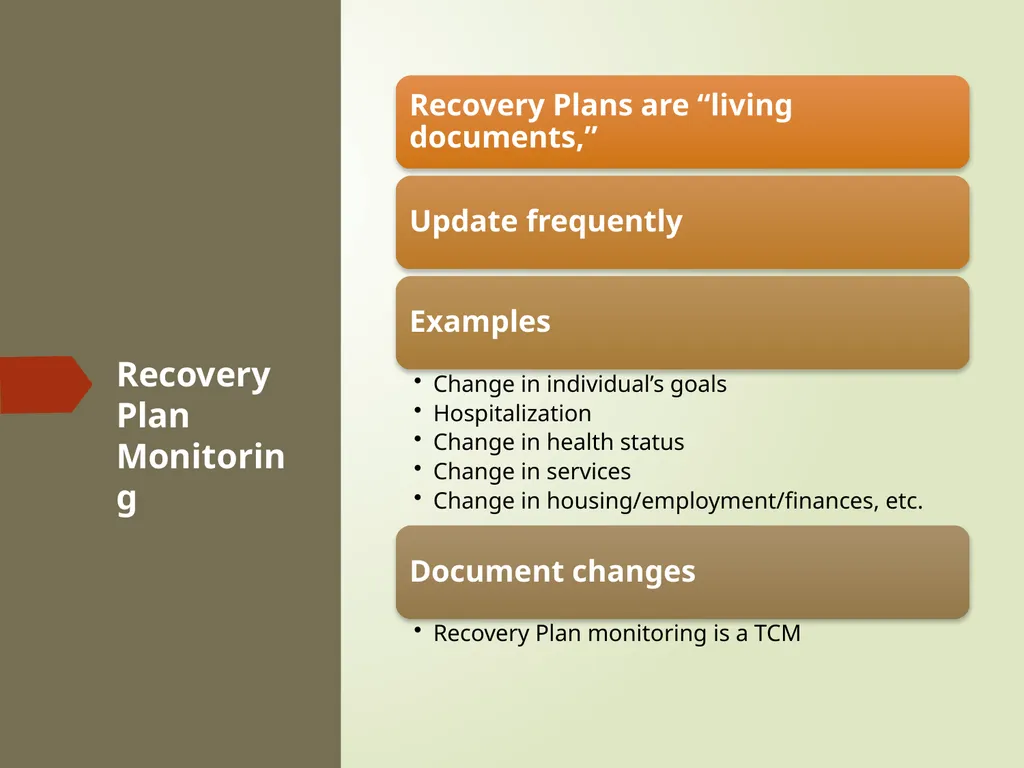
Recovery Plan Monitoring<br>
13
Goals in Recovery Planning Person Centered
Meaningful
Hopeful
Dreams and Desires
Positive
Not just symptom reduction
Long-term, overarching and motivating to move towards something positive
May take years to achieve<br>
Meaningful
Hopeful
Dreams and Desires
Positive
Not just symptom reduction
Long-term, overarching and motivating to move towards something positive
May take years to achieve<br>
14
Goals in Recovery Planning<br>
15
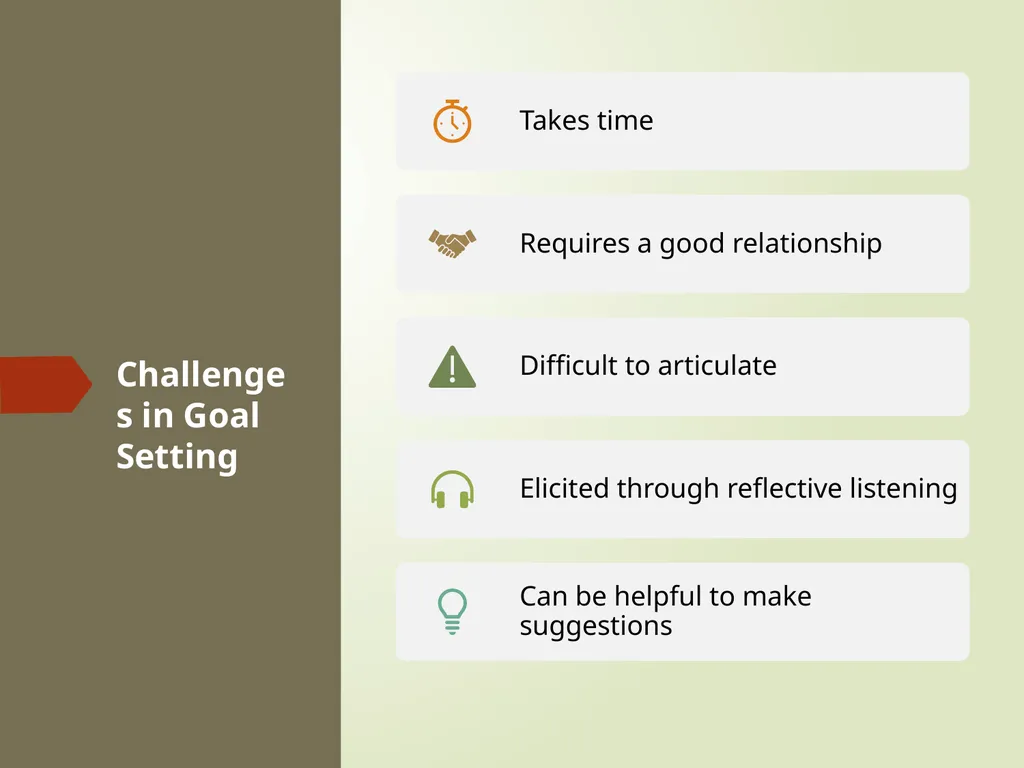
Challenges in Goal Setting<br>
16
Goal Examples<br>
17
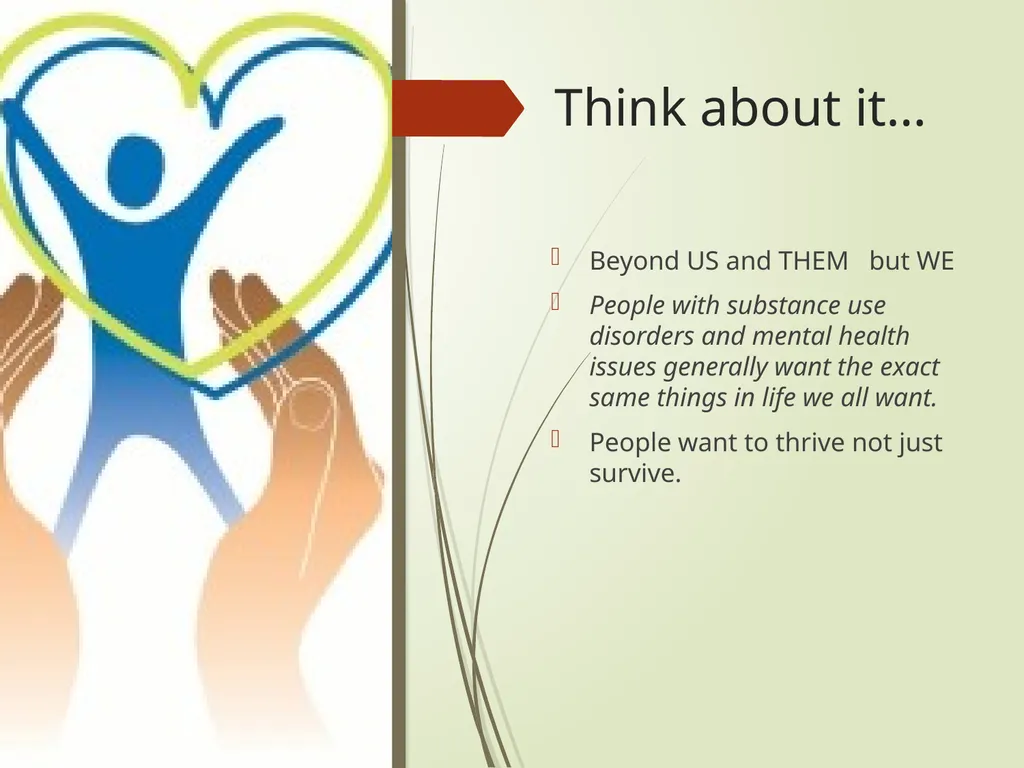
Think about it… Beyond US and THEM but WE
People with substance use disorders and mental health issues generally want the exact same things in life we all want.
People want to thrive not just survive.<br>
People with substance use disorders and mental health issues generally want the exact same things in life we all want.
People want to thrive not just survive.<br>
18
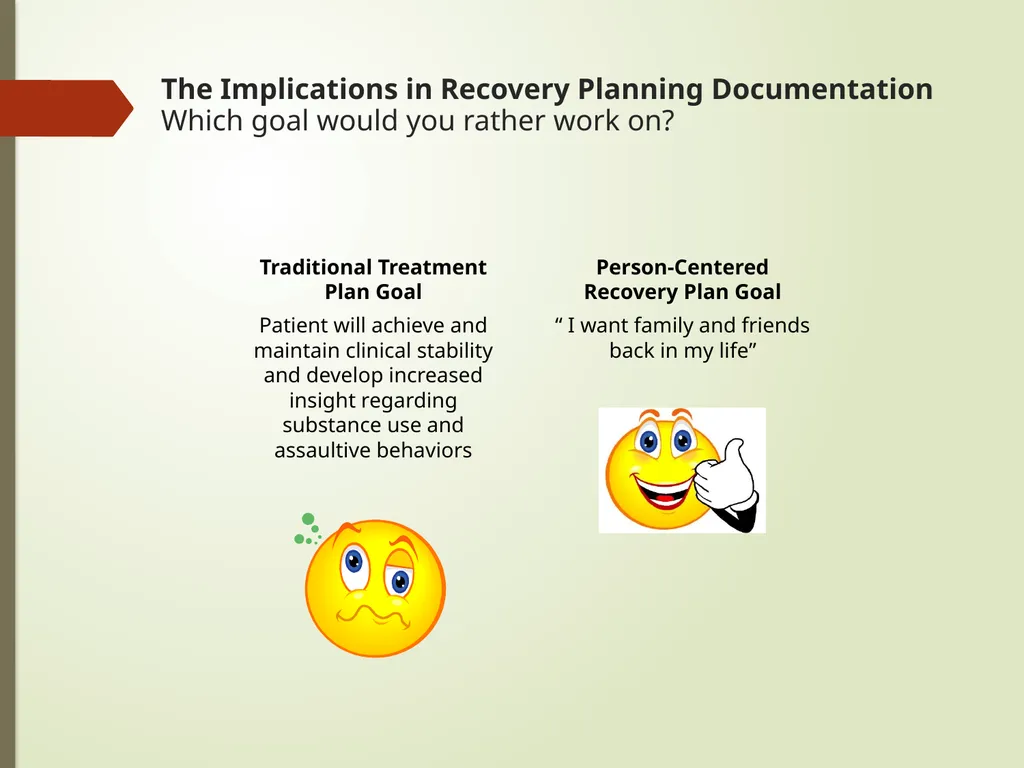
The Implications in Recovery Planning Documentation
Which goal would you rather work on? Traditional Treatment Plan Goal
Patient will achieve and maintain clinical stability and develop increased insight regarding substance use and assaultive behaviors Person-Centered Recovery Plan Goal
“ I want family and friends back in my life”<br>
Patient will achieve and maintain clinical stability and develop increased insight regarding substance use and assaultive behaviors Person-Centered Recovery Plan Goal
“ I want family and friends back in my life”<br>
19
Objectives in Recovery Planning Breaking it down
Objectives are the what-
what is the next step towards completing the goal?<br>
Objectives are the what-
what is the next step towards completing the goal?<br>
20
Creating SMART Objectives Specific, written an understandable language.
Measurable; concrete change that is easily observed.
Attainable; based on the client’s desire and strengths and skills.
Relevant; meaningful to the client and helps overcome a barrier to achieving a goal.
Time-framed; achievable in a reasonable amount of time. (30 days, 60 days etc.)<br>
Measurable; concrete change that is easily observed.
Attainable; based on the client’s desire and strengths and skills.
Relevant; meaningful to the client and helps overcome a barrier to achieving a goal.
Time-framed; achievable in a reasonable amount of time. (30 days, 60 days etc.)<br>
21
Coordination of Care Objective A “Coordination of Care” objective is considered a “Best Practice”
include the barrier that is preventing the client from accessing and utilizing the services on their own.
Coordinating care should be coded as TCM<br>
include the barrier that is preventing the client from accessing and utilizing the services on their own.
Coordinating care should be coded as TCM<br>
22
Formula for writing objectives<br>
23
Interventions in Recovery Planning Interventions are the How- How are we going to do it?
Interventions are the actions taken to achieve the objective- services provided by the case manager, or collateral resource.
Interventions provided by the case manager should target completion of the plan objective and be documented in a way to support the necessity of the services you are providing.<br>
Interventions are the actions taken to achieve the objective- services provided by the case manager, or collateral resource.
Interventions provided by the case manager should target completion of the plan objective and be documented in a way to support the necessity of the services you are providing.<br>
24
What Do People Want in Life? Independence
I want to control my own money.
Work /education
I want to finish school
Spiritual connection
I want to get back to church.
Health/well-being
I want to lose weight. Housing I want to move out of the group home.
Social activities I want to join a bowling league. Satisfying relationships
I want to see my grandkids.
Valued Roles
I want to volunteer at the Senior Center.<br>
I want to control my own money.
Work /education
I want to finish school
Spiritual connection
I want to get back to church.
Health/well-being
I want to lose weight. Housing I want to move out of the group home.
Social activities I want to join a bowling league. Satisfying relationships
I want to see my grandkids.
Valued Roles
I want to volunteer at the Senior Center.<br>
25
Objective Examples Karen (name) will have better control of her diabetes (improvement area) as evidenced by daily glucose readings of under 180 (accomplishing what achievement?) within the next 60 days. (time frame)
Sam(name) will decrease his anxiety (improvement area) as evidenced by attending one activity weekly at the community social club (accomplishment) for the next 90 days.(time frame)<br>
Sam(name) will decrease his anxiety (improvement area) as evidenced by attending one activity weekly at the community social club (accomplishment) for the next 90 days.(time frame)<br>
26
INTERVENTIONS Professional services should specify…
WHO: will provide the service, i.e., name and job title
WHAT: The TITLE of the service, e.g., Health & Wellness Group
WHEN: The SCHEDULE of the service, i.e., the time and day(s)
WHY: The individualized INTENT/PURPOSE of service<br>
WHO: will provide the service, i.e., name and job title
WHAT: The TITLE of the service, e.g., Health & Wellness Group
WHEN: The SCHEDULE of the service, i.e., the time and day(s)
WHY: The individualized INTENT/PURPOSE of service<br>
27
Types of Interventions<br>
28
Intervention Examples<br>
29
TCM Recovery Plan Tips<br>
30
TCM Recovery Plan TIPS For a Recovery Plan to be person-centered you need to document evidence of the client’s degree of participation and agreement with the Recovery Plan.
The best way to accomplish this is to have the client’s signature and date on the plan.
If the client is unavailable or refuses to sign, the Plan must include the case manager’s detailed explanation of why the signature could not be obtained and refer to a specific progress note that explains why.
Include documentation in the progress notes of your follow-up efforts to obtain the signature.
Also include documentation that you offered a copy of the plan to the client and their response.<br>
The best way to accomplish this is to have the client’s signature and date on the plan.
If the client is unavailable or refuses to sign, the Plan must include the case manager’s detailed explanation of why the signature could not be obtained and refer to a specific progress note that explains why.
Include documentation in the progress notes of your follow-up efforts to obtain the signature.
Also include documentation that you offered a copy of the plan to the client and their response.<br>
31
The Encounter Note The purpose of encounter notes is to provide an ongoing narrative of the interventions that have been utilized in your collaboration with the client.
An encounter note records the client’s progress in the small achievements towards reaching their long-term goal.
They provide an overview of the work and the progress made that is used to document Recovery Plan updates.<br>
An encounter note records the client’s progress in the small achievements towards reaching their long-term goal.
They provide an overview of the work and the progress made that is used to document Recovery Plan updates.<br>
32
The note should reflect back to an objective in the Recovery Plan The services you provide should be reasonably expected to improve an aspect of the client’s condition.
Designed to reduce or control symptoms
Prevent relapse or hospitalization
Improve or maintain current level of functioning.<br>
Designed to reduce or control symptoms
Prevent relapse or hospitalization
Improve or maintain current level of functioning.<br>
33
The Narrative You are telling a story with specific details.
The GIRP Format (all the elements of good documentation):
G-oal; Tie the story back to a goal in the Recovery Plan.
I-ntervention; Describe in detail what you did and why you provided the service
R-esponse; Document the client’s response to the intervention & the impact on the client’s progress.
P-lan; identify the focus of your next meeting.
Sign with credentials, date, time and duration<br>
The GIRP Format (all the elements of good documentation):
G-oal; Tie the story back to a goal in the Recovery Plan.
I-ntervention; Describe in detail what you did and why you provided the service
R-esponse; Document the client’s response to the intervention & the impact on the client’s progress.
P-lan; identify the focus of your next meeting.
Sign with credentials, date, time and duration<br>
34
Encounter Note Example
Using the GIRP Format Goal: Mental Health Objective#2- medication management for depression
Intervention: This case manager coordinated a medication management appointment with Dr. Suri at Bristol Hospital due to Bob’s concerns about his new medication for his depression. Accompanied Bob to the appointment where Bob expressed, he was gaining weight and didn’t like the way it made him feel. Dr. Suri let him know that these symptoms were common and usually went away within 4 weeks. He also encouraged Bob to try to eat healthier and exercise more to counteract any weight gain.
Response: Bob was happy the Dr. felt his side effects would go away but he expressed he doesn’t like to exercise.
Plan: meet next Tuesday to look at adding some light physical activity to his daily routine.
Carla Michaels, LPC, 6/10/21 start:10:13/end 10:45 33 min. total Psychiatrist office<br>
Intervention: This case manager coordinated a medication management appointment with Dr. Suri at Bristol Hospital due to Bob’s concerns about his new medication for his depression. Accompanied Bob to the appointment where Bob expressed, he was gaining weight and didn’t like the way it made him feel. Dr. Suri let him know that these symptoms were common and usually went away within 4 weeks. He also encouraged Bob to try to eat healthier and exercise more to counteract any weight gain.
Response: Bob was happy the Dr. felt his side effects would go away but he expressed he doesn’t like to exercise.
Plan: meet next Tuesday to look at adding some light physical activity to his daily routine.
Carla Michaels, LPC, 6/10/21 start:10:13/end 10:45 33 min. total Psychiatrist office<br>
35
GIRP Notes Helpful Tip It is considered a documentation “Best Practice” to enter your encounter note into the client’s permanent record within one business day of providing the service.
The longer you wait the more likely you are to forget important details.
If you have to delay documenting, be sure to clearly differentiate between the date and time you are writing the note and the date and time of the event.<br>
The longer you wait the more likely you are to forget important details.
If you have to delay documenting, be sure to clearly differentiate between the date and time you are writing the note and the date and time of the event.<br>
36
GIRP Notes Helpful Tip All documentation is open to scrutiny by employers, accreditation bodies, and federal and state reviewers and auditors.
It is a “best practice” to conduct a self-audit.
Select a random sample for a specific amount of time( ex.10% of all charts every 3 months)
Do not audit your own charts to remove bias
Use the results you find for improving compliance. There is no real value in conducting a self-audit unless discovered issues are resolved.<br>
It is a “best practice” to conduct a self-audit.
Select a random sample for a specific amount of time( ex.10% of all charts every 3 months)
Do not audit your own charts to remove bias
Use the results you find for improving compliance. There is no real value in conducting a self-audit unless discovered issues are resolved.<br>
37
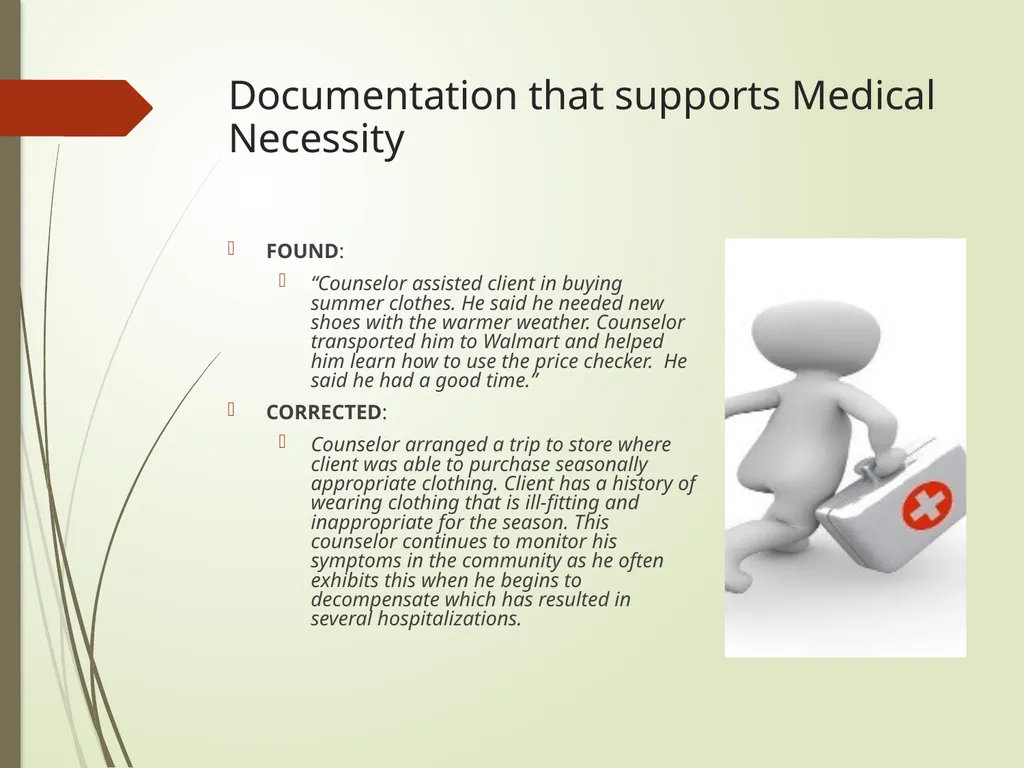
Documentation that supports Medical Necessity FOUND:
“Counselor assisted client in buying summer clothes. He said he needed new shoes with the warmer weather. Counselor transported him to Walmart and helped him learn how to use the price checker. He said he had a good time.”
CORRECTED:
Counselor arranged a trip to store where client was able to purchase seasonally appropriate clothing. Client has a history of wearing clothing that is ill-fitting and inappropriate for the season. This counselor continues to monitor his symptoms in the community as he often exhibits this when he begins to decompensate which has resulted in several hospitalizations.<br>
“Counselor assisted client in buying summer clothes. He said he needed new shoes with the warmer weather. Counselor transported him to Walmart and helped him learn how to use the price checker. He said he had a good time.”
CORRECTED:
Counselor arranged a trip to store where client was able to purchase seasonally appropriate clothing. Client has a history of wearing clothing that is ill-fitting and inappropriate for the season. This counselor continues to monitor his symptoms in the community as he often exhibits this when he begins to decompensate which has resulted in several hospitalizations.<br>
38
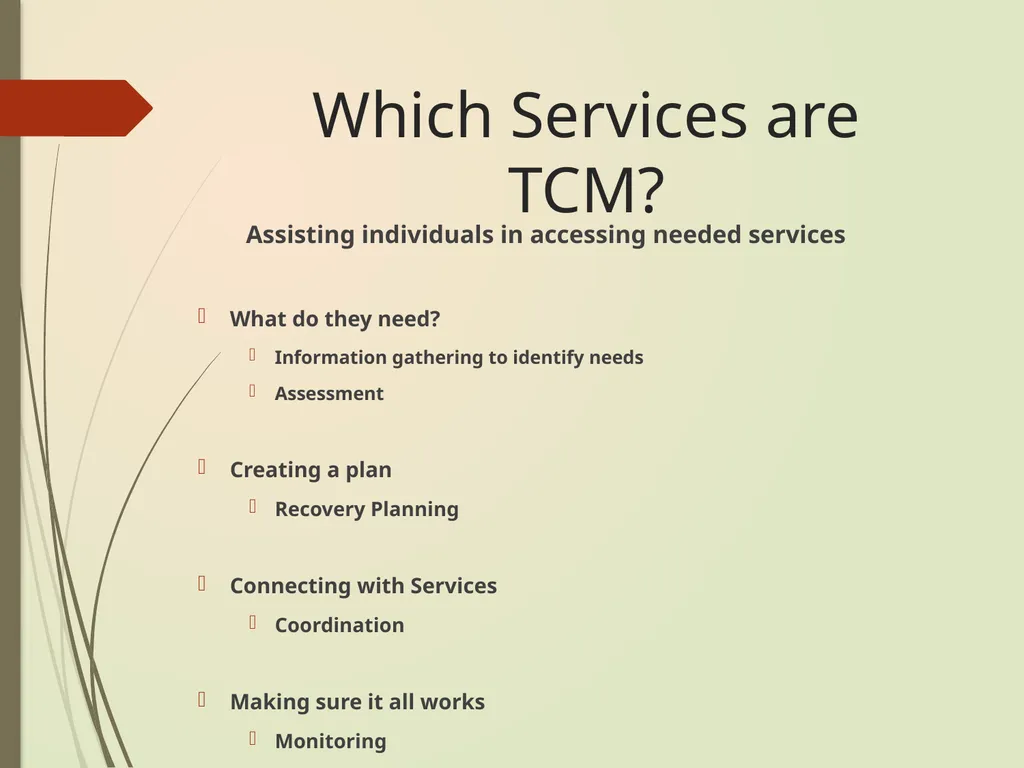
Which Services are TCM? Assisting individuals in accessing needed services
What do they need?
Information gathering to identify needs
Assessment
Creating a plan
Recovery Planning
Connecting with Services
Coordination
Making sure it all works
Monitoring<br>
What do they need?
Information gathering to identify needs
Assessment
Creating a plan
Recovery Planning
Connecting with Services
Coordination
Making sure it all works
Monitoring<br>
39
OVERVIEW OF SERVICES
Comprehensive Assessment and Periodic Reassessment Comprehensive Assessment and Periodic Reassessment of the individual’s needs to determine the need for medical, educational, employment, social or other services. These assessment activities include:
Using a standardized assessment tool to take the person’s history
Identify the person’s needs and completing related documentation and;
Gathering information from other sources such as family members, medical providers, social workers and educators to form a complete assessment of the person.
Periodic assessments must be repeated at least annually to be considered active. (This is a Medicaid standard; You may do these more frequently in your setting)<br>
Using a standardized assessment tool to take the person’s history
Identify the person’s needs and completing related documentation and;
Gathering information from other sources such as family members, medical providers, social workers and educators to form a complete assessment of the person.
Periodic assessments must be repeated at least annually to be considered active. (This is a Medicaid standard; You may do these more frequently in your setting)<br>
40
Overview of Services
Development and Periodic Revision of a Recovery Plan Development and periodic revision of a Recovery Plan based on the information collected through the assessment that:
Specifies the goals and objectives to address the educational, employment, medical, social, and other services needed by the individual;
Includes activities such as ensuring the active participation of the person to develop those goals;
Identifies a course of action to respond to the assessed needs of the person
*Recovery plans and must be reviewed and updated at least annually to reflect the accomplishments and changing needs to be considered active. Recovery plans may be modified as needed<br>
Specifies the goals and objectives to address the educational, employment, medical, social, and other services needed by the individual;
Includes activities such as ensuring the active participation of the person to develop those goals;
Identifies a course of action to respond to the assessed needs of the person
*Recovery plans and must be reviewed and updated at least annually to reflect the accomplishments and changing needs to be considered active. Recovery plans may be modified as needed<br>
41
Overview of Services
Referral and Related Activities Through Collateral Contacts Collateral contacts (entities outside of your agency such as BRS, clinical team members, family members, employers) that are directly related to identifying the person’s needs and care for the purposes of;
Helping the person access services such as scheduling appointments for the person including:
Activities that link the person with medical, social, employment, educational providers, or other programs and services that can provide needed services to address identified needs and achieve goals in the care plan.<br>
Helping the person access services such as scheduling appointments for the person including:
Activities that link the person with medical, social, employment, educational providers, or other programs and services that can provide needed services to address identified needs and achieve goals in the care plan.<br>
42
Overview of Services
Advocate For Services Identified In The Recovery Plan TCM providers advocate for the person served to receive the benefits identified and desired to help the person served obtain and maintain those services. They advocate for the person’s preferences regarding community living options and resources.
TCM providers break down barriers that keep the person from benefitting from all the community resources that are available to the community.
TCM providers promote the person’s self-advocacy and promote person-centered practices.<br>
TCM providers break down barriers that keep the person from benefitting from all the community resources that are available to the community.
TCM providers promote the person’s self-advocacy and promote person-centered practices.<br>
43
Overview of Services
Monitoring and Follow-Up Activities Activities and contacts necessary to ensure the Recovery Plan is implemented and adequately addresses the person’s needs, which may be with the person, family members, service providers or other entities and conducted as often as necessary, including at least one annual monitoring to determine if the following were met:
Services are being furnished as described in the Recovery Plan
Services in the Recovery Plan are adequate
Changes in the need or status or the person are reflected in the plan
Monitoring and follow-up activities include making necessary adjustments in the Recovery Plan and service arrangements with providers<br>
Services are being furnished as described in the Recovery Plan
Services in the Recovery Plan are adequate
Changes in the need or status or the person are reflected in the plan
Monitoring and follow-up activities include making necessary adjustments in the Recovery Plan and service arrangements with providers<br>
44
TCM Service Codes DDAP TCM Codes:
TCM01 – face to face with client
TCM02 – on the phone with client
TCM03 – with collateral
TCM04- Audio and Visual with the client
There are 2 newTCM04 Location Codes that should also be used :
Audio and Visual-client at home
Audio and Visual-Client in other location
if any other location is used it will result in the billing error “Service Name and Service Location Mismatch”<br>
TCM01 – face to face with client
TCM02 – on the phone with client
TCM03 – with collateral
TCM04- Audio and Visual with the client
There are 2 newTCM04 Location Codes that should also be used :
Audio and Visual-client at home
Audio and Visual-Client in other location
if any other location is used it will result in the billing error “Service Name and Service Location Mismatch”<br>
45
Documentation:
Why is it so important? For the Individuals we serve
To inform healthcare needs
Communication with your team
For accurate assessments and services
For evidence of progress<br>
To inform healthcare needs
Communication with your team
For accurate assessments and services
For evidence of progress<br>
46
Documentation:
Why is it so important? For ourselves
Evidence of our good work
Makes our work easier
Protection from liability<br>
Evidence of our good work
Makes our work easier
Protection from liability<br>
47
Documentation:
Why is it so important? For our Programs
Proof of services
Record of progress
Financial sustainability<br>
Proof of services
Record of progress
Financial sustainability<br>
48
THANK YOU!!! Carleen Zambetti For TCM and Documentation questions at carleen.Zambetti@ct.gov
Visit the DMHAS TCM webpage at https://portal.ct.gov/DMHAS/Initiatives/DMHAS-Initiatives/TCM for resources including power points, billable diagnosis and TIP Sheets. Check back often as information is added and updated on a regular basis.<br>
Visit the DMHAS TCM webpage at https://portal.ct.gov/DMHAS/Initiatives/DMHAS-Initiatives/TCM for resources including power points, billable diagnosis and TIP Sheets. Check back often as information is added and updated on a regular basis.<br>