
Teacher Quality Partnership (TQP) Grant Program



Description: Teacher Quality Partnership (TQP) Grant Program FY 2024 TQP Live Webinar Competition Overview May 3, 2024 APPLICATION CLOSING DATE: JUNE 3, 2024 (11:59:59 PM Eastern Time) Getting Started! Applicants should review the FY 2024 TQP Notice
Related Topics
Download Presentation
"Teacher Quality Partnership (TQP) Grant Program " is the property of its rightful owner. Permission is granted to download and print the materials on this website for personal, non-commercial use only, and to display it on your personal computer provided you do not modify the materials and that you retain all copyright notices contained in the materials. By downloading content from our website, you accept the terms of this agreement.
Presentation Transcript
slide1. Teacher Quality Partnership (TQP)
Grant Program
FY 2024 TQP Live Webinar Competition Overview
May 3, 2024 APPLICATION CLOSING DATE:
JUNE 3, 2024
(11:59:59 PM Eastern Time)<br>
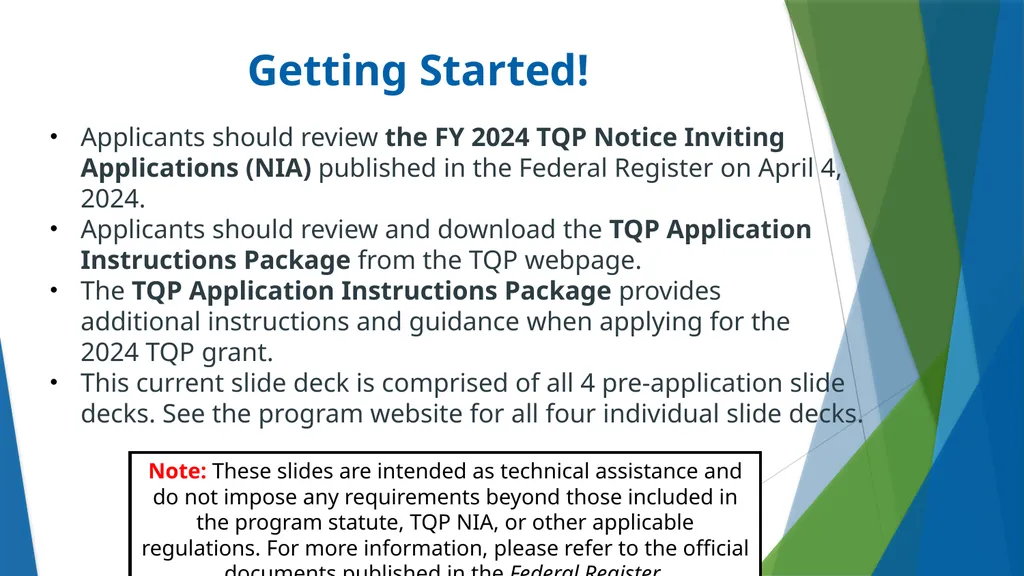
slide2. Getting Started! Applicants should review the FY 2024 TQP Notice Inviting Applications (NIA) published in the Federal Register on April 4, 2024.
Applicants should review and download the TQP Application Instructions Package from the TQP webpage.
The TQP Application Instructions Package provides additional instructions and guidance when applying for the 2024 TQP grant.
This current slide deck is comprised of all 4 pre-application slide decks. See the program website for all four individual slide decks. Note: These slides are intended as technical assistance and do not impose any requirements beyond those included in the program statute, TQP NIA, or other applicable regulations. For more information, please refer to the official documents published in the Federal Register.<br>
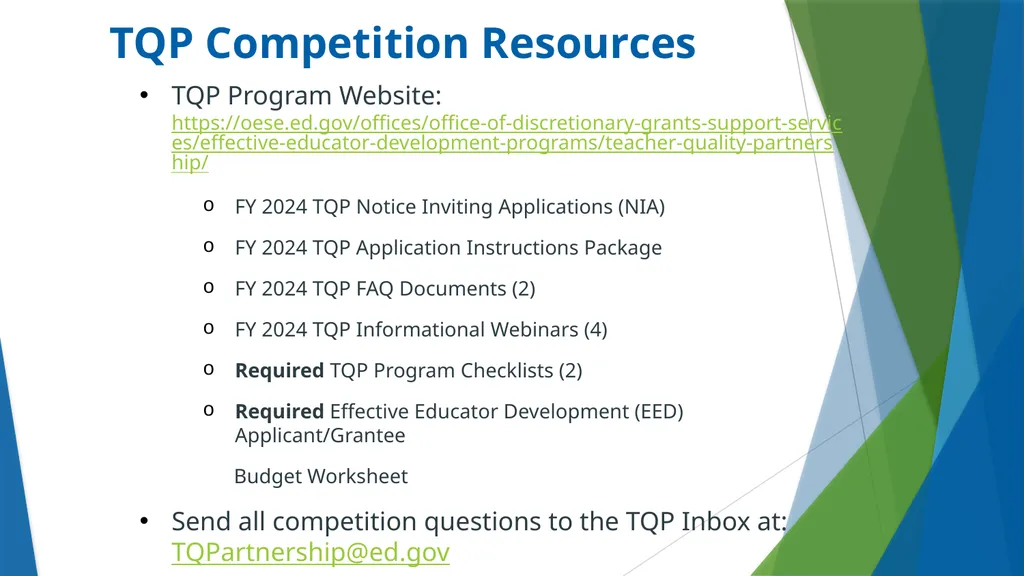
slide3. TQP Program Website: https://oese.ed.gov/offices/office-of-discretionary-grants-support-services/effective-educator-development-programs/teacher-quality-partnership/
FY 2024 TQP Notice Inviting Applications (NIA)
FY 2024 TQP Application Instructions Package
FY 2024 TQP FAQ Documents (2)
FY 2024 TQP Informational Webinars (4)
Required TQP Program Checklists (2)
Required Effective Educator Development (EED) Applicant/Grantee
Budget Worksheet
Send all competition questions to the TQP Inbox at: TQPartnership@ed.gov TQP Competition Resources<br>
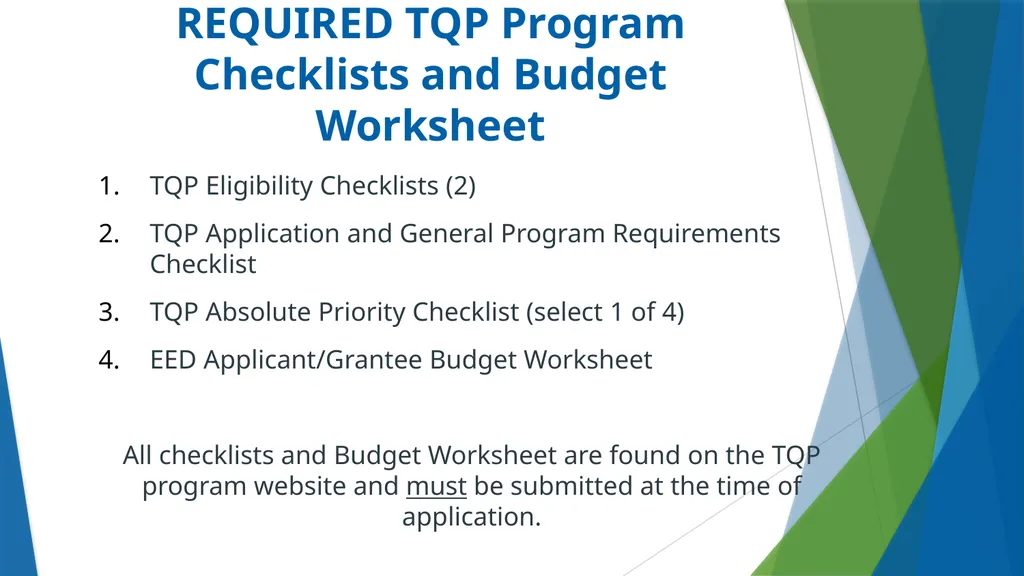
slide4. TQP Eligibility Checklists (2)
TQP Application and General Program Requirements Checklist
TQP Absolute Priority Checklist (select 1 of 4)
EED Applicant/Grantee Budget Worksheet
All checklists and Budget Worksheet are found on the TQP program website and must be submitted at the time of application. REQUIRED TQP Program Checklists and Budget Worksheet<br>
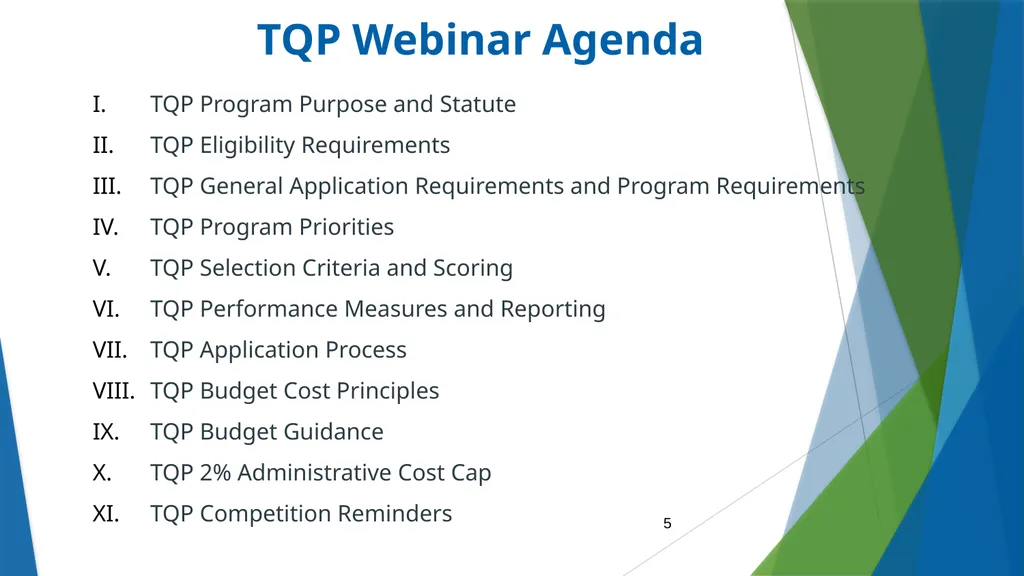
slide5. 5 TQP Webinar Agenda TQP Program Purpose and Statute
TQP Eligibility Requirements
TQP General Application Requirements and Program Requirements
TQP Program Priorities
TQP Selection Criteria and Scoring
TQP Performance Measures and Reporting
TQP Application Process
TQP Budget Cost Principles
TQP Budget Guidance
TQP 2% Administrative Cost Cap
TQP Competition Reminders<br>
slide6. TQP Program Purpose and Statute<br>
slide7. TQP Program Statute The Teacher Quality Partnership program statute is contained in Title II of the Higher Education Act (HEA), as amended on August 14, 2008, by the Higher Education Opportunity Act (Public Law 110-315)
Access the TQP program statute:
https://www.govinfo.gov/content/pkg/COMPS-765/pdf/COMPS-765.pdf<br>
slide8. TQP Program Purposes: To improve student achievement;
To improve the quality of prospective and new teachers by improving the preparation of prospective teachers and enhancing professional development activities for new teachers;
To hold teacher preparation programs at institutions of higher education accountable for preparing teachers who meet the applicable State certification and licensure requirements, including any requirements for certification obtained through alternative routes to certification, or, with regard to special education teachers, the qualifications described in section 1412(a)(14)(C) of the Individuals with Disabilities Education Act; and
To recruit highly qualified individuals, including minorities and individuals from other occupations, into the teaching force. 8<br>
slide9. TQP Eligibility Requirements<br>
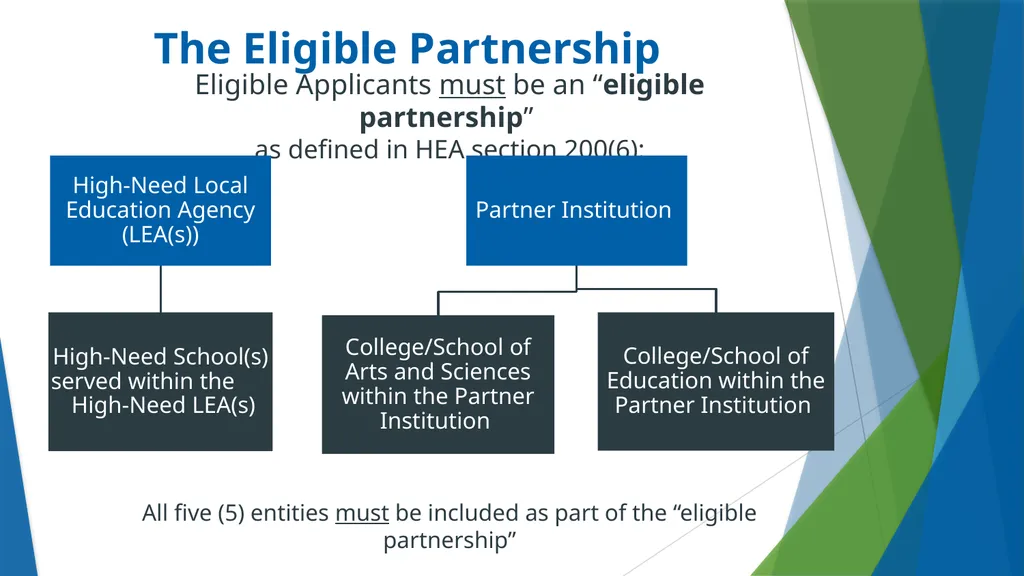
slide10. The Eligible Partnership Eligible Applicants must be an “eligible partnership”
as defined in HEA section 200(6): All five (5) entities must be included as part of the “eligible partnership” 10<br>
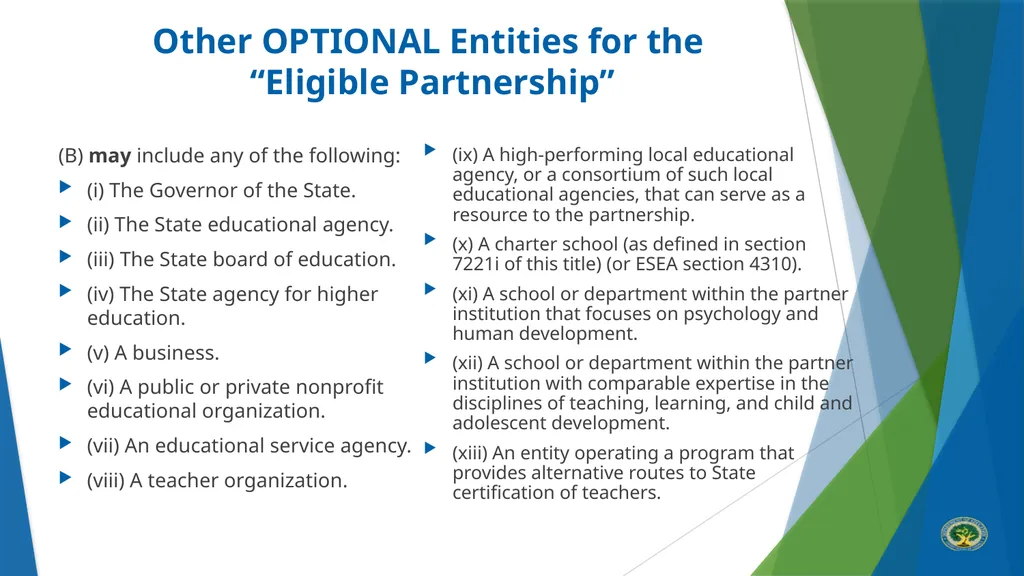
slide11. Other OPTIONAL Entities for the “Eligible Partnership” (B) may include any of the following:
(i) The Governor of the State.
(ii) The State educational agency.
(iii) The State board of education.
(iv) The State agency for higher education.
(v) A business.
(vi) A public or private nonprofit educational organization.
(vii) An educational service agency.
(viii) A teacher organization. (ix) A high-performing local educational agency, or a consortium of such local educational agencies, that can serve as a resource to the partnership.
(x) A charter school (as defined in section 7221i of this title) (or ESEA section 4310).
(xi) A school or department within the partner institution that focuses on psychology and human development.
(xii) A school or department within the partner institution with comparable expertise in the disciplines of teaching, learning, and child and adolescent development.
(xiii) An entity operating a program that provides alternative routes to State certification of teachers.<br>
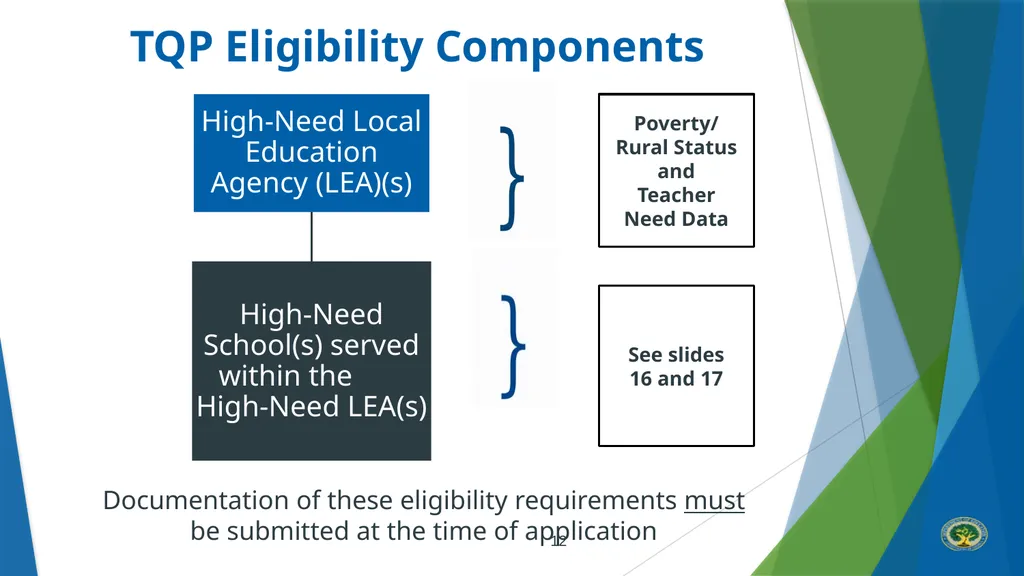
slide12. TQP Eligibility Components 12 Documentation of these eligibility requirements must be submitted at the time of application Poverty/Rural Status
and
Teacher Need Data See slides
16 and 17<br>
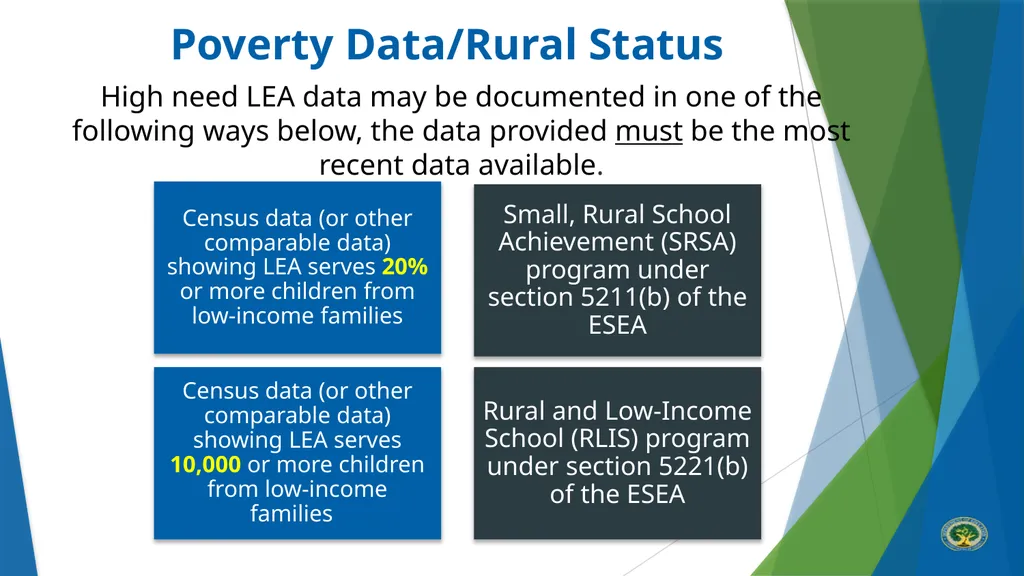
slide13. Poverty Data/Rural Status High need LEA data may be documented in one of the following ways below, the data provided must be the most recent data available.<br>
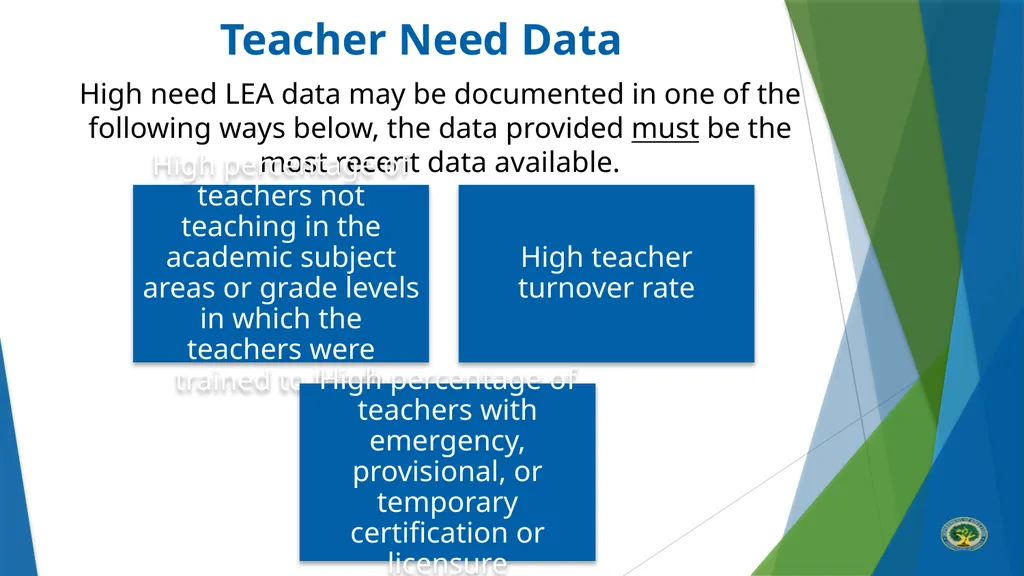
slide14. Teacher Need Data High need LEA data may be documented in one of the following ways below, the data provided must be the most recent data available.<br>
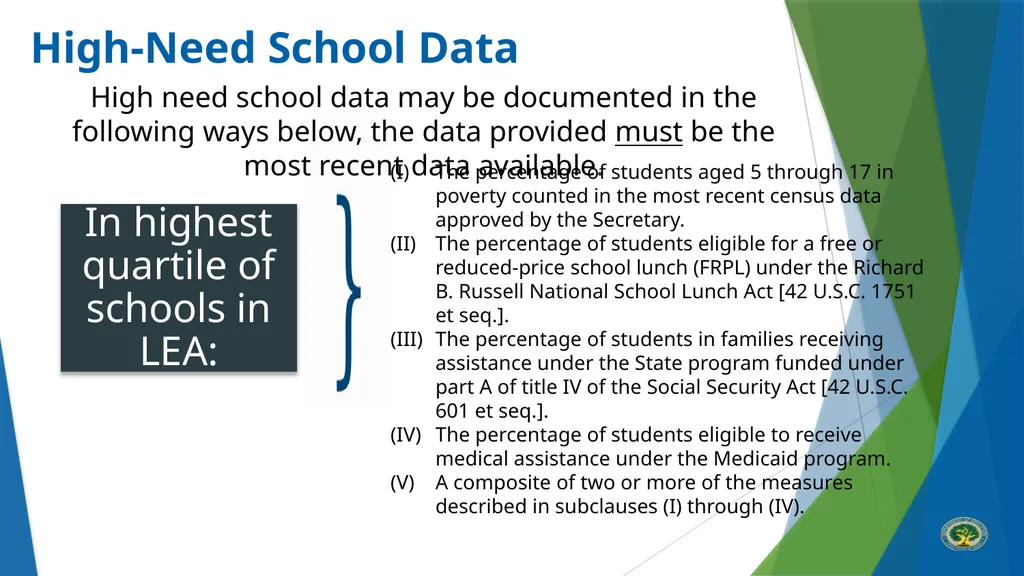
slide15. High-Need School Data High need school data may be documented in the following ways below, the data provided must be the most recent data available. The percentage of students aged 5 through 17 in poverty counted in the most recent census data approved by the Secretary.
The percentage of students eligible for a free or reduced-price school lunch (FRPL) under the Richard B. Russell National School Lunch Act [42 U.S.C. 1751 et seq.].
The percentage of students in families receiving assistance under the State program funded under part A of title IV of the Social Security Act [42 U.S.C. 601 et seq.].
The percentage of students eligible to receive medical assistance under the Medicaid program.
A composite of two or more of the measures described in subclauses (I) through (IV).<br>
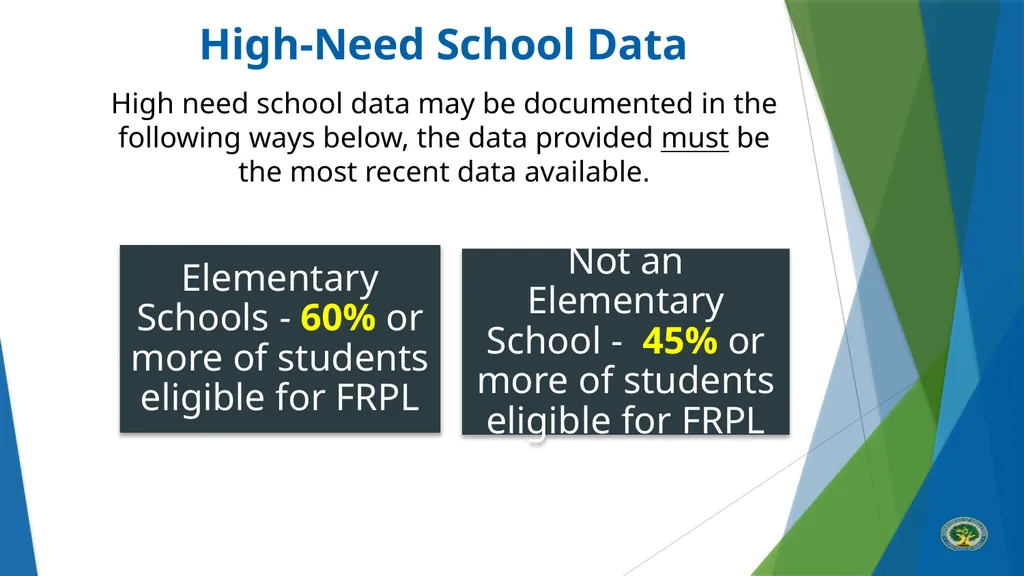
slide16. High-Need School Data High need school data may be documented in the following ways below, the data provided must be the most recent data available.<br>
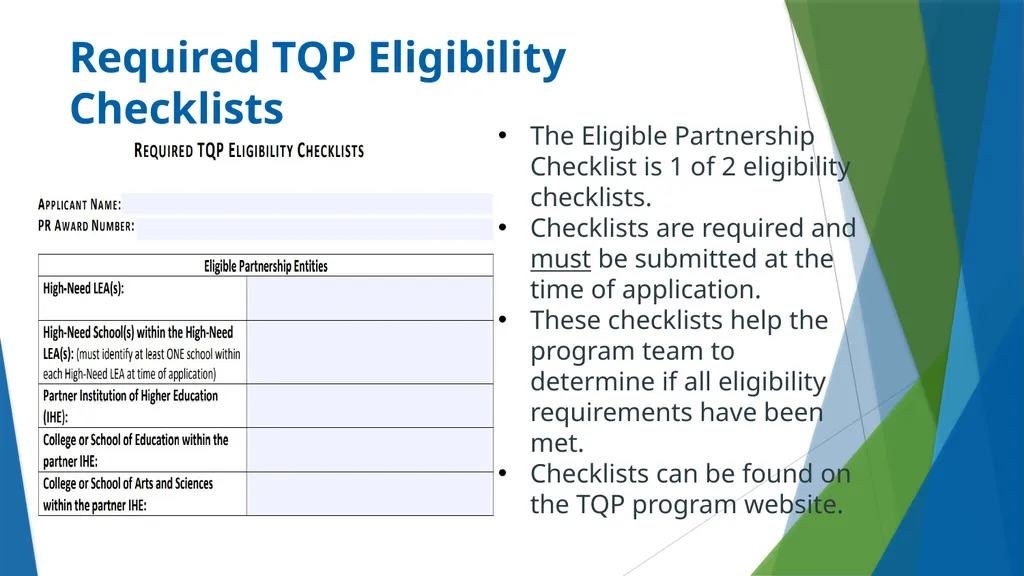
slide17. Required TQP Eligibility Checklists 17 The Eligible Partnership Checklist is 1 of 2 eligibility checklists.
Checklists are required and must be submitted at the time of application.
These checklists help the program team to determine if all eligibility requirements have been met.
Checklists can be found on the TQP program website.<br>
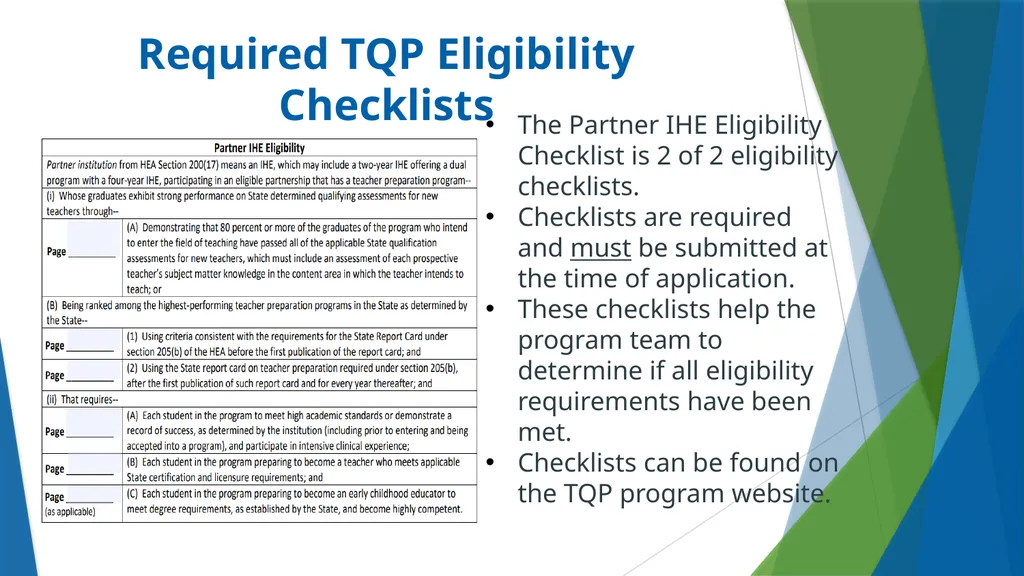
slide18. 18 Required TQP Eligibility Checklists The Partner IHE Eligibility Checklist is 2 of 2 eligibility checklists.
Checklists are required and must be submitted at the time of application.
These checklists help the program team to determine if all eligibility requirements have been met.
Checklists can be found on the TQP program website.<br>
slide19. TQP General Application and Program Requirements<br>
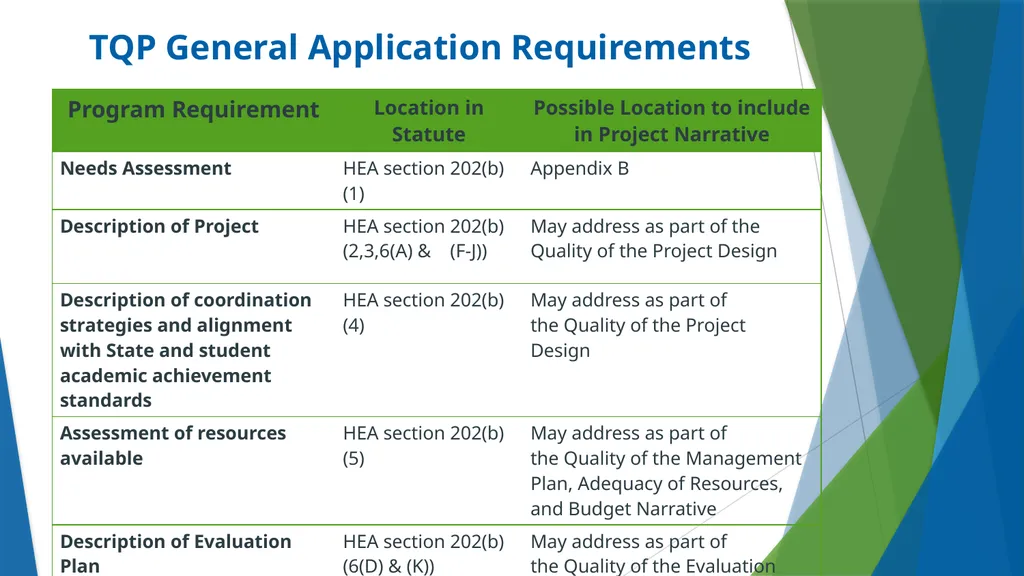
slide20. TQP General Application Requirements<br>
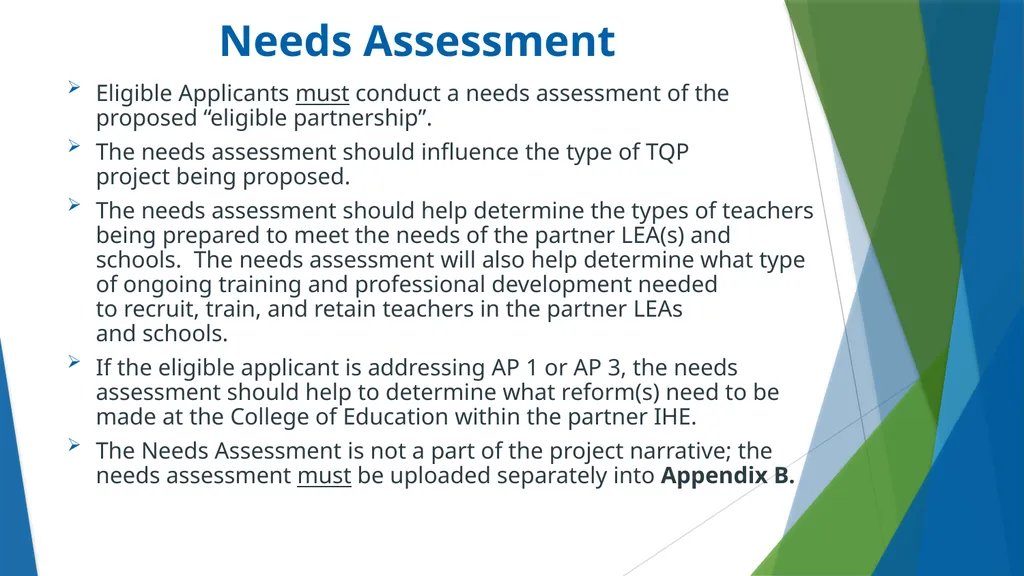
slide21. Needs Assessment Eligible Applicants must conduct a needs assessment of the proposed “eligible partnership”.
The needs assessment should influence the type of TQP project being proposed.
The needs assessment should help determine the types of teachers being prepared to meet the needs of the partner LEA(s) and schools. The needs assessment will also help determine what type of ongoing training and professional development needed to recruit, train, and retain teachers in the partner LEAs and schools.
If the eligible applicant is addressing AP 1 or AP 3, the needs assessment should help to determine what reform(s) need to be made at the College of Education within the partner IHE.
The Needs Assessment is not a part of the project narrative; the needs assessment must be uploaded separately into Appendix B. 21<br>
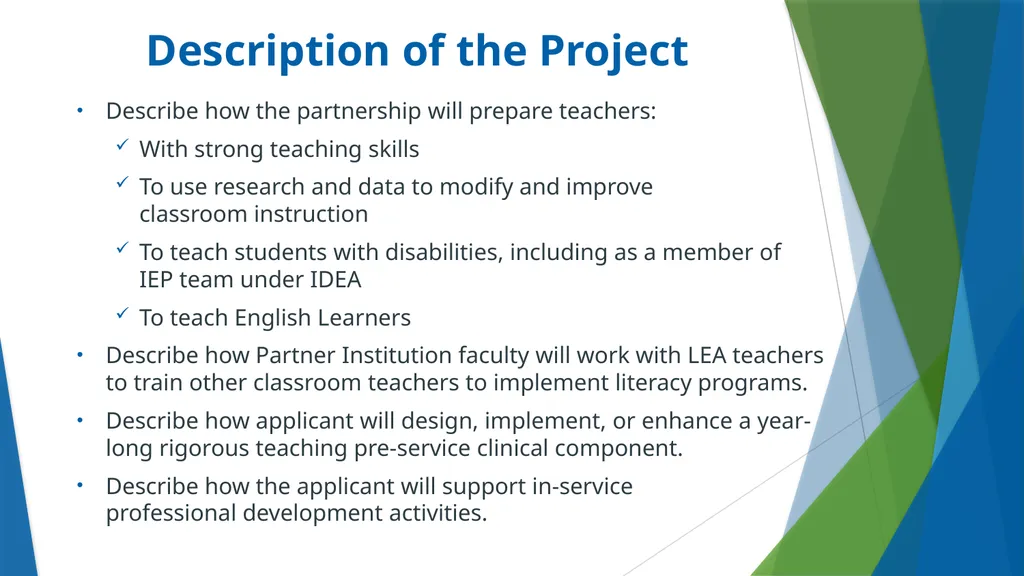
slide22. Description of the Project Describe how the partnership will prepare teachers:
With strong teaching skills
To use research and data to modify and improve classroom instruction
To teach students with disabilities, including as a member of IEP team under IDEA
To teach English Learners
Describe how Partner Institution faculty will work with LEA teachers to train other classroom teachers to implement literacy programs.
Describe how applicant will design, implement, or enhance a year-long rigorous teaching pre-service clinical component.
Describe how the applicant will support in-service professional development activities. 22<br>
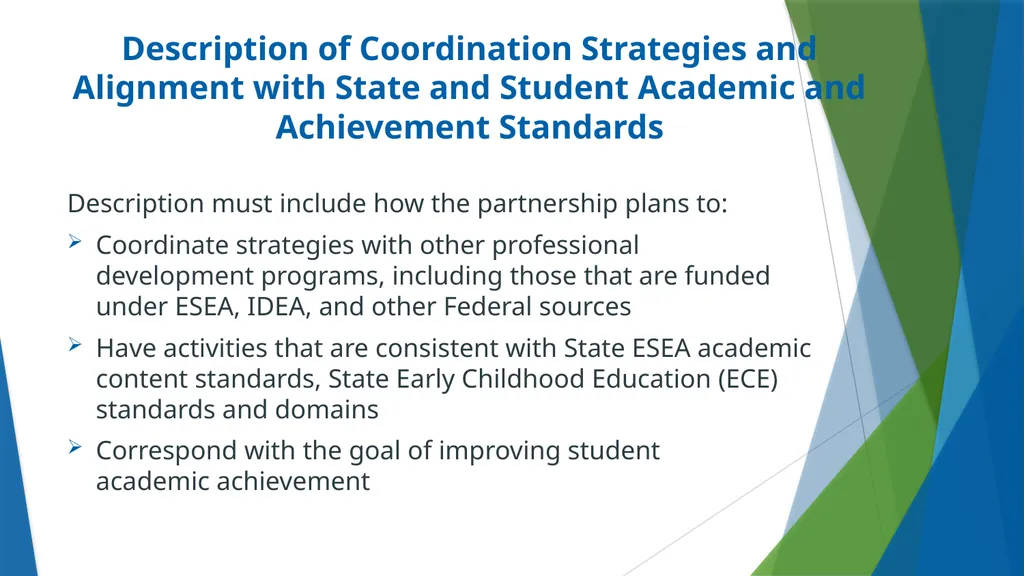
slide23. Description of Coordination Strategies and Alignment with State and Student Academic and Achievement Standards Description must include how the partnership plans to:
Coordinate strategies with other professional development programs, including those that are funded under ESEA, IDEA, and other Federal sources
Have activities that are consistent with State ESEA academic content standards, State Early Childhood Education (ECE) standards and domains
Correspond with the goal of improving student academic achievement 23<br>
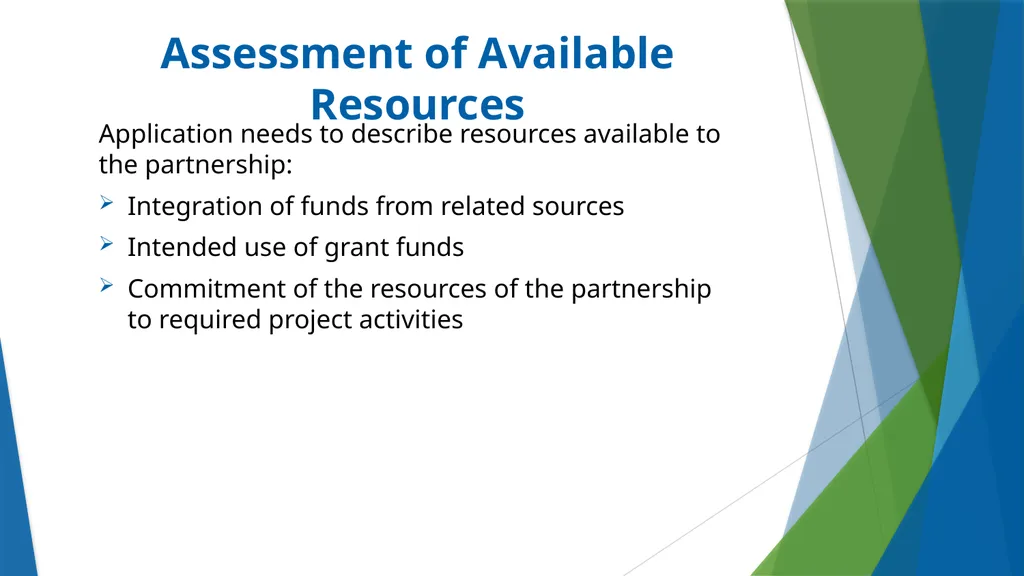
slide24. Assessment of Available Resources Application needs to describe resources available to the partnership:
Integration of funds from related sources
Intended use of grant funds
Commitment of the resources of the partnership to required project activities 24<br>
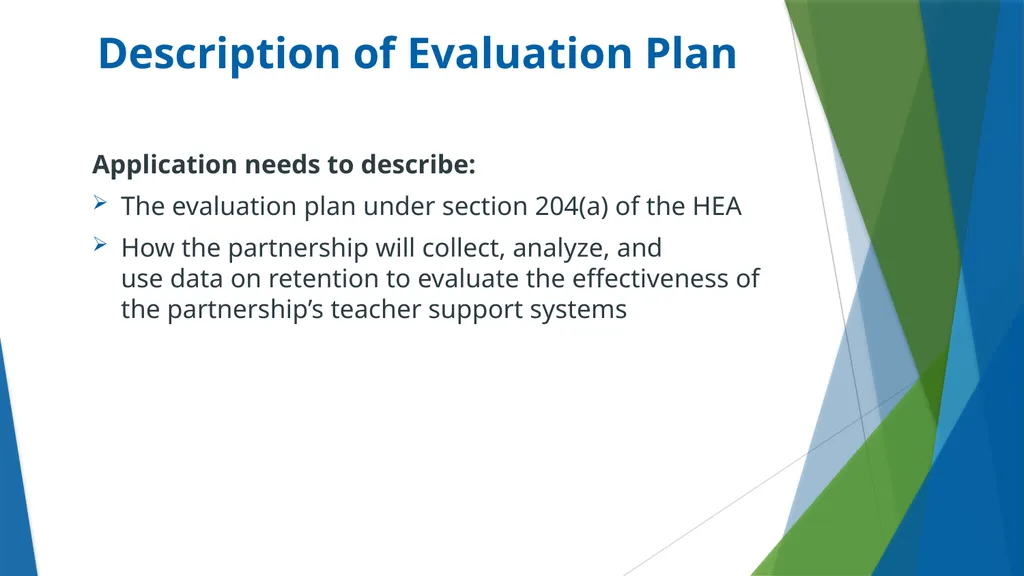
slide25. Description of Evaluation Plan Application needs to describe:
The evaluation plan under section 204(a) of the HEA
How the partnership will collect, analyze, and use data on retention to evaluate the effectiveness of the partnership’s teacher support systems 25<br>
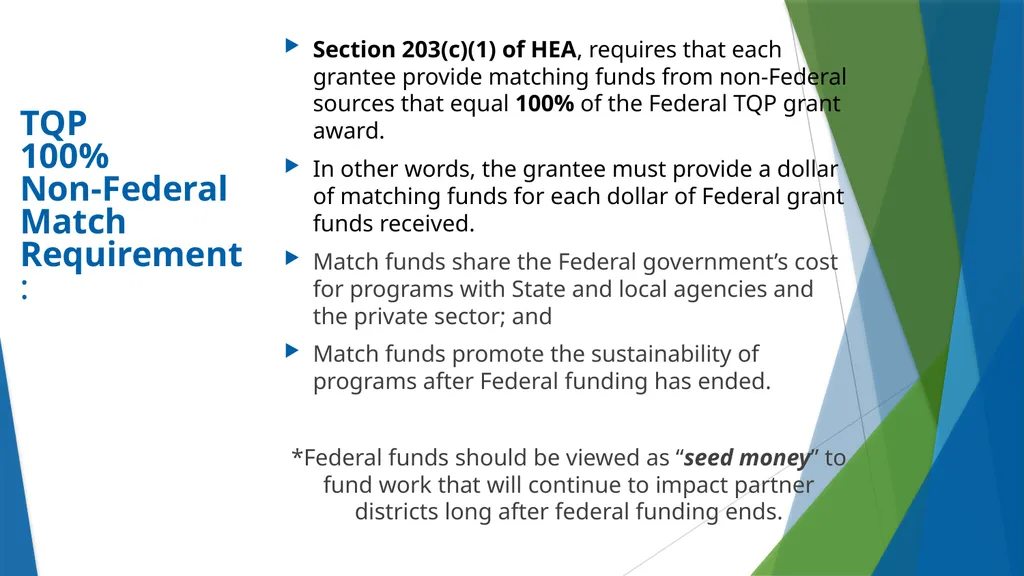
slide26. TQP 100% Non-Federal Match Requirement: Section 203(c)(1) of HEA, requires that each grantee provide matching funds from non-Federal sources that equal 100% of the Federal TQP grant award.
In other words, the grantee must provide a dollar of matching funds for each dollar of Federal grant funds received.
Match funds share the Federal government’s cost for programs with State and local agencies and the private sector; and
Match funds promote the sustainability of programs after Federal funding has ended.
*Federal funds should be viewed as “seed money” to fund work that will continue to impact partner districts long after federal funding ends. 26<br>
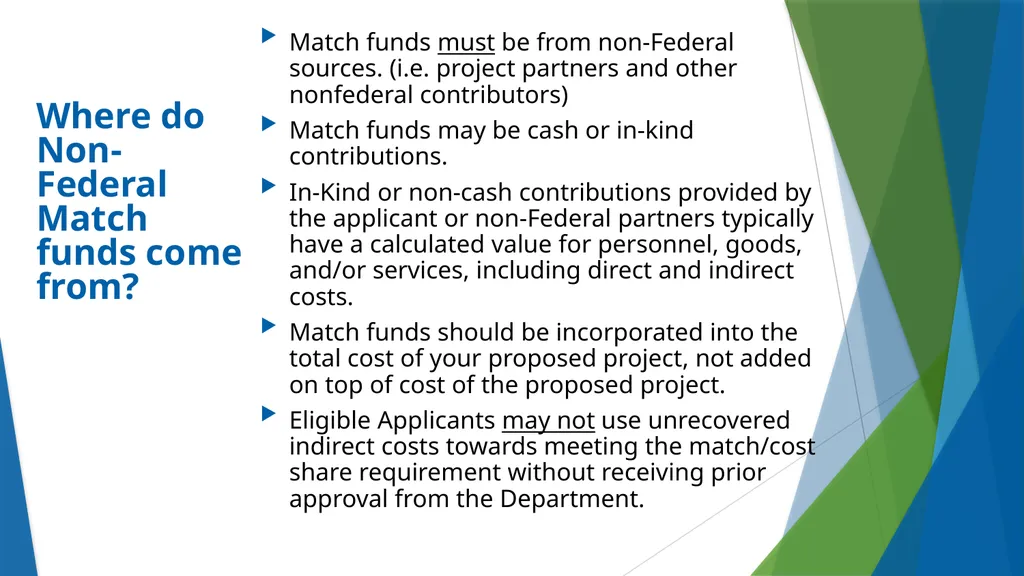
slide27. Where do Non-Federal Match funds come from? Match funds must be from non-Federal sources. (i.e. project partners and other nonfederal contributors)
Match funds may be cash or in-kind contributions.
In-Kind or non-cash contributions provided by the applicant or non-Federal partners typically have a calculated value for personnel, goods, and/or services, including direct and indirect costs.
Match funds should be incorporated into the total cost of your proposed project, not added on top of cost of the proposed project.
Eligible Applicants may not use unrecovered indirect costs towards meeting the match/cost share requirement without receiving prior approval from the Department. 27<br>
slide28. Questions & Answers<br>
slide29. FY 2024 TQP Absolute Priorities<br>
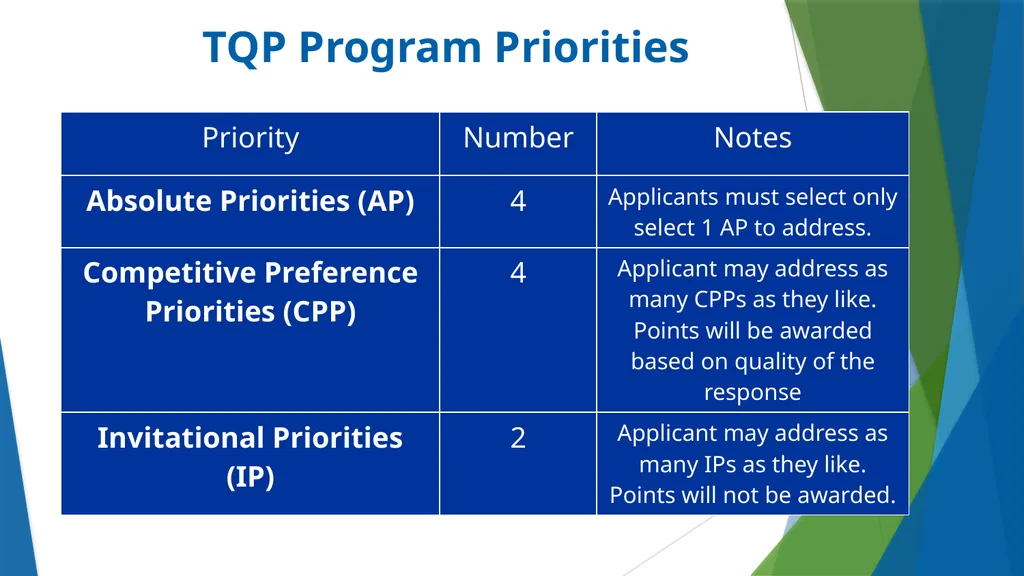
slide30. TQP Program Priorities 30<br>
slide31. AP1: Partnership Grants for the Preparation of Teachers (Pre-Bac Model)<br>
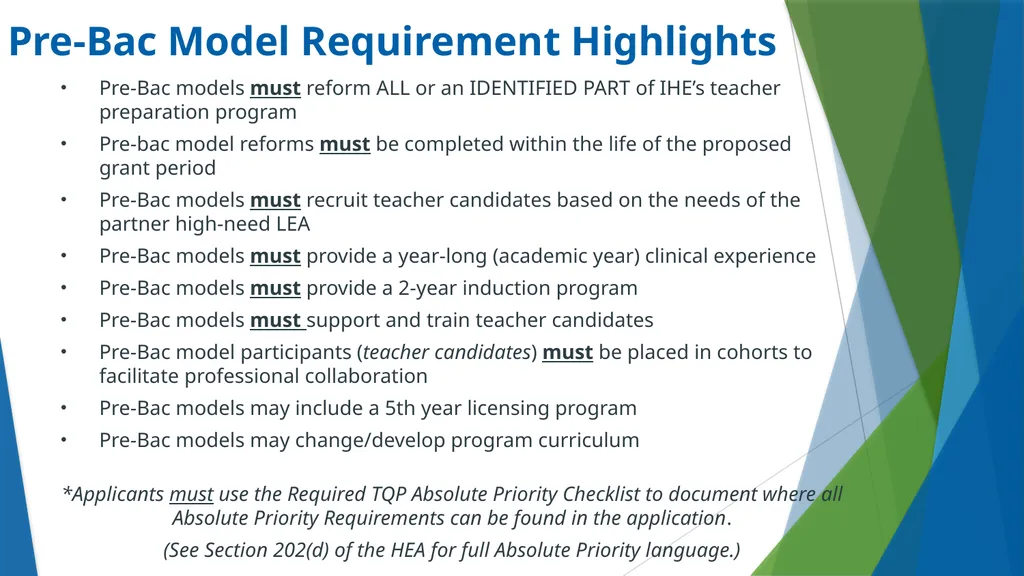
slide32. Pre-Bac Model Requirement Highlights Pre-Bac models must reform ALL or an IDENTIFIED PART of IHE’s teacher preparation program
Pre-bac model reforms must be completed within the life of the proposed grant period
Pre-Bac models must recruit teacher candidates based on the needs of the partner high-need LEA
Pre-Bac models must provide a year-long (academic year) clinical experience
Pre-Bac models must provide a 2-year induction program
Pre-Bac models must support and train teacher candidates
Pre-Bac model participants (teacher candidates) must be placed in cohorts to facilitate professional collaboration
Pre-Bac models may include a 5th year licensing program
Pre-Bac models may change/develop program curriculum
*Applicants must use the Required TQP Absolute Priority Checklist to document where all Absolute Priority Requirements can be found in the application.
(See Section 202(d) of the HEA for full Absolute Priority language.)
32<br>
slide33. AP2: Partnership Grants for the Establishment of Effective Teaching Residency Programs (Residency Model)<br>
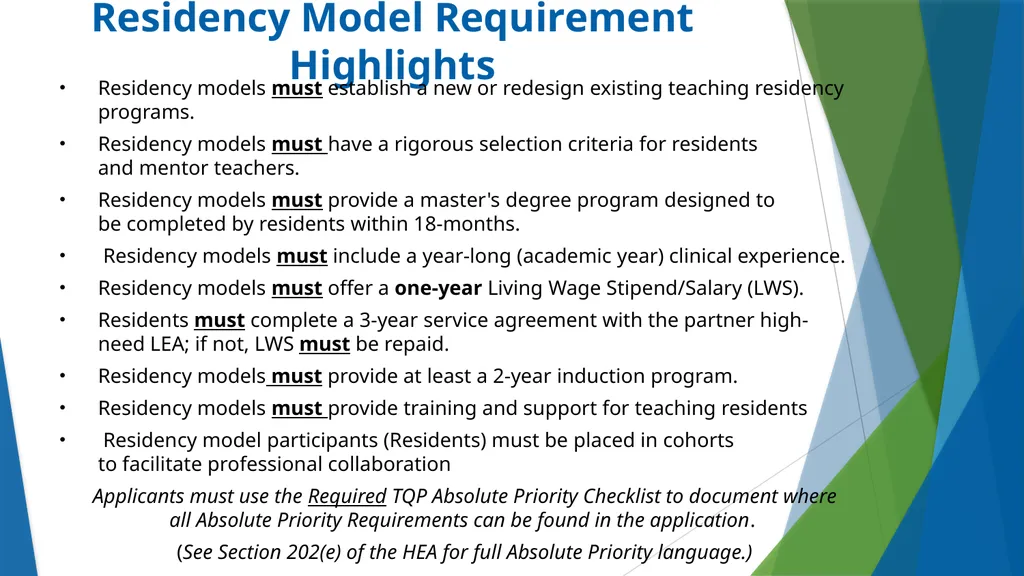
slide34. Residency Model Requirement Highlights Residency models must establish a new or redesign existing teaching residency programs.
Residency models must have a rigorous selection criteria for residents and mentor teachers.
Residency models must provide a master's degree program designed to be completed by residents within 18-months.
Residency models must include a year-long (academic year) clinical experience.
Residency models must offer a one-year Living Wage Stipend/Salary (LWS).
Residents must complete a 3-year service agreement with the partner high-need LEA; if not, LWS must be repaid.
Residency models must provide at least a 2-year induction program.
Residency models must provide training and support for teaching residents
Residency model participants (Residents) must be placed in cohorts to facilitate professional collaboration
Applicants must use the Required TQP Absolute Priority Checklist to document where all Absolute Priority Requirements can be found in the application.
(See Section 202(e) of the HEA for full Absolute Priority language.) 34<br>
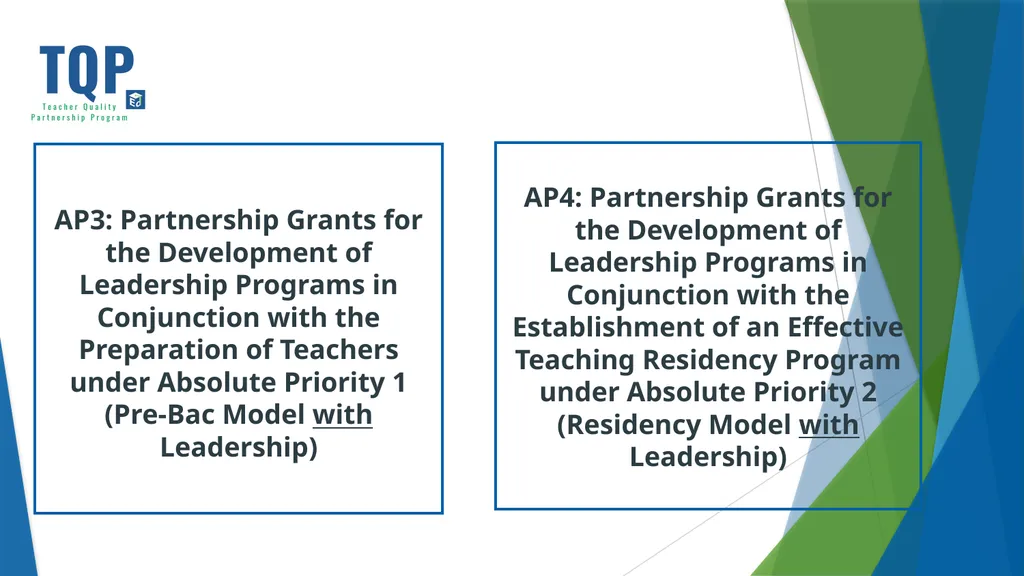
slide35. AP3: Partnership Grants for the Development of Leadership Programs in Conjunction with the Preparation of Teachers under Absolute Priority 1 (Pre-Bac Model with Leadership) AP4: Partnership Grants for the Development of Leadership Programs in Conjunction with the Establishment of an Effective Teaching Residency Program under Absolute Priority 2 (Residency Model with Leadership)<br>
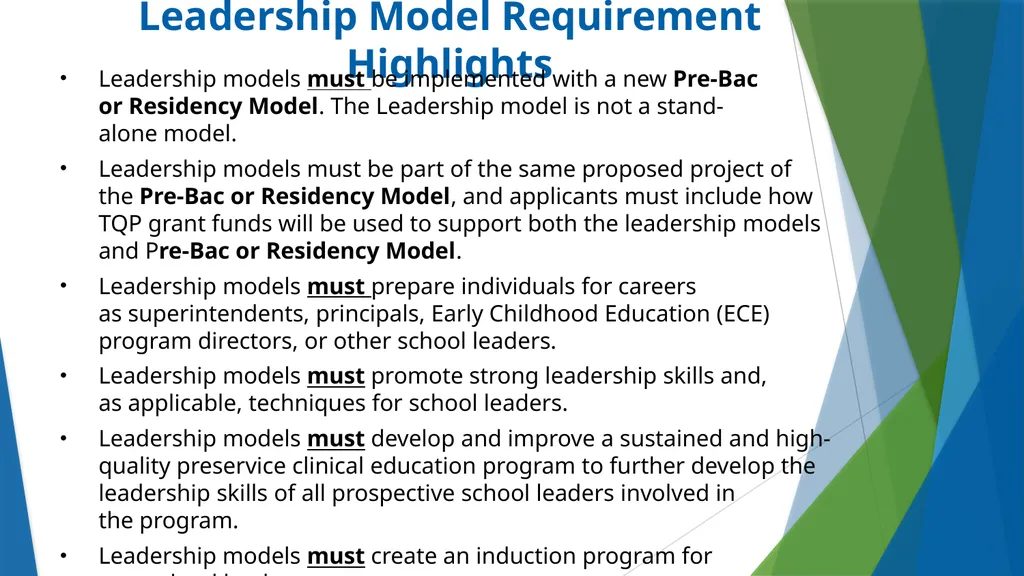
slide36. Leadership Model Requirement Highlights Leadership models must be implemented with a new Pre-Bac or Residency Model. The Leadership model is not a stand-alone model.
Leadership models must be part of the same proposed project of the Pre-Bac or Residency Model, and applicants must include how TQP grant funds will be used to support both the leadership models and Pre-Bac or Residency Model.
Leadership models must prepare individuals for careers as superintendents, principals, Early Childhood Education (ECE) program directors, or other school leaders.
Leadership models must promote strong leadership skills and, as applicable, techniques for school leaders.
Leadership models must develop and improve a sustained and high-quality preservice clinical education program to further develop the leadership skills of all prospective school leaders involved in the program.
Leadership models must create an induction program for new school leaders 36<br>
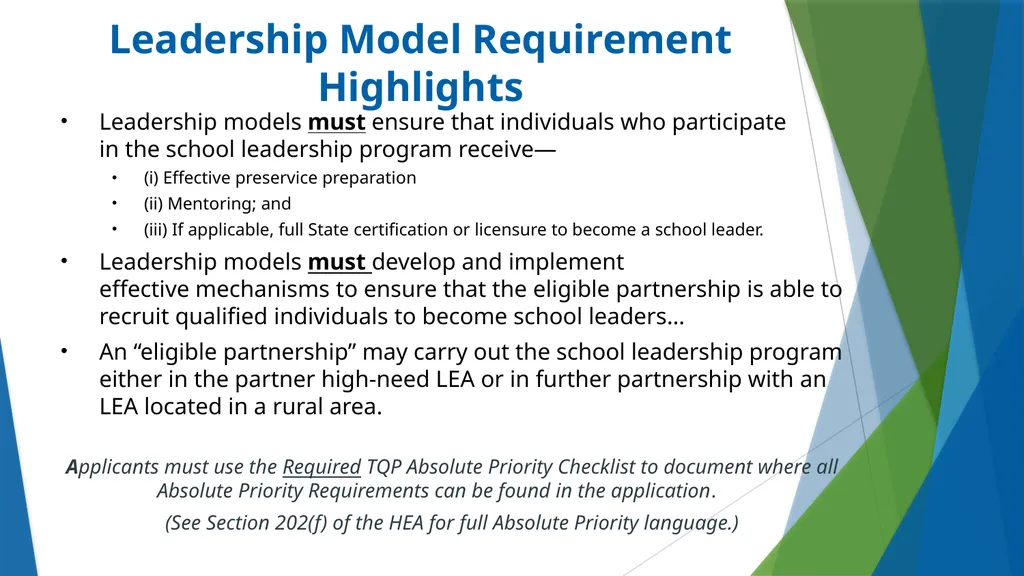
slide37. Leadership Model Requirement Highlights Leadership models must ensure that individuals who participate in the school leadership program receive—
(i) Effective preservice preparation
(ii) Mentoring; and
(iii) If applicable, full State certification or licensure to become a school leader.
Leadership models must develop and implement effective mechanisms to ensure that the eligible partnership is able to recruit qualified individuals to become school leaders…
An “eligible partnership” may carry out the school leadership program either in the partner high-need LEA or in further partnership with an LEA located in a rural area.
Applicants must use the Required TQP Absolute Priority Checklist to document where all Absolute Priority Requirements can be found in the application.
(See Section 202(f) of the HEA for full Absolute Priority language.) 37<br>
slide38. FY 2024 TQP Competitive Preference Priorities<br>
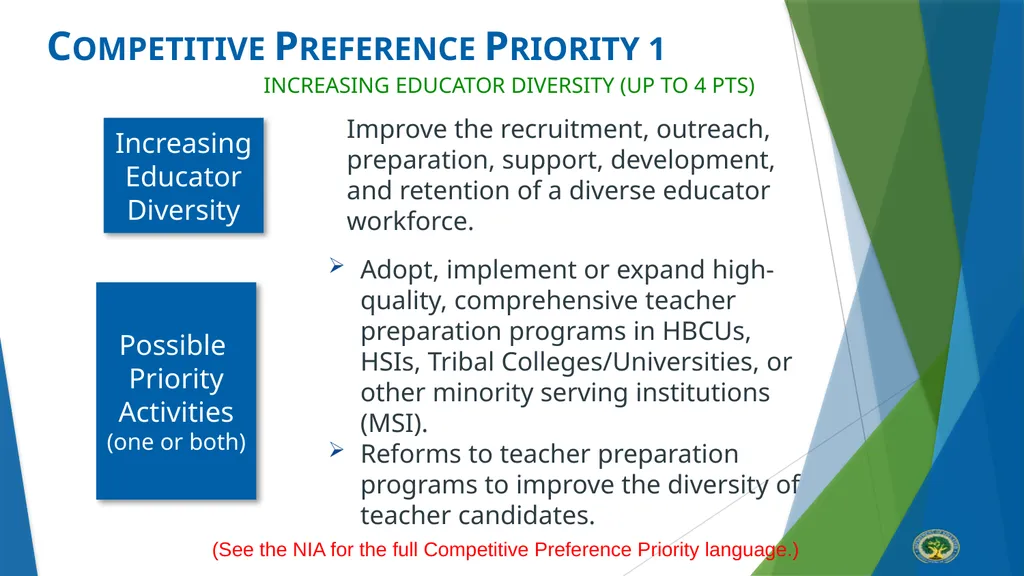
slide39. Competitive Preference Priority 1 Increasing Educator Diversity (Up to 4 pTS) Possible
Priority Activities
(one or both) Adopt, implement or expand high-quality, comprehensive teacher preparation programs in HBCUs, HSIs, Tribal Colleges/Universities, or other minority serving institutions (MSI).
Reforms to teacher preparation programs to improve the diversity of teacher candidates. Increasing Educator Diversity Improve the recruitment, outreach, preparation, support, development, and retention of a diverse educator workforce. (See the NIA for the full Competitive Preference Priority language.)<br>
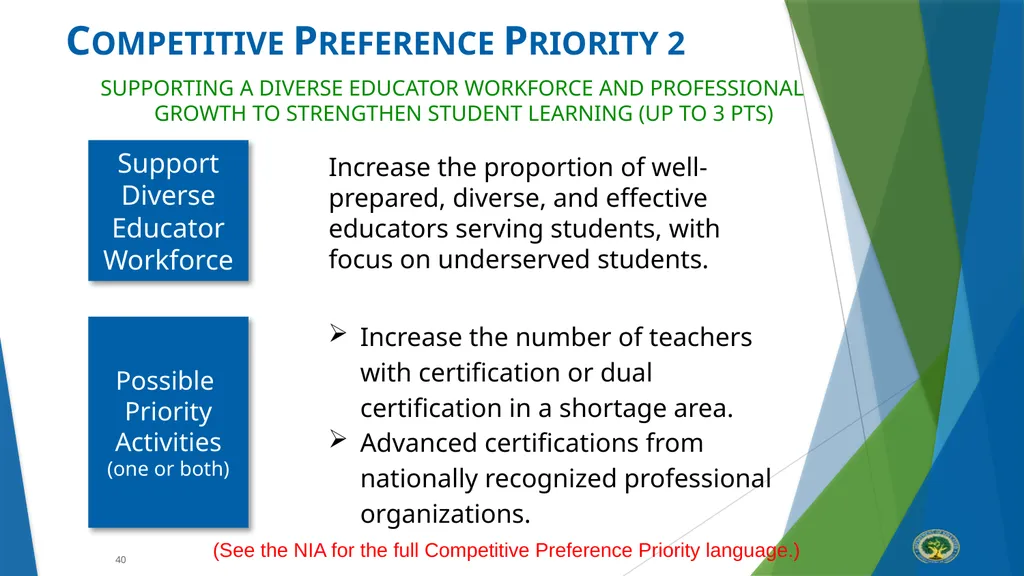
slide40. Competitive Preference Priority 2 40 Supporting a Diverse Educator Workforce and Professional Growth to Strengthen Student Learning (up to 3 pTS) Increase the proportion of well-prepared, diverse, and effective educators serving students, with focus on underserved students. Possible
Priority Activities
(one or both) Increase the number of teachers with certification or dual certification in a shortage area.
Advanced certifications from nationally recognized professional organizations. Support Diverse Educator Workforce (See the NIA for the full Competitive Preference Priority language.)<br>
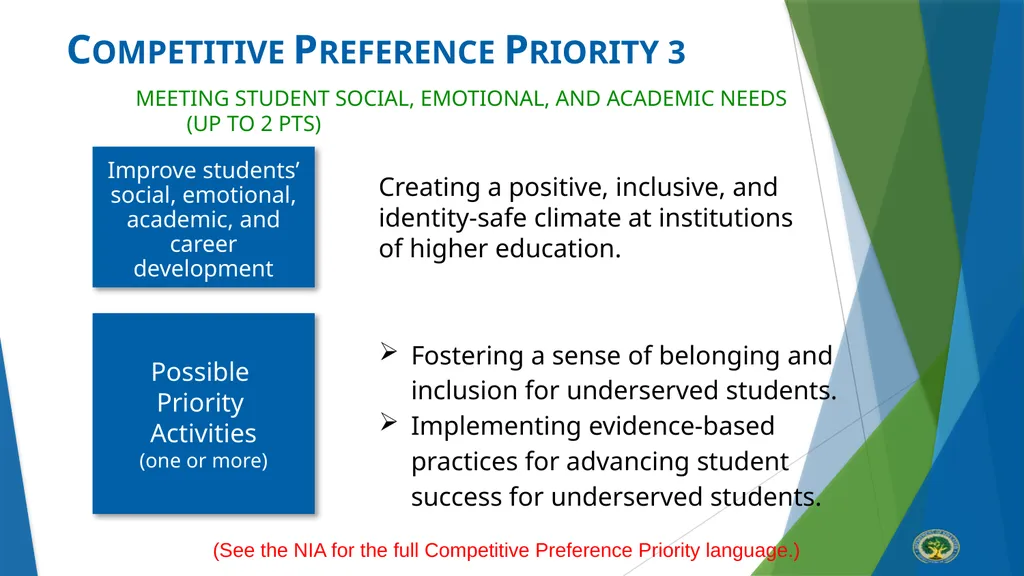
slide41. Competitive Preference Priority 3 41 Meeting Student Social, Emotional, and Academic Needs (up to 2 PTS) Creating a positive, inclusive, and identity-safe climate at institutions of higher education. Possible
Priority
Activities
(one or more) Fostering a sense of belonging and inclusion for underserved students.
Implementing evidence-based practices for advancing student success for underserved students. Improve students’ social, emotional, academic, and career development (See the NIA for the full Competitive Preference Priority language.)<br>
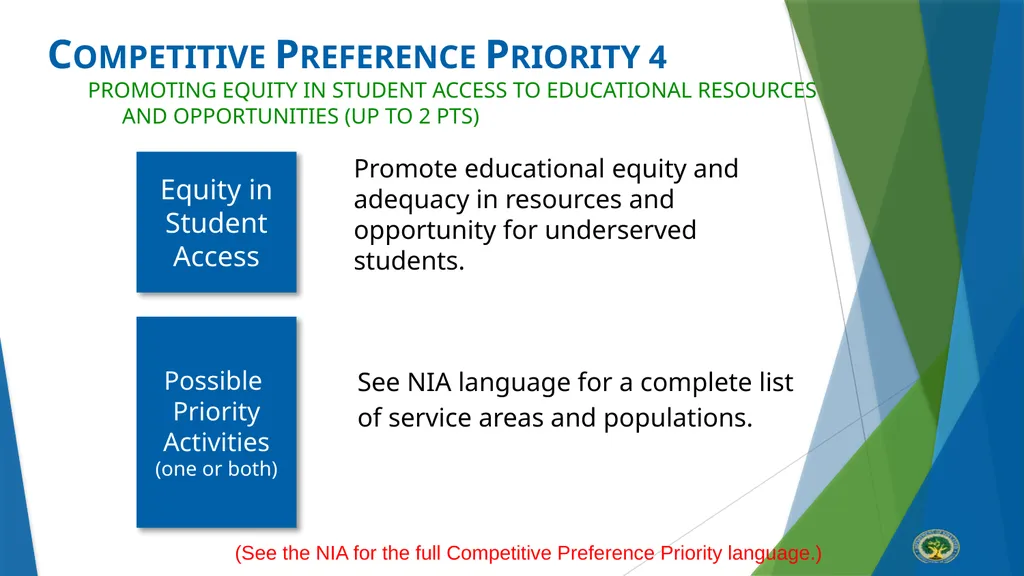
slide42. Competitive Preference Priority 4 Promoting Equity in Student Access to Educational Resources and Opportunities (UP to 2 pTS) Promote educational equity and adequacy in resources and opportunity for underserved students. Possible
Priority
Activities
(one or both) See NIA language for a complete list of service areas and populations. Equity in Student Access (See the NIA for the full Competitive Preference Priority language.)<br>
slide43. FY 2024 TQP Invitational Priorities<br>
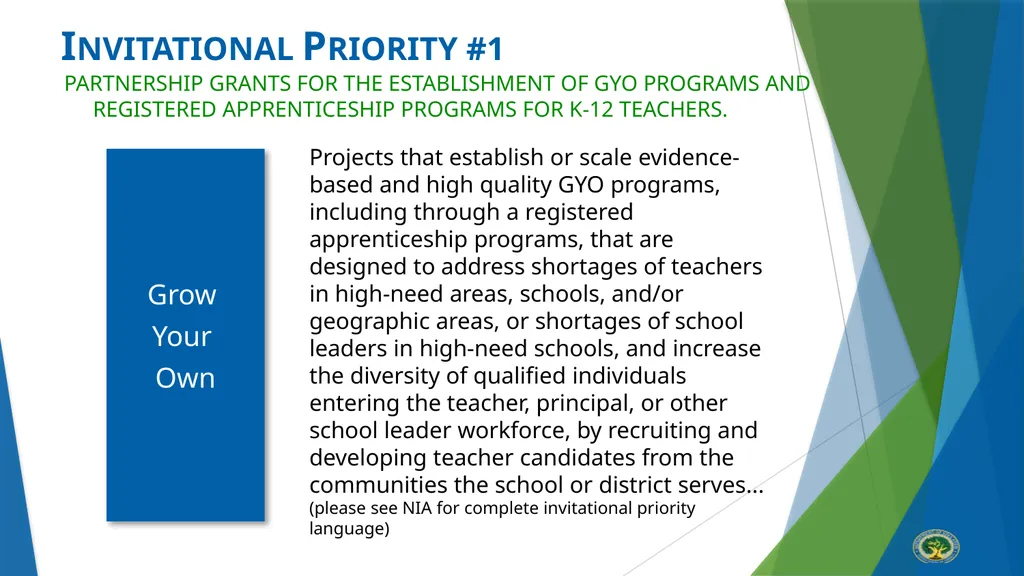
slide44. Invitational Priority #1 Partnership Grants for the Establishment of GYO Programs and Registered Apprenticeship Programs for K-12 Teachers. Projects that establish or scale evidence-based and high quality GYO programs, including through a registered apprenticeship programs, that are designed to address shortages of teachers in high-need areas, schools, and/or geographic areas, or shortages of school leaders in high-need schools, and increase the diversity of qualified individuals entering the teacher, principal, or other school leader workforce, by recruiting and developing teacher candidates from the communities the school or district serves... (please see NIA for complete invitational priority language) Grow
Your
Own<br>
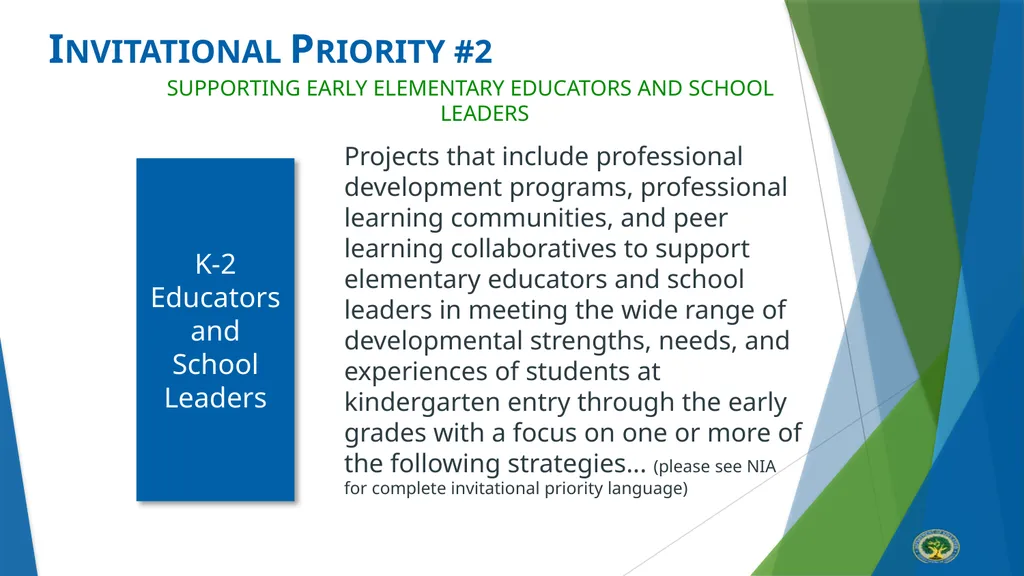
slide45. Invitational Priority #2 SUPPORTING EARLY ELEMENTARY EDUCATORS AND SCHOOL LEADERS K-2 Educators and School Leaders Projects that include professional development programs, professional learning communities, and peer learning collaboratives to support elementary educators and school leaders in meeting the wide range of developmental strengths, needs, and experiences of students at kindergarten entry through the early grades with a focus on one or more of the following strategies... (please see NIA for complete invitational priority language)<br>
slide46. Questions & Answers<br>
slide47. TQP Selection Criteria and Scoring<br>
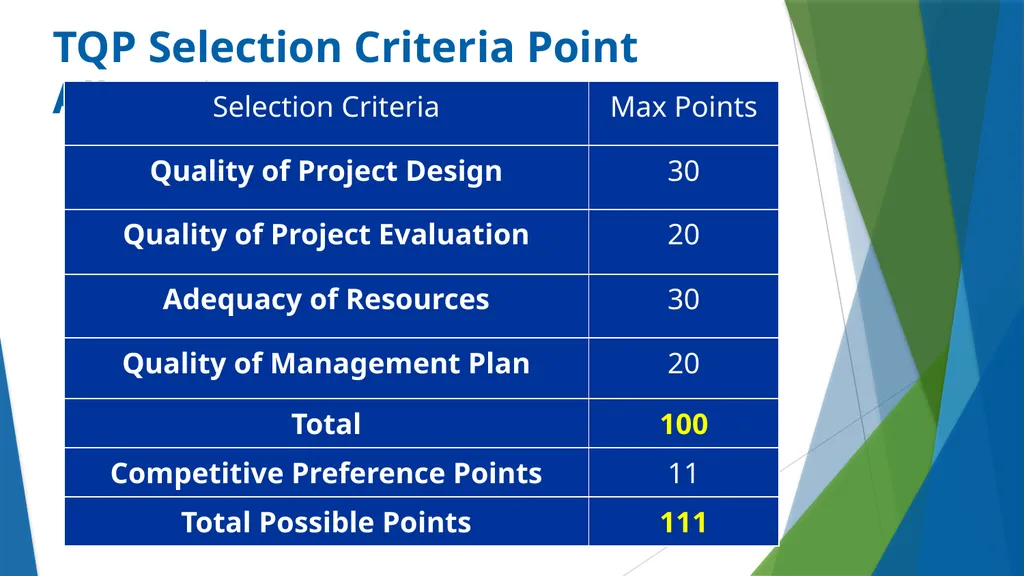
slide48. TQP Selection Criteria Point Allocation 48<br>
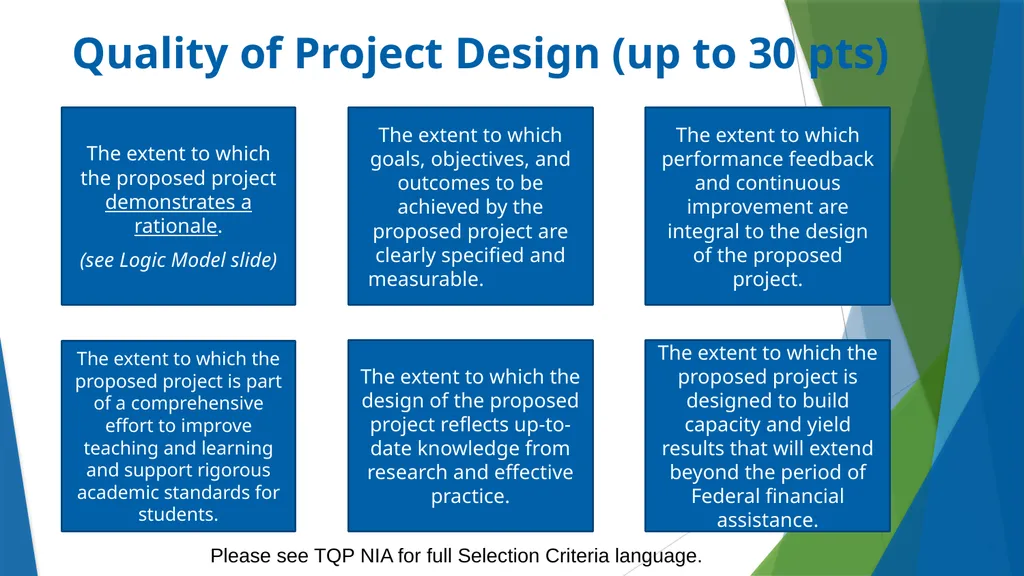
slide49. Quality of Project Design (up to 30 pts) 49 The extent to which the proposed project demonstrates a rationale.
(see Logic Model slide) The extent to which the proposed project is part of a comprehensive effort to improve teaching and learning and support rigorous academic standards for students. The extent to which goals, objectives, and outcomes to be achieved by the proposed project are clearly specified and measurable. The extent to which the design of the proposed project reflects up-to-date knowledge from research and effective practice. The extent to which performance feedback and continuous improvement are integral to the design of the proposed project. The extent to which the proposed project is designed to build capacity and yield results that will extend beyond the period of Federal financial assistance. Please see TQP NIA for full Selection Criteria language.<br>
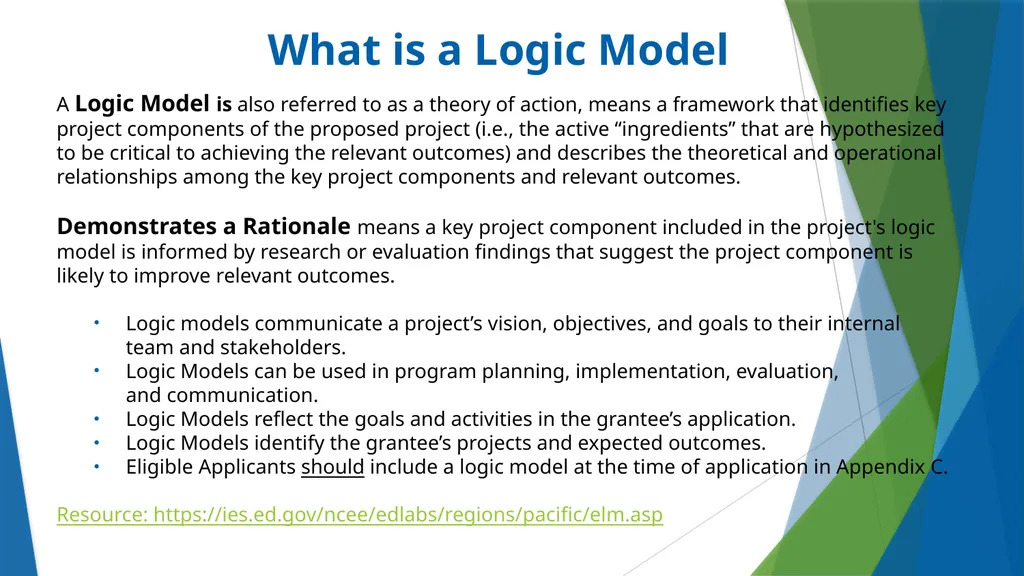
slide50. What is a Logic Model A Logic Model is also referred to as a theory of action, means a framework that identifies key project components of the proposed project (i.e., the active “ingredients” that are hypothesized to be critical to achieving the relevant outcomes) and describes the theoretical and operational relationships among the key project components and relevant outcomes.
Demonstrates a Rationale means a key project component included in the project's logic model is informed by research or evaluation findings that suggest the project component is likely to improve relevant outcomes.
Logic models communicate a project’s vision, objectives, and goals to their internal team and stakeholders.
Logic Models can be used in program planning, implementation, evaluation, and communication.
Logic Models reflect the goals and activities in the grantee’s application.
Logic Models identify the grantee’s projects and expected outcomes.
Eligible Applicants should include a logic model at the time of application in Appendix C.
Resource: https://ies.ed.gov/ncee/edlabs/regions/pacific/elm.asp<br>
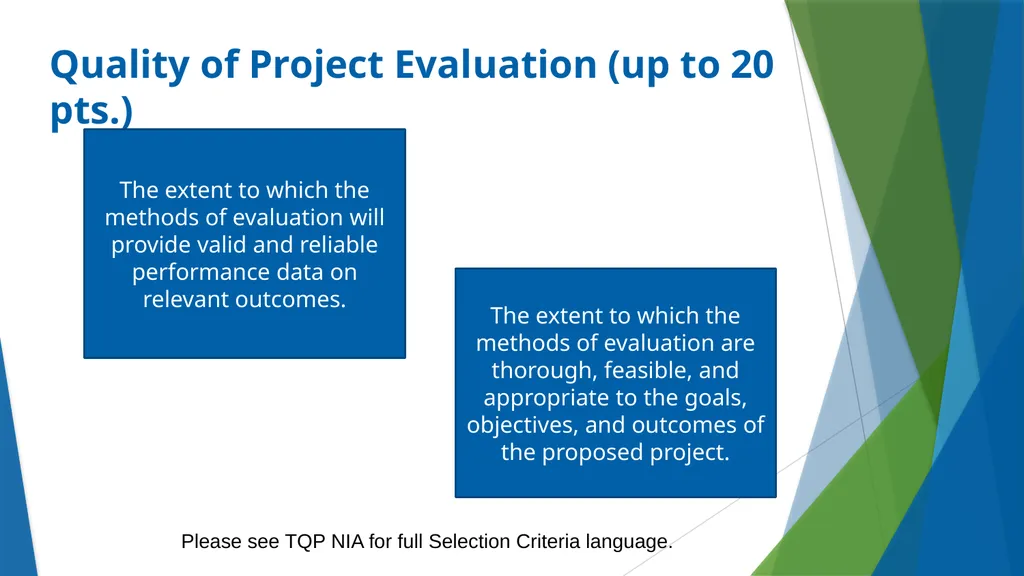
slide51. Quality of Project Evaluation (up to 20 pts.) 51 The extent to which the methods of evaluation will provide valid and reliable performance data on relevant outcomes. The extent to which the methods of evaluation are thorough, feasible, and appropriate to the goals, objectives, and outcomes of the proposed project. Please see TQP NIA for full Selection Criteria language.<br>
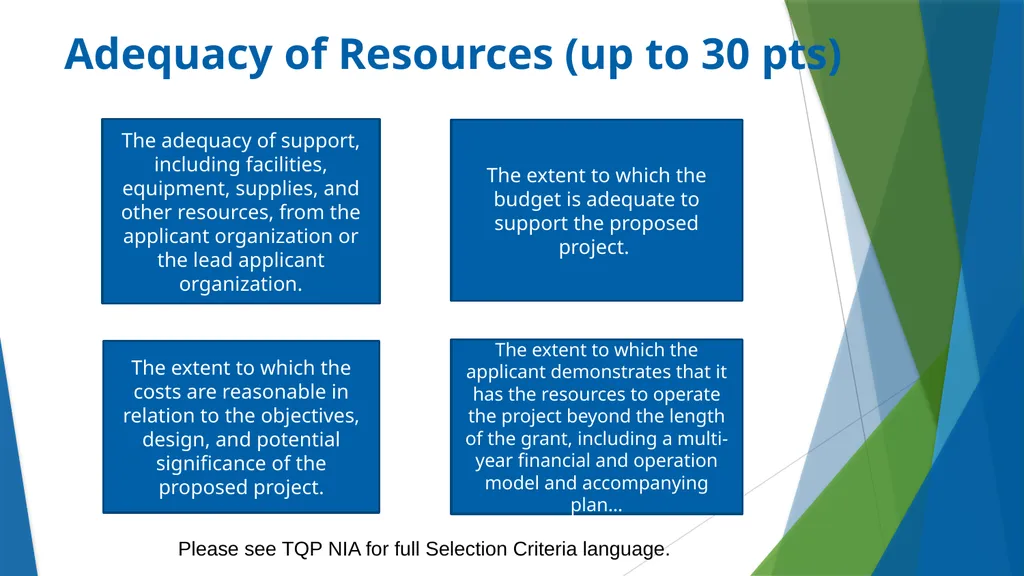
slide52. Balance of Costs with Outcomes of Project The extent to which the budget is adequate to support the proposed project. The adequacy of support, including facilities, equipment, supplies, and other resources, from the applicant organization or the lead applicant organization. The extent to which the applicant demonstrates that it has the resources to operate the project beyond the length of the grant, including a multi-year financial and operation model and accompanying plan… The extent to which the costs are reasonable in relation to the objectives, design, and potential significance of the proposed project. Adequacy of Resources (up to 30 pts) Please see TQP NIA for full Selection Criteria language.<br>
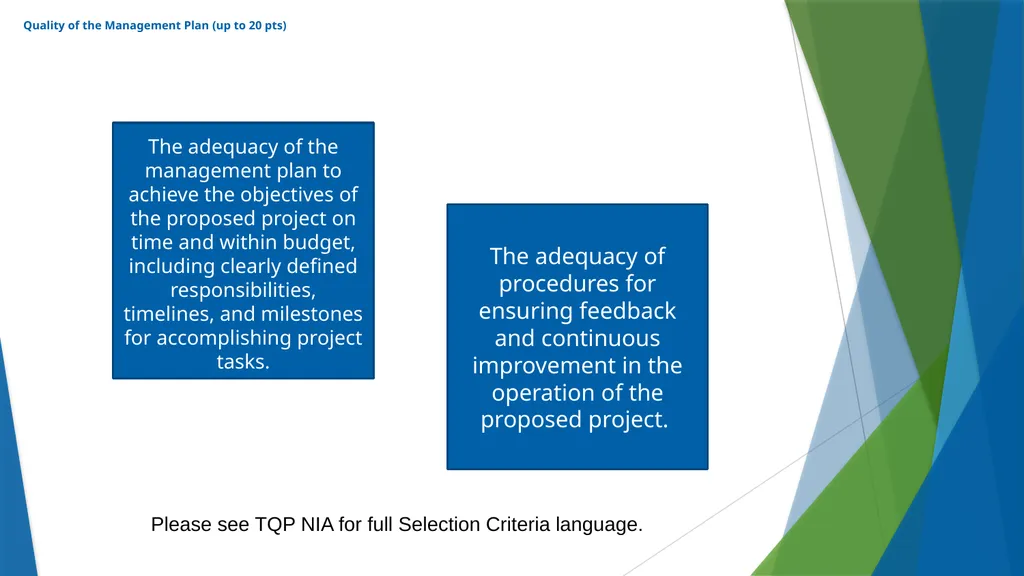
slide53. Quality of the Management Plan (up to 20 pts) The adequacy of the management plan to achieve the objectives of the proposed project on time and within budget, including clearly defined responsibilities, timelines, and milestones for accomplishing project tasks. The adequacy of procedures for ensuring feedback and continuous improvement in the operation of the proposed project. Please see TQP NIA for full Selection Criteria language.<br>
slide54. TQP Performance Measures, Individual Project Measures and Annual Reporting<br>
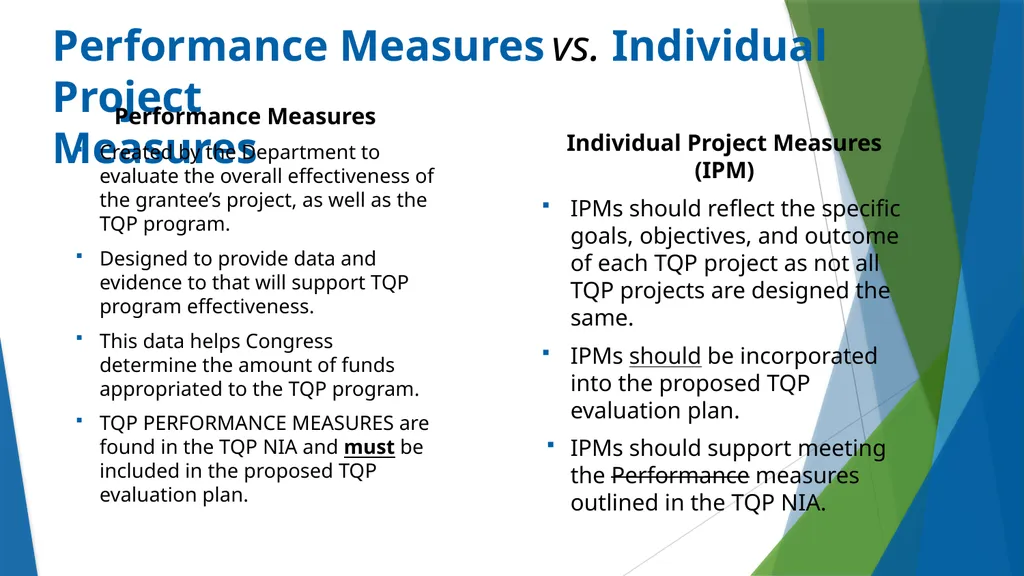
slide55. Performance Measures vs. Individual Project Measures Individual Project Measures (IPM)
IPMs should reflect the specific goals, objectives, and outcome of each TQP project as not all TQP projects are designed the same.
IPMs should be incorporated into the proposed TQP evaluation plan.
IPMs should support meeting the Performance measures outlined in the TQP NIA. Performance Measures
Created by the Department to evaluate the overall effectiveness of the grantee’s project, as well as the TQP program.
Designed to provide data and evidence to that will support TQP program effectiveness.
This data helps Congress determine the amount of funds appropriated to the TQP program.
TQP PERFORMANCE MEASURES are found in the TQP NIA and must be included in the proposed TQP evaluation plan.<br>
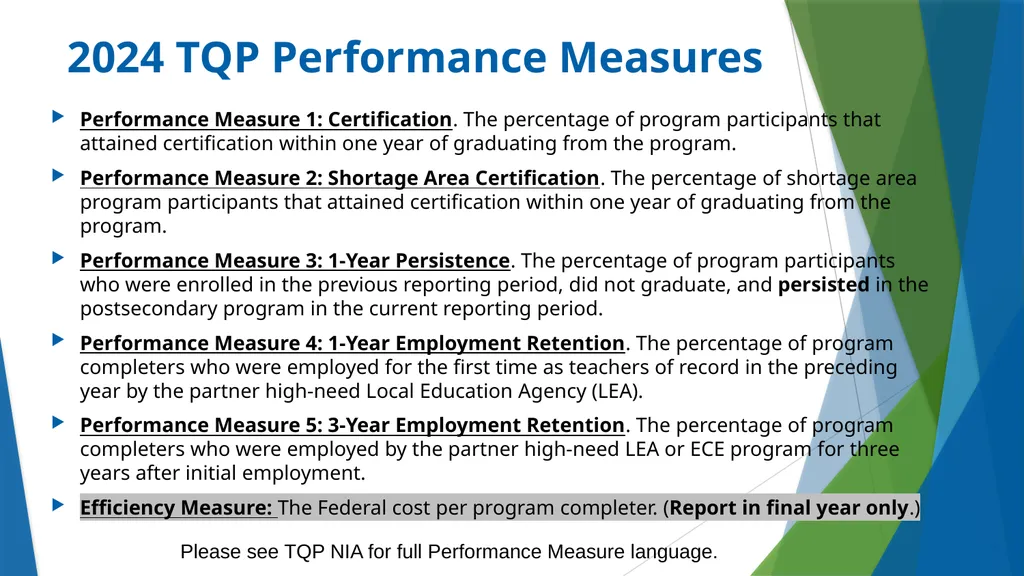
slide56. 2024 TQP Performance Measures 56 Performance Measure 1: Certification. The percentage of program participants that attained certification within one year of graduating from the program.
Performance Measure 2: Shortage Area Certification. The percentage of shortage area program participants that attained certification within one year of graduating from the program.
Performance Measure 3: 1-Year Persistence. The percentage of program participants who were enrolled in the previous reporting period, did not graduate, and persisted in the postsecondary program in the current reporting period.
Performance Measure 4: 1-Year Employment Retention. The percentage of program completers who were employed for the first time as teachers of record in the preceding year by the partner high-need Local Education Agency (LEA).
Performance Measure 5: 3-Year Employment Retention. The percentage of program completers who were employed by the partner high-need LEA or ECE program for three years after initial employment.
Efficiency Measure: The Federal cost per program completer. (Report in final year only.) Please see TQP NIA for full Performance Measure language.<br>
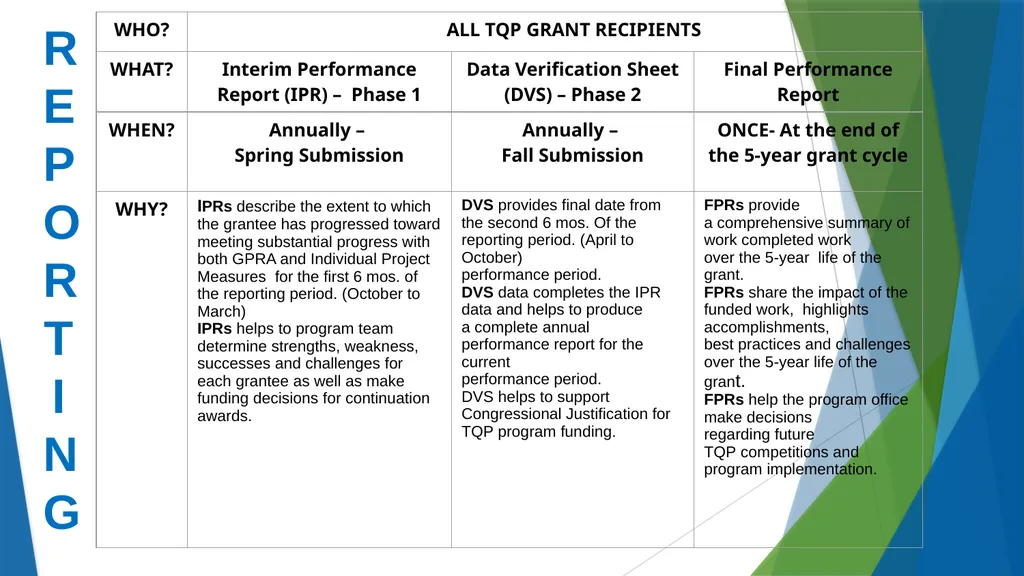
slide57. 57 REPORTING<br>
slide58. TQP Application Process<br>
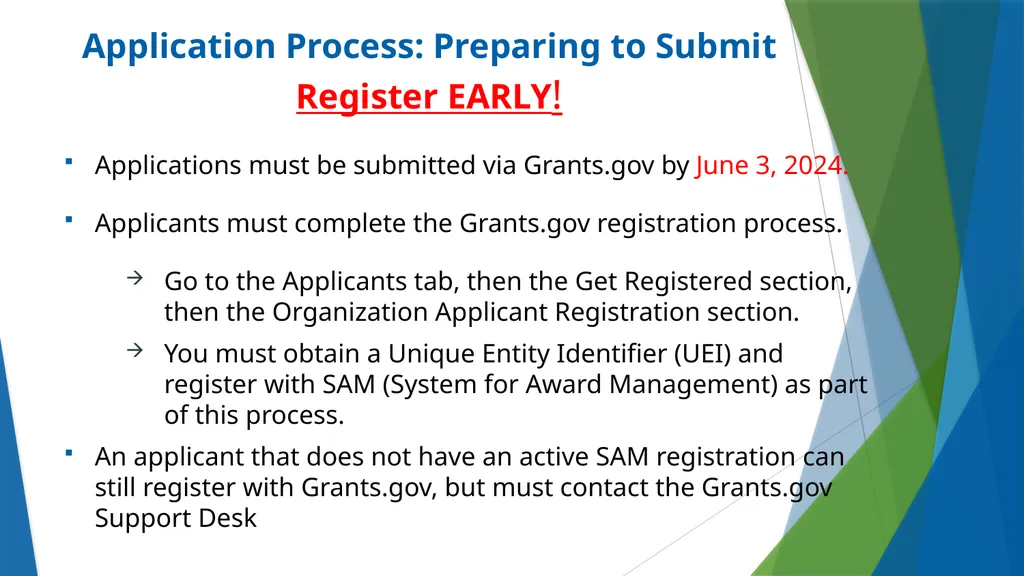
slide59. Application Process: Preparing to Submit Applications must be submitted via Grants.gov by June 3, 2024.
Applicants must complete the Grants.gov registration process.
Go to the Applicants tab, then the Get Registered section, then the Organization Applicant Registration section.
You must obtain a Unique Entity Identifier (UEI) and register with SAM (System for Award Management) as part of this process.
An applicant that does not have an active SAM registration can still register with Grants.gov, but must contact the Grants.gov Support Desk 59 Register EARLY!<br>
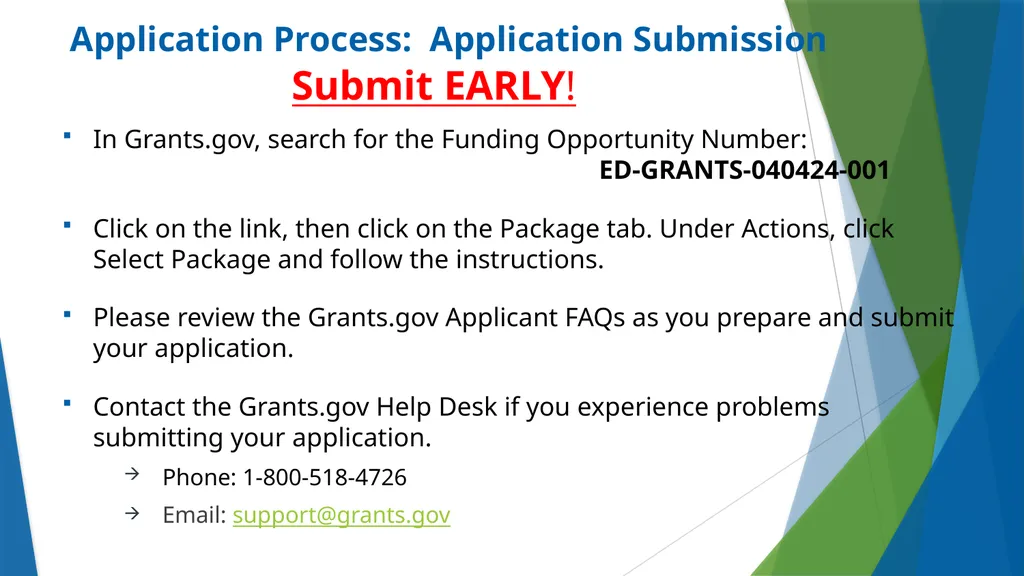
slide60. Application Process: Application Submission In Grants.gov, search for the Funding Opportunity Number: ED-GRANTS-040424-001
Click on the link, then click on the Package tab. Under Actions, click Select Package and follow the instructions.
Please review the Grants.gov Applicant FAQs as you prepare and submit your application.
Contact the Grants.gov Help Desk if you experience problems submitting your application.
Phone: 1-800-518-4726
Email: support@grants.gov 60 Submit EARLY!<br>
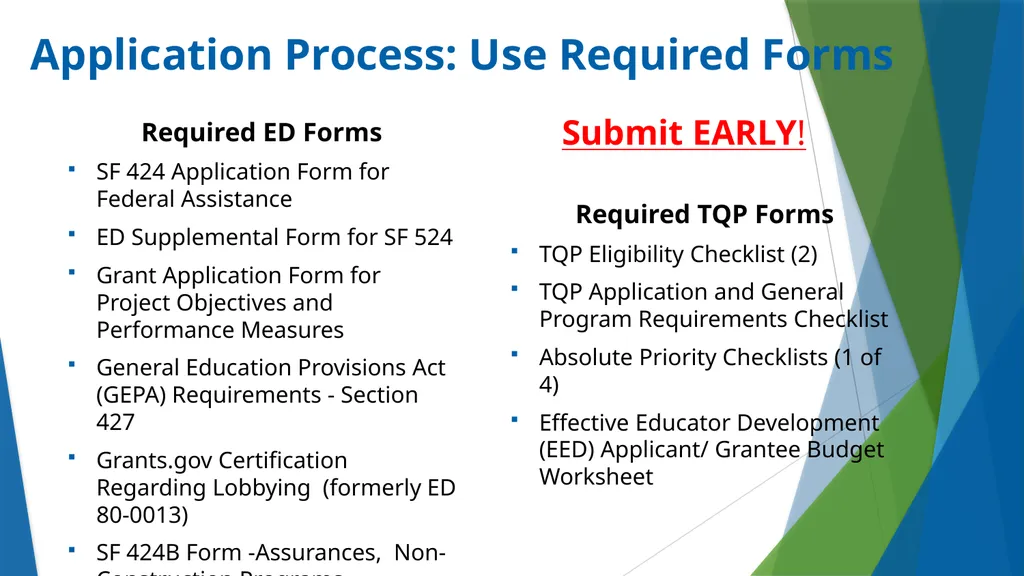
slide61. Application Process: Use Required Forms 61 Submit EARLY! Required ED Forms
SF 424 Application Form for Federal Assistance
ED Supplemental Form for SF 524
Grant Application Form for Project Objectives and Performance Measures
General Education Provisions Act (GEPA) Requirements - Section 427
Grants.gov Certification Regarding Lobbying (formerly ED 80-0013)
SF 424B Form -Assurances, Non-Construction Programs Required TQP Forms
TQP Eligibility Checklist (2)
TQP Application and General Program Requirements Checklist
Absolute Priority Checklists (1 of 4)
Effective Educator Development (EED) Applicant/ Grantee Budget Worksheet<br>
slide62. Importance of Using Required Forms It is imperative that all forms listed on the previous slide be included at the time of application submission.
The ED required forms help the Department collect applicant and competition data that may be useful in making funding and future competition decisions.
The TQP required forms help the TQP program staff determine if all program and absolute priority requirements have been met and where that information can be found in the application. If it cannot be clearly determined that these requirements have been met, an application may be deemed ineligible, and may not be reviewed. Submit EARLY!<br>
slide63. All applications are screened to identify late and duplicate applications.
Remaining applications are screened to determine:
Establishment of an “eligible partnership”;
All General Application and Program requirements have been met;
All Absolute Priority requirements have been met; and
Selection Criteria as been addressed
Eligible applications will be placed on a panel to be reviewed and scored by three non-Federal peer reviewers.
Applications are placed in rank order by total score.
Applications in funding range receive a post panel budget review.
An official slate memo is drafted and approved by the Secretary prior to making awards.
New awards will be announced on or before October 1, 2024. Application Process: What happens after submission<br>
slide64. TQP Program Cost Principles<br>
slide65. Grant Funds = Grant Activities Each Federal dollar that is awarded to a TQP grantee is inextricably linked to TQP activities or TQP actions.
Funding spent (or unspent) directly affects outcomes for educators and students.<br>
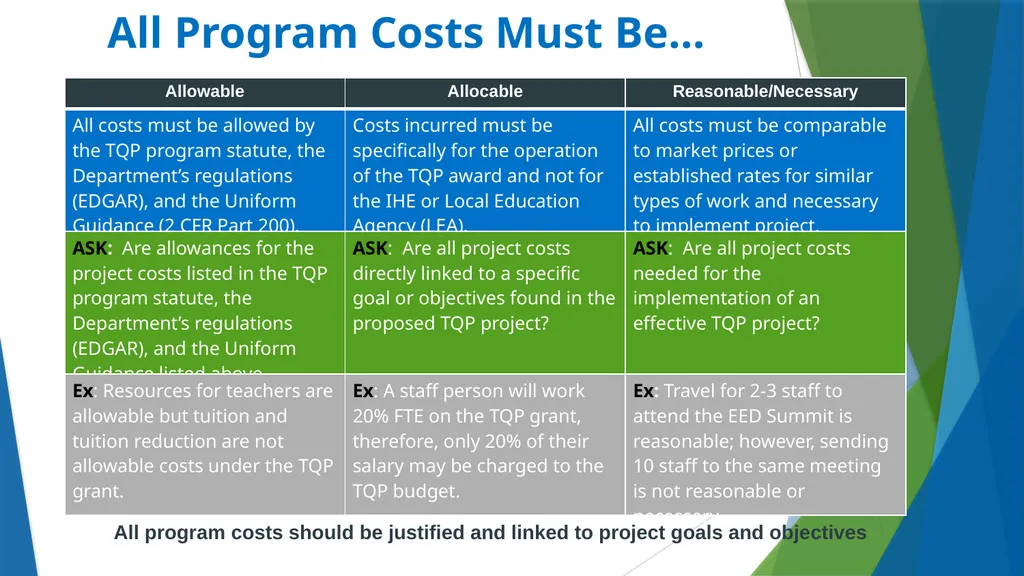
slide66. All Program Costs Must Be… All program costs should be justified and linked to project goals and objectives<br>
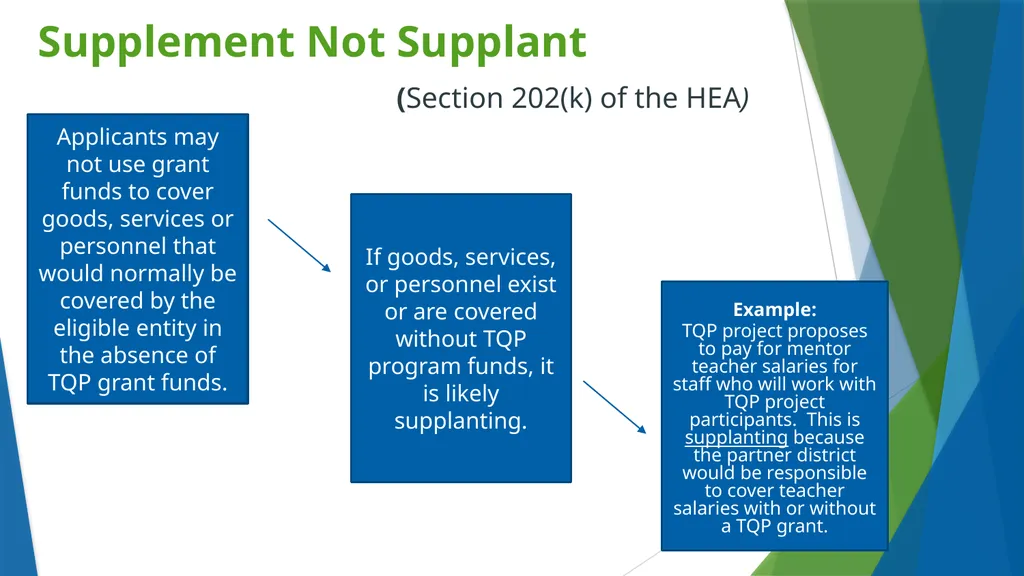
slide67. Supplement Not Supplant (Section 202(k) of the HEA) Applicants may not use grant funds to cover goods, services or personnel that would normally be covered by the eligible entity in the absence of TQP grant funds. If goods, services, or personnel exist or are covered without TQP program funds, it is likely supplanting. Example:
TQP project proposes to pay for mentor teacher salaries for staff who will work with TQP project participants. This is supplanting because the partner district would be responsible to cover teacher salaries with or without a TQP grant.<br>
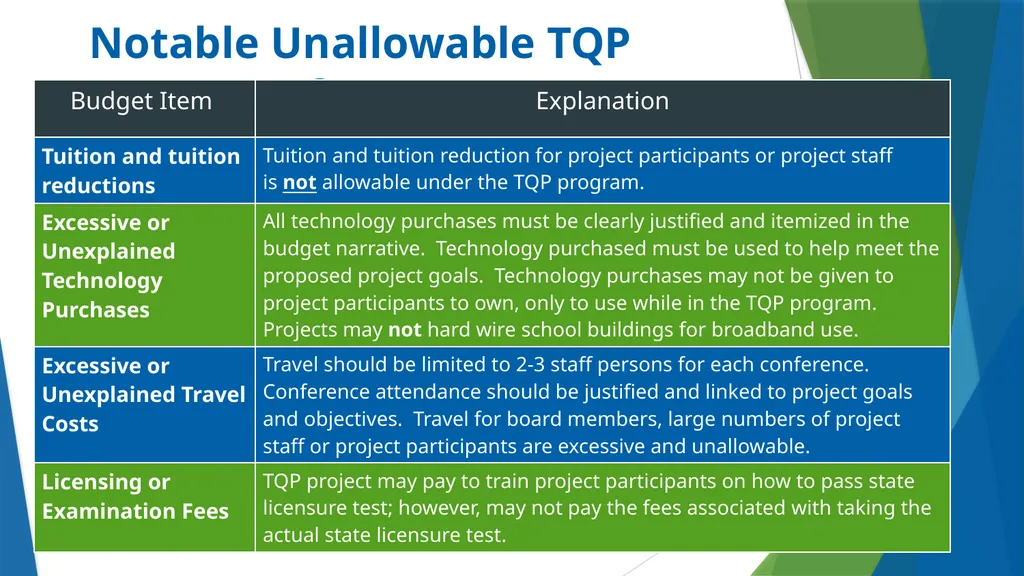
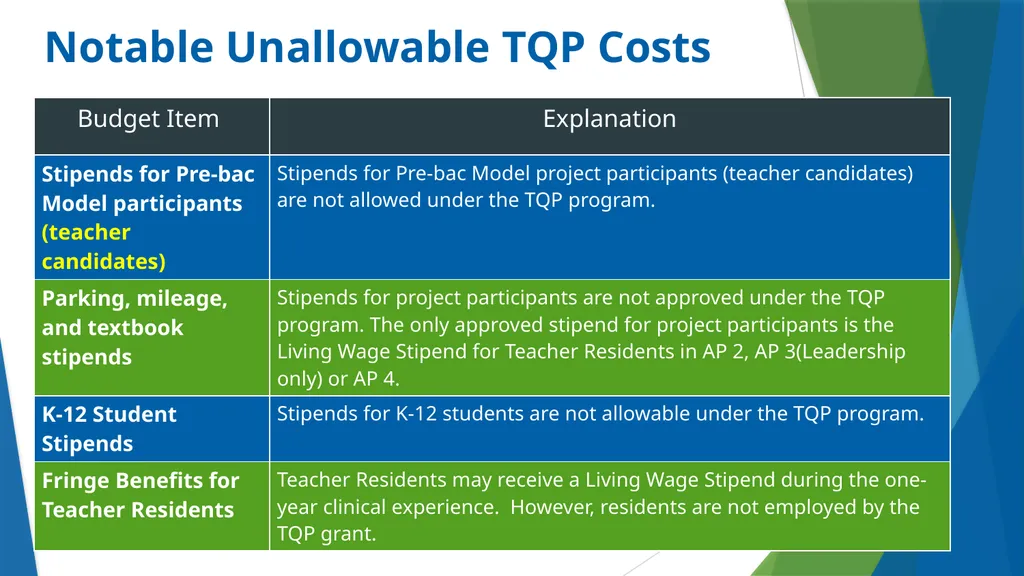
slide68. Notable Unallowable TQP Costs<br>
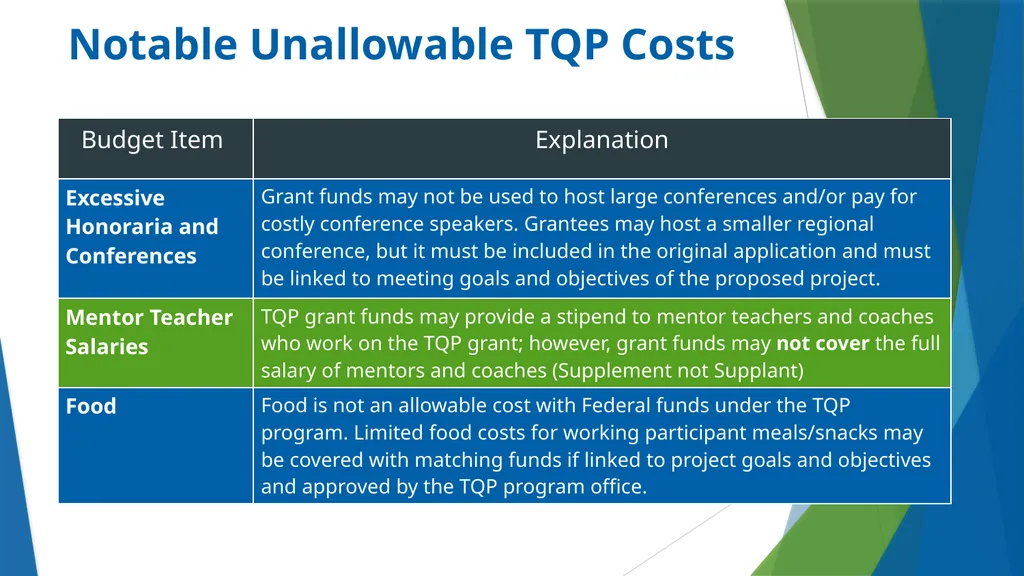
slide69. Notable Unallowable TQP Costs<br>
slide70. Notable Unallowable TQP Costs<br>
slide71. Preparing the TQP Budget Summary and Budget Narrative<br>
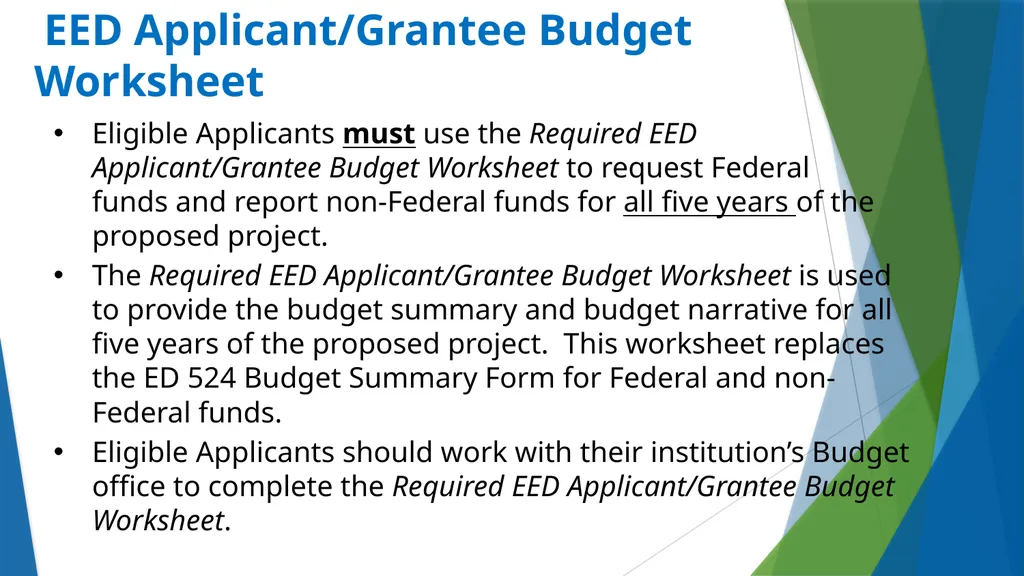
slide72. EED Applicant/Grantee Budget Worksheet Eligible Applicants must use the Required EED Applicant/Grantee Budget Worksheet to request Federal funds and report non-Federal funds for all five years of the proposed project.
The Required EED Applicant/Grantee Budget Worksheet is used to provide the budget summary and budget narrative for all five years of the proposed project. This worksheet replaces the ED 524 Budget Summary Form for Federal and non-Federal funds.
Eligible Applicants should work with their institution’s Budget office to complete the Required EED Applicant/Grantee Budget Worksheet.<br>
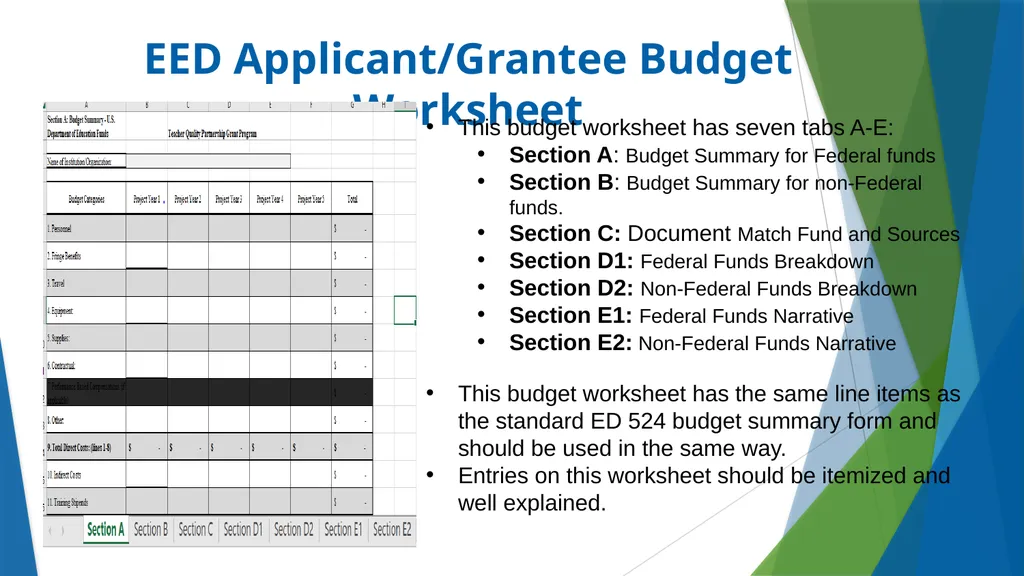
slide73. EED Applicant/Grantee Budget Worksheet This budget worksheet has seven tabs A-E:
Section A: Budget Summary for Federal funds
Section B: Budget Summary for non-Federal funds.
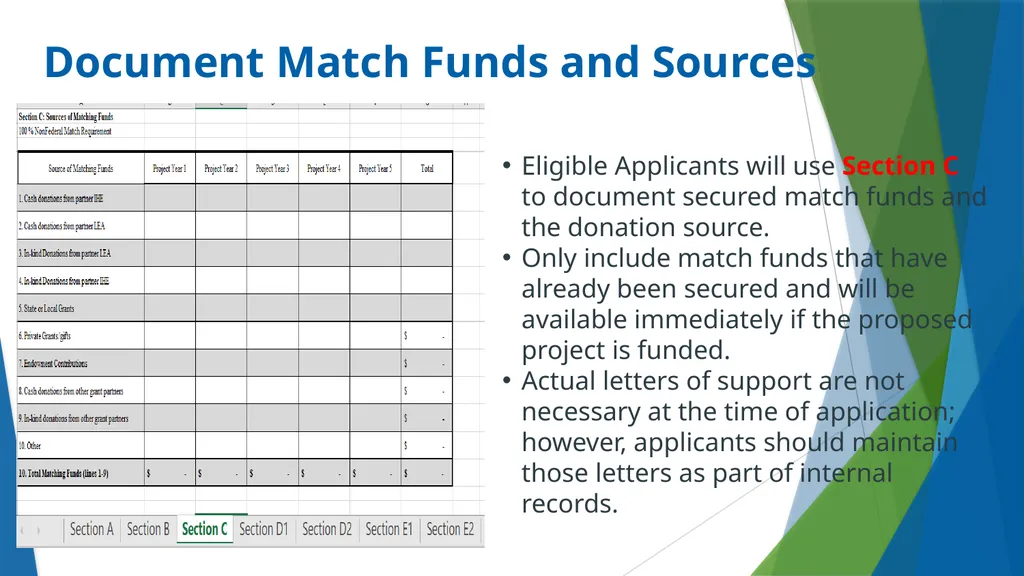
Section C: Document Match Fund and Sources
Section D1: Federal Funds Breakdown
Section D2: Non-Federal Funds Breakdown
Section E1: Federal Funds Narrative
Section E2: Non-Federal Funds Narrative
This budget worksheet has the same line items as the standard ED 524 budget summary form and should be used in the same way.
Entries on this worksheet should be itemized and well explained.<br>
slide74. Document Match Funds and Sources Eligible Applicants will use Section C to document secured match funds and the donation source.
Only include match funds that have already been secured and will be available immediately if the proposed project is funded.
Actual letters of support are not necessary at the time of application; however, applicants should maintain those letters as part of internal records.<br>
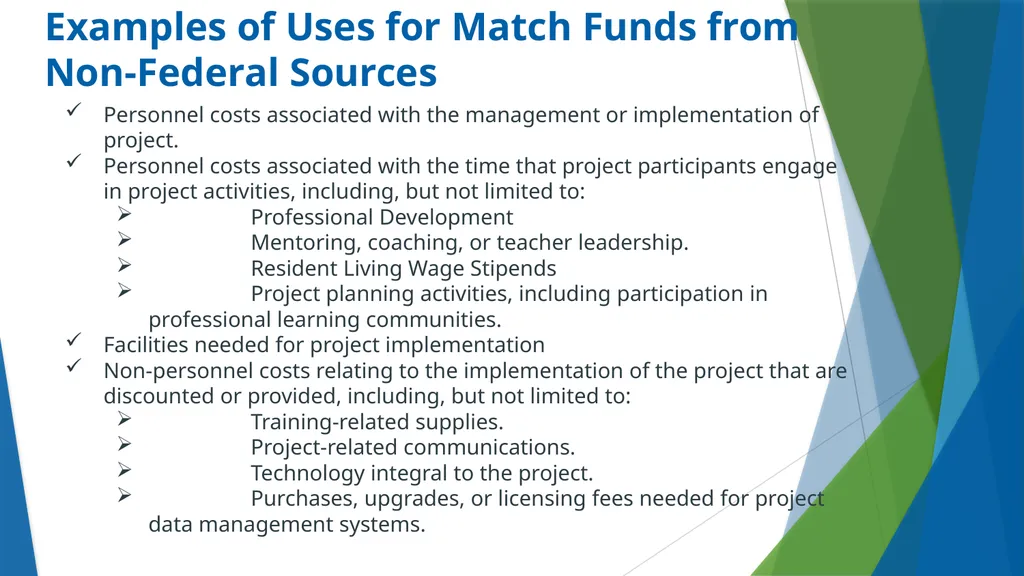
slide75. Personnel costs associated with the management or implementation of project.
Personnel costs associated with the time that project participants engage in project activities, including, but not limited to:
Professional Development
Mentoring, coaching, or teacher leadership.
Resident Living Wage Stipends
Project planning activities, including participation in professional learning communities.
Facilities needed for project implementation
Non-personnel costs relating to the implementation of the project that are discounted or provided, including, but not limited to:
Training-related supplies.
Project-related communications.
Technology integral to the project.
Purchases, upgrades, or licensing fees needed for project data management systems. Examples of Uses for Match Funds from
Non-Federal Sources<br>
slide76. Line-Item Guidance For Preparing aTQP Budget Narrative<br>
slide77. Budget Line-Item Guidance<br>
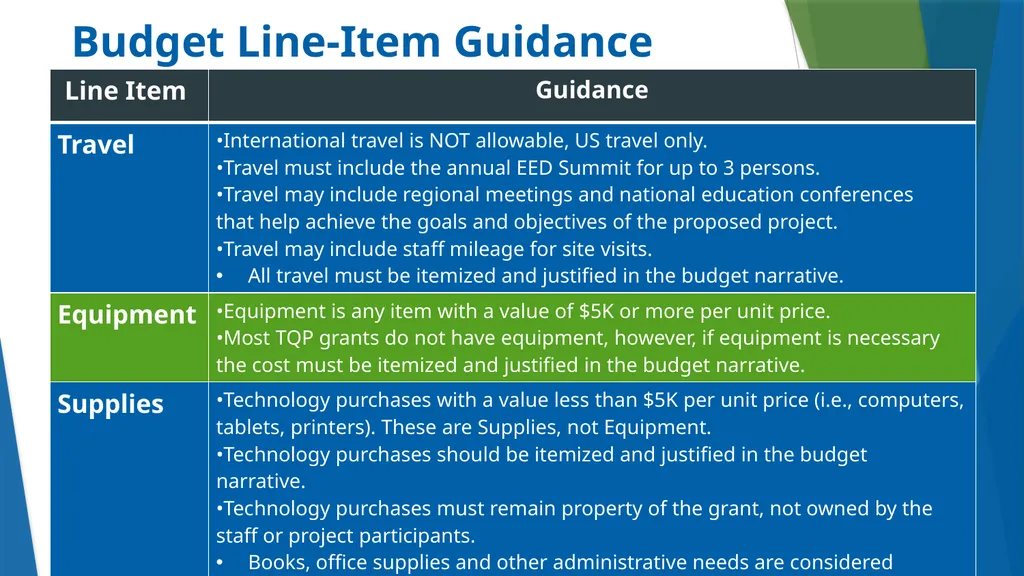
slide78. Budget Line-Item Guidance<br>
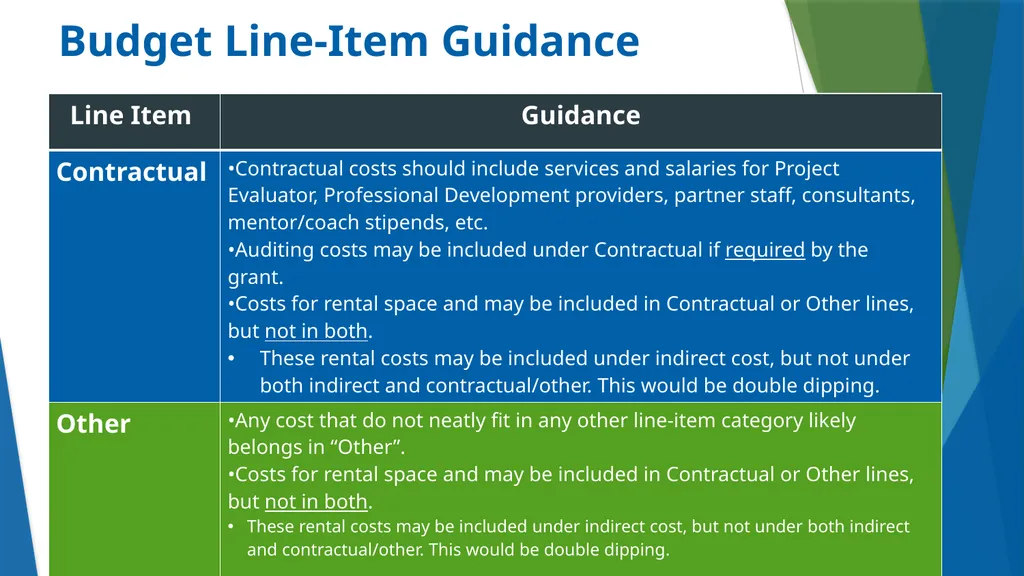
slide79. Budget Line-Item Guidance<br>
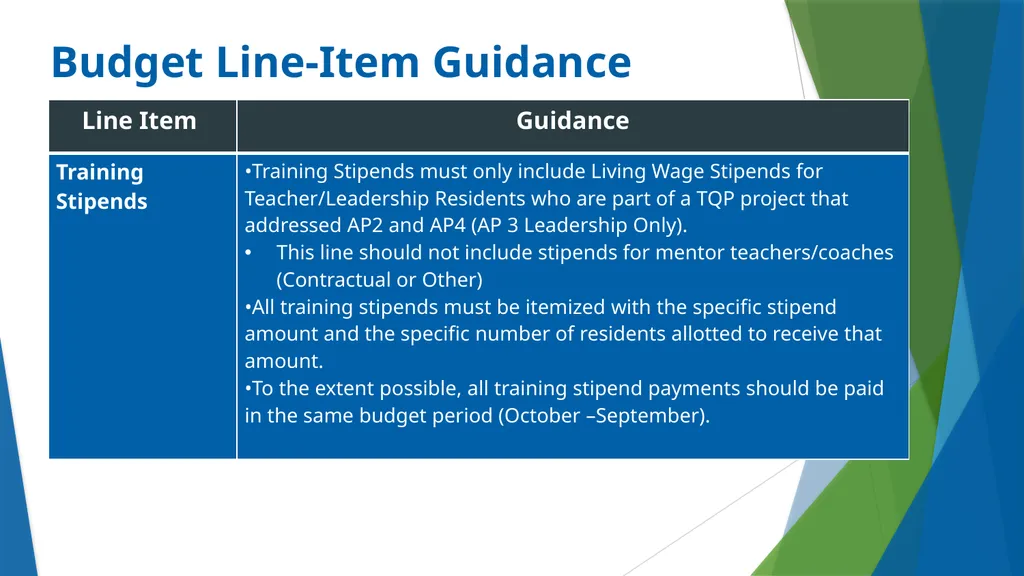
slide80. Budget Line-Item Guidance<br>
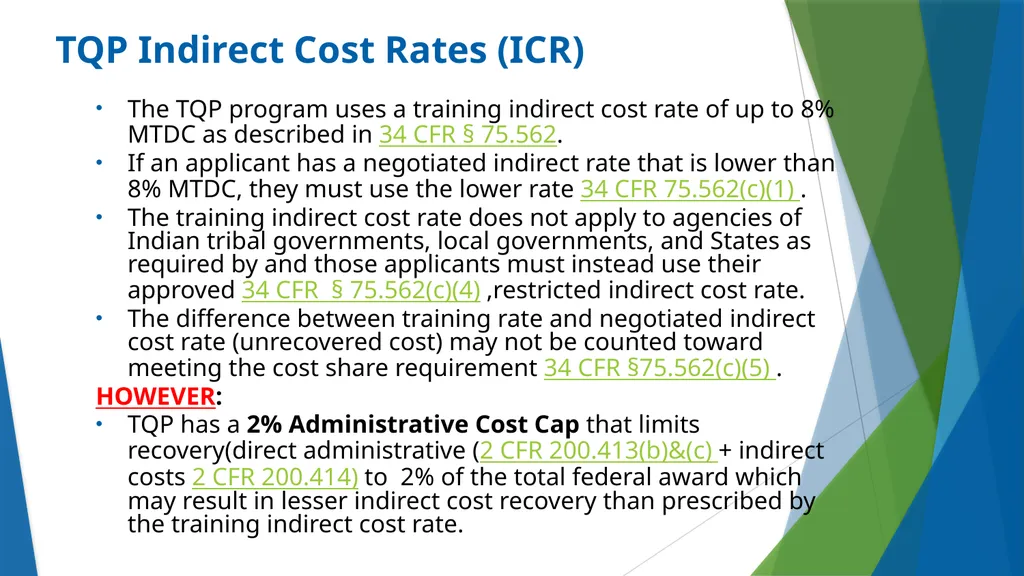
slide81. TQP Indirect Cost Rates (ICR) The TQP program uses a training indirect cost rate of up to 8% MTDC as described in 34 CFR § 75.562.
If an applicant has a negotiated indirect rate that is lower than 8% MTDC, they must use the lower rate 34 CFR 75.562(c)(1) .
The training indirect cost rate does not apply to agencies of Indian tribal governments, local governments, and States as required by and those applicants must instead use their approved 34 CFR § 75.562(c)(4) ,restricted indirect cost rate.
The difference between training rate and negotiated indirect cost rate (unrecovered cost) may not be counted toward meeting the cost share requirement 34 CFR §75.562(c)(5) .
HOWEVER:
TQP has a 2% Administrative Cost Cap that limits recovery(direct administrative (2 CFR 200.413(b)&(c) + indirect costs 2 CFR 200.414) to 2% of the total federal award which may result in lesser indirect cost recovery than prescribed by the training indirect cost rate.<br>
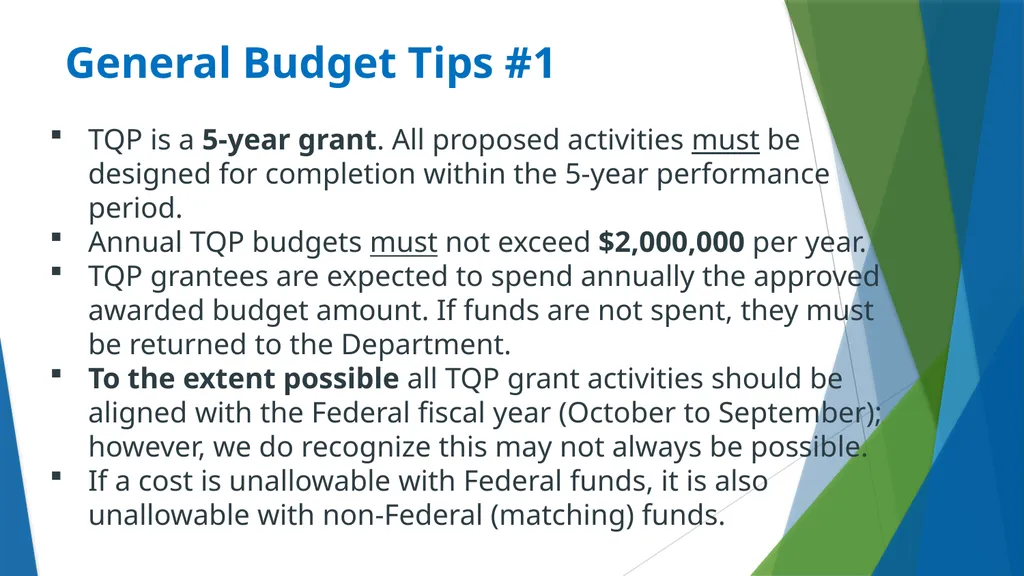
slide82. General Budget Tips #1 TQP is a 5-year grant. All proposed activities must be designed for completion within the 5-year performance period.
Annual TQP budgets must not exceed $2,000,000 per year.
TQP grantees are expected to spend annually the approved awarded budget amount. If funds are not spent, they must be returned to the Department.
To the extent possible all TQP grant activities should be aligned with the Federal fiscal year (October to September); however, we do recognize this may not always be possible.
If a cost is unallowable with Federal funds, it is also unallowable with non-Federal (matching) funds.<br>
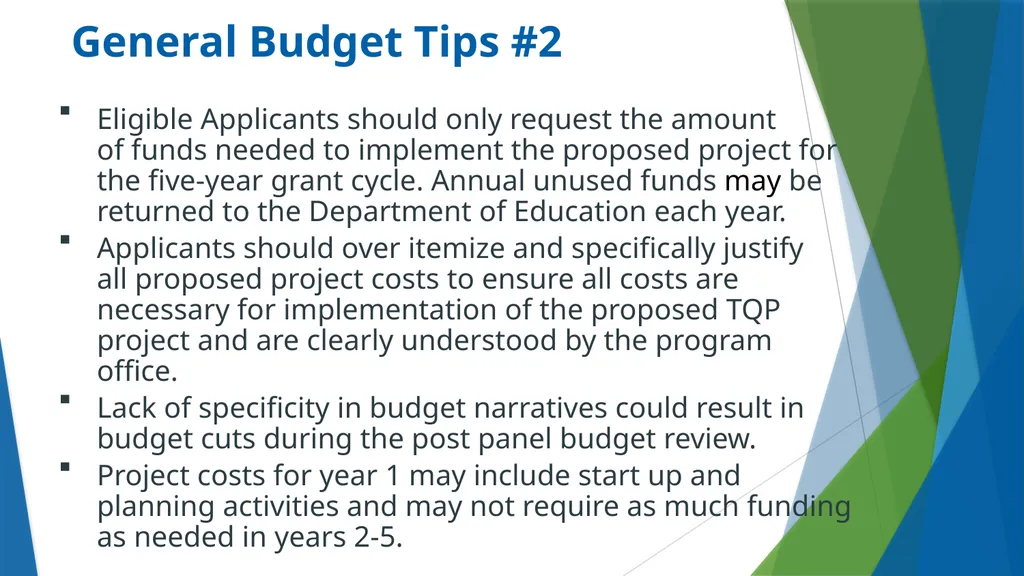
slide83. General Budget Tips #2 Eligible Applicants should only request the amount of funds needed to implement the proposed project for the five-year grant cycle. Annual unused funds may be returned to the Department of Education each year.
Applicants should over itemize and specifically justify all proposed project costs to ensure all costs are necessary for implementation of the proposed TQP project and are clearly understood by the program office.
Lack of specificity in budget narratives could result in budget cuts during the post panel budget review.
Project costs for year 1 may include start up and planning activities and may not require as much funding as needed in years 2-5.<br>
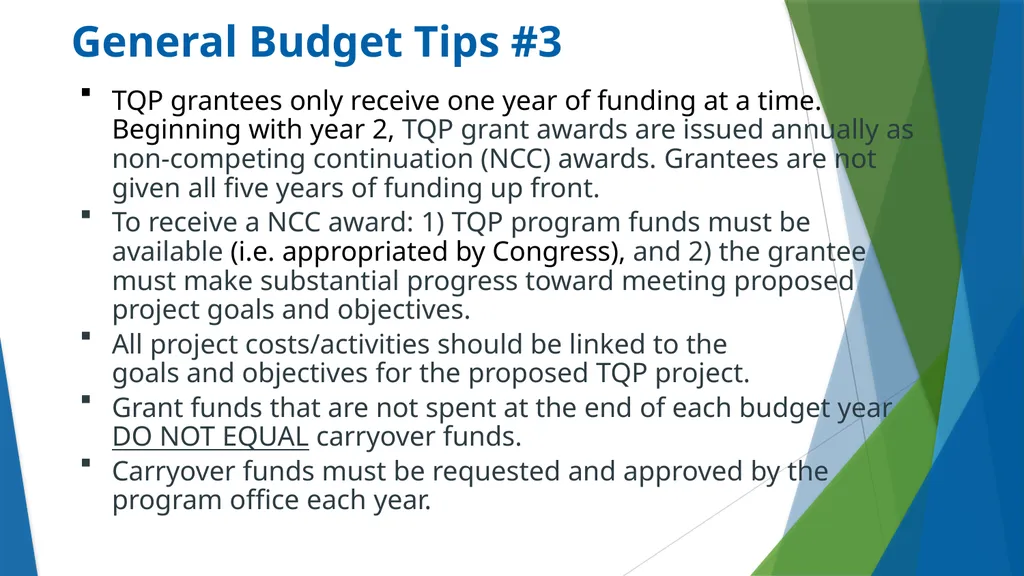
slide84. General Budget Tips #3 TQP grantees only receive one year of funding at a time. Beginning with year 2, TQP grant awards are issued annually as non-competing continuation (NCC) awards. Grantees are not given all five years of funding up front.
To receive a NCC award: 1) TQP program funds must be available (i.e. appropriated by Congress), and 2) the grantee must make substantial progress toward meeting proposed project goals and objectives.
All project costs/activities should be linked to the goals and objectives for the proposed TQP project.
Grant funds that are not spent at the end of each budget year DO NOT EQUAL carryover funds.
Carryover funds must be requested and approved by the program office each year.<br>
slide85. Questions & Answers<br>
slide86. TQP 2% Administrative Cost Cap (HEA Section 203(d))<br>
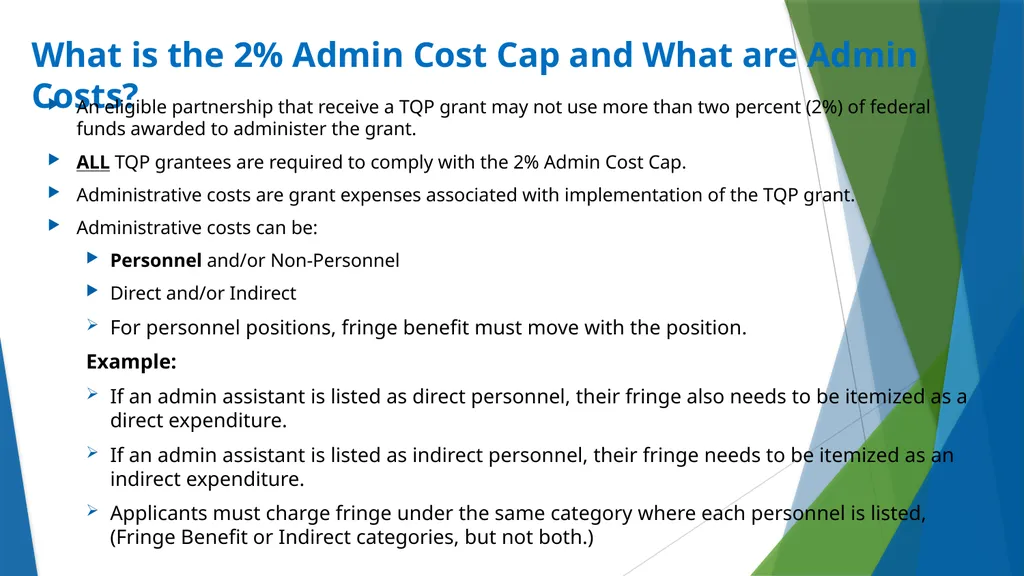
slide87. What is the 2% Admin Cost Cap and What are Admin Costs? An eligible partnership that receive a TQP grant may not use more than two percent (2%) of federal funds awarded to administer the grant.
ALL TQP grantees are required to comply with the 2% Admin Cost Cap.
Administrative costs are grant expenses associated with implementation of the TQP grant.
Administrative costs can be:
Personnel and/or Non-Personnel
Direct and/or Indirect
For personnel positions, fringe benefit must move with the position.
Example:
If an admin assistant is listed as direct personnel, their fringe also needs to be itemized as a direct expenditure.
If an admin assistant is listed as indirect personnel, their fringe needs to be itemized as an indirect expenditure.
Applicants must charge fringe under the same category where each personnel is listed, (Fringe Benefit or Indirect categories, but not both.)<br>
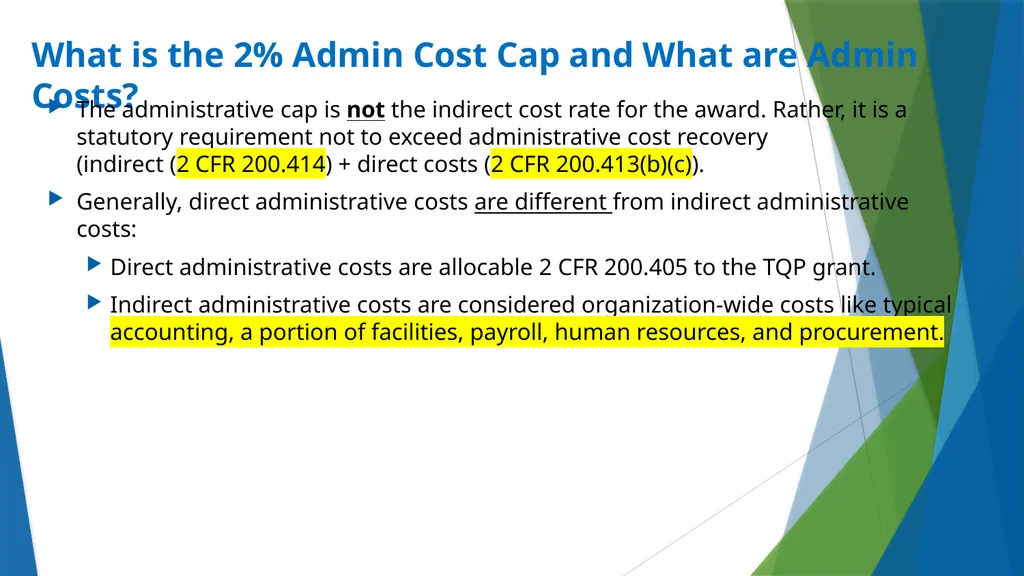
slide88. What is the 2% Admin Cost Cap and What are Admin Costs? The administrative cap is not the indirect cost rate for the award. Rather, it is a statutory requirement not to exceed administrative cost recovery (indirect (2 CFR 200.414) + direct costs (2 CFR 200.413(b)(c)).
Generally, direct administrative costs are different from indirect administrative costs:
Direct administrative costs are allocable 2 CFR 200.405 to the TQP grant.
Indirect administrative costs are considered organization-wide costs like typical accounting, a portion of facilities, payroll, human resources, and procurement.<br>
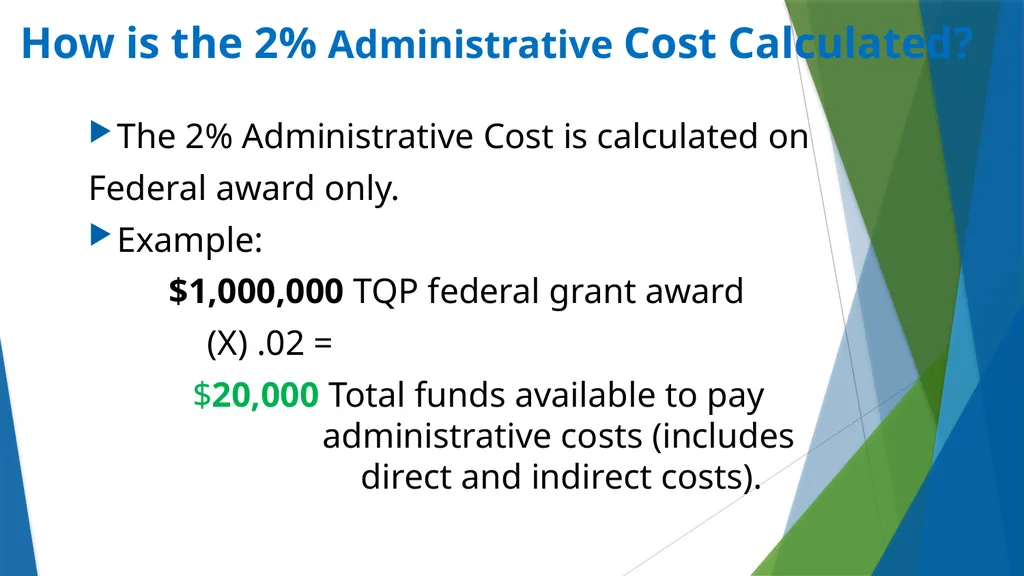
slide89. How is the 2% Administrative Cost Calculated? The 2% Administrative Cost is calculated on
Federal award only.
Example:
$1,000,000 TQP federal grant award
(X) .02 =
$20,000 Total funds available to pay administrative costs (includes direct and indirect costs).<br>
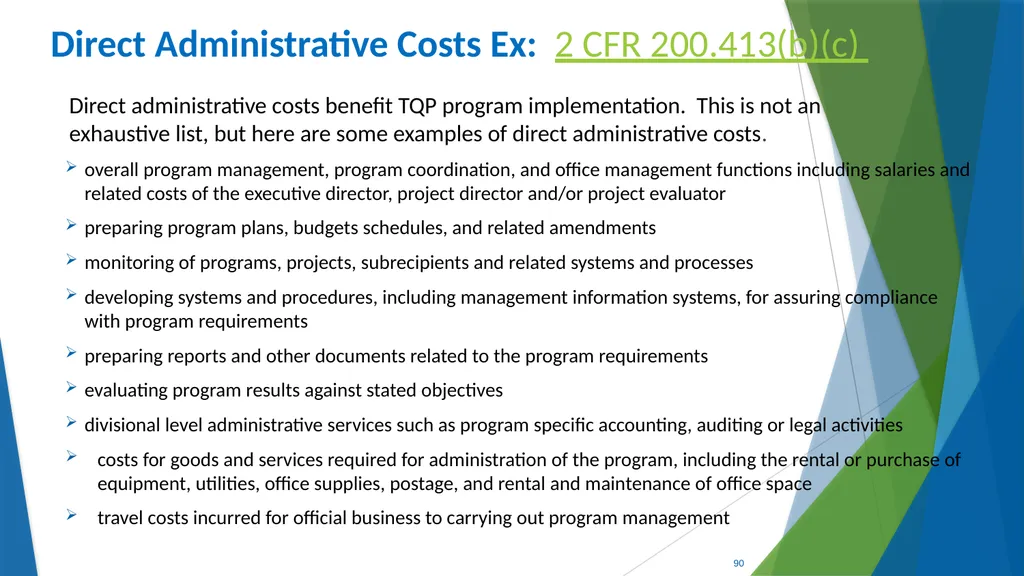
slide90. Direct Administrative Costs Ex: 2 CFR 200.413(b)(c) Direct administrative costs benefit TQP program implementation. This is not an exhaustive list, but here are some examples of direct administrative costs. overall program management, program coordination, and office management functions including salaries and related costs of the executive director, project director and/or project evaluator
preparing program plans, budgets schedules, and related amendments
monitoring of programs, projects, subrecipients and related systems and processes
developing systems and procedures, including management information systems, for assuring compliance with program requirements
preparing reports and other documents related to the program requirements
evaluating program results against stated objectives
divisional level administrative services such as program specific accounting, auditing or legal activities
costs for goods and services required for administration of the program, including the rental or purchase of equipment, utilities, office supplies, postage, and rental and maintenance of office space
travel costs incurred for official business to carrying out program management 90<br>
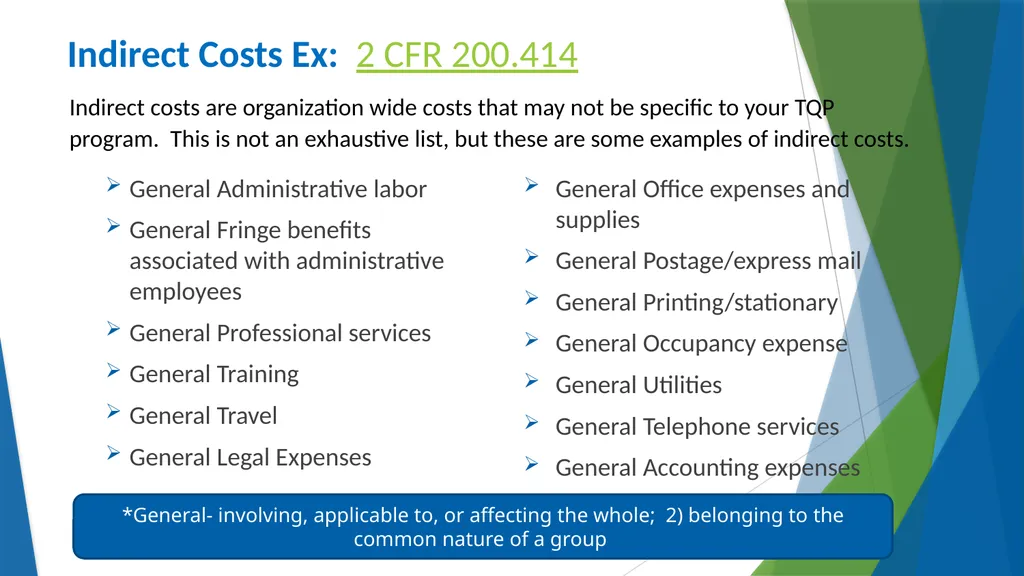
slide91. Indirect Costs Ex: 2 CFR 200.414 Indirect costs are organization wide costs that may not be specific to your TQP program. This is not an exhaustive list, but these are some examples of indirect costs. General Administrative labor
General Fringe benefits associated with administrative employees
General Professional services
General Training
General Travel
General Legal Expenses General Office expenses and supplies
General Postage/express mail
General Printing/stationary
General Occupancy expense
General Utilities
General Telephone services
General Accounting expenses 91 *General- involving, applicable to, or affecting the whole; 2) belonging to the common nature of a group<br>
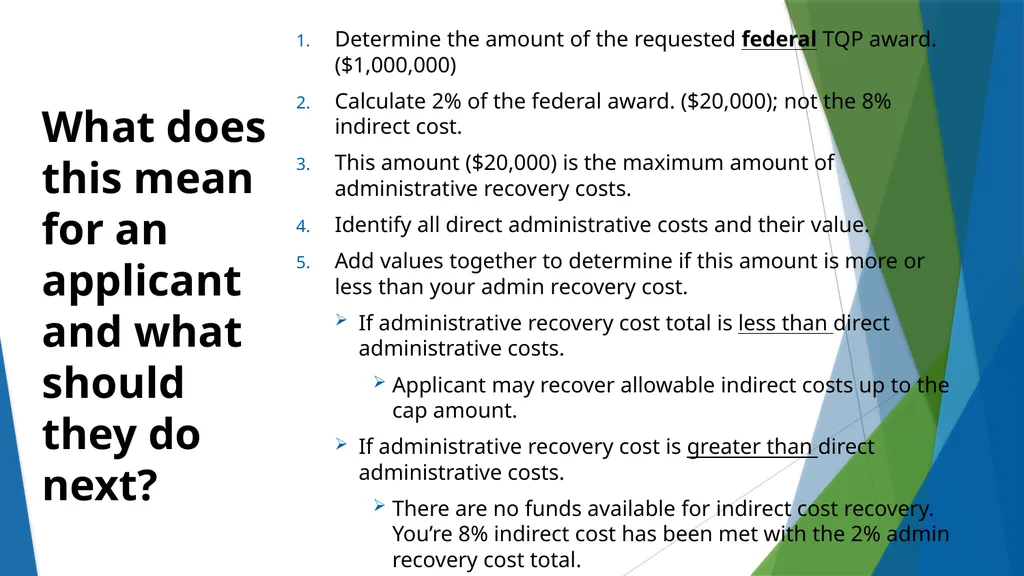
slide92. What does this mean for an applicant and what should they do next? Determine the amount of the requested federal TQP award. ($1,000,000)
Calculate 2% of the federal award. ($20,000); not the 8% indirect cost.
This amount ($20,000) is the maximum amount of administrative recovery costs.
Identify all direct administrative costs and their value.
Add values together to determine if this amount is more or less than your admin recovery cost.
If administrative recovery cost total is less than direct administrative costs.
Applicant may recover allowable indirect costs up to the cap amount.
If administrative recovery cost is greater than direct administrative costs.
There are no funds available for indirect cost recovery. You’re 8% indirect cost has been met with the 2% admin recovery cost total.<br>
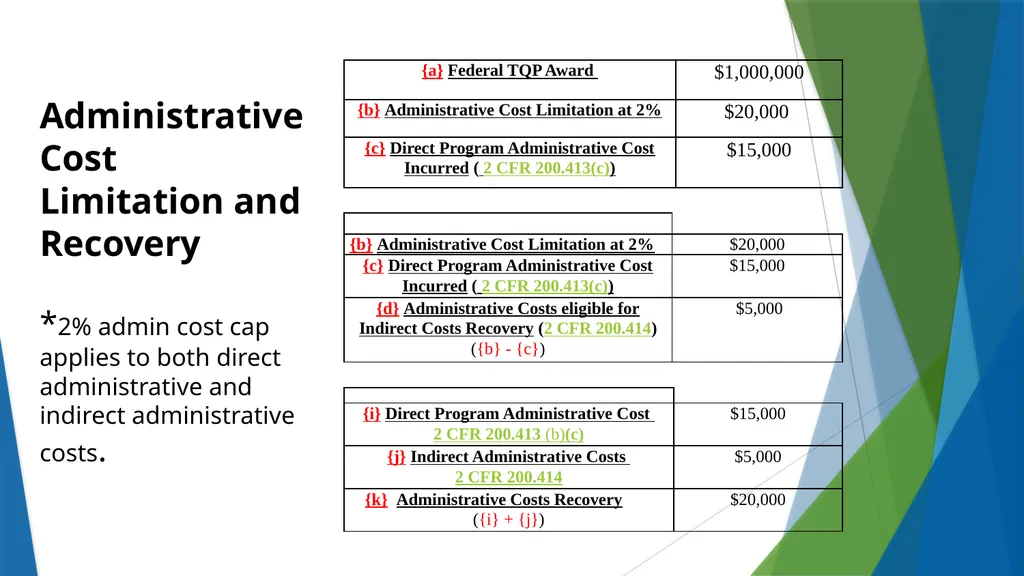
slide93. Administrative Cost Limitation and Recovery *2% admin cost cap applies to both direct administrative and indirect administrative costs.<br>
slide94. Final Question & Answer<br>
slide95. TQP Competition Reminders<br>
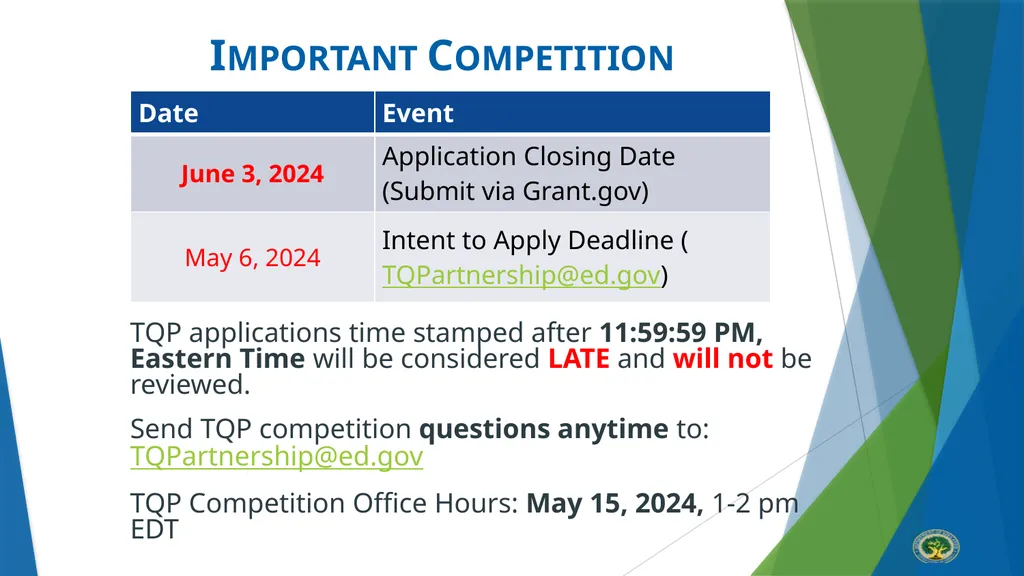
slide96. Important Competition Information TQP applications time stamped after 11:59:59 PM, Eastern Time will be considered LATE and will not be reviewed.
Send TQP competition questions anytime to: TQPartnership@ed.gov
TQP Competition Office Hours: May 15, 2024, 1-2 pm EDT<br>
slide97. Teacher Quality Partnership Grant Program APPLICATION CLOSING DATE:
JUNE 3, 2024
(11:59:59 PM Eastern Time)<br>
JUNE 3, 2024
(11:59:59 PM Eastern Time)<br>
slide2. Getting Started! Applicants should review the FY 2024 TQP Notice Inviting Applications (NIA) published in the Federal Register on April 4, 2024.
Applicants should review and download the TQP Application Instructions Package from the TQP webpage.
The TQP Application Instructions Package provides additional instructions and guidance when applying for the 2024 TQP grant.
This current slide deck is comprised of all 4 pre-application slide decks. See the program website for all four individual slide decks. Note: These slides are intended as technical assistance and do not impose any requirements beyond those included in the program statute, TQP NIA, or other applicable regulations. For more information, please refer to the official documents published in the Federal Register.<br>
slide3. TQP Program Website: https://oese.ed.gov/offices/office-of-discretionary-grants-support-services/effective-educator-development-programs/teacher-quality-partnership/
FY 2024 TQP Notice Inviting Applications (NIA)
FY 2024 TQP Application Instructions Package
FY 2024 TQP FAQ Documents (2)
FY 2024 TQP Informational Webinars (4)
Required TQP Program Checklists (2)
Required Effective Educator Development (EED) Applicant/Grantee
Budget Worksheet
Send all competition questions to the TQP Inbox at: TQPartnership@ed.gov TQP Competition Resources<br>
slide4. TQP Eligibility Checklists (2)
TQP Application and General Program Requirements Checklist
TQP Absolute Priority Checklist (select 1 of 4)
EED Applicant/Grantee Budget Worksheet
All checklists and Budget Worksheet are found on the TQP program website and must be submitted at the time of application. REQUIRED TQP Program Checklists and Budget Worksheet<br>
slide5. 5 TQP Webinar Agenda TQP Program Purpose and Statute
TQP Eligibility Requirements
TQP General Application Requirements and Program Requirements
TQP Program Priorities
TQP Selection Criteria and Scoring
TQP Performance Measures and Reporting
TQP Application Process
TQP Budget Cost Principles
TQP Budget Guidance
TQP 2% Administrative Cost Cap
TQP Competition Reminders<br>
slide6. TQP Program Purpose and Statute<br>
slide7. TQP Program Statute The Teacher Quality Partnership program statute is contained in Title II of the Higher Education Act (HEA), as amended on August 14, 2008, by the Higher Education Opportunity Act (Public Law 110-315)
Access the TQP program statute:
https://www.govinfo.gov/content/pkg/COMPS-765/pdf/COMPS-765.pdf<br>
slide8. TQP Program Purposes: To improve student achievement;
To improve the quality of prospective and new teachers by improving the preparation of prospective teachers and enhancing professional development activities for new teachers;
To hold teacher preparation programs at institutions of higher education accountable for preparing teachers who meet the applicable State certification and licensure requirements, including any requirements for certification obtained through alternative routes to certification, or, with regard to special education teachers, the qualifications described in section 1412(a)(14)(C) of the Individuals with Disabilities Education Act; and
To recruit highly qualified individuals, including minorities and individuals from other occupations, into the teaching force. 8<br>
slide9. TQP Eligibility Requirements<br>
slide10. The Eligible Partnership Eligible Applicants must be an “eligible partnership”
as defined in HEA section 200(6): All five (5) entities must be included as part of the “eligible partnership” 10<br>
slide11. Other OPTIONAL Entities for the “Eligible Partnership” (B) may include any of the following:
(i) The Governor of the State.
(ii) The State educational agency.
(iii) The State board of education.
(iv) The State agency for higher education.
(v) A business.
(vi) A public or private nonprofit educational organization.
(vii) An educational service agency.
(viii) A teacher organization. (ix) A high-performing local educational agency, or a consortium of such local educational agencies, that can serve as a resource to the partnership.
(x) A charter school (as defined in section 7221i of this title) (or ESEA section 4310).
(xi) A school or department within the partner institution that focuses on psychology and human development.
(xii) A school or department within the partner institution with comparable expertise in the disciplines of teaching, learning, and child and adolescent development.
(xiii) An entity operating a program that provides alternative routes to State certification of teachers.<br>
slide12. TQP Eligibility Components 12 Documentation of these eligibility requirements must be submitted at the time of application Poverty/Rural Status
and
Teacher Need Data See slides
16 and 17<br>
slide13. Poverty Data/Rural Status High need LEA data may be documented in one of the following ways below, the data provided must be the most recent data available.<br>
slide14. Teacher Need Data High need LEA data may be documented in one of the following ways below, the data provided must be the most recent data available.<br>
slide15. High-Need School Data High need school data may be documented in the following ways below, the data provided must be the most recent data available. The percentage of students aged 5 through 17 in poverty counted in the most recent census data approved by the Secretary.
The percentage of students eligible for a free or reduced-price school lunch (FRPL) under the Richard B. Russell National School Lunch Act [42 U.S.C. 1751 et seq.].
The percentage of students in families receiving assistance under the State program funded under part A of title IV of the Social Security Act [42 U.S.C. 601 et seq.].
The percentage of students eligible to receive medical assistance under the Medicaid program.
A composite of two or more of the measures described in subclauses (I) through (IV).<br>
slide16. High-Need School Data High need school data may be documented in the following ways below, the data provided must be the most recent data available.<br>
slide17. Required TQP Eligibility Checklists 17 The Eligible Partnership Checklist is 1 of 2 eligibility checklists.
Checklists are required and must be submitted at the time of application.
These checklists help the program team to determine if all eligibility requirements have been met.
Checklists can be found on the TQP program website.<br>
slide18. 18 Required TQP Eligibility Checklists The Partner IHE Eligibility Checklist is 2 of 2 eligibility checklists.
Checklists are required and must be submitted at the time of application.
These checklists help the program team to determine if all eligibility requirements have been met.
Checklists can be found on the TQP program website.<br>
slide19. TQP General Application and Program Requirements<br>
slide20. TQP General Application Requirements<br>
slide21. Needs Assessment Eligible Applicants must conduct a needs assessment of the proposed “eligible partnership”.
The needs assessment should influence the type of TQP project being proposed.
The needs assessment should help determine the types of teachers being prepared to meet the needs of the partner LEA(s) and schools. The needs assessment will also help determine what type of ongoing training and professional development needed to recruit, train, and retain teachers in the partner LEAs and schools.
If the eligible applicant is addressing AP 1 or AP 3, the needs assessment should help to determine what reform(s) need to be made at the College of Education within the partner IHE.
The Needs Assessment is not a part of the project narrative; the needs assessment must be uploaded separately into Appendix B. 21<br>
slide22. Description of the Project Describe how the partnership will prepare teachers:
With strong teaching skills
To use research and data to modify and improve classroom instruction
To teach students with disabilities, including as a member of IEP team under IDEA
To teach English Learners
Describe how Partner Institution faculty will work with LEA teachers to train other classroom teachers to implement literacy programs.
Describe how applicant will design, implement, or enhance a year-long rigorous teaching pre-service clinical component.
Describe how the applicant will support in-service professional development activities. 22<br>
slide23. Description of Coordination Strategies and Alignment with State and Student Academic and Achievement Standards Description must include how the partnership plans to:
Coordinate strategies with other professional development programs, including those that are funded under ESEA, IDEA, and other Federal sources
Have activities that are consistent with State ESEA academic content standards, State Early Childhood Education (ECE) standards and domains
Correspond with the goal of improving student academic achievement 23<br>
slide24. Assessment of Available Resources Application needs to describe resources available to the partnership:
Integration of funds from related sources
Intended use of grant funds
Commitment of the resources of the partnership to required project activities 24<br>
slide25. Description of Evaluation Plan Application needs to describe:
The evaluation plan under section 204(a) of the HEA
How the partnership will collect, analyze, and use data on retention to evaluate the effectiveness of the partnership’s teacher support systems 25<br>
slide26. TQP 100% Non-Federal Match Requirement: Section 203(c)(1) of HEA, requires that each grantee provide matching funds from non-Federal sources that equal 100% of the Federal TQP grant award.
In other words, the grantee must provide a dollar of matching funds for each dollar of Federal grant funds received.
Match funds share the Federal government’s cost for programs with State and local agencies and the private sector; and
Match funds promote the sustainability of programs after Federal funding has ended.
*Federal funds should be viewed as “seed money” to fund work that will continue to impact partner districts long after federal funding ends. 26<br>
slide27. Where do Non-Federal Match funds come from? Match funds must be from non-Federal sources. (i.e. project partners and other nonfederal contributors)
Match funds may be cash or in-kind contributions.
In-Kind or non-cash contributions provided by the applicant or non-Federal partners typically have a calculated value for personnel, goods, and/or services, including direct and indirect costs.
Match funds should be incorporated into the total cost of your proposed project, not added on top of cost of the proposed project.
Eligible Applicants may not use unrecovered indirect costs towards meeting the match/cost share requirement without receiving prior approval from the Department. 27<br>
slide28. Questions & Answers<br>
slide29. FY 2024 TQP Absolute Priorities<br>
slide30. TQP Program Priorities 30<br>
slide31. AP1: Partnership Grants for the Preparation of Teachers (Pre-Bac Model)<br>
slide32. Pre-Bac Model Requirement Highlights Pre-Bac models must reform ALL or an IDENTIFIED PART of IHE’s teacher preparation program
Pre-bac model reforms must be completed within the life of the proposed grant period
Pre-Bac models must recruit teacher candidates based on the needs of the partner high-need LEA
Pre-Bac models must provide a year-long (academic year) clinical experience
Pre-Bac models must provide a 2-year induction program
Pre-Bac models must support and train teacher candidates
Pre-Bac model participants (teacher candidates) must be placed in cohorts to facilitate professional collaboration
Pre-Bac models may include a 5th year licensing program
Pre-Bac models may change/develop program curriculum
*Applicants must use the Required TQP Absolute Priority Checklist to document where all Absolute Priority Requirements can be found in the application.
(See Section 202(d) of the HEA for full Absolute Priority language.)
32<br>
slide33. AP2: Partnership Grants for the Establishment of Effective Teaching Residency Programs (Residency Model)<br>
slide34. Residency Model Requirement Highlights Residency models must establish a new or redesign existing teaching residency programs.
Residency models must have a rigorous selection criteria for residents and mentor teachers.
Residency models must provide a master's degree program designed to be completed by residents within 18-months.
Residency models must include a year-long (academic year) clinical experience.
Residency models must offer a one-year Living Wage Stipend/Salary (LWS).
Residents must complete a 3-year service agreement with the partner high-need LEA; if not, LWS must be repaid.
Residency models must provide at least a 2-year induction program.
Residency models must provide training and support for teaching residents
Residency model participants (Residents) must be placed in cohorts to facilitate professional collaboration
Applicants must use the Required TQP Absolute Priority Checklist to document where all Absolute Priority Requirements can be found in the application.
(See Section 202(e) of the HEA for full Absolute Priority language.) 34<br>
slide35. AP3: Partnership Grants for the Development of Leadership Programs in Conjunction with the Preparation of Teachers under Absolute Priority 1 (Pre-Bac Model with Leadership) AP4: Partnership Grants for the Development of Leadership Programs in Conjunction with the Establishment of an Effective Teaching Residency Program under Absolute Priority 2 (Residency Model with Leadership)<br>
slide36. Leadership Model Requirement Highlights Leadership models must be implemented with a new Pre-Bac or Residency Model. The Leadership model is not a stand-alone model.
Leadership models must be part of the same proposed project of the Pre-Bac or Residency Model, and applicants must include how TQP grant funds will be used to support both the leadership models and Pre-Bac or Residency Model.
Leadership models must prepare individuals for careers as superintendents, principals, Early Childhood Education (ECE) program directors, or other school leaders.
Leadership models must promote strong leadership skills and, as applicable, techniques for school leaders.
Leadership models must develop and improve a sustained and high-quality preservice clinical education program to further develop the leadership skills of all prospective school leaders involved in the program.
Leadership models must create an induction program for new school leaders 36<br>
slide37. Leadership Model Requirement Highlights Leadership models must ensure that individuals who participate in the school leadership program receive—
(i) Effective preservice preparation
(ii) Mentoring; and
(iii) If applicable, full State certification or licensure to become a school leader.
Leadership models must develop and implement effective mechanisms to ensure that the eligible partnership is able to recruit qualified individuals to become school leaders…
An “eligible partnership” may carry out the school leadership program either in the partner high-need LEA or in further partnership with an LEA located in a rural area.
Applicants must use the Required TQP Absolute Priority Checklist to document where all Absolute Priority Requirements can be found in the application.
(See Section 202(f) of the HEA for full Absolute Priority language.) 37<br>
slide38. FY 2024 TQP Competitive Preference Priorities<br>
slide39. Competitive Preference Priority 1 Increasing Educator Diversity (Up to 4 pTS) Possible
Priority Activities
(one or both) Adopt, implement or expand high-quality, comprehensive teacher preparation programs in HBCUs, HSIs, Tribal Colleges/Universities, or other minority serving institutions (MSI).
Reforms to teacher preparation programs to improve the diversity of teacher candidates. Increasing Educator Diversity Improve the recruitment, outreach, preparation, support, development, and retention of a diverse educator workforce. (See the NIA for the full Competitive Preference Priority language.)<br>
slide40. Competitive Preference Priority 2 40 Supporting a Diverse Educator Workforce and Professional Growth to Strengthen Student Learning (up to 3 pTS) Increase the proportion of well-prepared, diverse, and effective educators serving students, with focus on underserved students. Possible
Priority Activities
(one or both) Increase the number of teachers with certification or dual certification in a shortage area.
Advanced certifications from nationally recognized professional organizations. Support Diverse Educator Workforce (See the NIA for the full Competitive Preference Priority language.)<br>
slide41. Competitive Preference Priority 3 41 Meeting Student Social, Emotional, and Academic Needs (up to 2 PTS) Creating a positive, inclusive, and identity-safe climate at institutions of higher education. Possible
Priority
Activities
(one or more) Fostering a sense of belonging and inclusion for underserved students.
Implementing evidence-based practices for advancing student success for underserved students. Improve students’ social, emotional, academic, and career development (See the NIA for the full Competitive Preference Priority language.)<br>
slide42. Competitive Preference Priority 4 Promoting Equity in Student Access to Educational Resources and Opportunities (UP to 2 pTS) Promote educational equity and adequacy in resources and opportunity for underserved students. Possible
Priority
Activities
(one or both) See NIA language for a complete list of service areas and populations. Equity in Student Access (See the NIA for the full Competitive Preference Priority language.)<br>
slide43. FY 2024 TQP Invitational Priorities<br>
slide44. Invitational Priority #1 Partnership Grants for the Establishment of GYO Programs and Registered Apprenticeship Programs for K-12 Teachers. Projects that establish or scale evidence-based and high quality GYO programs, including through a registered apprenticeship programs, that are designed to address shortages of teachers in high-need areas, schools, and/or geographic areas, or shortages of school leaders in high-need schools, and increase the diversity of qualified individuals entering the teacher, principal, or other school leader workforce, by recruiting and developing teacher candidates from the communities the school or district serves... (please see NIA for complete invitational priority language) Grow
Your
Own<br>
slide45. Invitational Priority #2 SUPPORTING EARLY ELEMENTARY EDUCATORS AND SCHOOL LEADERS K-2 Educators and School Leaders Projects that include professional development programs, professional learning communities, and peer learning collaboratives to support elementary educators and school leaders in meeting the wide range of developmental strengths, needs, and experiences of students at kindergarten entry through the early grades with a focus on one or more of the following strategies... (please see NIA for complete invitational priority language)<br>
slide46. Questions & Answers<br>
slide47. TQP Selection Criteria and Scoring<br>
slide48. TQP Selection Criteria Point Allocation 48<br>
slide49. Quality of Project Design (up to 30 pts) 49 The extent to which the proposed project demonstrates a rationale.
(see Logic Model slide) The extent to which the proposed project is part of a comprehensive effort to improve teaching and learning and support rigorous academic standards for students. The extent to which goals, objectives, and outcomes to be achieved by the proposed project are clearly specified and measurable. The extent to which the design of the proposed project reflects up-to-date knowledge from research and effective practice. The extent to which performance feedback and continuous improvement are integral to the design of the proposed project. The extent to which the proposed project is designed to build capacity and yield results that will extend beyond the period of Federal financial assistance. Please see TQP NIA for full Selection Criteria language.<br>
slide50. What is a Logic Model A Logic Model is also referred to as a theory of action, means a framework that identifies key project components of the proposed project (i.e., the active “ingredients” that are hypothesized to be critical to achieving the relevant outcomes) and describes the theoretical and operational relationships among the key project components and relevant outcomes.
Demonstrates a Rationale means a key project component included in the project's logic model is informed by research or evaluation findings that suggest the project component is likely to improve relevant outcomes.
Logic models communicate a project’s vision, objectives, and goals to their internal team and stakeholders.
Logic Models can be used in program planning, implementation, evaluation, and communication.
Logic Models reflect the goals and activities in the grantee’s application.
Logic Models identify the grantee’s projects and expected outcomes.
Eligible Applicants should include a logic model at the time of application in Appendix C.
Resource: https://ies.ed.gov/ncee/edlabs/regions/pacific/elm.asp<br>
slide51. Quality of Project Evaluation (up to 20 pts.) 51 The extent to which the methods of evaluation will provide valid and reliable performance data on relevant outcomes. The extent to which the methods of evaluation are thorough, feasible, and appropriate to the goals, objectives, and outcomes of the proposed project. Please see TQP NIA for full Selection Criteria language.<br>
slide52. Balance of Costs with Outcomes of Project The extent to which the budget is adequate to support the proposed project. The adequacy of support, including facilities, equipment, supplies, and other resources, from the applicant organization or the lead applicant organization. The extent to which the applicant demonstrates that it has the resources to operate the project beyond the length of the grant, including a multi-year financial and operation model and accompanying plan… The extent to which the costs are reasonable in relation to the objectives, design, and potential significance of the proposed project. Adequacy of Resources (up to 30 pts) Please see TQP NIA for full Selection Criteria language.<br>
slide53. Quality of the Management Plan (up to 20 pts) The adequacy of the management plan to achieve the objectives of the proposed project on time and within budget, including clearly defined responsibilities, timelines, and milestones for accomplishing project tasks. The adequacy of procedures for ensuring feedback and continuous improvement in the operation of the proposed project. Please see TQP NIA for full Selection Criteria language.<br>
slide54. TQP Performance Measures, Individual Project Measures and Annual Reporting<br>
slide55. Performance Measures vs. Individual Project Measures Individual Project Measures (IPM)
IPMs should reflect the specific goals, objectives, and outcome of each TQP project as not all TQP projects are designed the same.
IPMs should be incorporated into the proposed TQP evaluation plan.
IPMs should support meeting the Performance measures outlined in the TQP NIA. Performance Measures
Created by the Department to evaluate the overall effectiveness of the grantee’s project, as well as the TQP program.
Designed to provide data and evidence to that will support TQP program effectiveness.
This data helps Congress determine the amount of funds appropriated to the TQP program.
TQP PERFORMANCE MEASURES are found in the TQP NIA and must be included in the proposed TQP evaluation plan.<br>
slide56. 2024 TQP Performance Measures 56 Performance Measure 1: Certification. The percentage of program participants that attained certification within one year of graduating from the program.
Performance Measure 2: Shortage Area Certification. The percentage of shortage area program participants that attained certification within one year of graduating from the program.
Performance Measure 3: 1-Year Persistence. The percentage of program participants who were enrolled in the previous reporting period, did not graduate, and persisted in the postsecondary program in the current reporting period.
Performance Measure 4: 1-Year Employment Retention. The percentage of program completers who were employed for the first time as teachers of record in the preceding year by the partner high-need Local Education Agency (LEA).
Performance Measure 5: 3-Year Employment Retention. The percentage of program completers who were employed by the partner high-need LEA or ECE program for three years after initial employment.
Efficiency Measure: The Federal cost per program completer. (Report in final year only.) Please see TQP NIA for full Performance Measure language.<br>
slide57. 57 REPORTING<br>
slide58. TQP Application Process<br>
slide59. Application Process: Preparing to Submit Applications must be submitted via Grants.gov by June 3, 2024.
Applicants must complete the Grants.gov registration process.
Go to the Applicants tab, then the Get Registered section, then the Organization Applicant Registration section.
You must obtain a Unique Entity Identifier (UEI) and register with SAM (System for Award Management) as part of this process.
An applicant that does not have an active SAM registration can still register with Grants.gov, but must contact the Grants.gov Support Desk 59 Register EARLY!<br>
slide60. Application Process: Application Submission In Grants.gov, search for the Funding Opportunity Number: ED-GRANTS-040424-001
Click on the link, then click on the Package tab. Under Actions, click Select Package and follow the instructions.
Please review the Grants.gov Applicant FAQs as you prepare and submit your application.
Contact the Grants.gov Help Desk if you experience problems submitting your application.
Phone: 1-800-518-4726
Email: support@grants.gov 60 Submit EARLY!<br>
slide61. Application Process: Use Required Forms 61 Submit EARLY! Required ED Forms
SF 424 Application Form for Federal Assistance
ED Supplemental Form for SF 524
Grant Application Form for Project Objectives and Performance Measures
General Education Provisions Act (GEPA) Requirements - Section 427
Grants.gov Certification Regarding Lobbying (formerly ED 80-0013)
SF 424B Form -Assurances, Non-Construction Programs Required TQP Forms
TQP Eligibility Checklist (2)
TQP Application and General Program Requirements Checklist
Absolute Priority Checklists (1 of 4)
Effective Educator Development (EED) Applicant/ Grantee Budget Worksheet<br>
slide62. Importance of Using Required Forms It is imperative that all forms listed on the previous slide be included at the time of application submission.
The ED required forms help the Department collect applicant and competition data that may be useful in making funding and future competition decisions.
The TQP required forms help the TQP program staff determine if all program and absolute priority requirements have been met and where that information can be found in the application. If it cannot be clearly determined that these requirements have been met, an application may be deemed ineligible, and may not be reviewed. Submit EARLY!<br>
slide63. All applications are screened to identify late and duplicate applications.
Remaining applications are screened to determine:
Establishment of an “eligible partnership”;
All General Application and Program requirements have been met;
All Absolute Priority requirements have been met; and
Selection Criteria as been addressed
Eligible applications will be placed on a panel to be reviewed and scored by three non-Federal peer reviewers.
Applications are placed in rank order by total score.
Applications in funding range receive a post panel budget review.
An official slate memo is drafted and approved by the Secretary prior to making awards.
New awards will be announced on or before October 1, 2024. Application Process: What happens after submission<br>
slide64. TQP Program Cost Principles<br>
slide65. Grant Funds = Grant Activities Each Federal dollar that is awarded to a TQP grantee is inextricably linked to TQP activities or TQP actions.
Funding spent (or unspent) directly affects outcomes for educators and students.<br>
slide66. All Program Costs Must Be… All program costs should be justified and linked to project goals and objectives<br>
slide67. Supplement Not Supplant (Section 202(k) of the HEA) Applicants may not use grant funds to cover goods, services or personnel that would normally be covered by the eligible entity in the absence of TQP grant funds. If goods, services, or personnel exist or are covered without TQP program funds, it is likely supplanting. Example:
TQP project proposes to pay for mentor teacher salaries for staff who will work with TQP project participants. This is supplanting because the partner district would be responsible to cover teacher salaries with or without a TQP grant.<br>
slide68. Notable Unallowable TQP Costs<br>
slide69. Notable Unallowable TQP Costs<br>
slide70. Notable Unallowable TQP Costs<br>
slide71. Preparing the TQP Budget Summary and Budget Narrative<br>
slide72. EED Applicant/Grantee Budget Worksheet Eligible Applicants must use the Required EED Applicant/Grantee Budget Worksheet to request Federal funds and report non-Federal funds for all five years of the proposed project.
The Required EED Applicant/Grantee Budget Worksheet is used to provide the budget summary and budget narrative for all five years of the proposed project. This worksheet replaces the ED 524 Budget Summary Form for Federal and non-Federal funds.
Eligible Applicants should work with their institution’s Budget office to complete the Required EED Applicant/Grantee Budget Worksheet.<br>
slide73. EED Applicant/Grantee Budget Worksheet This budget worksheet has seven tabs A-E:
Section A: Budget Summary for Federal funds
Section B: Budget Summary for non-Federal funds.
Section C: Document Match Fund and Sources
Section D1: Federal Funds Breakdown
Section D2: Non-Federal Funds Breakdown
Section E1: Federal Funds Narrative
Section E2: Non-Federal Funds Narrative
This budget worksheet has the same line items as the standard ED 524 budget summary form and should be used in the same way.
Entries on this worksheet should be itemized and well explained.<br>
slide74. Document Match Funds and Sources Eligible Applicants will use Section C to document secured match funds and the donation source.
Only include match funds that have already been secured and will be available immediately if the proposed project is funded.
Actual letters of support are not necessary at the time of application; however, applicants should maintain those letters as part of internal records.<br>
slide75. Personnel costs associated with the management or implementation of project.
Personnel costs associated with the time that project participants engage in project activities, including, but not limited to:
Professional Development
Mentoring, coaching, or teacher leadership.
Resident Living Wage Stipends
Project planning activities, including participation in professional learning communities.
Facilities needed for project implementation
Non-personnel costs relating to the implementation of the project that are discounted or provided, including, but not limited to:
Training-related supplies.
Project-related communications.
Technology integral to the project.
Purchases, upgrades, or licensing fees needed for project data management systems. Examples of Uses for Match Funds from
Non-Federal Sources<br>
slide76. Line-Item Guidance For Preparing aTQP Budget Narrative<br>
slide77. Budget Line-Item Guidance<br>
slide78. Budget Line-Item Guidance<br>
slide79. Budget Line-Item Guidance<br>
slide80. Budget Line-Item Guidance<br>
slide81. TQP Indirect Cost Rates (ICR) The TQP program uses a training indirect cost rate of up to 8% MTDC as described in 34 CFR § 75.562.
If an applicant has a negotiated indirect rate that is lower than 8% MTDC, they must use the lower rate 34 CFR 75.562(c)(1) .
The training indirect cost rate does not apply to agencies of Indian tribal governments, local governments, and States as required by and those applicants must instead use their approved 34 CFR § 75.562(c)(4) ,restricted indirect cost rate.
The difference between training rate and negotiated indirect cost rate (unrecovered cost) may not be counted toward meeting the cost share requirement 34 CFR §75.562(c)(5) .
HOWEVER:
TQP has a 2% Administrative Cost Cap that limits recovery(direct administrative (2 CFR 200.413(b)&(c) + indirect costs 2 CFR 200.414) to 2% of the total federal award which may result in lesser indirect cost recovery than prescribed by the training indirect cost rate.<br>
slide82. General Budget Tips #1 TQP is a 5-year grant. All proposed activities must be designed for completion within the 5-year performance period.
Annual TQP budgets must not exceed $2,000,000 per year.
TQP grantees are expected to spend annually the approved awarded budget amount. If funds are not spent, they must be returned to the Department.
To the extent possible all TQP grant activities should be aligned with the Federal fiscal year (October to September); however, we do recognize this may not always be possible.
If a cost is unallowable with Federal funds, it is also unallowable with non-Federal (matching) funds.<br>
slide83. General Budget Tips #2 Eligible Applicants should only request the amount of funds needed to implement the proposed project for the five-year grant cycle. Annual unused funds may be returned to the Department of Education each year.
Applicants should over itemize and specifically justify all proposed project costs to ensure all costs are necessary for implementation of the proposed TQP project and are clearly understood by the program office.
Lack of specificity in budget narratives could result in budget cuts during the post panel budget review.
Project costs for year 1 may include start up and planning activities and may not require as much funding as needed in years 2-5.<br>
slide84. General Budget Tips #3 TQP grantees only receive one year of funding at a time. Beginning with year 2, TQP grant awards are issued annually as non-competing continuation (NCC) awards. Grantees are not given all five years of funding up front.
To receive a NCC award: 1) TQP program funds must be available (i.e. appropriated by Congress), and 2) the grantee must make substantial progress toward meeting proposed project goals and objectives.
All project costs/activities should be linked to the goals and objectives for the proposed TQP project.
Grant funds that are not spent at the end of each budget year DO NOT EQUAL carryover funds.
Carryover funds must be requested and approved by the program office each year.<br>
slide85. Questions & Answers<br>
slide86. TQP 2% Administrative Cost Cap (HEA Section 203(d))<br>
slide87. What is the 2% Admin Cost Cap and What are Admin Costs? An eligible partnership that receive a TQP grant may not use more than two percent (2%) of federal funds awarded to administer the grant.
ALL TQP grantees are required to comply with the 2% Admin Cost Cap.
Administrative costs are grant expenses associated with implementation of the TQP grant.
Administrative costs can be:
Personnel and/or Non-Personnel
Direct and/or Indirect
For personnel positions, fringe benefit must move with the position.
Example:
If an admin assistant is listed as direct personnel, their fringe also needs to be itemized as a direct expenditure.
If an admin assistant is listed as indirect personnel, their fringe needs to be itemized as an indirect expenditure.
Applicants must charge fringe under the same category where each personnel is listed, (Fringe Benefit or Indirect categories, but not both.)<br>
slide88. What is the 2% Admin Cost Cap and What are Admin Costs? The administrative cap is not the indirect cost rate for the award. Rather, it is a statutory requirement not to exceed administrative cost recovery (indirect (2 CFR 200.414) + direct costs (2 CFR 200.413(b)(c)).
Generally, direct administrative costs are different from indirect administrative costs:
Direct administrative costs are allocable 2 CFR 200.405 to the TQP grant.
Indirect administrative costs are considered organization-wide costs like typical accounting, a portion of facilities, payroll, human resources, and procurement.<br>
slide89. How is the 2% Administrative Cost Calculated? The 2% Administrative Cost is calculated on
Federal award only.
Example:
$1,000,000 TQP federal grant award
(X) .02 =
$20,000 Total funds available to pay administrative costs (includes direct and indirect costs).<br>
slide90. Direct Administrative Costs Ex: 2 CFR 200.413(b)(c) Direct administrative costs benefit TQP program implementation. This is not an exhaustive list, but here are some examples of direct administrative costs. overall program management, program coordination, and office management functions including salaries and related costs of the executive director, project director and/or project evaluator
preparing program plans, budgets schedules, and related amendments
monitoring of programs, projects, subrecipients and related systems and processes
developing systems and procedures, including management information systems, for assuring compliance with program requirements
preparing reports and other documents related to the program requirements
evaluating program results against stated objectives
divisional level administrative services such as program specific accounting, auditing or legal activities
costs for goods and services required for administration of the program, including the rental or purchase of equipment, utilities, office supplies, postage, and rental and maintenance of office space
travel costs incurred for official business to carrying out program management 90<br>
slide91. Indirect Costs Ex: 2 CFR 200.414 Indirect costs are organization wide costs that may not be specific to your TQP program. This is not an exhaustive list, but these are some examples of indirect costs. General Administrative labor
General Fringe benefits associated with administrative employees
General Professional services
General Training
General Travel
General Legal Expenses General Office expenses and supplies
General Postage/express mail
General Printing/stationary
General Occupancy expense
General Utilities
General Telephone services
General Accounting expenses 91 *General- involving, applicable to, or affecting the whole; 2) belonging to the common nature of a group<br>
slide92. What does this mean for an applicant and what should they do next? Determine the amount of the requested federal TQP award. ($1,000,000)
Calculate 2% of the federal award. ($20,000); not the 8% indirect cost.
This amount ($20,000) is the maximum amount of administrative recovery costs.
Identify all direct administrative costs and their value.
Add values together to determine if this amount is more or less than your admin recovery cost.
If administrative recovery cost total is less than direct administrative costs.
Applicant may recover allowable indirect costs up to the cap amount.
If administrative recovery cost is greater than direct administrative costs.
There are no funds available for indirect cost recovery. You’re 8% indirect cost has been met with the 2% admin recovery cost total.<br>
slide93. Administrative Cost Limitation and Recovery *2% admin cost cap applies to both direct administrative and indirect administrative costs.<br>
slide94. Final Question & Answer<br>
slide95. TQP Competition Reminders<br>
slide96. Important Competition Information TQP applications time stamped after 11:59:59 PM, Eastern Time will be considered LATE and will not be reviewed.
Send TQP competition questions anytime to: TQPartnership@ed.gov
TQP Competition Office Hours: May 15, 2024, 1-2 pm EDT<br>
slide97. Teacher Quality Partnership Grant Program APPLICATION CLOSING DATE:
JUNE 3, 2024
(11:59:59 PM Eastern Time)<br>