Teaching about drugs, alcohol and tobacco Part of:

Published  . 0 views
↓ Download
Teaching about drugs, alcohol and tobacco Part of:
1 / 1
Teaching about drugs, alcohol and tobacco Part of: - slide 1 of 90 Teaching about drugs, alcohol and tobacco Part of: - slide 2 of 90 Teaching about drugs, alcohol and tobacco Part of: - slide 3 of 90 Teaching about drugs, alcohol and tobacco Part of: - slide 4 of 90 Teaching about drugs, alcohol and tobacco Part of: - slide 5 of 90 Teaching about drugs, alcohol and tobacco Part of: - slide 6 of 90 Teaching about drugs, alcohol and tobacco Part of: - slide 7 of 90 Teaching about drugs, alcohol and tobacco Part of: - slide 8 of 90 Teaching about drugs, alcohol and tobacco Part of: - slide 9 of 90 Teaching about drugs, alcohol and tobacco Part of: - slide 10 of 90 Teaching about drugs, alcohol and tobacco Part of: - slide 11 of 90 Teaching about drugs, alcohol and tobacco Part of: - slide 12 of 90 Teaching about drugs, alcohol and tobacco Part of: - slide 13 of 90 Teaching about drugs, alcohol and tobacco Part of: - slide 14 of 90 Teaching about drugs, alcohol and tobacco Part of: - slide 15 of 90 Teaching about drugs, alcohol and tobacco Part of: - slide 16 of 90 Teaching about drugs, alcohol and tobacco Part of: - slide 17 of 90 Teaching about drugs, alcohol and tobacco Part of: - slide 18 of 90 Teaching about drugs, alcohol and tobacco Part of: - slide 19 of 90 Teaching about drugs, alcohol and tobacco Part of: - slide 20 of 90 Teaching about drugs, alcohol and tobacco Part of: - slide 21 of 90 Teaching about drugs, alcohol and tobacco Part of: - slide 22 of 90 Teaching about drugs, alcohol and tobacco Part of: - slide 23 of 90 Teaching about drugs, alcohol and tobacco Part of: - slide 24 of 90 Teaching about drugs, alcohol and tobacco Part of: - slide 25 of 90 Teaching about drugs, alcohol and tobacco Part of: - slide 26 of 90 Teaching about drugs, alcohol and tobacco Part of: - slide 27 of 90 Teaching about drugs, alcohol and tobacco Part of: - slide 28 of 90 Teaching about drugs, alcohol and tobacco Part of: - slide 29 of 90 Teaching about drugs, alcohol and tobacco Part of: - slide 30 of 90 Teaching about drugs, alcohol and tobacco Part of: - slide 31 of 90 Teaching about drugs, alcohol and tobacco Part of: - slide 32 of 90 Teaching about drugs, alcohol and tobacco Part of: - slide 33 of 90 Teaching about drugs, alcohol and tobacco Part of: - slide 34 of 90 Teaching about drugs, alcohol and tobacco Part of: - slide 35 of 90 Teaching about drugs, alcohol and tobacco Part of: - slide 36 of 90 Teaching about drugs, alcohol and tobacco Part of: - slide 37 of 90 Teaching about drugs, alcohol and tobacco Part of: - slide 38 of 90 Teaching about drugs, alcohol and tobacco Part of: - slide 39 of 90 Teaching about drugs, alcohol and tobacco Part of: - slide 40 of 90 Teaching about drugs, alcohol and tobacco Part of: - slide 41 of 90 Teaching about drugs, alcohol and tobacco Part of: - slide 42 of 90 Teaching about drugs, alcohol and tobacco Part of: - slide 43 of 90 Teaching about drugs, alcohol and tobacco Part of: - slide 44 of 90 Teaching about drugs, alcohol and tobacco Part of: - slide 45 of 90 Teaching about drugs, alcohol and tobacco Part of: - slide 46 of 90 Teaching about drugs, alcohol and tobacco Part of: - slide 47 of 90 Teaching about drugs, alcohol and tobacco Part of: - slide 48 of 90 Teaching about drugs, alcohol and tobacco Part of: - slide 49 of 90 Teaching about drugs, alcohol and tobacco Part of: - slide 50 of 90 Teaching about drugs, alcohol and tobacco Part of: - slide 51 of 90 Teaching about drugs, alcohol and tobacco Part of: - slide 52 of 90 Teaching about drugs, alcohol and tobacco Part of: - slide 53 of 90 Teaching about drugs, alcohol and tobacco Part of: - slide 54 of 90 Teaching about drugs, alcohol and tobacco Part of: - slide 55 of 90 Teaching about drugs, alcohol and tobacco Part of: - slide 56 of 90 Teaching about drugs, alcohol and tobacco Part of: - slide 57 of 90 Teaching about drugs, alcohol and tobacco Part of: - slide 58 of 90 Teaching about drugs, alcohol and tobacco Part of: - slide 59 of 90 Teaching about drugs, alcohol and tobacco Part of: - slide 60 of 90 Teaching about drugs, alcohol and tobacco Part of: - slide 61 of 90 Teaching about drugs, alcohol and tobacco Part of: - slide 62 of 90 Teaching about drugs, alcohol and tobacco Part of: - slide 63 of 90 Teaching about drugs, alcohol and tobacco Part of: - slide 64 of 90 Teaching about drugs, alcohol and tobacco Part of: - slide 65 of 90 Teaching about drugs, alcohol and tobacco Part of: - slide 66 of 90 Teaching about drugs, alcohol and tobacco Part of: - slide 67 of 90 Teaching about drugs, alcohol and tobacco Part of: - slide 68 of 90 Teaching about drugs, alcohol and tobacco Part of: - slide 69 of 90 Teaching about drugs, alcohol and tobacco Part of: - slide 70 of 90 Teaching about drugs, alcohol and tobacco Part of: - slide 71 of 90 Teaching about drugs, alcohol and tobacco Part of: - slide 72 of 90 Teaching about drugs, alcohol and tobacco Part of: - slide 73 of 90 Teaching about drugs, alcohol and tobacco Part of: - slide 74 of 90 Teaching about drugs, alcohol and tobacco Part of: - slide 75 of 90 Teaching about drugs, alcohol and tobacco Part of: - slide 76 of 90 Teaching about drugs, alcohol and tobacco Part of: - slide 77 of 90 Teaching about drugs, alcohol and tobacco Part of: - slide 78 of 90 Teaching about drugs, alcohol and tobacco Part of: - slide 79 of 90 Teaching about drugs, alcohol and tobacco Part of: - slide 80 of 90 Teaching about drugs, alcohol and tobacco Part of: - slide 81 of 90 Teaching about drugs, alcohol and tobacco Part of: - slide 82 of 90 Teaching about drugs, alcohol and tobacco Part of: - slide 83 of 90 Teaching about drugs, alcohol and tobacco Part of: - slide 84 of 90 Teaching about drugs, alcohol and tobacco Part of: - slide 85 of 90 Teaching about drugs, alcohol and tobacco Part of: - slide 86 of 90 Teaching about drugs, alcohol and tobacco Part of: - slide 87 of 90 Teaching about drugs, alcohol and tobacco Part of: - slide 88 of 90 Teaching about drugs, alcohol and tobacco Part of: - slide 89 of 90 Teaching about drugs, alcohol and tobacco Part of: - slide 90 of 90
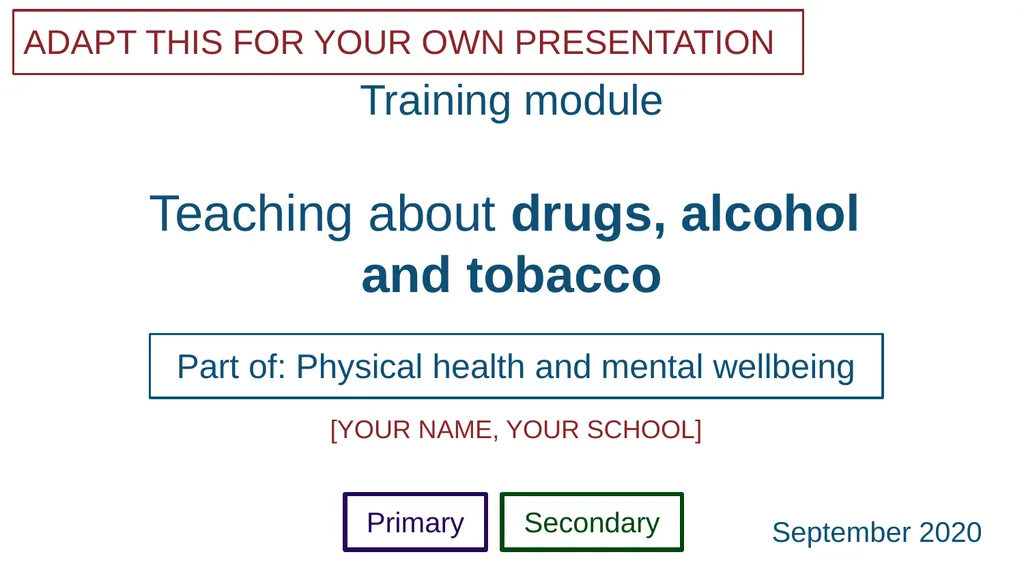
Description: Teaching about drugs, alcohol and tobacco Part of: Physical health and mental wellbeing ADAPT THIS FOR YOUR OWN PRESENTATION Training module YOUR NAME, YOUR SCHOOL Primary Secondary September 2020 Contents 2 3 About this training module 5

Related Topics

Download Presentation

"Teaching about drugs, alcohol and tobacco Part of:" is the property of its rightful owner. Permission is granted to download and print the materials on this website for personal, non-commercial use only, and to display it on your personal computer provided you do not modify the materials and that you retain all copyright notices contained in the materials. By downloading content from our website, you accept the terms of this agreement.

Presentation Transcript

slide1. Teaching about drugs, alcohol
and tobacco Part of: Physical health and mental wellbeing ADAPT THIS FOR YOUR OWN PRESENTATION Training module [YOUR NAME, YOUR SCHOOL] Primary Secondary September 2020<br>
slide2. Contents 2 3 About this training module
5 Teaching the new curriculum
14 Safeguarding
16 Ground rules
19 Primary curriculum
35 Secondary curriculum
69 Examples of good practice
75 Activities and templates for trainers<br>
slide3. About this training module Subject leads can use the adaptable slides and ‘activities and templates for trainers’ section at the end of this module to help shape training sessions for teachers.
This non-statutory training module supplements the statutory guidance on teaching drugs, alcohol and tobacco, which schools should read in full.
Schools can choose whether and how to follow or adapt this training module and should refer to the Early Career Framework for pedagogical guidance. 3<br>
slide4. What you get out of today By the end of this training you should:
know what is included in the statutory guidance
know some key knowledge and facts to cover as part of this topic
have strategies to deal with questions that come up in class
feel more confident teaching about drugs, alcohol and tobacco 4<br>
slide5. Teaching the new curriculum 5<br>
slide6. Making well-informed, positive choices From September 2020 schools must have regard to the new statutory guidance for teaching about drugs, alcohol and tobacco.
The topic is part of the wider health education curriculum and seeks to enable pupils to make well-informed decisions through a knowledge-based approach. STATUTORY GUIDANCE It is important that the starting point for health and wellbeing education should be a focus on enabling pupils to make well-informed, positive choices for themselves. (p35) 6<br>
slide7. Knowledge of risks and harms The drugs, alcohol and tobacco topic is part of health and mental wellbeing curriculum. It gives pupils factual knowledge about the risks posed by alcohol, drugs and tobacco use, so they are well equipped to make informed and safe choices.
Teachers may also want to teach pupils about the factors that can contribute to someone drinking alcohol in excess, smoking, or using illegal drugs. This could involve teaching about social / peer pressure. The following related modules contain more information on these issues:
respectful relationships
being safe 7<br>
slide8. Related topics Drugs, alcohol and tobacco is related to the science curriculum as well as topics such as:
health and prevention
physical health and fitness
healthy eating
basic first aid
Therefore you should:
consider thematic links across key topics and the whole school when planning and delivering lessons
find ways to link knowledge and vocabulary across topics 8<br>
slide9. Support with this topic at [school name] Our leads
[Names, contact details of safeguarding leads]
Our policies
[Add details - e.g. school policy on drugs]
Specialist support [Add details - e.g. providers school already works with]
Other information
[Add resources] 9<br>
slide10. Drugs, alcohol and tobacco teaching at [school name] Ways in which we already teach about the risks of drugs, alcohol and tobacco at our school:
[add details]
[add details]
[add details] 10<br>
slide11. Primary and secondary teaching Some slides in this training have a Primary or Secondary label to indicate that the material is usually first introduced in that phase. STATUTORY GUIDANCE Schools have flexibility to design and plan age-appropriate subject content. (p31) Using your knowledge of your pupils and school community you can:
introduce secondary content in primary with pupils who need it and are ready
teach the primary content in early secondary lessons to pupils who need to build knowledge before secondary content is taught 11<br>
slide12. Pupils with SEND You will need to plan lessons to allow all pupils to access and practise the core knowledge, using your expertise as you normally would.
You might want to link lesson outcomes with statutory ‘preparing for adulthood’ outcomes for those with an education, health and care (EHC) plan. (See SEND code of practice, section 8.) STATUTORY GUIDANCE
In special schools and for some SEND pupils in mainstream schools there may be a need to tailor content and teaching to meet the specific needs of pupils at different developmental stages. As with all teaching for these subjects, schools should ensure that their teaching is sensitive, age-appropriate, developmentally appropriate and delivered with reference to the law. (p15) 12<br>
slide13. Teacher wellbeing The new curriculum covers a wide range of topics, some of which individual teachers might find personally challenging in different ways.
It is important to feel you can ask for support or raise questions if:
you have personal experience of a topic which makes teaching that content particularly challenging for you
you have personal views on a topic that mean you need to discuss how you can ensure the teaching is delivered objectively
Talk to your line manager, in the first instance, if you do need support. 13<br>
slide14. Safeguarding 14<br>
slide15. Safeguarding (1) Pupils may be affected by issues discussed in lessons.
Let your designated safeguarding lead or deputy and any other relevant staff, such as pastoral leads, know what you are teaching. This will enable them to identify and speak to relevant pupils, especially those who they know may have been directly impacted by issues covered in the lessons and those with adverse childhood experiences.
Teachers may need to deal with disclosures or concerns (e.g. of abuse or offending behaviour) in a way that safeguards pupils in line with school policies, especially the child protection policy. 15<br>
slide16. Ground rules 16<br>
slide17. Create class ground rules Clear class ground rules can help when teaching about sensitive topics. They also support confidentiality and safeguarding of pupils.
Good practice is for ground rules to be:
discussed and understood by all
clear and practical
modelled by the teacher
followed consistently and enforced
updated when needed
visible in lessons (for example, posters) 17<br>
slide18. Example ground rules Respect privacy. We can discuss examples but do not use names or descriptions that identify anyone, including ourselves.
Listen to others. It is okay to disagree with each other, but we should listen properly before making assumptions or deciding how to respond. When disagreeing, challenge the statement not the person.
No judgement. We can explore beliefs and misunderstandings about a topic without fear of being judged.
Choose level of participation. Everyone has the right to choose not to answer a question or join discussion. We never put anyone ‘on the spot’ (no personal questions or pressure to answer). 18<br>
slide19. Primary curriculum 19<br>
slide20. Legal and illegal harmful substances Primary Give a clear definition of ‘drugs’ (substances that change the way the body or mind works).
Teach pupils that there are different types of drugs:
medicines (prescribed by a doctor and ‘over the counter’, e.g. paracetamol)
legal drugs that are not medicines (e.g. alcohol, tobacco and caffeine)
illegal drugs (give examples if appropriate)
other substances that are misused as drugs 20 STATUTORY GUIDANCE Know the facts about legal and illegal harmful substances and associated risks, including smoking, alcohol use and drug-taking.<br>
slide21. Tobacco 21<br>
slide22. Smoking basics Primary Explain that smoking is inhaling the smoke from burning tobacco (which is made out of the dried leaves of the tobacco plant). When tobacco is burned it releases dangerous substances including:
tar - a toxic substance that damages lungs over time
carbon monoxide - a toxic gas that is absorbed through the lungs and enters the bloodstream
Tobacco also contains a highly addictive chemical called nicotine which makes it hard to stop smoking.
Teach pupils about harms of smoking and the strong link between smoking and serious health conditions (NHS). 22 STATUTORY GUIDANCE Know the facts about legal and illegal harmful substances and associated risks, including smoking, alcohol use and drug-taking.<br>
slide23. Smoking risks and dangers Primary Explain that smoking is one of the biggest causes of death and illness in the UK. For example, it can:
cause cancer in various parts of the body (including lungs, mouth, bowel and liver)
damage your lungs, leading to lung diseases that make breathing difficult
increase the risk of a heart attack and stroke
make asthma and the common cold worse
Bear in mind that these facts may scare pupils who have parents who smoke. STATUTORY GUIDANCE Know the facts about legal and illegal harmful substances and associated risks, including smoking, alcohol use and drug-taking. 23<br>
slide24. Passive smoking Primary Teach pupils that all of the risks for smoking can also occur as a result of ‘passive smoking’. This is when people accidentally breathe in other people’s smoke.
Babies and children are particularly vulnerable to the effects of second-hand smoke.
Explain that due to the risks of passive smoking, it is against the law to smoke in workplaces, enclosed public buildings and on public transport.
Explain that it is also illegal to smoke in an enclosed private vehicle if someone under 18 is also present.
Read more about passive smoking on NHS.UK. STATUTORY GUIDANCE Know the facts about legal and illegal harmful substances and associated risks, including smoking, alcohol use and drug-taking. 24<br>
slide25. E-cigarettes (vaping) Primary Teach pupils that e-cigarettes allow someone to inhale nicotine in a vapour instead of through tobacco smoke.
People sometimes use e-cigarettes when they are trying to give up smoking. However, vaping also carries risks, and no-one should start vaping unless they are trying to give up smoking, because:
e-cigarette liquid/vapour still contains low levels of potentially harmful chemicals
the long-term health risks of vaping (e.g. to heart, lungs and blood vessels) are not known
most e-cigarettes contain addictive nicotine 25 STATUTORY GUIDANCE Know the facts about legal and illegal harmful substances and associated risks, including smoking, alcohol use and drug-taking.<br>
slide26. Alcohol 26<br>
slide27. Alcohol use (1) Primary Teach that alcohol is a clear liquid drug (chemical name - ethanol). It is found in different amounts in alcoholic drinks such as beer, wine and spirits.
Acknowledge that many adults drink alcohol, e.g. in social situations.
Explain that many people also choose not to drink any alcohol, introducing vocabulary such as ‘teetotal’.
Teachers may also refer to faith perspectives, e.g. that some religions prohibit / strongly discourage drinking alcohol. 27 STATUTORY GUIDANCE Know the facts about legal and illegal harmful substances and associated risks, including smoking, alcohol use and drug-taking.<br>
slide28. Alcohol use (2) Primary Begin to introduce pupils to the risks of alcohol to physical and mental health (e.g. cancers, stroke, heart disease, liver disease, alcohol poisoning).
Explain that when adults drink more than a certain amount (NHS guidelines) the risks increase.
Teach that alcohol can be addictive and that it can be hard for people to give up or cut back their drinking if they are addicted.
Teachers can also refer to content on alcohol use in the secondary slides in this module, if they think they are appropriate. 28 STATUTORY GUIDANCE Know the facts about legal and illegal harmful substances and associated risks, including smoking, alcohol use and drug-taking.<br>
slide29. Smoking/alcohol age restrictions Primary Teach pupils that some legal drugs have age restrictions to protect young people.
Smoking: Ensure pupils understand laws about children buying cigarettes. You must be 18 or older to buy cigarettes in the UK. It is illegal to sell tobacco, electronic cigarettes (e-cigarettes) or e-liquids to anyone under 18, or to buy them for anyone under 18.
Alcohol: It is illegal to buy or try to buy alcohol if you are under 18. It is also illegal to sell alcohol to, or buy alcohol for, under 18s. Ensure pupils understand laws relating to alcohol and young people. 29 STATUTORY GUIDANCE Know the facts about legal and illegal harmful substances and associated risks, including smoking, alcohol use and drug-taking.<br>
slide30. Drugs 30<br>
slide31. Illegal drugs risks Primary Teach that it is highly dangerous to take illegal drugs because they can cause serious harm to physical and mental health, and even death. The effects of some illegal drugs can be very fast.
Teach that people are also committing a crime if they possess, buy or sell illegal drugs.
Explain that some illegal drugs can also be highly addictive. 31 STATUTORY GUIDANCE Know the facts about legal and illegal harmful substances and associated risks, including smoking, alcohol use and drug-taking.<br>
slide32. Prescription drugs risks Primary Teach that legal drugs / medicines can cause serious harm to people’s health and wellbeing if misused. This includes both prescribed and ‘over the counter’ medicines such as paracetamol.
Explain that people should only take medicines that a doctor or parent tells them to take, following any extra instructions. It is very dangerous to take other people’s prescription drugs, which could make us unwell.
Explain that some legal drugs can also be highly addictive if misused. 32 STATUTORY GUIDANCE Know the facts about legal and illegal harmful substances and associated risks, including smoking, alcohol use and drug-taking.<br>
slide33. Addiction risk Primary Teach pupils that smoking, drinking alcohol and taking certain types of drugs can be addictive (varies by substance and frequency of use) and what this means.
Explain that:
it can be hard for people to stop using a substance once they are addicted
addictions sometimes lead to problems such as abusive behaviour and debt
there is help available for people who want to stop smoking, drinking alcohol or taking drugs
Teacher reference: Addiction: What is it? (NHS) 33 STATUTORY GUIDANCE Know the facts about legal and illegal harmful substances and associated risks, including smoking, alcohol use and drug-taking.<br>
slide34. Risks of accidents after drinking or using drugs Primary Explain that some substances (including alcohol and both illegal and some legal drugs) can affect how people’s brains and bodies work, often slowing down thinking and responses.
This makes activities such as using machinery, driving or swimming particularly dangerous. The risk of serious accidents from these and other activities are much higher after people have consumed alcohol or drugs. 34 STATUTORY GUIDANCE Know the facts about legal and illegal harmful substances and associated risks, including smoking, alcohol use and drug-taking.<br>
slide35. Secondary curriculum 35 STATUTORY GUIDANCE Schools should continue to develop knowledge on topics specified for primary as required and in addition cover the following content by the end of secondary. (p36)<br>
slide36. Drugs (1) 36<br>
slide37. About drugs Building on knowledge from primary, teach pupils that drugs are defined as “a medicine or other substance which has a physiological effect when ingested or otherwise introduced into the body.”
This means that a drug is something that changes how the body functions and feels.
Teach pupils that there are different types of drugs:
medicines (prescribed and ‘over the counter’)
legal drugs that are not medicines (e.g. alcohol, tobacco, caffeine)
illegal drugs
substances that are misused as drugs 37 Secondary STATUTORY GUIDANCE Know the facts about legal and illegal drugs and their associated risks, including the link between drug use, and the associated risks, including the link to serious mental health conditions.<br>
slide38. Illegal drugs Teach pupils that there are different types of illegal drug (e.g. stimulants, depressants and hallucinogens). Make pupils aware of some common illegal drugs, such as cocaine, ecstasy, heroin and cannabis.
Teachers may consider pupils’ context, including prevalence of certain drugs in the wider community, when planning the content of lessons.
Great care must be taken not to make any illegal drug sound attractive when discussing its impact.
Teacher reference: Frank A-Z of drugs. 38 Secondary STATUTORY GUIDANCE Know the facts about legal and illegal drugs and their associated risks, including the link between drug use, and the associated risks, including the link to serious mental health conditions.<br>
slide39. Substance misuse Teach pupils that there are some legal substances that people sometimes misuse as drugs.
Explain that any substance used for purposes other than those intended can be dangerous and could even cause death. 39 Secondary STATUTORY GUIDANCE Know the facts about legal and illegal drugs and their associated risks, including the link between drug use, and the associated risks, including the link to serious mental health conditions.<br>
slide40. Health risks of illegal drugs Explain that illegal drugs are highly dangerous and:
contain uncontrolled quantities of dangerous chemicals
have serious short- and long-term health risks
carry a risk of death the first and every subsequent time they are used
can be highly addictive
Warn pupils that people are at even higher risk if:
they mix different types of drugs, or take both illegal drugs and alcohol (also a drug)
they already have physical/mental health problems 40 Secondary STATUTORY GUIDANCE Know the facts about legal and illegal drugs and their associated risks, including the link between drug use, and the associated risks, including the link to serious mental health conditions.<br>
slide41. Drug risks awareness Increase pupils’ awareness of illegal drugs and their risks by referring to relevant examples in classes. Explain:
what the drug is (including common names)
short-term physical and mental health risks
long-term physical and mental health risks
how addictive it is
the law (e.g. class of drug and penalties)
Remind pupils that illegal drugs could contain any substance, in any quantity. This makes them even more dangerously unpredictable.
Teacher reference: Frank A-Z of drugs. 41 Secondary STATUTORY GUIDANCE Know the facts about legal and illegal drugs and their associated risks, including the link between drug use, and the associated risks, including the link to serious mental health conditions.<br>
slide42. Illegal drugs and mental health STATUTORY GUIDANCE Know the facts about legal and illegal drugs and their associated risks, including the link between drug use, and the associated risks, including the link to serious mental health conditions. Teach that illegal drug use can lead to complex mental health problems. Drug-taking (even single/occasional use) can cause or contribute to:
anxiety and depression
hallucinations, paranoia, memory loss
Teacher reference: The effects of drugs (NHS). Secondary 42<br>
slide43. Dangers of ‘self-medication’ STATUTORY GUIDANCE Know the facts about legal and illegal drugs and their associated risks, including the link between drug use, and the associated risks, including the link to serious mental health conditions. Teach that people sometimes inappropriately use substances to try to cope with symptoms of pre-existing health problems such as physical pain, sleeplessness or anxiety.
Explain that this can be dangerous to health and could lead to addiction.
If someone has a medical problem they should always seek advice and treatment from a doctor. Secondary 43<br>
slide44. Illegal drugs and the law Teach that in the UK there are laws relating to possessing, supplying, carrying and making illegal drugs.
The punishment can vary depending on the amount and type of drug (e.g. its ‘class’).
Explain that the age of criminal responsibility is 10 years old. This means that people aged 10 to 17 can be cautioned, tried for criminal offences and gain a criminal record.
Teacher reference: Drugs penalties, Age of criminal responsibility (GOV.UK). STATUTORY GUIDANCE Know the law relating to the supply and possession of illegal substances. Secondary 44<br>
slide45. Travel abroad and drugs Teach pupils that other countries have different laws and punishments for drug offences (e.g. drug trafficking). Add that if a person commits a crime in another country they are subject to that country’s legal system.
Taking any illegal drug into another country is highly dangerous and can result in tough punishments in that country (some examples can be explored).
People taking a prescription drug abroad should always take a prescription to prove it is theirs. They should check NHS advice on taking medicines abroad and check the rules for the country they are visiting. STATUTORY GUIDANCE Know the law relating to the supply and possession of illegal substances. Secondary 45<br>
slide46. Impact of drug convictions Explain to pupils that drug charges and convictions (a criminal record) can have a long-term impact on their life choices. They can:
make it harder to get a job
limit the ability to travel to many countries, such as the US
Many illegal drugs are also very expensive and addictive. This combination can lead people to commit other crimes to pay for drugs. STATUTORY GUIDANCE Know the law relating to the supply and possession of illegal substances. Secondary 46<br>
slide47. Wider impact of illegal drugs Teach pupils that buying and using illegal drugs has a ‘social impact’.
When people buy drugs they contribute towards demand (e.g. drug trafficking), which encourages more criminal activity (e.g. intimidation and recruitment of young people into illegal gangs). STATUTORY GUIDANCE Know the facts about legal and illegal drugs and their associated risks, including the link between drug use, and the associated risks, including the link to serious mental health conditions. Secondary 47<br>
slide48. Prescription drugs risks (1) Teach pupils the dangers associated with incorrect use of prescription (and ‘over the counter’) drugs such as painkillers, antidepressants and steroids.
People should only take drugs prescribed to them personally by their doctor (and at the dose specified). They should tell their doctor if they:
experience side effects
feel their condition has worsened
take too much (and instructions say to tell doctor)
Explain that it is often unsafe to mix prescription drugs with other medicines or alcohol. STATUTORY GUIDANCE Have an awareness of the dangers of drugs which are prescribed but still present serious health risks. Secondary 48<br>
slide49. Prescription drugs risks (2) Teach pupils that people should never:
take drugs that have been prescribed for someone else
share their medicines with someone else
If someone takes medicine that has not been prescribed to them they could get very ill or have a dangerous reaction.
Also teach that there are risks in buying prescription drugs online (NHS) - e.g. self diagnosis, wrong dose, not the drug you think you are buying. STATUTORY GUIDANCE Have an awareness of the dangers of drugs which are prescribed but still present serious health risks. Secondary 49<br>
slide50. Drugs, crime and illegal gangs (1) STATUTORY GUIDANCE Know the facts about legal and illegal drugs and their associated risks, including the link between drug use, and the associated risks, including the link to serious mental health conditions. Teach pupils there is a link between drugs and crime, including illegal gangs (e.g. ‘county lines’ gangs).
Such gangs often use people (including very young children) to move and store drugs and money for them.
Gangs manipulate and pressure people to become more involved in different ways, for example by:
offering money, presents such as mobile phones, false ‘friendship’, addictive drugs
using threats, violence and abuse
getting people to do bad/illegal things so they do not feel able to ask for help (e.g. from family, the police) Secondary 50<br>
slide51. Drugs, crime and illegal gangs (2) Explain that it can be hard (especially for young people) to tell that they are being pressured by an illegal gang or involved in criminal activity at first. It can also be hard to get away from a gang once they have involved you.
Children and young people targeted by illegal gangs can talk to someone anonymously and get support through:
Childline on 0800 1111
SafeCall service
Teacher reference: County lines guidance for frontline professionals (Home Office). STATUTORY GUIDANCE Know the facts about legal and illegal drugs and their associated risks, including the link between drug use, and the associated risks, including the link to serious mental health conditions. Secondary 51<br>
slide52. Alcohol (1) 52<br>
slide53. Short-term health risks of alcohol Teach pupils there are serious short-term risks of alcohol misuse. It can affect judgement, reduce inhibitions and encourage risky behaviour. This can:
result in people having an accident
make people vulnerable to others
Explain that drinking a lot in a short period of time (‘binge drinking’) can result in alcohol poisoning:
confusion, slurred speech and loss of coordination
irregular or slow breathing
losing consciousness and vomiting (choking risk)
coma, brain damage and death (in the most serious cases) STATUTORY GUIDANCE Know the physical and psychological risks associated with alcohol consumption and what constitutes low risk alcohol consumption in adulthood. Secondary 53<br>
slide54. Long-term health risks of alcohol Teach pupils that over time alcohol misuse increases your risk of many serious health conditions (NHS) such as:
several types of cancer
heart disease
stroke
liver disease
pancreatitis
brain and nervous system damage
Alcohol is calorific so it can also contribute to weight issues. STATUTORY GUIDANCE Know the physical and psychological risks associated with alcohol consumption and what constitutes low risk alcohol consumption in adulthood. Secondary 54<br>
slide55. Psychological risks of alcohol Teach that alcohol can affect how the brain functions and how we feel. If people drink too much they can experience issues such as:
mood changes - emotion, anger, violence
decreased inhibitions and impaired judgment
slowed reaction times
memory problems and confusion
Teach pupils that long-term alcohol misuse can cause serious mental health problems and permanent damage to the brain.
Add that if someone is under the influence of alcohol at work they could be disciplined and might lose their job. STATUTORY GUIDANCE Know the physical and psychological risks associated with alcohol consumption and what constitutes low risk alcohol consumption in adulthood. Secondary 55<br>
slide56. Brain development and alcohol Teach pupils that some research suggests that alcohol and drug use in childhood and adolescence can negatively affect brain development and function.
While the full risks are not known, the NHS comments:
“The brains of teenagers are still developing, so any drug or substance that can affect the brain, be it illegal or legal, could possibly have long-term effects.” STATUTORY GUIDANCE Know the physical and psychological risks associated with alcohol consumption and what constitutes low risk alcohol consumption in adulthood. Secondary 56<br>
slide57. Lower risk alcohol consumption Explain that alcohol consumption is measured in ‘units’ (NHS). Give examples of different drinks to show what this means in practice.
Referring to NHS alcohol guidance, explain that the recommended weekly limit for adults is 14 units. Drinking up to this limit and spreading units out over 3 or more days lowers risk. However, there is no ‘safe’ level for alcohol.
Explain that drinking alcohol during pregnancy can lead to severe health problems for the foetus and baby. It is safest not to drink any alcohol if you are pregnant or trying to become pregnant. STATUTORY GUIDANCE Know the physical and psychological risks associated with alcohol consumption and what constitutes low risk alcohol consumption in adulthood. Secondary 57<br>
slide58. Substance use and functioning Teach that many substances (including alcohol, some legal drugs and illegal drugs) can affect people’s ability to function normally in the short term. For example, they can affect:
mental/cognitive function (e.g. decision-making ability and memory)
physical function (e.g. coordination and reflexes)
Explain that it is therefore dangerous to undertake many activities when using substances, e.g. using machinery or driving.
Teach pupils that there is a ‘drink drive limit’ and that driving under the influence of drugs is also illegal. STATUTORY GUIDANCE Know the facts about legal and illegal drugs and their associated risks, including the link between drug use, and the associated risks, including the link to serious mental health conditions. Secondary 58<br>
slide59. The ‘drink drive’ limit Explain that in England the legal limit for alcohol is:
35 micrograms per 100 millilitres of breath
80 milligrammes per 100 millilitres of blood
107 milligrammes per 100 millilitres of urine
Limits are lower in Scotland.
It is impossible to be certain how much you can drink and stay within the limit. It varies from person to person and depends on what you have eaten, age, weight, metabolism, stress levels and the type of alcohol you have drunk.
Teacher reference: www.drinkaware.co.uk. STATUTORY GUIDANCE Know the physical and psychological risks associated with alcohol consumption and what constitutes low risk alcohol consumption in adulthood. Secondary 59<br>
slide60. Tobacco (1) 60<br>
slide61. Harms from tobacco Teach pupils about the harms of smoking tobacco, including:
cigarettes
roll up cigarettes
pipe tobacco
shisha pipes
Explain that there are also risks associated with all types of tobacco use - e.g. chewing tobacco.
Teach that the nicotine in tobacco alters the balance of chemicals (dopamine and noradrenaline) in the brain and this makes it highly addictive. STATUTORY GUIDANCE Know the facts about the harms from smoking tobacco (particularly the link to lung cancer), the benefits of quitting and how to access support to do so. Secondary 61<br>
slide62. Smoking risks and dangers (1) Explain that smoking is one of the biggest causes of death and illness in the UK.
Smoking causes around 70% of lung cancer cases.
Smoking also damages your lungs, leading to conditions such as chronic obstructive pulmonary disease (COPD), which incorporates bronchitis, emphysema, and pneumonia.
Teach that there are a wide range of other health impacts caused by smoking. STATUTORY GUIDANCE Know the facts about the harms from smoking tobacco (particularly the link to lung cancer), the benefits of quitting and how to access support to do so. Secondary 62<br>
slide63. Smoking risks and dangers (2) Smoking can:
worsen or prolong the symptoms of respiratory conditions such as asthma, or respiratory tract infections (e.g. the common cold)
cause cancer throughout the body, including the mouth, throat, voice box (larynx), oesophagus (the tube between your mouth and stomach), bladder, bowel, kidney, liver, stomach and pancreas
damage the heart and circulation, increasing the risk of conditions such as coronary heart disease, heart attack and stroke
reduce fertility STATUTORY GUIDANCE Know the facts about the harms from smoking tobacco (particularly the link to lung cancer), the benefits of quitting and how to access support to do so. Secondary 63<br>
slide64. Stopping smoking Teach pupils that although the nicotine in tobacco makes it highly addictive, many people stop smoking because of:
health concerns - due to high risks of illness
financial reasons
pregnancy - smoking in pregnancy can damage the foetus
social reasons - friends stop smoking or people aren’t able to smoke in public places
Explain that there are many benefits to stopping smoking (NHS) and the types of help available.
Teacher reference: NHS Smokefree website. STATUTORY GUIDANCE Know the facts about the harms from smoking tobacco (particularly the link to lung cancer), the benefits of quitting and how to access support to do so. Secondary 64<br>
slide65. Benefits of stopping smoking Explain that stopping smoking:
improves lung capacity and breathing
increases energy, as blood circulation improves
decreases stress levels
improves sexual functioning as an adult
improves fertility
improves smell and taste
slows facial ageing and the development of wrinkles
stops teeth becoming stained
improves the chance of living a longer, disease-free life STATUTORY GUIDANCE Know the facts about the harms from smoking tobacco (particularly the link to lung cancer), the benefits of quitting and how to access support to do so. Secondary 65<br>
slide66. Addiction 66<br>
slide67. Addiction Teach that drugs, including alcohol, tobacco and legal drugs, can be physically/chemically addictive as well as behaviourally addictive.
Explain:
what addiction means
what causes addiction
how addiction can affect people (physical and psychological impacts)
consequences of addiction (e.g. cycle of addiction, withdrawal)
how people can get help
Teacher reference: Addiction: What is it? (NHS). STATUTORY GUIDANCE Know the physical and psychological consequences of addiction, including alcohol dependency. Secondary 67<br>
slide68. Consequences of addiction Teach that addiction can have serious consequences for people’s health and wellbeing.
For example, addiction can result in:
lack of self care and personal hygiene
debt and risk taking behaviour to pay for addiction (e.g. gang involvement, crime)
isolation from support networks (partner/friends/family)
a chaotic lifestyle, including financial problems
prioritising addiction over everything else STATUTORY GUIDANCE Know the physical and psychological consequences of addiction, including alcohol dependency. Secondary 68<br>
slide69. Examples of good practice 69<br>
slide70. Good practice The following are just some of the approaches you might consider when preparing to teach about drugs, alcohol and tobacco.
You will need to adapt these approaches to ensure they are age appropriate and developmentally appropriate for your pupils. 70 Good practice<br>
slide71. Good practice approaches (1) Create knowledge-rich lessons, rather than relying on ‘scare tactics’, so pupils fully understand risks and can make informed choices.
Ensure information is taught at the right time so that pupils are not lacking the knowledge they need to make informed decisions when they encounter drugs, alcohol and tobacco.
Encourage pupils to reflect on how an individual’s personal experience and context could influence them to use substances and the ways in which they can resist pressure and make their own choices. Good practice 71<br>
slide72. Good practice approaches (2) Use medically/scientifically correct language to accurately describe human anatomy and the processes of the body.
Only make use of the insights of ex-users and other external speakers where their input is part of and supports the aims of a wider planned programme.
Be prepared to answer questions about drugs that you do not know about. The Frank A to Z includes the scientific and street names of many drugs and can be a useful reference for teachers. Good practice 72<br>
slide73. Good practice approaches (3) Consider broadening discussions to substances such as caffeine (coffee, tea, energy drinks) and explaining why excess use can make people feel unwell.
Provide opportunities for teacher-led discussions of how the depiction of alcohol on TV and in films can influence people, or the way that scent, flavour and packaging is used to promote products like e-cigarettes.
Embed the school’s own drugs, alcohol and tobacco policy, ensuring pupils and parents are aware of the rules and consequences. Good practice 73<br>
slide74. Further information Teachers should be familiar with (and where appropriate refer pupils for information to):
support available in their own school (e.g. through nurse or referral to drug/alcohol services)
NHS website
NHS Smokefree website
Childline
SafeCall service Good practice 74<br>
slide75. Activities and templates for trainers 75<br>
slide76. About these activities and templates Subject leads can use the following templates and training activities to plan training on teaching the new curriculum topics.
You can:
move slides - e.g. ‘rate your confidence (before training)’ - to the point in the presentation where you want to carry out that activity
delete slides if you are not covering those curriculum elements at this time 76<br>
slide77. Training activity:
Rate your confidence 77<br>
slide78. Rate your confidence (trainer notes) Ask your colleagues to rate confidence before and after topic training using the slides in this deck.
Before training Ask teachers to think about where they currently fit on the scale.
After training Ask teachers to rate their confidence again and talk about changes. You might want to repeat this activity at later check ins.
If teachers still rate confidence as low, discuss ways you can develop their subject knowledge, offer peer support etc. 78<br>
slide79. Rate your confidence (before training) How do you feel about teaching this topic? Not confident at all Very confident 79<br>
slide80. Rate your confidence (after training) How do you feel now? What support/information could help? Not confident at all Very confident 80<br>
slide81. Training activity:
Dealing with difficult questions 81<br>
slide82. Dealing with difficult questions (trainer notes) Use the following slides in your training to help teachers:
share concerns about questions they could be asked by pupils
strategise ways to respond to such questions 82<br>
slide83. Dealing with difficult questions (1) [Prepare ‘difficult’ questions to discuss in training or give teachers a blank version to fill with their own questions] What would you say? What wouldn’t you say? Follow up 83<br>
slide84. Dealing with difficult questions (2) Pupils may well ask questions because they:
want information
are seeking permission - “Is it OK if I …?”
are trying to shock or get attention
have related personal beliefs
Remember:
don’t feel pressured or that you have to answer straight away
don’t disclose personal information - use third-person examples, say ‘some people...’
seek advice if you need it 84<br>
slide85. Training activity:
How will I teach this? 85<br>
slide86. How will I teach this? (trainer notes) Use the following slides in your training to help teachers:
begin to plan and resource their lessons
discuss and address any issues they anticipate in the delivery of lessons 86<br>
slide87. How will I teach this? 87<br>
slide88. Additional slides for structuring training 88<br>
slide89. Any concerns? ADAPT THIS FOR YOUR OWN PRESENTATION Any questions? What support do you need? 89<br>
slide90. XX% ADAPT THIS FOR YOUR OWN PRESENTATION [Use this format to present your own key facts and statistics - e.g. from your local authority or own monitoring. Include the source.] 90<br>