
Teaching about intimate and sexual relationships,
AS
Published · 105 slides · 0 views

1 / 1















Description
Teaching about intimate and sexual relationships, including sexual health Part of: Relationships and sex education ADAPT THIS FOR YOUR OWN PRESENTATION Training module YOUR NAME, YOUR SCHOOL Secondary September 2020 Contents 2 3 About
Related Topics
Share
Embed code
Download this presentation From Below
"Teaching about intimate and sexual relationships," is the property of its rightful owner. Permission is granted to download and print the materials on this website for personal, non-commercial use only, and to display it on your personal computer provided you do not modify the materials and that you retain all copyright notices contained in the materials. By downloading content from our website, you accept the terms of this agreement.
Presentation Transcript
01
Teaching about intimate and sexual relationships, including sexual health Part of: Relationships and sex education ADAPT THIS FOR YOUR OWN PRESENTATION Training module [YOUR NAME, YOUR SCHOOL] Secondary September 2020<br>
02
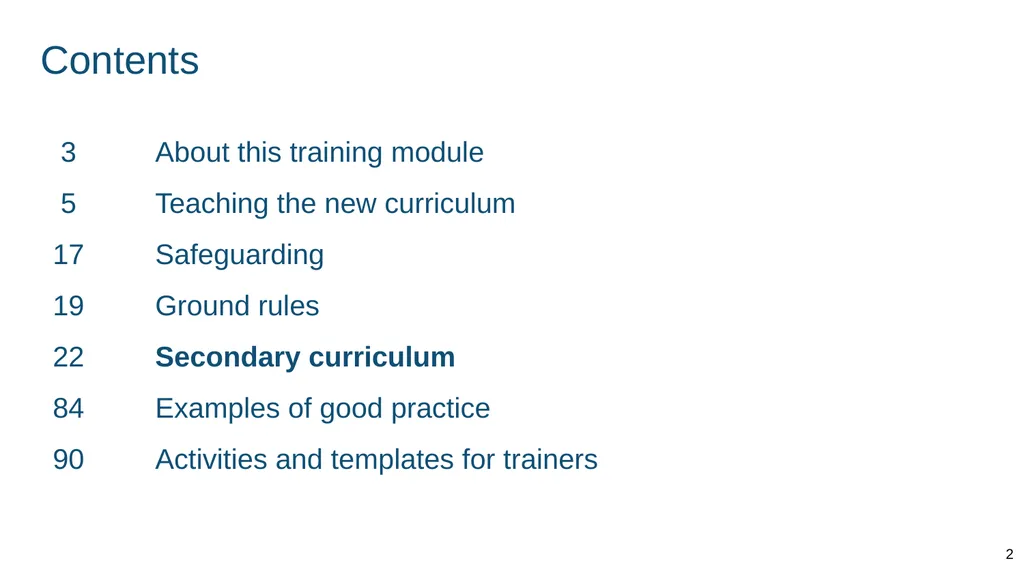
Contents 2 3 About this training module
5 Teaching the new curriculum
17 Safeguarding
19 Ground rules
22 Secondary curriculum
84 Examples of good practice
90 Activities and templates for trainers<br>
5 Teaching the new curriculum
17 Safeguarding
19 Ground rules
22 Secondary curriculum
84 Examples of good practice
90 Activities and templates for trainers<br>
03
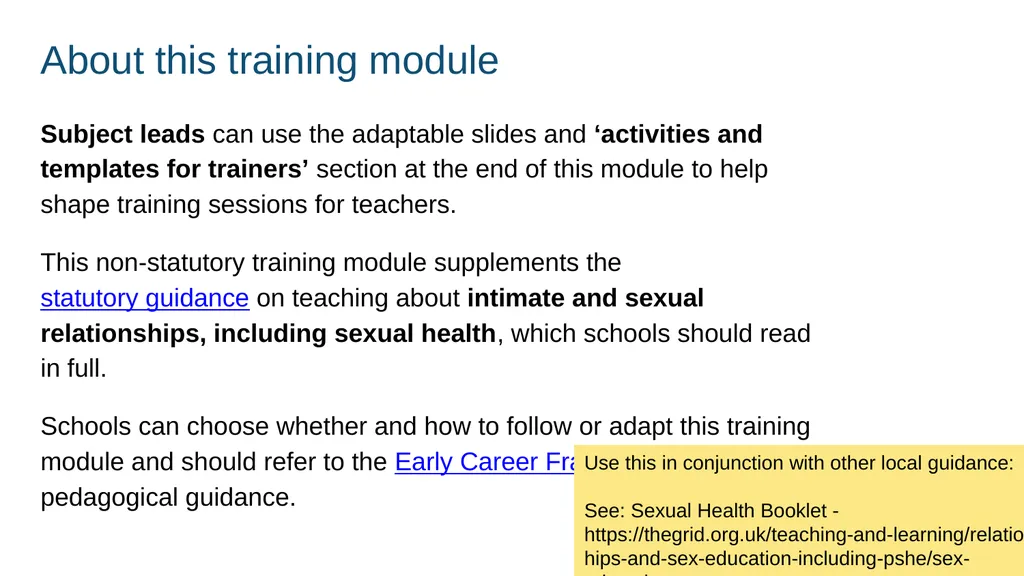
About this training module Subject leads can use the adaptable slides and ‘activities and templates for trainers’ section at the end of this module to help shape training sessions for teachers.
This non-statutory training module supplements the statutory guidance on teaching about intimate and sexual relationships, including sexual health, which schools should read in full.
Schools can choose whether and how to follow or adapt this training module and should refer to the Early Career Framework for pedagogical guidance. 3 Use this in conjunction with other local guidance:
See: Sexual Health Booklet - https://thegrid.org.uk/teaching-and-learning/relationships-and-sex-education-including-pshe/sex-education<br>
This non-statutory training module supplements the statutory guidance on teaching about intimate and sexual relationships, including sexual health, which schools should read in full.
Schools can choose whether and how to follow or adapt this training module and should refer to the Early Career Framework for pedagogical guidance. 3 Use this in conjunction with other local guidance:
See: Sexual Health Booklet - https://thegrid.org.uk/teaching-and-learning/relationships-and-sex-education-including-pshe/sex-education<br>
04
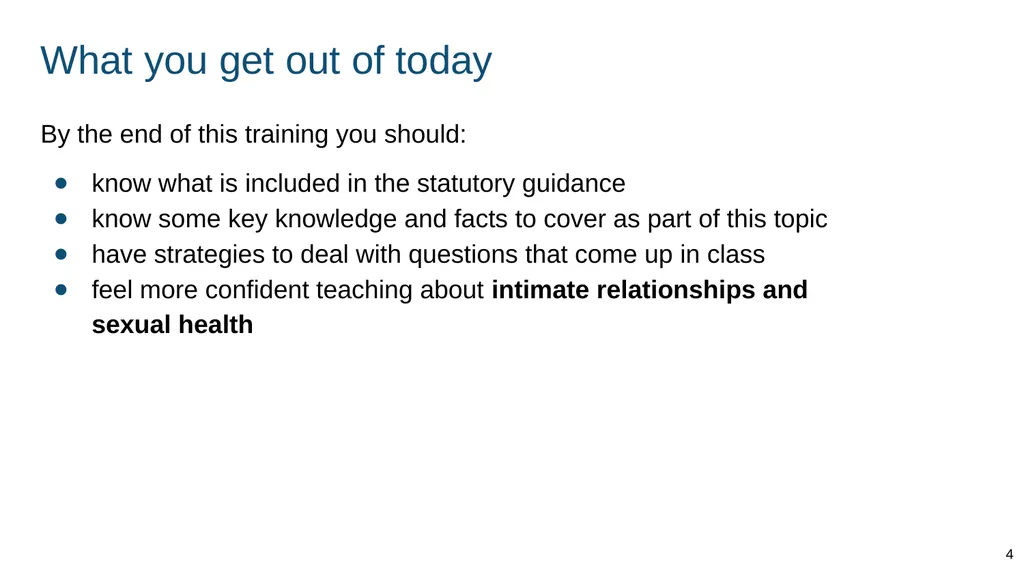
What you get out of today By the end of this training you should:
know what is included in the statutory guidance
know some key knowledge and facts to cover as part of this topic
have strategies to deal with questions that come up in class
feel more confident teaching about intimate relationships and sexual health 4<br>
know what is included in the statutory guidance
know some key knowledge and facts to cover as part of this topic
have strategies to deal with questions that come up in class
feel more confident teaching about intimate relationships and sexual health 4<br>
05
Teaching the new curriculum 5<br>
06
Related topics Intimate and sexual relationships, including sexual health is closely related to the science curriculum as well as topics such as:
respectful relationships, including friendships
being safe
changing adolescent body
mental wellbeing
health and prevention
Therefore you should:
consider thematic links across key topics and the whole school when planning and delivering lessons
find ways to link knowledge and vocabulary across topics 6<br>
respectful relationships, including friendships
being safe
changing adolescent body
mental wellbeing
health and prevention
Therefore you should:
consider thematic links across key topics and the whole school when planning and delivering lessons
find ways to link knowledge and vocabulary across topics 6<br>
07
RSE and healthcare support at [school name] Our leads
[Names, contact details of child protection, wellbeing, pastoral, designated mental health leads]
Our policies
[Add details - e.g. school policy on PSHE, training opportunities]
Specialist support [Add details - e.g. local authority, CAMHS, charities]
Other information
[Add resources] 7<br>
[Names, contact details of child protection, wellbeing, pastoral, designated mental health leads]
Our policies
[Add details - e.g. school policy on PSHE, training opportunities]
Specialist support [Add details - e.g. local authority, CAMHS, charities]
Other information
[Add resources] 7<br>
08
RSE at [school name] Ways in which we already teach about and support relationships and sex education at our school:
[add details]
[add details]
[add details] 8<br>
[add details]
[add details]
[add details] 8<br>
09
Helping young people make healthy decisions From September 2020 schools must have regard to the new statutory guidance for teaching relationships and sex education, The guidance explains how this teaching will benefit pupils. STATUTORY GUIDANCE
The aim of RSE is to give young people the information they need to help them develop healthy, nurturing relationships of all kinds, not just intimate relationships… Knowledge about safer sex and sexual health remains important to ensure that young people are equipped to make safe, informed and healthy choices as they progress through adult life. (p25) 9<br>
10
Progression from primary relationships teaching Schools have flexibility to design and plan age-appropriate subject content based on the statutory guidance.
Using your knowledge of your pupils and school community, you can decide when to introduce subject areas within the secondary phase. STATUTORY GUIDANCE RSE should provide clear progression from what is taught in primary school in Relationships Education. Teachers should build on the foundation of Relationships Education and, as pupils grow up, at the appropriate time extend teaching to include intimate relationships. (p25) 10<br>
Using your knowledge of your pupils and school community, you can decide when to introduce subject areas within the secondary phase. STATUTORY GUIDANCE RSE should provide clear progression from what is taught in primary school in Relationships Education. Teachers should build on the foundation of Relationships Education and, as pupils grow up, at the appropriate time extend teaching to include intimate relationships. (p25) 10<br>
11
Start with healthy intimate relationships Ground teaching in the characteristics of healthy relationships.
When pupils have an understanding of what healthy looks like they will be better equipped to:
establish and maintain good relationships
recognise unacceptable behaviour in intimate relationships
understand what they can do to protect their own and a partner’s health in a sexual relationship
know when and where to get help and advice if they need it 11<br>
When pupils have an understanding of what healthy looks like they will be better equipped to:
establish and maintain good relationships
recognise unacceptable behaviour in intimate relationships
understand what they can do to protect their own and a partner’s health in a sexual relationship
know when and where to get help and advice if they need it 11<br>
12
LGBT needs and inclusion Secondary schools should include LGBT content.
Where LGBT content is included, schools should ensure teaching is inclusive of LGBT people and experiences. This should include:
ensuring LGBT-relevant knowledge and examples are included throughout programmes of study (not one-off teaching)
use of inclusive language, considering how individual pupils may relate to particular topics 12<br>
Where LGBT content is included, schools should ensure teaching is inclusive of LGBT people and experiences. This should include:
ensuring LGBT-relevant knowledge and examples are included throughout programmes of study (not one-off teaching)
use of inclusive language, considering how individual pupils may relate to particular topics 12<br>
13
Faith backgrounds All schools must ensure the faith/religious background of pupils are taken into account when planning teaching, so that topics are appropriately handled. STATUTORY GUIDANCE
In all schools, when teaching these subjects, the religious background of all pupils must be taken into account when planning teaching, so that the topics that are included in the core content in this guidance [the statutory guidance] are appropriately handled. (p12) 13<br>
14
Pupils with SEND You will need to plan lessons to allow all pupils to access and practise the core knowledge, using your expertise as you normally would.
You might want to link lesson outcomes with statutory ‘preparing for adulthood’ outcomes for those with an education, health and care (EHC) plan. (See SEND code of practice, section 8.) STATUTORY GUIDANCE
In special schools and for some SEND pupils in mainstream schools there may be a need to tailor content and teaching to meet the specific needs of pupils at different developmental stages. As with all teaching for these subjects, schools should ensure that their teaching is sensitive, age-appropriate, developmentally appropriate and delivered with reference to the law. (p15) 14<br>
You might want to link lesson outcomes with statutory ‘preparing for adulthood’ outcomes for those with an education, health and care (EHC) plan. (See SEND code of practice, section 8.) STATUTORY GUIDANCE
In special schools and for some SEND pupils in mainstream schools there may be a need to tailor content and teaching to meet the specific needs of pupils at different developmental stages. As with all teaching for these subjects, schools should ensure that their teaching is sensitive, age-appropriate, developmentally appropriate and delivered with reference to the law. (p15) 14<br>
15
‘Right to withdraw’ This training does not cover the considerations you must take in relation to ‘right to withdraw’. Schools must refer to the following for full information:
statutory guidance
implementation guide STATUTORY GUIDANCE Parents have the right to request that their child be withdrawn from some or all of sex education delivered as part of statutory RSE. (p18) 15<br>
statutory guidance
implementation guide STATUTORY GUIDANCE Parents have the right to request that their child be withdrawn from some or all of sex education delivered as part of statutory RSE. (p18) 15<br>
16
Teacher wellbeing The new curriculum covers a wide range of topics, some of which individual teachers might find personally challenging in different ways.
It is important to feel you can ask for support or raise questions if:
you have personal experience of a topic which makes teaching that content particularly challenging for you
you have personal views on a topic that mean you need to discuss how you can ensure the teaching is delivered objectively
Talk to your line manager, in the first instance, if you do need support. 16<br>
It is important to feel you can ask for support or raise questions if:
you have personal experience of a topic which makes teaching that content particularly challenging for you
you have personal views on a topic that mean you need to discuss how you can ensure the teaching is delivered objectively
Talk to your line manager, in the first instance, if you do need support. 16<br>
17
Safeguarding 17<br>
18
Safeguarding (1) Pupils may be affected by issues discussed in lessons.
Let your designated safeguarding lead or deputy and any other relevant staff, such as pastoral leads, know what you are teaching. This will enable them to identify and speak to relevant pupils, especially those who they know may have been directly impacted by issues covered in the lessons and those with adverse childhood experiences.
Teachers may need to deal with disclosures or concerns (e.g. of abuse or offending behaviour) in a way that safeguards pupils in line with school policies, especially the child protection policy. 18<br>
Let your designated safeguarding lead or deputy and any other relevant staff, such as pastoral leads, know what you are teaching. This will enable them to identify and speak to relevant pupils, especially those who they know may have been directly impacted by issues covered in the lessons and those with adverse childhood experiences.
Teachers may need to deal with disclosures or concerns (e.g. of abuse or offending behaviour) in a way that safeguards pupils in line with school policies, especially the child protection policy. 18<br>
19
Ground rules 19<br>
20
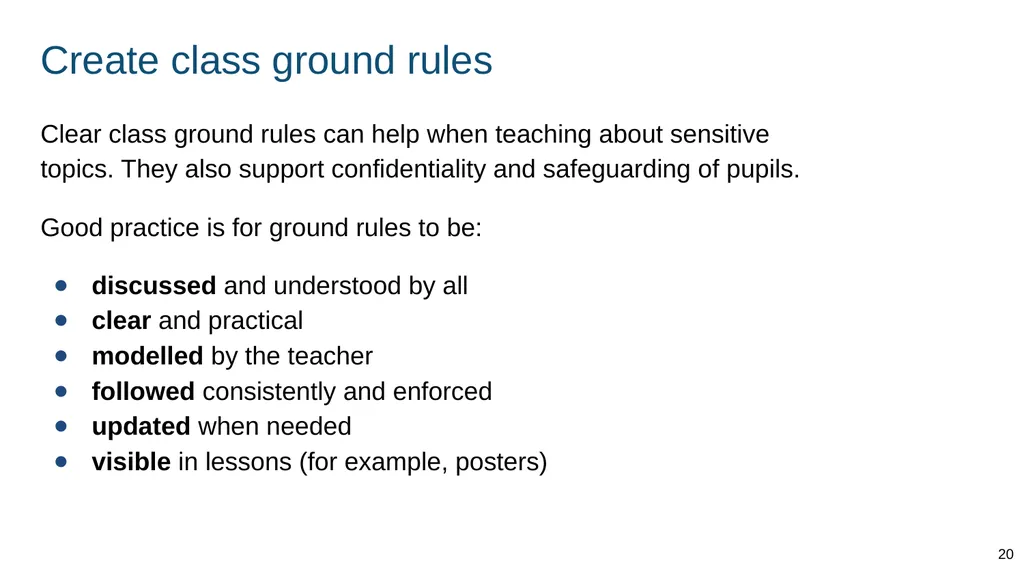
Create class ground rules Clear class ground rules can help when teaching about sensitive topics. They also support confidentiality and safeguarding of pupils.
Good practice is for ground rules to be:
discussed and understood by all
clear and practical
modelled by the teacher
followed consistently and enforced
updated when needed
visible in lessons (for example, posters) 20<br>
Good practice is for ground rules to be:
discussed and understood by all
clear and practical
modelled by the teacher
followed consistently and enforced
updated when needed
visible in lessons (for example, posters) 20<br>
21
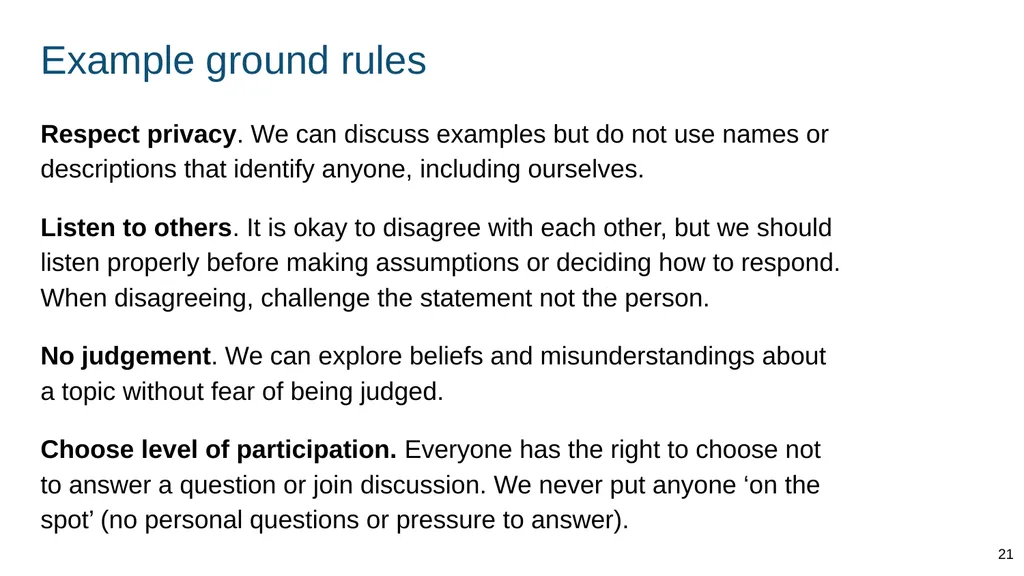
Example ground rules Respect privacy. We can discuss examples but do not use names or descriptions that identify anyone, including ourselves.
Listen to others. It is okay to disagree with each other, but we should listen properly before making assumptions or deciding how to respond. When disagreeing, challenge the statement not the person.
No judgement. We can explore beliefs and misunderstandings about a topic without fear of being judged.
Choose level of participation. Everyone has the right to choose not to answer a question or join discussion. We never put anyone ‘on the spot’ (no personal questions or pressure to answer). 21<br>
Listen to others. It is okay to disagree with each other, but we should listen properly before making assumptions or deciding how to respond. When disagreeing, challenge the statement not the person.
No judgement. We can explore beliefs and misunderstandings about a topic without fear of being judged.
Choose level of participation. Everyone has the right to choose not to answer a question or join discussion. We never put anyone ‘on the spot’ (no personal questions or pressure to answer). 21<br>
22
Intimate and sexual relationships, including sexual health 22<br>
23
Subjects covered by these slides The content is divided into the following sections for ease of reference:
healthy intimate relationships
sexual consent and the law
identifying and managing sexual pressure
sexual relationships
human fertility and reproduction
pregnancy choices and support
sexually transmitted infections (STIs)
contraception and sexual health advice 23<br>
healthy intimate relationships
sexual consent and the law
identifying and managing sexual pressure
sexual relationships
human fertility and reproduction
pregnancy choices and support
sexually transmitted infections (STIs)
contraception and sexual health advice 23<br>
24
Healthy intimate relationships 24<br>
25
Healthy intimate relationships Building on ‘respectful relationships’, teach pupils that the following characteristics contribute to healthy intimate relationships:
friendship, shared interests and goals
mutual respect and loyalty
trust and consent
Explain that intimate relationships, like other positive relationships (such as with friends, family), can support our mental wellbeing.
Related topic: being safe (examples of unhealthy relationships). STATUTORY GUIDANCE Know how to recognise the characteristics and positive aspects of healthy one-to-one intimate relationships, which include mutual respect, consent, loyalty, trust, shared interests and outlook, sex and friendship. Secondary 25<br>
friendship, shared interests and goals
mutual respect and loyalty
trust and consent
Explain that intimate relationships, like other positive relationships (such as with friends, family), can support our mental wellbeing.
Related topic: being safe (examples of unhealthy relationships). STATUTORY GUIDANCE Know how to recognise the characteristics and positive aspects of healthy one-to-one intimate relationships, which include mutual respect, consent, loyalty, trust, shared interests and outlook, sex and friendship. Secondary 25<br>
26
Diversity of intimate relationships Teach that people are free to choose who they develop intimate one-to-one relationships with and that such relationships are diverse. Include reference to:
same-sex / opposite-sex / non-binary relationships
couples who share / have different cultural influences and beliefs
committed relationships with or without a legal status (e.g. marriage, civil partnership, cohabiting)
couples that do or do not have children
Explain to pupils that not everyone is in a relationship. There is nothing unusual about this and many people choose to be ‘single’. STATUTORY GUIDANCE Know how to recognise the characteristics and positive aspects of healthy one-to-one intimate relationships, which include mutual respect, consent, loyalty, trust, shared interests and outlook, sex and friendship. Secondary 26<br>
same-sex / opposite-sex / non-binary relationships
couples who share / have different cultural influences and beliefs
committed relationships with or without a legal status (e.g. marriage, civil partnership, cohabiting)
couples that do or do not have children
Explain to pupils that not everyone is in a relationship. There is nothing unusual about this and many people choose to be ‘single’. STATUTORY GUIDANCE Know how to recognise the characteristics and positive aspects of healthy one-to-one intimate relationships, which include mutual respect, consent, loyalty, trust, shared interests and outlook, sex and friendship. Secondary 26<br>
27
Good communication Teach that in a respectful relationship people should:
feel able to express what they think and feel without being made to feel stupid or scared
listen to and value the other person’s views and feelings
Honest communication is very important when people disagree (which is normal) or face challenges.
It can be hard to talk about some issues but disagreements can often be resolved when people trust each other and talk issues through honestly and patiently. STATUTORY GUIDANCE Know how to recognise the characteristics and positive aspects of healthy one-to-one intimate relationships, which include mutual respect, consent, loyalty, trust, shared interests and outlook, sex and friendship. Secondary 27<br>
feel able to express what they think and feel without being made to feel stupid or scared
listen to and value the other person’s views and feelings
Honest communication is very important when people disagree (which is normal) or face challenges.
It can be hard to talk about some issues but disagreements can often be resolved when people trust each other and talk issues through honestly and patiently. STATUTORY GUIDANCE Know how to recognise the characteristics and positive aspects of healthy one-to-one intimate relationships, which include mutual respect, consent, loyalty, trust, shared interests and outlook, sex and friendship. Secondary 27<br>
28
Sex in intimate relationships Teach that couples can choose to delay sex or enjoy intimacy without sex.
In a healthy relationship people can discuss how they feel about sex without feeling pressured, intimidated or ashamed. If someone is not ready to talk about sex that should also be respected.
Teach that not everyone experiences sexual feelings. It is just as natural for someone not to experience sexual feelings as it is for someone else to have these feelings. STATUTORY GUIDANCE Know that they have a choice to delay sex or to enjoy intimacy without sex. Secondary 28<br>
In a healthy relationship people can discuss how they feel about sex without feeling pressured, intimidated or ashamed. If someone is not ready to talk about sex that should also be respected.
Teach that not everyone experiences sexual feelings. It is just as natural for someone not to experience sexual feelings as it is for someone else to have these feelings. STATUTORY GUIDANCE Know that they have a choice to delay sex or to enjoy intimacy without sex. Secondary 28<br>
29
Choosing to not to have sex Teach that many people choose not to have sex, or to delay sex, for different reasons. This is sometimes referred to as ‘abstinence’.
People do not need to explain or justify their reasons for not having sex and should not be pressured into changing their minds.
Explain that deciding not to have sex with someone does not mean you do not love or care about them. Sex is not the only way people can be intimate or show love and affection. STATUTORY GUIDANCE Know that they have a choice to delay sex or to enjoy intimacy without sex. Secondary 29 Useful resource for young people:
Rise Above
https://riseabove.org.uk/topic/love-life/<br>
People do not need to explain or justify their reasons for not having sex and should not be pressured into changing their minds.
Explain that deciding not to have sex with someone does not mean you do not love or care about them. Sex is not the only way people can be intimate or show love and affection. STATUTORY GUIDANCE Know that they have a choice to delay sex or to enjoy intimacy without sex. Secondary 29 Useful resource for young people:
Rise Above
https://riseabove.org.uk/topic/love-life/<br>
30
Intimacy without sex Explain that there are many ways people can be intimate with their partner without sex such as:
holding hands
taking part in active hobbies together
sharing experiences
talking to your partner about how you feel about them STATUTORY GUIDANCE Know that they have a choice to delay sex or to enjoy intimacy without sex. Secondary 30<br>
holding hands
taking part in active hobbies together
sharing experiences
talking to your partner about how you feel about them STATUTORY GUIDANCE Know that they have a choice to delay sex or to enjoy intimacy without sex. Secondary 30<br>
31
When relationships end Teach that relationships can end for different reasons.
Everyone has the right to end a relationship and it doesn’t have to mean the other person did anything wrong. Explain that:
sometimes people give reasons for ending a relationship, but they do not have to
‘breaking up’ can be difficult for both people
if wellbeing is affected people can ask for support
Explain that nobody has the right to harass or harm someone because they end a relationship. Related topic: being safe. STATUTORY GUIDANCE Know how to recognise the characteristics and positive aspects of healthy one-to-one intimate relationships, which include mutual respect, consent, loyalty, trust, shared interests and outlook, sex and friendship. Secondary 31<br>
Everyone has the right to end a relationship and it doesn’t have to mean the other person did anything wrong. Explain that:
sometimes people give reasons for ending a relationship, but they do not have to
‘breaking up’ can be difficult for both people
if wellbeing is affected people can ask for support
Explain that nobody has the right to harass or harm someone because they end a relationship. Related topic: being safe. STATUTORY GUIDANCE Know how to recognise the characteristics and positive aspects of healthy one-to-one intimate relationships, which include mutual respect, consent, loyalty, trust, shared interests and outlook, sex and friendship. Secondary 31<br>
32
Sexual consent and the law You will also need to be aware of and, where needed, cover the content on consent included in the related module ‘being safe’. 32<br>
33
UK legal age of consent (1) The age of sexual consent in the UK is 16.
It applies to all people and sexual activity, regardless of gender or sexuality.
The law aims to protect the rights and interests of children and young people.
It also makes it easier to prosecute those who pressure/force others into sex. STATUTORY GUIDANCE Know how to recognise the characteristics and positive aspects of healthy one-to-one intimate relationships, which include mutual respect, consent, loyalty, trust, shared interests and outlook, sex and friendship. This content is also part of being safe. Secondary 33 Useful resource for young people:
Rise Above
https://riseabove.org.uk/topic/love-life/<br>
It applies to all people and sexual activity, regardless of gender or sexuality.
The law aims to protect the rights and interests of children and young people.
It also makes it easier to prosecute those who pressure/force others into sex. STATUTORY GUIDANCE Know how to recognise the characteristics and positive aspects of healthy one-to-one intimate relationships, which include mutual respect, consent, loyalty, trust, shared interests and outlook, sex and friendship. This content is also part of being safe. Secondary 33 Useful resource for young people:
Rise Above
https://riseabove.org.uk/topic/love-life/<br>
34
UK legal age of consent (2) The law is clear that sexual activity with a child under 16 is an offence.
It may be useful for teachers to be aware of the Home Office guidance on this area when approaching the issue.
Consensual sexual activity between 2 people aged 16 or over is legal. STATUTORY GUIDANCE Know how to recognise the characteristics and positive aspects of healthy one-to-one intimate relationships, which include mutual respect, consent, loyalty, trust, shared interests and outlook, sex and friendship. This content is also part of being safe. Secondary 34<br>
It may be useful for teachers to be aware of the Home Office guidance on this area when approaching the issue.
Consensual sexual activity between 2 people aged 16 or over is legal. STATUTORY GUIDANCE Know how to recognise the characteristics and positive aspects of healthy one-to-one intimate relationships, which include mutual respect, consent, loyalty, trust, shared interests and outlook, sex and friendship. This content is also part of being safe. Secondary 34<br>
35
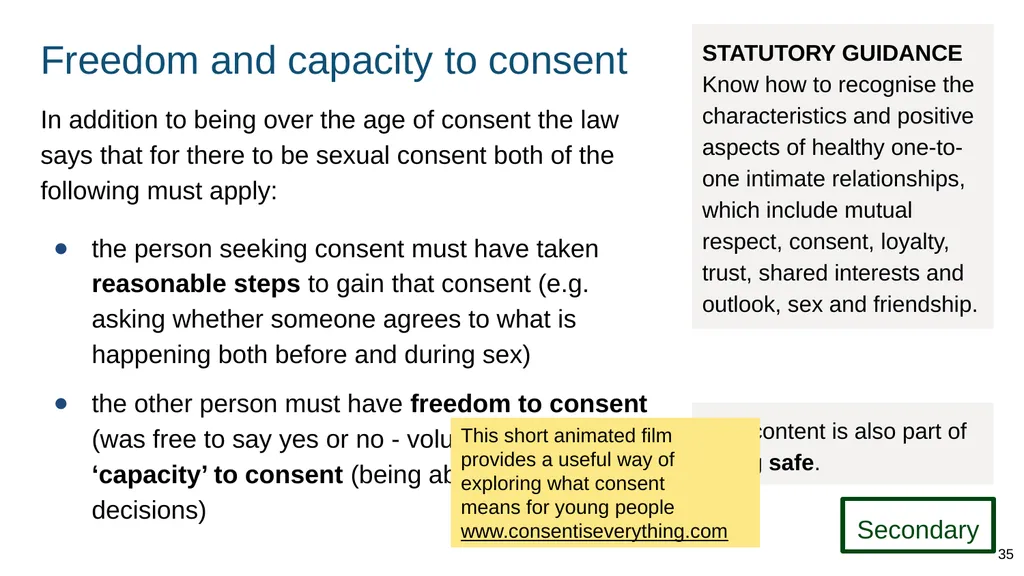
Freedom and capacity to consent In addition to being over the age of consent the law says that for there to be sexual consent both of the following must apply:
the person seeking consent must have taken reasonable steps to gain that consent (e.g. asking whether someone agrees to what is happening both before and during sex)
the other person must have freedom to consent (was free to say yes or no - voluntariness) and ‘capacity’ to consent (being able to make decisions) STATUTORY GUIDANCE Know how to recognise the characteristics and positive aspects of healthy one-to-one intimate relationships, which include mutual respect, consent, loyalty, trust, shared interests and outlook, sex and friendship. This content is also part of being safe. Secondary 35 This short animated film
provides a useful way of
exploring what consent
means for young people
www.consentiseverything.com<br>
the person seeking consent must have taken reasonable steps to gain that consent (e.g. asking whether someone agrees to what is happening both before and during sex)
the other person must have freedom to consent (was free to say yes or no - voluntariness) and ‘capacity’ to consent (being able to make decisions) STATUTORY GUIDANCE Know how to recognise the characteristics and positive aspects of healthy one-to-one intimate relationships, which include mutual respect, consent, loyalty, trust, shared interests and outlook, sex and friendship. This content is also part of being safe. Secondary 35 This short animated film
provides a useful way of
exploring what consent
means for young people
www.consentiseverything.com<br>
36
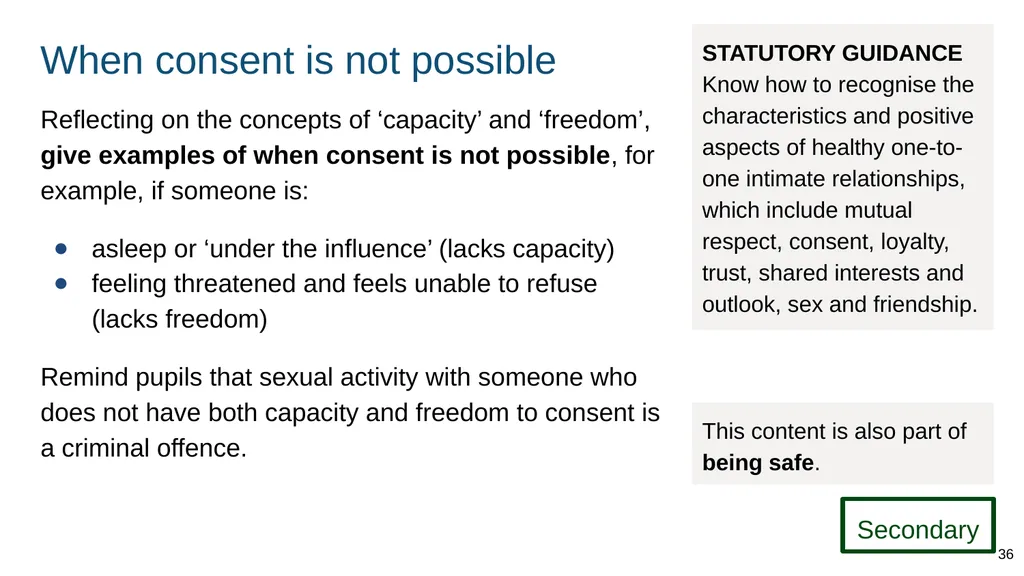
When consent is not possible Reflecting on the concepts of ‘capacity’ and ‘freedom’, give examples of when consent is not possible, for example, if someone is:
asleep or ‘under the influence’ (lacks capacity)
feeling threatened and feels unable to refuse (lacks freedom)
Remind pupils that sexual activity with someone who does not have both capacity and freedom to consent is a criminal offence. STATUTORY GUIDANCE Know how to recognise the characteristics and positive aspects of healthy one-to-one intimate relationships, which include mutual respect, consent, loyalty, trust, shared interests and outlook, sex and friendship. This content is also part of being safe. Secondary 36<br>
asleep or ‘under the influence’ (lacks capacity)
feeling threatened and feels unable to refuse (lacks freedom)
Remind pupils that sexual activity with someone who does not have both capacity and freedom to consent is a criminal offence. STATUTORY GUIDANCE Know how to recognise the characteristics and positive aspects of healthy one-to-one intimate relationships, which include mutual respect, consent, loyalty, trust, shared interests and outlook, sex and friendship. This content is also part of being safe. Secondary 36<br>
37
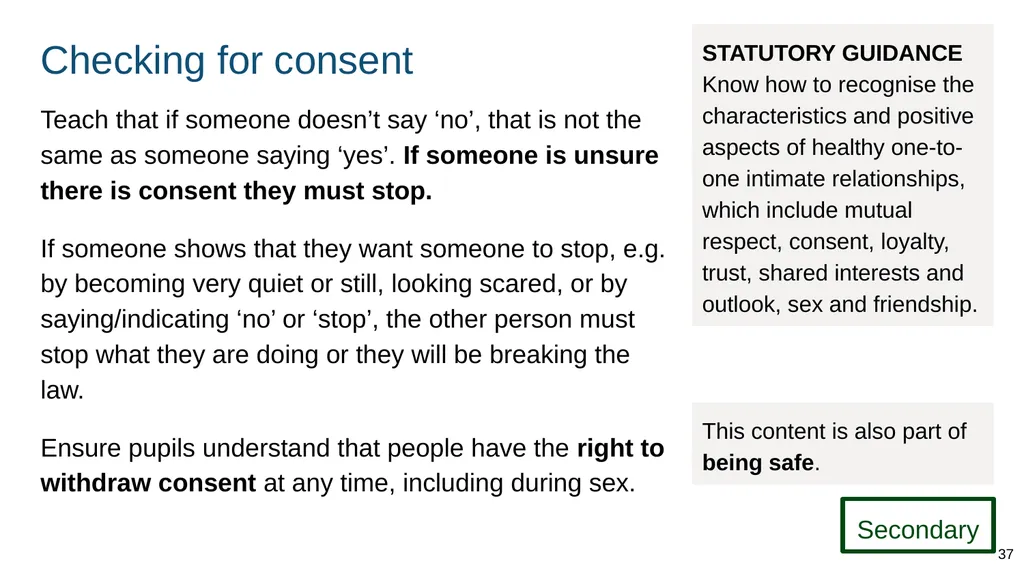
Checking for consent Teach that if someone doesn’t say ‘no’, that is not the same as someone saying ‘yes’. If someone is unsure there is consent they must stop.
If someone shows that they want someone to stop, e.g. by becoming very quiet or still, looking scared, or by saying/indicating ‘no’ or ‘stop’, the other person must stop what they are doing or they will be breaking the law.
Ensure pupils understand that people have the right to withdraw consent at any time, including during sex. STATUTORY GUIDANCE Know how to recognise the characteristics and positive aspects of healthy one-to-one intimate relationships, which include mutual respect, consent, loyalty, trust, shared interests and outlook, sex and friendship. This content is also part of being safe. Secondary 37<br>
If someone shows that they want someone to stop, e.g. by becoming very quiet or still, looking scared, or by saying/indicating ‘no’ or ‘stop’, the other person must stop what they are doing or they will be breaking the law.
Ensure pupils understand that people have the right to withdraw consent at any time, including during sex. STATUTORY GUIDANCE Know how to recognise the characteristics and positive aspects of healthy one-to-one intimate relationships, which include mutual respect, consent, loyalty, trust, shared interests and outlook, sex and friendship. This content is also part of being safe. Secondary 37<br>
38
People in a position of trust Teach pupils that there is an extra legal protection for young people.
It is against the law for a person aged 18 or over to have any sexual activity with a person under the age of 18 if the older person is in a position of trust (e.g. a doctor, care worker or teacher).
This is because the influence that someone in this position has could affect the younger person’s freedom and capacity to consent.
Teacher reference: Sexual Offences Act 2003. STATUTORY GUIDANCE Know how to recognise the characteristics and positive aspects of healthy one-to-one intimate relationships, which include mutual respect, consent, loyalty, trust, shared interests and outlook, sex and friendship. This content is also part of being safe. Secondary 38<br>
It is against the law for a person aged 18 or over to have any sexual activity with a person under the age of 18 if the older person is in a position of trust (e.g. a doctor, care worker or teacher).
This is because the influence that someone in this position has could affect the younger person’s freedom and capacity to consent.
Teacher reference: Sexual Offences Act 2003. STATUTORY GUIDANCE Know how to recognise the characteristics and positive aspects of healthy one-to-one intimate relationships, which include mutual respect, consent, loyalty, trust, shared interests and outlook, sex and friendship. This content is also part of being safe. Secondary 38<br>
39
Identifying and managing sexual pressure 39<br>
40
Sources of sexual pressure Teach pupils to identify sexual pressure in sexual decision-making, e.g. when people base decisions on:
what others are doing (peers, celebrities, pornography)
what others tell them to do (a partner, friends, social expectations)
emotional/psychological pressure (‘If you loved me you would do it’)
Explain that pressure can be applied by individuals or by groups and that people are sometimes pressured differently, e.g. depending on their gender or sexuality (expectations based on stereotypes). STATUTORY GUIDANCE Know that there are a range of strategies for identifying and managing sexual pressure, including understanding peer pressure, resisting pressure and not pressurising others. Secondary 40<br>
what others are doing (peers, celebrities, pornography)
what others tell them to do (a partner, friends, social expectations)
emotional/psychological pressure (‘If you loved me you would do it’)
Explain that pressure can be applied by individuals or by groups and that people are sometimes pressured differently, e.g. depending on their gender or sexuality (expectations based on stereotypes). STATUTORY GUIDANCE Know that there are a range of strategies for identifying and managing sexual pressure, including understanding peer pressure, resisting pressure and not pressurising others. Secondary 40<br>
41
Recognising sexual pressure Explain that in a respectful relationship:
‘positives’ (e.g. pleasure) are not used to pressure someone to have sex
threats (e.g. of ending a relationship) are not used to bully or manipulate someone into having sex
consent cannot not be assumed and is always necessary
sex shouldn’t be expected because people have had sex before
consent to one type of sexual activity does not mean there is consent to other activities STATUTORY GUIDANCE Know that there are a range of strategies for identifying and managing sexual pressure, including understanding peer pressure, resisting pressure and not pressurising others. Secondary 41 Useful resource for young people:
Rise Above
https://riseabove.org.uk/topic/love-life/<br>
‘positives’ (e.g. pleasure) are not used to pressure someone to have sex
threats (e.g. of ending a relationship) are not used to bully or manipulate someone into having sex
consent cannot not be assumed and is always necessary
sex shouldn’t be expected because people have had sex before
consent to one type of sexual activity does not mean there is consent to other activities STATUTORY GUIDANCE Know that there are a range of strategies for identifying and managing sexual pressure, including understanding peer pressure, resisting pressure and not pressurising others. Secondary 41 Useful resource for young people:
Rise Above
https://riseabove.org.uk/topic/love-life/<br>
42
Managing sexual pressure Teach that it is wrong, and sometimes illegal, for anyone (partner, boyfriend, girlfriend, anyone else) to sexually pressure or control someone else.
Tell pupils that if this happens and someone needs help they can:
speak to someone they trust at home or to a friend
speak to a teacher or nurse at school
contact ChildLine and speak anonymously about concerns
Develop vocabulary, progressing from ‘pressure’ to concepts such as ‘coercion’. STATUTORY GUIDANCE Know that there are a range of strategies for identifying and managing sexual pressure, including understanding peer pressure, resisting pressure and not pressurising others. Secondary 42<br>
Tell pupils that if this happens and someone needs help they can:
speak to someone they trust at home or to a friend
speak to a teacher or nurse at school
contact ChildLine and speak anonymously about concerns
Develop vocabulary, progressing from ‘pressure’ to concepts such as ‘coercion’. STATUTORY GUIDANCE Know that there are a range of strategies for identifying and managing sexual pressure, including understanding peer pressure, resisting pressure and not pressurising others. Secondary 42<br>
43
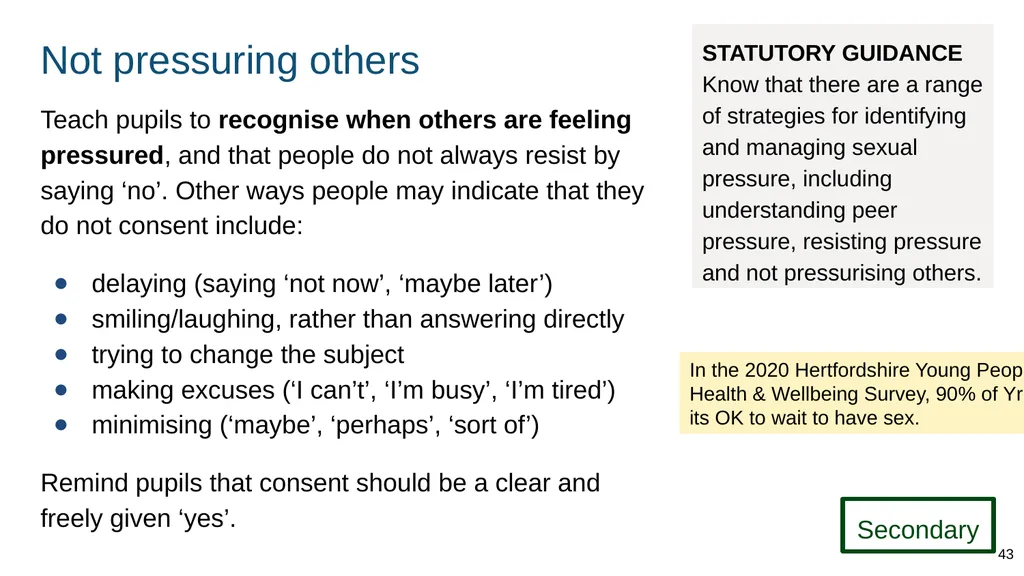
Not pressuring others Teach pupils to recognise when others are feeling pressured, and that people do not always resist by saying ‘no’. Other ways people may indicate that they do not consent include:
delaying (saying ‘not now’, ‘maybe later’)
smiling/laughing, rather than answering directly
trying to change the subject
making excuses (‘I can’t’, ‘I’m busy’, ‘I’m tired’)
minimising (‘maybe’, ‘perhaps’, ‘sort of’)
Remind pupils that consent should be a clear and freely given ‘yes’. STATUTORY GUIDANCE Know that there are a range of strategies for identifying and managing sexual pressure, including understanding peer pressure, resisting pressure and not pressurising others. Secondary 43 In the 2020 Hertfordshire Young Peoples
Health & Wellbeing Survey, 90% of Yr10 pupils said
its OK to wait to have sex.<br>
delaying (saying ‘not now’, ‘maybe later’)
smiling/laughing, rather than answering directly
trying to change the subject
making excuses (‘I can’t’, ‘I’m busy’, ‘I’m tired’)
minimising (‘maybe’, ‘perhaps’, ‘sort of’)
Remind pupils that consent should be a clear and freely given ‘yes’. STATUTORY GUIDANCE Know that there are a range of strategies for identifying and managing sexual pressure, including understanding peer pressure, resisting pressure and not pressurising others. Secondary 43 In the 2020 Hertfordshire Young Peoples
Health & Wellbeing Survey, 90% of Yr10 pupils said
its OK to wait to have sex.<br>
44
Sexual relationships 44<br>
45
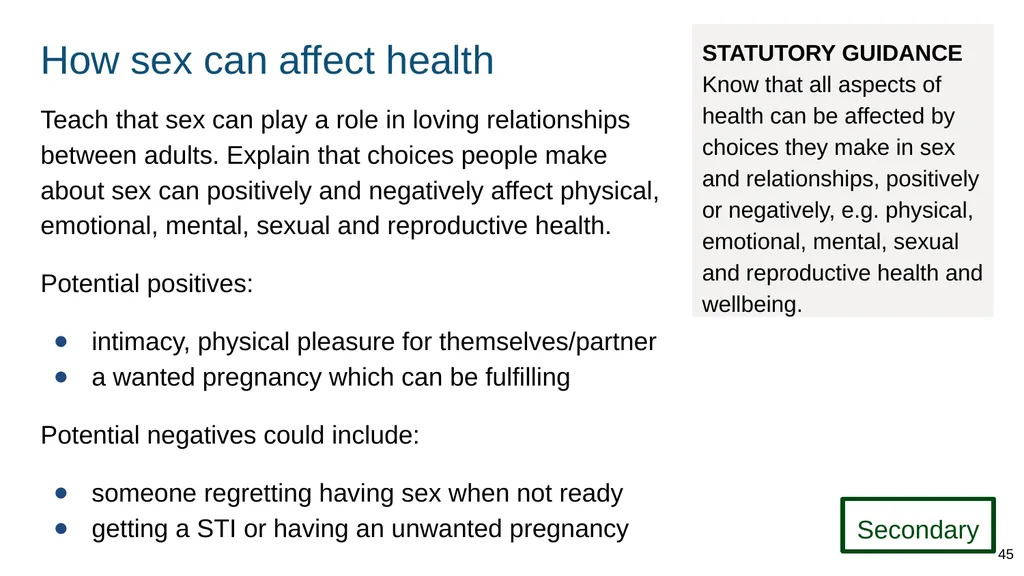
How sex can affect health Teach that sex can play a role in loving relationships between adults. Explain that choices people make about sex can positively and negatively affect physical, emotional, mental, sexual and reproductive health.
Potential positives:
intimacy, physical pleasure for themselves/partner
a wanted pregnancy which can be fulfilling
Potential negatives could include:
someone regretting having sex when not ready
getting a STI or having an unwanted pregnancy STATUTORY GUIDANCE Know that all aspects of health can be affected by choices they make in sex and relationships, positively or negatively, e.g. physical, emotional, mental, sexual and reproductive health and wellbeing. Secondary 45<br>
Potential positives:
intimacy, physical pleasure for themselves/partner
a wanted pregnancy which can be fulfilling
Potential negatives could include:
someone regretting having sex when not ready
getting a STI or having an unwanted pregnancy STATUTORY GUIDANCE Know that all aspects of health can be affected by choices they make in sex and relationships, positively or negatively, e.g. physical, emotional, mental, sexual and reproductive health and wellbeing. Secondary 45<br>
46
Future sexual health Teach that there is a link between future sexual health and someone’s first sexual experience.
Future sexual health tends to be better when the following applies to a person’s first experience of sex:
Willingness of both partners to have sex (both partners are able to and do consent).
Not reacting to peer pressure and not being under the influence of alcohol or drugs.
Using reliable contraception / protection against STIs. STATUTORY GUIDANCE Know that all aspects of health can be affected by choices they make in sex and relationships, positively or negatively, e.g. physical, emotional, mental, sexual and reproductive health and wellbeing. Secondary 46<br>
Future sexual health tends to be better when the following applies to a person’s first experience of sex:
Willingness of both partners to have sex (both partners are able to and do consent).
Not reacting to peer pressure and not being under the influence of alcohol or drugs.
Using reliable contraception / protection against STIs. STATUTORY GUIDANCE Know that all aspects of health can be affected by choices they make in sex and relationships, positively or negatively, e.g. physical, emotional, mental, sexual and reproductive health and wellbeing. Secondary 46<br>
47
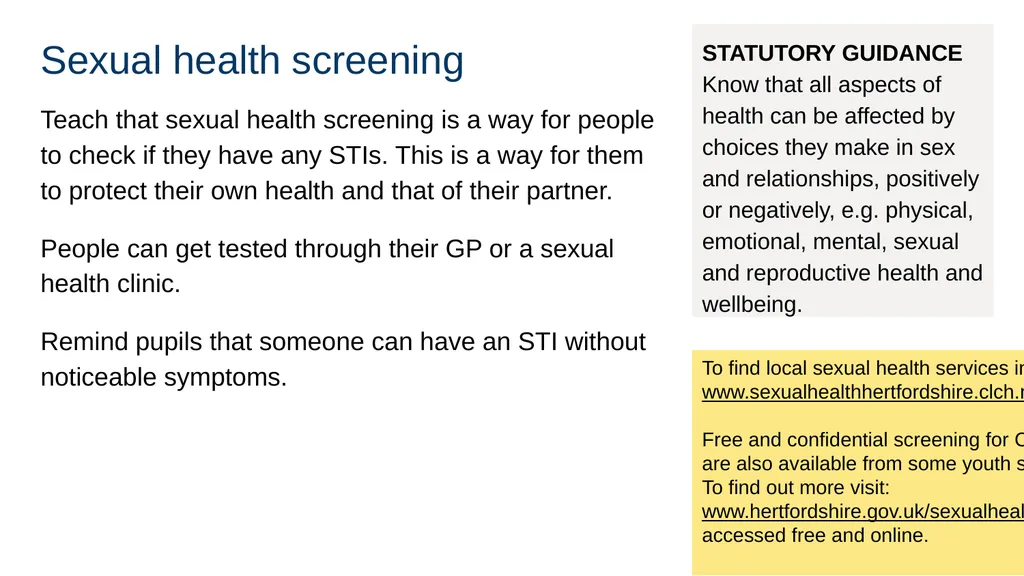
Sexual health screening Teach that sexual health screening is a way for people to check if they have any STIs. This is a way for them to protect their own health and that of their partner.
People can get tested through their GP or a sexual health clinic.
Remind pupils that someone can have an STI without noticeable symptoms. STATUTORY GUIDANCE Know that all aspects of health can be affected by choices they make in sex and relationships, positively or negatively, e.g. physical, emotional, mental, sexual and reproductive health and wellbeing. Secondary 47 To find local sexual health services in Hertfordshire visit:
www.sexualhealthhertfordshire.clch.nhs.uk
Free and confidential screening for Chlamydia and Gonorrhoea are also available from some youth services, pharmacies and GP. To find out more visit:
www.hertfordshire.gov.uk/sexualhealth STI testing can be also accessed free and online.<br>
People can get tested through their GP or a sexual health clinic.
Remind pupils that someone can have an STI without noticeable symptoms. STATUTORY GUIDANCE Know that all aspects of health can be affected by choices they make in sex and relationships, positively or negatively, e.g. physical, emotional, mental, sexual and reproductive health and wellbeing. Secondary 47 To find local sexual health services in Hertfordshire visit:
www.sexualhealthhertfordshire.clch.nhs.uk
Free and confidential screening for Chlamydia and Gonorrhoea are also available from some youth services, pharmacies and GP. To find out more visit:
www.hertfordshire.gov.uk/sexualhealth STI testing can be also accessed free and online.<br>
48
Alcohol, drugs and sex (1) Teach that alcohol and drugs make it harder to make good decisions (including about sex). They can ‘cloud’ thinking, lower ‘inhibitions’ and lead to risky behaviour, such as:
doing things you wouldn’t choose to do when sober
doing things you or a partner do not remember
pressuring others in ways you wouldn’t when sober (including pressuring others to get drunk or high, sexual pressure)
unprotected sex (risk of pregnancy and STIs) STATUTORY GUIDANCE Know how the use of alcohol and drugs can lead to risky sexual behaviour. Secondary 48 CGL Spectrum is the local drug and alcohol service for young people in Hertfordshire. For more information visit:
https://www.changegrowlive.org/advice-info/under-21-advice you can also access information from the national drug helping https://www.talktofrank.com/<br>
doing things you wouldn’t choose to do when sober
doing things you or a partner do not remember
pressuring others in ways you wouldn’t when sober (including pressuring others to get drunk or high, sexual pressure)
unprotected sex (risk of pregnancy and STIs) STATUTORY GUIDANCE Know how the use of alcohol and drugs can lead to risky sexual behaviour. Secondary 48 CGL Spectrum is the local drug and alcohol service for young people in Hertfordshire. For more information visit:
https://www.changegrowlive.org/advice-info/under-21-advice you can also access information from the national drug helping https://www.talktofrank.com/<br>
49
Alcohol, drugs and sex (2) Expand on the increased risks associated with alcohol and drugs.
For example, people can experience:
painful emotions (regret, anxiety, paranoia)
relationship problems (e.g. people being ‘unfaithful’ to each other)
physical injury to themselves or their partner STATUTORY GUIDANCE Know how the use of alcohol and drugs can lead to risky sexual behaviour. Secondary 49<br>
For example, people can experience:
painful emotions (regret, anxiety, paranoia)
relationship problems (e.g. people being ‘unfaithful’ to each other)
physical injury to themselves or their partner STATUTORY GUIDANCE Know how the use of alcohol and drugs can lead to risky sexual behaviour. Secondary 49<br>
50
Human fertility and reproduction 50<br>
51
Individual development Ensure pupils understand that although many important changes happen during puberty, this does not mean that an individual is physically or emotionally ready to have sex, or able to consent.
Related topic: changing adolescent body. STATUTORY GUIDANCE Know the facts about reproductive health, including fertility, and the potential impact of lifestyle on fertility for men and women and menopause. Secondary 51<br>
Related topic: changing adolescent body. STATUTORY GUIDANCE Know the facts about reproductive health, including fertility, and the potential impact of lifestyle on fertility for men and women and menopause. Secondary 51<br>
52
Fertility and reproduction Building on knowledge of reproduction teach that during puberty:
the ovaries develop and release eggs and periods start, usually from age 10 to 16 - this does vary though (a GP can give advice if periods haven’t started by 16)
the testicles start producing sperm, usually from age 10 to 14
Explain that sperm can fertilise an egg through sexual intercourse, and this can result in a pregnancy. STATUTORY GUIDANCE Know the facts about reproductive health, including fertility, and the potential impact of lifestyle on fertility for men and women and menopause. Secondary 52<br>
the ovaries develop and release eggs and periods start, usually from age 10 to 16 - this does vary though (a GP can give advice if periods haven’t started by 16)
the testicles start producing sperm, usually from age 10 to 14
Explain that sperm can fertilise an egg through sexual intercourse, and this can result in a pregnancy. STATUTORY GUIDANCE Know the facts about reproductive health, including fertility, and the potential impact of lifestyle on fertility for men and women and menopause. Secondary 52<br>
53
Ways people have a child Teach pupils that there are different ways that people, including LGBT people, can have a child, including:
donor insemination
co-parenting
adoption or fostering
surrogacy
Refer to NHS guidance for detailed paths to parenthood information on each of these options. STATUTORY GUIDANCE Know the facts about reproductive health, including fertility, and the potential impact of lifestyle on fertility for men and women and menopause. Secondary 53<br>
donor insemination
co-parenting
adoption or fostering
surrogacy
Refer to NHS guidance for detailed paths to parenthood information on each of these options. STATUTORY GUIDANCE Know the facts about reproductive health, including fertility, and the potential impact of lifestyle on fertility for men and women and menopause. Secondary 53<br>
54
How health can affect fertility Teach that lifestyle and health factors (some of which can be treated) can reduce fertility such as:
drinking alcohol, smoking and using certain drugs
sexually transmitted infections (STIs)
taking medications
hormone imbalance
weight issues (unhealthy BMI) and stress
health conditions such as pelvic inflammatory disease, polycystic ovaries and endometriosis
Explain that some people have fertility problems without there being a clear reason. STATUTORY GUIDANCE Know the facts about reproductive health, including fertility, and the potential impact of lifestyle on fertility for men and women and menopause. Secondary 54<br>
drinking alcohol, smoking and using certain drugs
sexually transmitted infections (STIs)
taking medications
hormone imbalance
weight issues (unhealthy BMI) and stress
health conditions such as pelvic inflammatory disease, polycystic ovaries and endometriosis
Explain that some people have fertility problems without there being a clear reason. STATUTORY GUIDANCE Know the facts about reproductive health, including fertility, and the potential impact of lifestyle on fertility for men and women and menopause. Secondary 54<br>
55
Fertility and menopause Teach pupils that getting pregnant later in life can be more difficult because reproductive health (‘fertility’) reduces with age.
Up to 500 eggs are released in a typical lifespan. Egg quality declines with age (particularly from late 30s).
Around the age of 50 eggs stop being released and periods eventually stop. This is called the menopause and women are usually no longer able to get pregnant once the menopause is complete.
Explain that some people can get pregnant during the ‘perimenopause’ (transition into the menopause). STATUTORY GUIDANCE Know the facts about reproductive health, including fertility, and the potential impact of lifestyle on fertility for men and women and menopause. Secondary 55<br>
Up to 500 eggs are released in a typical lifespan. Egg quality declines with age (particularly from late 30s).
Around the age of 50 eggs stop being released and periods eventually stop. This is called the menopause and women are usually no longer able to get pregnant once the menopause is complete.
Explain that some people can get pregnant during the ‘perimenopause’ (transition into the menopause). STATUTORY GUIDANCE Know the facts about reproductive health, including fertility, and the potential impact of lifestyle on fertility for men and women and menopause. Secondary 55<br>
56
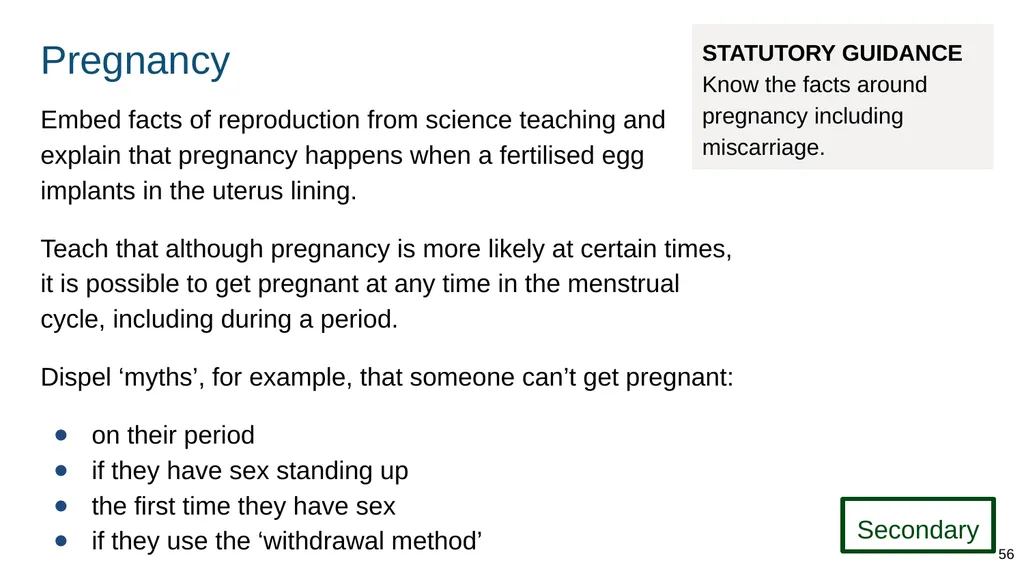
Pregnancy STATUTORY GUIDANCE
Know the facts around pregnancy including miscarriage. Embed facts of reproduction from science teaching and explain that pregnancy happens when a fertilised egg implants in the uterus lining.
Teach that although pregnancy is more likely at certain times, it is possible to get pregnant at any time in the menstrual cycle, including during a period.
Dispel ‘myths’, for example, that someone can’t get pregnant:
on their period
if they have sex standing up
the first time they have sex
if they use the ‘withdrawal method’ Secondary 56<br>
Teach that although pregnancy is more likely at certain times, it is possible to get pregnant at any time in the menstrual cycle, including during a period.
Dispel ‘myths’, for example, that someone can’t get pregnant:
on their period
if they have sex standing up
the first time they have sex
if they use the ‘withdrawal method’ Secondary 56<br>
57
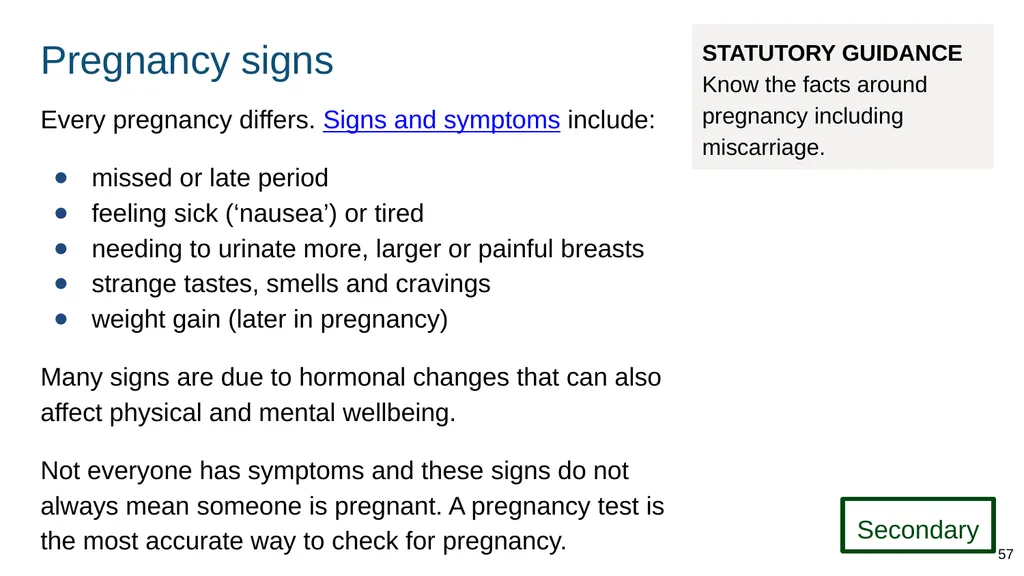
Pregnancy signs Every pregnancy differs. Signs and symptoms include:
missed or late period
feeling sick (‘nausea’) or tired
needing to urinate more, larger or painful breasts
strange tastes, smells and cravings
weight gain (later in pregnancy)
Many signs are due to hormonal changes that can also affect physical and mental wellbeing.
Not everyone has symptoms and these signs do not always mean someone is pregnant. A pregnancy test is the most accurate way to check for pregnancy. STATUTORY GUIDANCE Know the facts around pregnancy including miscarriage. Secondary 57<br>
missed or late period
feeling sick (‘nausea’) or tired
needing to urinate more, larger or painful breasts
strange tastes, smells and cravings
weight gain (later in pregnancy)
Many signs are due to hormonal changes that can also affect physical and mental wellbeing.
Not everyone has symptoms and these signs do not always mean someone is pregnant. A pregnancy test is the most accurate way to check for pregnancy. STATUTORY GUIDANCE Know the facts around pregnancy including miscarriage. Secondary 57<br>
58
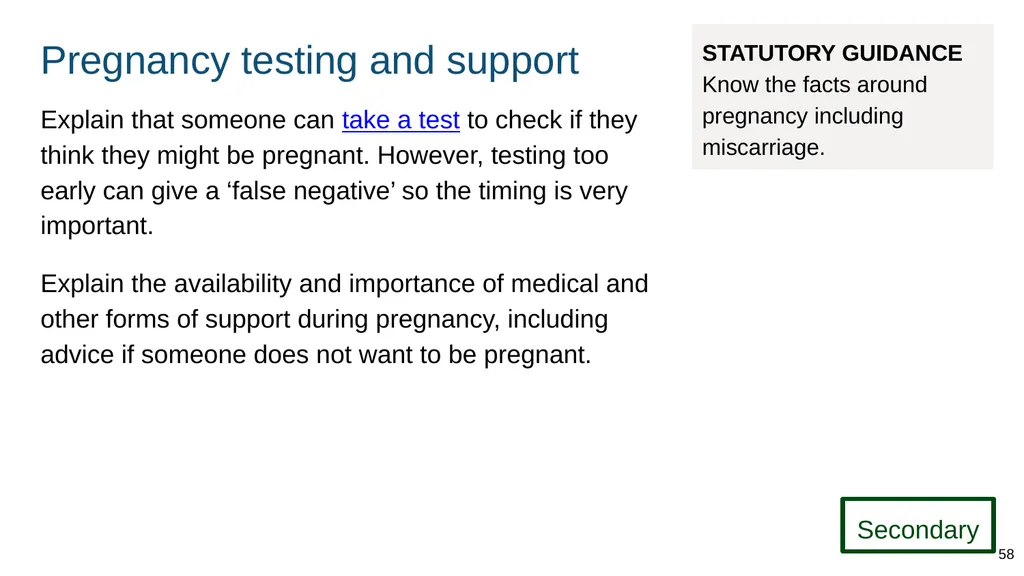
Pregnancy testing and support Explain that someone can take a test to check if they think they might be pregnant. However, testing too early can give a ‘false negative’ so the timing is very important.
Explain the availability and importance of medical and other forms of support during pregnancy, including advice if someone does not want to be pregnant. STATUTORY GUIDANCE Know the facts around pregnancy including miscarriage. Secondary 58<br>
Explain the availability and importance of medical and other forms of support during pregnancy, including advice if someone does not want to be pregnant. STATUTORY GUIDANCE Know the facts around pregnancy including miscarriage. Secondary 58<br>
59
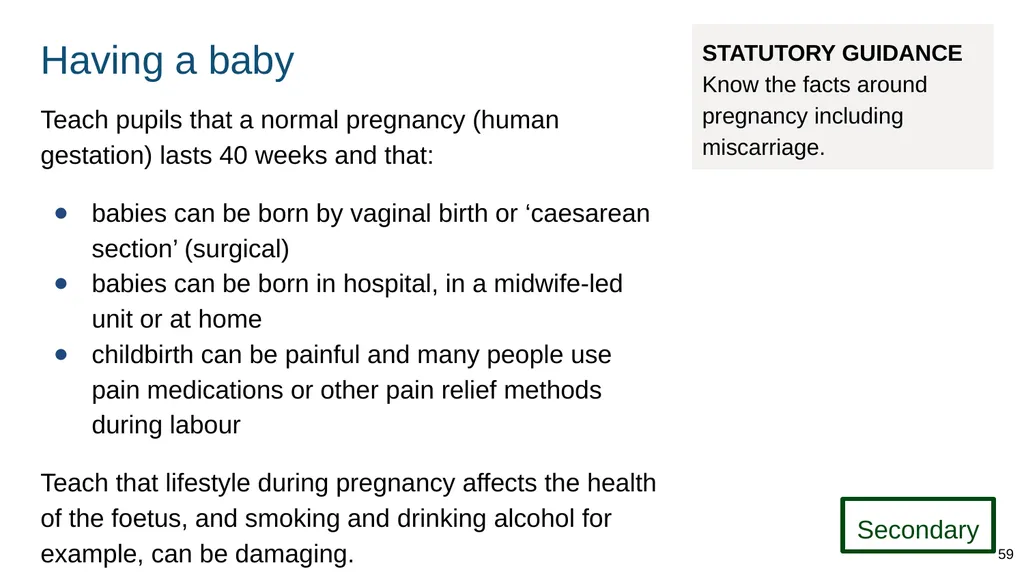
Having a baby Teach pupils that a normal pregnancy (human gestation) lasts 40 weeks and that:
babies can be born by vaginal birth or ‘caesarean section’ (surgical)
babies can be born in hospital, in a midwife-led unit or at home
childbirth can be painful and many people use pain medications or other pain relief methods during labour
Teach that lifestyle during pregnancy affects the health of the foetus, and smoking and drinking alcohol for example, can be damaging. STATUTORY GUIDANCE Know the facts around pregnancy including miscarriage. Secondary 59<br>
babies can be born by vaginal birth or ‘caesarean section’ (surgical)
babies can be born in hospital, in a midwife-led unit or at home
childbirth can be painful and many people use pain medications or other pain relief methods during labour
Teach that lifestyle during pregnancy affects the health of the foetus, and smoking and drinking alcohol for example, can be damaging. STATUTORY GUIDANCE Know the facts around pregnancy including miscarriage. Secondary 59<br>
60
Wellbeing during/after pregnancy Explain that many people feel well during pregnancy and after. However, some people might feel physically or mentally unwell during pregnancy, or get ‘postnatal depression’ after pregnancy.
Explain the importance of midwife/antenatal and other support throughout and after pregnancy. STATUTORY GUIDANCE Know the facts around pregnancy including miscarriage. Secondary 60<br>
Explain the importance of midwife/antenatal and other support throughout and after pregnancy. STATUTORY GUIDANCE Know the facts around pregnancy including miscarriage. Secondary 60<br>
61
Miscarriage and ‘stillbirth’ Tell pupils that not all pregnancies result in a baby and that some people experience:
miscarriage - loss of the foetus at any stage (more common in first 12 weeks)
‘stillbirth’ (death of baby before or during delivery)
Sometimes doctors do not know why this has happened. However, most people can conceive again.
Emphasise that medical and emotional support is available for those who experience a miscarriage, stillbirth or neonatal death. STATUTORY GUIDANCE Know the facts around pregnancy including miscarriage. Secondary 61<br>
miscarriage - loss of the foetus at any stage (more common in first 12 weeks)
‘stillbirth’ (death of baby before or during delivery)
Sometimes doctors do not know why this has happened. However, most people can conceive again.
Emphasise that medical and emotional support is available for those who experience a miscarriage, stillbirth or neonatal death. STATUTORY GUIDANCE Know the facts around pregnancy including miscarriage. Secondary 61<br>
62
Pregnancy choices and support 62<br>
63
Making decisions about pregnancy Tell pupils about the choices people can legally make in relation to pregnancy. Choices include:
continuing with the pregnancy
considering adoption or fostering
termination or abortion (within the provisions of the law)
Emphasise that it’s important people get support from a health professional if they are concerned about a pregnancy or need help and advice. STATUTORY GUIDANCE Know that there are choices in relation to pregnancy (with medically and legally accurate, impartial information on all options, including keeping the baby, adoption, abortion and where to get further help). Secondary 63 Brook https://www.brook.org.uk/topics/pregnancy/ and the national Sex Wise website has useful information about pregnancy: https://www.sexwise.org.uk/unplanned-pregnancy<br>
continuing with the pregnancy
considering adoption or fostering
termination or abortion (within the provisions of the law)
Emphasise that it’s important people get support from a health professional if they are concerned about a pregnancy or need help and advice. STATUTORY GUIDANCE Know that there are choices in relation to pregnancy (with medically and legally accurate, impartial information on all options, including keeping the baby, adoption, abortion and where to get further help). Secondary 63 Brook https://www.brook.org.uk/topics/pregnancy/ and the national Sex Wise website has useful information about pregnancy: https://www.sexwise.org.uk/unplanned-pregnancy<br>
64
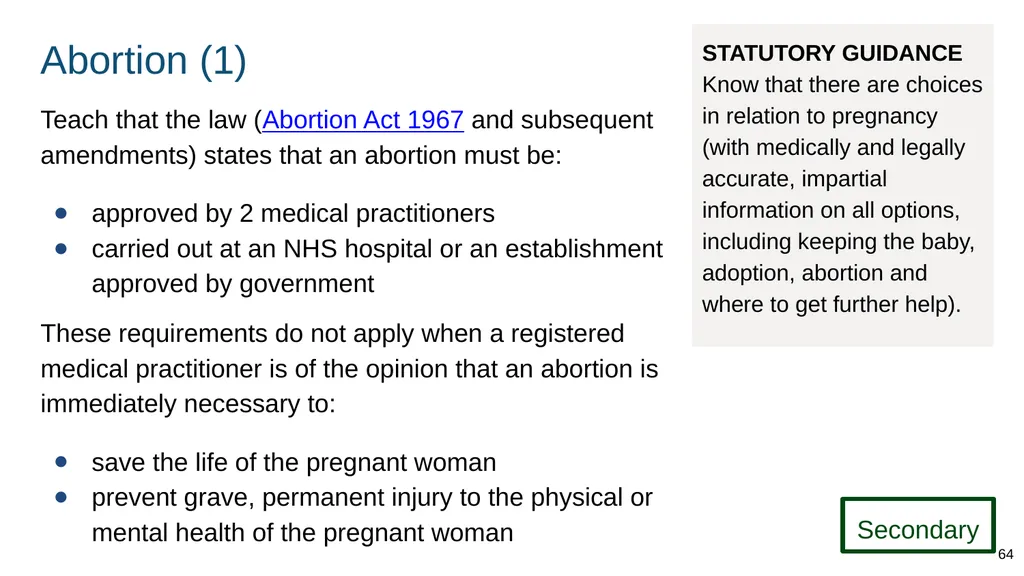
Abortion (1) Teach that the law (Abortion Act 1967 and subsequent amendments) states that an abortion must be:
approved by 2 medical practitioners
carried out at an NHS hospital or an establishment approved by government
These requirements do not apply when a registered medical practitioner is of the opinion that an abortion is immediately necessary to:
save the life of the pregnant woman
prevent grave, permanent injury to the physical or mental health of the pregnant woman STATUTORY GUIDANCE Know that there are choices in relation to pregnancy (with medically and legally accurate, impartial information on all options, including keeping the baby, adoption, abortion and where to get further help). Secondary 64<br>
approved by 2 medical practitioners
carried out at an NHS hospital or an establishment approved by government
These requirements do not apply when a registered medical practitioner is of the opinion that an abortion is immediately necessary to:
save the life of the pregnant woman
prevent grave, permanent injury to the physical or mental health of the pregnant woman STATUTORY GUIDANCE Know that there are choices in relation to pregnancy (with medically and legally accurate, impartial information on all options, including keeping the baby, adoption, abortion and where to get further help). Secondary 64<br>
65
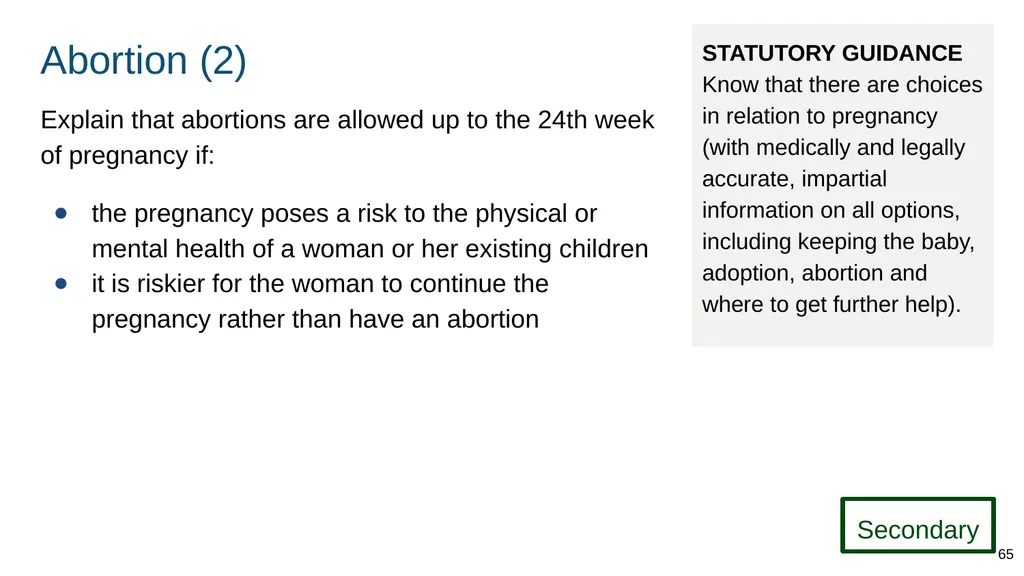
Abortion (2) Explain that abortions are allowed up to the 24th week of pregnancy if:
the pregnancy poses a risk to the physical or mental health of a woman or her existing children
it is riskier for the woman to continue the pregnancy rather than have an abortion STATUTORY GUIDANCE Know that there are choices in relation to pregnancy (with medically and legally accurate, impartial information on all options, including keeping the baby, adoption, abortion and where to get further help). Secondary 65<br>
the pregnancy poses a risk to the physical or mental health of a woman or her existing children
it is riskier for the woman to continue the pregnancy rather than have an abortion STATUTORY GUIDANCE Know that there are choices in relation to pregnancy (with medically and legally accurate, impartial information on all options, including keeping the baby, adoption, abortion and where to get further help). Secondary 65<br>
66
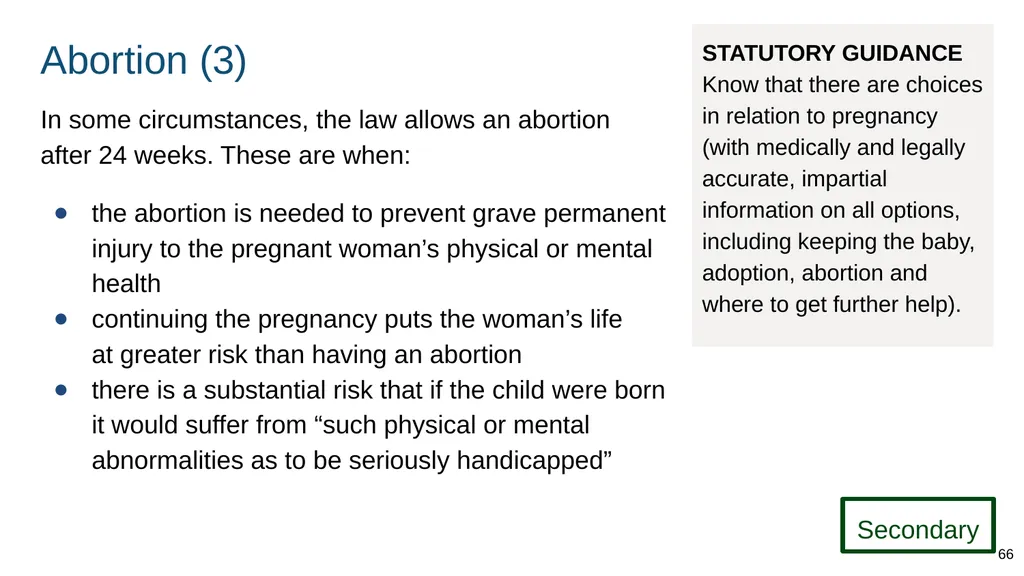
Abortion (3) In some circumstances, the law allows an abortion after 24 weeks. These are when:
the abortion is needed to prevent grave permanent injury to the pregnant woman’s physical or mental health
continuing the pregnancy puts the woman’s life at greater risk than having an abortion
there is a substantial risk that if the child were born it would suffer from “such physical or mental abnormalities as to be seriously handicapped” STATUTORY GUIDANCE Know that there are choices in relation to pregnancy (with medically and legally accurate, impartial information on all options, including keeping the baby, adoption, abortion and where to get further help). Secondary 66<br>
the abortion is needed to prevent grave permanent injury to the pregnant woman’s physical or mental health
continuing the pregnancy puts the woman’s life at greater risk than having an abortion
there is a substantial risk that if the child were born it would suffer from “such physical or mental abnormalities as to be seriously handicapped” STATUTORY GUIDANCE Know that there are choices in relation to pregnancy (with medically and legally accurate, impartial information on all options, including keeping the baby, adoption, abortion and where to get further help). Secondary 66<br>
67
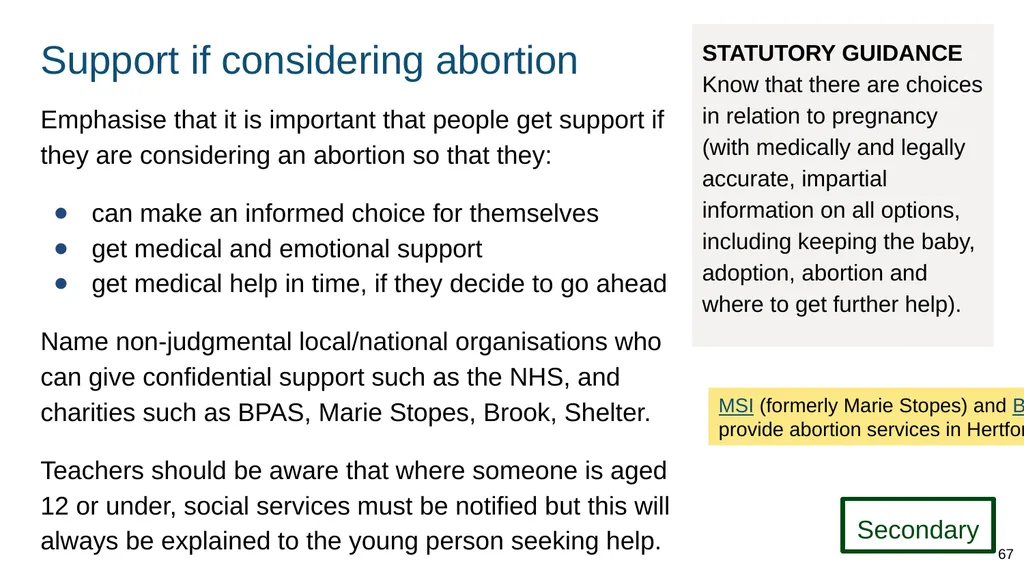
Support if considering abortion Emphasise that it is important that people get support if they are considering an abortion so that they:
can make an informed choice for themselves
get medical and emotional support
get medical help in time, if they decide to go ahead
Name non-judgmental local/national organisations who can give confidential support such as the NHS, and charities such as BPAS, Marie Stopes, Brook, Shelter.
Teachers should be aware that where someone is aged 12 or under, social services must be notified but this will always be explained to the young person seeking help. STATUTORY GUIDANCE Know that there are choices in relation to pregnancy (with medically and legally accurate, impartial information on all options, including keeping the baby, adoption, abortion and where to get further help). Secondary 67 MSI (formerly Marie Stopes) and BPAS both
provide abortion services in Hertfordshire.<br>
can make an informed choice for themselves
get medical and emotional support
get medical help in time, if they decide to go ahead
Name non-judgmental local/national organisations who can give confidential support such as the NHS, and charities such as BPAS, Marie Stopes, Brook, Shelter.
Teachers should be aware that where someone is aged 12 or under, social services must be notified but this will always be explained to the young person seeking help. STATUTORY GUIDANCE Know that there are choices in relation to pregnancy (with medically and legally accurate, impartial information on all options, including keeping the baby, adoption, abortion and where to get further help). Secondary 67 MSI (formerly Marie Stopes) and BPAS both
provide abortion services in Hertfordshire.<br>
68
Sexually transmitted infections (STIs) 68<br>
69
Sexually transmitted infections Teach there are different STIs and explain that they can be transmitted through mucous membranes / body fluids (blood, saliva, vaginal mucus, anal mucus).
Explain which parts of body have mucous membrane (mouth, anus, vagina, tip of penis).
Ensure pupils understand that transmission of an STI can happen during different types of sexual activity (including oral sex).
Also tell pupils about the NHS human papillomavirus (HPV) vaccine scheme and the protection it offers. STATUTORY GUIDANCE Know how the different sexually transmitted infections (STIs), including HIV/AIDs, are transmitted, how risk can be reduced through safer sex (including through condom use) and the importance of and facts about testing. Secondary 69<br>
Explain which parts of body have mucous membrane (mouth, anus, vagina, tip of penis).
Ensure pupils understand that transmission of an STI can happen during different types of sexual activity (including oral sex).
Also tell pupils about the NHS human papillomavirus (HPV) vaccine scheme and the protection it offers. STATUTORY GUIDANCE Know how the different sexually transmitted infections (STIs), including HIV/AIDs, are transmitted, how risk can be reduced through safer sex (including through condom use) and the importance of and facts about testing. Secondary 69<br>
70
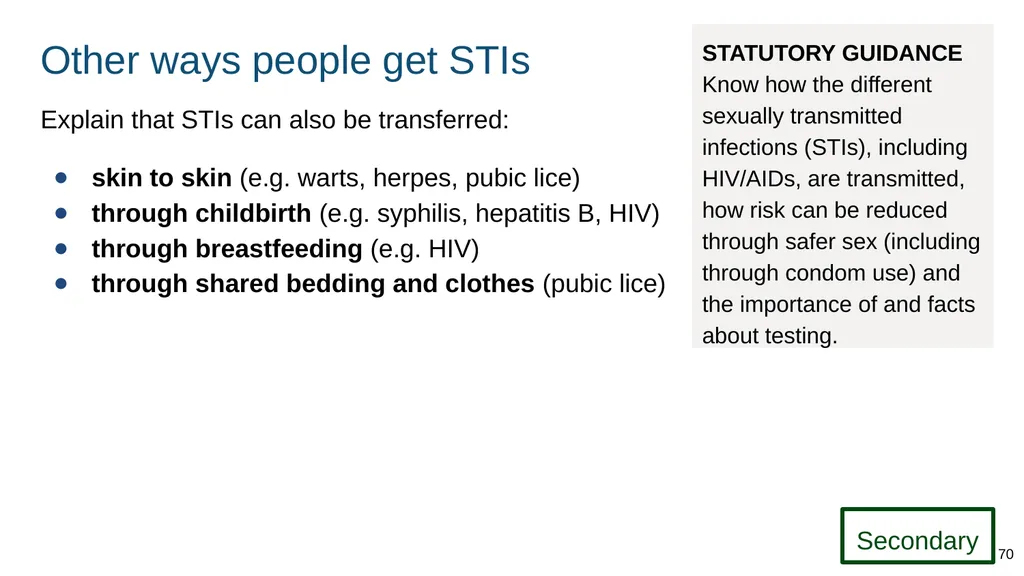
Other ways people get STIs Explain that STIs can also be transferred:
skin to skin (e.g. warts, herpes, pubic lice)
through childbirth (e.g. syphilis, hepatitis B, HIV)
through breastfeeding (e.g. HIV)
through shared bedding and clothes (pubic lice) STATUTORY GUIDANCE Know how the different sexually transmitted infections (STIs), including HIV/AIDs, are transmitted, how risk can be reduced through safer sex (including through condom use) and the importance of and facts about testing. Secondary 70<br>
skin to skin (e.g. warts, herpes, pubic lice)
through childbirth (e.g. syphilis, hepatitis B, HIV)
through breastfeeding (e.g. HIV)
through shared bedding and clothes (pubic lice) STATUTORY GUIDANCE Know how the different sexually transmitted infections (STIs), including HIV/AIDs, are transmitted, how risk can be reduced through safer sex (including through condom use) and the importance of and facts about testing. Secondary 70<br>
71
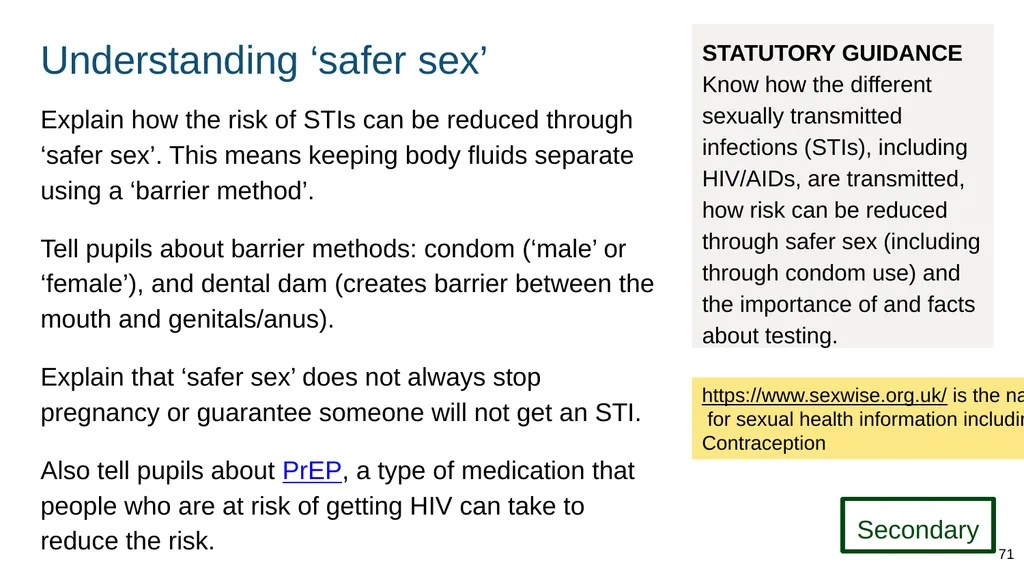
Understanding ‘safer sex’ Explain how the risk of STIs can be reduced through ‘safer sex’. This means keeping body fluids separate using a ‘barrier method’.
Tell pupils about barrier methods: condom (‘male’ or ‘female’), and dental dam (creates barrier between the mouth and genitals/anus).
Explain that ‘safer sex’ does not always stop pregnancy or guarantee someone will not get an STI.
Also tell pupils about PrEP, a type of medication that people who are at risk of getting HIV can take to reduce the risk. STATUTORY GUIDANCE Know how the different sexually transmitted infections (STIs), including HIV/AIDs, are transmitted, how risk can be reduced through safer sex (including through condom use) and the importance of and facts about testing. Secondary 71 https://www.sexwise.org.uk/ is the national website
for sexual health information including STIs and Contraception<br>
Tell pupils about barrier methods: condom (‘male’ or ‘female’), and dental dam (creates barrier between the mouth and genitals/anus).
Explain that ‘safer sex’ does not always stop pregnancy or guarantee someone will not get an STI.
Also tell pupils about PrEP, a type of medication that people who are at risk of getting HIV can take to reduce the risk. STATUTORY GUIDANCE Know how the different sexually transmitted infections (STIs), including HIV/AIDs, are transmitted, how risk can be reduced through safer sex (including through condom use) and the importance of and facts about testing. Secondary 71 https://www.sexwise.org.uk/ is the national website
for sexual health information including STIs and Contraception<br>
72
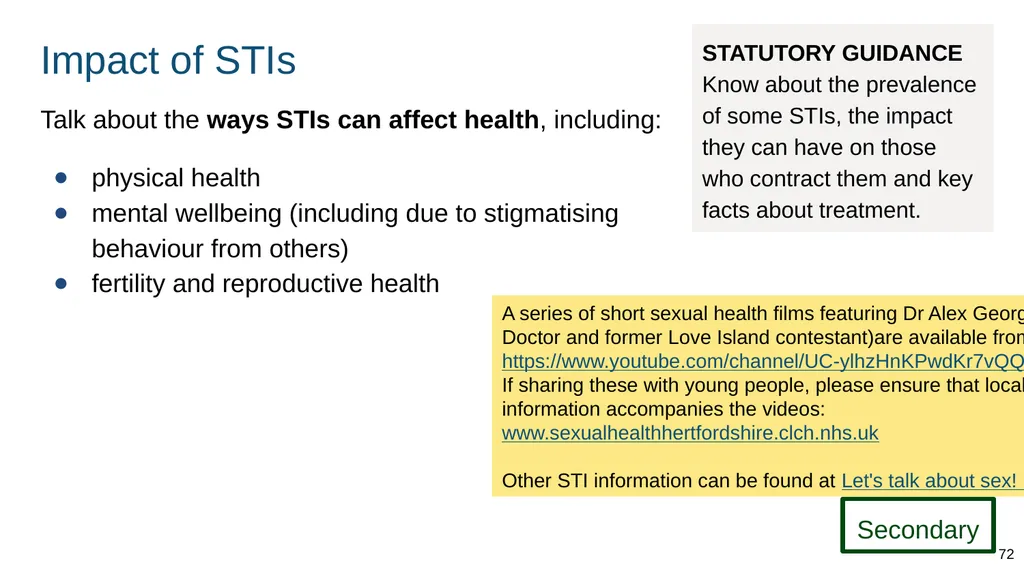
Impact of STIs Talk about the ways STIs can affect health, including:
physical health
mental wellbeing (including due to stigmatising behaviour from others)
fertility and reproductive health STATUTORY GUIDANCE Know about the prevalence of some STIs, the impact they can have on those who contract them and key facts about treatment. Secondary 72 A series of short sexual health films featuring Dr Alex George (A&E Doctor and former Love Island contestant)are available from: https://www.youtube.com/channel/UC-ylhzHnKPwdKr7vQQzoIJg
If sharing these with young people, please ensure that local service information accompanies the videos: www.sexualhealthhertfordshire.clch.nhs.uk
Other STI information can be found at Let's talk about sex! | Sexwise<br>
physical health
mental wellbeing (including due to stigmatising behaviour from others)
fertility and reproductive health STATUTORY GUIDANCE Know about the prevalence of some STIs, the impact they can have on those who contract them and key facts about treatment. Secondary 72 A series of short sexual health films featuring Dr Alex George (A&E Doctor and former Love Island contestant)are available from: https://www.youtube.com/channel/UC-ylhzHnKPwdKr7vQQzoIJg
If sharing these with young people, please ensure that local service information accompanies the videos: www.sexualhealthhertfordshire.clch.nhs.uk
Other STI information can be found at Let's talk about sex! | Sexwise<br>
73
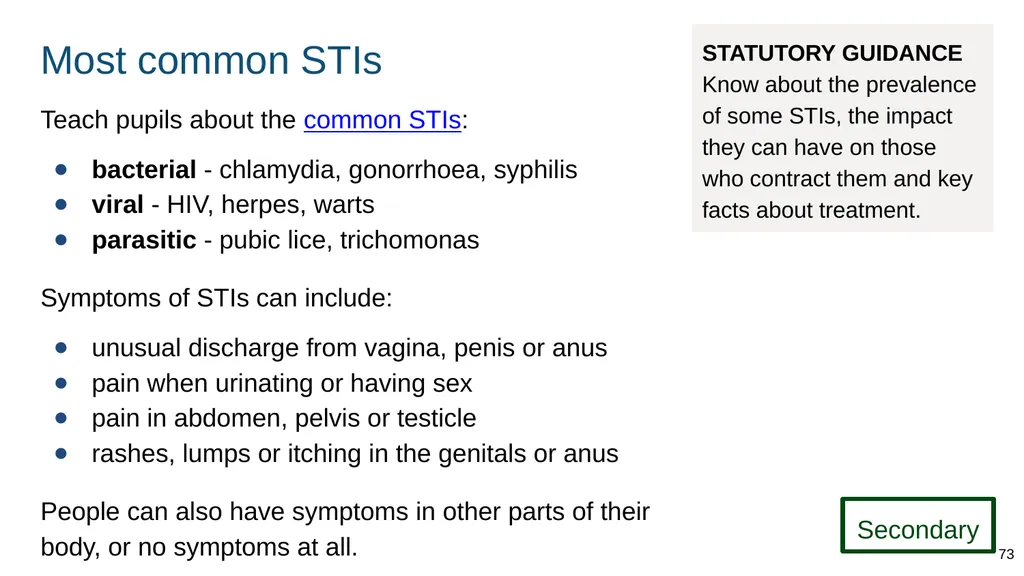
Most common STIs Teach pupils about the common STIs:
bacterial - chlamydia, gonorrhoea, syphilis
viral - HIV, herpes, warts
parasitic - pubic lice, trichomonas
Symptoms of STIs can include:
unusual discharge from vagina, penis or anus
pain when urinating or having sex
pain in abdomen, pelvis or testicle
rashes, lumps or itching in the genitals or anus
People can also have symptoms in other parts of their body, or no symptoms at all. STATUTORY GUIDANCE Know about the prevalence of some STIs, the impact they can have on those who contract them and key facts about treatment. Secondary 73<br>
bacterial - chlamydia, gonorrhoea, syphilis
viral - HIV, herpes, warts
parasitic - pubic lice, trichomonas
Symptoms of STIs can include:
unusual discharge from vagina, penis or anus
pain when urinating or having sex
pain in abdomen, pelvis or testicle
rashes, lumps or itching in the genitals or anus
People can also have symptoms in other parts of their body, or no symptoms at all. STATUTORY GUIDANCE Know about the prevalence of some STIs, the impact they can have on those who contract them and key facts about treatment. Secondary 73<br>
74
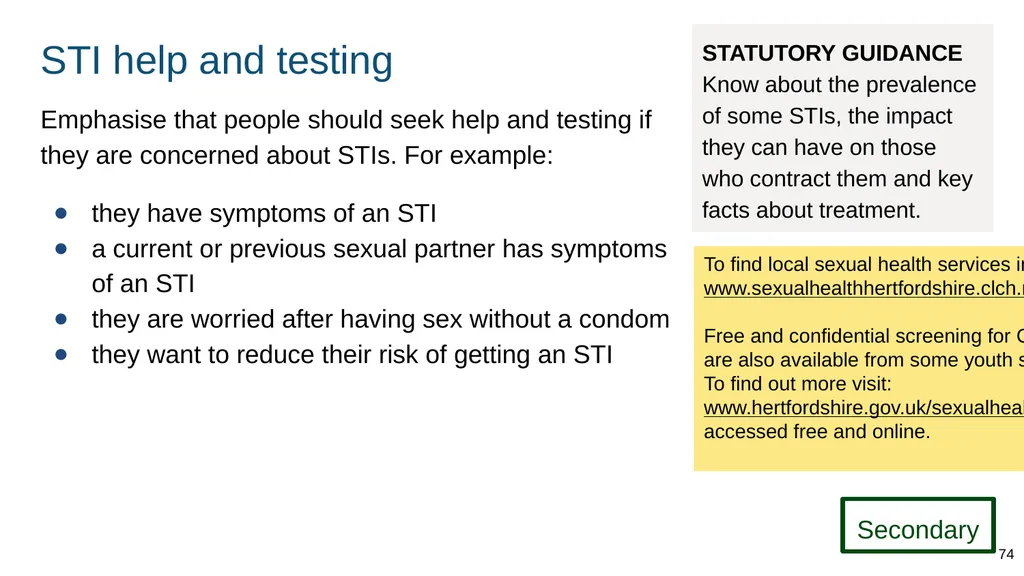
STI help and testing Emphasise that people should seek help and testing if they are concerned about STIs. For example:
they have symptoms of an STI
a current or previous sexual partner has symptoms of an STI
they are worried after having sex without a condom
they want to reduce their risk of getting an STI STATUTORY GUIDANCE Know about the prevalence of some STIs, the impact they can have on those who contract them and key facts about treatment. Secondary 74 To find local sexual health services in Hertfordshire visit:
www.sexualhealthhertfordshire.clch.nhs.uk
Free and confidential screening for Chlamydia and Gonorrhoea are also available from some youth services, pharmacies and GP. To find out more visit:
www.hertfordshire.gov.uk/sexualhealth STI testing can be also accessed free and online.<br>
they have symptoms of an STI
a current or previous sexual partner has symptoms of an STI
they are worried after having sex without a condom
they want to reduce their risk of getting an STI STATUTORY GUIDANCE Know about the prevalence of some STIs, the impact they can have on those who contract them and key facts about treatment. Secondary 74 To find local sexual health services in Hertfordshire visit:
www.sexualhealthhertfordshire.clch.nhs.uk
Free and confidential screening for Chlamydia and Gonorrhoea are also available from some youth services, pharmacies and GP. To find out more visit:
www.hertfordshire.gov.uk/sexualhealth STI testing can be also accessed free and online.<br>
75
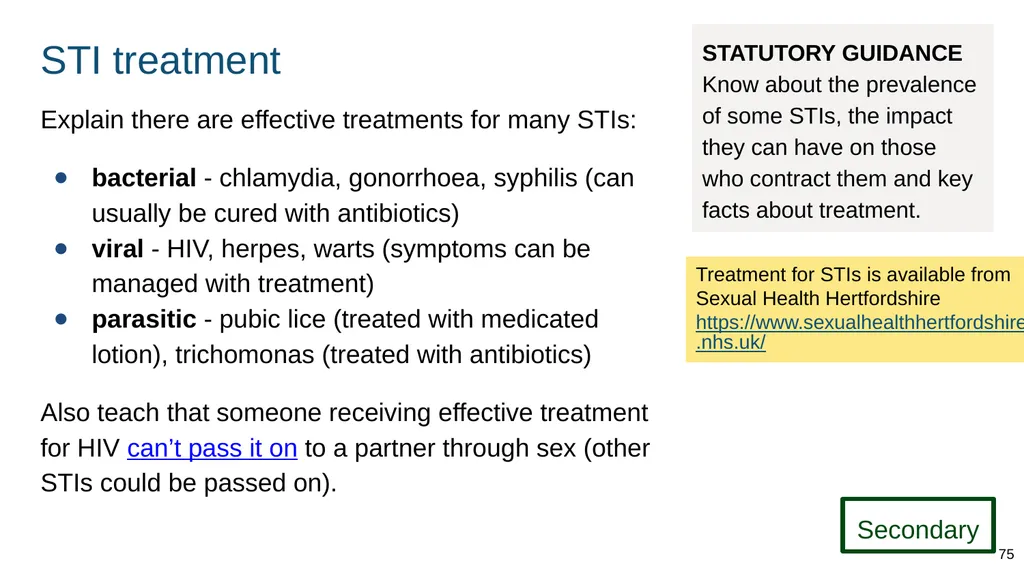
STI treatment Explain there are effective treatments for many STIs:
bacterial - chlamydia, gonorrhoea, syphilis (can usually be cured with antibiotics)
viral - HIV, herpes, warts (symptoms can be managed with treatment)
parasitic - pubic lice (treated with medicated lotion), trichomonas (treated with antibiotics)
Also teach that someone receiving effective treatment for HIV can’t pass it on to a partner through sex (other STIs could be passed on). STATUTORY GUIDANCE Know about the prevalence of some STIs, the impact they can have on those who contract them and key facts about treatment. Secondary 75 Treatment for STIs is available from Sexual Health Hertfordshire https://www.sexualhealthhertfordshire.clch.nhs.uk/<br>
bacterial - chlamydia, gonorrhoea, syphilis (can usually be cured with antibiotics)
viral - HIV, herpes, warts (symptoms can be managed with treatment)
parasitic - pubic lice (treated with medicated lotion), trichomonas (treated with antibiotics)
Also teach that someone receiving effective treatment for HIV can’t pass it on to a partner through sex (other STIs could be passed on). STATUTORY GUIDANCE Know about the prevalence of some STIs, the impact they can have on those who contract them and key facts about treatment. Secondary 75 Treatment for STIs is available from Sexual Health Hertfordshire https://www.sexualhealthhertfordshire.clch.nhs.uk/<br>
76
Contraception and sexual health advice 76<br>
77
Right to sexual health services Explain that everyone, regardless of age, has the right to free confidential sexual health advice and services, including contraception, from a GP, sexual health clinic, NHS drop in centre or even A&E.
Anyone can use such services, as long as the health professional believes the individual is ‘competent’ to make decisions about medical care. Health professionals will encourage young people to talk to a parent/carer but will not breach confidentiality unless there is risk of harm.
Explain also that some people choose not to use contraception because of their personal beliefs. STATUTORY GUIDANCE Know to get further advice, including how and where to access confidential sexual and reproductive health advice and treatment. Secondary 77 Visit www.hertfordshire.gov.uk/sexualhealth for information on local services.<br>
Anyone can use such services, as long as the health professional believes the individual is ‘competent’ to make decisions about medical care. Health professionals will encourage young people to talk to a parent/carer but will not breach confidentiality unless there is risk of harm.
Explain also that some people choose not to use contraception because of their personal beliefs. STATUTORY GUIDANCE Know to get further advice, including how and where to access confidential sexual and reproductive health advice and treatment. Secondary 77 Visit www.hertfordshire.gov.uk/sexualhealth for information on local services.<br>
78
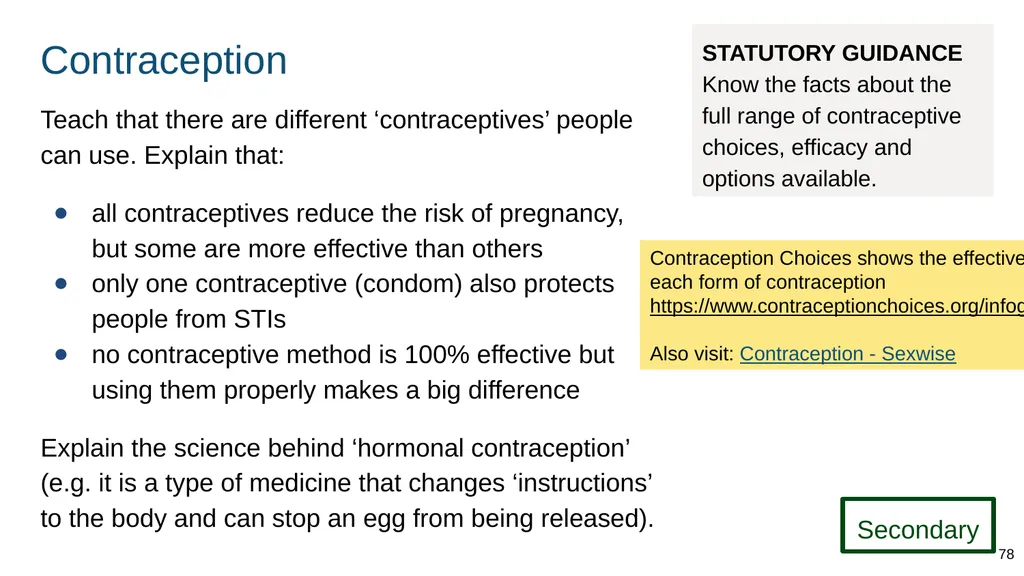
Contraception Teach that there are different ‘contraceptives’ people can use. Explain that:
all contraceptives reduce the risk of pregnancy, but some are more effective than others
only one contraceptive (condom) also protects people from STIs
no contraceptive method is 100% effective but using them properly makes a big difference
Explain the science behind ‘hormonal contraception’ (e.g. it is a type of medicine that changes ‘instructions’ to the body and can stop an egg from being released). STATUTORY GUIDANCE Know the facts about the full range of contraceptive choices, efficacy and options available. Secondary 78 Contraception Choices shows the effectiveness of each form of contraception
https://www.contraceptionchoices.org/infographic
Also visit: Contraception - Sexwise<br>
all contraceptives reduce the risk of pregnancy, but some are more effective than others
only one contraceptive (condom) also protects people from STIs
no contraceptive method is 100% effective but using them properly makes a big difference
Explain the science behind ‘hormonal contraception’ (e.g. it is a type of medicine that changes ‘instructions’ to the body and can stop an egg from being released). STATUTORY GUIDANCE Know the facts about the full range of contraceptive choices, efficacy and options available. Secondary 78 Contraception Choices shows the effectiveness of each form of contraception
https://www.contraceptionchoices.org/infographic
Also visit: Contraception - Sexwise<br>
79
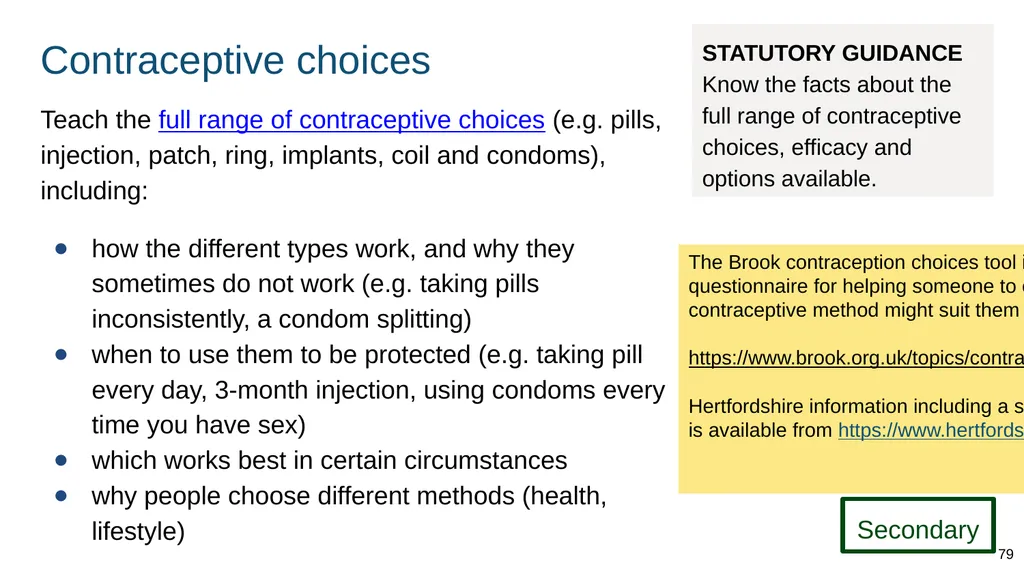
Contraceptive choices Teach the full range of contraceptive choices (e.g. pills, injection, patch, ring, implants, coil and condoms), including:
how the different types work, and why they sometimes do not work (e.g. taking pills inconsistently, a condom splitting)
when to use them to be protected (e.g. taking pill every day, 3-month injection, using condoms every time you have sex)
which works best in certain circumstances
why people choose different methods (health, lifestyle) STATUTORY GUIDANCE Know the facts about the full range of contraceptive choices, efficacy and options available. Secondary 79 The Brook contraception choices tool is a useful
questionnaire for helping someone to choose which
contraceptive method might suit them best.
https://www.brook.org.uk/topics/contraception/
Hertfordshire information including a short animation on contraception services
is available from https://www.hertfordshire.gov.uk/contraception<br>
how the different types work, and why they sometimes do not work (e.g. taking pills inconsistently, a condom splitting)
when to use them to be protected (e.g. taking pill every day, 3-month injection, using condoms every time you have sex)
which works best in certain circumstances
why people choose different methods (health, lifestyle) STATUTORY GUIDANCE Know the facts about the full range of contraceptive choices, efficacy and options available. Secondary 79 The Brook contraception choices tool is a useful
questionnaire for helping someone to choose which
contraceptive method might suit them best.
https://www.brook.org.uk/topics/contraception/
Hertfordshire information including a short animation on contraception services
is available from https://www.hertfordshire.gov.uk/contraception<br>
80
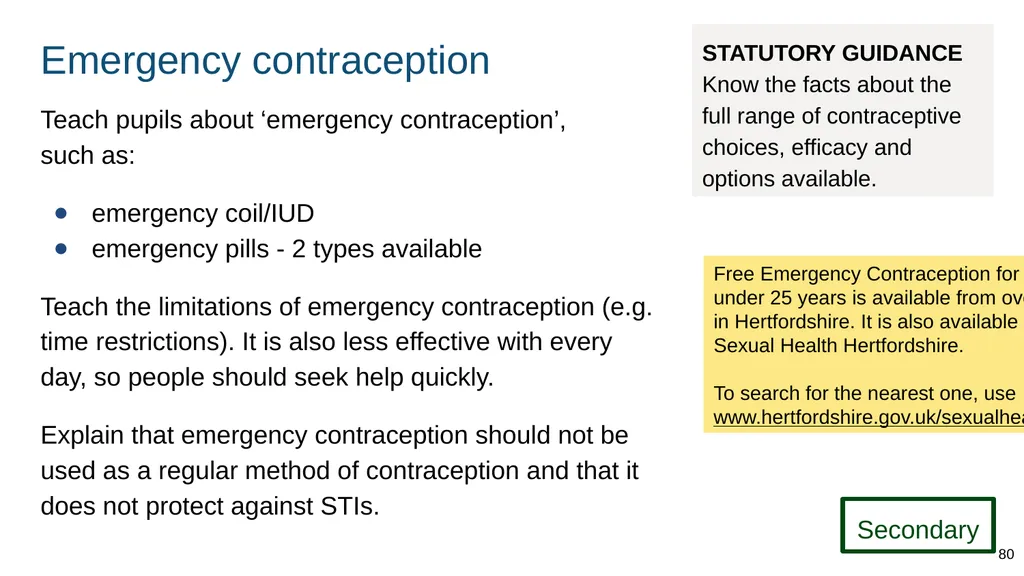
Emergency contraception Teach pupils about ‘emergency contraception’,
such as:
emergency coil/IUD
emergency pills - 2 types available
Teach the limitations of emergency contraception (e.g. time restrictions). It is also less effective with every day, so people should seek help quickly.
Explain that emergency contraception should not be used as a regular method of contraception and that it does not protect against STIs. STATUTORY GUIDANCE Know the facts about the full range of contraceptive choices, efficacy and options available. Secondary 80 Free Emergency Contraception for young people under 25 years is available from over 70 pharmacies in Hertfordshire. It is also available from your GP and Sexual Health Hertfordshire.
To search for the nearest one, use
www.hertfordshire.gov.uk/sexualhealth<br>
emergency coil/IUD
emergency pills - 2 types available
Teach the limitations of emergency contraception (e.g. time restrictions). It is also less effective with every day, so people should seek help quickly.
Explain that emergency contraception should not be used as a regular method of contraception and that it does not protect against STIs. STATUTORY GUIDANCE Know the facts about the full range of contraceptive choices, efficacy and options available. Secondary 80 Free Emergency Contraception for young people under 25 years is available from over 70 pharmacies in Hertfordshire. It is also available from your GP and Sexual Health Hertfordshire.
To search for the nearest one, use
www.hertfordshire.gov.uk/sexualhealth<br>
81
Using condoms (1) Teach the facts about condoms, including that they:
protect against STIs and pregnancy (unlike other contraceptives) by keeping body fluids separate
can be used at the same time as other contraceptives
are very effective if the right size is chosen and if used correctly
sometimes do not work (e.g. could split, fall off) - explain how to minimise risks if this happens
have an ‘expiration date’ and what this means
should be stored in a cool, dry place or could be damaged STATUTORY GUIDANCE Know the facts about the full range of contraceptive choices, efficacy and options available. Secondary 81<br>
protect against STIs and pregnancy (unlike other contraceptives) by keeping body fluids separate
can be used at the same time as other contraceptives
are very effective if the right size is chosen and if used correctly
sometimes do not work (e.g. could split, fall off) - explain how to minimise risks if this happens
have an ‘expiration date’ and what this means
should be stored in a cool, dry place or could be damaged STATUTORY GUIDANCE Know the facts about the full range of contraceptive choices, efficacy and options available. Secondary 81<br>
82
Using condoms (2) Explain what ‘lubricant’ is and that is sometimes used to prevent condom breakage and make sex more comfortable.
Teach that latex condoms mustn’t be used with oil-based lubricant (damages condoms). People can use a silicone- or water-based lubricant instead. STATUTORY GUIDANCE Know the facts about the full range of contraceptive choices, efficacy and options available. Secondary 82<br>
Teach that latex condoms mustn’t be used with oil-based lubricant (damages condoms). People can use a silicone- or water-based lubricant instead. STATUTORY GUIDANCE Know the facts about the full range of contraceptive choices, efficacy and options available. Secondary 82<br>
83
Condom choice Teach that condoms are available for free for young people from GPs, health centres, C-Card and other schemes.
Explain that condoms are available:
in latex and non-latex (mention latex allergy)
in ‘male’ and ‘female’ types, which work differently:
‘male’ condoms go on the penis
‘female’ condoms (sometimes called femidoms) are put inside the vagina, with a ring that stays outside the body STATUTORY GUIDANCE Know the facts about the full range of contraceptive choices, efficacy and options available. Secondary 83 A condom demonstration video is available at
www.hertfordshire.gov.uk/condoms
In Hertfordshire we don’t have a C-card scheme but free condom wallets (containing 6 regular condoms are available from Services for Young People - Access Points and participating Pharmacies in Hertfordshire.
Services can be found on this interactive map.
Condoms are also available for free from Sexual Health Hertfordshire
Find the best condom for You - https://www.startswithme.org.uk/condom-fitter/<br>
Explain that condoms are available:
in latex and non-latex (mention latex allergy)
in ‘male’ and ‘female’ types, which work differently:
‘male’ condoms go on the penis
‘female’ condoms (sometimes called femidoms) are put inside the vagina, with a ring that stays outside the body STATUTORY GUIDANCE Know the facts about the full range of contraceptive choices, efficacy and options available. Secondary 83 A condom demonstration video is available at
www.hertfordshire.gov.uk/condoms
In Hertfordshire we don’t have a C-card scheme but free condom wallets (containing 6 regular condoms are available from Services for Young People - Access Points and participating Pharmacies in Hertfordshire.
Services can be found on this interactive map.
Condoms are also available for free from Sexual Health Hertfordshire
Find the best condom for You - https://www.startswithme.org.uk/condom-fitter/<br>
84
Examples of good practice 84<br>
85
Good practice The following are just some of the approaches you might consider when preparing to teach about intimate and sexual relationships, including sexual health.
You will need to adapt these approaches to ensure they are age appropriate and developmentally appropriate for your pupils. Good practice 85<br>
You will need to adapt these approaches to ensure they are age appropriate and developmentally appropriate for your pupils. Good practice 85<br>
86
Good practice approaches (1) Ensure the content is taught at the right time so that pupils are not lacking the knowledge they need to make informed decisions, and are aware of their legal protections, rights and responsibilities.
Where schools decide it is appropriate to include LGBT content, the knowledge should be included throughout teaching (not a one-off session) using inclusive language, considering how individual pupils may relate to particular topics.
Do not use photographic images relating to STIs. Such images can cause distress and could mislead as symptoms can vary significantly. The NHS website provides useful information on symptoms if specific information is needed. Good practice 86<br>
Where schools decide it is appropriate to include LGBT content, the knowledge should be included throughout teaching (not a one-off session) using inclusive language, considering how individual pupils may relate to particular topics.
Do not use photographic images relating to STIs. Such images can cause distress and could mislead as symptoms can vary significantly. The NHS website provides useful information on symptoms if specific information is needed. Good practice 86<br>
87
Good practice approaches (2) Avoid segregating by sex unless there is a clear rationale for doing so in order to meet the needs of pupils.
Ensure pupils have opportunities to ask teachers questions in small groups or individually if they have concerns about topics that relate directly to them - e.g. menstruation.
Use medically correct language to accurately describe human anatomy, including genitalia (e.g. vulva, vagina, penis, testicles, foreskin).
Give pupils opportunities to handle relevant objects (e.g. contraceptives, period products) and to ask questions about them. Good practice 87<br>
Ensure pupils have opportunities to ask teachers questions in small groups or individually if they have concerns about topics that relate directly to them - e.g. menstruation.
Use medically correct language to accurately describe human anatomy, including genitalia (e.g. vulva, vagina, penis, testicles, foreskin).
Give pupils opportunities to handle relevant objects (e.g. contraceptives, period products) and to ask questions about them. Good practice 87<br>
88
Demonstrating condoms Teach pupils how to use condoms correctly. Use a purpose-designed condom demonstrator (anatomical) rather than other props which can result in misunderstandings. Femidoms should also be demonstrated.
Correct condom use
Push condom to side of pack and tear down side of pack to open.
Take condom out of packet.
Make sure condom is the right way round (roll on the outside).
Pinch the top of the condom.
Roll the condom down the erect penis demonstrator.
After sex, carefully take condom off, away from your partner.
Check for breakages and tie condom in a knot.
Wrap condom in tissue and put it in the bin. Good practice 88 A condom demonstration video is available at
www.hertfordshire.gov.uk/condoms
Free condom wallets (containing 6 regular condoms
are available from YC Hertfordshire Access Points and
participating Pharmacies in Hertfordshire.
Services can be found on this interactive map.
Condoms are also available for free from Sexual Health Hertfordshire<br>
Correct condom use
Push condom to side of pack and tear down side of pack to open.
Take condom out of packet.
Make sure condom is the right way round (roll on the outside).
Pinch the top of the condom.
Roll the condom down the erect penis demonstrator.
After sex, carefully take condom off, away from your partner.
Check for breakages and tie condom in a knot.
Wrap condom in tissue and put it in the bin. Good practice 88 A condom demonstration video is available at
www.hertfordshire.gov.uk/condoms
Free condom wallets (containing 6 regular condoms
are available from YC Hertfordshire Access Points and
participating Pharmacies in Hertfordshire.
Services can be found on this interactive map.
Condoms are also available for free from Sexual Health Hertfordshire<br>
89
Sharing further information Make sure pupils know the key people they can speak to at school, and that if they want to they can speak to any teacher if they have concerns or need help.
You could also make information about support organisations available in the classroom and school spaces, for example, referencing:
GP and other health professionals
NHS website
Childline - where children can get in touch on 0800 1111
In an emergency or crisis pupils should also know they can contact the Samaritans or call 999. Good practice 89<br>
You could also make information about support organisations available in the classroom and school spaces, for example, referencing:
GP and other health professionals
NHS website
Childline - where children can get in touch on 0800 1111
In an emergency or crisis pupils should also know they can contact the Samaritans or call 999. Good practice 89<br>
90
Activities and templates for trainers 90<br>
91
About these activities and templates Subject leads can use the following templates and training activities to plan training on teaching the new curriculum topics.
You can:
move slides - e.g. ‘rate your confidence (before training)’ - to the point in the presentation where you want to carry out that activity
delete slides if you are not covering those curriculum elements at this time 91<br>
You can:
move slides - e.g. ‘rate your confidence (before training)’ - to the point in the presentation where you want to carry out that activity
delete slides if you are not covering those curriculum elements at this time 91<br>
92
Training activity:
Rate your confidence 92<br>
Rate your confidence 92<br>
93
Rate your confidence (trainer notes) Ask your colleagues to rate confidence before and after topic training using the slides in this deck.
Before training Ask teachers to think about where they currently fit on the scale.
After training Ask teachers to rate their confidence again and talk about changes. You might want to repeat this activity at later check ins.
If teachers still rate confidence as low, discuss ways you can develop their subject knowledge, offer peer support etc. 93<br>
Before training Ask teachers to think about where they currently fit on the scale.
After training Ask teachers to rate their confidence again and talk about changes. You might want to repeat this activity at later check ins.
If teachers still rate confidence as low, discuss ways you can develop their subject knowledge, offer peer support etc. 93<br>
94
Rate your confidence (before training) How do you feel about teaching this topic? Not confident at all Very confident 94<br>
95
Rate your confidence (after training) How do you feel now? What support/information could help? Not confident at all Very confident 95<br>
96
Training activity:
Dealing with difficult questions 96<br>
Dealing with difficult questions 96<br>
97
Dealing with difficult questions (trainer notes) Use the following slides in your training to help teachers:
share concerns about questions they could be asked by pupils
strategise ways to respond to such questions 97<br>
share concerns about questions they could be asked by pupils
strategise ways to respond to such questions 97<br>
98
Dealing with difficult questions (1) [Prepare ‘difficult’ questions to discuss in training or give teachers a blank version to fill with their own questions] What would you say? What wouldn’t you say? Follow up 98<br>
99
Dealing with difficult questions (2) Pupils may well ask questions because they:
want information
are seeking permission - “Is it OK if I …?”
are trying to shock or get attention
have related personal beliefs
Remember:
don’t feel pressured or that you have to answer straight away
don’t disclose personal information - use third-person examples, say ‘some people...’
seek advice if you need it 99<br>
want information
are seeking permission - “Is it OK if I …?”
are trying to shock or get attention
have related personal beliefs
Remember:
don’t feel pressured or that you have to answer straight away
don’t disclose personal information - use third-person examples, say ‘some people...’
seek advice if you need it 99<br>
100
Training activity:
How will I teach this? 100<br>
How will I teach this? 100<br>
101
How will I teach this? (trainer notes) Use the following slides in your training to help teachers:
begin to plan and resource their lessons
discuss and address any issues they anticipate in the delivery of lessons 101<br>
begin to plan and resource their lessons
discuss and address any issues they anticipate in the delivery of lessons 101<br>
102
How will I teach this? 102<br>
103
Additional slides for structuring training 103<br>
104
Any concerns? ADAPT THIS FOR YOUR OWN PRESENTATION Any questions? What support do you need? 104<br>
105
XX% ADAPT THIS FOR YOUR OWN PRESENTATION [Use this format to present your own key facts and statistics - e.g. from your local authority or own monitoring. Include the source.] 105<br>