Teaching by Fostering Learning Strategies EDU 221 Learning Strategies Change of Schedule (no quiz 3; final will be over chapters 11-14-videotapes; Dec. 7th Classroom Management Strategies working with parents) HYLA 2 findings Chapter 11
Related Topics
Share
Embed code
Download this presentation From Below
"Teaching by Fostering Learning Strategies EDU 221" is the property of its rightful owner. Permission is granted to
download and print the materials on this website for personal, non-commercial use only, and to display it
on your personal computer provided you do not modify the materials and that you retain all copyright
notices contained in the materials. By downloading content from our website, you accept the terms of this
agreement.
Presentation Transcript
01
Teaching by Fostering Learning Strategies EDU 221<br>
02
Learning Strategies Change of Schedule (no quiz #3; final will be over chapters 11-14-videotapes; Dec. 7th Classroom Management Strategies & working with parents)
HYLA #2 findings
Chapter 11 Group Presentation
Chapter 11 PP
For Tuesday: Read Chapter 12<br>
03
Learning Strategies Goal:
Learning Strategies are designed to help learners become cognitively active learners.
3 Main Criteria
involves intentional cognitive processing by the learner
occurs at the time of learning
intended to improve learning<br>
04
Passive to Active teach students how to learn not just what to learn
learning strategies help students:
recall specific facts
organize material into coherent structure
integrate material with prior knowledge
***All are traits of active learning.***<br>
05
Benefits Learning strategies help students become skilled learners.
Highly skilled students can look at new material and perform the following actions.
Be able to select relevant material
Know how to organize the material into a coherent structure
Integrate the new material with previous knowledge<br>
06
Mnemonic Strategies<br>
07
What Are Mnemonic Strategies? Techniques that help students remember material through memorization
Promote transfer 2 ways
By memorizing the basic facts and then using the information without much effort
When a student has learned information a mnemonic can help make the information seem more meaningful.<br>
08
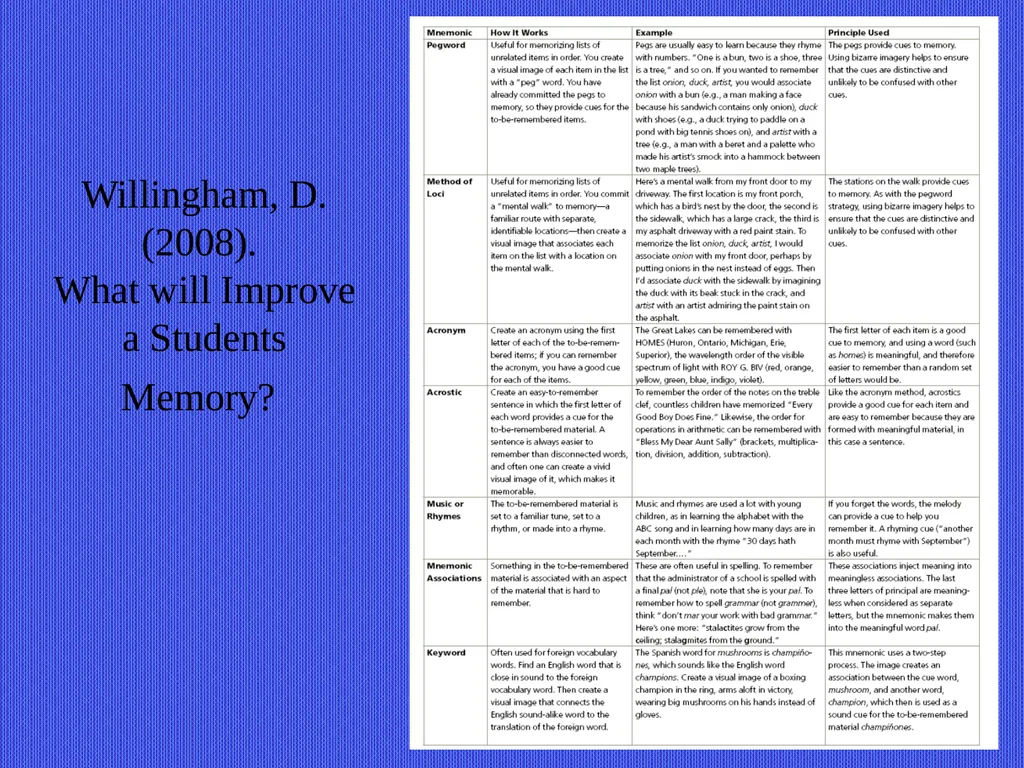
Willingham, D. (2008). What will Improve a Students Memory?<br>
09
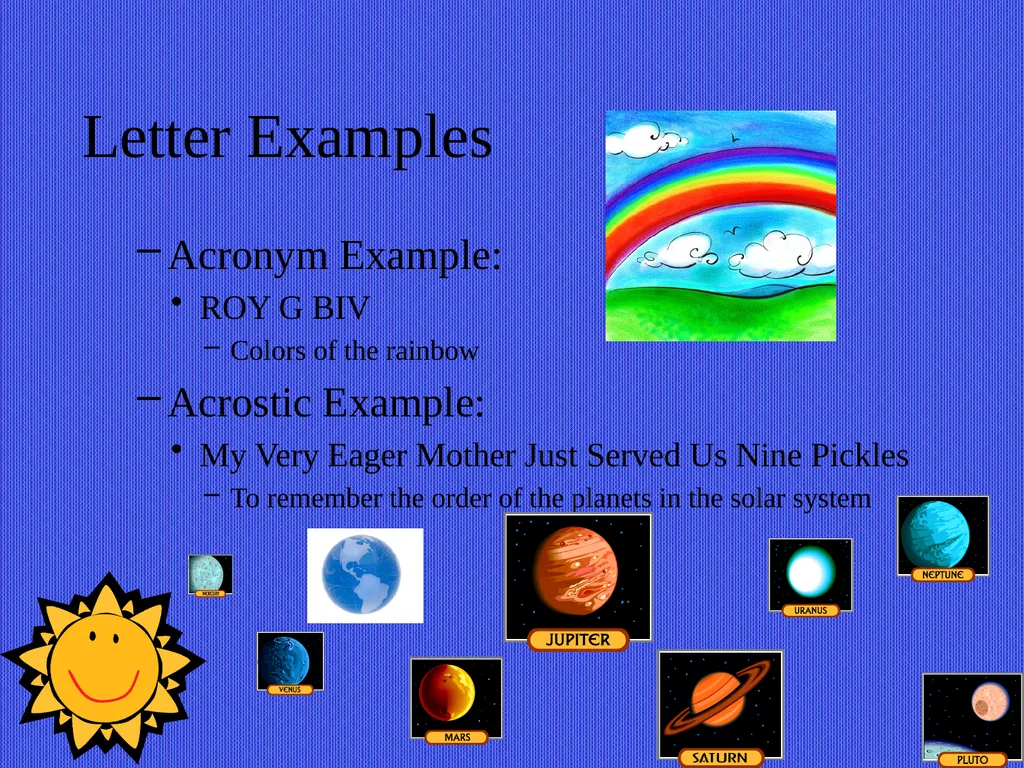
Letter Examples Acronym Example:
ROY G BIV
Colors of the rainbow
Acrostic Example:
My Very Eager Mother Just Served Us Nine Pickles
To remember the order of the planets in the solar system<br>
10
Why Mnemonics Work Dual Coding- strategies involve imagery as well as verbal representation, meaning more ways to find it in memory.
Organization- provide organization into which new information fits, tends to hold it together rather then separate in memory
Association- involves forming associations between information which allows for better recall of the information.<br>
11
Structure Strategies<br>
12
Goal: Prompt active learning by encouraging learners to mentally select relevant pieces of information and relate them to one another within a structure.<br>
13
“Dual-coding” Theory -Paivio, 1991 Stored in Memory in Two Forms:
Linguistic: words or statements
Non-linguistic: mental pictures of physical sensations
Most information is delivered linguistically
Structure Strategies designed to help students see relationships between information with the help of visual representations<br>
14
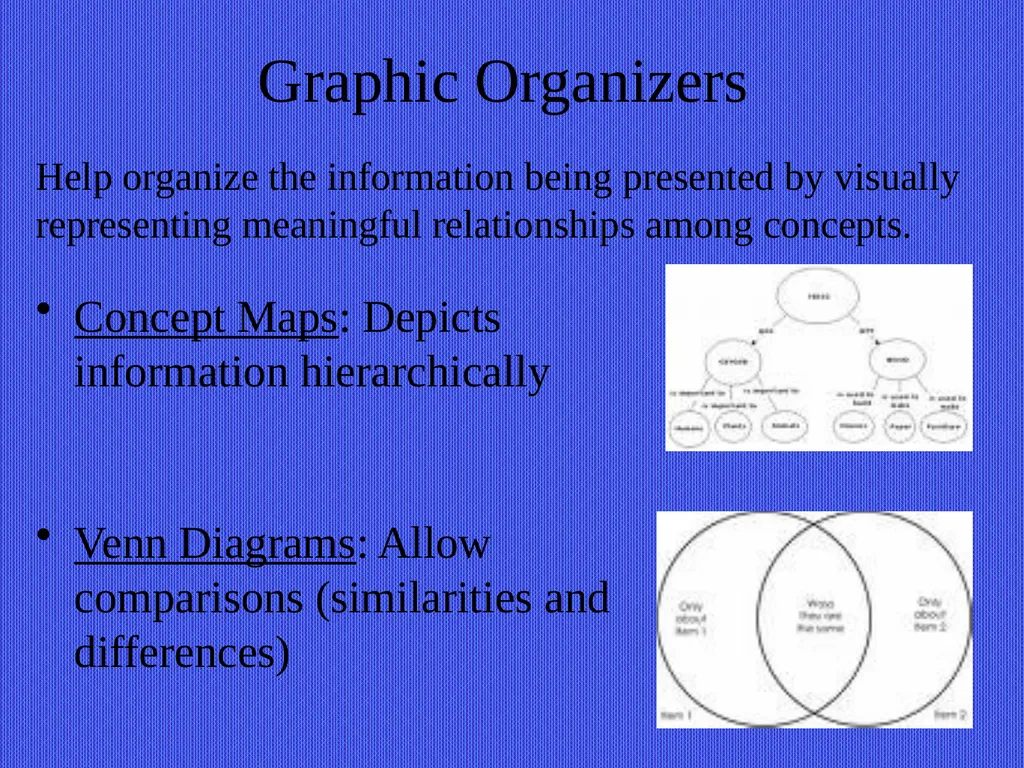
Graphic Organizers Concept Maps: Depicts information hierarchically
Venn Diagrams: Allow comparisons (similarities and differences) Help organize the information being presented by visually representing meaningful relationships among concepts.<br>
15
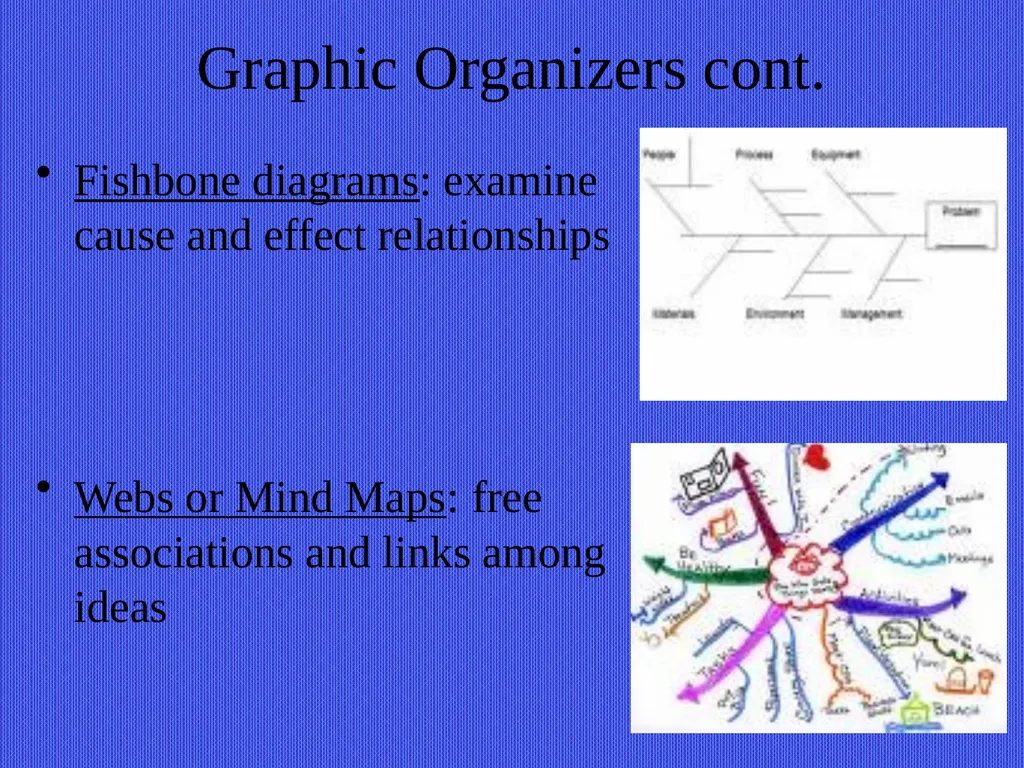
Graphic Organizers cont. Fishbone diagrams: examine cause and effect relationships
Webs or Mind Maps: free associations and links among ideas<br>
16
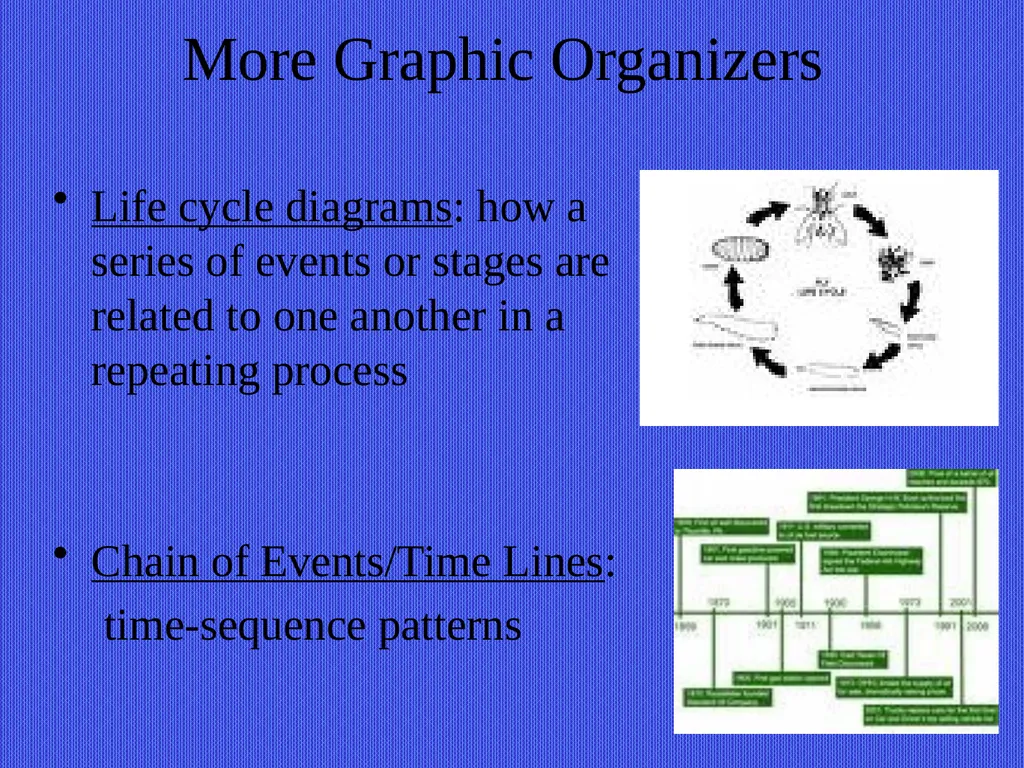
More Graphic Organizers Life cycle diagrams: how a series of events or stages are related to one another in a repeating process
Chain of Events/Time Lines:
time-sequence patterns<br>
17
Generative Strategies<br>
18
What are generative strategies? Learning strategies that are used to help integrate the information that was presented to the learner.
Promote Mathemagenic Activity<br>
19
Generative Strategies Note taking
Summarizing
Repeating information out loud
Answering questions
All require students to integrate the given information to information the previously learned.<br>
20
Slotte and Lonka (1999) It is more beneficial to take summary notes rather than verbatim notes.
Summary notes require more in depth thinking
Organizing material
Integrating material
Verbatim notes do not require the student to put information into their own words, which leads to a lower grasp of concepts.<br>
21
Generative Strategies Note taking
Summarizing
Repeating information out loud
Answering questions
All require students to integrate the given information to information the previously learned.<br>
22
Questioning Method Aimed at getting the student to create questions relating to the information in order to build onto their knowledge base.
If a student is taught how to construct questions about certain aspects of a topic they are more likely to integrate previous knowledge to the new information.
Questioning can lead to deeper understanding and lead to transfer of the information.<br>