
Teaching respectful relationships (primary),
MY
Published · 90 slides · 0 views
1 / 1



Description
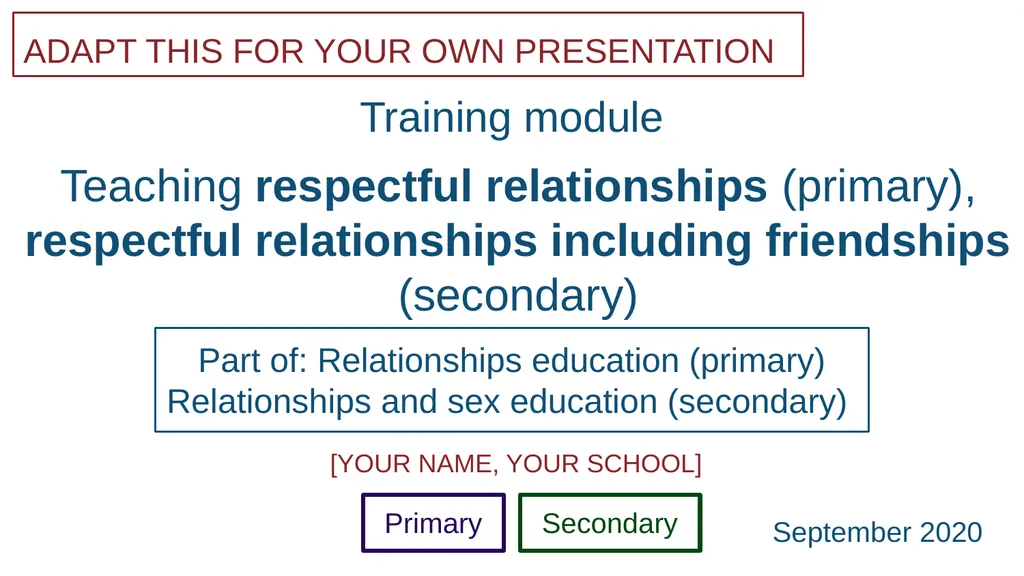
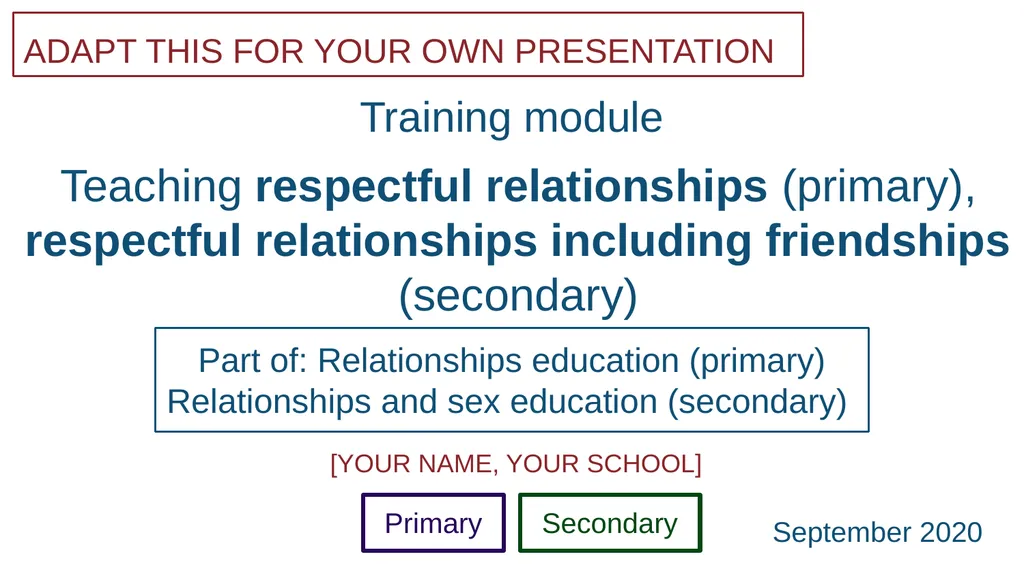
Teaching respectful relationships (primary), respectful relationships including friendships (secondary) September 2020 ADAPT THIS FOR YOUR OWN PRESENTATION Training module Part of: Relationships education (primary) Relationships and sex
Related Topics
Share
Embed code
Download this presentation From Below
"Teaching respectful relationships (primary)," is the property of its rightful owner. Permission is granted to download and print the materials on this website for personal, non-commercial use only, and to display it on your personal computer provided you do not modify the materials and that you retain all copyright notices contained in the materials. By downloading content from our website, you accept the terms of this agreement.
Presentation Transcript
01
Teaching respectful relationships (primary), respectful relationships including friendships (secondary) September 2020 ADAPT THIS FOR YOUR OWN PRESENTATION Training module Part of: Relationships education (primary)
Relationships and sex education (secondary) [YOUR NAME, YOUR SCHOOL] Primary Secondary<br>
02
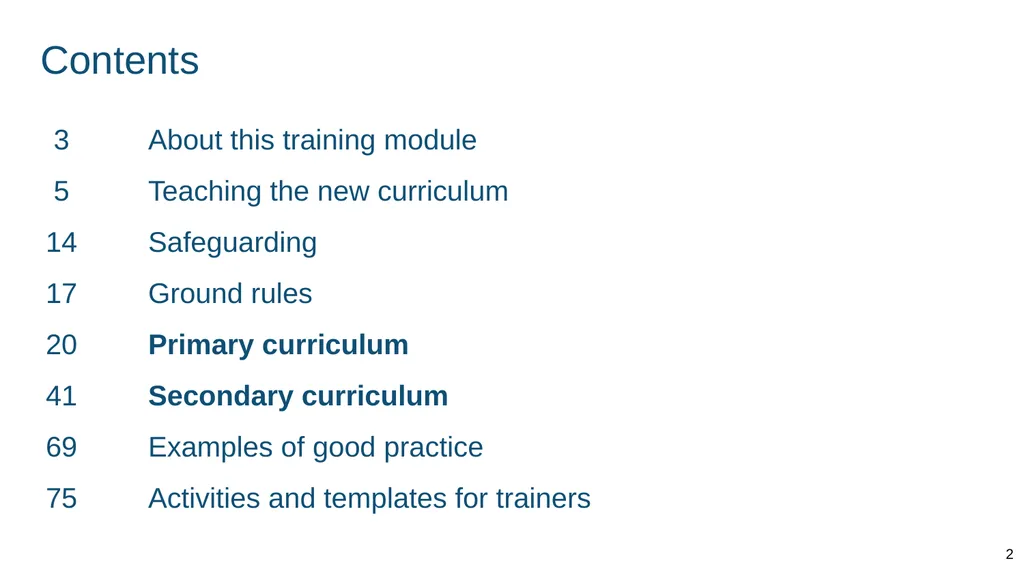
Contents 2 3 About this training module
5 Teaching the new curriculum
14 Safeguarding
17 Ground rules
20 Primary curriculum
41 Secondary curriculum
69 Examples of good practice
75 Activities and templates for trainers<br>
5 Teaching the new curriculum
14 Safeguarding
17 Ground rules
20 Primary curriculum
41 Secondary curriculum
69 Examples of good practice
75 Activities and templates for trainers<br>
03
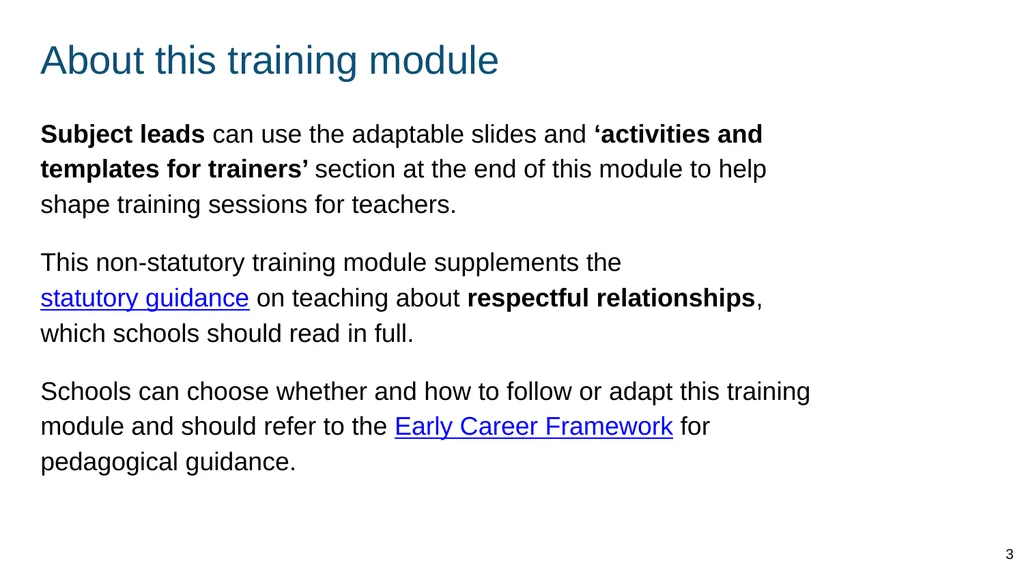
About this training module Subject leads can use the adaptable slides and ‘activities and templates for trainers’ section at the end of this module to help shape training sessions for teachers.
This non-statutory training module supplements the statutory guidance on teaching about respectful relationships, which schools should read in full.
Schools can choose whether and how to follow or adapt this training module and should refer to the Early Career Framework for pedagogical guidance. 3<br>
This non-statutory training module supplements the statutory guidance on teaching about respectful relationships, which schools should read in full.
Schools can choose whether and how to follow or adapt this training module and should refer to the Early Career Framework for pedagogical guidance. 3<br>
04
What you get out of today By the end of this training you should:
know what is included in the statutory guidance
know some key knowledge and facts to cover as part of this topic
have strategies to deal with questions that come up in class
feel more confident teaching about respectful relationships 4<br>
know what is included in the statutory guidance
know some key knowledge and facts to cover as part of this topic
have strategies to deal with questions that come up in class
feel more confident teaching about respectful relationships 4<br>
05
Teaching the new curriculum 5<br>
06
Closely related topics Respectful relationships is related to the modules:
online relationships
mental wellbeing
being safe
intimate and sexual relationships (secondary only)
caring friendships
families and people who care for me
Therefore you should:
consider thematic links across key topics and the whole school when planning and delivering lessons
find ways to link knowledge and vocabulary across topics 6<br>
online relationships
mental wellbeing
being safe
intimate and sexual relationships (secondary only)
caring friendships
families and people who care for me
Therefore you should:
consider thematic links across key topics and the whole school when planning and delivering lessons
find ways to link knowledge and vocabulary across topics 6<br>
07
Related guidance Schools may also want to refer to the following related guidance when planning to teach this subject:
Guidance for schools on preventing and responding to bullying (including cyberbullying)
Teaching online safety in school 7<br>
Guidance for schools on preventing and responding to bullying (including cyberbullying)
Teaching online safety in school 7<br>
08
Relationships support at [school name] Our leads
[Names, contact details of relationships support]
Our policies
[Add details - e.g. school policy on bullying]
Specialist support [Add details - e.g. providers school already works with]
Other information
[Add resources] 8<br>
[Names, contact details of relationships support]
Our policies
[Add details - e.g. school policy on bullying]
Specialist support [Add details - e.g. providers school already works with]
Other information
[Add resources] 8<br>
09
Teaching about respectful relationships at [school name] Ways in which we already teach about respectful relationships at our school:
[add details]
[add details]
[add details] 9<br>
[add details]
[add details]
[add details] 9<br>
10
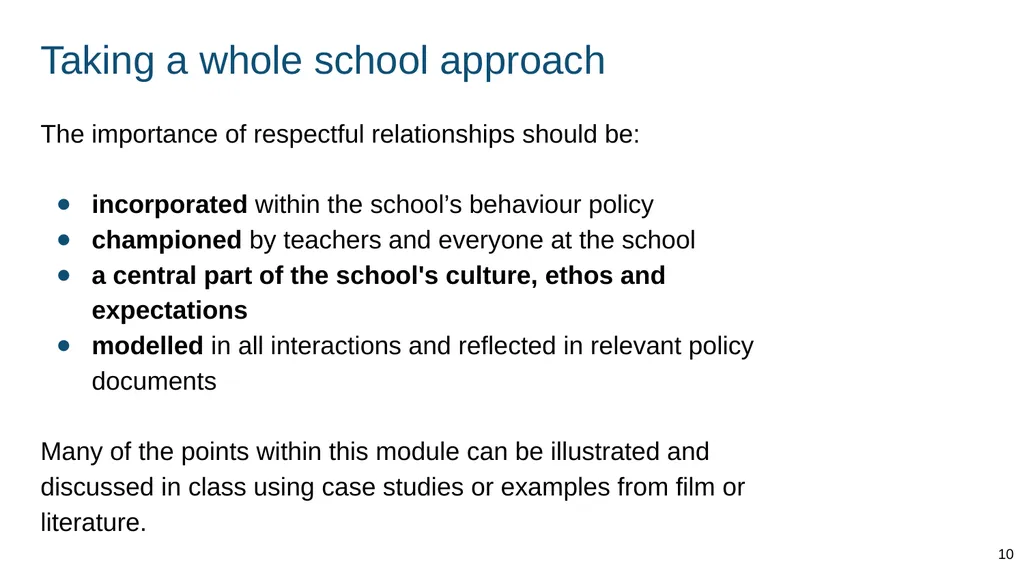
Taking a whole school approach The importance of respectful relationships should be:
incorporated within the school’s behaviour policy
championed by teachers and everyone at the school
a central part of the school's culture, ethos and expectations
modelled in all interactions and reflected in relevant policy documents
Many of the points within this module can be illustrated and discussed in class using case studies or examples from film or literature. 10<br>
incorporated within the school’s behaviour policy
championed by teachers and everyone at the school
a central part of the school's culture, ethos and expectations
modelled in all interactions and reflected in relevant policy documents
Many of the points within this module can be illustrated and discussed in class using case studies or examples from film or literature. 10<br>
11
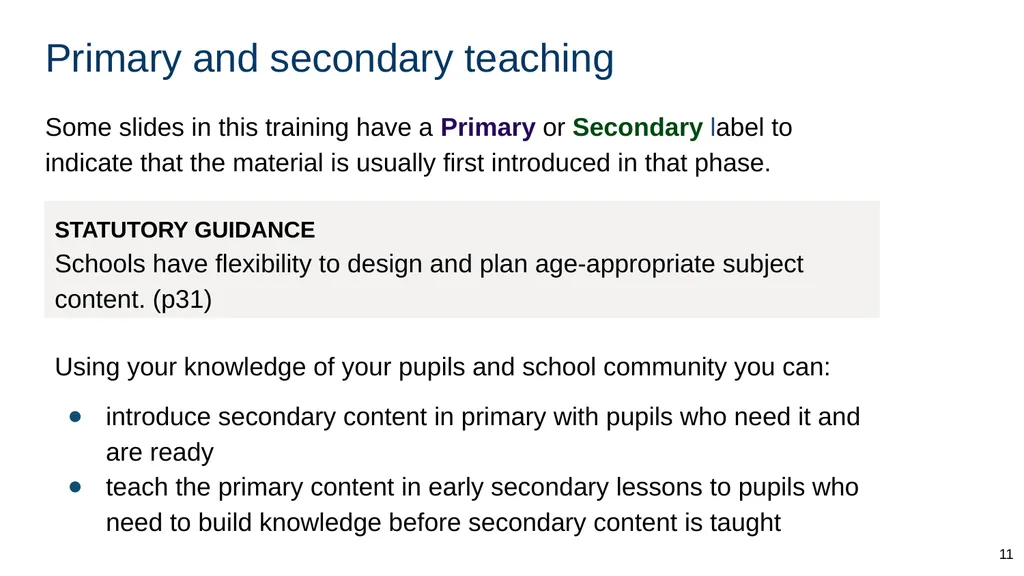
Primary and secondary teaching Some slides in this training have a Primary or Secondary label to indicate that the material is usually first introduced in that phase. STATUTORY GUIDANCE
Schools have flexibility to design and plan age-appropriate subject content. (p31) Using your knowledge of your pupils and school community you can:
introduce secondary content in primary with pupils who need it and are ready
teach the primary content in early secondary lessons to pupils who need to build knowledge before secondary content is taught 11<br>
introduce secondary content in primary with pupils who need it and are ready
teach the primary content in early secondary lessons to pupils who need to build knowledge before secondary content is taught 11<br>
12
LGBT needs and inclusion Primary schools are enabled and encouraged to cover LGBT (lesbian, gay, bisexual and transgender) content if they consider it age appropriate to do so. Secondary schools should include LGBT content.
When doing so, schools should ensure:
LGBT-relevant knowledge and examples are included throughout programmes of study (not one-off teaching)
inclusive language is used, considering how individual pupils may relate to particular topics 12<br>
When doing so, schools should ensure:
LGBT-relevant knowledge and examples are included throughout programmes of study (not one-off teaching)
inclusive language is used, considering how individual pupils may relate to particular topics 12<br>
13
Pupils with SEND You will need to plan lessons to allow all pupils to access and practise the core knowledge, using your expertise as you normally would.
You might want to link lesson outcomes with statutory ‘preparing for adulthood’ outcomes for those with an education, health and care (EHC) plan. (See SEND code of practice, section 8.) STATUTORY GUIDANCE
In special schools and for some SEND pupils in mainstream schools there may be a need to tailor content and teaching to meet the specific needs of pupils at different developmental stages. As with all teaching for these subjects, schools should ensure that their teaching is sensitive, age-appropriate, developmentally appropriate and delivered with reference to the law. (p15) 13<br>
You might want to link lesson outcomes with statutory ‘preparing for adulthood’ outcomes for those with an education, health and care (EHC) plan. (See SEND code of practice, section 8.) STATUTORY GUIDANCE
In special schools and for some SEND pupils in mainstream schools there may be a need to tailor content and teaching to meet the specific needs of pupils at different developmental stages. As with all teaching for these subjects, schools should ensure that their teaching is sensitive, age-appropriate, developmentally appropriate and delivered with reference to the law. (p15) 13<br>
14
Safeguarding 14<br>
15
Safeguarding (1) Pupils may be affected by issues discussed in lessons.
Let your designated safeguarding lead or deputy and any other relevant staff, such as pastoral leads, know what you are teaching. This will enable them to identify and speak to relevant pupils, especially those who they know may have been directly impacted by issues covered in the lessons and those with adverse childhood experiences.
Teachers may need to deal with disclosures/concerns (e.g. of abuse or offending behaviour) in a way that safeguards pupils in line with school policies, especially the child protection policy. 15<br>
Let your designated safeguarding lead or deputy and any other relevant staff, such as pastoral leads, know what you are teaching. This will enable them to identify and speak to relevant pupils, especially those who they know may have been directly impacted by issues covered in the lessons and those with adverse childhood experiences.
Teachers may need to deal with disclosures/concerns (e.g. of abuse or offending behaviour) in a way that safeguards pupils in line with school policies, especially the child protection policy. 15<br>
16
Trusted adults Within this module we have used the term trusted adult.
A trusted adult will generally be someone who children feel comfortable to turn to for help. Obvious examples include family members, teachers and doctors.
It will be important when teaching this topic, and any other relevant topics, that teachers explore this concept. Pupils should be comfortable and capable of identifying who their trusted adults could be, both within their families and wider circles. 16<br>
A trusted adult will generally be someone who children feel comfortable to turn to for help. Obvious examples include family members, teachers and doctors.
It will be important when teaching this topic, and any other relevant topics, that teachers explore this concept. Pupils should be comfortable and capable of identifying who their trusted adults could be, both within their families and wider circles. 16<br>
17
Ground rules 17<br>
18
Create class ground rules Clear class ground rules can help when teaching about sensitive topics. They also support confidentiality and safeguarding of pupils.
Good practice is for ground rules to be:
discussed and understood by all
clear and practical
modelled by the teacher
followed consistently and enforced
updated when needed
visible in lessons (for example, posters) 18<br>
Good practice is for ground rules to be:
discussed and understood by all
clear and practical
modelled by the teacher
followed consistently and enforced
updated when needed
visible in lessons (for example, posters) 18<br>
19
Example ground rules Respect privacy. We can discuss examples but do not use names or descriptions that identify anyone, including ourselves.
Listen to others. It is okay to disagree with each other, but we should listen properly before making assumptions or deciding how to respond. When disagreeing, challenge the statement not the person.
No judgement. We can explore beliefs and misunderstandings about a topic without fear of being judged.
Choose level of participation. Everyone has the right to choose not to answer a question or join discussion. We never put anyone ‘on the spot’ (no personal questions or pressure to answer). 19<br>
Listen to others. It is okay to disagree with each other, but we should listen properly before making assumptions or deciding how to respond. When disagreeing, challenge the statement not the person.
No judgement. We can explore beliefs and misunderstandings about a topic without fear of being judged.
Choose level of participation. Everyone has the right to choose not to answer a question or join discussion. We never put anyone ‘on the spot’ (no personal questions or pressure to answer). 19<br>
20
Primary curriculum 20<br>
21
The importance of respect Primary Explain that respect means being considerate of the wishes, feelings and needs of another person.
Teach that mutual respect is fundamental to building all healthy friendships and relationships.
Discuss some characteristics of a positive:
friendship, e.g. enjoying time together
family relationship, e.g. love and trust
relationship with someone else, e.g. feeling supported by a teacher
Explain to pupils that in school and in wider society it is important to show respect and feel respected by others. STATUTORY GUIDANCE Know the importance of respecting others, even when they are very different from them (for example, physically, in character, personality or backgrounds), or make different choices or have different preferences or beliefs. 21<br>
Teach that mutual respect is fundamental to building all healthy friendships and relationships.
Discuss some characteristics of a positive:
friendship, e.g. enjoying time together
family relationship, e.g. love and trust
relationship with someone else, e.g. feeling supported by a teacher
Explain to pupils that in school and in wider society it is important to show respect and feel respected by others. STATUTORY GUIDANCE Know the importance of respecting others, even when they are very different from them (for example, physically, in character, personality or backgrounds), or make different choices or have different preferences or beliefs. 21<br>
22
Boundaries and personal space Primary Teach that a key part of a healthy relationship is to respect each other’s personal space and boundaries.
Explain that everyone has the right to have their own boundaries, for example:
to share some of their toys, but not all of them
to choose how much physical contact they have, e.g. some people like to hug, but other people prefer to just wave
Explain the differences between appropriate and inappropriate or unsafe contact (in both physical and in other contexts, e.g. online). STATUTORY GUIDANCE Know the importance of respecting others, even when they are very different from them (for example, physically, in character, personality or backgrounds), or make different choices or have different preferences or beliefs. 22<br>
Explain that everyone has the right to have their own boundaries, for example:
to share some of their toys, but not all of them
to choose how much physical contact they have, e.g. some people like to hug, but other people prefer to just wave
Explain the differences between appropriate and inappropriate or unsafe contact (in both physical and in other contexts, e.g. online). STATUTORY GUIDANCE Know the importance of respecting others, even when they are very different from them (for example, physically, in character, personality or backgrounds), or make different choices or have different preferences or beliefs. 22<br>
23
Respecting difference Primary Teach that everybody is unique. For example, people:
look different from each other
like and dislike different things
might have different beliefs or customs
Explain that everyone needs to show the same respect to others, regardless of how different they are to them.
Explain that targeting someone simply because you disagree with them is a form of bullying and not acceptable. STATUTORY GUIDANCE Know the importance of respecting others, even when they are very different from them (for example, physically, in character, personality or backgrounds), or make different choices or have different preferences or beliefs. 23<br>
look different from each other
like and dislike different things
might have different beliefs or customs
Explain that everyone needs to show the same respect to others, regardless of how different they are to them.
Explain that targeting someone simply because you disagree with them is a form of bullying and not acceptable. STATUTORY GUIDANCE Know the importance of respecting others, even when they are very different from them (for example, physically, in character, personality or backgrounds), or make different choices or have different preferences or beliefs. 23<br>
24
Self-respect and happiness Primary Explain to pupils that self-respect means valuing their own worth, needs and wishes. These are of equal value to anybody else’s.
Having self-respect and self-worth can help them to:
be confident and happy
feel that they matter
empathise with others
achieve personal goals
be resilient STATUTORY GUIDANCE Know the importance of self-respect and how this links to their own happiness. 24<br>
Having self-respect and self-worth can help them to:
be confident and happy
feel that they matter
empathise with others
achieve personal goals
be resilient STATUTORY GUIDANCE Know the importance of self-respect and how this links to their own happiness. 24<br>
25
Respect for ourselves and others Primary Explain to pupils that practising respect for ourselves and others also means showing other qualities such as honesty, empathy, integrity, courage, humility, kindness, generosity, trustworthiness, tolerance and fairness.
Explain each of these qualities to pupils and encourage active demonstration of these behaviours throughout the school community.
Teach that they can develop these qualities by taking part in activities such as helping others and volunteering. STATUTORY GUIDANCE Know the importance of self-respect and how this links to their own happiness. 25<br>
Explain each of these qualities to pupils and encourage active demonstration of these behaviours throughout the school community.
Teach that they can develop these qualities by taking part in activities such as helping others and volunteering. STATUTORY GUIDANCE Know the importance of self-respect and how this links to their own happiness. 25<br>
26
Respecting people in authority Primary Explain that all relationships benefit when respect is mutual and reciprocal.
Teach pupils that it is courteous to respect those in positions of authority. Explain that the people within these jobs often have a responsibility to make other people’s lives safe and secure. Teach that by respecting those positions we enable them to do this properly.
Give some examples of people in such positions and explain why respect for them and the job they do is important. STATUTORY GUIDANCE Know that in school and in wider society they can expect to be treated with respect by others, and that in turn they should show due respect to others, including those in positions of authority. 26<br>
Teach pupils that it is courteous to respect those in positions of authority. Explain that the people within these jobs often have a responsibility to make other people’s lives safe and secure. Teach that by respecting those positions we enable them to do this properly.
Give some examples of people in such positions and explain why respect for them and the job they do is important. STATUTORY GUIDANCE Know that in school and in wider society they can expect to be treated with respect by others, and that in turn they should show due respect to others, including those in positions of authority. 26<br>
27
Improving relationships Primary Teach pupils that all relationships (e.g. friends, family, online) can be supported by:
being kind, considerate and respectful
being honest
listening to each other
respecting personal space, privacy and boundaries
accepting each other’s differences
focussing on the good things in each other
praising each other on their achievements STATUTORY GUIDANCE Know practical steps they can take in a range of different contexts to improve or support respectful relationships. 27<br>
being kind, considerate and respectful
being honest
listening to each other
respecting personal space, privacy and boundaries
accepting each other’s differences
focussing on the good things in each other
praising each other on their achievements STATUTORY GUIDANCE Know practical steps they can take in a range of different contexts to improve or support respectful relationships. 27<br>
28
Supporting relationships Primary Explain to pupils that when relationships have problems it may help them to:
negotiate together and compromise
not pressure each other to think or do something
acknowledge when someone has done something wrong (including ourselves) and say sorry
Teach pupils that mutual respect does not mean having to agree with someone and that their own needs are just as important. STATUTORY GUIDANCE Know practical steps they can take in a range of different contexts to improve or support respectful relationships. 28<br>
negotiate together and compromise
not pressure each other to think or do something
acknowledge when someone has done something wrong (including ourselves) and say sorry
Teach pupils that mutual respect does not mean having to agree with someone and that their own needs are just as important. STATUTORY GUIDANCE Know practical steps they can take in a range of different contexts to improve or support respectful relationships. 28<br>
29
Courtesy and good manners (1) Primary Teach pupils that there are conventions which are considered to be courteous and respectful, for example:
saying please and thank you
being on time, e.g. when meeting people
taking turns, e.g. waiting for their turn to play with a toy
not talking over or interrupting other people
listening attentively when others are speaking
using respectful language, e.g. not calling names
being considerate of personal space and boundaries STATUTORY GUIDANCE Know the conventions of courtesy and manners. 29<br>
saying please and thank you
being on time, e.g. when meeting people
taking turns, e.g. waiting for their turn to play with a toy
not talking over or interrupting other people
listening attentively when others are speaking
using respectful language, e.g. not calling names
being considerate of personal space and boundaries STATUTORY GUIDANCE Know the conventions of courtesy and manners. 29<br>
30
Courtesy and good manners (2) Primary allowing other people to go first, e.g. through doors
offering to help people where they can
greeting people when they see them (e.g. good morning) and using their name
asking for permission, e.g. ‘would you mind if I …?’ STATUTORY GUIDANCE Know the conventions of courtesy and manners. 30<br>
offering to help people where they can
greeting people when they see them (e.g. good morning) and using their name
asking for permission, e.g. ‘would you mind if I …?’ STATUTORY GUIDANCE Know the conventions of courtesy and manners. 30<br>
31
Bullying Primary Teach that bullying is behaviour:
by an individual or group
repeated over time
which intentionally hurts another individual or group
which can be either physical and/or emotional
Teach that bullying is not the same as arguing with friends. Explain that bullying might be motivated by actual differences between children, or perceived differences.
Teachers should read the guidance on preventing and tackling bullying. STATUTORY GUIDANCE Know about different types of bullying (including cyberbullying), the impact of bullying, responsibilities of bystanders (primarily reporting bullying to an adult) and how to get help. 31<br>
by an individual or group
repeated over time
which intentionally hurts another individual or group
which can be either physical and/or emotional
Teach that bullying is not the same as arguing with friends. Explain that bullying might be motivated by actual differences between children, or perceived differences.
Teachers should read the guidance on preventing and tackling bullying. STATUTORY GUIDANCE Know about different types of bullying (including cyberbullying), the impact of bullying, responsibilities of bystanders (primarily reporting bullying to an adult) and how to get help. 31<br>
32
Types of bullying Primary Explain bullying can take many forms, such as:
physical, e.g. pinching, hitting, pushing
verbal, e.g. name calling, spreading rumours
non-verbal, e.g. staring at someone, making faces
psychological, e.g. making someone feel bad about themselves, trying to control what someone does or says, regularly excluding someone
Teach that it is not always possible to tell if someone is hurt by bullying, for example, they may laugh or smile. Explain that bullying is always harmful. STATUTORY GUIDANCE Know about different types of bullying (including cyberbullying), the impact of bullying, responsibilities of bystanders (primarily reporting bullying to an adult) and how to get help. 32<br>
physical, e.g. pinching, hitting, pushing
verbal, e.g. name calling, spreading rumours
non-verbal, e.g. staring at someone, making faces
psychological, e.g. making someone feel bad about themselves, trying to control what someone does or says, regularly excluding someone
Teach that it is not always possible to tell if someone is hurt by bullying, for example, they may laugh or smile. Explain that bullying is always harmful. STATUTORY GUIDANCE Know about different types of bullying (including cyberbullying), the impact of bullying, responsibilities of bystanders (primarily reporting bullying to an adult) and how to get help. 32<br>
33
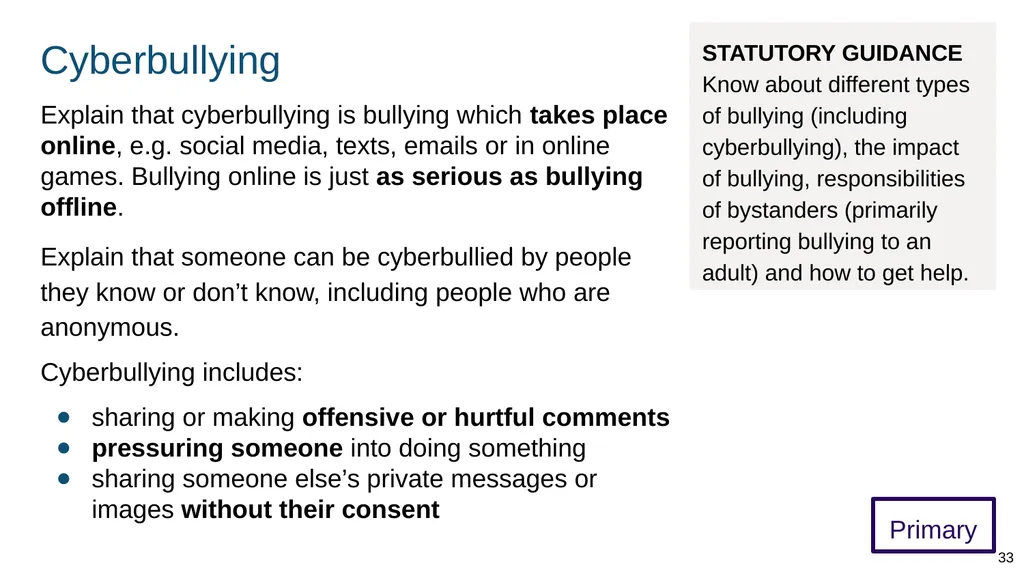
Cyberbullying Primary Explain that cyberbullying is bullying which takes place online, e.g. social media, texts, emails or in online games. Bullying online is just as serious as bullying offline.
Explain that someone can be cyberbullied by people they know or don’t know, including people who are anonymous.
Cyberbullying includes:
sharing or making offensive or hurtful comments
pressuring someone into doing something
sharing someone else’s private messages or images without their consent STATUTORY GUIDANCE Know about different types of bullying (including cyberbullying), the impact of bullying, responsibilities of bystanders (primarily reporting bullying to an adult) and how to get help. 33<br>
Explain that someone can be cyberbullied by people they know or don’t know, including people who are anonymous.
Cyberbullying includes:
sharing or making offensive or hurtful comments
pressuring someone into doing something
sharing someone else’s private messages or images without their consent STATUTORY GUIDANCE Know about different types of bullying (including cyberbullying), the impact of bullying, responsibilities of bystanders (primarily reporting bullying to an adult) and how to get help. 33<br>
34
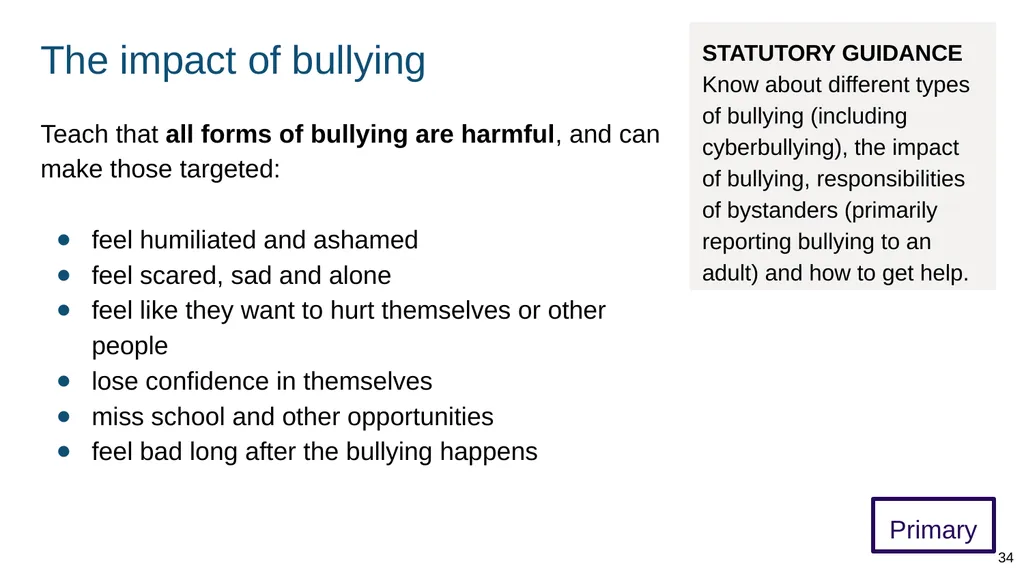
The impact of bullying Primary Teach that all forms of bullying are harmful, and can make those targeted:
feel humiliated and ashamed
feel scared, sad and alone
feel like they want to hurt themselves or other people
lose confidence in themselves
miss school and other opportunities
feel bad long after the bullying happens STATUTORY GUIDANCE Know about different types of bullying (including cyberbullying), the impact of bullying, responsibilities of bystanders (primarily reporting bullying to an adult) and how to get help. 34<br>
feel humiliated and ashamed
feel scared, sad and alone
feel like they want to hurt themselves or other people
lose confidence in themselves
miss school and other opportunities
feel bad long after the bullying happens STATUTORY GUIDANCE Know about different types of bullying (including cyberbullying), the impact of bullying, responsibilities of bystanders (primarily reporting bullying to an adult) and how to get help. 34<br>
35
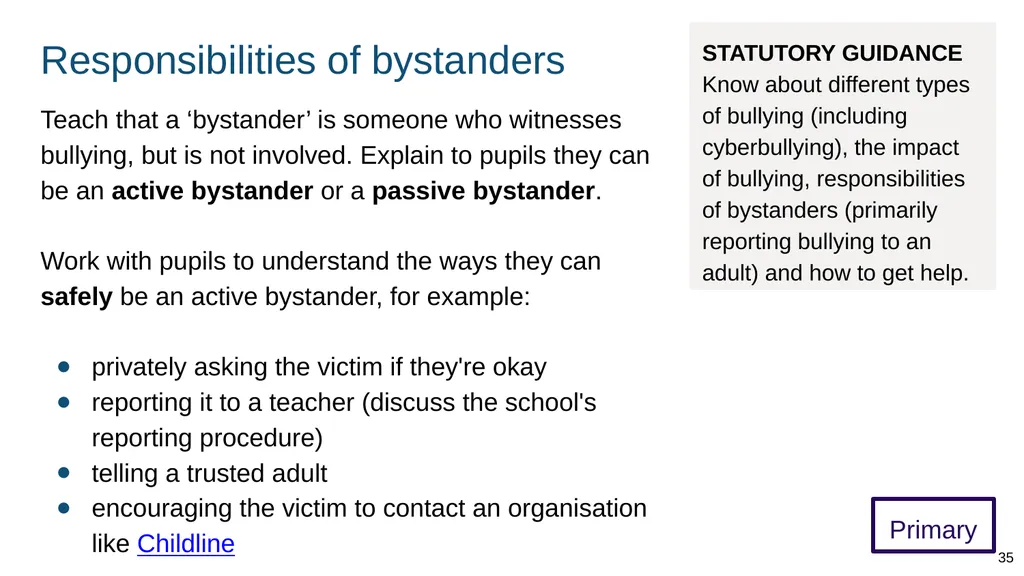
Responsibilities of bystanders Primary Teach that a ‘bystander’ is someone who witnesses bullying, but is not involved. Explain to pupils they can be an active bystander or a passive bystander.
Work with pupils to understand the ways they can safely be an active bystander, for example:
privately asking the victim if they're okay
reporting it to a teacher (discuss the school's reporting procedure)
telling a trusted adult
encouraging the victim to contact an organisation like Childline STATUTORY GUIDANCE Know about different types of bullying (including cyberbullying), the impact of bullying, responsibilities of bystanders (primarily reporting bullying to an adult) and how to get help. 35<br>
Work with pupils to understand the ways they can safely be an active bystander, for example:
privately asking the victim if they're okay
reporting it to a teacher (discuss the school's reporting procedure)
telling a trusted adult
encouraging the victim to contact an organisation like Childline STATUTORY GUIDANCE Know about different types of bullying (including cyberbullying), the impact of bullying, responsibilities of bystanders (primarily reporting bullying to an adult) and how to get help. 35<br>
36
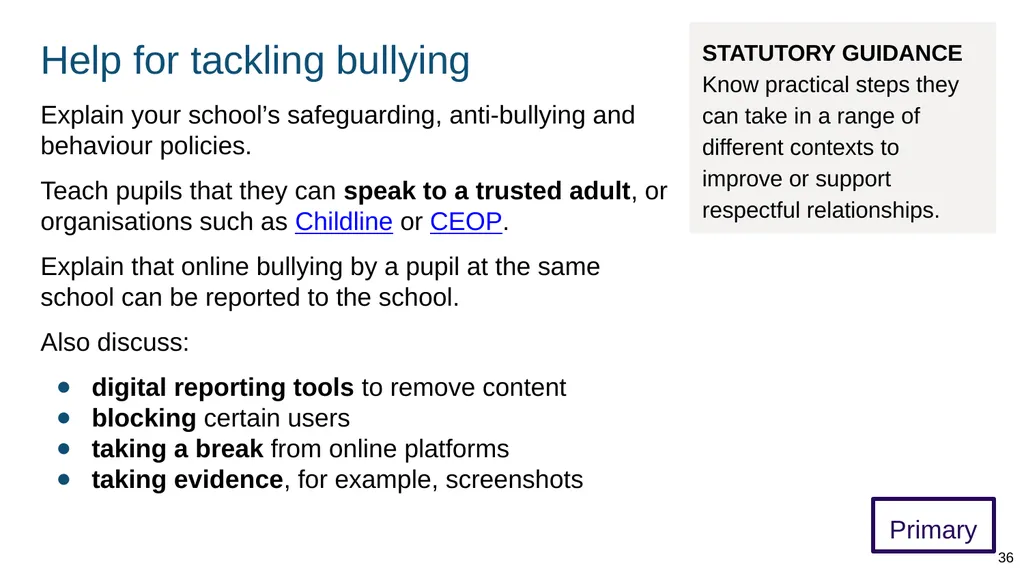
Help for tackling bullying Primary Explain your school’s safeguarding, anti-bullying and behaviour policies.
Teach pupils that they can speak to a trusted adult, or organisations such as Childline or CEOP.
Explain that online bullying by a pupil at the same school can be reported to the school.
Also discuss:
digital reporting tools to remove content
blocking certain users
taking a break from online platforms
taking evidence, for example, screenshots STATUTORY GUIDANCE Know practical steps they can take in a range of different contexts to improve or support respectful relationships. 36<br>
Teach pupils that they can speak to a trusted adult, or organisations such as Childline or CEOP.
Explain that online bullying by a pupil at the same school can be reported to the school.
Also discuss:
digital reporting tools to remove content
blocking certain users
taking a break from online platforms
taking evidence, for example, screenshots STATUTORY GUIDANCE Know practical steps they can take in a range of different contexts to improve or support respectful relationships. 36<br>
37
Understanding stereotypes Primary Teach that a stereotype is an overly simplified, often untrue, fixed idea about a group of people.
Explain that a stereotype is a belief that someone's character, preferences, attributes or abilities can be automatically inferred from a group that they may happen to be a part of.
For example, their gender or ethnic background. STATUTORY GUIDANCE Know what a stereotype is, and how stereotypes can be unfair, negative or destructive. 37<br>
Explain that a stereotype is a belief that someone's character, preferences, attributes or abilities can be automatically inferred from a group that they may happen to be a part of.
For example, their gender or ethnic background. STATUTORY GUIDANCE Know what a stereotype is, and how stereotypes can be unfair, negative or destructive. 37<br>
38
How stereotypes can damage Primary Teach that stereotypes are damaging for anyone in those groups as they:
affect how people think about and behave towards them
mean they are judged on assumptions about them rather than their own achievements and qualities
make people look for behaviour in them that reinforces the stereotype of that group
Teach that stereotypes are damaging and unfair whether they are applied to a group that is in the majority or the minority. STATUTORY GUIDANCE Know what a stereotype is, and how stereotypes can be unfair, negative or destructive. 38<br>
affect how people think about and behave towards them
mean they are judged on assumptions about them rather than their own achievements and qualities
make people look for behaviour in them that reinforces the stereotype of that group
Teach that stereotypes are damaging and unfair whether they are applied to a group that is in the majority or the minority. STATUTORY GUIDANCE Know what a stereotype is, and how stereotypes can be unfair, negative or destructive. 38<br>
39
Seeking permission Primary Discuss with pupils when people need to seek permission from someone else, e.g. borrowing property, joining someone else’s game.
Discuss with pupils:
what they should do if permission is unclear
other ways that people say ‘no’, for example, ‘maybe later’ or ‘I don’t know’
non-verbal cues, for example, people shaking their head, or saying nothing
Teach pupils the importance of being clear when seeking permission, for example, by asking a direct question. 39 STATUTORY GUIDANCE Know the importance of permission-seeking and giving in relationships with friends, peers and adults.<br>
Discuss with pupils:
what they should do if permission is unclear
other ways that people say ‘no’, for example, ‘maybe later’ or ‘I don’t know’
non-verbal cues, for example, people shaking their head, or saying nothing
Teach pupils the importance of being clear when seeking permission, for example, by asking a direct question. 39 STATUTORY GUIDANCE Know the importance of permission-seeking and giving in relationships with friends, peers and adults.<br>
40
Giving permission Primary Explain to pupils that part of self-respect is knowing when they want to do something or not.
Discuss ways they can express this with confidence and kindness.
Teach pupils that:
not giving permission does not make them a bad friend
giving permission does not make them a good friend STATUTORY GUIDANCE Know the importance of permission-seeking and giving in relationships with friends, peers and adults. 40<br>
Discuss ways they can express this with confidence and kindness.
Teach pupils that:
not giving permission does not make them a bad friend
giving permission does not make them a good friend STATUTORY GUIDANCE Know the importance of permission-seeking and giving in relationships with friends, peers and adults. 40<br>
41
Secondary curriculum STATUTORY GUIDANCE
Schools should continue to develop knowledge on topics specified for primary as required and in addition cover the following content by the end of secondary. (p36) 41<br>
42
Positive and healthy friendships Building on what is taught in primary, teach that healthy friendships make people feel happy, confident, safe, and positive about themselves.
Explain to pupils that this applies to relationships in person and online.
Explore, in both contexts, what pupils can do if they are in a relationship that does not make them feel this way, for example, tell a trusted adult. STATUTORY GUIDANCE Know the characteristics of positive and healthy friendships (in all contexts, including online) including: trust, respect, honesty, kindness, generosity, boundaries, privacy, consent and the management of conflict, reconciliation and ending relationships. This includes different (non-sexual) types of relationship. Secondary 42<br>
Explain to pupils that this applies to relationships in person and online.
Explore, in both contexts, what pupils can do if they are in a relationship that does not make them feel this way, for example, tell a trusted adult. STATUTORY GUIDANCE Know the characteristics of positive and healthy friendships (in all contexts, including online) including: trust, respect, honesty, kindness, generosity, boundaries, privacy, consent and the management of conflict, reconciliation and ending relationships. This includes different (non-sexual) types of relationship. Secondary 42<br>
43
Positive and healthy friendships (1) In a positive and healthy friendship both people:
are kind, considerate and respectful to each other
are honest with each other
listen to each other
respect each others personal space, privacy and boundaries
accept each other’s differences STATUTORY GUIDANCE Know the characteristics of positive and healthy friendships (in all contexts, including online) including: trust, respect, honesty, kindness, generosity, boundaries, privacy, consent and the management of conflict, reconciliation and ending relationships. This includes different (non-sexual) types of relationship. Secondary 43<br>
are kind, considerate and respectful to each other
are honest with each other
listen to each other
respect each others personal space, privacy and boundaries
accept each other’s differences STATUTORY GUIDANCE Know the characteristics of positive and healthy friendships (in all contexts, including online) including: trust, respect, honesty, kindness, generosity, boundaries, privacy, consent and the management of conflict, reconciliation and ending relationships. This includes different (non-sexual) types of relationship. Secondary 43<br>
44
Respect Explain that in a respectful relationship they should be able to:
express their feelings and opinions without being made to feel stupid, scared, or embarrassed
listen to and genuinely value the other person’s feelings and opinions
be able to disagree without causing a fight or someone saying hurtful things STATUTORY GUIDANCE Know the characteristics of positive and healthy friendships (in all contexts, including online) including: trust, respect, honesty, kindness, generosity, boundaries, privacy, consent and the management of conflict, reconciliation and ending relationships. This includes different (non-sexual) types of relationship. Secondary 44<br>
express their feelings and opinions without being made to feel stupid, scared, or embarrassed
listen to and genuinely value the other person’s feelings and opinions
be able to disagree without causing a fight or someone saying hurtful things STATUTORY GUIDANCE Know the characteristics of positive and healthy friendships (in all contexts, including online) including: trust, respect, honesty, kindness, generosity, boundaries, privacy, consent and the management of conflict, reconciliation and ending relationships. This includes different (non-sexual) types of relationship. Secondary 44<br>
45
Respecting difference (1) Building on the primary curriculum, reinforce that everyone needs to show the same respect to others regardless of how different they are to them.
Explain the harm caused by ‘cancel culture’ and the importance of freedom of speech and freedom of association to a tolerant and free society.
Teach that censorship and ‘no platforming’ are harmful and damaging.
Explain that seeking to get people ‘cancelled’ (e.g. having them removed from their position of authority or job) simply because you disagree with them, is a form of bullying and is not acceptable. STATUTORY GUIDANCE Know the importance of respecting others, even when they are very different from them (for example physically, in character, personality or background), or make different choices or have different preferences or beliefs. Secondary 45<br>
Explain the harm caused by ‘cancel culture’ and the importance of freedom of speech and freedom of association to a tolerant and free society.
Teach that censorship and ‘no platforming’ are harmful and damaging.
Explain that seeking to get people ‘cancelled’ (e.g. having them removed from their position of authority or job) simply because you disagree with them, is a form of bullying and is not acceptable. STATUTORY GUIDANCE Know the importance of respecting others, even when they are very different from them (for example physically, in character, personality or background), or make different choices or have different preferences or beliefs. Secondary 45<br>
46
Boundaries, privacy, consent Teach that even within the closest friendships, people appreciate and expect to:
have their privacy respected, e.g. trust that their friends will not access their phone without permission
have their boundaries respected, e.g. how closely they interact with people, physically or otherwise
be able to choose when to give and withdraw consent, e.g. change their mind
Explain that this applies to all relationships, e.g. family, friends or other’s they regularly interact with. STATUTORY GUIDANCE Know the characteristics of positive and healthy friendships (in all contexts, including online) including: trust, respect, honesty, kindness, generosity, boundaries, privacy, consent and the management of conflict, reconciliation and ending relationships. This includes different (non-sexual) types of relationship. Secondary 46<br>
have their privacy respected, e.g. trust that their friends will not access their phone without permission
have their boundaries respected, e.g. how closely they interact with people, physically or otherwise
be able to choose when to give and withdraw consent, e.g. change their mind
Explain that this applies to all relationships, e.g. family, friends or other’s they regularly interact with. STATUTORY GUIDANCE Know the characteristics of positive and healthy friendships (in all contexts, including online) including: trust, respect, honesty, kindness, generosity, boundaries, privacy, consent and the management of conflict, reconciliation and ending relationships. This includes different (non-sexual) types of relationship. Secondary 46<br>
47
Conflict and reconciliation Teach that when there is conflict in relationships it can help to:
apologise if they are in the wrong
discuss ways to de-escalate conflict
listen and acknowledge each other’s viewpoints
clarify views and opinions
accept the consequences of their actions
Explain that a successfully resolved conflict can strengthen a relationship as the parties understand more about the other person and themselves as a result. STATUTORY GUIDANCE Know practical steps they can take in a range of different contexts to improve or support respectful relationships. Secondary 47<br>
apologise if they are in the wrong
discuss ways to de-escalate conflict
listen and acknowledge each other’s viewpoints
clarify views and opinions
accept the consequences of their actions
Explain that a successfully resolved conflict can strengthen a relationship as the parties understand more about the other person and themselves as a result. STATUTORY GUIDANCE Know practical steps they can take in a range of different contexts to improve or support respectful relationships. Secondary 47<br>
48
Ending relationships STATUTORY GUIDANCE
Know the characteristics of positive and healthy friendships (in all contexts, including online) including: trust, respect, honesty, kindness, generosity, boundaries, privacy, consent and the management of conflict, reconciliation and ending relationships. This includes different (non-sexual) types of relationship. Teach that friendships can end for different reasons:
they can end suddenly, e.g. with a disagreement
people can grow apart gradually as they develop different interests or priorities
Explain that all people make and end relationships throughout their lives. After a relationship ends:
learning to move on without ill-feeling is part of a mature response to these normal life events
trying to maintain a relationship with someone who does not want to can be damaging for both people Secondary 48<br>
they can end suddenly, e.g. with a disagreement
people can grow apart gradually as they develop different interests or priorities
Explain that all people make and end relationships throughout their lives. After a relationship ends:
learning to move on without ill-feeling is part of a mature response to these normal life events
trying to maintain a relationship with someone who does not want to can be damaging for both people Secondary 48<br>
49
Building on what is taught in primary school, teach that stereotypes are unfair, and can be limiting for the individual and for our society.
These include stereotypes based on:
sex
gender
disability
race
religion
sexual orientation
gender reassignment
background Stereotypes damage individuals STATUTORY GUIDANCE Know how stereotypes, in particular stereotypes based on sex, gender, race, religion, sexual orientation or disability, can cause damage (e.g. how they might normalise non-consensual behaviour or encourage prejudice). Secondary 49<br>
These include stereotypes based on:
sex
gender
disability
race
religion
sexual orientation
gender reassignment
background Stereotypes damage individuals STATUTORY GUIDANCE Know how stereotypes, in particular stereotypes based on sex, gender, race, religion, sexual orientation or disability, can cause damage (e.g. how they might normalise non-consensual behaviour or encourage prejudice). Secondary 49<br>
50
Teach that stereotypes are unfair because people do not always fit into the idea that others may have of them. Explain that a lot of potential is wasted if people base their decisions on stereotypes rather than on an individual's strengths.
Explain that it shows greater integrity to respect people’s individuality rather than having preconceptions about them.
Teach that stereotypes are damaging and unfair whether they are applied to a group that is in the majority or the minority. Stereotypes damage individuals (2) STATUTORY GUIDANCE Know how stereotypes, in particular stereotypes based on sex, gender, race, religion, sexual orientation or disability, can cause damage (e.g. how they might normalise non-consensual behaviour or encourage prejudice). Secondary 50<br>
Explain that it shows greater integrity to respect people’s individuality rather than having preconceptions about them.
Teach that stereotypes are damaging and unfair whether they are applied to a group that is in the majority or the minority. Stereotypes damage individuals (2) STATUTORY GUIDANCE Know how stereotypes, in particular stereotypes based on sex, gender, race, religion, sexual orientation or disability, can cause damage (e.g. how they might normalise non-consensual behaviour or encourage prejudice). Secondary 50<br>
51
Teach that stereotypes encourage prejudice and can normalise non-consensual behaviour.
For example, the stereotypes of femininity and masculinity may:
make people think certain careers are for men and others are for women, limiting the types of jobs people think they can do
contribute to the idea that one party has fewer rights in a relationship than the other Stereotypes encourage prejudice STATUTORY GUIDANCE Know how stereotypes, in particular stereotypes based on sex, gender, race, religion, sexual orientation or disability, can cause damage (e.g. how they might normalise non-consensual behaviour or encourage prejudice). Secondary 51<br>
For example, the stereotypes of femininity and masculinity may:
make people think certain careers are for men and others are for women, limiting the types of jobs people think they can do
contribute to the idea that one party has fewer rights in a relationship than the other Stereotypes encourage prejudice STATUTORY GUIDANCE Know how stereotypes, in particular stereotypes based on sex, gender, race, religion, sexual orientation or disability, can cause damage (e.g. how they might normalise non-consensual behaviour or encourage prejudice). Secondary 51<br>
52
Respect and tolerance Teach that everyone is entitled to be respected. Explain that as we live in a society, we are all obliged for everyone's benefit to show respect and tolerance.
Identify key roles in society that are needed to ensure society works and is fair and just, e.g. the police, judges, government. Discuss the consequences of undermining these roles through disrespect.
Discuss the difference between fair and evidence-based challenge to authority (e.g. whistleblowing) versus abusive, personal attacks, slander and libel. STATUTORY GUIDANCE Know that in school and in wider society they can expect to be treated with respect by others, and that in turn they should show due respect to others, including people in positions of authority and due tolerance of other people’s beliefs. Secondary 52<br>
Identify key roles in society that are needed to ensure society works and is fair and just, e.g. the police, judges, government. Discuss the consequences of undermining these roles through disrespect.
Discuss the difference between fair and evidence-based challenge to authority (e.g. whistleblowing) versus abusive, personal attacks, slander and libel. STATUTORY GUIDANCE Know that in school and in wider society they can expect to be treated with respect by others, and that in turn they should show due respect to others, including people in positions of authority and due tolerance of other people’s beliefs. Secondary 52<br>
53
Types of bullying (1) Building on what is taught in primary, discuss with pupils the types of bullying they may encounter, e.g.:
physical, e.g. punching or kicking someone
verbal, e.g. spreading rumours, using racial, sexist, or homophobic slurs
non-verbal, e.g. intimidating someone by staring at them, blocking someone’s path
psychological, e.g. ‘gaslighting’, putting someone down, humiliating them, or excluding them STATUTORY GUIDANCE Know about different types of bullying (including cyberbullying), the impact of bullying, responsibilities of bystanders to report bullying and how and where to get help. Secondary 53<br>
physical, e.g. punching or kicking someone
verbal, e.g. spreading rumours, using racial, sexist, or homophobic slurs
non-verbal, e.g. intimidating someone by staring at them, blocking someone’s path
psychological, e.g. ‘gaslighting’, putting someone down, humiliating them, or excluding them STATUTORY GUIDANCE Know about different types of bullying (including cyberbullying), the impact of bullying, responsibilities of bystanders to report bullying and how and where to get help. Secondary 53<br>
54
Cyberbullying (1) Building on what is taught in primary, explain that all the following behaviours constitute cyberbullying:
publishing someone’s personal information or images without their consent, e.g. deliberately trying to humiliate them by sharing their private messages
intimidating or threatening someone, e.g. with threats of violence, or revealing private information
harassing or stalking someone, e.g. repeatedly sending unwanted messages, either privately or publicly STATUTORY GUIDANCE Know about different types of bullying (including cyberbullying), the impact of bullying, responsibilities of bystanders to report bullying and how and where to get help. Secondary 54<br>
publishing someone’s personal information or images without their consent, e.g. deliberately trying to humiliate them by sharing their private messages
intimidating or threatening someone, e.g. with threats of violence, or revealing private information
harassing or stalking someone, e.g. repeatedly sending unwanted messages, either privately or publicly STATUTORY GUIDANCE Know about different types of bullying (including cyberbullying), the impact of bullying, responsibilities of bystanders to report bullying and how and where to get help. Secondary 54<br>
55
Cyberbullying (2) vilifying or defaming someone, e.g. posting upsetting or defamatory remarks about them online
excluding someone, e.g. setting up closed groups or ‘blocking’ them
impersonating someone, e.g. identity theft, carrying out acts online or posting messages while pretending to be that person
Teach that cyberbullying can be extremely hurtful and damaging.
Explain that cyberbullying can be hard to escape and particularly hurtful because of the ‘large audience’ online. STATUTORY GUIDANCE Know about different types of bullying (including cyberbullying), the impact of bullying, responsibilities of bystanders to report bullying and how and where to get help. Secondary 55<br>
excluding someone, e.g. setting up closed groups or ‘blocking’ them
impersonating someone, e.g. identity theft, carrying out acts online or posting messages while pretending to be that person
Teach that cyberbullying can be extremely hurtful and damaging.
Explain that cyberbullying can be hard to escape and particularly hurtful because of the ‘large audience’ online. STATUTORY GUIDANCE Know about different types of bullying (including cyberbullying), the impact of bullying, responsibilities of bystanders to report bullying and how and where to get help. Secondary 55<br>
56
Impact of bullying Teach that all forms of bullying, including cyberbullying, are harmful. Bullying can:
make someone want to hurt themselves
make someone want to hurt other people
have a negative impact on mental health and wellbeing, e.g. depression, social withdrawal
affect someone long afterwards
make someone miss school
Teach that someone might be affected by bullying even if they appear otherwise. Unexplained changes in their behaviour might be a sign of this. STATUTORY GUIDANCE Know about different types of bullying (including cyberbullying), the impact of bullying, responsibilities of bystanders to report bullying and how and where to get help. Secondary 56<br>
make someone want to hurt themselves
make someone want to hurt other people
have a negative impact on mental health and wellbeing, e.g. depression, social withdrawal
affect someone long afterwards
make someone miss school
Teach that someone might be affected by bullying even if they appear otherwise. Unexplained changes in their behaviour might be a sign of this. STATUTORY GUIDANCE Know about different types of bullying (including cyberbullying), the impact of bullying, responsibilities of bystanders to report bullying and how and where to get help. Secondary 56<br>
57
Bystander intervention Build on what is taught in primary. Remind pupils what active and passive bystanders are and the importance of bystander intervention.
Teach to pupils the ways that they can become an active bystander including:
diffusing the situation if they are able to do so
privately asking the victim if they're okay, giving reassurance, solidarity and offering the hand of friendship
reporting the bullying STATUTORY GUIDANCE Know about different types of bullying (including cyberbullying), the impact of bullying, responsibilities of bystanders to report bullying and how and where to get help. Secondary 57<br>
Teach to pupils the ways that they can become an active bystander including:
diffusing the situation if they are able to do so
privately asking the victim if they're okay, giving reassurance, solidarity and offering the hand of friendship
reporting the bullying STATUTORY GUIDANCE Know about different types of bullying (including cyberbullying), the impact of bullying, responsibilities of bystanders to report bullying and how and where to get help. Secondary 57<br>
58
Help for bullying victims Explain your school’s safeguarding, anti-bullying and behaviour policies with regards to bullying.
Teach that pupils can speak to a trusted adult, or an organisation such as Childline. Explain that online bullying by a pupil at the same school can be reported to the school.
Discuss:
digital reporting tools to remove content
blocking certain users
taking a break from online platforms
taking evidence, for example, screenshots
Find more help and tools at www.childline.org.uk. STATUTORY GUIDANCE Know about different types of bullying (including cyberbullying), the impact of bullying, responsibilities of bystanders to report bullying and how and where to get help. Secondary 58<br>
Teach that pupils can speak to a trusted adult, or an organisation such as Childline. Explain that online bullying by a pupil at the same school can be reported to the school.
Discuss:
digital reporting tools to remove content
blocking certain users
taking a break from online platforms
taking evidence, for example, screenshots
Find more help and tools at www.childline.org.uk. STATUTORY GUIDANCE Know about different types of bullying (including cyberbullying), the impact of bullying, responsibilities of bystanders to report bullying and how and where to get help. Secondary 58<br>
59
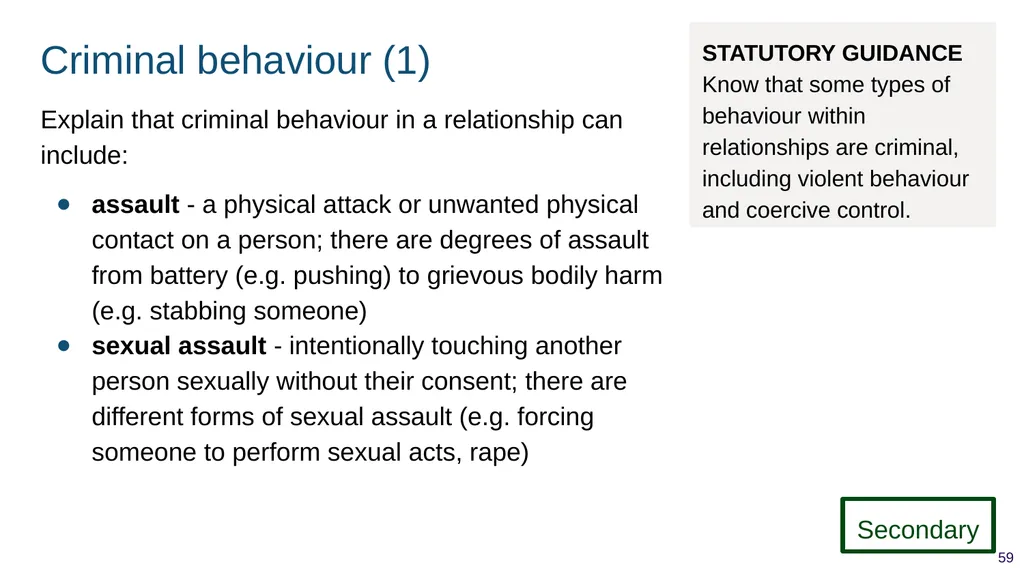
Criminal behaviour (1) Explain that criminal behaviour in a relationship can include:
assault - a physical attack or unwanted physical contact on a person; there are degrees of assault from battery (e.g. pushing) to grievous bodily harm (e.g. stabbing someone)
sexual assault - intentionally touching another person sexually without their consent; there are different forms of sexual assault (e.g. forcing someone to perform sexual acts, rape) STATUTORY GUIDANCE Know that some types of behaviour within relationships are criminal, including violent behaviour and coercive control. Secondary 59<br>
assault - a physical attack or unwanted physical contact on a person; there are degrees of assault from battery (e.g. pushing) to grievous bodily harm (e.g. stabbing someone)
sexual assault - intentionally touching another person sexually without their consent; there are different forms of sexual assault (e.g. forcing someone to perform sexual acts, rape) STATUTORY GUIDANCE Know that some types of behaviour within relationships are criminal, including violent behaviour and coercive control. Secondary 59<br>
60
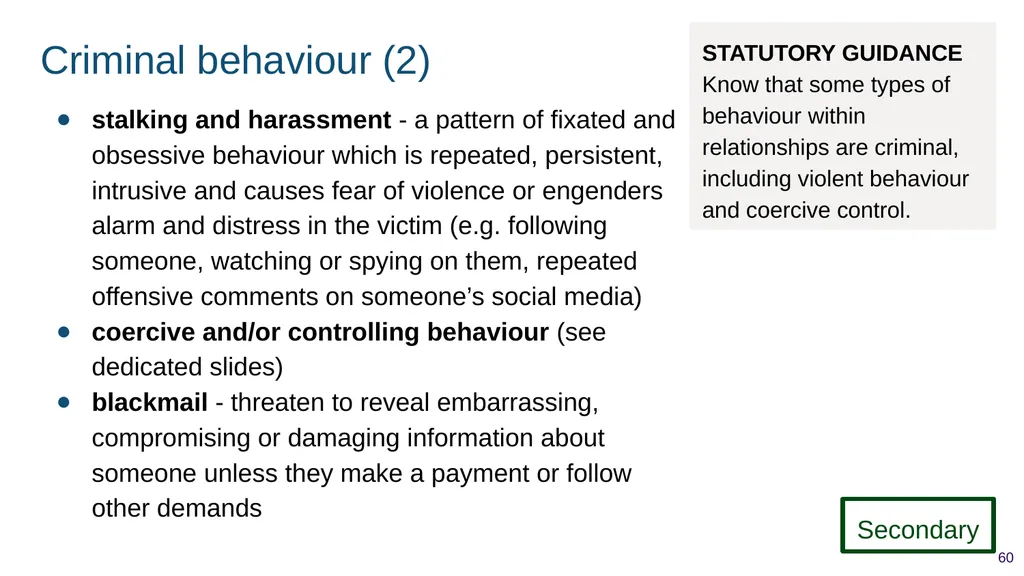
Criminal behaviour (2) stalking and harassment - a pattern of fixated and obsessive behaviour which is repeated, persistent, intrusive and causes fear of violence or engenders alarm and distress in the victim (e.g. following someone, watching or spying on them, repeated offensive comments on someone’s social media)
coercive and/or controlling behaviour (see dedicated slides)
blackmail - threaten to reveal embarrassing, compromising or damaging information about someone unless they make a payment or follow other demands STATUTORY GUIDANCE Know that some types of behaviour within relationships are criminal, including violent behaviour and coercive control. Secondary 60<br>
coercive and/or controlling behaviour (see dedicated slides)
blackmail - threaten to reveal embarrassing, compromising or damaging information about someone unless they make a payment or follow other demands STATUTORY GUIDANCE Know that some types of behaviour within relationships are criminal, including violent behaviour and coercive control. Secondary 60<br>
61
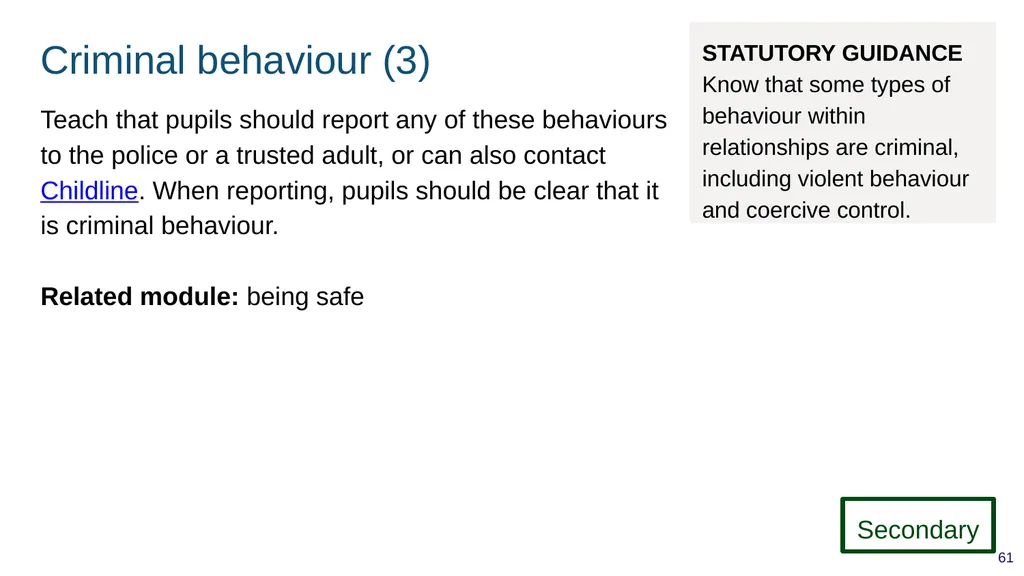
Criminal behaviour (3) Teach that pupils should report any of these behaviours to the police or a trusted adult, or can also contact Childline. When reporting, pupils should be clear that it is criminal behaviour.
Related module: being safe STATUTORY GUIDANCE Know that some types of behaviour within relationships are criminal, including violent behaviour and coercive control. Secondary 61<br>
Related module: being safe STATUTORY GUIDANCE Know that some types of behaviour within relationships are criminal, including violent behaviour and coercive control. Secondary 61<br>
62
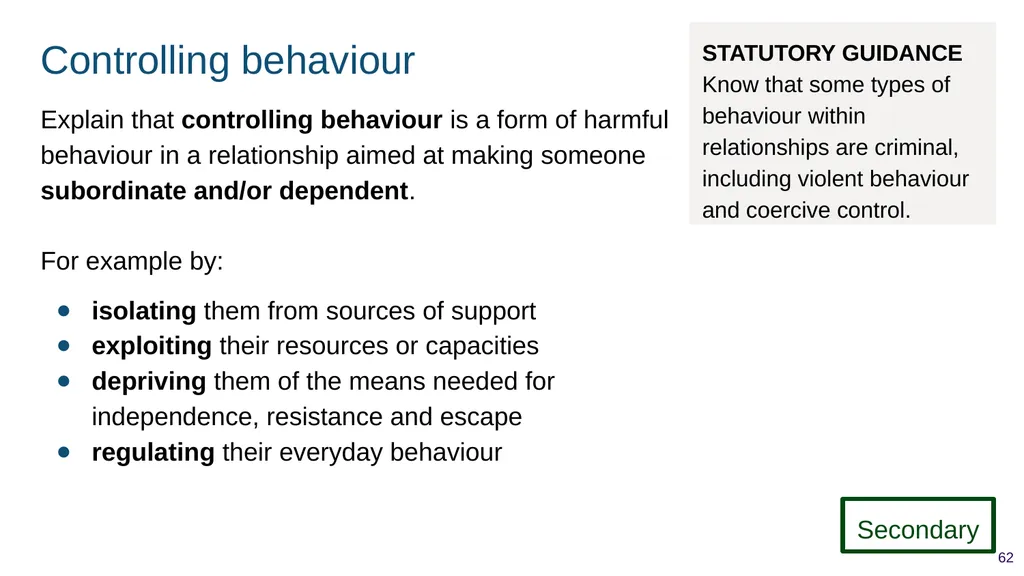
Controlling behaviour Explain that controlling behaviour is a form of harmful behaviour in a relationship aimed at making someone subordinate and/or dependent.
For example by:
isolating them from sources of support
exploiting their resources or capacities
depriving them of the means needed for independence, resistance and escape
regulating their everyday behaviour STATUTORY GUIDANCE Know that some types of behaviour within relationships are criminal, including violent behaviour and coercive control. Secondary 62<br>
For example by:
isolating them from sources of support
exploiting their resources or capacities
depriving them of the means needed for independence, resistance and escape
regulating their everyday behaviour STATUTORY GUIDANCE Know that some types of behaviour within relationships are criminal, including violent behaviour and coercive control. Secondary 62<br>
63
Coercive control Define coercive behaviour as an act or pattern of acts such as assaults, threats, humiliation and intimidation, used to harm, punish, or frighten someone.
Teach that coercive and/or controlling behaviour is always wrong, and can be a criminal offence.
Explain that abusive behaviour in relationships, including criminal behaviour, can be subtle and may be justified as being about love or care.
Remind pupils of the importance of mutual respect in all relationships. STATUTORY GUIDANCE Know that some types of behaviour within relationships are criminal, including violent behaviour and coercive control. Secondary 63<br>
Teach that coercive and/or controlling behaviour is always wrong, and can be a criminal offence.
Explain that abusive behaviour in relationships, including criminal behaviour, can be subtle and may be justified as being about love or care.
Remind pupils of the importance of mutual respect in all relationships. STATUTORY GUIDANCE Know that some types of behaviour within relationships are criminal, including violent behaviour and coercive control. Secondary 63<br>
64
Sexual harassment Define sexual harassment as ‘unwanted conduct of a sexual nature which has the purpose or effect of violating someone’s dignity, or creating an intimidating, hostile, degrading, humiliating or offensive environment for them.’
Illustrate how sexual harassment can happen in different contexts, for example:
at school, e.g. unwanted touching, sexual comments
online, e.g. unwanted sharing of naked photographs
in the workplace, e.g. displaying sexual images
in public, e.g. ‘catcalls’, wolf-whistles
Related module: being safe STATUTORY GUIDANCE Know what constitutes sexual harassment and sexual violence and why these are always unacceptable. Secondary 64<br>
Illustrate how sexual harassment can happen in different contexts, for example:
at school, e.g. unwanted touching, sexual comments
online, e.g. unwanted sharing of naked photographs
in the workplace, e.g. displaying sexual images
in public, e.g. ‘catcalls’, wolf-whistles
Related module: being safe STATUTORY GUIDANCE Know what constitutes sexual harassment and sexual violence and why these are always unacceptable. Secondary 64<br>
65
Sexual violence Teach pupils that sexual violence is a broad term which can:
describe a sexual act which uses coercion, e.g. physical force, psychological intimidation, blackmail
involve someone who does not or cannot consent, including sexual comments or advances
Define consent as agreement by choice and having the freedom and capacity to make that choice. STATUTORY GUIDANCE Know what constitutes sexual harassment and sexual violence and why these are always unacceptable. Secondary 65<br>
describe a sexual act which uses coercion, e.g. physical force, psychological intimidation, blackmail
involve someone who does not or cannot consent, including sexual comments or advances
Define consent as agreement by choice and having the freedom and capacity to make that choice. STATUTORY GUIDANCE Know what constitutes sexual harassment and sexual violence and why these are always unacceptable. Secondary 65<br>
66
The Equality Act 2010 Explain that everyone is unique and equal and that respect for difference and protection from discrimination is built into the law.
Teach that discrimination is when people are treated unfavourably on the basis of a protected characteristic such as race or gender.
The Equality Act 2010 provides a single, consolidated source of discrimination law, covering all the circumstances in which discrimination (as well as harassment and victimisation) are unlawful. STATUTORY GUIDANCE Know the legal rights and responsibilities regarding equality (particularly with reference to the protected characteristics as defined in the Equality Act 2010) and that everyone is unique and equal. Secondary 66<br>
Teach that discrimination is when people are treated unfavourably on the basis of a protected characteristic such as race or gender.
The Equality Act 2010 provides a single, consolidated source of discrimination law, covering all the circumstances in which discrimination (as well as harassment and victimisation) are unlawful. STATUTORY GUIDANCE Know the legal rights and responsibilities regarding equality (particularly with reference to the protected characteristics as defined in the Equality Act 2010) and that everyone is unique and equal. Secondary 66<br>
67
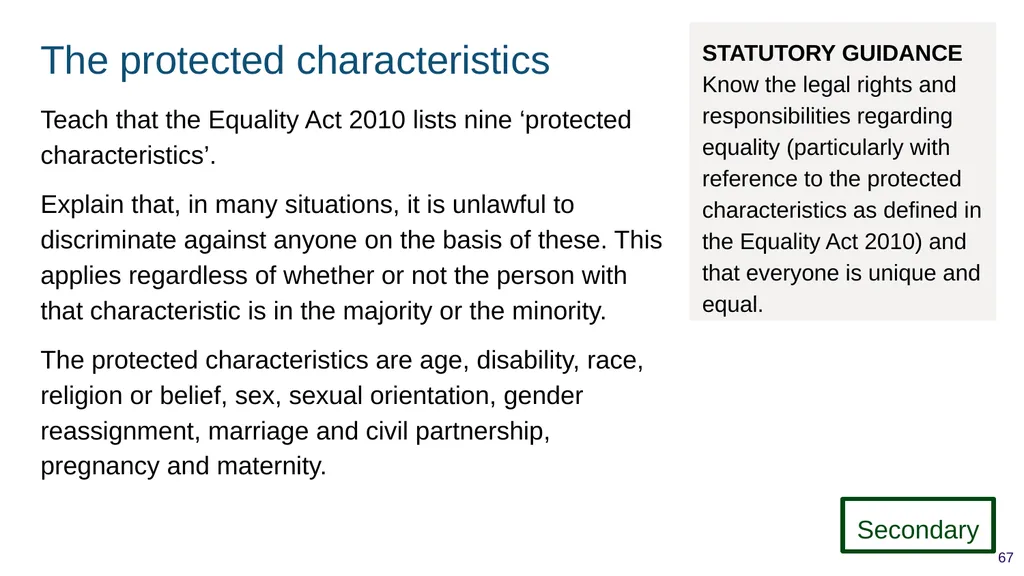
The protected characteristics Teach that the Equality Act 2010 lists nine ‘protected characteristics’.
Explain that, in many situations, it is unlawful to discriminate against anyone on the basis of these. This applies regardless of whether or not the person with that characteristic is in the majority or the minority.
The protected characteristics are age, disability, race, religion or belief, sex, sexual orientation, gender reassignment, marriage and civil partnership, pregnancy and maternity. STATUTORY GUIDANCE Know the legal rights and responsibilities regarding equality (particularly with reference to the protected characteristics as defined in the Equality Act 2010) and that everyone is unique and equal. Secondary 67<br>
Explain that, in many situations, it is unlawful to discriminate against anyone on the basis of these. This applies regardless of whether or not the person with that characteristic is in the majority or the minority.
The protected characteristics are age, disability, race, religion or belief, sex, sexual orientation, gender reassignment, marriage and civil partnership, pregnancy and maternity. STATUTORY GUIDANCE Know the legal rights and responsibilities regarding equality (particularly with reference to the protected characteristics as defined in the Equality Act 2010) and that everyone is unique and equal. Secondary 67<br>
68
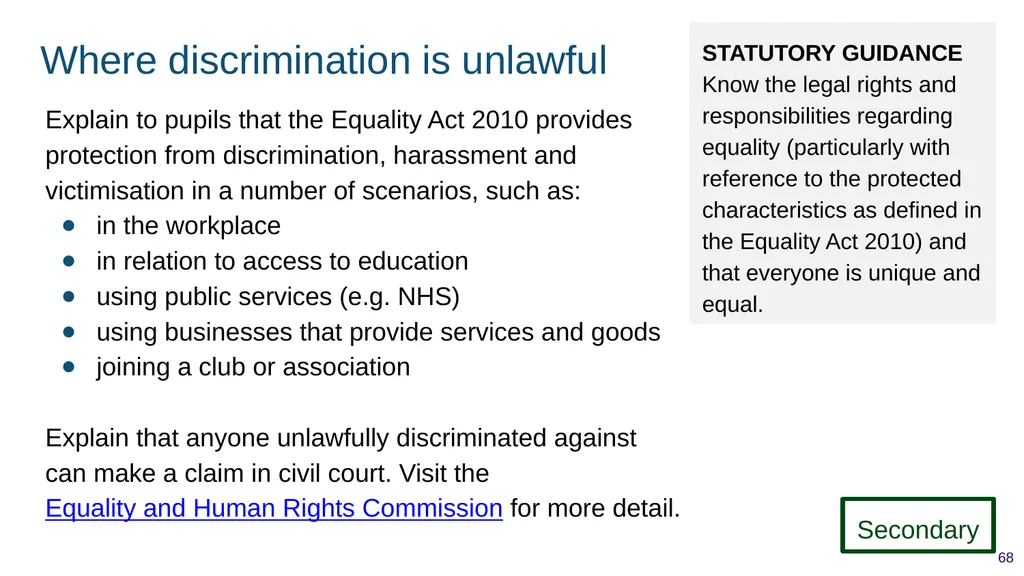
Where discrimination is unlawful Explain to pupils that the Equality Act 2010 provides protection from discrimination, harassment and victimisation in a number of scenarios, such as:
in the workplace
in relation to access to education
using public services (e.g. NHS)
using businesses that provide services and goods
joining a club or association
Explain that anyone unlawfully discriminated against can make a claim in civil court. Visit the Equality and Human Rights Commission for more detail. STATUTORY GUIDANCE Know the legal rights and responsibilities regarding equality (particularly with reference to the protected characteristics as defined in the Equality Act 2010) and that everyone is unique and equal. Secondary 68<br>
in the workplace
in relation to access to education
using public services (e.g. NHS)
using businesses that provide services and goods
joining a club or association
Explain that anyone unlawfully discriminated against can make a claim in civil court. Visit the Equality and Human Rights Commission for more detail. STATUTORY GUIDANCE Know the legal rights and responsibilities regarding equality (particularly with reference to the protected characteristics as defined in the Equality Act 2010) and that everyone is unique and equal. Secondary 68<br>
69
Examples of good practice 69<br>
70
Good practice The following are just some of the approaches you might consider when preparing to teach about respectful relationships.
You will need to adapt these approaches to ensure they are age appropriate and developmentally appropriate for your pupils. Good practice 70<br>
You will need to adapt these approaches to ensure they are age appropriate and developmentally appropriate for your pupils. Good practice 70<br>
71
Good practice approaches (1) Ensure information is taught at the right time so that pupils are not lacking the knowledge they need to make informed decisions, and are aware of their legal protections, rights and responsibilities.
When appropriate to do so, ensure LGBT-relevant knowledge is included throughout teaching (not a one-off session) and use inclusive language, considering how individual pupils may relate to particular topics. It is not compulsory for primary schools to cover LGBT content, though they are enabled and encouraged to do so if they consider it age appropriate. Secondary schools should cover LGBT content.
Take into account issues specific to the group or setting, e.g. conditional friendships which often arise in behaviour settings, or non-reciprocal friendships which often arise in SEND settings. Good practice 71<br>
When appropriate to do so, ensure LGBT-relevant knowledge is included throughout teaching (not a one-off session) and use inclusive language, considering how individual pupils may relate to particular topics. It is not compulsory for primary schools to cover LGBT content, though they are enabled and encouraged to do so if they consider it age appropriate. Secondary schools should cover LGBT content.
Take into account issues specific to the group or setting, e.g. conditional friendships which often arise in behaviour settings, or non-reciprocal friendships which often arise in SEND settings. Good practice 71<br>
72
Good practice approaches (2) Ensure that information on age-appropriate support services is available for different groups.
For example, signpost to services for:
women/girls: Rape Crisis, national domestic abuse helpline
men/boys: Survivors UK
LGBT people, e.g. GALOP
perpetrators, e.g. Respect helpline
friendships, bullying, and other concerns, e.g. Childline, Childnet, CEOP, anti-bullying organisations Good practice 72<br>
For example, signpost to services for:
women/girls: Rape Crisis, national domestic abuse helpline
men/boys: Survivors UK
LGBT people, e.g. GALOP
perpetrators, e.g. Respect helpline
friendships, bullying, and other concerns, e.g. Childline, Childnet, CEOP, anti-bullying organisations Good practice 72<br>
73
Good practice approaches (3) When teaching about relationships:
help pupils practice respect in relationships and to demonstrate how they already treat each other with respect (refer to ground rules)
do not assume that all pupils have experienced positive relationships, such as friendships with peers, or relationships with any family members
refrain from activities where pupils are asked to name the positive or negative qualities of their own relationships, as this can be very exposing, instead use case studies, characters or examples (e.g. from literature or film) to identify relationship qualities Good practice 73<br>
help pupils practice respect in relationships and to demonstrate how they already treat each other with respect (refer to ground rules)
do not assume that all pupils have experienced positive relationships, such as friendships with peers, or relationships with any family members
refrain from activities where pupils are asked to name the positive or negative qualities of their own relationships, as this can be very exposing, instead use case studies, characters or examples (e.g. from literature or film) to identify relationship qualities Good practice 73<br>
74
Responding to questions about suicide If raised in class, it is important to talk about suicide as pupils will know about news stories, TV storylines, or may have personal experience of suicide.
However, when teaching about suicide or self-harm it is important not to glamorise, or give methods which may encourage suicide ideation.
Teaching about suicide should be preventative, signposting pupils to support networks and helping them to identify signs of someone at risk.
Find more information and resources at:
minded.org.uk
papyrus-uk.org Good practice 74<br>
However, when teaching about suicide or self-harm it is important not to glamorise, or give methods which may encourage suicide ideation.
Teaching about suicide should be preventative, signposting pupils to support networks and helping them to identify signs of someone at risk.
Find more information and resources at:
minded.org.uk
papyrus-uk.org Good practice 74<br>
75
Activities and templates for trainers 75<br>
76
About these activities and templates Subject leads can use the following templates and training activities to plan training on teaching the new curriculum topics.
You can:
move slides - e.g. ‘rate your confidence (before training)’ - to the point in the presentation where you want to carry out that activity
delete slides if you are not covering those curriculum elements at this time 76<br>
You can:
move slides - e.g. ‘rate your confidence (before training)’ - to the point in the presentation where you want to carry out that activity
delete slides if you are not covering those curriculum elements at this time 76<br>
77
Training activity:
Rate your confidence 77<br>
Rate your confidence 77<br>
78
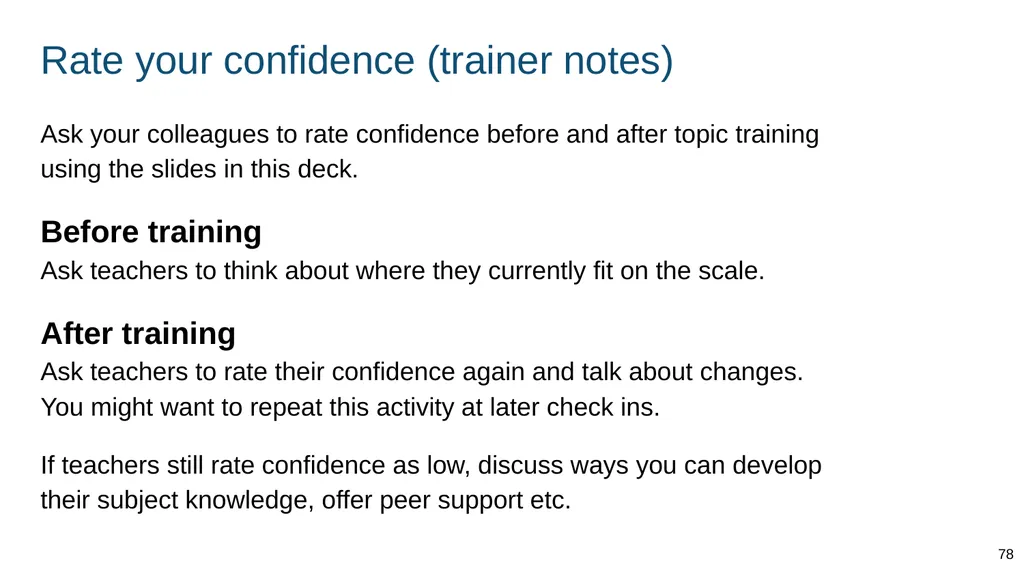
Rate your confidence (trainer notes) Ask your colleagues to rate confidence before and after topic training using the slides in this deck.
Before training Ask teachers to think about where they currently fit on the scale.
After training Ask teachers to rate their confidence again and talk about changes. You might want to repeat this activity at later check ins.
If teachers still rate confidence as low, discuss ways you can develop their subject knowledge, offer peer support etc. 78<br>
Before training Ask teachers to think about where they currently fit on the scale.
After training Ask teachers to rate their confidence again and talk about changes. You might want to repeat this activity at later check ins.
If teachers still rate confidence as low, discuss ways you can develop their subject knowledge, offer peer support etc. 78<br>
79
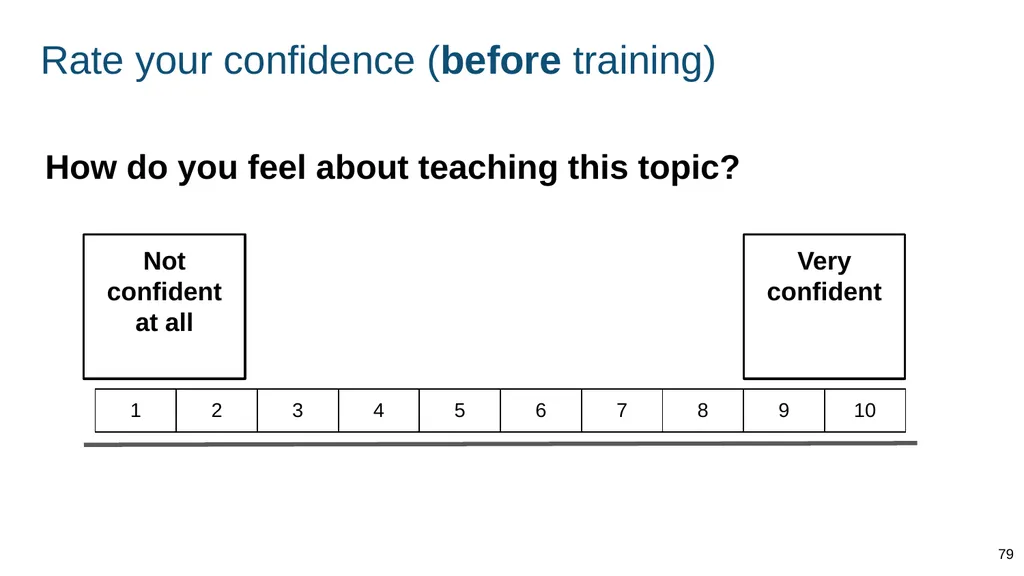
Rate your confidence (before training) How do you feel about teaching this topic? Not confident at all Very confident 79<br>
80
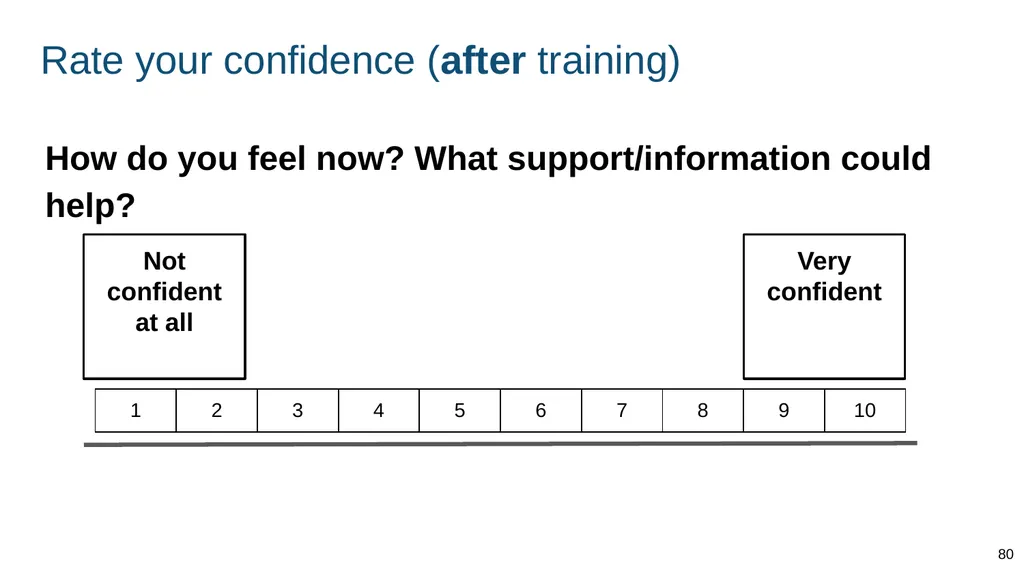
Rate your confidence (after training) How do you feel now? What support/information could help? Not confident at all Very confident 80<br>
81
Training activity:
Dealing with difficult questions 81<br>
Dealing with difficult questions 81<br>
82
Dealing with difficult questions (trainer notes) Use the following slides in your training to help teachers:
share concerns about questions they could be asked by pupils
strategise ways to respond to such questions 82<br>
share concerns about questions they could be asked by pupils
strategise ways to respond to such questions 82<br>
83
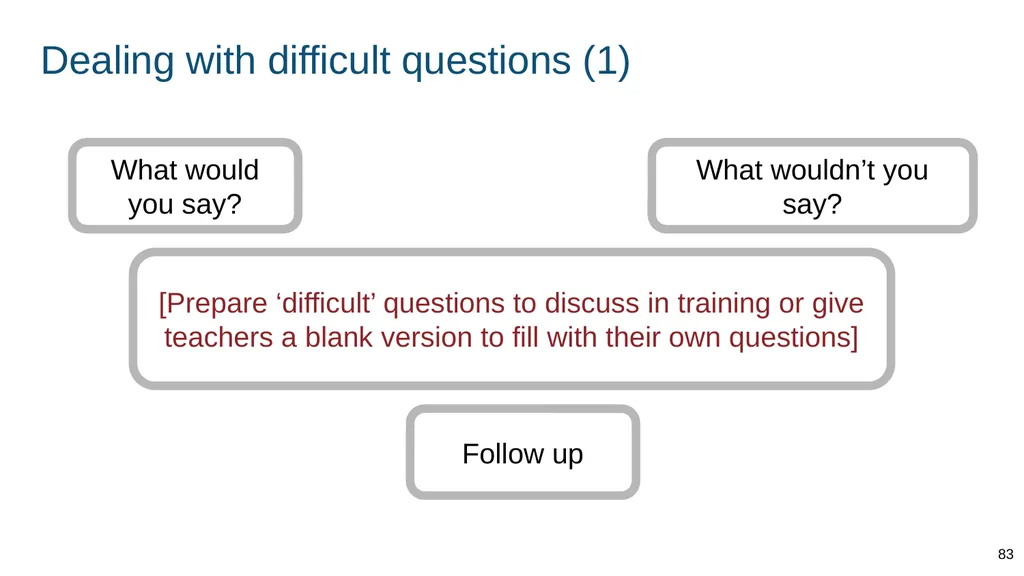
Dealing with difficult questions (1) [Prepare ‘difficult’ questions to discuss in training or give teachers a blank version to fill with their own questions] What would you say? What wouldn’t you say? Follow up 83<br>
84
Dealing with difficult questions (2) Pupils may well ask questions because they:
want information
are seeking permission - “Is it OK if I …?”
are trying to shock or get attention
have related personal beliefs
Remember:
don’t feel pressured or that you have to answer straight away
don’t disclose personal information - use third-person examples, say ‘some people...’
seek advice if you need it 84<br>
want information
are seeking permission - “Is it OK if I …?”
are trying to shock or get attention
have related personal beliefs
Remember:
don’t feel pressured or that you have to answer straight away
don’t disclose personal information - use third-person examples, say ‘some people...’
seek advice if you need it 84<br>
85
Training activity:
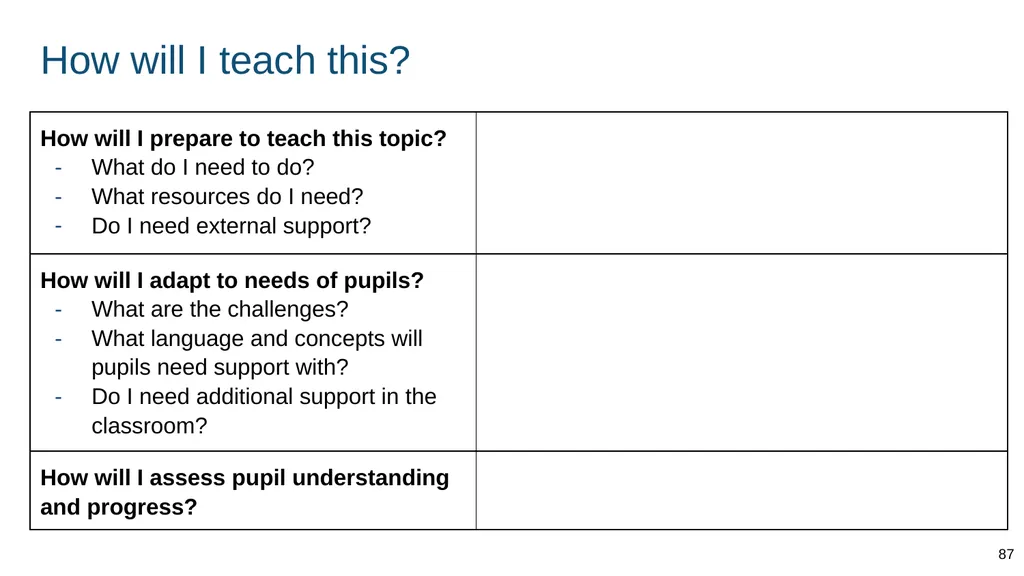
How will I teach this? 85<br>
How will I teach this? 85<br>
86
How will I teach this? (trainer notes) Use the following slides in your training to help teachers:
begin to plan and resource their lessons
discuss and address any issues they anticipate in the delivery of lessons 86<br>
begin to plan and resource their lessons
discuss and address any issues they anticipate in the delivery of lessons 86<br>
87
How will I teach this? 87<br>
88
Additional slides for structuring training 88<br>
89
Any concerns? ADAPT THIS FOR YOUR OWN PRESENTATION Any questions? What support do you need? 89<br>
90
XX% ADAPT THIS FOR YOUR OWN PRESENTATION [Use this format to present your own key facts and statistics - e.g. from your local authority or own monitoring. Include the source.] 90<br>