
Teaching with Sustainability A course offered
Description: Teaching with Sustainability A course offered during IAP - January 2022 Instructors: Liz Potter-Nelson and Sarah Meyers Environmental Solutions Initiative at MIT Week 1 - What is sustainability education? Defining sustainability using the
Related Topics
Download Presentation
"Teaching with Sustainability A course offered" is the property of its rightful owner. Permission is granted to download and print the materials on this website for personal, non-commercial use only, and to display it on your personal computer provided you do not modify the materials and that you retain all copyright notices contained in the materials. By downloading content from our website, you accept the terms of this agreement.
Presentation Transcript
slide1. Teaching with Sustainability A course offered during IAP - January 2022
Instructors:
Liz Potter-Nelson and Sarah Meyers
Environmental Solutions Initiative at MIT<br>
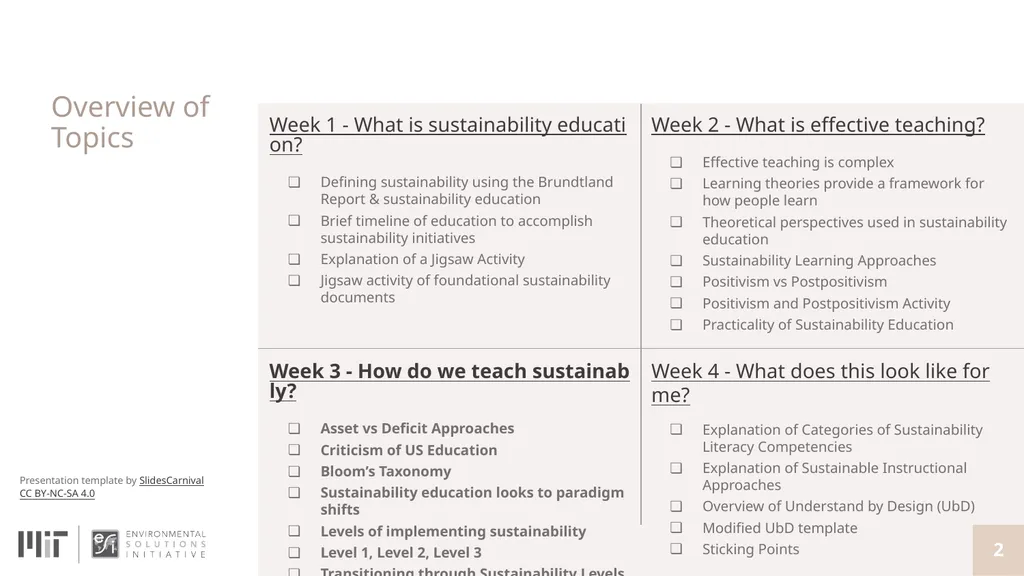
slide2. Week 1 - What is sustainability education?
Defining sustainability using the Brundtland Report & sustainability education
Brief timeline of education to accomplish sustainability initiatives
Explanation of a Jigsaw Activity
Jigsaw activity of foundational sustainability documents Overview of Topics 2 Week 2 - What is effective teaching?
Effective teaching is complex
Learning theories provide a framework for how people learn
Theoretical perspectives used in sustainability education
Sustainability Learning Approaches
Positivism vs Postpositivism
Positivism and Postpositivism Activity
Practicality of Sustainability Education Week 3 - How do we teach sustainably?
Asset vs Deficit Approaches
Criticism of US Education
Bloom’s Taxonomy
Sustainability education looks to paradigm shifts
Levels of implementing sustainability
Level 1, Level 2, Level 3
Transitioning through Sustainability Levels Week 4 - What does this look like for me?
Explanation of Categories of Sustainability Literacy Competencies
Explanation of Sustainable Instructional Approaches
Overview of Understand by Design (UbD)
Modified UbD template
Sticking Points<br>
slide3. How do we teach sustainably? Week 3<br>
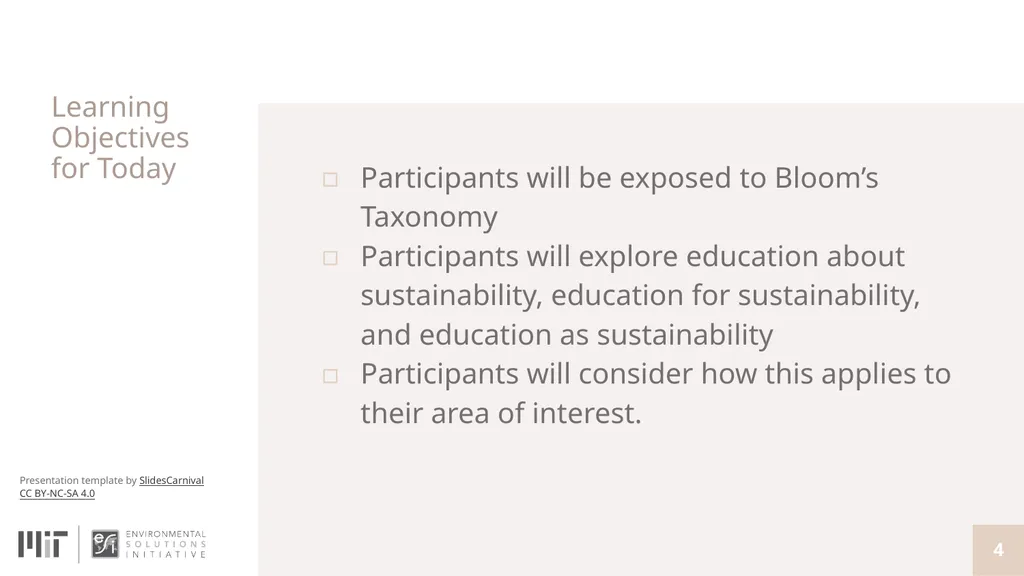
slide4. Learning Objectives for Today Participants will be exposed to Bloom’s Taxonomy
Participants will explore education about sustainability, education for sustainability, and education as sustainability
Participants will consider how this applies to their area of interest. 4<br>
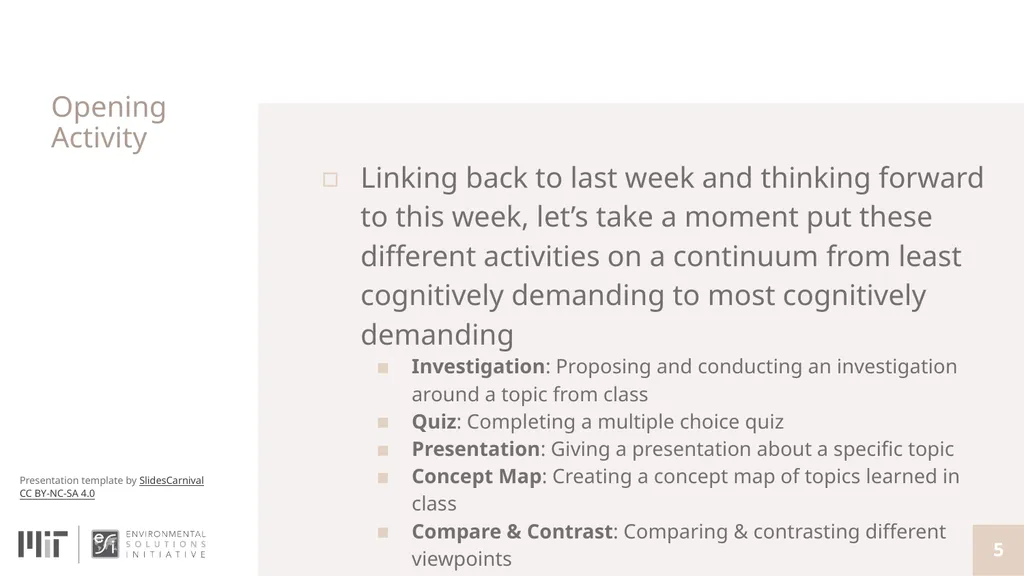
slide5. Linking back to last week and thinking forward to this week, let’s take a moment put these different activities on a continuum from least cognitively demanding to most cognitively demanding
Investigation: Proposing and conducting an investigation around a topic from class
Quiz: Completing a multiple choice quiz
Presentation: Giving a presentation about a specific topic
Concept Map: Creating a concept map of topics learned in class
Compare & Contrast: Comparing & contrasting different viewpoints
Interview: Interviewing someone about a class topic Opening Activity 5<br>
slide6. A quick word on…
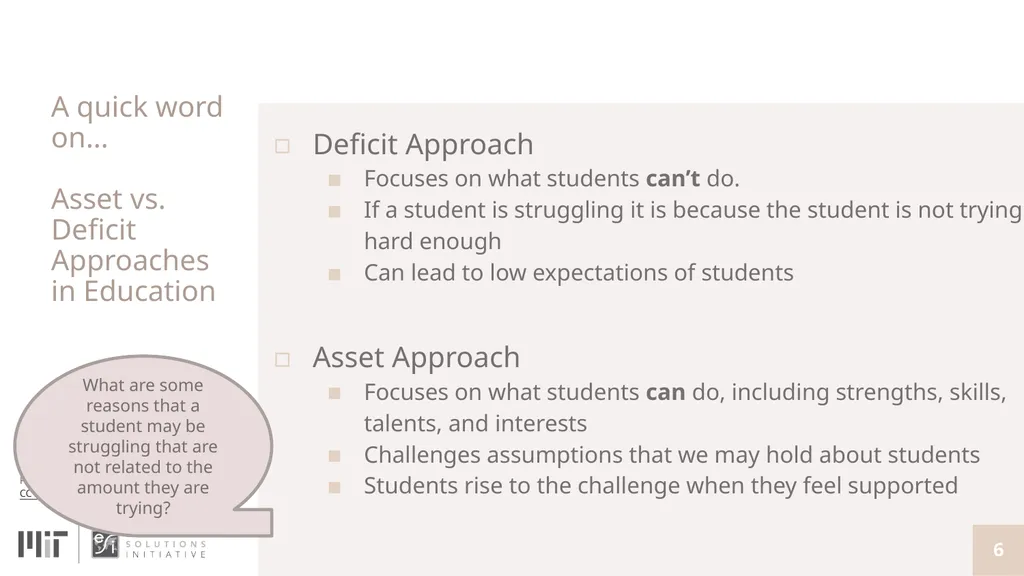
Asset vs. Deficit Approaches in Education Deficit Approach
Focuses on what students can’t do.
If a student is struggling it is because the student is not trying hard enough
Can lead to low expectations of students
Asset Approach
Focuses on what students can do, including strengths, skills, talents, and interests
Challenges assumptions that we may hold about students
Students rise to the challenge when they feel supported 6 What are some reasons that a student may be struggling that are not related to the amount they are trying?<br>
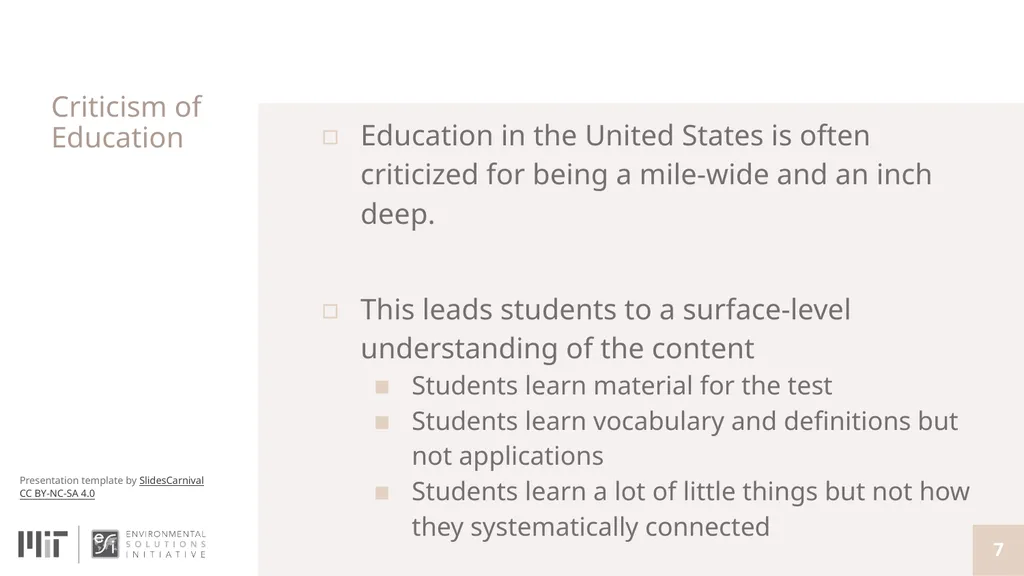
slide7. Criticism of Education Education in the United States is often criticized for being a mile-wide and an inch deep.
This leads students to a surface-level understanding of the content
Students learn material for the test
Students learn vocabulary and definitions but not applications
Students learn a lot of little things but not how they systematically connected 7<br>
slide8. What are our goals? How do we decide what to teach our students?
What are our goals for students?
How demanding and/or attainable are these goals?
How do we support students in achieving these goals? 8<br>
slide9. Bloom’s Taxonomy 1956 - Benjamin Bloom presented a taxonomy that allowed for the classification of the cognitive demand of learning objectives
In theory, students move up each level of the pyramid as they build their understandings and teachers can facilitate this growth 9<br>
slide10. Scaffolding Scaffolding is used to build and provide support to students.
Often the building is from concrete ideas to abstract ideas
This can be done during on multiple scales when you are an instructor
Responding to a student question
Building an idea through a class period
Building to abstract ideas in a course
You can’t just jump into the deep end! 10<br>
slide11. Bloom’s Taxonomy 11 2001 Bloom’s Taxonomy was revised
Replaced nouns with verbs were swapped to better identify the actions at each level
Top two levels are swapped - leading to the application of knowledge into something new as the most important in learning<br>
slide12. Bloom’s Taxonomy If nothing else, Bloom’s Taxonomy gives us a common language to think about how we can increase the rigor or cognitive demand of our lessons with our students.
For many teachers this moves the conversation past rote knowledge into how students are engaging with the information they are learning. 12<br>
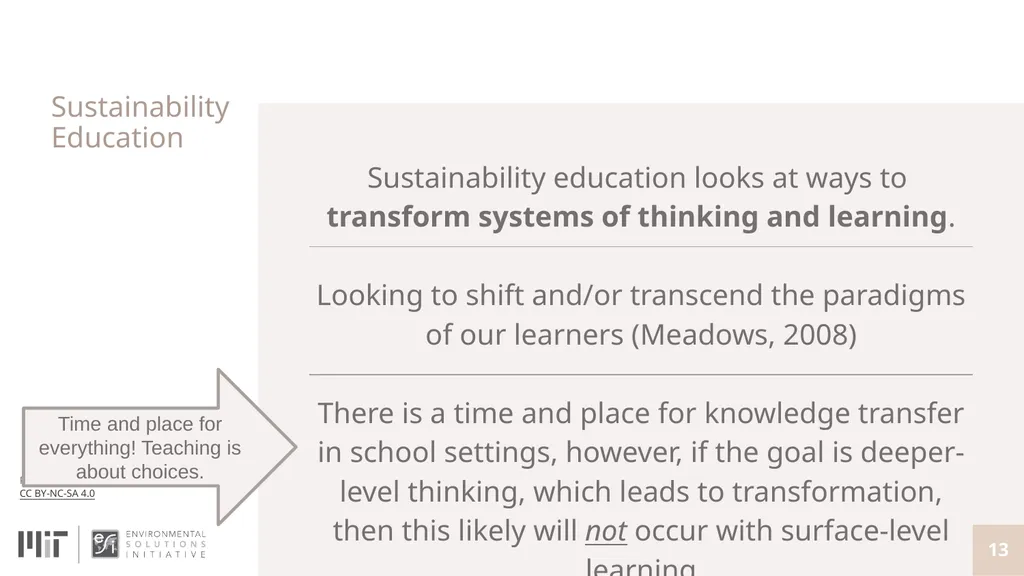
slide13. Sustainability Education 13 Sustainability education looks at ways to
transform systems of thinking and learning.
Looking to shift and/or transcend the paradigms of our learners (Meadows, 2008)
There is a time and place for knowledge transfer in school settings, however, if the goal is deeper-level thinking, which leads to transformation, then this likely will not occur with surface-level learning Time and place for everything! Teaching is about choices.<br>
slide14. Sustainability Education Sustainability Education is no stranger to the conversation about cognitive demand.
Research has pointed to much of sustainability being covered at a surface-level, if at all, in many learning environments (Cortese, 2003; Everett, 2008; Sterling, 2011)
Potter-Nelson Studies 14<br>
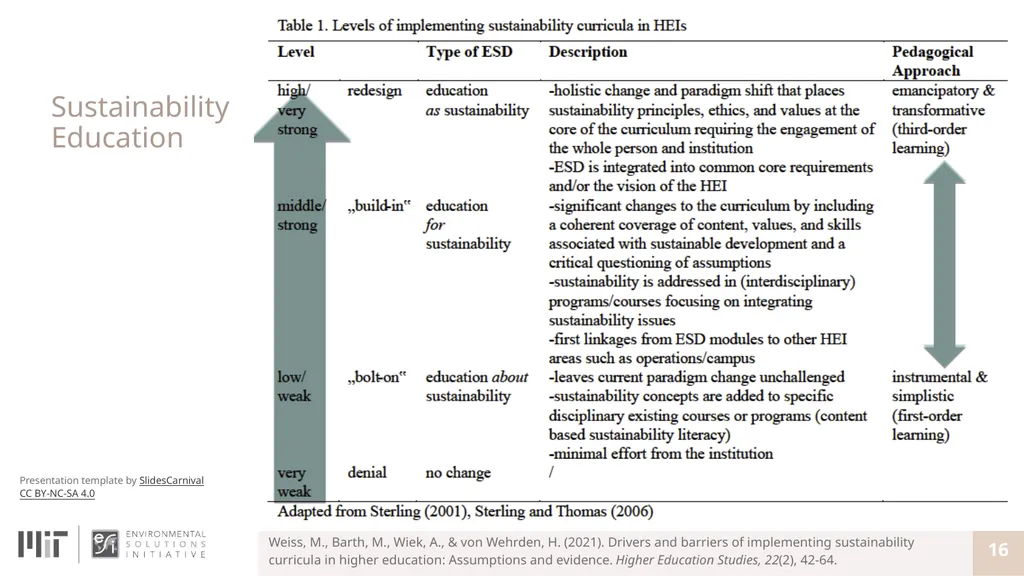
slide15. Sustainability Education Sterling discusses paradigm shifts in the guise of transformative learning experiences using the terms:
First-Order: Change in thinking
Second-Order: Change in Behavior
Third-Order: Epistemological Change 15<br>
slide16. Sustainability Education 16 Weiss, M., Barth, M., Wiek, A., & von Wehrden, H. (2021). Drivers and barriers of implementing sustainability curricula in higher education: Assumptions and evidence. Higher Education Studies, 22(2), 42-64.<br>
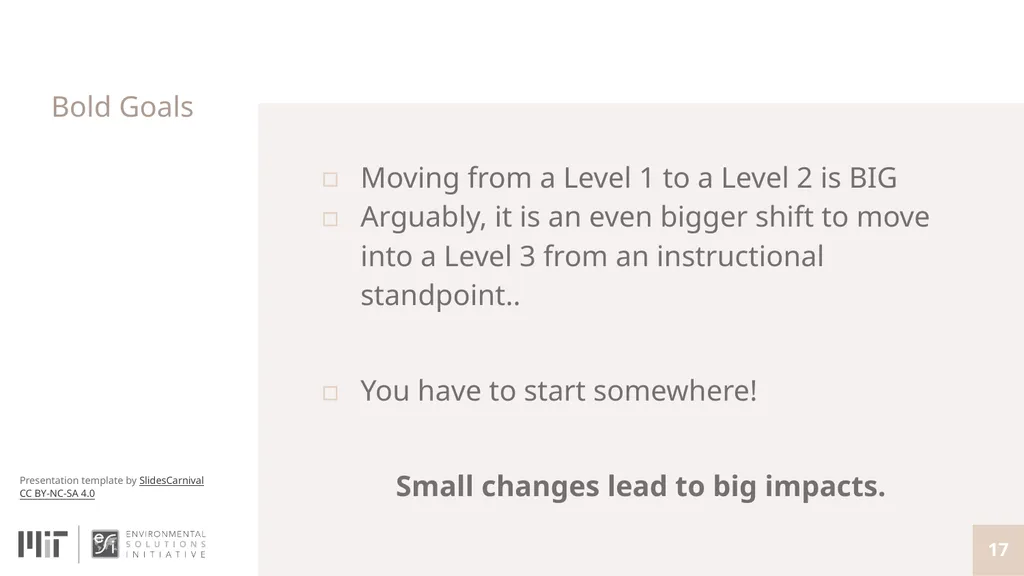
slide17. Bold Goals 17 Moving from a Level 1 to a Level 2 is BIG
Arguably, it is an even bigger shift to move into a Level 3 from an instructional standpoint..
You have to start somewhere!
Small changes lead to big impacts.<br>
slide18. What does this look like in practice?
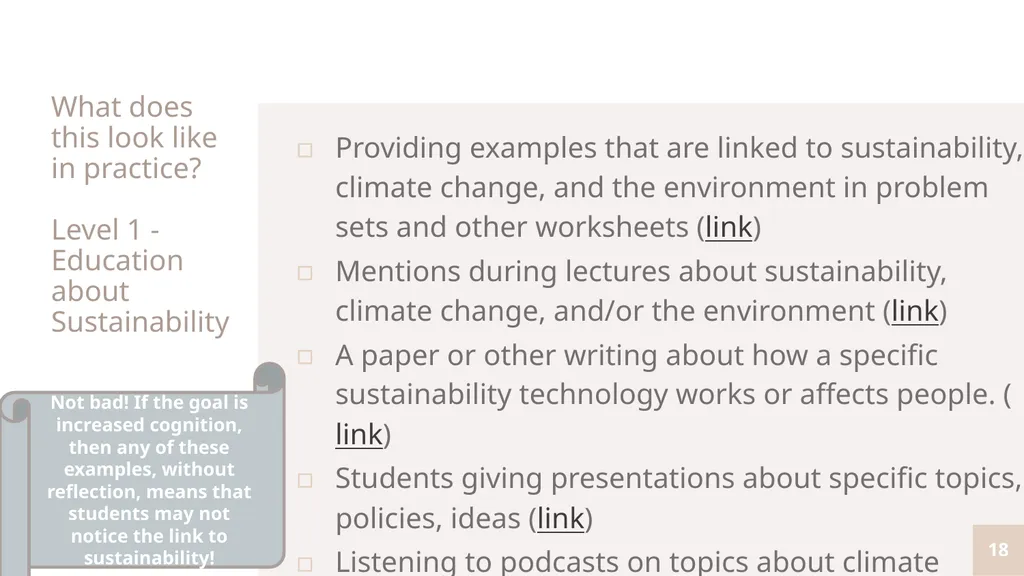
Level 1 - Education about Sustainability Providing examples that are linked to sustainability, climate change, and the environment in problem sets and other worksheets (link)
Mentions during lectures about sustainability, climate change, and/or the environment (link)
A paper or other writing about how a specific sustainability technology works or affects people. (link)
Students giving presentations about specific topics, policies, ideas (link)
Listening to podcasts on topics about climate change, sustainability and/or the environment 18 Not bad! If the goal is increased cognition, then any of these examples, without reflection, means that students may not notice the link to sustainability!<br>
slide19. What does this look like in practice?
Level 2 -
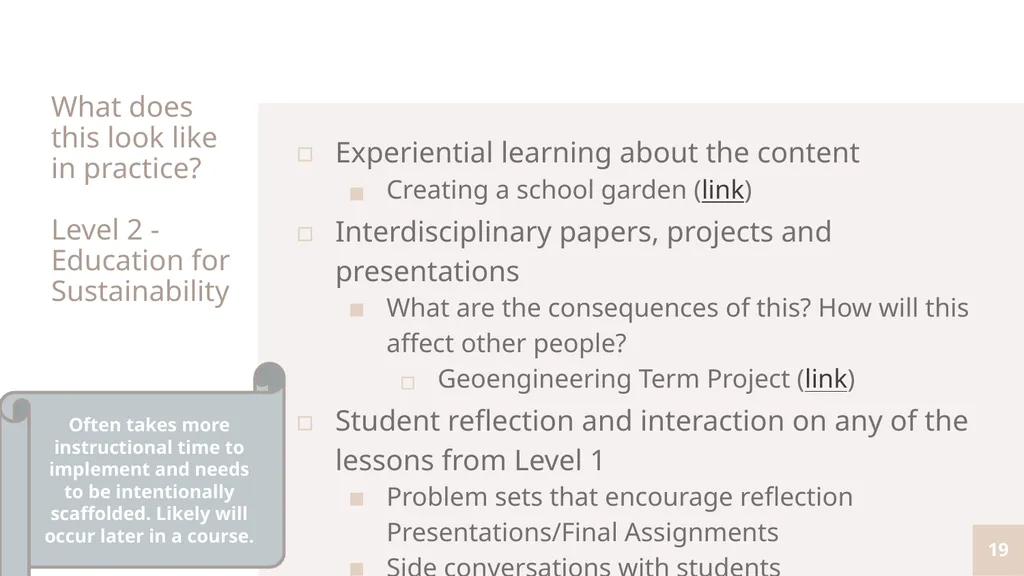
Education for Sustainability Experiential learning about the content
Creating a school garden (link)
Interdisciplinary papers, projects and presentations
What are the consequences of this? How will this affect other people?
Geoengineering Term Project (link)
Student reflection and interaction on any of the lessons from Level 1
Problem sets that encourage reflection Presentations/Final Assignments
Side conversations with students 19 Often takes more instructional time to implement and needs to be intentionally scaffolded. Likely will occur later in a course.<br>
slide20. What does this look like in practice?
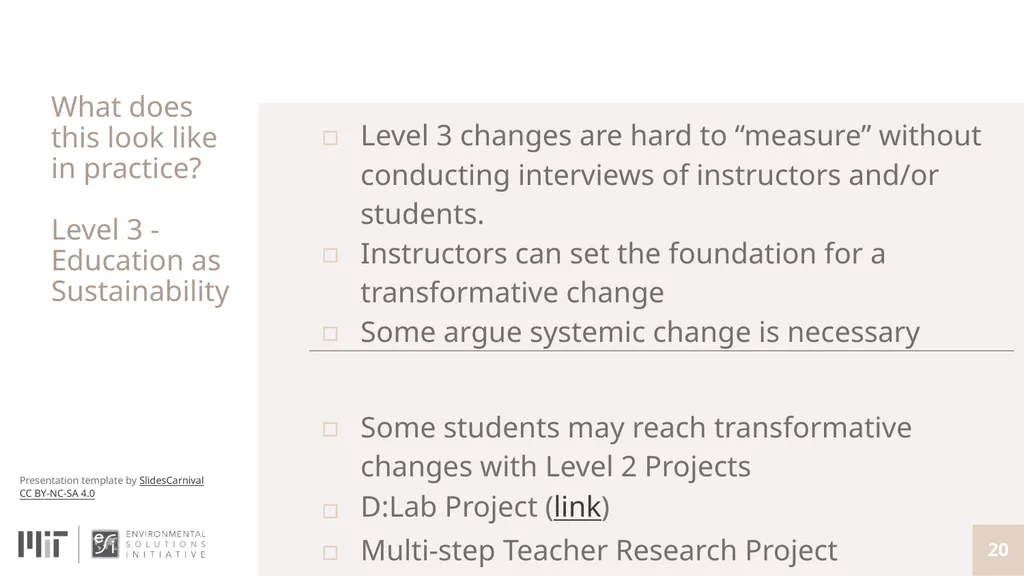
Level 3 -
Education as Sustainability Level 3 changes are hard to “measure” without conducting interviews of instructors and/or students.
Instructors can set the foundation for a transformative change
Some argue systemic change is necessary
Some students may reach transformative changes with Level 2 Projects
D:Lab Project (link)
Multi-step Teacher Research Project
Thermodynamics w/o combustion engines 20<br>
slide21. Transitioning through Sustainability in Classroom Activities 21<br>
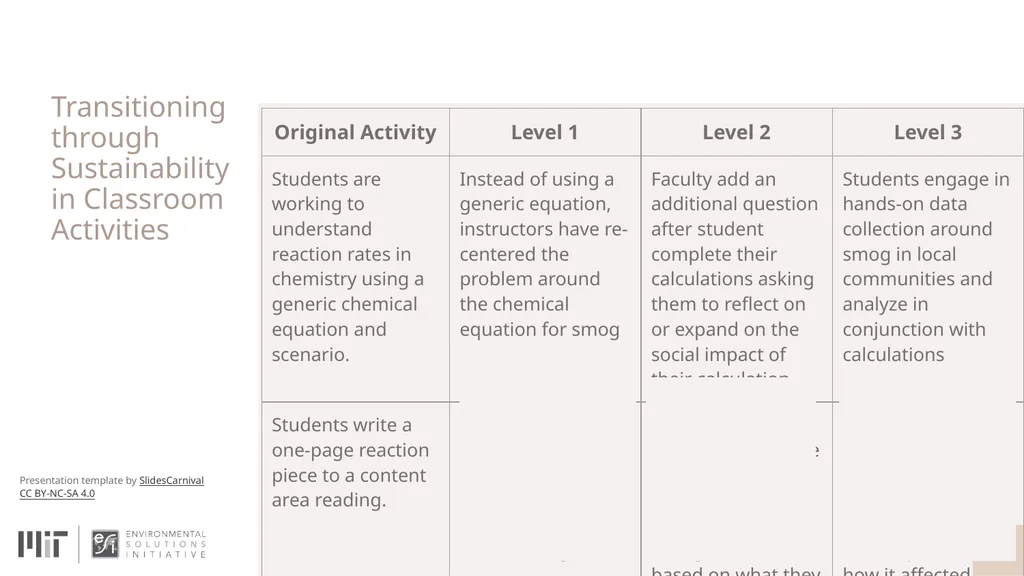
slide22. Transitioning through Sustainability in Classroom Activities 22<br>
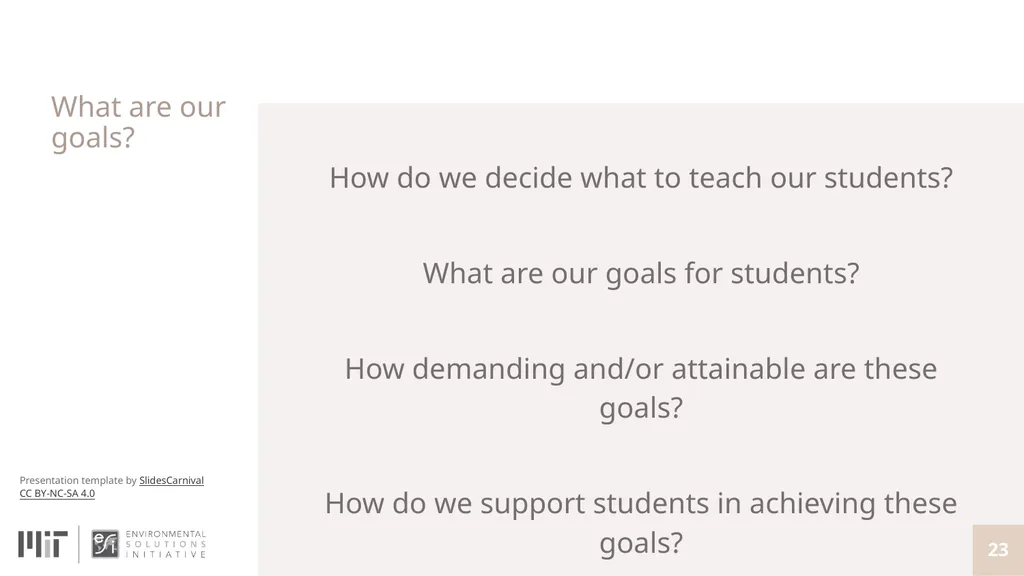
slide23. What are our goals? How do we decide what to teach our students?
What are our goals for students?
How demanding and/or attainable are these goals?
How do we support students in achieving these goals? 23<br>
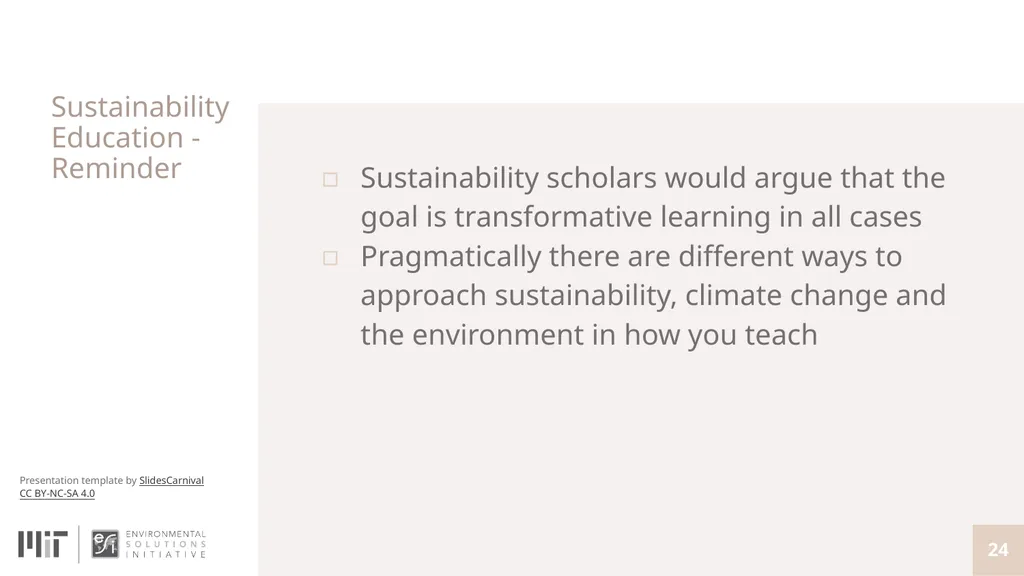
slide24. Sustainability Education - Reminder Sustainability scholars would argue that the goal is transformative learning in all cases
Pragmatically there are different ways to approach sustainability, climate change and the environment in how you teach 24<br>
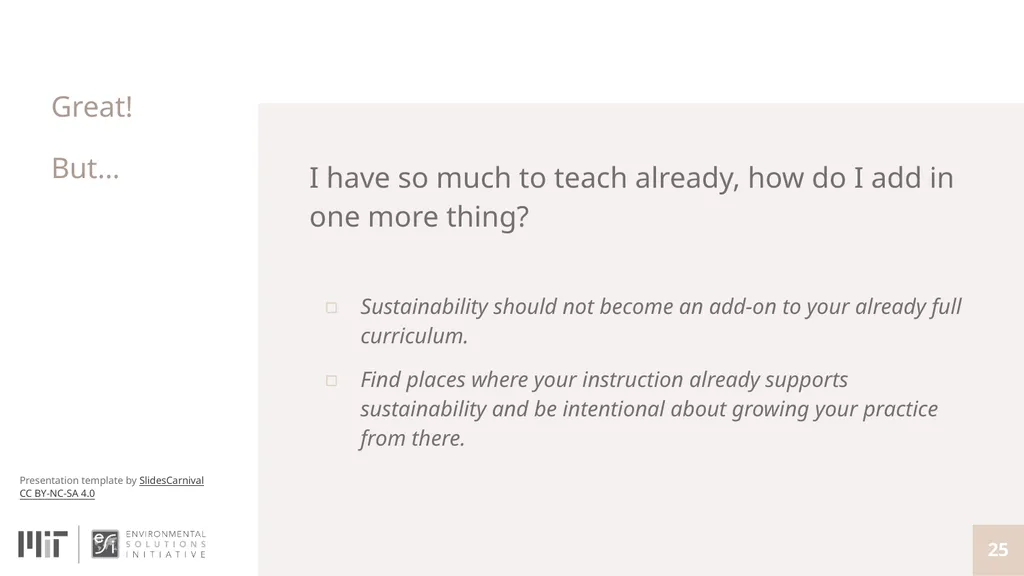
slide25. Great!
But… I have so much to teach already, how do I add in one more thing?
Sustainability should not become an add-on to your already full curriculum.
Find places where your instruction already supports sustainability and be intentional about growing your practice from there. 25<br>
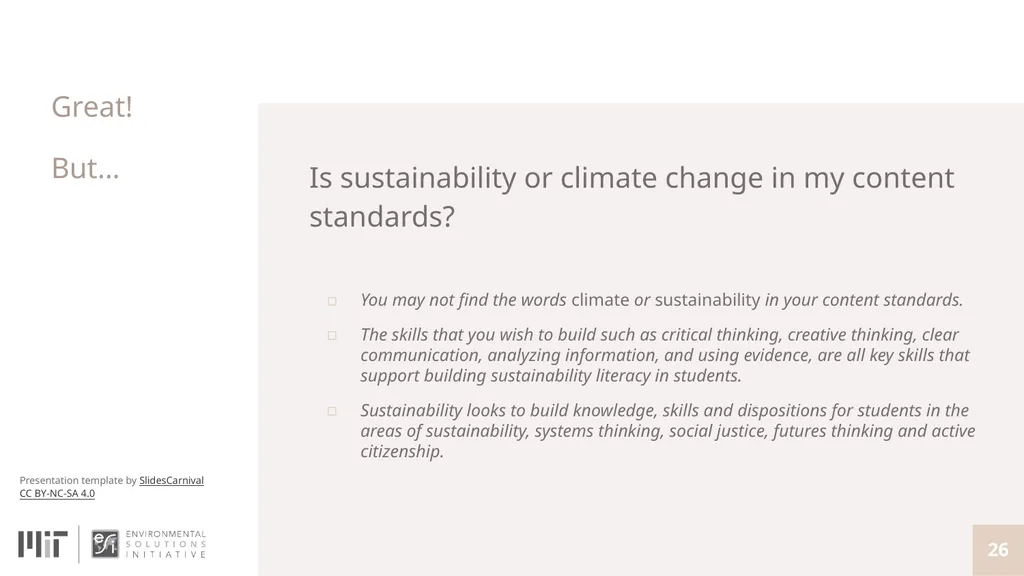
slide26. Great!
But… Is sustainability or climate change in my content standards?
You may not find the words climate or sustainability in your content standards.
The skills that you wish to build such as critical thinking, creative thinking, clear communication, analyzing information, and using evidence, are all key skills that support building sustainability literacy in students.
Sustainability looks to build knowledge, skills and dispositions for students in the areas of sustainability, systems thinking, social justice, futures thinking and active citizenship. 26<br>
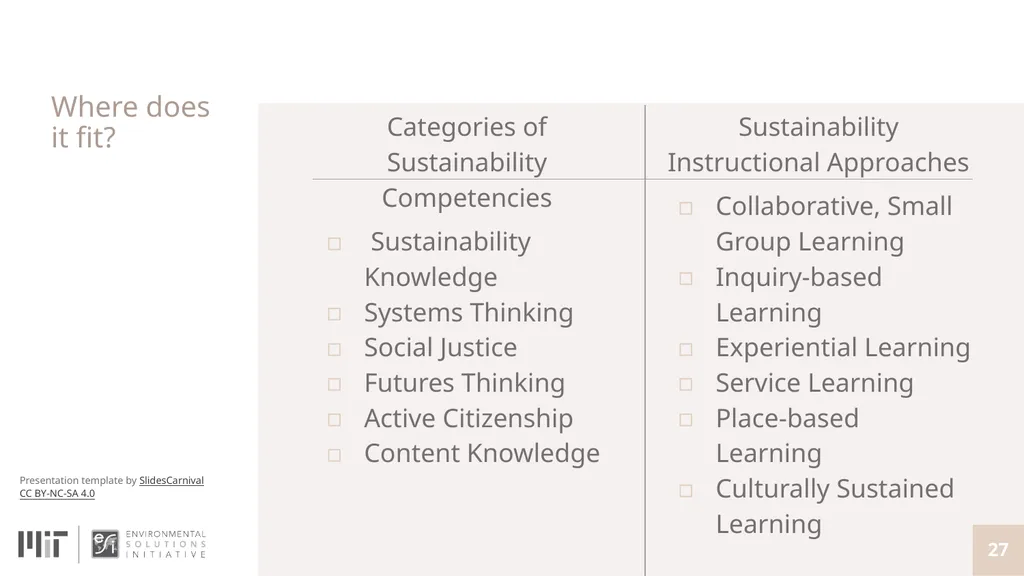
slide27. Where does it fit? Categories of Sustainability Competencies
Sustainability Knowledge
Systems Thinking
Social Justice
Futures Thinking
Active Citizenship
Content Knowledge 27 Sustainability Instructional Approaches
Collaborative, Small Group Learning
Inquiry-based Learning
Experiential Learning
Service Learning
Place-based Learning
Culturally Sustained Learning<br>
slide28. Pause for Pedagogy Padlet
Zoom Questions
What were strengths of these activities?
What were barriers in these activities?
What are ways that we could have more fully embodied sustainability in this lesson? 28<br>
slide29. Articles that address topics from class today:
Weiss, M., Barth, M., Wiek, A., & von Wehrden, H. (2021). Drivers and barriers of implementing sustainability curricula in higher education: Assumptions and evidence. Higher Education Studies, 22(2), 42-64. https://doi.org/10.5539/hes.v11n2p42
Paris, D. (2012). Culturally sustaining pedagogy: A needed change in stance, terminology, and practice. Educational Researcher, 41(3), 93–97. https://doi.org/10.3102/0013189X12441244
Sterling, S. (2011). Transformative learning and sustainability: Sketching the conceptual ground. Learning and Teaching in Higher Education, 5, 17-33. 29 Going Further<br>
slide30. Preview of Next Week Next week please have on hand the resources that you need to (re)vision an activity that you teach or hope to teach to be more sustainable
We’ll go more in detail on the framework
You’ll have time to work and share ideas with each other
You’ll be able to share out what your tentative plan to the large group 30<br>
slide31. Review of Learning Objectives Participants will be exposed to Bloom’s Taxonomy
Participants will explore education about sustainability, education for sustainability, and education as sustainability
Participants will consider how this applies to their area of interest.
What did you learn today?
How will people you interact with know and benefit? 31<br>
slide32. MIT OpenCourseWare
https://ocw.mit.edu
RES.ENV-006 Teaching with Sustainability IAP 2022
For more information about citing these materials or our Terms of Use, visit https://ocw.mit.edu/terms. 32<br>
Instructors:
Liz Potter-Nelson and Sarah Meyers
Environmental Solutions Initiative at MIT<br>
slide2. Week 1 - What is sustainability education?
Defining sustainability using the Brundtland Report & sustainability education
Brief timeline of education to accomplish sustainability initiatives
Explanation of a Jigsaw Activity
Jigsaw activity of foundational sustainability documents Overview of Topics 2 Week 2 - What is effective teaching?
Effective teaching is complex
Learning theories provide a framework for how people learn
Theoretical perspectives used in sustainability education
Sustainability Learning Approaches
Positivism vs Postpositivism
Positivism and Postpositivism Activity
Practicality of Sustainability Education Week 3 - How do we teach sustainably?
Asset vs Deficit Approaches
Criticism of US Education
Bloom’s Taxonomy
Sustainability education looks to paradigm shifts
Levels of implementing sustainability
Level 1, Level 2, Level 3
Transitioning through Sustainability Levels Week 4 - What does this look like for me?
Explanation of Categories of Sustainability Literacy Competencies
Explanation of Sustainable Instructional Approaches
Overview of Understand by Design (UbD)
Modified UbD template
Sticking Points<br>
slide3. How do we teach sustainably? Week 3<br>
slide4. Learning Objectives for Today Participants will be exposed to Bloom’s Taxonomy
Participants will explore education about sustainability, education for sustainability, and education as sustainability
Participants will consider how this applies to their area of interest. 4<br>
slide5. Linking back to last week and thinking forward to this week, let’s take a moment put these different activities on a continuum from least cognitively demanding to most cognitively demanding
Investigation: Proposing and conducting an investigation around a topic from class
Quiz: Completing a multiple choice quiz
Presentation: Giving a presentation about a specific topic
Concept Map: Creating a concept map of topics learned in class
Compare & Contrast: Comparing & contrasting different viewpoints
Interview: Interviewing someone about a class topic Opening Activity 5<br>
slide6. A quick word on…
Asset vs. Deficit Approaches in Education Deficit Approach
Focuses on what students can’t do.
If a student is struggling it is because the student is not trying hard enough
Can lead to low expectations of students
Asset Approach
Focuses on what students can do, including strengths, skills, talents, and interests
Challenges assumptions that we may hold about students
Students rise to the challenge when they feel supported 6 What are some reasons that a student may be struggling that are not related to the amount they are trying?<br>
slide7. Criticism of Education Education in the United States is often criticized for being a mile-wide and an inch deep.
This leads students to a surface-level understanding of the content
Students learn material for the test
Students learn vocabulary and definitions but not applications
Students learn a lot of little things but not how they systematically connected 7<br>
slide8. What are our goals? How do we decide what to teach our students?
What are our goals for students?
How demanding and/or attainable are these goals?
How do we support students in achieving these goals? 8<br>
slide9. Bloom’s Taxonomy 1956 - Benjamin Bloom presented a taxonomy that allowed for the classification of the cognitive demand of learning objectives
In theory, students move up each level of the pyramid as they build their understandings and teachers can facilitate this growth 9<br>
slide10. Scaffolding Scaffolding is used to build and provide support to students.
Often the building is from concrete ideas to abstract ideas
This can be done during on multiple scales when you are an instructor
Responding to a student question
Building an idea through a class period
Building to abstract ideas in a course
You can’t just jump into the deep end! 10<br>
slide11. Bloom’s Taxonomy 11 2001 Bloom’s Taxonomy was revised
Replaced nouns with verbs were swapped to better identify the actions at each level
Top two levels are swapped - leading to the application of knowledge into something new as the most important in learning<br>
slide12. Bloom’s Taxonomy If nothing else, Bloom’s Taxonomy gives us a common language to think about how we can increase the rigor or cognitive demand of our lessons with our students.
For many teachers this moves the conversation past rote knowledge into how students are engaging with the information they are learning. 12<br>
slide13. Sustainability Education 13 Sustainability education looks at ways to
transform systems of thinking and learning.
Looking to shift and/or transcend the paradigms of our learners (Meadows, 2008)
There is a time and place for knowledge transfer in school settings, however, if the goal is deeper-level thinking, which leads to transformation, then this likely will not occur with surface-level learning Time and place for everything! Teaching is about choices.<br>
slide14. Sustainability Education Sustainability Education is no stranger to the conversation about cognitive demand.
Research has pointed to much of sustainability being covered at a surface-level, if at all, in many learning environments (Cortese, 2003; Everett, 2008; Sterling, 2011)
Potter-Nelson Studies 14<br>
slide15. Sustainability Education Sterling discusses paradigm shifts in the guise of transformative learning experiences using the terms:
First-Order: Change in thinking
Second-Order: Change in Behavior
Third-Order: Epistemological Change 15<br>
slide16. Sustainability Education 16 Weiss, M., Barth, M., Wiek, A., & von Wehrden, H. (2021). Drivers and barriers of implementing sustainability curricula in higher education: Assumptions and evidence. Higher Education Studies, 22(2), 42-64.<br>
slide17. Bold Goals 17 Moving from a Level 1 to a Level 2 is BIG
Arguably, it is an even bigger shift to move into a Level 3 from an instructional standpoint..
You have to start somewhere!
Small changes lead to big impacts.<br>
slide18. What does this look like in practice?
Level 1 - Education about Sustainability Providing examples that are linked to sustainability, climate change, and the environment in problem sets and other worksheets (link)
Mentions during lectures about sustainability, climate change, and/or the environment (link)
A paper or other writing about how a specific sustainability technology works or affects people. (link)
Students giving presentations about specific topics, policies, ideas (link)
Listening to podcasts on topics about climate change, sustainability and/or the environment 18 Not bad! If the goal is increased cognition, then any of these examples, without reflection, means that students may not notice the link to sustainability!<br>
slide19. What does this look like in practice?
Level 2 -
Education for Sustainability Experiential learning about the content
Creating a school garden (link)
Interdisciplinary papers, projects and presentations
What are the consequences of this? How will this affect other people?
Geoengineering Term Project (link)
Student reflection and interaction on any of the lessons from Level 1
Problem sets that encourage reflection Presentations/Final Assignments
Side conversations with students 19 Often takes more instructional time to implement and needs to be intentionally scaffolded. Likely will occur later in a course.<br>
slide20. What does this look like in practice?
Level 3 -
Education as Sustainability Level 3 changes are hard to “measure” without conducting interviews of instructors and/or students.
Instructors can set the foundation for a transformative change
Some argue systemic change is necessary
Some students may reach transformative changes with Level 2 Projects
D:Lab Project (link)
Multi-step Teacher Research Project
Thermodynamics w/o combustion engines 20<br>
slide21. Transitioning through Sustainability in Classroom Activities 21<br>
slide22. Transitioning through Sustainability in Classroom Activities 22<br>
slide23. What are our goals? How do we decide what to teach our students?
What are our goals for students?
How demanding and/or attainable are these goals?
How do we support students in achieving these goals? 23<br>
slide24. Sustainability Education - Reminder Sustainability scholars would argue that the goal is transformative learning in all cases
Pragmatically there are different ways to approach sustainability, climate change and the environment in how you teach 24<br>
slide25. Great!
But… I have so much to teach already, how do I add in one more thing?
Sustainability should not become an add-on to your already full curriculum.
Find places where your instruction already supports sustainability and be intentional about growing your practice from there. 25<br>
slide26. Great!
But… Is sustainability or climate change in my content standards?
You may not find the words climate or sustainability in your content standards.
The skills that you wish to build such as critical thinking, creative thinking, clear communication, analyzing information, and using evidence, are all key skills that support building sustainability literacy in students.
Sustainability looks to build knowledge, skills and dispositions for students in the areas of sustainability, systems thinking, social justice, futures thinking and active citizenship. 26<br>
slide27. Where does it fit? Categories of Sustainability Competencies
Sustainability Knowledge
Systems Thinking
Social Justice
Futures Thinking
Active Citizenship
Content Knowledge 27 Sustainability Instructional Approaches
Collaborative, Small Group Learning
Inquiry-based Learning
Experiential Learning
Service Learning
Place-based Learning
Culturally Sustained Learning<br>
slide28. Pause for Pedagogy Padlet
Zoom Questions
What were strengths of these activities?
What were barriers in these activities?
What are ways that we could have more fully embodied sustainability in this lesson? 28<br>
slide29. Articles that address topics from class today:
Weiss, M., Barth, M., Wiek, A., & von Wehrden, H. (2021). Drivers and barriers of implementing sustainability curricula in higher education: Assumptions and evidence. Higher Education Studies, 22(2), 42-64. https://doi.org/10.5539/hes.v11n2p42
Paris, D. (2012). Culturally sustaining pedagogy: A needed change in stance, terminology, and practice. Educational Researcher, 41(3), 93–97. https://doi.org/10.3102/0013189X12441244
Sterling, S. (2011). Transformative learning and sustainability: Sketching the conceptual ground. Learning and Teaching in Higher Education, 5, 17-33. 29 Going Further<br>
slide30. Preview of Next Week Next week please have on hand the resources that you need to (re)vision an activity that you teach or hope to teach to be more sustainable
We’ll go more in detail on the framework
You’ll have time to work and share ideas with each other
You’ll be able to share out what your tentative plan to the large group 30<br>
slide31. Review of Learning Objectives Participants will be exposed to Bloom’s Taxonomy
Participants will explore education about sustainability, education for sustainability, and education as sustainability
Participants will consider how this applies to their area of interest.
What did you learn today?
How will people you interact with know and benefit? 31<br>
slide32. MIT OpenCourseWare
https://ocw.mit.edu
RES.ENV-006 Teaching with Sustainability IAP 2022
For more information about citing these materials or our Terms of Use, visit https://ocw.mit.edu/terms. 32<br>