
Terrorism Response and Disaster Management CHAPTER
LS
Published · 58 slides · 0 views
1 / 1

Description
Terrorism Response and Disaster Management CHAPTER 42: Focused Lecture National EMS Education Standard Competencies EMS Operations Knowledge of operational roles and responsibilities to ensure patient, public, and personnel safety
Related Topics
Share
Embed code
Download this presentation From Below
"Terrorism Response and Disaster Management CHAPTER" is the property of its rightful owner. Permission is granted to download and print the materials on this website for personal, non-commercial use only, and to display it on your personal computer provided you do not modify the materials and that you retain all copyright notices contained in the materials. By downloading content from our website, you accept the terms of this agreement.
Presentation Transcript
01
Terrorism Response and Disaster Management CHAPTER 42: Focused Lecture<br>
02
National EMS Education Standard Competencies EMS Operations
Knowledge of operational roles and responsibilities to ensure patient, public, and personnel safety
Mass-Casualty Incidents Due to Terrorism and Disaster
Risks and responsibilities of operating on the scene of a natural or man-made disaster.<br>
Knowledge of operational roles and responsibilities to ensure patient, public, and personnel safety
Mass-Casualty Incidents Due to Terrorism and Disaster
Risks and responsibilities of operating on the scene of a natural or man-made disaster.<br>
03
Introduction It is difficult to plan and anticipate a response to many terrorist events.
Several key principles apply to every response.
Terrorists pose a threat to nations and cultures everywhere.<br>
Several key principles apply to every response.
Terrorists pose a threat to nations and cultures everywhere.<br>
04
What Is Terrorism? (1 of 2) US Department of Justice defines terrorism with these points:
Involves violent acts or acts dangerous to human life that violate federal or state law
Intended to:
Intimidate or coerce a civilian population
Influence the policy of a government
Affect the conduct of a government<br>
Involves violent acts or acts dangerous to human life that violate federal or state law
Intended to:
Intimidate or coerce a civilian population
Influence the policy of a government
Affect the conduct of a government<br>
05
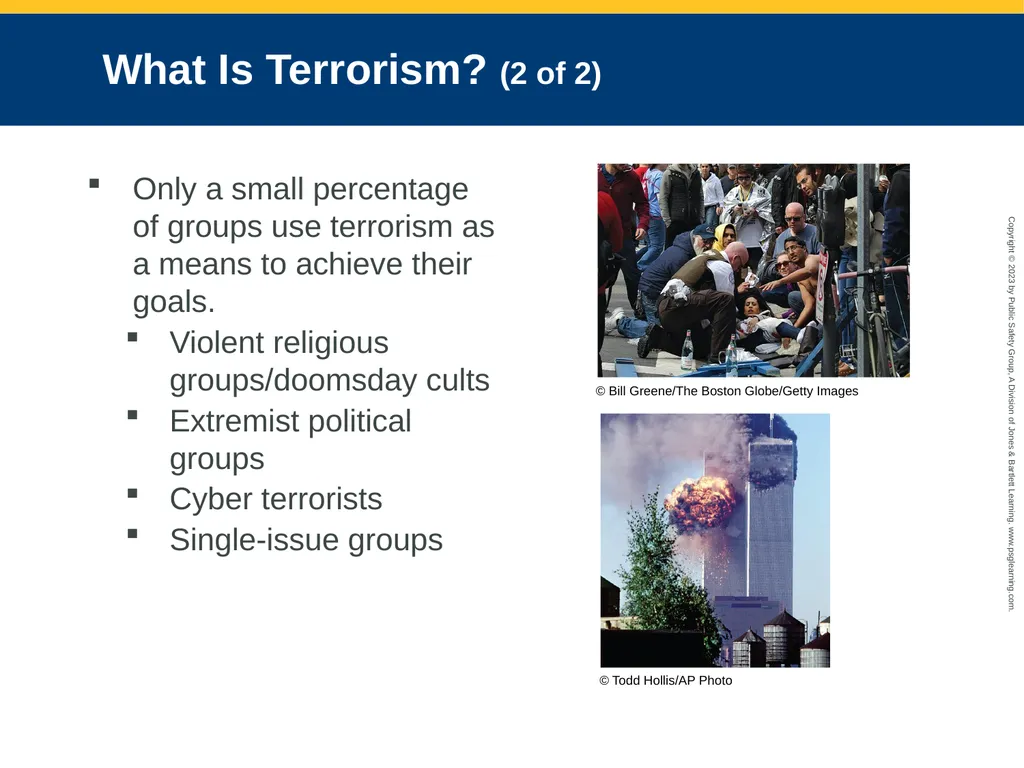
What Is Terrorism? (2 of 2) Only a small percentage of groups use terrorism as a means to achieve their goals.
Violent religious groups/doomsday cults
Extremist political groups
Cyber terrorists
Single-issue groups © Bill Greene/The Boston Globe/Getty Images © Todd Hollis/AP Photo<br>
Violent religious groups/doomsday cults
Extremist political groups
Cyber terrorists
Single-issue groups © Bill Greene/The Boston Globe/Getty Images © Todd Hollis/AP Photo<br>
06
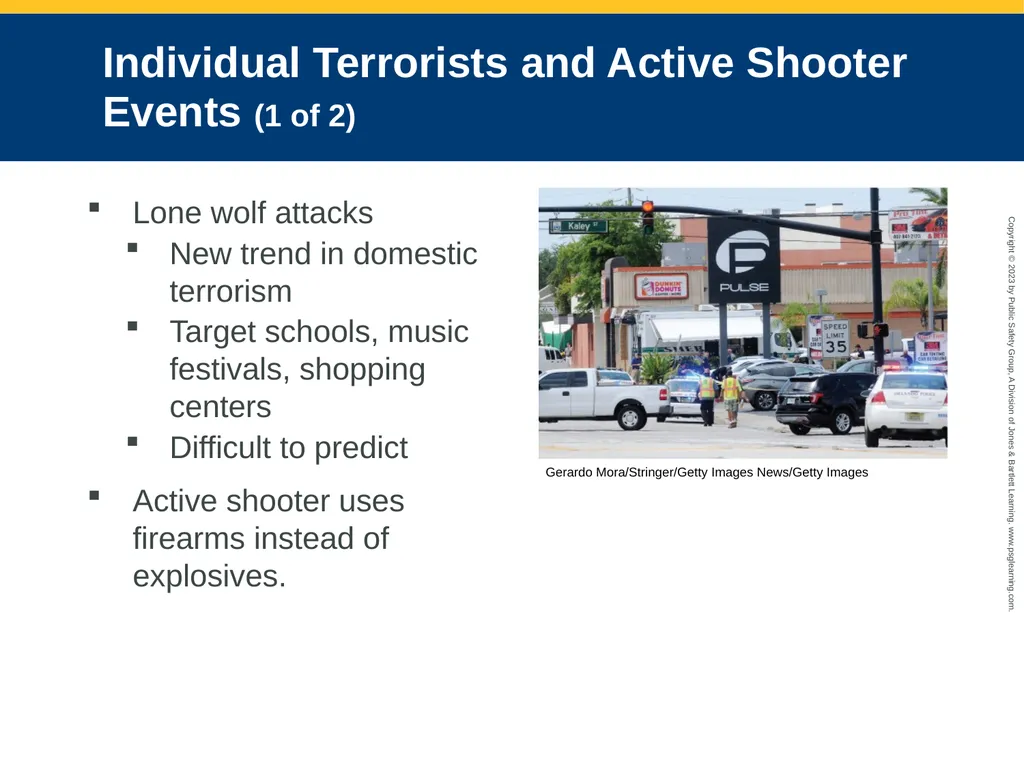
Individual Terrorists and Active Shooter Events (1 of 2) Lone wolf attacks
New trend in domestic terrorism
Target schools, music festivals, shopping centers
Difficult to predict
Active shooter uses firearms instead of explosives. Gerardo Mora/Stringer/Getty Images News/Getty Images<br>
New trend in domestic terrorism
Target schools, music festivals, shopping centers
Difficult to predict
Active shooter uses firearms instead of explosives. Gerardo Mora/Stringer/Getty Images News/Getty Images<br>
07
Individual Terrorists and Active Shooter Events (2 of 2) Hartford Consensus recommendations:
Use THREAT mnemonic.
Immediate responders
Early hemorrhage control
Rescue Task Force: Incorporates EMS crews with law enforcement<br>
Use THREAT mnemonic.
Immediate responders
Early hemorrhage control
Rescue Task Force: Incorporates EMS crews with law enforcement<br>
08
Weapons of Mass Destruction (1 of 4) Any agent designed to bring about:
Mass death
Casualties
Massive damage to property and infrastructure
Types
B-NICE
CBRNE<br>
Mass death
Casualties
Massive damage to property and infrastructure
Types
B-NICE
CBRNE<br>
09
Weapons of Mass Destruction (2 of 4) Terrorist groups have favored tactics that use explosive devices.
Truck bombs or pedestrian suicide bombers
Attempts to use chemical or biologic weapons have been unsuccessful
WMDs are relatively easy to obtain or create.<br>
Truck bombs or pedestrian suicide bombers
Attempts to use chemical or biologic weapons have been unsuccessful
WMDs are relatively easy to obtain or create.<br>
10
Weapons of Mass Destruction (3 of 4) Chemical terrorism/warfare
Chemical agents: Manufactured substances that can have devastating effects on living organisms
Vesicants (blister agents)
Respiratory agents (choking agents)
Nerve agents
Metabolic agents (cyanides)<br>
Chemical agents: Manufactured substances that can have devastating effects on living organisms
Vesicants (blister agents)
Respiratory agents (choking agents)
Nerve agents
Metabolic agents (cyanides)<br>
11
Weapons of Mass Destruction (4 of 4) Biologic terrorism/warfare
Biologic agents cause disease
Viruses
Bacteria
Toxins
Radiologic/nuclear terrorism
Materials/waste are easier for a terrorist to acquire and require less expertise to use.<br>
Biologic agents cause disease
Viruses
Bacteria
Toxins
Radiologic/nuclear terrorism
Materials/waste are easier for a terrorist to acquire and require less expertise to use.<br>
12
Recognizing a Terrorist Event (1 of 2) Most acts of terror are covert.
Be aware of your surroundings and understand possible risks for terrorism.
Know current threat level issued by the federal government.
Know the information sent out by the NTAS.<br>
Be aware of your surroundings and understand possible risks for terrorism.
Know current threat level issued by the federal government.
Know the information sent out by the NTAS.<br>
13
Recognizing a Terrorist Event (2 of 2) To determine the potential for a terrorist attack:
Type of location
Type of call
Number of patients
Patients’ statements
Preincident indicators<br>
Type of location
Type of call
Number of patients
Patients’ statements
Preincident indicators<br>
14
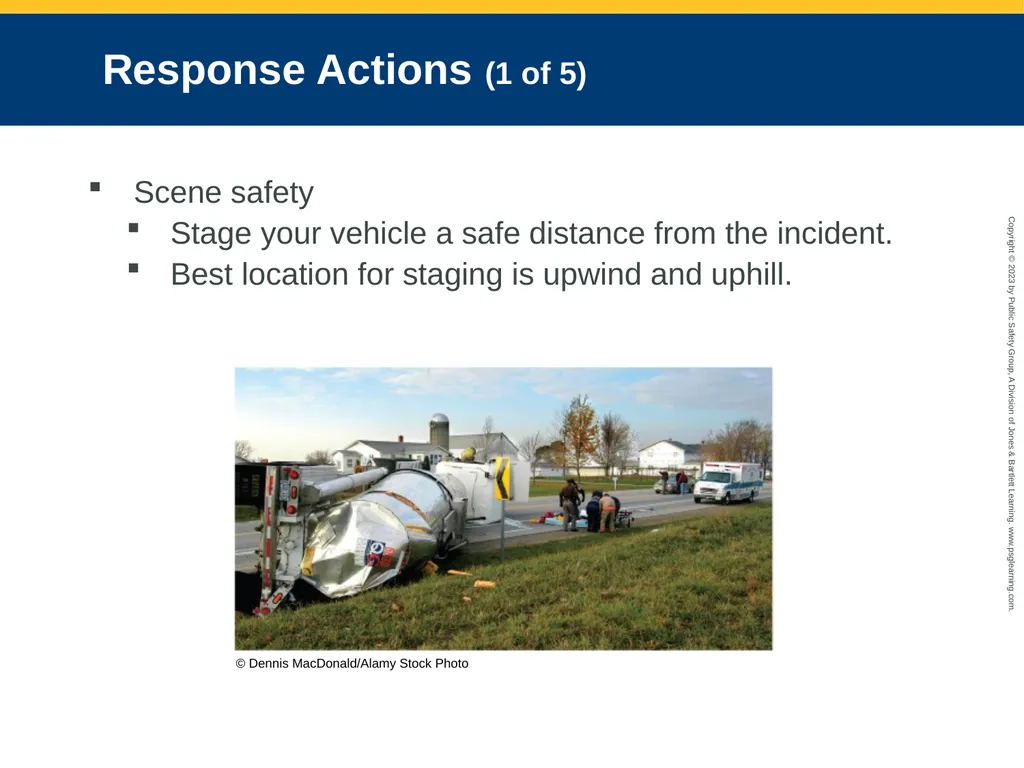
Response Actions (1 of 5) Scene safety
Stage your vehicle a safe distance from the incident.
Best location for staging is upwind and uphill. © Dennis MacDonald/Alamy Stock Photo<br>
Stage your vehicle a safe distance from the incident.
Best location for staging is upwind and uphill. © Dennis MacDonald/Alamy Stock Photo<br>
15
Response Actions (2 of 5) Failure to park your vehicle at a safe location can place you and your partner in danger.
Always make an escape plan beforehand.
If your vehicle is blocked in by other emergency vehicles or damaged by a secondary device or event, you will be unable to help.
Responder safety (personnel protection)
Keep yourself from coming in contact with agent.
Greatest threats are contamination and cross-contamination.<br>
16
Response Actions (3 of 5) Notification procedures
Inform dispatch of:
Nature of the event
Any additional resources that may be required
Estimated number of patients
Upwind or optimal route of approach
Establish a staging area.
Call for specialized units early.
Keep in mind that there may be more than one type of device or agent present.<br>
Inform dispatch of:
Nature of the event
Any additional resources that may be required
Estimated number of patients
Upwind or optimal route of approach
Establish a staging area.
Call for specialized units early.
Keep in mind that there may be more than one type of device or agent present.<br>
17
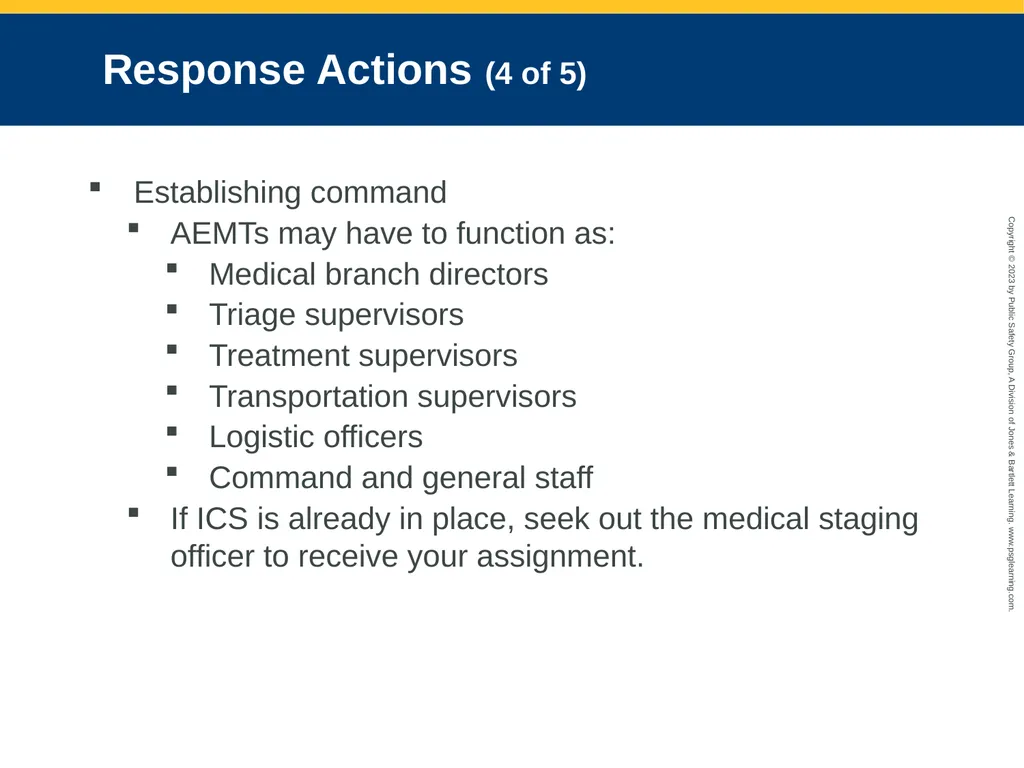
Response Actions (4 of 5) Establishing command
AEMTs may have to function as:
Medical branch directors
Triage supervisors
Treatment supervisors
Transportation supervisors
Logistic officers
Command and general staff
If ICS is already in place, seek out the medical staging officer to receive your assignment.<br>
AEMTs may have to function as:
Medical branch directors
Triage supervisors
Treatment supervisors
Transportation supervisors
Logistic officers
Command and general staff
If ICS is already in place, seek out the medical staging officer to receive your assignment.<br>
18
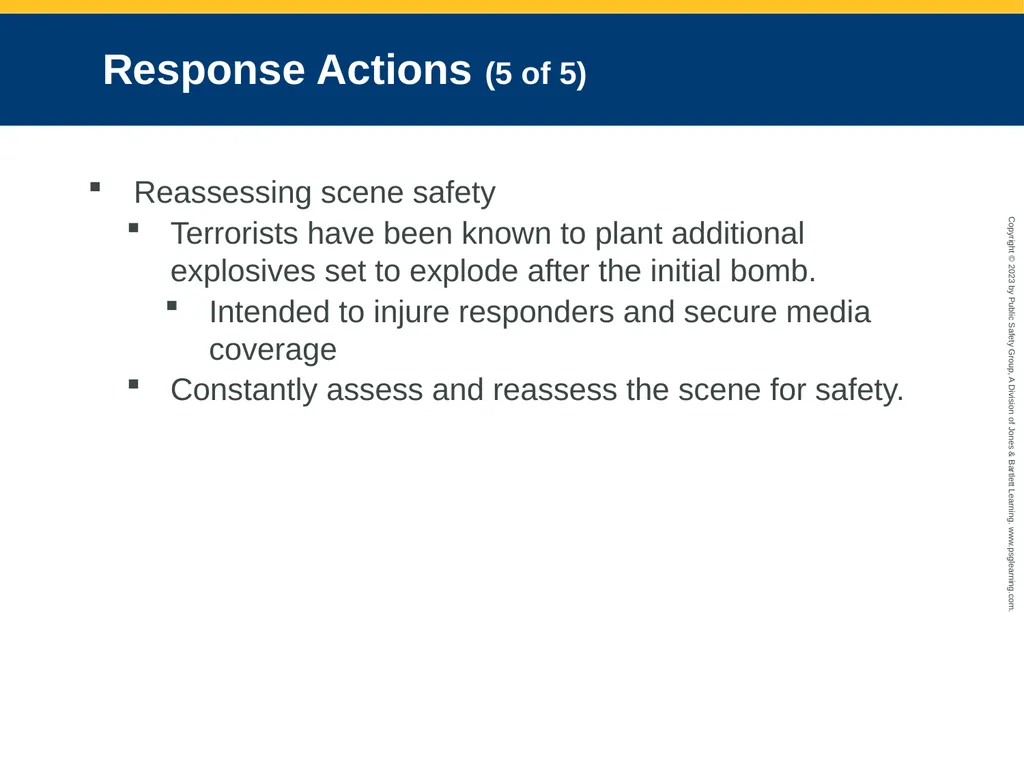
Response Actions (5 of 5) Reassessing scene safety
Terrorists have been known to plant additional explosives set to explode after the initial bomb.
Intended to injure responders and secure media coverage
Constantly assess and reassess the scene for safety.<br>
Terrorists have been known to plant additional explosives set to explode after the initial bomb.
Intended to injure responders and secure media coverage
Constantly assess and reassess the scene for safety.<br>
19
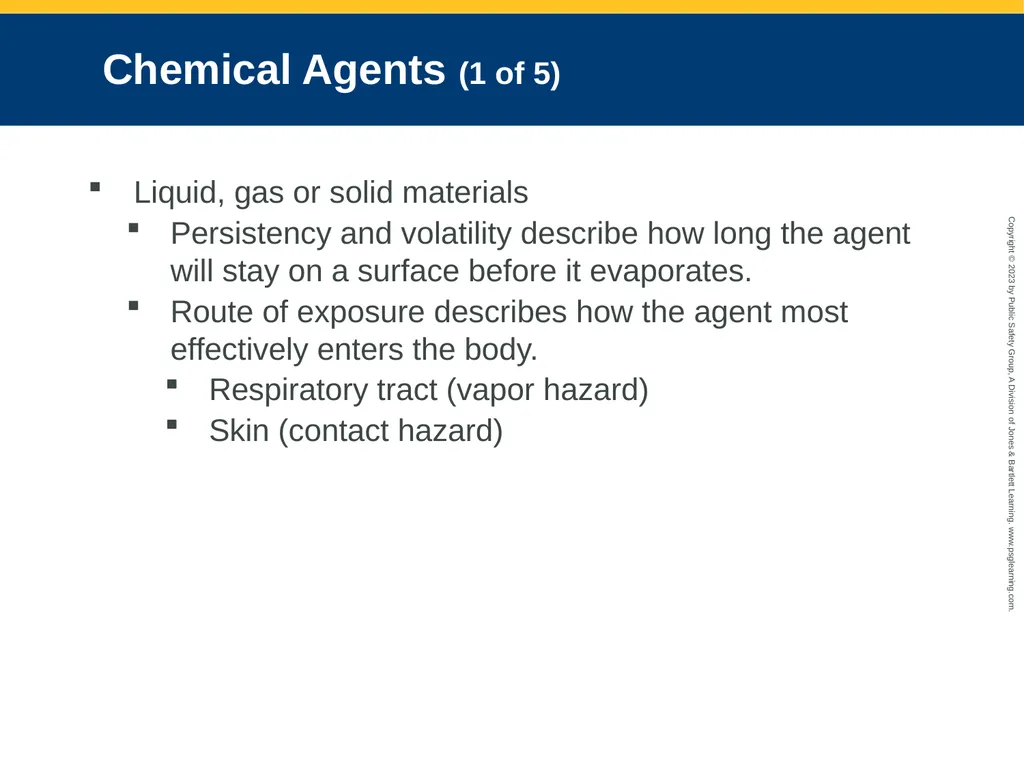
Chemical Agents (1 of 5) Liquid, gas or solid materials
Persistency and volatility describe how long the agent will stay on a surface before it evaporates.
Route of exposure describes how the agent most effectively enters the body.
Respiratory tract (vapor hazard)
Skin (contact hazard)<br>
Persistency and volatility describe how long the agent will stay on a surface before it evaporates.
Route of exposure describes how the agent most effectively enters the body.
Respiratory tract (vapor hazard)
Skin (contact hazard)<br>
20
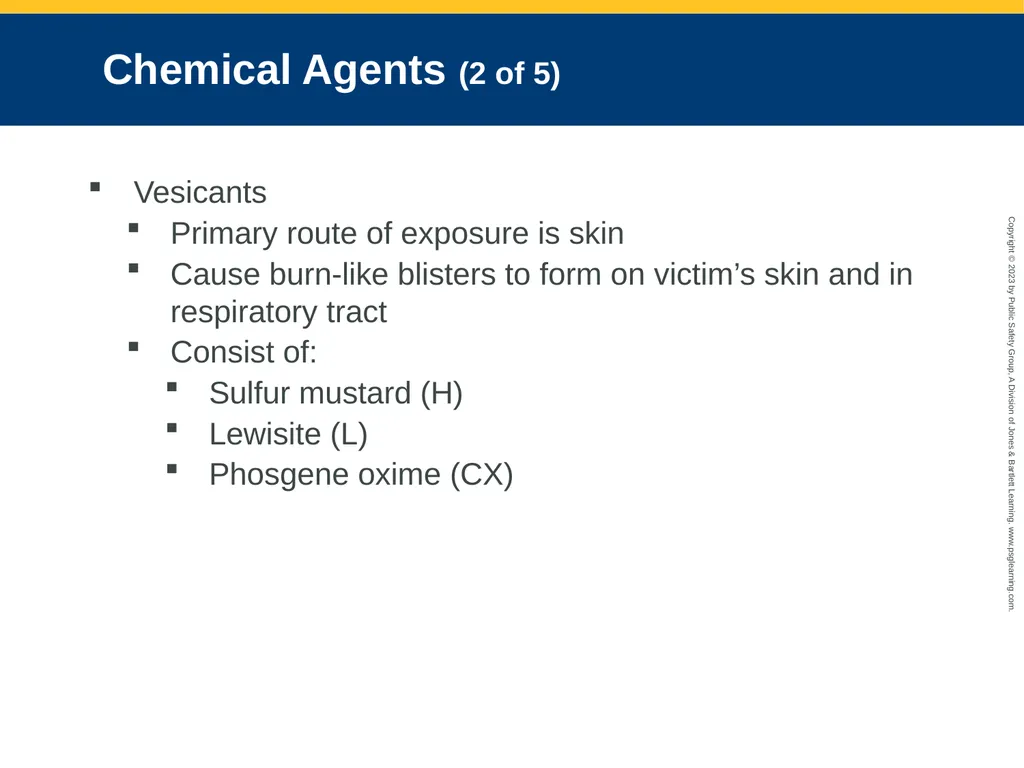
Chemical Agents (2 of 5) Vesicants
Primary route of exposure is skin
Cause burn-like blisters to form on victim’s skin and in respiratory tract
Consist of:
Sulfur mustard (H)
Lewisite (L)
Phosgene oxime (CX)<br>
Primary route of exposure is skin
Cause burn-like blisters to form on victim’s skin and in respiratory tract
Consist of:
Sulfur mustard (H)
Lewisite (L)
Phosgene oxime (CX)<br>
21
Chemical Agents (3 of 5) Signs of exposure:
Skin irritation, burning, and reddening
Immediate, intense skin pain
Formation of large blisters
Gray discoloration of the skin
Swollen and closed or irritated eyes
Permanent eye injury
If vapors were inhaled:
Hoarseness and stridor, severe cough, hemoptysis, severe dyspnea<br>
Skin irritation, burning, and reddening
Immediate, intense skin pain
Formation of large blisters
Gray discoloration of the skin
Swollen and closed or irritated eyes
Permanent eye injury
If vapors were inhaled:
Hoarseness and stridor, severe cough, hemoptysis, severe dyspnea<br>
22
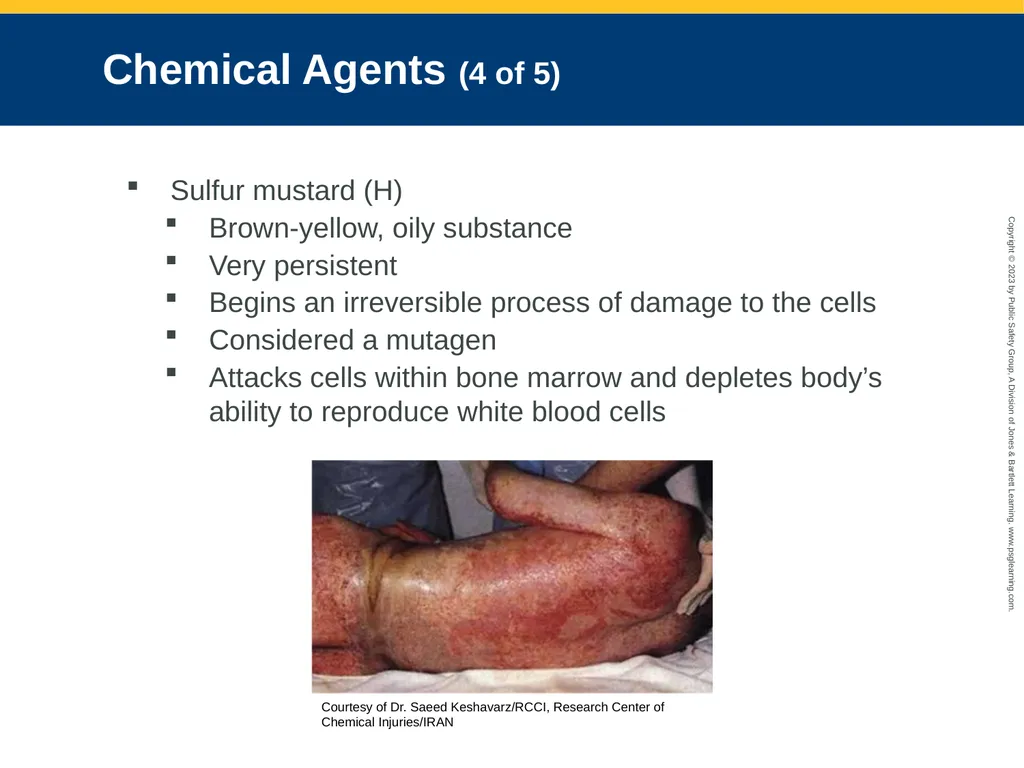
Chemical Agents (4 of 5) Sulfur mustard (H)
Brown-yellow, oily substance
Very persistent
Begins an irreversible process of damage to the cells
Considered a mutagen
Attacks cells within bone marrow and depletes body’s ability to reproduce white blood cells Courtesy of Dr. Saeed Keshavarz/RCCI, Research Center of Chemical Injuries/IRAN<br>
Brown-yellow, oily substance
Very persistent
Begins an irreversible process of damage to the cells
Considered a mutagen
Attacks cells within bone marrow and depletes body’s ability to reproduce white blood cells Courtesy of Dr. Saeed Keshavarz/RCCI, Research Center of Chemical Injuries/IRAN<br>
23
Chemical Agents (5 of 5) Lewisite (L) and phosgene oxime (CX)
Produce immediate intense pain and discomfort
Patient’s skin may have gray discoloration.
Tissue damage also occurs.
Vesicant agent treatment
No antidotes available for H or CX exposure
Ensure that the patient has been decontaminated before the treatment is initiated.
Gain IV access and initiate transport as soon as possible.<br>
24
Respiratory Agents (1 of 4) Gases that cause immediate harm
Primary route of exposure is through respiratory tract.
Damage lung tissue and fluid leaks into the lungs
Produce respiratory-related symptoms:
Dyspnea
Tachypnea
Pulmonary edema<br>
Primary route of exposure is through respiratory tract.
Damage lung tissue and fluid leaks into the lungs
Produce respiratory-related symptoms:
Dyspnea
Tachypnea
Pulmonary edema<br>
25
Respiratory Agents (2 of 4) Chlorine (Cl)
Initially it produces upper airway irritation and a choking sensation
Patient may later experience:
Shortness of breath
Chest tightness
Hoarseness and stridor
Gasping and coughing
Serious exposures leads to pulmonary edema, complete airway constriction, and/or death.<br>
Initially it produces upper airway irritation and a choking sensation
Patient may later experience:
Shortness of breath
Chest tightness
Hoarseness and stridor
Gasping and coughing
Serious exposures leads to pulmonary edema, complete airway constriction, and/or death.<br>
26
Respiratory Agents (3 of 4) Phosgene
Very potent agent with has a delayed onset of symptoms
Initially, a mild exposure may result in:
Nausea
Chest tightness
Severe cough
Dyspnea on exertion
Severe exposure may cause dyspnea at rest and excessive pulmonary edema.<br>
Very potent agent with has a delayed onset of symptoms
Initially, a mild exposure may result in:
Nausea
Chest tightness
Severe cough
Dyspnea on exertion
Severe exposure may cause dyspnea at rest and excessive pulmonary edema.<br>
27
Respiratory Agents (4 of 4) Treatment
Remove the patient from the contaminated atmosphere.
Primary goals:
Manage the ABCs.
Gain IV access.
Allow the patient to rest in a position of comfort with the head elevated.
Initiate prompt transport.<br>
Remove the patient from the contaminated atmosphere.
Primary goals:
Manage the ABCs.
Gain IV access.
Allow the patient to rest in a position of comfort with the head elevated.
Initiate prompt transport.<br>
28
Nerve Agents (1 of 4) Extremely toxic and rapidly fatal
Organophosphates cause organs to become overstimulated and burn out.
G agents came from the early nerve agents
Sarin (GB)
Highly volatile colorless and odorless liquid
Highly lethal with an LD50 of about one drop
Contact and inhalation hazard<br>
Organophosphates cause organs to become overstimulated and burn out.
G agents came from the early nerve agents
Sarin (GB)
Highly volatile colorless and odorless liquid
Highly lethal with an LD50 of about one drop
Contact and inhalation hazard<br>
29
Nerve Agents (2 of 4) Soman (GD)
Twice as persistent as GB and five times as lethal
Contact and inhalation hazard
Binds to the cells and attacks faster than any other agent
Tabun (GA)
One-half as lethal as GB and 36 times more persistent
Components used to manufacture it are easy to acquire and the agent is easy to manufacture.
Contact and inhalation hazard<br>
30
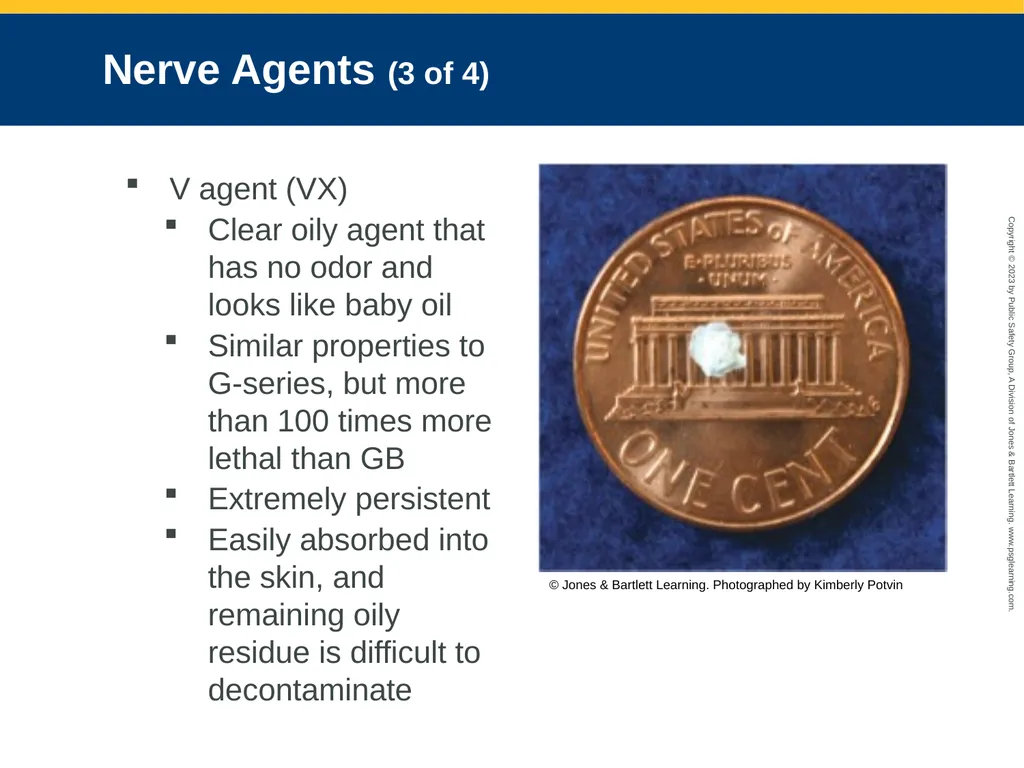
Nerve Agents (3 of 4) V agent (VX)
Clear oily agent that has no odor and looks like baby oil
Similar properties to G-series, but more than 100 times more lethal than GB
Extremely persistent
Easily absorbed into the skin, and remaining oily residue is difficult to decontaminate © Jones & Bartlett Learning. Photographed by Kimberly Potvin<br>
31
Nerve Agents (4 of 4) Produce similar symptoms but have varying routes of entry
Symptoms: SLUDGEM and DUMBELS
Nerve agent treatment
Provide airway and ventilatory support.
Antidote Treatment Nerve Agent Auto-Injector (ATNAA)<br>
Symptoms: SLUDGEM and DUMBELS
Nerve agent treatment
Provide airway and ventilatory support.
Antidote Treatment Nerve Agent Auto-Injector (ATNAA)<br>
32
Metabolic Agents (1 of 3) Hydrogen cyanide (AC) and cyanogen chloride (CK) affect body’s ability to use oxygen
Kill within seconds to minutes
In low doses, result in dizziness, light-headedness, headache, and vomiting.<br>
Kill within seconds to minutes
In low doses, result in dizziness, light-headedness, headache, and vomiting.<br>
33
Metabolic Agents (2 of 3) Higher doses lead to:
Shortness of breath and gasping respirations
Respiratory distress or arrest
Tachypnea
Flushed skin
Tachycardia
Altered mental status
Seizures
Coma
Apnea
Cardiac arrest<br>
Shortness of breath and gasping respirations
Respiratory distress or arrest
Tachypnea
Flushed skin
Tachycardia
Altered mental status
Seizures
Coma
Apnea
Cardiac arrest<br>
34
Metabolic Agents (3 of 3) Treatment
Several medications act as antidotes.
All the patient’s clothes must be removed to prevent off-gassing.
Support ABCs and gain IV access.
Severe exposure will require aggressive oxygenation and ventilation.<br>
Several medications act as antidotes.
All the patient’s clothes must be removed to prevent off-gassing.
Support ABCs and gain IV access.
Severe exposure will require aggressive oxygenation and ventilation.<br>
35
Biologic Agents Viruses, bacteria, and neurotoxins spread in various ways
Dissemination: Means by the agent is spread
Disease vector: Animal that spreads disease
Communicability: How easily the disease can be spread.
Incubation period: Time between the person becoming exposed to the agent and appearance of first symptom(s)<br>
Dissemination: Means by the agent is spread
Disease vector: Animal that spreads disease
Communicability: How easily the disease can be spread.
Incubation period: Time between the person becoming exposed to the agent and appearance of first symptom(s)<br>
36
Viruses (1 of 4) Require a living host to multiply and survive
Move from host to host by direct methods or through vectors
Vector: Agent that acts as a carrier
Some viral agents have vaccines.<br>
Move from host to host by direct methods or through vectors
Vector: Agent that acts as a carrier
Some viral agents have vaccines.<br>
37
Viruses (2 of 4) COVID-19 (coronavirus disease)
Virus mutated and caused worldwide pandemic
To prevent further spread, countries instituted:
Quarantine
Stay-at-home orders
Closure of all nonessential businesses
Health care workers were faced with protecting themselves while caring for critically ill patients.<br>
Virus mutated and caused worldwide pandemic
To prevent further spread, countries instituted:
Quarantine
Stay-at-home orders
Closure of all nonessential businesses
Health care workers were faced with protecting themselves while caring for critically ill patients.<br>
38
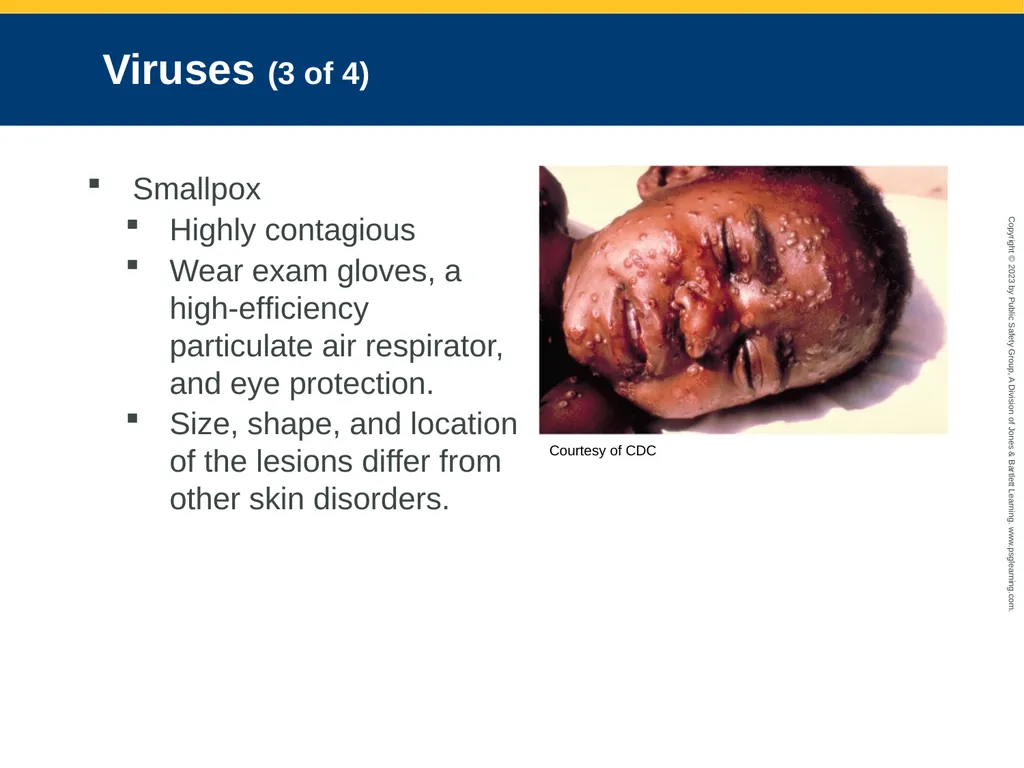
Viruses (3 of 4) Smallpox
Highly contagious
Wear exam gloves, a high-efficiency particulate air respirator, and eye protection.
Size, shape, and location of the lesions differ from other skin disorders. Courtesy of CDC<br>
Highly contagious
Wear exam gloves, a high-efficiency particulate air respirator, and eye protection.
Size, shape, and location of the lesions differ from other skin disorders. Courtesy of CDC<br>
39
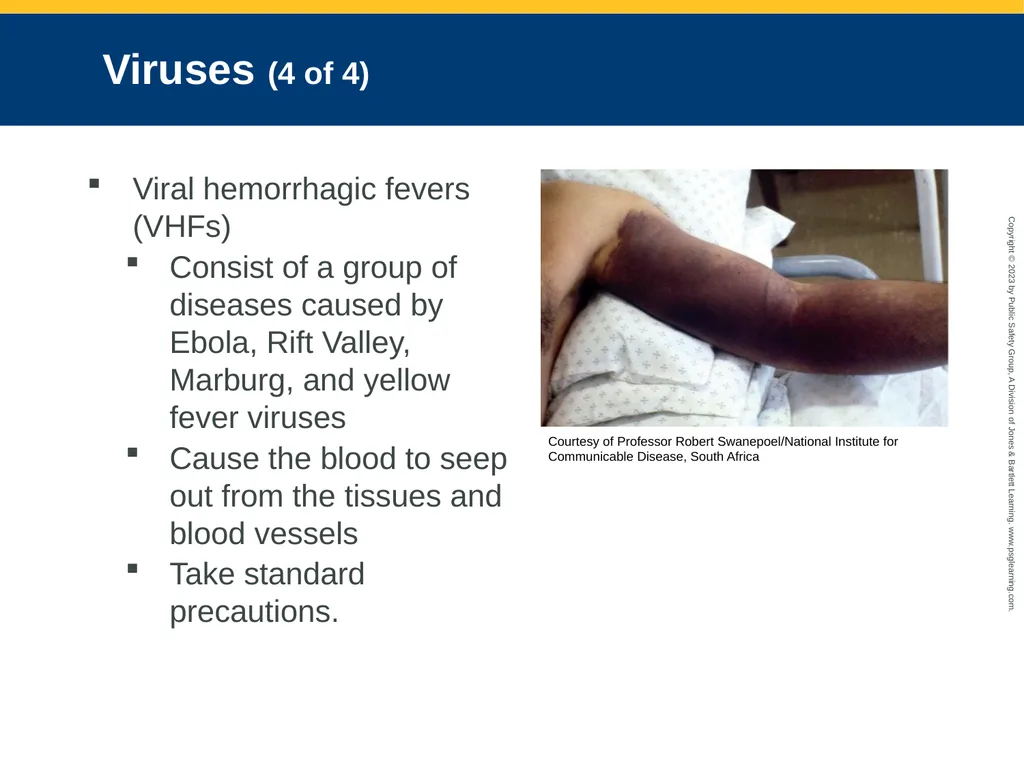
Viruses (4 of 4) Viral hemorrhagic fevers (VHFs)
Consist of a group of diseases caused by Ebola, Rift Valley, Marburg, and yellow fever viruses
Cause the blood to seep out from the tissues and blood vessels
Take standard precautions. Courtesy of Professor Robert Swanepoel/National Institute for Communicable Disease, South Africa<br>
Consist of a group of diseases caused by Ebola, Rift Valley, Marburg, and yellow fever viruses
Cause the blood to seep out from the tissues and blood vessels
Take standard precautions. Courtesy of Professor Robert Swanepoel/National Institute for Communicable Disease, South Africa<br>
40
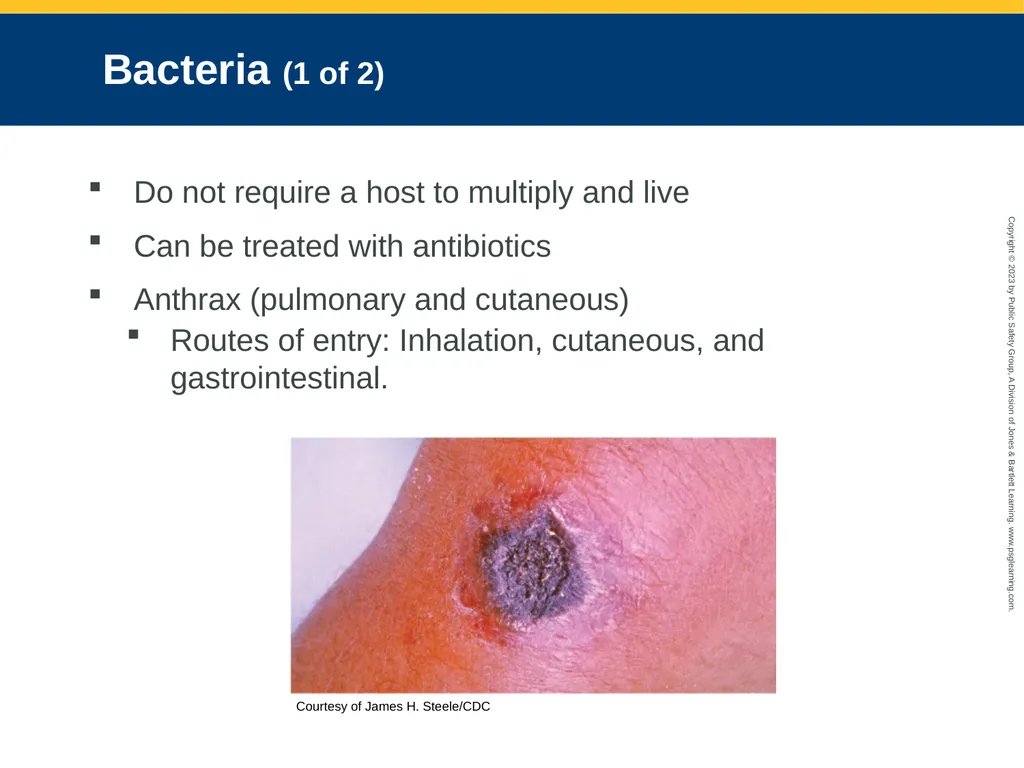
Bacteria (1 of 2) Do not require a host to multiply and live
Can be treated with antibiotics
Anthrax (pulmonary and cutaneous)
Routes of entry: Inhalation, cutaneous, and gastrointestinal. Courtesy of James H. Steele/CDC<br>
Can be treated with antibiotics
Anthrax (pulmonary and cutaneous)
Routes of entry: Inhalation, cutaneous, and gastrointestinal. Courtesy of James H. Steele/CDC<br>
41
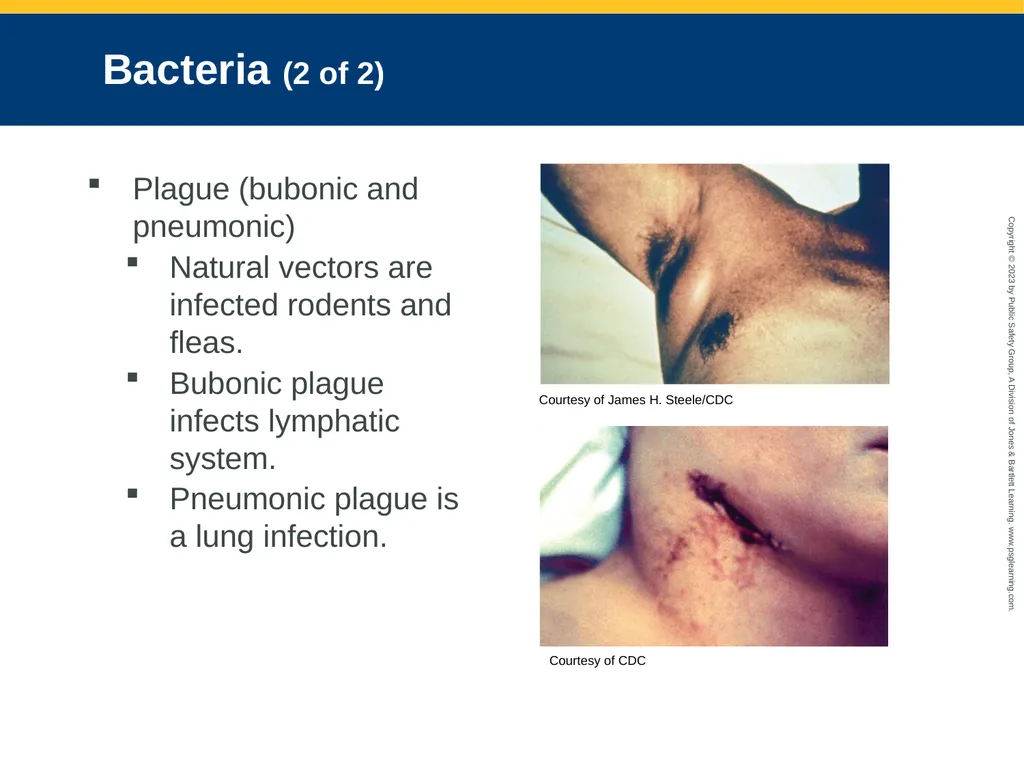
Bacteria (2 of 2) Plague (bubonic and pneumonic)
Natural vectors are infected rodents and fleas.
Bubonic plague infects lymphatic system.
Pneumonic plague is a lung infection. Courtesy of James H. Steele/CDC Courtesy of CDC<br>
Natural vectors are infected rodents and fleas.
Bubonic plague infects lymphatic system.
Pneumonic plague is a lung infection. Courtesy of James H. Steele/CDC Courtesy of CDC<br>
42
Neurotoxins (1 of 2) Produced from plants, marine animals, molds, and bacteria
Not contagious and have a faster onset of symptoms
Botulinum toxin: Most potent neurotoxin
Affects the nervous system’s ability to function
Voluntary muscle control diminishes.
Eventually causes muscle paralysis.
Leads to respiratory arrest<br>
Not contagious and have a faster onset of symptoms
Botulinum toxin: Most potent neurotoxin
Affects the nervous system’s ability to function
Voluntary muscle control diminishes.
Eventually causes muscle paralysis.
Leads to respiratory arrest<br>
43
Neurotoxins (2 of 2) Ricin
Five times more lethal than VX
Causes pulmonary edema and respiratory and circulatory failure
Presents different signs and symptoms for ingestion and inhalation
Treatment is supportive.<br>
Five times more lethal than VX
Causes pulmonary edema and respiratory and circulatory failure
Presents different signs and symptoms for ingestion and inhalation
Treatment is supportive.<br>
44
Roles of the AEMT During a Biologic Event (1 of 2) Syndromic surveillance
Monitoring of patients presenting to emergency departments and alternative care facilities
Recording of EMS call volume
Monitoring the use of over-the-counter medications
Role of EMS in syndromic surveillance is valuable in the overall tracking of a biologic terrorist event or infectious disease outbreak.<br>
45
Roles of the AEMT During a Biologic Event (2 of 2) Points of distribution
Facilities established for mass distribution of antibiotics, chemical antidotes, antitoxins, vaccinations, and other medications and supplies
Supplies may be released in deliveries known as “push packs.”
May be called on to assist in the delivery of the medications to the public<br>
Facilities established for mass distribution of antibiotics, chemical antidotes, antitoxins, vaccinations, and other medications and supplies
Supplies may be released in deliveries known as “push packs.”
May be called on to assist in the delivery of the medications to the public<br>
46
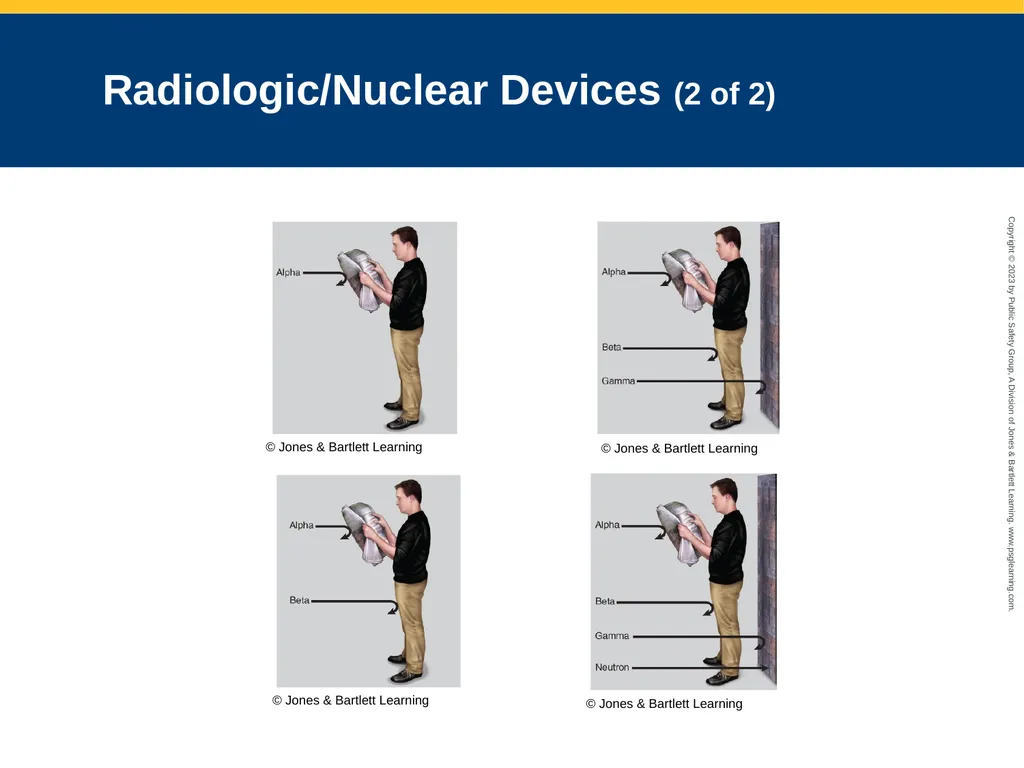
Radiologic/Nuclear Devices (1 of 2) Ionizing radiation: Energy emitted in the form of rays or particles
Found in radioactive material
Energy emitted from a strong radiologic source:
Alpha: Least harmful penetrating type
Beta radiation: Slightly more penetrating than alpha
Gamma rays: Far faster and stronger than alpha and beta radiation
Neutron particles are among the most powerful.<br>
Found in radioactive material
Energy emitted from a strong radiologic source:
Alpha: Least harmful penetrating type
Beta radiation: Slightly more penetrating than alpha
Gamma rays: Far faster and stronger than alpha and beta radiation
Neutron particles are among the most powerful.<br>
47
Radiologic/Nuclear Devices (2 of 2) © Jones & Bartlett Learning © Jones & Bartlett Learning © Jones & Bartlett Learning © Jones & Bartlett Learning<br>
48
Sources of Radiologic Material Radioactive materials can be found at:
Hospitals and other health care facilities with radiology departments
Colleges and universities
Chemical and industrial sites
Nuclear power plants<br>
Hospitals and other health care facilities with radiology departments
Colleges and universities
Chemical and industrial sites
Nuclear power plants<br>
49
Radiologic Dispersal Devices Any container that is designed to disperse radioactive material
Dirty bomb
Carries potential to injure people with not only the radioactive material, but also the explosive material used to deliver it
Destructive capability of a dirty bomb is limited to the explosives attached to it.
Ineffective WMD<br>
Dirty bomb
Carries potential to injure people with not only the radioactive material, but also the explosive material used to deliver it
Destructive capability of a dirty bomb is limited to the explosives attached to it.
Ineffective WMD<br>
50
Nuclear Energy Artificially made by altering (splitting) radioactive atoms
Nuclear material is used in:
Medicine
Weapons
Naval vessels
Power plants<br>
Nuclear material is used in:
Medicine
Weapons
Naval vessels
Power plants<br>
51
Nuclear Weapons Kept only in secure facilities throughout the world
The whereabouts of many small nuclear devices are unknown.
Small suitcase-sized nuclear weapons called Special Atomic Demolition Munitions (SADMs), or “suitcase nukes”<br>
The whereabouts of many small nuclear devices are unknown.
Small suitcase-sized nuclear weapons called Special Atomic Demolition Munitions (SADMs), or “suitcase nukes”<br>
52
Symptomatology Effects of radiation exposure will vary depending on the amount of radiation that a person receives and the route of exposure.
Radiation can be introduced into the body by all routes of entry.<br>
Radiation can be introduced into the body by all routes of entry.<br>
53
Medical Management Being exposed to a radiation source does not make a patient contaminated or radioactive.
When patients have a radioactive source on their body, they are contaminated.
After the patient is decontaminated and no threat to you exists, treatment can be started with the ABCs.<br>
When patients have a radioactive source on their body, they are contaminated.
After the patient is decontaminated and no threat to you exists, treatment can be started with the ABCs.<br>
54
Protective Measures There are no suits or protective gear to completely shield from radiation.
Best ways to protection include:
Time
Distance
Shielding<br>
Best ways to protection include:
Time
Distance
Shielding<br>
55
Incendiary and Explosive Devices (1 of 4) Come in various shapes and sizes
Mechanisms of injury
Type and severity of wounds depend on the patient’s distance from the explosion.
Primary blast injury
Secondary blast injury
Tertiary blast injury
Quaternary blast injury
Quinary blast injury<br>
Mechanisms of injury
Type and severity of wounds depend on the patient’s distance from the explosion.
Primary blast injury
Secondary blast injury
Tertiary blast injury
Quaternary blast injury
Quinary blast injury<br>
56
Incendiary and Explosive Devices (2 of 4) Physics of an explosion
When a substance is detonated, a solid or liquid is chemically converted into large volumes of gas under high pressure with resultant explosive energy release.
Generates a pressure pulse in the shape of a spherical blast wave that expands in all directions from the point of explosion<br>
When a substance is detonated, a solid or liquid is chemically converted into large volumes of gas under high pressure with resultant explosive energy release.
Generates a pressure pulse in the shape of a spherical blast wave that expands in all directions from the point of explosion<br>
57
Incendiary and Explosive Devices (3 of 4) Tissues at risk
Hollow organs are most susceptible.
Junction between tissues of different densities and exposed are prone to injury.
Primary pulmonary blast injuries occur as contusions and hemorrhages.
Solid organs may be injured by secondary missiles or a hurled body.<br>
Hollow organs are most susceptible.
Junction between tissues of different densities and exposed are prone to injury.
Primary pulmonary blast injuries occur as contusions and hemorrhages.
Solid organs may be injured by secondary missiles or a hurled body.<br>
58
Incendiary and Explosive Devices (4 of 4) Neurologic injuries and head trauma
Subarachnoid and subdural hematomas
Permanent or transient neurologic deficits may be secondary to concussion, intracerebral bleeding, or air embolism.
Instant but transient unresponsiveness
Bradycardia and hypotension
Extremity injuries, including traumatic amputations<br>
Subarachnoid and subdural hematomas
Permanent or transient neurologic deficits may be secondary to concussion, intracerebral bleeding, or air embolism.
Instant but transient unresponsiveness
Bradycardia and hypotension
Extremity injuries, including traumatic amputations<br>