
TESTING AND MAINTENANCE OF ELECTRICAL EQIPMENT
CS
Published · 21 slides · 0 views

1 / 1
Description
TESTING AND MAINTENANCE OF ELECTRICAL EQIPMENT ,CODE (66775). 7th semester Electrical. Welcome to my presentation by Engr: MUSARRF HOSSAIN Chief Instructor Electrical Technology,Mymensingh polytechnice Institute. To provide the students
Related Topics
Share
Embed code
Download this presentation From Below
"TESTING AND MAINTENANCE OF ELECTRICAL EQIPMENT" is the property of its rightful owner. Permission is granted to download and print the materials on this website for personal, non-commercial use only, and to display it on your personal computer provided you do not modify the materials and that you retain all copyright notices contained in the materials. By downloading content from our website, you accept the terms of this agreement.
Presentation Transcript
01
TESTING AND MAINTENANCE OF ELECTRICAL EQIPMENT ,CODE (66775).
7th semester Electrical. Welcome to my presentation by
Engr: MUSARRF HOSSAIN
Chief Instructor Electrical Technology,Mymensingh polytechnice Institute.<br>
Engr: MUSARRF HOSSAIN
Chief Instructor Electrical Technology,Mymensingh polytechnice Institute.<br>
02
To provide the students opportunities to acquire knowledge, skills and attitude in the area of Testing and Maintenance of electrical equipment with the special emphasizes on:
1. Trouble shooting and maintenance of electrical equipment,
2. Faults findings and remedy the faults of Battery, DC Generators, DC motors,
3. Faults findings and remedy the troubles Transformers, Induction motors, Alternators,
4. Faults findings and remedy the troubles Synchronous motor and Circuit breaker<br>
03
To provide the students opportunities to acquire knowledge, skills and attitude in the area of Testing
and Maintenance of electrical equipment with the special emphasizes on:
Trouble shooting and maintenance of electrical equipment,
Faults findings and remedy the faults of Battery, DC Generators, DC motors,
Faults findings and remedy the troubles Transformers, Induction motors, Alternators,
Faults findings and remedy the troubles Synchronous motor and Circuit breaker Chapter -1
Identify the hand tools and equipment for trouble shooting and maintenance of electrical equipment.<br>
Identify the hand tools and equipment for trouble shooting and maintenance of electrical equipment.<br>
04
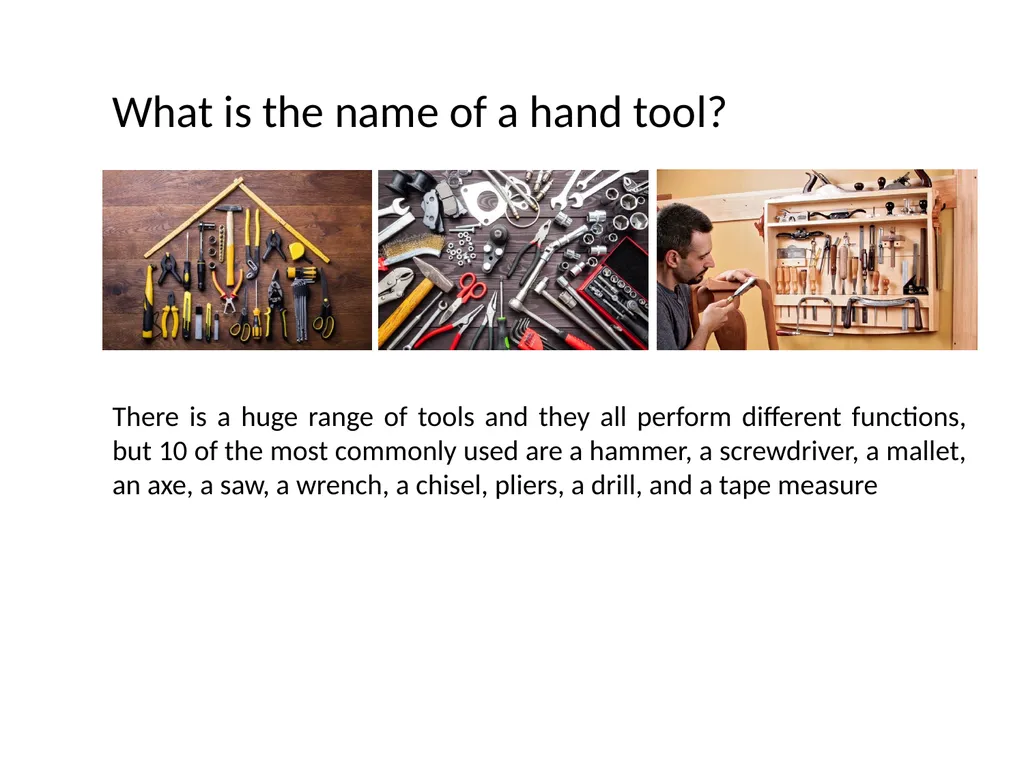
What is the name of a hand tool? There is a huge range of tools and they all perform different functions, but 10 of the most commonly used are a hammer, a screwdriver, a mallet, an axe, a saw, a wrench, a chisel, pliers, a drill, and a tape measure<br>
05
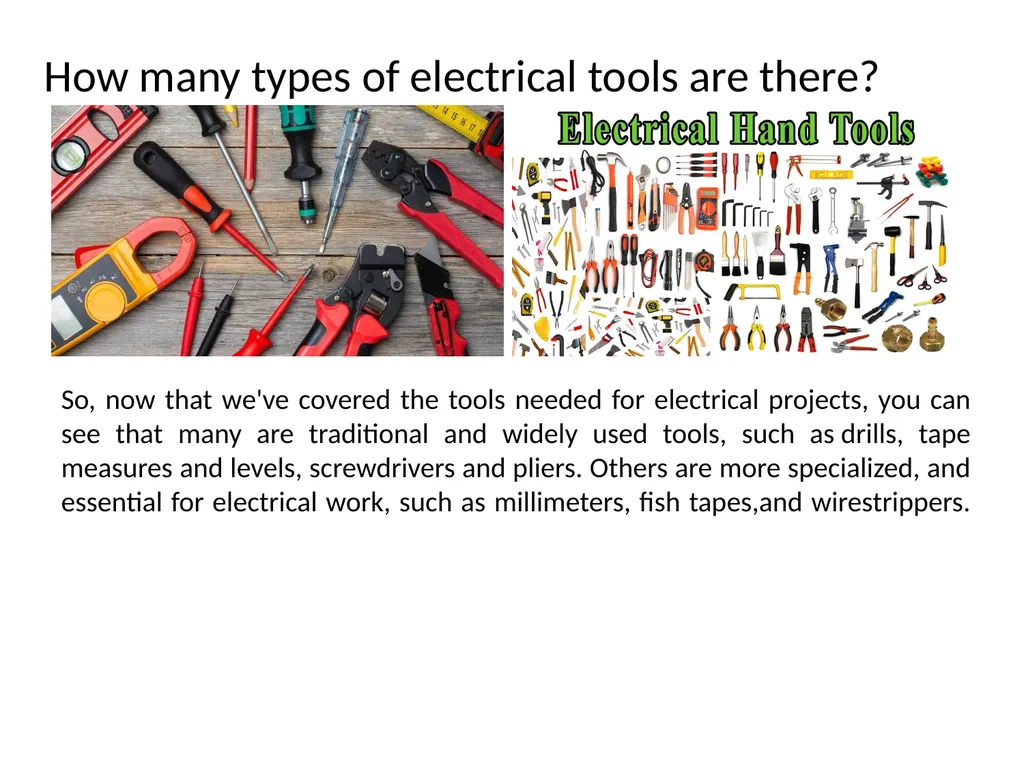
How many types of electrical tools are there? So, now that we've covered the tools needed for electrical projects, you can see that many are traditional and widely used tools, such as drills, tape measures and levels, screwdrivers and pliers. Others are more specialized, and essential for electrical work, such as millimeters, fish tapes,and wirestrippers.<br>
06
Chapter -2 Find the trouble and repair the troubles of Batteries, DC Generator and DC Motors. After the session student will be able to do the following Topics.
1 Identify the troubles of Batteries
2 Explain the troubles of the storage Batteries
3 Describe the process of repair and maintenance of storage batteries
4 Identify the Faults of DC Generator and Dc Motor
5 Explain the faults of the Dc Generator and Dc Motor
6 Describe the process of repair and maintenance of DC Generator and Dc Moto<br>
1 Identify the troubles of Batteries
2 Explain the troubles of the storage Batteries
3 Describe the process of repair and maintenance of storage batteries
4 Identify the Faults of DC Generator and Dc Motor
5 Explain the faults of the Dc Generator and Dc Motor
6 Describe the process of repair and maintenance of DC Generator and Dc Moto<br>
07
Physical Damage
Sulphation
Wear and Tear
Deep Cycling
Overcharging
False Claim
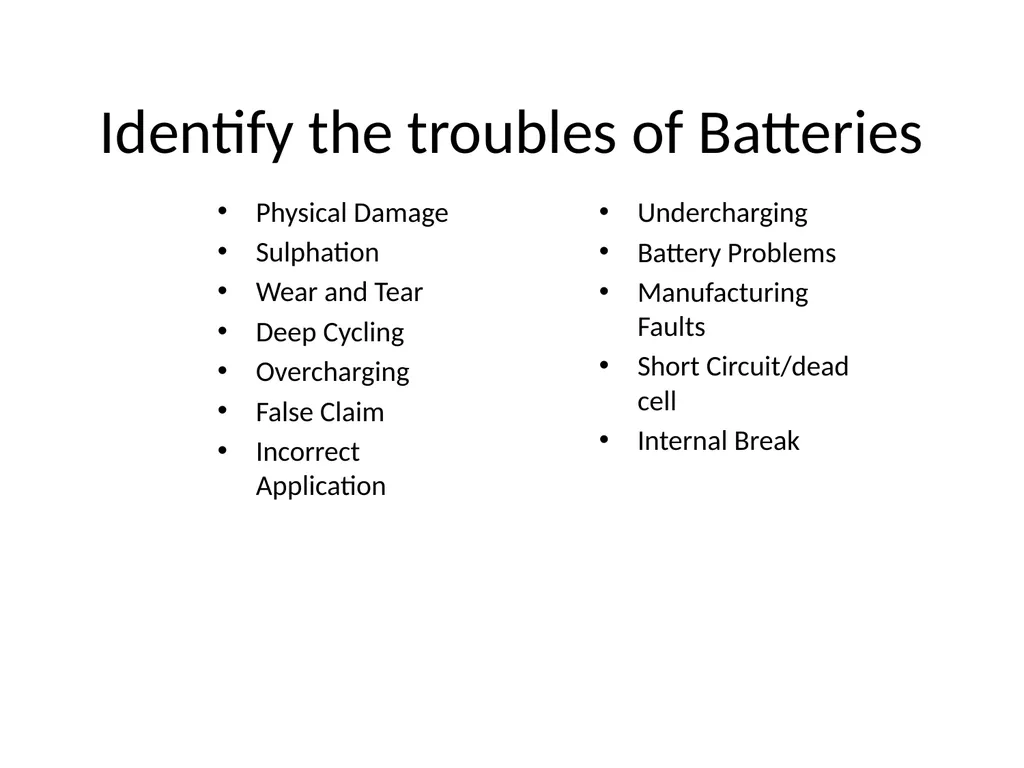
Incorrect Application Identify the troubles of Batteries Undercharging
Battery Problems
Manufacturing Faults
Short Circuit/dead cell
Internal Break<br>
Sulphation
Wear and Tear
Deep Cycling
Overcharging
False Claim
Incorrect Application Identify the troubles of Batteries Undercharging
Battery Problems
Manufacturing Faults
Short Circuit/dead cell
Internal Break<br>
08
1. Failure to start
2. Sparking at brushes
3. Vibrations and pounding noises
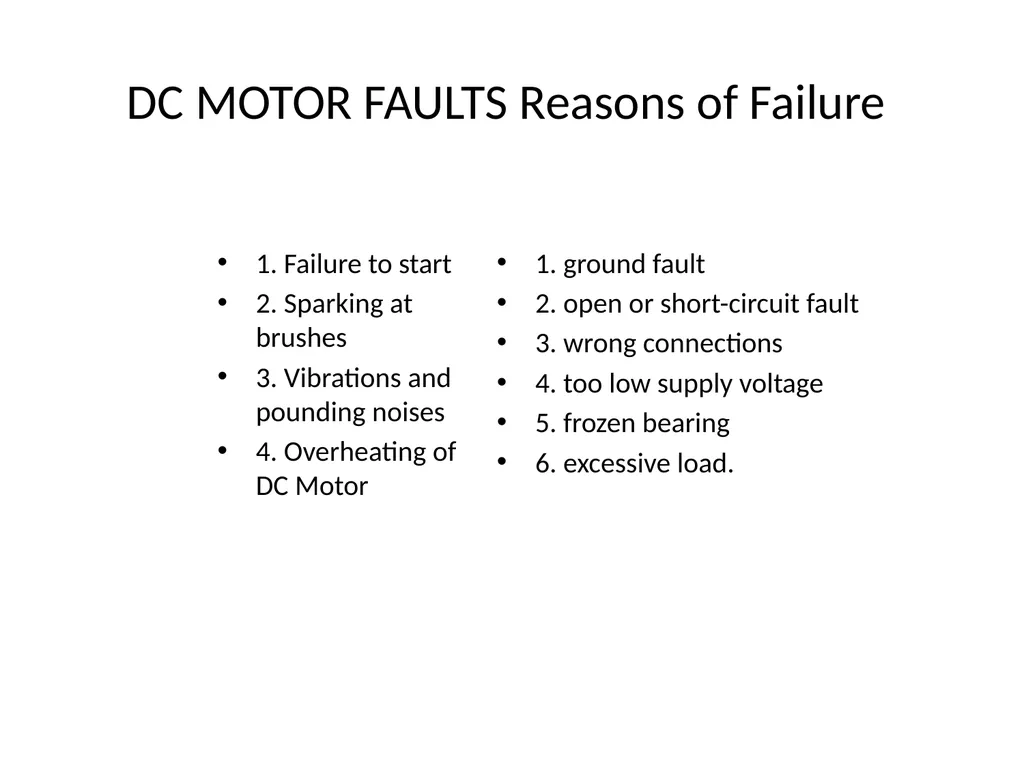
4. Overheating of DC Motor DC MOTOR FAULTS Reasons of Failure 1. ground fault
2. open or short-circuit fault
3. wrong connections
4. too low supply voltage
5. frozen bearing
6. excessive load.<br>
2. Sparking at brushes
3. Vibrations and pounding noises
4. Overheating of DC Motor DC MOTOR FAULTS Reasons of Failure 1. ground fault
2. open or short-circuit fault
3. wrong connections
4. too low supply voltage
5. frozen bearing
6. excessive load.<br>
09
DC Generator Maintenance
Noise and Vibration Inspections.
Reviewing the Service History.
Windings Tests.
Visual Inspection.
Bearings and Lubrication.
Brush and Commutator Maintenance. The process of repair and maintenance of DC Generator and Dc Moto DC Generator Repairing Process
Your generator’s electrical components are broken
Your generator leaks fuel
Your generator starts up slowly
Your generator is physically damaged<br>
Noise and Vibration Inspections.
Reviewing the Service History.
Windings Tests.
Visual Inspection.
Bearings and Lubrication.
Brush and Commutator Maintenance. The process of repair and maintenance of DC Generator and Dc Moto DC Generator Repairing Process
Your generator’s electrical components are broken
Your generator leaks fuel
Your generator starts up slowly
Your generator is physically damaged<br>
10
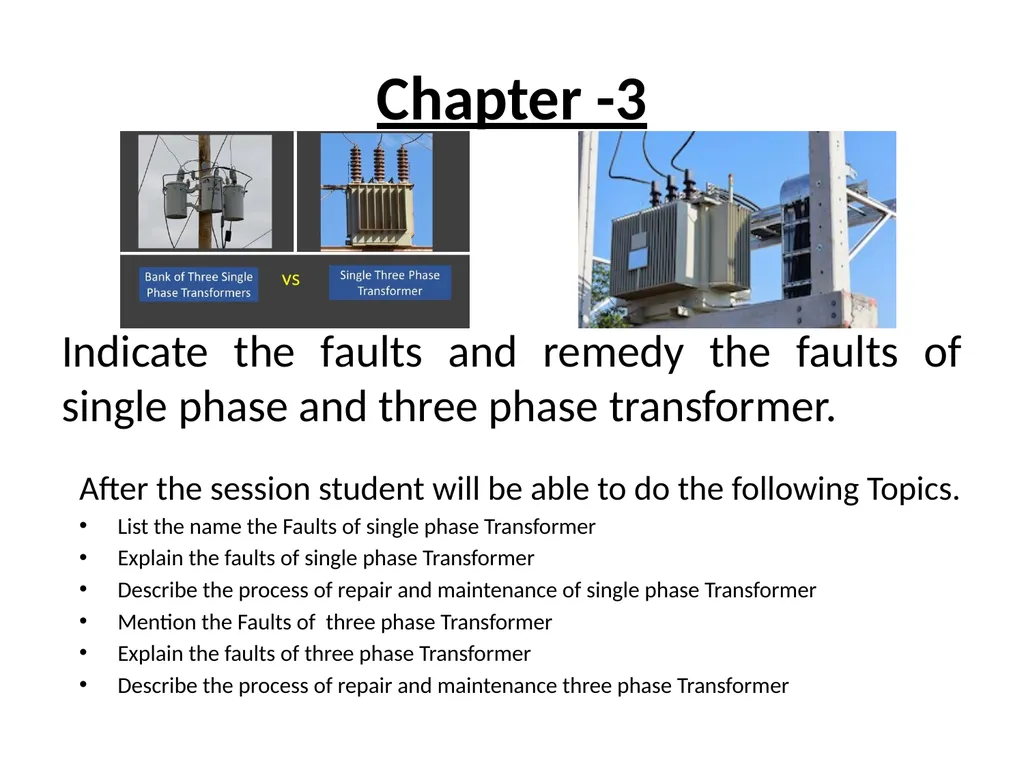
Chapter -3 Indicate the faults and remedy the faults of single phase and three phase transformer. After the session student will be able to do the following Topics.
List the name the Faults of single phase Transformer
Explain the faults of single phase Transformer
Describe the process of repair and maintenance of single phase Transformer
Mention the Faults of three phase Transformer
Explain the faults of three phase Transformer
Describe the process of repair and maintenance three phase Transformer<br>
List the name the Faults of single phase Transformer
Explain the faults of single phase Transformer
Describe the process of repair and maintenance of single phase Transformer
Mention the Faults of three phase Transformer
Explain the faults of three phase Transformer
Describe the process of repair and maintenance three phase Transformer<br>
11
Over heating
Winding faults
Open circuits
External faults
Over fluxing The Faults of single phase Transformer Earth faults
Phase faults
Inter turn faults
Core faults
Tank faults and cooling failure
Tap changer faults<br>
Winding faults
Open circuits
External faults
Over fluxing The Faults of single phase Transformer Earth faults
Phase faults
Inter turn faults
Core faults
Tank faults and cooling failure
Tap changer faults<br>
12
It is important to note some of the essential maintenance tips to ensure your transformers are running efficiently.
Ensure the transformers are not overloaded. ...
Conduct regular checks on the oil. ...
Keep an eye on the silica gel. ...
Conduct regular testing on the transformers. ...
Get an expert's opinion The process of repair and maintenance of single phase Transformer<br>
Ensure the transformers are not overloaded. ...
Conduct regular checks on the oil. ...
Keep an eye on the silica gel. ...
Conduct regular testing on the transformers. ...
Get an expert's opinion The process of repair and maintenance of single phase Transformer<br>
13
MAINTENANCE PROCEDURE
Sludge, dust, dirt ,moisture can be removed by filtration.
Oil when topped up shall be of the same make. ...
Insulation resistance of the transformer should be checked once in 6 months.
Megger values along with oil values indicate the condition of transformer. The process of repair and maintenance three phase Transformer<br>
Sludge, dust, dirt ,moisture can be removed by filtration.
Oil when topped up shall be of the same make. ...
Insulation resistance of the transformer should be checked once in 6 months.
Megger values along with oil values indicate the condition of transformer. The process of repair and maintenance three phase Transformer<br>
14
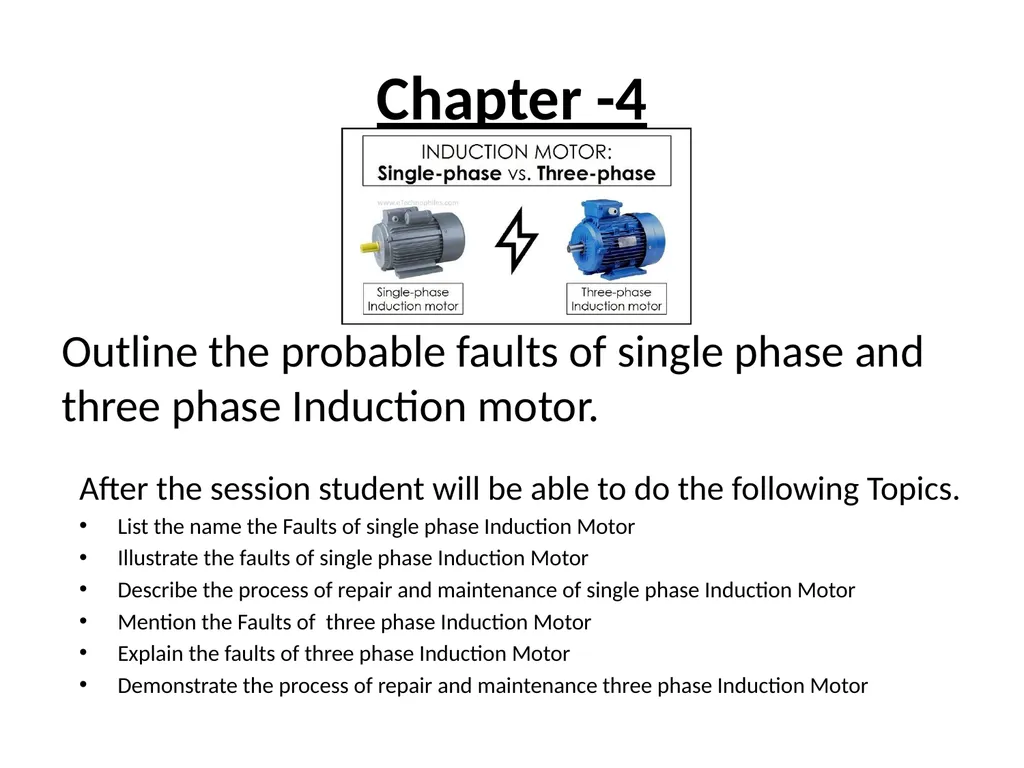
Chapter -4 Outline the probable faults of single phase and three phase Induction motor. After the session student will be able to do the following Topics.
List the name the Faults of single phase Induction Motor
Illustrate the faults of single phase Induction Motor
Describe the process of repair and maintenance of single phase Induction Motor
Mention the Faults of three phase Induction Motor
Explain the faults of three phase Induction Motor
Demonstrate the process of repair and maintenance three phase Induction Motor<br>
List the name the Faults of single phase Induction Motor
Illustrate the faults of single phase Induction Motor
Describe the process of repair and maintenance of single phase Induction Motor
Mention the Faults of three phase Induction Motor
Explain the faults of three phase Induction Motor
Demonstrate the process of repair and maintenance three phase Induction Motor<br>
15
Broken rotor bars
Phase to phase short circuit fault
Line to phase short circuit fault
Crossing the stator thermal limit
Crossing the rotor thermal limit
Stator open circuit fault The Faults of single phase Induction Motor<br>
Phase to phase short circuit fault
Line to phase short circuit fault
Crossing the stator thermal limit
Crossing the rotor thermal limit
Stator open circuit fault The Faults of single phase Induction Motor<br>
16
Clean the motor completely, blowing dirt out of the windings and wiping the commutator and brushes.
Replace any brushes that are more than half worn.
Examine brush holders and, if necessary, clean them.
Drain, clean, and refill the oil in the sleeve bearings. The process of repair and maintenance of single phase Induction Motor<br>
Replace any brushes that are more than half worn.
Examine brush holders and, if necessary, clean them.
Drain, clean, and refill the oil in the sleeve bearings. The process of repair and maintenance of single phase Induction Motor<br>
17
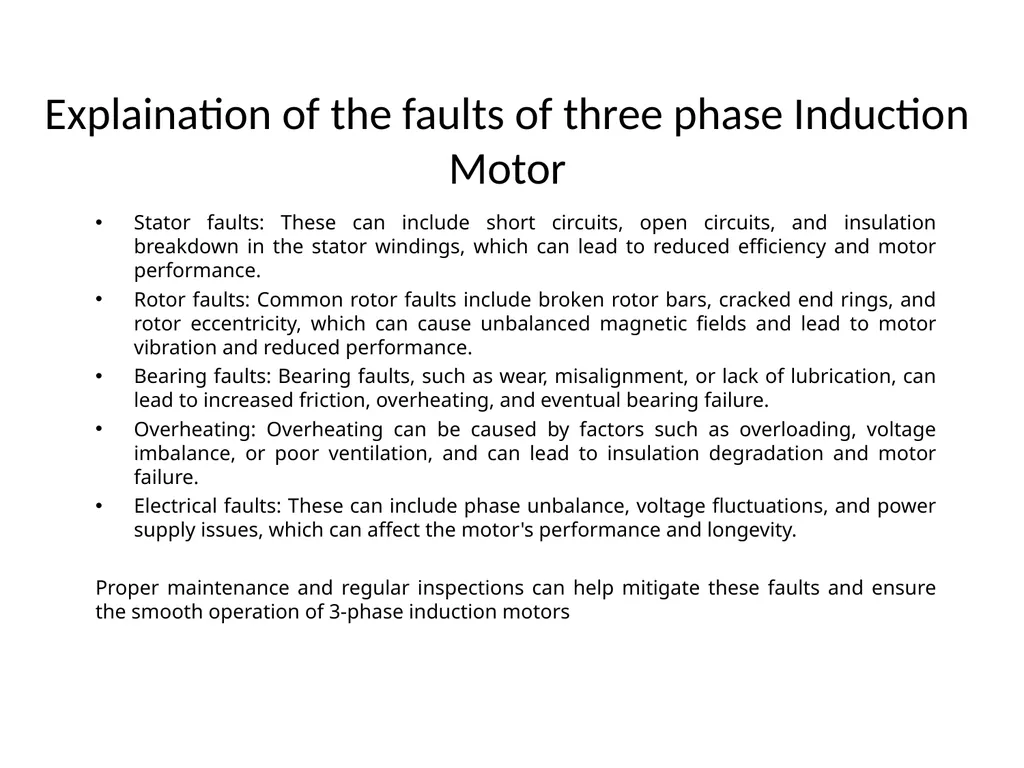
Stator faults: These can include short circuits, open circuits, and insulation breakdown in the stator windings, which can lead to reduced efficiency and motor performance.
Rotor faults: Common rotor faults include broken rotor bars, cracked end rings, and rotor eccentricity, which can cause unbalanced magnetic fields and lead to motor vibration and reduced performance.
Bearing faults: Bearing faults, such as wear, misalignment, or lack of lubrication, can lead to increased friction, overheating, and eventual bearing failure.
Overheating: Overheating can be caused by factors such as overloading, voltage imbalance, or poor ventilation, and can lead to insulation degradation and motor failure.
Electrical faults: These can include phase unbalance, voltage fluctuations, and power supply issues, which can affect the motor's performance and longevity.
Proper maintenance and regular inspections can help mitigate these faults and ensure the smooth operation of 3-phase induction motors Explaination of the faults of three phase Induction Motor<br>
Rotor faults: Common rotor faults include broken rotor bars, cracked end rings, and rotor eccentricity, which can cause unbalanced magnetic fields and lead to motor vibration and reduced performance.
Bearing faults: Bearing faults, such as wear, misalignment, or lack of lubrication, can lead to increased friction, overheating, and eventual bearing failure.
Overheating: Overheating can be caused by factors such as overloading, voltage imbalance, or poor ventilation, and can lead to insulation degradation and motor failure.
Electrical faults: These can include phase unbalance, voltage fluctuations, and power supply issues, which can affect the motor's performance and longevity.
Proper maintenance and regular inspections can help mitigate these faults and ensure the smooth operation of 3-phase induction motors Explaination of the faults of three phase Induction Motor<br>
18
Check and make sure the frame or terminal box of the motor is grounded . Insulation Resistance. To test the stator and rotor windings by their terminal connectors . Testing device of 500V be used to test stator windings below 3KV. Stator windings above 3KV be tested by 1000V device
Proper maintenance and regular inspections can help mitigate these faults and ensure the smooth operation of 3-phase induction motors The method of maintenance of a three-phase induction motor<br>
Proper maintenance and regular inspections can help mitigate these faults and ensure the smooth operation of 3-phase induction motors The method of maintenance of a three-phase induction motor<br>
19
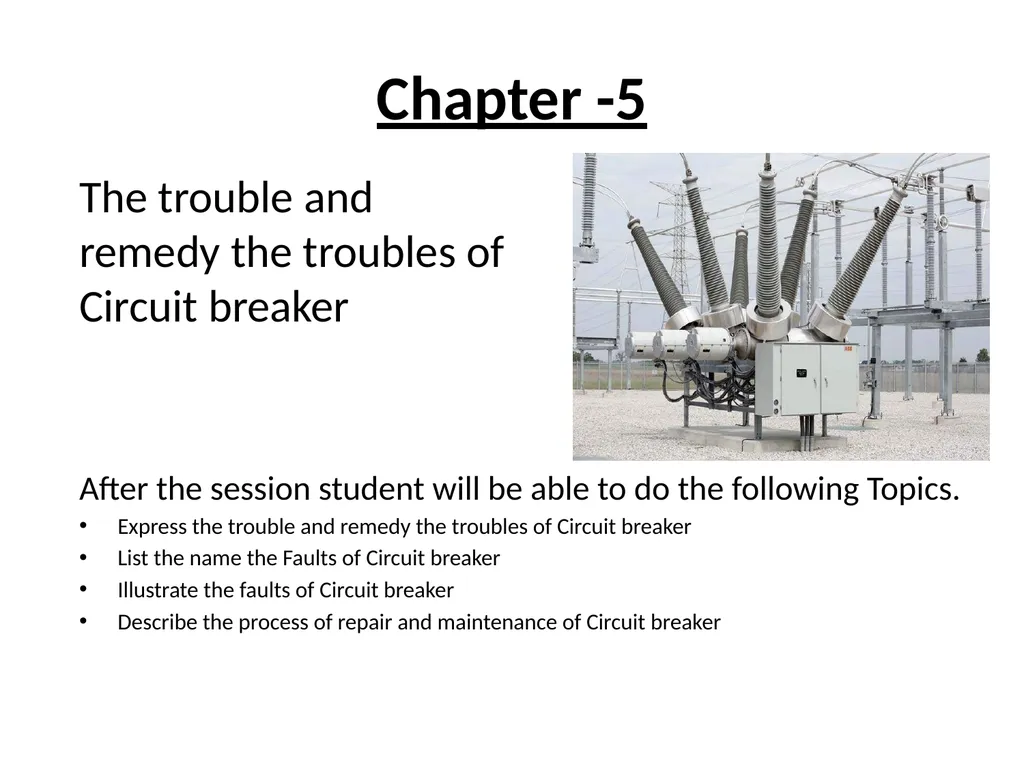
Chapter -5 The trouble and remedy the troubles of Circuit breaker After the session student will be able to do the following Topics.
Express the trouble and remedy the troubles of Circuit breaker
List the name the Faults of Circuit breaker
Illustrate the faults of Circuit breaker
Describe the process of repair and maintenance of Circuit breaker<br>
Express the trouble and remedy the troubles of Circuit breaker
List the name the Faults of Circuit breaker
Illustrate the faults of Circuit breaker
Describe the process of repair and maintenance of Circuit breaker<br>
20
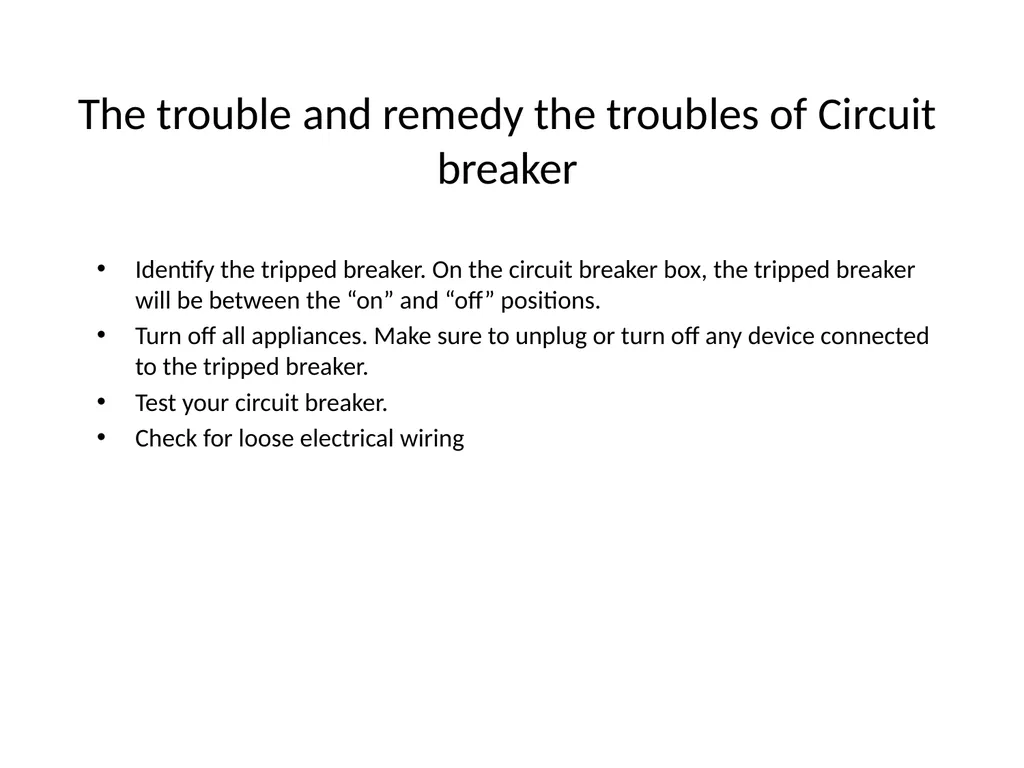
Identify the tripped breaker. On the circuit breaker box, the tripped breaker will be between the “on” and “off” positions.
Turn off all appliances. Make sure to unplug or turn off any device connected to the tripped breaker.
Test your circuit breaker.
Check for loose electrical wiring The trouble and remedy the troubles of Circuit breaker<br>
Turn off all appliances. Make sure to unplug or turn off any device connected to the tripped breaker.
Test your circuit breaker.
Check for loose electrical wiring The trouble and remedy the troubles of Circuit breaker<br>
21
Evaluate, Clean, Service and Test.
Insulating parts which include bushings should be wiped down and cleaned.
Check fault operations.
Trip Testing to ensure manufacturer standards.
Inspection of alignment conditions and stationary contacts.
Remove damaged parts The process of repair and maintenance of Circuit breaker<br>
Insulating parts which include bushings should be wiped down and cleaned.
Check fault operations.
Trip Testing to ensure manufacturer standards.
Inspection of alignment conditions and stationary contacts.
Remove damaged parts The process of repair and maintenance of Circuit breaker<br>