
Text Classification and Naïve Bayes The Task of
SN
Published · 71 slides · 0 views

1 / 1


Description
Text Classification and Naïve Bayes The Task of Text Classification Is this spam? Who wrote which Federalist papers? 1787-8: anonymous essays try to convince New York to ratify U.S Constitution: Jay, Madison, Hamilton. Authorship of 12 of
Related Topics
Share
Embed code
Download this presentation From Below
"Text Classification and Naïve Bayes The Task of" is the property of its rightful owner. Permission is granted to download and print the materials on this website for personal, non-commercial use only, and to display it on your personal computer provided you do not modify the materials and that you retain all copyright notices contained in the materials. By downloading content from our website, you accept the terms of this agreement.
Presentation Transcript
01
Text Classification and Naïve Bayes The Task of Text Classification<br>
02
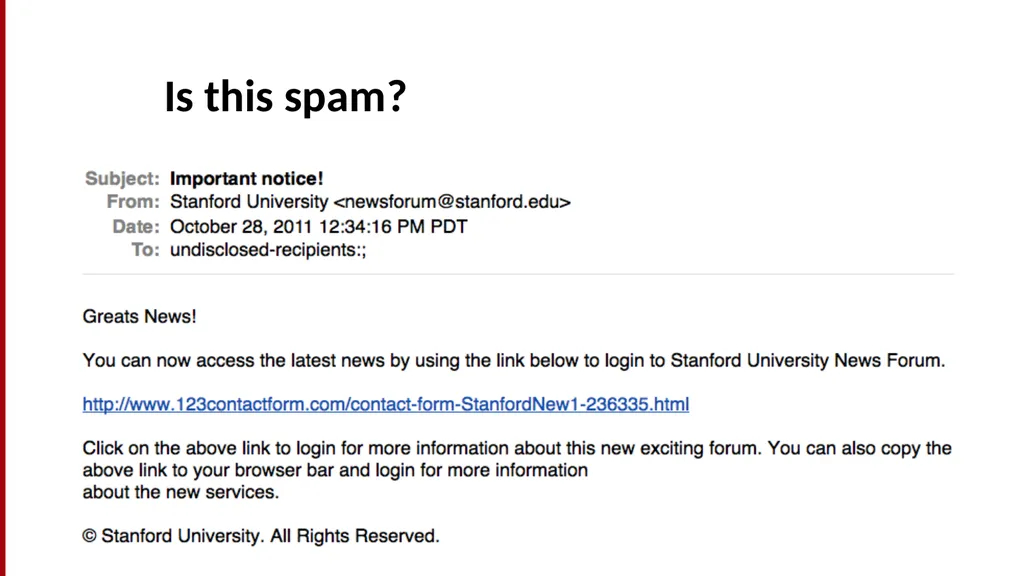
Is this spam?<br>
03
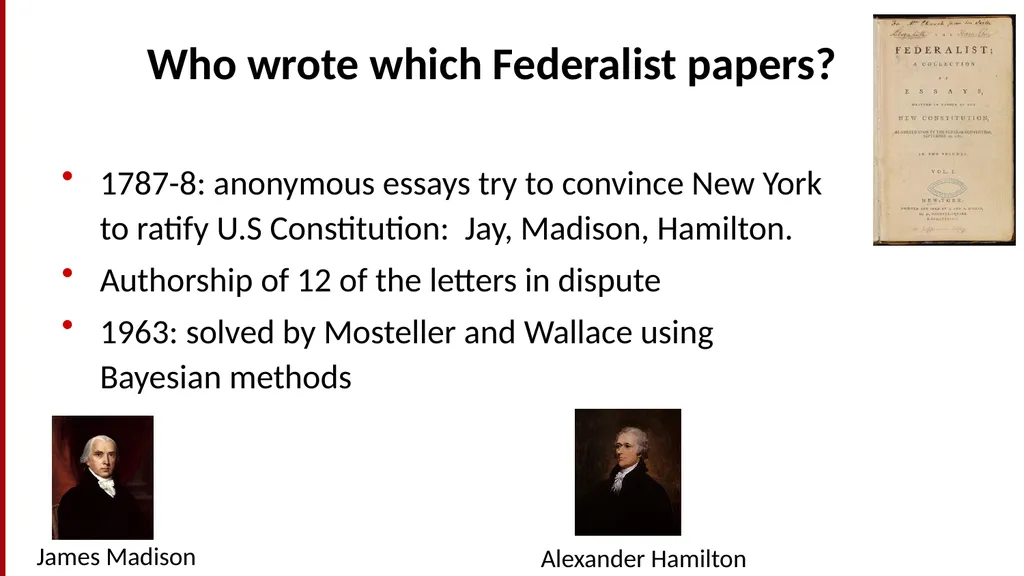
Who wrote which Federalist papers? 1787-8: anonymous essays try to convince New York to ratify U.S Constitution: Jay, Madison, Hamilton.
Authorship of 12 of the letters in dispute
1963: solved by Mosteller and Wallace using Bayesian methods James Madison Alexander Hamilton<br>
Authorship of 12 of the letters in dispute
1963: solved by Mosteller and Wallace using Bayesian methods James Madison Alexander Hamilton<br>
04
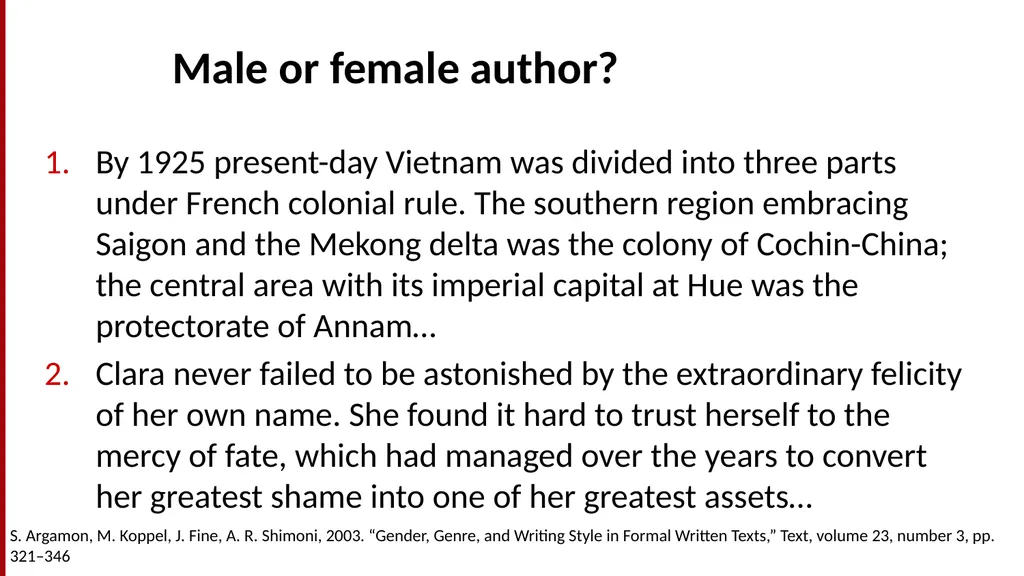
Male or female author? By 1925 present-day Vietnam was divided into three parts under French colonial rule. The southern region embracing Saigon and the Mekong delta was the colony of Cochin-China; the central area with its imperial capital at Hue was the protectorate of Annam…
Clara never failed to be astonished by the extraordinary felicity of her own name. She found it hard to trust herself to the mercy of fate, which had managed over the years to convert her greatest shame into one of her greatest assets… S. Argamon, M. Koppel, J. Fine, A. R. Shimoni, 2003. “Gender, Genre, and Writing Style in Formal Written Texts,” Text, volume 23, number 3, pp. 321–346<br>
Clara never failed to be astonished by the extraordinary felicity of her own name. She found it hard to trust herself to the mercy of fate, which had managed over the years to convert her greatest shame into one of her greatest assets… S. Argamon, M. Koppel, J. Fine, A. R. Shimoni, 2003. “Gender, Genre, and Writing Style in Formal Written Texts,” Text, volume 23, number 3, pp. 321–346<br>
05
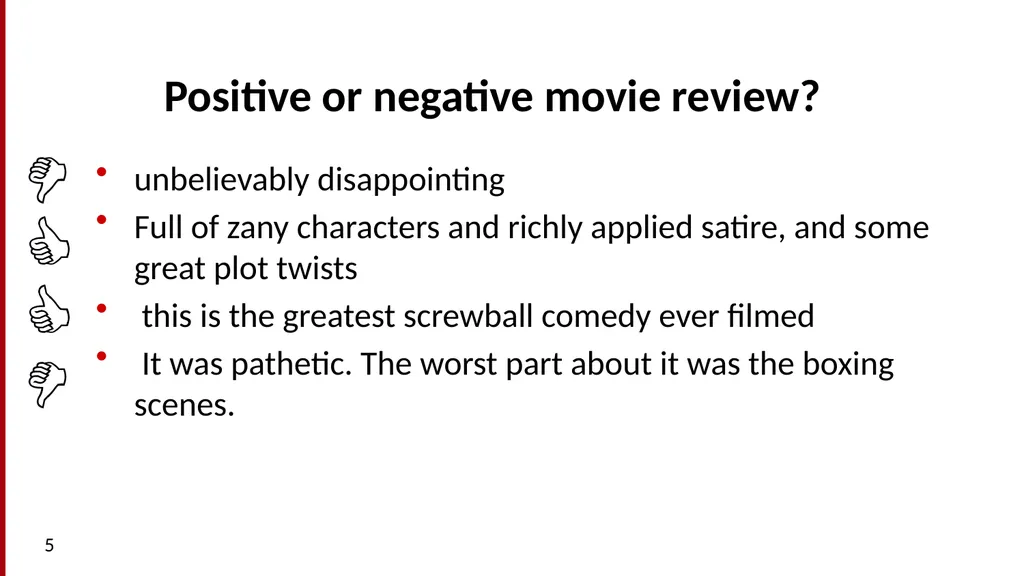
Positive or negative movie review? unbelievably disappointing
Full of zany characters and richly applied satire, and some great plot twists
this is the greatest screwball comedy ever filmed
It was pathetic. The worst part about it was the boxing scenes. 5<br>
Full of zany characters and richly applied satire, and some great plot twists
this is the greatest screwball comedy ever filmed
It was pathetic. The worst part about it was the boxing scenes. 5<br>
06
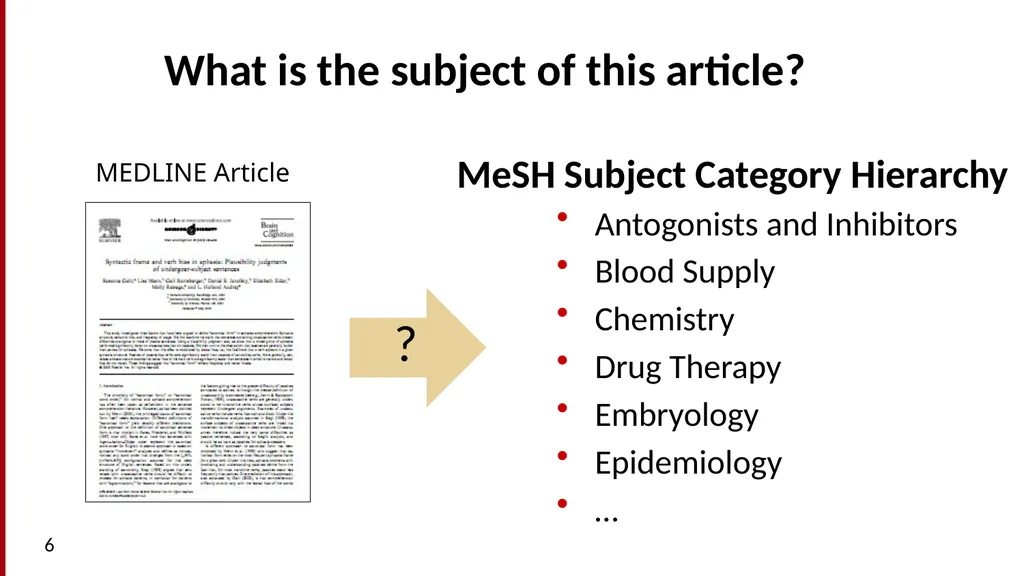
What is the subject of this article? Antogonists and Inhibitors
Blood Supply
Chemistry
Drug Therapy
Embryology
Epidemiology
… 6 MeSH Subject Category Hierarchy ? MEDLINE Article<br>
Blood Supply
Chemistry
Drug Therapy
Embryology
Epidemiology
… 6 MeSH Subject Category Hierarchy ? MEDLINE Article<br>
07
Text Classification Assigning subject categories, topics, or genres
Spam detection
Authorship identification
Age/gender identification
Language Identification
Sentiment analysis
…<br>
Spam detection
Authorship identification
Age/gender identification
Language Identification
Sentiment analysis
…<br>
08
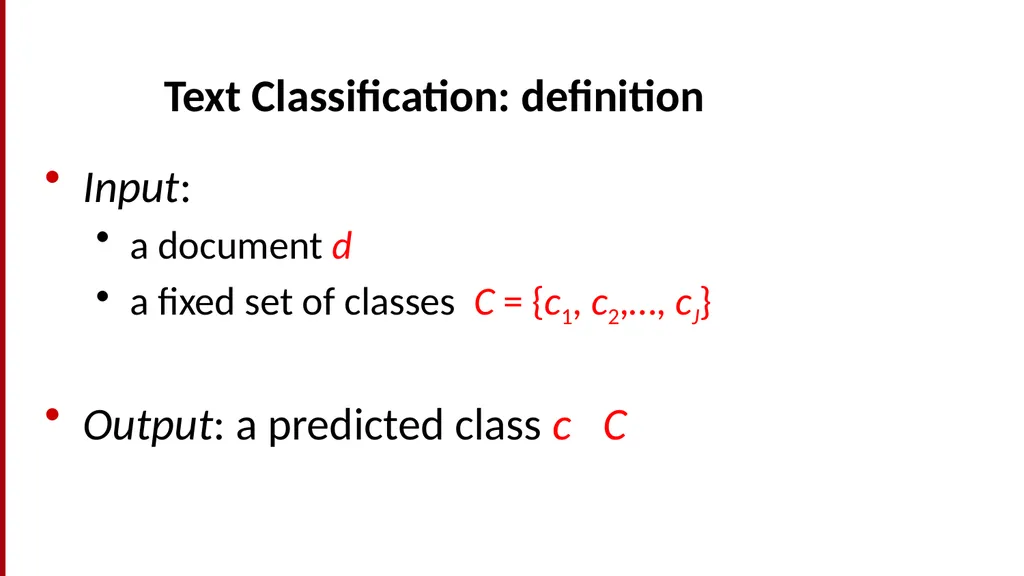
Text Classification: definition Input:
a document d
a fixed set of classes C = {c1, c2,…, cJ}
Output: a predicted class c C<br>
a document d
a fixed set of classes C = {c1, c2,…, cJ}
Output: a predicted class c C<br>
09
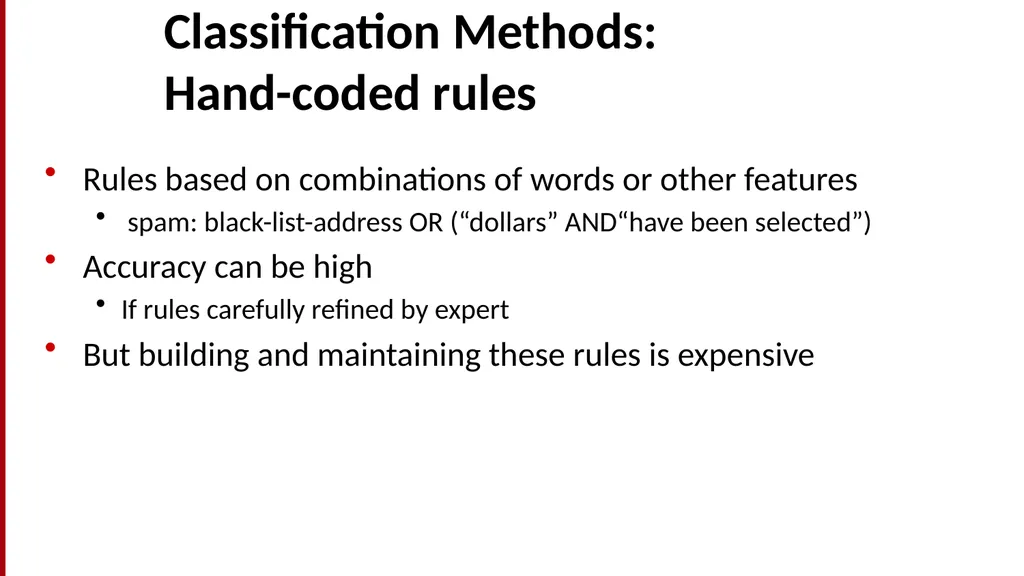
Classification Methods:
Hand-coded rules Rules based on combinations of words or other features
spam: black-list-address OR (“dollars” AND“have been selected”)
Accuracy can be high
If rules carefully refined by expert
But building and maintaining these rules is expensive<br>
spam: black-list-address OR (“dollars” AND“have been selected”)
Accuracy can be high
If rules carefully refined by expert
But building and maintaining these rules is expensive<br>
10
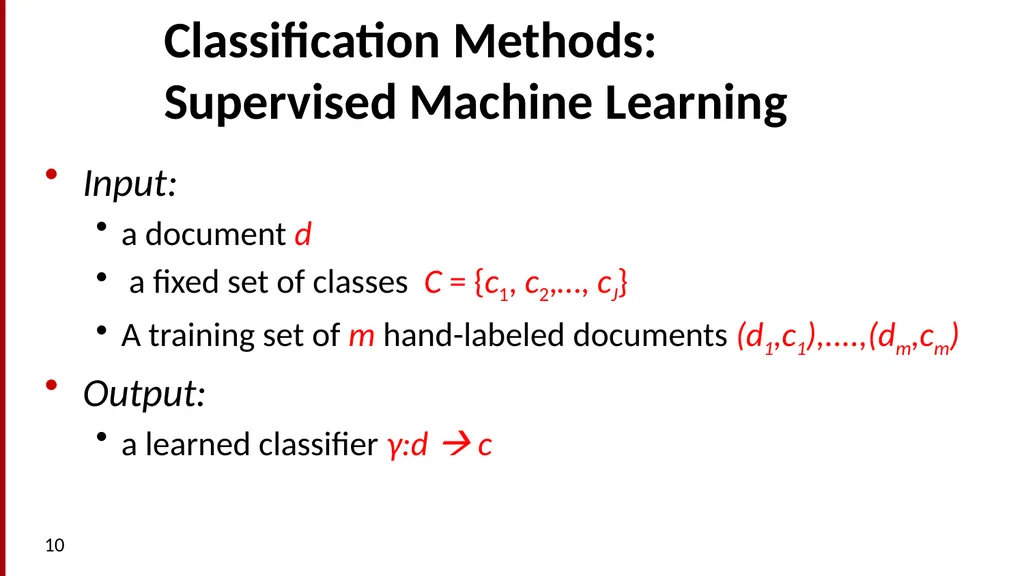
Classification Methods:
Supervised Machine Learning Input:
a document d
a fixed set of classes C = {c1, c2,…, cJ}
A training set of m hand-labeled documents (d1,c1),....,(dm,cm)
Output:
a learned classifier γ:d c 10<br>
a document d
a fixed set of classes C = {c1, c2,…, cJ}
A training set of m hand-labeled documents (d1,c1),....,(dm,cm)
Output:
a learned classifier γ:d c 10<br>
11
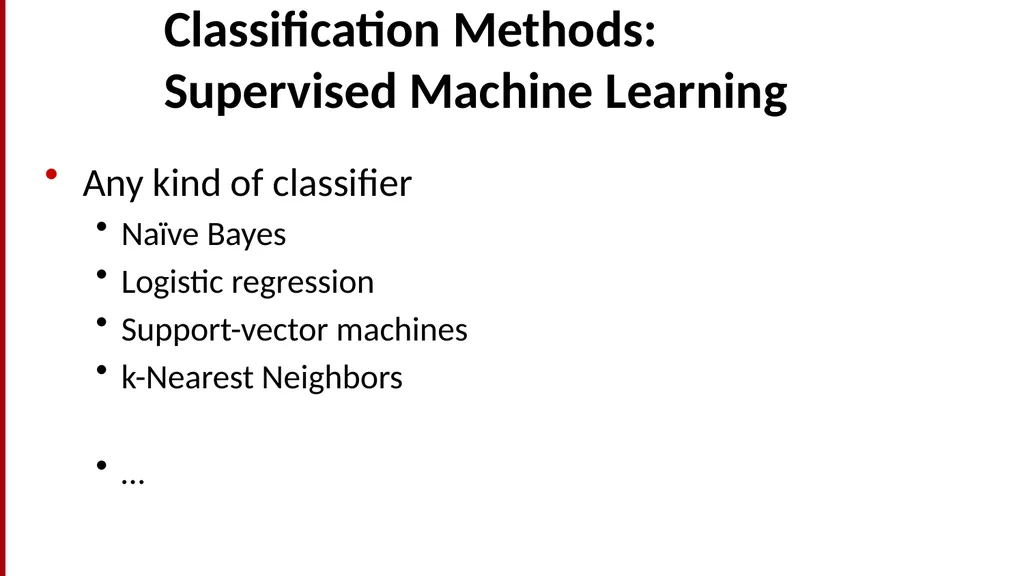
Classification Methods:
Supervised Machine Learning Any kind of classifier
Naïve Bayes
Logistic regression
Support-vector machines
k-Nearest Neighbors
…<br>
Naïve Bayes
Logistic regression
Support-vector machines
k-Nearest Neighbors
…<br>
12
Text Classification and Naïve Bayes The Task of Text Classification<br>
13
Text Classification and Naïve Bayes Naïve Bayes (I)<br>
14
Naïve Bayes Intuition Simple (“naïve”) classification method based on Bayes rule
Relies on very simple representation of document
Bag of words<br>
Relies on very simple representation of document
Bag of words<br>
15
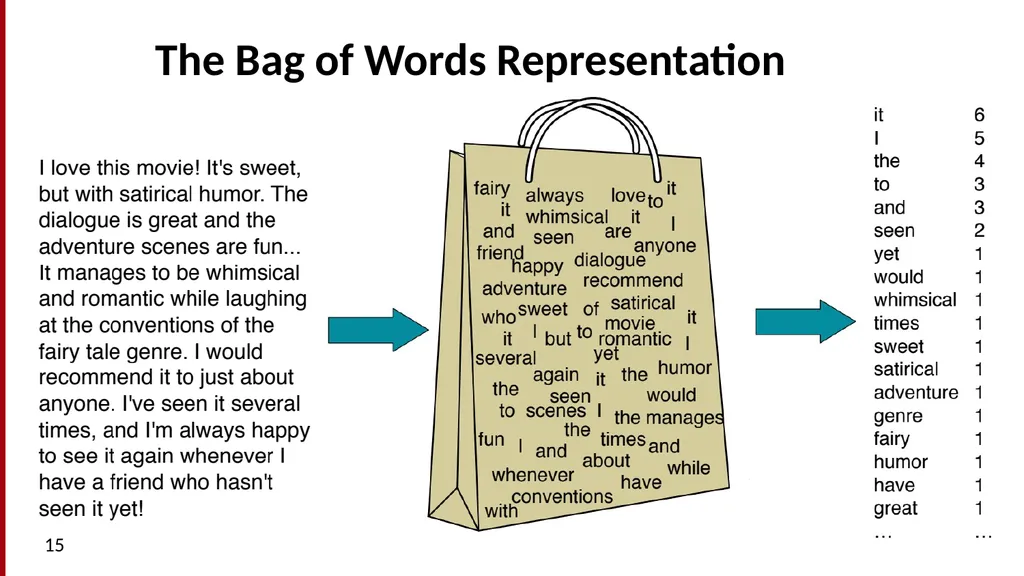
The Bag of Words Representation 15<br>
16
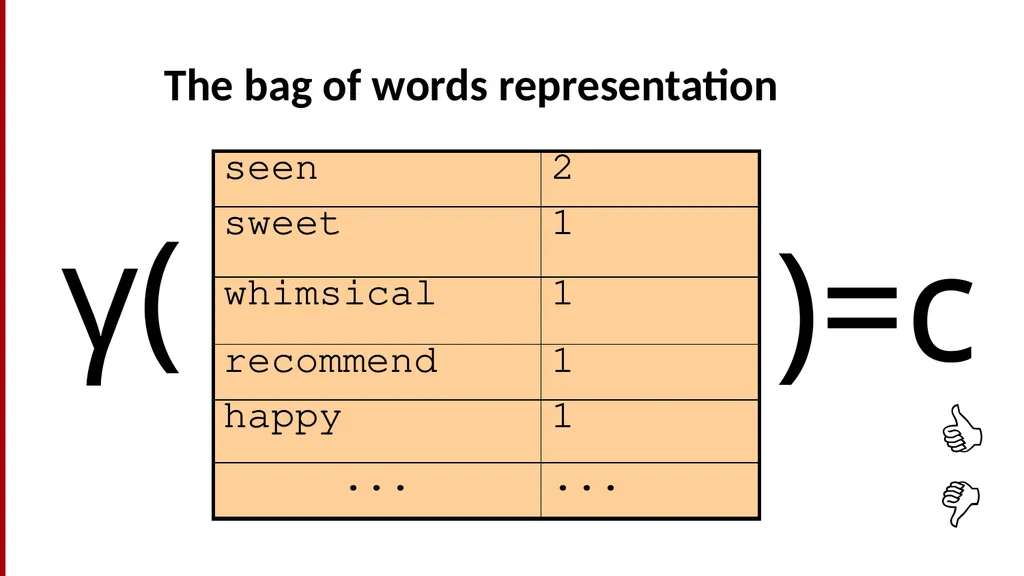
The bag of words representation γ( )=c<br>
17
Text Classification and Naïve Bayes Naïve Bayes (I)<br>
18
Text Classification and Naïve Bayes Formalizing the Naïve Bayes Classifier<br>
19
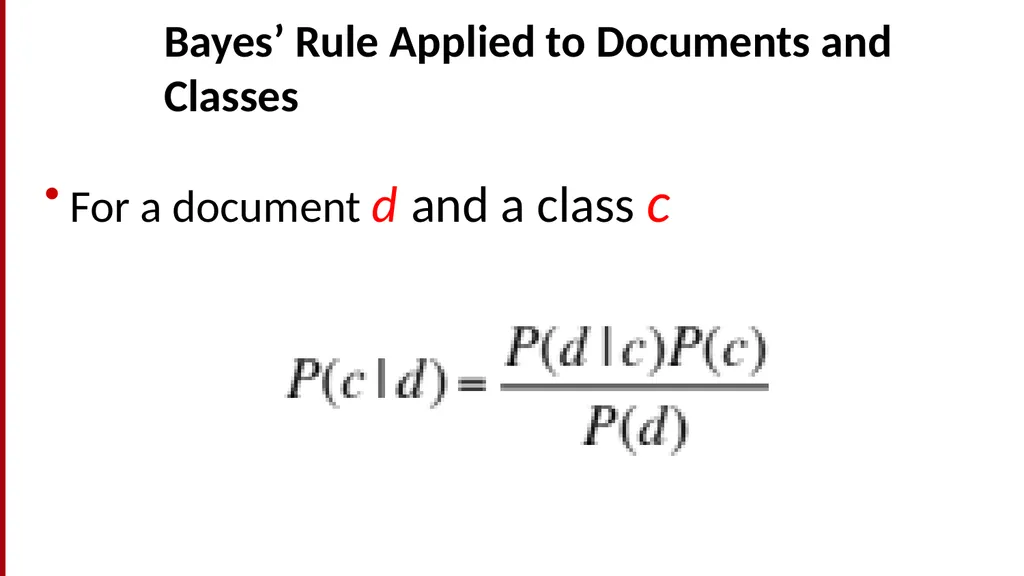
Bayes’ Rule Applied to Documents and Classes For a document d and a class c<br>
20
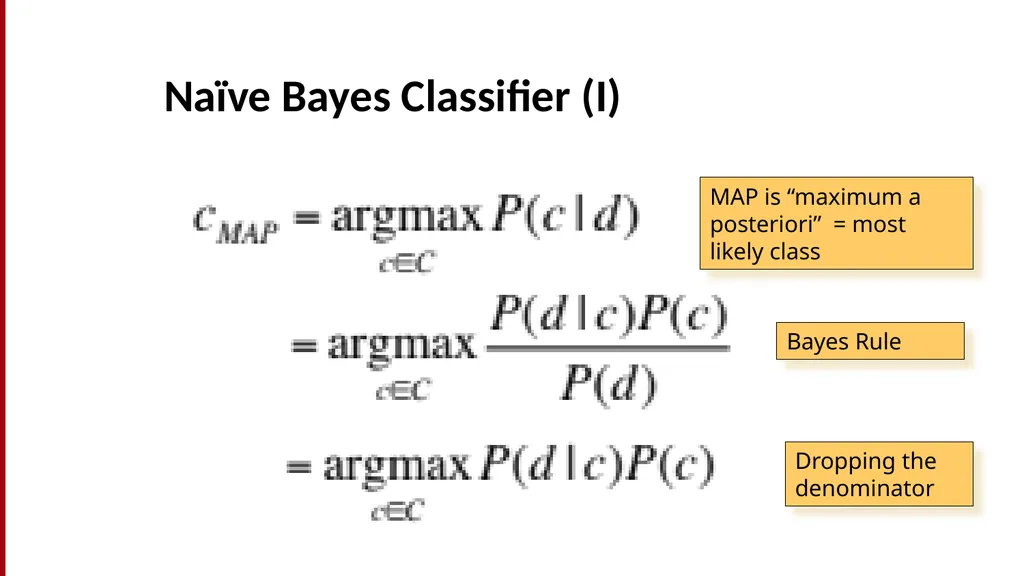
Naïve Bayes Classifier (I) MAP is “maximum a posteriori” = most likely class Bayes Rule Dropping the denominator<br>
21
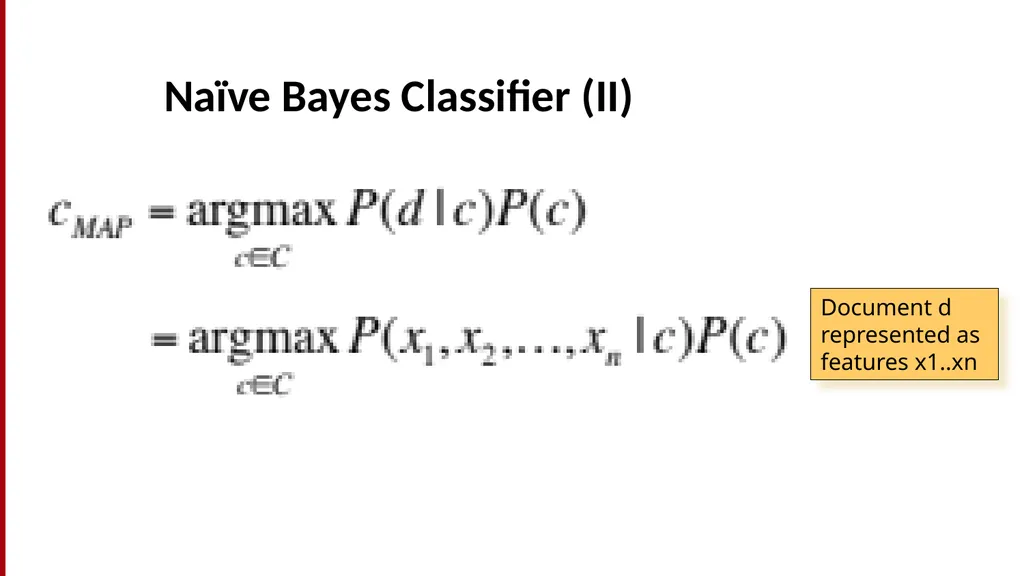
Naïve Bayes Classifier (II) Document d represented as features x1..xn<br>
22
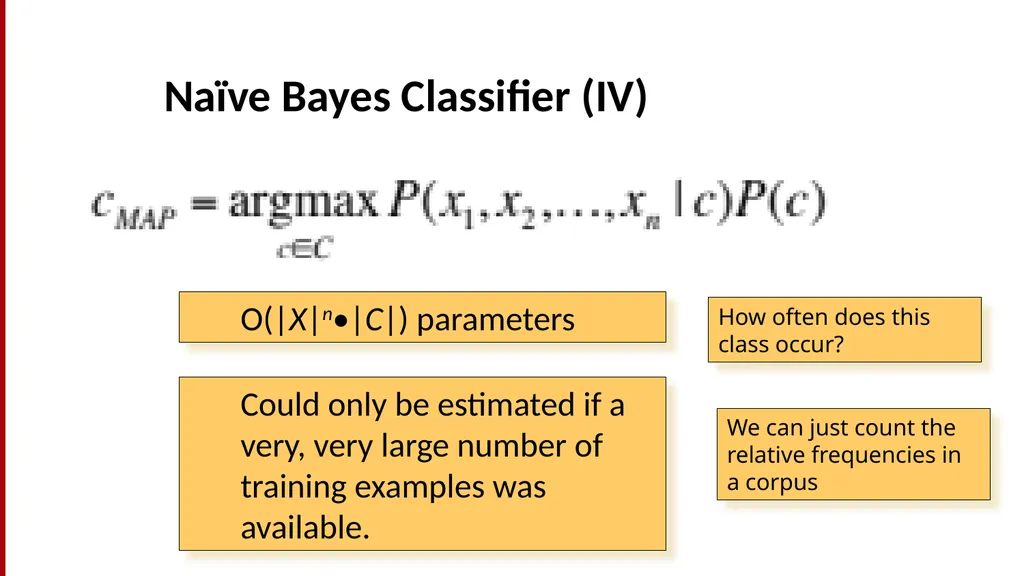
Naïve Bayes Classifier (IV) How often does this class occur? O(|X|n•|C|) parameters We can just count the relative frequencies in a corpus Could only be estimated if a very, very large number of training examples was available.<br>
23
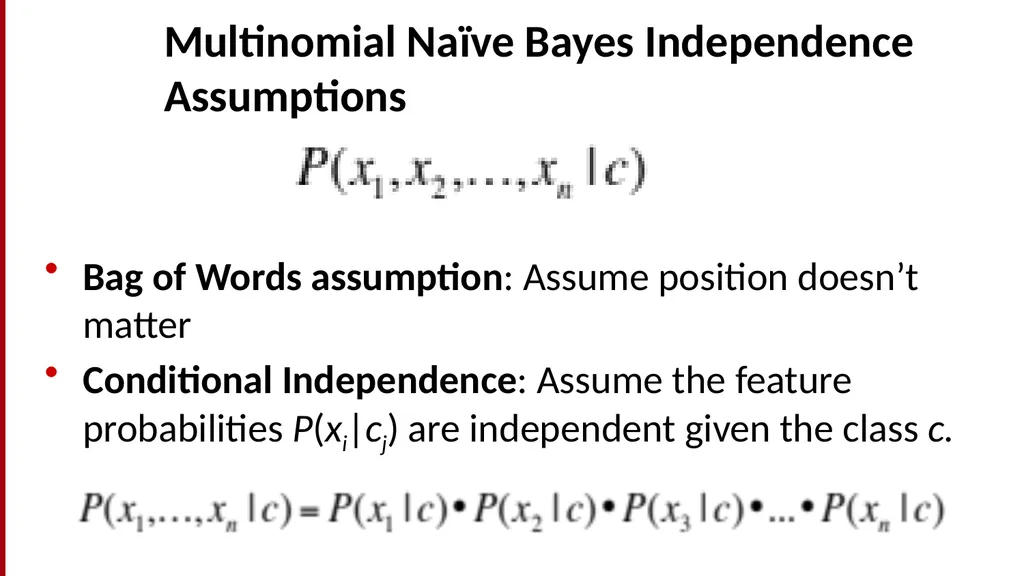
Multinomial Naïve Bayes Independence Assumptions Bag of Words assumption: Assume position doesn’t matter
Conditional Independence: Assume the feature probabilities P(xi|cj) are independent given the class c.<br>
Conditional Independence: Assume the feature probabilities P(xi|cj) are independent given the class c.<br>
24
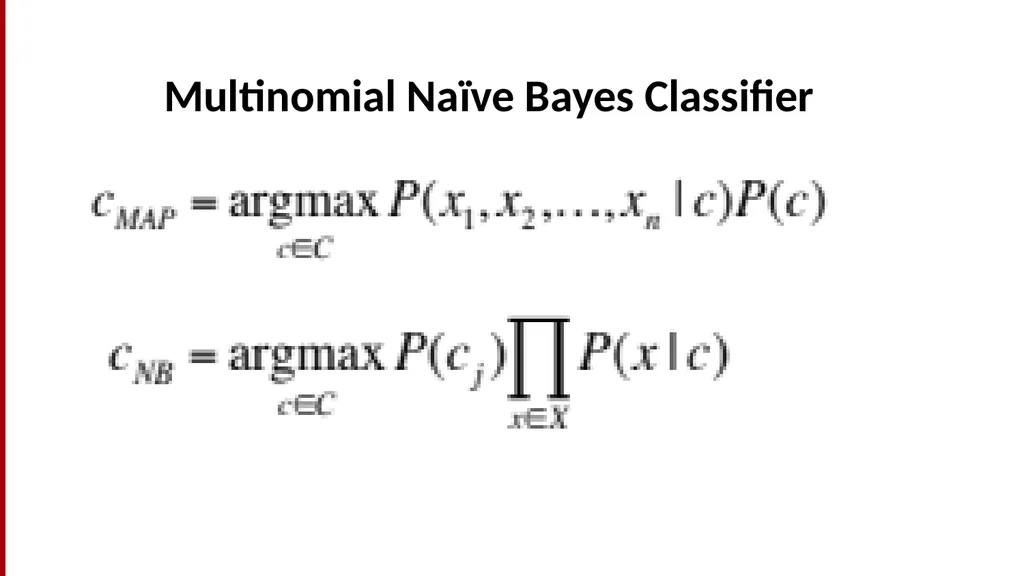
Multinomial Naïve Bayes Classifier<br>
25
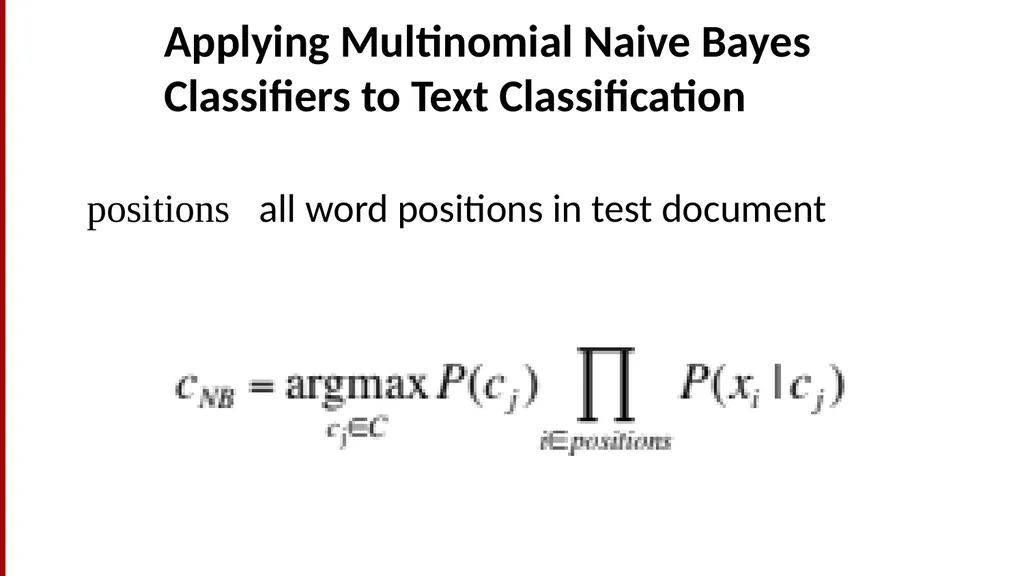
Applying Multinomial Naive Bayes Classifiers to Text Classification positions all word positions in test document<br>
26
Text Classification and Naïve Bayes Formalizing the Naïve Bayes Classifier<br>
27
Text Classification and Naïve Bayes Naïve Bayes: Learning<br>
28
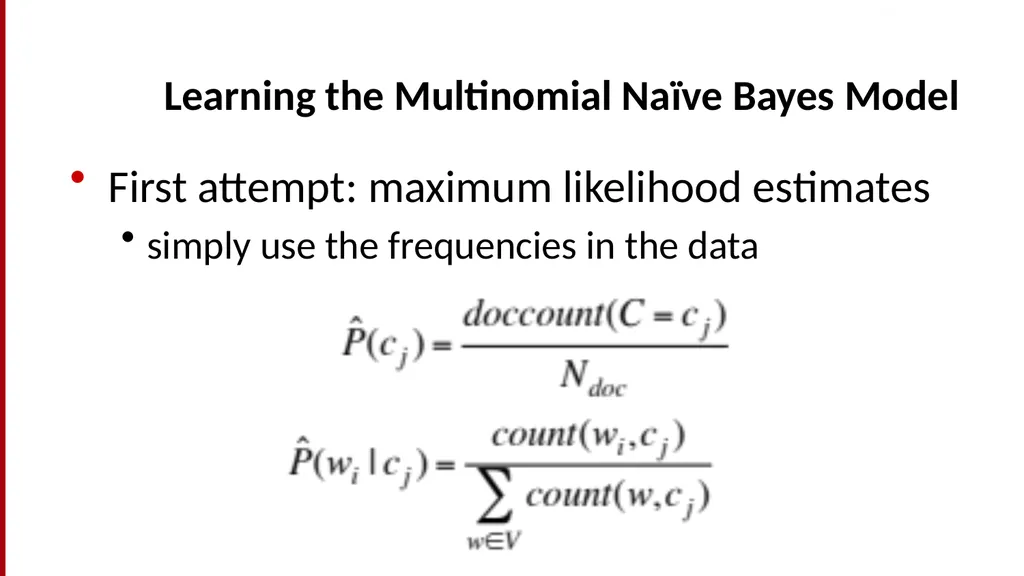
Learning the Multinomial Naïve Bayes Model First attempt: maximum likelihood estimates
simply use the frequencies in the data Sec.13.3<br>
simply use the frequencies in the data Sec.13.3<br>
29
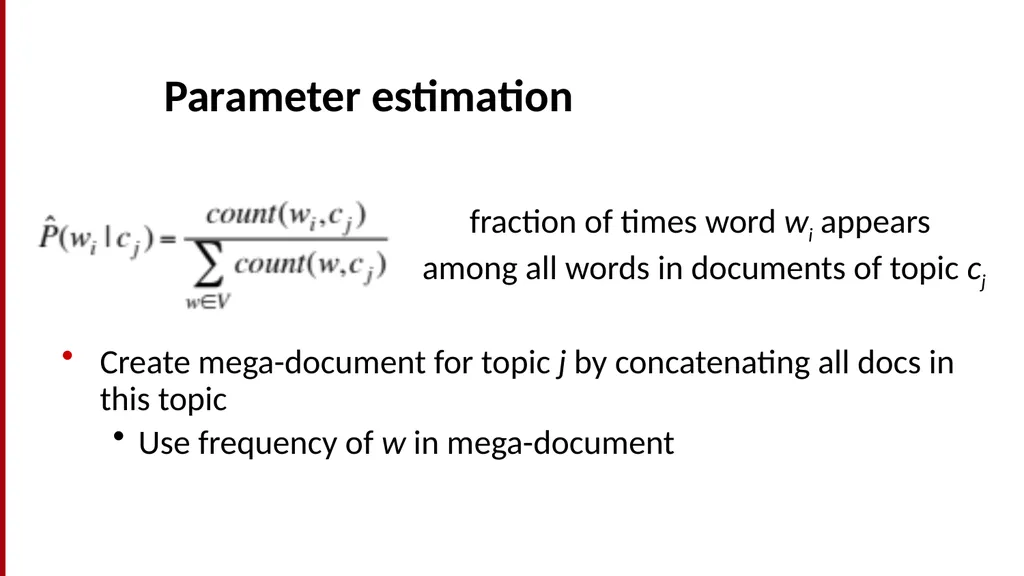
Create mega-document for topic j by concatenating all docs in this topic
Use frequency of w in mega-document Parameter estimation fraction of times word wi appears
among all words in documents of topic cj<br>
Use frequency of w in mega-document Parameter estimation fraction of times word wi appears
among all words in documents of topic cj<br>
30
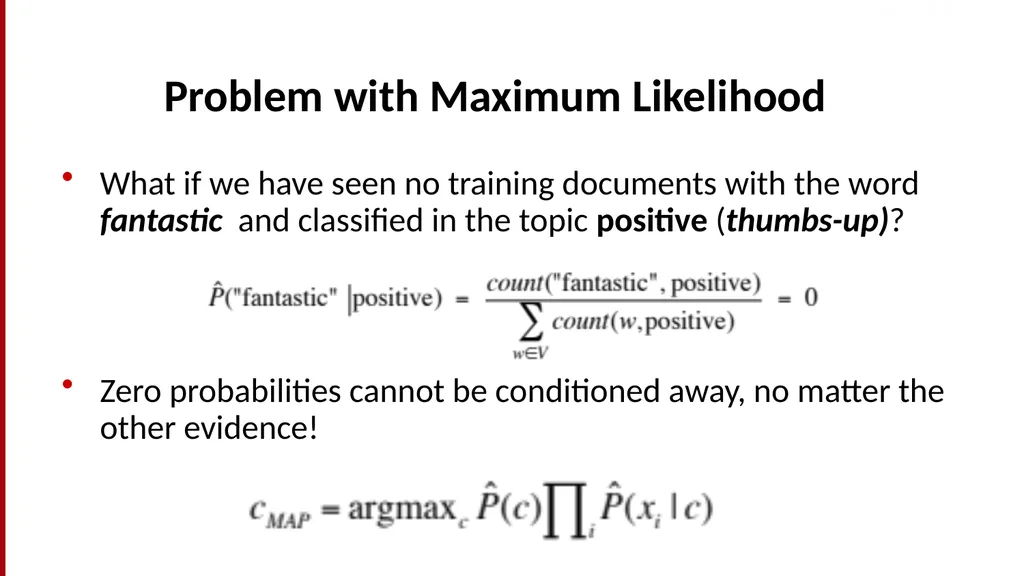
Problem with Maximum Likelihood What if we have seen no training documents with the word fantastic and classified in the topic positive (thumbs-up)?
Zero probabilities cannot be conditioned away, no matter the other evidence! Sec.13.3<br>
Zero probabilities cannot be conditioned away, no matter the other evidence! Sec.13.3<br>
31
Laplace (add-1) smoothing for Naïve Bayes<br>
32
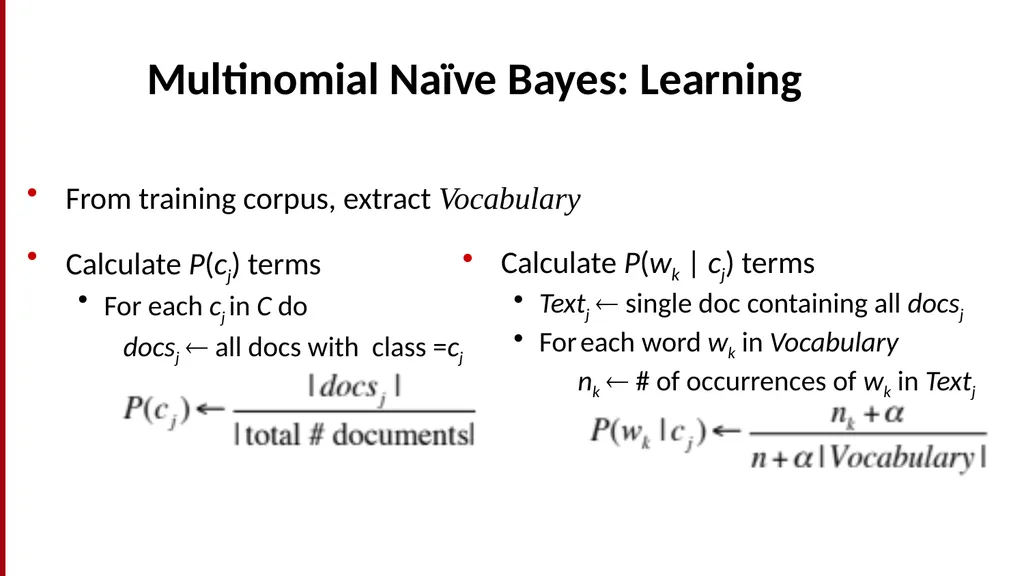
Multinomial Naïve Bayes: Learning Calculate P(cj) terms
For each cj in C do
docsj all docs with class =cj Calculate P(wk | cj) terms
Textj single doc containing all docsj
For each word wk in Vocabulary
nk # of occurrences of wk in Textj From training corpus, extract Vocabulary<br>
For each cj in C do
docsj all docs with class =cj Calculate P(wk | cj) terms
Textj single doc containing all docsj
For each word wk in Vocabulary
nk # of occurrences of wk in Textj From training corpus, extract Vocabulary<br>
33
Text Classification and Naïve Bayes Naïve Bayes: Learning<br>
34
Text Classification and Naïve Bayes Naïve Bayes: Relationship to Language Modeling<br>
35
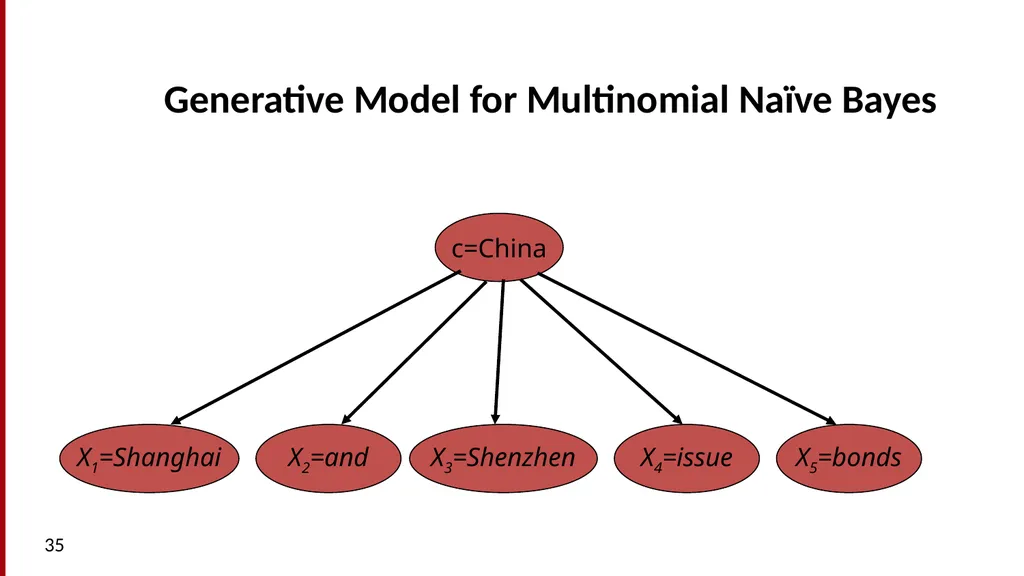
Generative Model for Multinomial Naïve Bayes 35 c=China X1=Shanghai X2=and X3=Shenzhen X4=issue X5=bonds<br>
36
Naïve Bayes and Language Modeling Naïve bayes classifiers can use any sort of feature
URL, email address, dictionaries, network features
But if, as in the previous slides
We use only word features
we use all of the words in the text (not a subset)
Then
Naïve bayes has an important similarity to language modeling. 36<br>
URL, email address, dictionaries, network features
But if, as in the previous slides
We use only word features
we use all of the words in the text (not a subset)
Then
Naïve bayes has an important similarity to language modeling. 36<br>
37
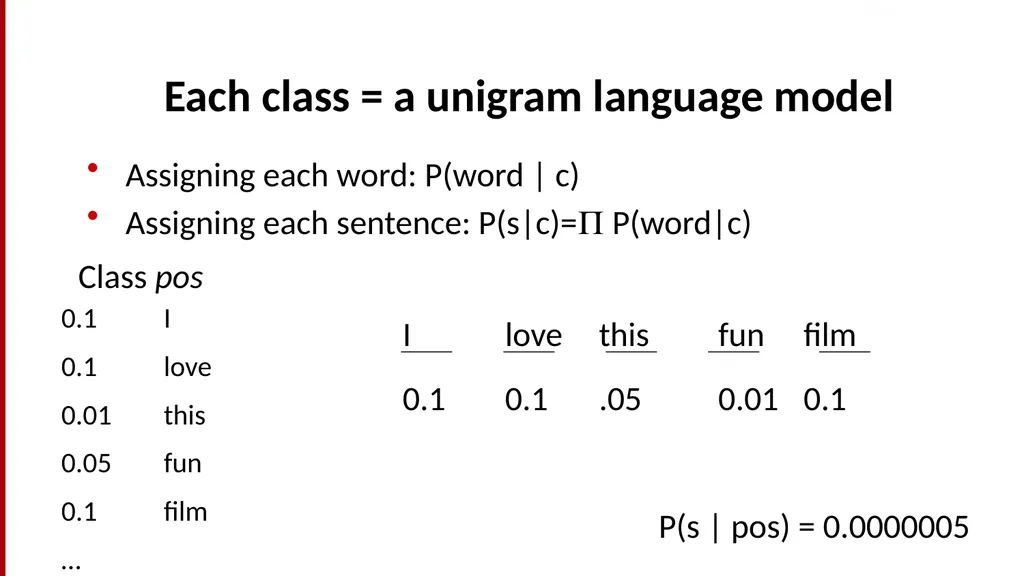
Each class = a unigram language model Assigning each word: P(word | c)
Assigning each sentence: P(s|c)=Π P(word|c) 0.1 I
0.1 love
0.01 this
0.05 fun
0.1 film
… I love this fun film 0.1 0.1 .05 0.01 0.1 Class pos P(s | pos) = 0.0000005 Sec.13.2.1<br>
Assigning each sentence: P(s|c)=Π P(word|c) 0.1 I
0.1 love
0.01 this
0.05 fun
0.1 film
… I love this fun film 0.1 0.1 .05 0.01 0.1 Class pos P(s | pos) = 0.0000005 Sec.13.2.1<br>
38
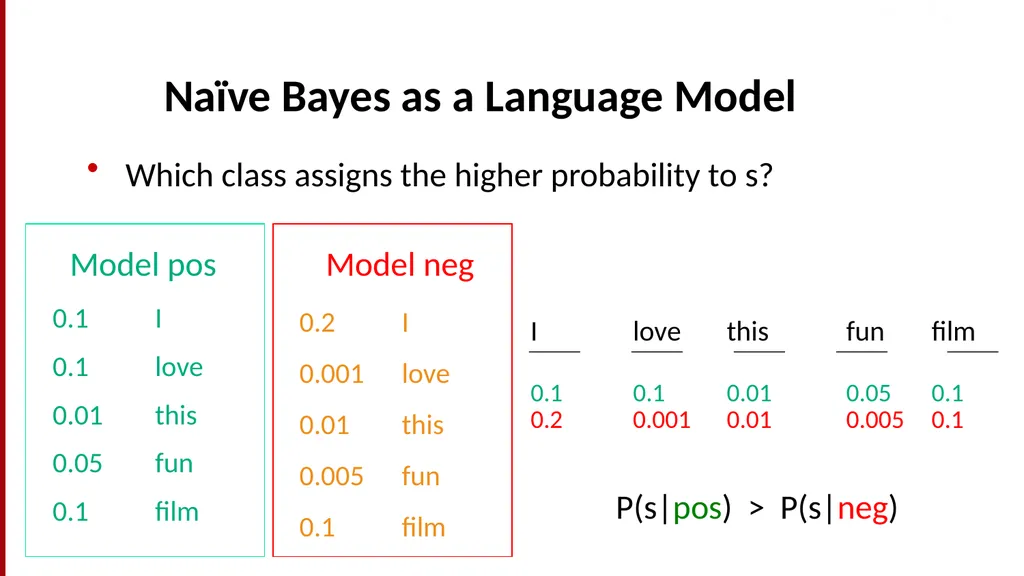
Naïve Bayes as a Language Model Which class assigns the higher probability to s? 0.1 I
0.1 love
0.01 this
0.05 fun
0.1 film Model pos Model neg P(s|pos) > P(s|neg) 0.2 I
0.001 love
0.01 this
0.005 fun
0.1 film Sec.13.2.1<br>
0.1 love
0.01 this
0.05 fun
0.1 film Model pos Model neg P(s|pos) > P(s|neg) 0.2 I
0.001 love
0.01 this
0.005 fun
0.1 film Sec.13.2.1<br>
39
Text Classification and Naïve Bayes Naïve Bayes: Relationship to Language Modeling<br>
40
Text Classification and Naïve Bayes Multinomial Naïve Bayes: A Worked Example<br>
41
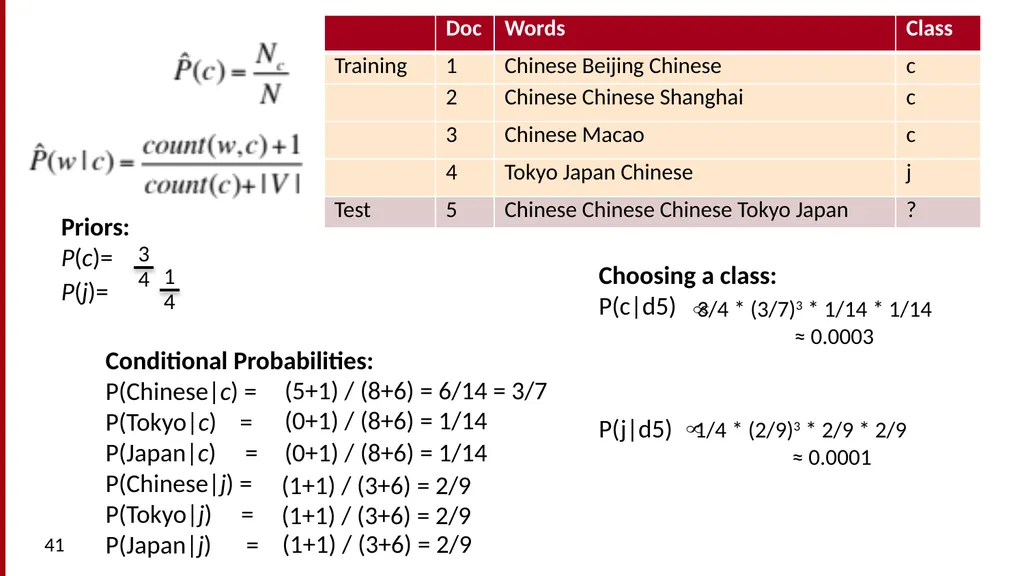
Choosing a class:
P(c|d5)
P(j|d5) 1/4 * (2/9)3 * 2/9 * 2/9
≈ 0.0001 41 Conditional Probabilities:
P(Chinese|c) =
P(Tokyo|c) =
P(Japan|c) =
P(Chinese|j) =
P(Tokyo|j) =
P(Japan|j) = Priors:
P(c)=
P(j)= 3 4 1 4 (5+1) / (8+6) = 6/14 = 3/7 (0+1) / (8+6) = 1/14 (1+1) / (3+6) = 2/9 (0+1) / (8+6) = 1/14 (1+1) / (3+6) = 2/9 (1+1) / (3+6) = 2/9 3/4 * (3/7)3 * 1/14 * 1/14
≈ 0.0003<br>
P(c|d5)
P(j|d5) 1/4 * (2/9)3 * 2/9 * 2/9
≈ 0.0001 41 Conditional Probabilities:
P(Chinese|c) =
P(Tokyo|c) =
P(Japan|c) =
P(Chinese|j) =
P(Tokyo|j) =
P(Japan|j) = Priors:
P(c)=
P(j)= 3 4 1 4 (5+1) / (8+6) = 6/14 = 3/7 (0+1) / (8+6) = 1/14 (1+1) / (3+6) = 2/9 (0+1) / (8+6) = 1/14 (1+1) / (3+6) = 2/9 (1+1) / (3+6) = 2/9 3/4 * (3/7)3 * 1/14 * 1/14
≈ 0.0003<br>
42
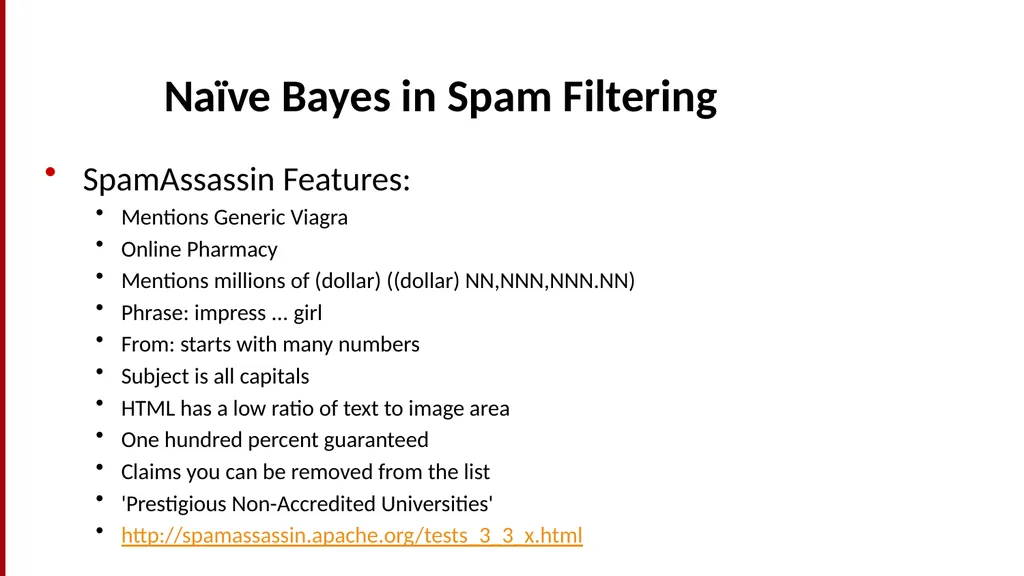
Naïve Bayes in Spam Filtering SpamAssassin Features:
Mentions Generic Viagra
Online Pharmacy
Mentions millions of (dollar) ((dollar) NN,NNN,NNN.NN)
Phrase: impress ... girl
From: starts with many numbers
Subject is all capitals
HTML has a low ratio of text to image area
One hundred percent guaranteed
Claims you can be removed from the list
'Prestigious Non-Accredited Universities'
http://spamassassin.apache.org/tests_3_3_x.html<br>
Mentions Generic Viagra
Online Pharmacy
Mentions millions of (dollar) ((dollar) NN,NNN,NNN.NN)
Phrase: impress ... girl
From: starts with many numbers
Subject is all capitals
HTML has a low ratio of text to image area
One hundred percent guaranteed
Claims you can be removed from the list
'Prestigious Non-Accredited Universities'
http://spamassassin.apache.org/tests_3_3_x.html<br>
43
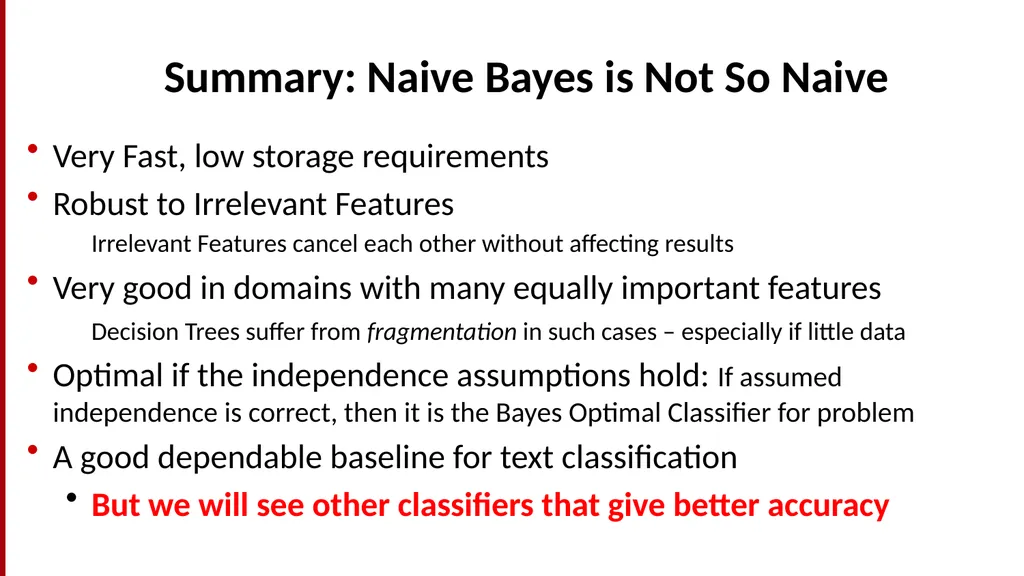
Summary: Naive Bayes is Not So Naive Very Fast, low storage requirements
Robust to Irrelevant Features
Irrelevant Features cancel each other without affecting results
Very good in domains with many equally important features
Decision Trees suffer from fragmentation in such cases – especially if little data
Optimal if the independence assumptions hold: If assumed independence is correct, then it is the Bayes Optimal Classifier for problem
A good dependable baseline for text classification
But we will see other classifiers that give better accuracy<br>
Robust to Irrelevant Features
Irrelevant Features cancel each other without affecting results
Very good in domains with many equally important features
Decision Trees suffer from fragmentation in such cases – especially if little data
Optimal if the independence assumptions hold: If assumed independence is correct, then it is the Bayes Optimal Classifier for problem
A good dependable baseline for text classification
But we will see other classifiers that give better accuracy<br>
44
Text Classification and Naïve Bayes Multinomial Naïve Bayes: A Worked Example<br>
45
Text Classification and Naïve Bayes Precision, Recall, and the F measure<br>
46
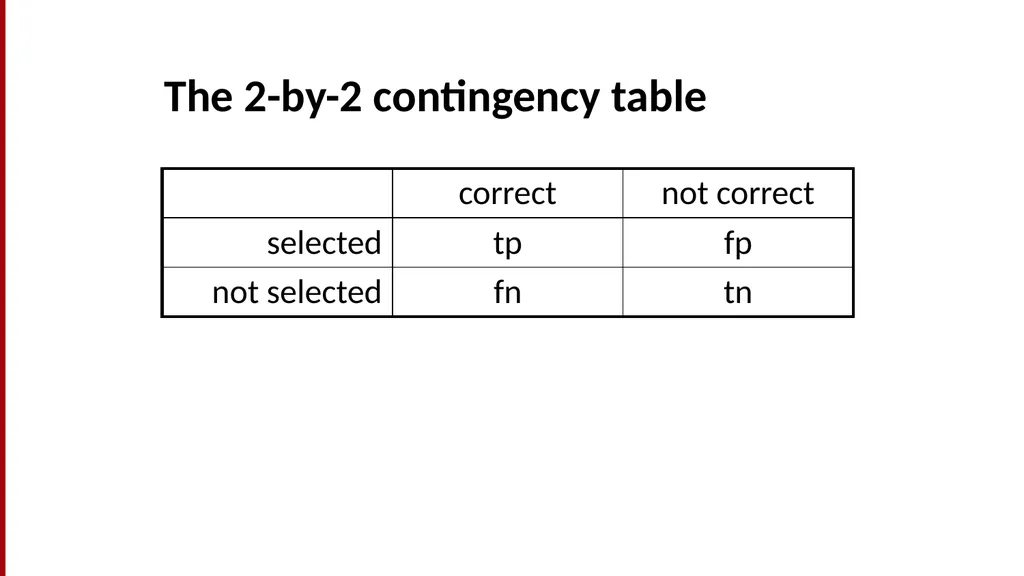
The 2-by-2 contingency table<br>
47
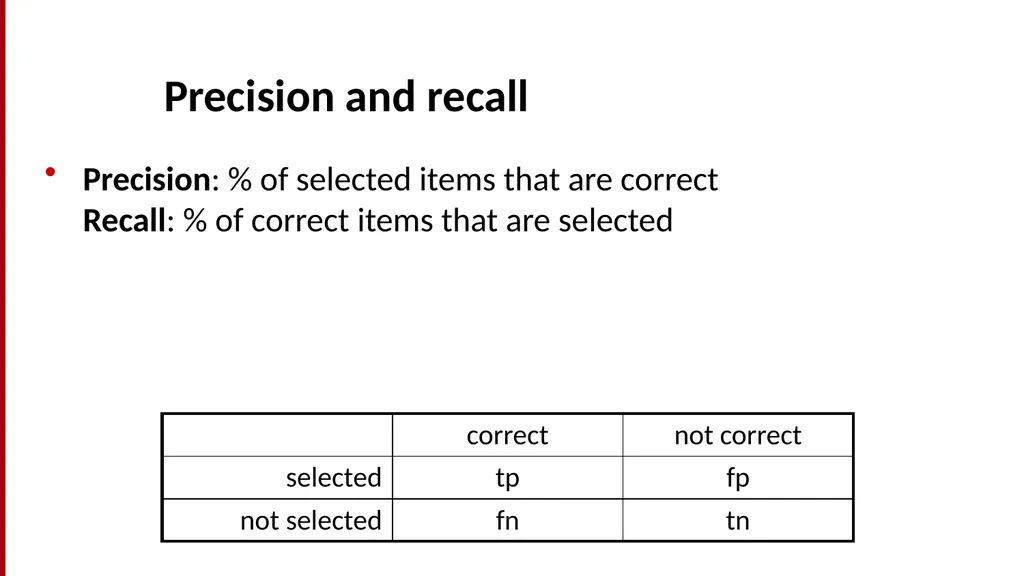
Precision and recall Precision: % of selected items that are correct
Recall: % of correct items that are selected<br>
48
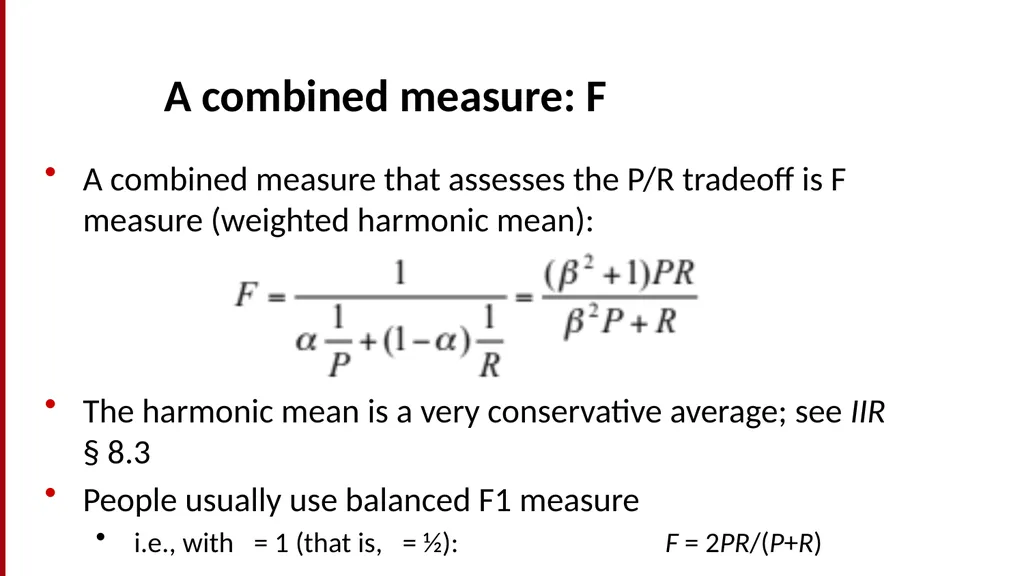
A combined measure: F A combined measure that assesses the P/R tradeoff is F measure (weighted harmonic mean):
The harmonic mean is a very conservative average; see IIR § 8.3
People usually use balanced F1 measure
i.e., with = 1 (that is, = ½): F = 2PR/(P+R)<br>
The harmonic mean is a very conservative average; see IIR § 8.3
People usually use balanced F1 measure
i.e., with = 1 (that is, = ½): F = 2PR/(P+R)<br>
49
Text Classification and Naïve Bayes Precision, Recall, and the F measure<br>
50
Text Classification and Naïve Bayes Text Classification: Evaluation<br>
51
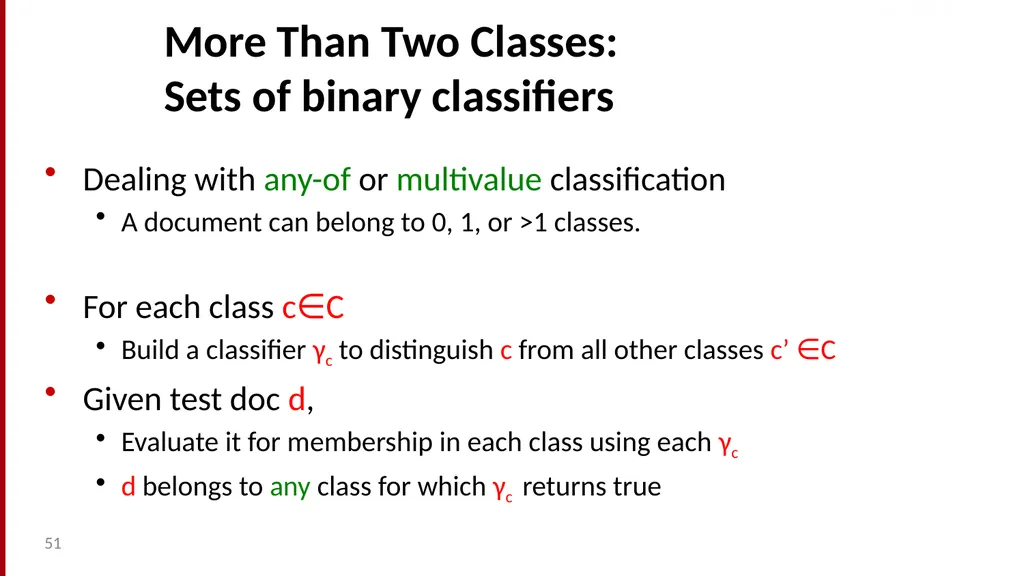
51 More Than Two Classes:
Sets of binary classifiers Dealing with any-of or multivalue classification
A document can belong to 0, 1, or >1 classes.
For each class c∈C
Build a classifier γc to distinguish c from all other classes c’ ∈C
Given test doc d,
Evaluate it for membership in each class using each γc
d belongs to any class for which γc returns true Sec.14.5<br>
A document can belong to 0, 1, or >1 classes.
For each class c∈C
Build a classifier γc to distinguish c from all other classes c’ ∈C
Given test doc d,
Evaluate it for membership in each class using each γc
d belongs to any class for which γc returns true Sec.14.5<br>
52
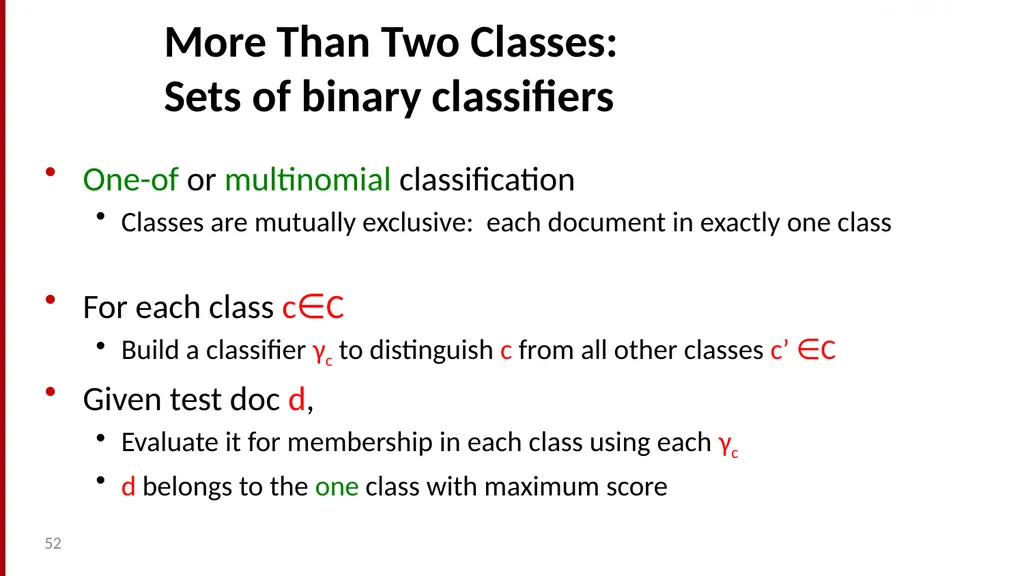
52 More Than Two Classes:
Sets of binary classifiers One-of or multinomial classification
Classes are mutually exclusive: each document in exactly one class
For each class c∈C
Build a classifier γc to distinguish c from all other classes c’ ∈C
Given test doc d,
Evaluate it for membership in each class using each γc
d belongs to the one class with maximum score Sec.14.5<br>
Classes are mutually exclusive: each document in exactly one class
For each class c∈C
Build a classifier γc to distinguish c from all other classes c’ ∈C
Given test doc d,
Evaluate it for membership in each class using each γc
d belongs to the one class with maximum score Sec.14.5<br>
53
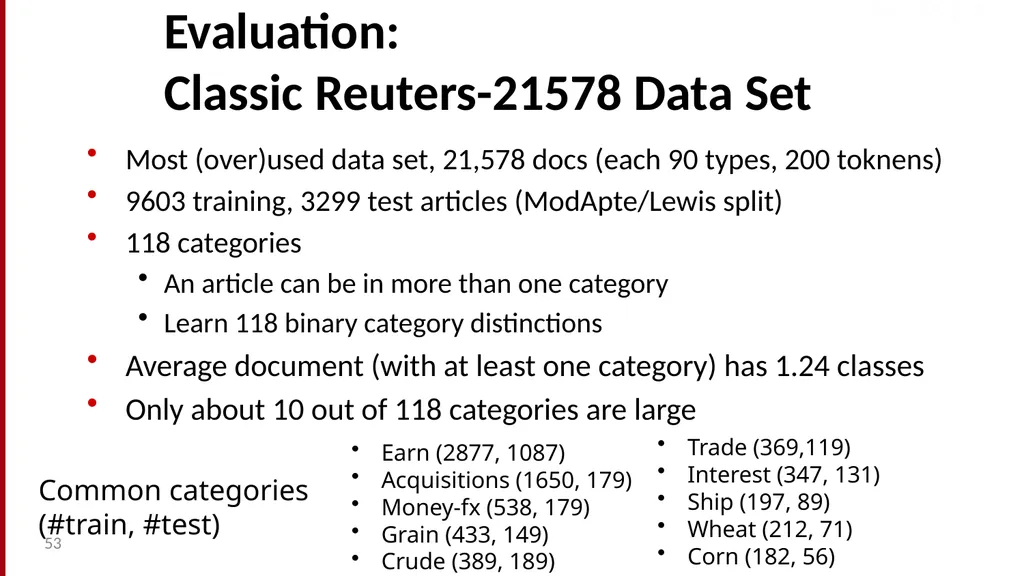
53 Most (over)used data set, 21,578 docs (each 90 types, 200 toknens)
9603 training, 3299 test articles (ModApte/Lewis split)
118 categories
An article can be in more than one category
Learn 118 binary category distinctions
Average document (with at least one category) has 1.24 classes
Only about 10 out of 118 categories are large Common categories
(#train, #test) Evaluation: Classic Reuters-21578 Data Set Earn (2877, 1087)
Acquisitions (1650, 179)
Money-fx (538, 179)
Grain (433, 149)
Crude (389, 189) Trade (369,119)
Interest (347, 131)
Ship (197, 89)
Wheat (212, 71)
Corn (182, 56) Sec. 15.2.4<br>
9603 training, 3299 test articles (ModApte/Lewis split)
118 categories
An article can be in more than one category
Learn 118 binary category distinctions
Average document (with at least one category) has 1.24 classes
Only about 10 out of 118 categories are large Common categories
(#train, #test) Evaluation: Classic Reuters-21578 Data Set Earn (2877, 1087)
Acquisitions (1650, 179)
Money-fx (538, 179)
Grain (433, 149)
Crude (389, 189) Trade (369,119)
Interest (347, 131)
Ship (197, 89)
Wheat (212, 71)
Corn (182, 56) Sec. 15.2.4<br>
54
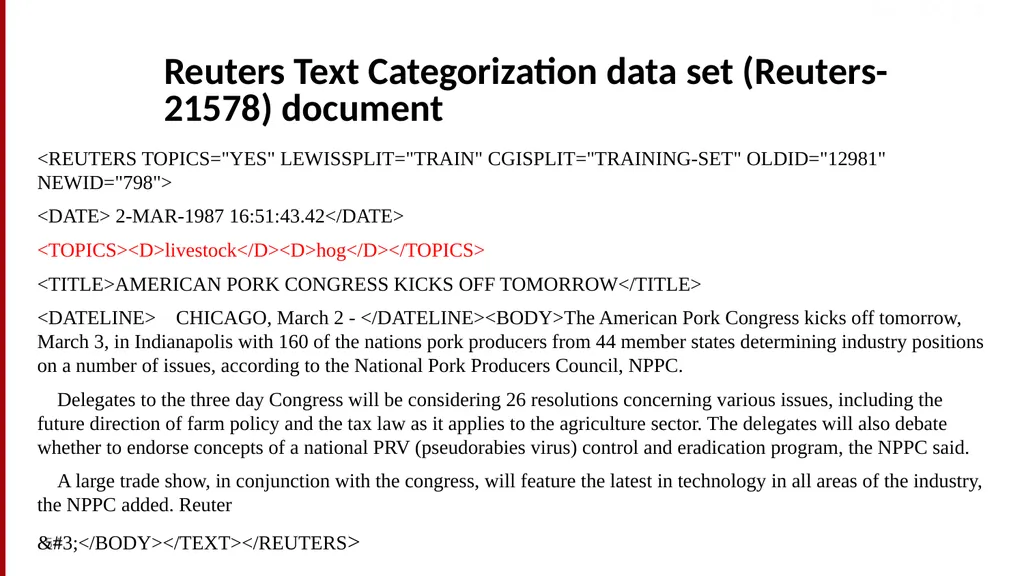
54 Reuters Text Categorization data set (Reuters-21578) document <REUTERS TOPICS="YES" LEWISSPLIT="TRAIN" CGISPLIT="TRAINING-SET" OLDID="12981" NEWID="798">
<DATE> 2-MAR-1987 16:51:43.42</DATE>
<TOPICS><D>livestock</D><D>hog</D></TOPICS>
<TITLE>AMERICAN PORK CONGRESS KICKS OFF TOMORROW</TITLE>
<DATELINE> CHICAGO, March 2 - </DATELINE><BODY>The American Pork Congress kicks off tomorrow, March 3, in Indianapolis with 160 of the nations pork producers from 44 member states determining industry positions on a number of issues, according to the National Pork Producers Council, NPPC.
Delegates to the three day Congress will be considering 26 resolutions concerning various issues, including the future direction of farm policy and the tax law as it applies to the agriculture sector. The delegates will also debate whether to endorse concepts of a national PRV (pseudorabies virus) control and eradication program, the NPPC said.
A large trade show, in conjunction with the congress, will feature the latest in technology in all areas of the industry, the NPPC added. Reuter
</BODY></TEXT></REUTERS> Sec. 15.2.4<br>
<DATE> 2-MAR-1987 16:51:43.42</DATE>
<TOPICS><D>livestock</D><D>hog</D></TOPICS>
<TITLE>AMERICAN PORK CONGRESS KICKS OFF TOMORROW</TITLE>
<DATELINE> CHICAGO, March 2 - </DATELINE><BODY>The American Pork Congress kicks off tomorrow, March 3, in Indianapolis with 160 of the nations pork producers from 44 member states determining industry positions on a number of issues, according to the National Pork Producers Council, NPPC.
Delegates to the three day Congress will be considering 26 resolutions concerning various issues, including the future direction of farm policy and the tax law as it applies to the agriculture sector. The delegates will also debate whether to endorse concepts of a national PRV (pseudorabies virus) control and eradication program, the NPPC said.
A large trade show, in conjunction with the congress, will feature the latest in technology in all areas of the industry, the NPPC added. Reuter
</BODY></TEXT></REUTERS> Sec. 15.2.4<br>
55
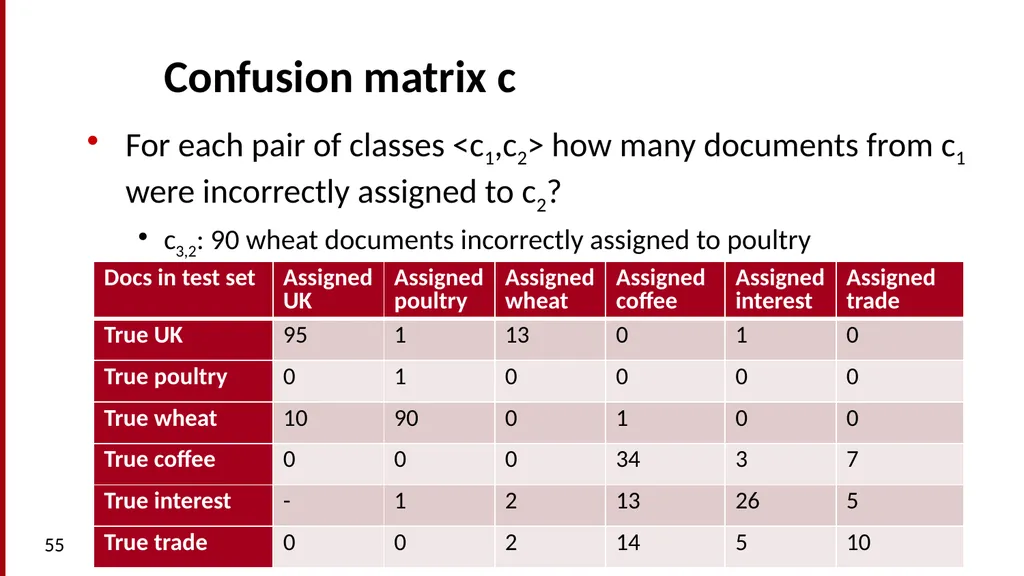
Confusion matrix c For each pair of classes <c1,c2> how many documents from c1 were incorrectly assigned to c2?
c3,2: 90 wheat documents incorrectly assigned to poultry 55<br>
c3,2: 90 wheat documents incorrectly assigned to poultry 55<br>
56
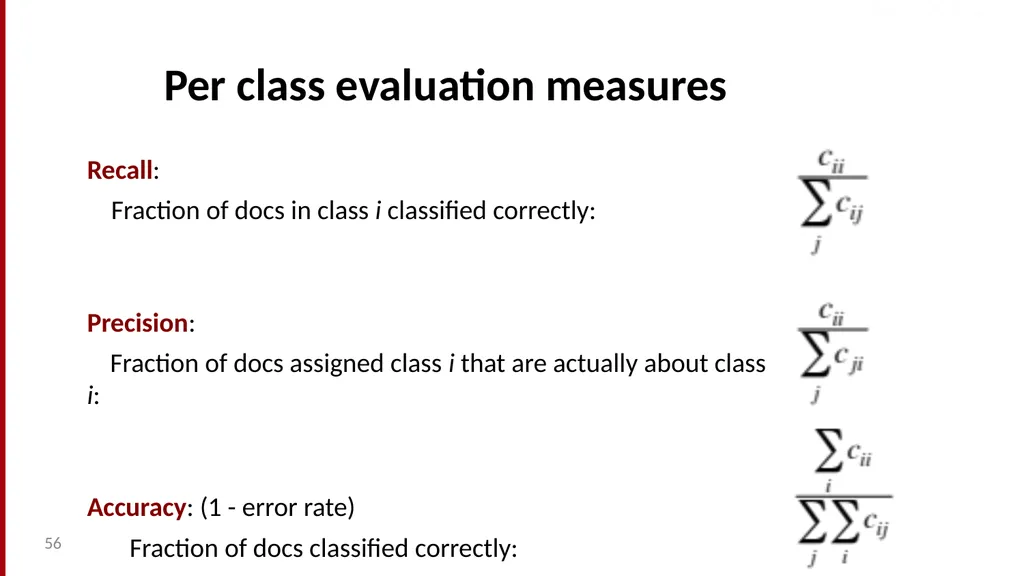
56 Per class evaluation measures Recall:
Fraction of docs in class i classified correctly:
Precision:
Fraction of docs assigned class i that are actually about class i:
Accuracy: (1 - error rate)
Fraction of docs classified correctly: Sec. 15.2.4<br>
Fraction of docs in class i classified correctly:
Precision:
Fraction of docs assigned class i that are actually about class i:
Accuracy: (1 - error rate)
Fraction of docs classified correctly: Sec. 15.2.4<br>
57
57 Micro- vs. Macro-Averaging If we have more than one class, how do we combine multiple performance measures into one quantity?
Macroaveraging: Compute performance for each class, then average.
Microaveraging: Collect decisions for all classes, compute contingency table, evaluate. Sec. 15.2.4<br>
Macroaveraging: Compute performance for each class, then average.
Microaveraging: Collect decisions for all classes, compute contingency table, evaluate. Sec. 15.2.4<br>
58
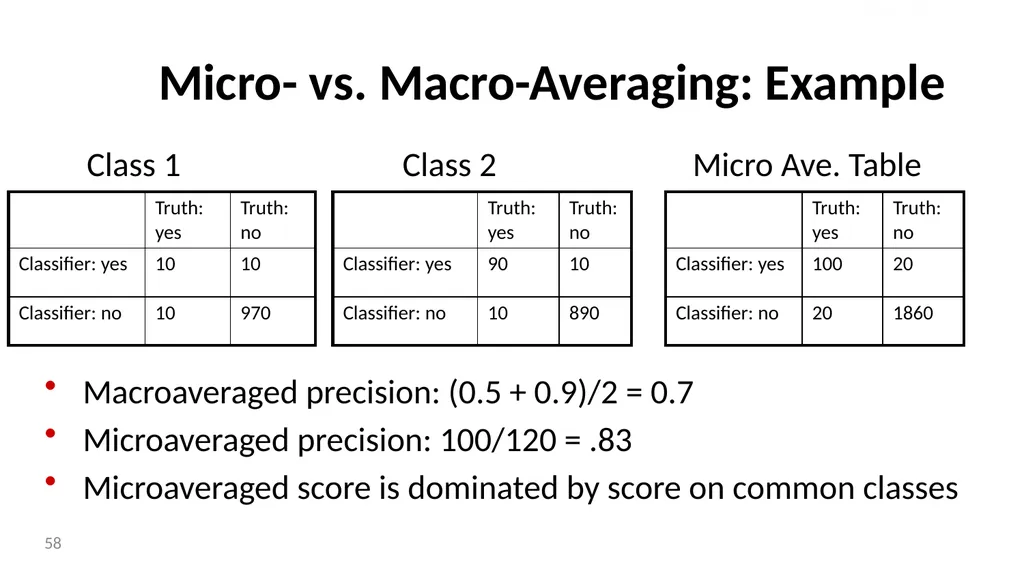
58 Micro- vs. Macro-Averaging: Example Class 1 Class 2 Micro Ave. Table Sec. 15.2.4 Macroaveraged precision: (0.5 + 0.9)/2 = 0.7
Microaveraged precision: 100/120 = .83
Microaveraged score is dominated by score on common classes<br>
Microaveraged precision: 100/120 = .83
Microaveraged score is dominated by score on common classes<br>
59
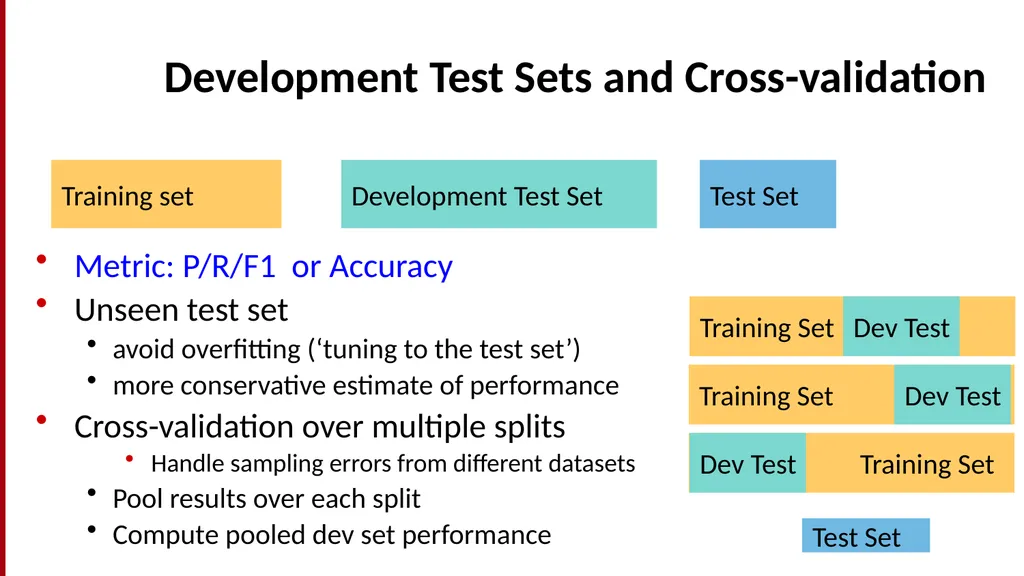
Development Test Sets and Cross-validation Metric: P/R/F1 or Accuracy
Unseen test set
avoid overfitting (‘tuning to the test set’)
more conservative estimate of performance
Cross-validation over multiple splits
Handle sampling errors from different datasets
Pool results over each split
Compute pooled dev set performance Training set Development Test Set Test Set Test Set<br>
Unseen test set
avoid overfitting (‘tuning to the test set’)
more conservative estimate of performance
Cross-validation over multiple splits
Handle sampling errors from different datasets
Pool results over each split
Compute pooled dev set performance Training set Development Test Set Test Set Test Set<br>
60
Text Classification and Naïve Bayes Text Classification: Evaluation<br>
61
Text Classification and Naïve Bayes Text Classification: Practical Issues<br>
62
62 The Real World Gee, I’m building a text classifier for real, now!
What should I do? Sec. 15.3.1<br>
What should I do? Sec. 15.3.1<br>
63
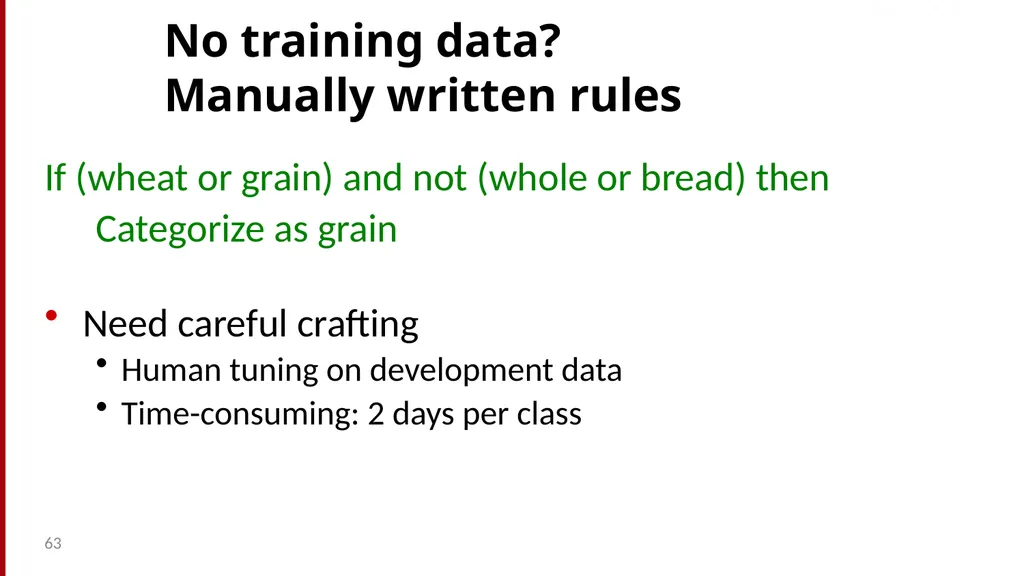
63 No training data?
Manually written rules If (wheat or grain) and not (whole or bread) then
Categorize as grain
Need careful crafting
Human tuning on development data
Time-consuming: 2 days per class Sec. 15.3.1<br>
Categorize as grain
Need careful crafting
Human tuning on development data
Time-consuming: 2 days per class Sec. 15.3.1<br>
64
64 Very little data? Use Naïve Bayes
Naïve Bayes is a “high-bias” algorithm (Ng and Jordan 2002 NIPS)
Get more labeled data
Find clever ways to get humans to label data for you
Try semi-supervised training methods:
Bootstrapping, EM over unlabeled documents, … Sec. 15.3.1<br>
Naïve Bayes is a “high-bias” algorithm (Ng and Jordan 2002 NIPS)
Get more labeled data
Find clever ways to get humans to label data for you
Try semi-supervised training methods:
Bootstrapping, EM over unlabeled documents, … Sec. 15.3.1<br>
65
65 A reasonable amount of data? Perfect for all the clever classifiers
SVM
Regularized Logistic Regression
You can even use user-interpretable decision trees
Users like to hack
Management likes quick fixes Sec. 15.3.1<br>
SVM
Regularized Logistic Regression
You can even use user-interpretable decision trees
Users like to hack
Management likes quick fixes Sec. 15.3.1<br>
66
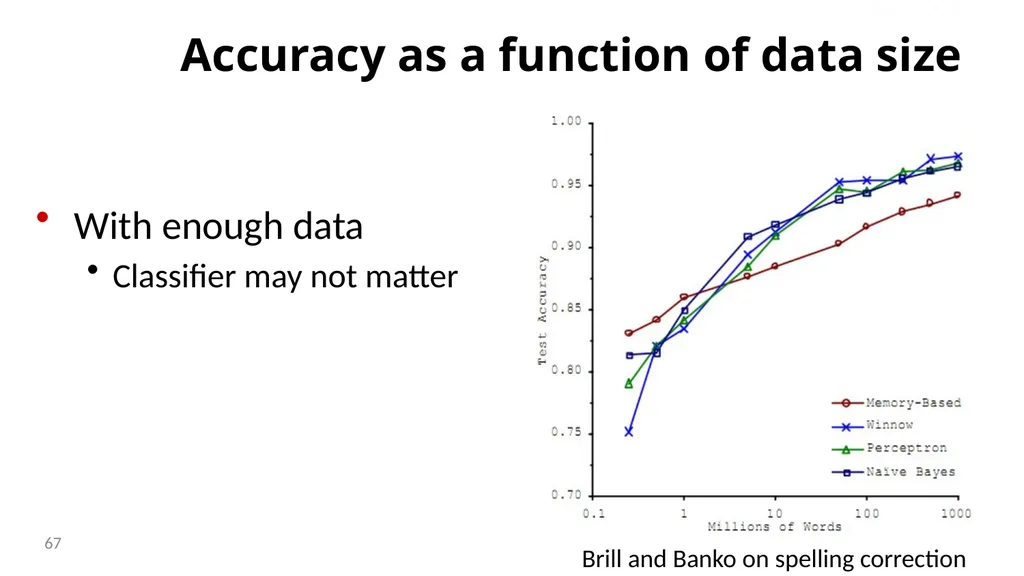
66 A huge amount of data? Can achieve high accuracy!
At a cost:
SVMs (train time) or kNN (test time) can be too slow
Regularized logistic regression can be somewhat better
So Naïve Bayes can come back into its own again! Sec. 15.3.1<br>
At a cost:
SVMs (train time) or kNN (test time) can be too slow
Regularized logistic regression can be somewhat better
So Naïve Bayes can come back into its own again! Sec. 15.3.1<br>
67
67 Accuracy as a function of data size With enough data
Classifier may not matter Sec. 15.3.1 Brill and Banko on spelling correction<br>
Classifier may not matter Sec. 15.3.1 Brill and Banko on spelling correction<br>
68
Real-world systems generally combine: Automatic classification
Manual review of uncertain/difficult/"new” cases 68<br>
Manual review of uncertain/difficult/"new” cases 68<br>
69
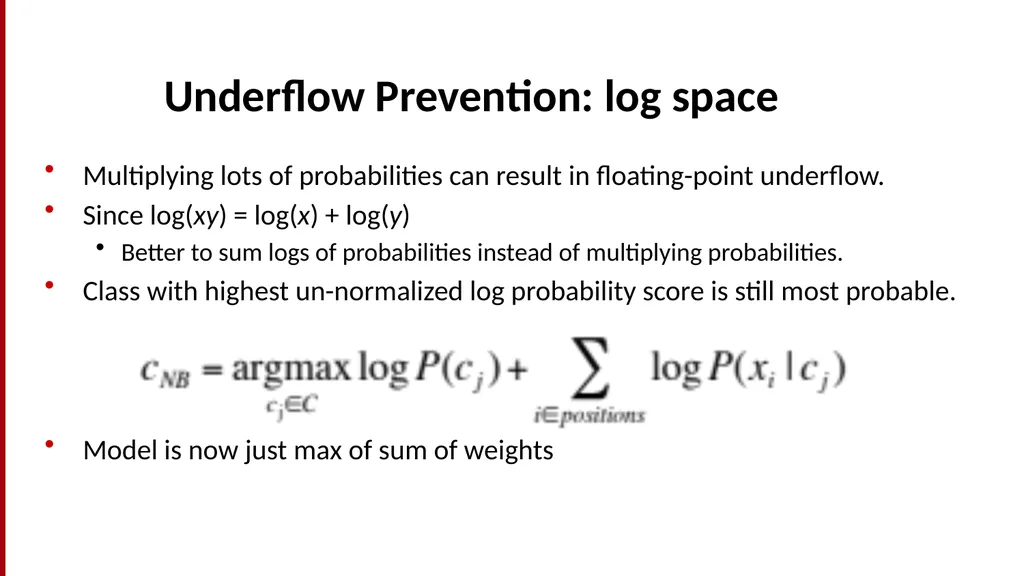
Underflow Prevention: log space Multiplying lots of probabilities can result in floating-point underflow.
Since log(xy) = log(x) + log(y)
Better to sum logs of probabilities instead of multiplying probabilities.
Class with highest un-normalized log probability score is still most probable.
Model is now just max of sum of weights<br>
Since log(xy) = log(x) + log(y)
Better to sum logs of probabilities instead of multiplying probabilities.
Class with highest un-normalized log probability score is still most probable.
Model is now just max of sum of weights<br>
70
70 How to tweak performance Domain-specific features and weights: very important in real performance
Sometimes need to collapse terms:
Part numbers, chemical formulas, …
But stemming generally doesn’t help
Upweighting: Counting a word as if it occurred twice:
title words (Cohen & Singer 1996)
first sentence of each paragraph (Murata, 1999)
In sentences that contain title words (Ko et al, 2002) Sec. 15.3.2<br>
Sometimes need to collapse terms:
Part numbers, chemical formulas, …
But stemming generally doesn’t help
Upweighting: Counting a word as if it occurred twice:
title words (Cohen & Singer 1996)
first sentence of each paragraph (Murata, 1999)
In sentences that contain title words (Ko et al, 2002) Sec. 15.3.2<br>
71
Text Classification and Naïve Bayes Text Classification: Practical Issues<br>