Thank you for being ready to learn! Title: The Problem of Evil Y11 Philosophy Induction Aims: To understand the A Level Philosophy course a bit better To know the logical problem of evil. To consider responses to the logical problem. To
"Thank you for being ready to learn! Title: The" is the property of its rightful owner. Permission is granted to
download and print the materials on this website for personal, non-commercial use only, and to display it
on your personal computer provided you do not modify the materials and that you retain all copyright
notices contained in the materials. By downloading content from our website, you accept the terms of this
agreement.
Presentation Transcript
01
Thank you for being ready to learn! Title: The Problem of Evil
Y11 Philosophy Induction Aims:
To understand the A Level Philosophy course a bit better
To know the logical problem of evil.
To consider responses to the logical problem.
To develop logical evaluation skills. DNA:
Write down some of the worst evils you can think of. Divide them into those done by people, and those that occur through non-human forces.<br>
02
What is Philosophy? Philosophy literally means love of wisdom. But this isn’t hugely helpful in understanding what Philosophy is.
It means asking big questions and using logical thinking to figure out answers to them.
This means not just accepting what others think, what has been thought, is thought by most people or what feels right, but ‘seeing where the argument leads’.
This isn’t always popular. People don’t like their ways of being, their traditional beliefs, being questioned. Socrates was made to drink poison. Many philosophers (e.g. Spinoza) have been cast out of their communities.
Do you like thinking about deep questions?<br>
03
Our Course’s Big Questions The Philosophy course covers these big questions:
What do we know for sure?
What is right and what is wrong?
Is there a God?
What is a mind? Is it the same as a brain or is it the same as a spiritual soul?<br>
04
How the course is assessed Two three-hour exams at the end of the two years, covering all content from the two years of the course
Yes, you read that right, 2 x 3hr exams.
No coursework<br>
05
Problem of Evil Does evil show that God does not exist?<br>
06
Write down the worst evils you can think of in the following categories: Moral evil (done by humans) Natural evil (happens because of natural processes)<br>
07
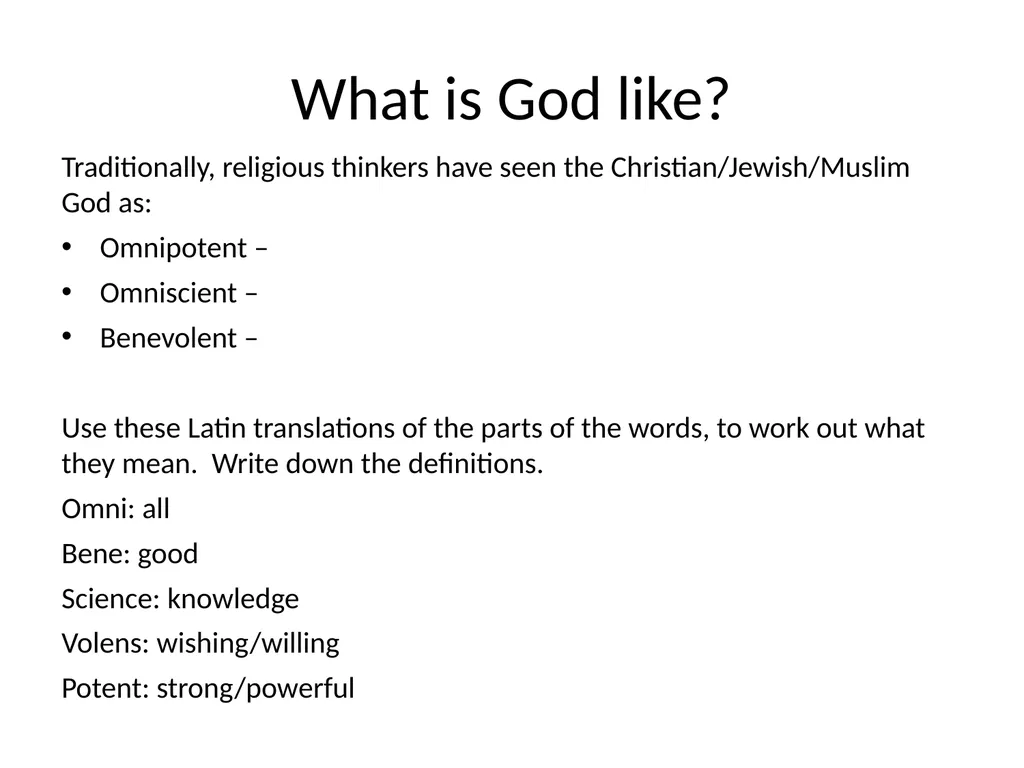
What is God like? Traditionally, religious thinkers have seen the Christian/Jewish/Muslim God as:
Omnipotent –
Omniscient –
Benevolent –
Use these Latin translations of the parts of the words, to work out what they mean. Write down the definitions.
Omni: all
Bene: good
Science: knowledge
Volens: wishing/willing
Potent: strong/powerful<br>
08
Evil and God Looking back through the list of evils we made at the start of the lesson, what might seem problematic about this definition of God?<br>
09
What something with God’s properties would be like towards evil: Something that were omnipotent would…evil.
Something that were omniscient would… evil.
Something that were benevolent would… evil.
WRITE EACH IN TURN ON YOUR WHITE BOARD<br>
10
The Problem of Evil Inconsistency: the quality of not being able to be true together.
The Problem of Evil says that an omnipotent (all-powerful), omniscient (all-knowing) and benevolent (perfectly loving) God could not exist at the same time as evil. Yet evil exists.<br>
11
The logical argument P1: The idea of God is of a being that is omniscient, omnipotent and benevolent.
P2: If there were an omniscient being, then it would know all the evil and how to stop it.
P3: If there were an omnipotent being, then it would have the power to stop all evil.
P4: If there were a benevolent being, then it would not wish for there to be any evil.
C1: An omniscient, omnipotent and benevolent being would stop all evil.
P5: Evil exists.
C2: Therefore, EITHER, (1) an omniscient, omnipotent and benevolent being (God) does not exist at all OR (2) only a being who is omniscient and omnipotent, but not benevolent exists OR (3) a only being who is omniscient and benevolent but not omnipotent exists OR (4) only a being who is omnipotent and benevolent but not omniscient exists.<br>
12
Soundness in arguments A sound argument (a technical term in philosophy) is one that both:
Has true premises
Where the inferences are valid.
The rational support offered by the premises to the conclusion/from one proposition to another is legitimate. In other words, the premises do show the truth of the conclusion/support the conclusion.<br>
13
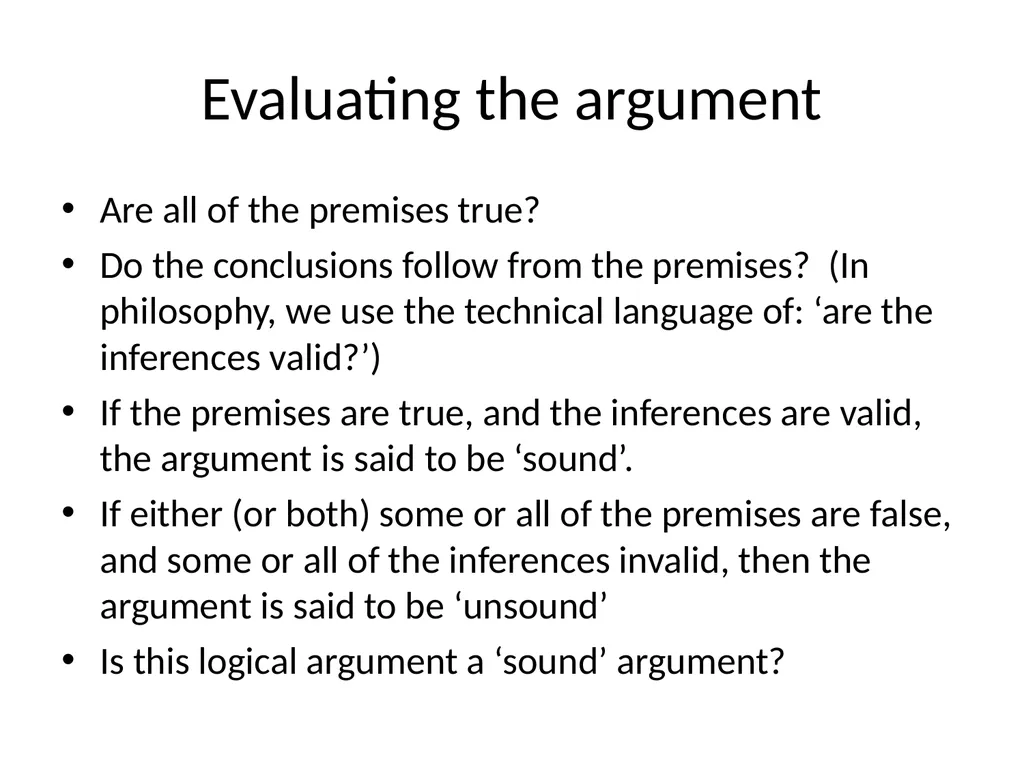
Evaluating the argument Are all of the premises true?
Do the conclusions follow from the premises? (In philosophy, we use the technical language of: ‘are the inferences valid?’)
If the premises are true, and the inferences are valid, the argument is said to be ‘sound’.
If either (or both) some or all of the premises are false, and some or all of the inferences invalid, then the argument is said to be ‘unsound’
Is this logical argument a ‘sound’ argument?<br>
14
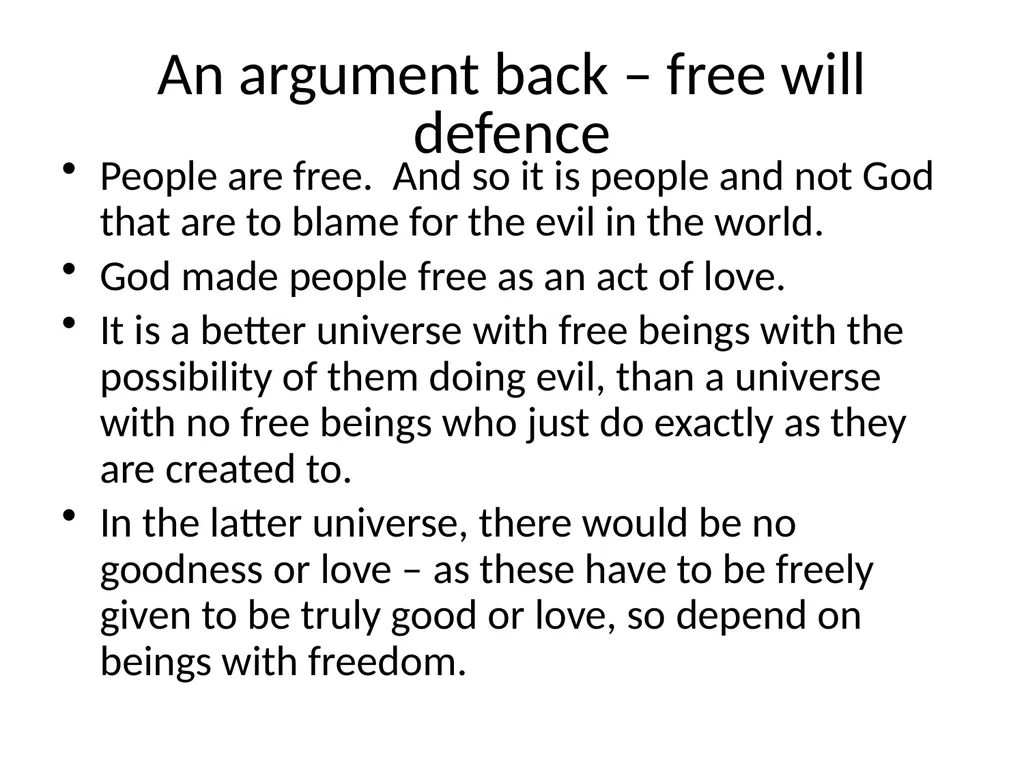
An argument back – free will defence People are free. And so it is people and not God that are to blame for the evil in the world.
God made people free as an act of love.
It is a better universe with free beings with the possibility of them doing evil, than a universe with no free beings who just do exactly as they are created to.
In the latter universe, there would be no goodness or love – as these have to be freely given to be truly good or love, so depend on beings with freedom.<br>
15
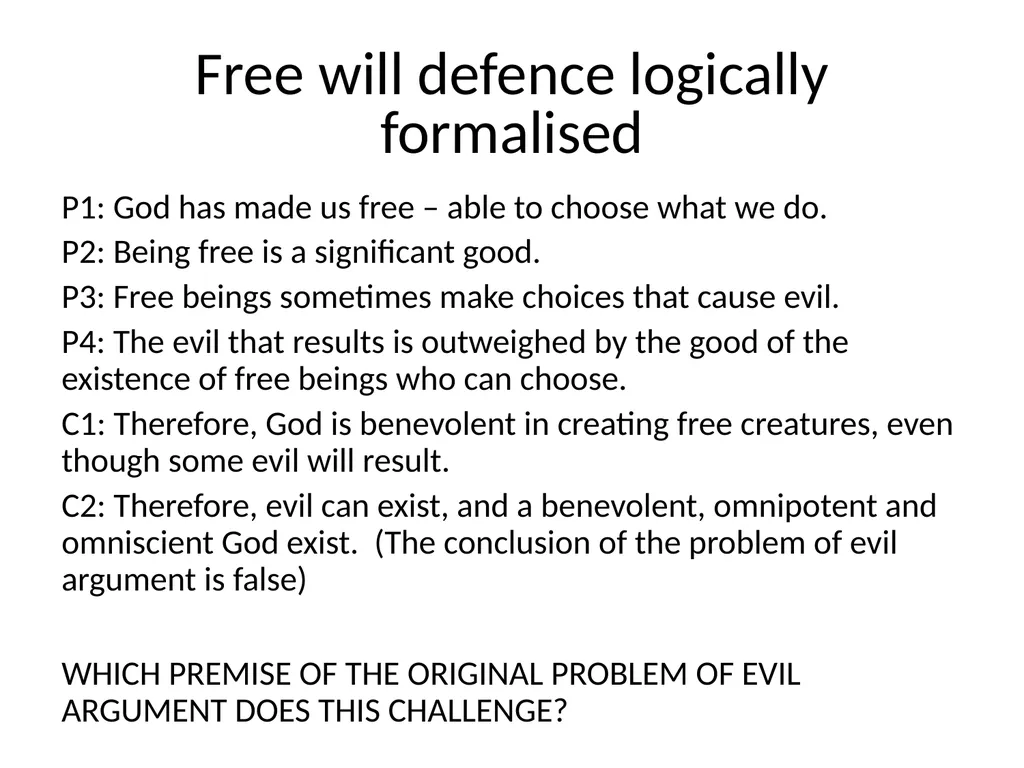
Free will defence logically formalised P1: God has made us free – able to choose what we do.
P2: Being free is a significant good.
P3: Free beings sometimes make choices that cause evil.
P4: The evil that results is outweighed by the good of the existence of free beings who can choose.
C1: Therefore, God is benevolent in creating free creatures, even though some evil will result.
C2: Therefore, evil can exist, and a benevolent, omnipotent and omniscient God exist. (The conclusion of the problem of evil argument is false)
WHICH PREMISE OF THE ORIGINAL PROBLEM OF EVIL ARGUMENT DOES THIS CHALLENGE?<br>
16
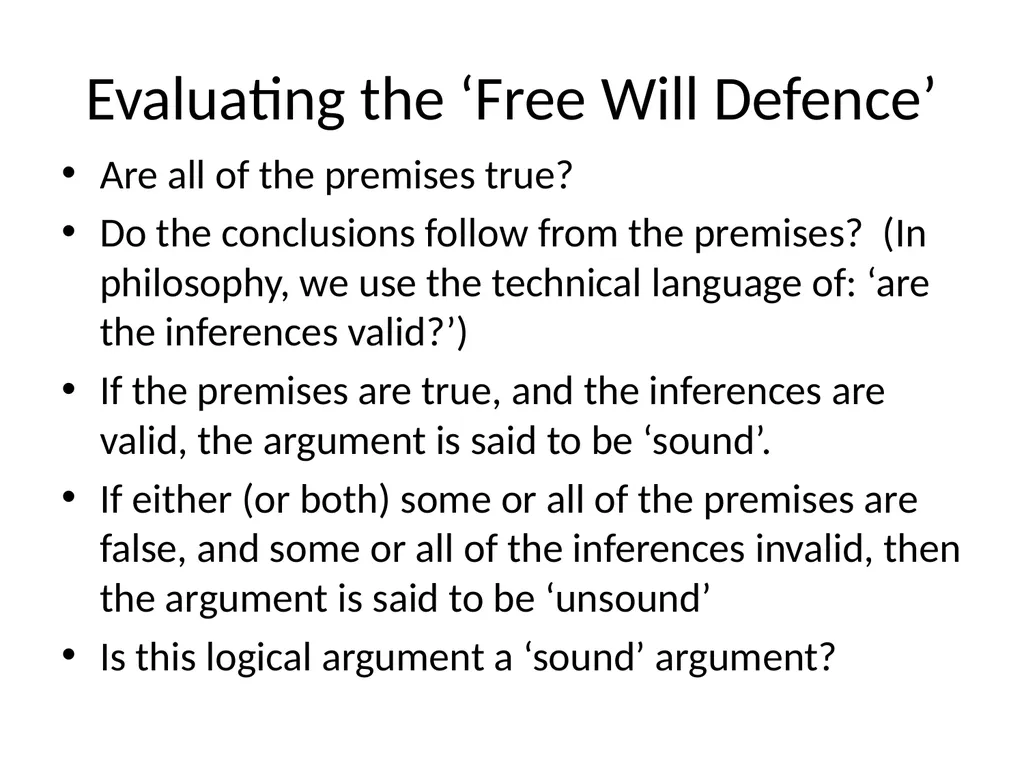
Evaluating the ‘Free Will Defence’ Are all of the premises true?
Do the conclusions follow from the premises? (In philosophy, we use the technical language of: ‘are the inferences valid?’)
If the premises are true, and the inferences are valid, the argument is said to be ‘sound’.
If either (or both) some or all of the premises are false, and some or all of the inferences invalid, then the argument is said to be ‘unsound’
Is this logical argument a ‘sound’ argument?<br>
17
Check your understanding/review What is the problem of evil?
Why is evil specifically a problem for those who believe in a perfect God, rather than those who do not?
What are the premises and conclusion of the logical problem of evil?
What is the ‘free will defence’?
Which of the premises of the logical problem of evil does it criticise?
What criticisms have there been of the free will defence?
REFLECTION: Do you think the logical problem of evil is a strong argument against the existence of God? Why or why not?<br>