
Thank you for using this resource. We hope it


Description: Thank you for using this resource. We hope it helps you, and your pupils! This advice may help. PowerPoints cover more than one lesson The PowerPoint presentation matches a section in the planning provided for this unit of work. This is
Related Topics
Download Presentation
"Thank you for using this resource. We hope it" is the property of its rightful owner. Permission is granted to download and print the materials on this website for personal, non-commercial use only, and to display it on your personal computer provided you do not modify the materials and that you retain all copyright notices contained in the materials. By downloading content from our website, you accept the terms of this agreement.
Presentation Transcript
slide1. Thank you for using this resource. We hope it helps you, and your pupils! This advice may help.
PowerPoints cover more than one lesson
The PowerPoint presentation matches a section in the planning provided for this unit of work. This is likely to contain material for more than one lesson. It is important not to speed through the slides without completing suggested activities or discussion. Some sections in the planning, and the matching PowerPoints, may provide sufficient material for two or more lessons.
Please make sure you prepare and plan with staff
It is critical that delivery, style and speed reflect the needs and responses of pupils. The resource has been designed to support teachers, not to replace you! If this resource is provided as supporting material for HLTAs, cover teachers or non-specialists, please ensure you prepare them carefully and plan with them.
We recommend you use the detailed planning as well as this PowerPoint
This PowerPoint is designed to be used with the detailed planning written to support the RE syllabus ‘Believing and Belonging’. We strongly recommend that you use the PowerPoint in conjunction with the planning. Please ask us how to access this if you do not have it.
To feed back and for further support and to access webinar training please email enquiries@penninelearning.com. Dear Teacher<br>
slide2. Where this lesson fits: This session is in the Pathway 5 unit – Influence and Authority. Children have been introduced to how and why different festivals are celebrated. Once the concept of festivals has been introduced, teachers are free to select a sequence of festivals over the year which are deemed appropriate to their class. Please note that it is not necessary to teach every celebration in this sequence.
Children may have explored what happens during a Christian Harvest festival. If not, the recap slide will need to be changed. In this lesson children are introduced to Rosh Hashanah, the Jewish new year festival. They begin to find similarities between festivals.
Points to note: Discussions will take place over several sessions and as part of continuous provision. Jewish new year takes place in September/early October. This period also includes the festivals of Yom Kippur (Day of Atonement) and Sukkot. Links can be developed between this RE unit and the prime area of Communication and Language.
Enrichment ideas: A persona doll can be used to give children an example to relate to for each festival. Ideally, arrange for a Jewish visitor in person or online to explain Rosh Hashanah. A Faith Visits Directory for West Yorkshire can be found at https://www.penninelearning.com/resources/ , including details of Synagogues in Leeds that offer visits and visitors.
Outdoor learning: Add instruments to the outdoor area.
Further lesson notes and additional ideas may be found in the ‘Notes’ section of some slides. Refer to the full unit plan for more activities and resources. Notes for teachers<br>
slide3. Exploring Jewish Worldviews (RE Today) has information and resources for teaching about Rosh Hashanah in EYFS.
Recommended text: Rosh Hashanah is Coming! (Newman/Viviana (Kar-Ben) ISBN-10: 1467779881
Slide 9: Sing a harvest song to remind children of the harvest festival. Music for the song is available at Oats and beans and barley grow - BBC Teach Encourage the children to join in with the actions.
Slide 10: Ideally, arrange for a Jewish visitor in person or online to explain Rosh Hashanah. A Faith Visits Directory for West Yorkshire can be found at https://www.penninelearning.com/resources/ , including details of Synagogues in Leeds that offer visits and visitors. Alternatively, this CBeebies video will help to explain some of the customs at Rosh Hashanah: https://www.bbc.co.uk/cbeebies/watch/the-lets-go-club-celebrating-rosh-hashanah
Slide 12: Resources for adult led tasks: Taste test apples in honey and other foods eaten at Rosh Hashanah such as pomegranate. N.B. check for food allergies before taste testing.
Slide 13: Resources for continuous provision: paper for horn instrument, blank cards, apples for printing, instruments, play food for the role play area.
Slide 16: Use the speech bubble template on the following slide to record any questions that children ask and look back at them in subsequent sessions. Resources to support this presentation<br>
slide4. Unit: E5
How do people celebrate
special times?
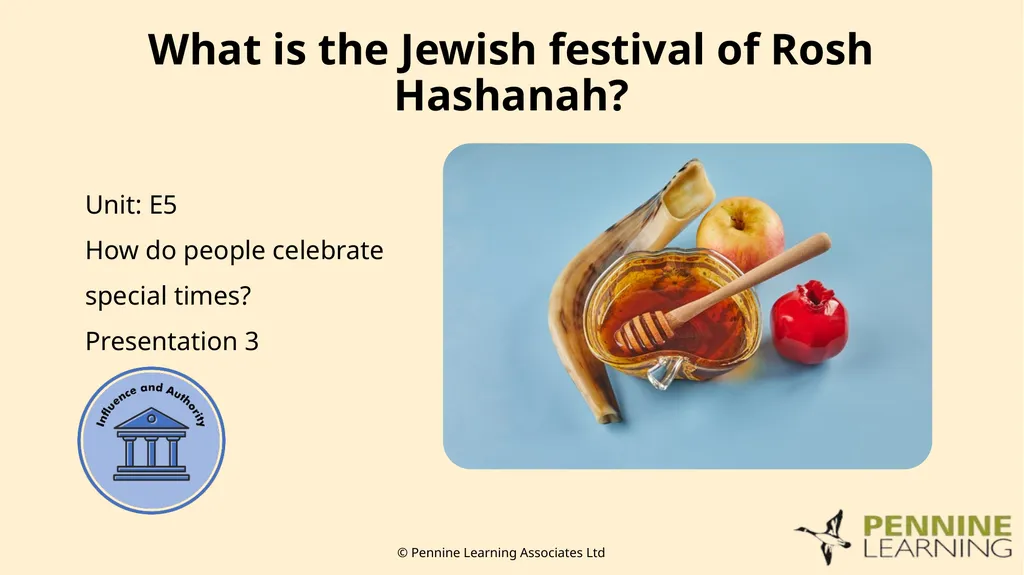
Presentation 3 What is the Jewish festival of Rosh Hashanah?<br>
slide5. How this presentation links to the pathway:
This presentation introduces children to the festival of Rosh Hashanah, the Jewish New Year. They may find similarities with other festivals such as the Christian harvest festival. Early Years
Through studying Influence and Authority, pupils should learn that:
People in our community have different beliefs and celebrate special times in different ways.
There are similarities and differences between different religious and cultural communities in our country. Pathway 5: Influence and Authority<br>
slide6. Begin to compare how different religions celebrate similar beliefs Talk about how Jewish people celebrate Rosh Hashanah at home and in the synagogue Learning objectives<br>
slide7. people who follow the religion of Judaism Jewish people a Jewish New Year festival Rosh Hashanah Key words<br>
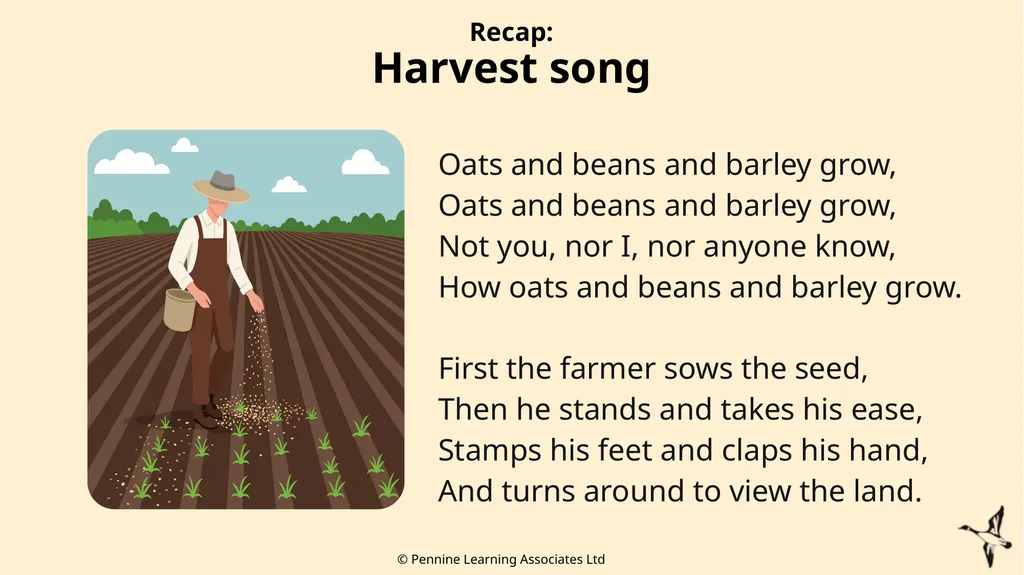
slide8. Recap: Harvest song Oats and beans and barley grow, Oats and beans and barley grow, Not you, nor I, nor anyone know, How oats and beans and barley grow.
First the farmer sows the seed, Then he stands and takes his ease, Stamps his feet and claps his hand, And turns around to view the land.<br>
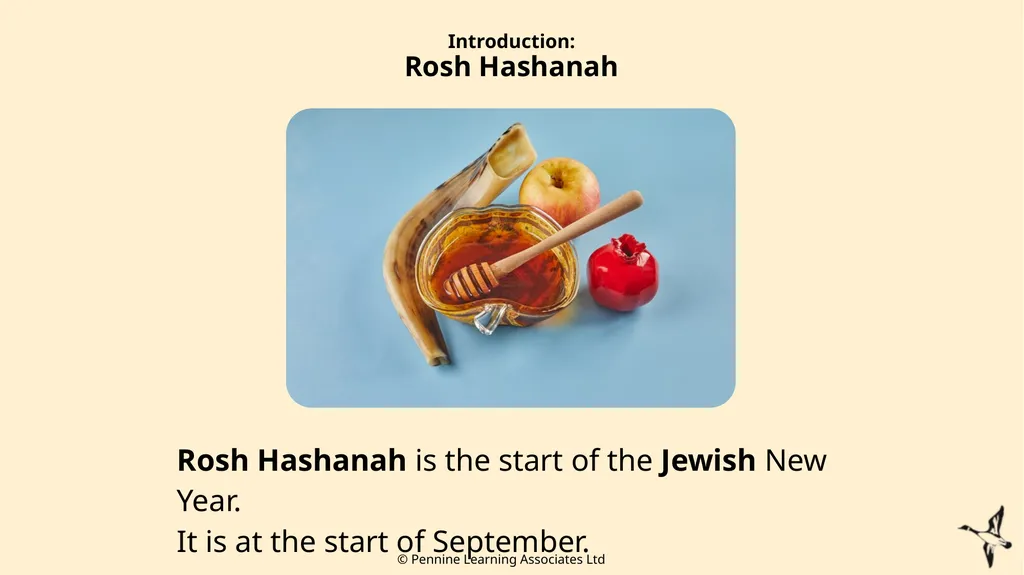
slide9. Introduction: Rosh Hashanah Rosh Hashanah is the start of the Jewish New Year.
It is at the start of September.<br>
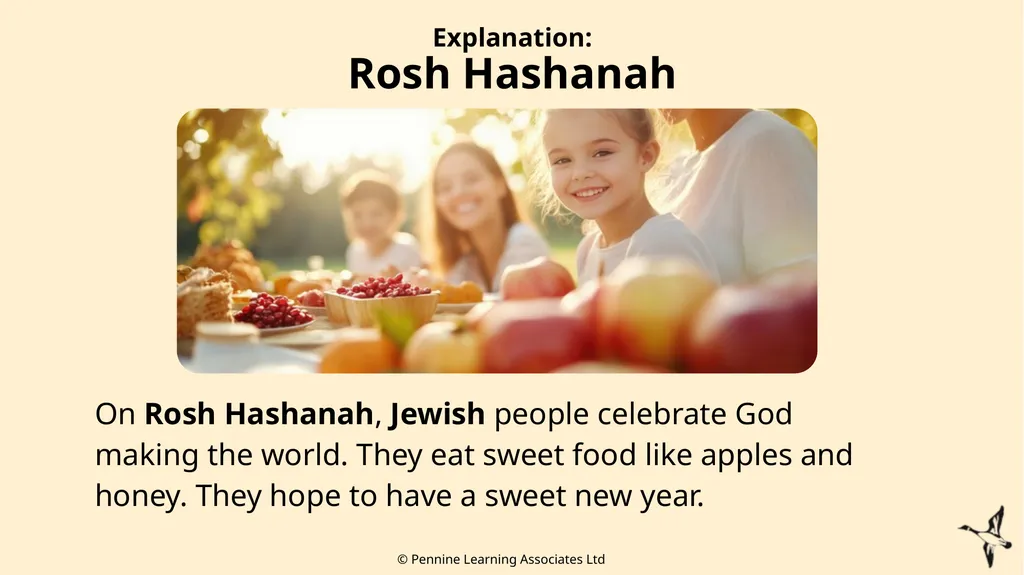
slide10. Explanation: Rosh Hashanah On Rosh Hashanah, Jewish people celebrate God making the world. They eat sweet food like apples and honey. They hope to have a sweet new year.<br>
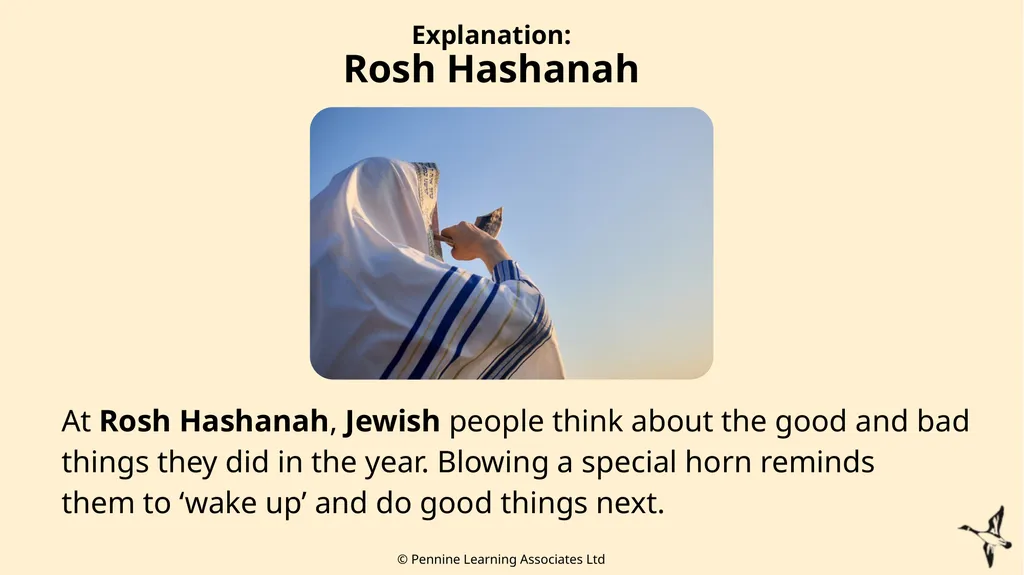
slide11. Explanation: Rosh Hashanah At Rosh Hashanah, Jewish people think about the good and bad things they did in the year. Blowing a special horn reminds them to ‘wake up’ and do good things next.<br>
slide12. Suggested tasks: Adult-led Read a book e.g. Rosh Hashanah is Coming! (Newman/Viviana (Kar-Ben) ISBN-10: 1467779881
Taste test apples in honey and other foods eaten at Rosh Hashanah such as pomegranate.
Learn to say ‘Shana Tova’ - ‘A good year!’ Include this greeting on a Rosh Hashanah card<br>
slide13. Explore music that can be made with a paper horn instrument like the shofar.
Make a card using apple printing.
Use instruments to create some ‘wake up!’ music.
Set up the role-play area with a feast for Rosh Hashanah. Suggested tasks: Independent in provision<br>
slide14. Jewish people celebrate God making the world. Eating sweet food is a wish for a sweet new year. Blowing a special horn reminds Jewish people to do good things. The festival of Rosh Hashanah is the Jewish new year. Learning summary<br>
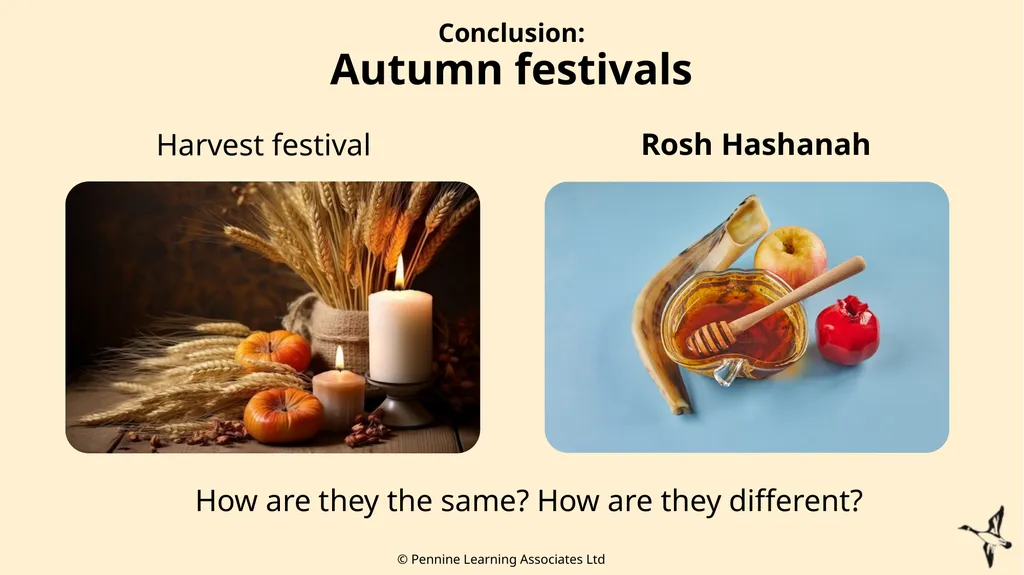
slide15. Conclusion: Autumn festivals Harvest festival Rosh Hashanah How are they the same? How are they different?<br>
slide16. Conclusion: Talk about celebrations I wonder…<br>
slide17. Can you think of something you've done that you needed to say sorry for?
Can you think of something you've done that you're proud of? Time to think<br>
slide18. Images reproduced under professional licence from Vecteezy. Acknowledgements<br>
PowerPoints cover more than one lesson
The PowerPoint presentation matches a section in the planning provided for this unit of work. This is likely to contain material for more than one lesson. It is important not to speed through the slides without completing suggested activities or discussion. Some sections in the planning, and the matching PowerPoints, may provide sufficient material for two or more lessons.
Please make sure you prepare and plan with staff
It is critical that delivery, style and speed reflect the needs and responses of pupils. The resource has been designed to support teachers, not to replace you! If this resource is provided as supporting material for HLTAs, cover teachers or non-specialists, please ensure you prepare them carefully and plan with them.
We recommend you use the detailed planning as well as this PowerPoint
This PowerPoint is designed to be used with the detailed planning written to support the RE syllabus ‘Believing and Belonging’. We strongly recommend that you use the PowerPoint in conjunction with the planning. Please ask us how to access this if you do not have it.
To feed back and for further support and to access webinar training please email enquiries@penninelearning.com. Dear Teacher<br>
slide2. Where this lesson fits: This session is in the Pathway 5 unit – Influence and Authority. Children have been introduced to how and why different festivals are celebrated. Once the concept of festivals has been introduced, teachers are free to select a sequence of festivals over the year which are deemed appropriate to their class. Please note that it is not necessary to teach every celebration in this sequence.
Children may have explored what happens during a Christian Harvest festival. If not, the recap slide will need to be changed. In this lesson children are introduced to Rosh Hashanah, the Jewish new year festival. They begin to find similarities between festivals.
Points to note: Discussions will take place over several sessions and as part of continuous provision. Jewish new year takes place in September/early October. This period also includes the festivals of Yom Kippur (Day of Atonement) and Sukkot. Links can be developed between this RE unit and the prime area of Communication and Language.
Enrichment ideas: A persona doll can be used to give children an example to relate to for each festival. Ideally, arrange for a Jewish visitor in person or online to explain Rosh Hashanah. A Faith Visits Directory for West Yorkshire can be found at https://www.penninelearning.com/resources/ , including details of Synagogues in Leeds that offer visits and visitors.
Outdoor learning: Add instruments to the outdoor area.
Further lesson notes and additional ideas may be found in the ‘Notes’ section of some slides. Refer to the full unit plan for more activities and resources. Notes for teachers<br>
slide3. Exploring Jewish Worldviews (RE Today) has information and resources for teaching about Rosh Hashanah in EYFS.
Recommended text: Rosh Hashanah is Coming! (Newman/Viviana (Kar-Ben) ISBN-10: 1467779881
Slide 9: Sing a harvest song to remind children of the harvest festival. Music for the song is available at Oats and beans and barley grow - BBC Teach Encourage the children to join in with the actions.
Slide 10: Ideally, arrange for a Jewish visitor in person or online to explain Rosh Hashanah. A Faith Visits Directory for West Yorkshire can be found at https://www.penninelearning.com/resources/ , including details of Synagogues in Leeds that offer visits and visitors. Alternatively, this CBeebies video will help to explain some of the customs at Rosh Hashanah: https://www.bbc.co.uk/cbeebies/watch/the-lets-go-club-celebrating-rosh-hashanah
Slide 12: Resources for adult led tasks: Taste test apples in honey and other foods eaten at Rosh Hashanah such as pomegranate. N.B. check for food allergies before taste testing.
Slide 13: Resources for continuous provision: paper for horn instrument, blank cards, apples for printing, instruments, play food for the role play area.
Slide 16: Use the speech bubble template on the following slide to record any questions that children ask and look back at them in subsequent sessions. Resources to support this presentation<br>
slide4. Unit: E5
How do people celebrate
special times?
Presentation 3 What is the Jewish festival of Rosh Hashanah?<br>
slide5. How this presentation links to the pathway:
This presentation introduces children to the festival of Rosh Hashanah, the Jewish New Year. They may find similarities with other festivals such as the Christian harvest festival. Early Years
Through studying Influence and Authority, pupils should learn that:
People in our community have different beliefs and celebrate special times in different ways.
There are similarities and differences between different religious and cultural communities in our country. Pathway 5: Influence and Authority<br>
slide6. Begin to compare how different religions celebrate similar beliefs Talk about how Jewish people celebrate Rosh Hashanah at home and in the synagogue Learning objectives<br>
slide7. people who follow the religion of Judaism Jewish people a Jewish New Year festival Rosh Hashanah Key words<br>
slide8. Recap: Harvest song Oats and beans and barley grow, Oats and beans and barley grow, Not you, nor I, nor anyone know, How oats and beans and barley grow.
First the farmer sows the seed, Then he stands and takes his ease, Stamps his feet and claps his hand, And turns around to view the land.<br>
slide9. Introduction: Rosh Hashanah Rosh Hashanah is the start of the Jewish New Year.
It is at the start of September.<br>
slide10. Explanation: Rosh Hashanah On Rosh Hashanah, Jewish people celebrate God making the world. They eat sweet food like apples and honey. They hope to have a sweet new year.<br>
slide11. Explanation: Rosh Hashanah At Rosh Hashanah, Jewish people think about the good and bad things they did in the year. Blowing a special horn reminds them to ‘wake up’ and do good things next.<br>
slide12. Suggested tasks: Adult-led Read a book e.g. Rosh Hashanah is Coming! (Newman/Viviana (Kar-Ben) ISBN-10: 1467779881
Taste test apples in honey and other foods eaten at Rosh Hashanah such as pomegranate.
Learn to say ‘Shana Tova’ - ‘A good year!’ Include this greeting on a Rosh Hashanah card<br>
slide13. Explore music that can be made with a paper horn instrument like the shofar.
Make a card using apple printing.
Use instruments to create some ‘wake up!’ music.
Set up the role-play area with a feast for Rosh Hashanah. Suggested tasks: Independent in provision<br>
slide14. Jewish people celebrate God making the world. Eating sweet food is a wish for a sweet new year. Blowing a special horn reminds Jewish people to do good things. The festival of Rosh Hashanah is the Jewish new year. Learning summary<br>
slide15. Conclusion: Autumn festivals Harvest festival Rosh Hashanah How are they the same? How are they different?<br>
slide16. Conclusion: Talk about celebrations I wonder…<br>
slide17. Can you think of something you've done that you needed to say sorry for?
Can you think of something you've done that you're proud of? Time to think<br>
slide18. Images reproduced under professional licence from Vecteezy. Acknowledgements<br>