
The 4th Trimester: Postpartum Care for Primary
GB
Published · 40 slides · 0 views
1 / 1


Description
The 4th Trimester: Postpartum Care for Primary Care Amy H Farkas, MD, MS Assistant Professor of Medicine Medical College of Wisconsin Milwaukee VA Medical Center Learning Objectives Understand the role of primary care in postpartum care
Related Topics
Share
Embed code
Download this presentation From Below
"The 4th Trimester: Postpartum Care for Primary" is the property of its rightful owner. Permission is granted to download and print the materials on this website for personal, non-commercial use only, and to display it on your personal computer provided you do not modify the materials and that you retain all copyright notices contained in the materials. By downloading content from our website, you accept the terms of this agreement.
Presentation Transcript
01
The 4th Trimester: Postpartum Care for Primary Care Amy H Farkas, MD, MS
Assistant Professor of Medicine
Medical College of Wisconsin
Milwaukee VA Medical Center<br>
Assistant Professor of Medicine
Medical College of Wisconsin
Milwaukee VA Medical Center<br>
02
Learning Objectives Understand the role of primary care in postpartum care
Understand the prevalence the treatment of postpartum depression
Understand the presentation and management of postpartum thyroiditis
Understand the long-term risk and management of metabolic and cardiovascular complications of pregnancy<br>
Understand the prevalence the treatment of postpartum depression
Understand the presentation and management of postpartum thyroiditis
Understand the long-term risk and management of metabolic and cardiovascular complications of pregnancy<br>
03
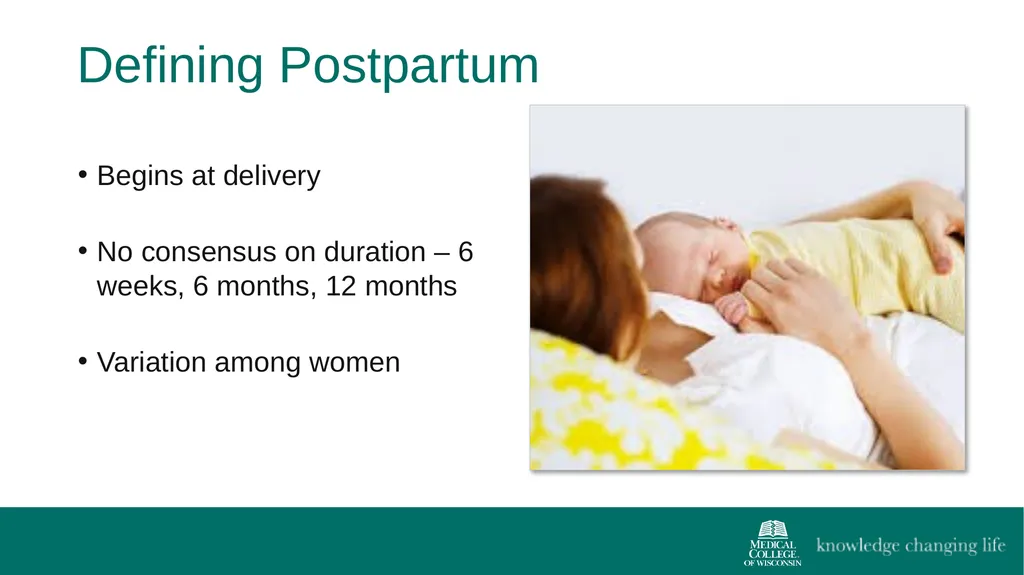
Defining Postpartum Begins at delivery
No consensus on duration – 6 weeks, 6 months, 12 months
Variation among women<br>
No consensus on duration – 6 weeks, 6 months, 12 months
Variation among women<br>
04
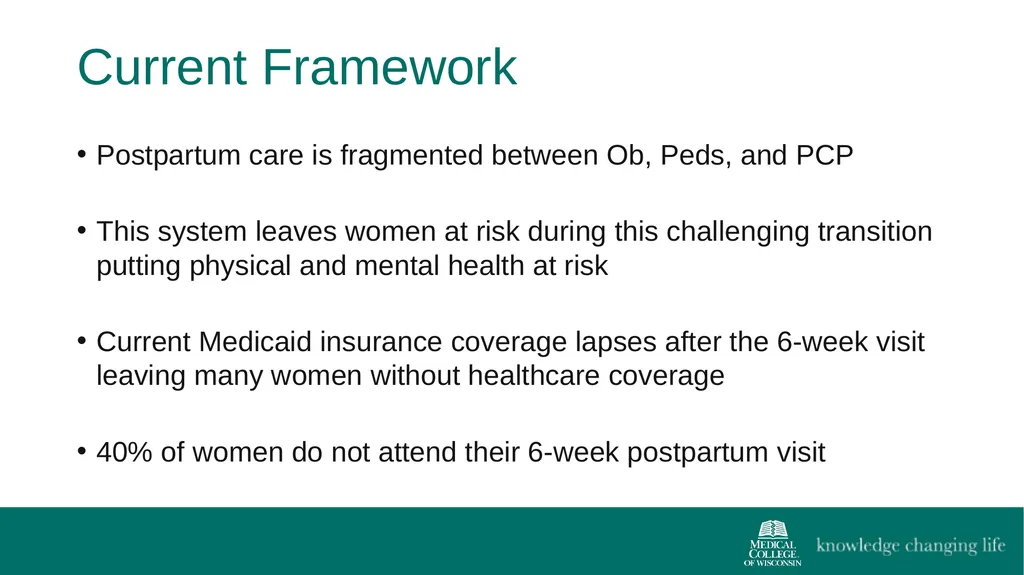
Current Framework Postpartum care is fragmented between Ob, Peds, and PCP
This system leaves women at risk during this challenging transition putting physical and mental health at risk
Current Medicaid insurance coverage lapses after the 6-week visit leaving many women without healthcare coverage
40% of women do not attend their 6-week postpartum visit<br>
This system leaves women at risk during this challenging transition putting physical and mental health at risk
Current Medicaid insurance coverage lapses after the 6-week visit leaving many women without healthcare coverage
40% of women do not attend their 6-week postpartum visit<br>
05
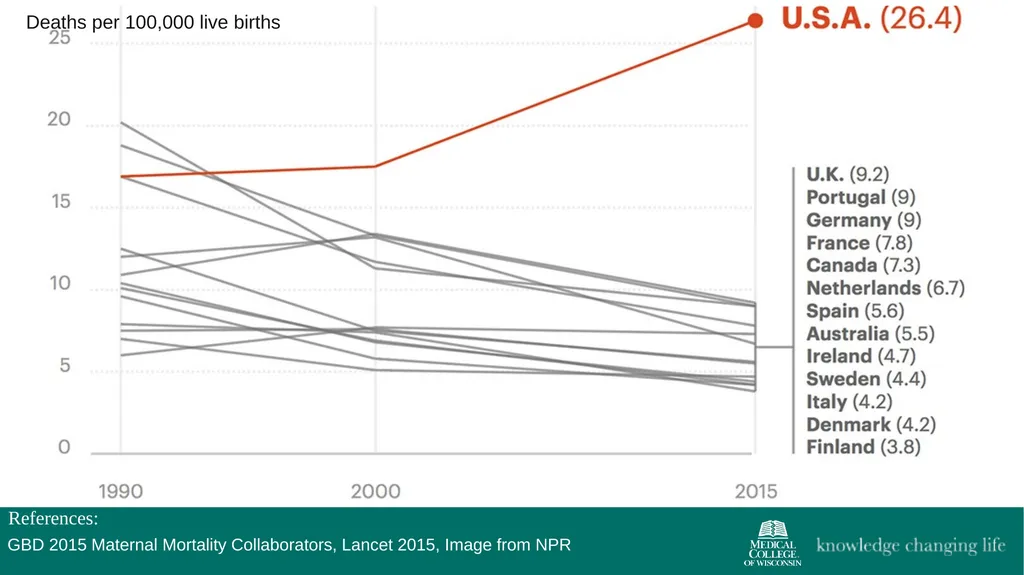
GBD 2015 Maternal Mortality Collaborators, Lancet 2015, Image from NPR Deaths per 100,000 live births<br>
06
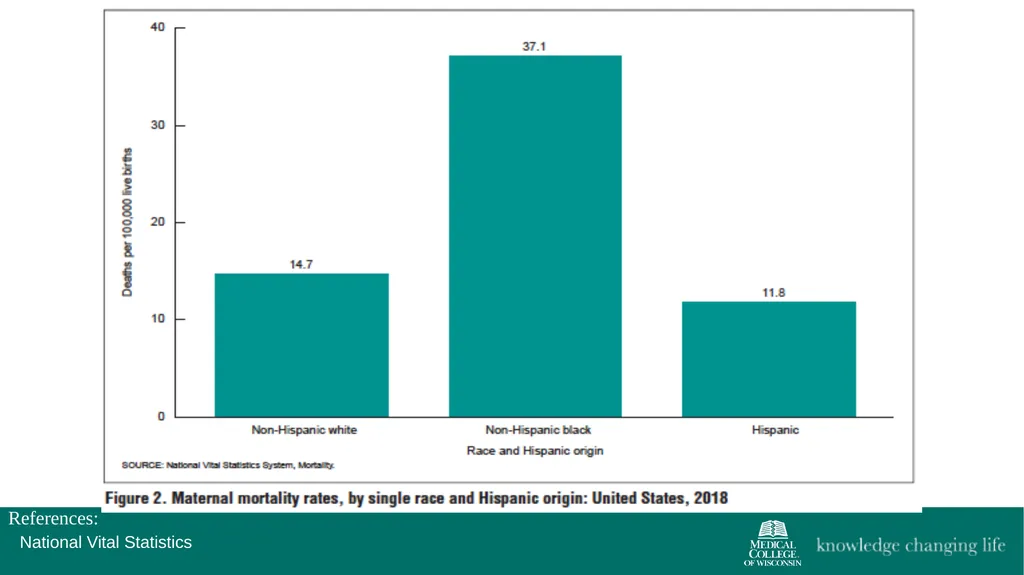
National Vital Statistics<br>
07
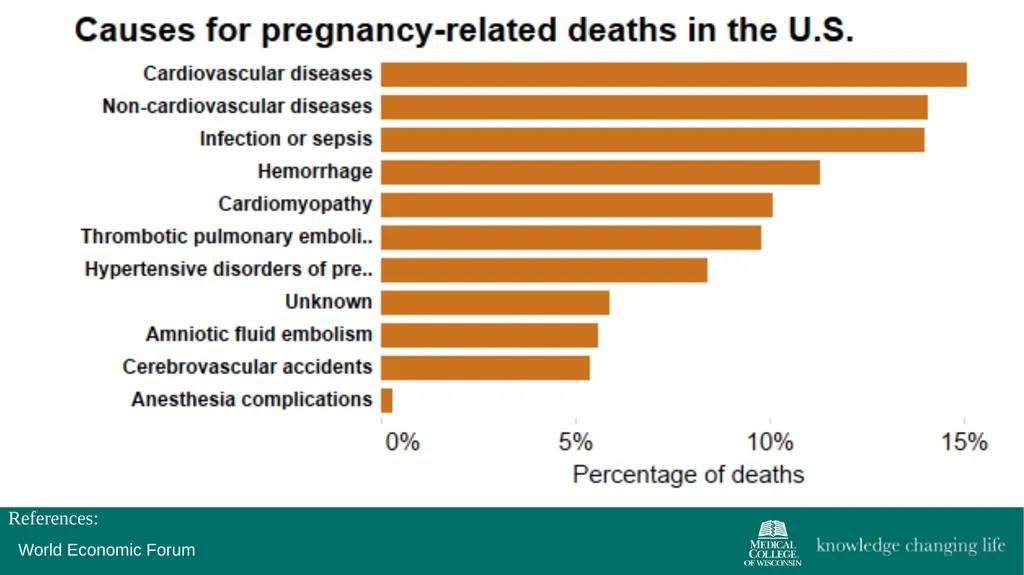
World Economic Forum<br>
08
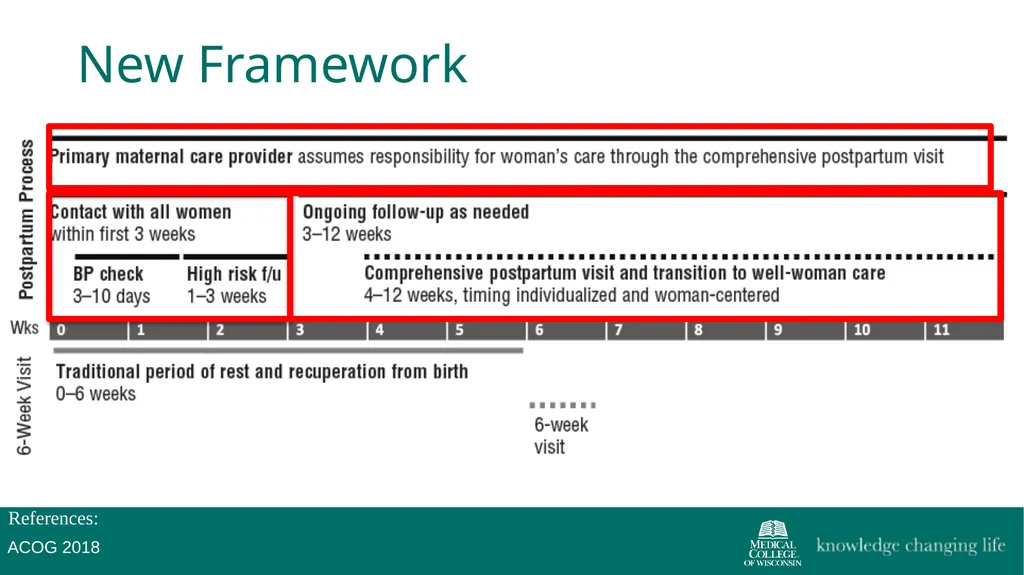
New Framework ACOG 2018<br>
09
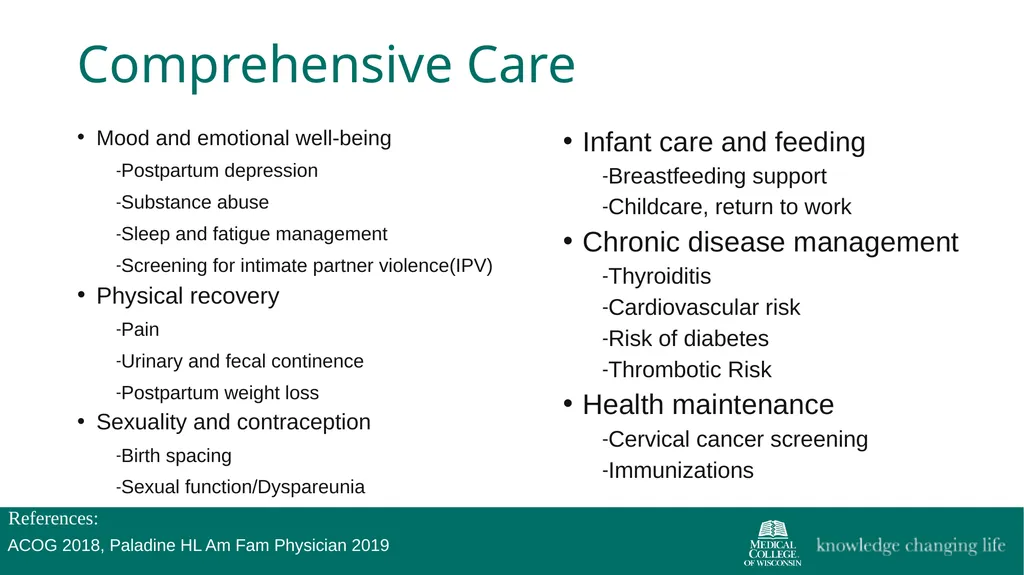
Comprehensive Care Mood and emotional well-being
Postpartum depression
Substance abuse
Sleep and fatigue management
Screening for intimate partner violence(IPV)
Physical recovery
Pain
Urinary and fecal continence
Postpartum weight loss
Sexuality and contraception
Birth spacing
Sexual function/Dyspareunia Infant care and feeding
Breastfeeding support
Childcare, return to work
Chronic disease management
Thyroiditis
Cardiovascular risk
Risk of diabetes
Thrombotic Risk
Health maintenance
Cervical cancer screening
Immunizations ACOG 2018, Paladine HL Am Fam Physician 2019<br>
Postpartum depression
Substance abuse
Sleep and fatigue management
Screening for intimate partner violence(IPV)
Physical recovery
Pain
Urinary and fecal continence
Postpartum weight loss
Sexuality and contraception
Birth spacing
Sexual function/Dyspareunia Infant care and feeding
Breastfeeding support
Childcare, return to work
Chronic disease management
Thyroiditis
Cardiovascular risk
Risk of diabetes
Thrombotic Risk
Health maintenance
Cervical cancer screening
Immunizations ACOG 2018, Paladine HL Am Fam Physician 2019<br>
10
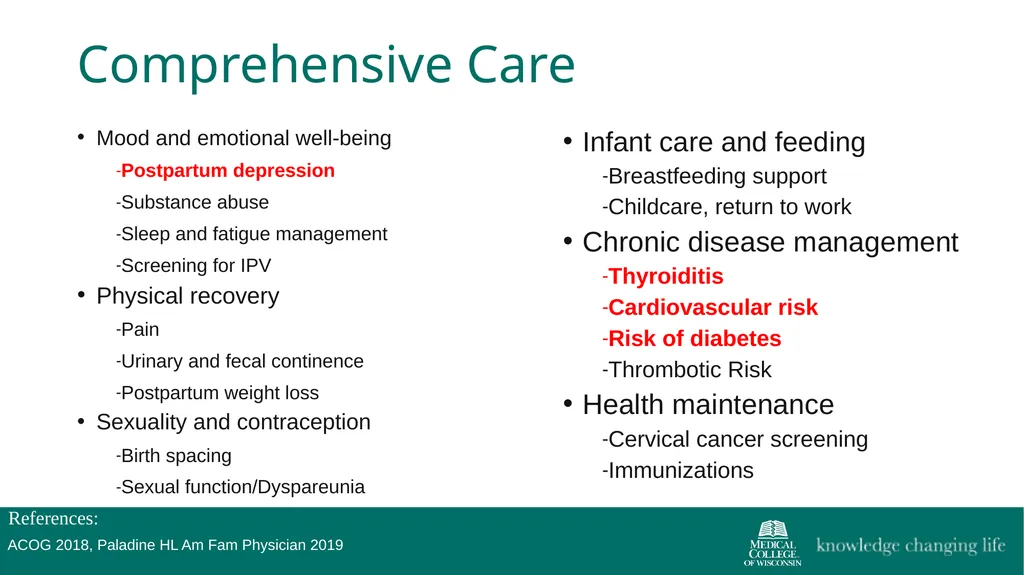
Comprehensive Care Mood and emotional well-being
Postpartum depression
Substance abuse
Sleep and fatigue management
Screening for IPV
Physical recovery
Pain
Urinary and fecal continence
Postpartum weight loss
Sexuality and contraception
Birth spacing
Sexual function/Dyspareunia Infant care and feeding
Breastfeeding support
Childcare, return to work
Chronic disease management
Thyroiditis
Cardiovascular risk
Risk of diabetes
Thrombotic Risk
Health maintenance
Cervical cancer screening
Immunizations ACOG 2018, Paladine HL Am Fam Physician 2019<br>
Postpartum depression
Substance abuse
Sleep and fatigue management
Screening for IPV
Physical recovery
Pain
Urinary and fecal continence
Postpartum weight loss
Sexuality and contraception
Birth spacing
Sexual function/Dyspareunia Infant care and feeding
Breastfeeding support
Childcare, return to work
Chronic disease management
Thyroiditis
Cardiovascular risk
Risk of diabetes
Thrombotic Risk
Health maintenance
Cervical cancer screening
Immunizations ACOG 2018, Paladine HL Am Fam Physician 2019<br>
11
Postpartum Depression<br>
12
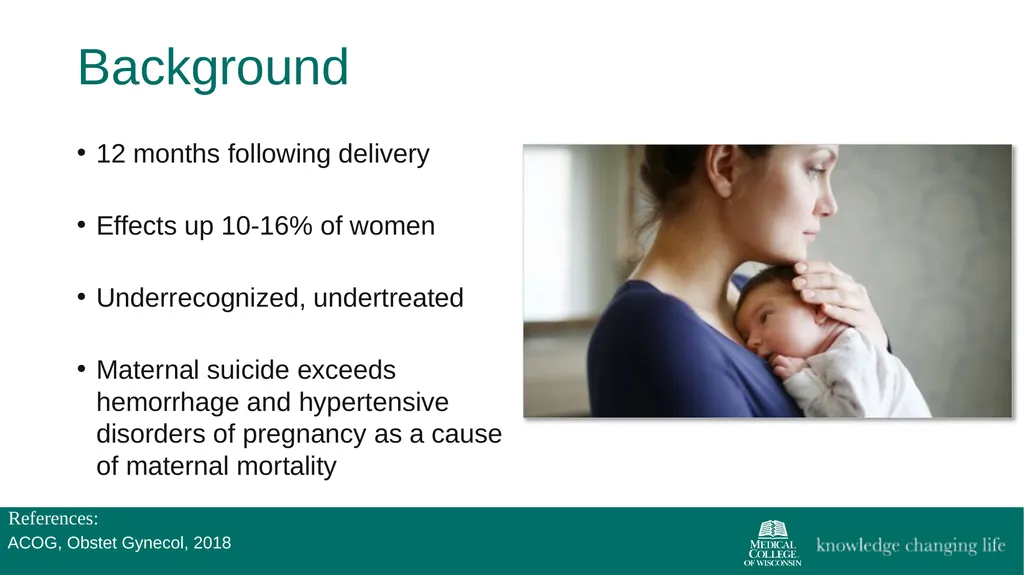
Background 12 months following delivery
Effects up 10-16% of women
Underrecognized, undertreated
Maternal suicide exceeds hemorrhage and hypertensive disorders of pregnancy as a cause of maternal mortality ACOG, Obstet Gynecol, 2018<br>
Effects up 10-16% of women
Underrecognized, undertreated
Maternal suicide exceeds hemorrhage and hypertensive disorders of pregnancy as a cause of maternal mortality ACOG, Obstet Gynecol, 2018<br>
13
Risk Factors Depression or anxiety during pregnancy
h/o of depression of anxiety
Stressful life event during pregnancy
Traumatic birth experience
Preterm birth/NICU admission for infant
Low social support
Breastfeeding problems Lancaster, CA Am J Obstet Gynecol, 2010
ACOG, Obstet Gynecol, 2018; Slomian, Womens Health, 2019<br>
h/o of depression of anxiety
Stressful life event during pregnancy
Traumatic birth experience
Preterm birth/NICU admission for infant
Low social support
Breastfeeding problems Lancaster, CA Am J Obstet Gynecol, 2010
ACOG, Obstet Gynecol, 2018; Slomian, Womens Health, 2019<br>
14
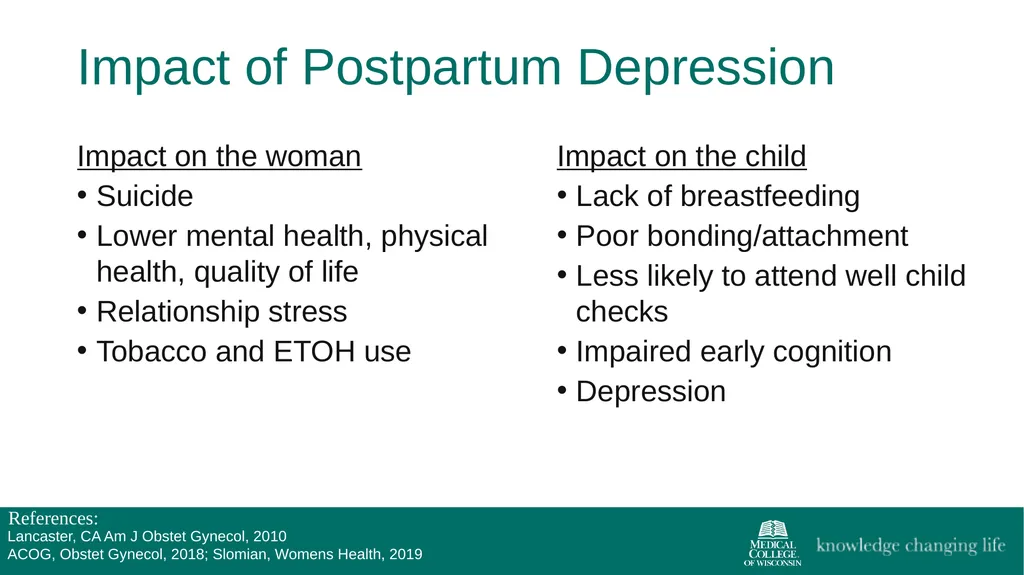
Impact of Postpartum Depression Impact on the woman
Suicide
Lower mental health, physical health, quality of life
Relationship stress
Tobacco and ETOH use Impact on the child
Lack of breastfeeding
Poor bonding/attachment
Less likely to attend well child checks
Impaired early cognition
Depression Lancaster, CA Am J Obstet Gynecol, 2010
ACOG, Obstet Gynecol, 2018; Slomian, Womens Health, 2019<br>
Suicide
Lower mental health, physical health, quality of life
Relationship stress
Tobacco and ETOH use Impact on the child
Lack of breastfeeding
Poor bonding/attachment
Less likely to attend well child checks
Impaired early cognition
Depression Lancaster, CA Am J Obstet Gynecol, 2010
ACOG, Obstet Gynecol, 2018; Slomian, Womens Health, 2019<br>
15
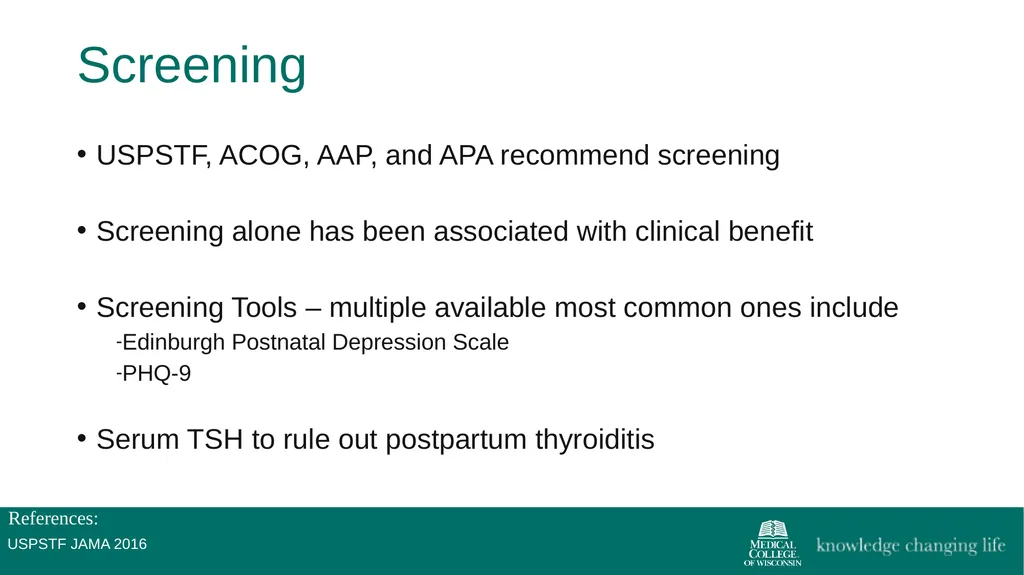
Screening USPSTF, ACOG, AAP, and APA recommend screening
Screening alone has been associated with clinical benefit
Screening Tools – multiple available most common ones include
Edinburgh Postnatal Depression Scale
PHQ-9
Serum TSH to rule out postpartum thyroiditis USPSTF JAMA 2016<br>
Screening alone has been associated with clinical benefit
Screening Tools – multiple available most common ones include
Edinburgh Postnatal Depression Scale
PHQ-9
Serum TSH to rule out postpartum thyroiditis USPSTF JAMA 2016<br>
16
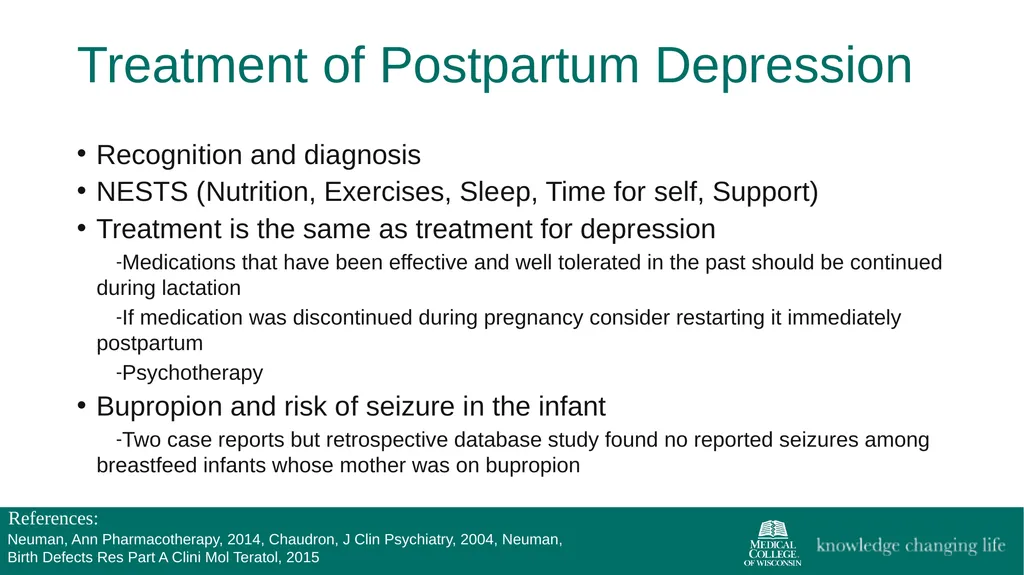
Treatment of Postpartum Depression Recognition and diagnosis
NESTS (Nutrition, Exercises, Sleep, Time for self, Support)
Treatment is the same as treatment for depression
Medications that have been effective and well tolerated in the past should be continued during lactation
If medication was discontinued during pregnancy consider restarting it immediately postpartum
Psychotherapy
Bupropion and risk of seizure in the infant
Two case reports but retrospective database study found no reported seizures among breastfeed infants whose mother was on bupropion Neuman, Ann Pharmacotherapy, 2014, Chaudron, J Clin Psychiatry, 2004, Neuman, Birth Defects Res Part A Clini Mol Teratol, 2015<br>
NESTS (Nutrition, Exercises, Sleep, Time for self, Support)
Treatment is the same as treatment for depression
Medications that have been effective and well tolerated in the past should be continued during lactation
If medication was discontinued during pregnancy consider restarting it immediately postpartum
Psychotherapy
Bupropion and risk of seizure in the infant
Two case reports but retrospective database study found no reported seizures among breastfeed infants whose mother was on bupropion Neuman, Ann Pharmacotherapy, 2014, Chaudron, J Clin Psychiatry, 2004, Neuman, Birth Defects Res Part A Clini Mol Teratol, 2015<br>
17
Safe Prescribing TERIS database http://depts.washington.edu/terisdb/terisweb/index.html
Reprotox: https://www.reprotox.org/
LactMed: https://www.ncbi.nlm.nih.gov/books/NBK501922/
Available as an App!<br>
Reprotox: https://www.reprotox.org/
LactMed: https://www.ncbi.nlm.nih.gov/books/NBK501922/
Available as an App!<br>
18
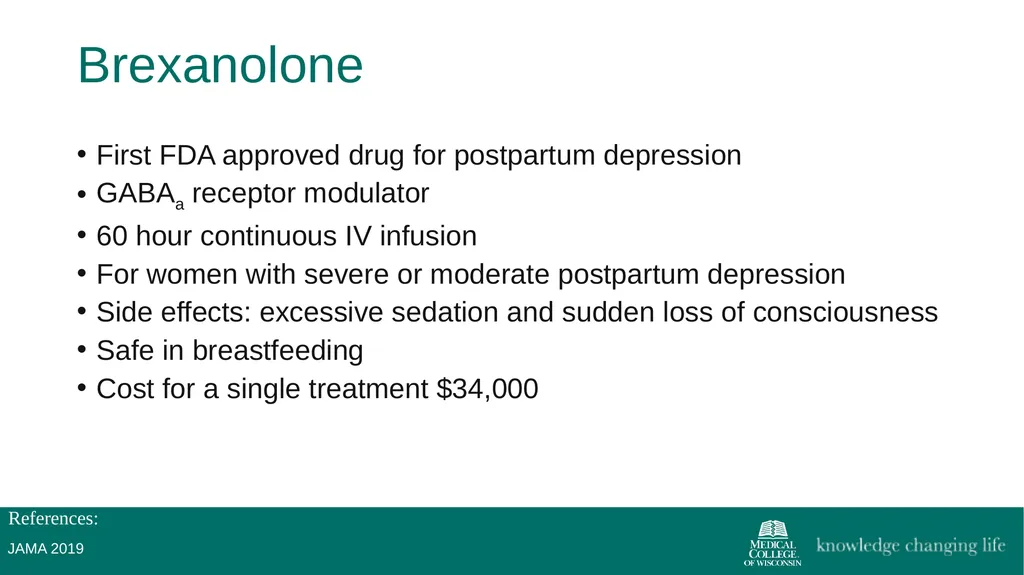
Brexanolone First FDA approved drug for postpartum depression
GABAa receptor modulator
60 hour continuous IV infusion
For women with severe or moderate postpartum depression
Side effects: excessive sedation and sudden loss of consciousness
Safe in breastfeeding
Cost for a single treatment $34,000 JAMA 2019<br>
GABAa receptor modulator
60 hour continuous IV infusion
For women with severe or moderate postpartum depression
Side effects: excessive sedation and sudden loss of consciousness
Safe in breastfeeding
Cost for a single treatment $34,000 JAMA 2019<br>
19
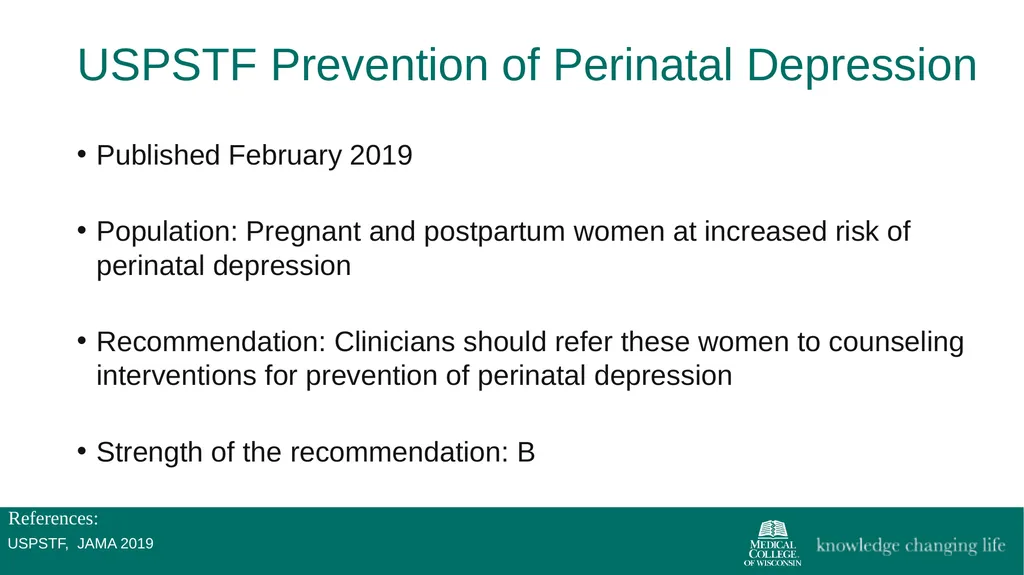
USPSTF Prevention of Perinatal Depression Published February 2019
Population: Pregnant and postpartum women at increased risk of perinatal depression
Recommendation: Clinicians should refer these women to counseling interventions for prevention of perinatal depression
Strength of the recommendation: B USPSTF, JAMA 2019<br>
Population: Pregnant and postpartum women at increased risk of perinatal depression
Recommendation: Clinicians should refer these women to counseling interventions for prevention of perinatal depression
Strength of the recommendation: B USPSTF, JAMA 2019<br>
20
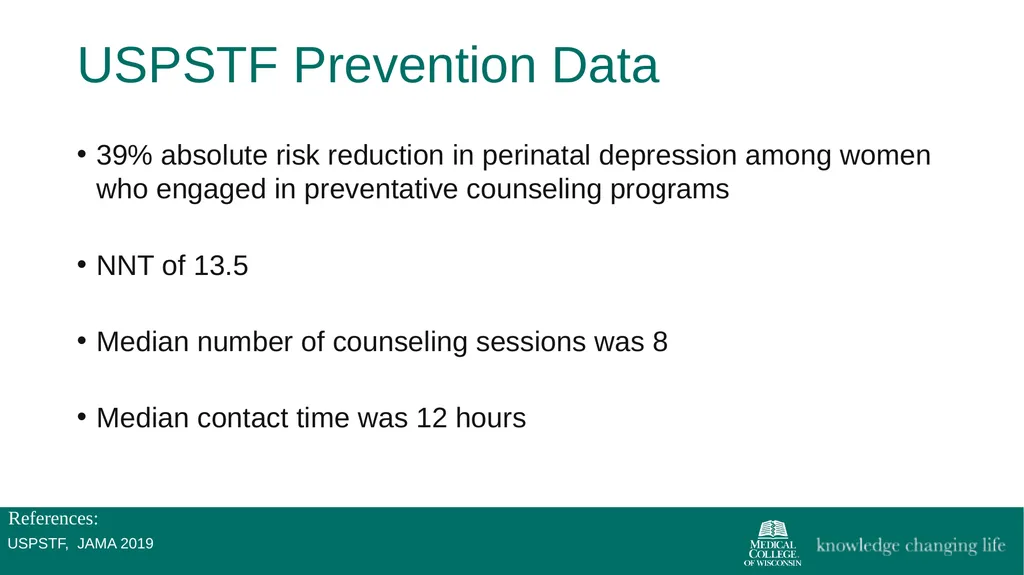
USPSTF Prevention Data 39% absolute risk reduction in perinatal depression among women who engaged in preventative counseling programs
NNT of 13.5
Median number of counseling sessions was 8
Median contact time was 12 hours USPSTF, JAMA 2019<br>
NNT of 13.5
Median number of counseling sessions was 8
Median contact time was 12 hours USPSTF, JAMA 2019<br>
21
USPSTF Clinical Application There is no clinical screening tool to identify these women
Suggest referring women with any 1 of these risk factors
History of depression
Current depression symptoms that do not met diagnostic threshold
SES risk factors: low income, adolescent or single parenthood, recent IPV
Mental health factors: anxiety symptoms, h/o significant negative life event USPSTF, JAMA 2019<br>
Suggest referring women with any 1 of these risk factors
History of depression
Current depression symptoms that do not met diagnostic threshold
SES risk factors: low income, adolescent or single parenthood, recent IPV
Mental health factors: anxiety symptoms, h/o significant negative life event USPSTF, JAMA 2019<br>
22
Referral Options Mothers and Babies Program
Cognitive based therapy program
Developed at Northwestern but available beyond Illinois
https://www.mothersandbabiesprogram.org/
The Periscope Project
MCW sponsored provider resources for perinatal psychiatry
Available Monday-Friday 8AM-4PM - 877-296-9049
Email generally answered in one business day – theperiscopeproject@mcw.edu
https://the-periscope-project.org/<br>
Cognitive based therapy program
Developed at Northwestern but available beyond Illinois
https://www.mothersandbabiesprogram.org/
The Periscope Project
MCW sponsored provider resources for perinatal psychiatry
Available Monday-Friday 8AM-4PM - 877-296-9049
Email generally answered in one business day – theperiscopeproject@mcw.edu
https://the-periscope-project.org/<br>
23
Postpartum Thyroiditis<br>
24
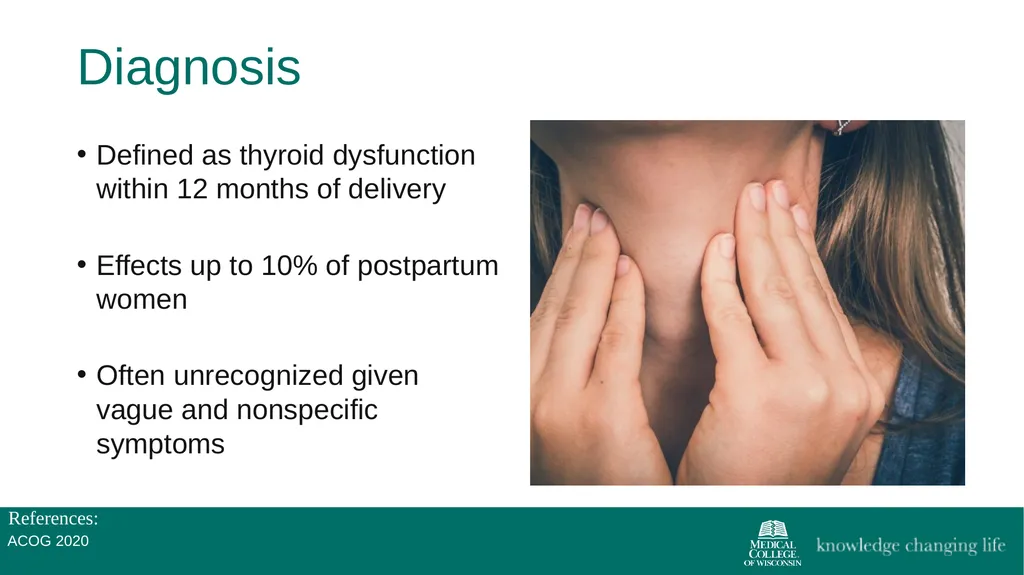
Diagnosis Defined as thyroid dysfunction within 12 months of delivery
Effects up to 10% of postpartum women
Often unrecognized given vague and nonspecific symptoms ACOG 2020<br>
Effects up to 10% of postpartum women
Often unrecognized given vague and nonspecific symptoms ACOG 2020<br>
25
Clinical Presentation Classically presents with 2 phases
1st phase: thyrotoxicosis
Small painless goiter is often present
Symptoms of hyperthyroidism: fatigue, irritability, weight loss, palpitations, heat intolerance
2nd phase: overt hypothyroidism
4-8 months postpartum
Thyroid enlargement
Symptoms of hypothyroidism: fatigue, constipation, depression
Majority of women are euthyroid by 1 year postpartum ACOG 2020, ATA 2017 Guidelines<br>
1st phase: thyrotoxicosis
Small painless goiter is often present
Symptoms of hyperthyroidism: fatigue, irritability, weight loss, palpitations, heat intolerance
2nd phase: overt hypothyroidism
4-8 months postpartum
Thyroid enlargement
Symptoms of hypothyroidism: fatigue, constipation, depression
Majority of women are euthyroid by 1 year postpartum ACOG 2020, ATA 2017 Guidelines<br>
26
Management Measurement of TPO antibodies
Generally negative in postpartum thyroiditis
Those with antibodies at higher risk for progression to permanent hypothyroidism
Thyrotoxic phase
Generally minimally symptomatic
Beta-blockers are first line for those requiring treatment
Hypothyroid phase
Supplementation as needed
Long term
Increased risk for permanent hypothyroidism with annual progression rate of 3.6%
Yearly TSH ACOG 2020, ATA 2017 Guidelines<br>
Generally negative in postpartum thyroiditis
Those with antibodies at higher risk for progression to permanent hypothyroidism
Thyrotoxic phase
Generally minimally symptomatic
Beta-blockers are first line for those requiring treatment
Hypothyroid phase
Supplementation as needed
Long term
Increased risk for permanent hypothyroidism with annual progression rate of 3.6%
Yearly TSH ACOG 2020, ATA 2017 Guidelines<br>
27
Chronic Disease Management Gestational diabetes and Hypertensive disorders of pregnancy<br>
28
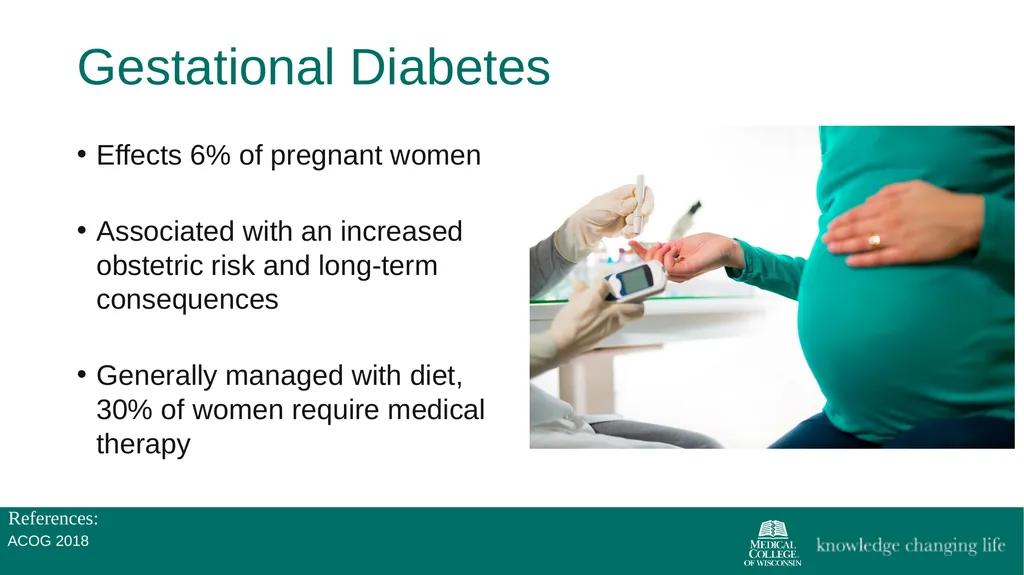
Gestational Diabetes Effects 6% of pregnant women
Associated with an increased obstetric risk and long-term consequences
Generally managed with diet, 30% of women require medical therapy ACOG 2018<br>
Associated with an increased obstetric risk and long-term consequences
Generally managed with diet, 30% of women require medical therapy ACOG 2018<br>
29
Future Risk RR > 7 for developing type 2 diabetes
Risk increases overtimes
9 months postpartum 3.7% will have diabetes
5 years postpartum 13.1%
9 years postpartum 18.9%
15-25 years postpartum 50-70%
Increased risk for cardiovascular disease
HR of 1.4 for CVD defined as fatal or non-fatal MI
Risk is even higher for those that develop DMII HR of 4 Lancet 2009, CMAJ 2008, JAMA Internal Medicine 2018<br>
Risk increases overtimes
9 months postpartum 3.7% will have diabetes
5 years postpartum 13.1%
9 years postpartum 18.9%
15-25 years postpartum 50-70%
Increased risk for cardiovascular disease
HR of 1.4 for CVD defined as fatal or non-fatal MI
Risk is even higher for those that develop DMII HR of 4 Lancet 2009, CMAJ 2008, JAMA Internal Medicine 2018<br>
30
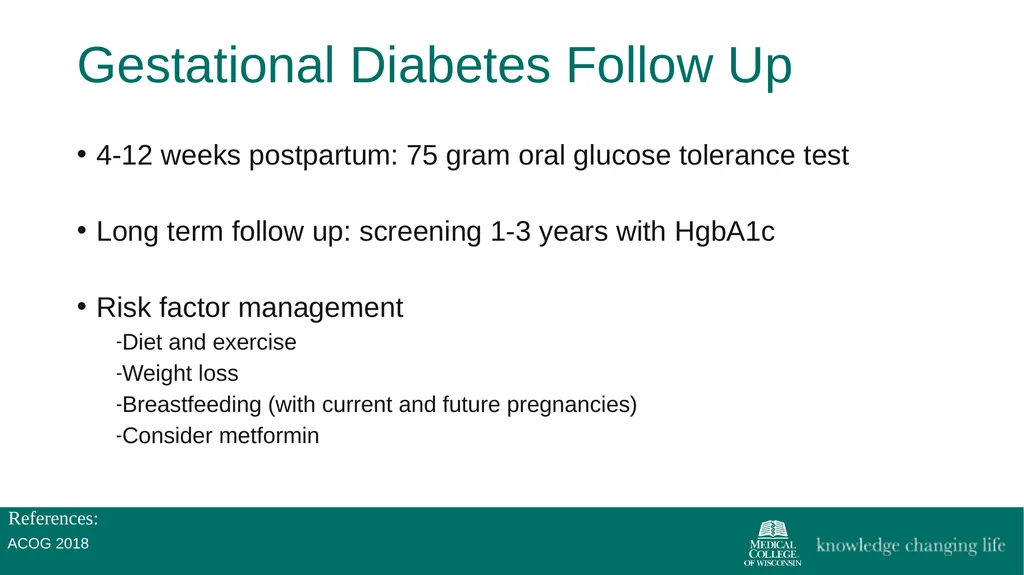
Gestational Diabetes Follow Up 4-12 weeks postpartum: 75 gram oral glucose tolerance test
Long term follow up: screening 1-3 years with HgbA1c
Risk factor management
Diet and exercise
Weight loss
Breastfeeding (with current and future pregnancies)
Consider metformin ACOG 2018<br>
Long term follow up: screening 1-3 years with HgbA1c
Risk factor management
Diet and exercise
Weight loss
Breastfeeding (with current and future pregnancies)
Consider metformin ACOG 2018<br>
31
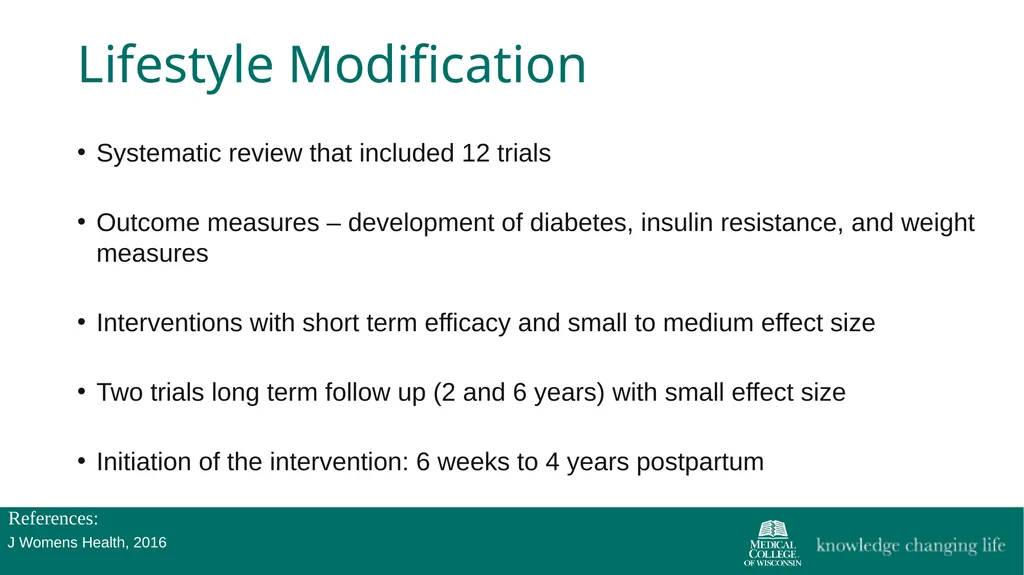
Lifestyle Modification Systematic review that included 12 trials
Outcome measures – development of diabetes, insulin resistance, and weight measures
Interventions with short term efficacy and small to medium effect size
Two trials long term follow up (2 and 6 years) with small effect size
Initiation of the intervention: 6 weeks to 4 years postpartum J Womens Health, 2016<br>
Outcome measures – development of diabetes, insulin resistance, and weight measures
Interventions with short term efficacy and small to medium effect size
Two trials long term follow up (2 and 6 years) with small effect size
Initiation of the intervention: 6 weeks to 4 years postpartum J Womens Health, 2016<br>
32
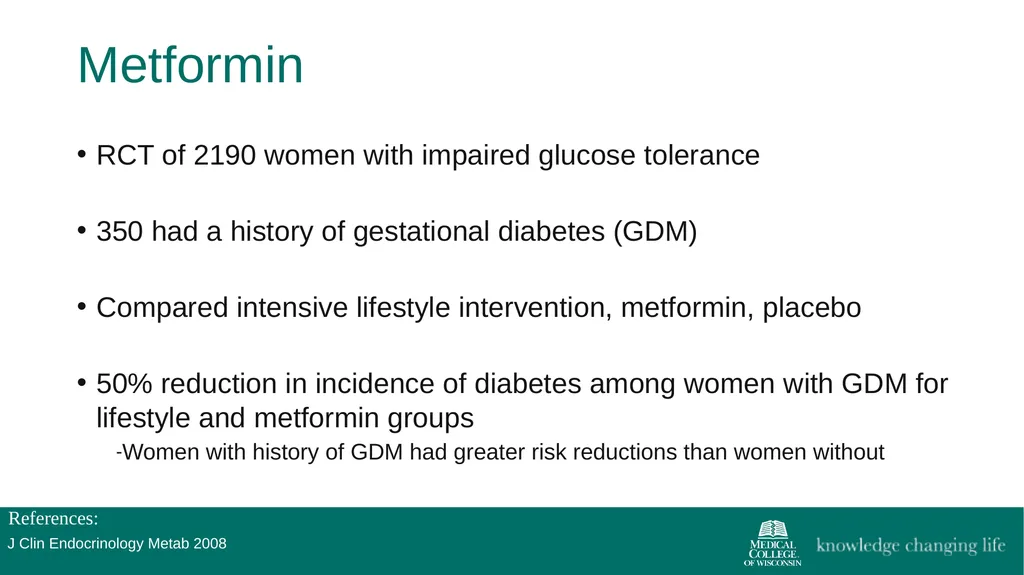
Metformin RCT of 2190 women with impaired glucose tolerance
350 had a history of gestational diabetes (GDM)
Compared intensive lifestyle intervention, metformin, placebo
50% reduction in incidence of diabetes among women with GDM for lifestyle and metformin groups
Women with history of GDM had greater risk reductions than women without J Clin Endocrinology Metab 2008<br>
350 had a history of gestational diabetes (GDM)
Compared intensive lifestyle intervention, metformin, placebo
50% reduction in incidence of diabetes among women with GDM for lifestyle and metformin groups
Women with history of GDM had greater risk reductions than women without J Clin Endocrinology Metab 2008<br>
33
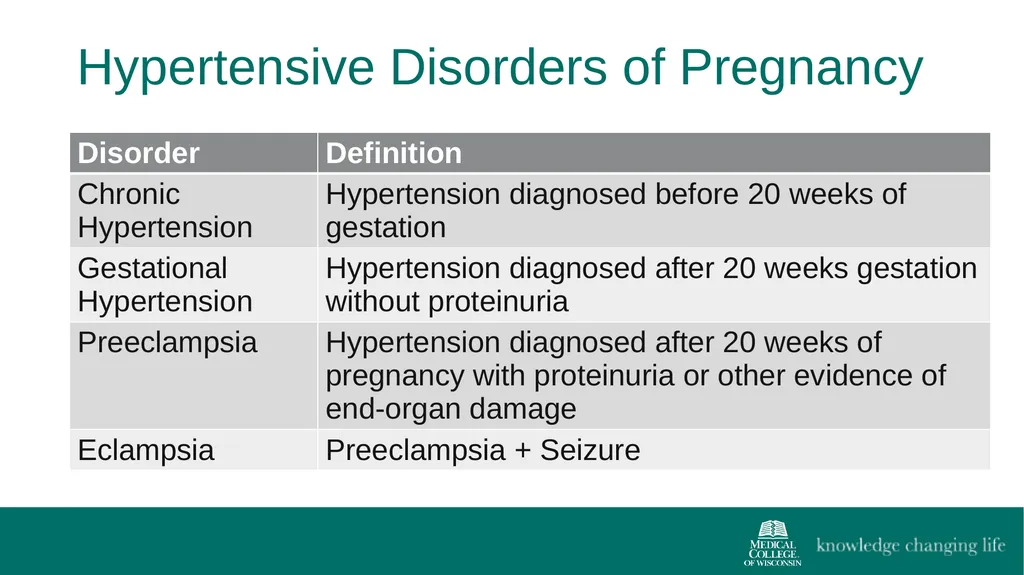
Hypertensive Disorders of Pregnancy<br>
34
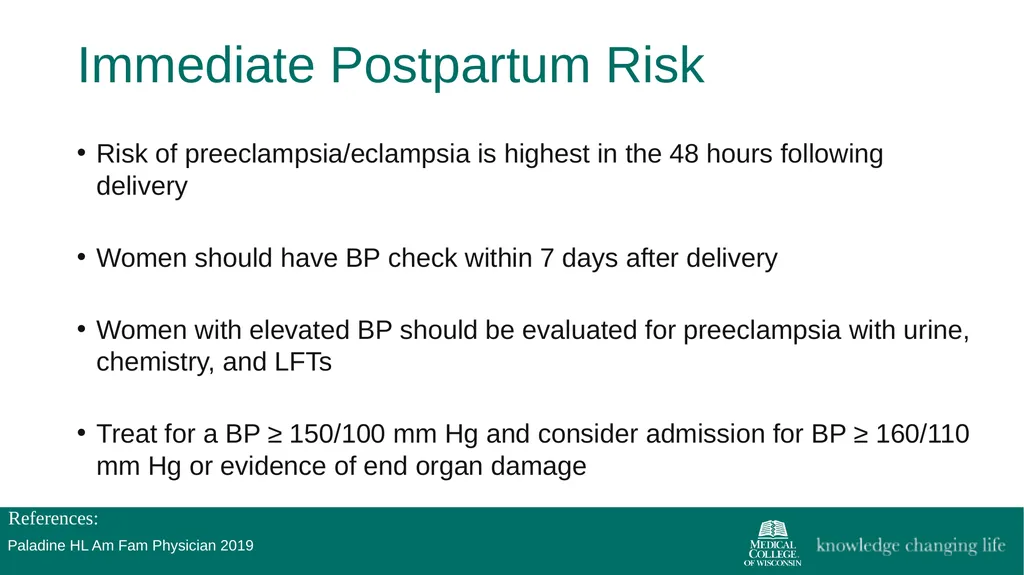
Immediate Postpartum Risk Risk of preeclampsia/eclampsia is highest in the 48 hours following delivery
Women should have BP check within 7 days after delivery
Women with elevated BP should be evaluated for preeclampsia with urine, chemistry, and LFTs
Treat for a BP ≥ 150/100 mm Hg and consider admission for BP ≥ 160/110 mm Hg or evidence of end organ damage Paladine HL Am Fam Physician 2019<br>
Women should have BP check within 7 days after delivery
Women with elevated BP should be evaluated for preeclampsia with urine, chemistry, and LFTs
Treat for a BP ≥ 150/100 mm Hg and consider admission for BP ≥ 160/110 mm Hg or evidence of end organ damage Paladine HL Am Fam Physician 2019<br>
35
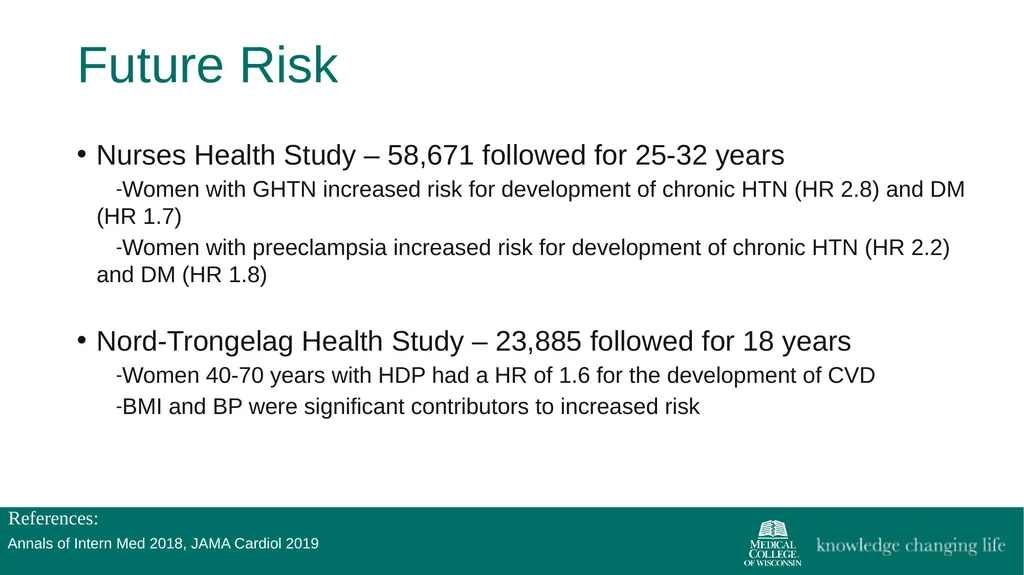
Future Risk Nurses Health Study – 58,671 followed for 25-32 years
Women with GHTN increased risk for development of chronic HTN (HR 2.8) and DM (HR 1.7)
Women with preeclampsia increased risk for development of chronic HTN (HR 2.2) and DM (HR 1.8)
Nord-Trongelag Health Study – 23,885 followed for 18 years
Women 40-70 years with HDP had a HR of 1.6 for the development of CVD
BMI and BP were significant contributors to increased risk Annals of Intern Med 2018, JAMA Cardiol 2019<br>
Women with GHTN increased risk for development of chronic HTN (HR 2.8) and DM (HR 1.7)
Women with preeclampsia increased risk for development of chronic HTN (HR 2.2) and DM (HR 1.8)
Nord-Trongelag Health Study – 23,885 followed for 18 years
Women 40-70 years with HDP had a HR of 1.6 for the development of CVD
BMI and BP were significant contributors to increased risk Annals of Intern Med 2018, JAMA Cardiol 2019<br>
36
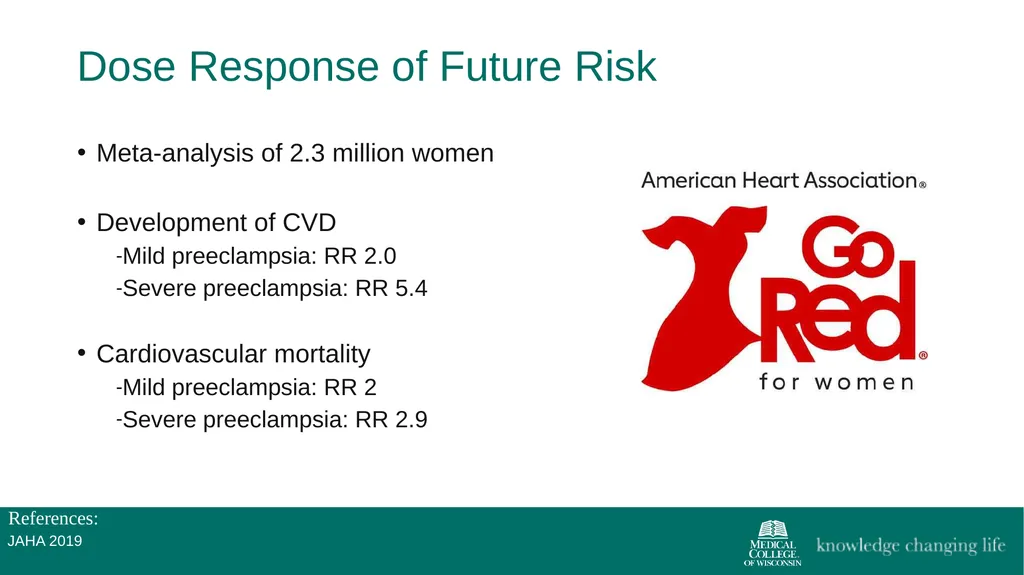
Dose Response of Future Risk Meta-analysis of 2.3 million women
Development of CVD
Mild preeclampsia: RR 2.0
Severe preeclampsia: RR 5.4
Cardiovascular mortality
Mild preeclampsia: RR 2
Severe preeclampsia: RR 2.9 JAHA 2019<br>
Development of CVD
Mild preeclampsia: RR 2.0
Severe preeclampsia: RR 5.4
Cardiovascular mortality
Mild preeclampsia: RR 2
Severe preeclampsia: RR 2.9 JAHA 2019<br>
37
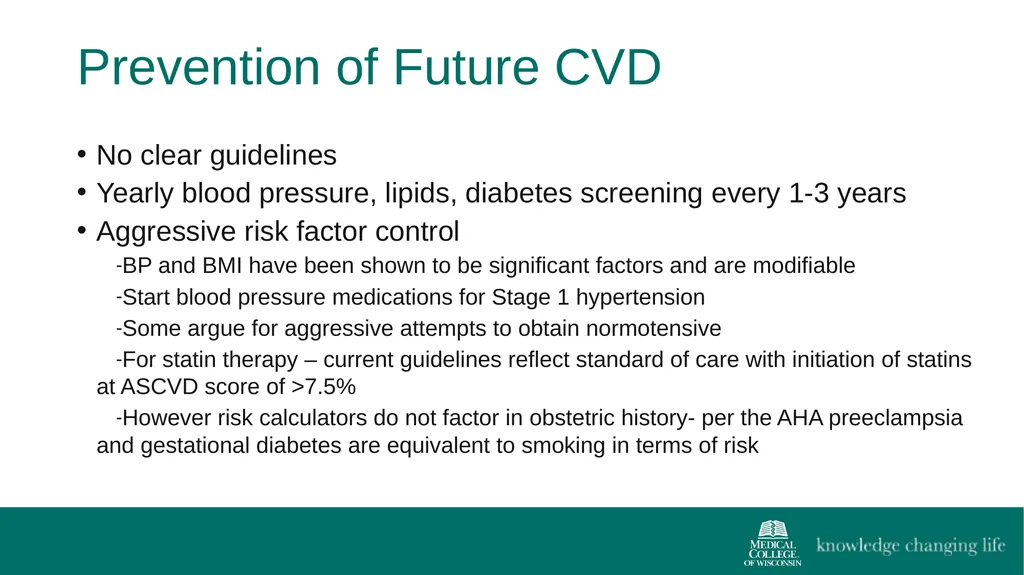
Prevention of Future CVD No clear guidelines
Yearly blood pressure, lipids, diabetes screening every 1-3 years
Aggressive risk factor control
BP and BMI have been shown to be significant factors and are modifiable
Start blood pressure medications for Stage 1 hypertension
Some argue for aggressive attempts to obtain normotensive
For statin therapy – current guidelines reflect standard of care with initiation of statins at ASCVD score of >7.5%
However risk calculators do not factor in obstetric history- per the AHA preeclampsia and gestational diabetes are equivalent to smoking in terms of risk<br>
Yearly blood pressure, lipids, diabetes screening every 1-3 years
Aggressive risk factor control
BP and BMI have been shown to be significant factors and are modifiable
Start blood pressure medications for Stage 1 hypertension
Some argue for aggressive attempts to obtain normotensive
For statin therapy – current guidelines reflect standard of care with initiation of statins at ASCVD score of >7.5%
However risk calculators do not factor in obstetric history- per the AHA preeclampsia and gestational diabetes are equivalent to smoking in terms of risk<br>
38
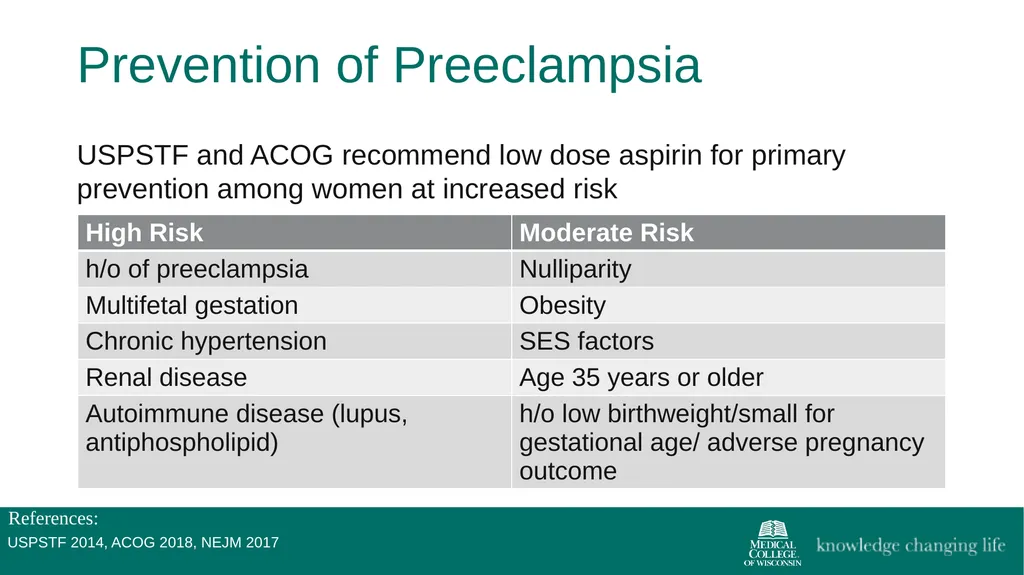
Prevention of Preeclampsia USPSTF and ACOG recommend low dose aspirin for primary prevention among women at increased risk USPSTF 2014, ACOG 2018, NEJM 2017<br>
39
References Paladine HL, Blenning CE, Stranga Y. Postpartum care: an approach to the fourth trimester. AAFP 2019;100(8):485-491
American College of Obstetricians and Gynecologists Optimizing postpartum care ACOG committee opinion 736. Obstet Gynecol 2018;131(5);e140-e150
American College of Obstetricians and Gynecologists. Screening for perinatal depression. ACOG Committee Opinion No 757. Obstet Gynecol 2018;132:e208-12
Siu AL, and the US Preventive Services Task Force (USPSTF). Screening for Depression in Adults: US Preventive Services Task Force Recommendation Statement. JAMA. 2016;315(4):380–387.
Lancaster CA, Gold KJ, Flynn HA, Yoo H, Marcus SM, Davis MM. Risk factors for depressive symptoms during pregnancy: a systematic review. Am J Obstet Gynecol 2010;202:5–14
Slomian J, Honvo G, Emonts P, Reginster JY, Bruyere O. Consequences of maternal postpartum depression: a systematic review. Womens Health 2019;15:1-55.
Siu Al, Bibbins-Domingo K, Grossman DC, et al, US Preventative Services Task Force recommendation statement, JAMA. 2016;315(4):380-387.
Neuman G, Colantonio D, Delaney S et al. Bupropion and escitalopram during lactation. Ann Pharmacother. 2014;48:928-31
Chaudron LH, Schoenecker CJ. Bupropion and breastfeeding: a case of a possible infant seizure. J Clin Psychiatry. 2004;65:881-2.
Neuman G, Bozzo P, Pupco S et al. Adverse effects in infants exposed to bupropion and/or SSRIS during lactation. Birth Defects Res Part A Clin Mol Teratol. 2015;103:461.
US Preventive Services Task Force. Interventions to Prevent Perinatal Depression: US Preventive Services Task Force Recommendation Statement. JAMA. 2019;321(6):580–587.<br>
American College of Obstetricians and Gynecologists Optimizing postpartum care ACOG committee opinion 736. Obstet Gynecol 2018;131(5);e140-e150
American College of Obstetricians and Gynecologists. Screening for perinatal depression. ACOG Committee Opinion No 757. Obstet Gynecol 2018;132:e208-12
Siu AL, and the US Preventive Services Task Force (USPSTF). Screening for Depression in Adults: US Preventive Services Task Force Recommendation Statement. JAMA. 2016;315(4):380–387.
Lancaster CA, Gold KJ, Flynn HA, Yoo H, Marcus SM, Davis MM. Risk factors for depressive symptoms during pregnancy: a systematic review. Am J Obstet Gynecol 2010;202:5–14
Slomian J, Honvo G, Emonts P, Reginster JY, Bruyere O. Consequences of maternal postpartum depression: a systematic review. Womens Health 2019;15:1-55.
Siu Al, Bibbins-Domingo K, Grossman DC, et al, US Preventative Services Task Force recommendation statement, JAMA. 2016;315(4):380-387.
Neuman G, Colantonio D, Delaney S et al. Bupropion and escitalopram during lactation. Ann Pharmacother. 2014;48:928-31
Chaudron LH, Schoenecker CJ. Bupropion and breastfeeding: a case of a possible infant seizure. J Clin Psychiatry. 2004;65:881-2.
Neuman G, Bozzo P, Pupco S et al. Adverse effects in infants exposed to bupropion and/or SSRIS during lactation. Birth Defects Res Part A Clin Mol Teratol. 2015;103:461.
US Preventive Services Task Force. Interventions to Prevent Perinatal Depression: US Preventive Services Task Force Recommendation Statement. JAMA. 2019;321(6):580–587.<br>
40
References Rortveit G, Daltveit AK, Hannestad YS, Hunskaar S, Urinary incontinence after vaginal delivery or cesarean section. NEJM. 2003;348(10):900-7.
Woodley SJ, Boyle R, Cody JD, Mørkved S, Hay‐Smith EJC. Pelvic floor muscle training for prevention and treatment of urinary and faecal incontinence in antenatal and postnatal women. Cochrane Database of Systematic Reviews 2017
Dumoulin C, Cacciari L, Hay-Smith EC. Pelvic floor muscle training versus no treatment, or inactive control treatments, for urinary incontinence in women. Cochrane Database of Systematic Reviews 2018
American College of Obstetricians and Gynecologist. ACOG Practice Bulletin No, 223: Thyroid disease in pregnancy. Obset &Gynec 2020;135(6);e261-267
Alexander EK et al 2017 Guidelines of the American Thyroid Association for the Diagnosis and Management of thyroid Disease During Pregnancy and Postpartum. Thyroid. 2017. 27(3):315-
American College of Obstetricians and Gynecologist. ACOG Practice Bulletin No, 190: Gestation diabetes mellitus. Obset &Gynec 2018;131(2);e49-464
Guo J, Chen JL, Whittermore R, Whitaker E. Postpartum lifestyle interventions to prevent type 2 diabetes among women with history of gestational diabetes: a systematic review of randomized clinical trials. J Womens Health. 2016;25:38-49.
Bellamy L, Casas JP, Hingorani AD, Williams D. Type 2 diabetes melitus after gestational diabetes: a systematic review and meta-analysis. Lancet. 2009;373(9677):1773
Feig DS, Zinman B, Wang X, Hux JE. Risk of development of diabetes melitus after diagnosis of gestational diabetes. CMAJ 2008;179(3):229
Tobias DK, Stuart JJ, Li S, et al. Association of History of Gestational Diabetes With Long-term Cardiovascular Disease Risk in a Large Prospective Cohort of US Women. JAMA Intern Med. 2017;177(12):1735–1742.
Ratner RE, Christophi CA, Metzger BE, et al. Prevention of diabetes in women with a history of gestational diabetes: effects of metformin and lifestyle interventions. J Clin Endocrinol Metab. 2008;93(12):4774–4779. doi:10.1210/jc.2008-0772
Stuart JJ, Tanz LJ, Missmer SA, Rimm, EB, Spiegelman D, James-Todd TM, et al Hypertensive disorders of pregnancy and maternal cardiovascular risk factor development: an observation cohort study. Ann Intern Med 2018;169:224-232
Ying W, Catov JM, Ouyang P Hypertensive disorders of pregnancy and future maternal cardiovascular risk. JAHA 2018;7(17)
Haug EB, Horn J, Markovitz AR, et al Association of conventional cardiovascular risk factors with cardiovascular disease after hypertensive disorders of pregnancy: analysis of the Nord-Trondelag Health Study. JAMA Cardiol 2019;4(7)628-635<br>
Woodley SJ, Boyle R, Cody JD, Mørkved S, Hay‐Smith EJC. Pelvic floor muscle training for prevention and treatment of urinary and faecal incontinence in antenatal and postnatal women. Cochrane Database of Systematic Reviews 2017
Dumoulin C, Cacciari L, Hay-Smith EC. Pelvic floor muscle training versus no treatment, or inactive control treatments, for urinary incontinence in women. Cochrane Database of Systematic Reviews 2018
American College of Obstetricians and Gynecologist. ACOG Practice Bulletin No, 223: Thyroid disease in pregnancy. Obset &Gynec 2020;135(6);e261-267
Alexander EK et al 2017 Guidelines of the American Thyroid Association for the Diagnosis and Management of thyroid Disease During Pregnancy and Postpartum. Thyroid. 2017. 27(3):315-
American College of Obstetricians and Gynecologist. ACOG Practice Bulletin No, 190: Gestation diabetes mellitus. Obset &Gynec 2018;131(2);e49-464
Guo J, Chen JL, Whittermore R, Whitaker E. Postpartum lifestyle interventions to prevent type 2 diabetes among women with history of gestational diabetes: a systematic review of randomized clinical trials. J Womens Health. 2016;25:38-49.
Bellamy L, Casas JP, Hingorani AD, Williams D. Type 2 diabetes melitus after gestational diabetes: a systematic review and meta-analysis. Lancet. 2009;373(9677):1773
Feig DS, Zinman B, Wang X, Hux JE. Risk of development of diabetes melitus after diagnosis of gestational diabetes. CMAJ 2008;179(3):229
Tobias DK, Stuart JJ, Li S, et al. Association of History of Gestational Diabetes With Long-term Cardiovascular Disease Risk in a Large Prospective Cohort of US Women. JAMA Intern Med. 2017;177(12):1735–1742.
Ratner RE, Christophi CA, Metzger BE, et al. Prevention of diabetes in women with a history of gestational diabetes: effects of metformin and lifestyle interventions. J Clin Endocrinol Metab. 2008;93(12):4774–4779. doi:10.1210/jc.2008-0772
Stuart JJ, Tanz LJ, Missmer SA, Rimm, EB, Spiegelman D, James-Todd TM, et al Hypertensive disorders of pregnancy and maternal cardiovascular risk factor development: an observation cohort study. Ann Intern Med 2018;169:224-232
Ying W, Catov JM, Ouyang P Hypertensive disorders of pregnancy and future maternal cardiovascular risk. JAHA 2018;7(17)
Haug EB, Horn J, Markovitz AR, et al Association of conventional cardiovascular risk factors with cardiovascular disease after hypertensive disorders of pregnancy: analysis of the Nord-Trondelag Health Study. JAMA Cardiol 2019;4(7)628-635<br>