
The Basic Science Hypothesis What It Is and How to
TF
Published · 61 slides · 0 views
1 / 1



Description
The Basic Science Hypothesis What It Is and How to Write One The Basic Science Hypothesis Outline History lesson: scientific method and the basic-science hypothesis Dos and Donts of hypothesis writing and specific examples Goals Appreciate
Related Topics
Share
Embed code
Download this presentation From Below
"The Basic Science Hypothesis What It Is and How to" is the property of its rightful owner. Permission is granted to download and print the materials on this website for personal, non-commercial use only, and to display it on your personal computer provided you do not modify the materials and that you retain all copyright notices contained in the materials. By downloading content from our website, you accept the terms of this agreement.
Presentation Transcript
01
The Basic Science Hypothesis What It Is and How to Write One<br>
02
The Basic Science Hypothesis Outline
History lesson: scientific method and the basic-science hypothesis
Dos and Don’ts of hypothesis writing and specific examples
Goals
Appreciate utility of a clear hypothesis in your research
Help you communicate your hypothesis clearly to funding agencies and in the literature<br>
History lesson: scientific method and the basic-science hypothesis
Dos and Don’ts of hypothesis writing and specific examples
Goals
Appreciate utility of a clear hypothesis in your research
Help you communicate your hypothesis clearly to funding agencies and in the literature<br>
03
Back to Basics: The Scientific Method<br>
04
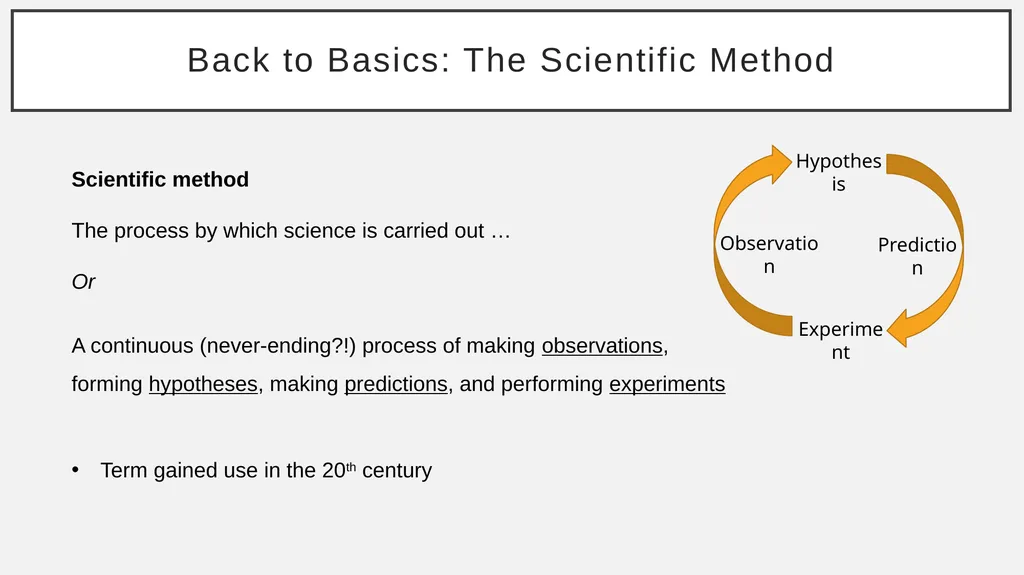
Scientific method
The process by which science is carried out …
Or
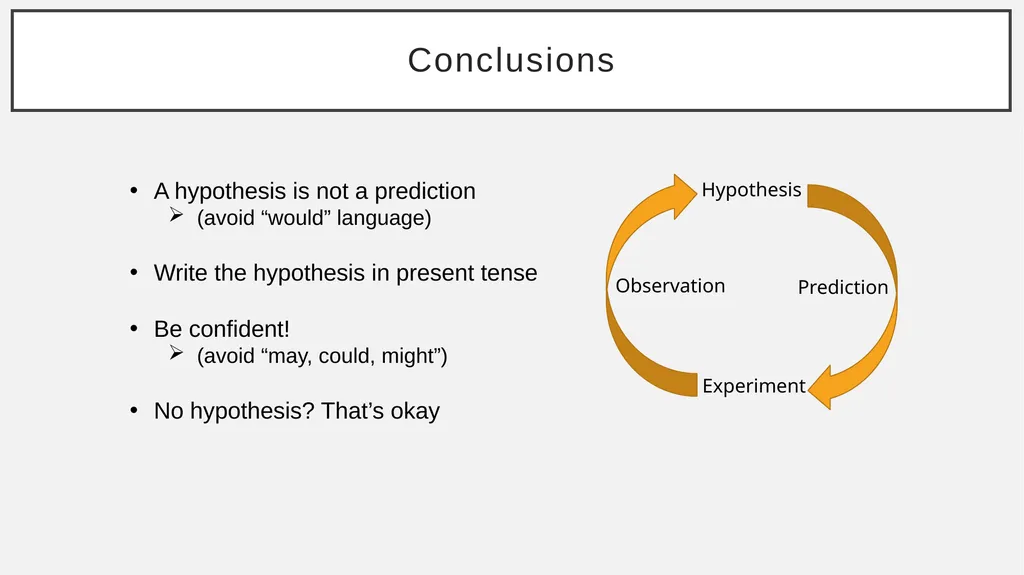
A continuous (never-ending?!) process of making observations, forming hypotheses, making predictions, and performing experiments Back to Basics: The Scientific Method Term gained use in the 20th century<br>
The process by which science is carried out …
Or
A continuous (never-ending?!) process of making observations, forming hypotheses, making predictions, and performing experiments Back to Basics: The Scientific Method Term gained use in the 20th century<br>
05
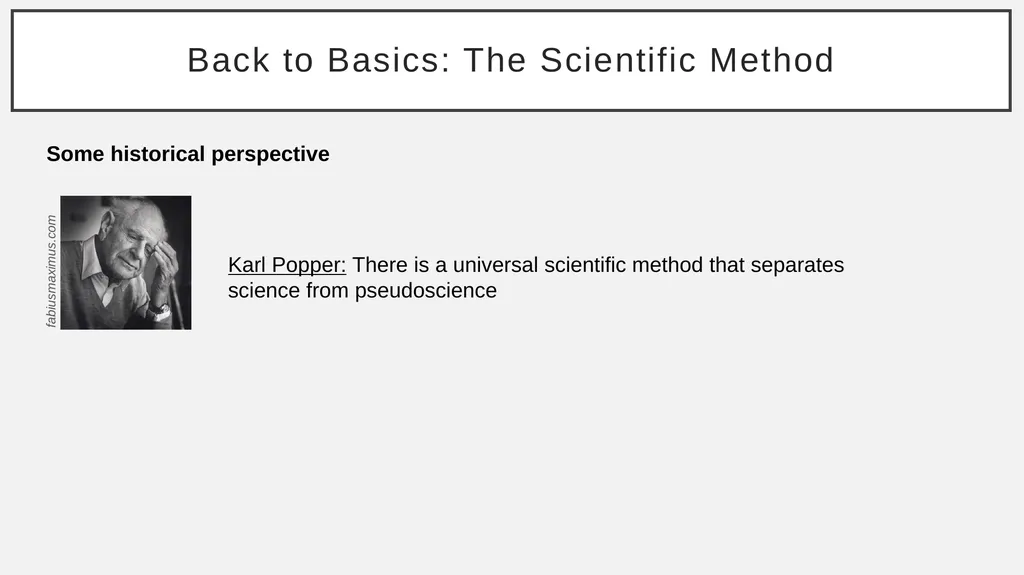
Back to Basics: The Scientific Method Karl Popper: There is a universal scientific method that separates science from pseudoscience Some historical perspective fabiusmaximus.com<br>
06
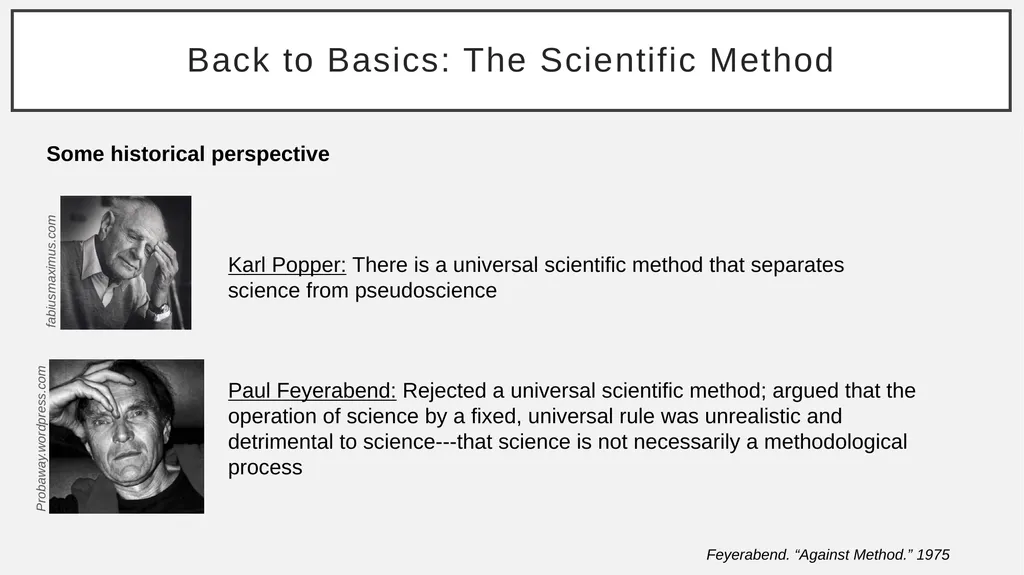
Back to Basics: The Scientific Method Karl Popper: There is a universal scientific method that separates science from pseudoscience Paul Feyerabend: Rejected a universal scientific method; argued that the operation of science by a fixed, universal rule was unrealistic and detrimental to science---that science is not necessarily a methodological process Some historical perspective Feyerabend. “Against Method.” 1975 fabiusmaximus.com Probaway.wordpress.com<br>
07
Back to Basics: The Scientific Method Kerry: Whether or not there should be a universal scientific method, it is a useful tool for organizing research questions and clearly stating hypotheses Some historical perspective<br>
08
Back to Basics: The Scientific Method Serendipity vs. Scientific Method
Serendipity = Unexpected good luck; happy accident Psychologist Kevin Dunbar estimates that 30%-50% of scientific discoveries are serendipitous Dunbar and Fugelsgang, 2005<br>
Serendipity = Unexpected good luck; happy accident Psychologist Kevin Dunbar estimates that 30%-50% of scientific discoveries are serendipitous Dunbar and Fugelsgang, 2005<br>
09
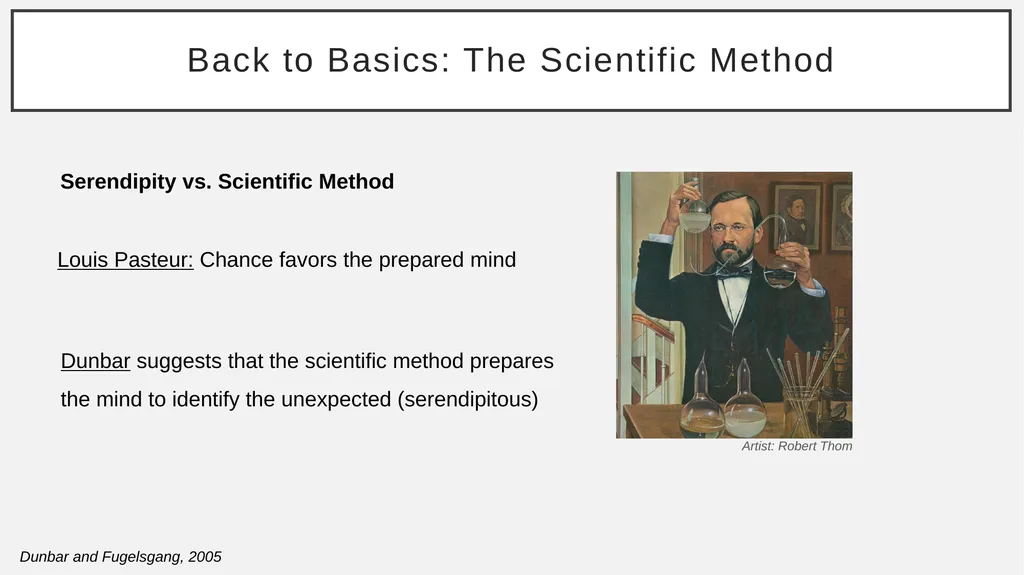
Back to Basics: The Scientific Method Louis Pasteur: Chance favors the prepared mind Serendipity vs. Scientific Method Dunbar suggests that the scientific method prepares the mind to identify the unexpected (serendipitous) Dunbar and Fugelsgang, 2005 Artist: Robert Thom<br>
10
The Hypothesis in Basic Science<br>
11
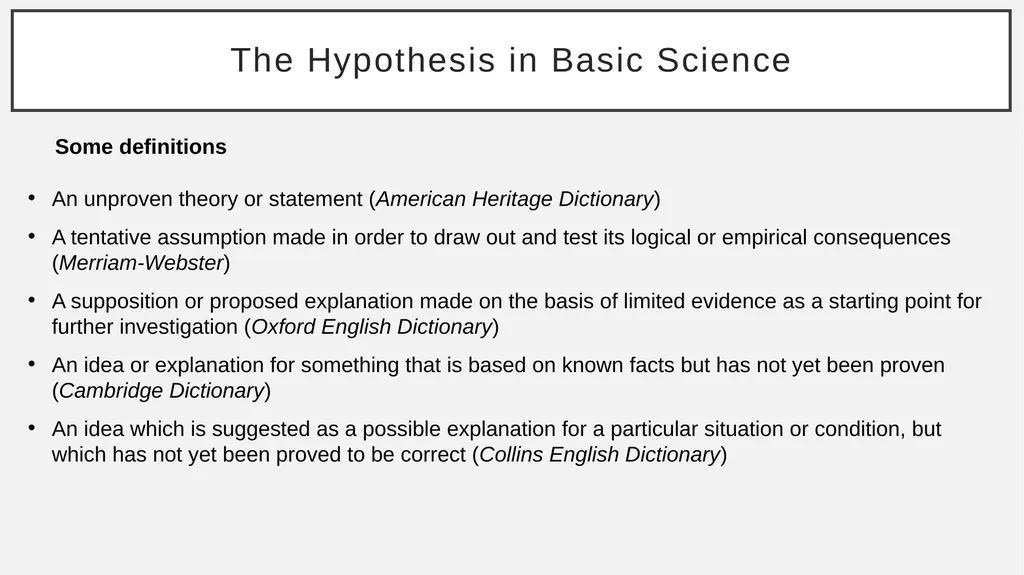
Some definitions An unproven theory or statement (American Heritage Dictionary)
A tentative assumption made in order to draw out and test its logical or empirical consequences (Merriam-Webster)
A supposition or proposed explanation made on the basis of limited evidence as a starting point for further investigation (Oxford English Dictionary)
An idea or explanation for something that is based on known facts but has not yet been proven (Cambridge Dictionary)
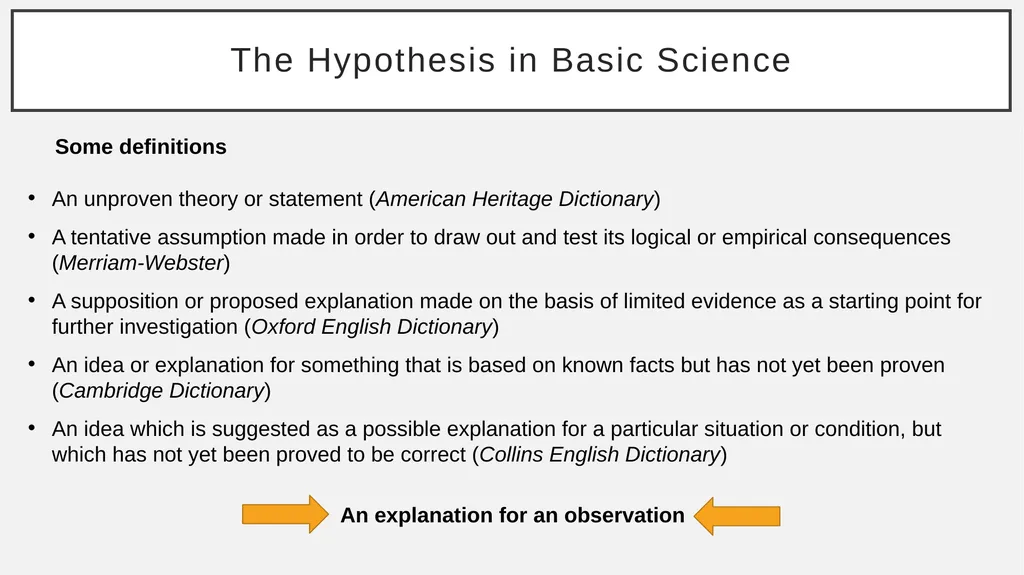
An idea which is suggested as a possible explanation for a particular situation or condition, but which has not yet been proved to be correct (Collins English Dictionary) The Hypothesis in Basic Science<br>
A tentative assumption made in order to draw out and test its logical or empirical consequences (Merriam-Webster)
A supposition or proposed explanation made on the basis of limited evidence as a starting point for further investigation (Oxford English Dictionary)
An idea or explanation for something that is based on known facts but has not yet been proven (Cambridge Dictionary)
An idea which is suggested as a possible explanation for a particular situation or condition, but which has not yet been proved to be correct (Collins English Dictionary) The Hypothesis in Basic Science<br>
12
Some definitions An unproven theory or statement (American Heritage Dictionary)
A tentative assumption made in order to draw out and test its logical or empirical consequences (Merriam-Webster)
A supposition or proposed explanation made on the basis of limited evidence as a starting point for further investigation (Oxford English Dictionary)
An idea or explanation for something that is based on known facts but has not yet been proven (Cambridge Dictionary)
An idea which is suggested as a possible explanation for a particular situation or condition, but which has not yet been proved to be correct (Collins English Dictionary) The Hypothesis in Basic Science<br>
A tentative assumption made in order to draw out and test its logical or empirical consequences (Merriam-Webster)
A supposition or proposed explanation made on the basis of limited evidence as a starting point for further investigation (Oxford English Dictionary)
An idea or explanation for something that is based on known facts but has not yet been proven (Cambridge Dictionary)
An idea which is suggested as a possible explanation for a particular situation or condition, but which has not yet been proved to be correct (Collins English Dictionary) The Hypothesis in Basic Science<br>
13
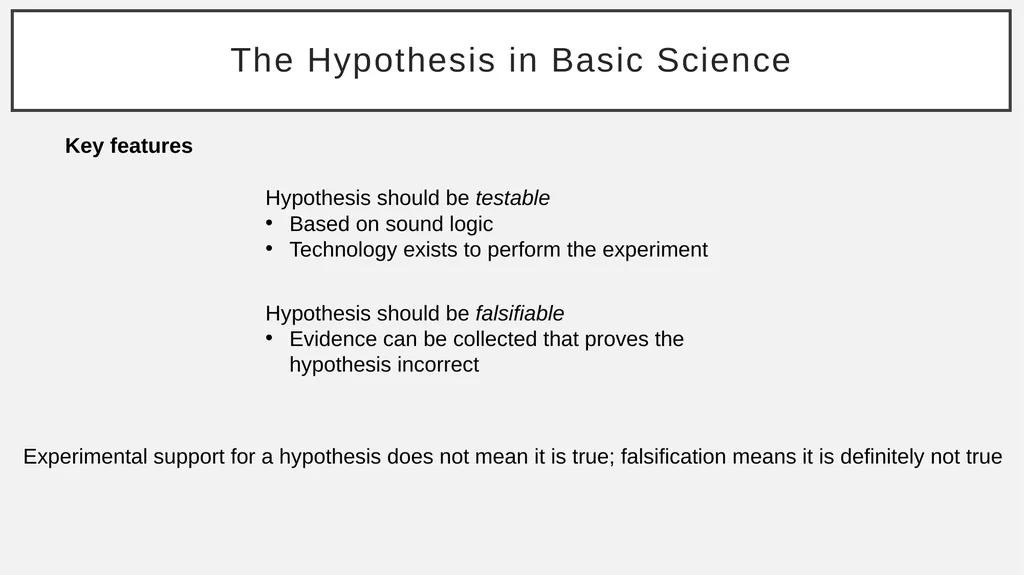
The Hypothesis in Basic Science Hypothesis should be testable
Based on sound logic
Technology exists to perform the experiment
Hypothesis should be falsifiable
Evidence can be collected that proves the hypothesis incorrect Experimental support for a hypothesis does not mean it is true; falsification means it is definitely not true Key features<br>
Based on sound logic
Technology exists to perform the experiment
Hypothesis should be falsifiable
Evidence can be collected that proves the hypothesis incorrect Experimental support for a hypothesis does not mean it is true; falsification means it is definitely not true Key features<br>
14
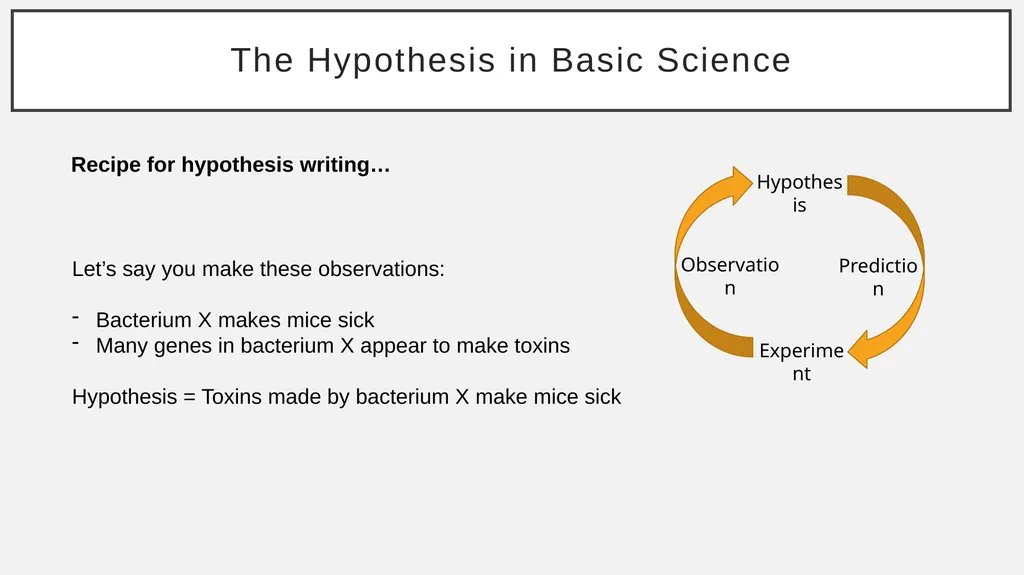
Recipe for hypothesis writing… Let’s say you make these observations:
Bacterium X makes mice sick
Many genes in bacterium X appear to make toxins
Hypothesis = Toxins made by bacterium X make mice sick The Hypothesis in Basic Science<br>
Bacterium X makes mice sick
Many genes in bacterium X appear to make toxins
Hypothesis = Toxins made by bacterium X make mice sick The Hypothesis in Basic Science<br>
15
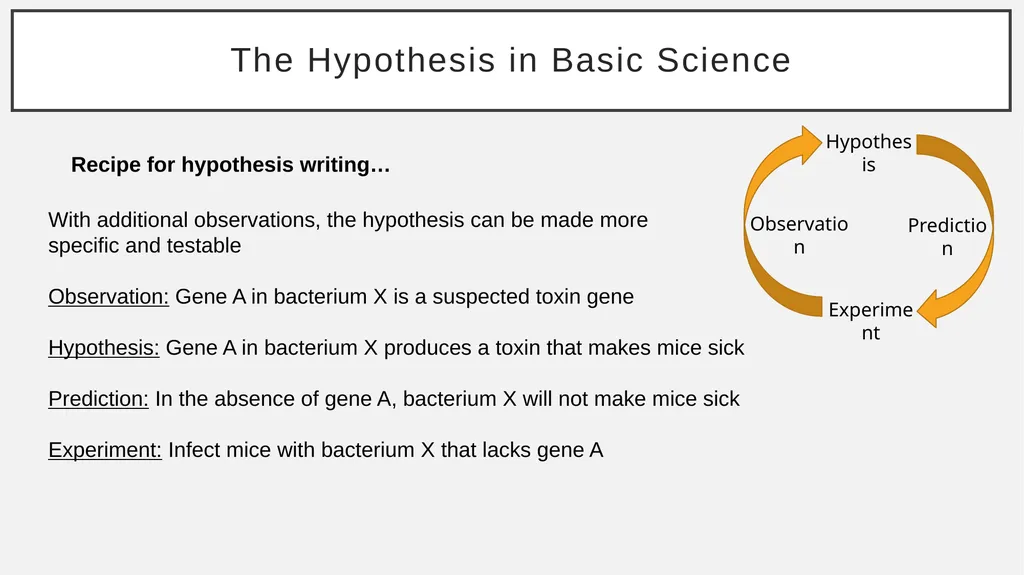
With additional observations, the hypothesis can be made more
specific and testable
Observation: Gene A in bacterium X is a suspected toxin gene
Hypothesis: Gene A in bacterium X produces a toxin that makes mice sick
Prediction: In the absence of gene A, bacterium X will not make mice sick
Experiment: Infect mice with bacterium X that lacks gene A The Hypothesis in Basic Science Recipe for hypothesis writing…<br>
specific and testable
Observation: Gene A in bacterium X is a suspected toxin gene
Hypothesis: Gene A in bacterium X produces a toxin that makes mice sick
Prediction: In the absence of gene A, bacterium X will not make mice sick
Experiment: Infect mice with bacterium X that lacks gene A The Hypothesis in Basic Science Recipe for hypothesis writing…<br>
16
Dos and Don’ts<br>
17
It’s Not a Prediction<br>
18
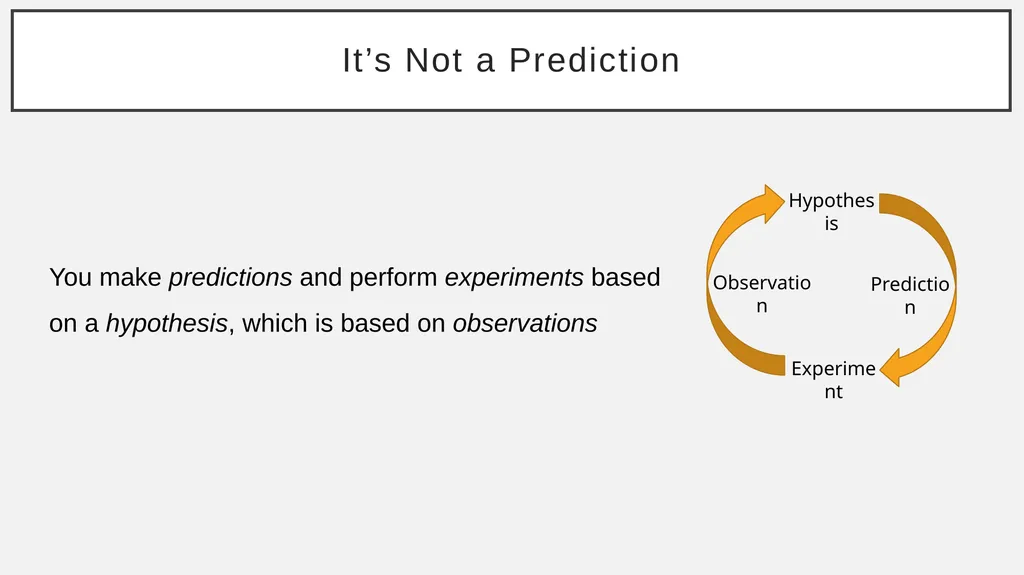
You make predictions and perform experiments based on a hypothesis, which is based on observations It’s Not a Prediction<br>
19
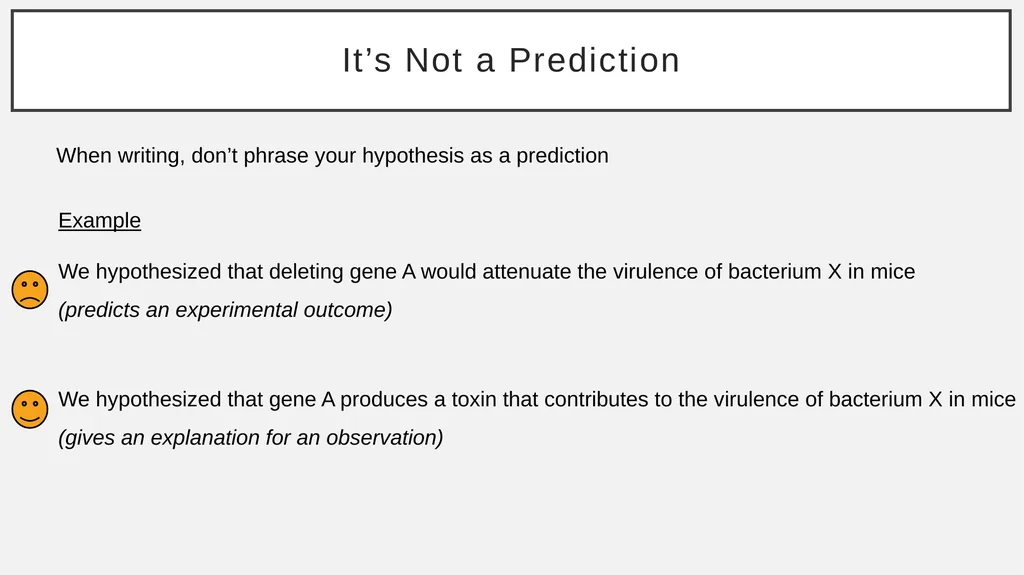
When writing, don’t phrase your hypothesis as a prediction It’s Not a Prediction<br>
20
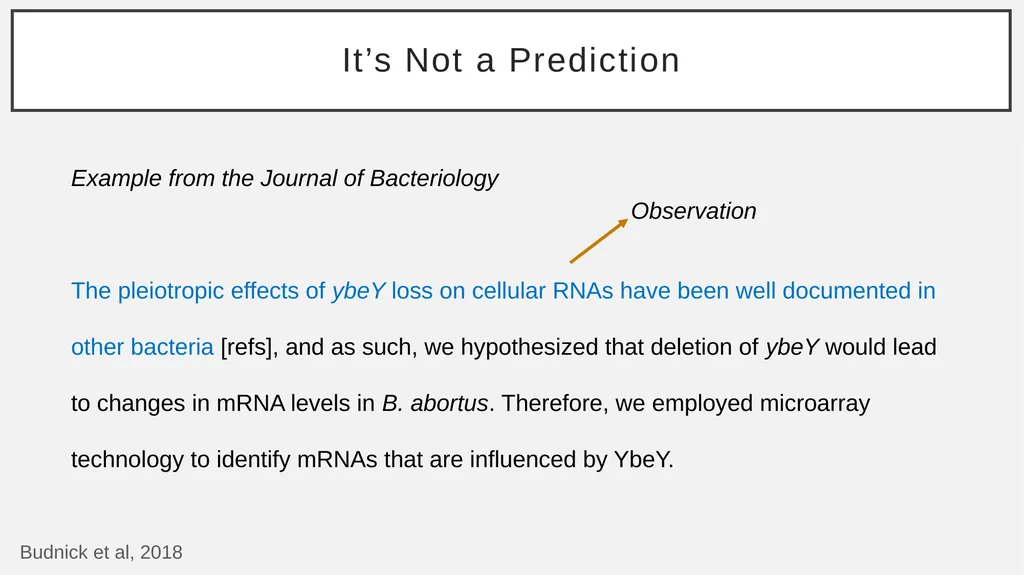
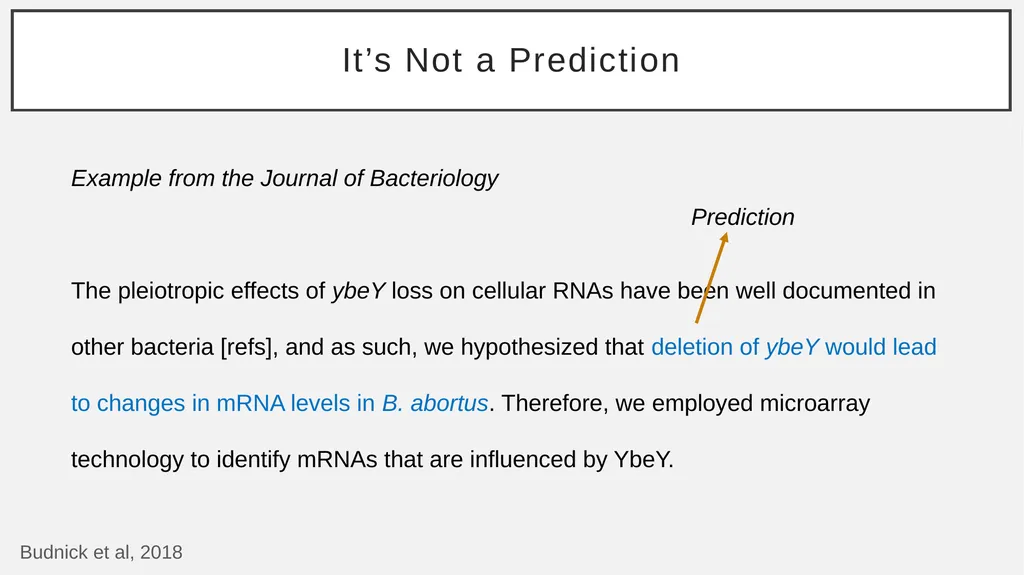
Example from the Journal of Bacteriology
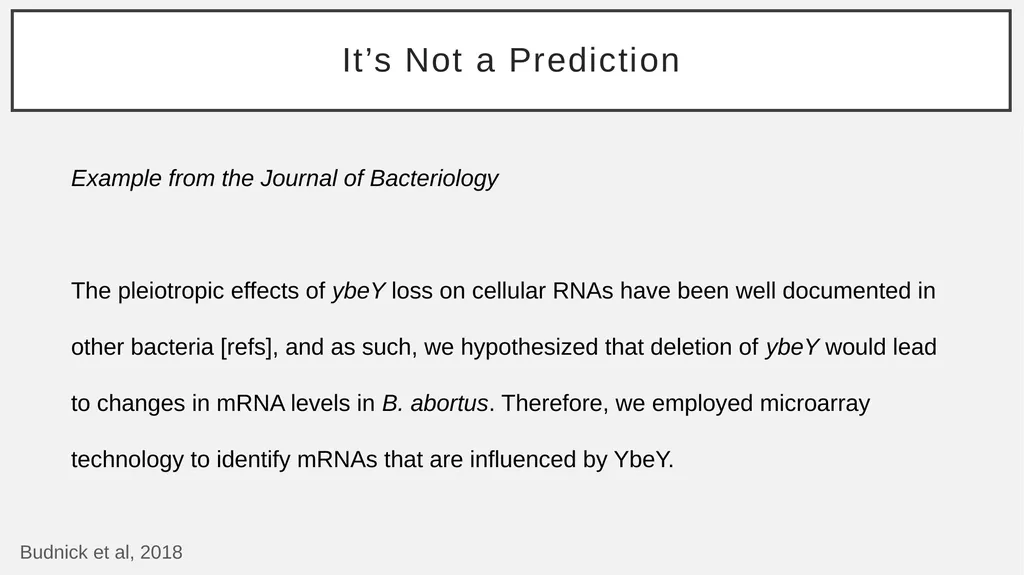
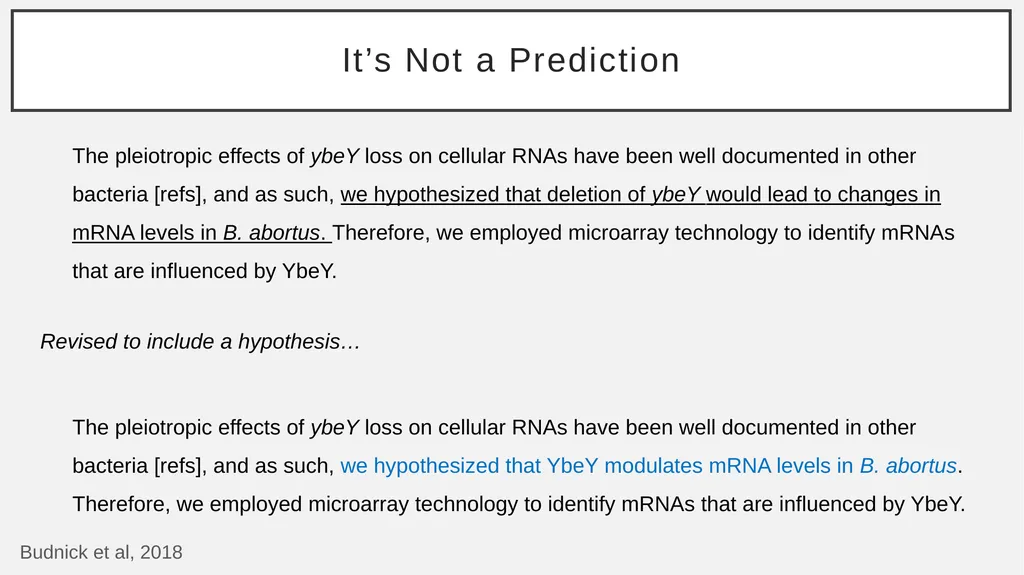
The pleiotropic effects of ybeY loss on cellular RNAs have been well documented in other bacteria [refs], and as such, we hypothesized that deletion of ybeY would lead to changes in mRNA levels in B. abortus. Therefore, we employed microarray technology to identify mRNAs that are influenced by YbeY. It’s Not a Prediction Budnick et al, 2018<br>
The pleiotropic effects of ybeY loss on cellular RNAs have been well documented in other bacteria [refs], and as such, we hypothesized that deletion of ybeY would lead to changes in mRNA levels in B. abortus. Therefore, we employed microarray technology to identify mRNAs that are influenced by YbeY. It’s Not a Prediction Budnick et al, 2018<br>
21
It’s Not a Prediction Budnick et al, 2018<br>
22
It’s Not a Prediction Budnick et al, 2018<br>
23
Example from the Journal of Bacteriology
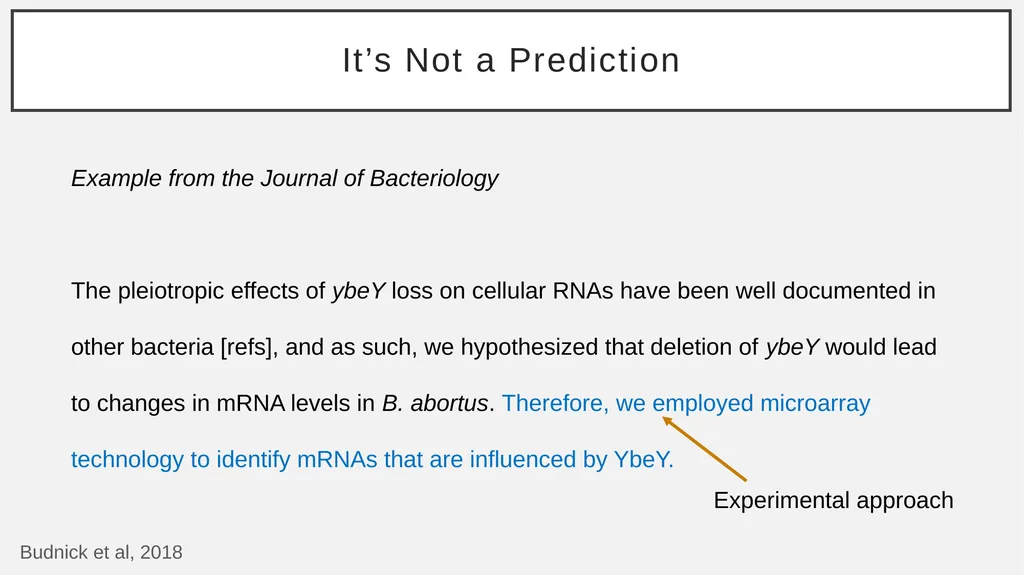
The pleiotropic effects of ybeY loss on cellular RNAs have been well documented in other bacteria [refs], and as such, we hypothesized that deletion of ybeY would lead to changes in mRNA levels in B. abortus. Therefore, we employed microarray technology to identify mRNAs that are influenced by YbeY. Experimental approach It’s Not a Prediction Budnick et al, 2018<br>
The pleiotropic effects of ybeY loss on cellular RNAs have been well documented in other bacteria [refs], and as such, we hypothesized that deletion of ybeY would lead to changes in mRNA levels in B. abortus. Therefore, we employed microarray technology to identify mRNAs that are influenced by YbeY. Experimental approach It’s Not a Prediction Budnick et al, 2018<br>
24
Let’s revise to state a hypothesis… It’s Not a Prediction<br>
25
The pleiotropic effects of ybeY loss on cellular RNAs have been well documented in other bacteria [refs], and as such, we hypothesized that deletion of ybeY would lead to changes in mRNA levels in B. abortus. Therefore, we employed microarray technology to identify mRNAs that are influenced by YbeY. The pleiotropic effects of ybeY loss on cellular RNAs have been well documented in other bacteria [refs], and as such, we hypothesized that YbeY modulates mRNA levels in B. abortus. Therefore, we employed microarray technology to identify mRNAs that are influenced by YbeY. Revised to include a hypothesis… It’s Not a Prediction Budnick et al, 2018<br>
26
Example from Free Radical Biology and Medicine
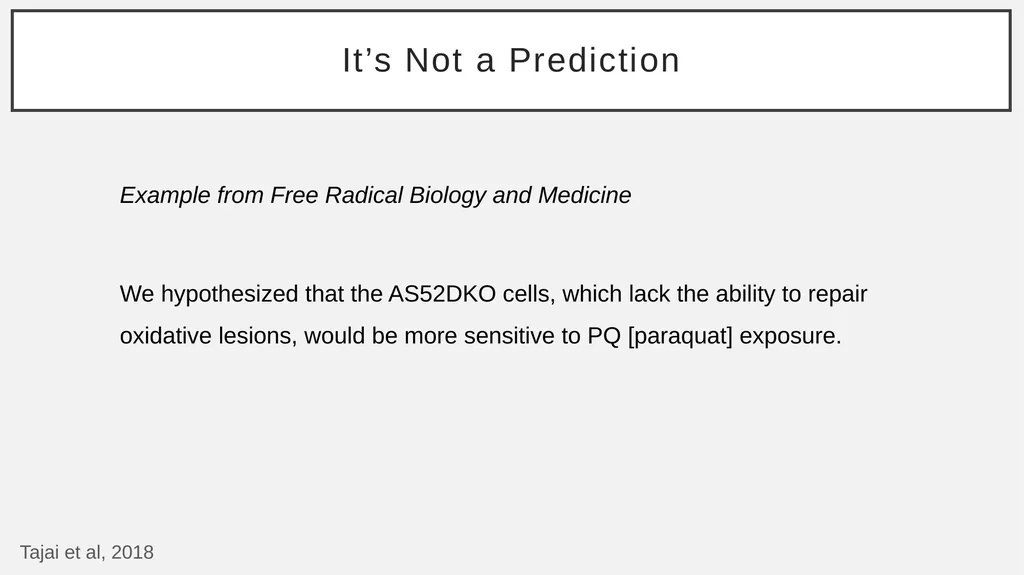
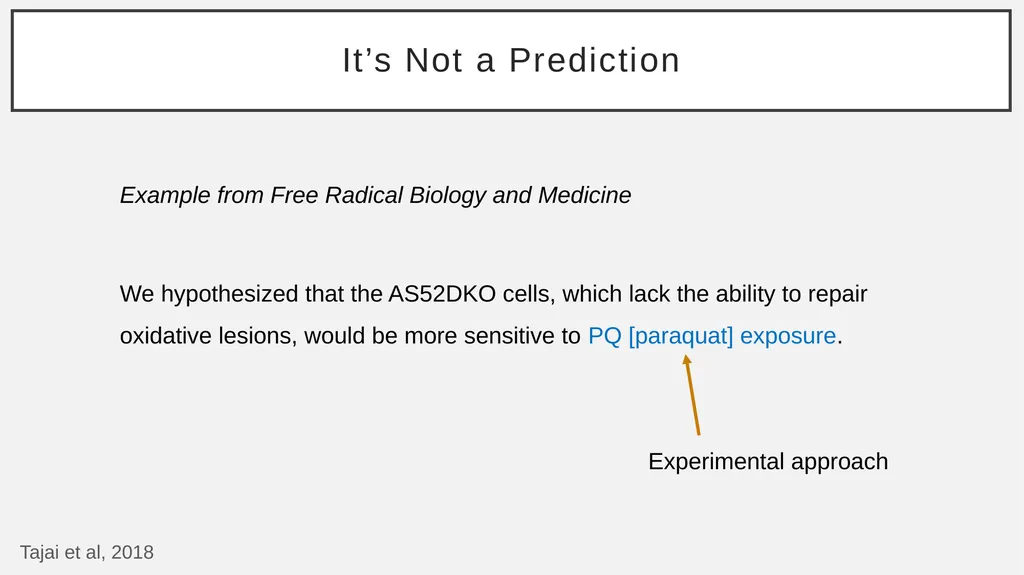
We hypothesized that the AS52DKO cells, which lack the ability to repair oxidative lesions, would be more sensitive to PQ [paraquat] exposure. It’s Not a Prediction Tajai et al, 2018<br>
We hypothesized that the AS52DKO cells, which lack the ability to repair oxidative lesions, would be more sensitive to PQ [paraquat] exposure. It’s Not a Prediction Tajai et al, 2018<br>
27
Example from Free Radical Biology and Medicine
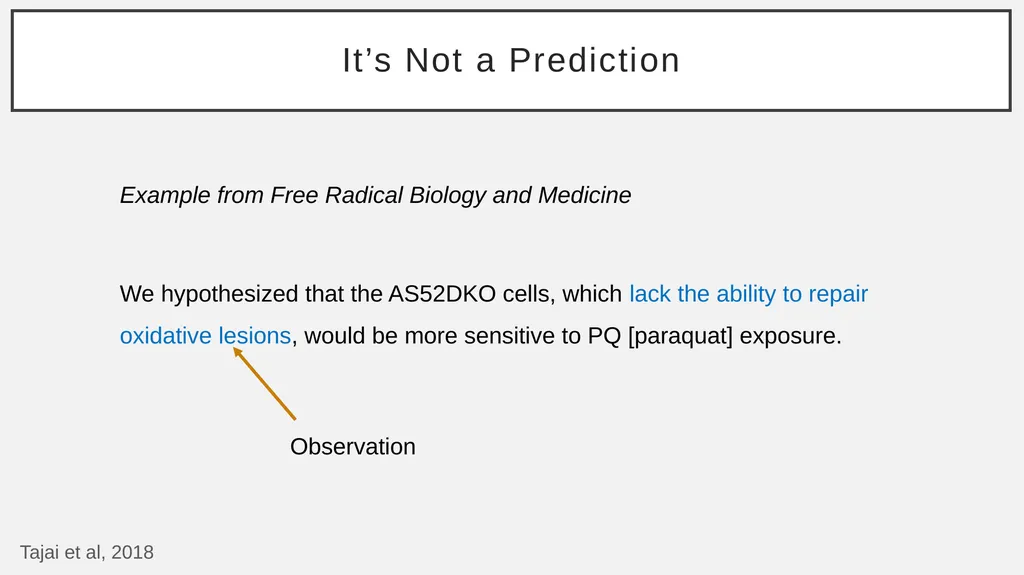
We hypothesized that the AS52DKO cells, which lack the ability to repair oxidative lesions, would be more sensitive to PQ [paraquat] exposure. It’s Not a Prediction Observation Tajai et al, 2018<br>
We hypothesized that the AS52DKO cells, which lack the ability to repair oxidative lesions, would be more sensitive to PQ [paraquat] exposure. It’s Not a Prediction Observation Tajai et al, 2018<br>
28
Example from Free Radical Biology and Medicine
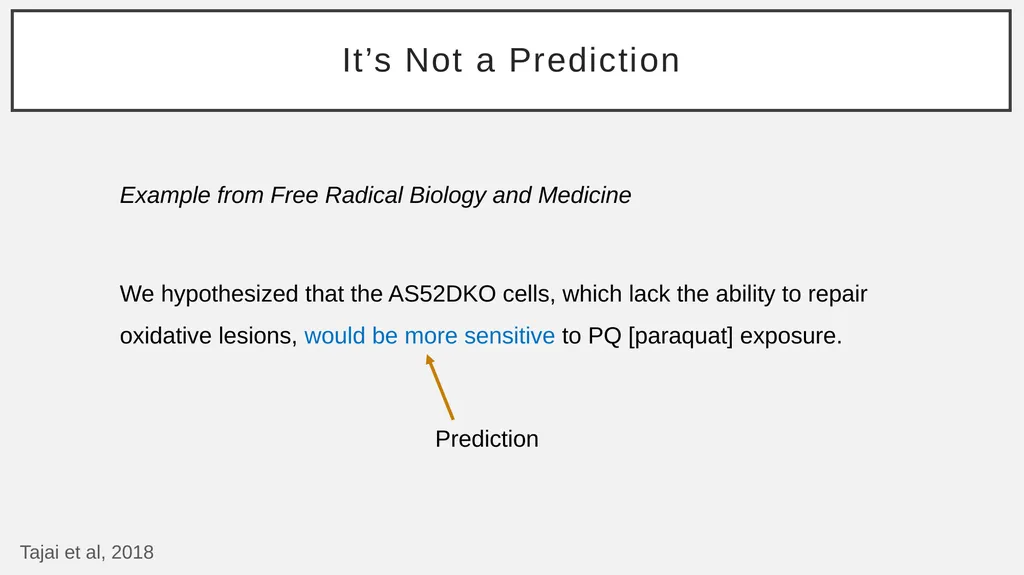
We hypothesized that the AS52DKO cells, which lack the ability to repair oxidative lesions, would be more sensitive to PQ [paraquat] exposure. It’s Not a Prediction Prediction Tajai et al, 2018<br>
We hypothesized that the AS52DKO cells, which lack the ability to repair oxidative lesions, would be more sensitive to PQ [paraquat] exposure. It’s Not a Prediction Prediction Tajai et al, 2018<br>
29
Example from Free Radical Biology and Medicine
We hypothesized that the AS52DKO cells, which lack the ability to repair oxidative lesions, would be more sensitive to PQ [paraquat] exposure. It’s Not a Prediction Experimental approach Tajai et al, 2018<br>
We hypothesized that the AS52DKO cells, which lack the ability to repair oxidative lesions, would be more sensitive to PQ [paraquat] exposure. It’s Not a Prediction Experimental approach Tajai et al, 2018<br>
30
Example from Free Radical Biology and Medicine
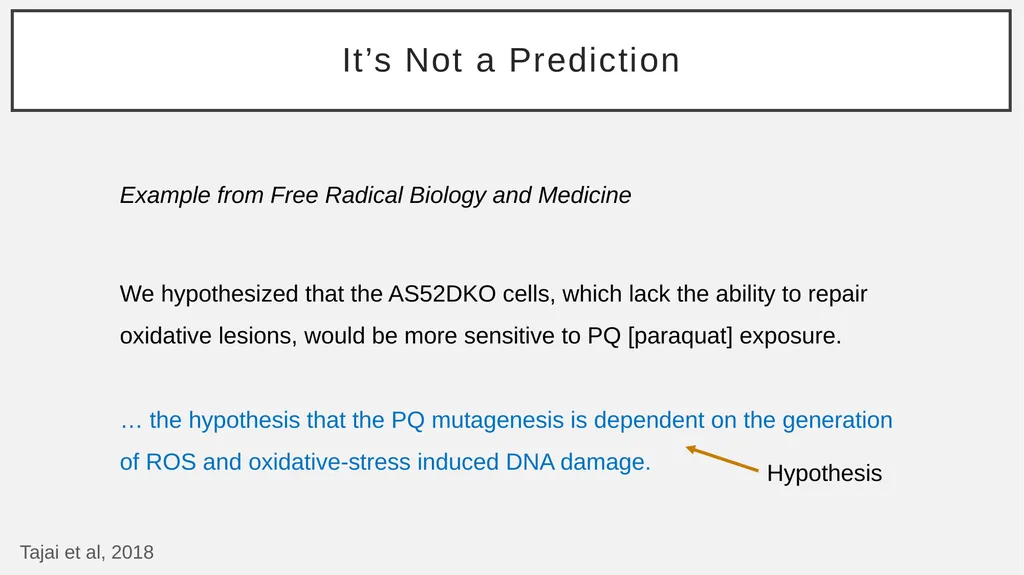
We hypothesized that the AS52DKO cells, which lack the ability to repair oxidative lesions, would be more sensitive to PQ [paraquat] exposure.
… the hypothesis that the PQ mutagenesis is dependent on the generation of ROS and oxidative-stress induced DNA damage. It’s Not a Prediction Hypothesis Tajai et al, 2018<br>
We hypothesized that the AS52DKO cells, which lack the ability to repair oxidative lesions, would be more sensitive to PQ [paraquat] exposure.
… the hypothesis that the PQ mutagenesis is dependent on the generation of ROS and oxidative-stress induced DNA damage. It’s Not a Prediction Hypothesis Tajai et al, 2018<br>
31
We hypothesized that the AS52DKO cells, which lack the ability to repair oxidative lesions, would be more sensitive to PQ [paraquat] exposure.
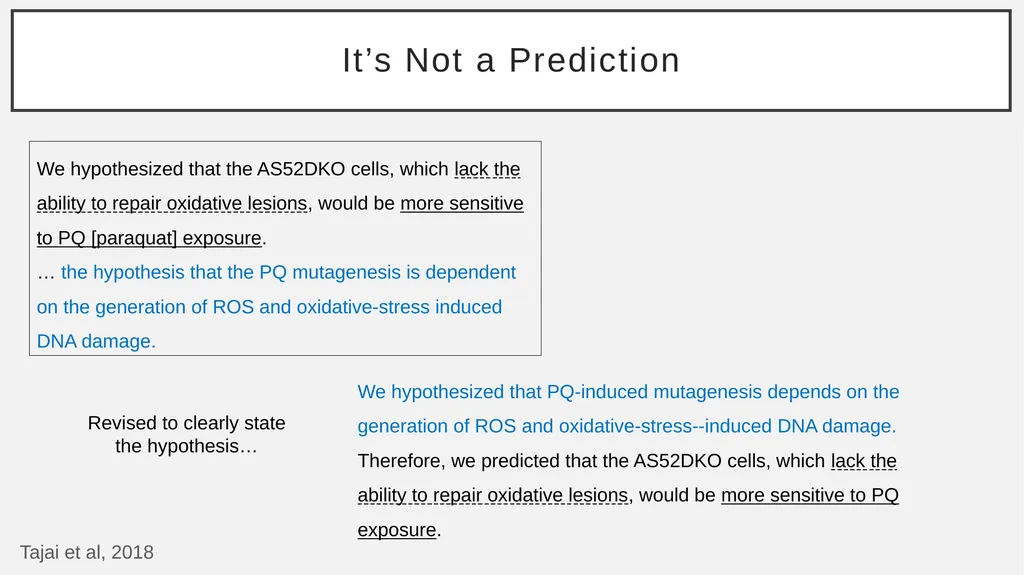
… the hypothesis that the PQ mutagenesis is dependent on the generation of ROS and oxidative-stress induced DNA damage. We hypothesized that PQ-induced mutagenesis depends on the generation of ROS and oxidative-stress--induced DNA damage. Therefore, we predicted that the AS52DKO cells, which lack the ability to repair oxidative lesions, would be more sensitive to PQ exposure. Revised to clearly state the hypothesis… It’s Not a Prediction Tajai et al, 2018<br>
… the hypothesis that the PQ mutagenesis is dependent on the generation of ROS and oxidative-stress induced DNA damage. We hypothesized that PQ-induced mutagenesis depends on the generation of ROS and oxidative-stress--induced DNA damage. Therefore, we predicted that the AS52DKO cells, which lack the ability to repair oxidative lesions, would be more sensitive to PQ exposure. Revised to clearly state the hypothesis… It’s Not a Prediction Tajai et al, 2018<br>
32
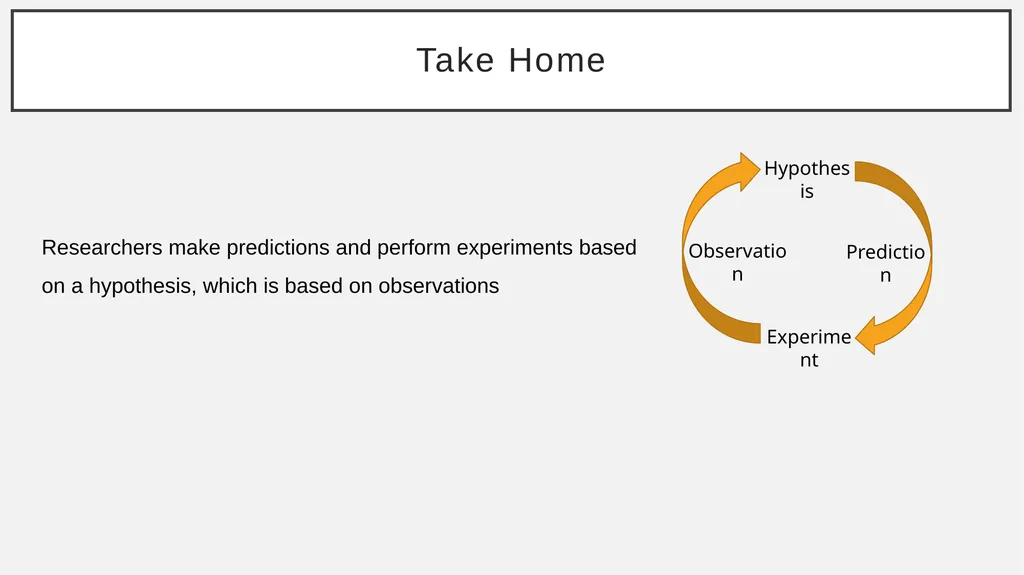
Take Home Researchers make predictions and perform experiments based on a hypothesis, which is based on observations<br>
33
Write in Present Tense<br>
34
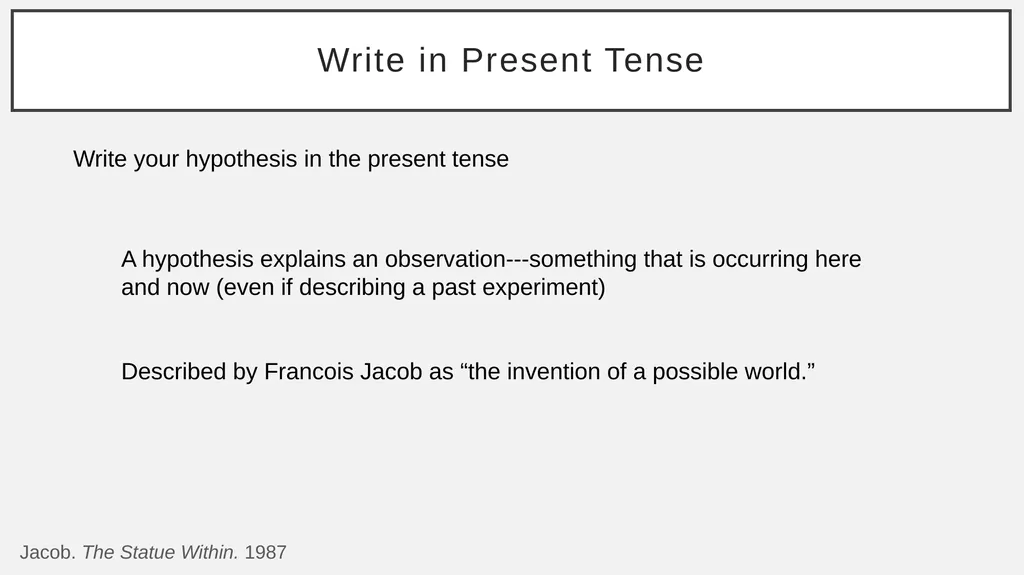
Write your hypothesis in the present tense A hypothesis explains an observation---something that is occurring here and now (even if describing a past experiment)
Described by Francois Jacob as “the invention of a possible world.” Write in Present Tense Jacob. The Statue Within. 1987<br>
Described by Francois Jacob as “the invention of a possible world.” Write in Present Tense Jacob. The Statue Within. 1987<br>
35
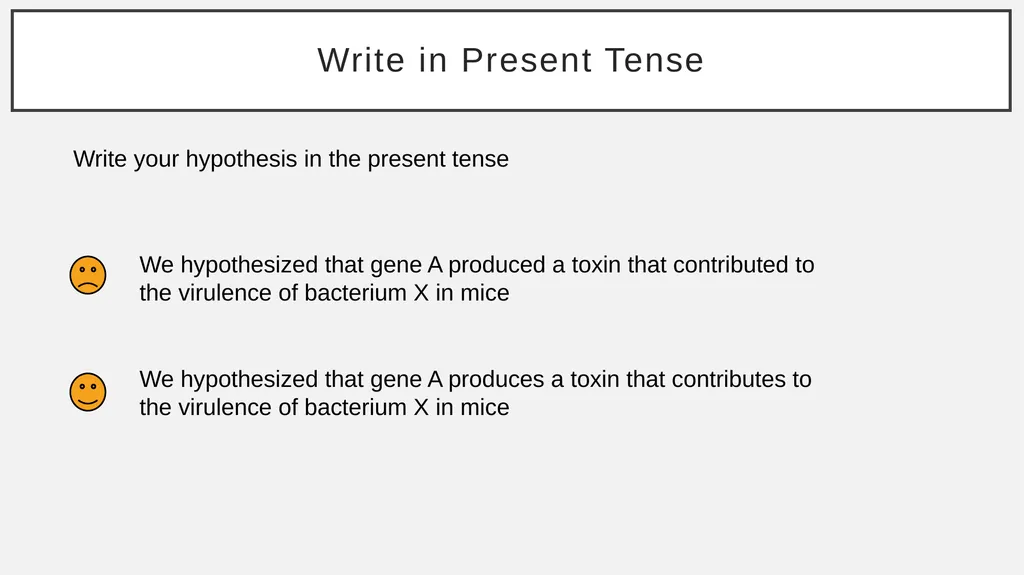
Write your hypothesis in the present tense We hypothesized that gene A produced a toxin that contributed to the virulence of bacterium X in mice We hypothesized that gene A produces a toxin that contributes to the virulence of bacterium X in mice Write in Present Tense<br>
36
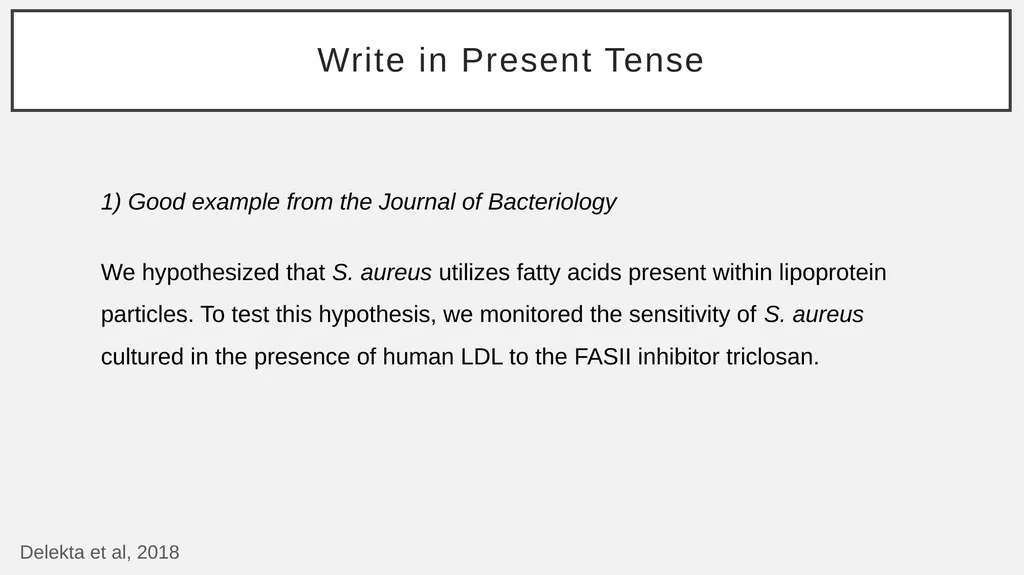
1) Good example from the Journal of Bacteriology
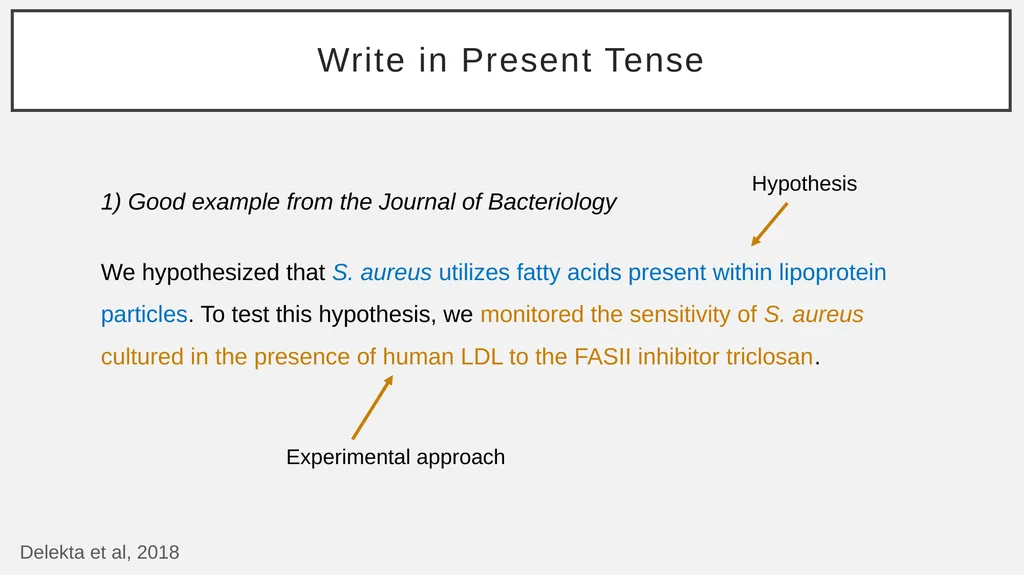
We hypothesized that S. aureus utilizes fatty acids present within lipoprotein particles. To test this hypothesis, we monitored the sensitivity of S. aureus cultured in the presence of human LDL to the FASII inhibitor triclosan. Write in Present Tense Delekta et al, 2018<br>
We hypothesized that S. aureus utilizes fatty acids present within lipoprotein particles. To test this hypothesis, we monitored the sensitivity of S. aureus cultured in the presence of human LDL to the FASII inhibitor triclosan. Write in Present Tense Delekta et al, 2018<br>
37
1) Good example from the Journal of Bacteriology
We hypothesized that S. aureus utilizes fatty acids present within lipoprotein particles. To test this hypothesis, we monitored the sensitivity of S. aureus cultured in the presence of human LDL to the FASII inhibitor triclosan. Hypothesis Experimental approach Write in Present Tense Delekta et al, 2018<br>
We hypothesized that S. aureus utilizes fatty acids present within lipoprotein particles. To test this hypothesis, we monitored the sensitivity of S. aureus cultured in the presence of human LDL to the FASII inhibitor triclosan. Hypothesis Experimental approach Write in Present Tense Delekta et al, 2018<br>
38
2) Good example from the Journal of Bacteriology
Analysis of the known SpoVG-binding sites has not revealed any obvious consensus sequence; therefore, we hypothesize that SpoVG may interact with certain nucleic acid structural motifs rather than a particular nucleotide sequence. Write in Present Tense Savage et al, 2018<br>
Analysis of the known SpoVG-binding sites has not revealed any obvious consensus sequence; therefore, we hypothesize that SpoVG may interact with certain nucleic acid structural motifs rather than a particular nucleotide sequence. Write in Present Tense Savage et al, 2018<br>
39
2) Good example from the Journal of Bacteriology
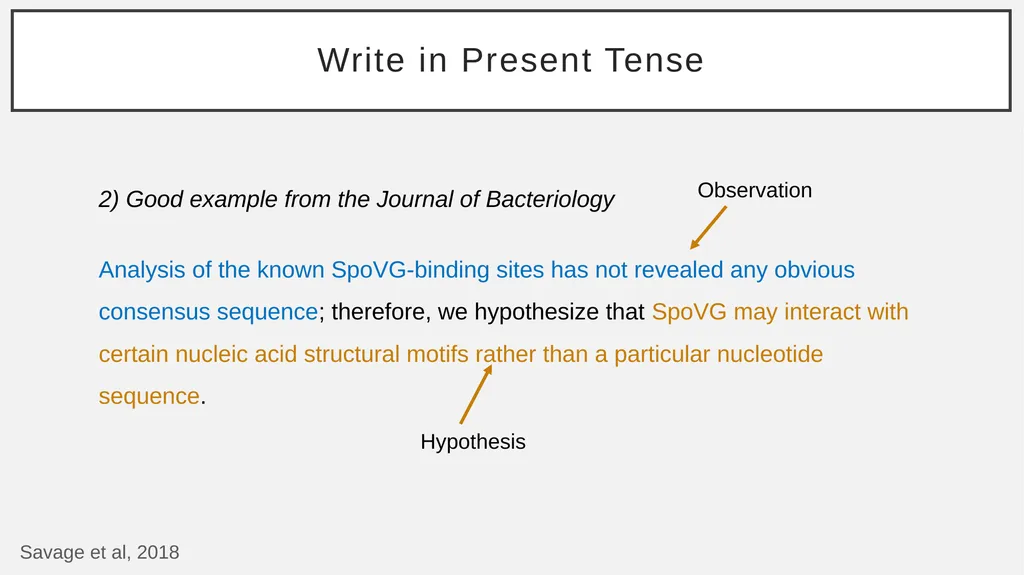
Analysis of the known SpoVG-binding sites has not revealed any obvious consensus sequence; therefore, we hypothesize that SpoVG may interact with certain nucleic acid structural motifs rather than a particular nucleotide sequence. Observation Hypothesis Write in Present Tense Savage et al, 2018<br>
Analysis of the known SpoVG-binding sites has not revealed any obvious consensus sequence; therefore, we hypothesize that SpoVG may interact with certain nucleic acid structural motifs rather than a particular nucleotide sequence. Observation Hypothesis Write in Present Tense Savage et al, 2018<br>
40
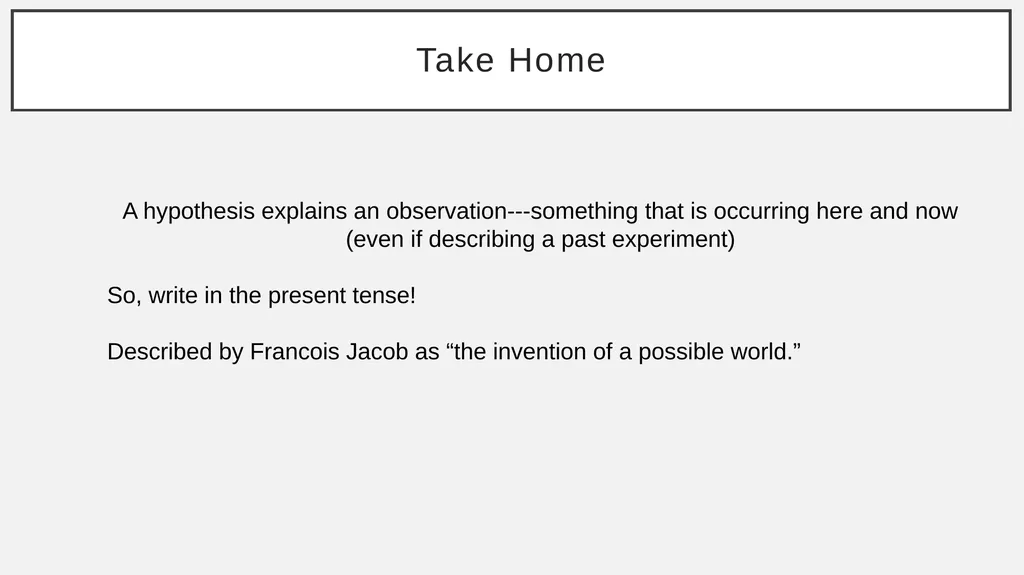
Take Home A hypothesis explains an observation---something that is occurring here and now (even if describing a past experiment)
So, write in the present tense!
Described by Francois Jacob as “the invention of a possible world.”<br>
So, write in the present tense!
Described by Francois Jacob as “the invention of a possible world.”<br>
41
Be Confident<br>
42
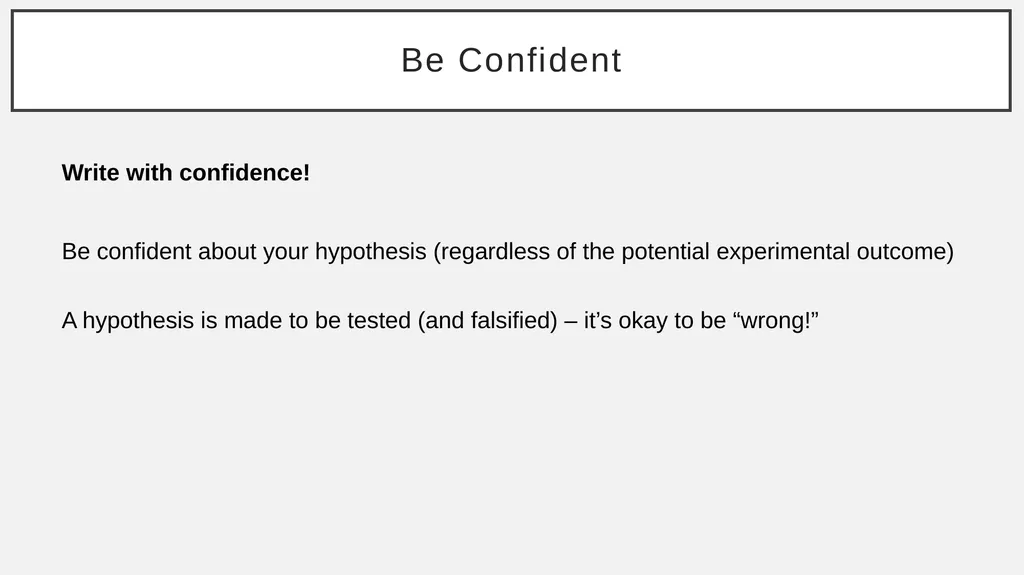
Write with confidence! Be confident about your hypothesis (regardless of the potential experimental outcome)
A hypothesis is made to be tested (and falsified) – it’s okay to be “wrong!” Be Confident<br>
A hypothesis is made to be tested (and falsified) – it’s okay to be “wrong!” Be Confident<br>
43
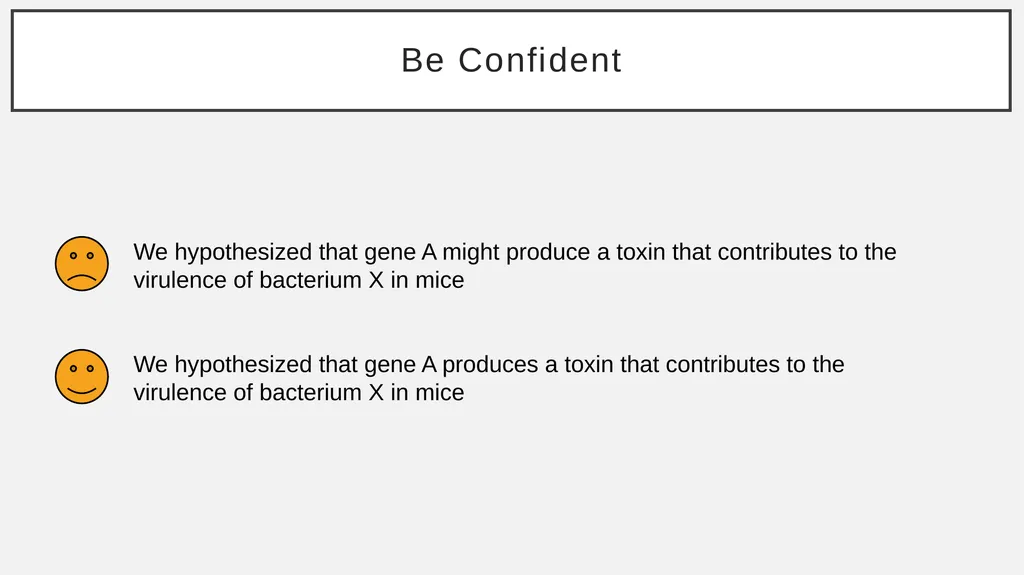
We hypothesized that gene A might produce a toxin that contributes to the virulence of bacterium X in mice
We hypothesized that gene A produces a toxin that contributes to the virulence of bacterium X in mice Be Confident<br>
We hypothesized that gene A produces a toxin that contributes to the virulence of bacterium X in mice Be Confident<br>
44
Previous example from Journal of Bacteriology
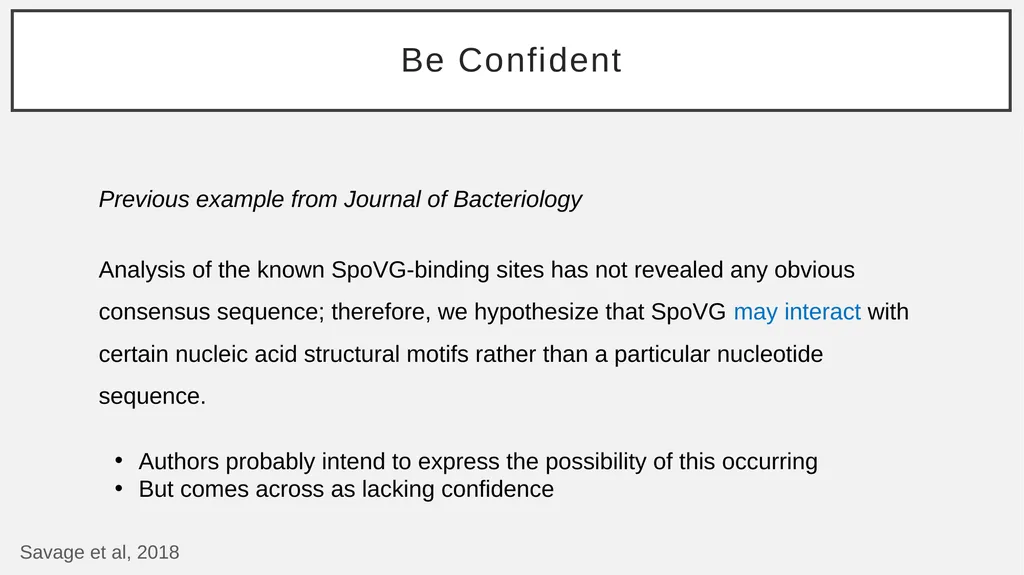
Analysis of the known SpoVG-binding sites has not revealed any obvious consensus sequence; therefore, we hypothesize that SpoVG may interact with certain nucleic acid structural motifs rather than a particular nucleotide sequence. Authors probably intend to express the possibility of this occurring
But comes across as lacking confidence Be Confident Savage et al, 2018<br>
Analysis of the known SpoVG-binding sites has not revealed any obvious consensus sequence; therefore, we hypothesize that SpoVG may interact with certain nucleic acid structural motifs rather than a particular nucleotide sequence. Authors probably intend to express the possibility of this occurring
But comes across as lacking confidence Be Confident Savage et al, 2018<br>
45
Previous example from Journal of Bacteriology
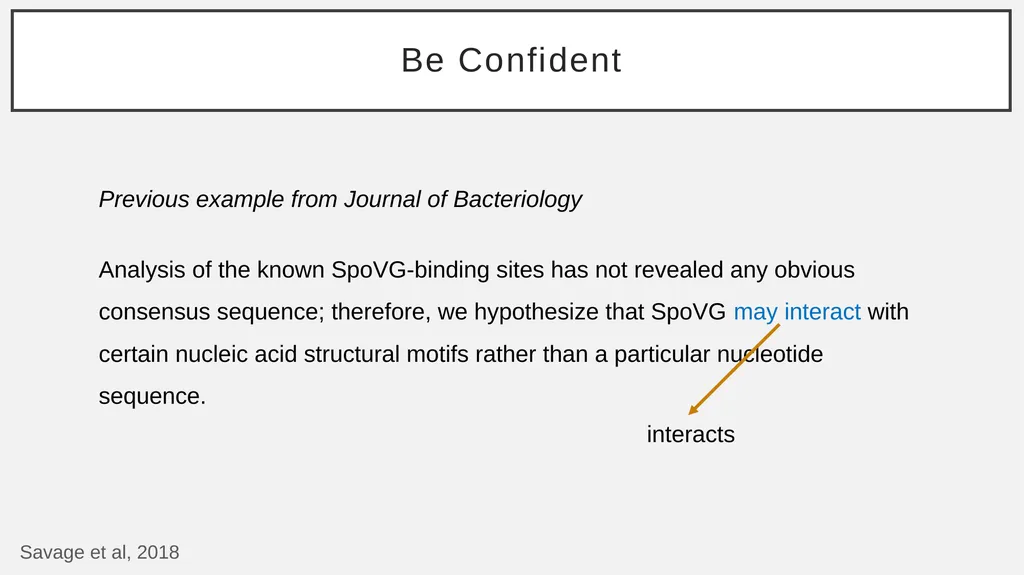
Analysis of the known SpoVG-binding sites has not revealed any obvious consensus sequence; therefore, we hypothesize that SpoVG may interact with certain nucleic acid structural motifs rather than a particular nucleotide sequence. interacts Be Confident Savage et al, 2018<br>
Analysis of the known SpoVG-binding sites has not revealed any obvious consensus sequence; therefore, we hypothesize that SpoVG may interact with certain nucleic acid structural motifs rather than a particular nucleotide sequence. interacts Be Confident Savage et al, 2018<br>
46
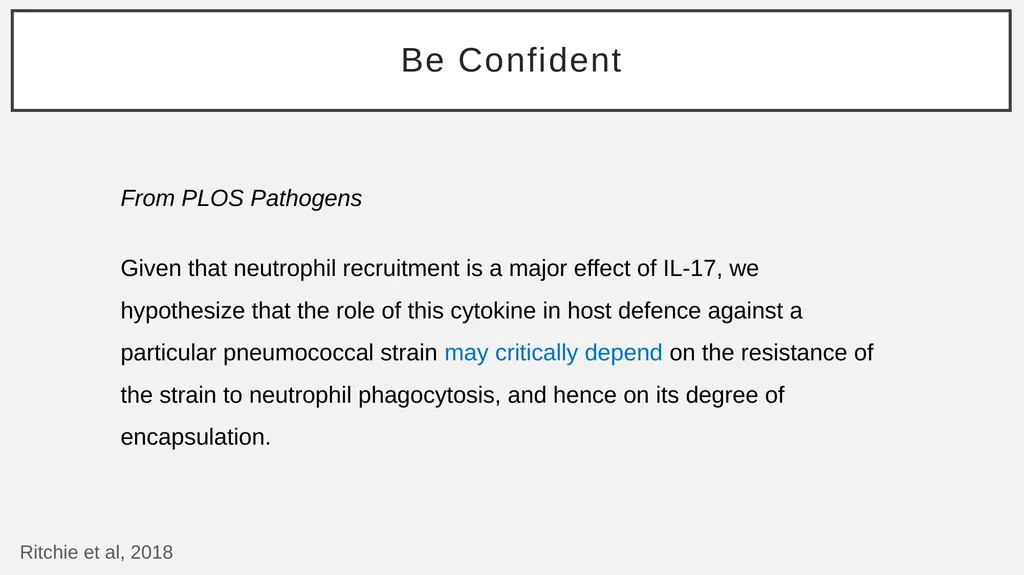
From PLOS Pathogens
Given that neutrophil recruitment is a major effect of IL-17, we hypothesize that the role of this cytokine in host defence against a particular pneumococcal strain may critically depend on the resistance of the strain to neutrophil phagocytosis, and hence on its degree of encapsulation. Be Confident Ritchie et al, 2018<br>
Given that neutrophil recruitment is a major effect of IL-17, we hypothesize that the role of this cytokine in host defence against a particular pneumococcal strain may critically depend on the resistance of the strain to neutrophil phagocytosis, and hence on its degree of encapsulation. Be Confident Ritchie et al, 2018<br>
47
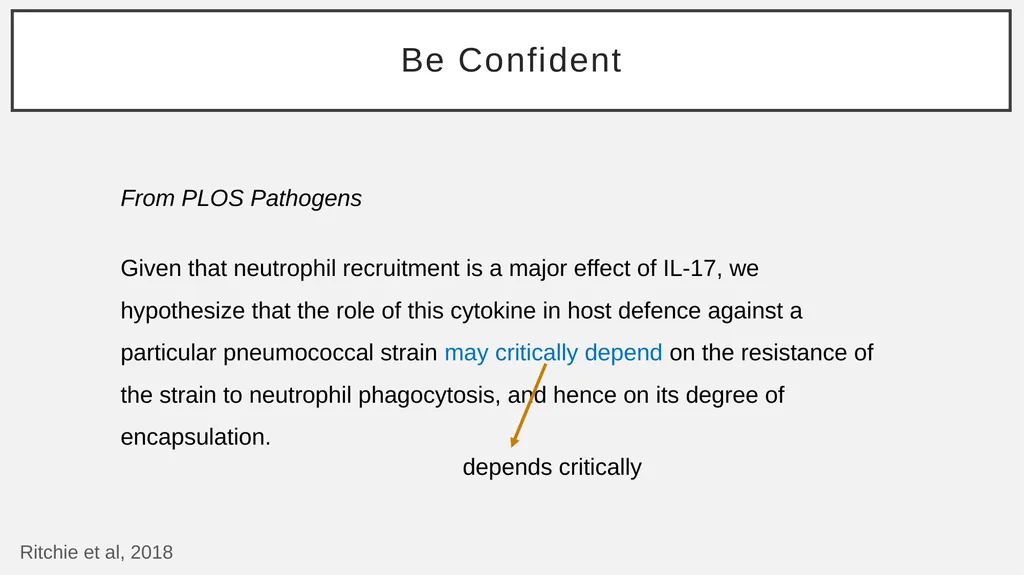
From PLOS Pathogens
Given that neutrophil recruitment is a major effect of IL-17, we hypothesize that the role of this cytokine in host defence against a particular pneumococcal strain may critically depend on the resistance of the strain to neutrophil phagocytosis, and hence on its degree of encapsulation. depends critically Be Confident Ritchie et al, 2018<br>
Given that neutrophil recruitment is a major effect of IL-17, we hypothesize that the role of this cytokine in host defence against a particular pneumococcal strain may critically depend on the resistance of the strain to neutrophil phagocytosis, and hence on its degree of encapsulation. depends critically Be Confident Ritchie et al, 2018<br>
48
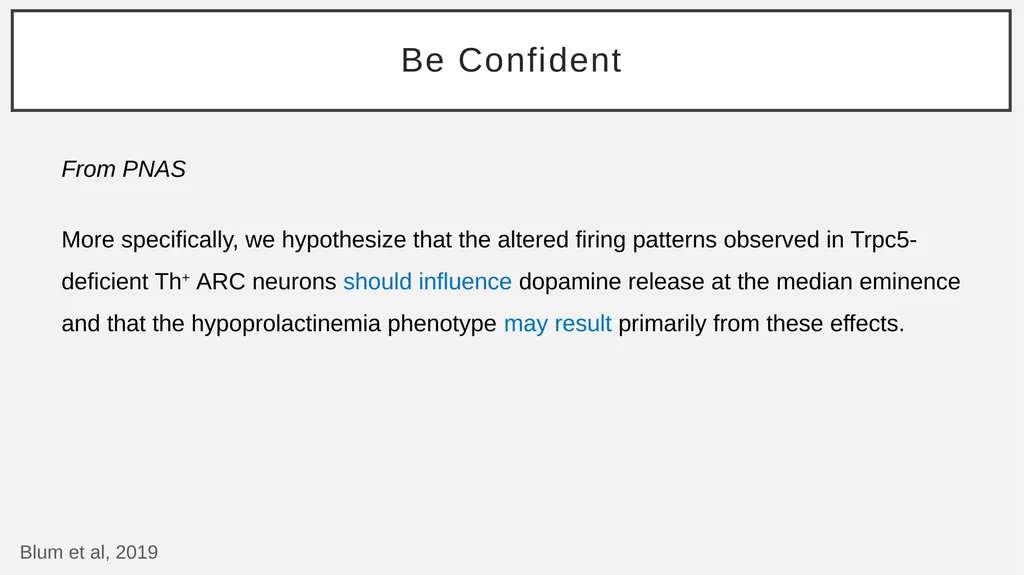
From PNAS
More specifically, we hypothesize that the altered firing patterns observed in Trpc5-deficient Th+ ARC neurons should influence dopamine release at the median eminence and that the hypoprolactinemia phenotype may result primarily from these effects. Be Confident Blum et al, 2019<br>
More specifically, we hypothesize that the altered firing patterns observed in Trpc5-deficient Th+ ARC neurons should influence dopamine release at the median eminence and that the hypoprolactinemia phenotype may result primarily from these effects. Be Confident Blum et al, 2019<br>
49
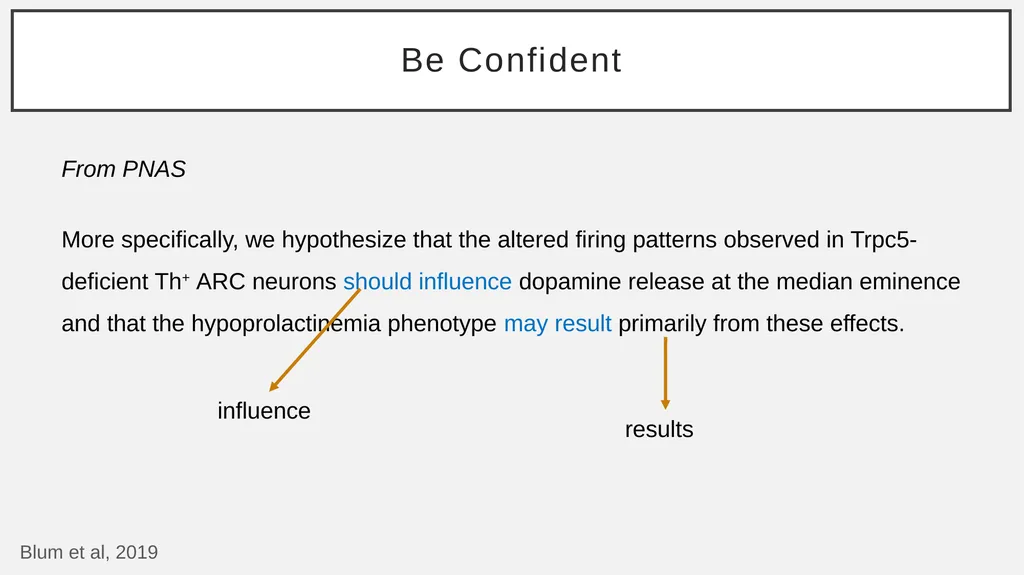
From PNAS
More specifically, we hypothesize that the altered firing patterns observed in Trpc5-deficient Th+ ARC neurons should influence dopamine release at the median eminence and that the hypoprolactinemia phenotype may result primarily from these effects. influence results Be Confident Blum et al, 2019<br>
More specifically, we hypothesize that the altered firing patterns observed in Trpc5-deficient Th+ ARC neurons should influence dopamine release at the median eminence and that the hypoprolactinemia phenotype may result primarily from these effects. influence results Be Confident Blum et al, 2019<br>
50
Take-home message
When authors tell a story with confidence, the reader has more confidence in them and their data---and in how they interpret their results. Take Home<br>
When authors tell a story with confidence, the reader has more confidence in them and their data---and in how they interpret their results. Take Home<br>
51
Don’t Hypothesize About Impact<br>
52
From the journal Medical Hypotheses
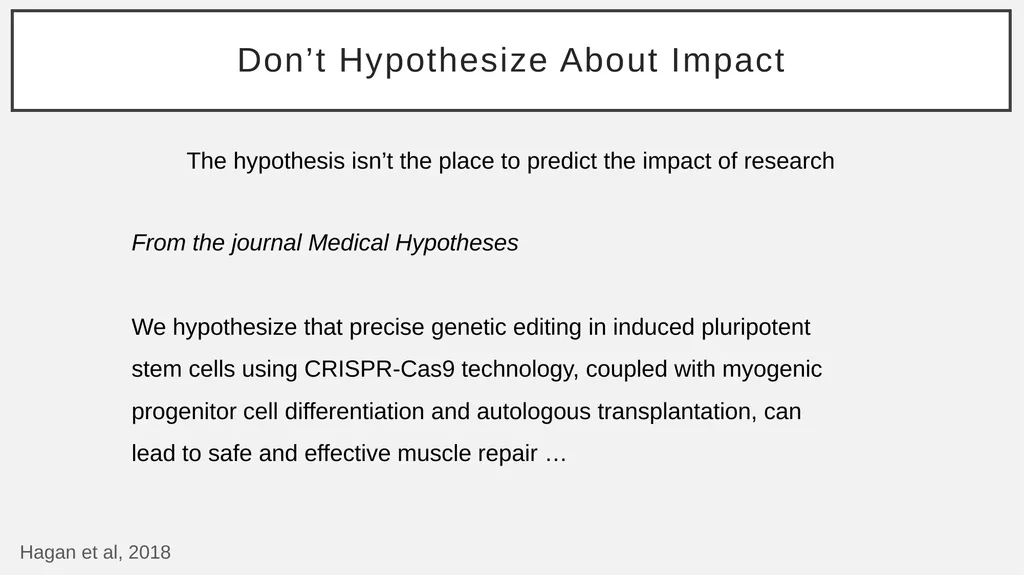
We hypothesize that precise genetic editing in induced pluripotent stem cells using CRISPR-Cas9 technology, coupled with myogenic progenitor cell differentiation and autologous transplantation, can lead to safe and effective muscle repair … Don’t Hypothesize About Impact The hypothesis isn’t the place to predict the impact of research Hagan et al, 2018<br>
We hypothesize that precise genetic editing in induced pluripotent stem cells using CRISPR-Cas9 technology, coupled with myogenic progenitor cell differentiation and autologous transplantation, can lead to safe and effective muscle repair … Don’t Hypothesize About Impact The hypothesis isn’t the place to predict the impact of research Hagan et al, 2018<br>
53
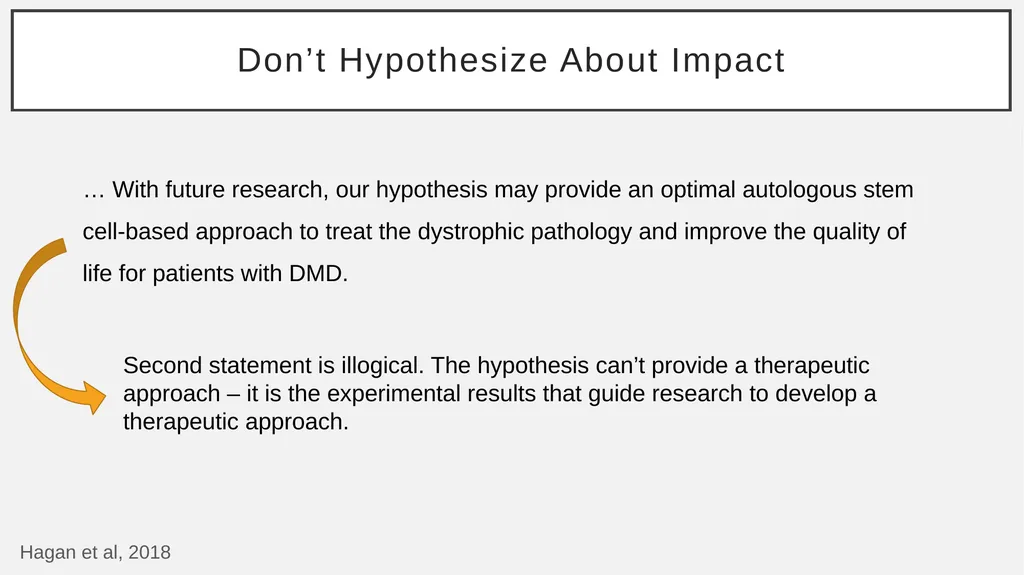
… With future research, our hypothesis may provide an optimal autologous stem cell-based approach to treat the dystrophic pathology and improve the quality of life for patients with DMD. Don’t Hypothesize About Impact Hagan et al, 2018 Second statement is illogical. The hypothesis can’t provide a therapeutic approach – it is the experimental results that guide research to develop a therapeutic approach.<br>
54
No Hypothesis? That’s Okay!<br>
55
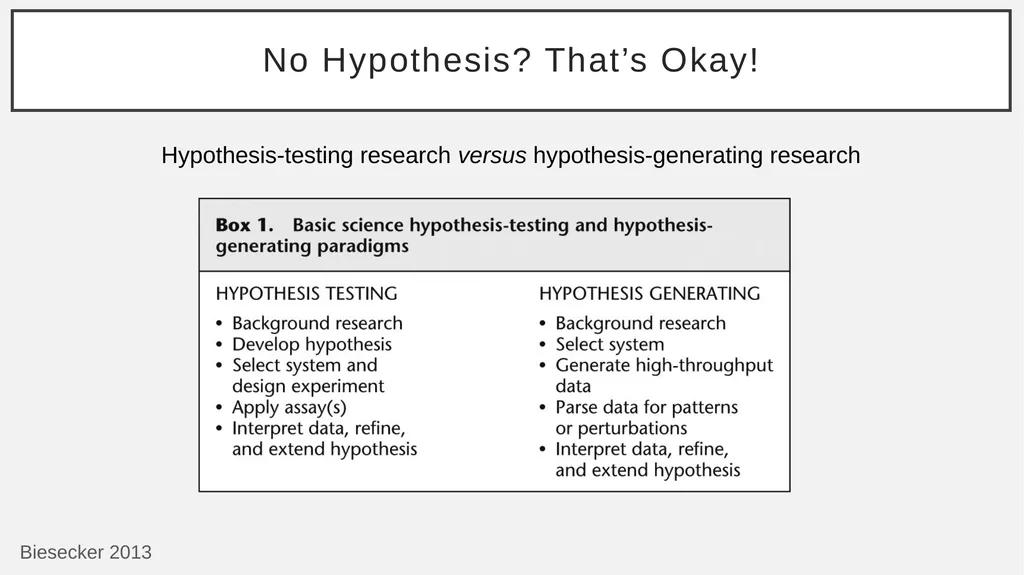
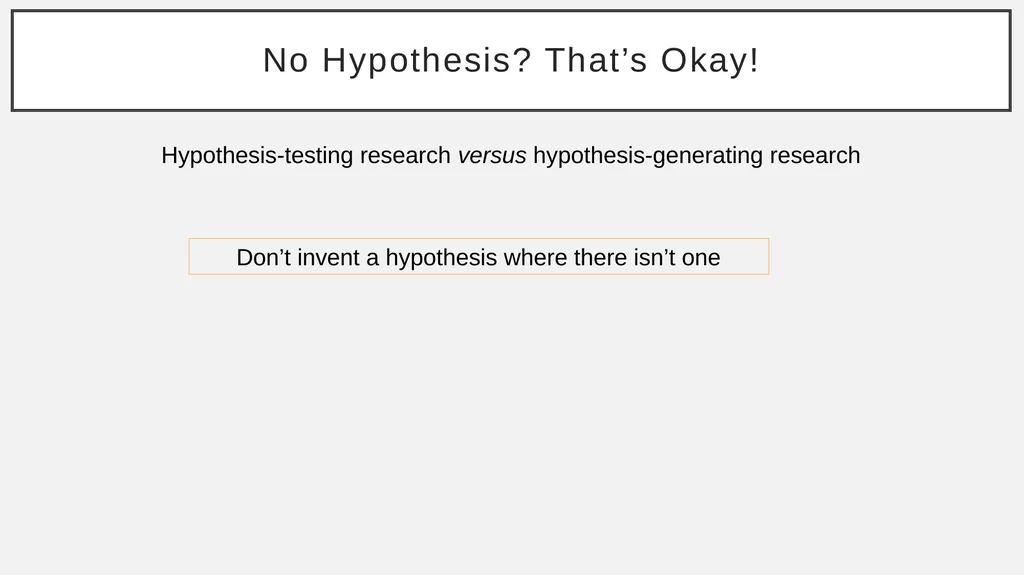
Hypothesis-testing research versus hypothesis-generating research No Hypothesis? That’s Okay! Biesecker 2013<br>
56
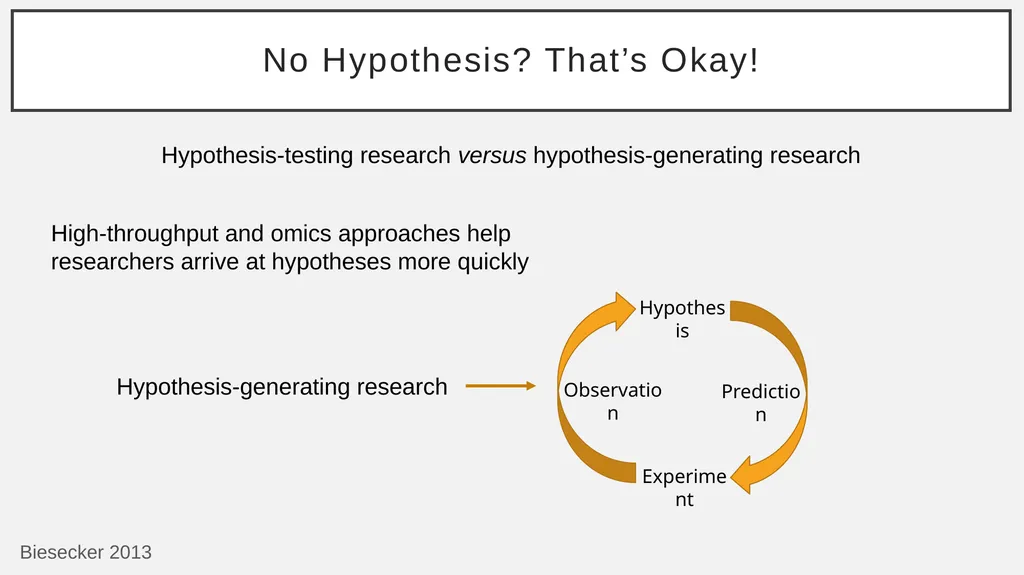
High-throughput and omics approaches help researchers arrive at hypotheses more quickly No Hypothesis? That’s Okay! Hypothesis-testing research versus hypothesis-generating research Biesecker 2013<br>
57
From the journal Microbiome
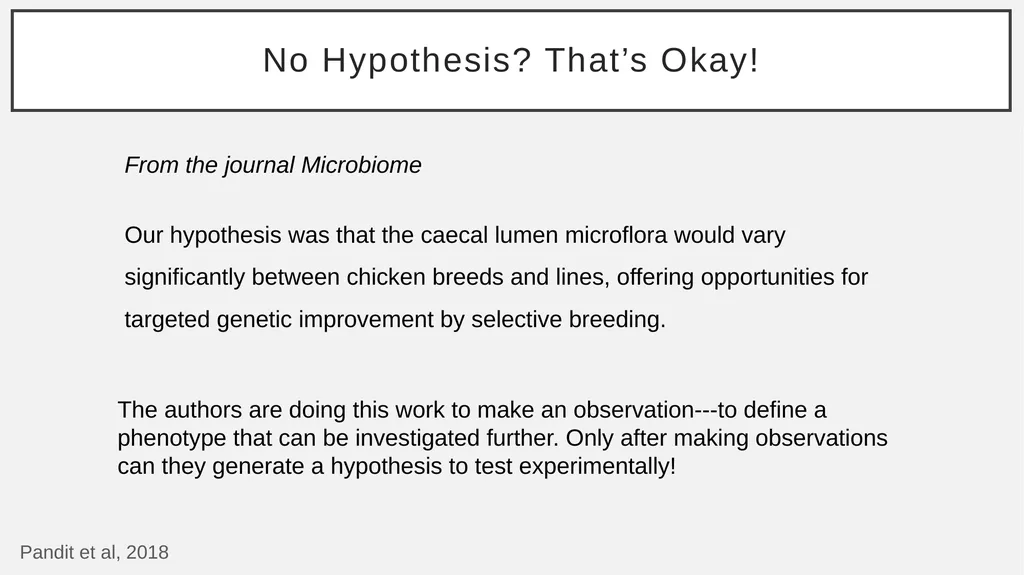
Our hypothesis was that the caecal lumen microflora would vary significantly between chicken breeds and lines, offering opportunities for targeted genetic improvement by selective breeding. The authors are doing this work to make an observation---to define a phenotype that can be investigated further. Only after making observations can they generate a hypothesis to test experimentally! No Hypothesis? That’s Okay! Pandit et al, 2018<br>
Our hypothesis was that the caecal lumen microflora would vary significantly between chicken breeds and lines, offering opportunities for targeted genetic improvement by selective breeding. The authors are doing this work to make an observation---to define a phenotype that can be investigated further. Only after making observations can they generate a hypothesis to test experimentally! No Hypothesis? That’s Okay! Pandit et al, 2018<br>
58
Don’t invent a hypothesis where there isn’t one No Hypothesis? That’s Okay! Hypothesis-testing research versus hypothesis-generating research<br>
59
Conclusions A hypothesis is not a prediction
(avoid “would” language)
Write the hypothesis in present tense
Be confident!
(avoid “may, could, might”)
No hypothesis? That’s okay<br>
(avoid “would” language)
Write the hypothesis in present tense
Be confident!
(avoid “may, could, might”)
No hypothesis? That’s okay<br>
60
Science Communication Group (SciCom) Kerry Evans, PhD, ELS
klevans@uams.edu
https://ospan.uams.edu/scicom/
Science Communication Group
Winthrop P. Rockefeller Cancer Institute
Walker Annex, 2nd floor Edit grants and manuscripts
Mentored proposal and manuscript development
Mentored grant submissions
6 Editors
1 Senior Research Administrator COBREs
INBRE
R01
R21
R03
K and F awards
Grant-writing workshops<br>
klevans@uams.edu
https://ospan.uams.edu/scicom/
Science Communication Group
Winthrop P. Rockefeller Cancer Institute
Walker Annex, 2nd floor Edit grants and manuscripts
Mentored proposal and manuscript development
Mentored grant submissions
6 Editors
1 Senior Research Administrator COBREs
INBRE
R01
R21
R03
K and F awards
Grant-writing workshops<br>
61
Questions?<br>