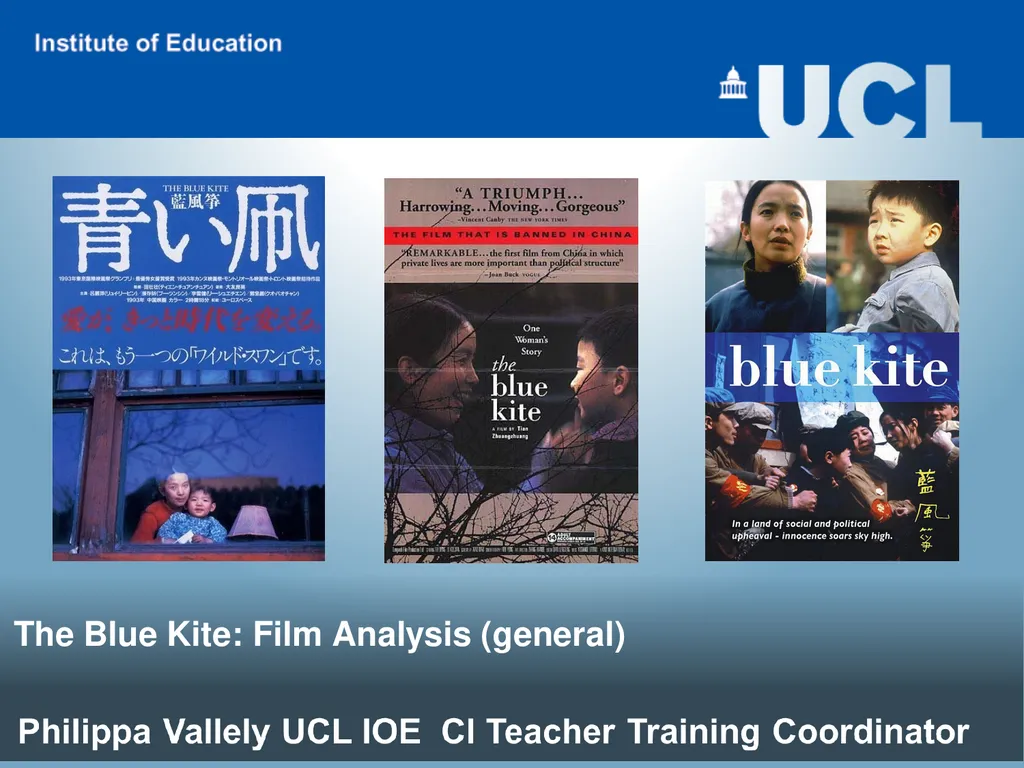
The Blue Kite: Film Analysis (general) Critically analysing film: some general notes Dont research lots before you watch the film- let it speak to you Watch alone the first time Dont interrupt your (first) viewing Take notes as you watch
"The Blue Kite: Film Analysis (general) Critically" is the property of its rightful owner. Permission is granted to
download and print the materials on this website for personal, non-commercial use only, and to display it
on your personal computer provided you do not modify the materials and that you retain all copyright
notices contained in the materials. By downloading content from our website, you accept the terms of this
agreement.
Presentation Transcript
01
The Blue Kite: Film Analysis (general)<br>
02
Critically analysing film: some general notes
Don’t research lots before you watch the film- let it speak to you
Watch alone the first time
Don’t interrupt your (first) viewing
Take notes as you watch
Write all your thoughts immediately after in more depth Things to think about:
What was the overall story about? Was it told successfully?
What were the key themes for you?
Did particular characters represent anything?
Were objects/ colour/ music/ lighting significant? How? Why?
Consider use of camera angles- why were certain angles used at key moments? Did the shots flow, or jar? Was this deliberate?<br>
03
Investigate the film’s background:
When was it made?
Is the director famous? What else has he/she made? Are they part of something bigger (eg a famous movement)?
Is the film intended to comment on social/ political/ contemporary/ historical issues?
What was happening in the country it was made, at the time it was made?
Is it a true story? Story arc (the structure):
Can you remember the major events of the story, in the order they happened?
Was the pace right?
Typical structure= setup, new situation, progress, higher stakes, final push, resolution.<br>
04
Writing:
What quotes can you remember?
Is language repeated? To what end?
Does the dialogue sounds natural (if it’s supposed to)?
Did you get the information you needed from the language? Acting:
Did the performances hold your attention?
Use of faces/ gestures/ body movement to convey information
Use of reaction/ silence- how does this “empty space” help tell the story?<br>
05
Technical aspects (camerawork, lighting, music, direction):
Music- what is used, when and why? Is certain music linked to certain characters/ places/ moments/ themes? Why? What is the effect?
What costumes are used? Why? What about set design?
Lighting/ use of colours/ shadows and light- how are they used?
Is it filmed in a studio, or in real places? What difference does this make?
Think about camera work- use of long shots, headshots, panning shots etc- why were these chosen at the moments they were?
Direction- did you like how the director told the story? Would you change any aspects? How did they tell the story? Was it linear/ jumped in time etc?
It’s a good idea to take a particular thematic concept that really strikes you (for example, the use of colour to represent emotions) and really explore every aspect.<br>
06
Organising your analysis:
You want facts that support your concept of the film’s themes
Sometimes themes emerge that were not the director’s intent
Don’t forget you can be critical of things you think didn’t work so well!
Don’t just repeat the story- the person reading your essay KNOWS the story- you need to tell them WHY the points that you are picking out are significant and relevant to the essay question.<br>
07
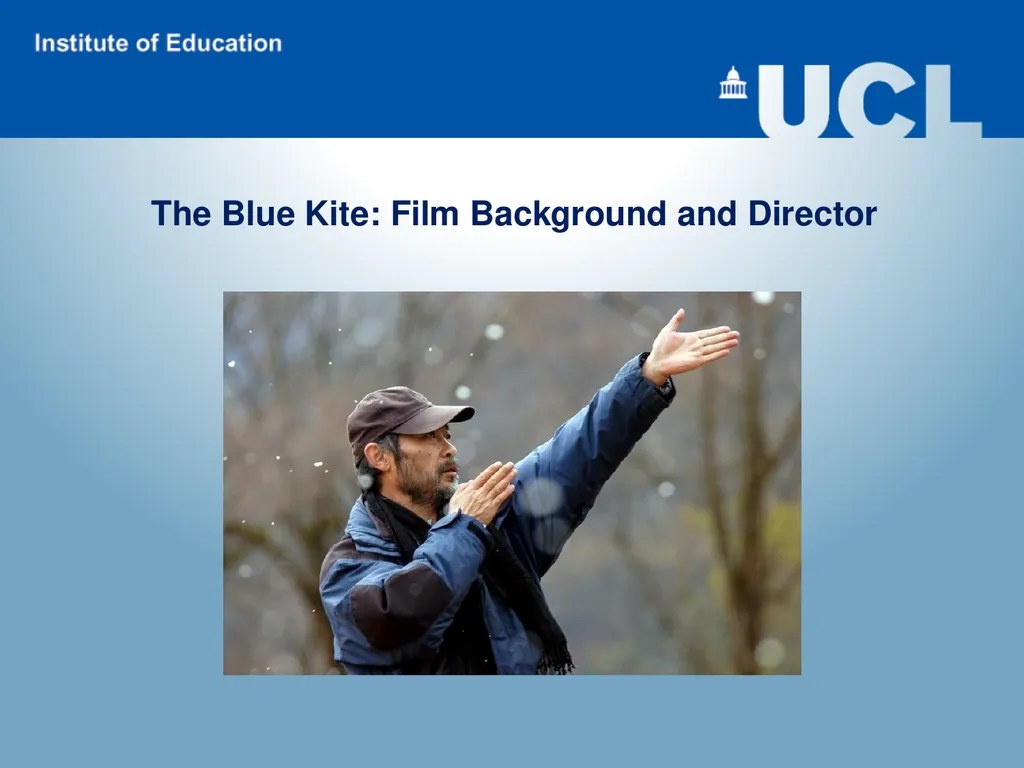
The Blue Kite: Film Background and Director<br>
08
About Tian Zhuangzhuang: Parents and childhood:
Father was once head of Beijing Film Studio
Mother was a famous actress (Yu Lan), and is the director of the Children’s Studio
Parents were “re-educated in Cultural Revolution (CR)
Father returned from CR, but died a few years later As a director:
Part of the “Fifth Generation”- a term applied to the (100+) students who were the first to study at the Beijing Film Academy (BFA) after the CR, graduating around 1980
Was director of Beijing Film Studio when he made The Blue Kite (1992)<br>
09
Quote from Tian about his father:
"He had been sentenced to hard labour, so I had to get there by 8 A.M., because that's when work began. I was 16, and the day before someone had introduced me to my first girlfriend. So the ride on my bicycle was quite pleasant. I knocked on the iron gates and told the guard I had come to say goodbye to my father."
[He remembers hearing the sound of his father's soft cloth shoes approaching, and recalls that his father was carrying a spade.]
"It was his eyes I remember most," he said. "I felt like he wanted to say something, but he saw the way I looked, and he said nothing."<br>
10
Tian Zhuangzhuang and The Blue Kite:
Tian was director of Beijing Film Studio, so the film was made there with money from Hong Kong
After filming, Beijing Studio refused to submit footage to the Central Film Bureau for approval
Sources say the footage was smuggled out of China to Japan, and edited there according to Tian’s written instructions
Any Chinese film must pass through the Central Film Bureau to be allowed out of the country for film festivals. When "The Blue Kite" was shown at the Tokyo film festival without official clearance, the Chinese delegation walked out in protest.
Tian quote: "In China, the best way to deal with things is to wait patiently. And work hard. That's how you prevail."<br>
11
Tian quote:
"I am interested in portraying people and their emotions. I like my country. I like my people. This belief is the education my parents gave me. I imagine my journey will be difficult.”
"The stories in the film are real, and they are related with total sincerity…What worries me is that it is precisely a fear of reality and sincerity that has led to the ban on such stories being told." Film Synopsis:
"The Blue Kite" is the story of the Chen family of Beijing, as the son, Tietou, recalls his infancy, childhood and adolescence. It follows the fortunes of the Chens, their relatives and friends from 1953, when Tietou's parents marry and Chairman Mao's revolution is still young and vigorous, into the Cultural Revolution in the late 1960's.<br>
12
Quote about The Blue Kite, from Richard Pena, director of the New York Film Festival:
It's not about action, it's about atmosphere. It's the first film to really address how political and personal oppression just became a day-to-day affair. How you'd get up every morning and you'd live with it every day, and it affected who you married, who you made love to, where you got a job. Everything.
"The Blue Kite" is especially good at showing how difficult it was for ordinary people to try to find space to just survive as the baffling crosswinds of politics caused the loss of jobs, relationships, even lives.
The Blue Kite gains much of its power by being about everyday, unexceptional lives. There are no villains. We never see a major party leader. Even the mobs that roam through the streets, plastering posters and shouting slogans, are neighbors who at some level are simply trying to do the right thing.<br>
13
The Blue Kite references:
http://www.rogerebert.com/reviews/great-movie-the-blue-kite-1993
http://polsci167.blogspot.co.uk/2007/10/blue-kite-dialectics-of-chronology.html
http://articles.latimes.com/1994-06-01/entertainment/ca-64366_1_blue-kite
http://www.nytimes.com/movie/review?res=9F0CE7DC1E3EF931A35753C1A965958260
http://www.nytimes.com/1994/04/03/movies/film-the-blue-kite-sails-beyond-the-censors.html?pagewanted=all How to critically analyse a film: references
http://www.sdfilmfest.com/how-to-analyze-a-movie-step-by-step-guide-to-reviewing-films-from-a-screeners-point-of-view/
http://classroom.synonym.com/write-film-analysis-essay-4125.html
http://www.wikihow.com/Analyze-a-Movie<br>