
The Buzz About Bees Facts, Importance, and how you


Description: The Buzz About Bees Facts, Importance, and how you can help! The Buzz About Bees Teea Educational program - 2021 Learning Objectives Explain the importance of bees and the risk of extinction Identify the process and importance for insect
Related Topics
Download Presentation
"The Buzz About Bees Facts, Importance, and how you" is the property of its rightful owner. Permission is granted to download and print the materials on this website for personal, non-commercial use only, and to display it on your personal computer provided you do not modify the materials and that you retain all copyright notices contained in the materials. By downloading content from our website, you accept the terms of this agreement.
Presentation Transcript
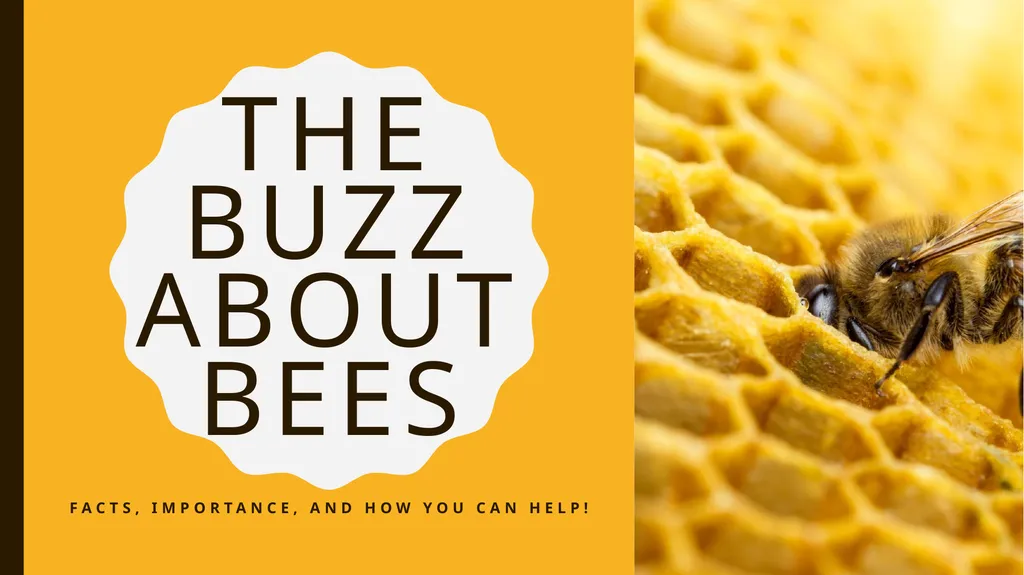
slide1. The Buzz About Bees Facts, Importance, and how you can help!<br>
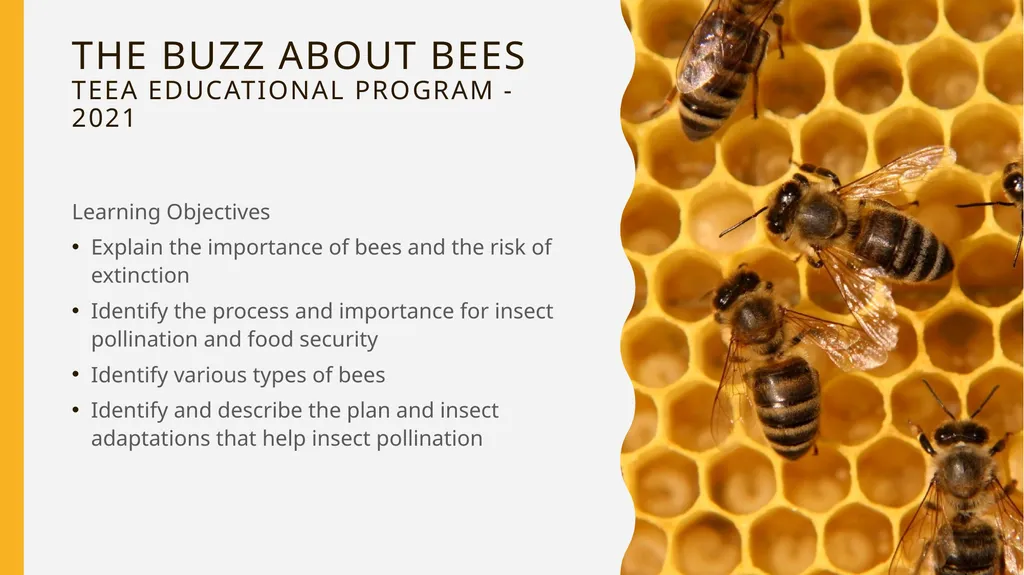
slide2. The Buzz About Bees Teea Educational program - 2021 Learning Objectives
Explain the importance of bees and the risk of extinction
Identify the process and importance for insect pollination and food security
Identify various types of bees
Identify and describe the plan and insect adaptations that help insect pollination<br>
slide3. Bee Trivia – ice-breaker First let’s see how much we know about bees with this Bee Trivia Activity<br>
slide4. Bee Facts Bees are essential for our ecosystem and our food supply
There are over 20,000 species and most are solitary
The ones we are most familiar with are those that live in hives – honeybees, bumblebees, and Africanized honeybees
Bee populations are at risk due to environmental and man-made issues – like climate control and pesticides and insecticides<br>
slide5. Bees and our food supply<br>
slide6. Bees and pollen<br>
slide7. Why is the bee population declining? Factors like pests, diseases, viruses and molds are affecting the bee population
In 2006, the colony collapse disorder was identified as a cause of the massive decline in bees throughout the world.
This collapse occurs when the worker bees die off leaving only a queen and a food supply.
Scientists believe that climate change, overuse of pesticides or insecticides, and industrialization and urbanization are changing natural habitats for bees<br>
slide8. Common types of bees<br>
slide9. Characteristics of bees Honeybees – most common and live in large colonies. Size of a paperclip. Produce honey and beeswax. All summer they collect nectar and pollen.
Bumble bees – large bees we see buzzing around gardens. They have larger hairy/furry and rounded bodies and lack the thin characteristic stripes of honeybees. They build their nests underground in abandoned bird or mouse burrows. Africanized Honeybees – introduced from Africa to Brazil in 1956. They quickly bred with local bees and became Africanized Honeybees. They are aggressive and protect their hive whether provoked or not. They can follow intruders for ¼ of a mile.
Carpenter Bees – make a life burrowing into wood. They are solitary. They drill into wooden structures.<br>
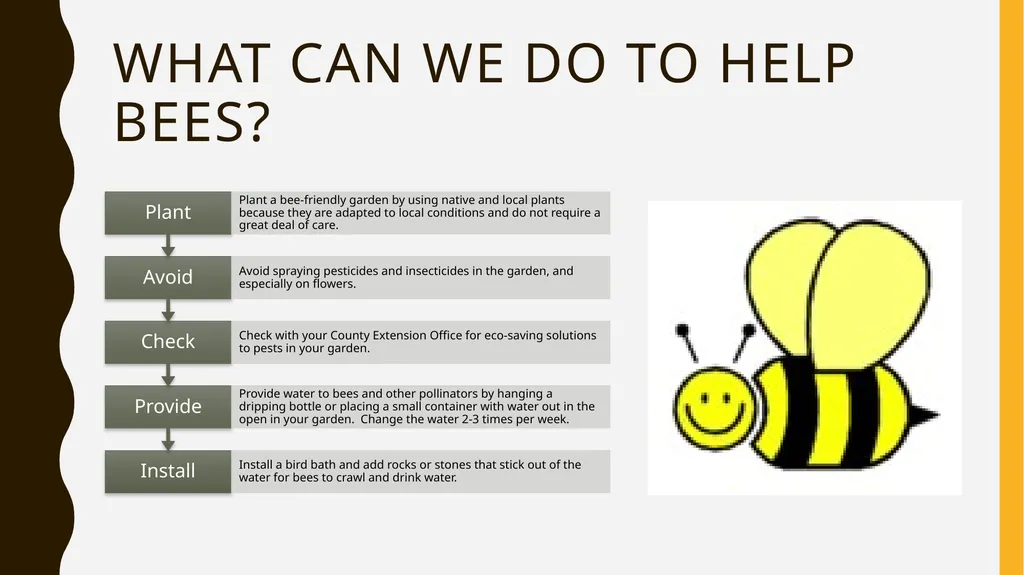
slide10. What can we do to help bees?<br>
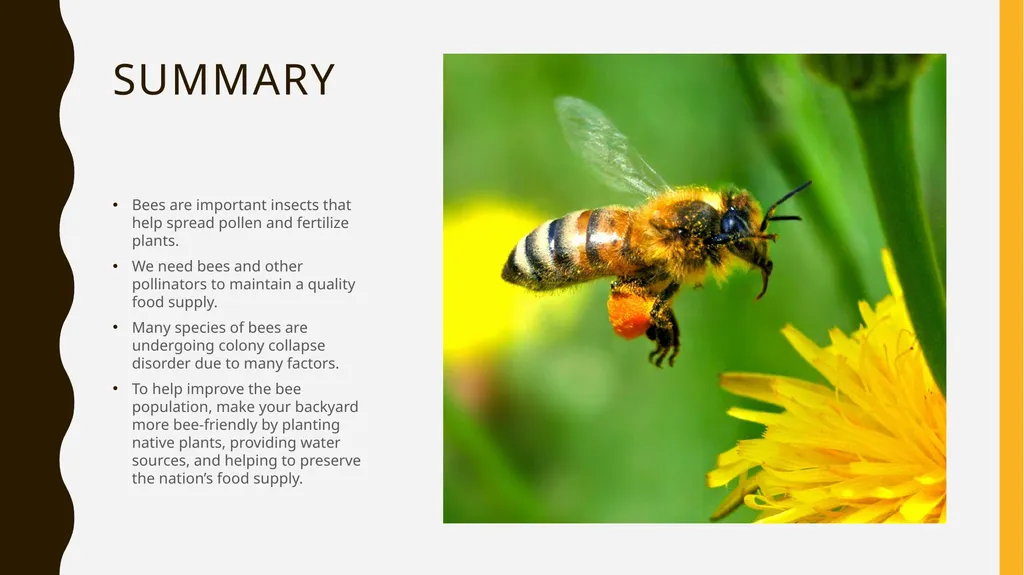
slide11. Summary Bees are important insects that help spread pollen and fertilize plants.
We need bees and other pollinators to maintain a quality food supply.
Many species of bees are undergoing colony collapse disorder due to many factors.
To help improve the bee population, make your backyard more bee-friendly by planting native plants, providing water sources, and helping to preserve the nation’s food supply.<br>
slide2. The Buzz About Bees Teea Educational program - 2021 Learning Objectives
Explain the importance of bees and the risk of extinction
Identify the process and importance for insect pollination and food security
Identify various types of bees
Identify and describe the plan and insect adaptations that help insect pollination<br>
slide3. Bee Trivia – ice-breaker First let’s see how much we know about bees with this Bee Trivia Activity<br>
slide4. Bee Facts Bees are essential for our ecosystem and our food supply
There are over 20,000 species and most are solitary
The ones we are most familiar with are those that live in hives – honeybees, bumblebees, and Africanized honeybees
Bee populations are at risk due to environmental and man-made issues – like climate control and pesticides and insecticides<br>
slide5. Bees and our food supply<br>
slide6. Bees and pollen<br>
slide7. Why is the bee population declining? Factors like pests, diseases, viruses and molds are affecting the bee population
In 2006, the colony collapse disorder was identified as a cause of the massive decline in bees throughout the world.
This collapse occurs when the worker bees die off leaving only a queen and a food supply.
Scientists believe that climate change, overuse of pesticides or insecticides, and industrialization and urbanization are changing natural habitats for bees<br>
slide8. Common types of bees<br>
slide9. Characteristics of bees Honeybees – most common and live in large colonies. Size of a paperclip. Produce honey and beeswax. All summer they collect nectar and pollen.
Bumble bees – large bees we see buzzing around gardens. They have larger hairy/furry and rounded bodies and lack the thin characteristic stripes of honeybees. They build their nests underground in abandoned bird or mouse burrows. Africanized Honeybees – introduced from Africa to Brazil in 1956. They quickly bred with local bees and became Africanized Honeybees. They are aggressive and protect their hive whether provoked or not. They can follow intruders for ¼ of a mile.
Carpenter Bees – make a life burrowing into wood. They are solitary. They drill into wooden structures.<br>
slide10. What can we do to help bees?<br>
slide11. Summary Bees are important insects that help spread pollen and fertilize plants.
We need bees and other pollinators to maintain a quality food supply.
Many species of bees are undergoing colony collapse disorder due to many factors.
To help improve the bee population, make your backyard more bee-friendly by planting native plants, providing water sources, and helping to preserve the nation’s food supply.<br>