
The Case for Philosophy in Schools APT Inaugural
CM
Published · 24 slides · 0 views

1 / 1

Description
The Case for Philosophy in Schools APT Inaugural Conference June 2023 The Overall Package In Why Teach Philosophy in Schools?, Jane Gatley gives two criteria that arguments must meet for philosophy in schools: 1) Does the study of
Related Topics
Share
Embed code
Download this presentation From Below
"The Case for Philosophy in Schools APT Inaugural" is the property of its rightful owner. Permission is granted to download and print the materials on this website for personal, non-commercial use only, and to display it on your personal computer provided you do not modify the materials and that you retain all copyright notices contained in the materials. By downloading content from our website, you accept the terms of this agreement.
Presentation Transcript
01
The Case for Philosophy in Schools APT Inaugural Conference
June 2023<br>
June 2023<br>
02
The Overall Package In Why Teach Philosophy in Schools?, Jane Gatley gives two criteria that arguments must meet for philosophy in schools:
1) Does the study of philosophy enable students to interact effectively with the world in respect of prominent and pressing questions?
2) Is philosophy the best placed subject for enabling students to interact effectively with the world in such a way?<br>
1) Does the study of philosophy enable students to interact effectively with the world in respect of prominent and pressing questions?
2) Is philosophy the best placed subject for enabling students to interact effectively with the world in such a way?<br>
03
The Overall Package And Gatley argues compellingly that philosophy can enable students to interact effectively with the world better than any other subject in two particular ways:
i) Analysis of concepts
ii) Making sense of the curriculum as a whole.
I agree, but today I want to make a slightly different claim:<br>
i) Analysis of concepts
ii) Making sense of the curriculum as a whole.
I agree, but today I want to make a slightly different claim:<br>
04
The Overall Package I wish to argue that the potential benefits of philosophy in school, when considered as a complete package, offer a package that no other subject does.
This means that I can also emphasise potential benefits of philosophy which do not necessarily meet the second of Gatley’s criteria, namely that philosophy is the best placed subject to offer that particular individual benefit.
So although I will be returning to the vital importance of conceptual analysis, I want to start by talking about the creative potential of philosophy.<br>
This means that I can also emphasise potential benefits of philosophy which do not necessarily meet the second of Gatley’s criteria, namely that philosophy is the best placed subject to offer that particular individual benefit.
So although I will be returning to the vital importance of conceptual analysis, I want to start by talking about the creative potential of philosophy.<br>
05
The Philosophic Imagination Consider the role in philosophy of thought experiments and counter-factuals. For young people familiar with e.g. Harry Potter, Dr Who, The Hunger Games, Game of Thrones and Lord of the Rings, imaginative leaps through time and space to fantastical other worlds are an enticing challenge, not an obstacle.
Consider the nuanced interpretative skills needed to explore some philosophical texts, such as the dialogues of Plato, the paradoxes of Heraclitus (‘the road up and down is one and the same’; ‘God is day and night, winter and summer, war and peace …’), the Cretan Liar Paradox: ‘I always lie’, the many and varied ‘dancing’ styles of Nietzsche, the teasing ironies of Wittgenstein.<br>
Consider the nuanced interpretative skills needed to explore some philosophical texts, such as the dialogues of Plato, the paradoxes of Heraclitus (‘the road up and down is one and the same’; ‘God is day and night, winter and summer, war and peace …’), the Cretan Liar Paradox: ‘I always lie’, the many and varied ‘dancing’ styles of Nietzsche, the teasing ironies of Wittgenstein.<br>
06
The Importance of Style Encountering this wide diversity of styles serves three crucial purposes:
i) the styles are fun and engaging in themselves, and attract imaginative young minds;
ii) they invite interpretation, questions and debate;
iii) the sheer variety of styles helps develop suppleness of mind in pupils and, as they grow older, encourages them to reflect on what philosophy itself is, and on what forms it may take.<br>
i) the styles are fun and engaging in themselves, and attract imaginative young minds;
ii) they invite interpretation, questions and debate;
iii) the sheer variety of styles helps develop suppleness of mind in pupils and, as they grow older, encourages them to reflect on what philosophy itself is, and on what forms it may take.<br>
07
Inheritance, Environment and Reason The imaginative potential of philosophy also encourages students to reflect creatively on what form a good life might take, whether they are considering the individual or the community.
Philosophy is one of the best subjects for showing young people there are different ways of living, being and thinking than those immediately on offer in their local postcode: it can extend the imaginative grasp of possible lives.
We are not just the product of our genes and environment: reason can provide at least a partial way out, but only if reason is properly trained, and this training will not just be in analysis, crucial though that is.<br>
Philosophy is one of the best subjects for showing young people there are different ways of living, being and thinking than those immediately on offer in their local postcode: it can extend the imaginative grasp of possible lives.
We are not just the product of our genes and environment: reason can provide at least a partial way out, but only if reason is properly trained, and this training will not just be in analysis, crucial though that is.<br>
08
Philosophy and the Good Life Thinking about such questions can provide young people with something positive to sustain them, and develop a conception of flourishing which is both strong and flexible.
The strength comes from foundations and a framework which are clear and robust enough to stand firm in an increasingly uncertain world.
The flexibility derives from the fact that the ways in which the actualization of potential can be understood and made manifest are adaptable to changing historical, political and geographical circumstances, and advances in biological and psychological understanding.<br>
The strength comes from foundations and a framework which are clear and robust enough to stand firm in an increasingly uncertain world.
The flexibility derives from the fact that the ways in which the actualization of potential can be understood and made manifest are adaptable to changing historical, political and geographical circumstances, and advances in biological and psychological understanding.<br>
09
A Flourishing Childhood And, crucially, if education is conceived within the context of an ethics and (small ‘p’) politics of flourishing, then it should assist the actualisation of potential not simply as a preparation for adulthood, but also because the years of school attendance form a substantial part of any individual’s life.
These years should be a time of flourishing in themselves: stimulating, fun and fulfilling.
If education is at least partly about helping a young person to actualize their intellectual, emotional and physical potential, then the aim should be to enable this in such an enjoyable way that the classroom becomes not only a preparation for future flourishing as an adult, but a place where the child can flourish as a child.
So the fact that philosophy can be so enjoyable is, for me, really important.<br>
These years should be a time of flourishing in themselves: stimulating, fun and fulfilling.
If education is at least partly about helping a young person to actualize their intellectual, emotional and physical potential, then the aim should be to enable this in such an enjoyable way that the classroom becomes not only a preparation for future flourishing as an adult, but a place where the child can flourish as a child.
So the fact that philosophy can be so enjoyable is, for me, really important.<br>
10
Social Development As, for example, the dialogues of Plato show, philosophy is often most fruitfully undertaken in debate with others.
By engaging in philosophic dialogue pupils can hone both their specific philosophic skills and, more generally, improve their social skills and increase their social confidence.
They can come to appreciate that a good philosopher knows how to listen as well as talk.<br>
By engaging in philosophic dialogue pupils can hone both their specific philosophic skills and, more generally, improve their social skills and increase their social confidence.
They can come to appreciate that a good philosopher knows how to listen as well as talk.<br>
11
Outside the Echo Chamber And such debates enable young people to step outside their social media echo chambers.
Plato is again a good example here. He makes sure that the main character (usually Socrates) has to converse with genuinely tough opponents, whose views and manner are sometimes positively hostile to Socrates.
Children and young people can learn that it is possible to disagree with someone, even robustly, without actually shouting, let alone coming to blows.<br>
Plato is again a good example here. He makes sure that the main character (usually Socrates) has to converse with genuinely tough opponents, whose views and manner are sometimes positively hostile to Socrates.
Children and young people can learn that it is possible to disagree with someone, even robustly, without actually shouting, let alone coming to blows.<br>
12
Conceptual Analysis Conceptual analysis not only plays a vital part in the overall package that philosophy offers; it meets Gatley’s two criteria. And recent history has shown us how crucial such analytic powers are.
For example: ‘freedom’. So many arguments about ‘freedom’ in the pandemic could have been assisted by philosophic distinctions between positive and negative freedom, and clarity about whose freedom was at stake.
Conceptual analysis can also provide young people with the resources needed to scrutinize talk of ‘alternative facts’, ‘fake news’, ‘post-fact’ and ‘post-truth’ (although I of course accept that philosophy is not always helpful here – it can sometimes be part of the problem …).<br>
For example: ‘freedom’. So many arguments about ‘freedom’ in the pandemic could have been assisted by philosophic distinctions between positive and negative freedom, and clarity about whose freedom was at stake.
Conceptual analysis can also provide young people with the resources needed to scrutinize talk of ‘alternative facts’, ‘fake news’, ‘post-fact’ and ‘post-truth’ (although I of course accept that philosophy is not always helpful here – it can sometimes be part of the problem …).<br>
13
Conceptual Analysis and ‘Fake News’ However, when taught responsibly, philosophy can help young people appreciate how very inchoate such claims often are. Is the assertion that facts are unimportant and to be disregarded? Or that an individual creates his or her own reality? Perhaps that there is no such thing as a shared ‘fact’ or ‘truth’ at all?
It can help them appreciate that the very phrases ‘post-fact’ and ‘post-truth’ are arguably self-refuting: is not the user of such phrases implicitly claiming that this very state of affairs is itself a fact, is itself true?<br>
It can help them appreciate that the very phrases ‘post-fact’ and ‘post-truth’ are arguably self-refuting: is not the user of such phrases implicitly claiming that this very state of affairs is itself a fact, is itself true?<br>
14
Democracy and Demagoguery ‘Democracy’ and ‘demagoguery’ also require careful analysis and consideration.
Democracy, of course = rule by the dēmos, rule by the people – but what does ‘rule’ mean here? And who are ‘the people’?
Demagoguery, on the other hand, = leading of the people (by one or more popular leaders), and often implies manipulation of the people.
Which brings us to another phrase in urgent need of analysis: ‘the will of the people.’<br>
Democracy, of course = rule by the dēmos, rule by the people – but what does ‘rule’ mean here? And who are ‘the people’?
Demagoguery, on the other hand, = leading of the people (by one or more popular leaders), and often implies manipulation of the people.
Which brings us to another phrase in urgent need of analysis: ‘the will of the people.’<br>
15
The wills of persons, not the ‘will of the people’ ‘The will of the people’ is a dangerously deceptive term: it suggests ‘the people’ are not a diverse collection of individual and diverse wills, but a homogeneous mass with a single, homogeneous will.
It is important to emphasize that this does not mean that collective action for the common good is impossible: individuals can separately decide to plan and act together for a common cause. A commitment to the separate wills of separate persons thinking for themselves does not in itself commit one to any specific political agenda.<br>
It is important to emphasize that this does not mean that collective action for the common good is impossible: individuals can separately decide to plan and act together for a common cause. A commitment to the separate wills of separate persons thinking for themselves does not in itself commit one to any specific political agenda.<br>
16
Enabling the Demagogue However, the notion of a homogeneous will – as opposed to collective action – is a different matter.
The notion of a homogeneous will not only disrespects the basis of liberal democracy in human and civic rights; it also allows an unscrupulous demagogue to claim that only he or she can truly understand, channel and represent the single will of the single people.<br>
The notion of a homogeneous will not only disrespects the basis of liberal democracy in human and civic rights; it also allows an unscrupulous demagogue to claim that only he or she can truly understand, channel and represent the single will of the single people.<br>
17
‘Rule’ and Rational Choice. At this point that we might find it helpful to turn to Plato for assistance.
Because he makes a very interesting (and controversial) claim in, for example, the Gorgias 466b ff. and Republic (passim, but especially 577d-e): true ‘rule’ can only take place if the ruler or rulers act from accurately informed, deliberative rational choice, and not just on a momentary whim (in these passages Plato clearly differentiates between boulomai and moi dokei).<br>
Because he makes a very interesting (and controversial) claim in, for example, the Gorgias 466b ff. and Republic (passim, but especially 577d-e): true ‘rule’ can only take place if the ruler or rulers act from accurately informed, deliberative rational choice, and not just on a momentary whim (in these passages Plato clearly differentiates between boulomai and moi dokei).<br>
18
Democracy to Demagoguery Those who act on unreflective, ill-informed whims, thinks Plato, are at risk of being manipulated by opportunistic demagogues: Republic 562a-569c provides an incisive and chilling analysis of this process.
According to Plato, the demagogue first gains power through democratic mechanisms, claiming to be a champion of ‘the people’ and making wild promises: in particular he offers intoxicating quantities of the neat spirit of independence (‘Freedom!’).
Anyone who opposes the demagogue is labelled ‘an enemy of the people’ and exiled or killed.<br>
According to Plato, the demagogue first gains power through democratic mechanisms, claiming to be a champion of ‘the people’ and making wild promises: in particular he offers intoxicating quantities of the neat spirit of independence (‘Freedom!’).
Anyone who opposes the demagogue is labelled ‘an enemy of the people’ and exiled or killed.<br>
19
Demagoguery to Tyranny Such tactics naturally create genuine enemies, and the demagogue quickly acquires a large bodyguard, and eventually a private army.
External conflicts are also stirred up to keep the people in need of a strong leader.
It is also in the demagogue’s interests to keep his supporters poor as well as fearful, and when they start to rebel, protesting that this is not why they voted him in, he attacks them too and the full-blooded tyrant is born.
Understanding the terms being bandied about really, really matters.<br>
External conflicts are also stirred up to keep the people in need of a strong leader.
It is also in the demagogue’s interests to keep his supporters poor as well as fearful, and when they start to rebel, protesting that this is not why they voted him in, he attacks them too and the full-blooded tyrant is born.
Understanding the terms being bandied about really, really matters.<br>
20
Conspiracy Theories and Indoctrination Philosophy can thus provide young people with the mental resources which may help them to understand and, ideally, resist a wide range of conspiracy theories, fantasies, half-truths and lies.
More controversially, it may provide them with the resources to help resist indoctrination.
It may help them to question authority figures (perhaps sometimes silently), and ask themselves whether there is any good reason to believe what they are being told – whether the authority figure is a mainstream teacher or politician, or a religious or nationalist extremist.<br>
More controversially, it may provide them with the resources to help resist indoctrination.
It may help them to question authority figures (perhaps sometimes silently), and ask themselves whether there is any good reason to believe what they are being told – whether the authority figure is a mainstream teacher or politician, or a religious or nationalist extremist.<br>
21
An Inclusive Strategy My wish is that each child in the country receives at least one year of non-examined philosophy provision (in addition to the establishment of an optional GCSE, and increased support for philosophy at A Level). Such a policy would have the great advantage of being inclusive – all children would ideally receive this training.
As such, it contrasts with e.g. the British Government’s current Prevent strategy (revised in February 2023 but still very much with us), which requires faith leaders, teachers, doctors, social service workers and others to refer to the local Prevent body those they believe to be at risk of joining extremist groups and carrying out terrorist activities.
The British Department for Education suggested in a research paper in 2010 a link between Philosophy for Children (P4C) and protection against indoctrination (Bonnell, Copestake, Kerr, Passy, Reed, Salter, Sarwar and Sheikh), and similar thinking informs a 2015 British Council working paper on education and extremism (Rose 2015).<br>
As such, it contrasts with e.g. the British Government’s current Prevent strategy (revised in February 2023 but still very much with us), which requires faith leaders, teachers, doctors, social service workers and others to refer to the local Prevent body those they believe to be at risk of joining extremist groups and carrying out terrorist activities.
The British Department for Education suggested in a research paper in 2010 a link between Philosophy for Children (P4C) and protection against indoctrination (Bonnell, Copestake, Kerr, Passy, Reed, Salter, Sarwar and Sheikh), and similar thinking informs a 2015 British Council working paper on education and extremism (Rose 2015).<br>
22
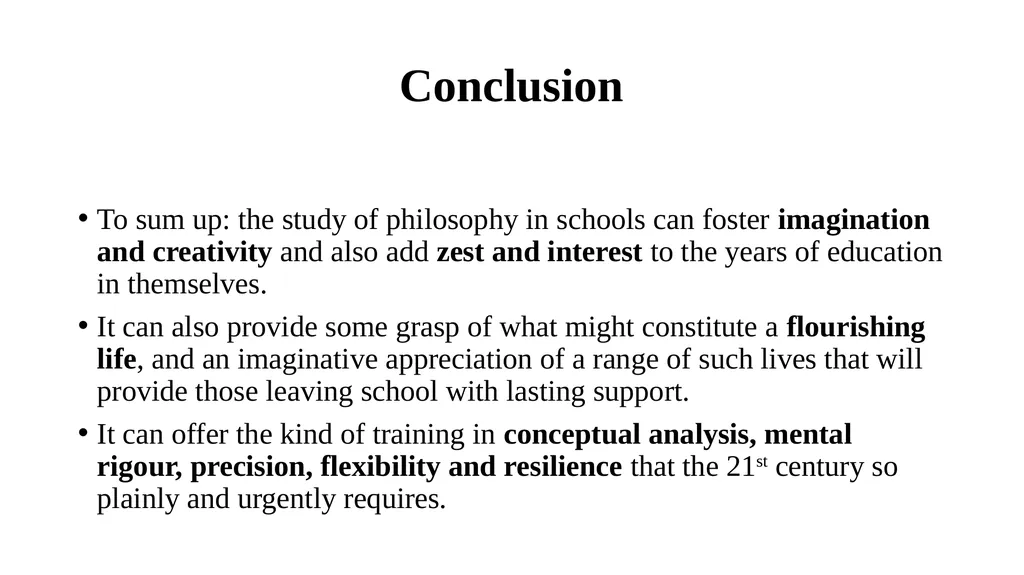
Conclusion To sum up: the study of philosophy in schools can foster imagination and creativity and also add zest and interest to the years of education in themselves.
It can also provide some grasp of what might constitute a flourishing life, and an imaginative appreciation of a range of such lives that will provide those leaving school with lasting support.
It can offer the kind of training in conceptual analysis, mental rigour, precision, flexibility and resilience that the 21st century so plainly and urgently requires.<br>
It can also provide some grasp of what might constitute a flourishing life, and an imaginative appreciation of a range of such lives that will provide those leaving school with lasting support.
It can offer the kind of training in conceptual analysis, mental rigour, precision, flexibility and resilience that the 21st century so plainly and urgently requires.<br>
23
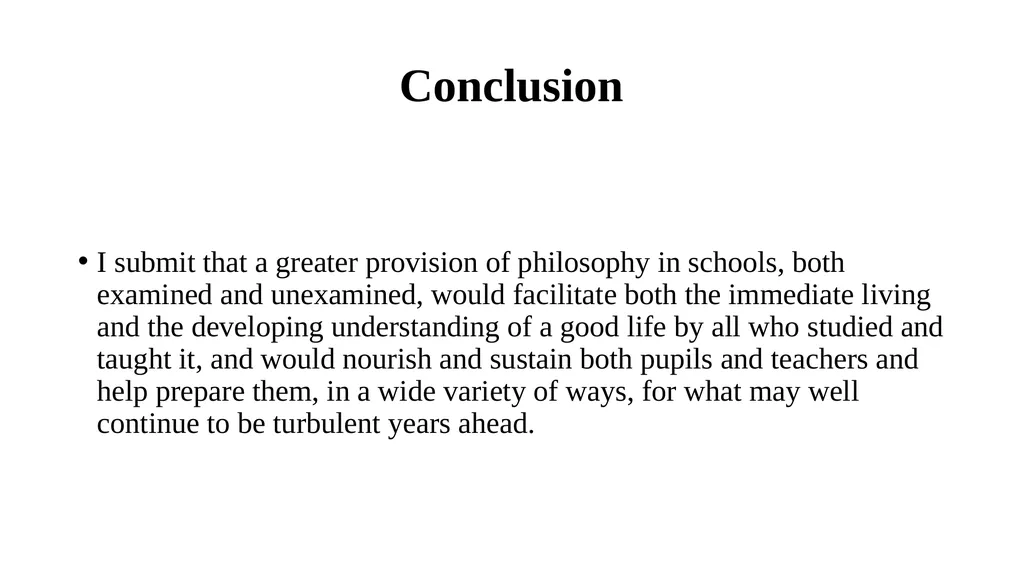
Conclusion I submit that a greater provision of philosophy in schools, both examined and unexamined, would facilitate both the immediate living and the developing understanding of a good life by all who studied and taught it, and would nourish and sustain both pupils and teachers and help prepare them, in a wide variety of ways, for what may well continue to be turbulent years ahead.<br>
24
Thank You! Angie Hobbs
Professor of the Public Understanding of Philosophy
University of Sheffield, U.K.
a.hobbs@sheffield.ac.uk
www.angiehobbs.com
@drangiehobbs<br>
Professor of the Public Understanding of Philosophy
University of Sheffield, U.K.
a.hobbs@sheffield.ac.uk
www.angiehobbs.com
@drangiehobbs<br>