The Cat Behaviour and Welfare 2. Birth and the kittenmother relationship Bjarne O. Braastad Professor of Ethology Department of Animal and Aquacultural Sciences, Norwegian University of Life Sciences, NMBU, Ås, Norway Norwegian
"The Cat – Behaviour and Welfare 2. Birth and the" is the property of its rightful owner. Permission is granted to
download and print the materials on this website for personal, non-commercial use only, and to display it
on your personal computer provided you do not modify the materials and that you retain all copyright
notices contained in the materials. By downloading content from our website, you accept the terms of this
agreement.
Presentation Transcript
01
The Cat – Behaviour and Welfare 2. Birth and the kitten–mother relationship Bjarne O. Braastad
Professor of Ethology
Department of Animal and Aquacultural Sciences,
Norwegian University of Life Sciences, NMBU, Ås, Norway Norwegian University of Life Sciences The Cat - Behaviour and Welfare - Bjarne O. Braastad 0<br>
02
Behavioural development Skin sense (tactile sense) and smell (olfactory sense) are ready at birth.
Ears are open by 5 days, eyes by 9 days (with variation).
Relationship to mother is most important for the first weeks.
The kitten becomes more active by 3 weeks.
3–21 weeks: socialization and social play:
socialization: 3–12 weeks; most active 3–7 weeks
social play: learns effect of signals and social responses
learns with whom it can have social contact
humans must be included in socialization or the cat will remain fearful towards them
– varied human contact important
start: weeks 3–9; most active: weeks 9–14 Norwegian University of Life Sciences The Cat - Behaviour and Welfare - Bjarne O. Braastad 1<br>
03
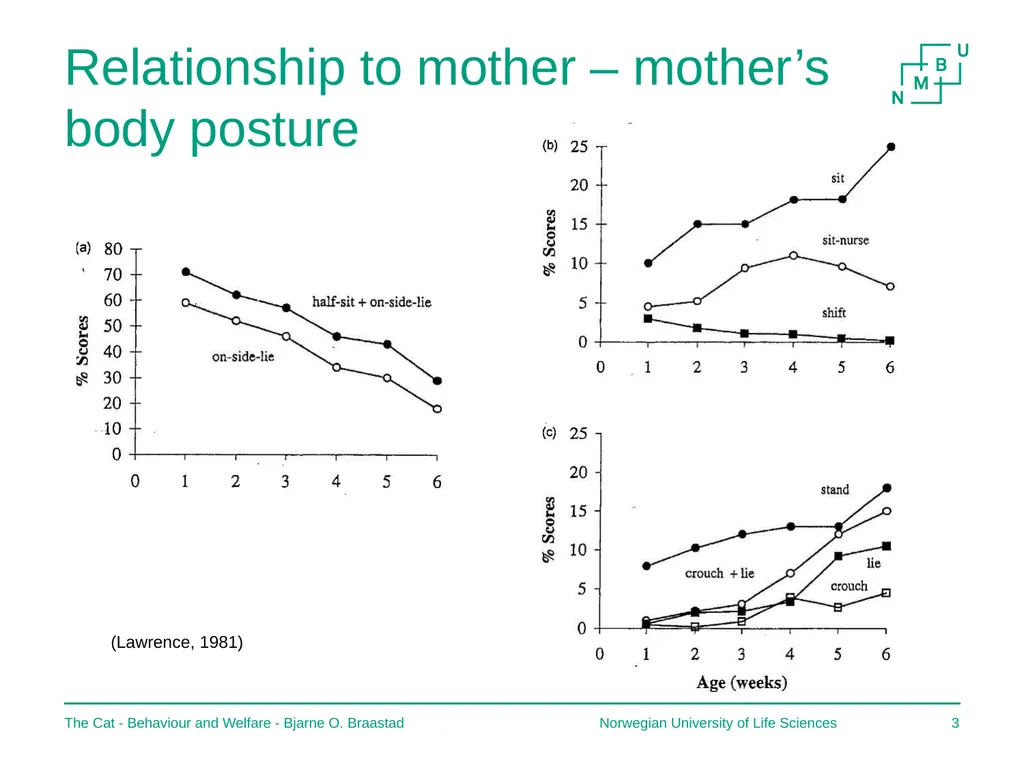
Relationship to mother – mother’s body posture (Lawrence, 1981) Norwegian University of Life Sciences The Cat - Behaviour and Welfare - Bjarne O. Braastad 2<br>
04
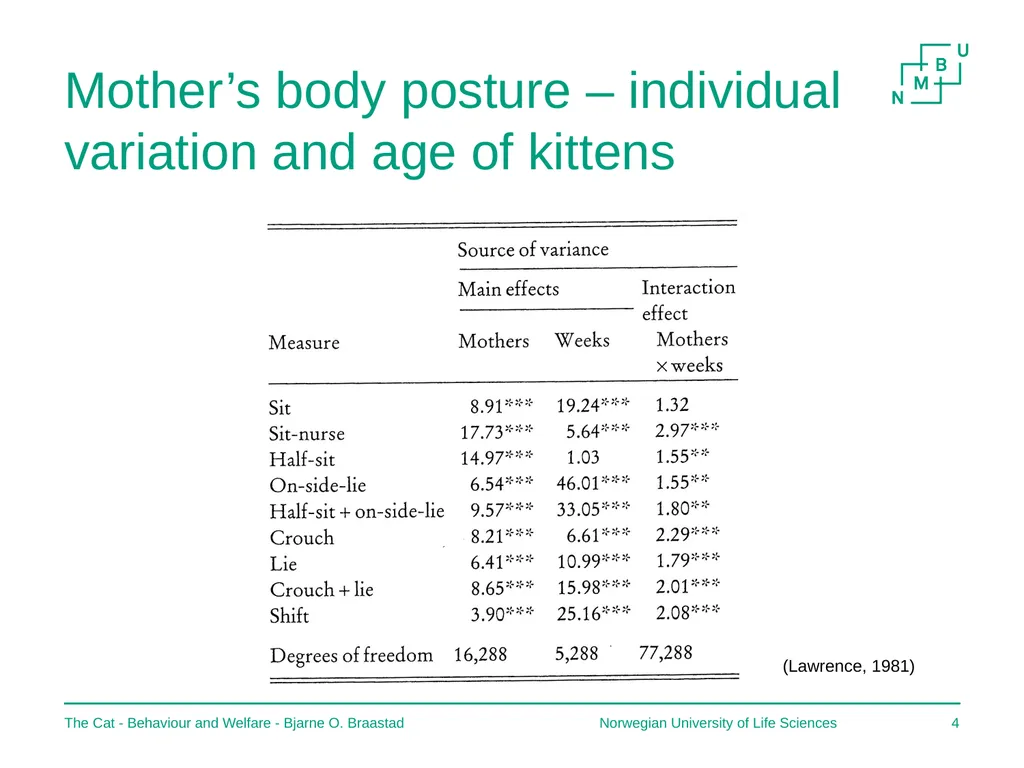
Mother’s body posture – individual variation and age of kittens Norwegian University of Life Sciences The Cat - Behaviour and Welfare - Bjarne O. Braastad 3 (Lawrence, 1981)<br>
05
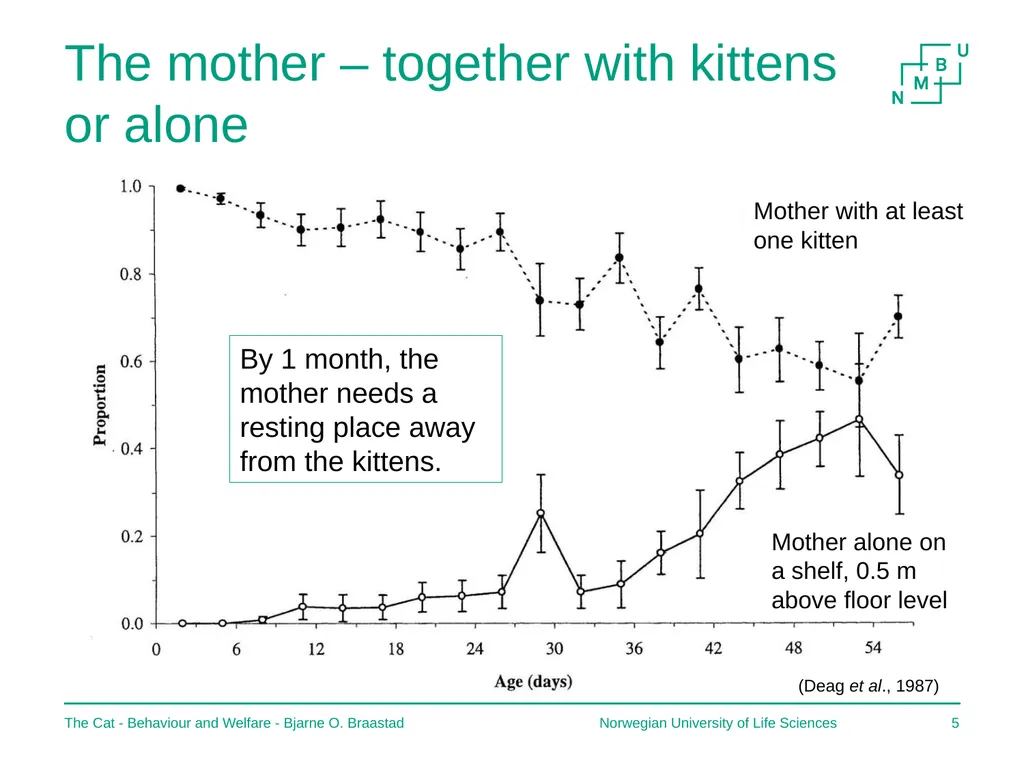
The mother – together with kittens or alone Mother with at least one kitten Mother alone on a shelf, 0.5 m above floor level By 1 month, the mother needs a resting place away from the kittens. (Deag et al., 1987) Norwegian University of Life Sciences The Cat - Behaviour and Welfare - Bjarne O. Braastad 4<br>
06
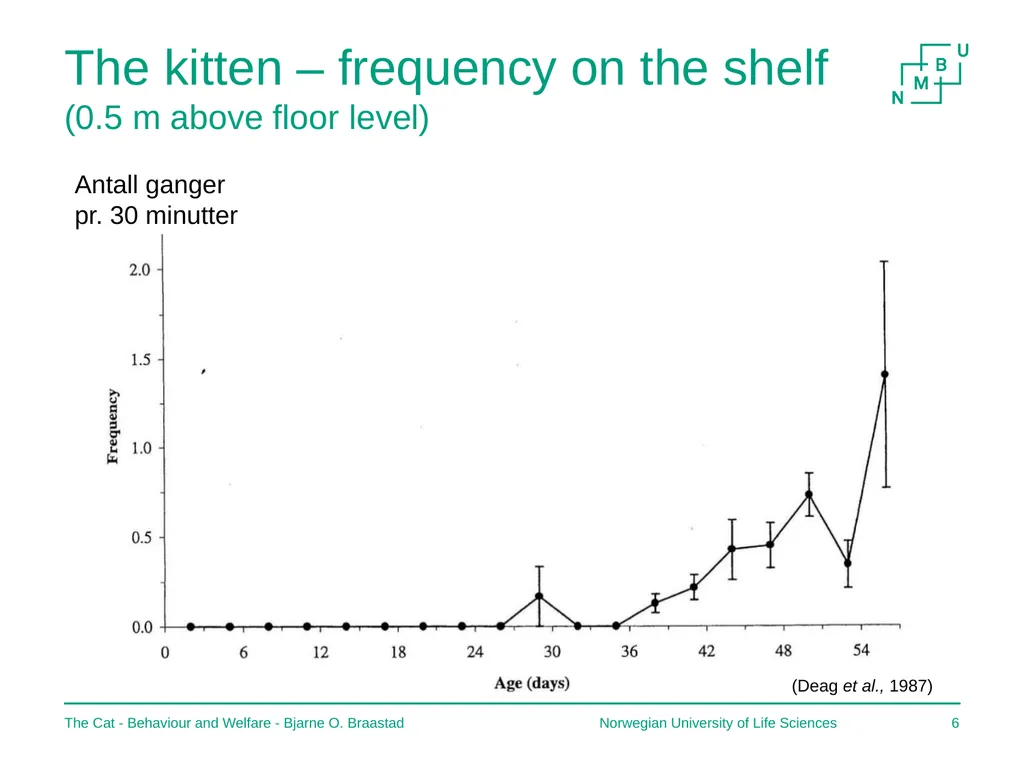
The kitten – frequency on the shelf (0.5 m above floor level) Antall ganger
pr. 30 minutter (Deag et al., 1987) Norwegian University of Life Sciences The Cat - Behaviour and Welfare - Bjarne O. Braastad 5<br>
07
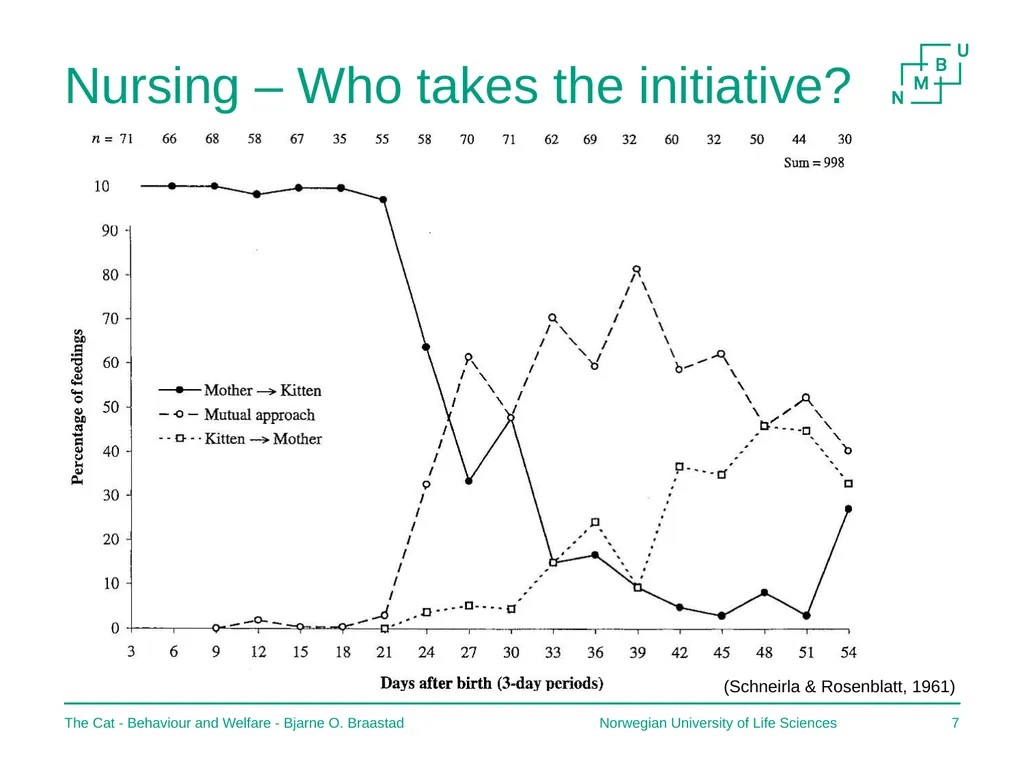
Nursing – Who takes the initiative? Antall ganger pr. 30 minutter (Schneirla & Rosenblatt, 1961) Norwegian University of Life Sciences The Cat - Behaviour and Welfare - Bjarne O. Braastad 6<br>
08
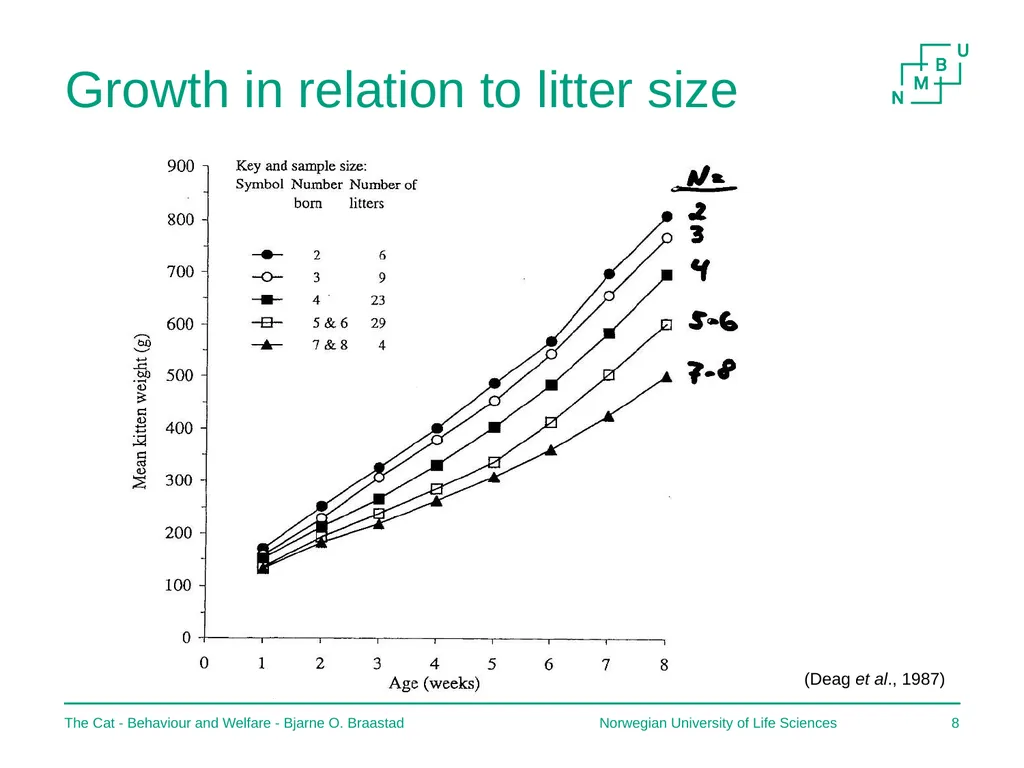
Growth in relation to litter size (Deag et al., 1987) Norwegian University of Life Sciences The Cat - Behaviour and Welfare - Bjarne O. Braastad 7<br>
09
More on cats’ behaviour and welfare is found here (in Norwegian) www.braastad.info – Braastad’s website on ethology, animal welfare, cats and human–animal relationship
www.facebook.com/KattenAtferdVelferd – Facebook (Meta) site for the Norwegian cat book
www.etologi.no – website for the Norwegian Association of Ethologists
www.etologi-dyrevelferd.no – website on ethology and animal welfare for secondary schools
www.animalpickings.com – popular scientific website for the Research Group on Ethology and Animal Environment at the Norwegian University of Life Sciences 8 Norwegian University of Life Sciences The Cat - Behaviour and Welfare - Bjarne O. Braastad<br>
10
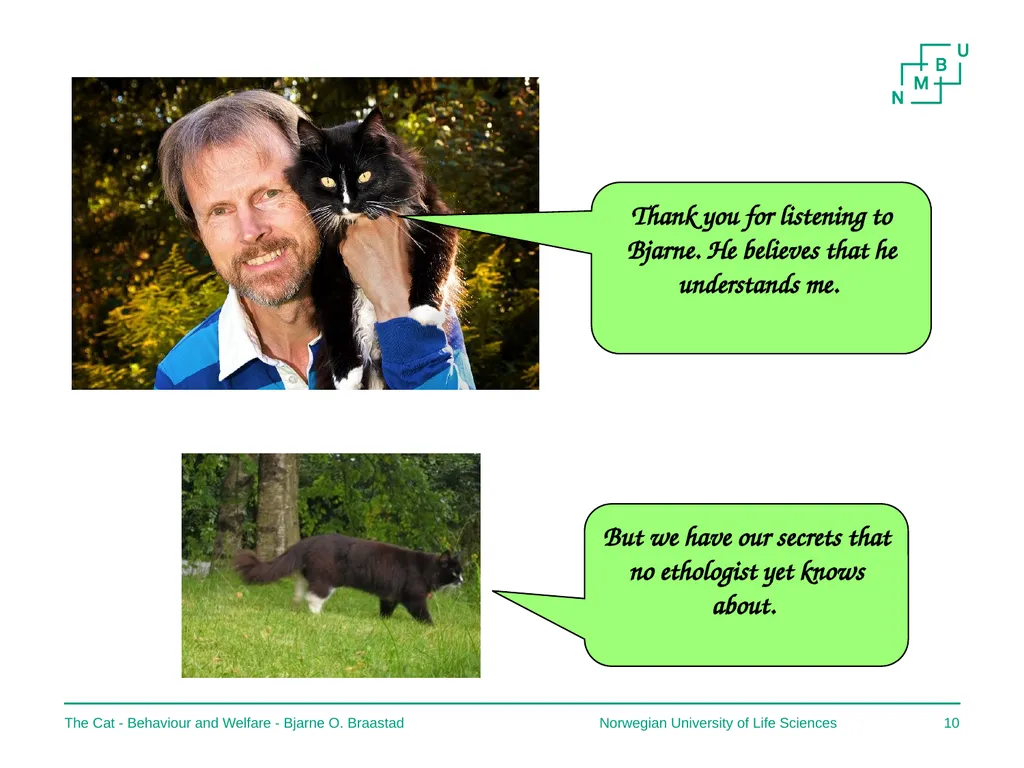
But we have our secrets that no ethologist yet knows about. 9 The Cat - Behaviour and Welfare - Bjarne O. Braastad Norwegian University of Life Sciences Thank you for listening to Bjarne. He believes that he understands me.<br>