
The Cognitive Science of Learning: Implications
CB
Published · 45 slides · 0 views

1 / 1













Description
The Cognitive Science of Learning: Implications for Multimedia Design Dr. Jolly Holden Associate Professor American InterContinental University Menu (Click any of the hyperlinks to go directly to that topic) The Science of Learning The
Related Topics
Share
Embed code
Download this presentation From Below
"The Cognitive Science of Learning: Implications" is the property of its rightful owner. Permission is granted to download and print the materials on this website for personal, non-commercial use only, and to display it on your personal computer provided you do not modify the materials and that you retain all copyright notices contained in the materials. By downloading content from our website, you accept the terms of this agreement.
Presentation Transcript
01
The Cognitive Science of Learning: Implications for Multimedia Design
Dr. Jolly Holden
Associate Professor
American InterContinental University<br>
Dr. Jolly Holden
Associate Professor
American InterContinental University<br>
02
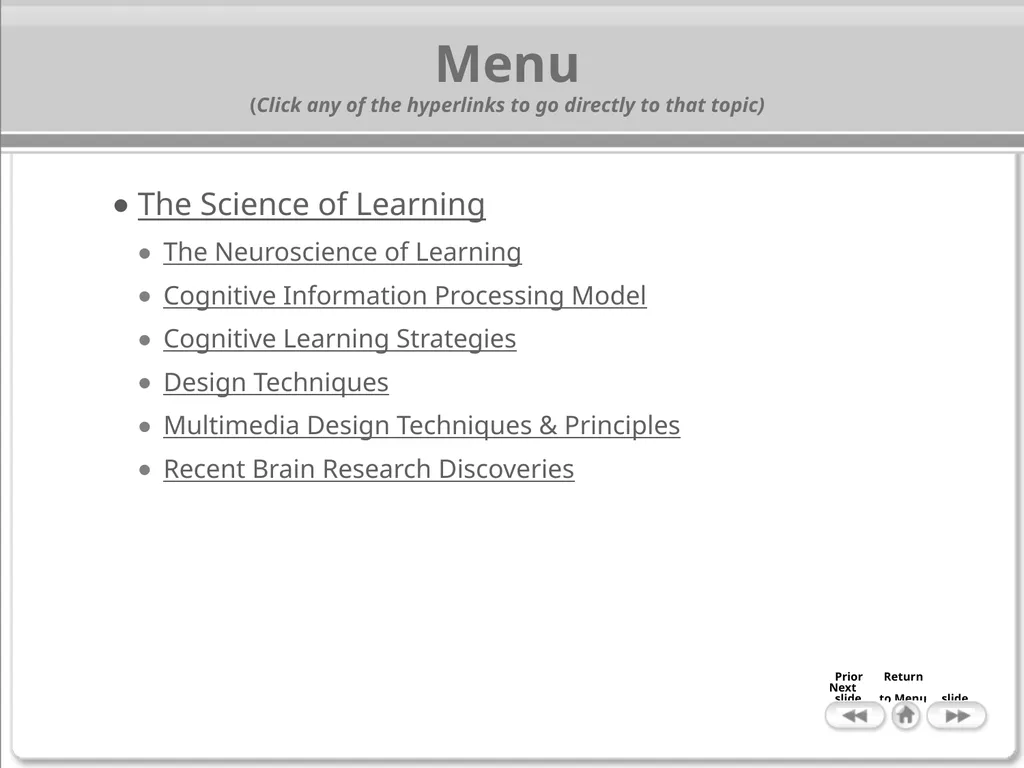
Menu
(Click any of the hyperlinks to go directly to that topic) The Science of Learning
The Neuroscience of Learning
Cognitive Information Processing Model
Cognitive Learning Strategies
Design Techniques
Multimedia Design Techniques & Principles
Recent Brain Research Discoveries Prior Return Next
slide to Menu slide<br>
The Neuroscience of Learning
Cognitive Information Processing Model
Cognitive Learning Strategies
Design Techniques
Multimedia Design Techniques & Principles
Recent Brain Research Discoveries Prior Return Next
slide to Menu slide<br>
03
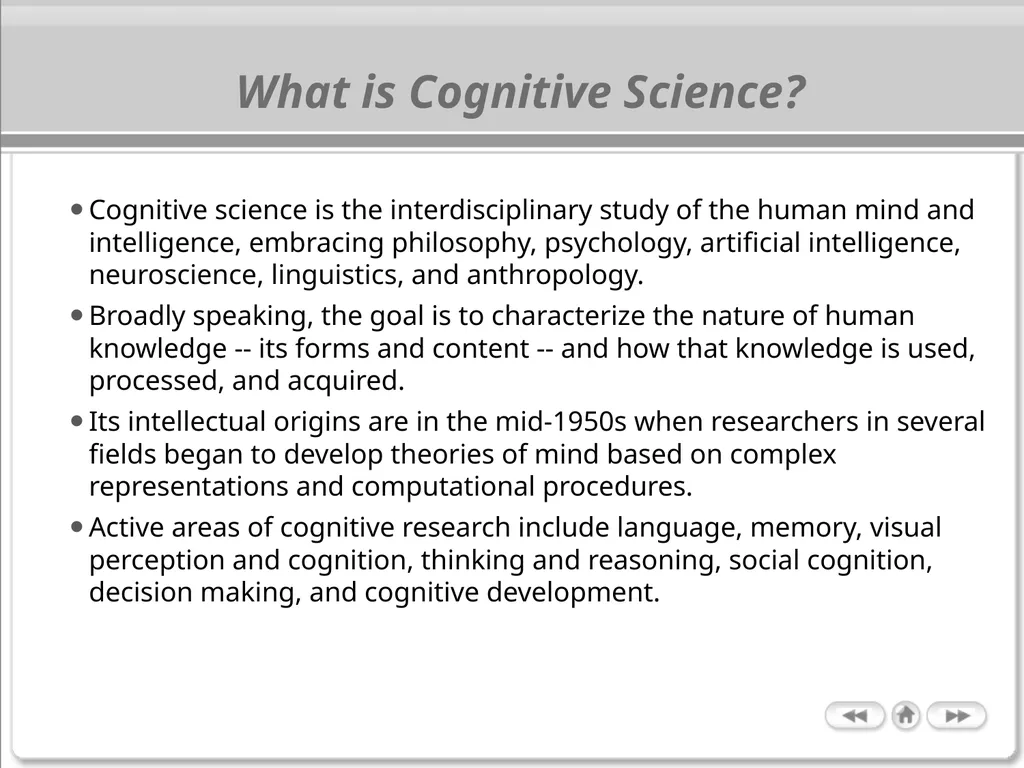
What is Cognitive Science? Cognitive science is the interdisciplinary study of the human mind and intelligence, embracing philosophy, psychology, artificial intelligence, neuroscience, linguistics, and anthropology.
Broadly speaking, the goal is to characterize the nature of human knowledge -- its forms and content -- and how that knowledge is used, processed, and acquired.
Its intellectual origins are in the mid-1950s when researchers in several fields began to develop theories of mind based on complex representations and computational procedures.
Active areas of cognitive research include language, memory, visual perception and cognition, thinking and reasoning, social cognition, decision making, and cognitive development.<br>
Broadly speaking, the goal is to characterize the nature of human knowledge -- its forms and content -- and how that knowledge is used, processed, and acquired.
Its intellectual origins are in the mid-1950s when researchers in several fields began to develop theories of mind based on complex representations and computational procedures.
Active areas of cognitive research include language, memory, visual perception and cognition, thinking and reasoning, social cognition, decision making, and cognitive development.<br>
04
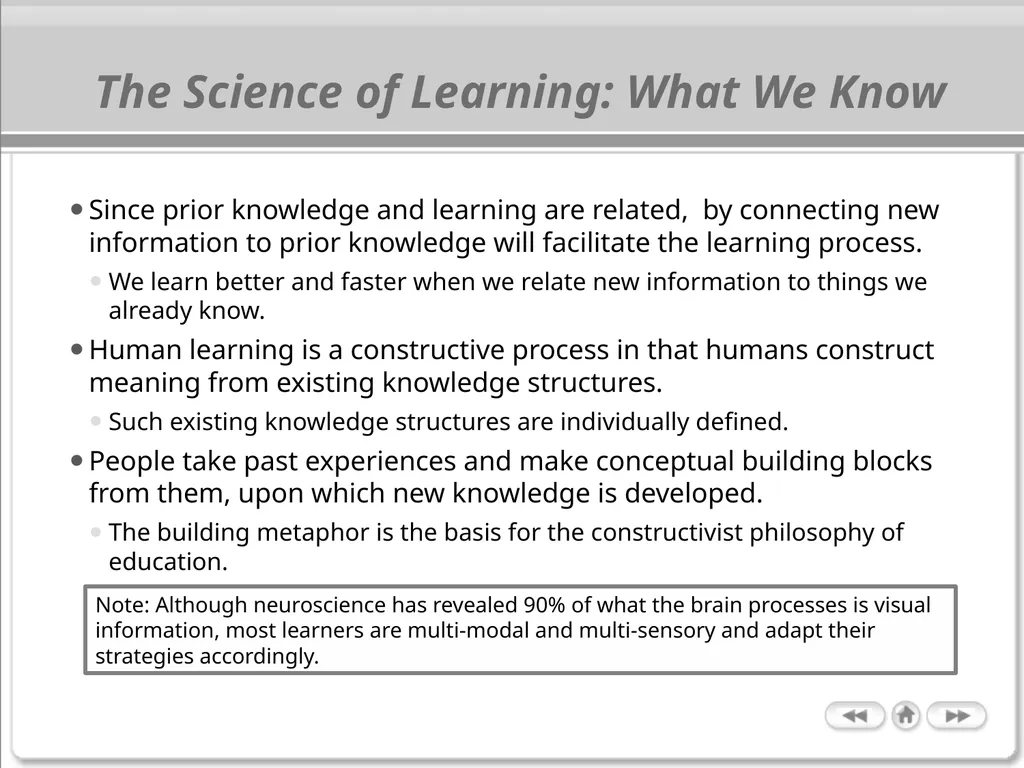
The Science of Learning: What We Know Since prior knowledge and learning are related, by connecting new information to prior knowledge will facilitate the learning process.
We learn better and faster when we relate new information to things we already know.
Human learning is a constructive process in that humans construct meaning from existing knowledge structures.
Such existing knowledge structures are individually defined.
People take past experiences and make conceptual building blocks from them, upon which new knowledge is developed.
The building metaphor is the basis for the constructivist philosophy of education. Note: Although neuroscience has revealed 90% of what the brain processes is visual information, most learners are multi-modal and multi-sensory and adapt their strategies accordingly.<br>
We learn better and faster when we relate new information to things we already know.
Human learning is a constructive process in that humans construct meaning from existing knowledge structures.
Such existing knowledge structures are individually defined.
People take past experiences and make conceptual building blocks from them, upon which new knowledge is developed.
The building metaphor is the basis for the constructivist philosophy of education. Note: Although neuroscience has revealed 90% of what the brain processes is visual information, most learners are multi-modal and multi-sensory and adapt their strategies accordingly.<br>
05
Cognitive Science & Learning Theories Learning theories are conceptual frameworks that describe how information is absorbed, processed, and retained…in other words, how people learn.
Therefore, it is essential to examine how information moves from sensory input, to short term memory, and on to long term memory.
However, the challenge for teachers is how to move information from short term memory to long term memory for recall [and application].
Therefore, by exploring the Cognitive Information Processing Model, one can facilitate the transfer of information [from short term memory to long term memory] and increase learning and retention by integrating cognitive learning strategies.<br>
Therefore, it is essential to examine how information moves from sensory input, to short term memory, and on to long term memory.
However, the challenge for teachers is how to move information from short term memory to long term memory for recall [and application].
Therefore, by exploring the Cognitive Information Processing Model, one can facilitate the transfer of information [from short term memory to long term memory] and increase learning and retention by integrating cognitive learning strategies.<br>
06
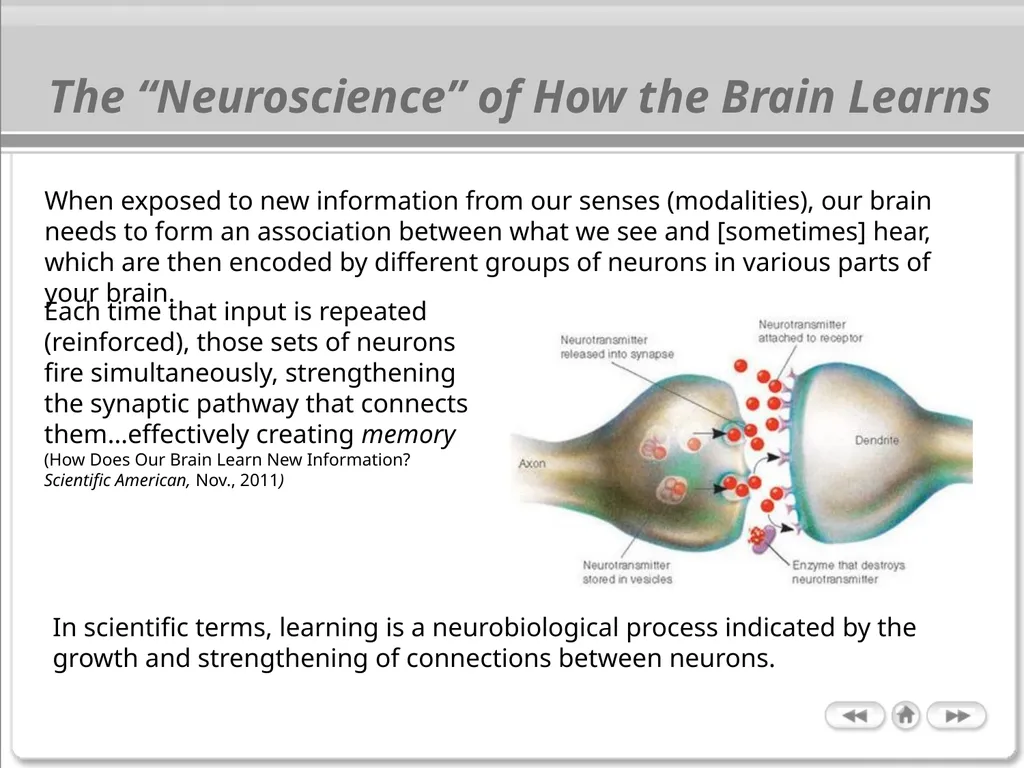
When exposed to new information from our senses (modalities), our brain needs to form an association between what we see and [sometimes] hear, which are then encoded by different groups of neurons in various parts of your brain. The “Neuroscience” of How the Brain Learns Each time that input is repeated (reinforced), those sets of neurons fire simultaneously, strengthening the synaptic pathway that connects them…effectively creating memory (How Does Our Brain Learn New Information? Scientific American, Nov., 2011) In scientific terms, learning is a neurobiological process indicated by the growth and strengthening of connections between neurons.<br>
07
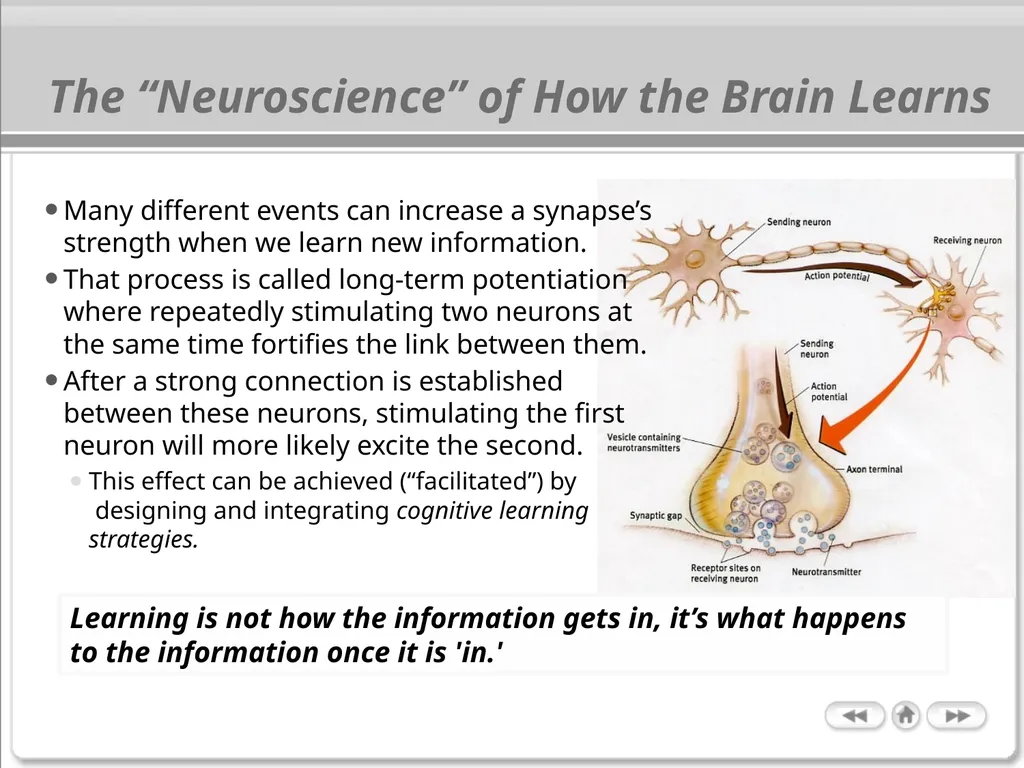
Many different events can increase a synapse’s strength when we learn new information.
That process is called long-term potentiation where repeatedly stimulating two neurons at the same time fortifies the link between them.
After a strong connection is established between these neurons, stimulating the first neuron will more likely excite the second. This effect can be achieved (“facilitated”) by
designing and integrating cognitive learning strategies. The “Neuroscience” of How the Brain Learns Learning is not how the information gets in, it’s what happens to the information once it is 'in.'<br>
That process is called long-term potentiation where repeatedly stimulating two neurons at the same time fortifies the link between them.
After a strong connection is established between these neurons, stimulating the first neuron will more likely excite the second. This effect can be achieved (“facilitated”) by
designing and integrating cognitive learning strategies. The “Neuroscience” of How the Brain Learns Learning is not how the information gets in, it’s what happens to the information once it is 'in.'<br>
08
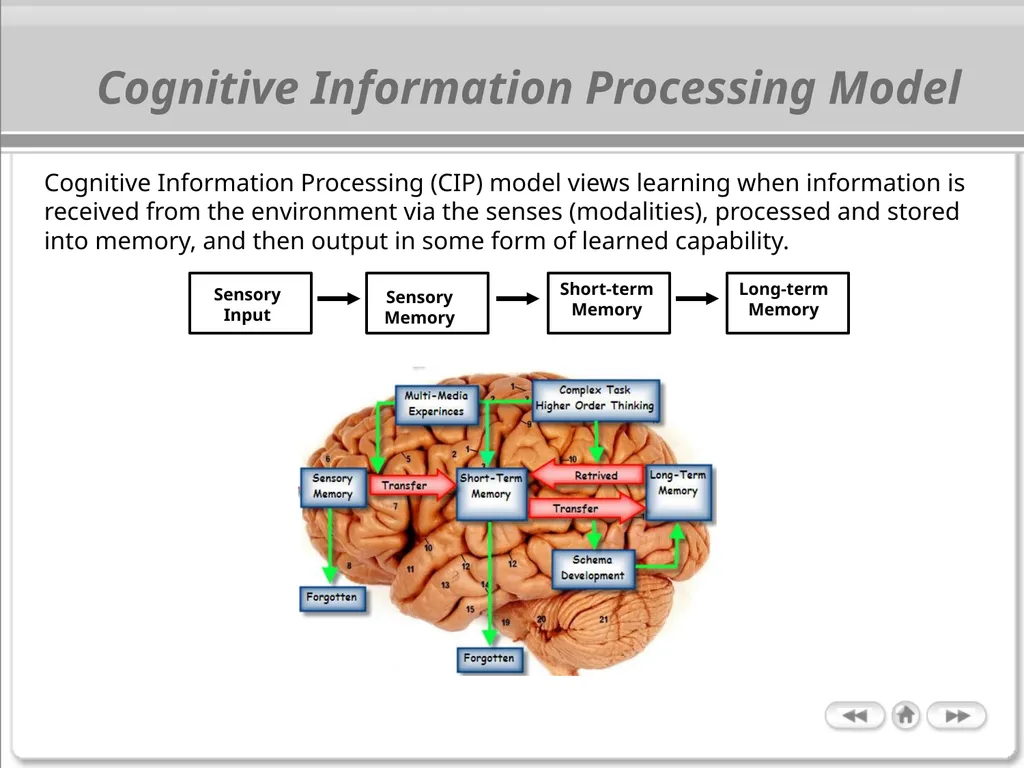
Cognitive Information Processing Model Cognitive Information Processing (CIP) model views learning when information is received from the environment via the senses (modalities), processed and stored into memory, and then output in some form of learned capability.<br>
09
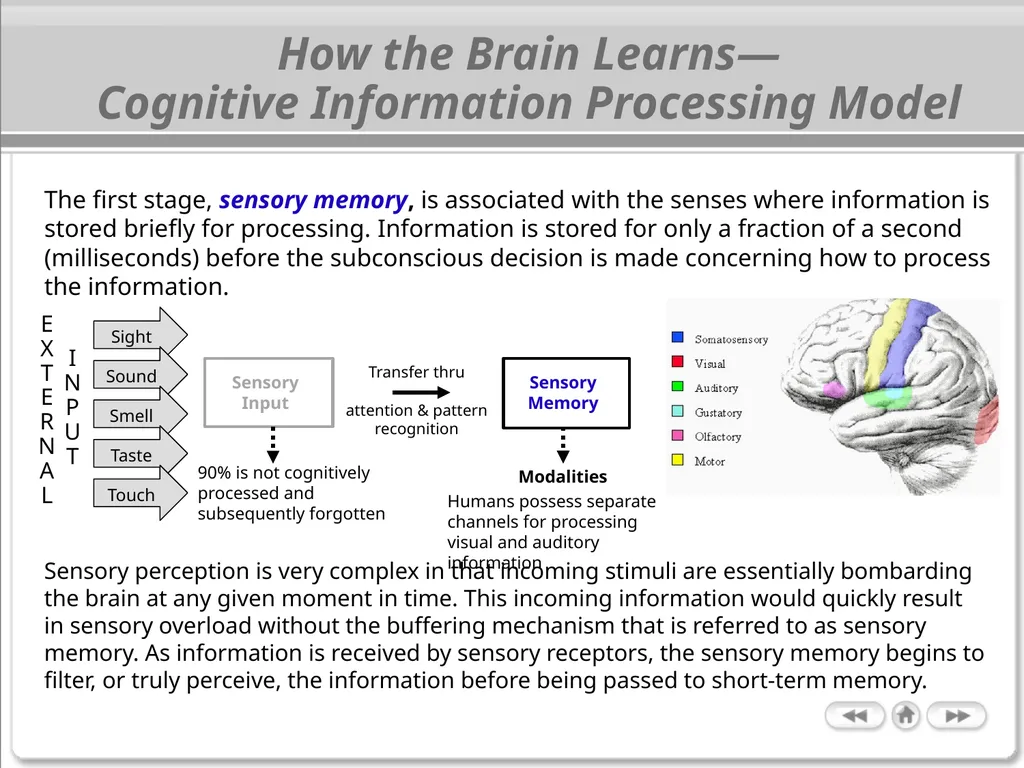
The first stage, sensory memory, is associated with the senses where information is stored briefly for processing. Information is stored for only a fraction of a second (milliseconds) before the subconscious decision is made concerning how to process the information. How the Brain Learns—
Cognitive Information Processing Model Sensory Input Sensory Memory Transfer thru
attention & pattern recognition 90% is not cognitively processed and subsequently forgotten Modalities
Humans possess separate channels for processing visual and auditory information Sensory perception is very complex in that incoming stimuli are essentially bombarding the brain at any given moment in time. This incoming information would quickly result in sensory overload without the buffering mechanism that is referred to as sensory memory. As information is received by sensory receptors, the sensory memory begins to filter, or truly perceive, the information before being passed to short-term memory. E
X
T
E
R
N
A
L I
N
P
U
T<br>
attention & pattern recognition 90% is not cognitively processed and subsequently forgotten Modalities
Humans possess separate channels for processing visual and auditory information Sensory perception is very complex in that incoming stimuli are essentially bombarding the brain at any given moment in time. This incoming information would quickly result in sensory overload without the buffering mechanism that is referred to as sensory memory. As information is received by sensory receptors, the sensory memory begins to filter, or truly perceive, the information before being passed to short-term memory. E
X
T
E
R
N
A
L I
N
P
U
T<br>
10
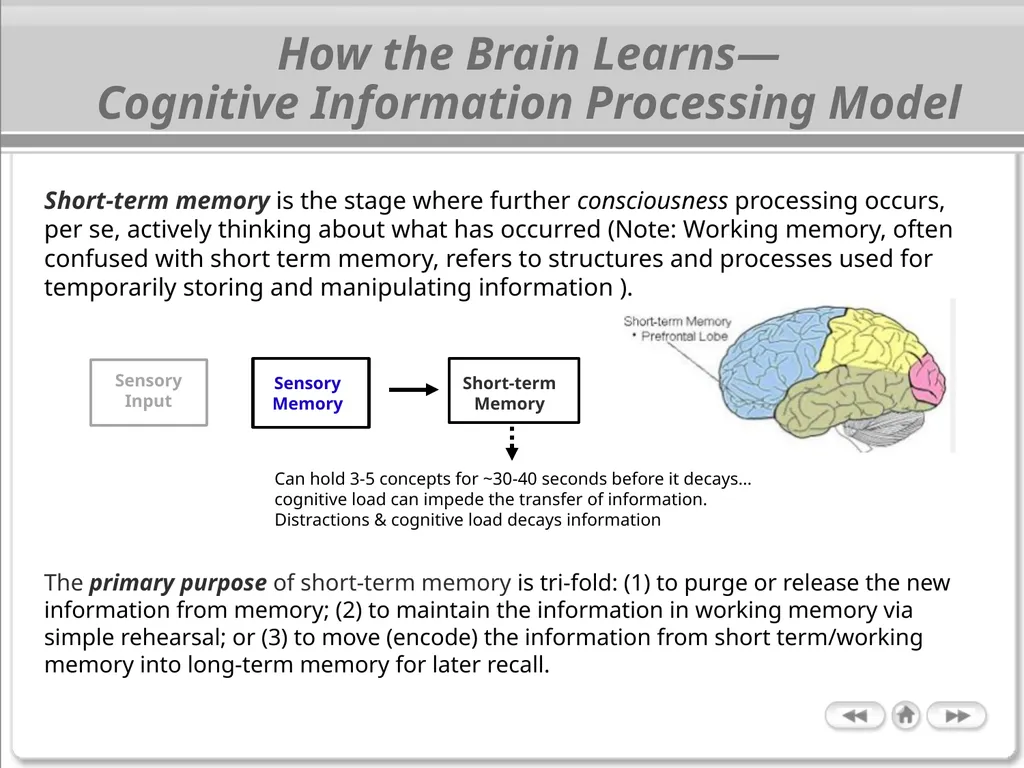
Short-term memory is the stage where further consciousness processing occurs, per se, actively thinking about what has occurred (Note: Working memory, often confused with short term memory, refers to structures and processes used for temporarily storing and manipulating information ). How the Brain Learns—
Cognitive Information Processing Model The primary purpose of short-term memory is tri-fold: (1) to purge or release the new information from memory; (2) to maintain the information in working memory via simple rehearsal; or (3) to move (encode) the information from short term/working memory into long-term memory for later recall.<br>
11
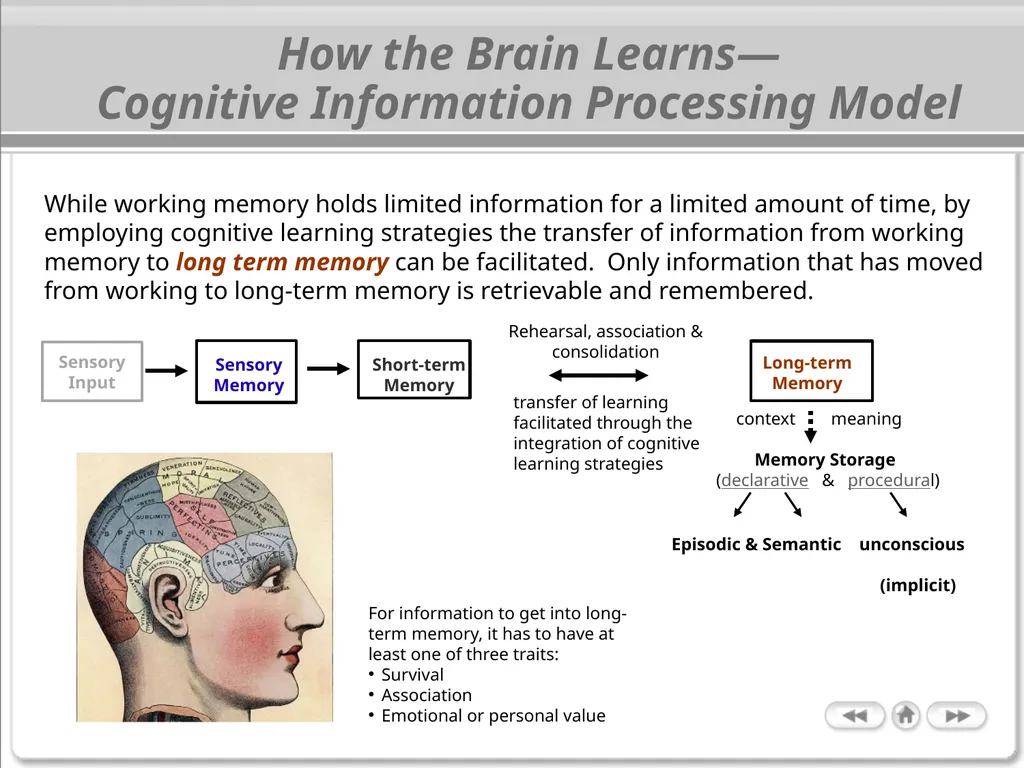
While working memory holds limited information for a limited amount of time, by employing cognitive learning strategies the transfer of information from working memory to long term memory can be facilitated. Only information that has moved from working to long-term memory is retrievable and remembered. How the Brain Learns—
Cognitive Information Processing Model For information to get into long-term memory, it has to have at least one of three traits:
Survival
Association
Emotional or personal value<br>
Survival
Association
Emotional or personal value<br>
12
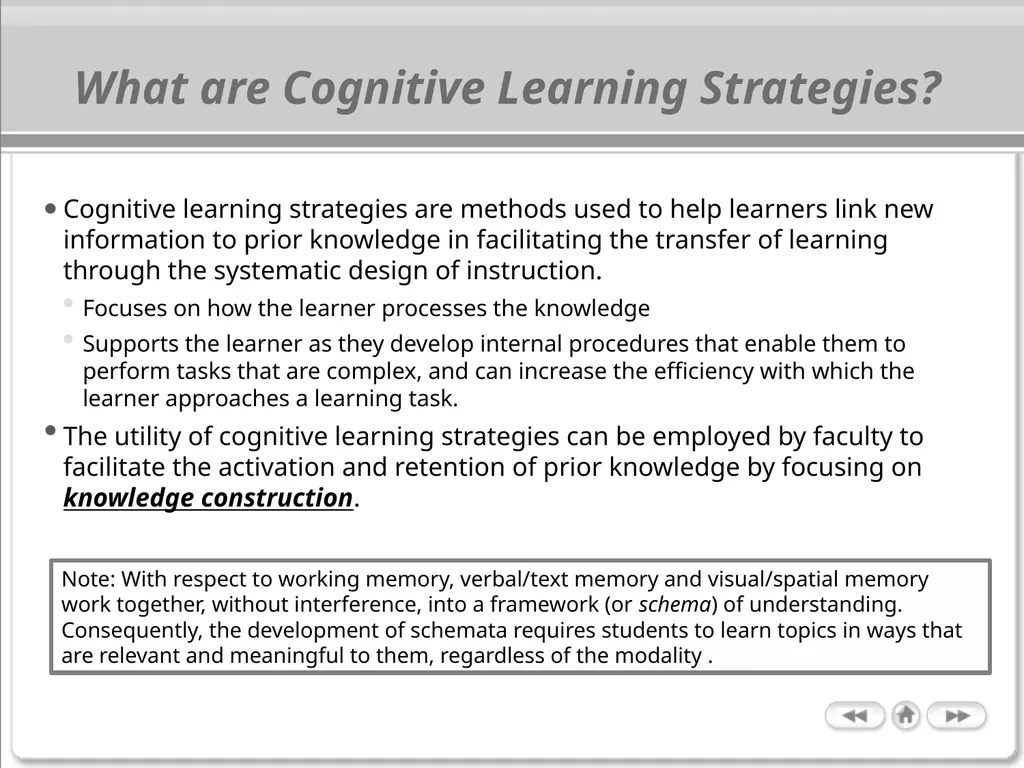
Cognitive learning strategies are methods used to help learners link new information to prior knowledge in facilitating the transfer of learning through the systematic design of instruction.
Focuses on how the learner processes the knowledge
Supports the learner as they develop internal procedures that enable them to perform tasks that are complex, and can increase the efficiency with which the learner approaches a learning task.
The utility of cognitive learning strategies can be employed by faculty to facilitate the activation and retention of prior knowledge by focusing on knowledge construction. What are Cognitive Learning Strategies? Note: With respect to working memory, verbal/text memory and visual/spatial memory work together, without interference, into a framework (or schema) of understanding. Consequently, the development of schemata requires students to learn topics in ways that are relevant and meaningful to them, regardless of the modality .<br>
Focuses on how the learner processes the knowledge
Supports the learner as they develop internal procedures that enable them to perform tasks that are complex, and can increase the efficiency with which the learner approaches a learning task.
The utility of cognitive learning strategies can be employed by faculty to facilitate the activation and retention of prior knowledge by focusing on knowledge construction. What are Cognitive Learning Strategies? Note: With respect to working memory, verbal/text memory and visual/spatial memory work together, without interference, into a framework (or schema) of understanding. Consequently, the development of schemata requires students to learn topics in ways that are relevant and meaningful to them, regardless of the modality .<br>
13
Organization of information by “chunking” information into smaller and meaningful units.
Makes it easier to use, store, and recall information.
Helps in overcoming working memory limitations.
Facilitate the transfer of learning by integrating:
Concept maps, frames
Advance Organizers
Mnemonics, analogies, metaphors, similes
Provide for "scaffolding when learning a task cannot be completed through a series of steps. Design Techniques: Integrating Cognitive Learning Strategies<br>
Makes it easier to use, store, and recall information.
Helps in overcoming working memory limitations.
Facilitate the transfer of learning by integrating:
Concept maps, frames
Advance Organizers
Mnemonics, analogies, metaphors, similes
Provide for "scaffolding when learning a task cannot be completed through a series of steps. Design Techniques: Integrating Cognitive Learning Strategies<br>
14
Design Techniques:
Integrating Cognitive Learning Strategies Long term retention is improved as the spacing between as repetitions increases
Employ retrieval practice—asking questions repeatedly to retrieve information from the brain which is then immediately followed by feedback
Reinforcement/engage often
Repetition practice-repeat material often and continually
Spacing can improve retention (over hours, days, weeks); spacing combined with retrieval leads to better learning
Bottom line…using the above activate more neurons. More neurons activated, the more likely retention is improved (long term memory). The benefits of active retrieval are large when students retrieve and then reread, and by engaging in repeated retrieval, retention increased to 80%. Another experiment revealed that practicing retrieval one time doubled long-term retention, and repeated retrieval produced a 400% improvement in retention relative to studying once (Retrieval-Based Learning: Active Retrieval Promotes Meaningful Learning: http://learninglab.psych.purdue.edu/downloads/2012_Karpicke_CDPS.pdf)<br>
Employ retrieval practice—asking questions repeatedly to retrieve information from the brain which is then immediately followed by feedback
Reinforcement/engage often
Repetition practice-repeat material often and continually
Spacing can improve retention (over hours, days, weeks); spacing combined with retrieval leads to better learning
Bottom line…using the above activate more neurons. More neurons activated, the more likely retention is improved (long term memory). The benefits of active retrieval are large when students retrieve and then reread, and by engaging in repeated retrieval, retention increased to 80%. Another experiment revealed that practicing retrieval one time doubled long-term retention, and repeated retrieval produced a 400% improvement in retention relative to studying once (Retrieval-Based Learning: Active Retrieval Promotes Meaningful Learning: http://learninglab.psych.purdue.edu/downloads/2012_Karpicke_CDPS.pdf)<br>
15
Avoid cognitive overload in multimedia design.
Cognitive Load Theory focuses on the role of working memory in instructional design.
Meaningful learning depends on active cognitive processing in learner’s working memory.
If learners encounter too many elements in the presentation of multimedia information (animation, graphics, sound, text), working memory can be overwhelmed.
Result is excessive cognitive load that impedes learning.
Recognize the efficacy and utility of cognitive flexibility theory and dual coding theory as they apply to multimedia design.
Accomplished by revisiting the same material, at different times, in rearranged contexts, and from different conceptual perspectives. Design Techniques: Integrating Cognitive Learning Strategies<br>
Cognitive Load Theory focuses on the role of working memory in instructional design.
Meaningful learning depends on active cognitive processing in learner’s working memory.
If learners encounter too many elements in the presentation of multimedia information (animation, graphics, sound, text), working memory can be overwhelmed.
Result is excessive cognitive load that impedes learning.
Recognize the efficacy and utility of cognitive flexibility theory and dual coding theory as they apply to multimedia design.
Accomplished by revisiting the same material, at different times, in rearranged contexts, and from different conceptual perspectives. Design Techniques: Integrating Cognitive Learning Strategies<br>
16
When translating learning theory into the design of content, integrating multimedia components can lead to effective learning.
Continued research into neuroscience is discovering how the brain processes information and has revealed that significant increases in learning can be accomplished through the informed use of visual and verbal multimodal learning.
Our brain is constantly searching its memory for context based on prior knowledge/experience.
In the absence of visual cues, the brain creates “mental pictures” based upon one’s schema to add context to what is printed/spoken. Multimedia Design Techniques: Note: With respect to working memory, verbal/text memory and visual/spatial memory work together, without interference, into a framework (or schema) of understanding. Consequently, the development of schemata requires students to learn topics in ways that are relevant and meaningful to them, regardless of the modality .<br>
Continued research into neuroscience is discovering how the brain processes information and has revealed that significant increases in learning can be accomplished through the informed use of visual and verbal multimodal learning.
Our brain is constantly searching its memory for context based on prior knowledge/experience.
In the absence of visual cues, the brain creates “mental pictures” based upon one’s schema to add context to what is printed/spoken. Multimedia Design Techniques: Note: With respect to working memory, verbal/text memory and visual/spatial memory work together, without interference, into a framework (or schema) of understanding. Consequently, the development of schemata requires students to learn topics in ways that are relevant and meaningful to them, regardless of the modality .<br>
17
Multimedia principle: People learn better from words and pictures than from words alone.
Modality Principle – People learn more deeply from multimedia lessons when graphics are explained by audio narration than onscreen text.
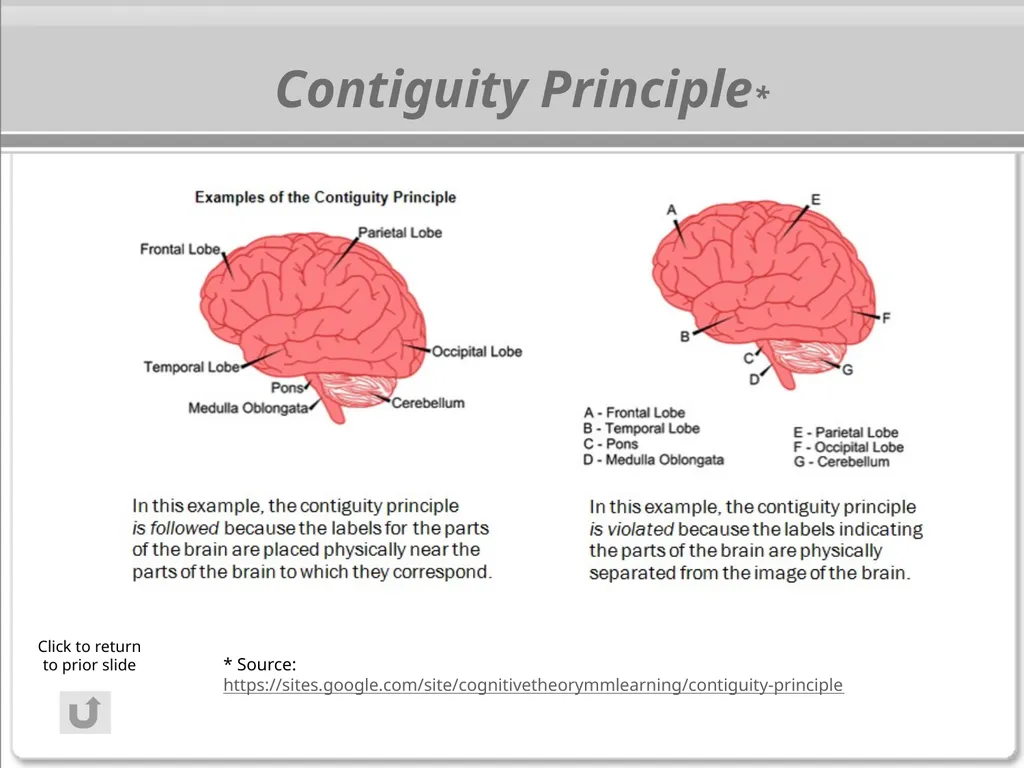
Spatial Contiguity Principle - People learn better when corresponding words and pictures are presented near rather than far from each other on the page or screen.
Temporal Contiguity Principle - People learn better when corresponding words and pictures are presented simultaneously rather than successively.
Studies have shown that how information is presented determines the retention level of the information.
Consequently, integrating multiple media in the design and delivery of instruction would facilitate the learning process. Multimedia Principles* * Clark, R., & Mayer, R. (2011). e-Learning and the Science of Instruction (3rd Ed). San Francisco, CA: Pfeiffer<br>
Modality Principle – People learn more deeply from multimedia lessons when graphics are explained by audio narration than onscreen text.
Spatial Contiguity Principle - People learn better when corresponding words and pictures are presented near rather than far from each other on the page or screen.
Temporal Contiguity Principle - People learn better when corresponding words and pictures are presented simultaneously rather than successively.
Studies have shown that how information is presented determines the retention level of the information.
Consequently, integrating multiple media in the design and delivery of instruction would facilitate the learning process. Multimedia Principles* * Clark, R., & Mayer, R. (2011). e-Learning and the Science of Instruction (3rd Ed). San Francisco, CA: Pfeiffer<br>
18
Principles for managing essential processing
Segmenting principle: People learn better when a multimedia lesson is presented in learner-paced segments rather than as a continuous unit.
Pre-training principle: People learn better from a multimedia lesson when they know the names and characteristics of the main concepts
Principles for reducing extraneous processing
Coherence principle: People learn better when extraneous words, pictures, and sounds are excluded rather than included.
Redundancy principle: People learn better from animation and narration than from animation, narration, and on-screen text.
The Redundancy Effect is when information is presented through different cognitive processing channels (such as text and graphic) and repeat the exact same content.
Signaling principle: People learn better when the words include cues about the organization of the presentation. Multimedia Principles* * Clark, R., & Mayer, R. (2011). e-Learning and the Science of Instruction (3rd Ed). San Francisco, CA: Pfeiffer<br>
Segmenting principle: People learn better when a multimedia lesson is presented in learner-paced segments rather than as a continuous unit.
Pre-training principle: People learn better from a multimedia lesson when they know the names and characteristics of the main concepts
Principles for reducing extraneous processing
Coherence principle: People learn better when extraneous words, pictures, and sounds are excluded rather than included.
Redundancy principle: People learn better from animation and narration than from animation, narration, and on-screen text.
The Redundancy Effect is when information is presented through different cognitive processing channels (such as text and graphic) and repeat the exact same content.
Signaling principle: People learn better when the words include cues about the organization of the presentation. Multimedia Principles* * Clark, R., & Mayer, R. (2011). e-Learning and the Science of Instruction (3rd Ed). San Francisco, CA: Pfeiffer<br>
19
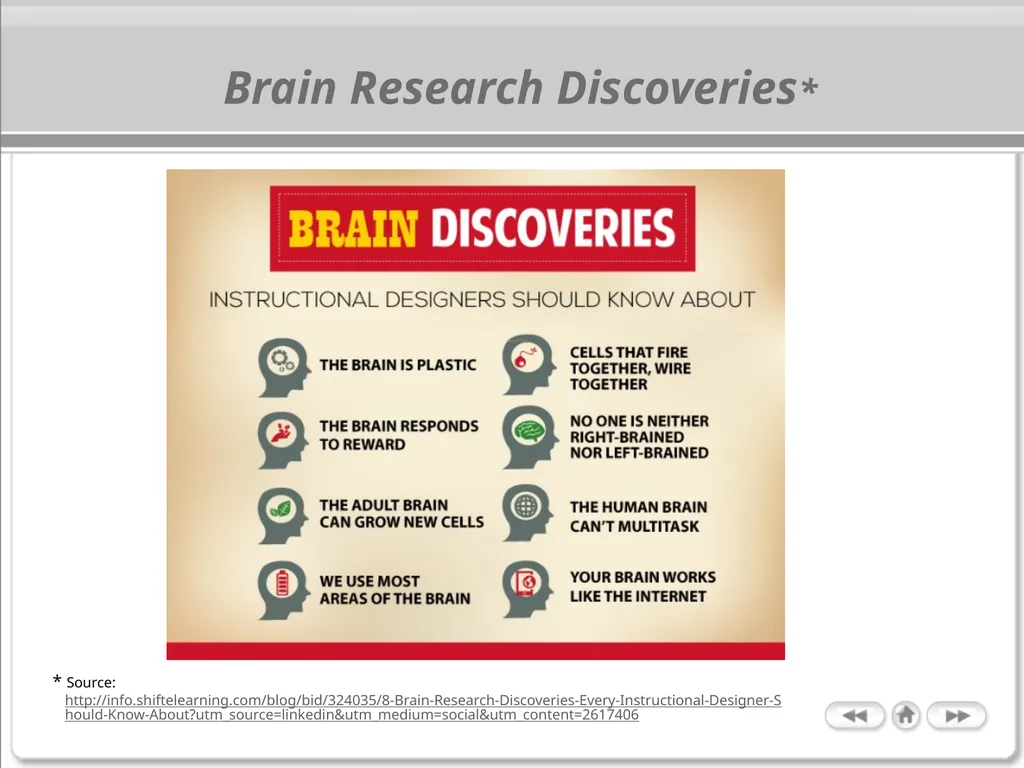
Brain Research Discoveries* * Source: http://info.shiftelearning.com/blog/bid/324035/8-Brain-Research-Discoveries-Every-Instructional-Designer-Should-Know-About?utm_source=linkedin&utm_medium=social&utm_content=2617406<br>
20
The brain is plastic. The brain is constantly changing, a concept referred to as neuroplasticity. Neuroplasticity means the brain can be improved and continues to adapt and learn through life, even after middle age and during old age. This also means that the brain can learn better, that the human potential for learning is limitless (Norman Doidge, 2007, The Brain That Changes Itself, Random House).
2. The brain responds to reward due to several factors. Recent discoveries by neuroscientists reveals rewards is influenced by many factors, and among them are context and individual differences. In the context of reinforcement learning, the individual learner’s reward system responds to prediction error, which is the difference between the result an individual expects from his or her action and the outcome he or she actually gets (Garrison, J., Erdeniz, B., & Done, J., 2013. Prediction error in reinforcement learning: A meta-analysis of neuroimaging studies. Neuroscience & Biobehavioral Reviews, Volume 37, Issue 7, pp. 1297–1310). Brain Research Discoveries* * Source: http://info.shiftelearning.com/blog/bid/324035/8-Brain-Research-Discoveries-Every-Instructional-Designer-Should-Know-About?utm_source=linkedin&utm_medium=social&utm_content=2617406<br>
2. The brain responds to reward due to several factors. Recent discoveries by neuroscientists reveals rewards is influenced by many factors, and among them are context and individual differences. In the context of reinforcement learning, the individual learner’s reward system responds to prediction error, which is the difference between the result an individual expects from his or her action and the outcome he or she actually gets (Garrison, J., Erdeniz, B., & Done, J., 2013. Prediction error in reinforcement learning: A meta-analysis of neuroimaging studies. Neuroscience & Biobehavioral Reviews, Volume 37, Issue 7, pp. 1297–1310). Brain Research Discoveries* * Source: http://info.shiftelearning.com/blog/bid/324035/8-Brain-Research-Discoveries-Every-Instructional-Designer-Should-Know-About?utm_source=linkedin&utm_medium=social&utm_content=2617406<br>
21
3. The adult brain CAN grow new cells. Recent studies have revealed the brain does grow new cells in the hippocampus, and these new cells take on functional roles and interact with existing cells.
Learners use most areas of the brain. This runs contrary to the myth that individuals are using only 5 to 10 percent of their brain. There’s no proof of this. Neuroscientists and neurologists have already presented evidence that refute this “10 percent” myth (Do People Only Use 10 Percent Of Their Brains? Scientific American, 2008, retrieved from http://www.scientificamerican.com/article.cfm?id=people-only-use-10-percent-of-brain).
5. Cells that fire together, wire together. In other words, the “use-it-or-lose-it” phenomenon, or simply put, if you want to retain new information, you have to use it constantly or else lose it. When you stop practicing a new skill or a new language, for instance, your brain will eventually prune or eliminate certain pathways. You’ll eventually lose a new skill unless you keep on practicing (Retrieval-Based Learning: Active Retrieval Promotes Meaningful Learning: http://learninglab.psych.purdue.edu/downloads/2012_Karpicke_CDPS.pdf ) Brain Research Discoveries<br>
Learners use most areas of the brain. This runs contrary to the myth that individuals are using only 5 to 10 percent of their brain. There’s no proof of this. Neuroscientists and neurologists have already presented evidence that refute this “10 percent” myth (Do People Only Use 10 Percent Of Their Brains? Scientific American, 2008, retrieved from http://www.scientificamerican.com/article.cfm?id=people-only-use-10-percent-of-brain).
5. Cells that fire together, wire together. In other words, the “use-it-or-lose-it” phenomenon, or simply put, if you want to retain new information, you have to use it constantly or else lose it. When you stop practicing a new skill or a new language, for instance, your brain will eventually prune or eliminate certain pathways. You’ll eventually lose a new skill unless you keep on practicing (Retrieval-Based Learning: Active Retrieval Promotes Meaningful Learning: http://learninglab.psych.purdue.edu/downloads/2012_Karpicke_CDPS.pdf ) Brain Research Discoveries<br>
22
No one is neither right-brained nor left-brained. While it’s true that some brain functions occur on either part of the brain, researchers have confirmed that personality traits have nothing to do with which side of their brain learners use more (Nielsen, J.A., Zielinski, B.A., Ferguson, M.A., Lainhart, J.E., & Anderson, J.S., 2013, An Evaluation of the Left-Brain vs. Right-Brain Hypothesis with Resting State Functional Connectivity Magnetic Resonance Imaging, retrieved from http://www.plosone.org/article/info%3Adoi%2F10.1371%2Fjournal.pone.0071275)
7. The human brain CAN'T multitask. The human brain, cannot focus on all these tasks at once. Multitasking simply splits the brain by frantically switching from one task to another. This results in significant inefficiency in filtering irrelevant information and simply doesn’t work (Ophira E., Nass, C., & Wagnerc, A.D., 2009. Cognitive control in media multitaskers, retrieved from http://www.pnas.org/content/106/37/15583.full.pdf+html?sid=7f096f1f-ca07-41d4-b7b6-9f7f7e9890c3) Brain Research Discoveries<br>
7. The human brain CAN'T multitask. The human brain, cannot focus on all these tasks at once. Multitasking simply splits the brain by frantically switching from one task to another. This results in significant inefficiency in filtering irrelevant information and simply doesn’t work (Ophira E., Nass, C., & Wagnerc, A.D., 2009. Cognitive control in media multitaskers, retrieved from http://www.pnas.org/content/106/37/15583.full.pdf+html?sid=7f096f1f-ca07-41d4-b7b6-9f7f7e9890c3) Brain Research Discoveries<br>
23
8. Your brain works a lot like the Internet. A recent study which exposes the basic principles of brain function. Researchers studied brain activity using a functional magnetic resonance imaging (fMRI) and found that the brain works like a complex interacting network, like the Internet. It depends on nodes to efficiently pass on information from place to place. This runs counter to the neurological assumption that the brain works in a hierarchical order (Feldman, J., Lee, D., &Thaw, D., 2012, Computer, Neural, and Social Networks , retrieved from http://www.stanford.edu/class/ee380/Abstracts/070418-Feldman-Lee-Thaw-EE380.pdf). Brain Research Discoveries<br>
24
Intentionally Left Blank<br>
25
Cognitive Load Theory focuses on the role of working memory when designing for multimedia.
Meaningful learning depends on active cognitive processing in learner’s working memory.
If learners encounter too many elements in the presentation of multimedia information (animation, graphics, sound, text), working memory can be overwhelmed which impedes learning, but can be overcome by…
Modality effect. Providing the text is short and easily held in working memory, it should be spoken rather than written. Auditory and visual working memories are partially separate and so using both channels can increase working memory capacity and facilitate learning.
Redundancy effect. The split-attention and modality effects require two or more sources of information that are unintelligible in isolation. If written or diagrammatic information is just a repetition of spoken information it is redundant and one form should be eliminated. Do not include text that just repeats the information contained in a diagram. Cognitive Load Theory Click to return to main discussion screen<br>
Meaningful learning depends on active cognitive processing in learner’s working memory.
If learners encounter too many elements in the presentation of multimedia information (animation, graphics, sound, text), working memory can be overwhelmed which impedes learning, but can be overcome by…
Modality effect. Providing the text is short and easily held in working memory, it should be spoken rather than written. Auditory and visual working memories are partially separate and so using both channels can increase working memory capacity and facilitate learning.
Redundancy effect. The split-attention and modality effects require two or more sources of information that are unintelligible in isolation. If written or diagrammatic information is just a repetition of spoken information it is redundant and one form should be eliminated. Do not include text that just repeats the information contained in a diagram. Cognitive Load Theory Click to return to main discussion screen<br>
26
Cognitive Load Theory proposes three types of cognitive load:
Intrinsic - This is the level of complexity inherent in the material being studied. There isn’t much that we can do about intrinsic cognitive load; some tasks are more complex than others so will have different levels of intrinsic cognitive load.
Extraneous - This is cognitive load imposed by non-relevant elements that require extra mental processing e.g. decorative pictures, animations etc., This form of cognitive load is generated by the manner in which information is presented to learners. Each of the cognitive loads are additive, and instructional design’s goal should be to reduce extraneous cognitive load to free up working memory.
Germane - Germane load are elements that allow cognitive resources to be put towards learning i.e. assist with information processing. Instructional designers can manipulate extraneous and germane load by limiting extraneous load and promoting germane load. Specifically, to facilitate the transfer of information from working memory to long-term memory, the information should be presented in such a way that it reduces extraneous cognitive load (non-relevant items) and increases germane cognitive load (items that assist with information processing. Cognitive Load Theory Click to return to main discussion screen<br>
Intrinsic - This is the level of complexity inherent in the material being studied. There isn’t much that we can do about intrinsic cognitive load; some tasks are more complex than others so will have different levels of intrinsic cognitive load.
Extraneous - This is cognitive load imposed by non-relevant elements that require extra mental processing e.g. decorative pictures, animations etc., This form of cognitive load is generated by the manner in which information is presented to learners. Each of the cognitive loads are additive, and instructional design’s goal should be to reduce extraneous cognitive load to free up working memory.
Germane - Germane load are elements that allow cognitive resources to be put towards learning i.e. assist with information processing. Instructional designers can manipulate extraneous and germane load by limiting extraneous load and promoting germane load. Specifically, to facilitate the transfer of information from working memory to long-term memory, the information should be presented in such a way that it reduces extraneous cognitive load (non-relevant items) and increases germane cognitive load (items that assist with information processing. Cognitive Load Theory Click to return to main discussion screen<br>
27
Intentional Left Blank<br>
28
Cognitive flexibility theory focuses on the nature of learning in complex and ill-structured domains.
It is a function of both the way knowledge is represented and the processes that operate on those mental representations.
The theory is largely concerned with transfer of knowledge and skills beyond their initial learning situation.
Emphasis is placed upon the presentation of information from multiple perspectives and asserts that effective learning is context-dependent.
Stresses the importance of constructed knowledge in that learners must be given an opportunity to develop their own representations of information in order to properly learn.
Accomplished by revisiting the same material, at different times, in rearranged contexts, and from different conceptual perspectives. Cognitive Flexibility Theory Click to return to prior slide<br>
It is a function of both the way knowledge is represented and the processes that operate on those mental representations.
The theory is largely concerned with transfer of knowledge and skills beyond their initial learning situation.
Emphasis is placed upon the presentation of information from multiple perspectives and asserts that effective learning is context-dependent.
Stresses the importance of constructed knowledge in that learners must be given an opportunity to develop their own representations of information in order to properly learn.
Accomplished by revisiting the same material, at different times, in rearranged contexts, and from different conceptual perspectives. Cognitive Flexibility Theory Click to return to prior slide<br>
29
Intentional Left Blank<br>
30
Dual Coding Theory When content is presented through two different channels (visual and auditory),working memory can be increased.
Dual coding theory attempts to give equal weight to verbal and non-verbal processing in that cognition is unique and has become specialized for dealing simultaneously with language and with nonverbal objects and events.
The theory assumes there are two cognitive subsystems, one specialized for the representation and processing of nonverbal objects/events (i.e., imagery), and the other specialized for dealing with language.
Adds context to the written/spoken word.
Retention is improved through words and pictures (visual media) rather than through words alone. Click to return to prior slide Note: Recent research from Harvard’s Medical School supports dual coding theory concepts in that presenting content in more than one way, e.g., visual and verbal, is helpful, if the information presented is complimentary and not conflicting (Kosslyn, & Kraemer, 2010, Implications from Cognitive and Neuroscience for Learning and Lecturing: Visual Processing of Information. Retrieved from http://mycourses.med.harvard.edu/MediaPlayer/Player.aspx?v=%7B632D53FE-0026-4AA1-9B50-9B6A4C66E902%7D )<br>
Dual coding theory attempts to give equal weight to verbal and non-verbal processing in that cognition is unique and has become specialized for dealing simultaneously with language and with nonverbal objects and events.
The theory assumes there are two cognitive subsystems, one specialized for the representation and processing of nonverbal objects/events (i.e., imagery), and the other specialized for dealing with language.
Adds context to the written/spoken word.
Retention is improved through words and pictures (visual media) rather than through words alone. Click to return to prior slide Note: Recent research from Harvard’s Medical School supports dual coding theory concepts in that presenting content in more than one way, e.g., visual and verbal, is helpful, if the information presented is complimentary and not conflicting (Kosslyn, & Kraemer, 2010, Implications from Cognitive and Neuroscience for Learning and Lecturing: Visual Processing of Information. Retrieved from http://mycourses.med.harvard.edu/MediaPlayer/Player.aspx?v=%7B632D53FE-0026-4AA1-9B50-9B6A4C66E902%7D )<br>
31
Intentional Left Blank<br>
32
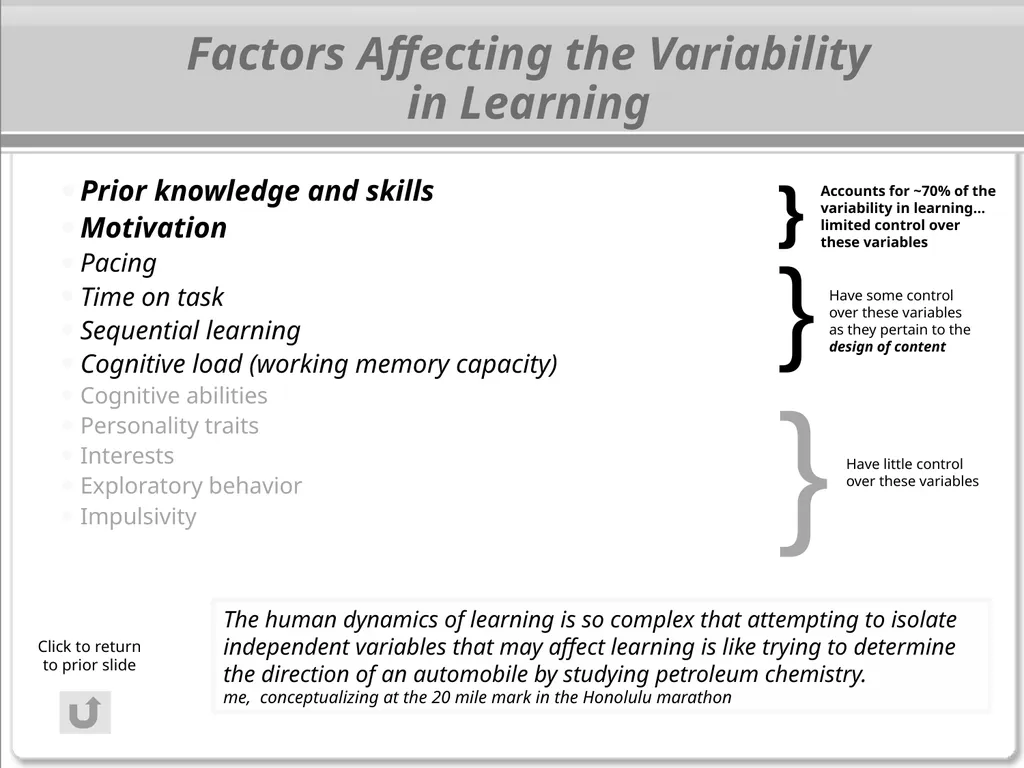
Factors Affecting the Variability in Learning Prior knowledge and skills
Motivation
Pacing
Time on task
Sequential learning
Cognitive load (working memory capacity)
Cognitive abilities
Personality traits
Interests
Exploratory behavior
Impulsivity Accounts for ~70% of the variability in learning… limited control over these variables } } Have some control over these variables as they pertain to the design of content } Have little control over these variables Click to return to prior slide The human dynamics of learning is so complex that attempting to isolate independent variables that may affect learning is like trying to determine the direction of an automobile by studying petroleum chemistry.
me, conceptualizing at the 20 mile mark in the Honolulu marathon<br>
Motivation
Pacing
Time on task
Sequential learning
Cognitive load (working memory capacity)
Cognitive abilities
Personality traits
Interests
Exploratory behavior
Impulsivity Accounts for ~70% of the variability in learning… limited control over these variables } } Have some control over these variables as they pertain to the design of content } Have little control over these variables Click to return to prior slide The human dynamics of learning is so complex that attempting to isolate independent variables that may affect learning is like trying to determine the direction of an automobile by studying petroleum chemistry.
me, conceptualizing at the 20 mile mark in the Honolulu marathon<br>
33
Intentional Left Blank<br>
34
What is Knowledge Construction? Knowledge construction is a methodological approach which assumes that knowledge needs to be constructed .
Occurs when learners explore issues, take positions, discuss positions in an argumentative format, and reflect and evaluate their positions .
Involves active learning through participation and discourse
Involves the opportunity to critically analyze information, dialogue with others about its meaning, reflect upon how the information fits within one’s personal belief and value systems (schema), and arrive at a meaningful understanding of that information
In this process, information becomes transformed into knowledge.
In other words, knowledge is constructed by learners who actively build knowledge structures. Click to return to prior slide<br>
Occurs when learners explore issues, take positions, discuss positions in an argumentative format, and reflect and evaluate their positions .
Involves active learning through participation and discourse
Involves the opportunity to critically analyze information, dialogue with others about its meaning, reflect upon how the information fits within one’s personal belief and value systems (schema), and arrive at a meaningful understanding of that information
In this process, information becomes transformed into knowledge.
In other words, knowledge is constructed by learners who actively build knowledge structures. Click to return to prior slide<br>
35
Intentional Left Blank<br>
36
What is Schema? The contents of long term memory are sophisticated structures that permit us to perceive, think, and solve problems, rather than a group of rote learned facts.
Long-term memory is not just a hodgepodge of information scattered in our brain. It consists of hierarchical networks that are known as ‘schemas’.
Schemas are a mental framework for under-standing and remembering information, and permit us to treat multiple elements as a single element.
Schemas are the cognitive structures that make up our knowledge base and assist us in knowledge construction.
A schema is like an information tree that connects elements of information. When you learn something new, the mind connects that new knowledge into already existing schemas that are located in long term memory.
Schemas can be “activated” through the use of cognitive learning strategies. Click to return to prior slide<br>
Long-term memory is not just a hodgepodge of information scattered in our brain. It consists of hierarchical networks that are known as ‘schemas’.
Schemas are a mental framework for under-standing and remembering information, and permit us to treat multiple elements as a single element.
Schemas are the cognitive structures that make up our knowledge base and assist us in knowledge construction.
A schema is like an information tree that connects elements of information. When you learn something new, the mind connects that new knowledge into already existing schemas that are located in long term memory.
Schemas can be “activated” through the use of cognitive learning strategies. Click to return to prior slide<br>
37
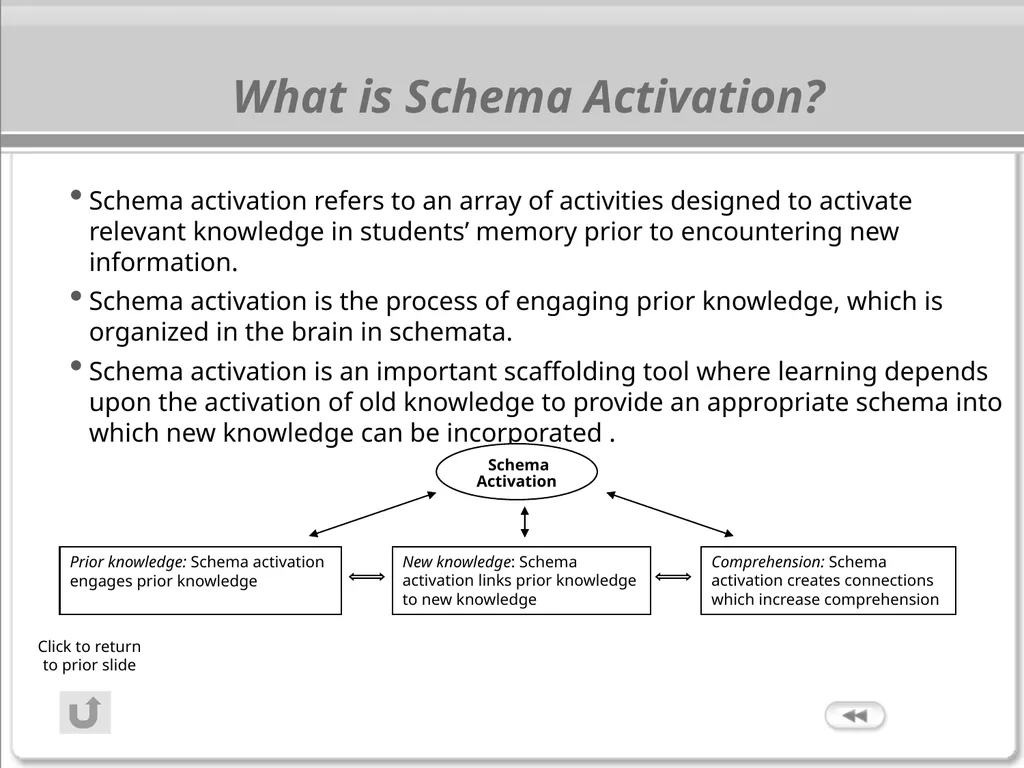
What is Schema Activation? Schema activation refers to an array of activities designed to activate relevant knowledge in students’ memory prior to encountering new information.
Schema activation is the process of engaging prior knowledge, which is organized in the brain in schemata.
Schema activation is an important scaffolding tool where learning depends upon the activation of old knowledge to provide an appropriate schema into which new knowledge can be incorporated . Click to return to prior slide<br>
Schema activation is the process of engaging prior knowledge, which is organized in the brain in schemata.
Schema activation is an important scaffolding tool where learning depends upon the activation of old knowledge to provide an appropriate schema into which new knowledge can be incorporated . Click to return to prior slide<br>
38
Intentional Left Blank<br>
39
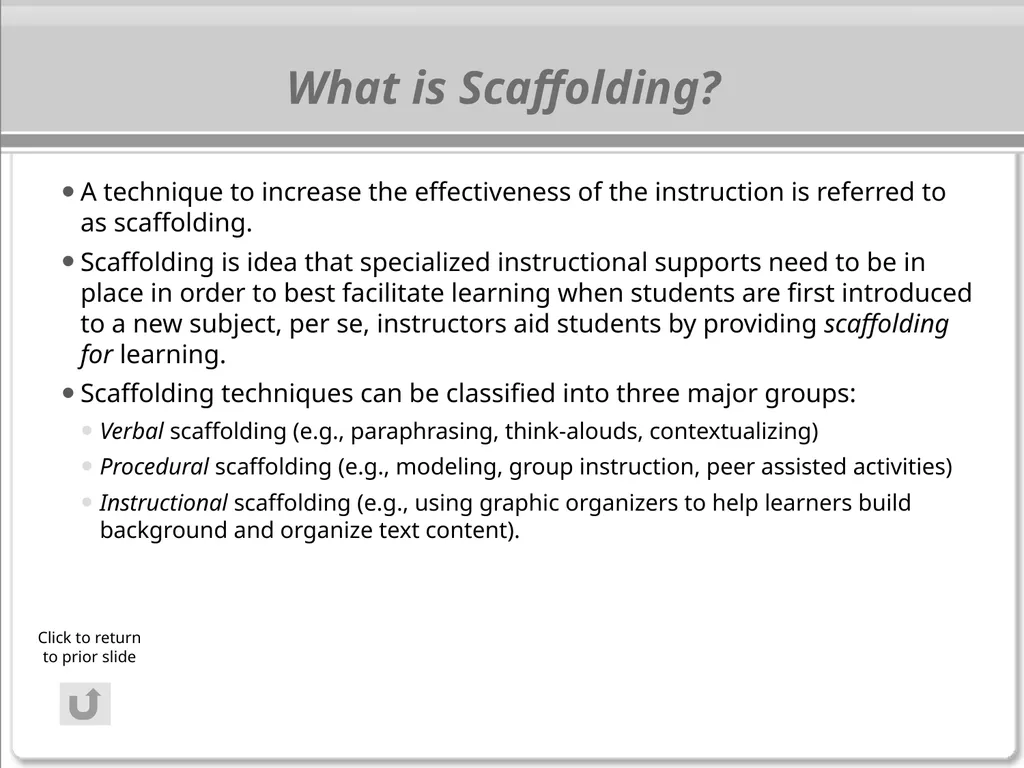
What is Scaffolding? A technique to increase the effectiveness of the instruction is referred to as scaffolding.
Scaffolding is idea that specialized instructional supports need to be in place in order to best facilitate learning when students are first introduced to a new subject, per se, instructors aid students by providing scaffolding for learning.
Scaffolding techniques can be classified into three major groups:
Verbal scaffolding (e.g., paraphrasing, think-alouds, contextualizing)
Procedural scaffolding (e.g., modeling, group instruction, peer assisted activities)
Instructional scaffolding (e.g., using graphic organizers to help learners build background and organize text content). Click to return to prior slide<br>
Scaffolding is idea that specialized instructional supports need to be in place in order to best facilitate learning when students are first introduced to a new subject, per se, instructors aid students by providing scaffolding for learning.
Scaffolding techniques can be classified into three major groups:
Verbal scaffolding (e.g., paraphrasing, think-alouds, contextualizing)
Procedural scaffolding (e.g., modeling, group instruction, peer assisted activities)
Instructional scaffolding (e.g., using graphic organizers to help learners build background and organize text content). Click to return to prior slide<br>
40
Intentional Left Blank<br>
41
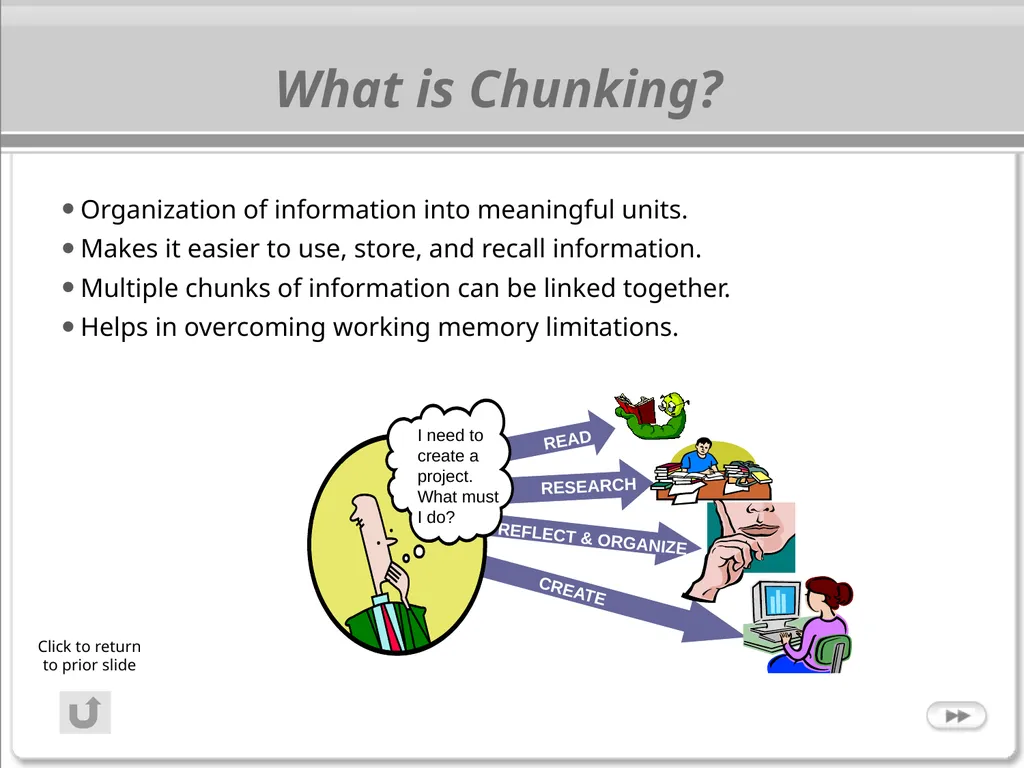
What is Chunking? Organization of information into meaningful units.
Makes it easier to use, store, and recall information.
Multiple chunks of information can be linked together.
Helps in overcoming working memory limitations. Click to return to prior slide<br>
Makes it easier to use, store, and recall information.
Multiple chunks of information can be linked together.
Helps in overcoming working memory limitations. Click to return to prior slide<br>
42
Limits on the capacity of immediate memory affects the amount of information that we are able to receive, process, and remember.
George A. Miller (originally published in The Psychological Review, 1956, vol. 63, pp. 81-97) in The magical number seven, plus or minus two: Some limits on our capacity for processing information identifies this limit (http://www.musanim.com/miller1956).
His work was a catalyst to explore ways instructional designers can package or recode content to increase the amount of information (instruction) successfully transmitted to learners. Chunking Click to return to prior slide<br>
George A. Miller (originally published in The Psychological Review, 1956, vol. 63, pp. 81-97) in The magical number seven, plus or minus two: Some limits on our capacity for processing information identifies this limit (http://www.musanim.com/miller1956).
His work was a catalyst to explore ways instructional designers can package or recode content to increase the amount of information (instruction) successfully transmitted to learners. Chunking Click to return to prior slide<br>
43
Intentional Left Blank<br>
44
Contiguity Principle* Click to return to prior slide * Source: https://sites.google.com/site/cognitivetheorymmlearning/contiguity-principle<br>
45
Intentional Left Blank<br>