The Criminal Process Criminal Courts Objectives Explain what is meant by an adversarial system Explain how offences are classified Describe the criminal court system Explain mode of trial Explain sending for trial Explain plea and case
"The Criminal Process Criminal Courts Objectives" is the property of its rightful owner. Permission is granted to
download and print the materials on this website for personal, non-commercial use only, and to display it
on your personal computer provided you do not modify the materials and that you retain all copyright
notices contained in the materials. By downloading content from our website, you accept the terms of this
agreement.
Presentation Transcript
01
The Criminal Process Criminal Courts<br>
02
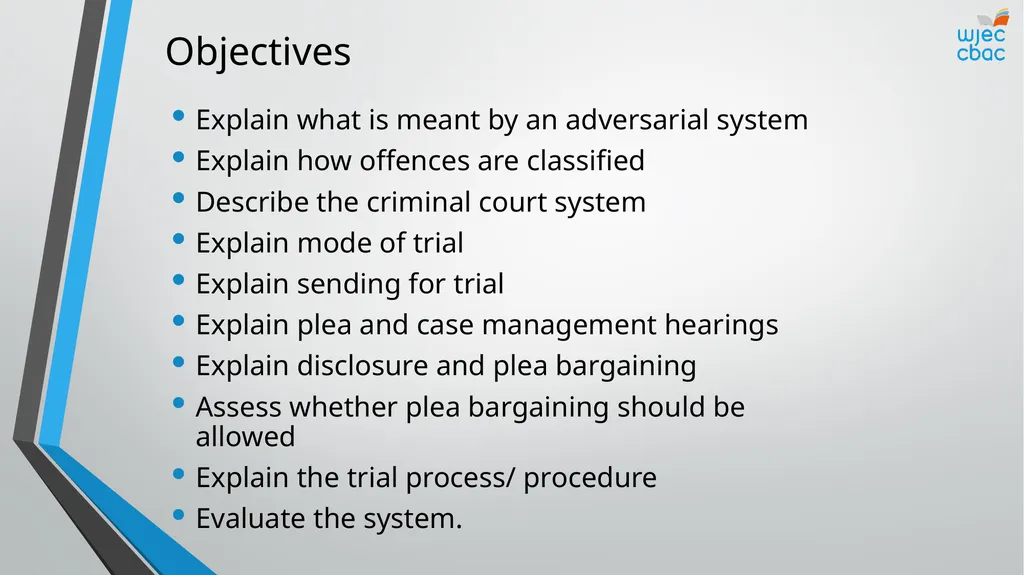
Objectives Explain what is meant by an adversarial system
Explain how offences are classified
Describe the criminal court system
Explain mode of trial
Explain sending for trial
Explain plea and case management hearings
Explain disclosure and plea bargaining
Assess whether plea bargaining should be allowed
Explain the trial process/ procedure
Evaluate the system.<br>
03
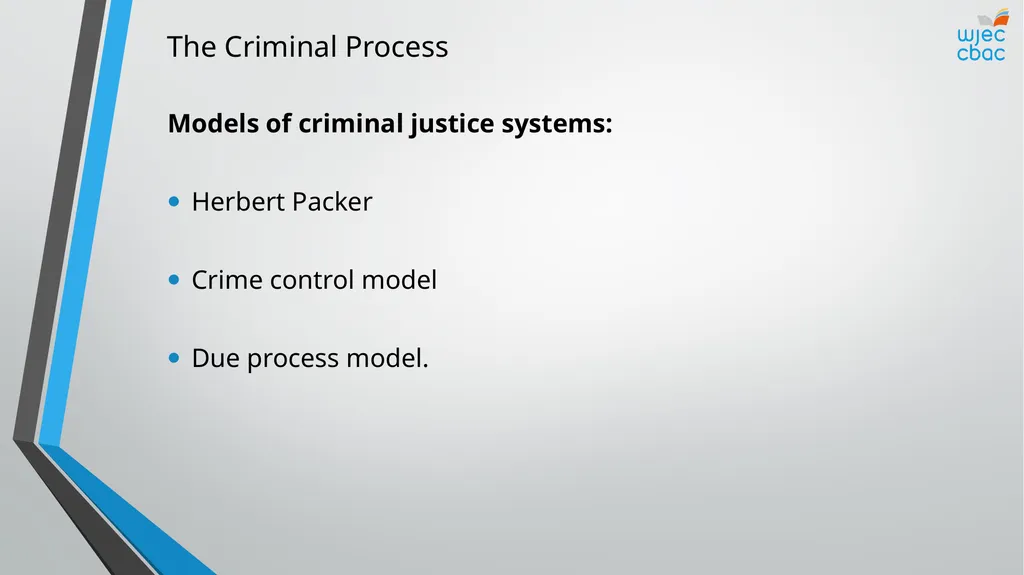
The Criminal Process Models of criminal justice systems:
Herbert Packer
Crime control model
Due process model.<br>
04
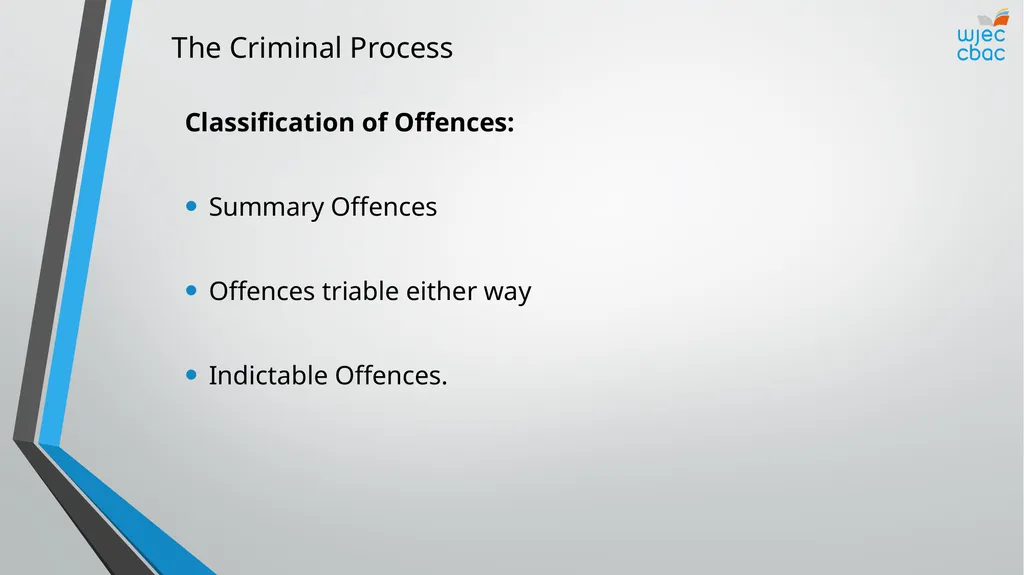
The Criminal Process Classification of Offences:
Summary Offences
Offences triable either way
Indictable Offences.<br>
05
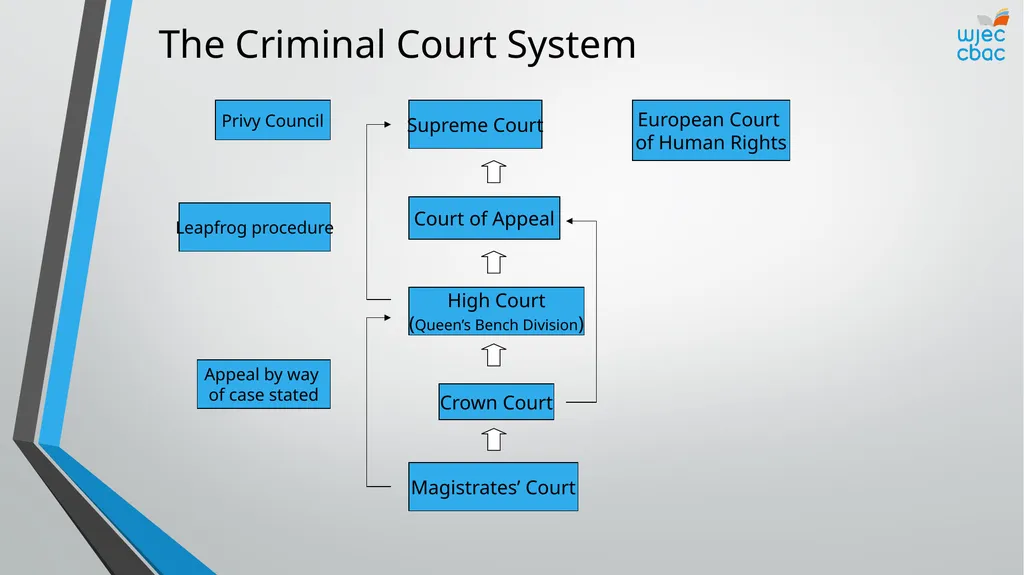
Privy Council European Court
of Human Rights Supreme Court Court of Appeal High Court
(Queen’s Bench Division) Crown Court Magistrates’ Court Leapfrog procedure Appeal by way
of case stated The Criminal Court System<br>
06
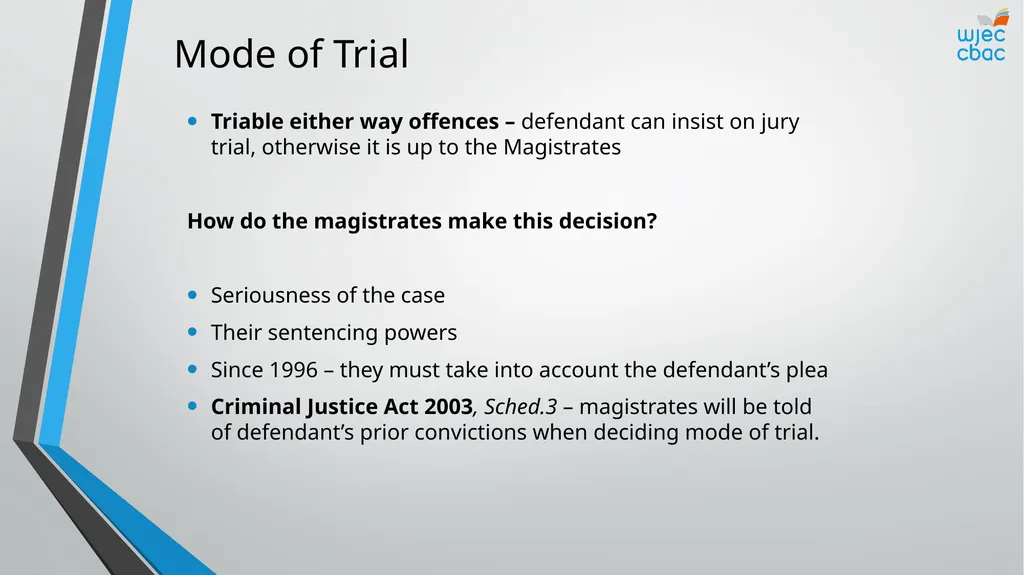
Mode of Trial Triable either way offences – defendant can insist on jury trial, otherwise it is up to the Magistrates
How do the magistrates make this decision?
Seriousness of the case
Their sentencing powers
Since 1996 – they must take into account the defendant’s plea
Criminal Justice Act 2003, Sched.3 – magistrates will be told of defendant’s prior convictions when deciding mode of trial.<br>
07
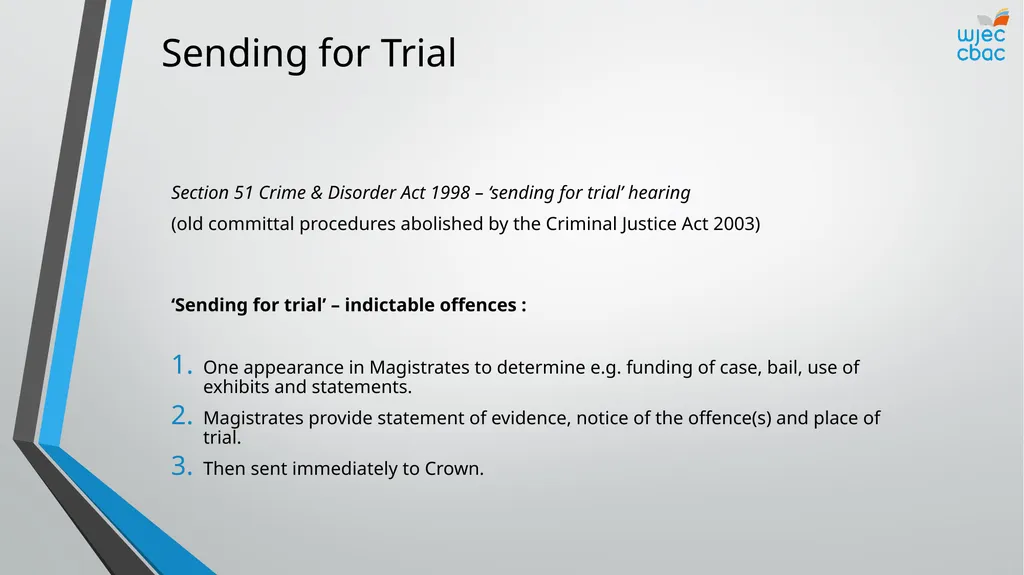
Sending for Trial Section 51 Crime & Disorder Act 1998 – ‘sending for trial’ hearing
(old committal procedures abolished by the Criminal Justice Act 2003)
‘Sending for trial’ – indictable offences :
One appearance in Magistrates to determine e.g. funding of case, bail, use of exhibits and statements.
Magistrates provide statement of evidence, notice of the offence(s) and place of trial.
Then sent immediately to Crown.<br>
08
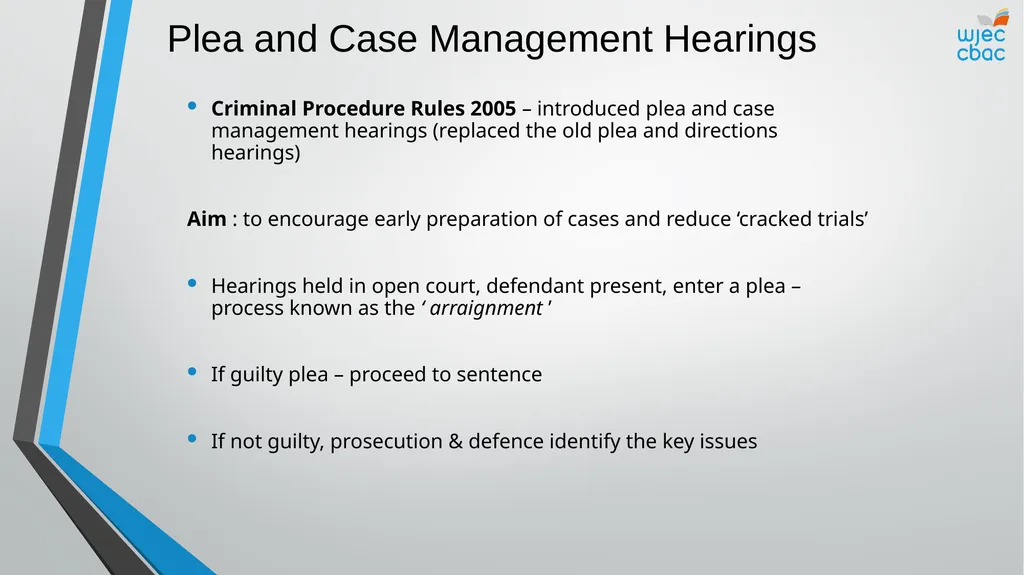
Criminal Procedure Rules 2005 – introduced plea and case management hearings (replaced the old plea and directions hearings)
Aim : to encourage early preparation of cases and reduce ‘cracked trials’
Hearings held in open court, defendant present, enter a plea – process known as the ‘ arraignment ’
If guilty plea – proceed to sentence
If not guilty, prosecution & defence identify the key issues Plea and Case Management Hearings<br>
09
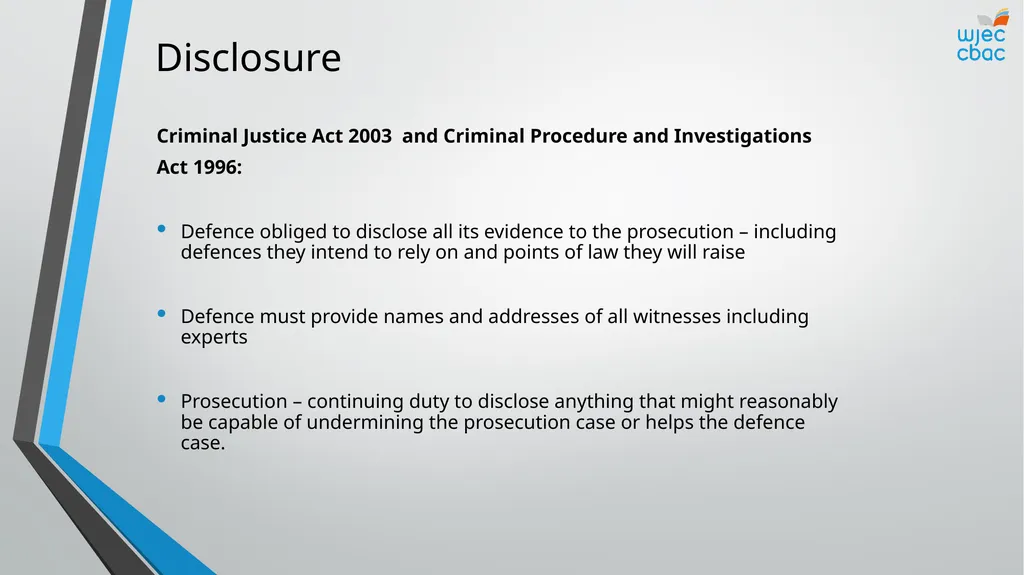
Disclosure Criminal Justice Act 2003 and Criminal Procedure and Investigations
Act 1996:
Defence obliged to disclose all its evidence to the prosecution – including defences they intend to rely on and points of law they will raise
Defence must provide names and addresses of all witnesses including experts
Prosecution – continuing duty to disclose anything that might reasonably be capable of undermining the prosecution case or helps the defence case.<br>
10
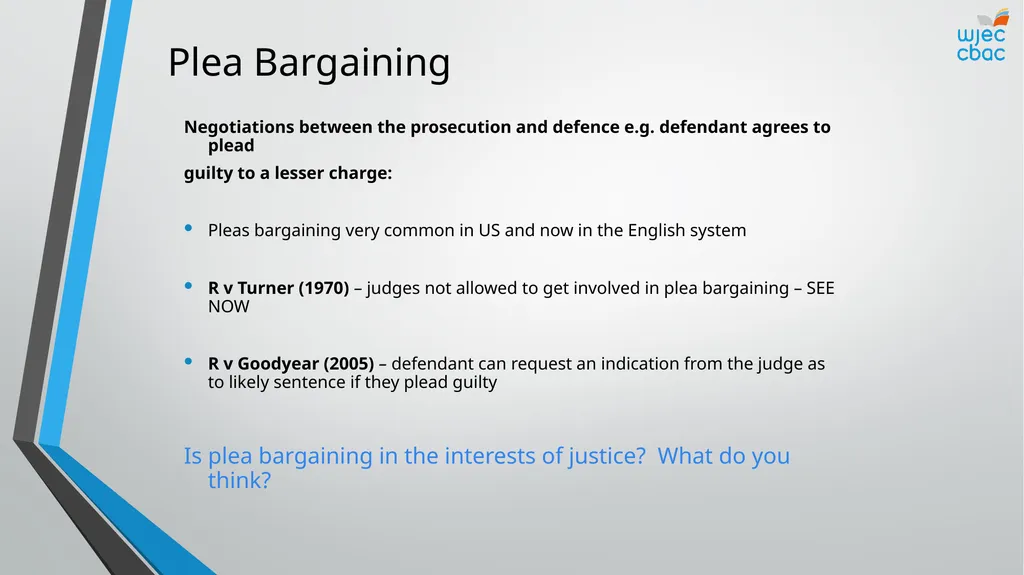
Plea Bargaining Negotiations between the prosecution and defence e.g. defendant agrees to plead
guilty to a lesser charge:
Pleas bargaining very common in US and now in the English system
R v Turner (1970) – judges not allowed to get involved in plea bargaining – SEE NOW
R v Goodyear (2005) – defendant can request an indication from the judge as to likely sentence if they plead guilty
Is plea bargaining in the interests of justice? What do you think?<br>
11
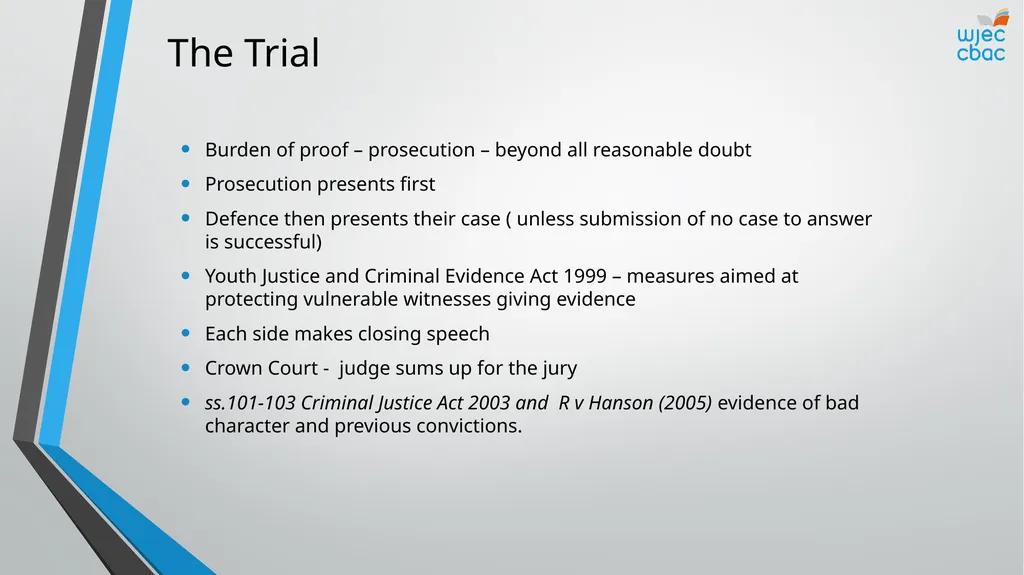
The Trial Burden of proof – prosecution – beyond all reasonable doubt
Prosecution presents first
Defence then presents their case ( unless submission of no case to answer is successful)
Youth Justice and Criminal Evidence Act 1999 – measures aimed at protecting vulnerable witnesses giving evidence
Each side makes closing speech
Crown Court - judge sums up for the jury
ss.101-103 Criminal Justice Act 2003 and R v Hanson (2005) evidence of bad character and previous convictions.<br>
12
The Criminal Process Should evidence of bad character and previous convictions be admitted?
What are the arguments for and against the allowing of such evidence?<br>
13
Criticism of the System Cracked and ineffective trials
Problems with disclosure – Criminal Procedure & Investigations Act 1996
Confession evidence and miscarriages of justice – the need for a corroboration rule
Role of expert witnesses – R v Clark (2003)
Treatment of victims and witnesses
Role of the media – contempt of court.<br>
14
Reforms Community Justice Centres
Government paper: Delivering simple, speedy, summary justice(2006) – ‘next day justice’.<br>
15
Test Yourself What is meant by an adversarial system?
How are criminal offences classified?
What is meant by mode of trial?
What are the disclosure rules?
What is plea bargaining?
What is the burden of proof and who must prove it?<br>