04
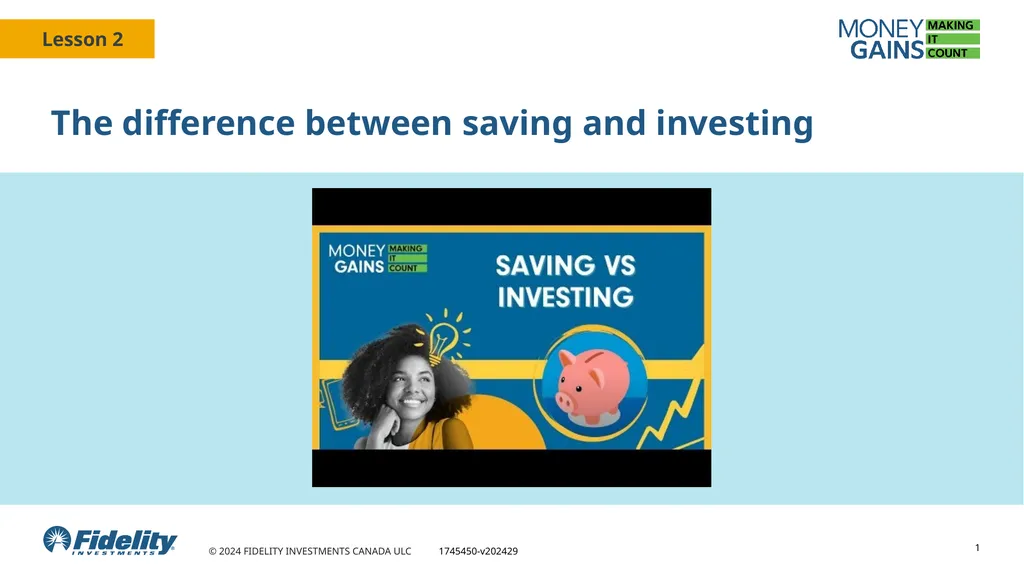
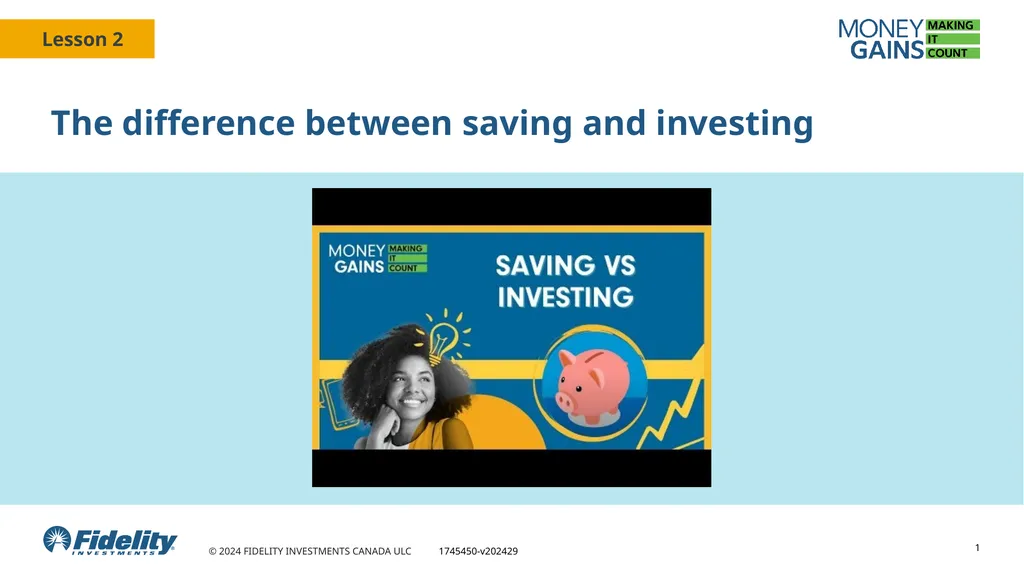
Saving vs. investing Saving
Definition: Putting money aside for when you need it in the future. Depositing money in �your bank account or piggy bank and leaving it untouched for a period of time �is considered saving.
Purpose: Typically used for short-term goals, emergencies or planned expenses.
Benefits: Low risk, liquidity and security.
Examples: Savings account, piggy bank or cash at home. Investing
Definition: Putting your money to work so that it can grow, with the goal that it can became more in the future than what you put away. Investing is generally associated with buying assets such as stocks or bonds.
Purpose: Typically used for long-term financial goals, such as retirement or wealth-building.
Benefits: Potential for higher returns, wealth accumulation and financial growth.
Examples: Stocks, bonds, real estate and mutual funds. 4<br>
05
Risk, return and liquidity Investment risk
The uncertainty related to investing. When investing, actual outcomes may differ from expected outcomes, and you may even lose some, or all, of your investment.
Investment return
How much a security, or collection of securities (generally referred to as a portfolio) increases or decreases in value over time These returns are often expressed as a percentage change.
Liquidity
The ability of an investment to be converted into cash quickly without loss of value. E.g. stock vs. a house 5<br>
06
Risk, return and liquidity Savings
Low risk
Low return
High liquidity Investments
High risk
High return
Low liquidity 6<br>
07
Inflation, savings and investments Today, a large soft drink at your favourite fast-food place costs $1.00. You buy the soft drink but also decide to save some money for the future as well. So you put a dollar in your savings account, where it earns 5%. 7<br>
08
Inflation, savings and investments One year later, the dollar in your saving account is worth $1.05. You take the money out and visit your favourite convenience store, hoping �to buy another delicious beverage. Unfortunately, drinks now cost $1.10. 8<br>
09
Inflation, savings and investments The point? Inflation can work against your money. You need to learn to invest wisely, follow the rate of inflation, and make sure your investment rates are higher than those of inflation.
Example - the cost of living is consistency increasing. 9<br>
10
Future value Refers to the amount of money to which an investment will grow over a finite period of time at a given interest rate.
Put another way, future value is the cash value of an investment at a particular time in the future. 10<br>
11
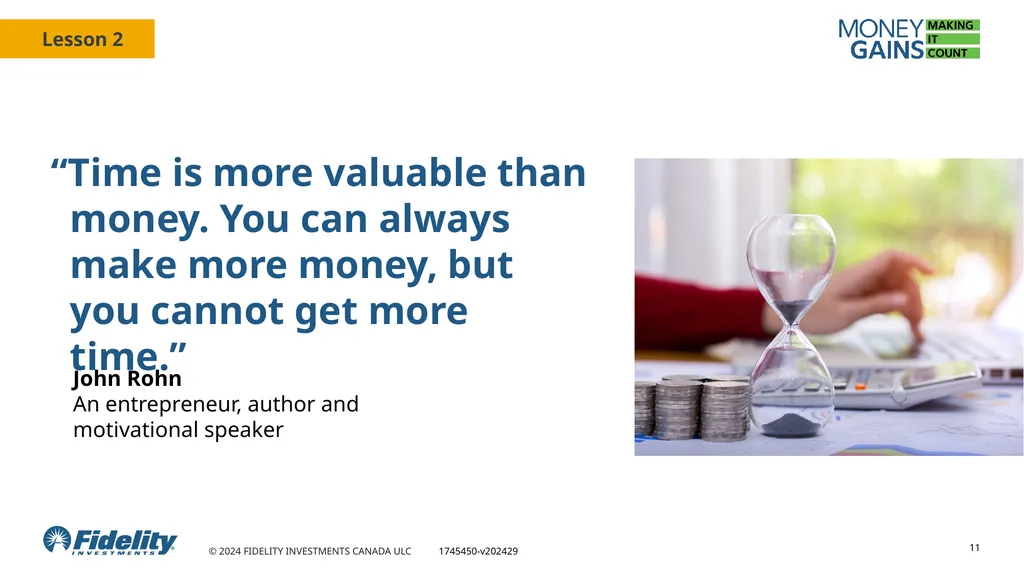
“Time is more valuable than money. You can always make more money, but �you cannot get more time.” John Rohn
An entrepreneur, author and motivational speaker 11<br>
12
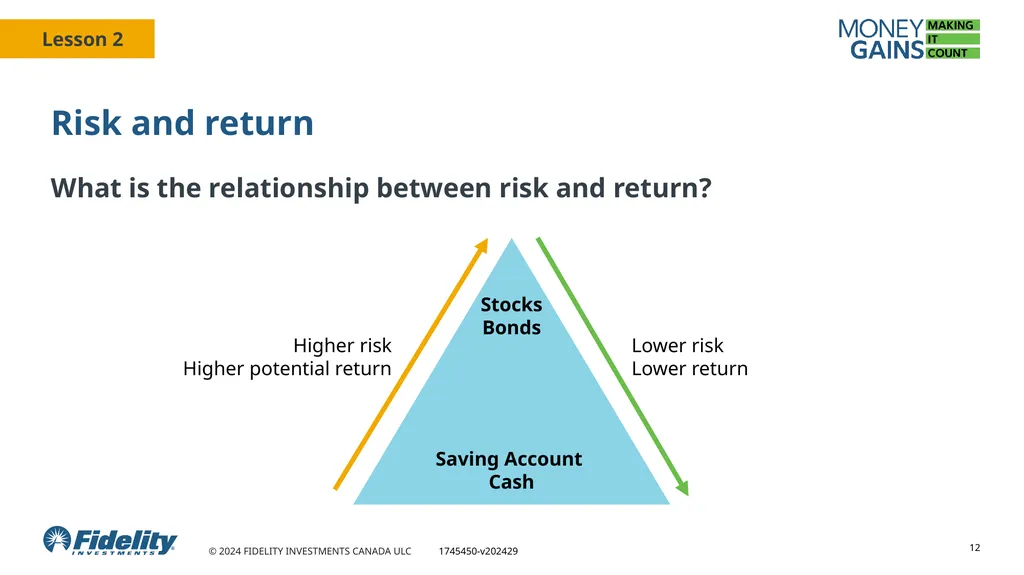
Risk and return What is the relationship between risk and return? Stocks
Bonds Lower risk
Lower return Higher risk
Higher potential return 12 Saving Account �Cash<br>
13
Savings Different events in our lives require different strategies for saving:
saving for a senior trip
saving for a down payment on a house
saving for retirement 13<br>
14
Savings vs. investing Investing allows your wealth to grow at a much higher rate than it could in a savings account.
For example, a savings account could generate an annual return between 0.05% and 3.00%. When you compare that to a typical market-tracking index account – like one that follows the S&P/TSX Composite, with its average annual return of 4.6% – it’s clear that you could be missing out.
If you invest for the long term, your money will grow a lot more than if you hadn’t invested.
The chart shows what would have happened if you had invested $5,000 in Canadian equities between April 30, 2000, and April 30, 2020. 14<br>
15
How to save money “Pay yourself first” means setting aside money for savings before you even see the money from your pay cheque.
If you take your savings contribution and put it aside before you even see your pay, you will not miss what you do not see.
Most banks will help you with paying yourself first by allowing you to set up automatic transfers of money from your chequing account to your savings account. Experts suggest that you should take 10% of your income off, before taxes, and put it away in savings/investments. 15<br>
16
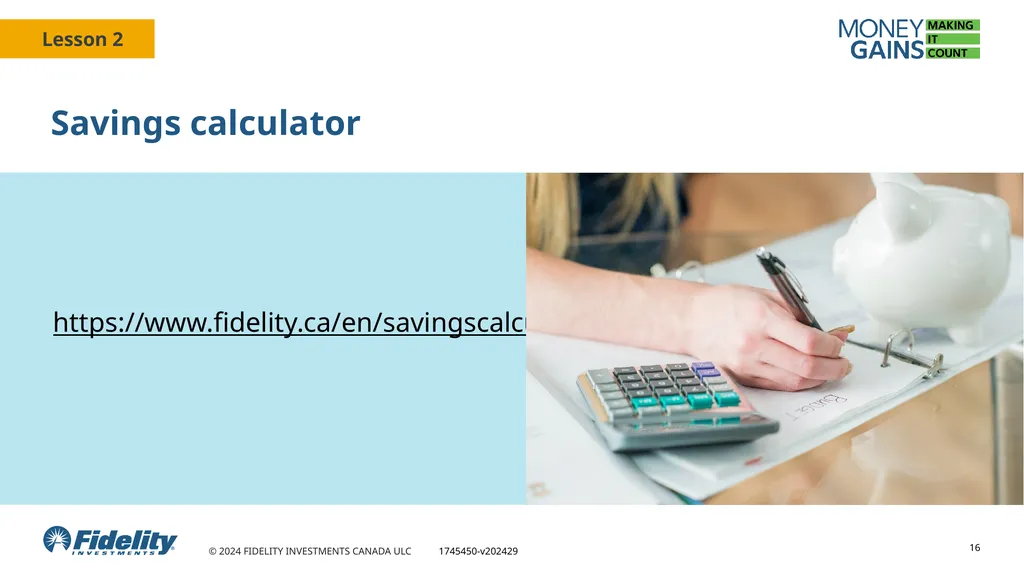
Savings calculator https://www.fidelity.ca/en/�savingscalculator/ 16<br>
17
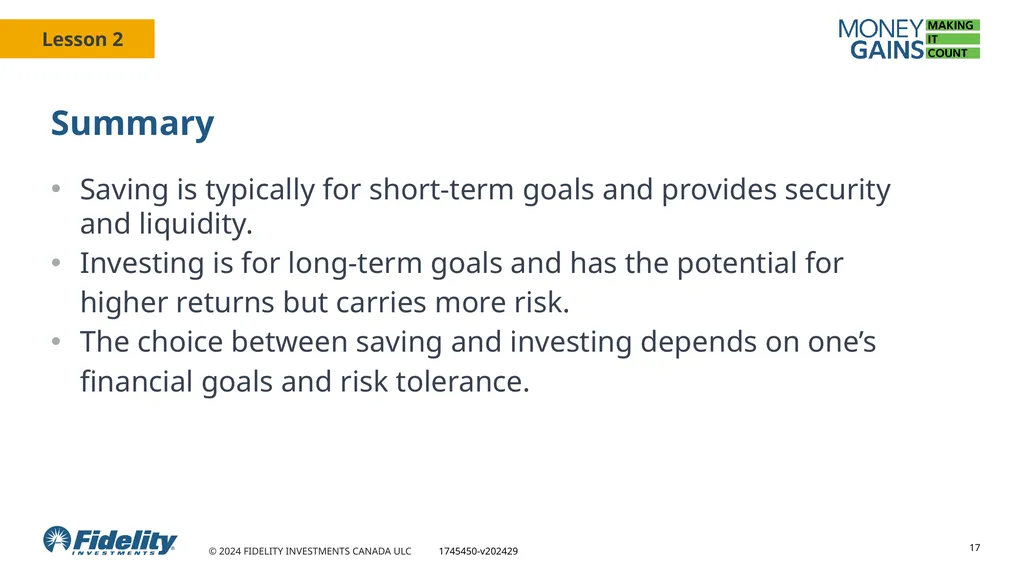
Summary Saving is typically for short-term goals and provides security and liquidity.
Investing is for long-term goals and has the potential for higher returns but carries more risk.
The choice between saving and investing depends on one’s financial goals and risk tolerance. 17<br>
18
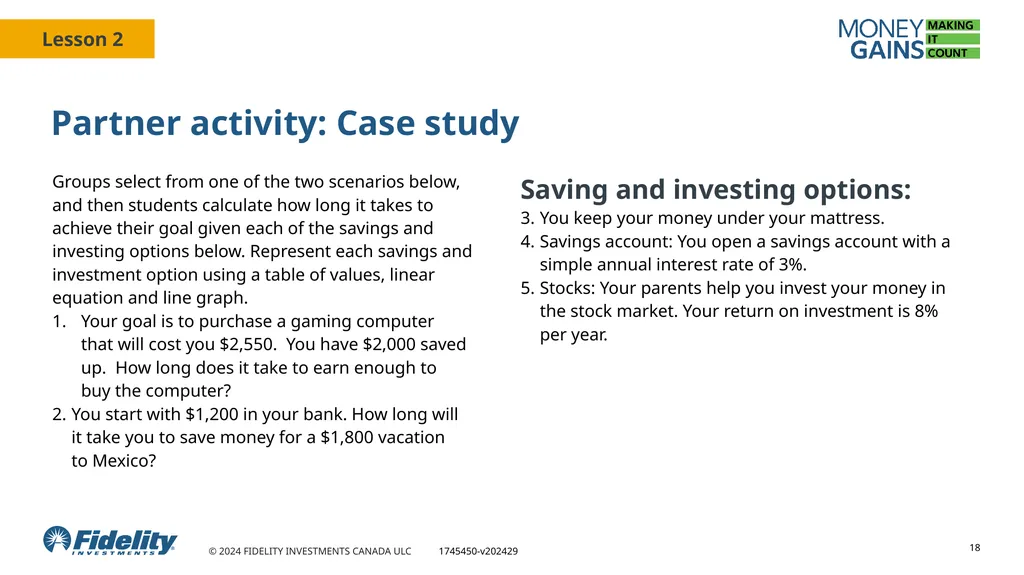
Partner activity: Case study Groups select from one of the two scenarios below, and then students calculate how long it takes to achieve their goal given each of the savings and investing options below. Represent each savings and investment option using a table of values, linear equation and line graph.
Your goal is to purchase a gaming computer �that will cost you $2,550. You have $2,000 saved up. How long does it take to earn enough to �buy the computer?
You start with $1,200 in your bank. How long will �it take you to save money for a $1,800 vacation �to Mexico?
Saving and investing options:
You keep your money under your mattress.
Savings account: You open a savings account with a simple annual interest rate of 3%.
Stocks: Your parents help you invest your money in the stock market. Your return on investment is 8% per year. 18<br>
19
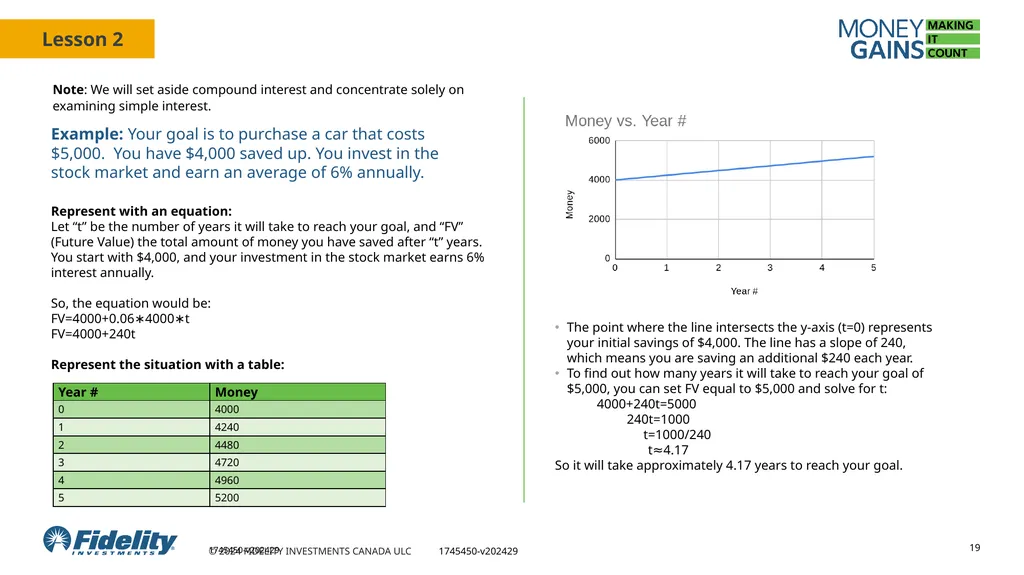
Example: Your goal is to purchase a car that costs $5,000. You have $4,000 saved up. You invest in the stock market and earn an average of 6% annually. Represent with an equation: �Let “t” be the number of years it will take to reach your goal, and “FV” (Future Value) the total amount of money you have saved after “t” years. You start with $4,000, and your investment in the stock market earns 6% interest annually.
So, the equation would be:�FV=4000+0.06∗4000∗t�FV=4000+240t
Represent the situation with a table: The point where the line intersects the y-axis (t=0) represents your initial savings of $4,000. The line has a slope of 240, which means you are saving an additional $240 each year.
To find out how many years it will take to reach your goal of $5,000, you can set FV equal to $5,000 and solve for t:� 4000+240t=5000� 240t=1000� t=1000/240
t≈4.17�So it will take approximately 4.17 years to reach your goal. 19 1745450-v202429 Note: We will set aside compound interest and concentrate solely on examining simple interest.<br>