
The Discursive Construction of Legitimation By
A
Published · 36 slides · 0 views
1 / 1


Description
The Discursive Construction of Legitimation By Jalil Naser Hilu Supervised by Prf. Ahmed Qadouri Abed (Ph.D) Outline Definition General principles of legitimation Major categories of legitimation Authorization Role model authority Moral
Related Topics
Share
Embed code
Download this presentation From Below
"The Discursive Construction of Legitimation By" is the property of its rightful owner. Permission is granted to download and print the materials on this website for personal, non-commercial use only, and to display it on your personal computer provided you do not modify the materials and that you retain all copyright notices contained in the materials. By downloading content from our website, you accept the terms of this agreement.
Presentation Transcript
01
The Discursive Construction of Legitimation By Jalil Naser Hilu
Supervised by Prf. Ahmed Qadouri Abed (Ph.D)<br>
Supervised by Prf. Ahmed Qadouri Abed (Ph.D)<br>
02
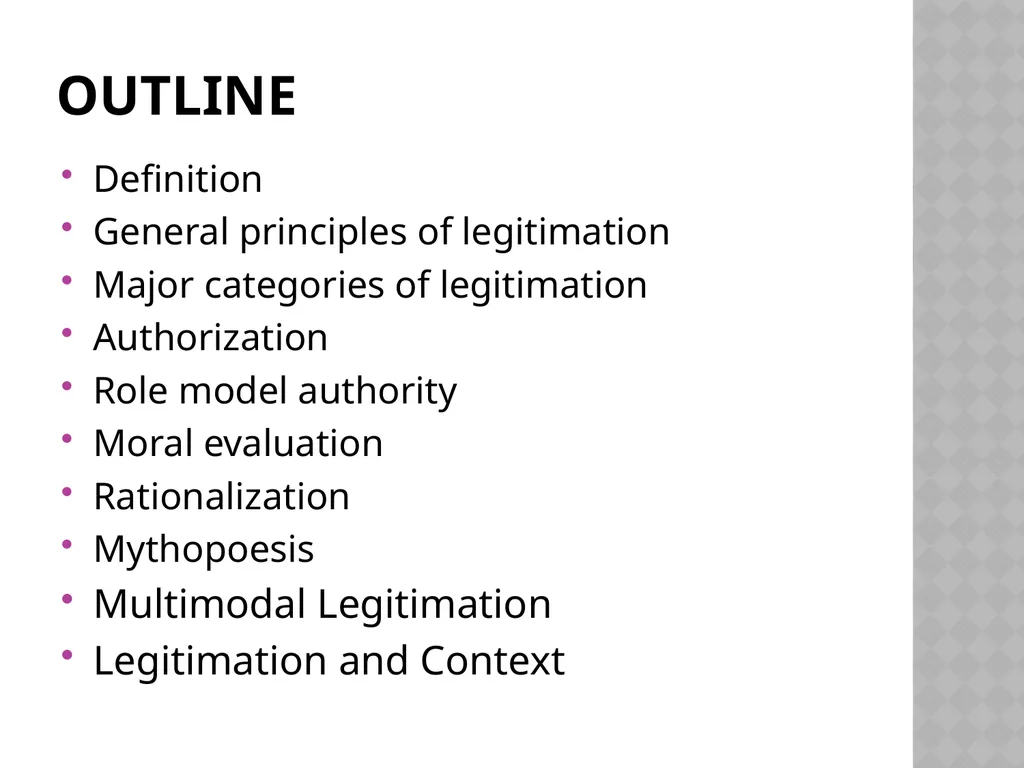
Outline Definition
General principles of legitimation
Major categories of legitimation
Authorization
Role model authority
Moral evaluation
Rationalization
Mythopoesis
Multimodal Legitimation
Legitimation and Context<br>
General principles of legitimation
Major categories of legitimation
Authorization
Role model authority
Moral evaluation
Rationalization
Mythopoesis
Multimodal Legitimation
Legitimation and Context<br>
03
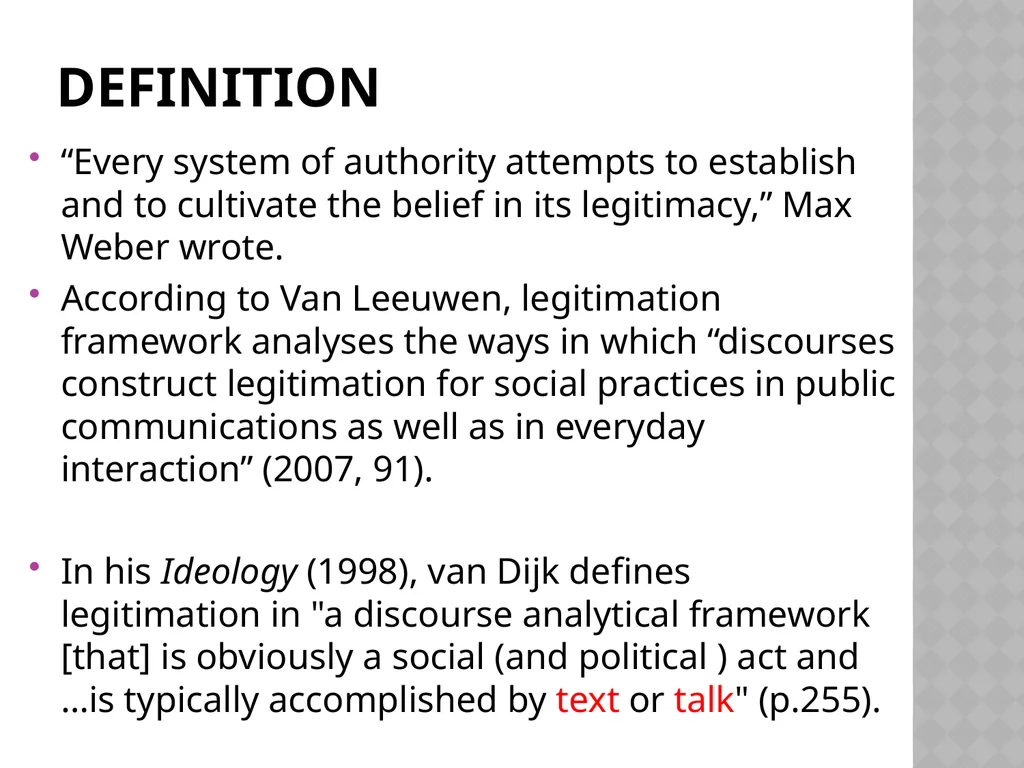
Definition “Every system of authority attempts to establish and to cultivate the belief in its legitimacy,” Max Weber wrote.
According to Van Leeuwen, legitimation framework analyses the ways in which “discourses construct legitimation for social practices in public communications as well as in everyday interaction” (2007, 91).
In his Ideology (1998), van Dijk defines legitimation in "a discourse analytical framework [that] is obviously a social (and political ) act and …is typically accomplished by text or talk" (p.255).<br>
According to Van Leeuwen, legitimation framework analyses the ways in which “discourses construct legitimation for social practices in public communications as well as in everyday interaction” (2007, 91).
In his Ideology (1998), van Dijk defines legitimation in "a discourse analytical framework [that] is obviously a social (and political ) act and …is typically accomplished by text or talk" (p.255).<br>
04
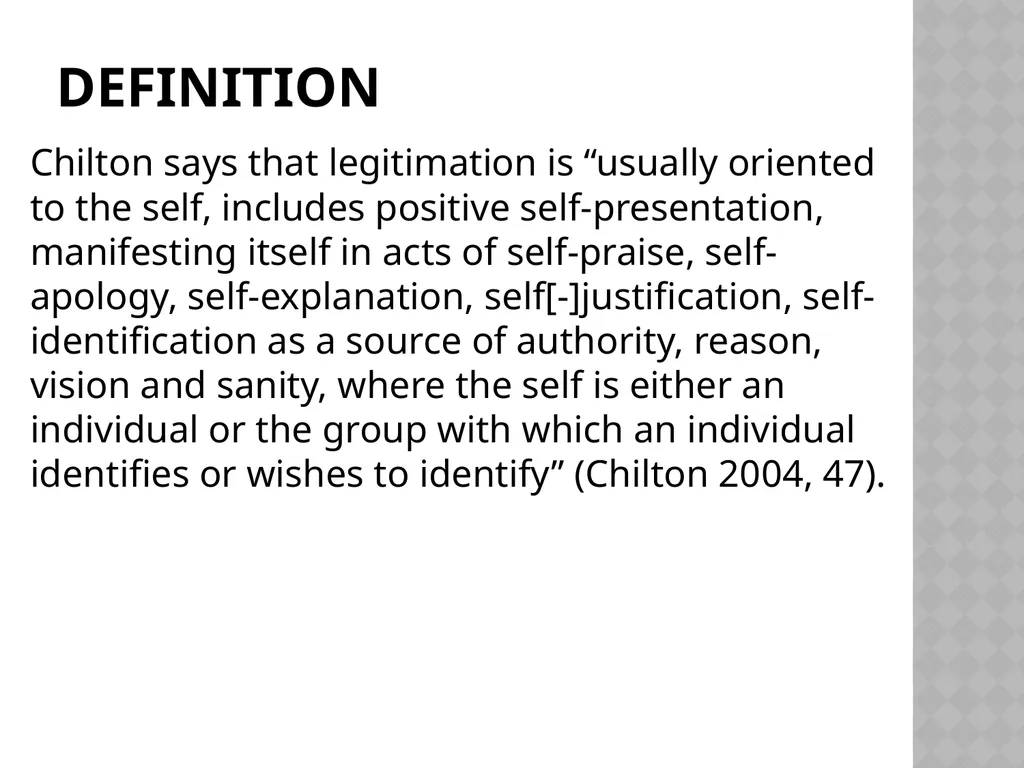
Definition Chilton says that legitimation is “usually oriented to the self, includes positive self-presentation, manifesting itself in acts of self-praise, self-apology, self-explanation, self[-]justification, self-identification as a source of authority, reason, vision and sanity, where the self is either an individual or the group with which an individual identifies or wishes to identify” (Chilton 2004, 47).<br>
05
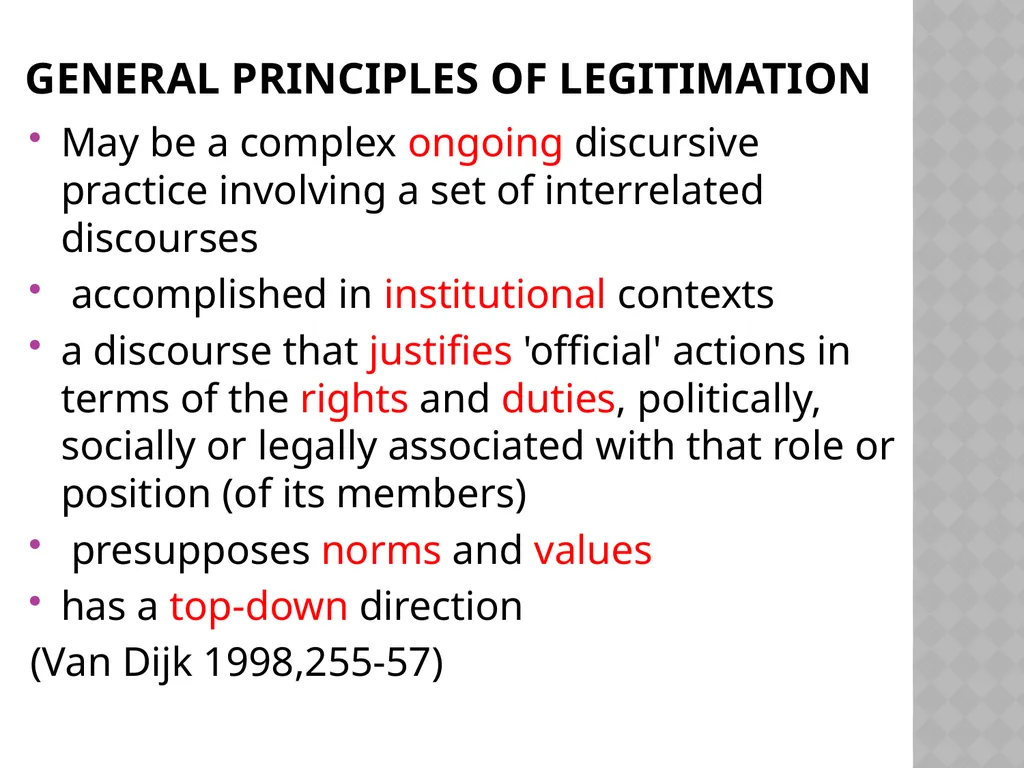
General principles of legitimation May be a complex ongoing discursive practice involving a set of interrelated discourses
accomplished in institutional contexts
a discourse that justifies 'official' actions in terms of the rights and duties, politically, socially or legally associated with that role or position (of its members)
presupposes norms and values
has a top-down direction
(Van Dijk 1998,255-57)<br>
accomplished in institutional contexts
a discourse that justifies 'official' actions in terms of the rights and duties, politically, socially or legally associated with that role or position (of its members)
presupposes norms and values
has a top-down direction
(Van Dijk 1998,255-57)<br>
06
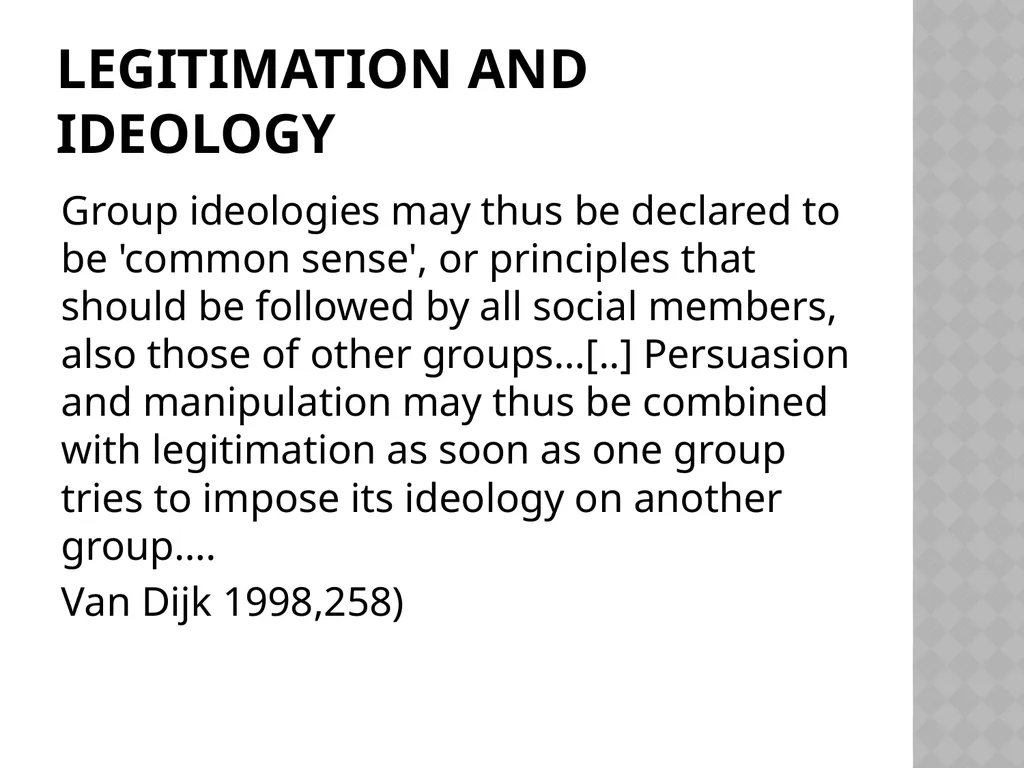
Legitimation and Ideology Group ideologies may thus be declared to be 'common sense', or principles that should be followed by all social members, also those of other groups…[..] Persuasion and manipulation may thus be combined with legitimation as soon as one group tries to impose its ideology on another group….
Van Dijk 1998,258)<br>
Van Dijk 1998,258)<br>
07
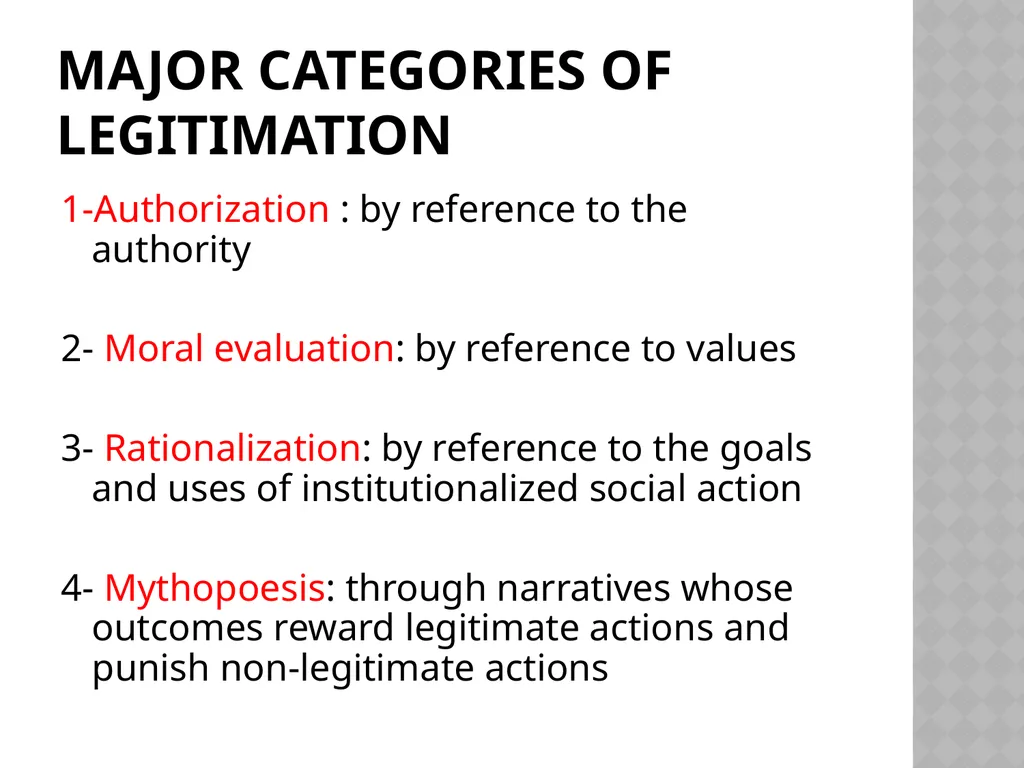
Major Categories of Legitimation 1-Authorization : by reference to the authority
2- Moral evaluation: by reference to values
3- Rationalization: by reference to the goals and uses of institutionalized social action
4- Mythopoesis: through narratives whose outcomes reward legitimate actions and punish non-legitimate actions<br>
2- Moral evaluation: by reference to values
3- Rationalization: by reference to the goals and uses of institutionalized social action
4- Mythopoesis: through narratives whose outcomes reward legitimate actions and punish non-legitimate actions<br>
08
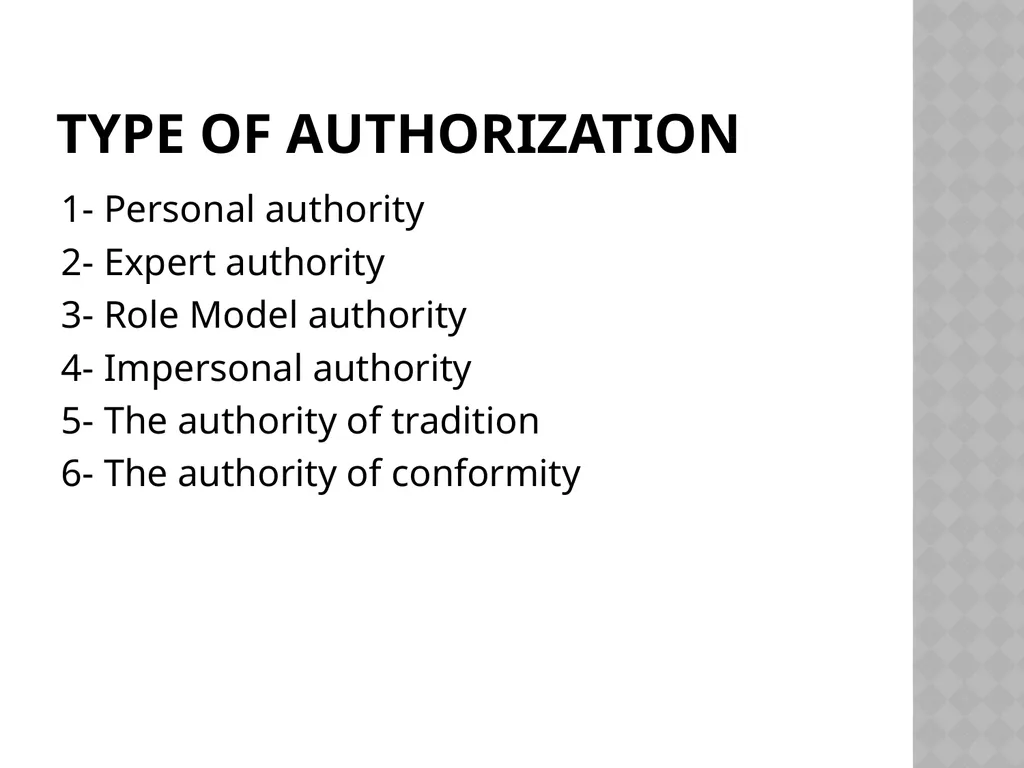
Type of Authorization 1- Personal authority
2- Expert authority
3- Role Model authority
4- Impersonal authority
5- The authority of tradition
6- The authority of conformity<br>
2- Expert authority
3- Role Model authority
4- Impersonal authority
5- The authority of tradition
6- The authority of conformity<br>
09
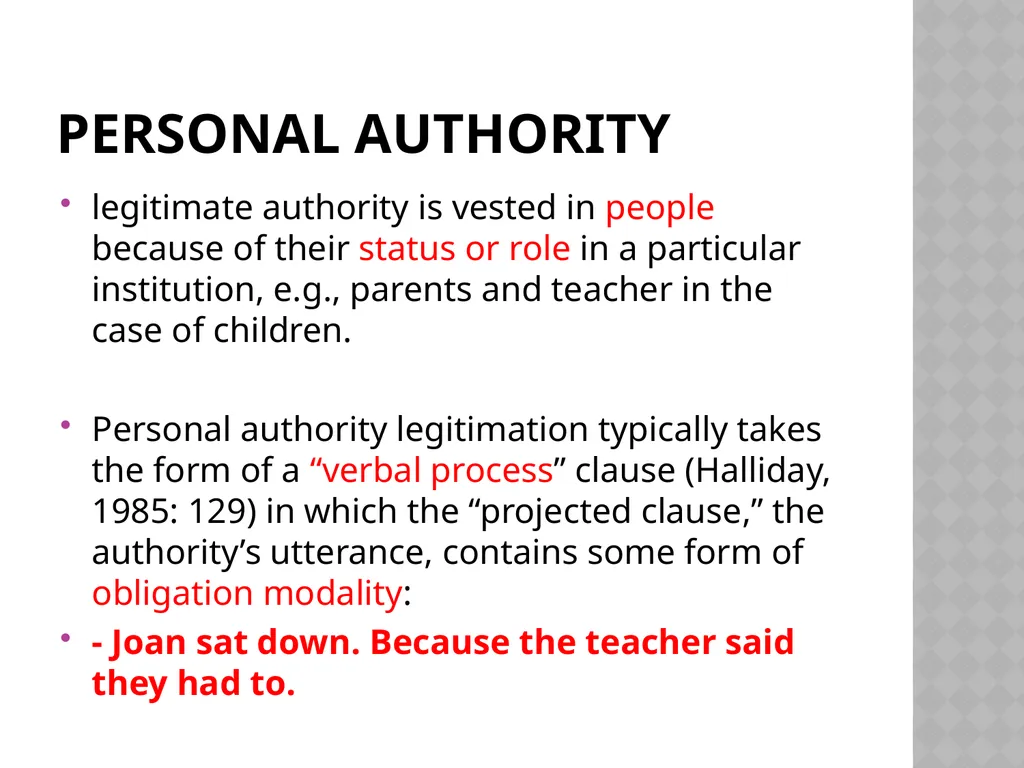
Personal Authority legitimate authority is vested in people because of their status or role in a particular institution, e.g., parents and teacher in the case of children.
Personal authority legitimation typically takes the form of a “verbal process” clause (Halliday, 1985: 129) in which the “projected clause,” the authority’s utterance, contains some form of obligation modality:
- Joan sat down. Because the teacher said they had to.<br>
Personal authority legitimation typically takes the form of a “verbal process” clause (Halliday, 1985: 129) in which the “projected clause,” the authority’s utterance, contains some form of obligation modality:
- Joan sat down. Because the teacher said they had to.<br>
10
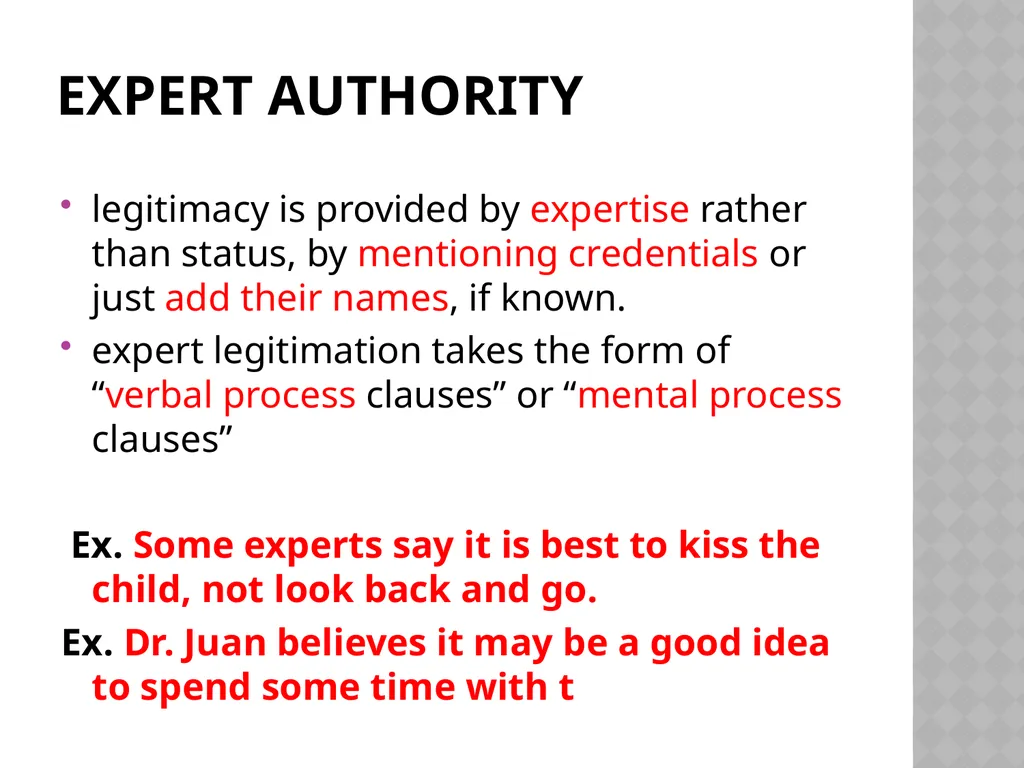
Expert Authority legitimacy is provided by expertise rather than status, by mentioning credentials or just add their names, if known.
expert legitimation takes the form of “verbal process clauses” or “mental process clauses”
Ex. Some experts say it is best to kiss the child, not look back and go.
Ex. Dr. Juan believes it may be a good idea to spend some time with t<br>
expert legitimation takes the form of “verbal process clauses” or “mental process clauses”
Ex. Some experts say it is best to kiss the child, not look back and go.
Ex. Dr. Juan believes it may be a good idea to spend some time with t<br>
11
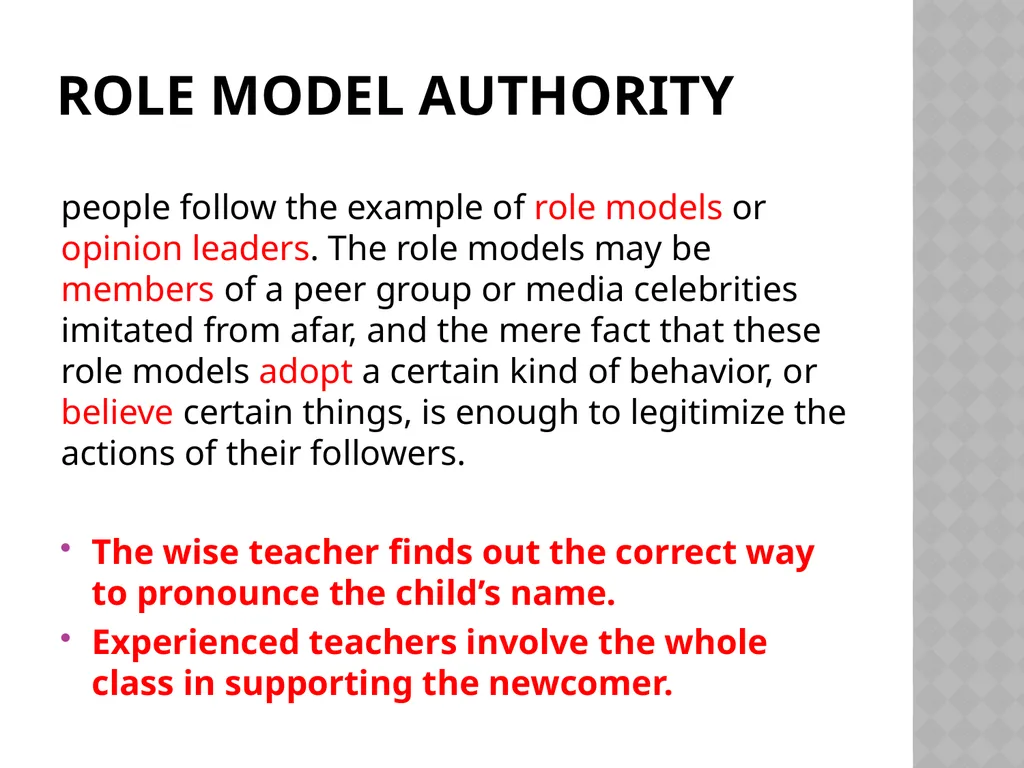
Role Model Authority people follow the example of role models or opinion leaders. The role models may be members of a peer group or media celebrities imitated from afar, and the mere fact that these role models adopt a certain kind of behavior, or believe certain things, is enough to legitimize the actions of their followers.
The wise teacher finds out the correct way to pronounce the child’s name.
Experienced teachers involve the whole class in supporting the newcomer.<br>
The wise teacher finds out the correct way to pronounce the child’s name.
Experienced teachers involve the whole class in supporting the newcomer.<br>
12
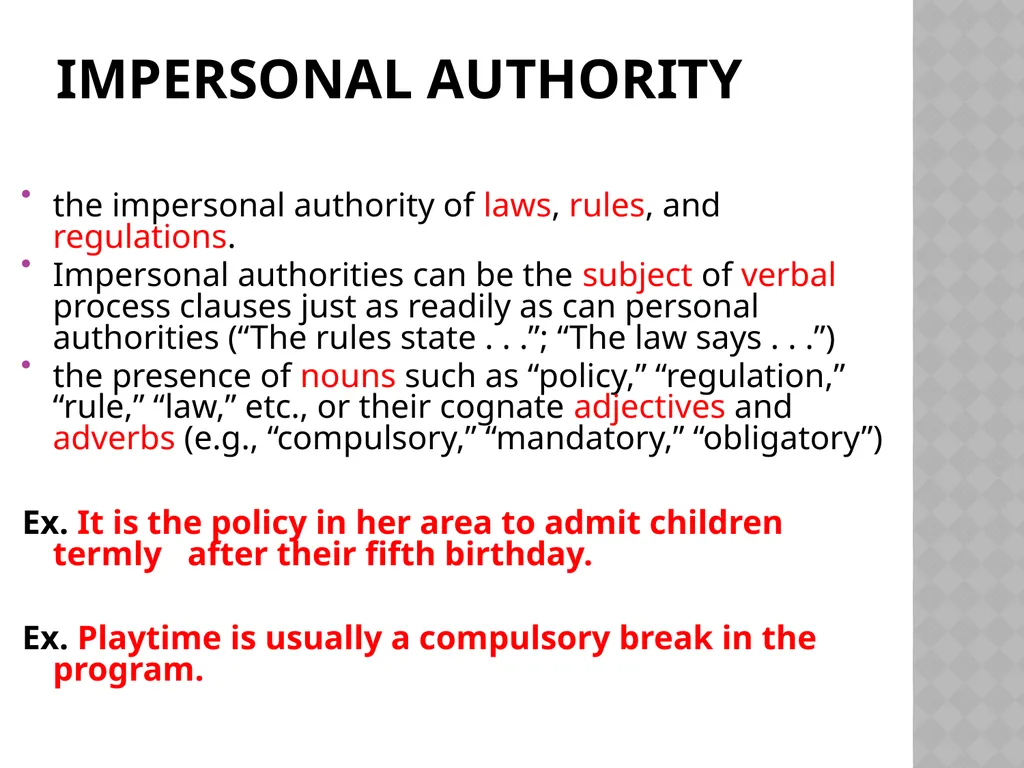
Impersonal Authority the impersonal authority of laws, rules, and regulations.
Impersonal authorities can be the subject of verbal process clauses just as readily as can personal authorities (“The rules state . . .”; “The law says . . .”)
the presence of nouns such as “policy,” “regulation,” “rule,” “law,” etc., or their cognate adjectives and adverbs (e.g., “compulsory,” “mandatory,” “obligatory”)
Ex. It is the policy in her area to admit children termly after their fifth birthday.
Ex. Playtime is usually a compulsory break in the program.<br>
Impersonal authorities can be the subject of verbal process clauses just as readily as can personal authorities (“The rules state . . .”; “The law says . . .”)
the presence of nouns such as “policy,” “regulation,” “rule,” “law,” etc., or their cognate adjectives and adverbs (e.g., “compulsory,” “mandatory,” “obligatory”)
Ex. It is the policy in her area to admit children termly after their fifth birthday.
Ex. Playtime is usually a compulsory break in the program.<br>
13
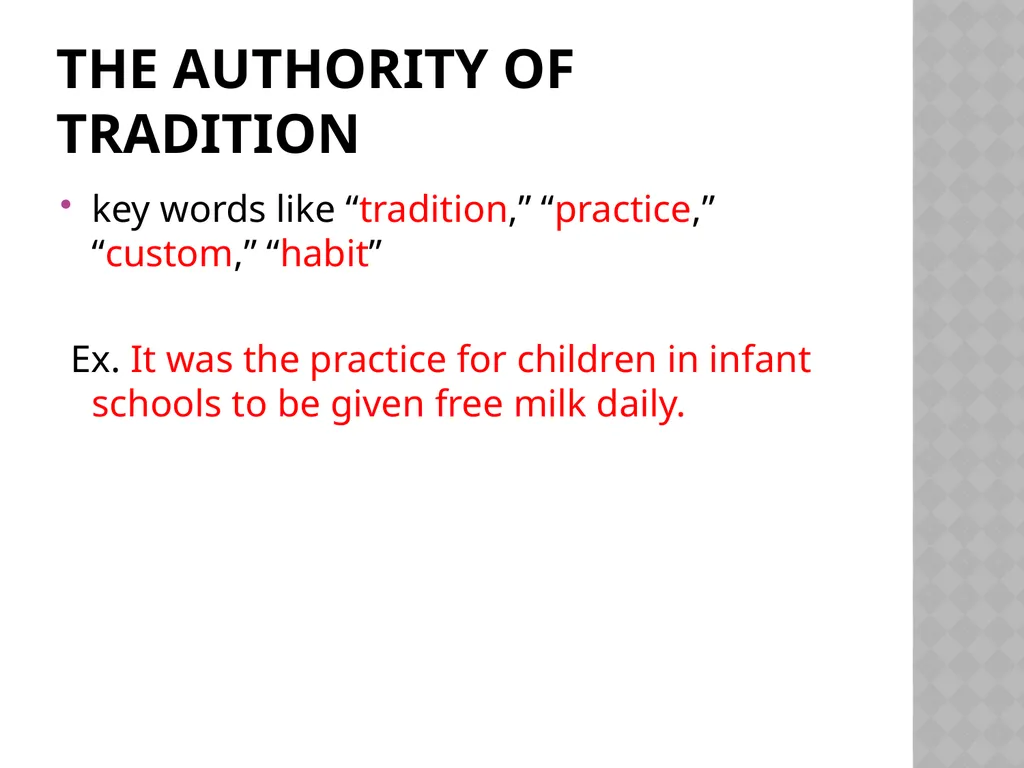
The Authority of Tradition key words like “tradition,” “practice,” “custom,” “habit”
Ex. It was the practice for children in infant schools to be given free milk daily.<br>
Ex. It was the practice for children in infant schools to be given free milk daily.<br>
14
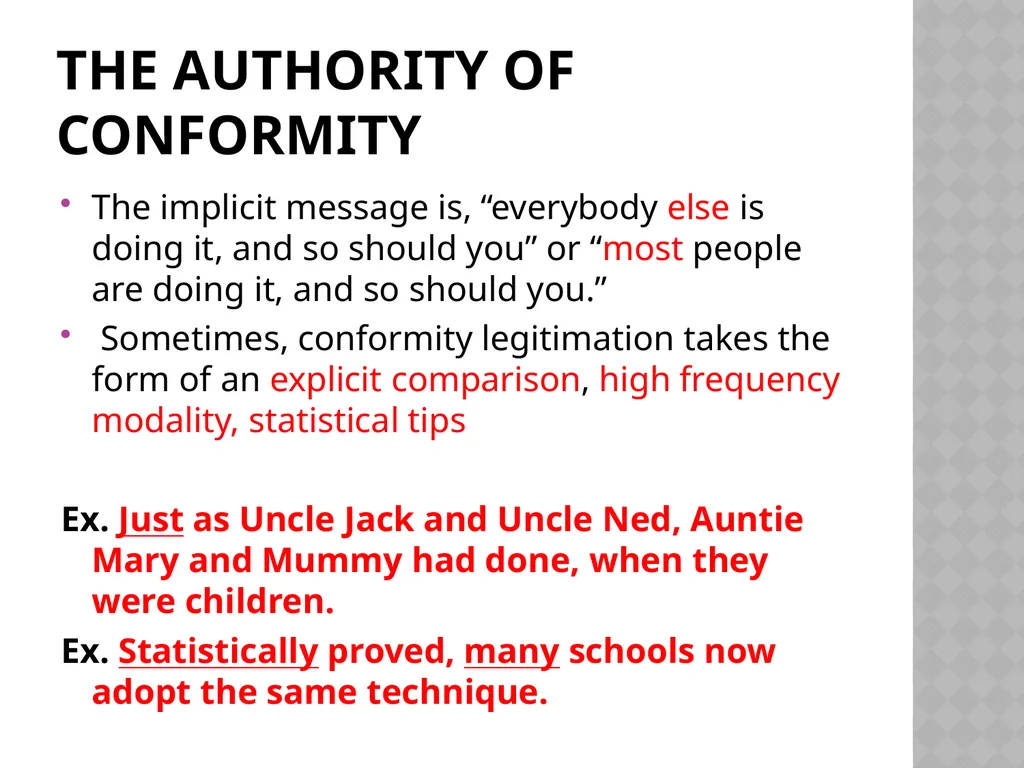
The Authority of Conformity The implicit message is, “everybody else is doing it, and so should you” or “most people are doing it, and so should you.”
Sometimes, conformity legitimation takes the form of an explicit comparison, high frequency modality, statistical tips
Ex. Just as Uncle Jack and Uncle Ned, Auntie Mary and Mummy had done, when they were children.
Ex. Statistically proved, many schools now adopt the same technique.<br>
Sometimes, conformity legitimation takes the form of an explicit comparison, high frequency modality, statistical tips
Ex. Just as Uncle Jack and Uncle Ned, Auntie Mary and Mummy had done, when they were children.
Ex. Statistically proved, many schools now adopt the same technique.<br>
15
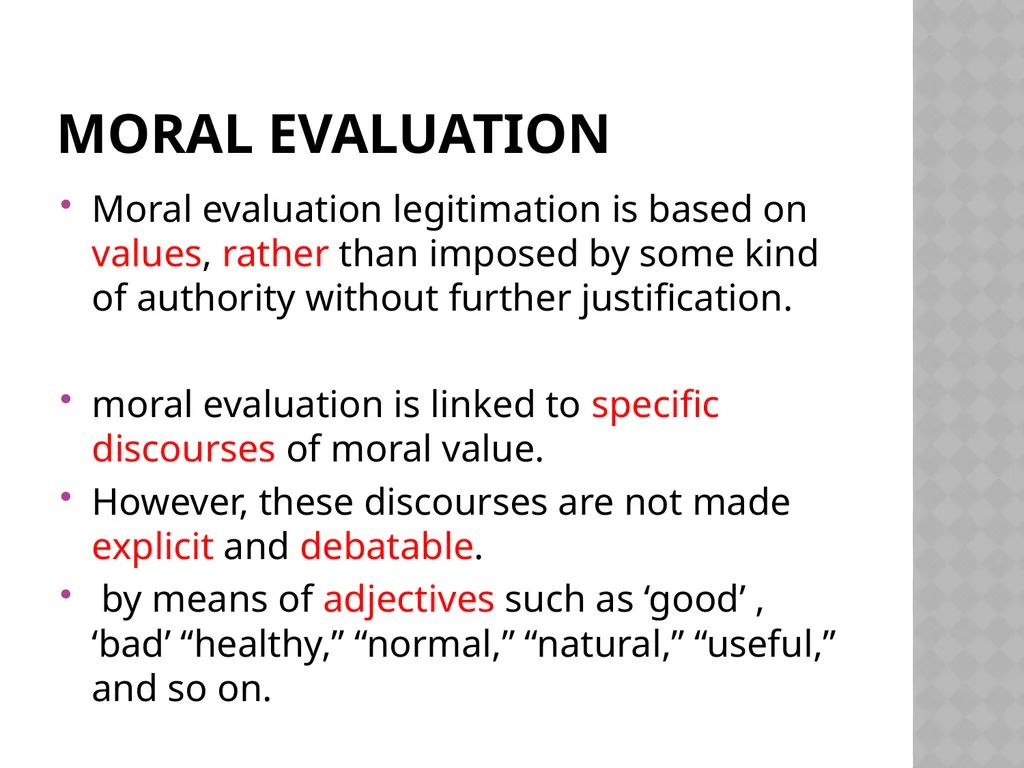
Moral Evaluation Moral evaluation legitimation is based on values, rather than imposed by some kind of authority without further justification.
moral evaluation is linked to specific discourses of moral value.
However, these discourses are not made explicit and debatable.
by means of adjectives such as ‘good’ , ‘bad’ “healthy,” “normal,” “natural,” “useful,” and so on.<br>
moral evaluation is linked to specific discourses of moral value.
However, these discourses are not made explicit and debatable.
by means of adjectives such as ‘good’ , ‘bad’ “healthy,” “normal,” “natural,” “useful,” and so on.<br>
16
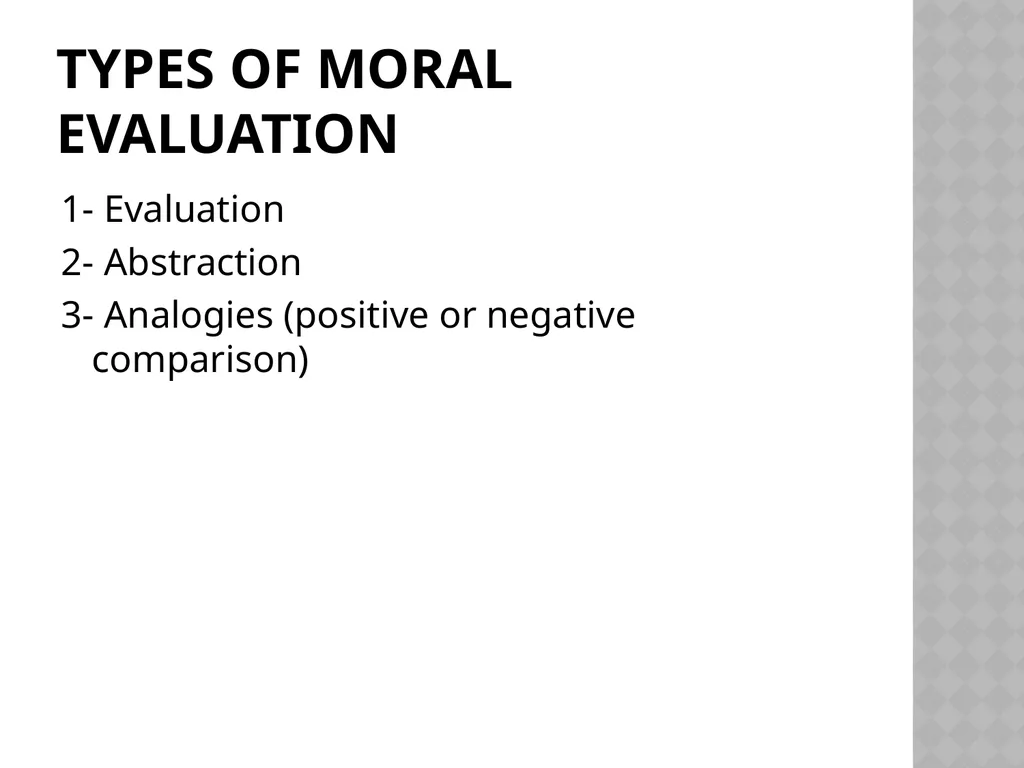
Types of Moral Evaluation 1- Evaluation
2- Abstraction
3- Analogies (positive or negative comparison)<br>
2- Abstraction
3- Analogies (positive or negative comparison)<br>
17
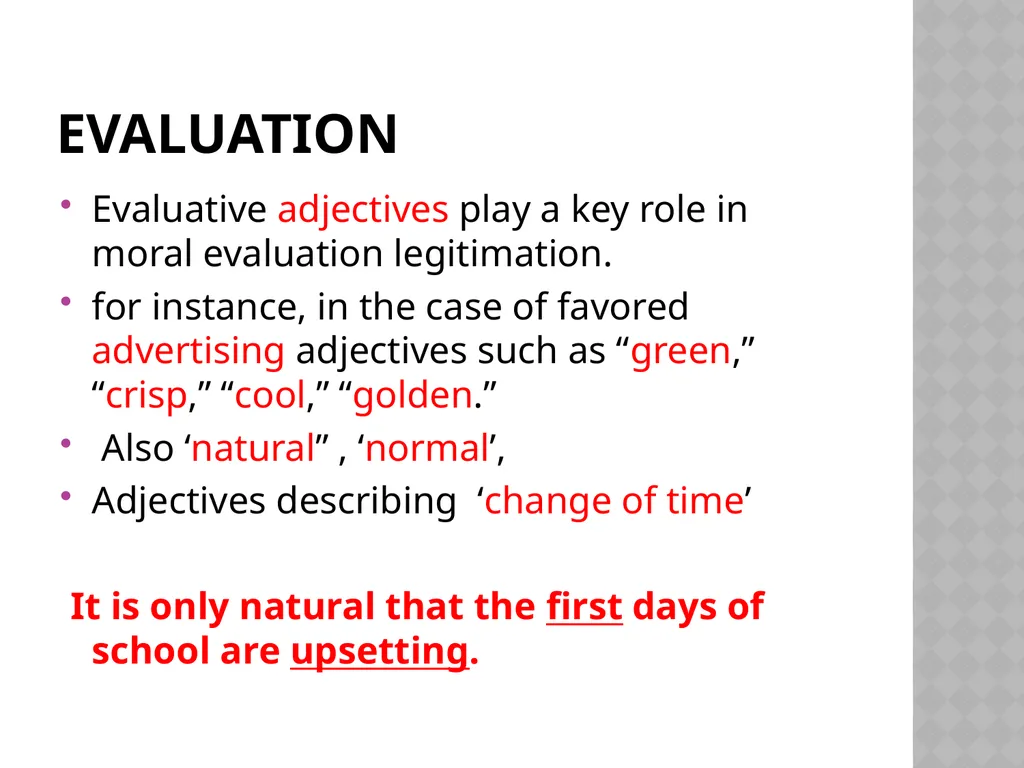
Evaluation Evaluative adjectives play a key role in moral evaluation legitimation.
for instance, in the case of favored advertising adjectives such as “green,” “crisp,” “cool,” “golden.”
Also ‘natural” , ‘normal’,
Adjectives describing ‘change of time’
It is only natural that the first days of school are upsetting.<br>
for instance, in the case of favored advertising adjectives such as “green,” “crisp,” “cool,” “golden.”
Also ‘natural” , ‘normal’,
Adjectives describing ‘change of time’
It is only natural that the first days of school are upsetting.<br>
18
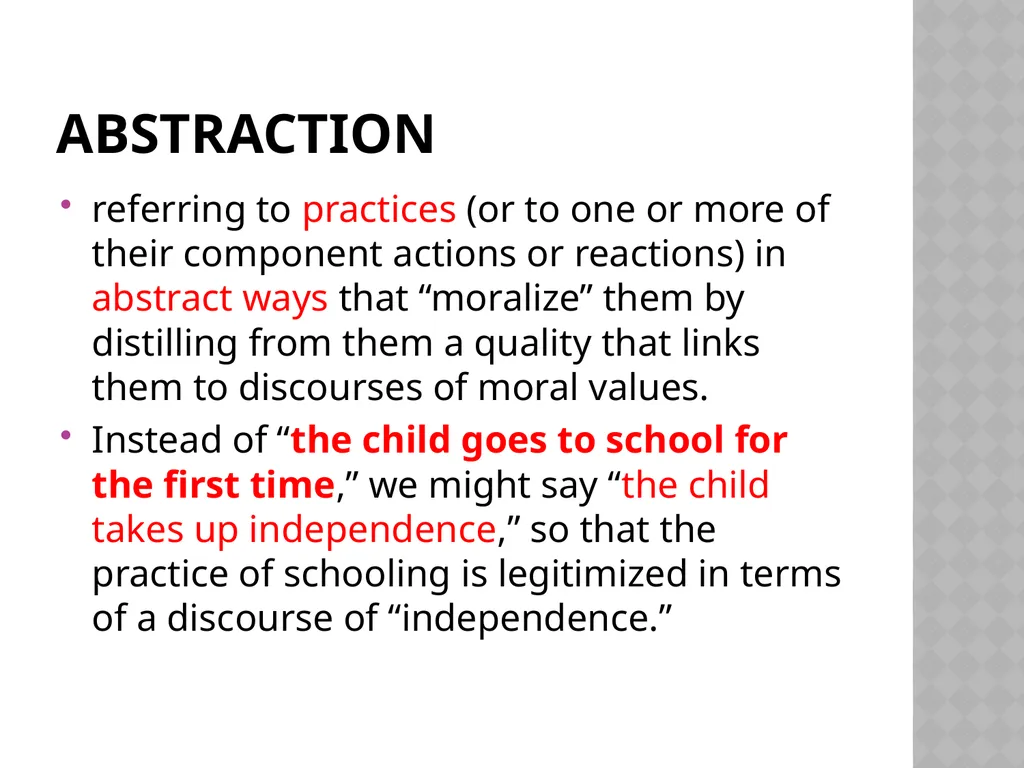
Abstraction referring to practices (or to one or more of their component actions or reactions) in abstract ways that “moralize” them by distilling from them a quality that links them to discourses of moral values.
Instead of “the child goes to school for the first time,” we might say “the child takes up independence,” so that the practice of schooling is legitimized in terms of a discourse of “independence.”<br>
Instead of “the child goes to school for the first time,” we might say “the child takes up independence,” so that the practice of schooling is legitimized in terms of a discourse of “independence.”<br>
19
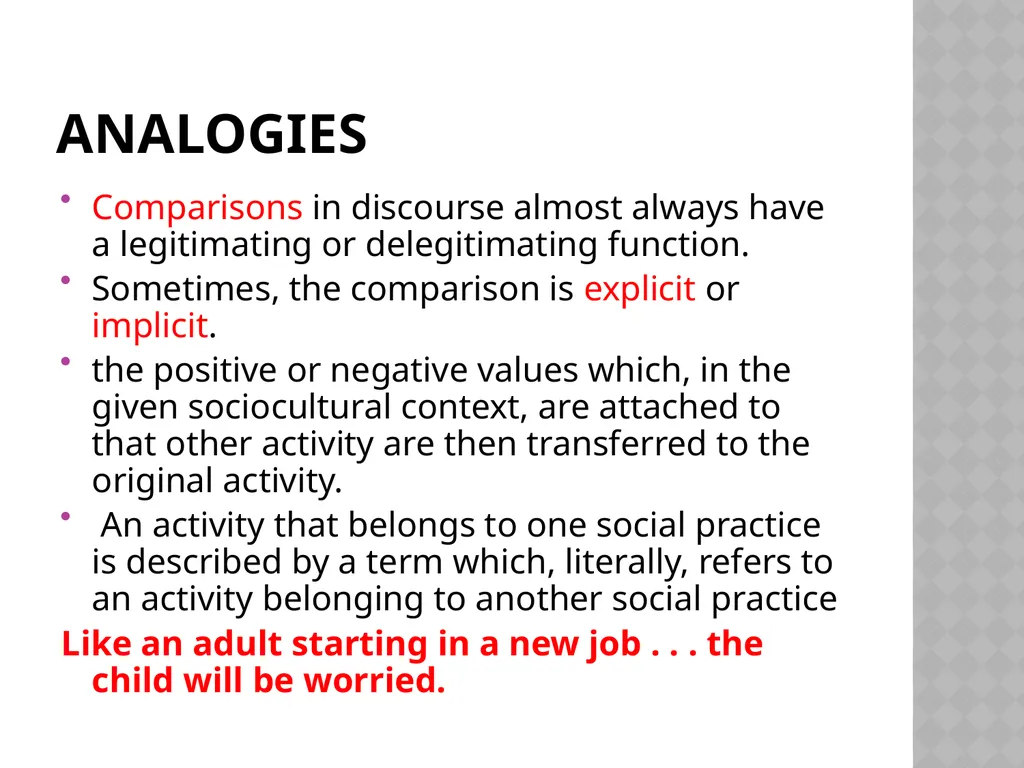
Analogies Comparisons in discourse almost always have a legitimating or delegitimating function.
Sometimes, the comparison is explicit or implicit.
the positive or negative values which, in the given sociocultural context, are attached to that other activity are then transferred to the original activity.
An activity that belongs to one social practice is described by a term which, literally, refers to an activity belonging to another social practice
Like an adult starting in a new job . . . the child will be worried.<br>
Sometimes, the comparison is explicit or implicit.
the positive or negative values which, in the given sociocultural context, are attached to that other activity are then transferred to the original activity.
An activity that belongs to one social practice is described by a term which, literally, refers to an activity belonging to another social practice
Like an adult starting in a new job . . . the child will be worried.<br>
20
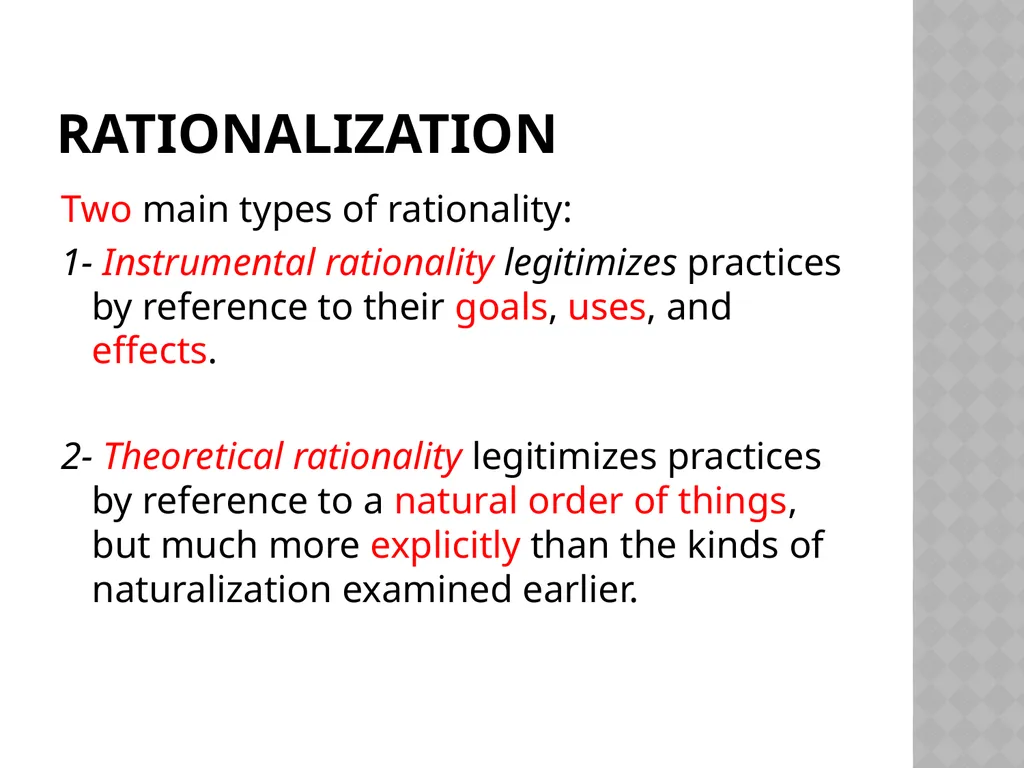
Rationalization Two main types of rationality:
1- Instrumental rationality legitimizes practices by reference to their goals, uses, and effects.
2- Theoretical rationality legitimizes practices by reference to a natural order of things, but much more explicitly than the kinds of naturalization examined earlier.<br>
1- Instrumental rationality legitimizes practices by reference to their goals, uses, and effects.
2- Theoretical rationality legitimizes practices by reference to a natural order of things, but much more explicitly than the kinds of naturalization examined earlier.<br>
21
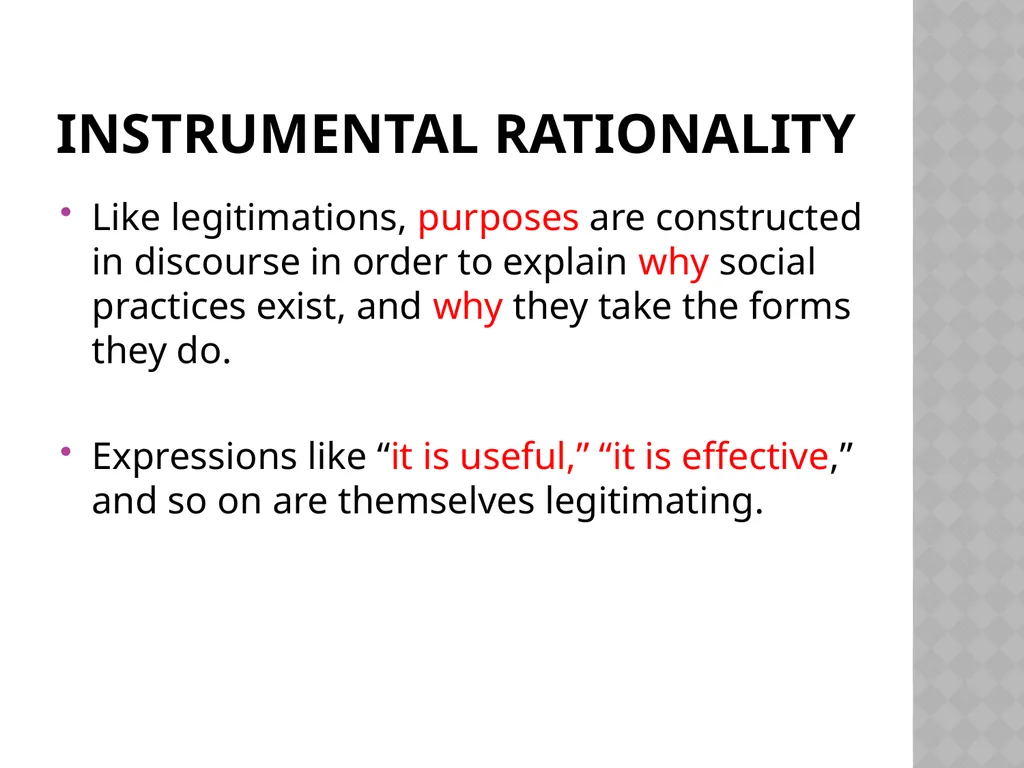
Instrumental rationality Like legitimations, purposes are constructed in discourse in order to explain why social practices exist, and why they take the forms they do.
Expressions like “it is useful,” “it is effective,” and so on are themselves legitimating.<br>
Expressions like “it is useful,” “it is effective,” and so on are themselves legitimating.<br>
22
General vs particular purpose legitimizing:
The following strategies were employed to make the introduction to PE more smooth.<br>
The following strategies were employed to make the introduction to PE more smooth.<br>
23
Goal orientation purposes
vs
means orientation purposes<br>
24
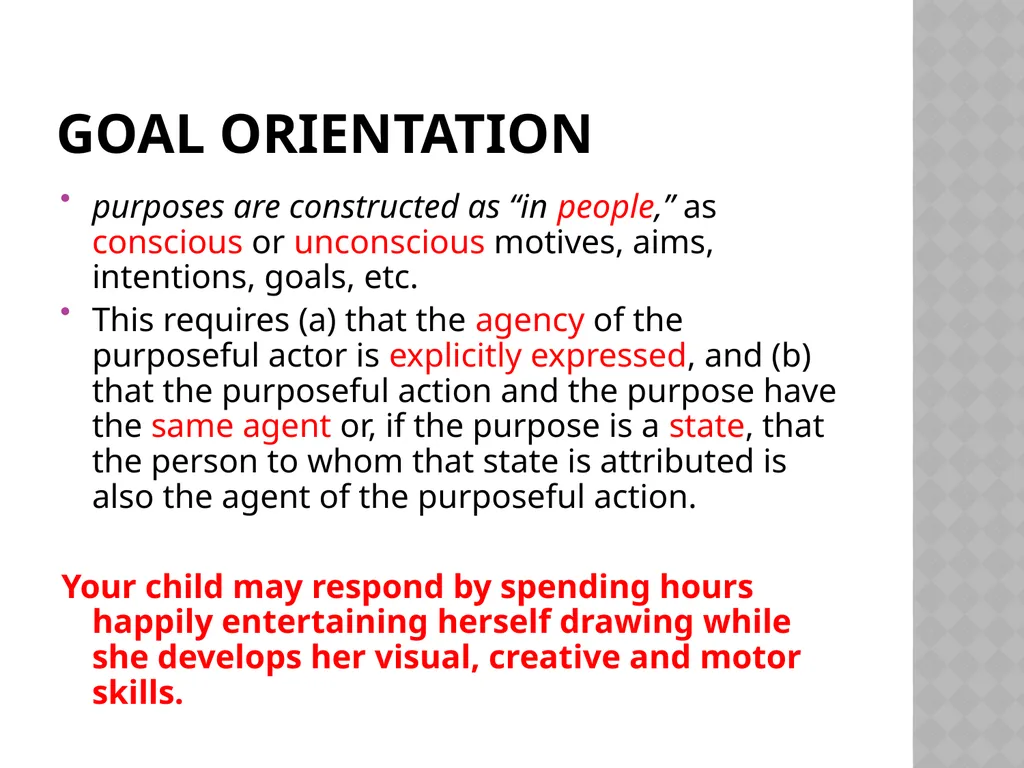
Goal orientation purposes are constructed as “in people,” as conscious or unconscious motives, aims, intentions, goals, etc.
This requires (a) that the agency of the purposeful actor is explicitly expressed, and (b) that the purposeful action and the purpose have the same agent or, if the purpose is a state, that the person to whom that state is attributed is also the agent of the purposeful action.
Your child may respond by spending hours happily entertaining herself drawing while she develops her visual, creative and motor skills.<br>
This requires (a) that the agency of the purposeful actor is explicitly expressed, and (b) that the purposeful action and the purpose have the same agent or, if the purpose is a state, that the person to whom that state is attributed is also the agent of the purposeful action.
Your child may respond by spending hours happily entertaining herself drawing while she develops her visual, creative and motor skills.<br>
25
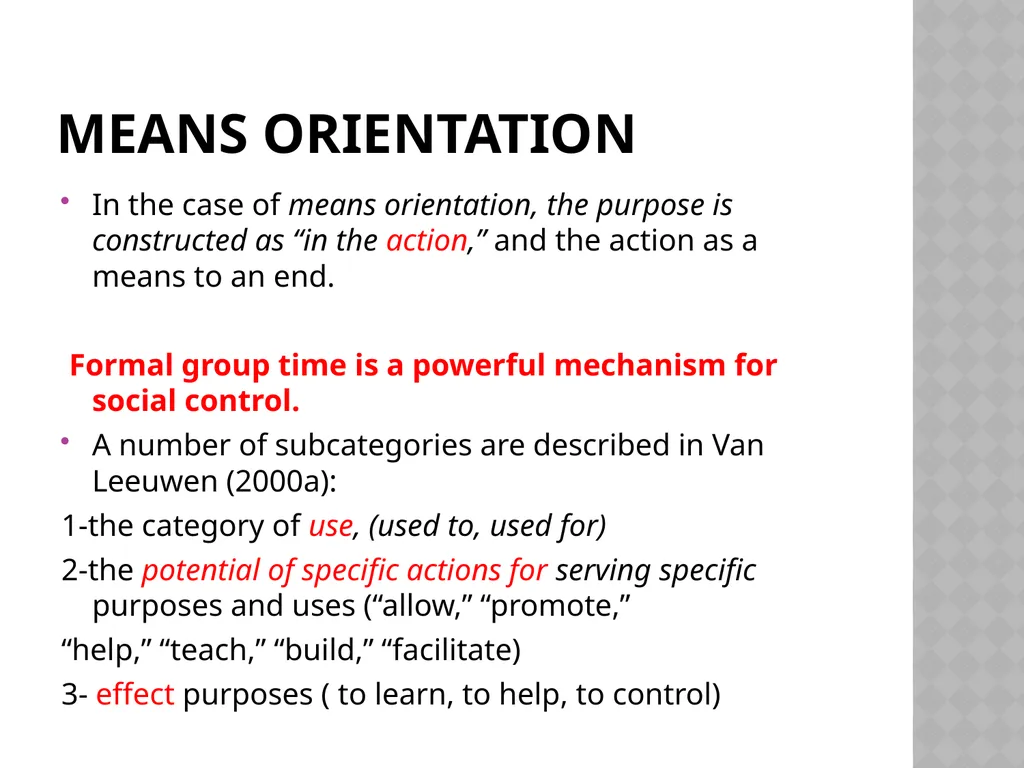
Means orientation In the case of means orientation, the purpose is constructed as “in the action,” and the action as a means to an end.
Formal group time is a powerful mechanism for social control.
A number of subcategories are described in Van Leeuwen (2000a):
1-the category of use, (used to, used for)
2-the potential of specific actions for serving specific purposes and uses (“allow,” “promote,”
“help,” “teach,” “build,” “facilitate)
3- effect purposes ( to learn, to help, to control)<br>
Formal group time is a powerful mechanism for social control.
A number of subcategories are described in Van Leeuwen (2000a):
1-the category of use, (used to, used for)
2-the potential of specific actions for serving specific purposes and uses (“allow,” “promote,”
“help,” “teach,” “build,” “facilitate)
3- effect purposes ( to learn, to help, to control)<br>
26
Theoretical Rationalization Legitimation is founded on some kind of truth, on “the way things are.”
Theoretical rationalization is therefore closely related to the category of naturalization, but by explicit representations of “the way things are.”<br>
Theoretical rationalization is therefore closely related to the category of naturalization, but by explicit representations of “the way things are.”<br>
27
Forms of Theoretical rationalization 1- definition
2- explanation
3- prediction<br>
2- explanation
3- prediction<br>
28
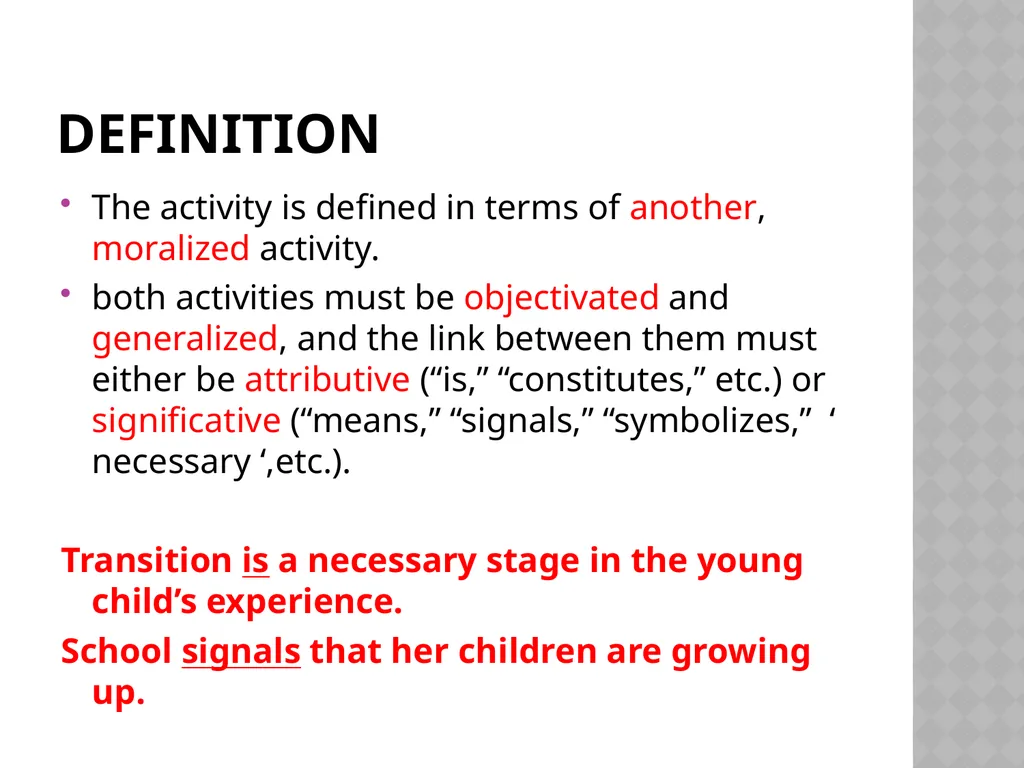
Definition The activity is defined in terms of another, moralized activity.
both activities must be objectivated and generalized, and the link between them must either be attributive (“is,” “constitutes,” etc.) or significative (“means,” “signals,” “symbolizes,” ‘ necessary ‘,etc.).
Transition is a necessary stage in the young child’s experience.
School signals that her children are growing up.<br>
both activities must be objectivated and generalized, and the link between them must either be attributive (“is,” “constitutes,” etc.) or significative (“means,” “signals,” “symbolizes,” ‘ necessary ‘,etc.).
Transition is a necessary stage in the young child’s experience.
School signals that her children are growing up.<br>
29
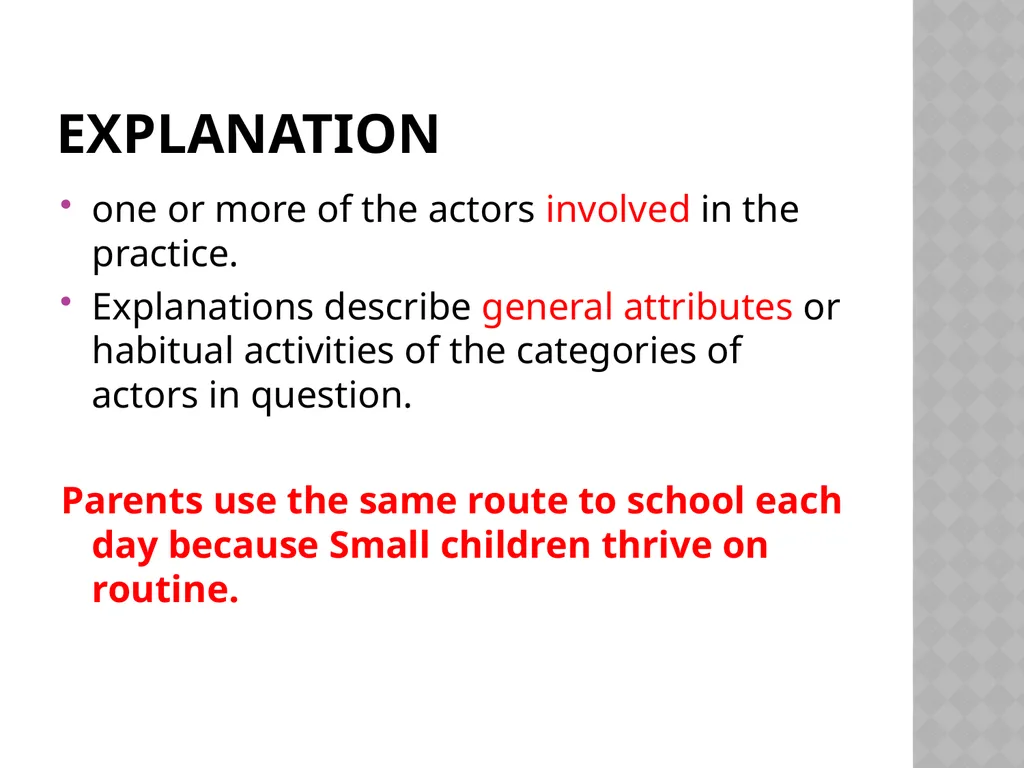
Explanation one or more of the actors involved in the practice.
Explanations describe general attributes or habitual activities of the categories of actors in question.
Parents use the same route to school each day because Small children thrive on routine.<br>
Explanations describe general attributes or habitual activities of the categories of actors in question.
Parents use the same route to school each day because Small children thrive on routine.<br>
30
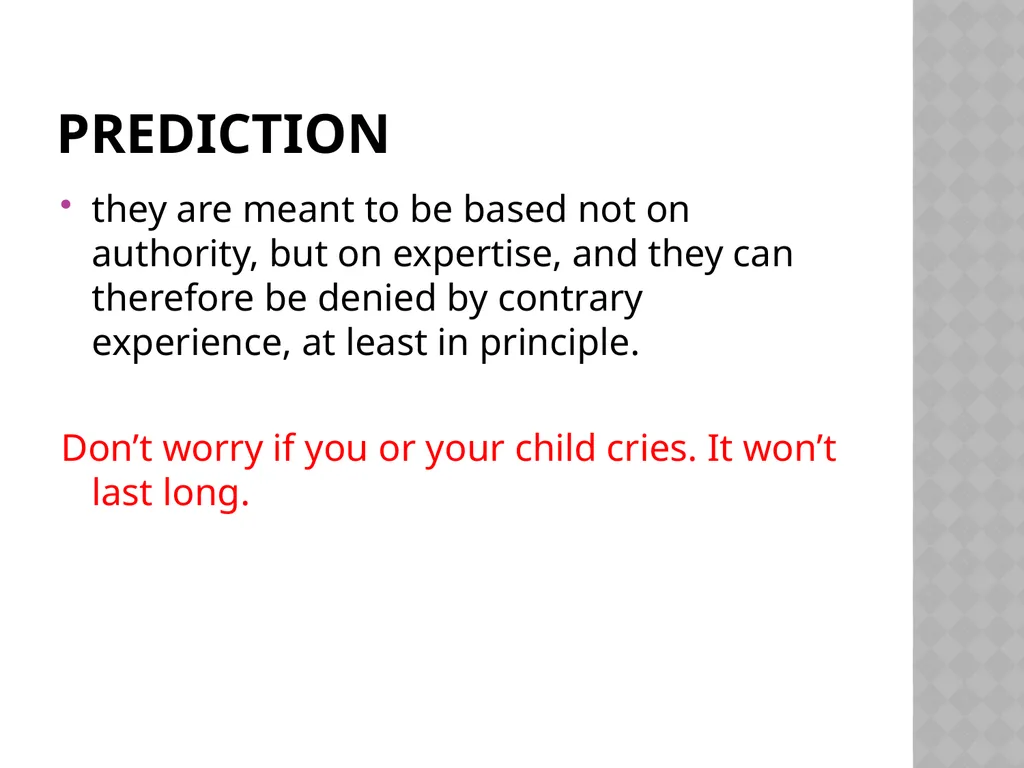
Prediction they are meant to be based not on authority, but on expertise, and they can therefore be denied by contrary experience, at least in principle.
Don’t worry if you or your child cries. It won’t last long.<br>
Don’t worry if you or your child cries. It won’t last long.<br>
31
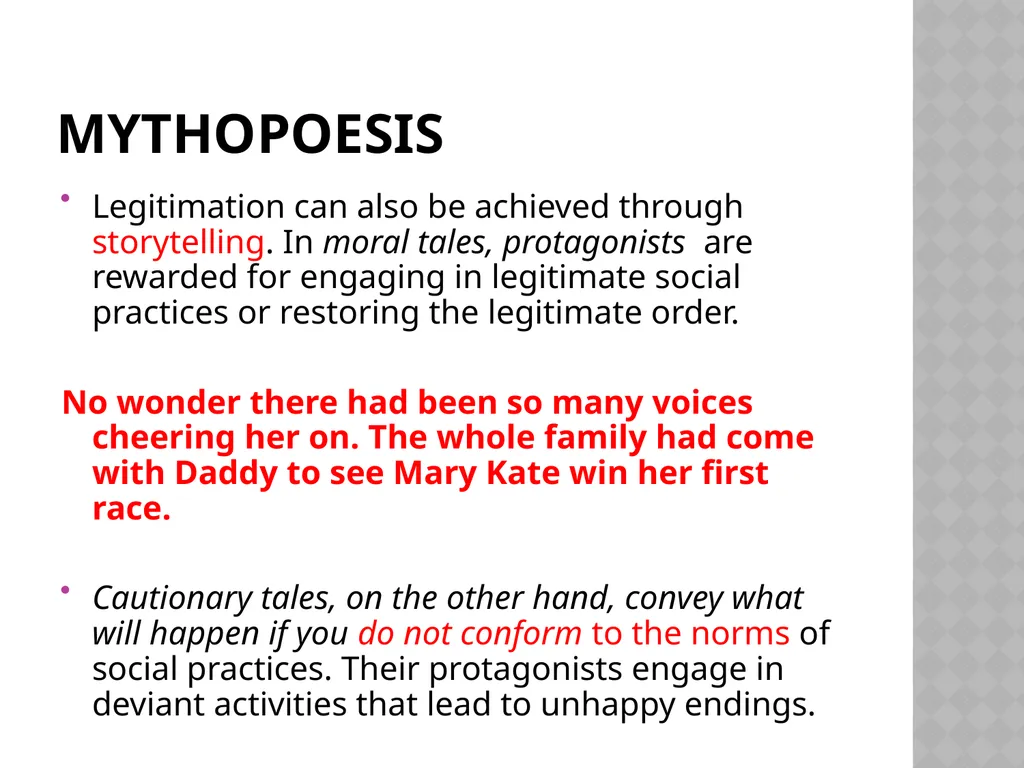
Mythopoesis Legitimation can also be achieved through storytelling. In moral tales, protagonists are rewarded for engaging in legitimate social practices or restoring the legitimate order.
No wonder there had been so many voices cheering her on. The whole family had come with Daddy to see Mary Kate win her first race.
Cautionary tales, on the other hand, convey what will happen if you do not conform to the norms of social practices. Their protagonists engage in deviant activities that lead to unhappy endings.<br>
No wonder there had been so many voices cheering her on. The whole family had come with Daddy to see Mary Kate win her first race.
Cautionary tales, on the other hand, convey what will happen if you do not conform to the norms of social practices. Their protagonists engage in deviant activities that lead to unhappy endings.<br>
32
Stories may also use symbolic actions, specific actions that can nevertheless represent more than one domain of institutionalized social practice and so provide a “mythical model of social action”
Instances of delegitimization can be seen in a mythical action<br>
Instances of delegitimization can be seen in a mythical action<br>
33
Multimodal Legitimation Some forms of legitimation can also be expressed visually, or even musically. Stories, for instance, can be told visually, in the form of comic strips, movies, and games.
Role models can be shown as engaged in actions that need legitimation.
Moral evaluations can be connoted visually or represented by visual symbols.<br>
Role models can be shown as engaged in actions that need legitimation.
Moral evaluations can be connoted visually or represented by visual symbols.<br>
34
Legitimation and Context These are the same folks that came and killed about 3,000 of our citizens.1 (Bush, 11 January 2007) Emotions
On September 11 2001, 19 men hijacked four airplanes and used them to murder nearly 3,000 people. (Obama, 1 December 2009) Fear
And so our commanders looked at the plan and said, Mr President, it’s not going to work until – unless we support – provide more troops. And so last night I told the country that I’ve committed an additional – a little over 20,000 more troops. (Bush, 11 January 2007) Expertise<br>
On September 11 2001, 19 men hijacked four airplanes and used them to murder nearly 3,000 people. (Obama, 1 December 2009) Fear
And so our commanders looked at the plan and said, Mr President, it’s not going to work until – unless we support – provide more troops. And so last night I told the country that I’ve committed an additional – a little over 20,000 more troops. (Bush, 11 January 2007) Expertise<br>
35
Legitimation and Context Your Government has in its possession another document made in Germany by Hitler’s government. It is a detailed plan … which they are ready to impose a little later on a dominated world – if Hitler wins. It is a plan to abolish all existing religions … The property of all churches will be seized by the Reich and its puppets. The cross and all other symbols of religion are to be forbidden … In the place of the churches of our civilization, there is to be set up an international Nazi church … In the place of the Bible, the words of Mein Kampf will be imposed and enforced as Holy Writ. And in place of the cross of Christ will be put two symbols – the swastika and the naked sword. A god of blood and iron will take the place of the God of love and mercy. (FDR, 1941a)<br>
36
THANK YOU<br>