
The Emigree By Carol Rumens Learning Objective To
JO
Published · 28 slides · 0 views
1 / 1





Description
The Emigree By Carol Rumens Learning Objective To understand the context and subject matter of the poem. Learning Objective: To understand the context and subject matter of the poem How did you feel about your home country as a child? What
Related Topics
Share
Embed code
Download this presentation From Below
"The Emigree By Carol Rumens Learning Objective To" is the property of its rightful owner. Permission is granted to download and print the materials on this website for personal, non-commercial use only, and to display it on your personal computer provided you do not modify the materials and that you retain all copyright notices contained in the materials. By downloading content from our website, you accept the terms of this agreement.
Presentation Transcript
01
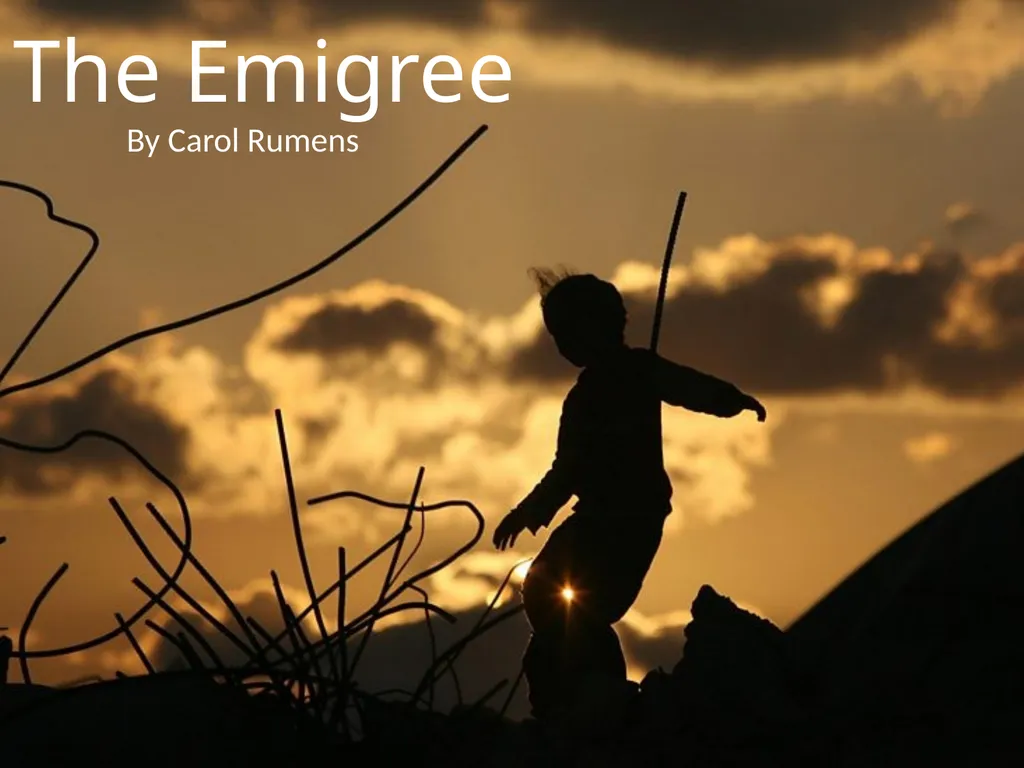
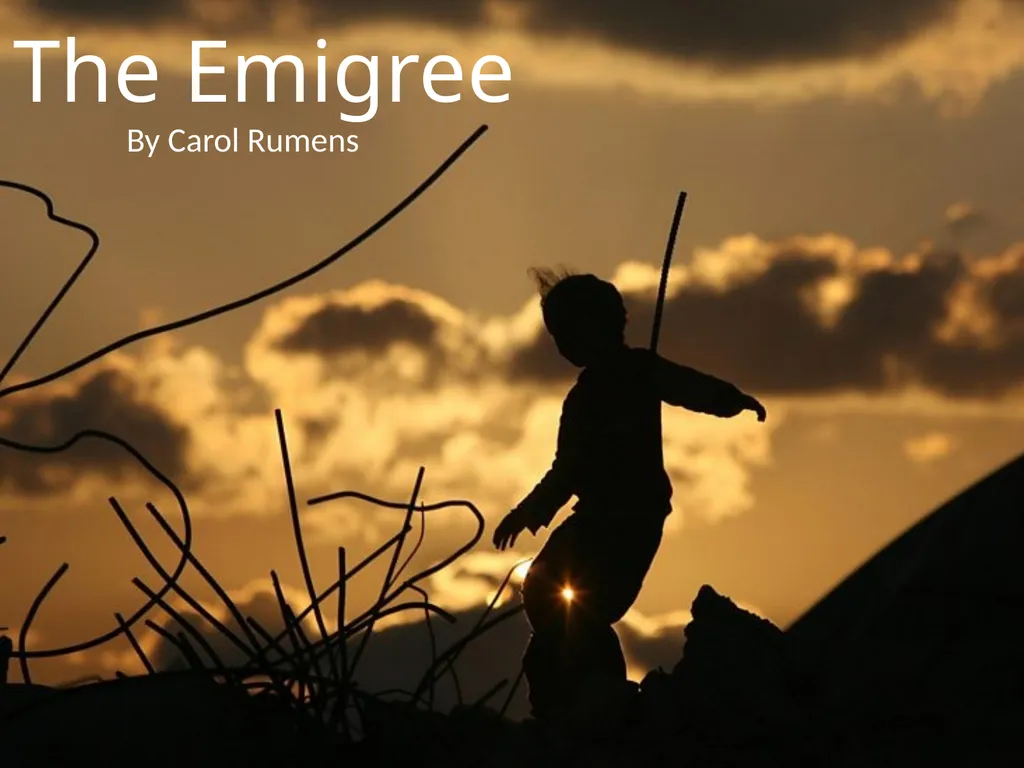
The Emigree By Carol Rumens<br>
02
Learning Objective
To understand the context and subject matter of the poem.<br>
03
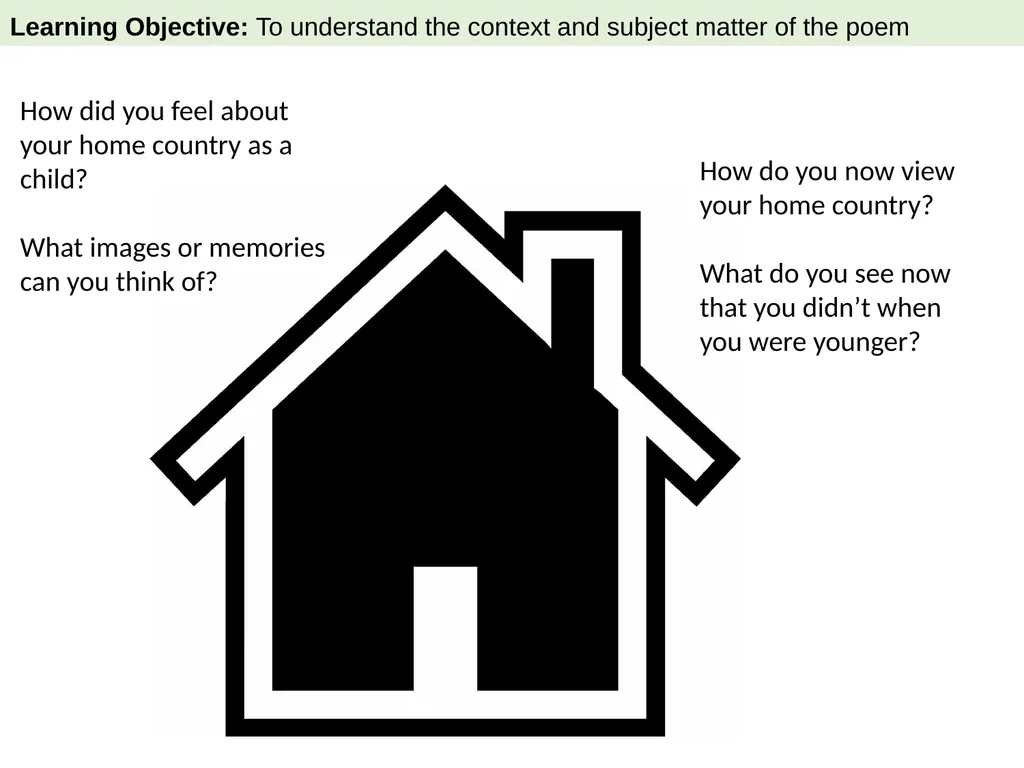
Learning Objective: To understand the context and subject matter of the poem How did you feel about your home country as a child?
What images or memories can you think of? How do you now view your home country?
What do you see now that you didn’t when you were younger?<br>
What images or memories can you think of? How do you now view your home country?
What do you see now that you didn’t when you were younger?<br>
04
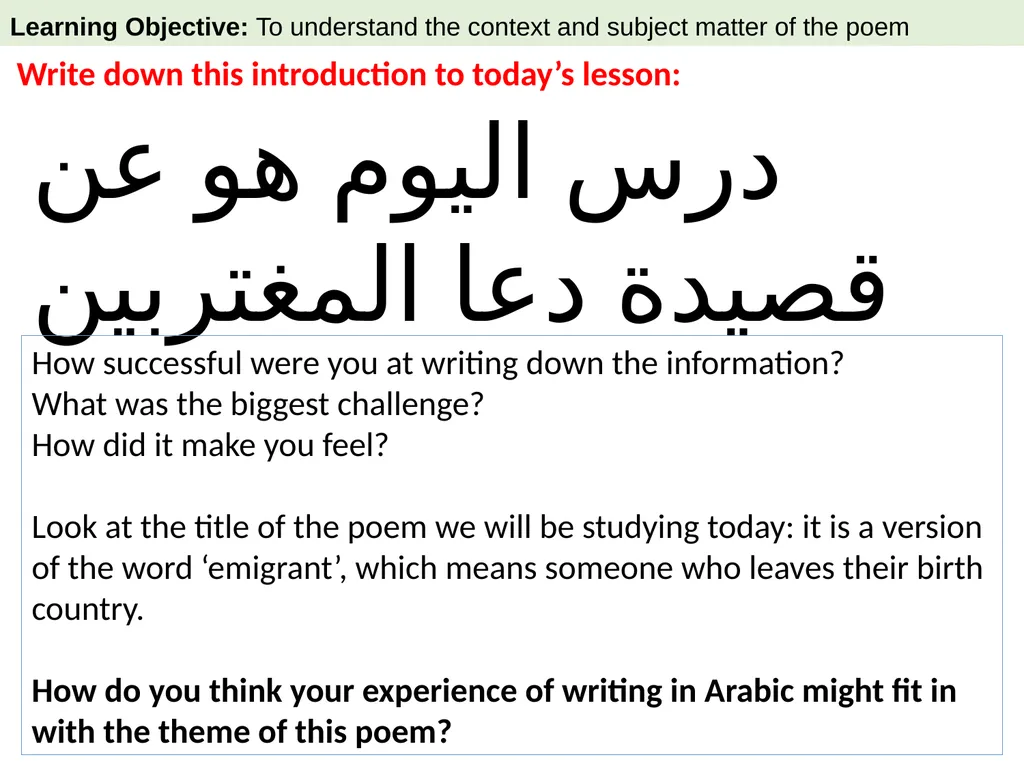
Learning Objective: To understand the context and subject matter of the poem درس اليوم هو عن قصيدة دعا المغتربين Write down this introduction to today’s lesson: How successful were you at writing down the information?
What was the biggest challenge?
How did it make you feel?
Look at the title of the poem we will be studying today: it is a version of the word ‘emigrant’, which means someone who leaves their birth country.
How do you think your experience of writing in Arabic might fit in with the theme of this poem?<br>
What was the biggest challenge?
How did it make you feel?
Look at the title of the poem we will be studying today: it is a version of the word ‘emigrant’, which means someone who leaves their birth country.
How do you think your experience of writing in Arabic might fit in with the theme of this poem?<br>
05
Learning Objective: To understand the context and subject matter of the poem A displaced person pictures the country and the city where he or she was born. Neither the city nor the country is ever named and this lack of specific detail seems intentional. It is as if Rumens wants her poem to be relevant to as many people who have left their homelands as possible.
Emigrants are people who have left the country of their birth to settle elsewhere in the world. The spelling of the word Rumens chooses - émigrée - is a feminine form and suggests the speaker of the poem is a woman.
The exact location of the city is unclear and precise details of it are sparse. Perhaps it only ever really existed in the émigrée’s imagination.
Rumens suggests the city and country may now be war-torn, or under the control of a dictatorial government that has banned the language the speaker once knew. Despite this, nothing shakes the light-filled impression of a perfect place that the émigrée’s childhood memories have left. This shows the power that places can have, even over people who have left them long ago and who have never revisited since. Though there is a clear sense of fondness for the place, there is also a more threatening tone in the poem, suggesting perhaps that the relationship with the past and with this place is not necessarily positive for the speaker. Stick the information about the poem into your exercise book. Underneath, list four things that you learn about the poem and its subject matter.<br>
Emigrants are people who have left the country of their birth to settle elsewhere in the world. The spelling of the word Rumens chooses - émigrée - is a feminine form and suggests the speaker of the poem is a woman.
The exact location of the city is unclear and precise details of it are sparse. Perhaps it only ever really existed in the émigrée’s imagination.
Rumens suggests the city and country may now be war-torn, or under the control of a dictatorial government that has banned the language the speaker once knew. Despite this, nothing shakes the light-filled impression of a perfect place that the émigrée’s childhood memories have left. This shows the power that places can have, even over people who have left them long ago and who have never revisited since. Though there is a clear sense of fondness for the place, there is also a more threatening tone in the poem, suggesting perhaps that the relationship with the past and with this place is not necessarily positive for the speaker. Stick the information about the poem into your exercise book. Underneath, list four things that you learn about the poem and its subject matter.<br>
06
There once was a country… I left it as a child
but my memory of it is sunlight-clear
for it seems I never saw it in that November
which, I am told, comes to the mildest city.
The worst news I receive of it cannot break
my original view, the bright, filled paperweight.
It may be at war, it may be sick with tyrants,
but I am branded by an impression of sunlight.
The white streets of that city, the graceful slopes glow even clearer as time rolls its tanks and the frontiers rise between us, close like waves. That child’s vocabulary I carried here like a hollow doll, opens and spills a grammar. Soon I shall have every coloured molecule of it. It may by now be a lie, banned by the state but I can’t get it off my tongue. It tastes of sunlight.
I have no passport, there’s no way back at all but my city comes to me in its own white plane. It lies down in front of me, docile as paper; I comb its hair and love its shining eyes. My city takes me dancing through the city of walls. They accuse me of absence, they circle me. They accuse me of being dark in their free city. My city hides behind me. They mutter death, and my shadow falls as evidence of sunlight.<br>
The white streets of that city, the graceful slopes glow even clearer as time rolls its tanks and the frontiers rise between us, close like waves. That child’s vocabulary I carried here like a hollow doll, opens and spills a grammar. Soon I shall have every coloured molecule of it. It may by now be a lie, banned by the state but I can’t get it off my tongue. It tastes of sunlight.
I have no passport, there’s no way back at all but my city comes to me in its own white plane. It lies down in front of me, docile as paper; I comb its hair and love its shining eyes. My city takes me dancing through the city of walls. They accuse me of absence, they circle me. They accuse me of being dark in their free city. My city hides behind me. They mutter death, and my shadow falls as evidence of sunlight.<br>
07
Learning Objective
To explore how the poet uses theme, language and structure to present a place.<br>
08
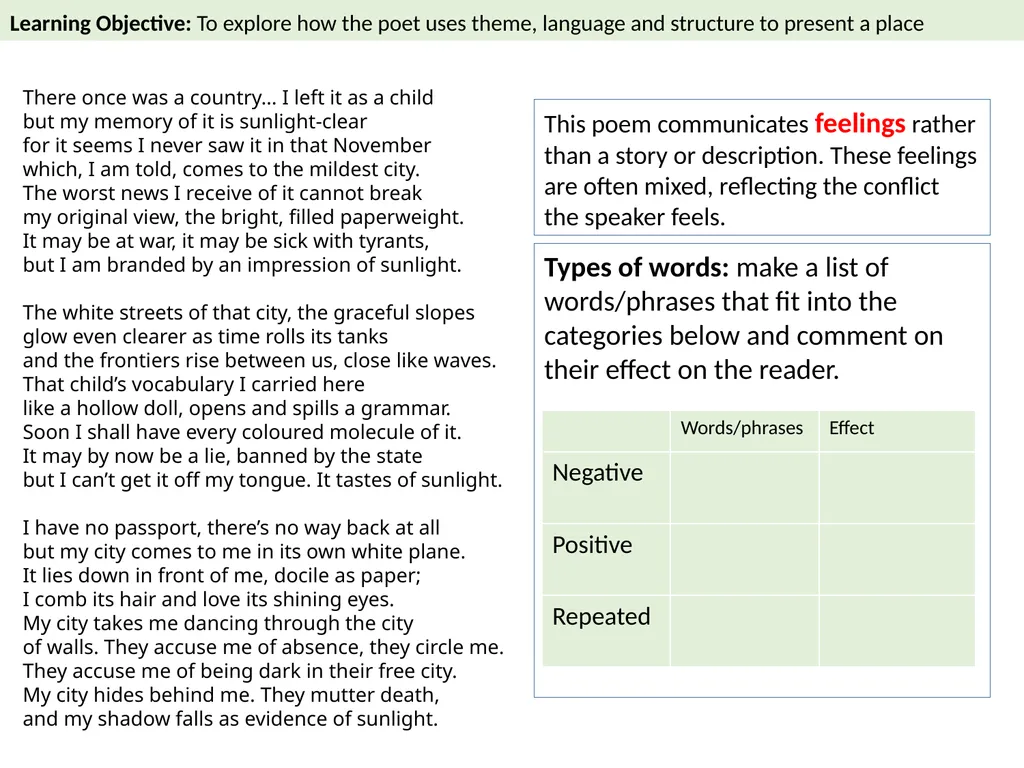
Learning Objective: To explore how the poet uses theme, language and structure to present a place There once was a country… I left it as a child
but my memory of it is sunlight-clear
for it seems I never saw it in that November
which, I am told, comes to the mildest city.
The worst news I receive of it cannot break
my original view, the bright, filled paperweight.
It may be at war, it may be sick with tyrants,
but I am branded by an impression of sunlight.
The white streets of that city, the graceful slopes glow even clearer as time rolls its tanks and the frontiers rise between us, close like waves. That child’s vocabulary I carried here like a hollow doll, opens and spills a grammar. Soon I shall have every coloured molecule of it. It may by now be a lie, banned by the state but I can’t get it off my tongue. It tastes of sunlight.
I have no passport, there’s no way back at all but my city comes to me in its own white plane. It lies down in front of me, docile as paper; I comb its hair and love its shining eyes. My city takes me dancing through the city of walls. They accuse me of absence, they circle me. They accuse me of being dark in their free city. My city hides behind me. They mutter death, and my shadow falls as evidence of sunlight. Types of words: make a list of words/phrases that fit into the categories below and comment on their effect on the reader. This poem communicates feelings rather than a story or description. These feelings are often mixed, reflecting the conflict the speaker feels.<br>
The white streets of that city, the graceful slopes glow even clearer as time rolls its tanks and the frontiers rise between us, close like waves. That child’s vocabulary I carried here like a hollow doll, opens and spills a grammar. Soon I shall have every coloured molecule of it. It may by now be a lie, banned by the state but I can’t get it off my tongue. It tastes of sunlight.
I have no passport, there’s no way back at all but my city comes to me in its own white plane. It lies down in front of me, docile as paper; I comb its hair and love its shining eyes. My city takes me dancing through the city of walls. They accuse me of absence, they circle me. They accuse me of being dark in their free city. My city hides behind me. They mutter death, and my shadow falls as evidence of sunlight. Types of words: make a list of words/phrases that fit into the categories below and comment on their effect on the reader. This poem communicates feelings rather than a story or description. These feelings are often mixed, reflecting the conflict the speaker feels.<br>
09
Learning Objective: To explore how the poet uses theme, language and structure to present a place There once was a country… I left it as a child
but my memory of it is sunlight-clear
for it seems I never saw it in that November
which, I am told, comes to the mildest city.
The worst news I receive of it cannot break
my original view, the bright, filled paperweight.
It may be at war, it may be sick with tyrants,
but I am branded by an impression of sunlight.
The white streets of that city, the graceful slopes glow even clearer as time rolls its tanks and the frontiers rise between us, close like waves. That child’s vocabulary I carried here like a hollow doll, opens and spills a grammar. Soon I shall have every coloured molecule of it. It may by now be a lie, banned by the state but I can’t get it off my tongue. It tastes of sunlight.
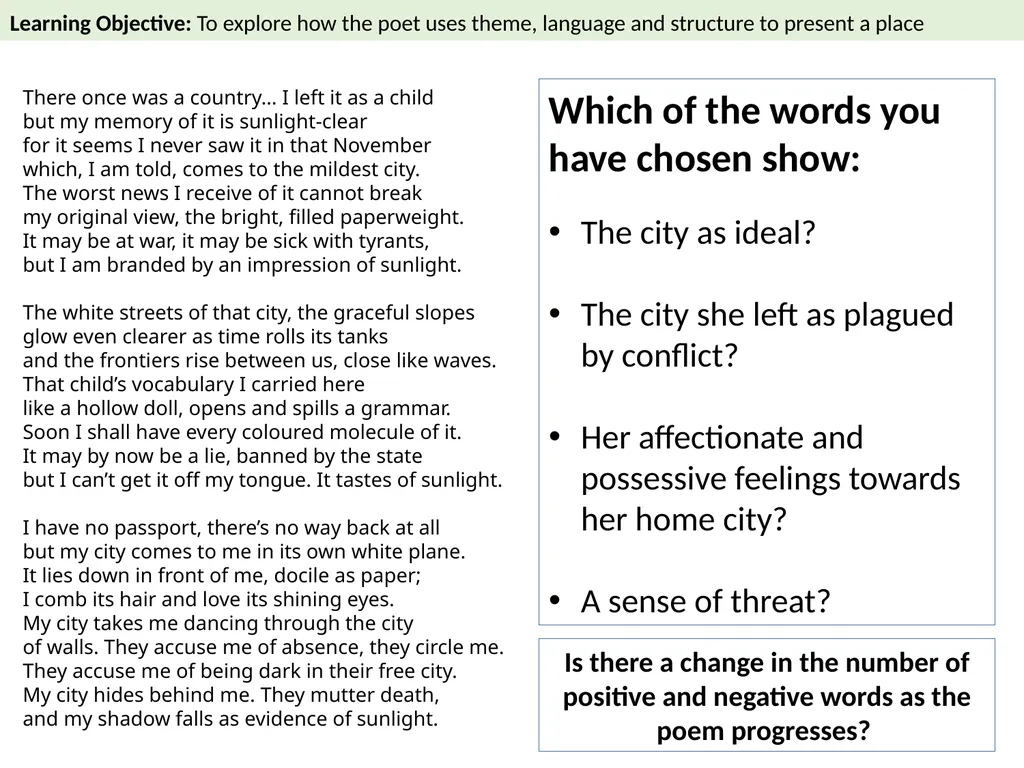
I have no passport, there’s no way back at all but my city comes to me in its own white plane. It lies down in front of me, docile as paper; I comb its hair and love its shining eyes. My city takes me dancing through the city of walls. They accuse me of absence, they circle me. They accuse me of being dark in their free city. My city hides behind me. They mutter death, and my shadow falls as evidence of sunlight. Which of the words you have chosen show:
The city as ideal?
The city she left as plagued by conflict?
Her affectionate and possessive feelings towards her home city?
A sense of threat? Is there a change in the number of positive and negative words as the poem progresses?<br>
The white streets of that city, the graceful slopes glow even clearer as time rolls its tanks and the frontiers rise between us, close like waves. That child’s vocabulary I carried here like a hollow doll, opens and spills a grammar. Soon I shall have every coloured molecule of it. It may by now be a lie, banned by the state but I can’t get it off my tongue. It tastes of sunlight.
I have no passport, there’s no way back at all but my city comes to me in its own white plane. It lies down in front of me, docile as paper; I comb its hair and love its shining eyes. My city takes me dancing through the city of walls. They accuse me of absence, they circle me. They accuse me of being dark in their free city. My city hides behind me. They mutter death, and my shadow falls as evidence of sunlight. Which of the words you have chosen show:
The city as ideal?
The city she left as plagued by conflict?
Her affectionate and possessive feelings towards her home city?
A sense of threat? Is there a change in the number of positive and negative words as the poem progresses?<br>
10
There once was a country… I left it as a child
but my memory of it is sunlight-clear
for it seems I never saw it in that November
which, I am told, comes to the mildest city. The opening makes it sound like a story, but ‘was’ also suggests loss. Suggests the memory is bright and clear. Contrast the ‘sunlight’ with ‘November’, representing dark and gloomy difficult times – a sense of foreboding is created. This hints at another voice telling her about her past. Ellipsis adds to the sense of the past being remembered. Learning Objective: To explore how the poet uses theme, language and structure to present a place<br>
11
The worst news I receive of it cannot break
my original view, the bright, filled paperweight.
It may be at war, it may be sick with tyrants,
but I am branded by an impression of sunlight. As an adult, she receives bad news about the country - the poem features language reminiscent of TV news bulletins. This suggests it has been invaded or is subject to a brutal government. Her positive view is no longer accurate. Metaphor: suggests her memories are bright and positive but also solid and fixed. Metaphor: ‘branded’ reinforces the idea of her view as unchangeable – she is marked by it. The repeated references to sunlight suggest the speaker has an idealised, almost dream-like picture of the past, where it is always sunny. Learning Objective: To explore how the poet uses theme, language and structure to present a place<br>
12
The white streets of that city, the graceful slopes
glow even clearer as time rolls its tanks
and the frontiers rise between us, close like waves. Learning Objective: To explore how the poet uses theme, language and structure to present a place This initial description makes the city sound pure and almost heavenly – reinforcing the idea of sunlight and clear memories.
Alliteration joins the idea of ‘graceful’ and ‘glow’. Time is personified as an enemy. ‘That city’ is never identified, so that it can stand for any place that anyone once loved. As we age, we all – in a sense – become exiles from the land of our childhood, a land that is filled with bright, unreachable memories that ‘glow even clearer’ as time moves on. Simile: suggests how close she feels to the city. Even as barriers are put up, the memories seep through like water through cracks.<br>
Alliteration joins the idea of ‘graceful’ and ‘glow’. Time is personified as an enemy. ‘That city’ is never identified, so that it can stand for any place that anyone once loved. As we age, we all – in a sense – become exiles from the land of our childhood, a land that is filled with bright, unreachable memories that ‘glow even clearer’ as time moves on. Simile: suggests how close she feels to the city. Even as barriers are put up, the memories seep through like water through cracks.<br>
13
That child’s vocabulary I carried here
like a hollow doll, opens and spills a grammar.
Soon I shall have every coloured molecule of it.
It may by now be a lie, banned by the state
but I can’t get it off my tongue. It tastes of sunlight. Learning Objective: To explore how the poet uses theme, language and structure to present a place 1. She seems to be referring to the language of her childhood that she ‘carried’ with her to her new country. The simile of the ‘hollow doll’ suggests it was smuggled or concealed. 2. Here, it ‘spills’ like the stuffing of the doll – the grammar of the language is revealed. 3. The language is returning to her – ‘coloured molecule’ reflects the brightness of the memories that are so precious to her. 4. Another reference to the current state of the city – she is remembering a language that is now supressed by those who rule it. 6. Sense description as metaphor: the language is a positive, treasured thing. 5. It is as fixed as her memories (compare to ‘branded’ or the ‘paperweight’).<br>
14
I have no passport, there’s no way back at all
but my city comes to me in its own white plane.
It lies down in front of me, docile as paper;
I comb its hair and love its shining eyes. Learning Objective: To explore how the poet uses theme, language and structure to present a place This first line sounds hopeless – but… Personification of the city: the ‘white plane’ could represent the speaker’s own memories. Key Image: ‘I comb its hair and love its shining eyes’ What does this key image suggest about the speaker’s relationship with the city? The city is personified as someone very close to the speaker; a lover perhaps, or a child.
The word ‘shining’ links this phrase to the theme of light that runs through the poem.
The line suggests the speaker spends a lot of time adoring the city and trying to improve its appearance. There’s a sense in which she lavishes attention on her memory of the city.
The effect on the reader is to see the speaker as emotionally dependent upon the city. Recalling the place has become a kind of homesick compulsion.<br>
The word ‘shining’ links this phrase to the theme of light that runs through the poem.
The line suggests the speaker spends a lot of time adoring the city and trying to improve its appearance. There’s a sense in which she lavishes attention on her memory of the city.
The effect on the reader is to see the speaker as emotionally dependent upon the city. Recalling the place has become a kind of homesick compulsion.<br>
15
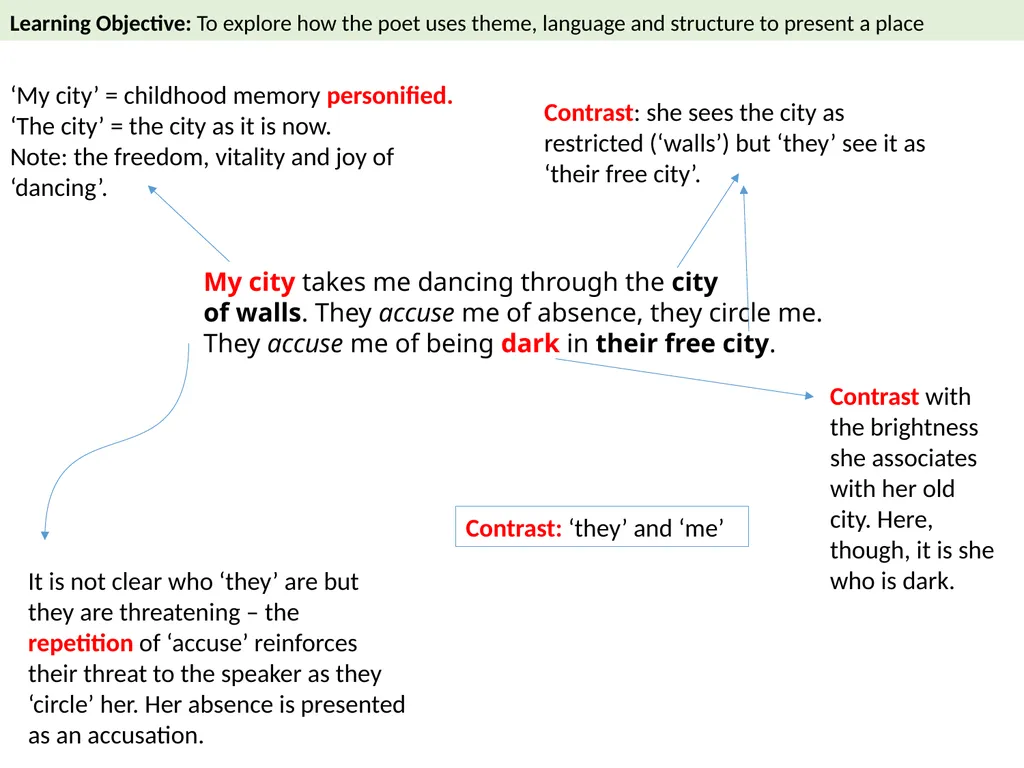
My city takes me dancing through the city
of walls. They accuse me of absence, they circle me.
They accuse me of being dark in their free city. Learning Objective: To explore how the poet uses theme, language and structure to present a place Contrast: she sees the city as restricted (‘walls’) but ‘they’ see it as ‘their free city’. ‘My city’ = childhood memory personified.
‘The city’ = the city as it is now.
Note: the freedom, vitality and joy of ‘dancing’. It is not clear who ‘they’ are but they are threatening – the repetition of ‘accuse’ reinforces their threat to the speaker as they ‘circle’ her. Her absence is presented as an accusation. Contrast with the brightness she associates with her old city. Here, though, it is she who is dark. Contrast: ‘they’ and ‘me’<br>
‘The city’ = the city as it is now.
Note: the freedom, vitality and joy of ‘dancing’. It is not clear who ‘they’ are but they are threatening – the repetition of ‘accuse’ reinforces their threat to the speaker as they ‘circle’ her. Her absence is presented as an accusation. Contrast with the brightness she associates with her old city. Here, though, it is she who is dark. Contrast: ‘they’ and ‘me’<br>
16
My city hides behind me. They mutter death,
and my shadow falls as evidence of sunlight. Learning Objective: To explore how the poet uses theme, language and structure to present a place The personified city of her childhood is threatened by the new city. She protects it. Sense of threat is amplified. The new city will destroy – or already has destroyed – the old city and its way of life. Oxymoron: Despite the threat of death and the mentions of ‘dark’ suggesting a threat to her wellbeing, the speaker ends the poem on a positive note. Even the darkness of her shadow is a reminder of the sunlight that once was. She will not give up her memories.<br>
17
Learning Objective: To explore how the poet uses theme, language and structure to present a place<br>
18
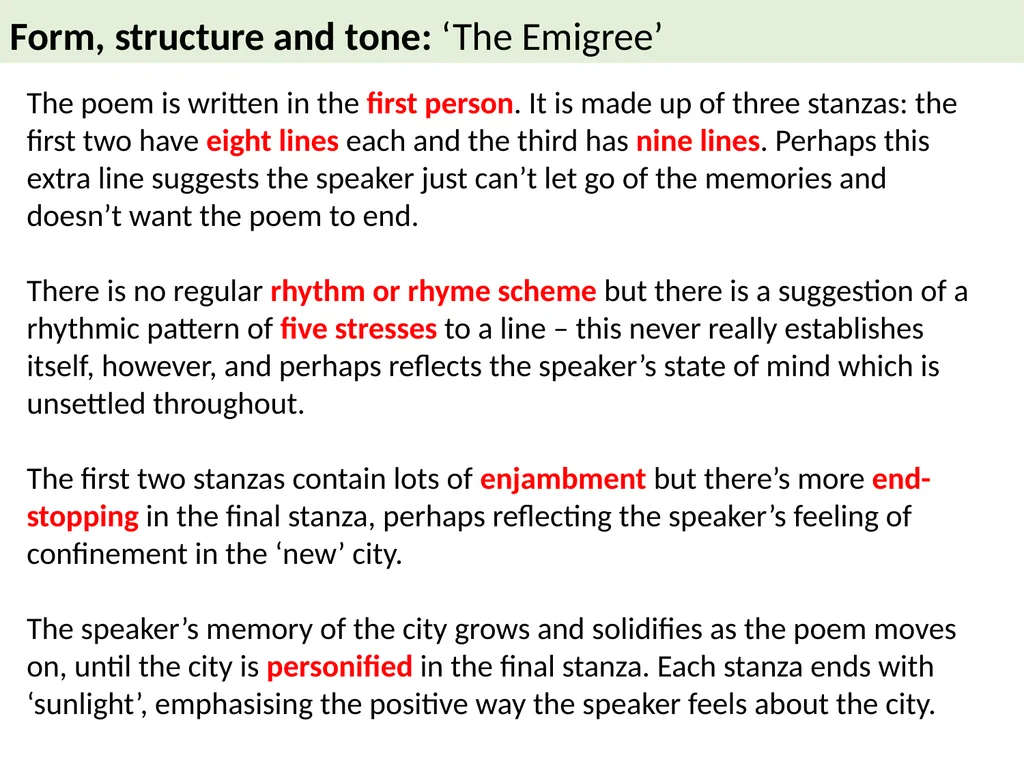
Form, structure and tone: ‘The Emigree’ The poem is written in the first person. It is made up of three stanzas: the first two have eight lines each and the third has nine lines. Perhaps this extra line suggests the speaker just can’t let go of the memories and doesn’t want the poem to end.
There is no regular rhythm or rhyme scheme but there is a suggestion of a rhythmic pattern of five stresses to a line – this never really establishes itself, however, and perhaps reflects the speaker’s state of mind which is unsettled throughout.
The first two stanzas contain lots of enjambment but there’s more end-stopping in the final stanza, perhaps reflecting the speaker’s feeling of confinement in the ‘new’ city.
The speaker’s memory of the city grows and solidifies as the poem moves on, until the city is personified in the final stanza. Each stanza ends with ‘sunlight’, emphasising the positive way the speaker feels about the city.<br>
There is no regular rhythm or rhyme scheme but there is a suggestion of a rhythmic pattern of five stresses to a line – this never really establishes itself, however, and perhaps reflects the speaker’s state of mind which is unsettled throughout.
The first two stanzas contain lots of enjambment but there’s more end-stopping in the final stanza, perhaps reflecting the speaker’s feeling of confinement in the ‘new’ city.
The speaker’s memory of the city grows and solidifies as the poem moves on, until the city is personified in the final stanza. Each stanza ends with ‘sunlight’, emphasising the positive way the speaker feels about the city.<br>
19
It’s time to summarise! We’re going to make a note of the poem’s VITALS.<br>
20
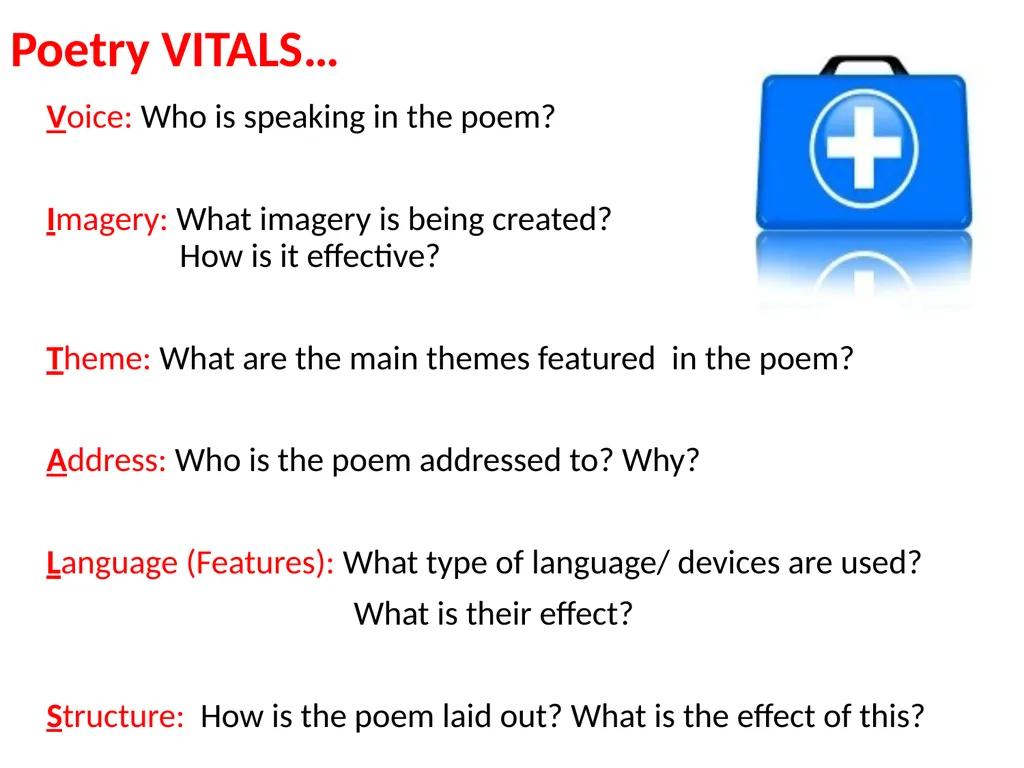
Poetry VITALS… Voice: Who is speaking in the poem?
Imagery: What imagery is being created? How is it effective?
Theme: What are the main themes featured in the poem?
Address: Who is the poem addressed to? Why?
Language (Features): What type of language/ devices are used?
What is their effect?
Structure: How is the poem laid out? What is the effect of this?<br>
Imagery: What imagery is being created? How is it effective?
Theme: What are the main themes featured in the poem?
Address: Who is the poem addressed to? Why?
Language (Features): What type of language/ devices are used?
What is their effect?
Structure: How is the poem laid out? What is the effect of this?<br>
21
Learning Objective
To compare ‘The Emigree’ to ‘London’<br>
22
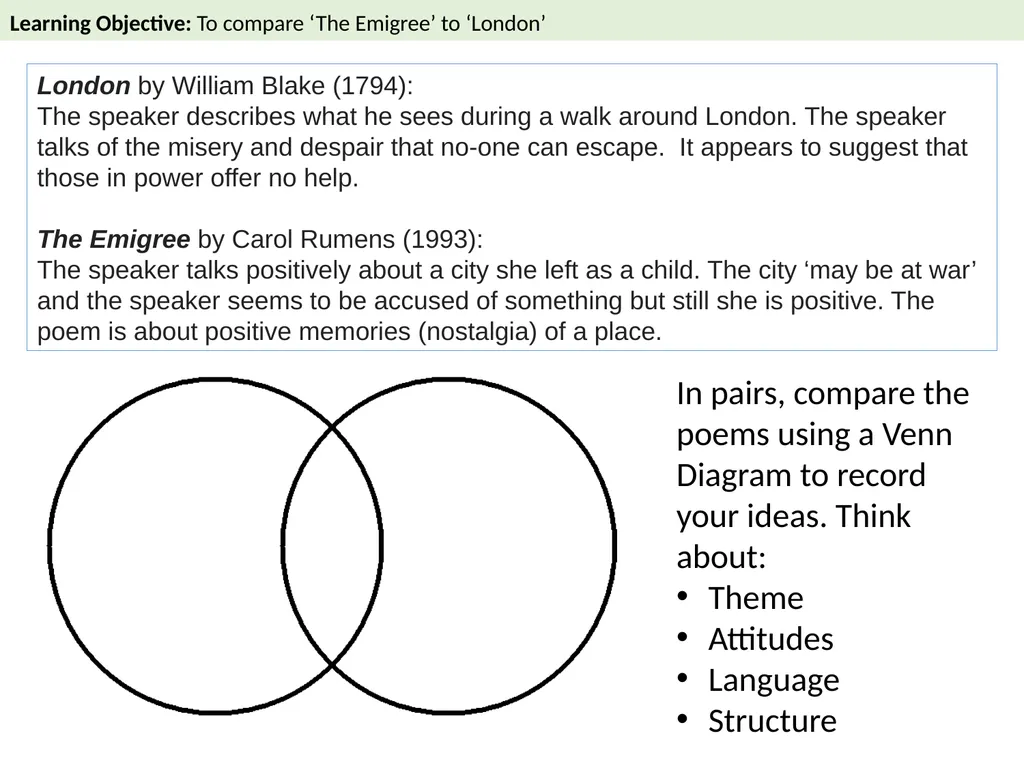
Learning Objective: To compare ‘The Emigree’ to ‘London’ London by William Blake (1794):
The speaker describes what he sees during a walk around London. The speaker talks of the misery and despair that no-one can escape. It appears to suggest that those in power offer no help.
The Emigree by Carol Rumens (1993):
The speaker talks positively about a city she left as a child. The city ‘may be at war’ and the speaker seems to be accused of something but still she is positive. The poem is about positive memories (nostalgia) of a place. In pairs, compare the poems using a Venn Diagram to record your ideas. Think about:
Theme
Attitudes
Language
Structure<br>
The speaker describes what he sees during a walk around London. The speaker talks of the misery and despair that no-one can escape. It appears to suggest that those in power offer no help.
The Emigree by Carol Rumens (1993):
The speaker talks positively about a city she left as a child. The city ‘may be at war’ and the speaker seems to be accused of something but still she is positive. The poem is about positive memories (nostalgia) of a place. In pairs, compare the poems using a Venn Diagram to record your ideas. Think about:
Theme
Attitudes
Language
Structure<br>
23
Learning Objective: To compare ‘The Emigree’ to ‘London’ Suggestions for comparison:
London: sees the place. The Emigree: recalls the place from memory.
Imagery: contrast between the poems of positive in Emigree, ‘sunlight’ and ‘white streets’ compared with the negative of London, ‘woe’, ‘black’ning’ and ‘blood’.
Contrast and oxymorons: contrast of innocence and corruption in London, and conflict and nostalgia in Emigree.
Dramatic monologue of London and first-person in The Emigree.
Use of children in both poems.
Key images.
Enjambment, rhythm and structure in both poems.<br>
London: sees the place. The Emigree: recalls the place from memory.
Imagery: contrast between the poems of positive in Emigree, ‘sunlight’ and ‘white streets’ compared with the negative of London, ‘woe’, ‘black’ning’ and ‘blood’.
Contrast and oxymorons: contrast of innocence and corruption in London, and conflict and nostalgia in Emigree.
Dramatic monologue of London and first-person in The Emigree.
Use of children in both poems.
Key images.
Enjambment, rhythm and structure in both poems.<br>
24
Compare the ways poets present places in ‘London’ and ‘The Emigree’.<br>
25
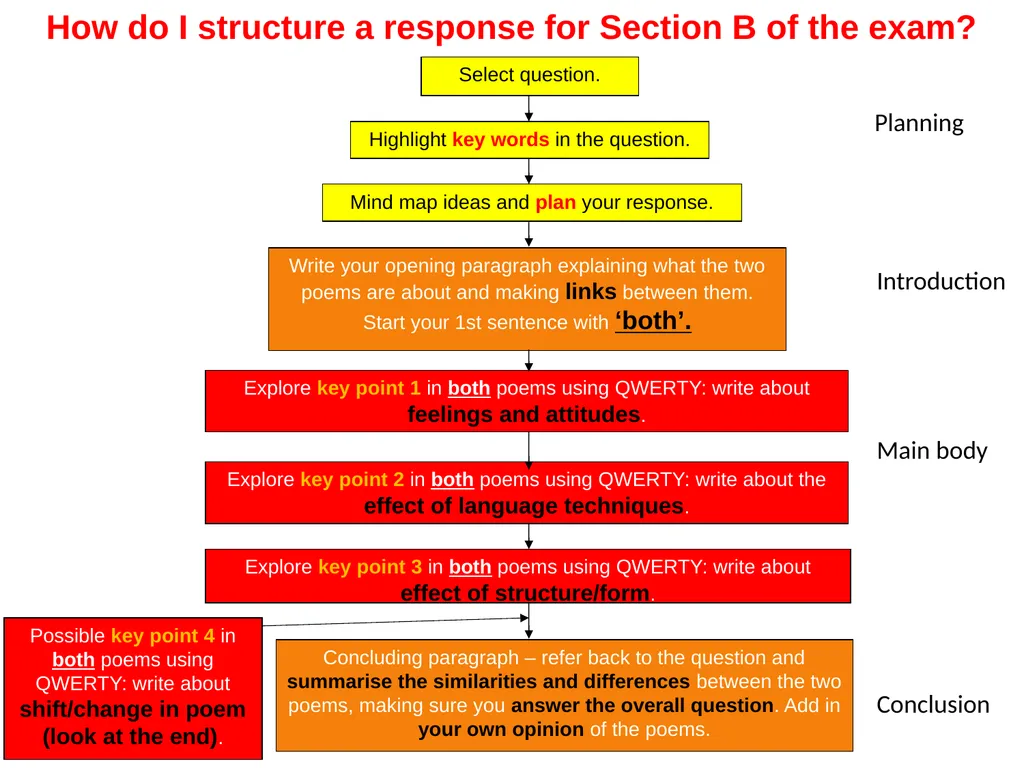
Select question. Highlight key words in the question. Mind map ideas and plan your response. Write your opening paragraph explaining what the two poems are about and making links between them. Start your 1st sentence with ‘both’. Explore key point 1 in both poems using QWERTY: write about feelings and attitudes. Explore key point 2 in both poems using QWERTY: write about the effect of language techniques. Concluding paragraph – refer back to the question and summarise the similarities and differences between the two poems, making sure you answer the overall question. Add in your own opinion of the poems. Explore key point 3 in both poems using QWERTY: write about effect of structure/form. How do I structure a response for Section B of the exam? Planning Introduction Main body Conclusion Possible key point 4 in both poems using QWERTY: write about shift/change in poem (look at the end).<br>
26
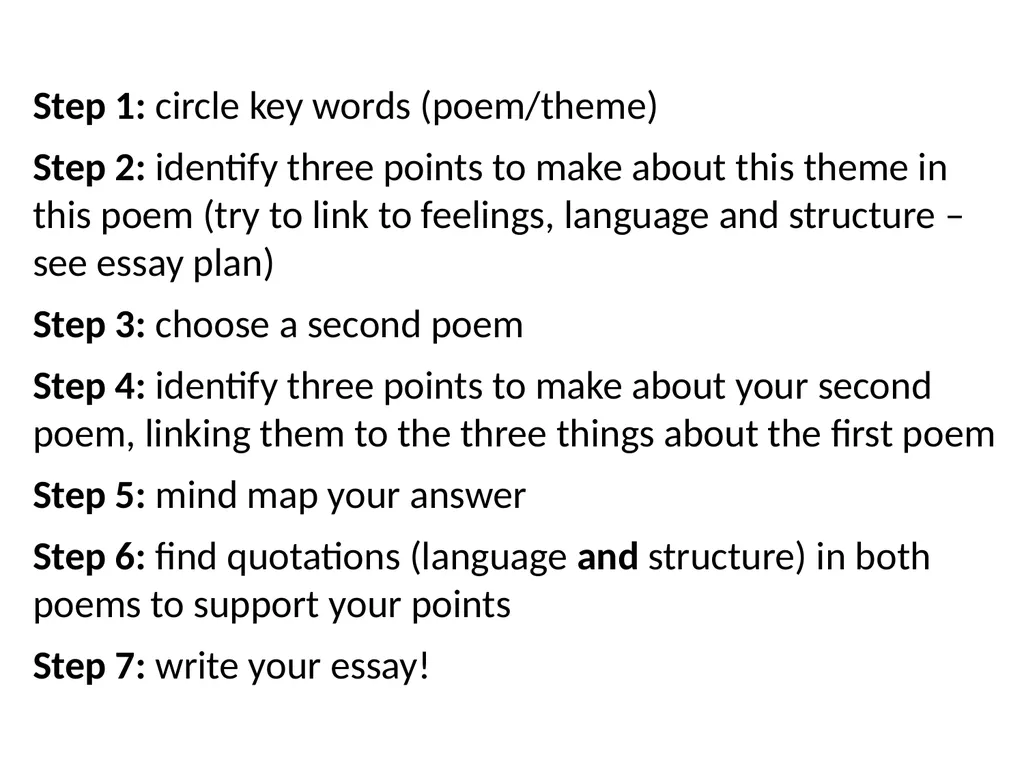
Step 1: circle key words (poem/theme)
Step 2: identify three points to make about this theme in this poem (try to link to feelings, language and structure – see essay plan)
Step 3: choose a second poem
Step 4: identify three points to make about your second poem, linking them to the three things about the first poem
Step 5: mind map your answer
Step 6: find quotations (language and structure) in both poems to support your points
Step 7: write your essay!<br>
Step 2: identify three points to make about this theme in this poem (try to link to feelings, language and structure – see essay plan)
Step 3: choose a second poem
Step 4: identify three points to make about your second poem, linking them to the three things about the first poem
Step 5: mind map your answer
Step 6: find quotations (language and structure) in both poems to support your points
Step 7: write your essay!<br>
27
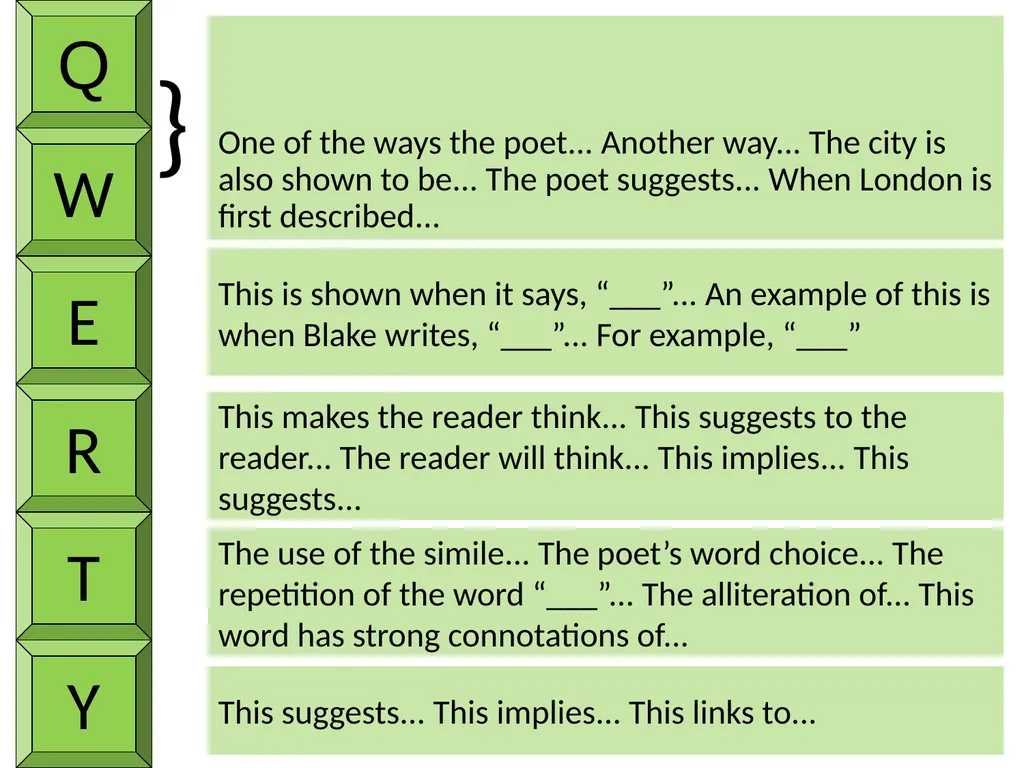
One of the ways the poet... Another way... The city is also shown to be... The poet suggests... When London is first described... Q W E R T Y } This is shown when it says, “___”... An example of this is when Blake writes, “___”... For example, “___” This makes the reader think... This suggests to the reader... The reader will think... This implies... This suggests... The use of the simile... The poet’s word choice... The repetition of the word “___”... The alliteration of... This word has strong connotations of... This suggests... This implies... This links to...<br>
28
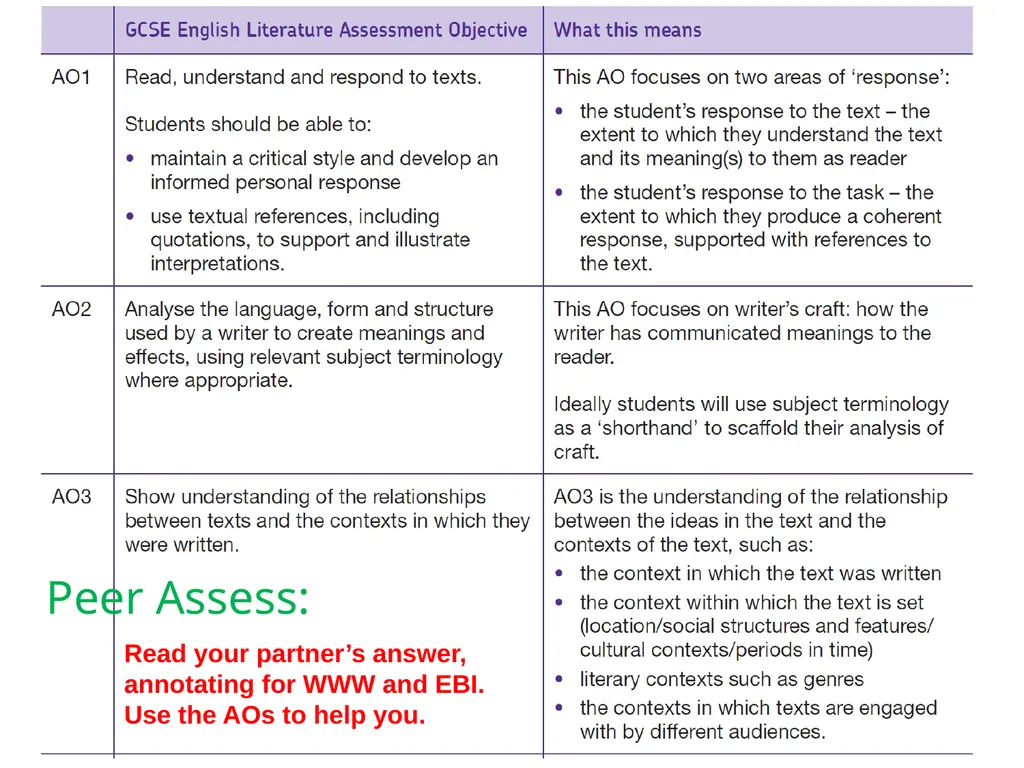
Peer Assess: Read your partner’s answer, annotating for WWW and EBI. Use the AOs to help you.<br>