
The End Times: Revelation Trinity Presbyterian

Description: The End Times: Revelation Trinity Presbyterian Church (PCA) Adult Sunday School Fall 2016 Revelation 20:1-10 Then I saw an angel coming down from heaven, holding in his hand the key to the bottomless pit and a great chain. 2 And he seized
Related Topics
Download Presentation
"The End Times: Revelation Trinity Presbyterian" is the property of its rightful owner. Permission is granted to download and print the materials on this website for personal, non-commercial use only, and to display it on your personal computer provided you do not modify the materials and that you retain all copyright notices contained in the materials. By downloading content from our website, you accept the terms of this agreement.
Presentation Transcript
slide1. The End Times: Revelation Trinity Presbyterian Church (PCA)
Adult Sunday School
Fall 2016<br>
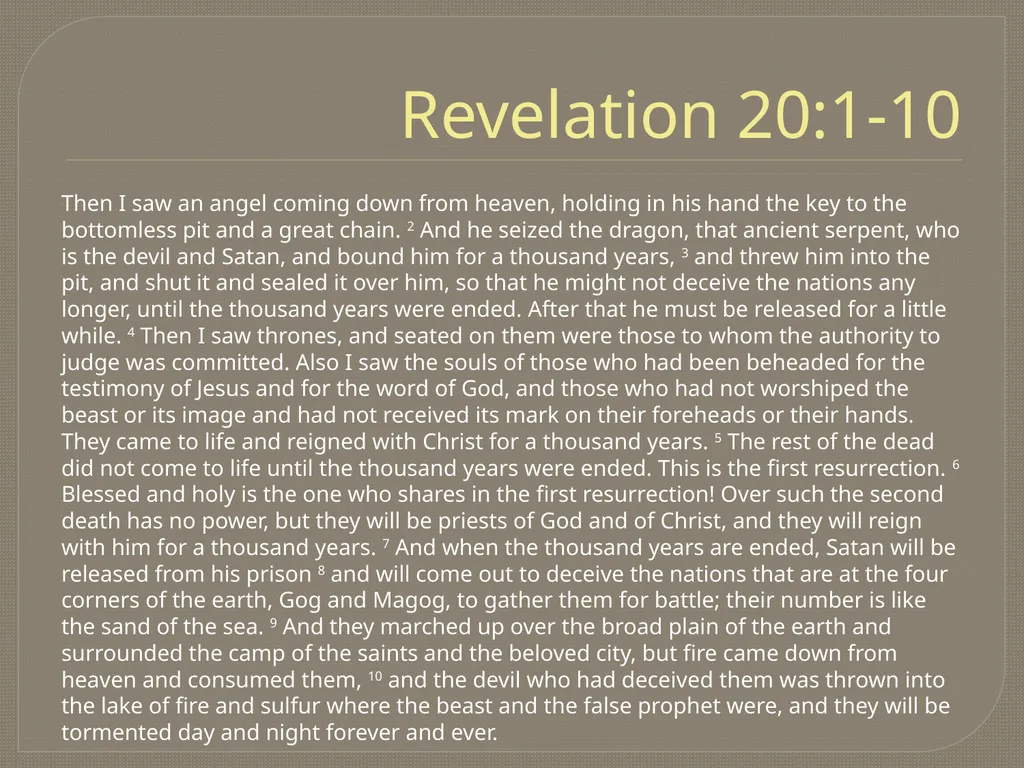
slide2. Revelation 20:1-10 Then I saw an angel coming down from heaven, holding in his hand the key to the bottomless pit and a great chain. 2 And he seized the dragon, that ancient serpent, who is the devil and Satan, and bound him for a thousand years, 3 and threw him into the pit, and shut it and sealed it over him, so that he might not deceive the nations any longer, until the thousand years were ended. After that he must be released for a little while. 4 Then I saw thrones, and seated on them were those to whom the authority to judge was committed. Also I saw the souls of those who had been beheaded for the testimony of Jesus and for the word of God, and those who had not worshiped the beast or its image and had not received its mark on their foreheads or their hands. They came to life and reigned with Christ for a thousand years. 5 The rest of the dead did not come to life until the thousand years were ended. This is the first resurrection. 6 Blessed and holy is the one who shares in the first resurrection! Over such the second death has no power, but they will be priests of God and of Christ, and they will reign with him for a thousand years. 7 And when the thousand years are ended, Satan will be released from his prison 8 and will come out to deceive the nations that are at the four corners of the earth, Gog and Magog, to gather them for battle; their number is like the sand of the sea. 9 And they marched up over the broad plain of the earth and surrounded the camp of the saints and the beloved city, but fire came down from heaven and consumed them, 10 and the devil who had deceived them was thrown into the lake of fire and sulfur where the beast and the false prophet were, and they will be tormented day and night forever and ever.<br>
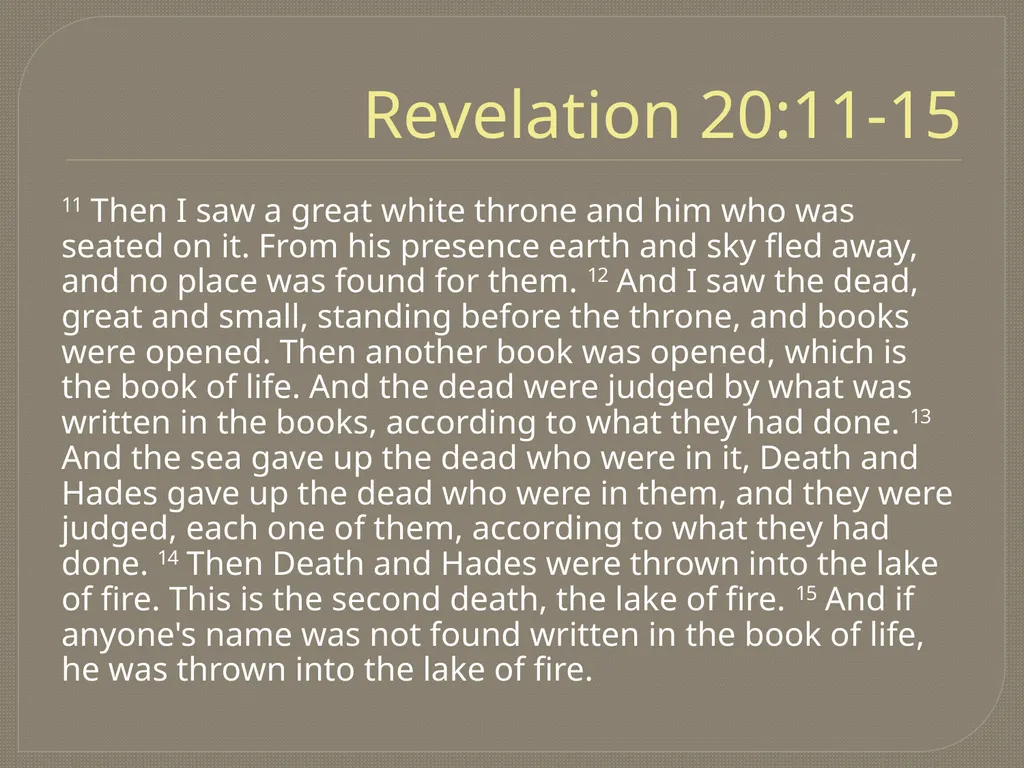
slide3. Revelation 20:11-15 11 Then I saw a great white throne and him who was seated on it. From his presence earth and sky fled away, and no place was found for them. 12 And I saw the dead, great and small, standing before the throne, and books were opened. Then another book was opened, which is the book of life. And the dead were judged by what was written in the books, according to what they had done. 13 And the sea gave up the dead who were in it, Death and Hades gave up the dead who were in them, and they were judged, each one of them, according to what they had done. 14 Then Death and Hades were thrown into the lake of fire. This is the second death, the lake of fire. 15 And if anyone's name was not found written in the book of life, he was thrown into the lake of fire.<br>
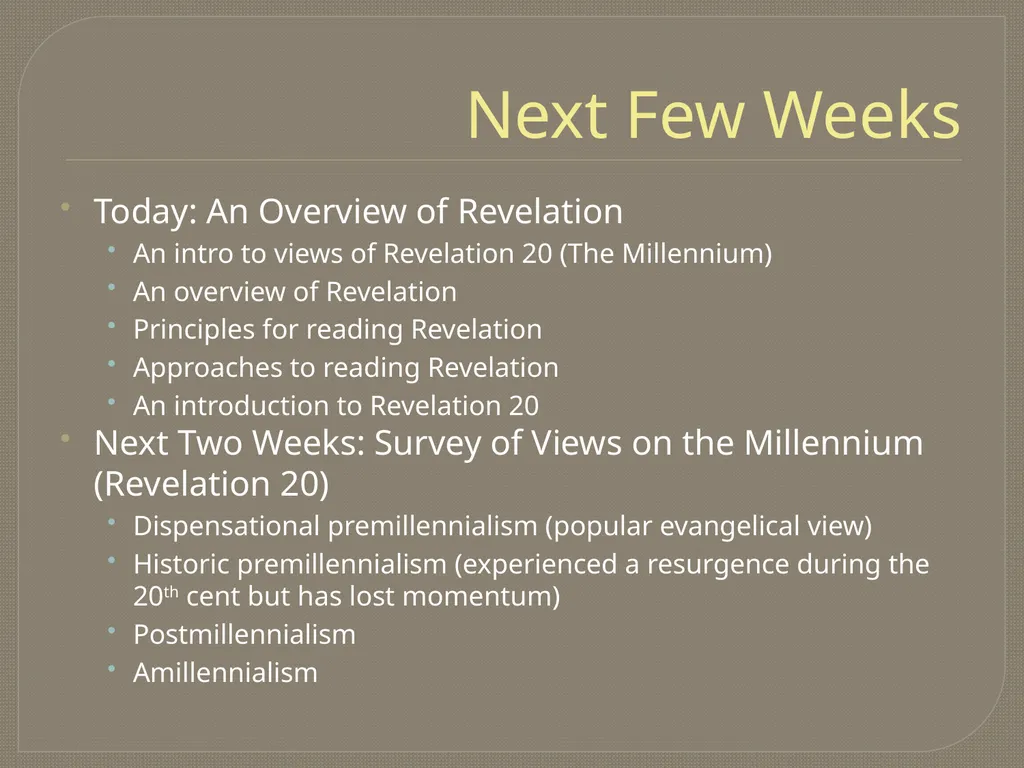
slide4. Next Few Weeks Today: An Overview of Revelation
An intro to views of Revelation 20 (The Millennium)
An overview of Revelation
Principles for reading Revelation
Approaches to reading Revelation
An introduction to Revelation 20
Next Two Weeks: Survey of Views on the Millennium (Revelation 20)
Dispensational premillennialism (popular evangelical view)
Historic premillennialism (experienced a resurgence during the 20th cent but has lost momentum)
Postmillennialism
Amillennialism<br>
slide5. Brief Overview of Views on Revelation 20 Premillennialism
Principle 1: “The symbols and numbers of Revelation 20 must be interpreted literally unless the text clearly indicates otherwise.” (John Walvoord)
When John says Satan is bound, he means Satan is literally somehow physically restrained
When John says Satan is bound for 1,000 years, he means a literal 1,000 years
Problem: fails to take the genre of Rev 20 into account (apocalyptic)
Principle 2: What is depicted in Revelation 20 is yet future; it will not occur until after the return of Christ and the “first resurrection” (see handout)
Revelation 19-20 are read chronologically : Rev 19 talks about the return of Christ, so Rev 20 is after the second coming<br>
slide6. Brief Overview of Views on Revelation 20 Postmillennialism
Like the premillennialist, postmillennialists believe the 1,000 year reign of Christ is yet future
At some point in this current age there will be a tremendous expansion of Christianity, there will be peace on the earth, and a large number of ethnic Jews will trust in Christ<br>
slide7. Brief Overview of Views on Revelation 20 Amillennialism
The Millennium (1,000 year reign of Christ) is a symbolic time between Christ’s first and second coming; Rev 20 is describing the time between the first and second coming of Christ
The Millennium is not future; it’s a present reality<br>
slide8. Brief Outline of Revelation (Charles Hill) First Vision: The Son of Man (1:9-3:22)
The seven letters to the churches
Second Vision: The Lamb Inaugurates His Heavenly Reign (4:1-16:21)
Sevens seals, sevens trumpets, seven bowls
Third Vision: The Judgement of Babylon (17:1-21:8)
Fourth Vision: The Descent of the Bride (21:9-22:8)<br>
slide9. A More Detailed Outline (Derek Thomas) 1. Chapters 1-3: John sees the risen, glorified Christ walking in the midst of seven golden lampstands. Letters are written to seven churches in Asia Minor. The issues referred to in these letters are issues contemporary with the time when the book was first written. But they have application for the entire period, up to our time and beyond. This will be true of the entire book of Revelation.
2. Chapters 4-7: John is caught up to heaven and sees God sitting on his throne. He sees the Lamb which had been slain taking the scroll with its seven seals from the hand of the one sitting on the throne. As the victorious Lamb, he has power to open the seals and as he does so, various judgments on the world are described. At 6:15-17 there is a reference to the final judgment and in 7:15-17 a description of the final blessedness.
3.Chapters 8-11 [repeat]: Seven trumpets of judgment. The church is avenged, protected and victorious. The section ends with a reference to the final judgment at 11:18.
4. Chapters 12-14: [repeat] a woman giving birth to a son while the dragon waits to devour him as soon as he is born – a reference to the birth of Christ. The rest describes a continued opposition of the dragon to the church. A final judgment scene ends this section at 14:14-15.
5. Chapters 15-16 [repeat]: Seven bowls of judgment. Final judgment scene at 16:19-20.
6. Chapters 17-19 [repeat]: Fall of Babylon, Beast of the Earth and Beast of the Sea. 19:11 describes the Second Coming followed at 19:19-20 by a description of the final judgment.
7. Chapters 20-22: the doom of the Dragon completing the description of the overthrow of Christ’s enemies. In this view, the final judgment is described at 20:11-12, 14-15.<br>
slide10. Some Conclusions The book of Revelation uses a principle of repetition (progressive parallelism)
Example: Revelation 11:18-19 (description of final judgment); Revelation 12 (the time of the incarnation)
There is a progressive repetitive cycle in the book that describes all of history from the time of Jesus’ first to second coming.
It includes events that were present in John’s time as well as events that will continue to occur until the return of Christ
Each cycle progressive reveals more until the book reaches its climatic conclusion with the final judgment and consummation
The book of Revelation should not be read as strictly chronological history<br>
slide11. Principles for Reading Revelation Revelation Is Given to Reveal and Bless Its Readers
Our starting point should be confidence that God has given this book not to confuse or divide his people but to give us light, to reveal to us the invisible realities that explain events experienced by the church in the world
Revelation 1:1-3: The revelation of Jesus Christ, which God gave him to show to his servants the things that must soon take place. He made it known by sending his angel to his servant John, 2 who bore witness to the word of God and to the testimony of Jesus Christ, even to all that he saw. 3 Blessed is the one who reads aloud the words of this prophecy, and blessed are those who hear, and who keep what is written in it, for the time is near.
Revelation (apocalypsis) – removal of a veil
By hearing the message of Revelation and taking it to heart, the church was to receive comfort, encouragement, and correction.<br>
slide12. Principles for Reading Revelation Revelation Is a Book to Be Seen
John is describing what he “saw” (52x with John as subject)
Revelation paints vivid symbolic pictures of spiritual realities on earth and in heaven
Revelation is apocalyptic in genre (though it includes prophecy and epistles)
The symbols disclose the true identity of the church, its enemies, and its Champion, King Jesus
Apocalyptic symbols shouldn’t be read in a “wooden” way (a literal dragon or harlot), but as vivid pictures that tell us something real about individuals, events, and institutions.<br>
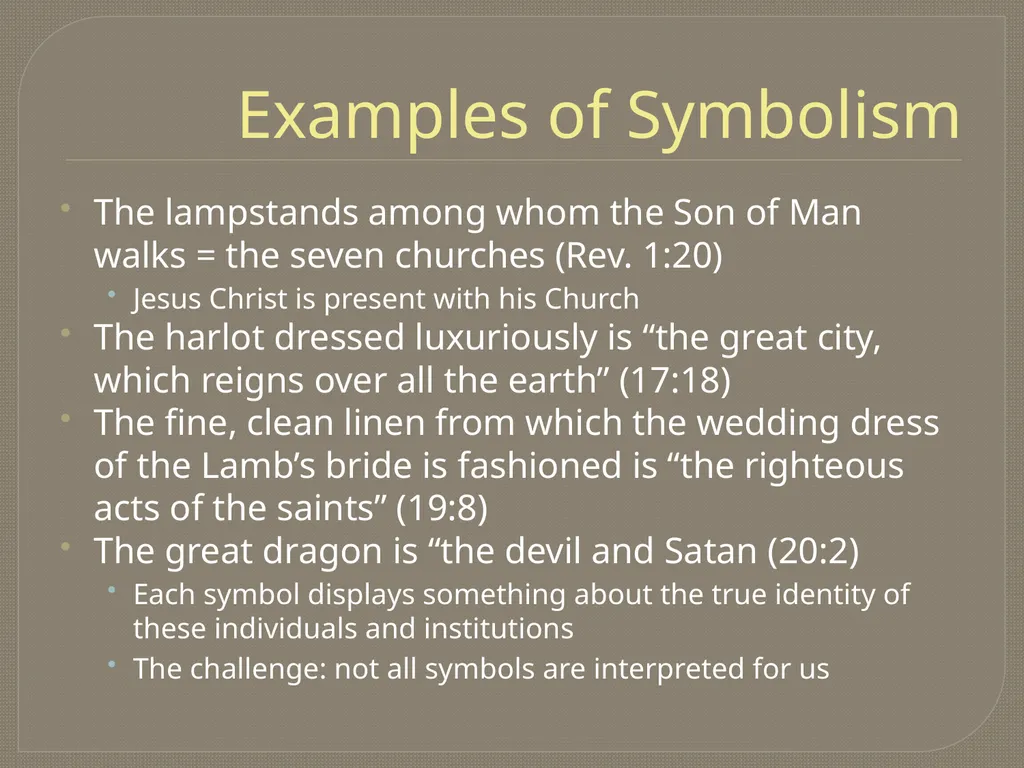
slide13. Examples of Symbolism The lampstands among whom the Son of Man walks = the seven churches (Rev. 1:20)
Jesus Christ is present with his Church
The harlot dressed luxuriously is “the great city, which reigns over all the earth” (17:18)
The fine, clean linen from which the wedding dress of the Lamb’s bride is fashioned is “the righteous acts of the saints” (19:8)
The great dragon is “the devil and Satan (20:2)
Each symbol displays something about the true identity of these individuals and institutions
The challenge: not all symbols are interpreted for us<br>
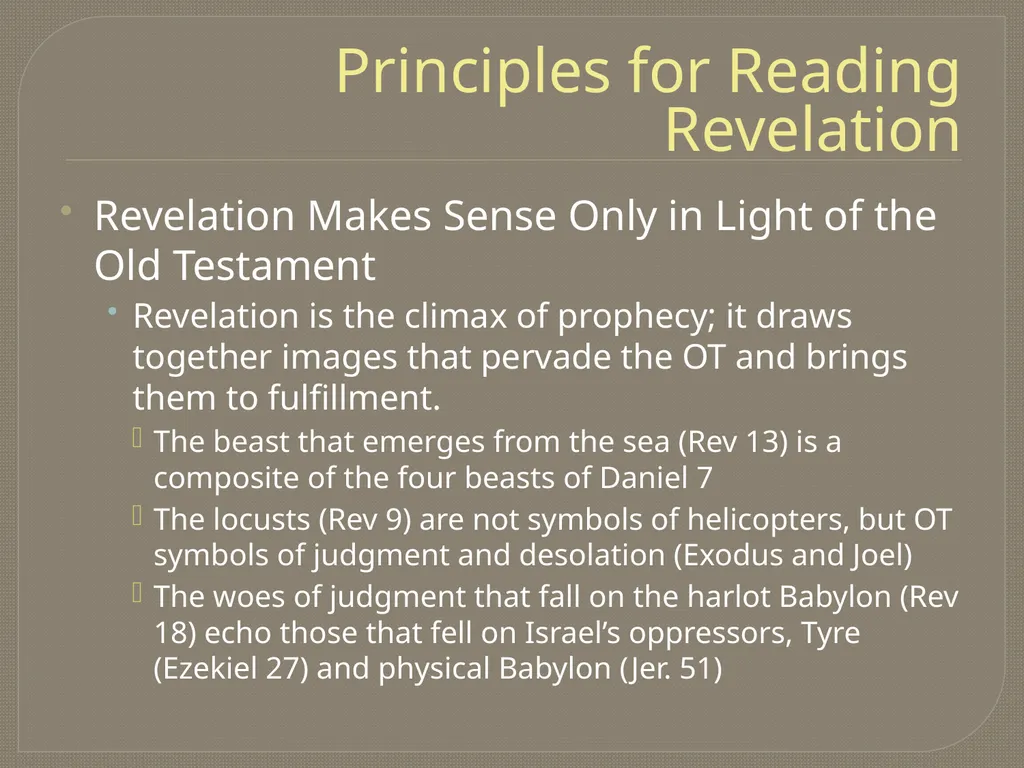
slide14. Principles for Reading Revelation Revelation Makes Sense Only in Light of the Old Testament
Revelation is the climax of prophecy; it draws together images that pervade the OT and brings them to fulfillment.
The beast that emerges from the sea (Rev 13) is a composite of the four beasts of Daniel 7
The locusts (Rev 9) are not symbols of helicopters, but OT symbols of judgment and desolation (Exodus and Joel)
The woes of judgment that fall on the harlot Babylon (Rev 18) echo those that fell on Israel’s oppressors, Tyre (Ezekiel 27) and physical Babylon (Jer. 51)<br>
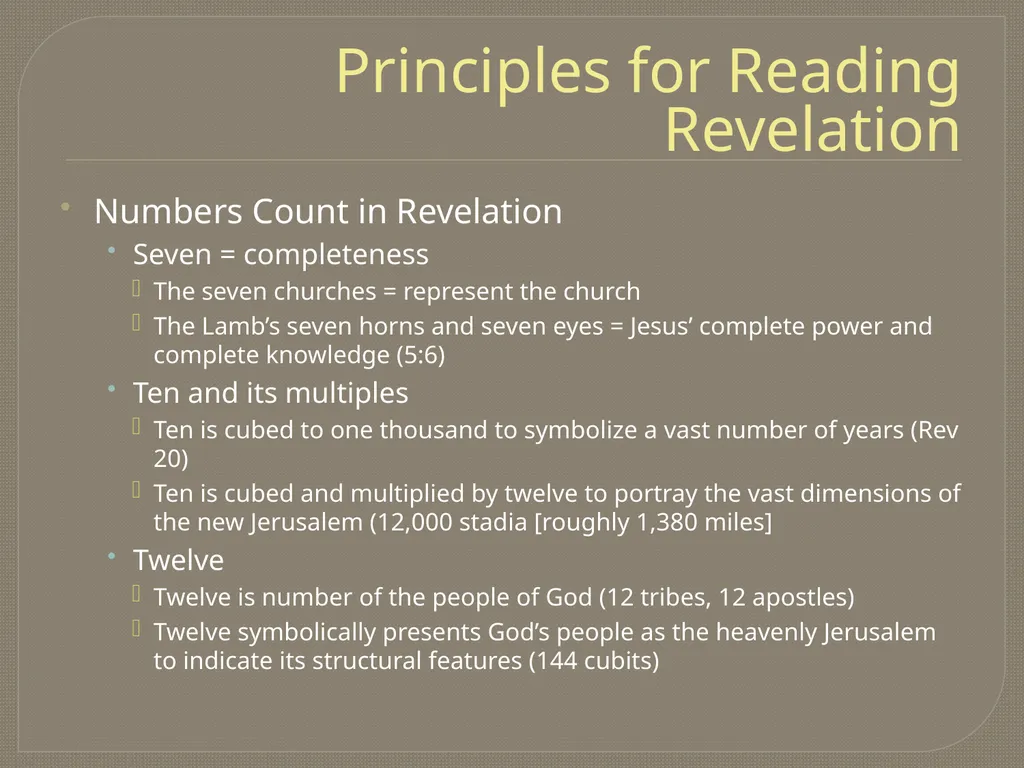
slide15. Principles for Reading Revelation Numbers Count in Revelation
Seven = completeness
The seven churches = represent the church
The Lamb’s seven horns and seven eyes = Jesus’ complete power and complete knowledge (5:6)
Ten and its multiples
Ten is cubed to one thousand to symbolize a vast number of years (Rev 20)
Ten is cubed and multiplied by twelve to portray the vast dimensions of the new Jerusalem (12,000 stadia [roughly 1,380 miles]
Twelve
Twelve is number of the people of God (12 tribes, 12 apostles)
Twelve symbolically presents God’s people as the heavenly Jerusalem to indicate its structural features (144 cubits)<br>
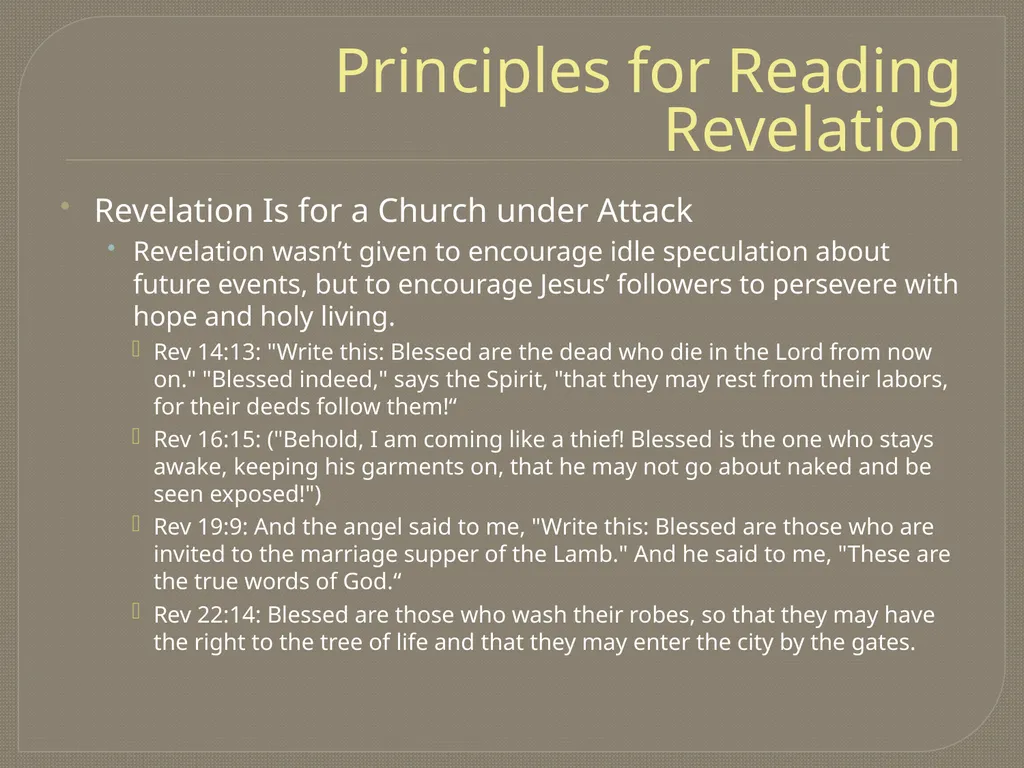
slide16. Principles for Reading Revelation Revelation Is for a Church under Attack
Revelation wasn’t given to encourage idle speculation about future events, but to encourage Jesus’ followers to persevere with hope and holy living.
Rev 14:13: "Write this: Blessed are the dead who die in the Lord from now on." "Blessed indeed," says the Spirit, "that they may rest from their labors, for their deeds follow them!“
Rev 16:15: ("Behold, I am coming like a thief! Blessed is the one who stays awake, keeping his garments on, that he may not go about naked and be seen exposed!")
Rev 19:9: And the angel said to me, "Write this: Blessed are those who are invited to the marriage supper of the Lamb." And he said to me, "These are the true words of God.“
Rev 22:14: Blessed are those who wash their robes, so that they may have the right to the tree of life and that they may enter the city by the gates.<br>
slide17. Principles for Reading Revelation The Victory Belongs to God and to His Christ
The big pattern: conflict to victory
Despite evil’s powers, God triumphs through the Lamb.<br>
slide18. Approaches to Reading Revelation Four major approaches to reading Revelation
Futurism
Preterism
Historicism
Idealism<br>
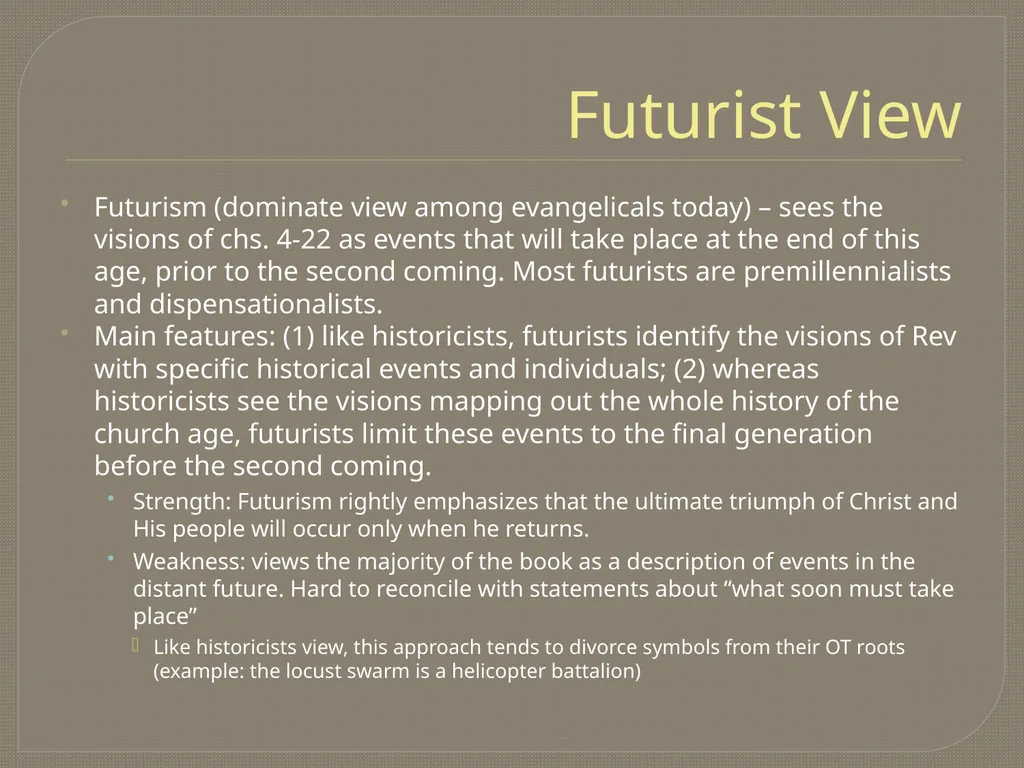
slide19. Futurist View Futurism (dominate view among evangelicals today) – sees the visions of chs. 4-22 as events that will take place at the end of this age, prior to the second coming. Most futurists are premillennialists and dispensationalists.
Main features: (1) like historicists, futurists identify the visions of Rev with specific historical events and individuals; (2) whereas historicists see the visions mapping out the whole history of the church age, futurists limit these events to the final generation before the second coming.
Strength: Futurism rightly emphasizes that the ultimate triumph of Christ and His people will occur only when he returns.
Weakness: views the majority of the book as a description of events in the distant future. Hard to reconcile with statements about “what soon must take place”
Like historicists view, this approach tends to divorce symbols from their OT roots (example: the locust swarm is a helicopter battalion)<br>
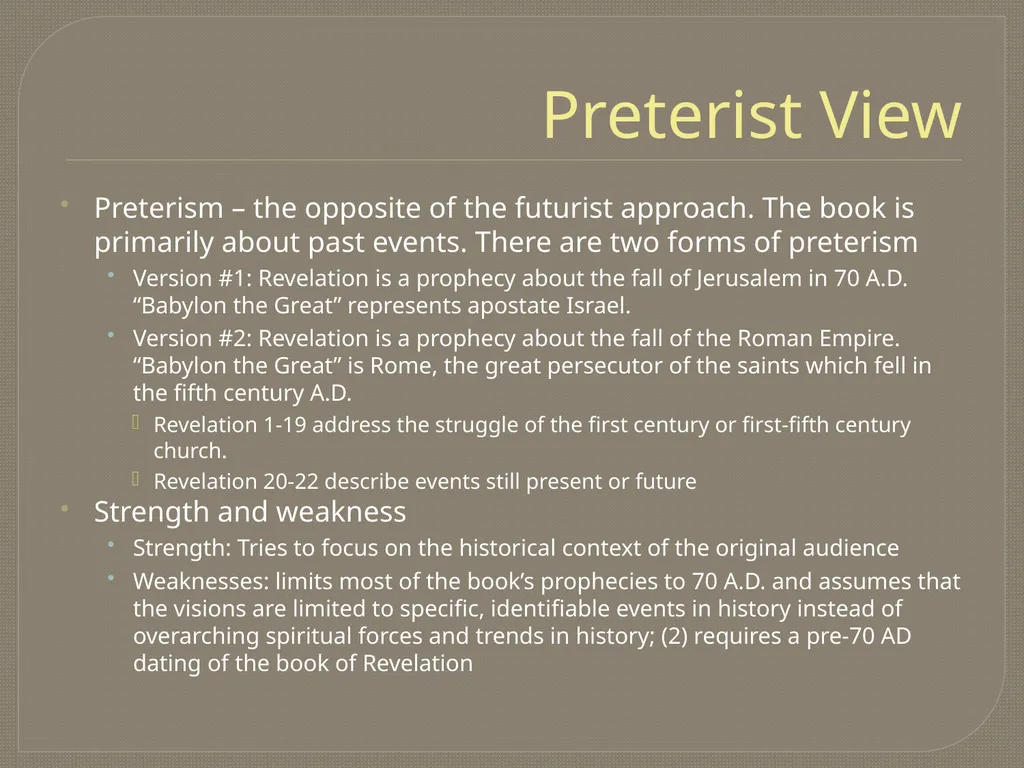
slide20. Preterist View Preterism – the opposite of the futurist approach. The book is primarily about past events. There are two forms of preterism
Version #1: Revelation is a prophecy about the fall of Jerusalem in 70 A.D. “Babylon the Great” represents apostate Israel.
Version #2: Revelation is a prophecy about the fall of the Roman Empire. “Babylon the Great” is Rome, the great persecutor of the saints which fell in the fifth century A.D.
Revelation 1-19 address the struggle of the first century or first-fifth century church.
Revelation 20-22 describe events still present or future
Strength and weakness
Strength: Tries to focus on the historical context of the original audience
Weaknesses: limits most of the book’s prophecies to 70 A.D. and assumes that the visions are limited to specific, identifiable events in history instead of overarching spiritual forces and trends in history; (2) requires a pre-70 AD dating of the book of Revelation<br>
slide21. Historicist View Historicism – events portrayed symbolically in Revelation point to a sequence of specific chronological events that will occur in history between the first and second coming of Christ
Examples: during the Middle Ages the emergence of the beast from the sea was identified with the rise of Islam (Rev. 13) Protestant Reformers: Pope is the Antichrist and the Roman Catholic Church is the harlot of Babylon;
Two main features: (1) visions are read as chronological events unfolding in history; (2) the visions correspond to specific events and individuals
Strength and weakness
Strength: visions of Revelation do refer to events that were happening at the time of its original writing and throughout the history of the church until Christ returns
Weakness: assumes that the visions of Revelation should be read as a series of chronological events rather than pictures of the same events from different perspectives<br>
slide22. Idealist View Idealism (Iterism) – Revelation symbolically portrays events throughout history between the first and second coming of Christ, not limiting the visions to specific individuals or events.
Example: Whereas historicists, preterists and futurists identify the harlot Babylon in Rev 17 with an historical, first century, or end-time figure, idealists argue that Babylon symbolizes a variety of political and religious forms opposition to the church and the gospel between the first and second coming of Christ.
Revelation gives multiple images that provide different perspectives on the same great warfare, sometimes in terms of behind-the-scenes heavenly sources and at other times in terms of their visible, earthly outworking in the experience of churches, countries, and cultures.<br>
slide23. Idealist View cont. Main features: (1) Recognizes that Revelation was written to encourage the early church in its struggles of persecution; (2) also maintains that the letters to the churches and visions reflect circumstances that characterize the entire church age from Christ’s first coming until his return<br>
slide24. The Millennium: Revelation 20 What does the binding of Satan mean?
When does the binding of Satan take place? Do other passages of Scripture help us here?
What is the rule of the saints? From where do they rule?
What is the first resurrection?<br>
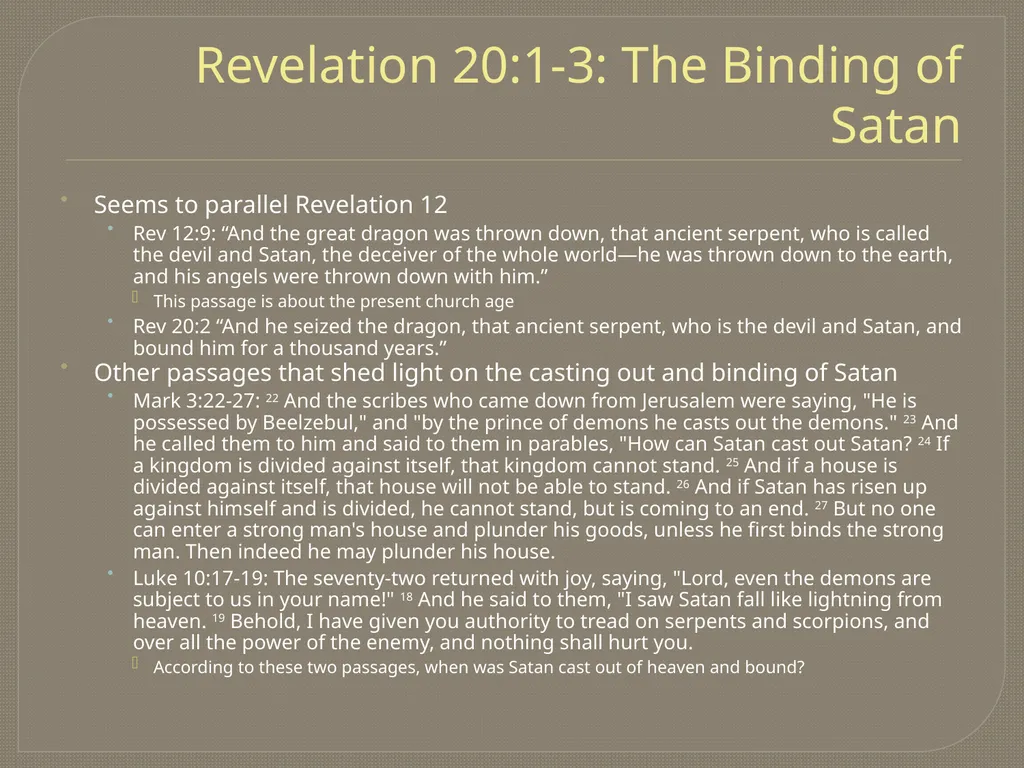
slide25. Revelation 20:1-3: The Binding of Satan Seems to parallel Revelation 12
Rev 12:9: “And the great dragon was thrown down, that ancient serpent, who is called the devil and Satan, the deceiver of the whole world—he was thrown down to the earth, and his angels were thrown down with him.”
This passage is about the present church age
Rev 20:2 “And he seized the dragon, that ancient serpent, who is the devil and Satan, and bound him for a thousand years.”
Other passages that shed light on the casting out and binding of Satan
Mark 3:22-27: 22 And the scribes who came down from Jerusalem were saying, "He is possessed by Beelzebul," and "by the prince of demons he casts out the demons." 23 And he called them to him and said to them in parables, "How can Satan cast out Satan? 24 If a kingdom is divided against itself, that kingdom cannot stand. 25 And if a house is divided against itself, that house will not be able to stand. 26 And if Satan has risen up against himself and is divided, he cannot stand, but is coming to an end. 27 But no one can enter a strong man's house and plunder his goods, unless he first binds the strong man. Then indeed he may plunder his house.
Luke 10:17-19: The seventy-two returned with joy, saying, "Lord, even the demons are subject to us in your name!" 18 And he said to them, "I saw Satan fall like lightning from heaven. 19 Behold, I have given you authority to tread on serpents and scorpions, and over all the power of the enemy, and nothing shall hurt you.
According to these two passages, when was Satan cast out of heaven and bound?<br>
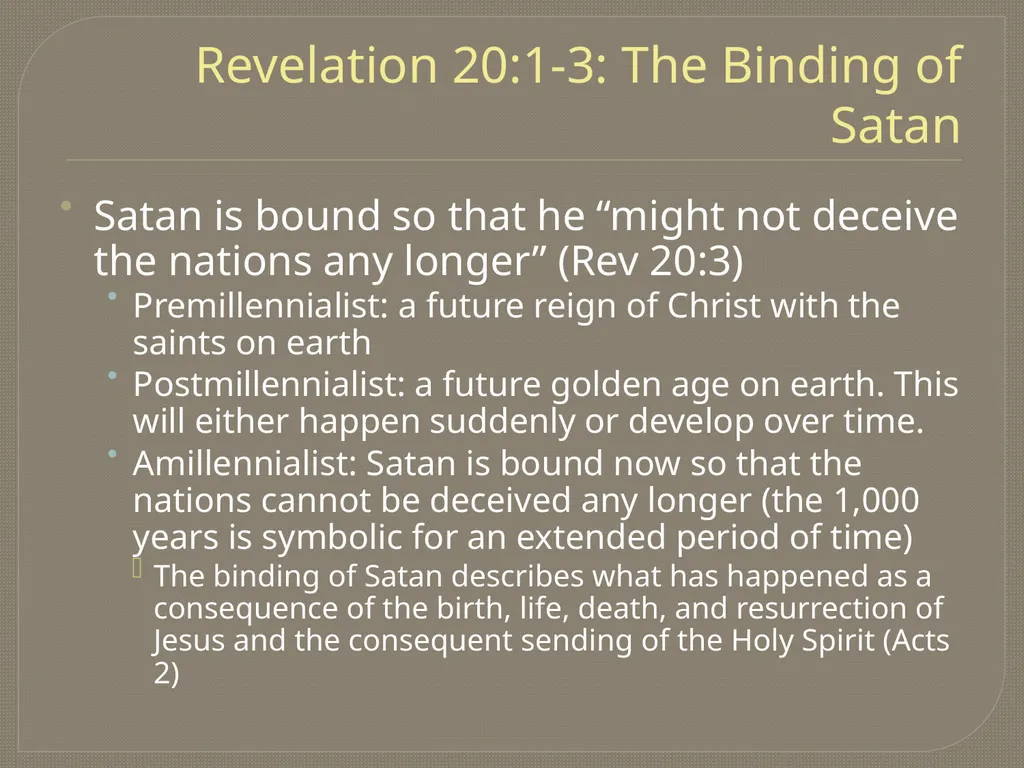
slide26. Revelation 20:1-3: The Binding of Satan Satan is bound so that he “might not deceive the nations any longer” (Rev 20:3)
Premillennialist: a future reign of Christ with the saints on earth
Postmillennialist: a future golden age on earth. This will either happen suddenly or develop over time.
Amillennialist: Satan is bound now so that the nations cannot be deceived any longer (the 1,000 years is symbolic for an extended period of time)
The binding of Satan describes what has happened as a consequence of the birth, life, death, and resurrection of Jesus and the consequent sending of the Holy Spirit (Acts 2)<br>
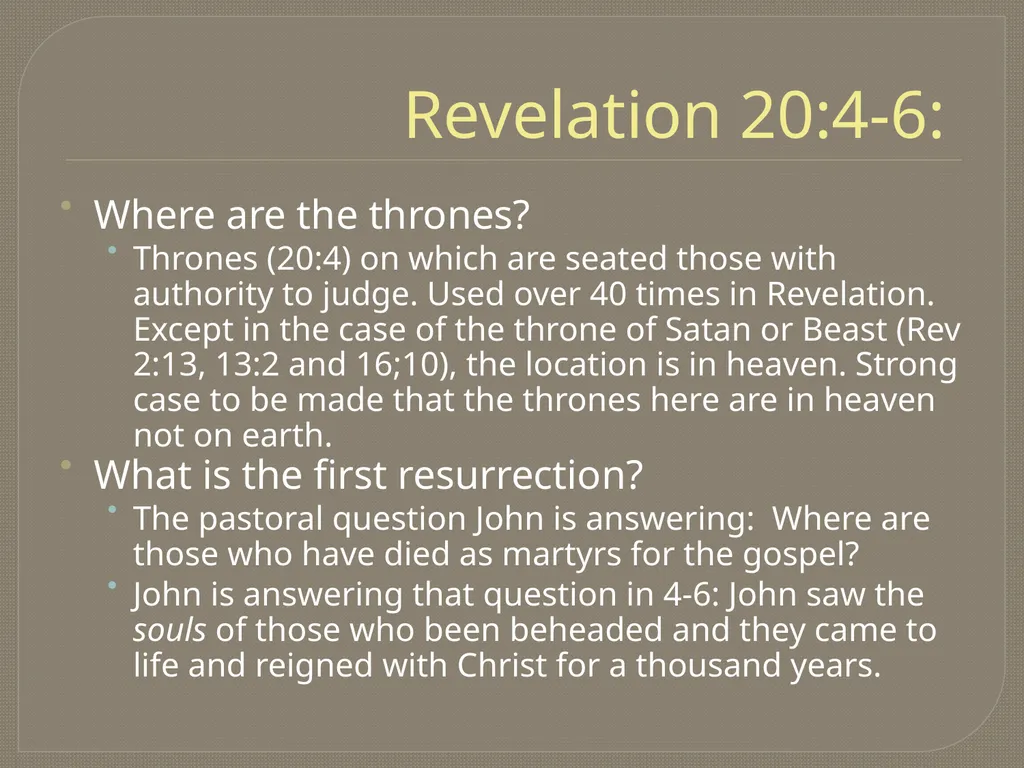
slide27. Revelation 20:4-6: Where are the thrones?
Thrones (20:4) on which are seated those with authority to judge. Used over 40 times in Revelation. Except in the case of the throne of Satan or Beast (Rev 2:13, 13:2 and 16;10), the location is in heaven. Strong case to be made that the thrones here are in heaven not on earth.
What is the first resurrection?
The pastoral question John is answering: Where are those who have died as martyrs for the gospel?
John is answering that question in 4-6: John saw the souls of those who been beheaded and they came to life and reigned with Christ for a thousand years.<br>
slide28. The Purpose of Revelation Revelation delivers to the churches in Asia Minor and to the church in all ages, the triumphant assurance that behind the scenes of history, the kingdom of God is in power, and Jesus Christ the King of kings is on his Father’s throne executing his sovereign judgment over the world.<br>
Adult Sunday School
Fall 2016<br>
slide2. Revelation 20:1-10 Then I saw an angel coming down from heaven, holding in his hand the key to the bottomless pit and a great chain. 2 And he seized the dragon, that ancient serpent, who is the devil and Satan, and bound him for a thousand years, 3 and threw him into the pit, and shut it and sealed it over him, so that he might not deceive the nations any longer, until the thousand years were ended. After that he must be released for a little while. 4 Then I saw thrones, and seated on them were those to whom the authority to judge was committed. Also I saw the souls of those who had been beheaded for the testimony of Jesus and for the word of God, and those who had not worshiped the beast or its image and had not received its mark on their foreheads or their hands. They came to life and reigned with Christ for a thousand years. 5 The rest of the dead did not come to life until the thousand years were ended. This is the first resurrection. 6 Blessed and holy is the one who shares in the first resurrection! Over such the second death has no power, but they will be priests of God and of Christ, and they will reign with him for a thousand years. 7 And when the thousand years are ended, Satan will be released from his prison 8 and will come out to deceive the nations that are at the four corners of the earth, Gog and Magog, to gather them for battle; their number is like the sand of the sea. 9 And they marched up over the broad plain of the earth and surrounded the camp of the saints and the beloved city, but fire came down from heaven and consumed them, 10 and the devil who had deceived them was thrown into the lake of fire and sulfur where the beast and the false prophet were, and they will be tormented day and night forever and ever.<br>
slide3. Revelation 20:11-15 11 Then I saw a great white throne and him who was seated on it. From his presence earth and sky fled away, and no place was found for them. 12 And I saw the dead, great and small, standing before the throne, and books were opened. Then another book was opened, which is the book of life. And the dead were judged by what was written in the books, according to what they had done. 13 And the sea gave up the dead who were in it, Death and Hades gave up the dead who were in them, and they were judged, each one of them, according to what they had done. 14 Then Death and Hades were thrown into the lake of fire. This is the second death, the lake of fire. 15 And if anyone's name was not found written in the book of life, he was thrown into the lake of fire.<br>
slide4. Next Few Weeks Today: An Overview of Revelation
An intro to views of Revelation 20 (The Millennium)
An overview of Revelation
Principles for reading Revelation
Approaches to reading Revelation
An introduction to Revelation 20
Next Two Weeks: Survey of Views on the Millennium (Revelation 20)
Dispensational premillennialism (popular evangelical view)
Historic premillennialism (experienced a resurgence during the 20th cent but has lost momentum)
Postmillennialism
Amillennialism<br>
slide5. Brief Overview of Views on Revelation 20 Premillennialism
Principle 1: “The symbols and numbers of Revelation 20 must be interpreted literally unless the text clearly indicates otherwise.” (John Walvoord)
When John says Satan is bound, he means Satan is literally somehow physically restrained
When John says Satan is bound for 1,000 years, he means a literal 1,000 years
Problem: fails to take the genre of Rev 20 into account (apocalyptic)
Principle 2: What is depicted in Revelation 20 is yet future; it will not occur until after the return of Christ and the “first resurrection” (see handout)
Revelation 19-20 are read chronologically : Rev 19 talks about the return of Christ, so Rev 20 is after the second coming<br>
slide6. Brief Overview of Views on Revelation 20 Postmillennialism
Like the premillennialist, postmillennialists believe the 1,000 year reign of Christ is yet future
At some point in this current age there will be a tremendous expansion of Christianity, there will be peace on the earth, and a large number of ethnic Jews will trust in Christ<br>
slide7. Brief Overview of Views on Revelation 20 Amillennialism
The Millennium (1,000 year reign of Christ) is a symbolic time between Christ’s first and second coming; Rev 20 is describing the time between the first and second coming of Christ
The Millennium is not future; it’s a present reality<br>
slide8. Brief Outline of Revelation (Charles Hill) First Vision: The Son of Man (1:9-3:22)
The seven letters to the churches
Second Vision: The Lamb Inaugurates His Heavenly Reign (4:1-16:21)
Sevens seals, sevens trumpets, seven bowls
Third Vision: The Judgement of Babylon (17:1-21:8)
Fourth Vision: The Descent of the Bride (21:9-22:8)<br>
slide9. A More Detailed Outline (Derek Thomas) 1. Chapters 1-3: John sees the risen, glorified Christ walking in the midst of seven golden lampstands. Letters are written to seven churches in Asia Minor. The issues referred to in these letters are issues contemporary with the time when the book was first written. But they have application for the entire period, up to our time and beyond. This will be true of the entire book of Revelation.
2. Chapters 4-7: John is caught up to heaven and sees God sitting on his throne. He sees the Lamb which had been slain taking the scroll with its seven seals from the hand of the one sitting on the throne. As the victorious Lamb, he has power to open the seals and as he does so, various judgments on the world are described. At 6:15-17 there is a reference to the final judgment and in 7:15-17 a description of the final blessedness.
3.Chapters 8-11 [repeat]: Seven trumpets of judgment. The church is avenged, protected and victorious. The section ends with a reference to the final judgment at 11:18.
4. Chapters 12-14: [repeat] a woman giving birth to a son while the dragon waits to devour him as soon as he is born – a reference to the birth of Christ. The rest describes a continued opposition of the dragon to the church. A final judgment scene ends this section at 14:14-15.
5. Chapters 15-16 [repeat]: Seven bowls of judgment. Final judgment scene at 16:19-20.
6. Chapters 17-19 [repeat]: Fall of Babylon, Beast of the Earth and Beast of the Sea. 19:11 describes the Second Coming followed at 19:19-20 by a description of the final judgment.
7. Chapters 20-22: the doom of the Dragon completing the description of the overthrow of Christ’s enemies. In this view, the final judgment is described at 20:11-12, 14-15.<br>
slide10. Some Conclusions The book of Revelation uses a principle of repetition (progressive parallelism)
Example: Revelation 11:18-19 (description of final judgment); Revelation 12 (the time of the incarnation)
There is a progressive repetitive cycle in the book that describes all of history from the time of Jesus’ first to second coming.
It includes events that were present in John’s time as well as events that will continue to occur until the return of Christ
Each cycle progressive reveals more until the book reaches its climatic conclusion with the final judgment and consummation
The book of Revelation should not be read as strictly chronological history<br>
slide11. Principles for Reading Revelation Revelation Is Given to Reveal and Bless Its Readers
Our starting point should be confidence that God has given this book not to confuse or divide his people but to give us light, to reveal to us the invisible realities that explain events experienced by the church in the world
Revelation 1:1-3: The revelation of Jesus Christ, which God gave him to show to his servants the things that must soon take place. He made it known by sending his angel to his servant John, 2 who bore witness to the word of God and to the testimony of Jesus Christ, even to all that he saw. 3 Blessed is the one who reads aloud the words of this prophecy, and blessed are those who hear, and who keep what is written in it, for the time is near.
Revelation (apocalypsis) – removal of a veil
By hearing the message of Revelation and taking it to heart, the church was to receive comfort, encouragement, and correction.<br>
slide12. Principles for Reading Revelation Revelation Is a Book to Be Seen
John is describing what he “saw” (52x with John as subject)
Revelation paints vivid symbolic pictures of spiritual realities on earth and in heaven
Revelation is apocalyptic in genre (though it includes prophecy and epistles)
The symbols disclose the true identity of the church, its enemies, and its Champion, King Jesus
Apocalyptic symbols shouldn’t be read in a “wooden” way (a literal dragon or harlot), but as vivid pictures that tell us something real about individuals, events, and institutions.<br>
slide13. Examples of Symbolism The lampstands among whom the Son of Man walks = the seven churches (Rev. 1:20)
Jesus Christ is present with his Church
The harlot dressed luxuriously is “the great city, which reigns over all the earth” (17:18)
The fine, clean linen from which the wedding dress of the Lamb’s bride is fashioned is “the righteous acts of the saints” (19:8)
The great dragon is “the devil and Satan (20:2)
Each symbol displays something about the true identity of these individuals and institutions
The challenge: not all symbols are interpreted for us<br>
slide14. Principles for Reading Revelation Revelation Makes Sense Only in Light of the Old Testament
Revelation is the climax of prophecy; it draws together images that pervade the OT and brings them to fulfillment.
The beast that emerges from the sea (Rev 13) is a composite of the four beasts of Daniel 7
The locusts (Rev 9) are not symbols of helicopters, but OT symbols of judgment and desolation (Exodus and Joel)
The woes of judgment that fall on the harlot Babylon (Rev 18) echo those that fell on Israel’s oppressors, Tyre (Ezekiel 27) and physical Babylon (Jer. 51)<br>
slide15. Principles for Reading Revelation Numbers Count in Revelation
Seven = completeness
The seven churches = represent the church
The Lamb’s seven horns and seven eyes = Jesus’ complete power and complete knowledge (5:6)
Ten and its multiples
Ten is cubed to one thousand to symbolize a vast number of years (Rev 20)
Ten is cubed and multiplied by twelve to portray the vast dimensions of the new Jerusalem (12,000 stadia [roughly 1,380 miles]
Twelve
Twelve is number of the people of God (12 tribes, 12 apostles)
Twelve symbolically presents God’s people as the heavenly Jerusalem to indicate its structural features (144 cubits)<br>
slide16. Principles for Reading Revelation Revelation Is for a Church under Attack
Revelation wasn’t given to encourage idle speculation about future events, but to encourage Jesus’ followers to persevere with hope and holy living.
Rev 14:13: "Write this: Blessed are the dead who die in the Lord from now on." "Blessed indeed," says the Spirit, "that they may rest from their labors, for their deeds follow them!“
Rev 16:15: ("Behold, I am coming like a thief! Blessed is the one who stays awake, keeping his garments on, that he may not go about naked and be seen exposed!")
Rev 19:9: And the angel said to me, "Write this: Blessed are those who are invited to the marriage supper of the Lamb." And he said to me, "These are the true words of God.“
Rev 22:14: Blessed are those who wash their robes, so that they may have the right to the tree of life and that they may enter the city by the gates.<br>
slide17. Principles for Reading Revelation The Victory Belongs to God and to His Christ
The big pattern: conflict to victory
Despite evil’s powers, God triumphs through the Lamb.<br>
slide18. Approaches to Reading Revelation Four major approaches to reading Revelation
Futurism
Preterism
Historicism
Idealism<br>
slide19. Futurist View Futurism (dominate view among evangelicals today) – sees the visions of chs. 4-22 as events that will take place at the end of this age, prior to the second coming. Most futurists are premillennialists and dispensationalists.
Main features: (1) like historicists, futurists identify the visions of Rev with specific historical events and individuals; (2) whereas historicists see the visions mapping out the whole history of the church age, futurists limit these events to the final generation before the second coming.
Strength: Futurism rightly emphasizes that the ultimate triumph of Christ and His people will occur only when he returns.
Weakness: views the majority of the book as a description of events in the distant future. Hard to reconcile with statements about “what soon must take place”
Like historicists view, this approach tends to divorce symbols from their OT roots (example: the locust swarm is a helicopter battalion)<br>
slide20. Preterist View Preterism – the opposite of the futurist approach. The book is primarily about past events. There are two forms of preterism
Version #1: Revelation is a prophecy about the fall of Jerusalem in 70 A.D. “Babylon the Great” represents apostate Israel.
Version #2: Revelation is a prophecy about the fall of the Roman Empire. “Babylon the Great” is Rome, the great persecutor of the saints which fell in the fifth century A.D.
Revelation 1-19 address the struggle of the first century or first-fifth century church.
Revelation 20-22 describe events still present or future
Strength and weakness
Strength: Tries to focus on the historical context of the original audience
Weaknesses: limits most of the book’s prophecies to 70 A.D. and assumes that the visions are limited to specific, identifiable events in history instead of overarching spiritual forces and trends in history; (2) requires a pre-70 AD dating of the book of Revelation<br>
slide21. Historicist View Historicism – events portrayed symbolically in Revelation point to a sequence of specific chronological events that will occur in history between the first and second coming of Christ
Examples: during the Middle Ages the emergence of the beast from the sea was identified with the rise of Islam (Rev. 13) Protestant Reformers: Pope is the Antichrist and the Roman Catholic Church is the harlot of Babylon;
Two main features: (1) visions are read as chronological events unfolding in history; (2) the visions correspond to specific events and individuals
Strength and weakness
Strength: visions of Revelation do refer to events that were happening at the time of its original writing and throughout the history of the church until Christ returns
Weakness: assumes that the visions of Revelation should be read as a series of chronological events rather than pictures of the same events from different perspectives<br>
slide22. Idealist View Idealism (Iterism) – Revelation symbolically portrays events throughout history between the first and second coming of Christ, not limiting the visions to specific individuals or events.
Example: Whereas historicists, preterists and futurists identify the harlot Babylon in Rev 17 with an historical, first century, or end-time figure, idealists argue that Babylon symbolizes a variety of political and religious forms opposition to the church and the gospel between the first and second coming of Christ.
Revelation gives multiple images that provide different perspectives on the same great warfare, sometimes in terms of behind-the-scenes heavenly sources and at other times in terms of their visible, earthly outworking in the experience of churches, countries, and cultures.<br>
slide23. Idealist View cont. Main features: (1) Recognizes that Revelation was written to encourage the early church in its struggles of persecution; (2) also maintains that the letters to the churches and visions reflect circumstances that characterize the entire church age from Christ’s first coming until his return<br>
slide24. The Millennium: Revelation 20 What does the binding of Satan mean?
When does the binding of Satan take place? Do other passages of Scripture help us here?
What is the rule of the saints? From where do they rule?
What is the first resurrection?<br>
slide25. Revelation 20:1-3: The Binding of Satan Seems to parallel Revelation 12
Rev 12:9: “And the great dragon was thrown down, that ancient serpent, who is called the devil and Satan, the deceiver of the whole world—he was thrown down to the earth, and his angels were thrown down with him.”
This passage is about the present church age
Rev 20:2 “And he seized the dragon, that ancient serpent, who is the devil and Satan, and bound him for a thousand years.”
Other passages that shed light on the casting out and binding of Satan
Mark 3:22-27: 22 And the scribes who came down from Jerusalem were saying, "He is possessed by Beelzebul," and "by the prince of demons he casts out the demons." 23 And he called them to him and said to them in parables, "How can Satan cast out Satan? 24 If a kingdom is divided against itself, that kingdom cannot stand. 25 And if a house is divided against itself, that house will not be able to stand. 26 And if Satan has risen up against himself and is divided, he cannot stand, but is coming to an end. 27 But no one can enter a strong man's house and plunder his goods, unless he first binds the strong man. Then indeed he may plunder his house.
Luke 10:17-19: The seventy-two returned with joy, saying, "Lord, even the demons are subject to us in your name!" 18 And he said to them, "I saw Satan fall like lightning from heaven. 19 Behold, I have given you authority to tread on serpents and scorpions, and over all the power of the enemy, and nothing shall hurt you.
According to these two passages, when was Satan cast out of heaven and bound?<br>
slide26. Revelation 20:1-3: The Binding of Satan Satan is bound so that he “might not deceive the nations any longer” (Rev 20:3)
Premillennialist: a future reign of Christ with the saints on earth
Postmillennialist: a future golden age on earth. This will either happen suddenly or develop over time.
Amillennialist: Satan is bound now so that the nations cannot be deceived any longer (the 1,000 years is symbolic for an extended period of time)
The binding of Satan describes what has happened as a consequence of the birth, life, death, and resurrection of Jesus and the consequent sending of the Holy Spirit (Acts 2)<br>
slide27. Revelation 20:4-6: Where are the thrones?
Thrones (20:4) on which are seated those with authority to judge. Used over 40 times in Revelation. Except in the case of the throne of Satan or Beast (Rev 2:13, 13:2 and 16;10), the location is in heaven. Strong case to be made that the thrones here are in heaven not on earth.
What is the first resurrection?
The pastoral question John is answering: Where are those who have died as martyrs for the gospel?
John is answering that question in 4-6: John saw the souls of those who been beheaded and they came to life and reigned with Christ for a thousand years.<br>
slide28. The Purpose of Revelation Revelation delivers to the churches in Asia Minor and to the church in all ages, the triumphant assurance that behind the scenes of history, the kingdom of God is in power, and Jesus Christ the King of kings is on his Father’s throne executing his sovereign judgment over the world.<br>