
The Enhanced ER (EER) Model Chapter 8 (6/E)
Description: The Enhanced ER (EER) Model Chapter 8 (6E) Chapter 4 (5E) Lecture Outline Extending the ER model Created to design more accurate database schemas Reflect the data properties and constraints more precisely Address more complex requirements
Related Topics
Download Presentation
"The Enhanced ER (EER) Model Chapter 8 (6/E)" is the property of its rightful owner. Permission is granted to download and print the materials on this website for personal, non-commercial use only, and to display it on your personal computer provided you do not modify the materials and that you retain all copyright notices contained in the materials. By downloading content from our website, you accept the terms of this agreement.
Presentation Transcript
slide1. The Enhanced ER (EER) Model Chapter 8 (6/E)
Chapter 4 (5/E)<br>
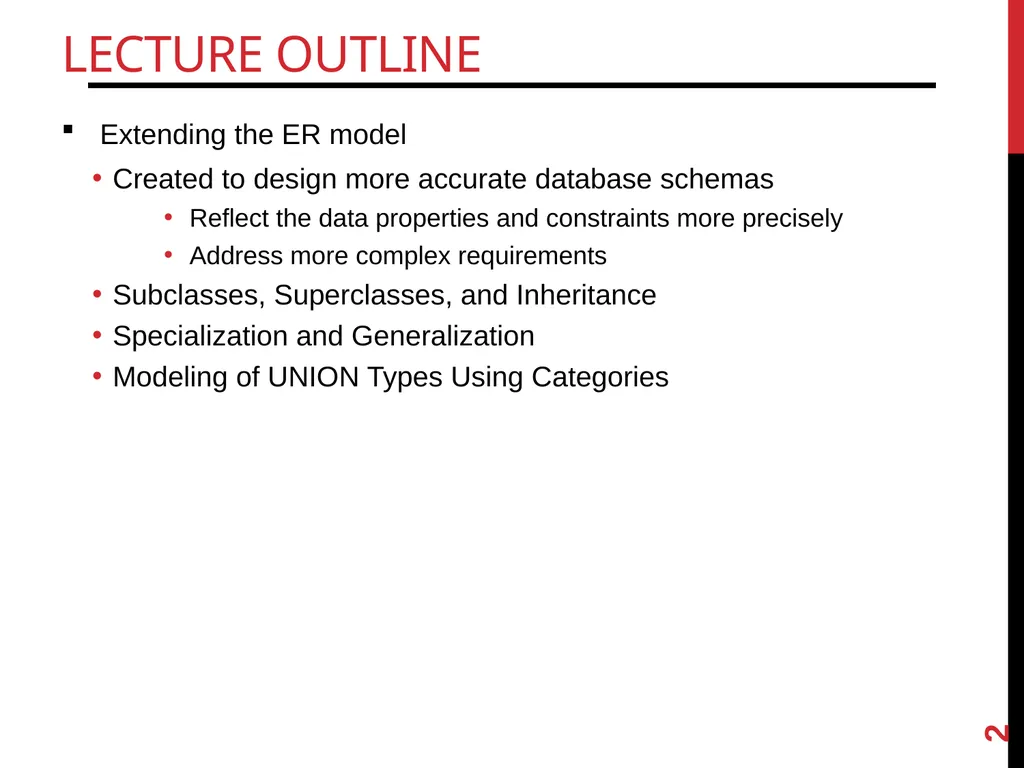
slide2. Lecture Outline Extending the ER model
Created to design more accurate database schemas
Reflect the data properties and constraints more precisely
Address more complex requirements
Subclasses, Superclasses, and Inheritance
Specialization and Generalization
Modeling of UNION Types Using Categories 2<br>
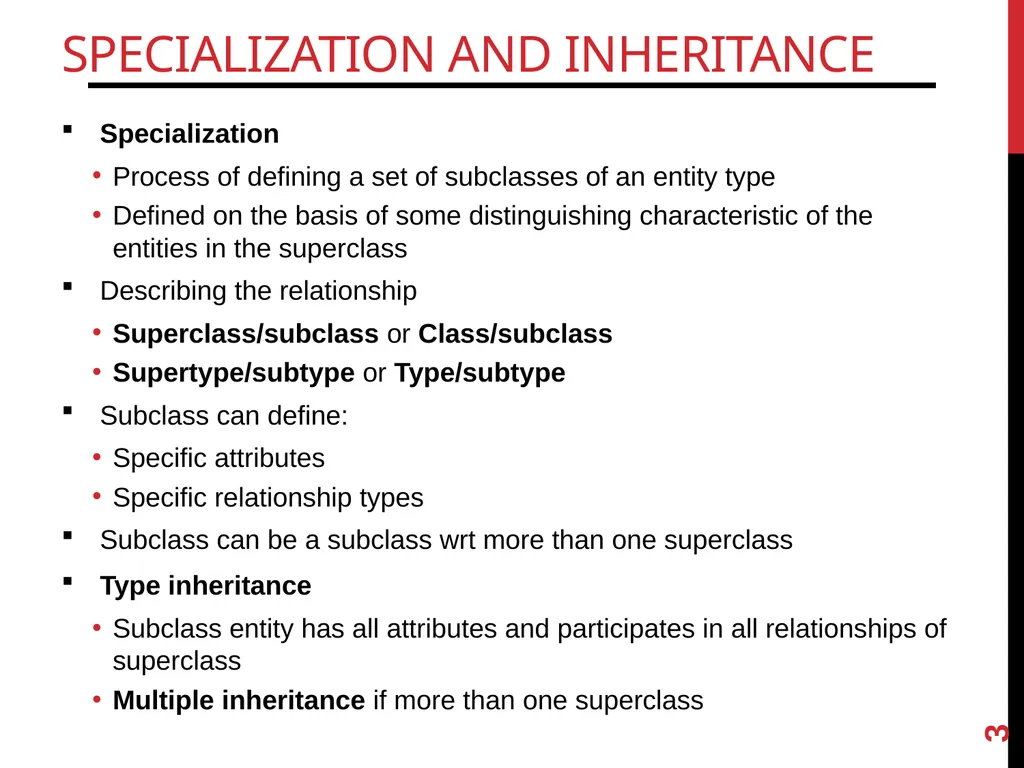
slide3. Specialization and Inheritance Specialization
Process of defining a set of subclasses of an entity type
Defined on the basis of some distinguishing characteristic of the entities in the superclass
Describing the relationship
Superclass/subclass or Class/subclass
Supertype/subtype or Type/subtype
Subclass can define:
Specific attributes
Specific relationship types
Subclass can be a subclass wrt more than one superclass
Type inheritance
Subclass entity has all attributes and participates in all relationships of superclass
Multiple inheritance if more than one superclass 3<br>
slide4. Generalization Generalization
Process of defining a more general entity type from given entity types
Reverse process of specialization
Generalize into a single superclass
Original entity types are specialized subclasses
Entities in generalization must all come from subclasses 4<br>
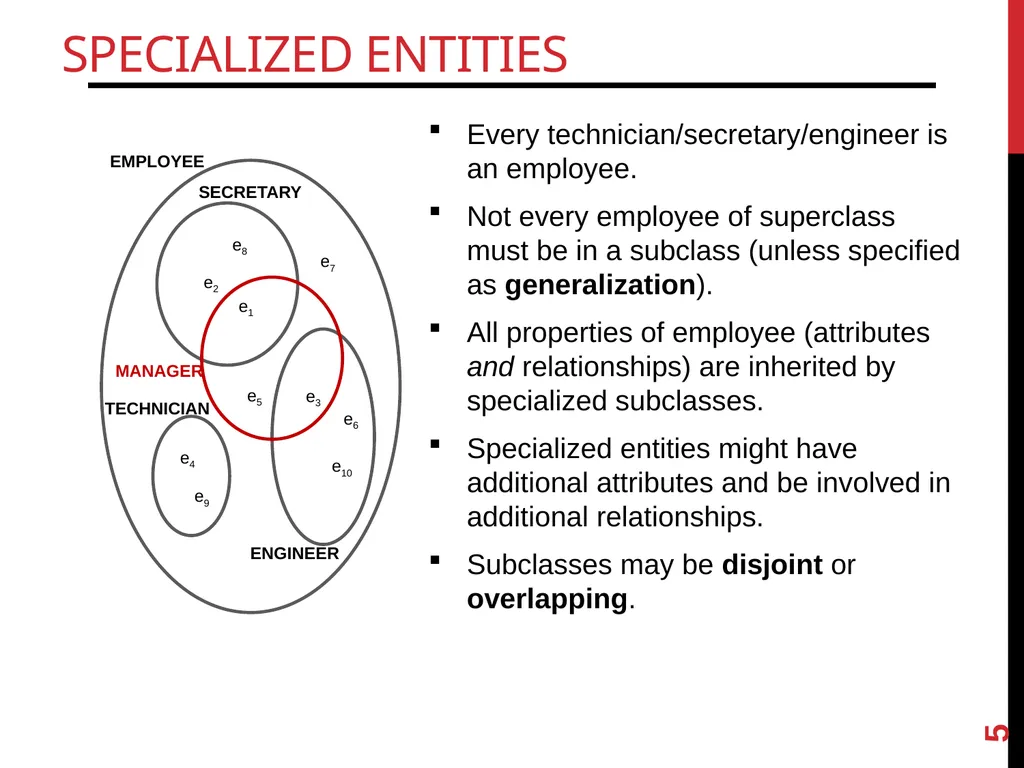
slide5. Specialized Entities Every technician/secretary/engineer is an employee.
Not every employee of superclass must be in a subclass (unless specified as generalization).
All properties of employee (attributes and relationships) are inherited by specialized subclasses.
Specialized entities might have additional attributes and be involved in additional relationships.
Subclasses may be disjoint or overlapping. MANAGER 5<br>
slide6. Constraints on Subclasses Disjointness constraint
Specifies that the subclasses of the specialization must be disjoint
Completeness constraint
Specifies that every superclass entity must be in a subclass
Required of generalization
Disjointness and completeness constraints are independent constraints 6<br>
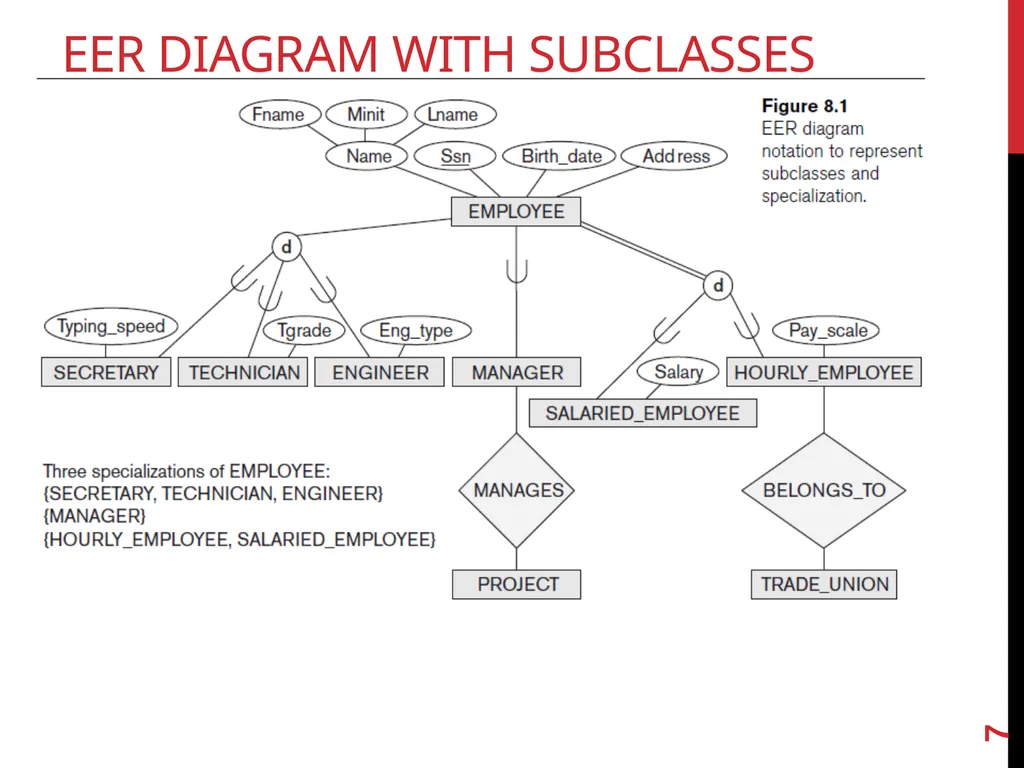
slide7. EER Diagram with Subclasses 7<br>
slide8. Refining Conceptual Schemas Using specialization
Starting with entity type, define subclasses by successive specialization
Top-down conceptual refinement
Using generalization
Starting with entity type, define superclasses by successive generalization
Bottom-up conceptual synthesis 8<br>
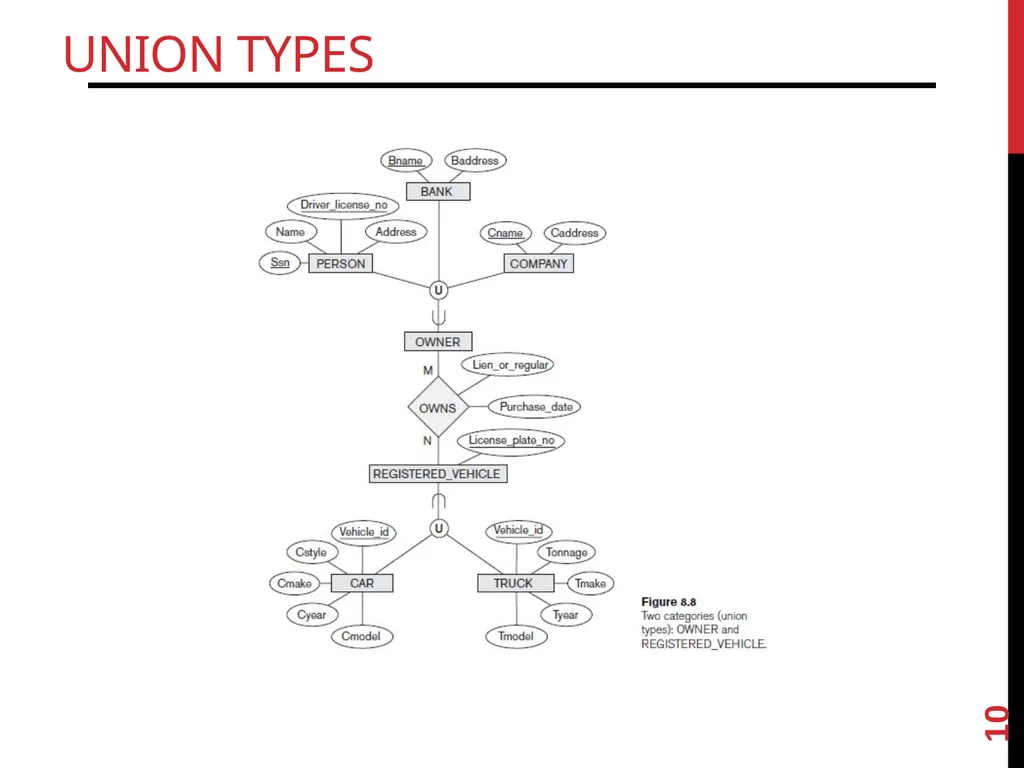
slide9. Modeling with UNION Types Union type or category
Represents a single superclass/subclass relationship with more than one superclass
Subclass represents a collection of objects that is a subset of the UNION of distinct entity types
Attribute inheritance works more selectively
Category can be total or partial
Some modeling methodologies do not have union types
Usually (always?) clearer to use specification/generalization 9<br>
slide10. UNION Types 10<br>
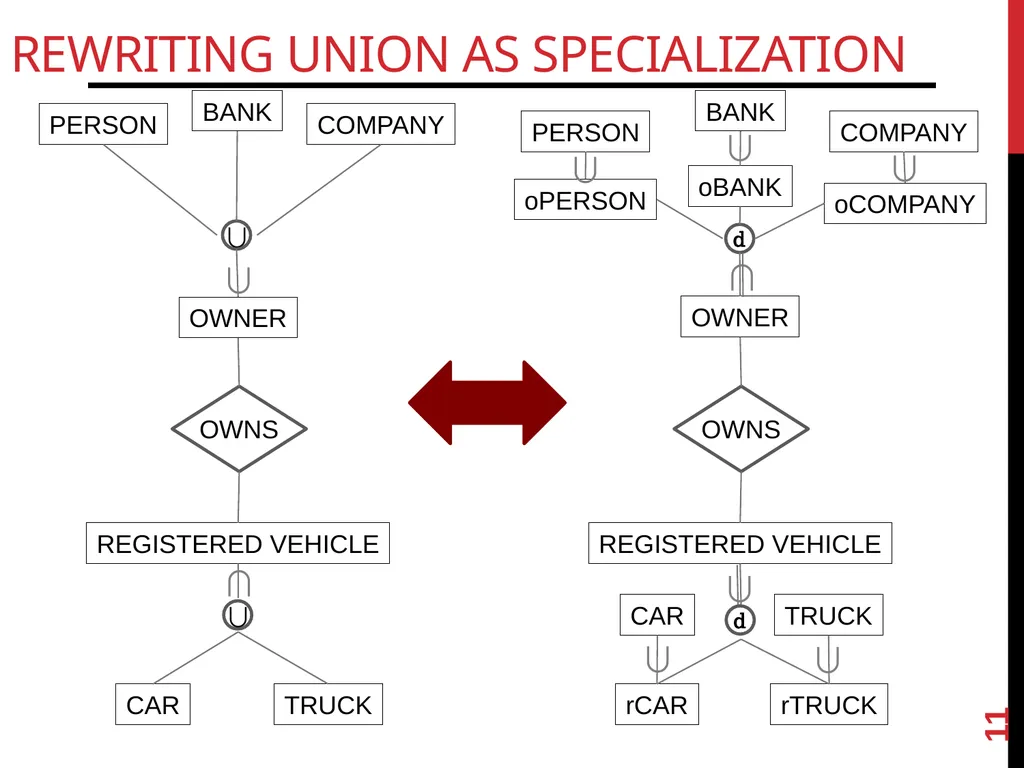
slide11. Rewriting Union as Specialization 11 BANK COMPANY PERSON OWNER REGISTERED VEHICLE TRUCK CAR ⋃ ⋂ oBANK oCOMPANY oPERSON OWNER REGISTERED VEHICLE rTRUCK rCAR ⋃ ⋂ BANK COMPANY PERSON ⋃ ⋃ TRUCK CAR ⋃ ⋃ ⋃<br>
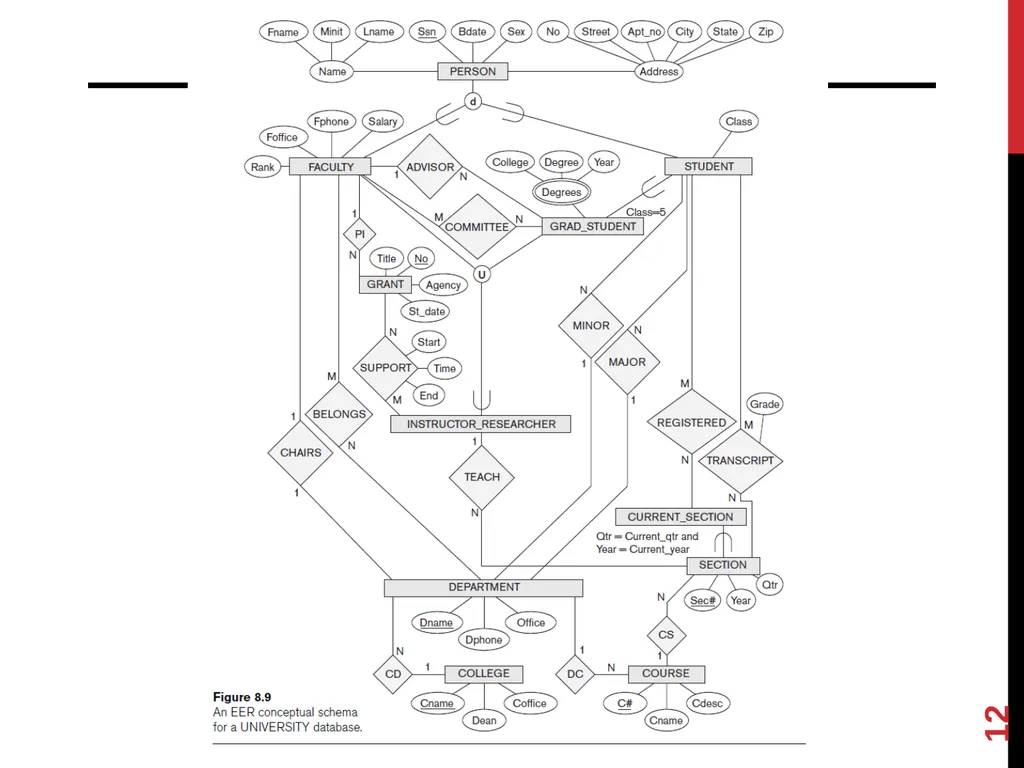
slide12. 12<br>
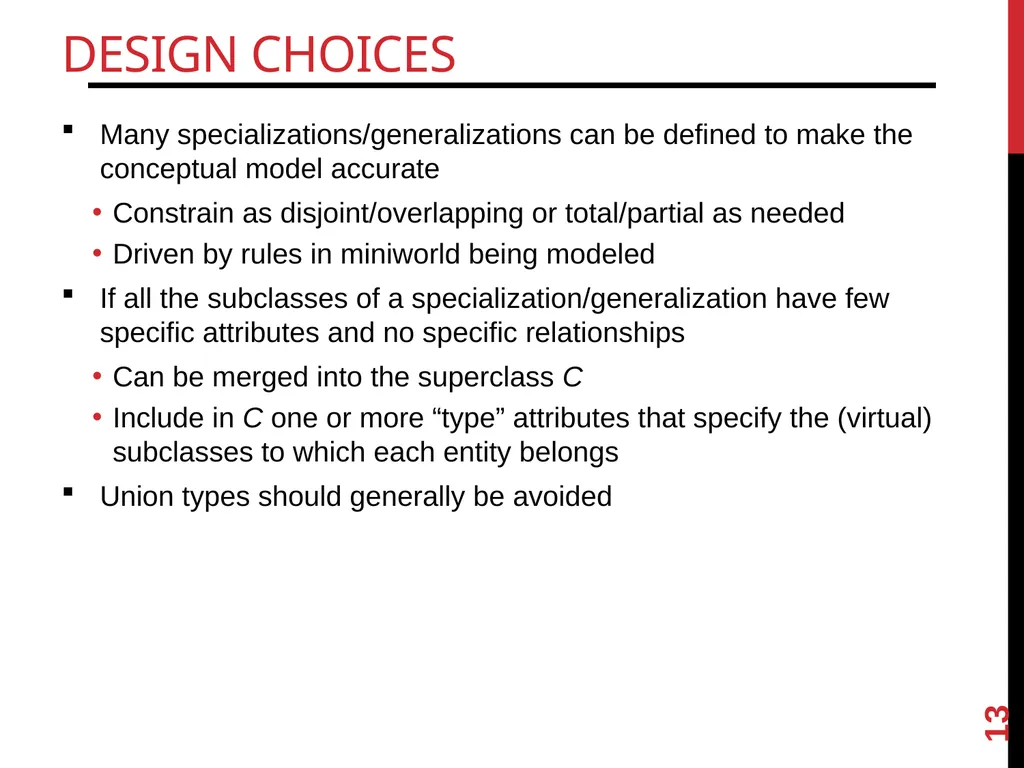
slide13. Design Choices Many specializations/generalizations can be defined to make the conceptual model accurate
Constrain as disjoint/overlapping or total/partial as needed
Driven by rules in miniworld being modeled
If all the subclasses of a specialization/generalization have few specific attributes and no specific relationships
Can be merged into the superclass C
Include in C one or more “type” attributes that specify the (virtual) subclasses to which each entity belongs
Union types should generally be avoided 13<br>
slide14. Lecture Summary Enhanced ER or EER model
Extensions to ER model that improve its representational capabilities
Subclass and its superclass
Category or union type
EER diagrams 14<br>
Chapter 4 (5/E)<br>
slide2. Lecture Outline Extending the ER model
Created to design more accurate database schemas
Reflect the data properties and constraints more precisely
Address more complex requirements
Subclasses, Superclasses, and Inheritance
Specialization and Generalization
Modeling of UNION Types Using Categories 2<br>
slide3. Specialization and Inheritance Specialization
Process of defining a set of subclasses of an entity type
Defined on the basis of some distinguishing characteristic of the entities in the superclass
Describing the relationship
Superclass/subclass or Class/subclass
Supertype/subtype or Type/subtype
Subclass can define:
Specific attributes
Specific relationship types
Subclass can be a subclass wrt more than one superclass
Type inheritance
Subclass entity has all attributes and participates in all relationships of superclass
Multiple inheritance if more than one superclass 3<br>
slide4. Generalization Generalization
Process of defining a more general entity type from given entity types
Reverse process of specialization
Generalize into a single superclass
Original entity types are specialized subclasses
Entities in generalization must all come from subclasses 4<br>
slide5. Specialized Entities Every technician/secretary/engineer is an employee.
Not every employee of superclass must be in a subclass (unless specified as generalization).
All properties of employee (attributes and relationships) are inherited by specialized subclasses.
Specialized entities might have additional attributes and be involved in additional relationships.
Subclasses may be disjoint or overlapping. MANAGER 5<br>
slide6. Constraints on Subclasses Disjointness constraint
Specifies that the subclasses of the specialization must be disjoint
Completeness constraint
Specifies that every superclass entity must be in a subclass
Required of generalization
Disjointness and completeness constraints are independent constraints 6<br>
slide7. EER Diagram with Subclasses 7<br>
slide8. Refining Conceptual Schemas Using specialization
Starting with entity type, define subclasses by successive specialization
Top-down conceptual refinement
Using generalization
Starting with entity type, define superclasses by successive generalization
Bottom-up conceptual synthesis 8<br>
slide9. Modeling with UNION Types Union type or category
Represents a single superclass/subclass relationship with more than one superclass
Subclass represents a collection of objects that is a subset of the UNION of distinct entity types
Attribute inheritance works more selectively
Category can be total or partial
Some modeling methodologies do not have union types
Usually (always?) clearer to use specification/generalization 9<br>
slide10. UNION Types 10<br>
slide11. Rewriting Union as Specialization 11 BANK COMPANY PERSON OWNER REGISTERED VEHICLE TRUCK CAR ⋃ ⋂ oBANK oCOMPANY oPERSON OWNER REGISTERED VEHICLE rTRUCK rCAR ⋃ ⋂ BANK COMPANY PERSON ⋃ ⋃ TRUCK CAR ⋃ ⋃ ⋃<br>
slide12. 12<br>
slide13. Design Choices Many specializations/generalizations can be defined to make the conceptual model accurate
Constrain as disjoint/overlapping or total/partial as needed
Driven by rules in miniworld being modeled
If all the subclasses of a specialization/generalization have few specific attributes and no specific relationships
Can be merged into the superclass C
Include in C one or more “type” attributes that specify the (virtual) subclasses to which each entity belongs
Union types should generally be avoided 13<br>
slide14. Lecture Summary Enhanced ER or EER model
Extensions to ER model that improve its representational capabilities
Subclass and its superclass
Category or union type
EER diagrams 14<br>