
The Everyday Forces of Physics Write short notes

Description: The Everyday Forces of Physics Write short notes on the topic (a) Gravitational force (Gravity, weight, and the gravitational field) (b) Gravitational force on a sphere (c) Gravitational field (d) Electrostatic force Turtle in an elevator
Related Topics
Download Presentation
"The Everyday Forces of Physics Write short notes" is the property of its rightful owner. Permission is granted to download and print the materials on this website for personal, non-commercial use only, and to display it on your personal computer provided you do not modify the materials and that you retain all copyright notices contained in the materials. By downloading content from our website, you accept the terms of this agreement.
Presentation Transcript
slide1. The Everyday Forces of Physics Write short notes on the topic
(a) Gravitational force (Gravity, weight, and the gravitational field)
(b) Gravitational force on a sphere
(c) Gravitational field
(d) Electrostatic force<br>
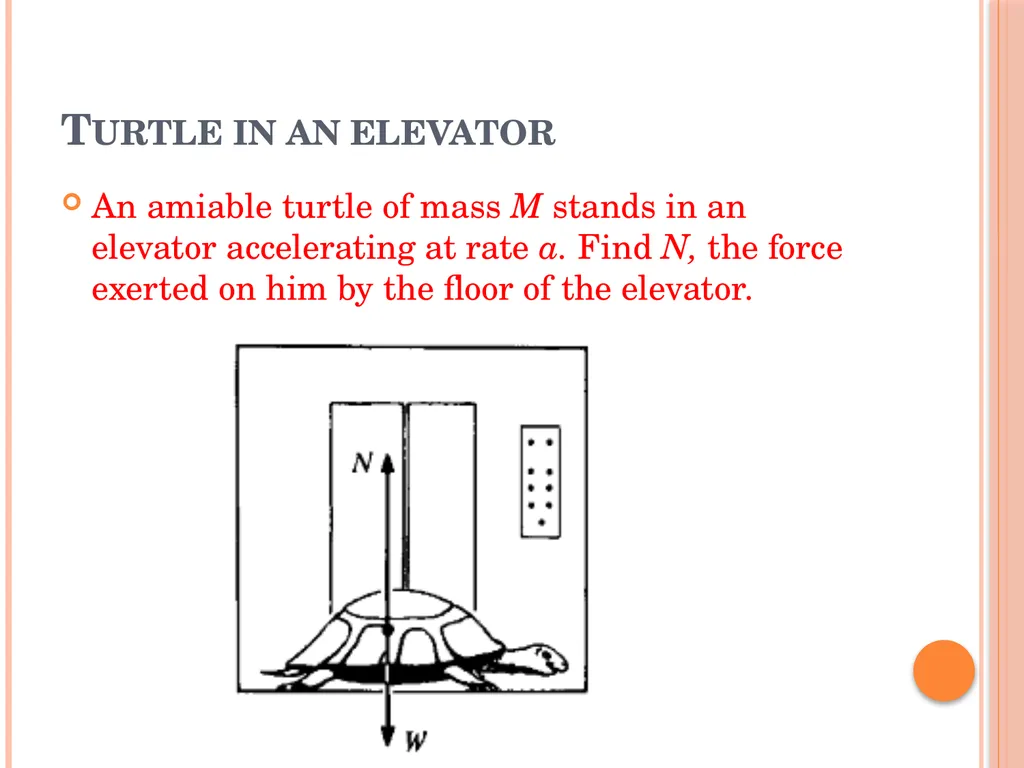
slide2. Turtle in an elevator An amiable turtle of mass M stands in an elevator accelerating at rate a. Find N, the force exerted on him by the floor of the elevator.<br>
slide3. The forces acting on the turtle are N and the weight, the true gravitational force W = Mg.
So the weight of turtle = W = N – Ma
( i) When the elevator is at rest or moving with constant velocity. W = N
Thus apparent weight = actual weight. The weighing machine shows exact weight.
(ii) When the elevator is accelerating upwards If an elevator is moving with upward acceleration +a<br>
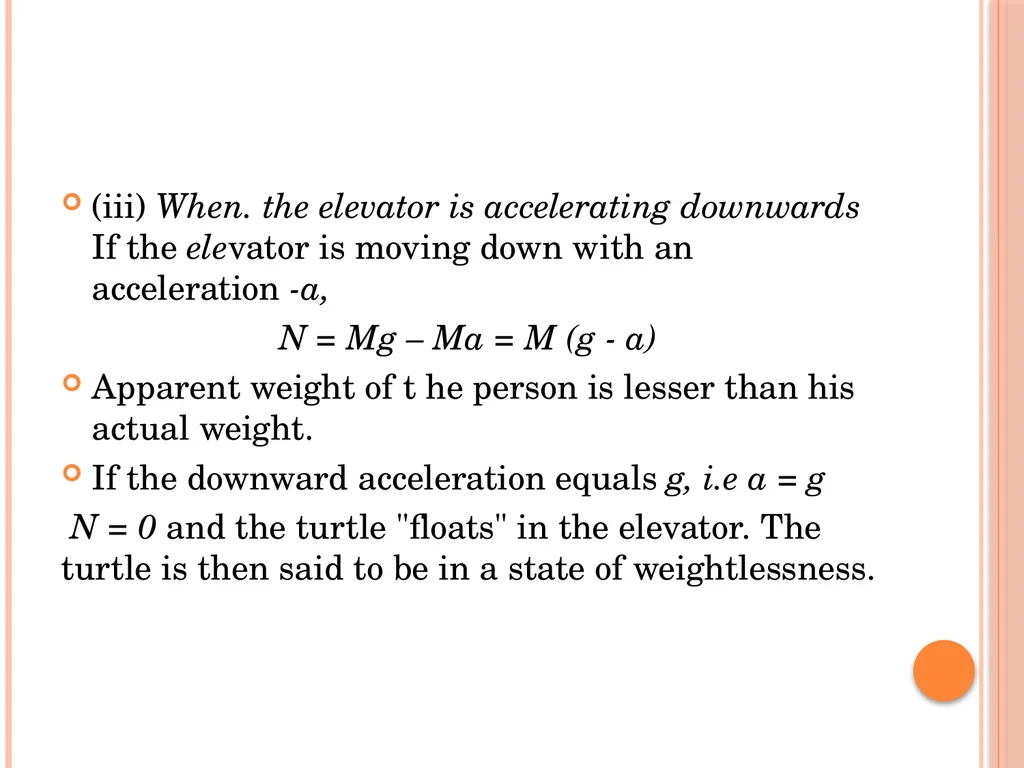
slide4. (iii) When. the elevator is accelerating downwards If the elevator is moving down with an acceleration -a,
N = Mg – Ma = M (g - a)
Apparent weight of t he person is lesser than his actual weight.
If the downward acceleration equals g, i.e a = g
N = 0 and the turtle "floats" in the elevator. The turtle is then said to be in a state of weightlessness.<br>
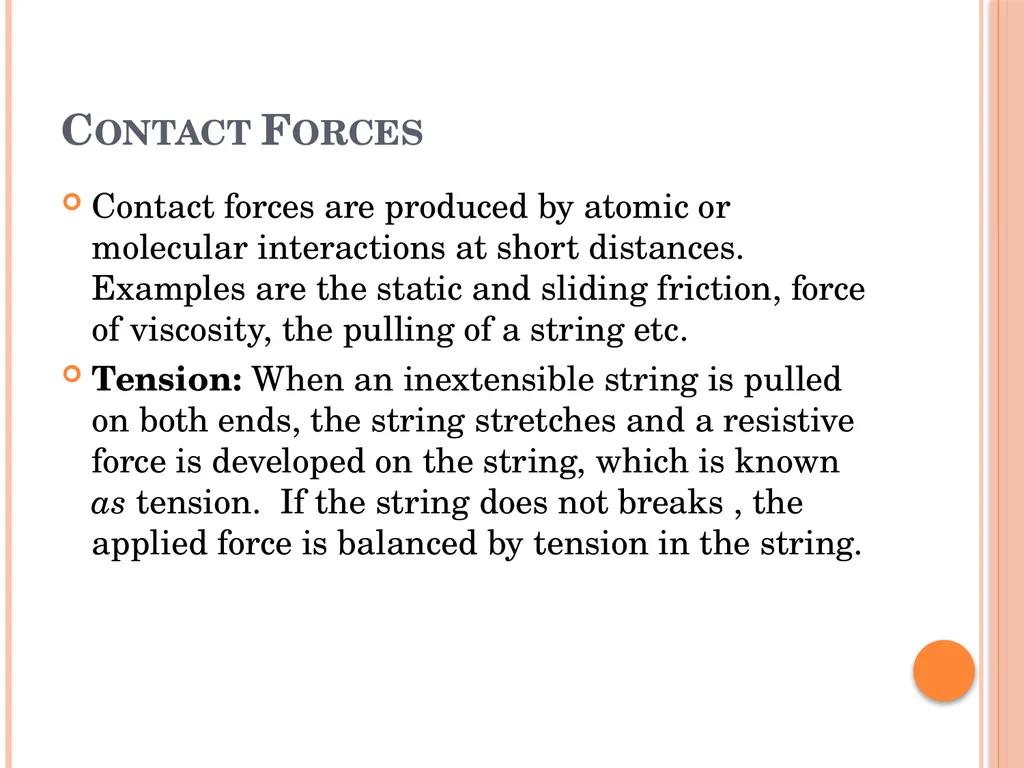
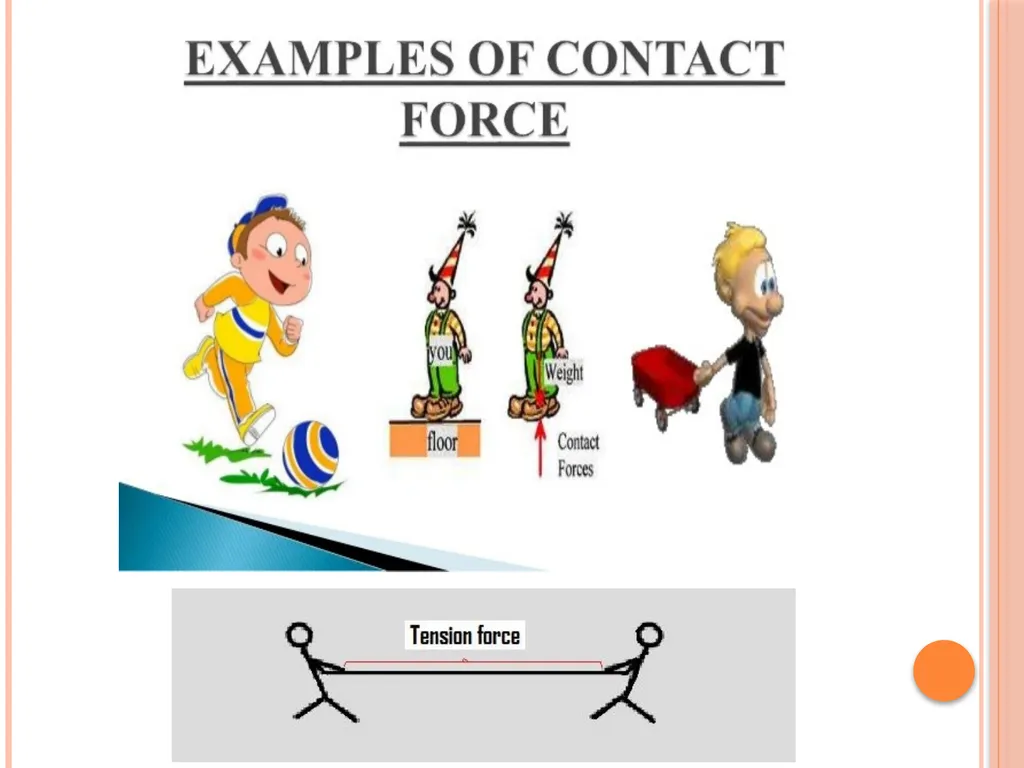
slide5. Contact Forces Contact forces are produced by atomic or molecular interactions at short distances. Examples are the static and sliding friction, force of viscosity, the pulling of a string etc.
Tension: When an inextensible string is pulled on both ends, the string stretches and a resistive force is developed on the string, which is known as tension. If the string does not breaks , the applied force is balanced by tension in the string.<br>
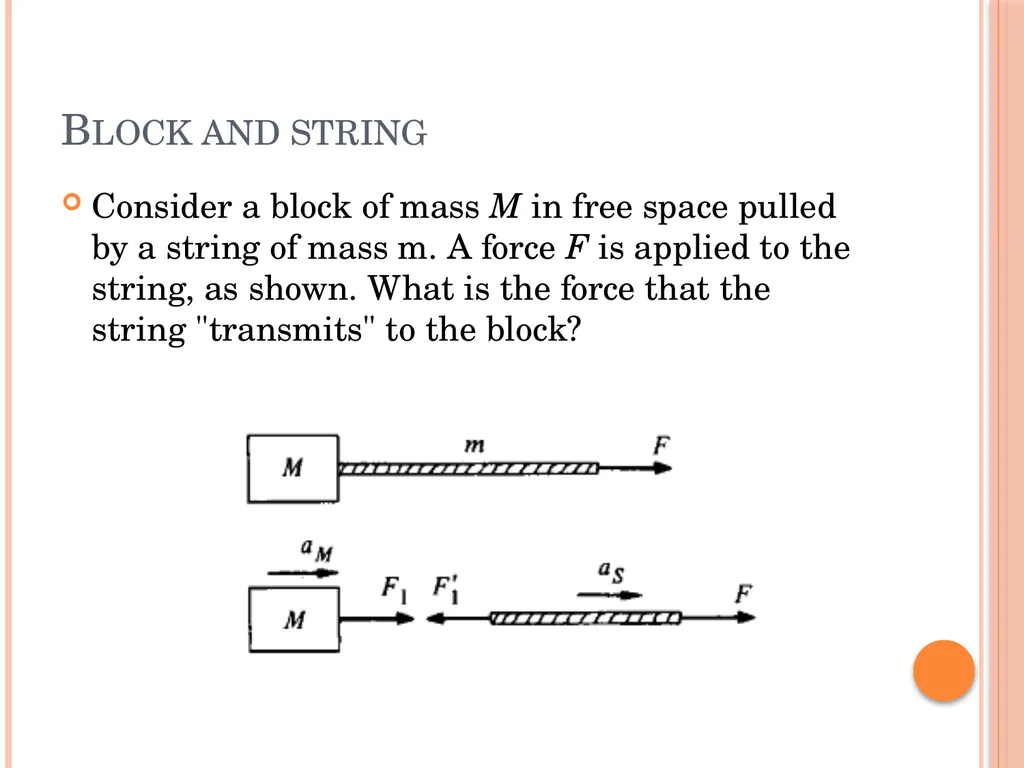
slide7. Block and string Consider a block of mass M in free space pulled by a string of mass m. A force F is applied to the string, as shown. What is the force that the string "transmits" to the block?<br>
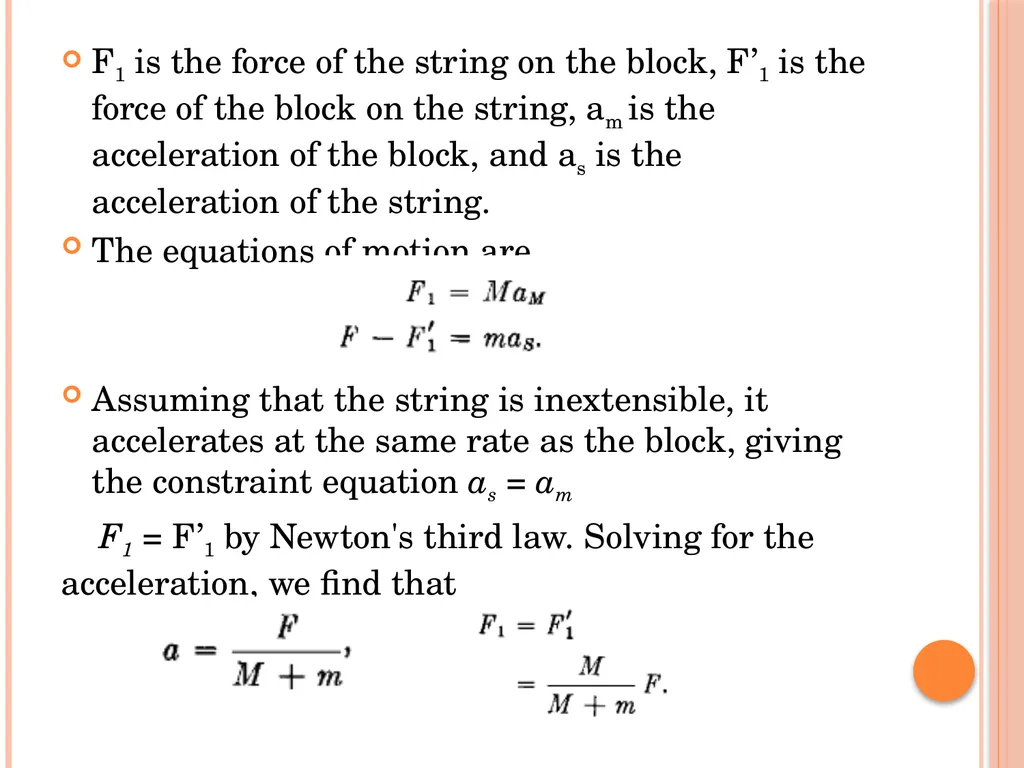
slide8. F1 is the force of the string on the block, F’1 is the force of the block on the string, am is the acceleration of the block, and as is the acceleration of the string.
The equations of motion are
Assuming that the string is inextensible, it accelerates at the same rate as the block, giving the constraint equation as = am
F1 = F’1 by Newton's third law. Solving for the acceleration, we find that<br>
slide9. The force on the block is less than F; the string does not transmit the full applied force. However, if the mass of the string is negligible compared with the block, F1 = F’1 to good approximation.<br>
(a) Gravitational force (Gravity, weight, and the gravitational field)
(b) Gravitational force on a sphere
(c) Gravitational field
(d) Electrostatic force<br>
slide2. Turtle in an elevator An amiable turtle of mass M stands in an elevator accelerating at rate a. Find N, the force exerted on him by the floor of the elevator.<br>
slide3. The forces acting on the turtle are N and the weight, the true gravitational force W = Mg.
So the weight of turtle = W = N – Ma
( i) When the elevator is at rest or moving with constant velocity. W = N
Thus apparent weight = actual weight. The weighing machine shows exact weight.
(ii) When the elevator is accelerating upwards If an elevator is moving with upward acceleration +a<br>
slide4. (iii) When. the elevator is accelerating downwards If the elevator is moving down with an acceleration -a,
N = Mg – Ma = M (g - a)
Apparent weight of t he person is lesser than his actual weight.
If the downward acceleration equals g, i.e a = g
N = 0 and the turtle "floats" in the elevator. The turtle is then said to be in a state of weightlessness.<br>
slide5. Contact Forces Contact forces are produced by atomic or molecular interactions at short distances. Examples are the static and sliding friction, force of viscosity, the pulling of a string etc.
Tension: When an inextensible string is pulled on both ends, the string stretches and a resistive force is developed on the string, which is known as tension. If the string does not breaks , the applied force is balanced by tension in the string.<br>
slide7. Block and string Consider a block of mass M in free space pulled by a string of mass m. A force F is applied to the string, as shown. What is the force that the string "transmits" to the block?<br>
slide8. F1 is the force of the string on the block, F’1 is the force of the block on the string, am is the acceleration of the block, and as is the acceleration of the string.
The equations of motion are
Assuming that the string is inextensible, it accelerates at the same rate as the block, giving the constraint equation as = am
F1 = F’1 by Newton's third law. Solving for the acceleration, we find that<br>
slide9. The force on the block is less than F; the string does not transmit the full applied force. However, if the mass of the string is negligible compared with the block, F1 = F’1 to good approximation.<br>