
The first World war By icHistory Navigation and
NS
Published · 62 slides · 0 views
1 / 1
















Description
The first World war By icHistory Navigation and action buttons Click the YouTube symbol to connect to external videos. If a link has been removed you can insert a new one independently. Click to return to sub menus. Click the PDF symbol on
Related Topics
Share
Embed code
Download this presentation From Below
"The first World war By icHistory Navigation and" is the property of its rightful owner. Permission is granted to download and print the materials on this website for personal, non-commercial use only, and to display it on your personal computer provided you do not modify the materials and that you retain all copyright notices contained in the materials. By downloading content from our website, you accept the terms of this agreement.
Presentation Transcript
01
The first
World war By icHistory<br>
02
Navigation and action buttons Click the YouTube symbol to connect to external videos. If a link has been removed you can insert a new one independently. Click to return to sub menus. Click the PDF symbol on pages to access free supporting student resources, PowerPoint and worksheets. Click to return to the main menu. (If there is no clear navigation path click relevant image to progress) Next slide.<br>
03
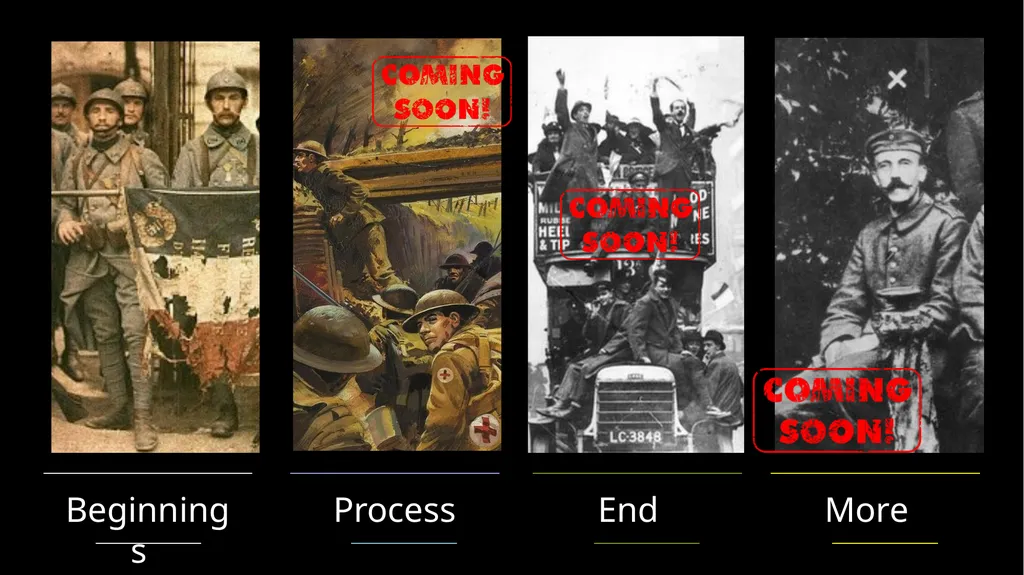
More Beginnings End Process<br>
04
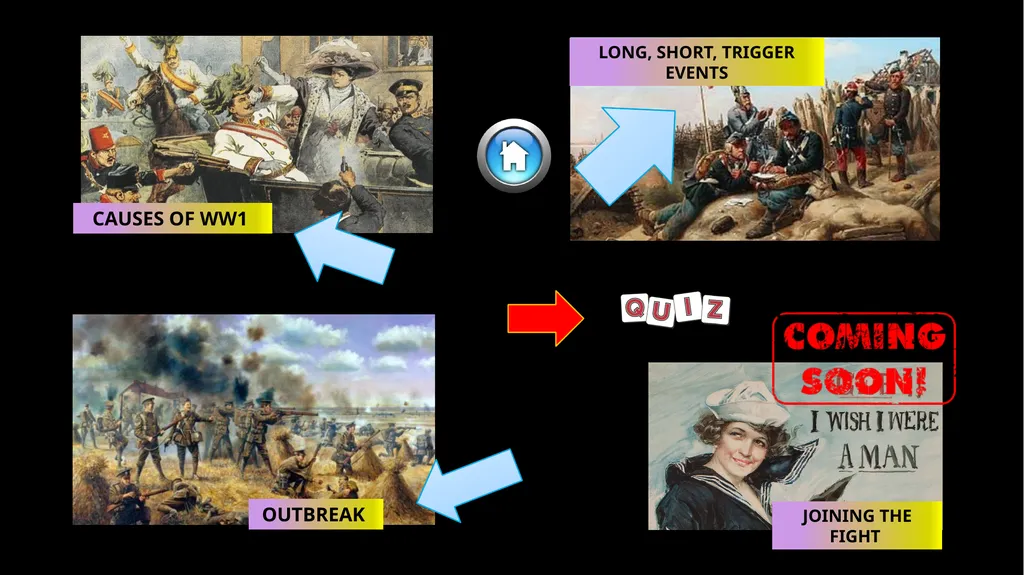
LONG, SHORT, TRIGGER EVENTS CAUSES OF WW1 OUTBREAK JOINING THE FIGHT<br>
05
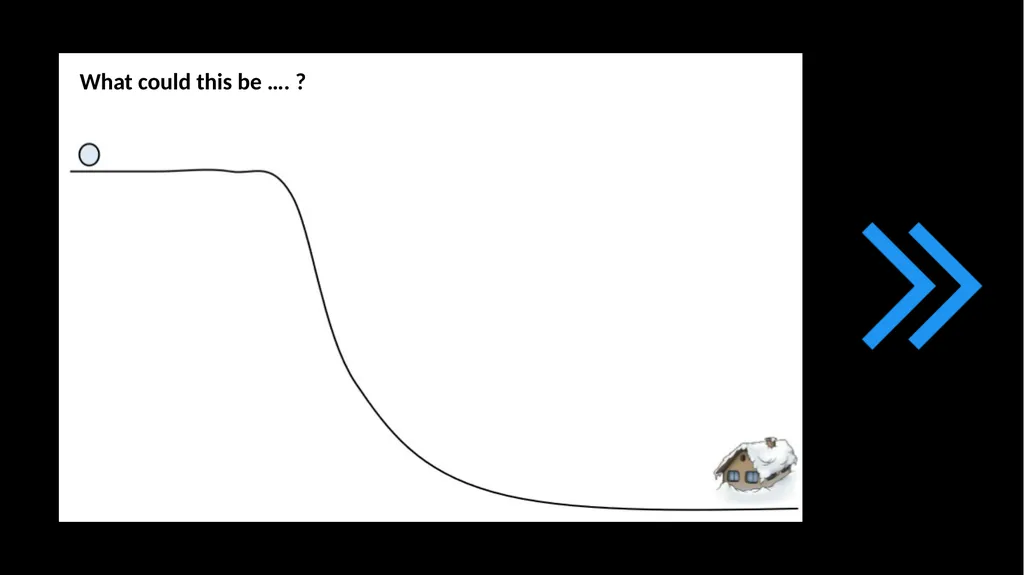
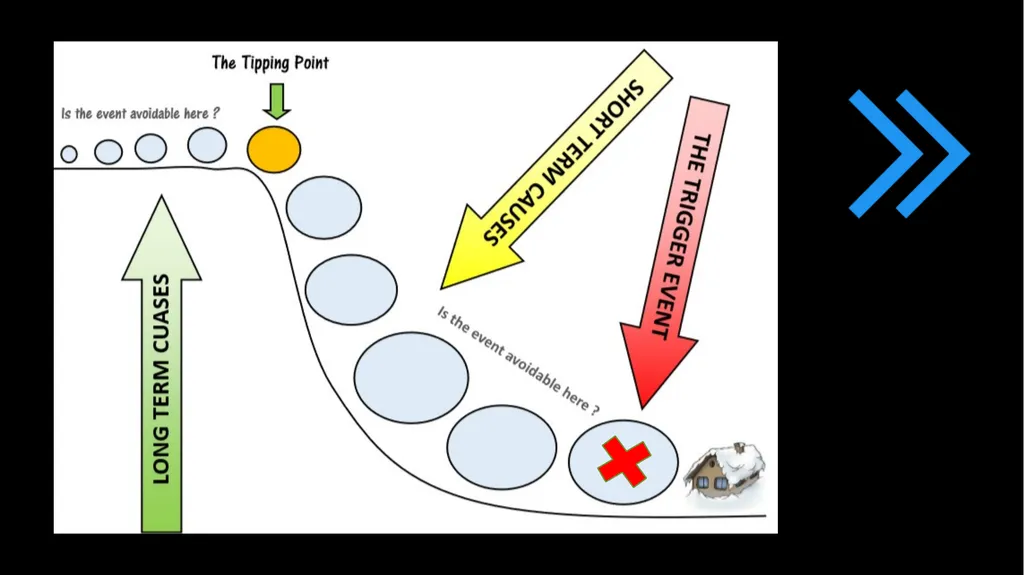
What could this be …. ?is<br>
06
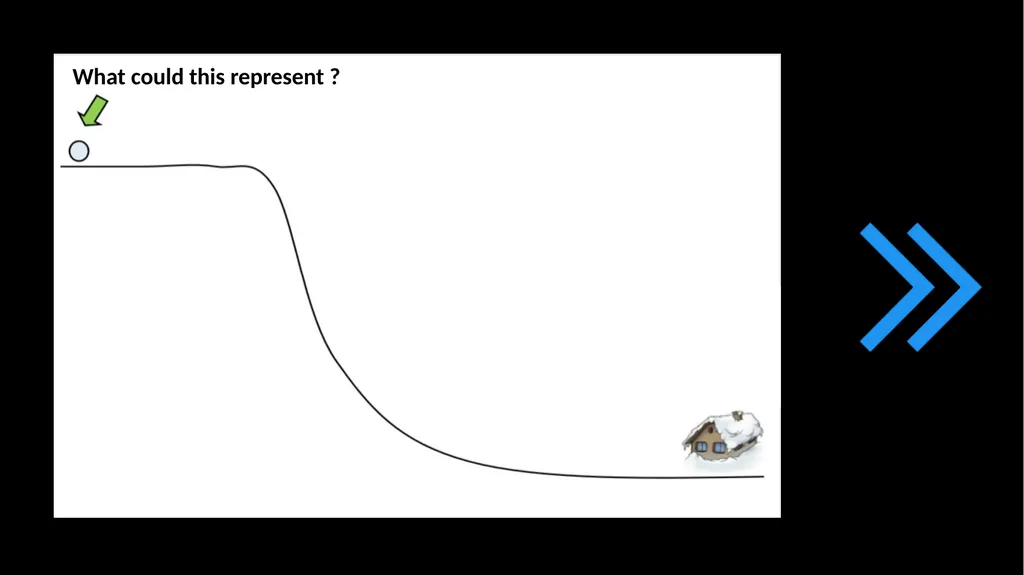
What could this represent ? s E
vents<br>
vents<br>
07
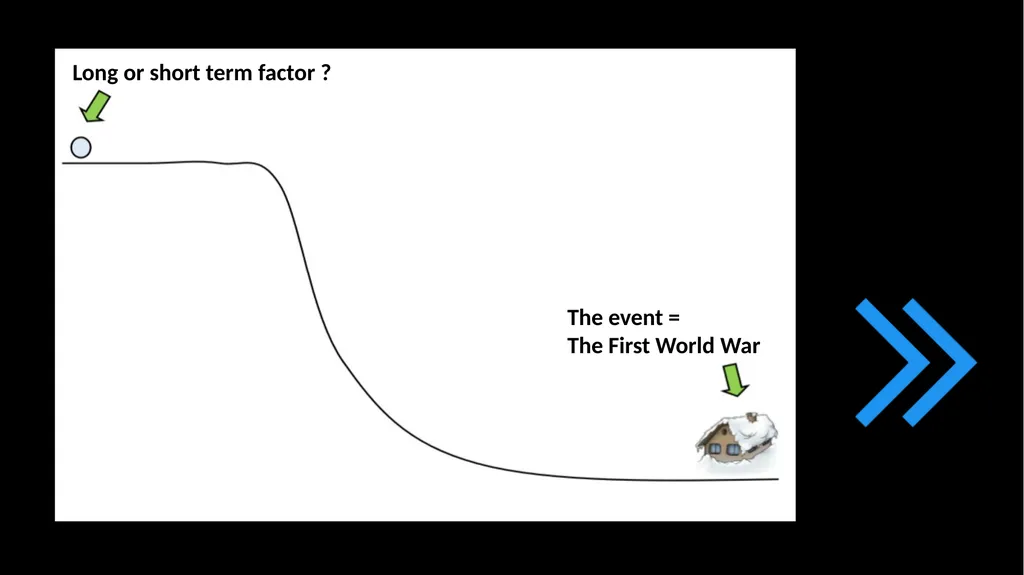
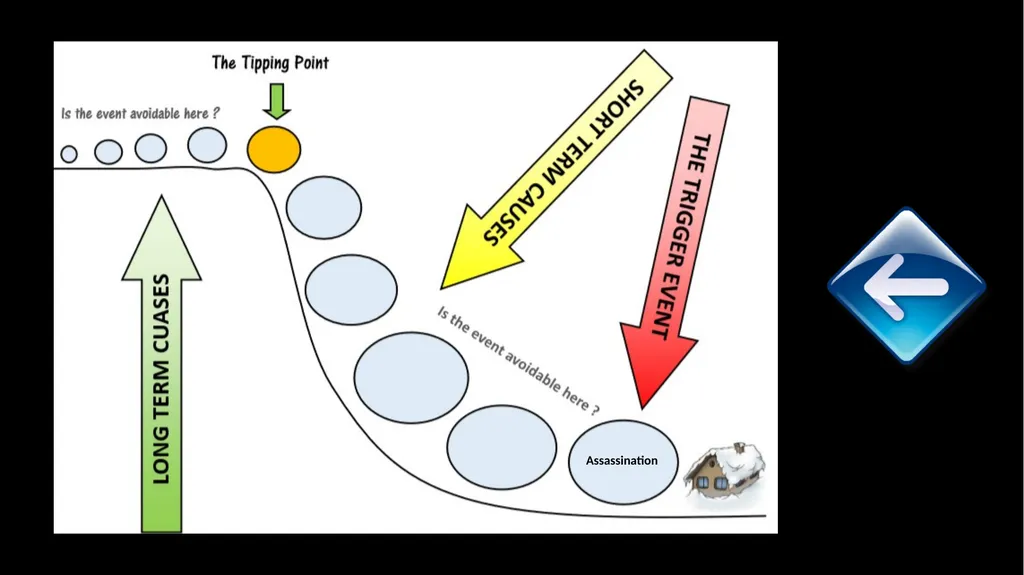
Long or short term factor ?is The event =
The First World War<br>
08
Assassination<br>
09
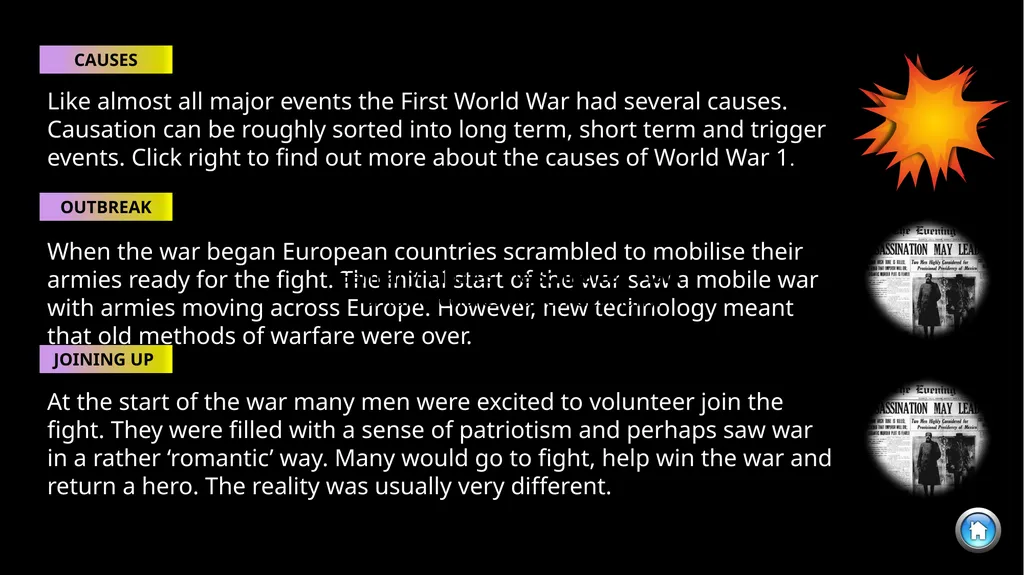
CAUSES OUTBREAK JOINING UP Like almost all major events the First World War had several causes. Causation can be roughly sorted into long term, short term and trigger events. Click right to find out more about the causes of World War 1. When the war began European countries scrambled to mobilise their armies ready for the fight. The initial start of the war saw a mobile war with armies moving across Europe. However, new technology meant that old methods of warfare were over. At the start of the war many men were excited to volunteer join the fight. They were filled with a sense of patriotism and perhaps saw war in a rather ‘romantic’ way. Many would go to fight, help win the war and return a hero. The reality was usually very different. Germany initiates the Schlieffen Plan.
Britain declares war on Germany.<br>
10
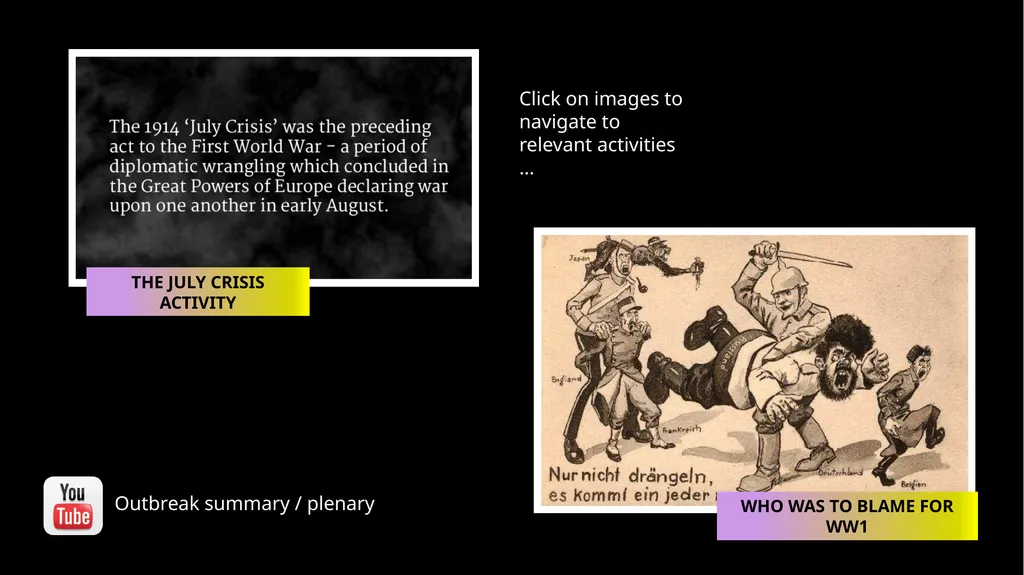
THE JULY CRISIS ACTIVITY WHO WAS TO BLAME FOR WW1 Click on images to navigate to relevant activities … Outbreak summary / plenary<br>
11
The July Crisis: 1914.
The following activity will help you understand the process of events that led to the outbreak of World War One. Simply click the events in the correct order.
Note - a wrong choice will reset the activity and you will have to start again.
Note, note - Follow the navigation buttons carefully to ensure the activity works correctly.
This can be done indivdually or run as a class activity as suggested below.
1. Split the class into two teams and decide which team begins. ‘Team A’ should vote to choose which event comes first. ’Team A’ is in control until an error is made. Once an error is made ‘Team B’ takes over. The team that gets to the end is the ‘winner’.<br>
12
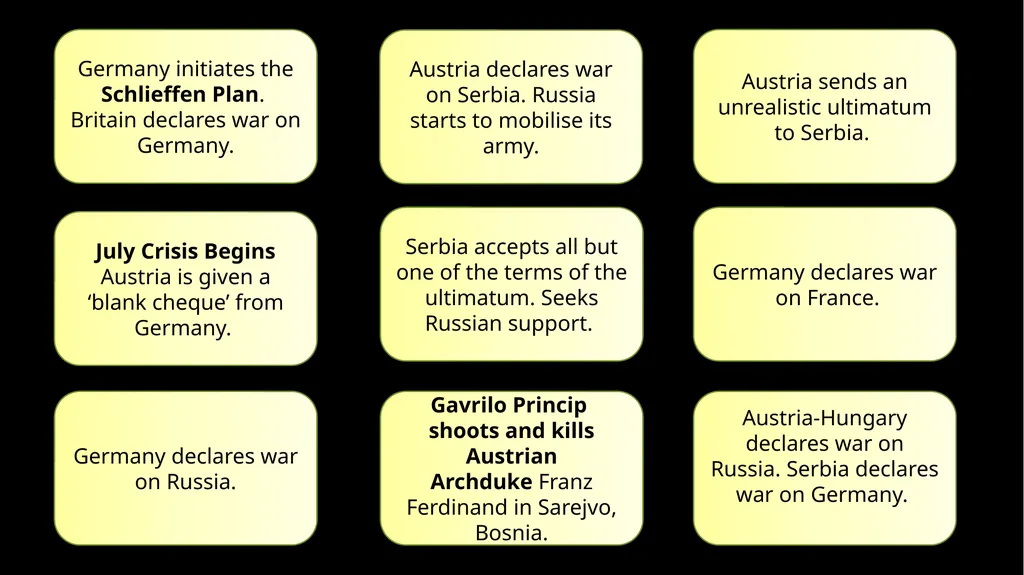
Gavrilo Princip
shoots and kills Austrian
Archduke Franz Ferdinand in Sarejvo, Bosnia. July Crisis Begins
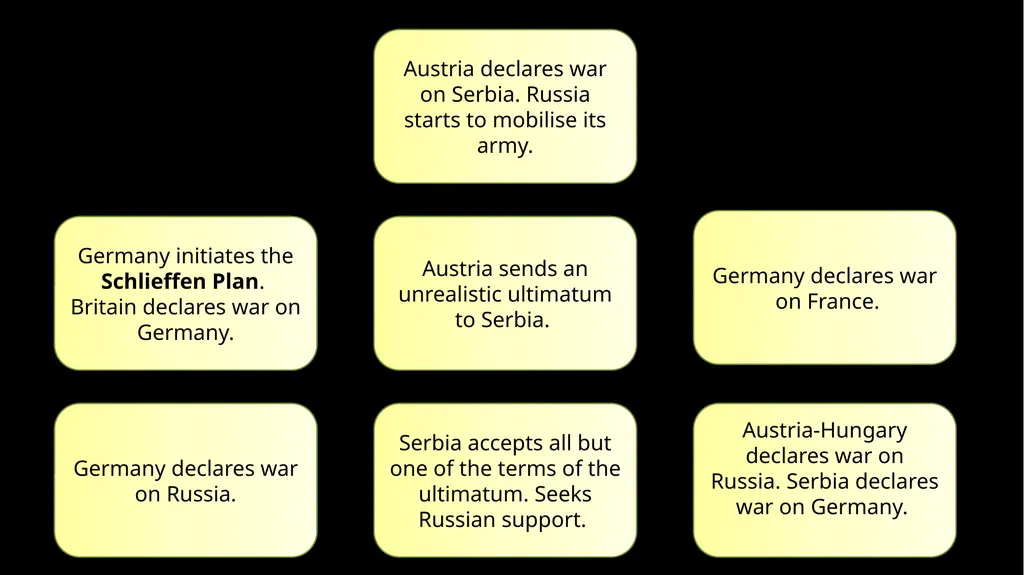
Austria is given a ‘blank cheque’ from Germany. Austria sends an unrealistic ultimatum to Serbia. Serbia accepts all but one of the terms of the ultimatum. Seeks Russian support. Austria declares war on Serbia. Russia starts to mobilise its army. Germany declares war
on Russia. Germany declares war
on France. Germany initiates the Schlieffen Plan.
Britain declares war on Germany. Austria-Hungary declares war on Russia. Serbia declares war on Germany.<br>
13
Incorrect…
Click Left To
Restart The Activity<br>
14
Well done …you must click the green arrow to ensure the PowerPoint navigates correctly.<br>
15
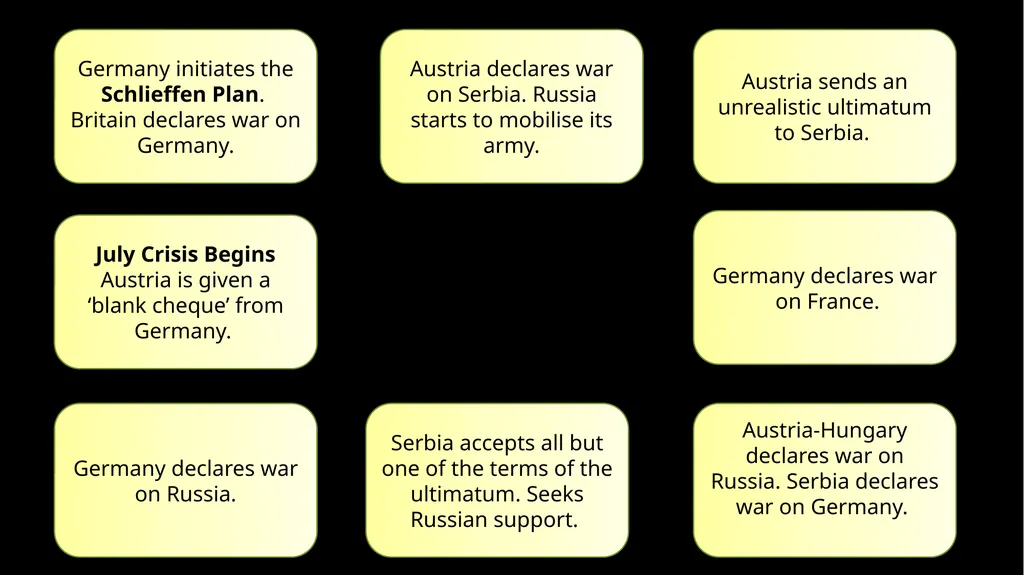
July Crisis Begins
Austria is given a ‘blank cheque’ from Germany. Austria sends an unrealistic ultimatum to Serbia. Serbia accepts all but one of the terms of the ultimatum. Seeks Russian support. Austria declares war on Serbia. Russia starts to mobilise its army. Germany declares war
on Russia. Germany declares war
on France. Germany initiates the Schlieffen Plan.
Britain declares war on Germany. Austria-Hungary declares war on Russia. Serbia declares war on Germany.<br>
16
Austria sends an unrealistic ultimatum to Serbia. Serbia accepts all but one of the terms of the ultimatum. Seeks Russian support. Austria declares war on Serbia. Russia starts to mobilise its army. Germany declares war
on Russia. Germany declares war
on France. Germany initiates the Schlieffen Plan.
Britain declares war on Germany. Austria-Hungary declares war on Russia. Serbia declares war on Germany.<br>
17
Serbia accepts all but one of the terms of the ultimatum. Seeks Russian support. Austria declares war on Serbia. Russia starts to mobilise its army. Germany declares war
on Russia. Germany declares war
on France. Germany initiates the Schlieffen Plan.
Britain declares war on Germany. Austria-Hungary declares war on Russia. Serbia declares war on Germany.<br>
18
Austria declares war on Serbia. Russia starts to mobilise its army. Germany declares war
on Russia. Germany declares war
on France. Germany initiates the Schlieffen Plan.
Britain declares war on Germany. Austria-Hungary declares war on Russia. Serbia declares war on Germany.<br>
19
Germany declares war
on Russia. Germany declares war
on France. Germany initiates the Schlieffen Plan.
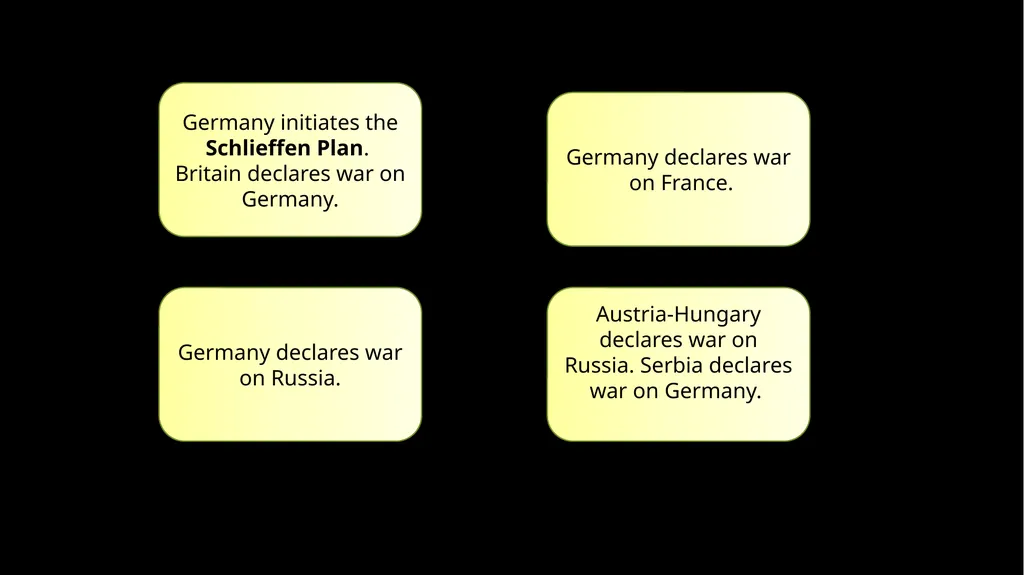
Britain declares war on Germany. Austria-Hungary declares war on Russia. Serbia declares war on Germany.<br>
20
Germany declares war
on France. Germany initiates the Schlieffen Plan.
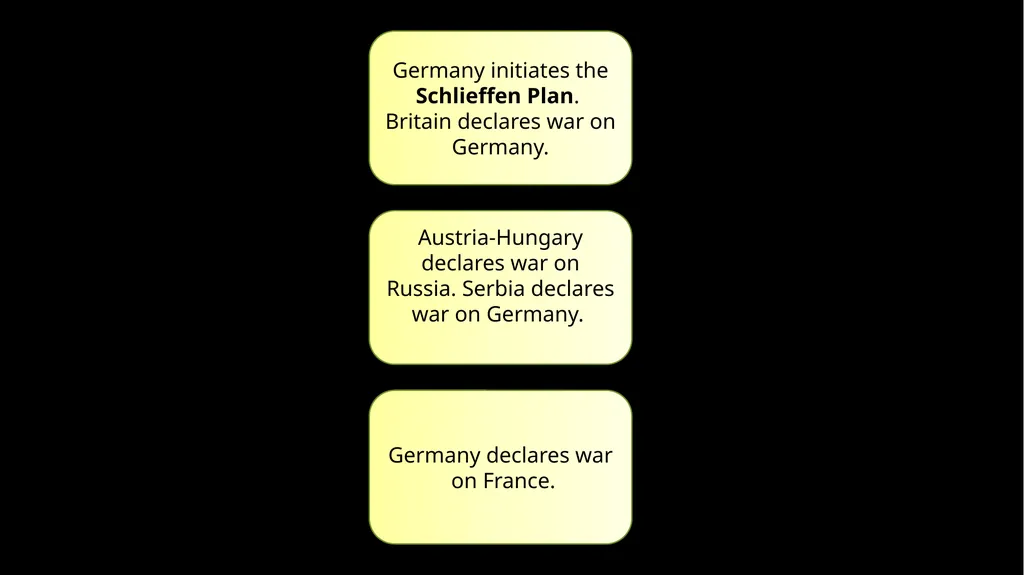
Britain declares war on Germany. Austria-Hungary declares war on Russia. Serbia declares war on Germany.<br>
21
Germany initiates the Schlieffen Plan.
Britain declares war on Germany. Austria-Hungary declares war on Russia. Serbia declares war on Germany.<br>
22
Austria-Hungary declares war on Russia. Serbia declares war on Germany.<br>
23
Well Done !
The First World War
Has Begun …
Now consider … who was most to blame?<br>
24
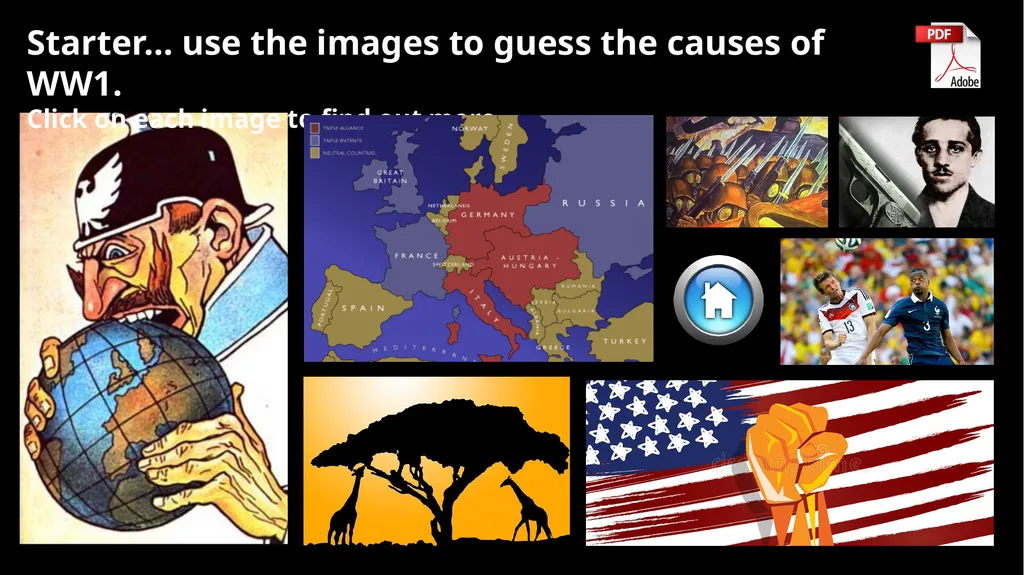
Starter… use the images to guess the causes of WW1.
Click on each image to find out more.<br>
Click on each image to find out more.<br>
25
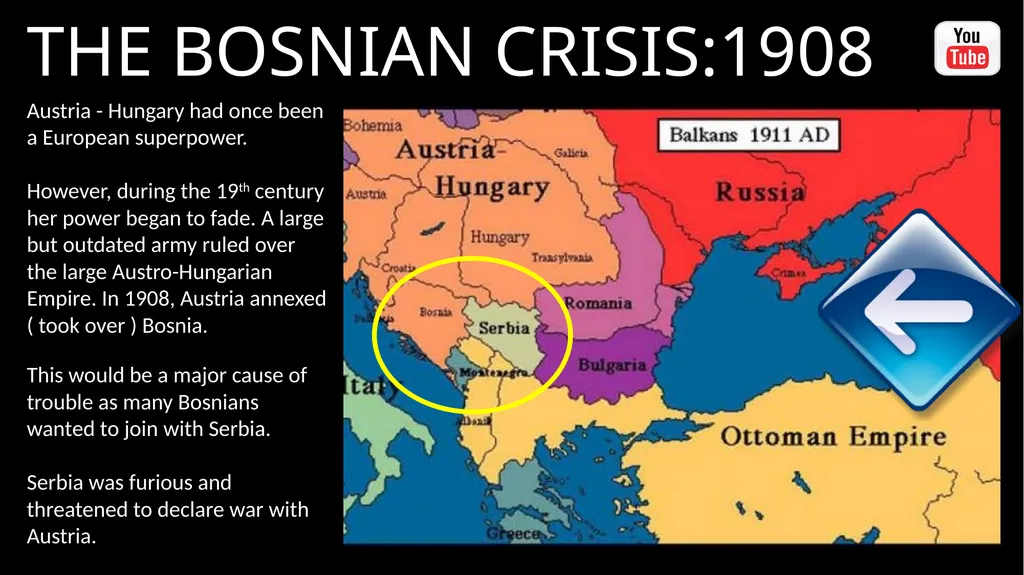
The Bosnian crisis:1908 Austria - Hungary had once been a European superpower.
However, during the 19th century her power began to fade. A large but outdated army ruled over the large Austro-Hungarian Empire. In 1908, Austria annexed ( took over ) Bosnia.
This would be a major cause of trouble as many Bosnians wanted to join with Serbia.
Serbia was furious and threatened to declare war with Austria.<br>
26
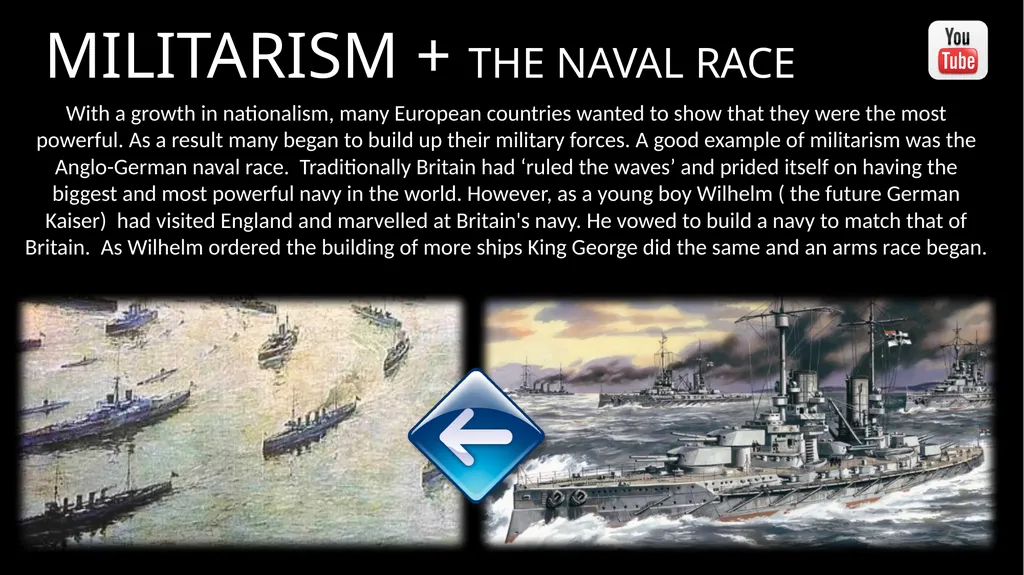
Militarism + The Naval Race With a growth in nationalism, many European countries wanted to show that they were the most powerful. As a result many began to build up their military forces. A good example of militarism was the Anglo-German naval race. Traditionally Britain had ‘ruled the waves’ and prided itself on having the biggest and most powerful navy in the world. However, as a young boy Wilhelm ( the future German Kaiser) had visited England and marvelled at Britain's navy. He vowed to build a navy to match that of Britain. As Wilhelm ordered the building of more ships King George did the same and an arms race began.<br>
27
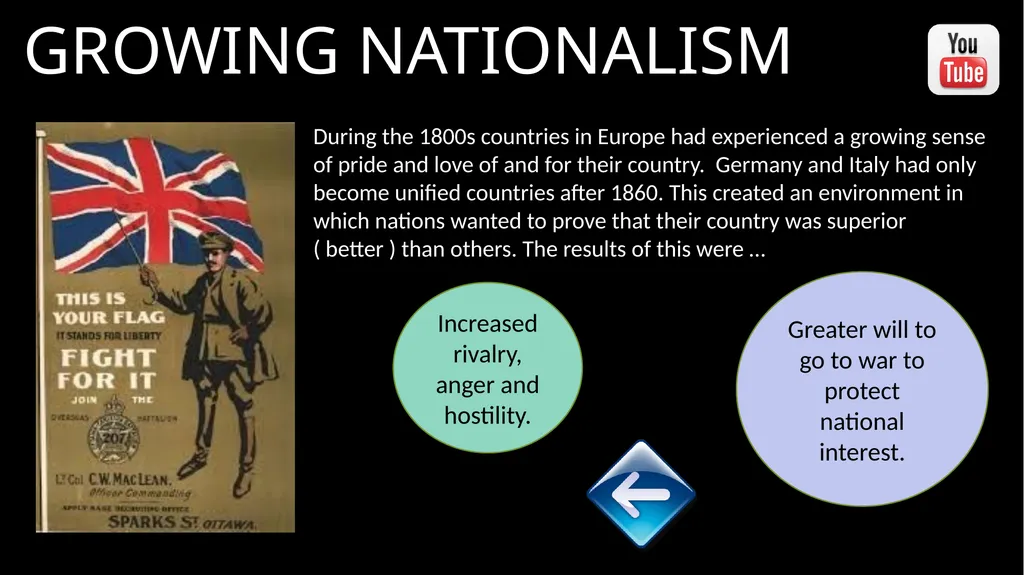
Growing nationalism During the 1800s countries in Europe had experienced a growing sense of pride and love of and for their country. Germany and Italy had only become unified countries after 1860. This created an environment in which nations wanted to prove that their country was superior ( better ) than others. The results of this were … Increased
rivalry, anger and hostility. Greater will to go to war to protect national interest.<br>
rivalry, anger and hostility. Greater will to go to war to protect national interest.<br>
28
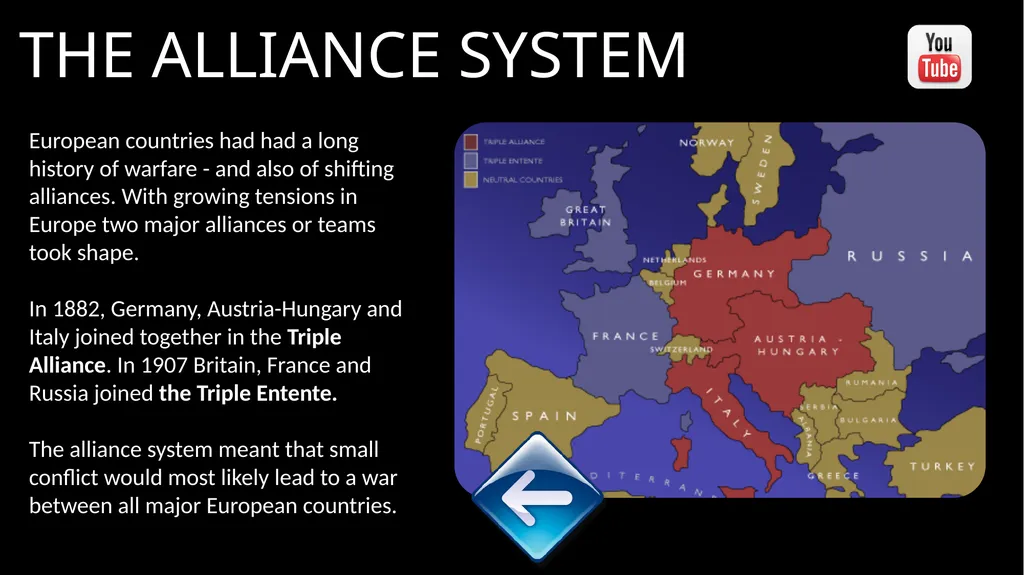
The Alliance System European countries had had a long history of warfare - and also of shifting alliances. With growing tensions in Europe two major alliances or teams took shape.
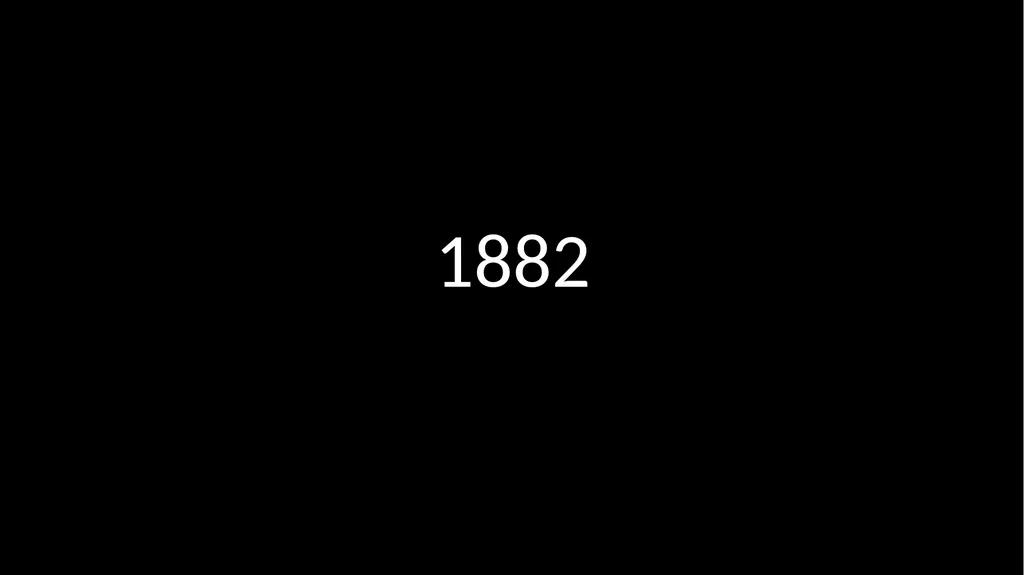
In 1882, Germany, Austria-Hungary and Italy joined together in the Triple Alliance. In 1907 Britain, France and Russia joined the Triple Entente.
The alliance system meant that small conflict would most likely lead to a war between all major European countries.<br>
In 1882, Germany, Austria-Hungary and Italy joined together in the Triple Alliance. In 1907 Britain, France and Russia joined the Triple Entente.
The alliance system meant that small conflict would most likely lead to a war between all major European countries.<br>
29
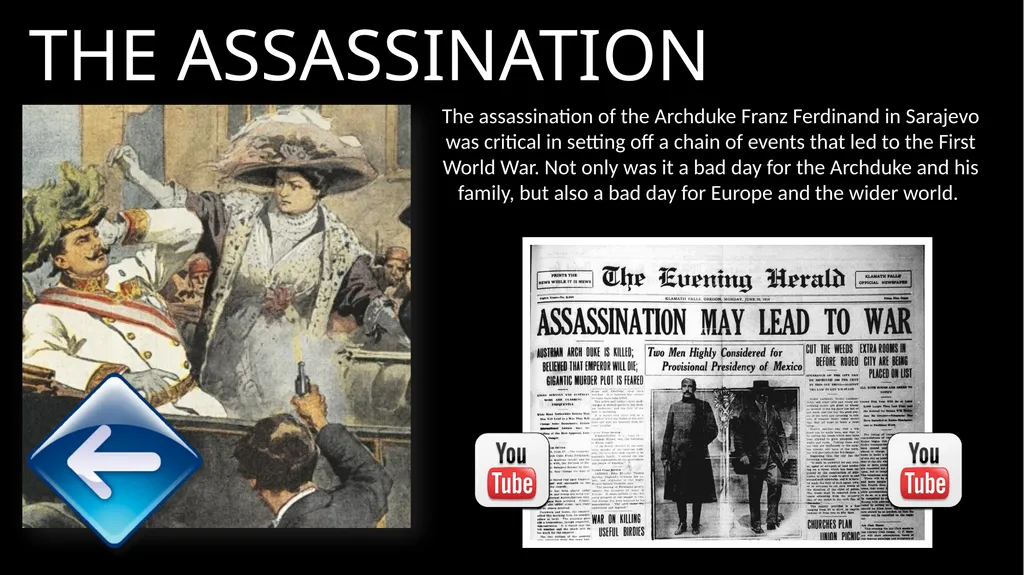
The assassination The assassination of the Archduke Franz Ferdinand in Sarajevo was critical in setting off a chain of events that led to the First World War. Not only was it a bad day for the Archduke and his family, but also a bad day for Europe and the wider world.<br>
30
Imperialism and empires The ‘Scramble for Africa’ or partition of Africa was the invasion and colonization of African territory by European powers in the later 1800s. This situation in Africa increased the tension between the major European countries.<br>
31
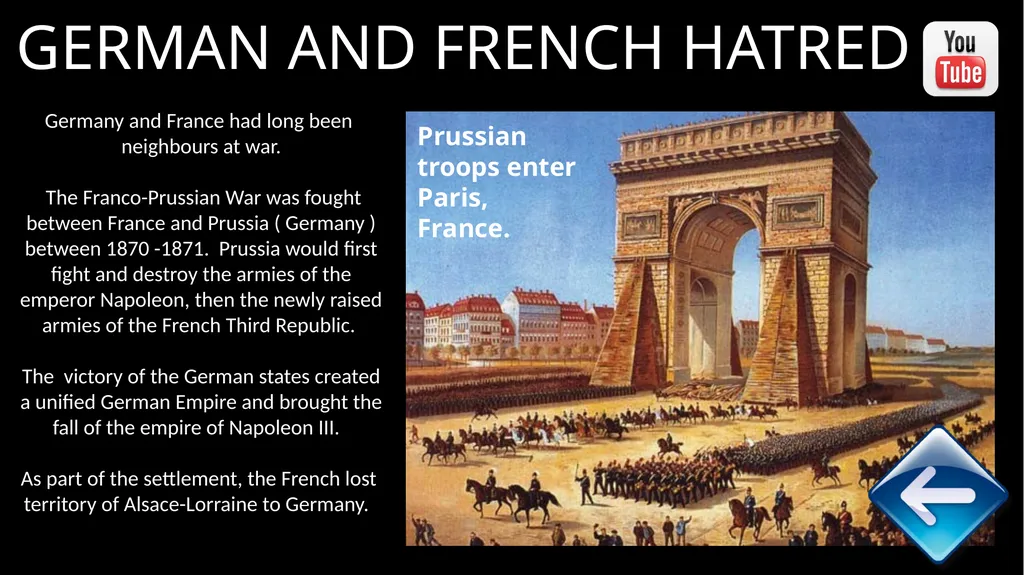
German and FRENCH Hatred Germany and France had long been neighbours at war.
The Franco-Prussian War was fought between France and Prussia ( Germany ) between 1870 -1871. Prussia would first fight and destroy the armies of the emperor Napoleon, then the newly raised armies of the French Third Republic.
The victory of the German states created a unified German Empire and brought the fall of the empire of Napoleon III.
As part of the settlement, the French lost territory of Alsace-Lorraine to Germany. Prussian troops enter Paris, France.<br>
32
Quick Quiz
The Causes Of WW1
Use a team flashboard for bonus answers?<br>
33
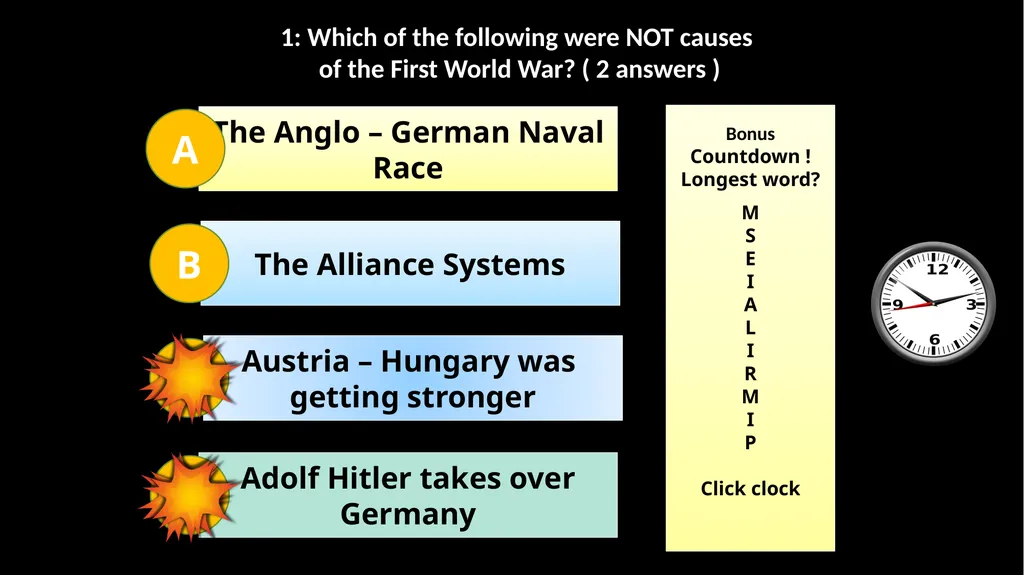
1: Which of the following were NOT causes
of the First World War? ( 2 answers ) The Anglo – German Naval Race The Alliance Systems Austria – Hungary was
getting stronger Adolf Hitler takes over
Germany A B C D Bonus
Countdown !
Longest word?
M
S
E
I
A
L
I
R
M
I
P
Click clock<br>
34
Longest word
Imperialism<br>
35
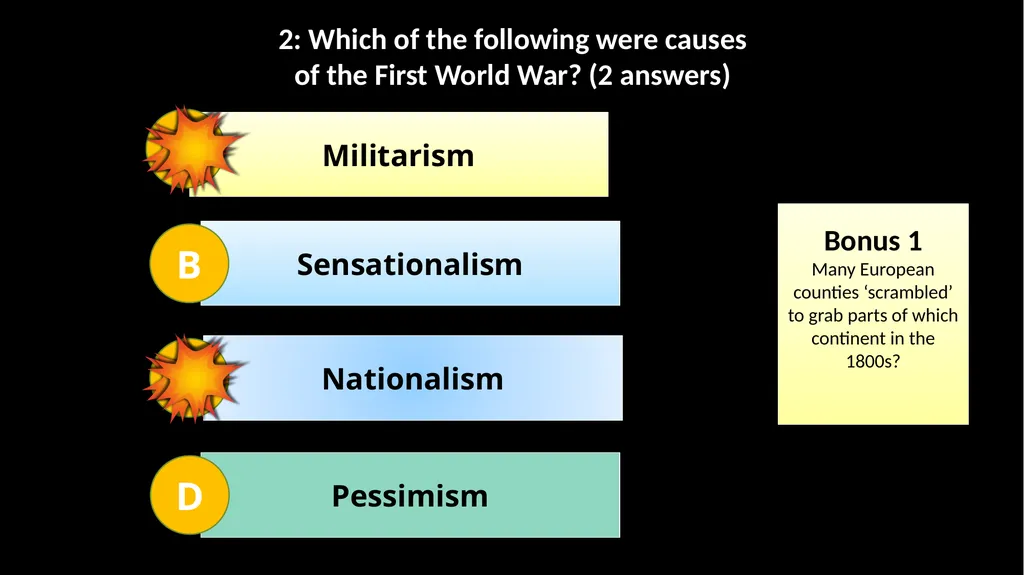
2: Which of the following were causes
of the First World War? (2 answers) Militarism Sensationalism Nationalism Pessimism A B C D Bonus 1
Many European counties ‘scrambled’ to grab parts of which continent in the 1800s?<br>
36
Africa<br>
37
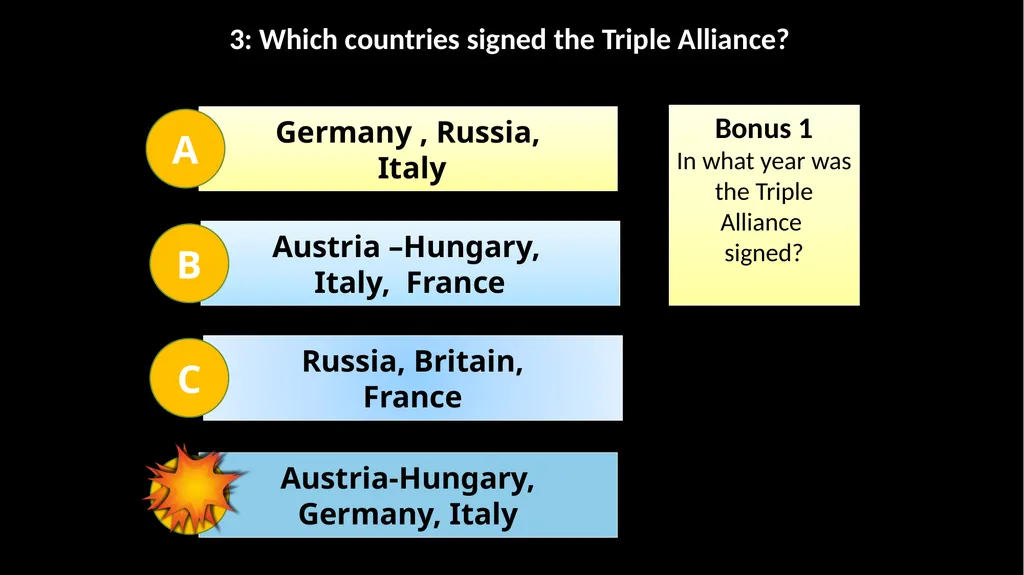
3: Which countries signed the Triple Alliance? Germany , Russia,
Italy Austria –Hungary,
Italy, France Russia, Britain,
France Austria-Hungary,
Germany, Italy A B C D Bonus 1
In what year was the Triple Alliance
signed?<br>
38
1882<br>
39
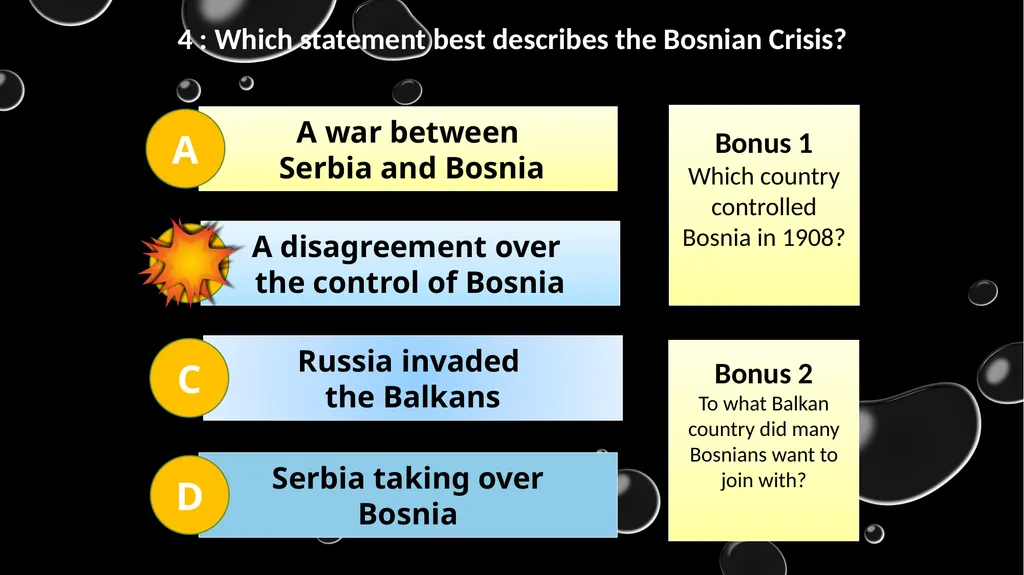
4 : Which statement best describes the Bosnian Crisis? A war between
Serbia and Bosnia A disagreement over
the control of Bosnia Russia invaded
the Balkans Serbia taking over
Bosnia A B C D Bonus 1
Which country controlled Bosnia in 1908? Bonus 2
To what Balkan country did many Bosnians want to join with?<br>
40
1. Austria-Hungary
2. Serbia<br>
41
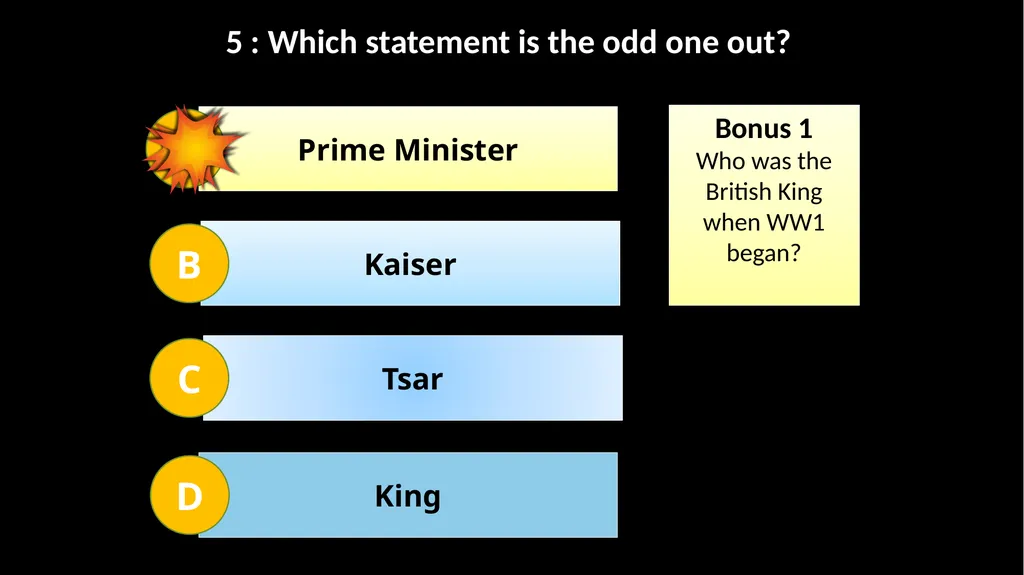
5 : Which statement is the odd one out? Prime Minister Kaiser Tsar King A B C D Bonus 1
Who was the British King when WW1
began?<br>
42
King George V<br>
43
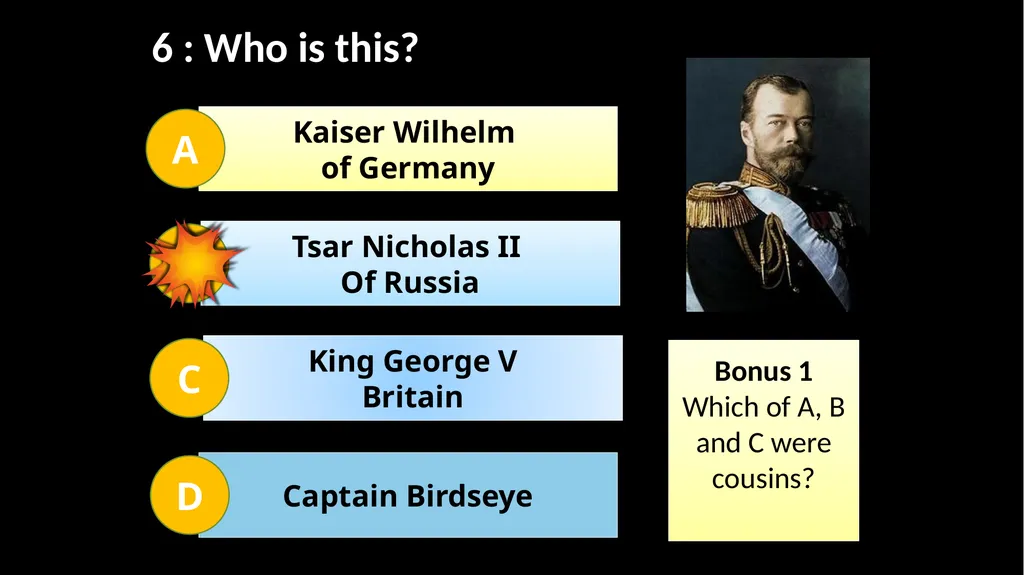
6 : Who is this? Kaiser Wilhelm
of Germany Tsar Nicholas II
Of Russia King George V
Britain Captain Birdseye A B C D Bonus 1
Which of A, B and C were cousins?<br>
44
All 3 were cousins yet they would eventually go to war with each other!<br>
45
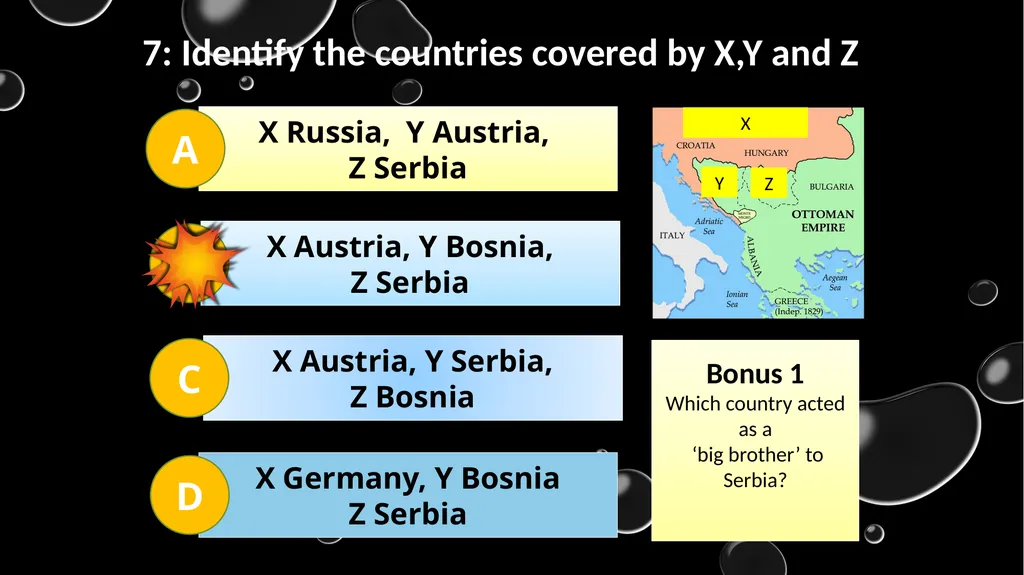
7: Identify the countries covered by X,Y and Z X Russia, Y Austria,
Z Serbia X Austria, Y Bosnia,
Z Serbia X Austria, Y Serbia,
Z Bosnia X Germany, Y Bosnia
Z Serbia A B C D Bonus 1
Which country acted as a
‘big brother’ to Serbia? Y Z X<br>
46
Russia<br>
47
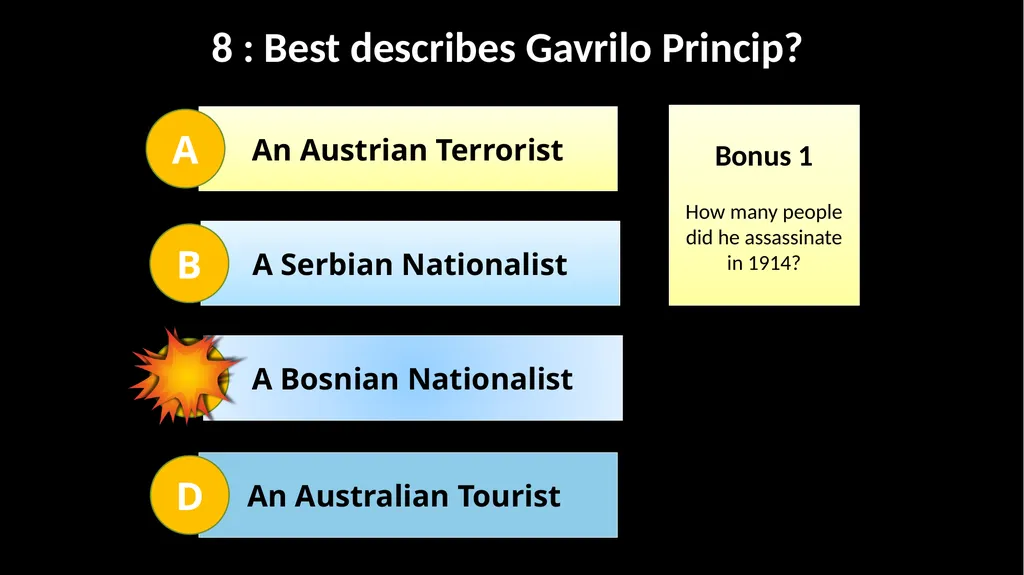
8 : Best describes Gavrilo Princip? An Austrian Terrorist A Serbian Nationalist A Bosnian Nationalist An Australian Tourist A B C D Bonus 1
How many people did he assassinate in 1914?<br>
How many people did he assassinate in 1914?<br>
48
Three
1. Archduke Ferdinand
2. Duchess Sophie
3. Their unborn child<br>
49
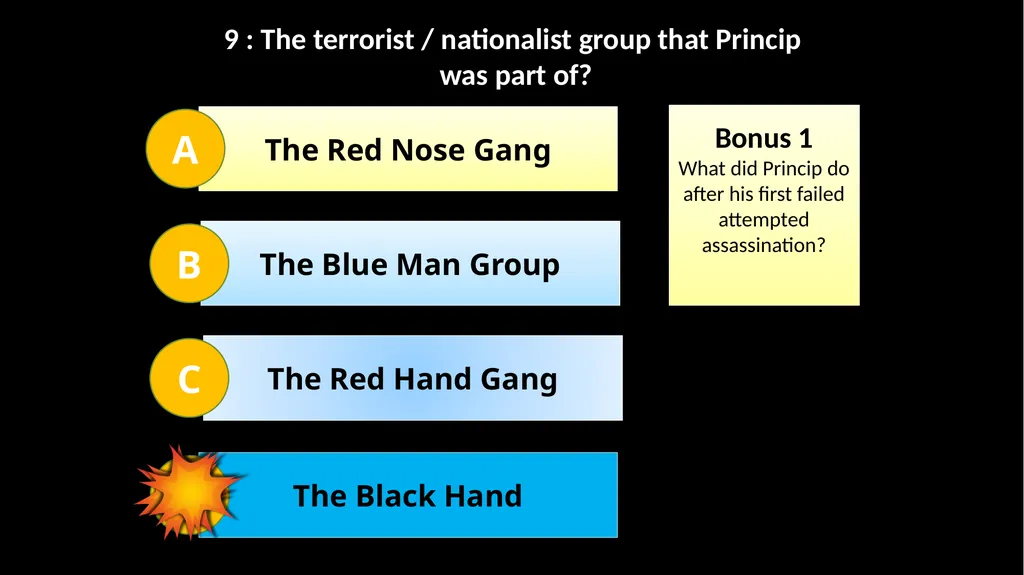
9 : The terrorist / nationalist group that Princip
was part of? The Red Nose Gang The Blue Man Group The Red Hand Gang The Black Hand A B C D Bonus 1
What did Princip do after his first failed attempted assassination?<br>
50
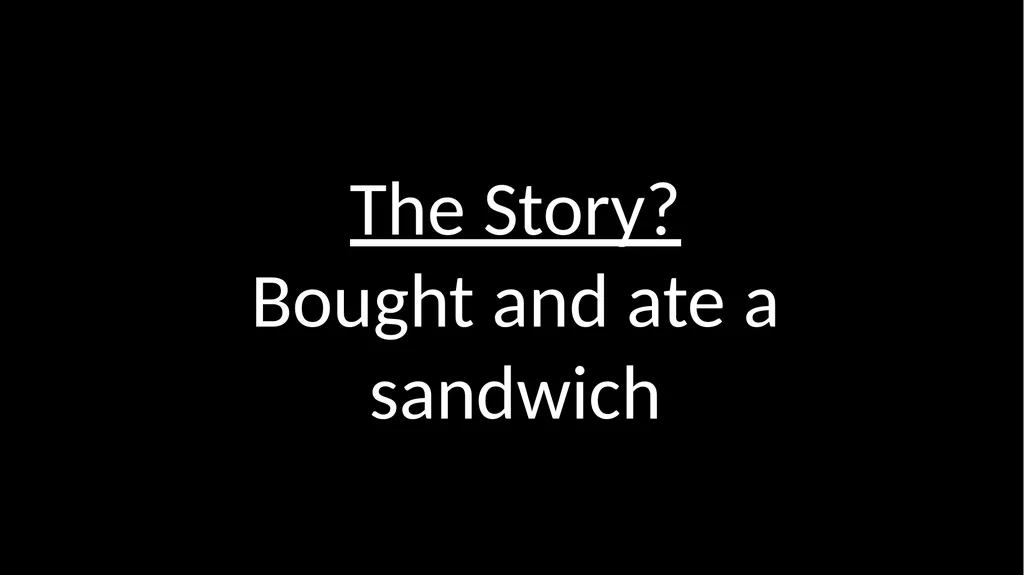
The Story?
Bought and ate a
sandwich<br>
sandwich<br>
51
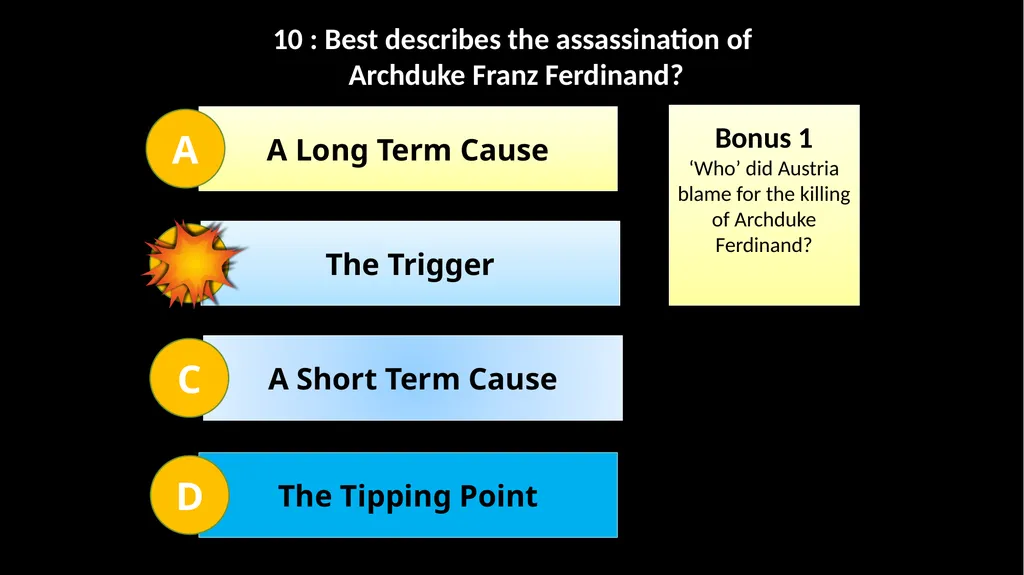
10 : Best describes the assassination of
Archduke Franz Ferdinand? A Long Term Cause The Trigger A Short Term Cause The Tipping Point A B C D Bonus 1
‘Who’ did Austria
blame for the killing of Archduke Ferdinand?<br>
52
Serbia<br>