
The Growth of Functions Section 3.2 1 Section
CM
Published · 25 slides · 0 views

1 / 1




Description
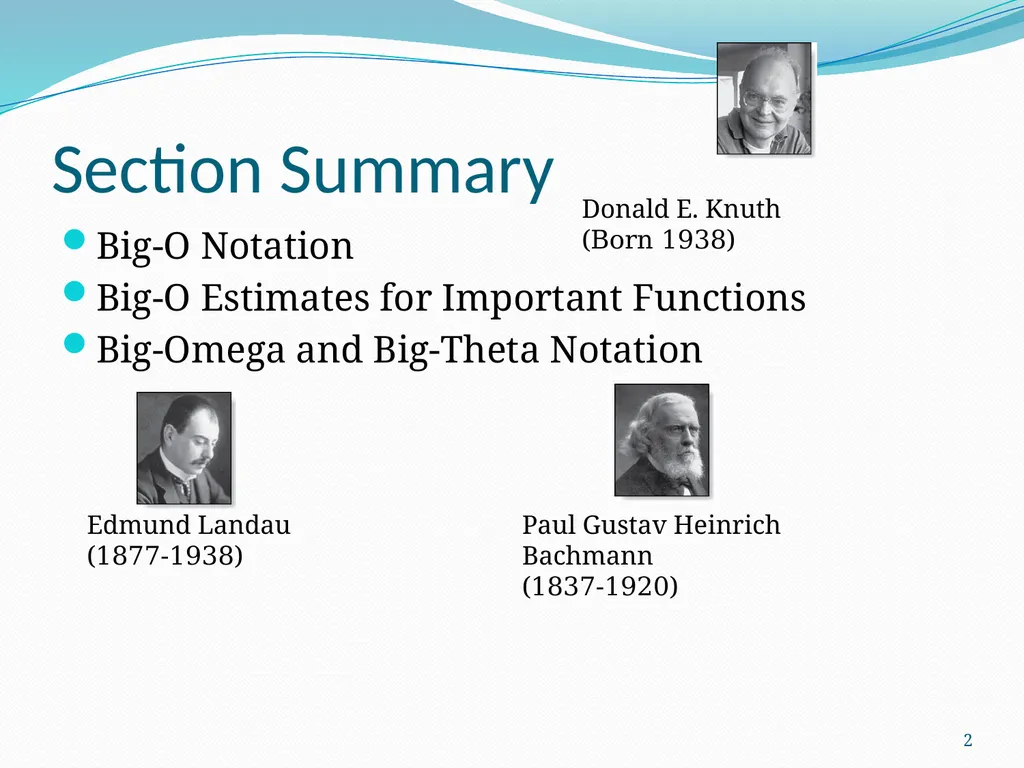
The Growth of Functions Section 3.2 1 Section Summary Big-O Notation Big-O Estimates for Important Functions Big-Omega and Big-Theta Notation Edmund Landau (1877-1938) Paul Gustav Heinrich Bachmann (1837-1920) Donald E. Knuth (Born 1938) 2
Related Topics
Share
Embed code
Download this presentation From Below
"The Growth of Functions Section 3.2 1 Section" is the property of its rightful owner. Permission is granted to download and print the materials on this website for personal, non-commercial use only, and to display it on your personal computer provided you do not modify the materials and that you retain all copyright notices contained in the materials. By downloading content from our website, you accept the terms of this agreement.
Presentation Transcript
01
The Growth of Functions Section 3.2 1<br>
02
Section Summary Big-O Notation
Big-O Estimates for Important Functions
Big-Omega and Big-Theta Notation Edmund Landau
(1877-1938) Paul Gustav Heinrich Bachmann
(1837-1920) Donald E. Knuth
(Born 1938) 2<br>
Big-O Estimates for Important Functions
Big-Omega and Big-Theta Notation Edmund Landau
(1877-1938) Paul Gustav Heinrich Bachmann
(1837-1920) Donald E. Knuth
(Born 1938) 2<br>
03
The Growth of Functions In both computer science and in mathematics, there are many times when we care about how fast a function grows.
In computer science, we want to understand how quickly an algorithm can solve a problem as the size of the input grows.
We can compare the efficiency of two different algorithms for solving the same problem.
We can also determine whether it is practical to use a particular algorithm as the input grows.
We’ll study these questions in Section 3.3.
Two of the areas of mathematics where questions about the growth of functions are studied are:
number theory (covered in Chapter 4)
combinatorics (covered in Chapters 6 and 8) 3<br>
In computer science, we want to understand how quickly an algorithm can solve a problem as the size of the input grows.
We can compare the efficiency of two different algorithms for solving the same problem.
We can also determine whether it is practical to use a particular algorithm as the input grows.
We’ll study these questions in Section 3.3.
Two of the areas of mathematics where questions about the growth of functions are studied are:
number theory (covered in Chapter 4)
combinatorics (covered in Chapters 6 and 8) 3<br>
04
Big-O Notation Definition: Let f and g be functions from the set of integers or the set of real numbers to the set of real numbers. We say that f(x) is O(g(x)) if there are constants C and k such that
whenever x > k. (illustration on next slide)
This is read as “f(x) is big-O of g(x)” or “g asymptotically dominates f.”
The constants C and k are called witnesses to the relationship f(x) is O(g(x)). Only one pair of witnesses is needed. 4<br>
whenever x > k. (illustration on next slide)
This is read as “f(x) is big-O of g(x)” or “g asymptotically dominates f.”
The constants C and k are called witnesses to the relationship f(x) is O(g(x)). Only one pair of witnesses is needed. 4<br>
05
Illustration of Big-O Notation f(x) is O(g(x) 5<br>
06
Some Important Points about Big-O Notation If one pair of witnesses is found, then there are infinitely many pairs. We can always make the k or the C larger and still maintain the inequality .
Any pair C ̍ and k̍ where C < C̍ and k < k ̍ is also a pair of witnesses since whenever x > k̍ > k.
You may see “ f(x) = O(g(x))” instead of “ f(x) is O(g(x)).”
But this is an abuse of the equals sign since the meaning is that there is an inequality relating the values of f and g, for sufficiently large values of x.
It is ok to write f(x) ∊ O(g(x)), because O(g(x)) represents the set of functions that are O(g(x)).
Usually, we will drop the absolute value sign since we will always deal with functions that take on positive values. 6<br>
Any pair C ̍ and k̍ where C < C̍ and k < k ̍ is also a pair of witnesses since whenever x > k̍ > k.
You may see “ f(x) = O(g(x))” instead of “ f(x) is O(g(x)).”
But this is an abuse of the equals sign since the meaning is that there is an inequality relating the values of f and g, for sufficiently large values of x.
It is ok to write f(x) ∊ O(g(x)), because O(g(x)) represents the set of functions that are O(g(x)).
Usually, we will drop the absolute value sign since we will always deal with functions that take on positive values. 6<br>
07
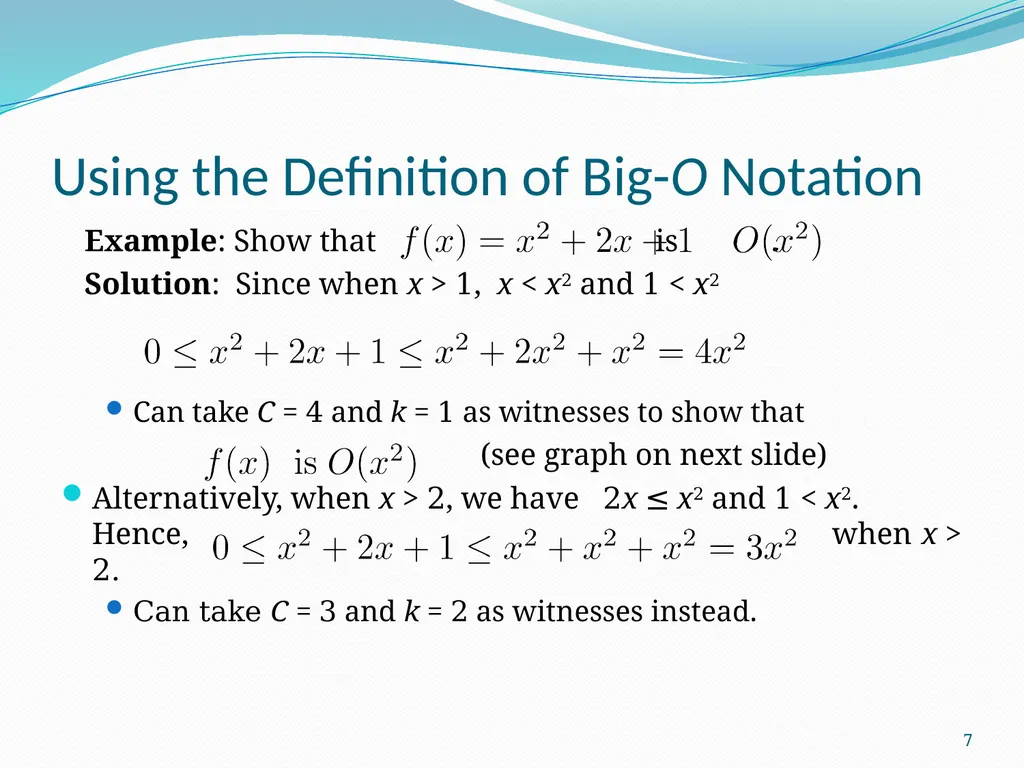
Using the Definition of Big-O Notation Example: Show that is .
Solution: Since when x > 1, x < x2 and 1 < x2
Can take C = 4 and k = 1 as witnesses to show that
(see graph on next slide)
Alternatively, when x > 2, we have 2x ≤ x2 and 1 < x2. Hence, when x > 2.
Can take C = 3 and k = 2 as witnesses instead. 7<br>
Solution: Since when x > 1, x < x2 and 1 < x2
Can take C = 4 and k = 1 as witnesses to show that
(see graph on next slide)
Alternatively, when x > 2, we have 2x ≤ x2 and 1 < x2. Hence, when x > 2.
Can take C = 3 and k = 2 as witnesses instead. 7<br>
08
Illustration of Big-O Notation is 8<br>
09
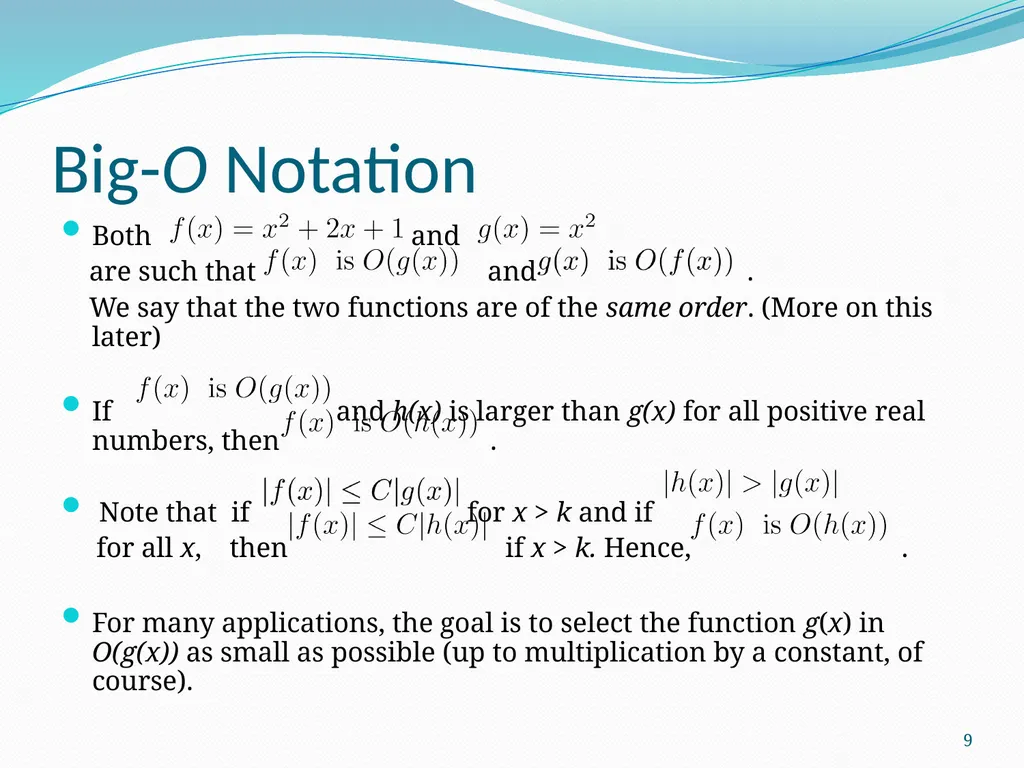
Big-O Notation Both and
are such that and .
We say that the two functions are of the same order. (More on this later)
If and h(x) is larger than g(x) for all positive real numbers, then .
Note that if for x > k and if
for all x, then if x > k. Hence, .
For many applications, the goal is to select the function g(x) in O(g(x)) as small as possible (up to multiplication by a constant, of course). 9<br>
are such that and .
We say that the two functions are of the same order. (More on this later)
If and h(x) is larger than g(x) for all positive real numbers, then .
Note that if for x > k and if
for all x, then if x > k. Hence, .
For many applications, the goal is to select the function g(x) in O(g(x)) as small as possible (up to multiplication by a constant, of course). 9<br>
10
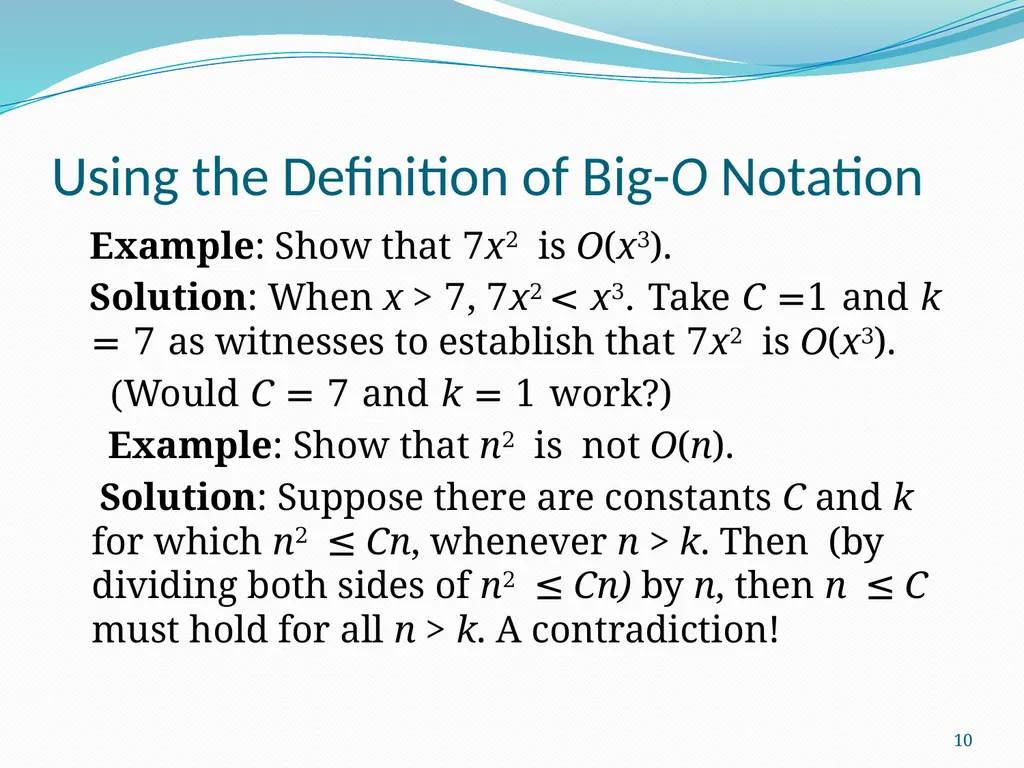
Using the Definition of Big-O Notation Example: Show that 7x2 is O(x3).
Solution: When x > 7, 7x2 < x3. Take C =1 and k = 7 as witnesses to establish that 7x2 is O(x3).
(Would C = 7 and k = 1 work?)
Example: Show that n2 is not O(n).
Solution: Suppose there are constants C and k for which n2 ≤ Cn, whenever n > k. Then (by dividing both sides of n2 ≤ Cn) by n, then n ≤ C must hold for all n > k. A contradiction! 10<br>
Solution: When x > 7, 7x2 < x3. Take C =1 and k = 7 as witnesses to establish that 7x2 is O(x3).
(Would C = 7 and k = 1 work?)
Example: Show that n2 is not O(n).
Solution: Suppose there are constants C and k for which n2 ≤ Cn, whenever n > k. Then (by dividing both sides of n2 ≤ Cn) by n, then n ≤ C must hold for all n > k. A contradiction! 10<br>
11
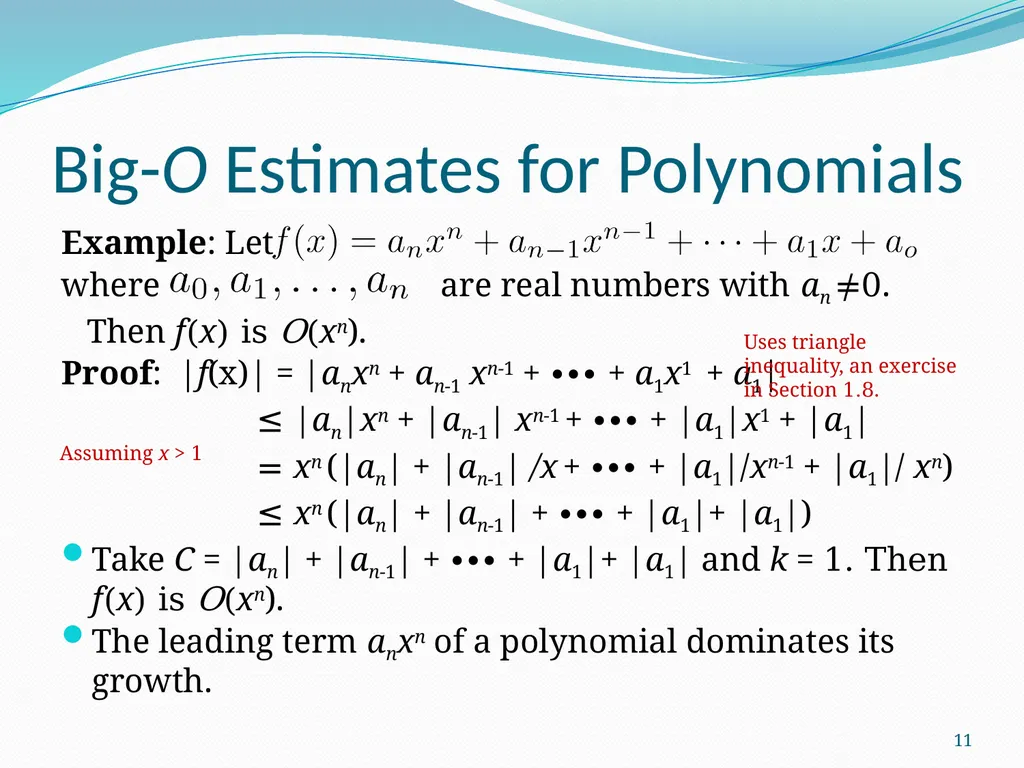
Big-O Estimates for Polynomials Example: Let
where are real numbers with an ≠0.
Then f(x) is O(xn).
Proof: |f(x)| = |anxn + an-1 xn-1 + ∙∙∙ + a1x1 + a1|
≤ |an|xn + |an-1| xn-1 + ∙∙∙ + |a1|x1 + |a1|
= xn (|an| + |an-1| /x + ∙∙∙ + |a1|/xn-1 + |a1|/ xn)
≤ xn (|an| + |an-1| + ∙∙∙ + |a1|+ |a1|)
Take C = |an| + |an-1| + ∙∙∙ + |a1|+ |a1| and k = 1. Then f(x) is O(xn).
The leading term anxn of a polynomial dominates its growth. Uses triangle inequality, an exercise in Section 1.8. Assuming x > 1 11<br>
where are real numbers with an ≠0.
Then f(x) is O(xn).
Proof: |f(x)| = |anxn + an-1 xn-1 + ∙∙∙ + a1x1 + a1|
≤ |an|xn + |an-1| xn-1 + ∙∙∙ + |a1|x1 + |a1|
= xn (|an| + |an-1| /x + ∙∙∙ + |a1|/xn-1 + |a1|/ xn)
≤ xn (|an| + |an-1| + ∙∙∙ + |a1|+ |a1|)
Take C = |an| + |an-1| + ∙∙∙ + |a1|+ |a1| and k = 1. Then f(x) is O(xn).
The leading term anxn of a polynomial dominates its growth. Uses triangle inequality, an exercise in Section 1.8. Assuming x > 1 11<br>
12
Big-O Estimates for some Important Functions Example: Use big-O notation to estimate the sum of the first n positive integers.
Solution:
Example: Use big-O notation to estimate the factorial function
Solution: Continued → 12<br>
Solution:
Example: Use big-O notation to estimate the factorial function
Solution: Continued → 12<br>
13
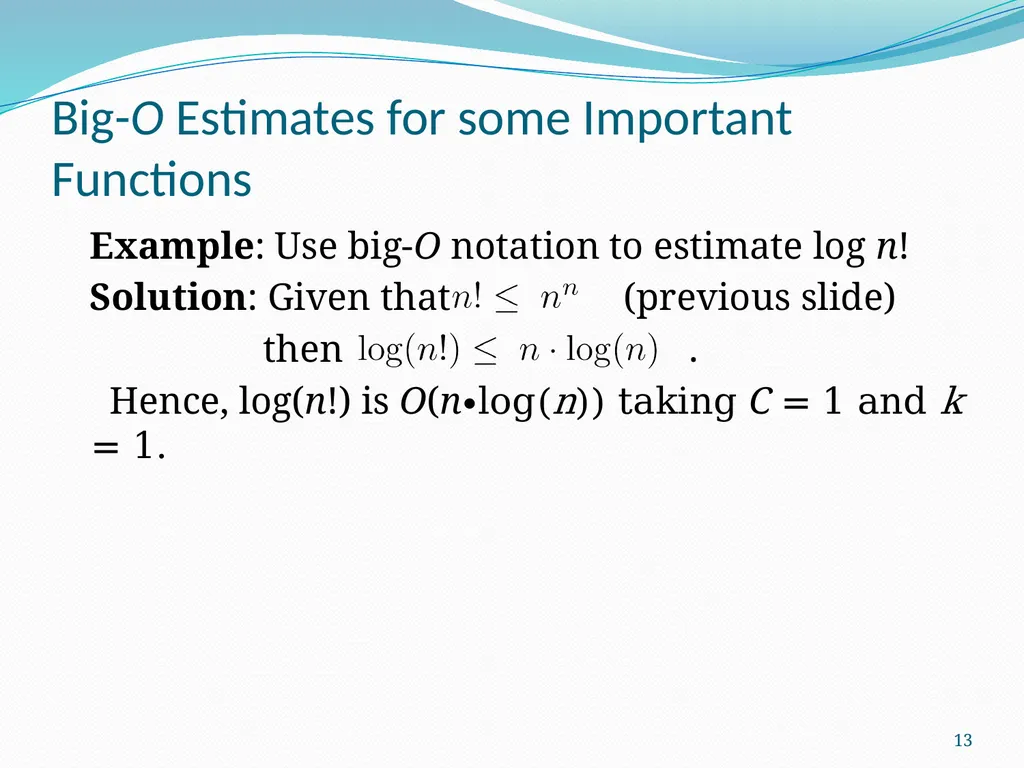
Big-O Estimates for some Important Functions Example: Use big-O notation to estimate log n!
Solution: Given that (previous slide)
then .
Hence, log(n!) is O(n∙log(n)) taking C = 1 and k = 1. 13<br>
Solution: Given that (previous slide)
then .
Hence, log(n!) is O(n∙log(n)) taking C = 1 and k = 1. 13<br>
14
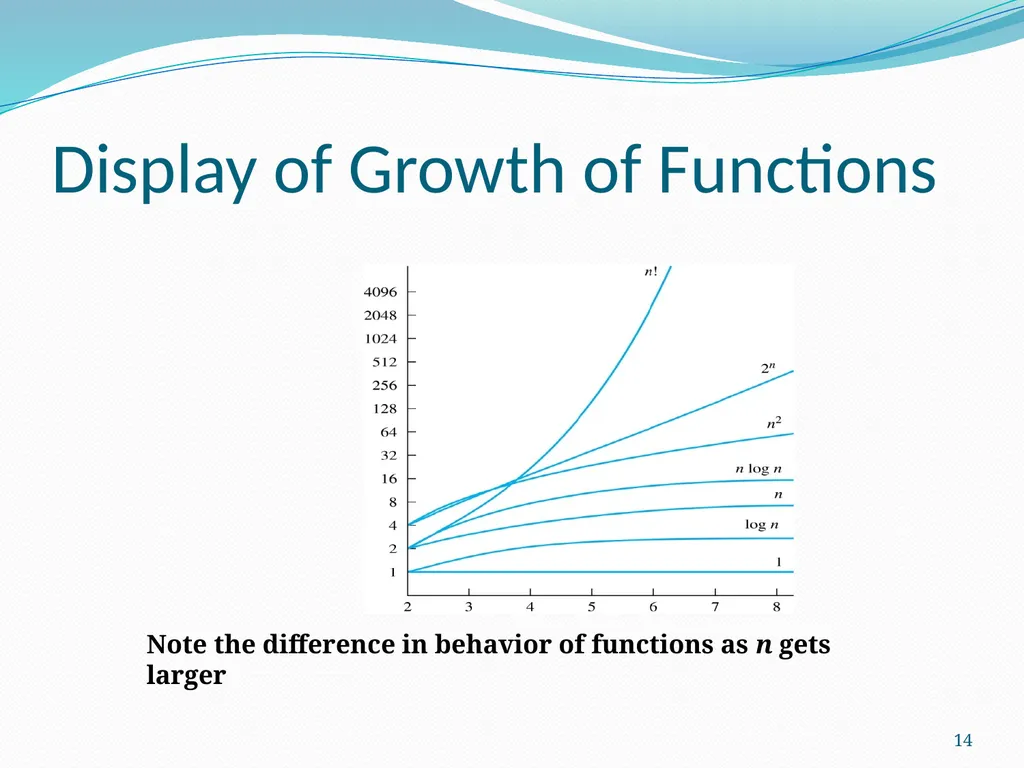
Display of Growth of Functions Note the difference in behavior of functions as n gets larger 14<br>
15
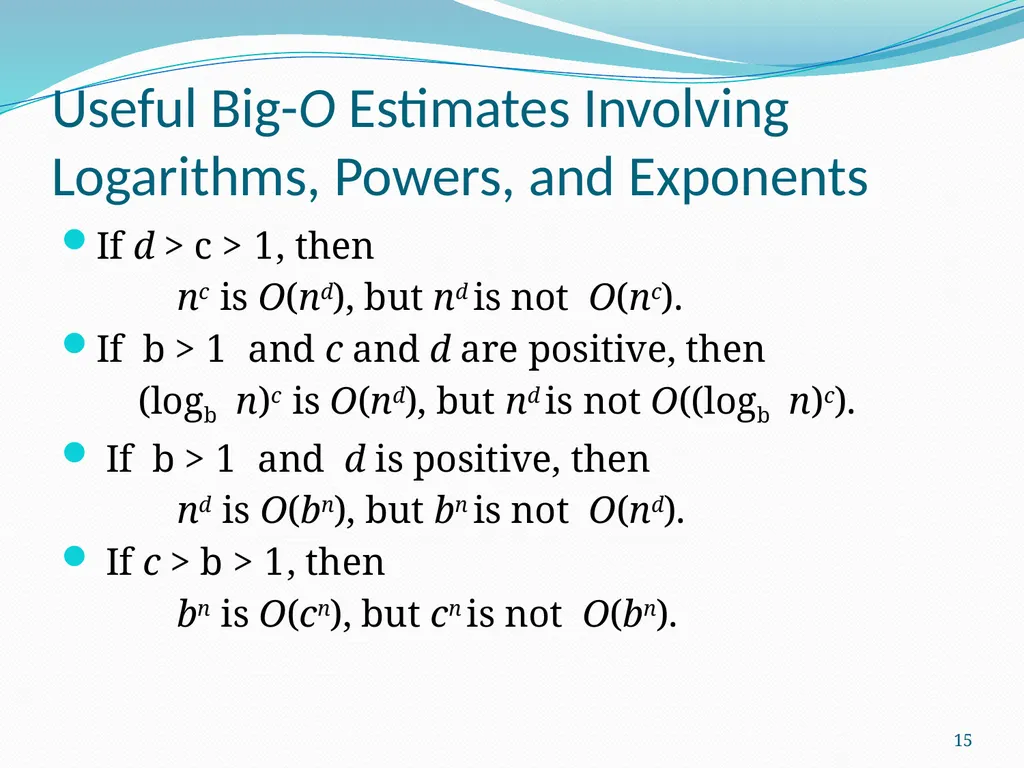
Useful Big-O Estimates Involving Logarithms, Powers, and Exponents If d > c > 1, then
nc is O(nd), but nd is not O(nc).
If b > 1 and c and d are positive, then
(logb n)c is O(nd), but nd is not O((logb n)c).
If b > 1 and d is positive, then
nd is O(bn), but bn is not O(nd).
If c > b > 1, then
bn is O(cn), but cn is not O(bn). 15<br>
nc is O(nd), but nd is not O(nc).
If b > 1 and c and d are positive, then
(logb n)c is O(nd), but nd is not O((logb n)c).
If b > 1 and d is positive, then
nd is O(bn), but bn is not O(nd).
If c > b > 1, then
bn is O(cn), but cn is not O(bn). 15<br>
16
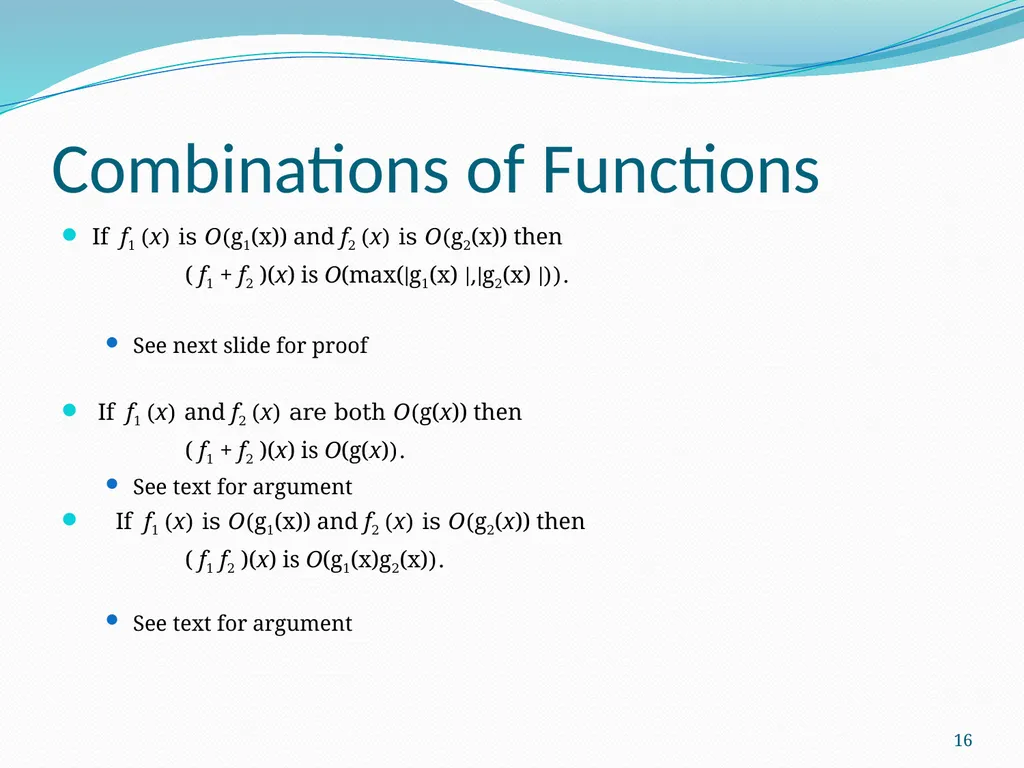
Combinations of Functions If f1 (x) is O(g1(x)) and f2 (x) is O(g2(x)) then
( f1 + f2 )(x) is O(max(|g1(x) |,|g2(x) |)).
See next slide for proof
If f1 (x) and f2 (x) are both O(g(x)) then
( f1 + f2 )(x) is O(g(x)).
See text for argument
If f1 (x) is O(g1(x)) and f2 (x) is O(g2(x)) then
( f1 f2 )(x) is O(g1(x)g2(x)).
See text for argument 16<br>
( f1 + f2 )(x) is O(max(|g1(x) |,|g2(x) |)).
See next slide for proof
If f1 (x) and f2 (x) are both O(g(x)) then
( f1 + f2 )(x) is O(g(x)).
See text for argument
If f1 (x) is O(g1(x)) and f2 (x) is O(g2(x)) then
( f1 f2 )(x) is O(g1(x)g2(x)).
See text for argument 16<br>
17
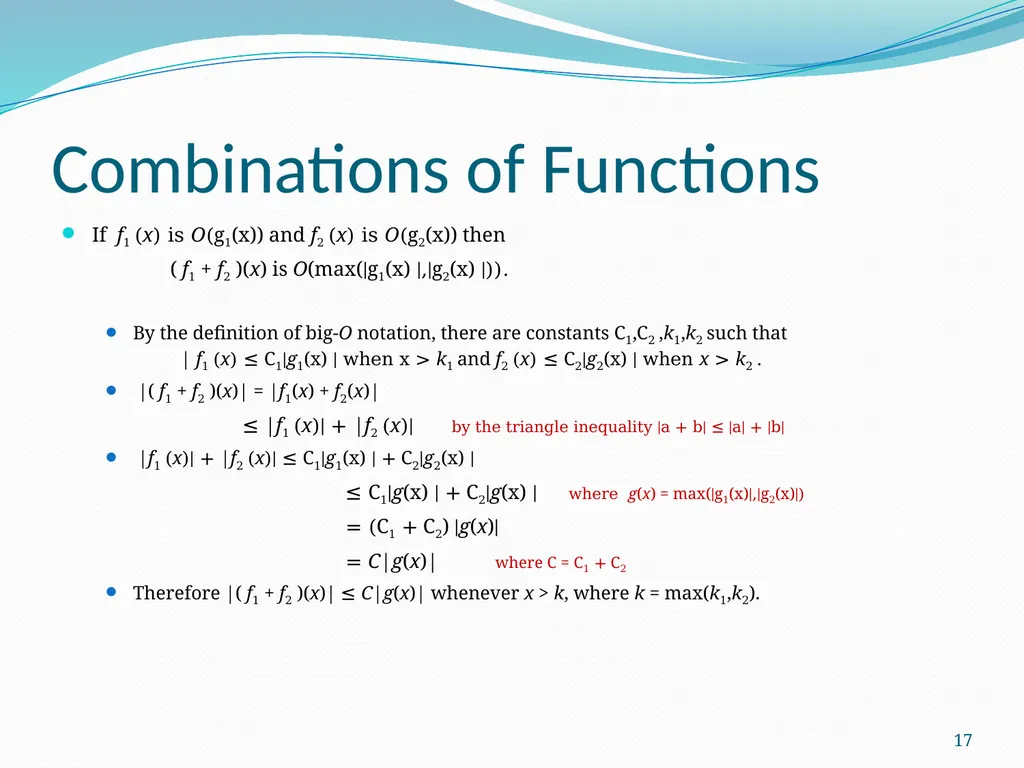
Combinations of Functions If f1 (x) is O(g1(x)) and f2 (x) is O(g2(x)) then
( f1 + f2 )(x) is O(max(|g1(x) |,|g2(x) |)).
By the definition of big-O notation, there are constants C1,C2 ,k1,k2 such that | f1 (x) ≤ C1|g1(x) | when x > k1 and f2 (x) ≤ C2|g2(x) | when x > k2 .
|( f1 + f2 )(x)| = |f1(x) + f2(x)|
≤ |f1 (x)| + |f2 (x)| by the triangle inequality |a + b| ≤ |a| + |b|
|f1 (x)| + |f2 (x)| ≤ C1|g1(x) | + C2|g2(x) |
≤ C1|g(x) | + C2|g(x) | where g(x) = max(|g1(x)|,|g2(x)|)
= (C1 + C2) |g(x)|
= C|g(x)| where C = C1 + C2
Therefore |( f1 + f2 )(x)| ≤ C|g(x)| whenever x > k, where k = max(k1,k2). 17<br>
( f1 + f2 )(x) is O(max(|g1(x) |,|g2(x) |)).
By the definition of big-O notation, there are constants C1,C2 ,k1,k2 such that | f1 (x) ≤ C1|g1(x) | when x > k1 and f2 (x) ≤ C2|g2(x) | when x > k2 .
|( f1 + f2 )(x)| = |f1(x) + f2(x)|
≤ |f1 (x)| + |f2 (x)| by the triangle inequality |a + b| ≤ |a| + |b|
|f1 (x)| + |f2 (x)| ≤ C1|g1(x) | + C2|g2(x) |
≤ C1|g(x) | + C2|g(x) | where g(x) = max(|g1(x)|,|g2(x)|)
= (C1 + C2) |g(x)|
= C|g(x)| where C = C1 + C2
Therefore |( f1 + f2 )(x)| ≤ C|g(x)| whenever x > k, where k = max(k1,k2). 17<br>
18
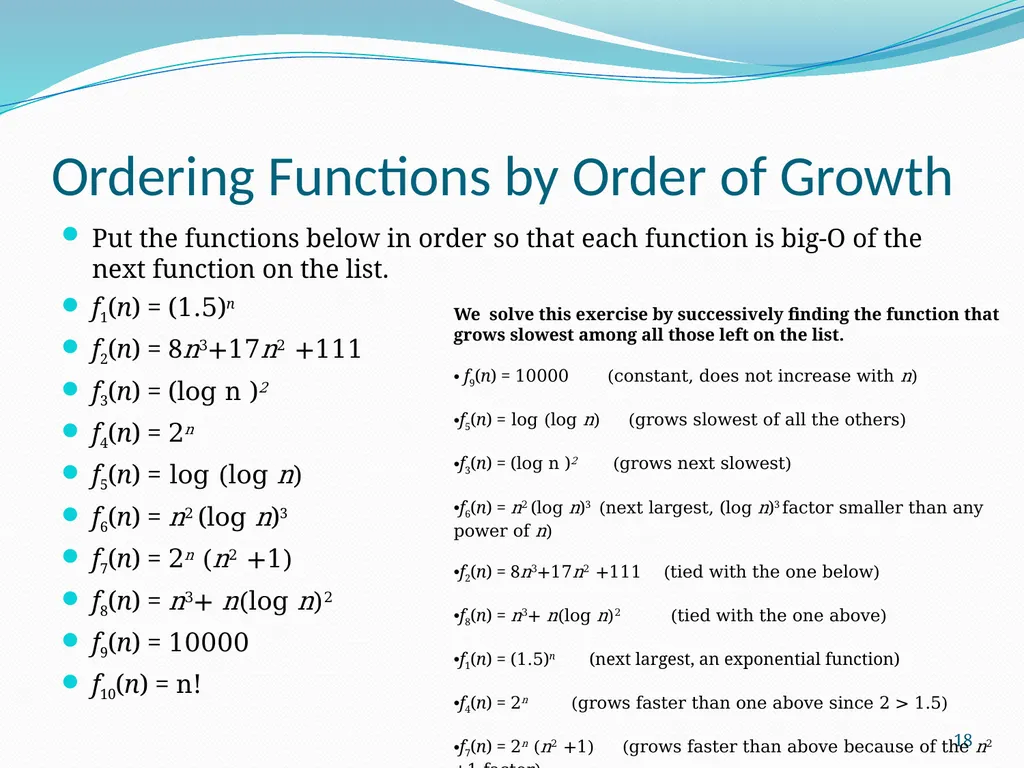
Ordering Functions by Order of Growth Put the functions below in order so that each function is big-O of the next function on the list.
f1(n) = (1.5)n
f2(n) = 8n3+17n2 +111
f3(n) = (log n )2
f4(n) = 2n
f5(n) = log (log n)
f6(n) = n2 (log n)3
f7(n) = 2n (n2 +1)
f8(n) = n3+ n(log n)2
f9(n) = 10000
f10(n) = n! We solve this exercise by successively finding the function that grows slowest among all those left on the list.
f9(n) = 10000 (constant, does not increase with n)
f5(n) = log (log n) (grows slowest of all the others)
f3(n) = (log n )2 (grows next slowest)
f6(n) = n2 (log n)3 (next largest, (log n)3 factor smaller than any power of n)
f2(n) = 8n3+17n2 +111 (tied with the one below)
f8(n) = n3+ n(log n)2 (tied with the one above)
f1(n) = (1.5)n (next largest, an exponential function)
f4(n) = 2n (grows faster than one above since 2 > 1.5)
f7(n) = 2n (n2 +1) (grows faster than above because of the n2 +1 factor)
f10(n) = n! ( n! grows faster than cn for every c) 18<br>
f1(n) = (1.5)n
f2(n) = 8n3+17n2 +111
f3(n) = (log n )2
f4(n) = 2n
f5(n) = log (log n)
f6(n) = n2 (log n)3
f7(n) = 2n (n2 +1)
f8(n) = n3+ n(log n)2
f9(n) = 10000
f10(n) = n! We solve this exercise by successively finding the function that grows slowest among all those left on the list.
f9(n) = 10000 (constant, does not increase with n)
f5(n) = log (log n) (grows slowest of all the others)
f3(n) = (log n )2 (grows next slowest)
f6(n) = n2 (log n)3 (next largest, (log n)3 factor smaller than any power of n)
f2(n) = 8n3+17n2 +111 (tied with the one below)
f8(n) = n3+ n(log n)2 (tied with the one above)
f1(n) = (1.5)n (next largest, an exponential function)
f4(n) = 2n (grows faster than one above since 2 > 1.5)
f7(n) = 2n (n2 +1) (grows faster than above because of the n2 +1 factor)
f10(n) = n! ( n! grows faster than cn for every c) 18<br>
19
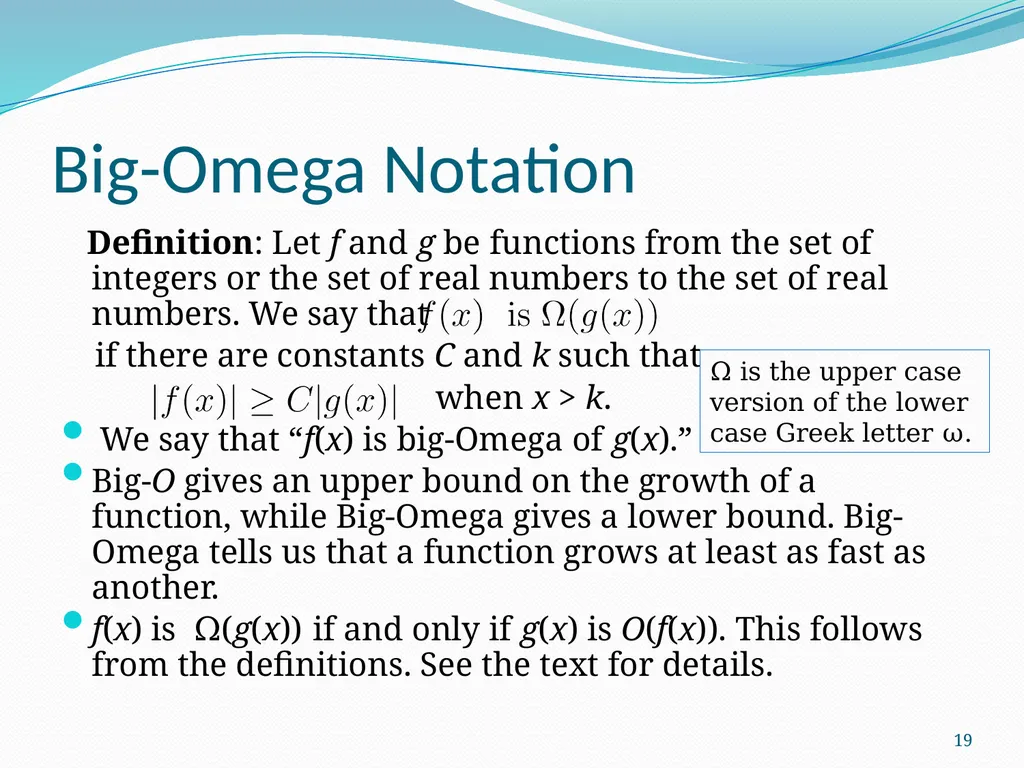
Big-Omega Notation Definition: Let f and g be functions from the set of integers or the set of real numbers to the set of real numbers. We say that
if there are constants C and k such that
when x > k.
We say that “f(x) is big-Omega of g(x).”
Big-O gives an upper bound on the growth of a function, while Big-Omega gives a lower bound. Big-Omega tells us that a function grows at least as fast as another.
f(x) is Ω(g(x)) if and only if g(x) is O(f(x)). This follows from the definitions. See the text for details. Ω is the upper case version of the lower case Greek letter ω. 19<br>
if there are constants C and k such that
when x > k.
We say that “f(x) is big-Omega of g(x).”
Big-O gives an upper bound on the growth of a function, while Big-Omega gives a lower bound. Big-Omega tells us that a function grows at least as fast as another.
f(x) is Ω(g(x)) if and only if g(x) is O(f(x)). This follows from the definitions. See the text for details. Ω is the upper case version of the lower case Greek letter ω. 19<br>
20
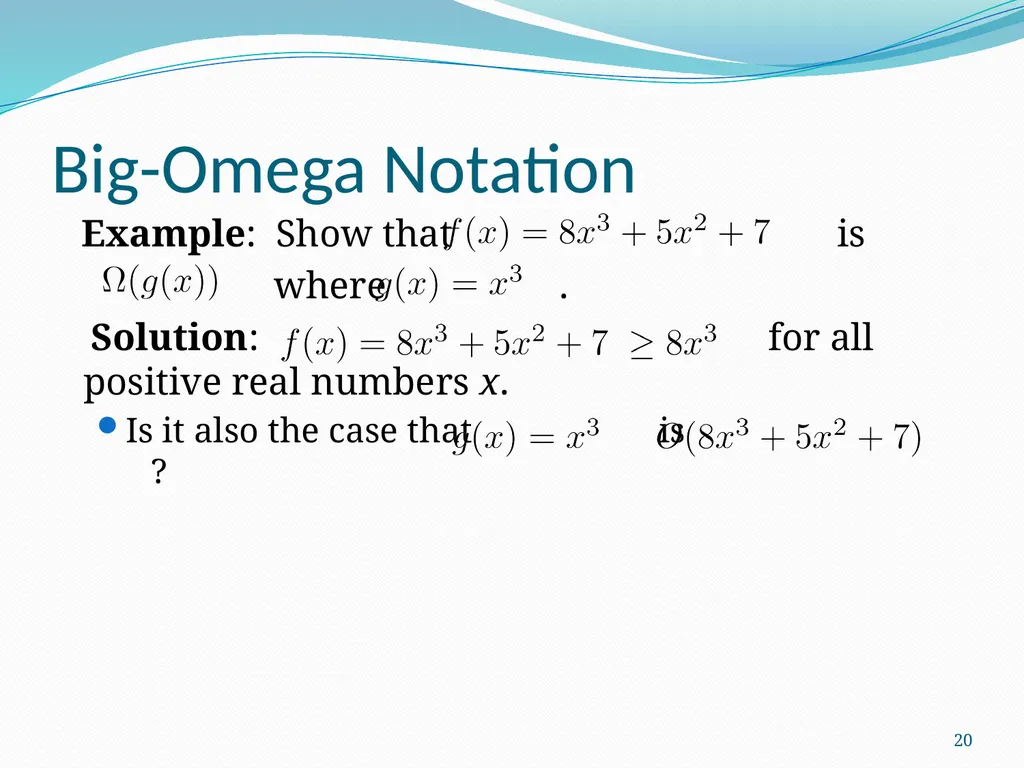
Big-Omega Notation Example: Show that is
where .
Solution: for all positive real numbers x.
Is it also the case that is ? 20<br>
where .
Solution: for all positive real numbers x.
Is it also the case that is ? 20<br>
21
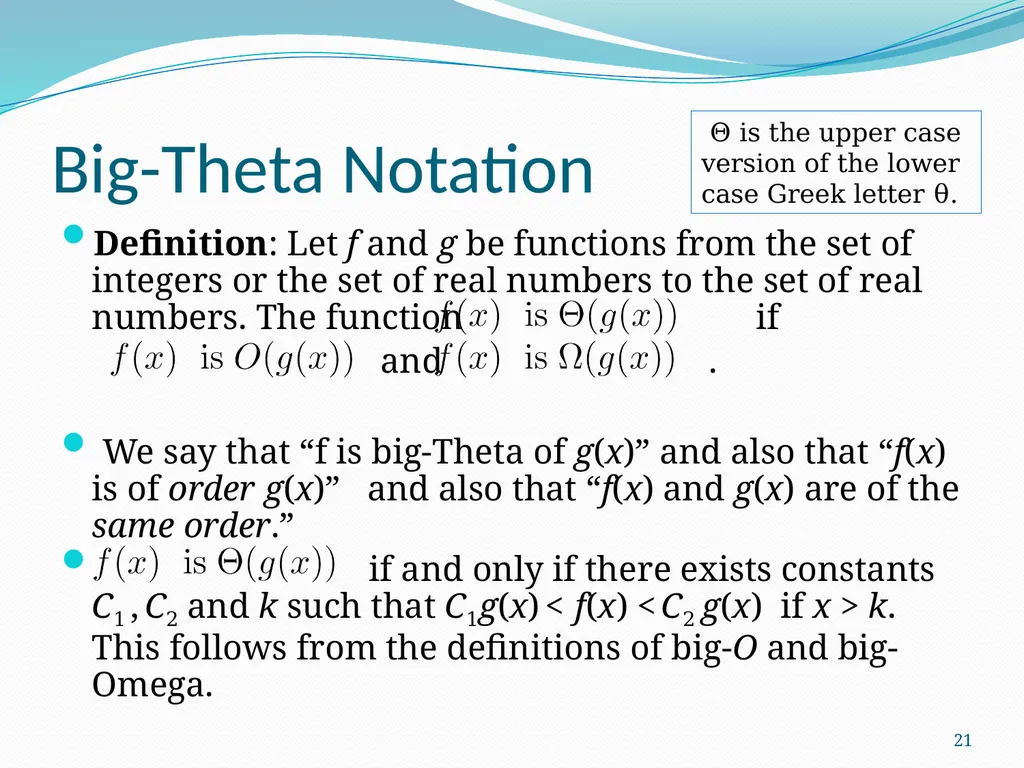
Big-Theta Notation Definition: Let f and g be functions from the set of integers or the set of real numbers to the set of real numbers. The function if
and .
We say that “f is big-Theta of g(x)” and also that “f(x) is of order g(x)” and also that “f(x) and g(x) are of the same order.”
if and only if there exists constants C1 , C2 and k such that C1g(x) < f(x) < C2 g(x) if x > k. This follows from the definitions of big-O and big-Omega. Θ is the upper case version of the lower case Greek letter θ. 21<br>
and .
We say that “f is big-Theta of g(x)” and also that “f(x) is of order g(x)” and also that “f(x) and g(x) are of the same order.”
if and only if there exists constants C1 , C2 and k such that C1g(x) < f(x) < C2 g(x) if x > k. This follows from the definitions of big-O and big-Omega. Θ is the upper case version of the lower case Greek letter θ. 21<br>
22
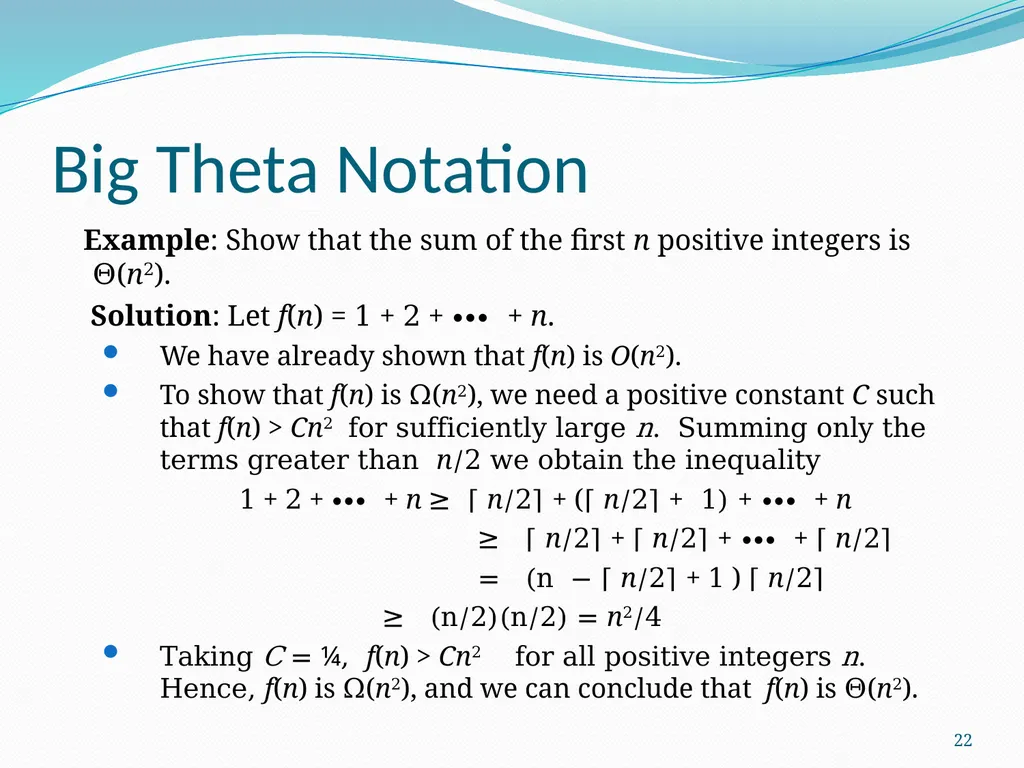
Big Theta Notation Example: Show that the sum of the first n positive integers is Θ(n2).
Solution: Let f(n) = 1 + 2 + ∙∙∙ + n.
We have already shown that f(n) is O(n2).
To show that f(n) is Ω(n2), we need a positive constant C such that f(n) > Cn2 for sufficiently large n. Summing only the terms greater than n/2 we obtain the inequality
1 + 2 + ∙∙∙ + n ≥ ⌈ n/2⌉ + (⌈ n/2⌉ + 1) + ∙∙∙ + n
≥ ⌈ n/2⌉ + ⌈ n/2⌉ + ∙∙∙ + ⌈ n/2⌉
= (n − ⌈ n/2⌉ + 1 ) ⌈ n/2⌉
≥ (n/2)(n/2) = n2/4
Taking C = ¼, f(n) > Cn2 for all positive integers n. Hence, f(n) is Ω(n2), and we can conclude that f(n) is Θ(n2). 22<br>
Solution: Let f(n) = 1 + 2 + ∙∙∙ + n.
We have already shown that f(n) is O(n2).
To show that f(n) is Ω(n2), we need a positive constant C such that f(n) > Cn2 for sufficiently large n. Summing only the terms greater than n/2 we obtain the inequality
1 + 2 + ∙∙∙ + n ≥ ⌈ n/2⌉ + (⌈ n/2⌉ + 1) + ∙∙∙ + n
≥ ⌈ n/2⌉ + ⌈ n/2⌉ + ∙∙∙ + ⌈ n/2⌉
= (n − ⌈ n/2⌉ + 1 ) ⌈ n/2⌉
≥ (n/2)(n/2) = n2/4
Taking C = ¼, f(n) > Cn2 for all positive integers n. Hence, f(n) is Ω(n2), and we can conclude that f(n) is Θ(n2). 22<br>
23
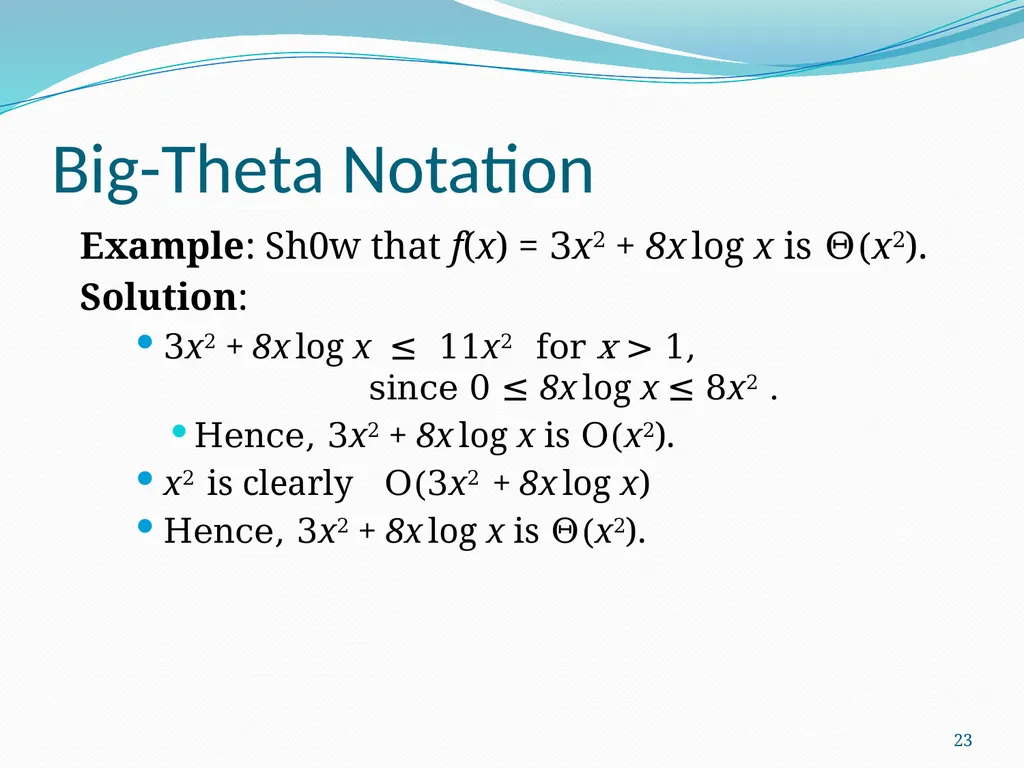
Big-Theta Notation Example: Sh0w that f(x) = 3x2 + 8x log x is Θ(x2).
Solution:
3x2 + 8x log x ≤ 11x2 for x > 1, since 0 ≤ 8x log x ≤ 8x2 .
Hence, 3x2 + 8x log x is O(x2).
x2 is clearly O(3x2 + 8x log x)
Hence, 3x2 + 8x log x is Θ(x2). 23<br>
Solution:
3x2 + 8x log x ≤ 11x2 for x > 1, since 0 ≤ 8x log x ≤ 8x2 .
Hence, 3x2 + 8x log x is O(x2).
x2 is clearly O(3x2 + 8x log x)
Hence, 3x2 + 8x log x is Θ(x2). 23<br>
24
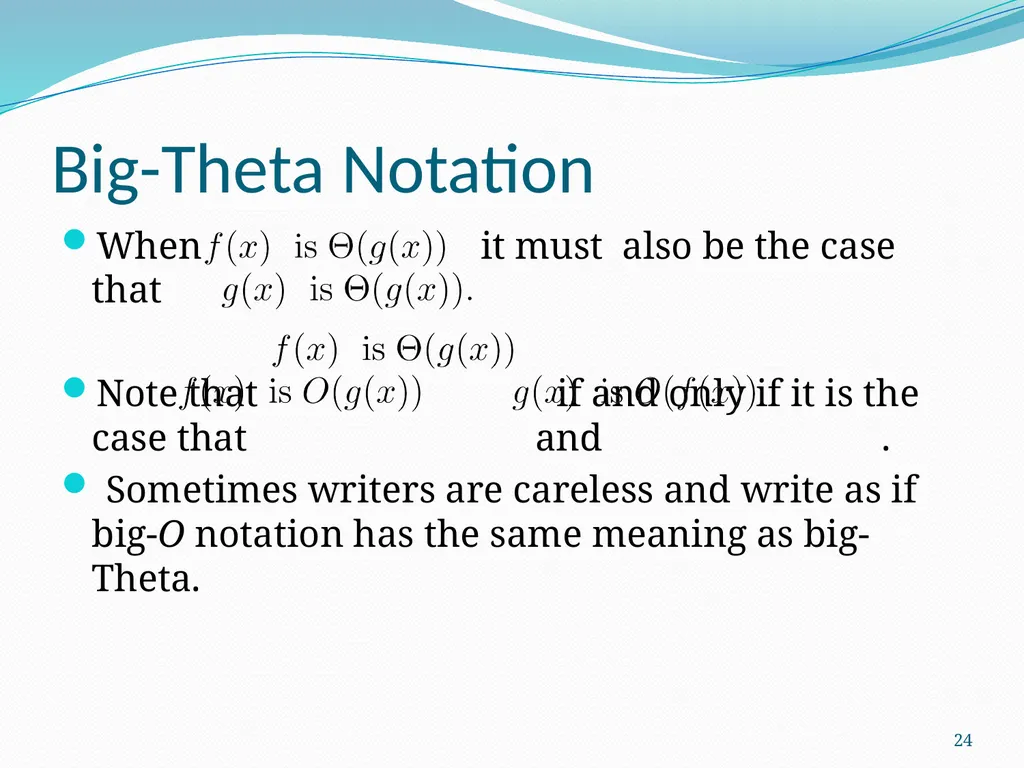
Big-Theta Notation When it must also be the case that
Note that if and only if it is the case that and .
Sometimes writers are careless and write as if big-O notation has the same meaning as big-Theta. 24<br>
Note that if and only if it is the case that and .
Sometimes writers are careless and write as if big-O notation has the same meaning as big-Theta. 24<br>
25
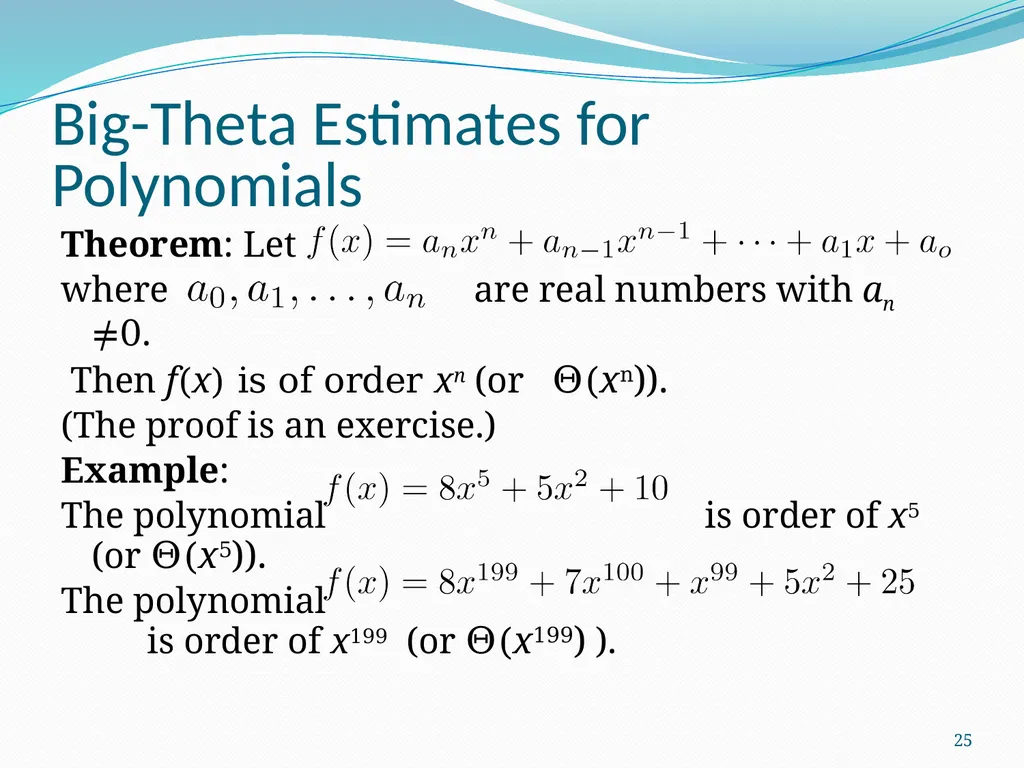
Big-Theta Estimates for Polynomials Theorem: Let
where are real numbers with an ≠0.
Then f(x) is of order xn (or Θ(xn)).
(The proof is an exercise.)
Example:
The polynomial is order of x5 (or Θ(x5)).
The polynomial is order of x199 (or Θ(x199) ). 25<br>
where are real numbers with an ≠0.
Then f(x) is of order xn (or Θ(xn)).
(The proof is an exercise.)
Example:
The polynomial is order of x5 (or Θ(x5)).
The polynomial is order of x199 (or Θ(x199) ). 25<br>