
The Importance of the Midterm Review A Case Study
SN
Published · 19 slides · 0 views

1 / 1
Description
The Importance of the Midterm Review A Case Study exercise from Mauritius The Importance of the Midterm Review from Agencies Point of View UNDP-GEF Regional Technical Advisers often say to project teams, The Terminal Evaluation is
Related Topics
Share
Embed code
Download this presentation From Below
"The Importance of the Midterm Review A Case Study" is the property of its rightful owner. Permission is granted to download and print the materials on this website for personal, non-commercial use only, and to display it on your personal computer provided you do not modify the materials and that you retain all copyright notices contained in the materials. By downloading content from our website, you accept the terms of this agreement.
Presentation Transcript
01
The Importance of the
Midterm Review A Case Study exercise from Mauritius<br>
02
The Importance of the
Midterm Review from Agencies Point of View UNDP-GEF Regional Technical Advisers often say to project teams,
“The Terminal Evaluation is important for the GEF to see what was achieved for their investment.
The Midterm Review is important for you – and for UNDP – because if performance is poor, we can still turn things around.”<br>
03
Questions about the
Midterm Review (MTR) What makes the MTR different from other reporting requirements?
Who benefits from the MTR and how?
How can the MTR catalyze change in a project?
What questions should be asked by the MTR?
Beyond the scope of a single project, how can MTR reports be used? A case study will help us answer these questions...<br>
04
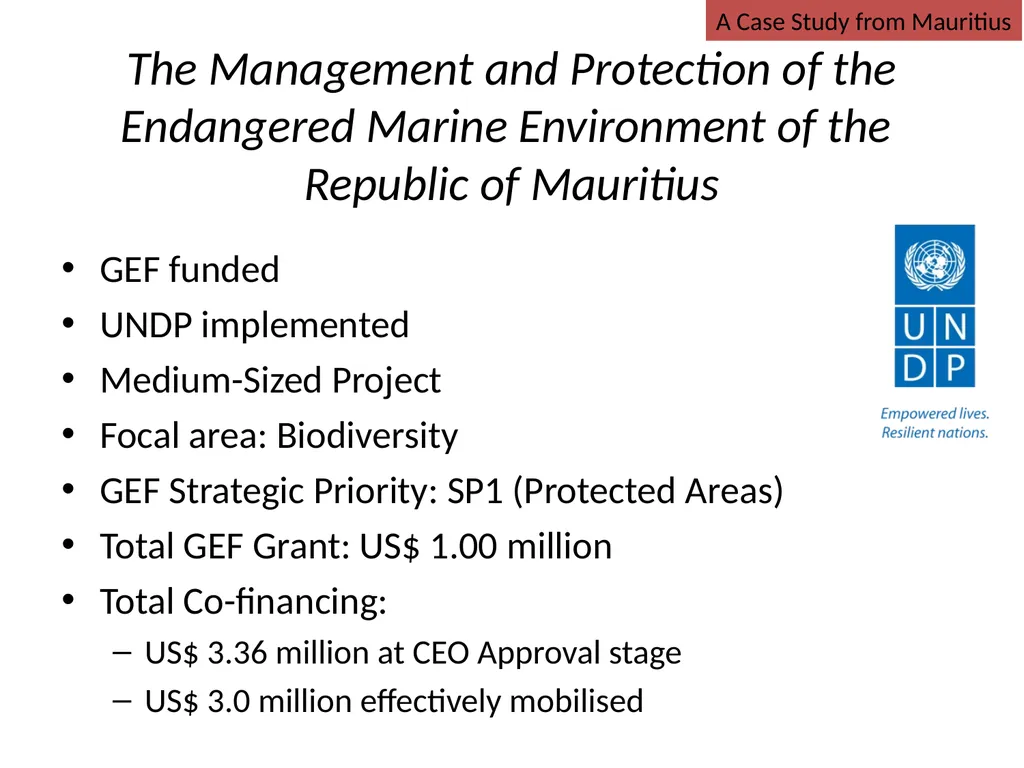
The Management and Protection of the Endangered Marine Environment of the
Republic of Mauritius GEF funded
UNDP implemented
Medium-Sized Project
Focal area: Biodiversity
GEF Strategic Priority: SP1 (Protected Areas)
Total GEF Grant: US$ 1.00 million
Total Co-financing:
US$ 3.36 million at CEO Approval stage
US$ 3.0 million effectively mobilised A Case Study from Mauritius<br>
05
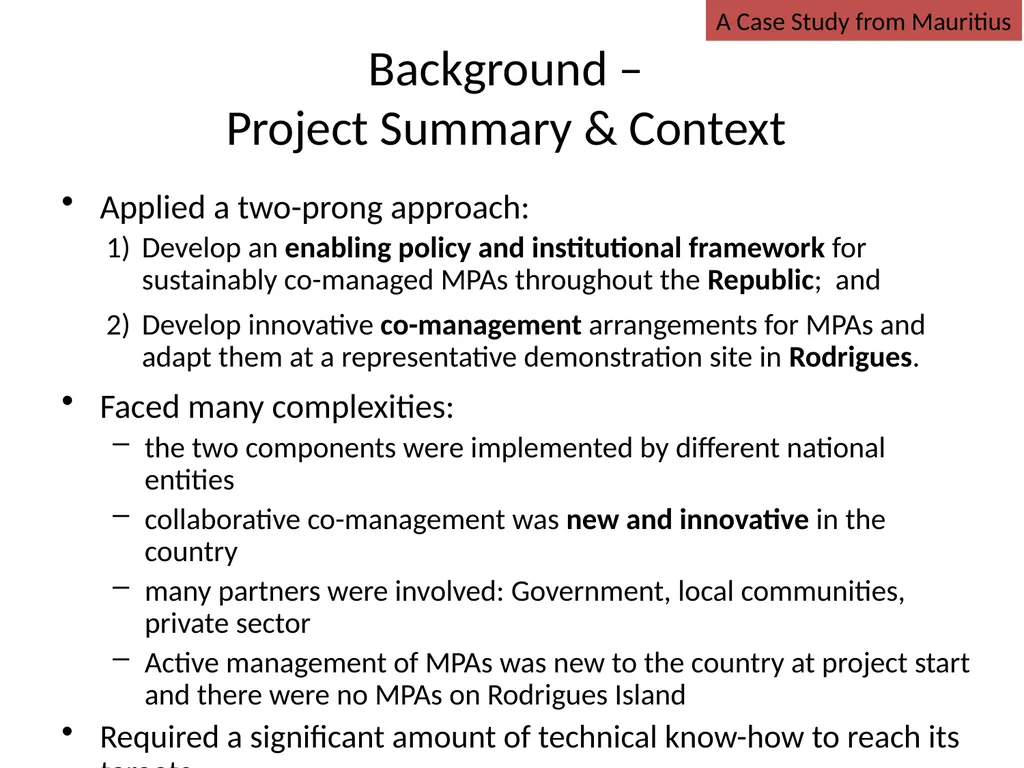
Background –
Project Summary & Context Applied a two-prong approach:
Develop an enabling policy and institutional framework for sustainably co-managed MPAs throughout the Republic; and
Develop innovative co-management arrangements for MPAs and adapt them at a representative demonstration site in Rodrigues.
Faced many complexities:
the two components were implemented by different national entities
collaborative co-management was new and innovative in the country
many partners were involved: Government, local communities, private sector
Active management of MPAs was new to the country at project start and there were no MPAs on Rodrigues Island
Required a significant amount of technical know-how to reach its targets A Case Study from Mauritius<br>
06
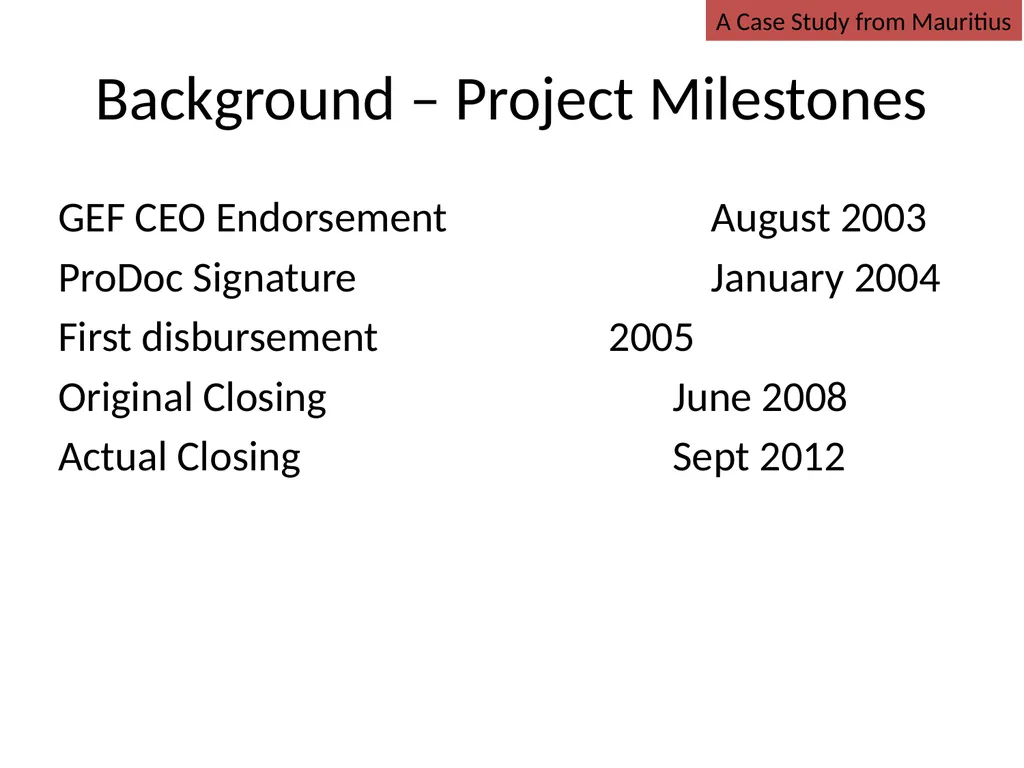
Background – Project Milestones GEF CEO Endorsement August 2003
ProDoc Signature January 2004
First disbursement 2005
Original Closing June 2008
Actual Closing Sept 2012 A Case Study from Mauritius<br>
07
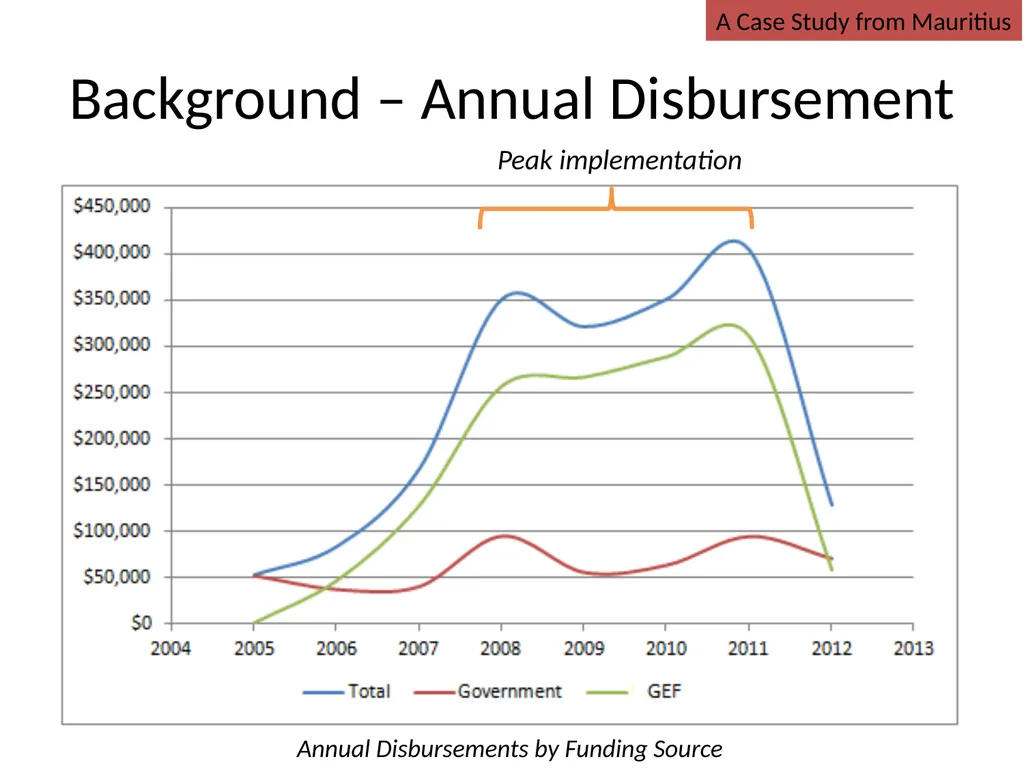
Background – Annual Disbursement Annual Disbursements by Funding Source Peak implementation A Case Study from Mauritius<br>
08
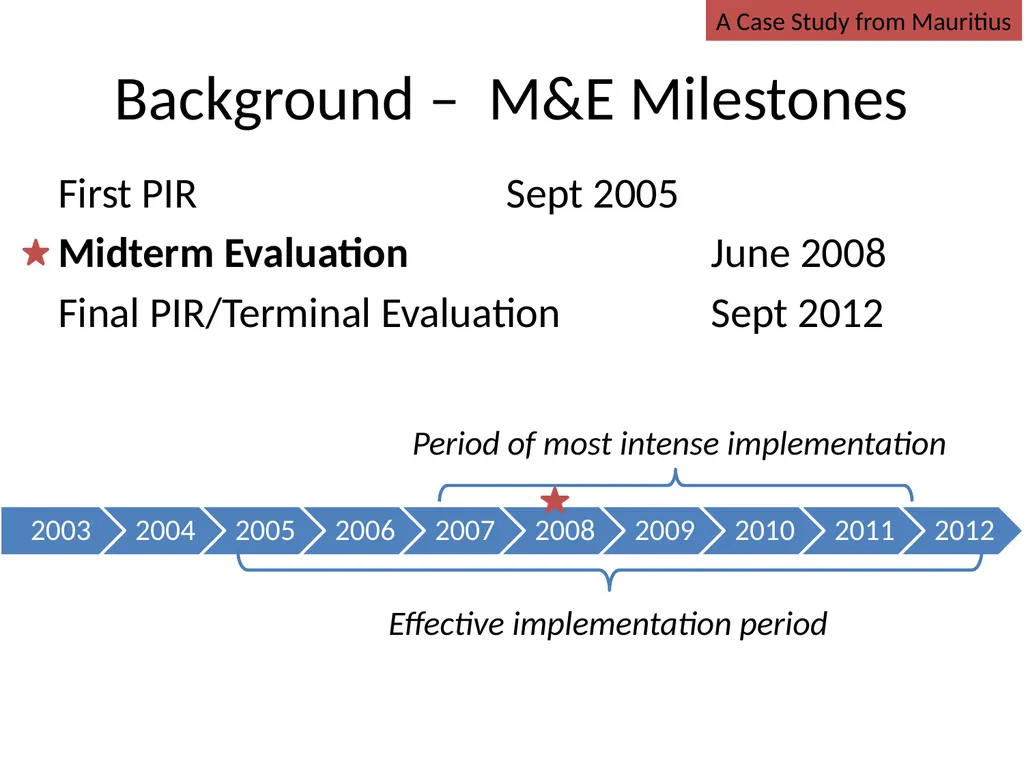
Background – M&E Milestones First PIR Sept 2005
Midterm Evaluation June 2008
Final PIR/Terminal Evaluation Sept 2012 Effective implementation period Period of most intense implementation A Case Study from Mauritius<br>
09
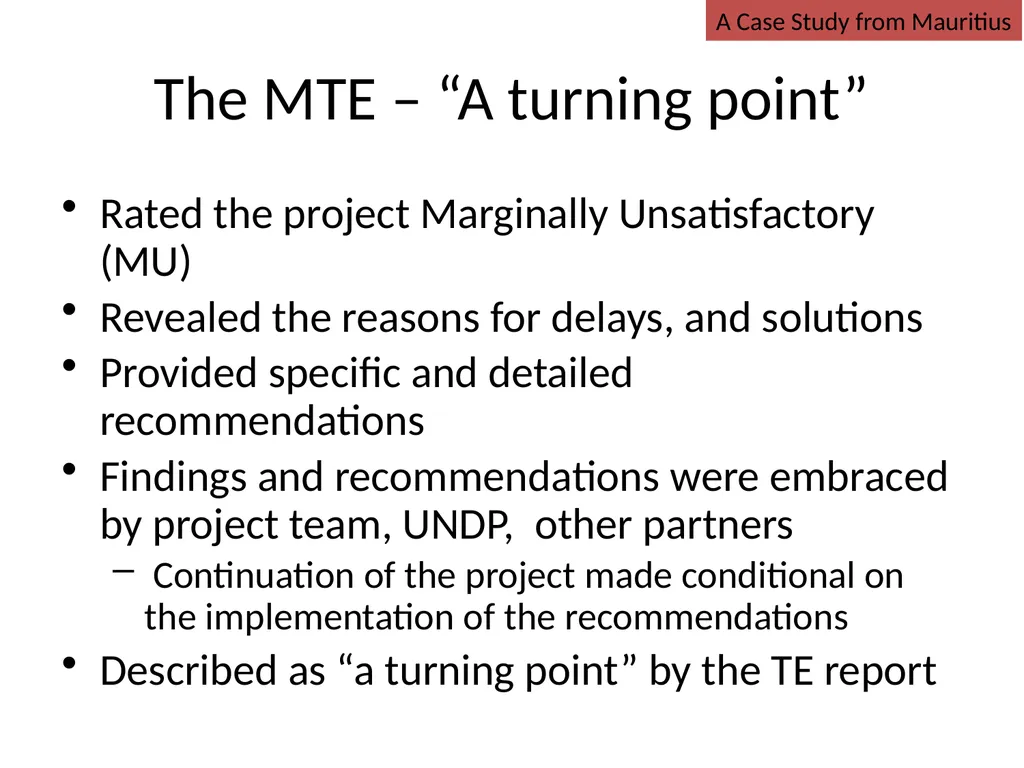
The MTE – “A turning point” Rated the project Marginally Unsatisfactory (MU)
Revealed the reasons for delays, and solutions
Provided specific and detailed recommendations
Findings and recommendations were embraced by project team, UNDP, other partners
Continuation of the project made conditional on the implementation of the recommendations
Described as “a turning point” by the TE report A Case Study from Mauritius<br>
10
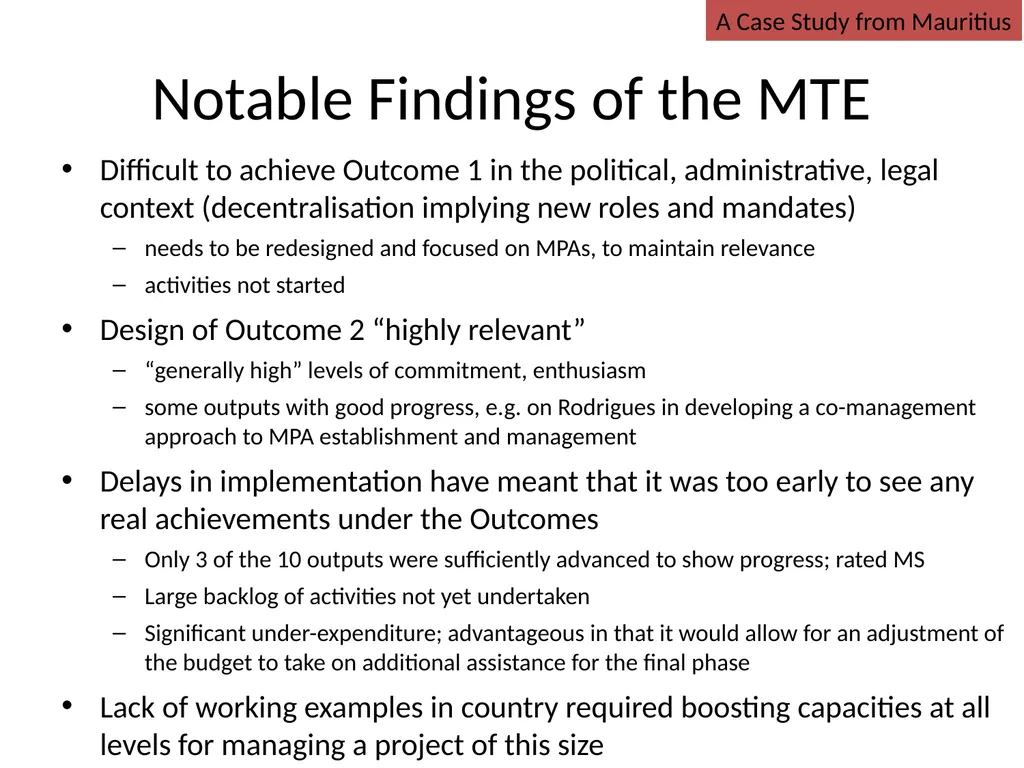
Notable Findings of the MTE Difficult to achieve Outcome 1 in the political, administrative, legal context (decentralisation implying new roles and mandates)
needs to be redesigned and focused on MPAs, to maintain relevance
activities not started
Design of Outcome 2 “highly relevant”
“generally high” levels of commitment, enthusiasm
some outputs with good progress, e.g. on Rodrigues in developing a co-management approach to MPA establishment and management
Delays in implementation have meant that it was too early to see any real achievements under the Outcomes
Only 3 of the 10 outputs were sufficiently advanced to show progress; rated MS
Large backlog of activities not yet undertaken
Significant under-expenditure; advantageous in that it would allow for an adjustment of the budget to take on additional assistance for the final phase
Lack of working examples in country required boosting capacities at all levels for managing a project of this size
In particular full time Technical Advisor with MPA know-how was not in team A Case Study from Mauritius<br>
11
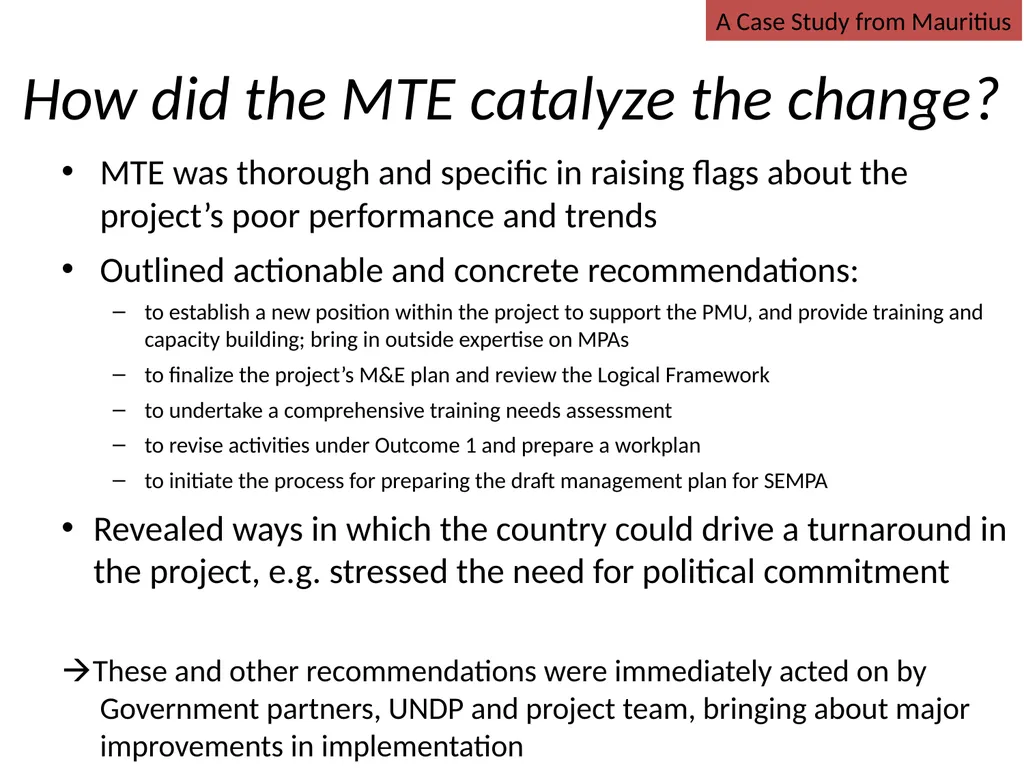
How did the MTE catalyze the change? MTE was thorough and specific in raising flags about the project’s poor performance and trends
Outlined actionable and concrete recommendations:
to establish a new position within the project to support the PMU, and provide training and capacity building; bring in outside expertise on MPAs
to finalize the project’s M&E plan and review the Logical Framework
to undertake a comprehensive training needs assessment
to revise activities under Outcome 1 and prepare a workplan
to initiate the process for preparing the draft management plan for SEMPA
Revealed ways in which the country could drive a turnaround in the project, e.g. stressed the need for political commitment
These and other recommendations were immediately acted on by Government partners, UNDP and project team, bringing about major improvements in implementation A Case Study from Mauritius<br>
12
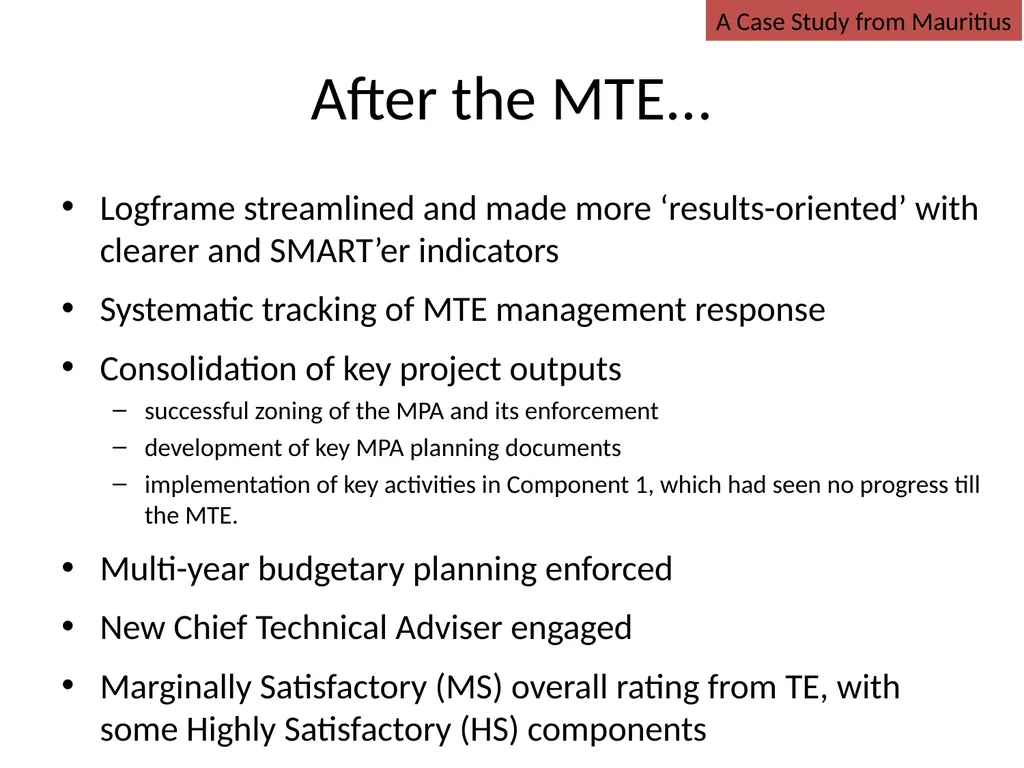
After the MTE... Logframe streamlined and made more ‘results-oriented’ with clearer and SMART’er indicators
Systematic tracking of MTE management response
Consolidation of key project outputs
successful zoning of the MPA and its enforcement
development of key MPA planning documents
implementation of key activities in Component 1, which had seen no progress till the MTE.
Multi-year budgetary planning enforced
New Chief Technical Adviser engaged
Marginally Satisfactory (MS) overall rating from TE, with some Highly Satisfactory (HS) components A Case Study from Mauritius<br>
13
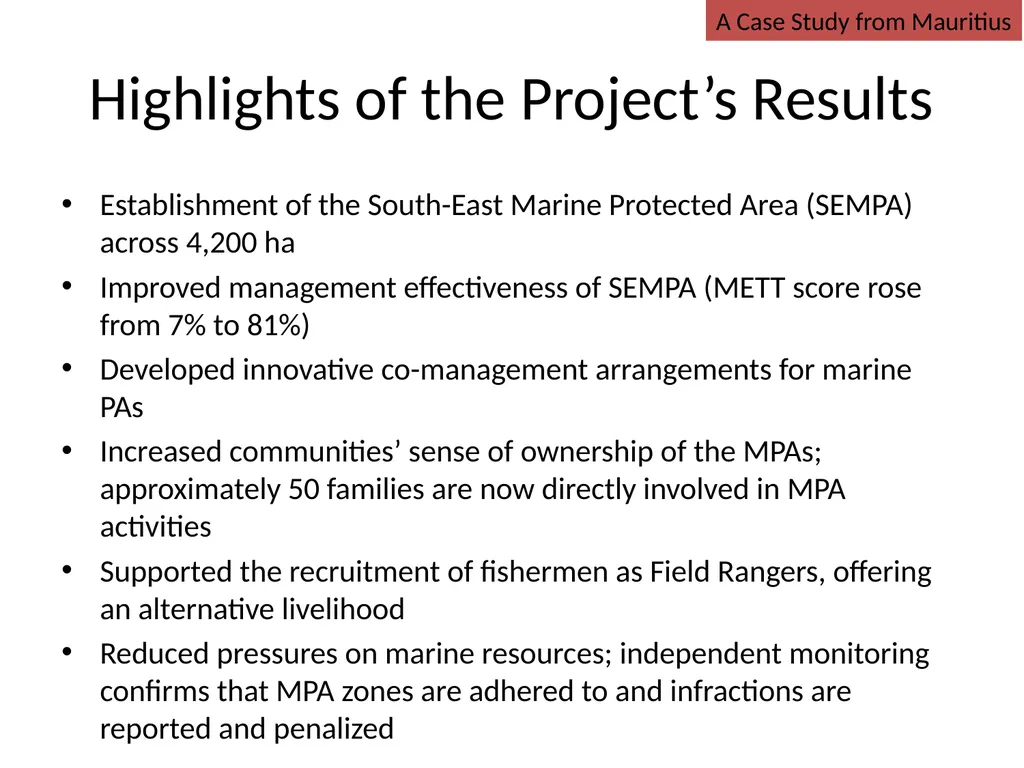
Highlights of the Project’s Results Establishment of the South-East Marine Protected Area (SEMPA) across 4,200 ha
Improved management effectiveness of SEMPA (METT score rose from 7% to 81%)
Developed innovative co-management arrangements for marine PAs
Increased communities’ sense of ownership of the MPAs; approximately 50 families are now directly involved in MPA activities
Supported the recruitment of fishermen as Field Rangers, offering an alternative livelihood
Reduced pressures on marine resources; independent monitoring confirms that MPA zones are adhered to and infractions are reported and penalized A Case Study from Mauritius<br>
14
Questions about the
Midterm Review (MTR) What makes the MTR different from other reporting requirements?
Who benefits from the MTR and how?
How can the MTR catalyze change in a project?
What questions should be asked by the MTR?
Beyond the scope of a single project, how can MTR reports be used?<br>
15
Answers... What makes the MTR different from other reporting requirements?
independent and holistic assessment
gives a fresh, unbiased view of the project
identifies potential for improvement
produces actionable, realistic, results-oriented and concrete recommendations
completed when the project still has time to recover and improve
presents a learning opportunity for all involved<br>
16
Answers... Who benefits from the MTR and how?
all stakeholders – it could be the difference between make-or-break
the project team – MTR as a learning exercise for improving performance and achieving results
the Government – providing specific policy guidance, promoting efficiency and informing decision-making
the project partners – rethinking their role and contribution to project results
the GEF agency – as a tool for institutional learning and identification of needed solutions<br>
17
Answers... How can the MTR catalyze change in a project?
Reviewing project design/assumptions in light of changed circumstances and adjusting design accordingly
inspiring the project team and partners through recognition of the project’s relevance
proposing concrete and actionable recommendations
outlining how those recommended changes have the potential to improve the project’s results<br>
18
Answers... What questions should be asked by the MTR?
Are there signs of advances towards the outcomes?
What progress does the midterm GEF Tracking Tool show?
What challenges are causing delays?
What has changed in the context?
Is the project still relevant?
Are there new opportunities?
How can the challenges be overcome?
Is it feasible to complete with the remaining resources and the existing context?<br>
19
Answers... Beyond the scope of a single project, how can MTR reports be used?
Learning: to reveal trends across a portfolio from which overarching lessons can be extracted and change thereby promoted
Results: to summarize mid-point results, which can be aggregated at the portfolio level
Knowledge: to advance our understanding of the hurdles faced by projects during implementation<br>