
The Incremental Commitment Spiral Model as Applied
OM
Published · 29 slides · 0 views
1 / 1

Description
The Incremental Commitment Spiral Model as Applied to SoS Presented to the San Diego Chapter of INCOSE January 2016 Jo Ann Lane (San Diego State University) Agenda ICSM Fundamentals Rationale and Legacy SoS Success Considerations and the
Related Topics
Share
Embed code
Download this presentation From Below
"The Incremental Commitment Spiral Model as Applied" is the property of its rightful owner. Permission is granted to download and print the materials on this website for personal, non-commercial use only, and to display it on your personal computer provided you do not modify the materials and that you retain all copyright notices contained in the materials. By downloading content from our website, you accept the terms of this agreement.
Presentation Transcript
01
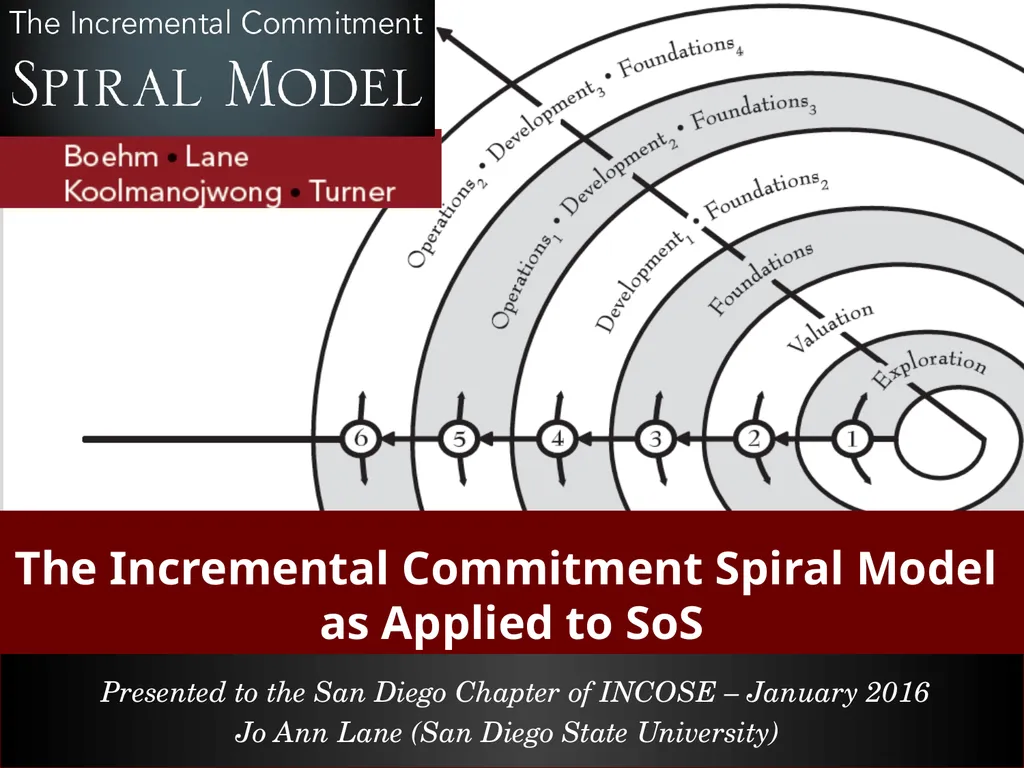
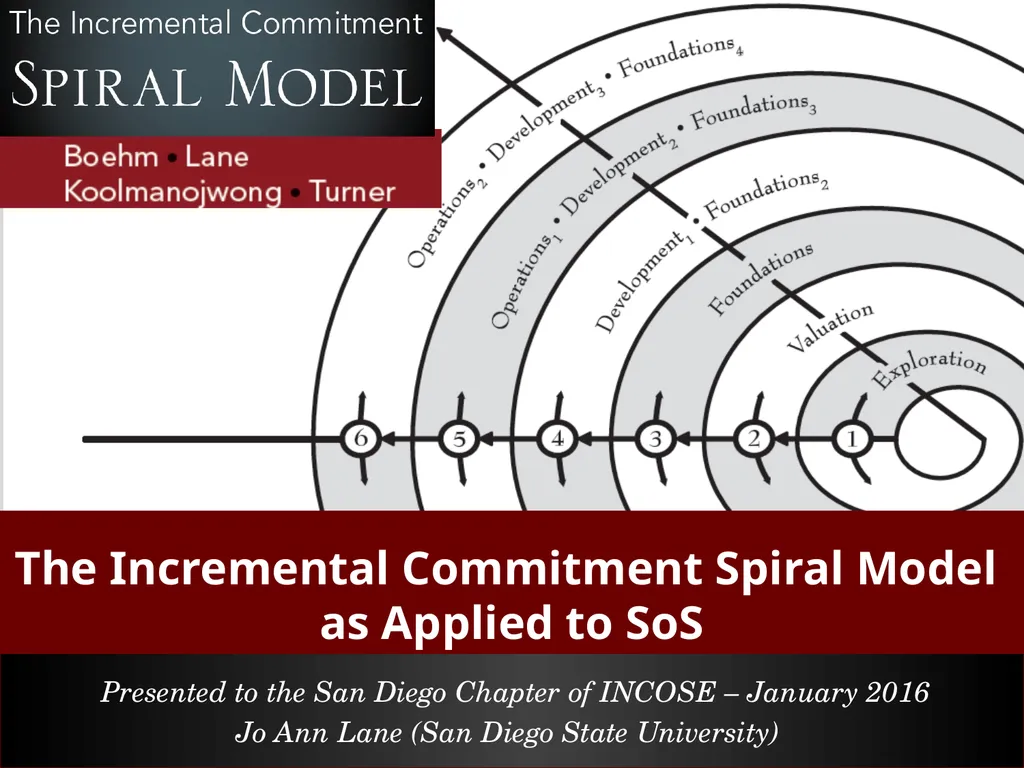
The Incremental Commitment Spiral Model
as Applied to SoS Presented to the San Diego Chapter of INCOSE – January 2016
Jo Ann Lane (San Diego State University)<br>
Jo Ann Lane (San Diego State University)<br>
02
Agenda ICSM Fundamentals
Rationale and Legacy
SoS Success Considerations and the ICSM Principles
ICSM General Framework and Views
ICSM and Systems of Systems
ICSM for SoS Context
ICSM for SoSE
Sources for Additional Information and Related Research 2<br>
Rationale and Legacy
SoS Success Considerations and the ICSM Principles
ICSM General Framework and Views
ICSM and Systems of Systems
ICSM for SoS Context
ICSM for SoSE
Sources for Additional Information and Related Research 2<br>
03
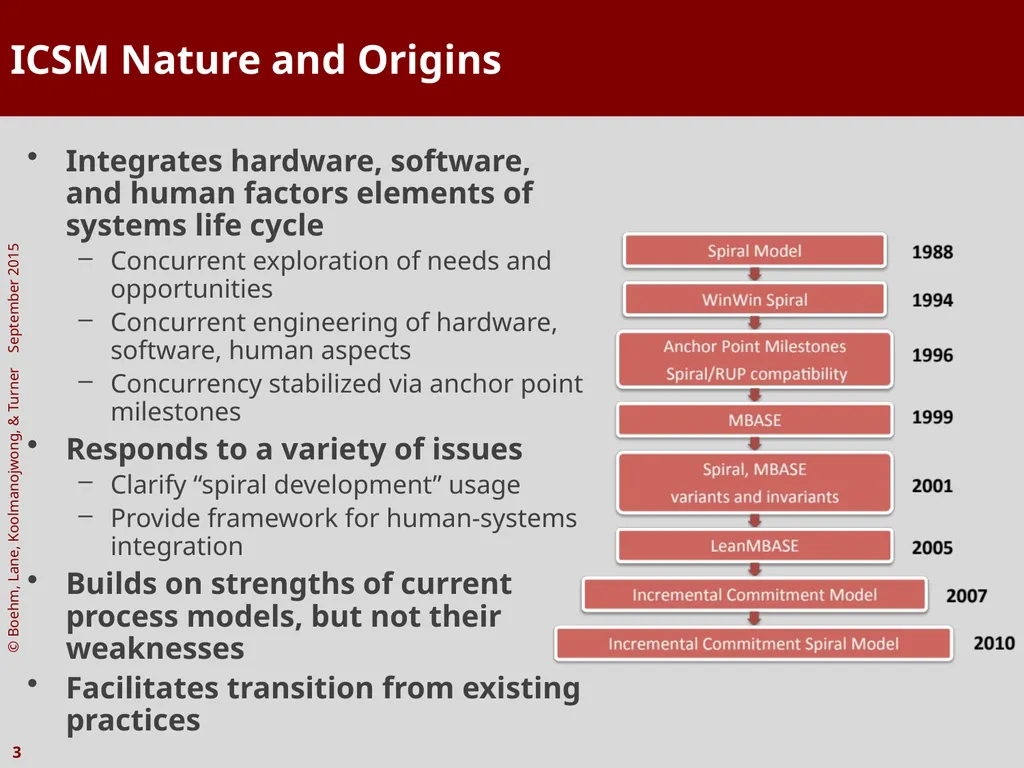
ICSM Nature and Origins Integrates hardware, software, and human factors elements of systems life cycle
Concurrent exploration of needs and opportunities
Concurrent engineering of hardware, software, human aspects
Concurrency stabilized via anchor point milestones
Responds to a variety of issues
Clarify “spiral development” usage
Provide framework for human-systems integration
Builds on strengths of current process models, but not their weaknesses
Facilitates transition from existing practices 3<br>
Concurrent exploration of needs and opportunities
Concurrent engineering of hardware, software, human aspects
Concurrency stabilized via anchor point milestones
Responds to a variety of issues
Clarify “spiral development” usage
Provide framework for human-systems integration
Builds on strengths of current process models, but not their weaknesses
Facilitates transition from existing practices 3<br>
04
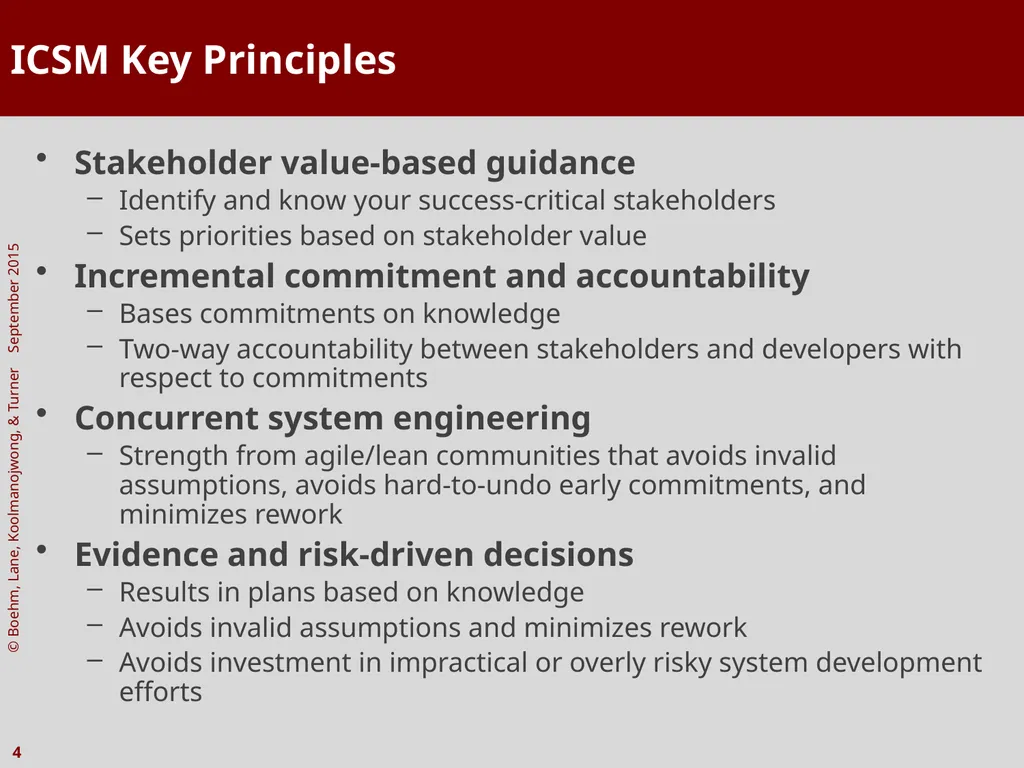
ICSM Key Principles Stakeholder value-based guidance
Identify and know your success-critical stakeholders
Sets priorities based on stakeholder value
Incremental commitment and accountability
Bases commitments on knowledge
Two-way accountability between stakeholders and developers with respect to commitments
Concurrent system engineering
Strength from agile/lean communities that avoids invalid assumptions, avoids hard-to-undo early commitments, and minimizes rework
Evidence and risk-driven decisions
Results in plans based on knowledge
Avoids invalid assumptions and minimizes rework
Avoids investment in impractical or overly risky system development efforts 4<br>
Identify and know your success-critical stakeholders
Sets priorities based on stakeholder value
Incremental commitment and accountability
Bases commitments on knowledge
Two-way accountability between stakeholders and developers with respect to commitments
Concurrent system engineering
Strength from agile/lean communities that avoids invalid assumptions, avoids hard-to-undo early commitments, and minimizes rework
Evidence and risk-driven decisions
Results in plans based on knowledge
Avoids invalid assumptions and minimizes rework
Avoids investment in impractical or overly risky system development efforts 4<br>
05
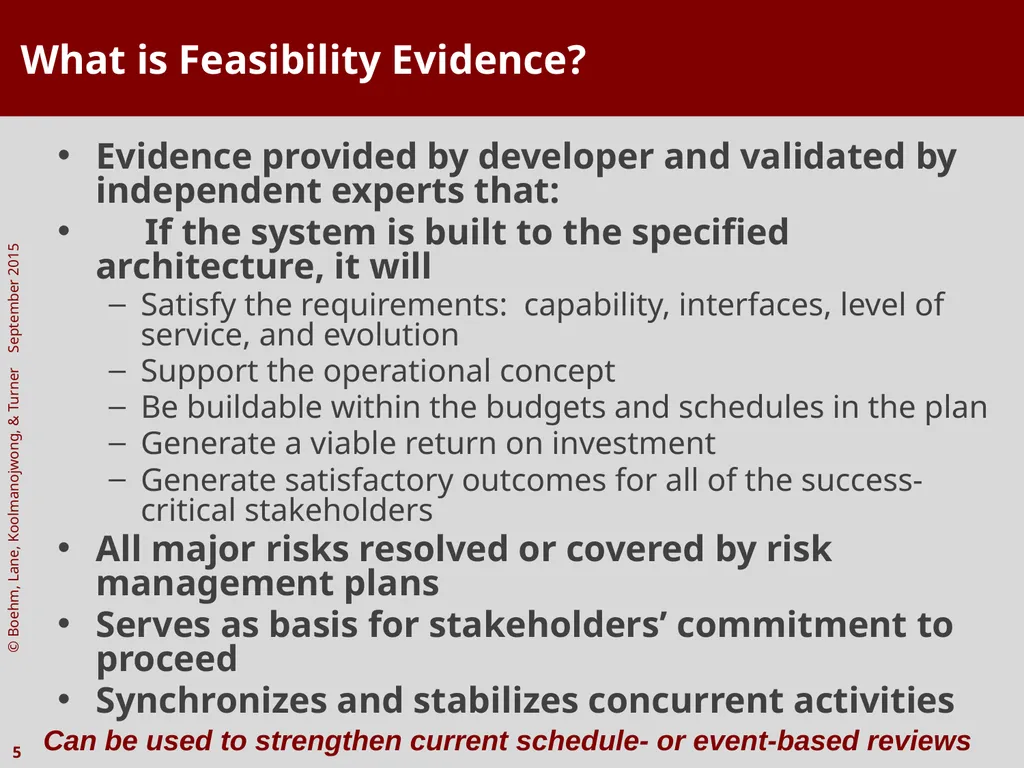
What is Feasibility Evidence? 5 Evidence provided by developer and validated by independent experts that:
If the system is built to the specified architecture, it will
Satisfy the requirements: capability, interfaces, level of service, and evolution
Support the operational concept
Be buildable within the budgets and schedules in the plan
Generate a viable return on investment
Generate satisfactory outcomes for all of the success-critical stakeholders
All major risks resolved or covered by risk management plans
Serves as basis for stakeholders’ commitment to proceed
Synchronizes and stabilizes concurrent activities Can be used to strengthen current schedule- or event-based reviews<br>
If the system is built to the specified architecture, it will
Satisfy the requirements: capability, interfaces, level of service, and evolution
Support the operational concept
Be buildable within the budgets and schedules in the plan
Generate a viable return on investment
Generate satisfactory outcomes for all of the success-critical stakeholders
All major risks resolved or covered by risk management plans
Serves as basis for stakeholders’ commitment to proceed
Synchronizes and stabilizes concurrent activities Can be used to strengthen current schedule- or event-based reviews<br>
06
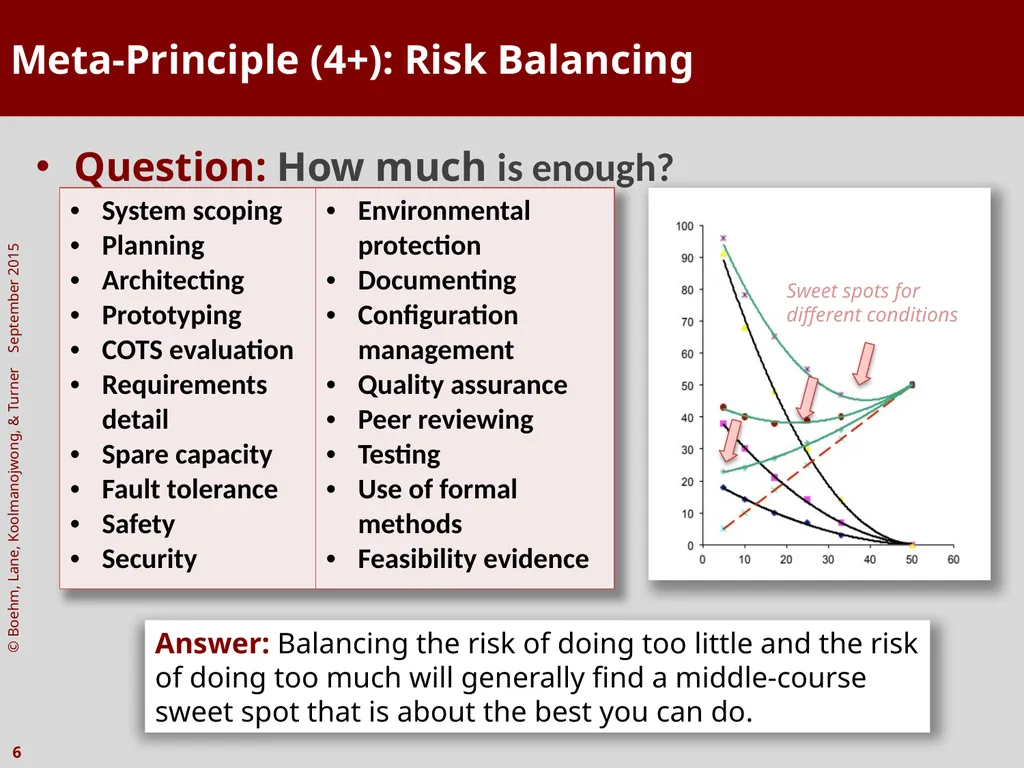
Meta-Principle (4+): Risk Balancing Question: How much is enough? 6 Answer: Balancing the risk of doing too little and the risk of doing too much will generally find a middle-course sweet spot that is about the best you can do. Sweet spots for different conditions<br>
07
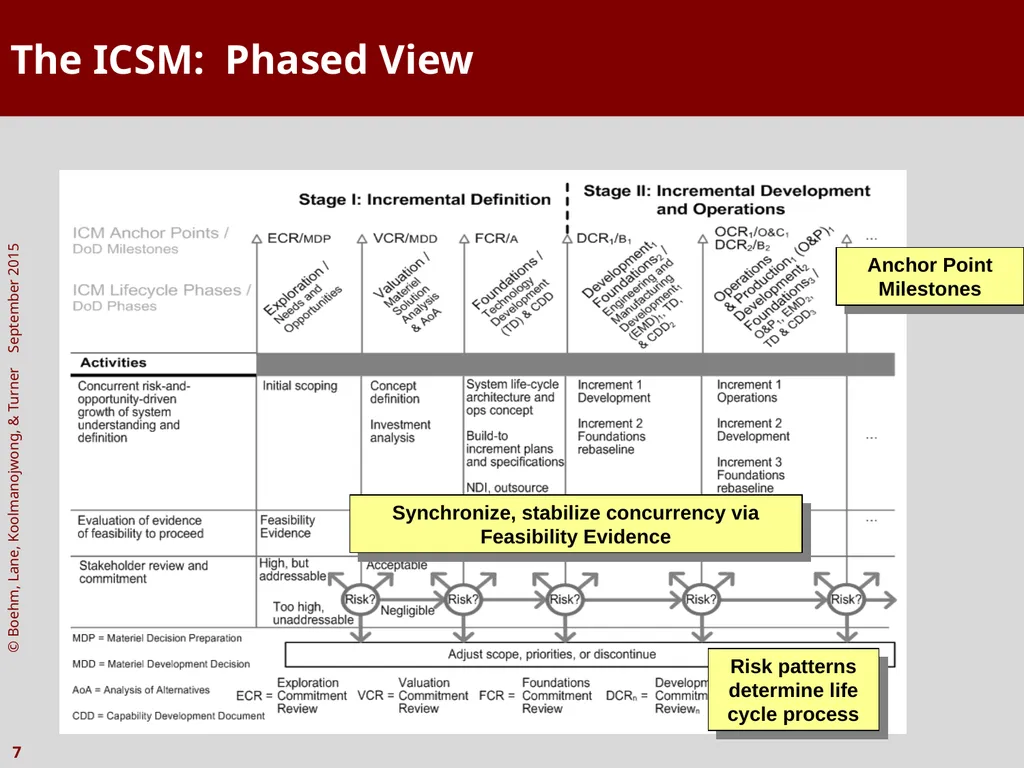
The ICSM: Phased View 7 Anchor Point Milestones Synchronize, stabilize concurrency via Feasibility Evidence Risk patterns determine life cycle process<br>
08
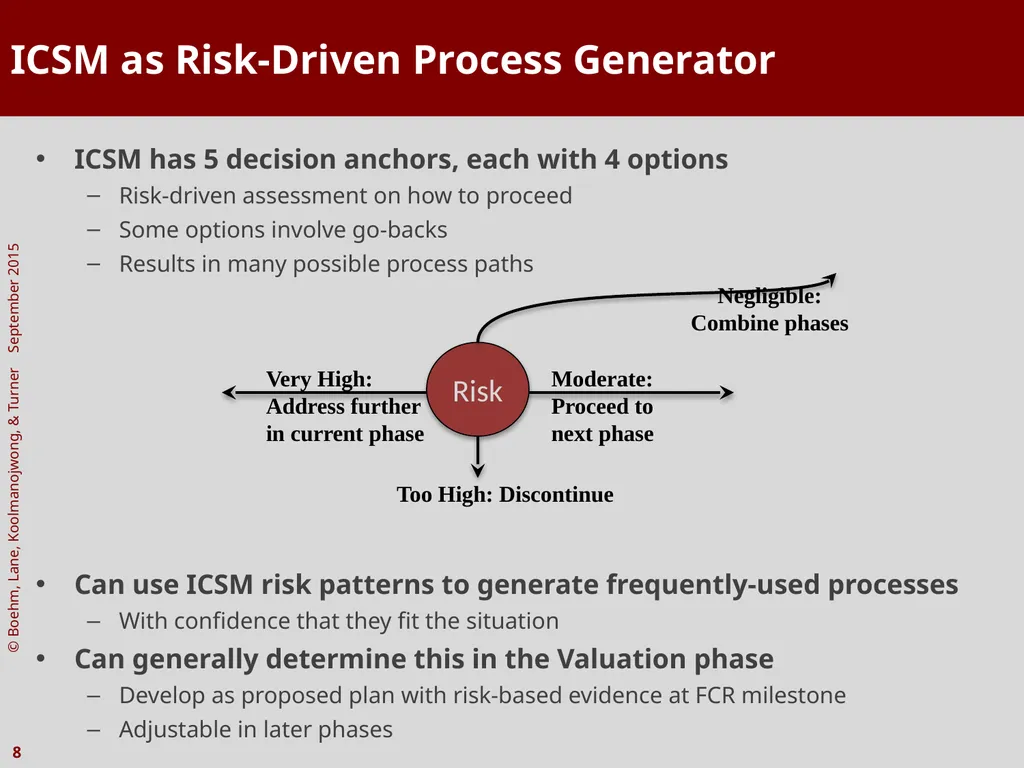
ICSM as Risk-Driven Process Generator ICSM has 5 decision anchors, each with 4 options
Risk-driven assessment on how to proceed
Some options involve go-backs
Results in many possible process paths
Can use ICSM risk patterns to generate frequently-used processes
With confidence that they fit the situation
Can generally determine this in the Valuation phase
Develop as proposed plan with risk-based evidence at FCR milestone
Adjustable in later phases 8 Very High: Address further in current phase Risk Too High: Discontinue Moderate: Proceed to next phase Negligible: Combine phases<br>
Risk-driven assessment on how to proceed
Some options involve go-backs
Results in many possible process paths
Can use ICSM risk patterns to generate frequently-used processes
With confidence that they fit the situation
Can generally determine this in the Valuation phase
Develop as proposed plan with risk-based evidence at FCR milestone
Adjustable in later phases 8 Very High: Address further in current phase Risk Too High: Discontinue Moderate: Proceed to next phase Negligible: Combine phases<br>
09
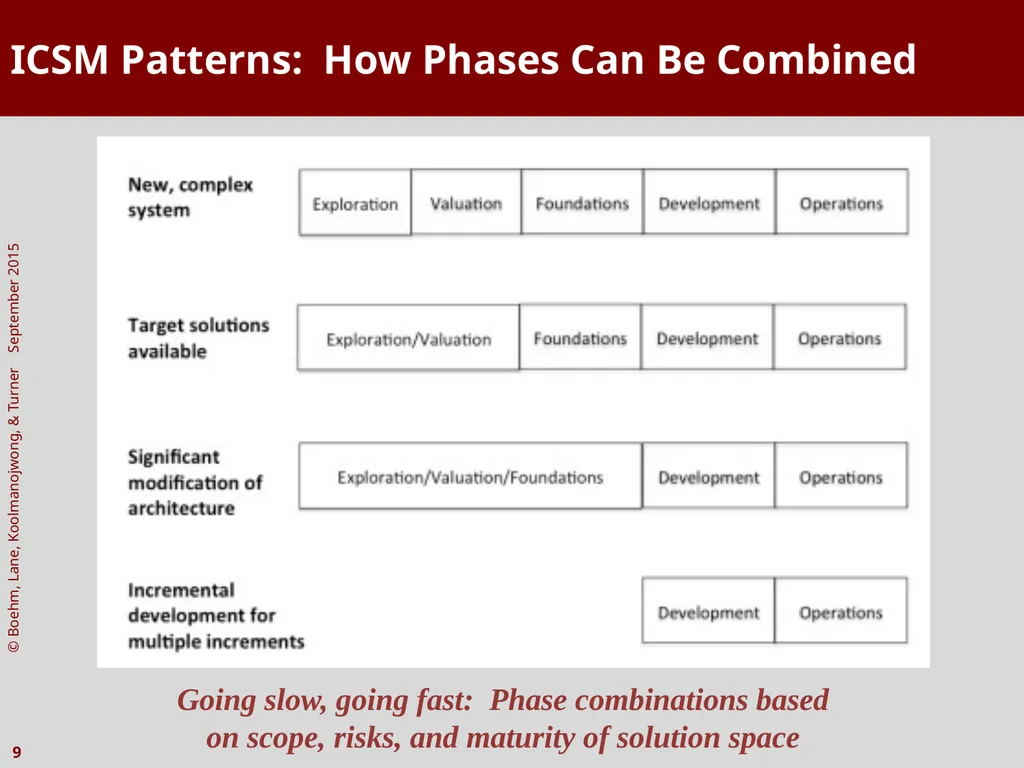
ICSM Patterns: How Phases Can Be Combined 9 Going slow, going fast: Phase combinations based on scope, risks, and maturity of solution space<br>
10
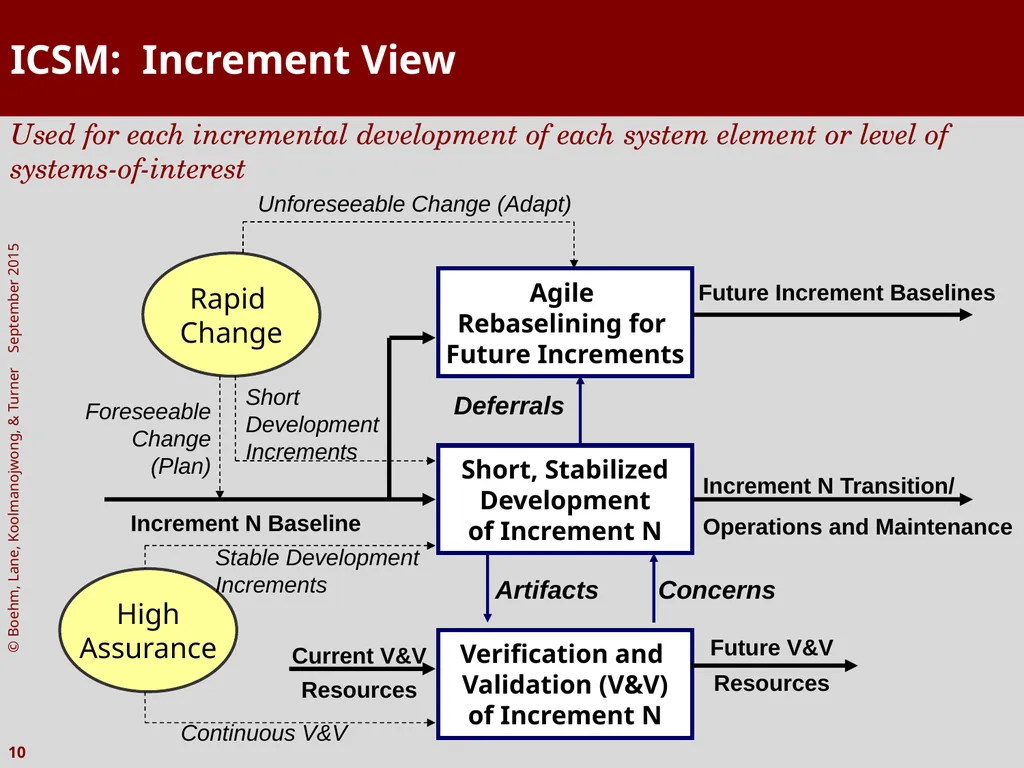
ICSM: Increment View 10 Agile
Rebaselining for
Future Increments Short, Stabilized
Development
of Increment N Verification and
Validation (V&V)
of Increment N Deferrals Artifacts Concerns Rapid
Change High
Assurance Future Increment Baselines Increment N Transition/
Operations and Maintenance Future V&V
Resources Increment N Baseline Current V&V
Resources Unforeseeable Change (Adapt) Short
Development
Increments Foreseeable
Change
(Plan) Stable Development
Increments Continuous V&V Used for each incremental development of each system element or level of systems-of-interest<br>
Rebaselining for
Future Increments Short, Stabilized
Development
of Increment N Verification and
Validation (V&V)
of Increment N Deferrals Artifacts Concerns Rapid
Change High
Assurance Future Increment Baselines Increment N Transition/
Operations and Maintenance Future V&V
Resources Increment N Baseline Current V&V
Resources Unforeseeable Change (Adapt) Short
Development
Increments Foreseeable
Change
(Plan) Stable Development
Increments Continuous V&V Used for each incremental development of each system element or level of systems-of-interest<br>
11
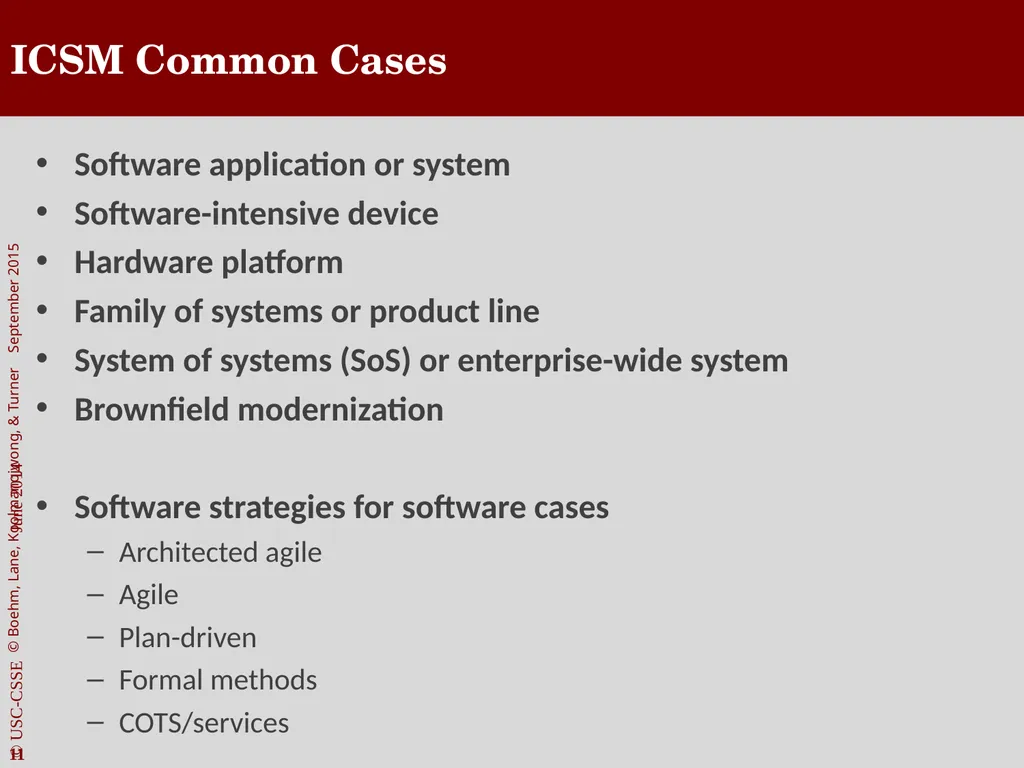
ICSM Common Cases Software application or system
Software-intensive device
Hardware platform
Family of systems or product line
System of systems (SoS) or enterprise-wide system
Brownfield modernization
Software strategies for software cases
Architected agile
Agile
Plan-driven
Formal methods
COTS/services June 2014 © USC-CSSE 11<br>
Software-intensive device
Hardware platform
Family of systems or product line
System of systems (SoS) or enterprise-wide system
Brownfield modernization
Software strategies for software cases
Architected agile
Agile
Plan-driven
Formal methods
COTS/services June 2014 © USC-CSSE 11<br>
12
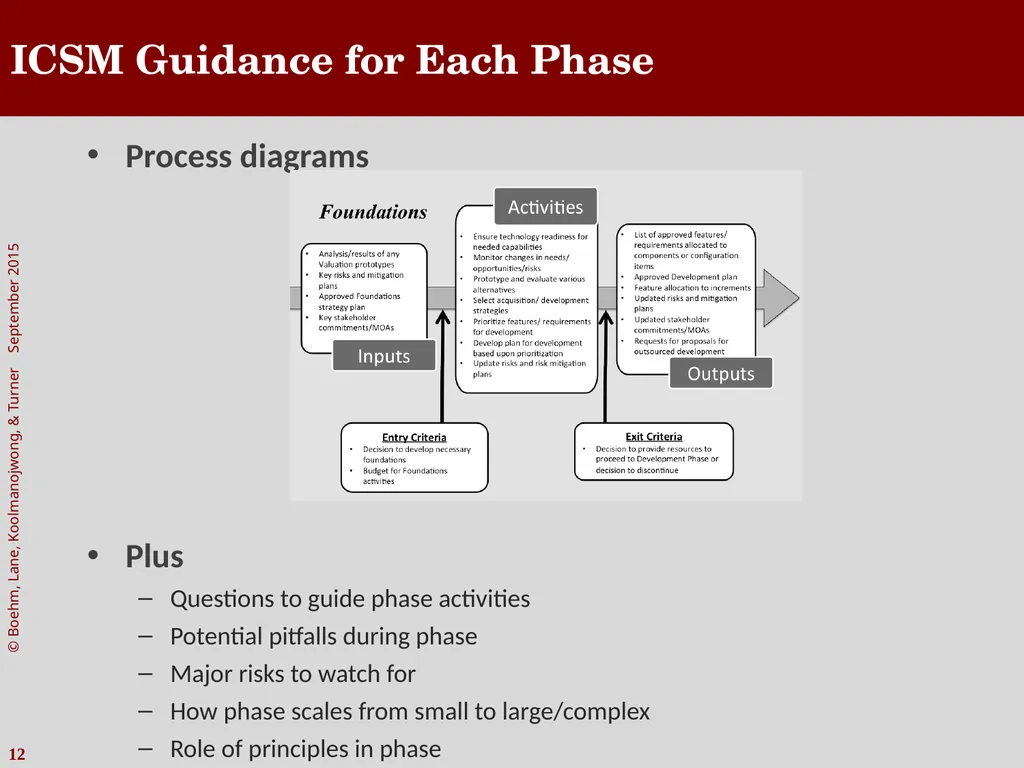
ICSM Guidance for Each Phase Process diagrams
Plus
Questions to guide phase activities
Potential pitfalls during phase
Major risks to watch for
How phase scales from small to large/complex
Role of principles in phase 12<br>
Plus
Questions to guide phase activities
Potential pitfalls during phase
Major risks to watch for
How phase scales from small to large/complex
Role of principles in phase 12<br>
13
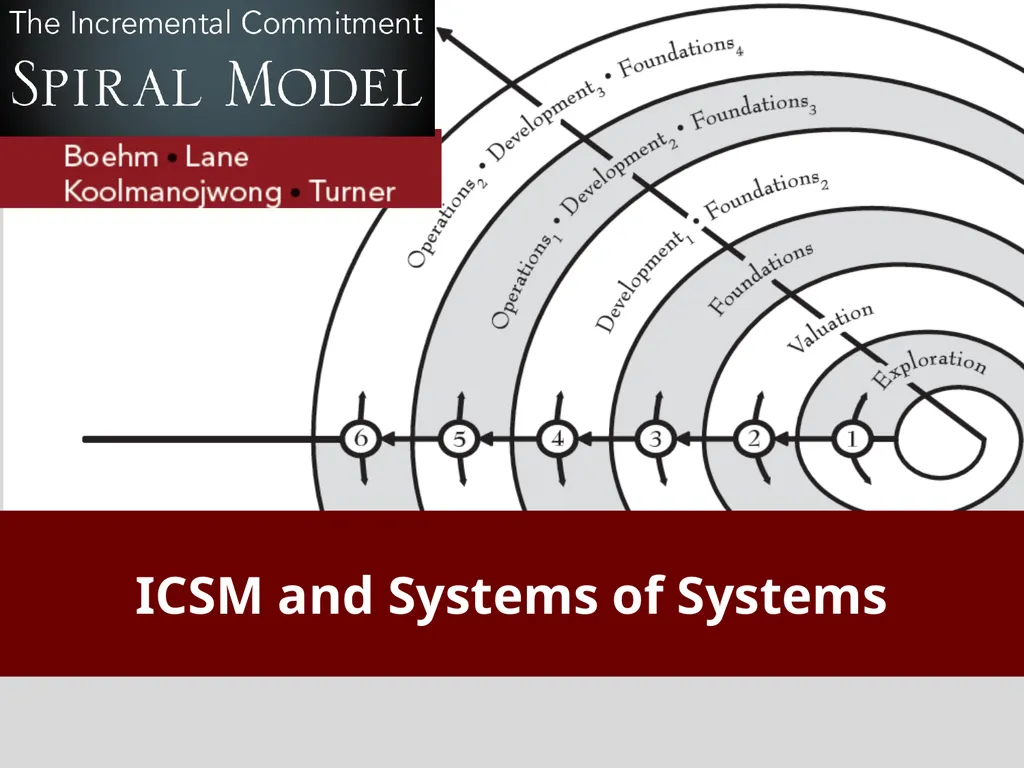
ICSM and Systems of Systems<br>
14
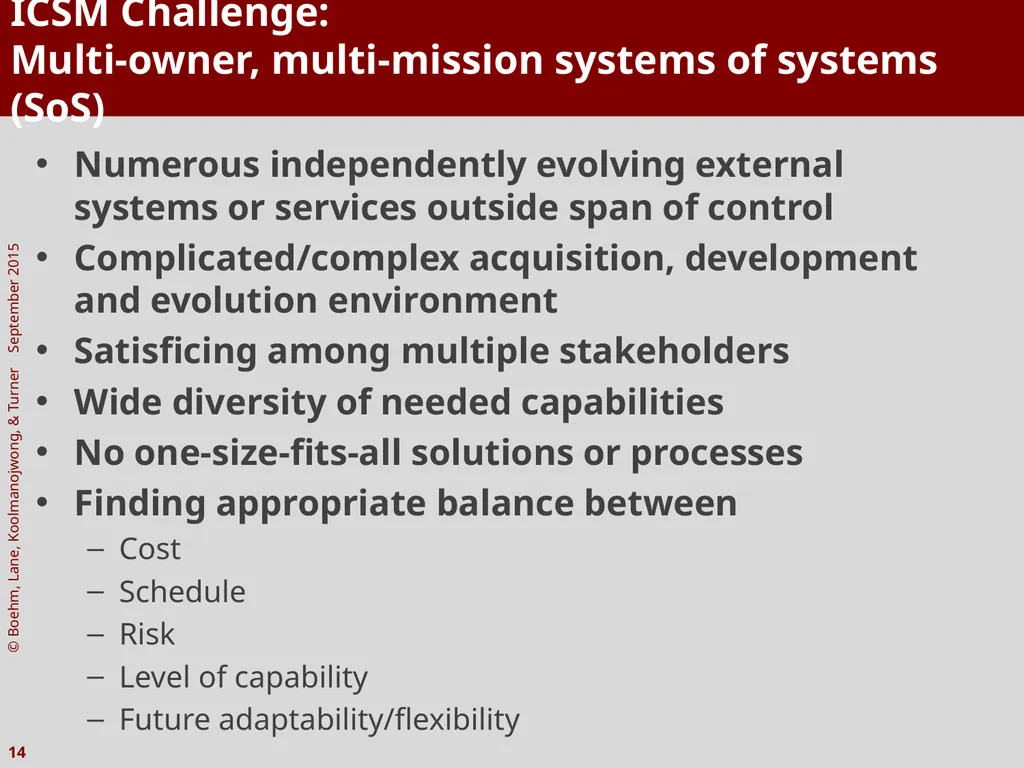
ICSM Challenge:
Multi-owner, multi-mission systems of systems (SoS) Numerous independently evolving external systems or services outside span of control
Complicated/complex acquisition, development and evolution environment
Satisficing among multiple stakeholders
Wide diversity of needed capabilities
No one-size-fits-all solutions or processes
Finding appropriate balance between
Cost
Schedule
Risk
Level of capability
Future adaptability/flexibility 14<br>
Complicated/complex acquisition, development and evolution environment
Satisficing among multiple stakeholders
Wide diversity of needed capabilities
No one-size-fits-all solutions or processes
Finding appropriate balance between
Cost
Schedule
Risk
Level of capability
Future adaptability/flexibility 14<br>
15
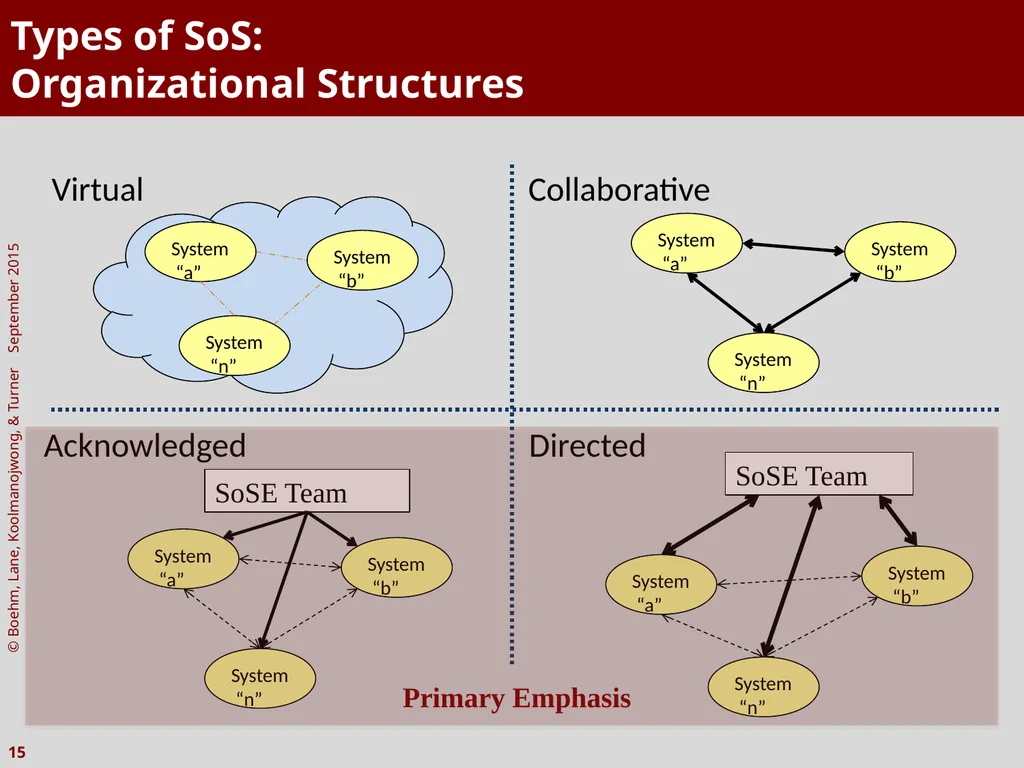
Types of SoS:
Organizational Structures System “a” System “n” System “b” Virtual Collaborative System “a” System “n” System “b” Primary Emphasis 15<br>
16
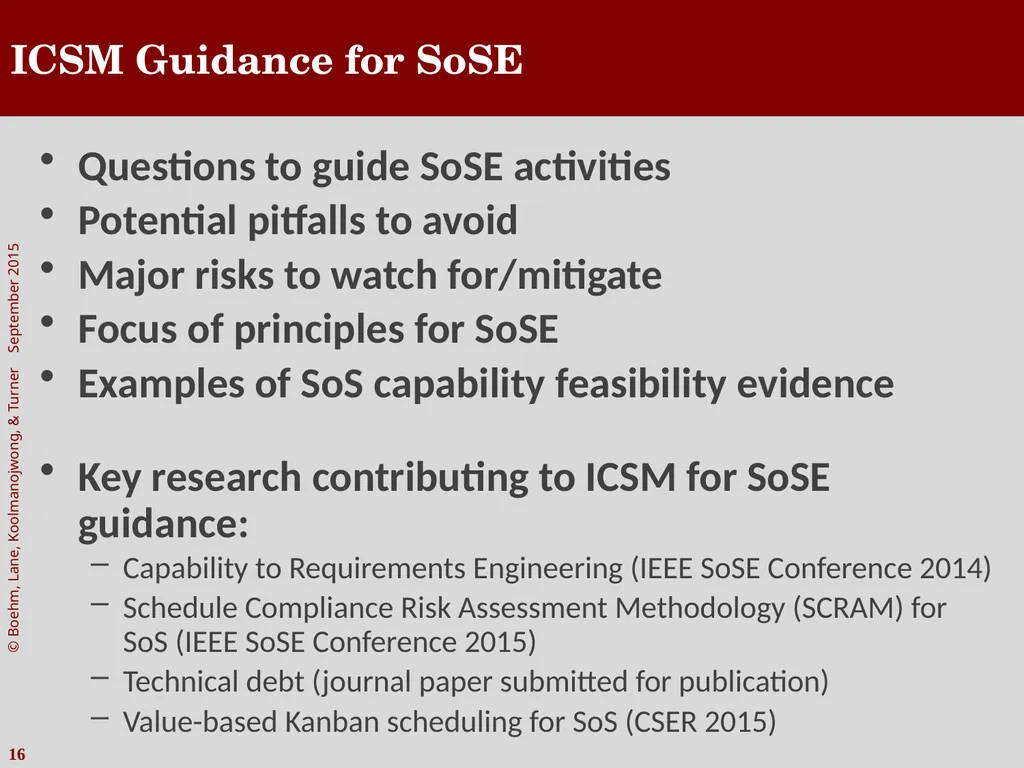
ICSM Guidance for SoSE Questions to guide SoSE activities
Potential pitfalls to avoid
Major risks to watch for/mitigate
Focus of principles for SoSE
Examples of SoS capability feasibility evidence
Key research contributing to ICSM for SoSE guidance:
Capability to Requirements Engineering (IEEE SoSE Conference 2014)
Schedule Compliance Risk Assessment Methodology (SCRAM) for SoS (IEEE SoSE Conference 2015)
Technical debt (journal paper submitted for publication)
Value-based Kanban scheduling for SoS (CSER 2015) 16<br>
Potential pitfalls to avoid
Major risks to watch for/mitigate
Focus of principles for SoSE
Examples of SoS capability feasibility evidence
Key research contributing to ICSM for SoSE guidance:
Capability to Requirements Engineering (IEEE SoSE Conference 2014)
Schedule Compliance Risk Assessment Methodology (SCRAM) for SoS (IEEE SoSE Conference 2015)
Technical debt (journal paper submitted for publication)
Value-based Kanban scheduling for SoS (CSER 2015) 16<br>
17
ICSM Phases for SoS Common Case 17 Identify desired capability(s)/capability changes Exploration
Identify resources and viable options Valuation
Assess options and downselects Development
Enable development via constituents
Coordinate enablement of capability Foundations
Develops management and technical foundations and downselects further Constituent a Constituent b Constituent c Constituent n … Operations
Monitor and assess performance<br>
Identify resources and viable options Valuation
Assess options and downselects Development
Enable development via constituents
Coordinate enablement of capability Foundations
Develops management and technical foundations and downselects further Constituent a Constituent b Constituent c Constituent n … Operations
Monitor and assess performance<br>
18
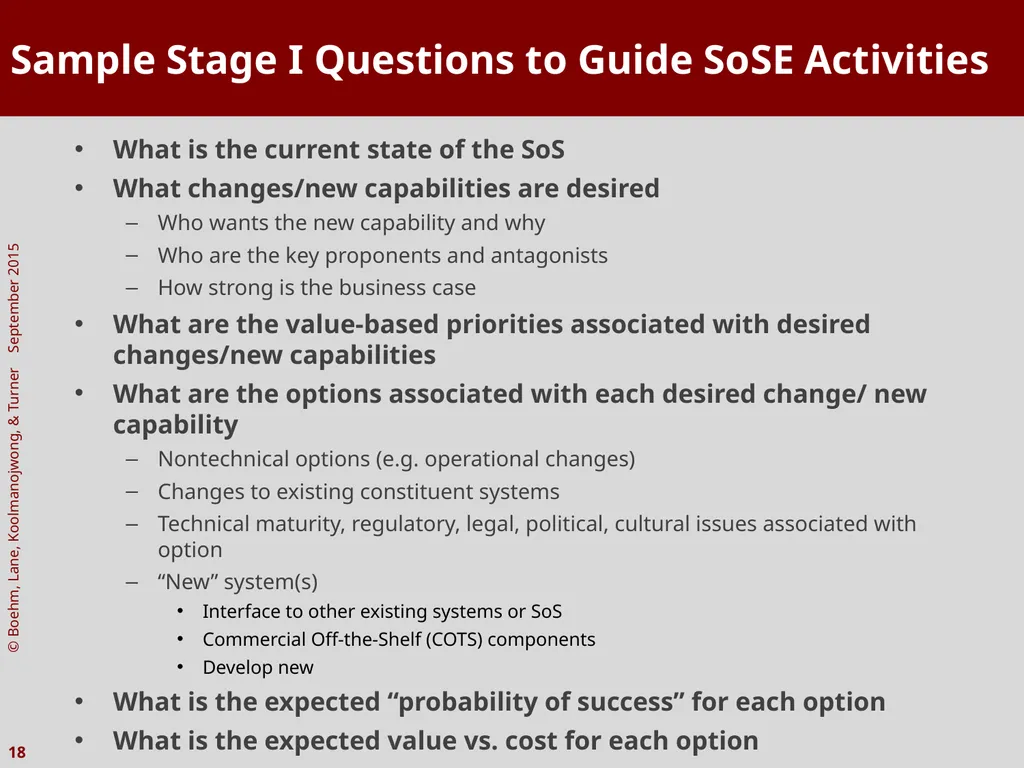
Sample Stage I Questions to Guide SoSE Activities What is the current state of the SoS
What changes/new capabilities are desired
Who wants the new capability and why
Who are the key proponents and antagonists
How strong is the business case
What are the value-based priorities associated with desired changes/new capabilities
What are the options associated with each desired change/ new capability
Nontechnical options (e.g. operational changes)
Changes to existing constituent systems
Technical maturity, regulatory, legal, political, cultural issues associated with option
“New” system(s)
Interface to other existing systems or SoS
Commercial Off-the-Shelf (COTS) components
Develop new
What is the expected “probability of success” for each option
What is the expected value vs. cost for each option 18<br>
What changes/new capabilities are desired
Who wants the new capability and why
Who are the key proponents and antagonists
How strong is the business case
What are the value-based priorities associated with desired changes/new capabilities
What are the options associated with each desired change/ new capability
Nontechnical options (e.g. operational changes)
Changes to existing constituent systems
Technical maturity, regulatory, legal, political, cultural issues associated with option
“New” system(s)
Interface to other existing systems or SoS
Commercial Off-the-Shelf (COTS) components
Develop new
What is the expected “probability of success” for each option
What is the expected value vs. cost for each option 18<br>
19
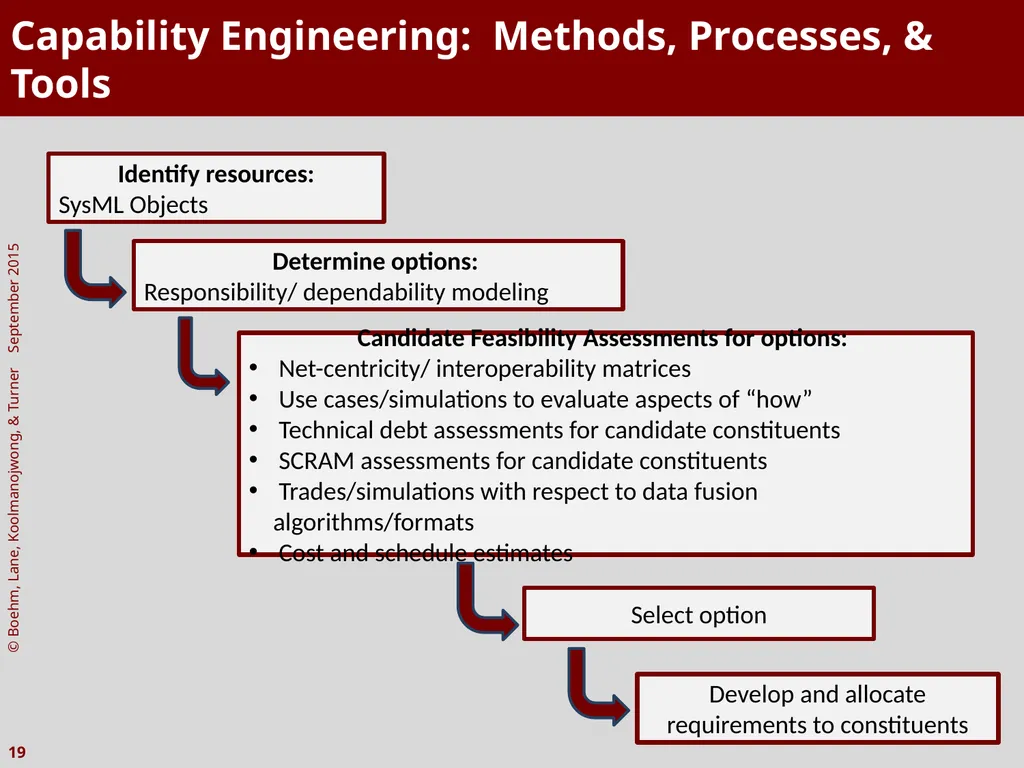
Capability Engineering: Methods, Processes, & Tools 19 Identify resources:
SysML Objects Determine options:
Responsibility/ dependability modeling Candidate Feasibility Assessments for options:
Net-centricity/ interoperability matrices
Use cases/simulations to evaluate aspects of “how”
Technical debt assessments for candidate constituents
SCRAM assessments for candidate constituents
Trades/simulations with respect to data fusion algorithms/formats
Cost and schedule estimates Develop and allocate requirements to constituents Select option<br>
SysML Objects Determine options:
Responsibility/ dependability modeling Candidate Feasibility Assessments for options:
Net-centricity/ interoperability matrices
Use cases/simulations to evaluate aspects of “how”
Technical debt assessments for candidate constituents
SCRAM assessments for candidate constituents
Trades/simulations with respect to data fusion algorithms/formats
Cost and schedule estimates Develop and allocate requirements to constituents Select option<br>
20
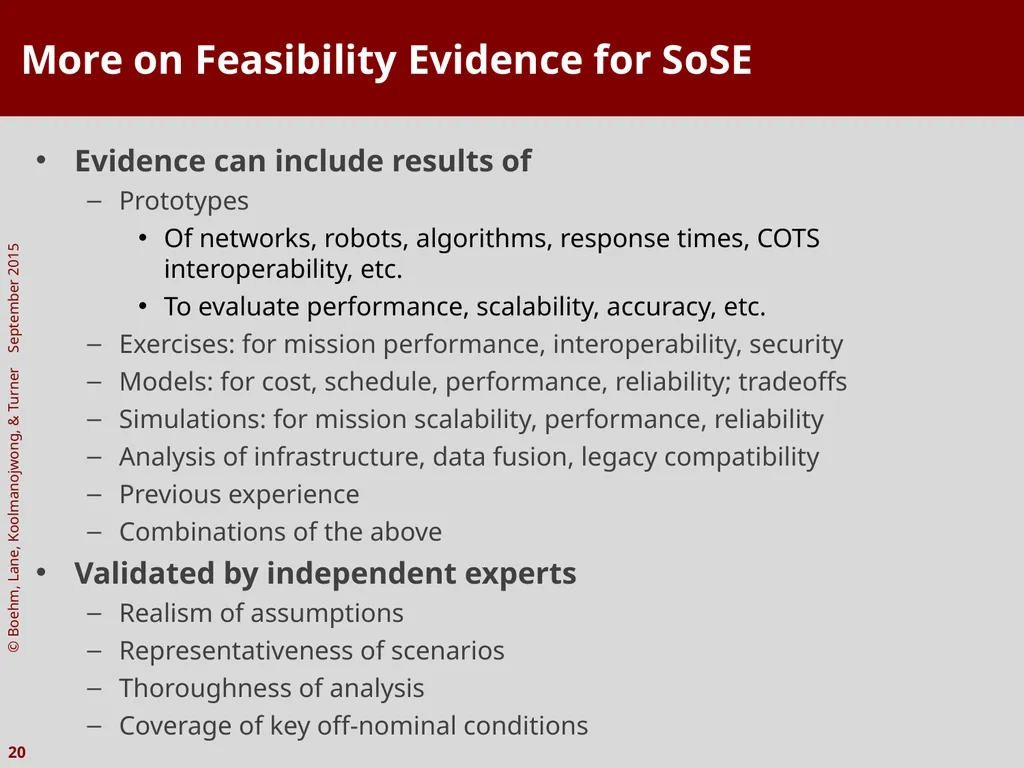
More on Feasibility Evidence for SoSE Evidence can include results of
Prototypes
Of networks, robots, algorithms, response times, COTS interoperability, etc.
To evaluate performance, scalability, accuracy, etc.
Exercises: for mission performance, interoperability, security
Models: for cost, schedule, performance, reliability; tradeoffs
Simulations: for mission scalability, performance, reliability
Analysis of infrastructure, data fusion, legacy compatibility
Previous experience
Combinations of the above
Validated by independent experts
Realism of assumptions
Representativeness of scenarios
Thoroughness of analysis
Coverage of key off-nominal conditions 20<br>
Prototypes
Of networks, robots, algorithms, response times, COTS interoperability, etc.
To evaluate performance, scalability, accuracy, etc.
Exercises: for mission performance, interoperability, security
Models: for cost, schedule, performance, reliability; tradeoffs
Simulations: for mission scalability, performance, reliability
Analysis of infrastructure, data fusion, legacy compatibility
Previous experience
Combinations of the above
Validated by independent experts
Realism of assumptions
Representativeness of scenarios
Thoroughness of analysis
Coverage of key off-nominal conditions 20<br>
21
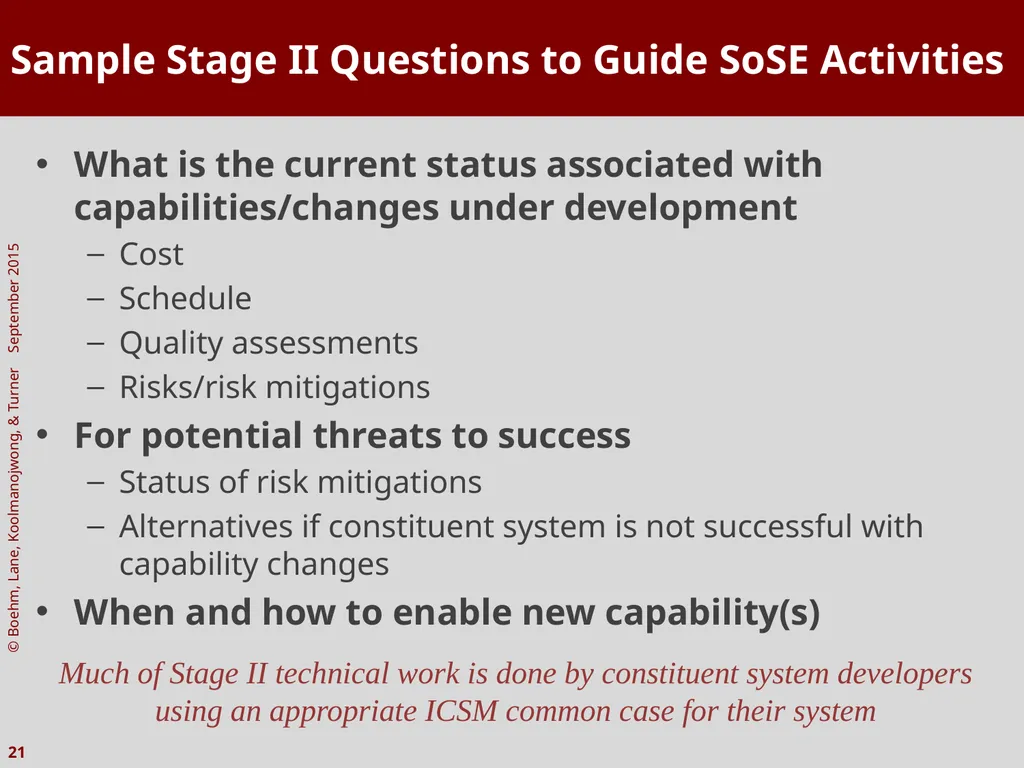
Sample Stage II Questions to Guide SoSE Activities What is the current status associated with capabilities/changes under development
Cost
Schedule
Quality assessments
Risks/risk mitigations
For potential threats to success
Status of risk mitigations
Alternatives if constituent system is not successful with capability changes
When and how to enable new capability(s) 21 Much of Stage II technical work is done by constituent system developers using an appropriate ICSM common case for their system<br>
Cost
Schedule
Quality assessments
Risks/risk mitigations
For potential threats to success
Status of risk mitigations
Alternatives if constituent system is not successful with capability changes
When and how to enable new capability(s) 21 Much of Stage II technical work is done by constituent system developers using an appropriate ICSM common case for their system<br>
22
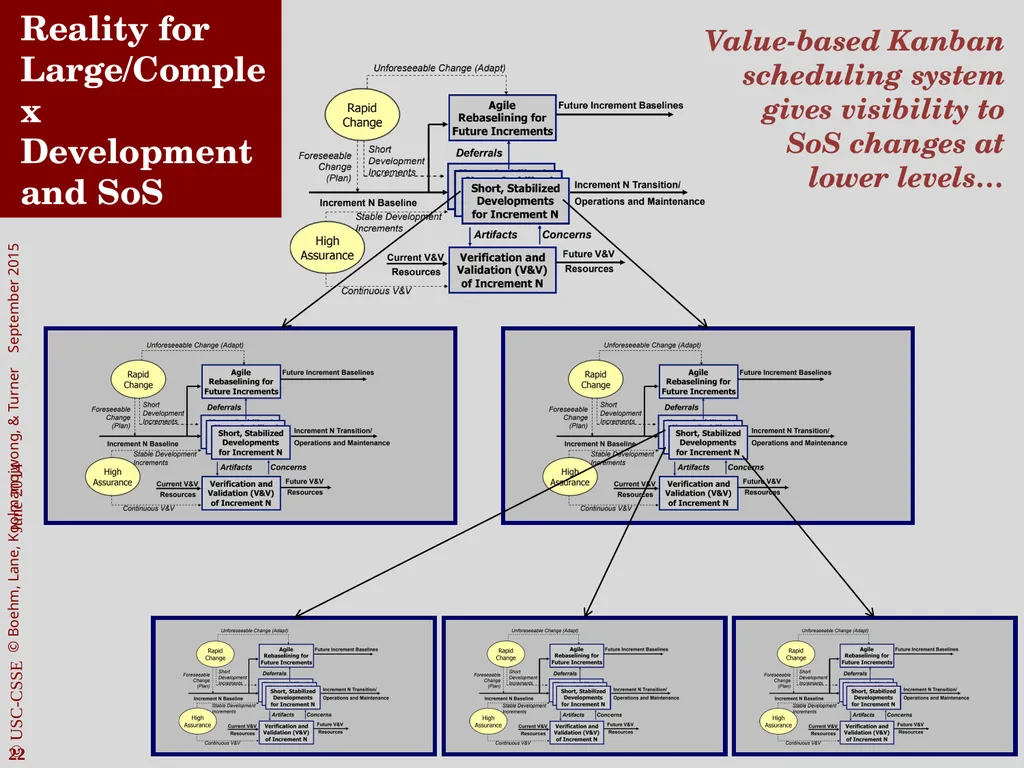
Reality for Large/Complex Development and SoS June 2014 © USC-CSSE 22 Value-based Kanban scheduling system gives visibility to SoS changes at lower levels…<br>
23
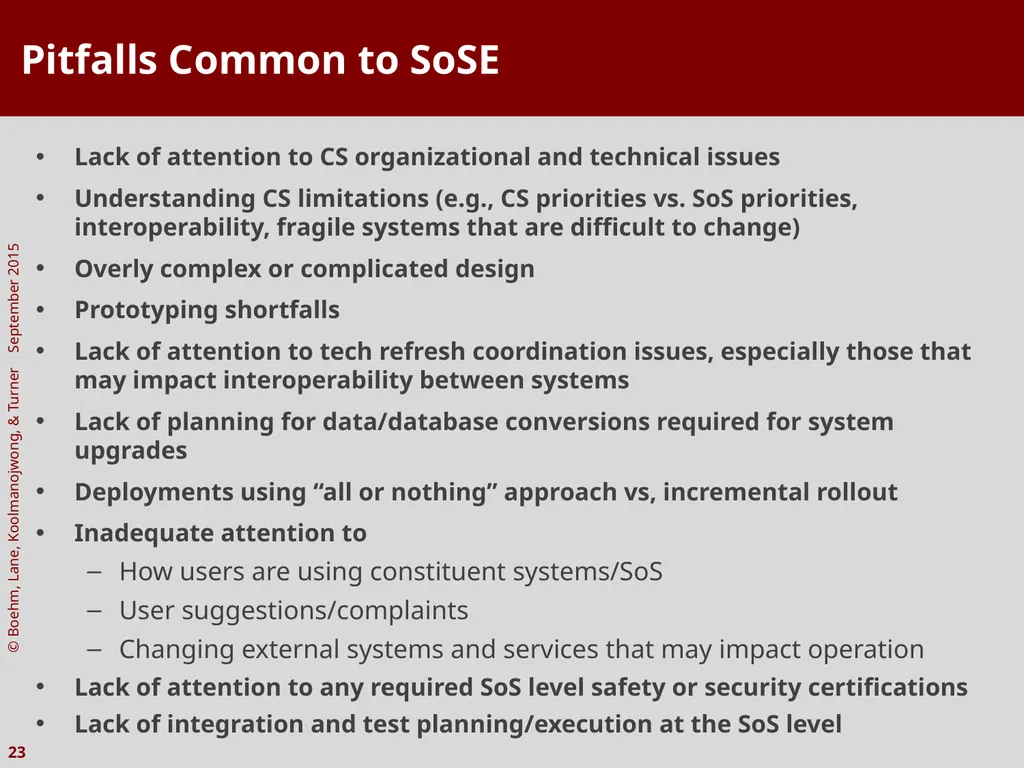
Pitfalls Common to SoSE Lack of attention to CS organizational and technical issues
Understanding CS limitations (e.g., CS priorities vs. SoS priorities, interoperability, fragile systems that are difficult to change)
Overly complex or complicated design
Prototyping shortfalls
Lack of attention to tech refresh coordination issues, especially those that may impact interoperability between systems
Lack of planning for data/database conversions required for system upgrades
Deployments using “all or nothing” approach vs, incremental rollout
Inadequate attention to
How users are using constituent systems/SoS
User suggestions/complaints
Changing external systems and services that may impact operation
Lack of attention to any required SoS level safety or security certifications
Lack of integration and test planning/execution at the SoS level 23<br>
Understanding CS limitations (e.g., CS priorities vs. SoS priorities, interoperability, fragile systems that are difficult to change)
Overly complex or complicated design
Prototyping shortfalls
Lack of attention to tech refresh coordination issues, especially those that may impact interoperability between systems
Lack of planning for data/database conversions required for system upgrades
Deployments using “all or nothing” approach vs, incremental rollout
Inadequate attention to
How users are using constituent systems/SoS
User suggestions/complaints
Changing external systems and services that may impact operation
Lack of attention to any required SoS level safety or security certifications
Lack of integration and test planning/execution at the SoS level 23<br>
24
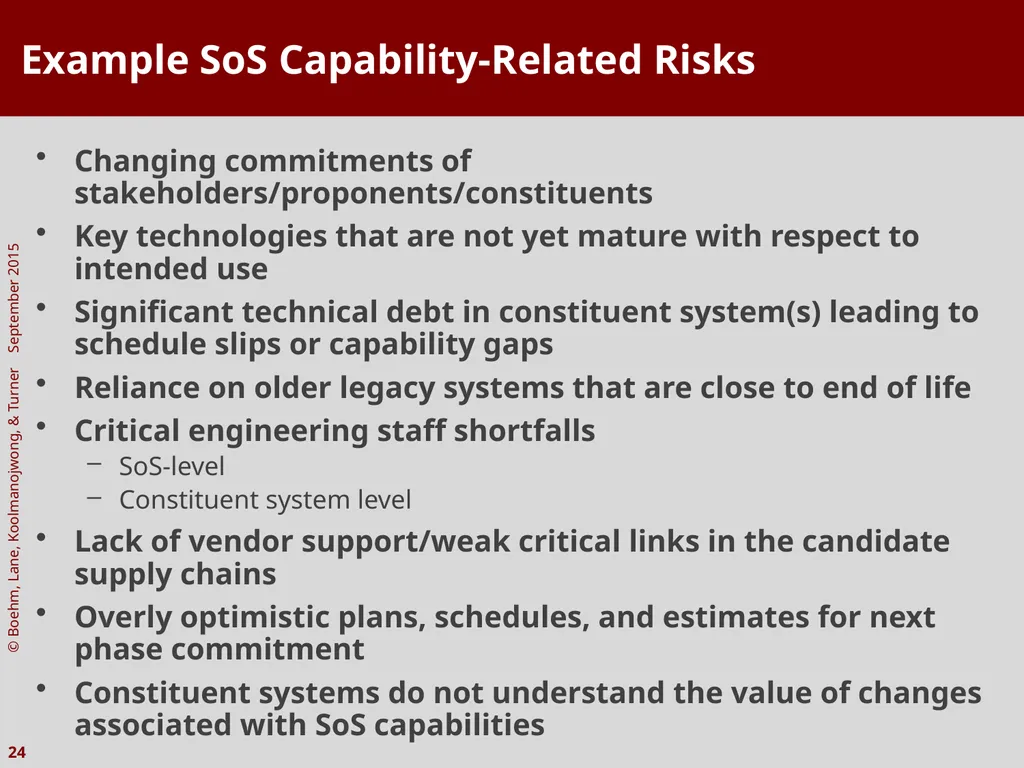
Example SoS Capability-Related Risks Changing commitments of stakeholders/proponents/constituents
Key technologies that are not yet mature with respect to intended use
Significant technical debt in constituent system(s) leading to schedule slips or capability gaps
Reliance on older legacy systems that are close to end of life
Critical engineering staff shortfalls
SoS-level
Constituent system level
Lack of vendor support/weak critical links in the candidate supply chains
Overly optimistic plans, schedules, and estimates for next phase commitment
Constituent systems do not understand the value of changes associated with SoS capabilities 24<br>
Key technologies that are not yet mature with respect to intended use
Significant technical debt in constituent system(s) leading to schedule slips or capability gaps
Reliance on older legacy systems that are close to end of life
Critical engineering staff shortfalls
SoS-level
Constituent system level
Lack of vendor support/weak critical links in the candidate supply chains
Overly optimistic plans, schedules, and estimates for next phase commitment
Constituent systems do not understand the value of changes associated with SoS capabilities 24<br>
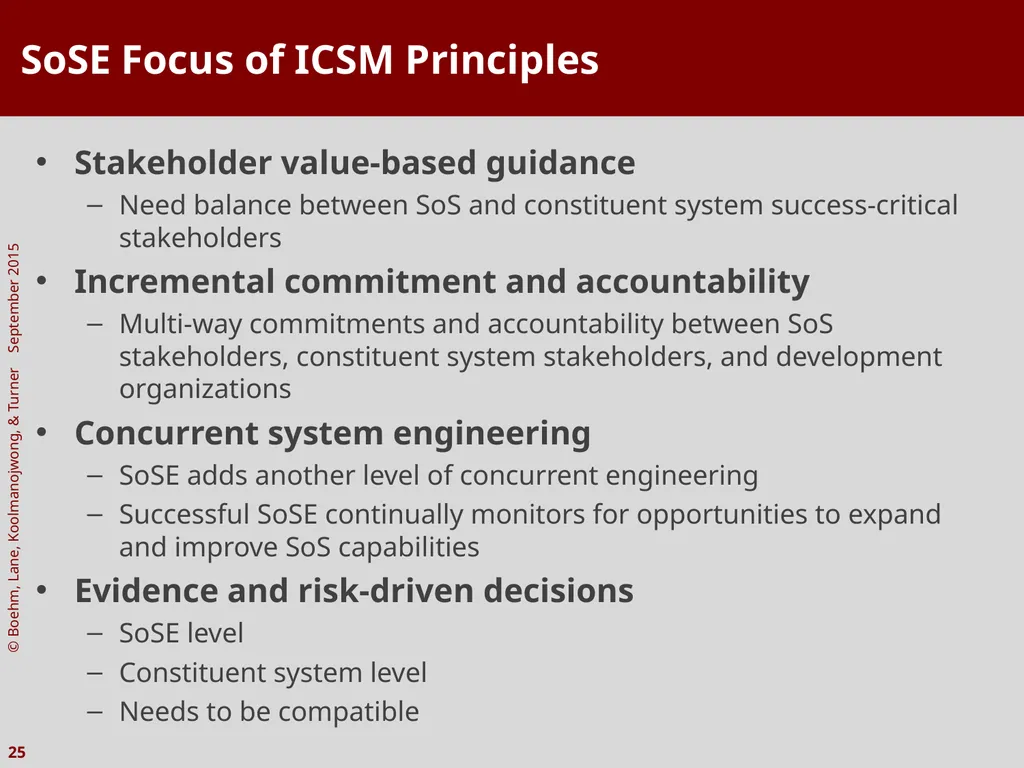
25
SoSE Focus of ICSM Principles Stakeholder value-based guidance
Need balance between SoS and constituent system success-critical stakeholders
Incremental commitment and accountability
Multi-way commitments and accountability between SoS stakeholders, constituent system stakeholders, and development organizations
Concurrent system engineering
SoSE adds another level of concurrent engineering
Successful SoSE continually monitors for opportunities to expand and improve SoS capabilities
Evidence and risk-driven decisions
SoSE level
Constituent system level
Needs to be compatible 25<br>
Need balance between SoS and constituent system success-critical stakeholders
Incremental commitment and accountability
Multi-way commitments and accountability between SoS stakeholders, constituent system stakeholders, and development organizations
Concurrent system engineering
SoSE adds another level of concurrent engineering
Successful SoSE continually monitors for opportunities to expand and improve SoS capabilities
Evidence and risk-driven decisions
SoSE level
Constituent system level
Needs to be compatible 25<br>
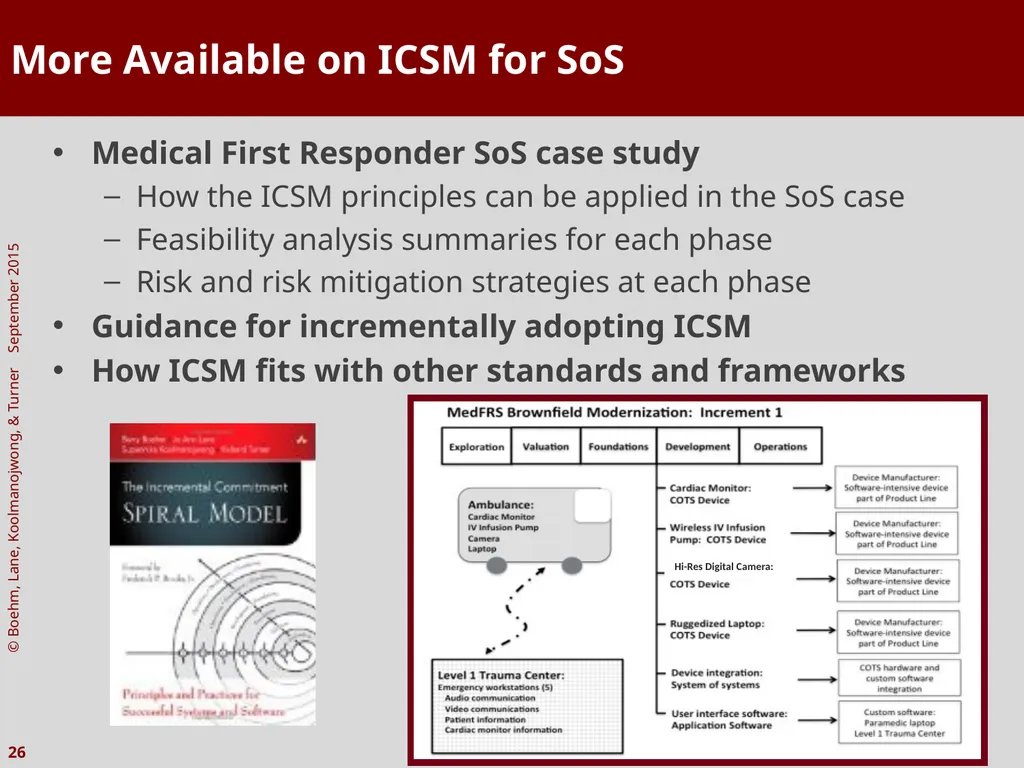
26
More Available on ICSM for SoS Medical First Responder SoS case study
How the ICSM principles can be applied in the SoS case
Feasibility analysis summaries for each phase
Risk and risk mitigation strategies at each phase
Guidance for incrementally adopting ICSM
How ICSM fits with other standards and frameworks 26<br>
How the ICSM principles can be applied in the SoS case
Feasibility analysis summaries for each phase
Risk and risk mitigation strategies at each phase
Guidance for incrementally adopting ICSM
How ICSM fits with other standards and frameworks 26<br>
27
On-going or Future SERC Work Related to
ICSM for SoS Integration of SysML models with cost estimations models
Value-based Kanban in SoS environment
Assessing and quantifying technical debt to support SoS capability trades
SERC toolbox for SoSE tools 27<br>
Value-based Kanban in SoS environment
Assessing and quantifying technical debt to support SoS capability trades
SERC toolbox for SoSE tools 27<br>
28
Questions and Discussion? June 2014 © Boehm, Lane, Koolmanojwong, & Turner 28<br>
29
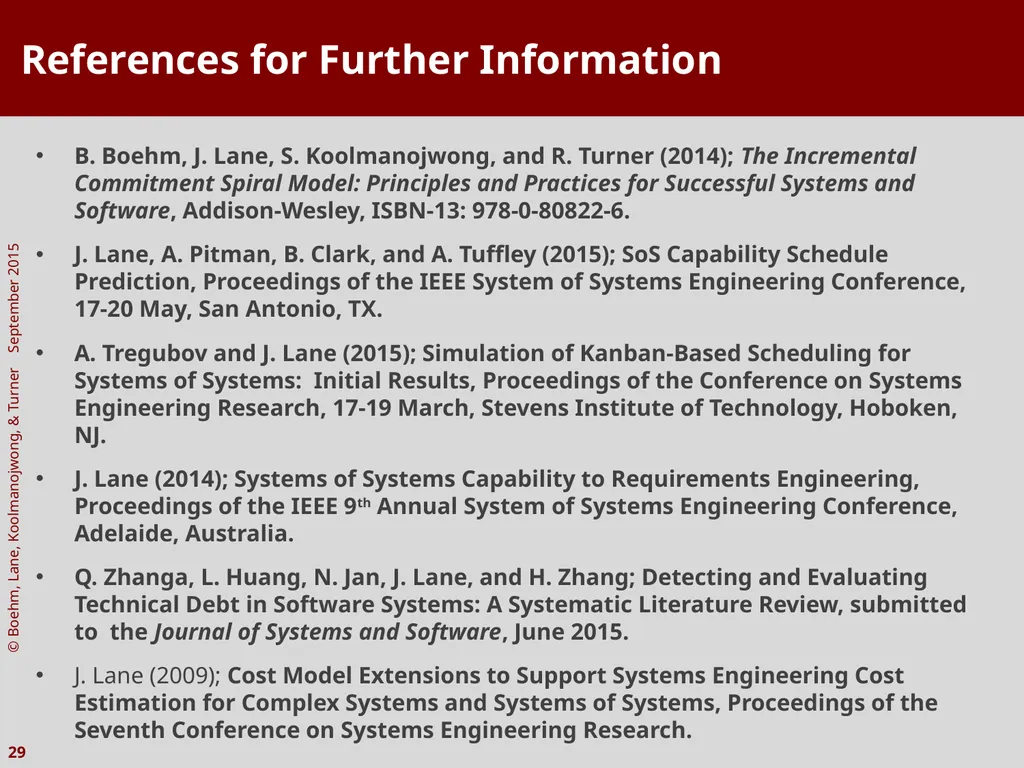
References for Further Information B. Boehm, J. Lane, S. Koolmanojwong, and R. Turner (2014); The Incremental Commitment Spiral Model: Principles and Practices for Successful Systems and Software, Addison-Wesley, ISBN-13: 978-0-80822-6.
J. Lane, A. Pitman, B. Clark, and A. Tuffley (2015); SoS Capability Schedule Prediction, Proceedings of the IEEE System of Systems Engineering Conference, 17-20 May, San Antonio, TX.
A. Tregubov and J. Lane (2015); Simulation of Kanban-Based Scheduling for Systems of Systems: Initial Results, Proceedings of the Conference on Systems Engineering Research, 17-19 March, Stevens Institute of Technology, Hoboken, NJ.
J. Lane (2014); Systems of Systems Capability to Requirements Engineering, Proceedings of the IEEE 9th Annual System of Systems Engineering Conference, Adelaide, Australia.
Q. Zhanga, L. Huang, N. Jan, J. Lane, and H. Zhang; Detecting and Evaluating Technical Debt in Software Systems: A Systematic Literature Review, submitted to the Journal of Systems and Software, June 2015.
J. Lane (2009); Cost Model Extensions to Support Systems Engineering Cost Estimation for Complex Systems and Systems of Systems, Proceedings of the Seventh Conference on Systems Engineering Research. 29<br>
J. Lane, A. Pitman, B. Clark, and A. Tuffley (2015); SoS Capability Schedule Prediction, Proceedings of the IEEE System of Systems Engineering Conference, 17-20 May, San Antonio, TX.
A. Tregubov and J. Lane (2015); Simulation of Kanban-Based Scheduling for Systems of Systems: Initial Results, Proceedings of the Conference on Systems Engineering Research, 17-19 March, Stevens Institute of Technology, Hoboken, NJ.
J. Lane (2014); Systems of Systems Capability to Requirements Engineering, Proceedings of the IEEE 9th Annual System of Systems Engineering Conference, Adelaide, Australia.
Q. Zhanga, L. Huang, N. Jan, J. Lane, and H. Zhang; Detecting and Evaluating Technical Debt in Software Systems: A Systematic Literature Review, submitted to the Journal of Systems and Software, June 2015.
J. Lane (2009); Cost Model Extensions to Support Systems Engineering Cost Estimation for Complex Systems and Systems of Systems, Proceedings of the Seventh Conference on Systems Engineering Research. 29<br>