
The Industrial Revolution © Student Handouts, Inc.
TD
Published · 115 slides · 0 views

1 / 1



Description
The Industrial Revolution Student Handouts, Inc. The First Industrial Revolution Historical Significance of the Industrial Revolution An ancient Greek or Roman would have been just as comfortable in Europe in 1700 because daily life was
Related Topics
Share
Embed code
Download this presentation From Below
"The Industrial Revolution © Student Handouts, Inc." is the property of its rightful owner. Permission is granted to download and print the materials on this website for personal, non-commercial use only, and to display it on your personal computer provided you do not modify the materials and that you retain all copyright notices contained in the materials. By downloading content from our website, you accept the terms of this agreement.
Presentation Transcript
01
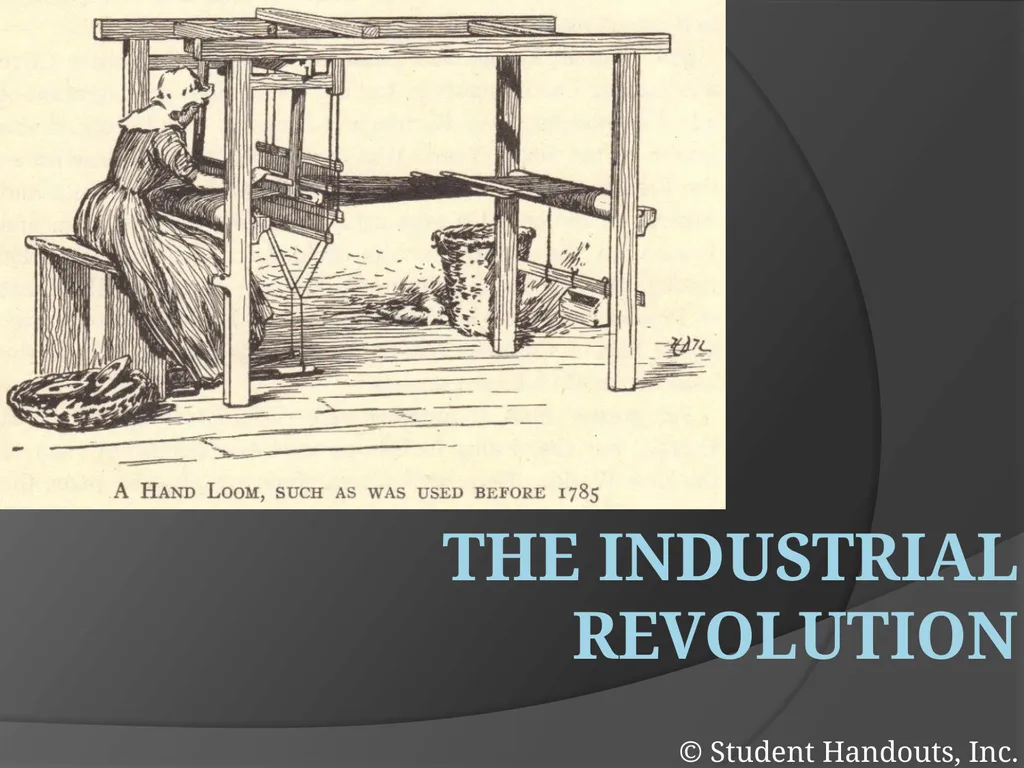
The Industrial Revolution © Student Handouts, Inc.<br>
02
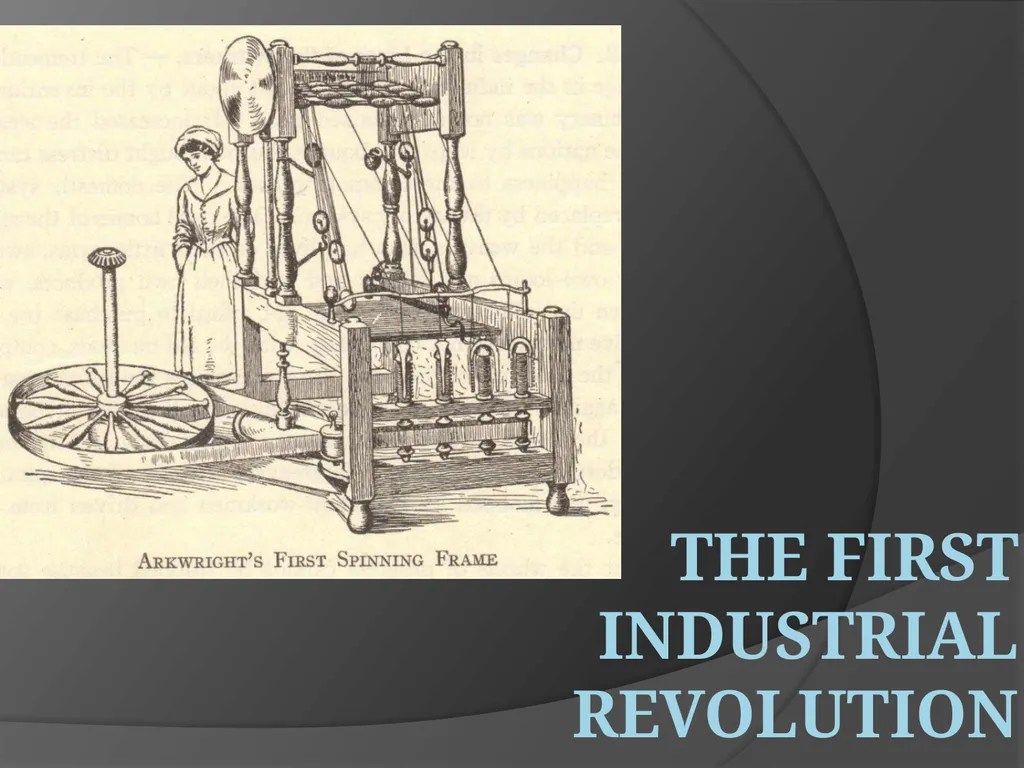
The First Industrial Revolution<br>
03
Historical Significance of the Industrial Revolution An ancient Greek or Roman would have been just as comfortable in Europe in 1700 because daily life was not much different – agriculture and technology were not much changed in 2000+ years
The Industrial Revolution changed human life drastically
More was created in the last 250+ years than in the previous 2500+ years of known human history<br>
The Industrial Revolution changed human life drastically
More was created in the last 250+ years than in the previous 2500+ years of known human history<br>
04
What was the Industrial Revolution? The Industrial Revolution was a fundamental change in the way goods were produced, from human labor to machines
The more efficient means of production and subsequent higher levels of production triggered far-reaching changes to industrialized societies<br>
The more efficient means of production and subsequent higher levels of production triggered far-reaching changes to industrialized societies<br>
05
The Industrial Revolution Machines were invented which replaced human labor
New energy sources were developed to power the new machinery – water, steam, electricity, oil (gas, kerosene)
Some historians place advances in atomic, solar, and wind energy at the later stages of the Industrial Revolution
Increased use of metals and minerals
Aluminum, coal, copper, iron, etc.<br>
New energy sources were developed to power the new machinery – water, steam, electricity, oil (gas, kerosene)
Some historians place advances in atomic, solar, and wind energy at the later stages of the Industrial Revolution
Increased use of metals and minerals
Aluminum, coal, copper, iron, etc.<br>
06
The Industrial Revolution Transportation improved
Ships
Wooden ships → Iron ships → Steel ships
Wind-powered sails → Steam-powered boilers
Trains
Automobiles
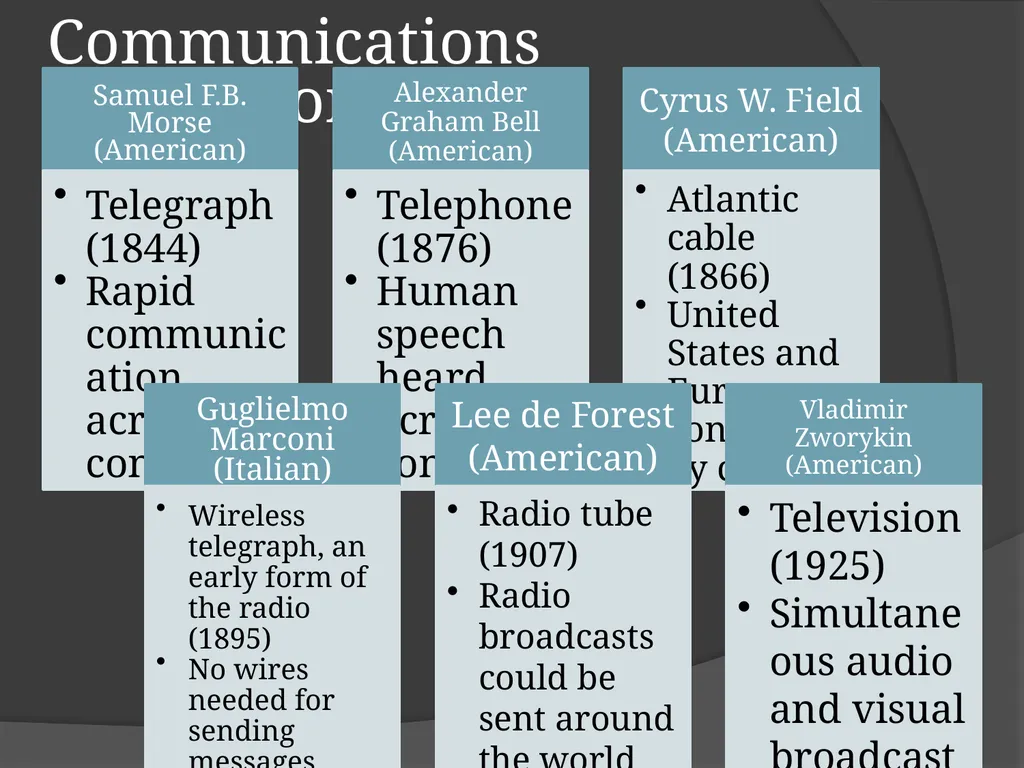
Communication improved
Telegraph
Telephone
Radio<br>
Ships
Wooden ships → Iron ships → Steel ships
Wind-powered sails → Steam-powered boilers
Trains
Automobiles
Communication improved
Telegraph
Telephone
Radio<br>
07
Developments Mass production of goods
Increased numbers of goods
Increased diversity of goods produced
Development of factory system of production
Rural-to-urban migration
People left farms to work in cities
Development of capitalism
Financial capital for continued industrial growth
Development and growth of new socio-economic classes
Working class, bourgeoisie, and wealthy industrial class
Commitment to research and development
Investments in new technologies
Industrial and governmental interest in promoting invention, the sciences, and overall industrial growth<br>
08
Background of the Industrial Revolution Commercial Revolution
15th, 16th, and 17th centuries
Europeans expanded their power worldwide
Increased geographic knowledge
Colonies in the Americas and Asia
Increased trade and commerce
Guild system could not meet the demands of increasing numbers goods<br>
15th, 16th, and 17th centuries
Europeans expanded their power worldwide
Increased geographic knowledge
Colonies in the Americas and Asia
Increased trade and commerce
Guild system could not meet the demands of increasing numbers goods<br>
09
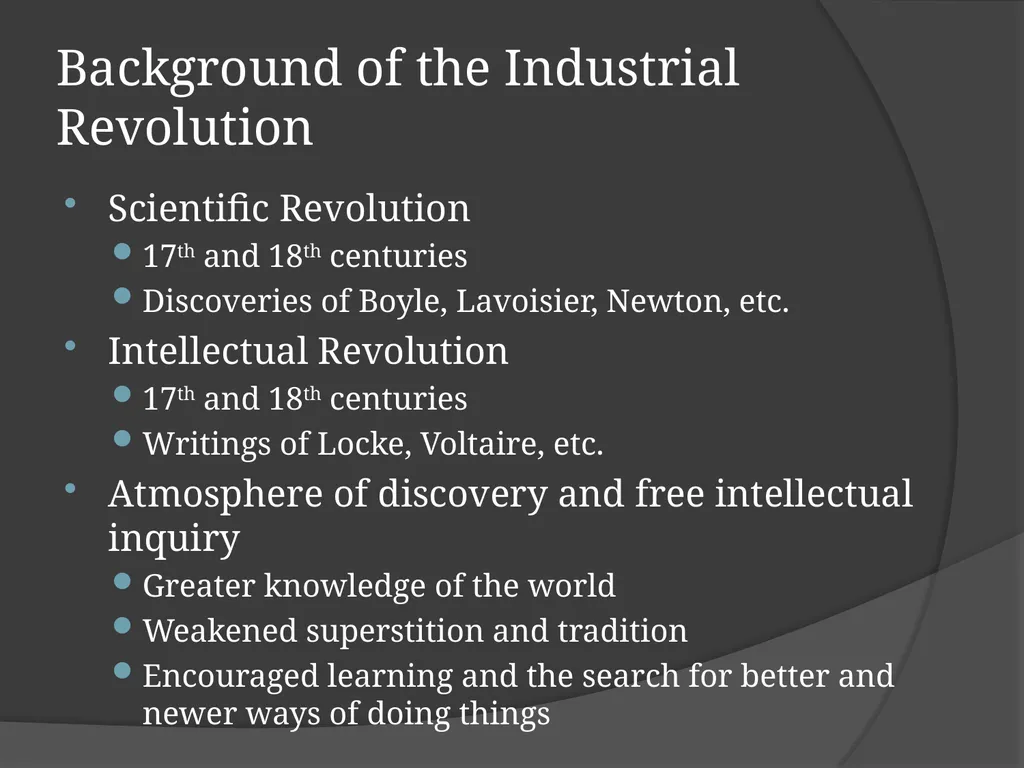
Background of the Industrial Revolution Scientific Revolution
17th and 18th centuries
Discoveries of Boyle, Lavoisier, Newton, etc.
Intellectual Revolution
17th and 18th centuries
Writings of Locke, Voltaire, etc.
Atmosphere of discovery and free intellectual inquiry
Greater knowledge of the world
Weakened superstition and tradition
Encouraged learning and the search for better and newer ways of doing things<br>
17th and 18th centuries
Discoveries of Boyle, Lavoisier, Newton, etc.
Intellectual Revolution
17th and 18th centuries
Writings of Locke, Voltaire, etc.
Atmosphere of discovery and free intellectual inquiry
Greater knowledge of the world
Weakened superstition and tradition
Encouraged learning and the search for better and newer ways of doing things<br>
10
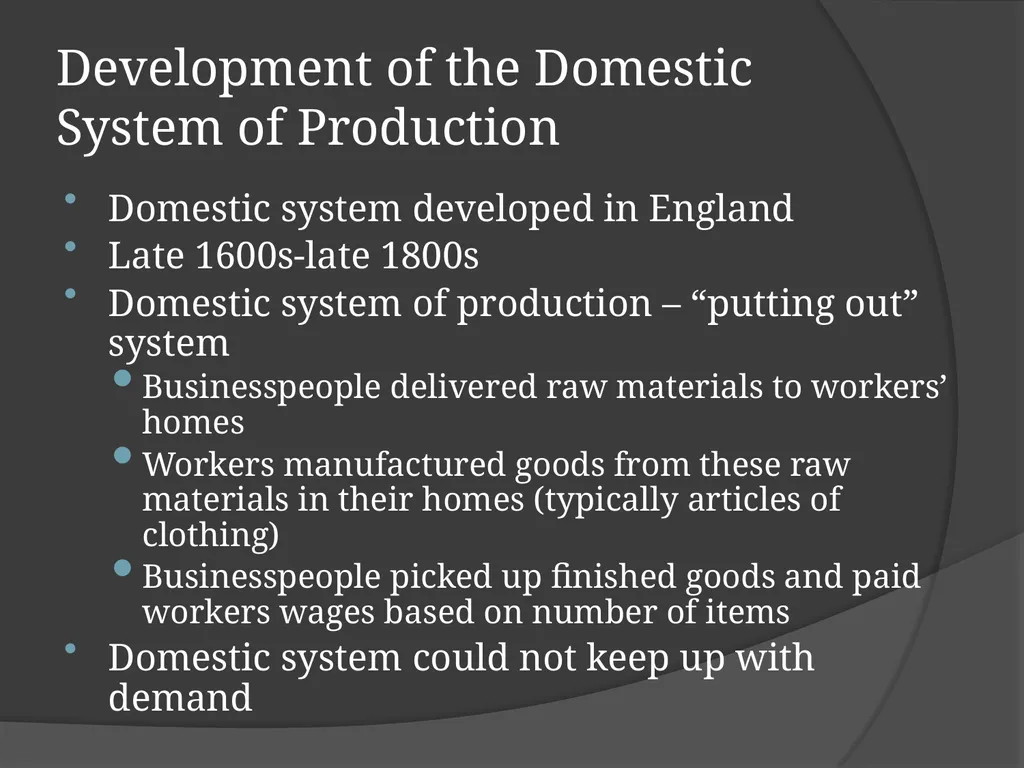
Development of the Domestic System of Production Domestic system developed in England
Late 1600s-late 1800s
Domestic system of production – “putting out” system
Businesspeople delivered raw materials to workers’ homes
Workers manufactured goods from these raw materials in their homes (typically articles of clothing)
Businesspeople picked up finished goods and paid workers wages based on number of items
Domestic system could not keep up with demand<br>
11
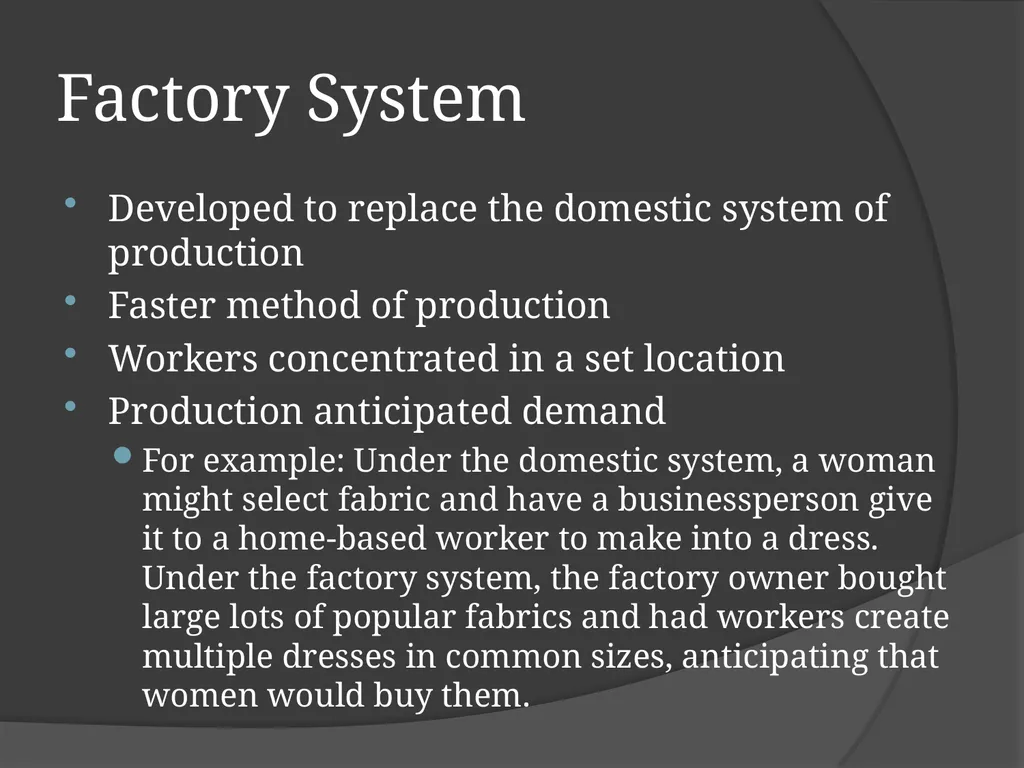
Factory System Developed to replace the domestic system of production
Faster method of production
Workers concentrated in a set location
Production anticipated demand
For example: Under the domestic system, a woman might select fabric and have a businessperson give it to a home-based worker to make into a dress. Under the factory system, the factory owner bought large lots of popular fabrics and had workers create multiple dresses in common sizes, anticipating that women would buy them.<br>
12
England: Birthplace of the Industrial Revolution No concrete start date for the Industrial Revolution
Marked by gradual, slow changes
After 1750 – these changes were noticeable first in England<br>
Marked by gradual, slow changes
After 1750 – these changes were noticeable first in England<br>
13
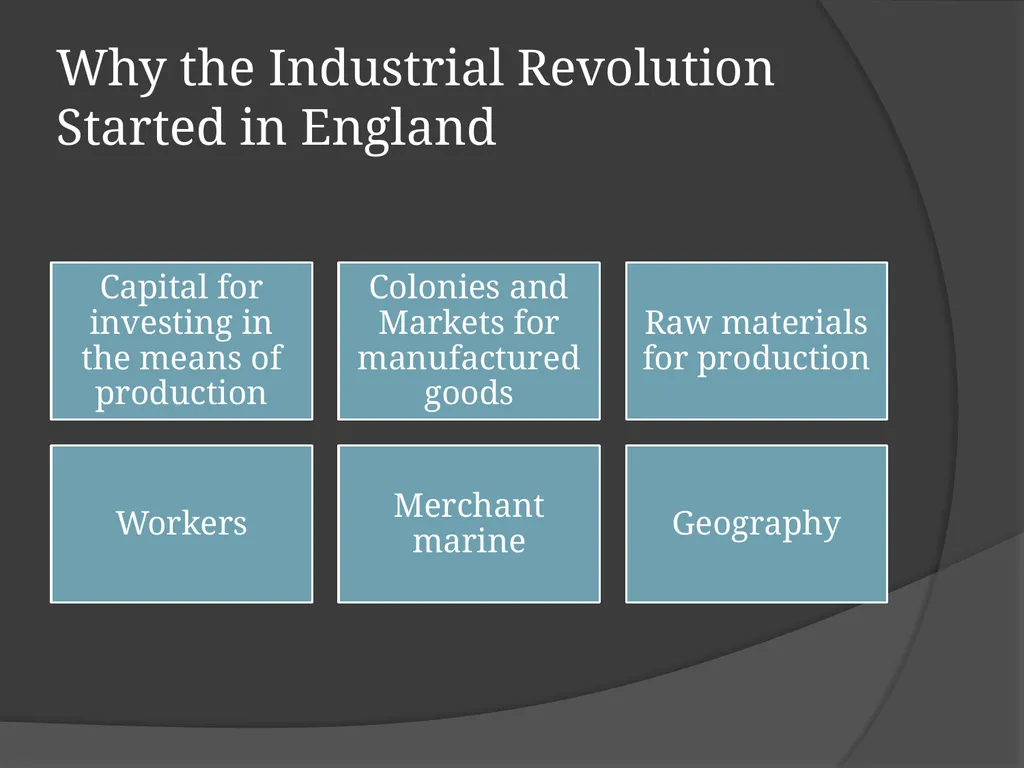
Why the Industrial Revolution Started in England<br>
14
England’s Resources: Capital The Commercial Revolution made many English merchants very wealthy
These merchants had the capital to invest in the factory system – money to buy buildings, machinery, and raw materials<br>
These merchants had the capital to invest in the factory system – money to buy buildings, machinery, and raw materials<br>
15
England’s Resources: Colonies and Markets Wealth from the Commercial Revolution spread beyond the merchant class
England had more colonies than any other nation
Its colonies gave England access to enormous markets and vast amounts of raw materials
Colonies had rich textile industries for centuries
Many of the natural cloths popular today, such as calico and gingham, were originally created in India
China had a silk industry<br>
16
England’s Resources: Raw Materials England itself possessed the necessary raw materials to create the means of production
Coal – vast coal reserves powered steam engines
Iron – basic building block of large machines, railroad tracks, trains, and ships<br>
Coal – vast coal reserves powered steam engines
Iron – basic building block of large machines, railroad tracks, trains, and ships<br>
17
England’s Resources: Workers Serfdom and guilds ended earlier in England than other countries
English people could freely travel from the countryside to the cities
Enclosure Acts – caused many small farmers to lose their lands, and these former farmers increased the labor supply<br>
English people could freely travel from the countryside to the cities
Enclosure Acts – caused many small farmers to lose their lands, and these former farmers increased the labor supply<br>
18
England’s Resources: Merchant Marine World’s largest merchant fleet
Merchant marine built up from the Commercial Revolution
Vast numbers of ships could bring raw materials and finished goods to and from England’s colonies and possessions, as well as to and from other countries<br>
Merchant marine built up from the Commercial Revolution
Vast numbers of ships could bring raw materials and finished goods to and from England’s colonies and possessions, as well as to and from other countries<br>
19
England’s Resources: Geography England is the political center of Great Britain, an island
Great Britain (as the entire island was called beginning in 1707) did not suffer fighting on its land during the wars of the 18th century
Island has excellent harbors and ports
Damp climate benefited the textile industry (thread did not dry out)
Government stable
No internal trade barriers<br>
Great Britain (as the entire island was called beginning in 1707) did not suffer fighting on its land during the wars of the 18th century
Island has excellent harbors and ports
Damp climate benefited the textile industry (thread did not dry out)
Government stable
No internal trade barriers<br>
20
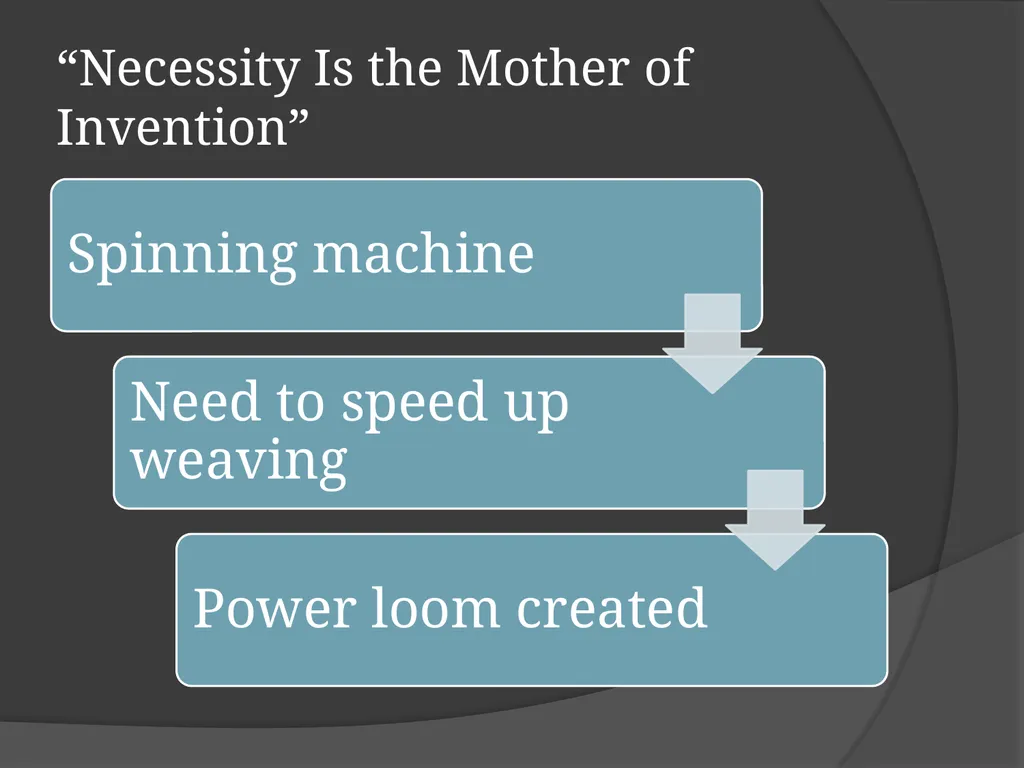
“Necessity Is the Mother of Invention”<br>
21
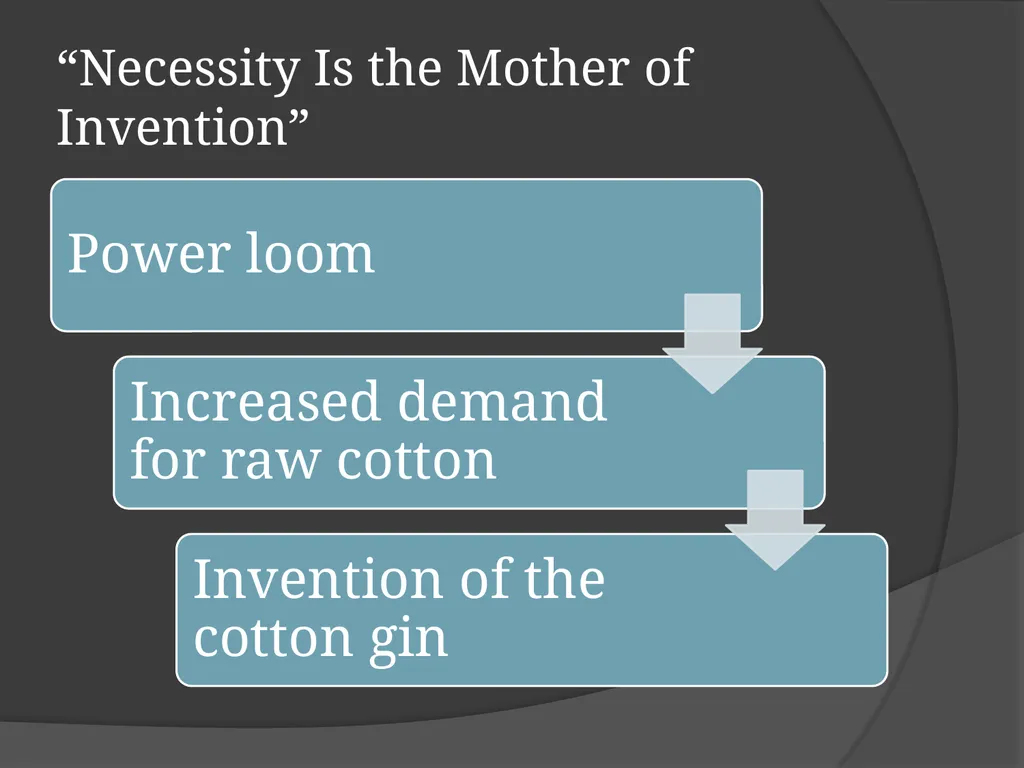
“Necessity Is the Mother of Invention”<br>
22
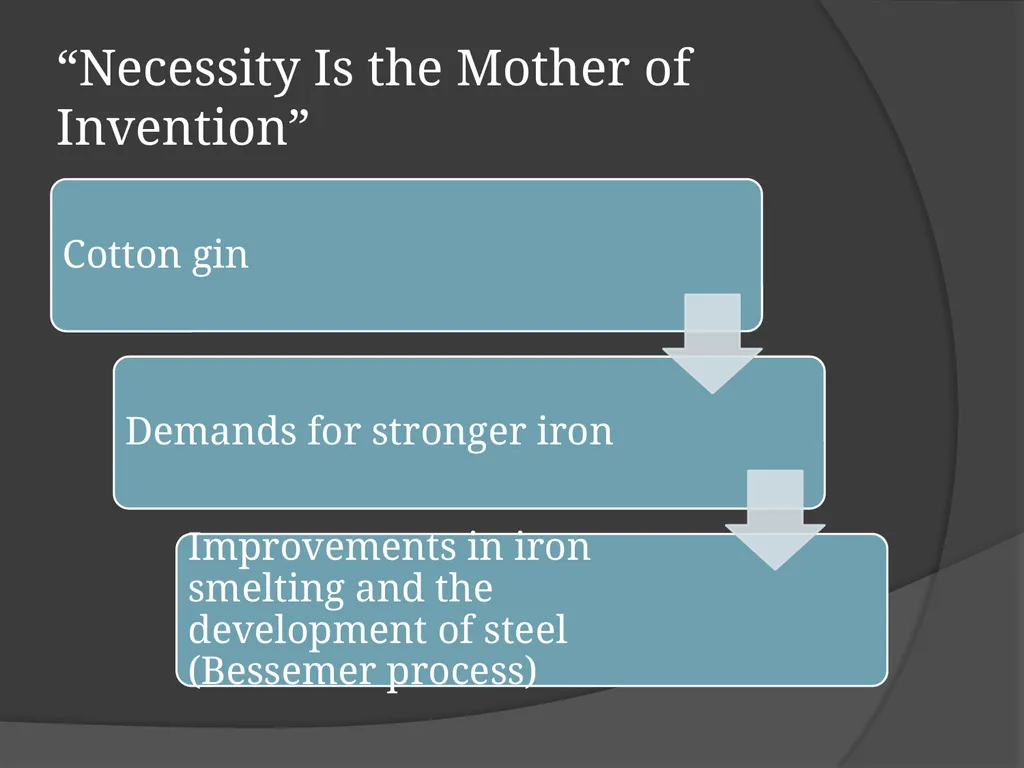
“Necessity Is the Mother of Invention”<br>
23
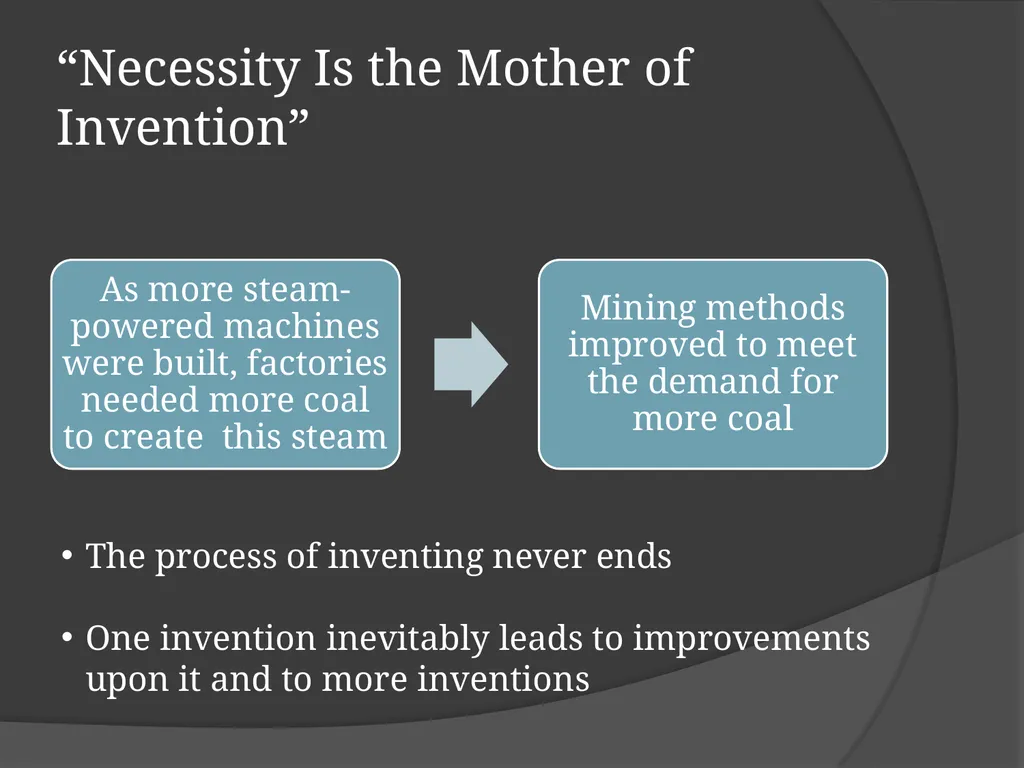
“Necessity Is the Mother of Invention” The process of inventing never ends
One invention inevitably leads to improvements upon it and to more inventions<br>
One invention inevitably leads to improvements upon it and to more inventions<br>
24
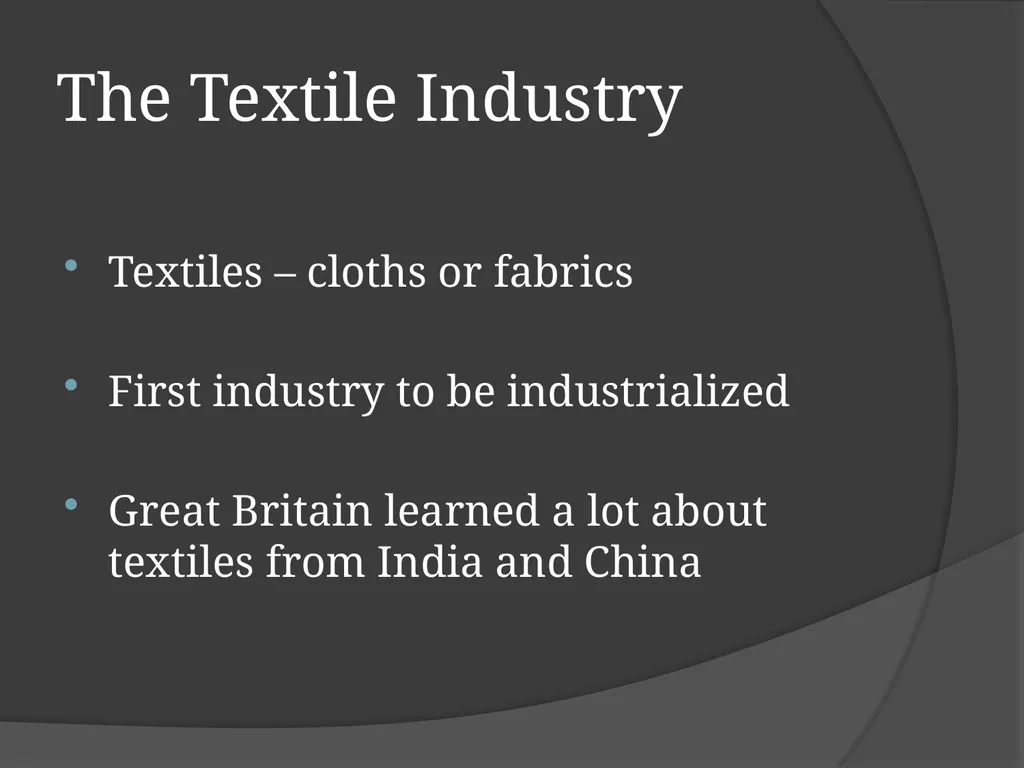
The Textile Industry Textiles – cloths or fabrics
First industry to be industrialized
Great Britain learned a lot about textiles from India and China<br>
First industry to be industrialized
Great Britain learned a lot about textiles from India and China<br>
25
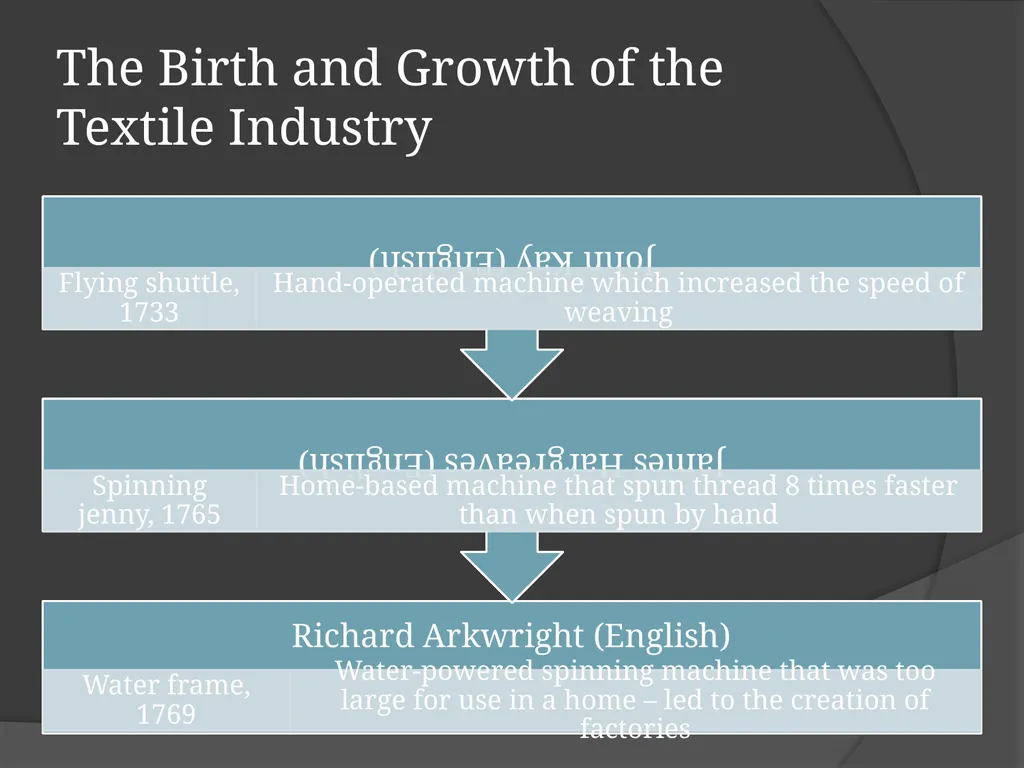
The Birth and Growth of the Textile Industry<br>
26
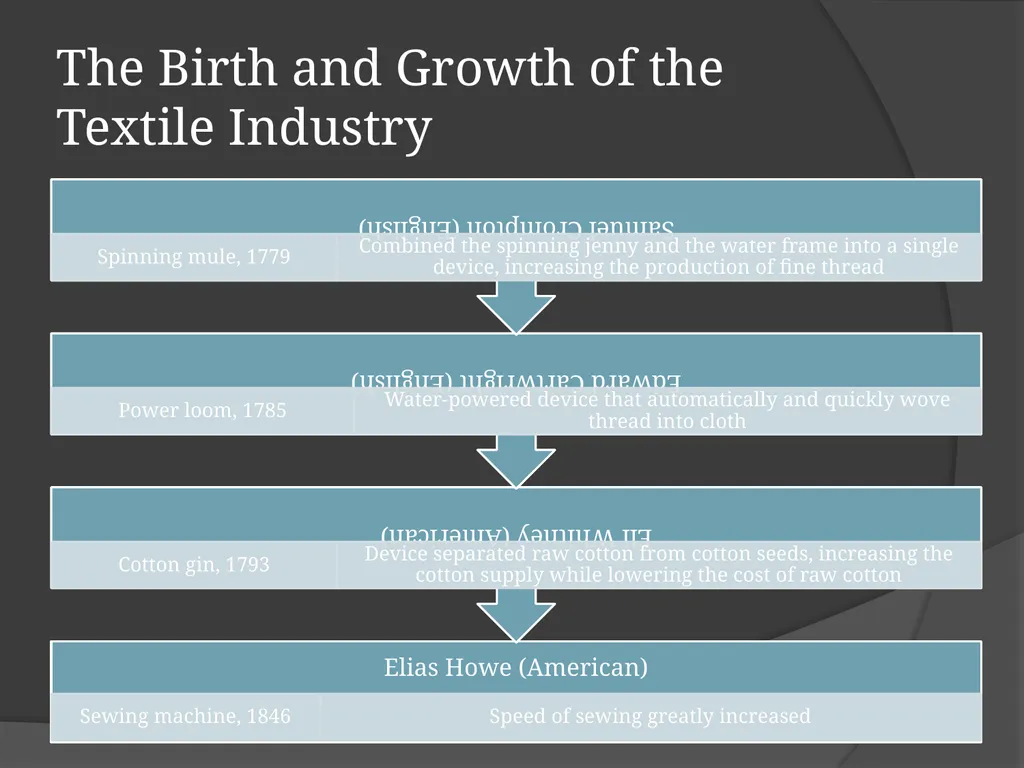
The Birth and Growth of the Textile Industry<br>
27
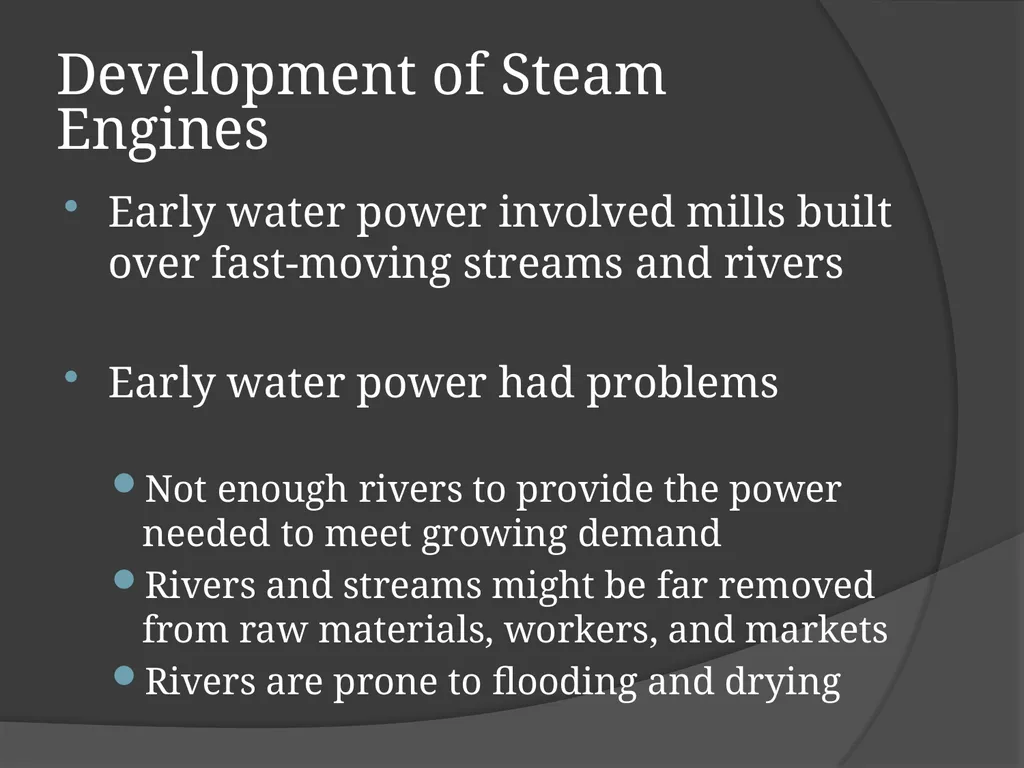
Development of Steam Engines Early water power involved mills built over fast-moving streams and rivers
Early water power had problems
Not enough rivers to provide the power needed to meet growing demand
Rivers and streams might be far removed from raw materials, workers, and markets
Rivers are prone to flooding and drying<br>
Early water power had problems
Not enough rivers to provide the power needed to meet growing demand
Rivers and streams might be far removed from raw materials, workers, and markets
Rivers are prone to flooding and drying<br>
28
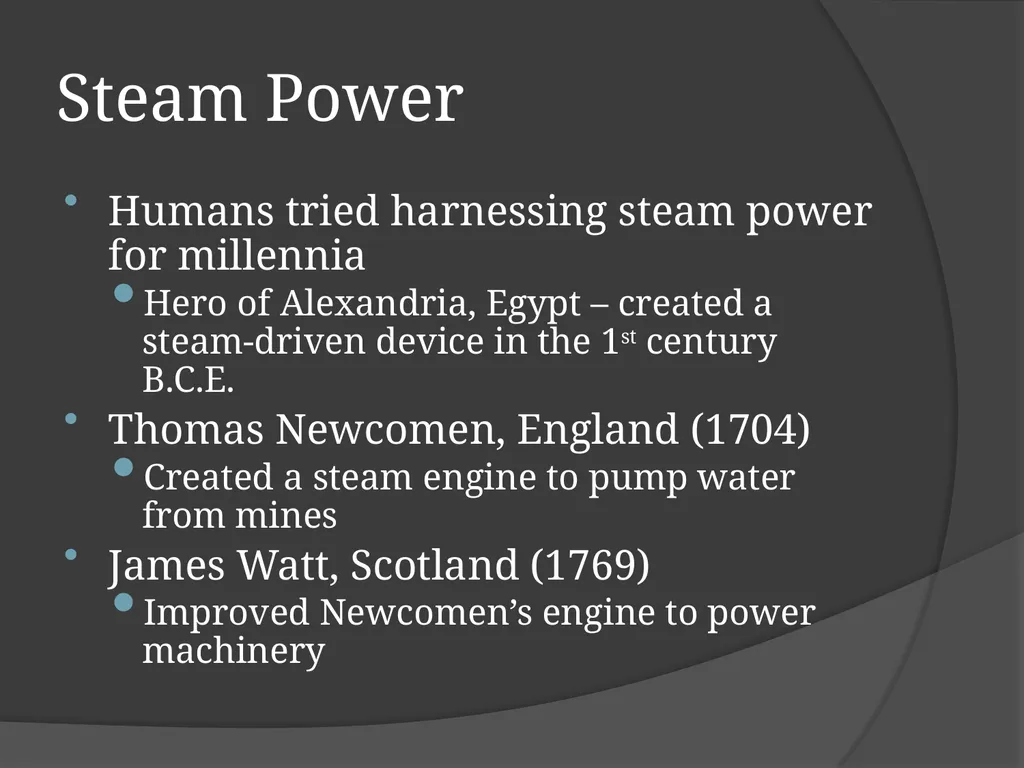
Steam Power Humans tried harnessing steam power for millennia
Hero of Alexandria, Egypt – created a steam-driven device in the 1st century B.C.E.
Thomas Newcomen, England (1704)
Created a steam engine to pump water from mines
James Watt, Scotland (1769)
Improved Newcomen’s engine to power machinery<br>
Hero of Alexandria, Egypt – created a steam-driven device in the 1st century B.C.E.
Thomas Newcomen, England (1704)
Created a steam engine to pump water from mines
James Watt, Scotland (1769)
Improved Newcomen’s engine to power machinery<br>
29
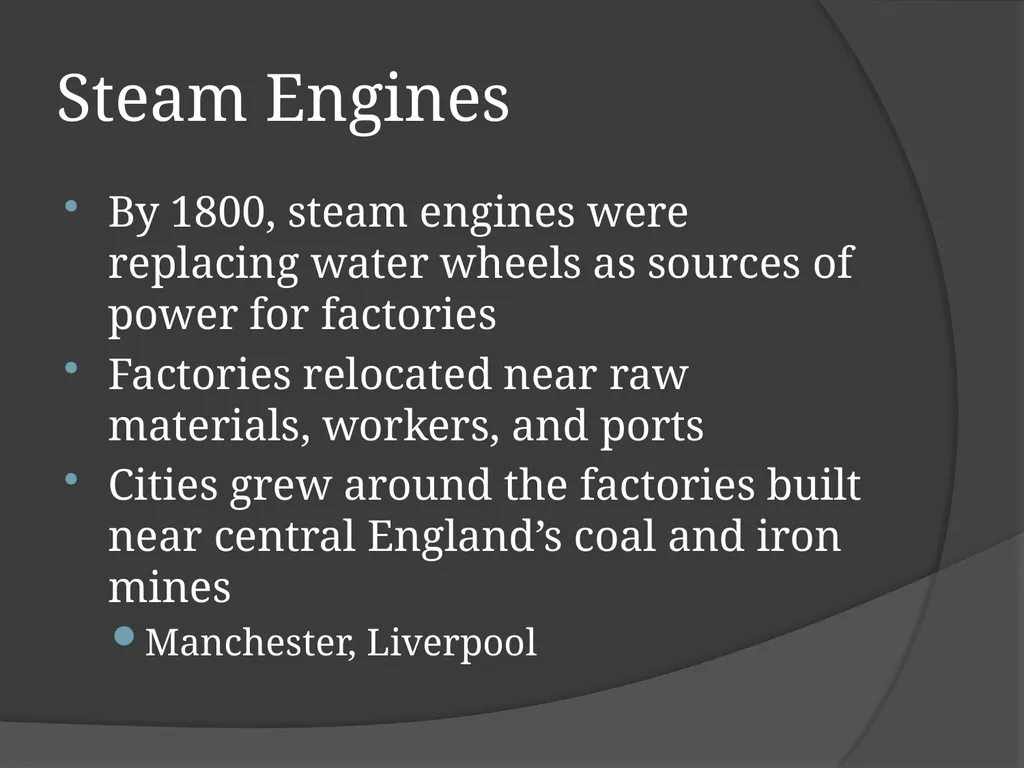
Steam Engines By 1800, steam engines were replacing water wheels as sources of power for factories
Factories relocated near raw materials, workers, and ports
Cities grew around the factories built near central England’s coal and iron mines
Manchester, Liverpool<br>
Factories relocated near raw materials, workers, and ports
Cities grew around the factories built near central England’s coal and iron mines
Manchester, Liverpool<br>
30
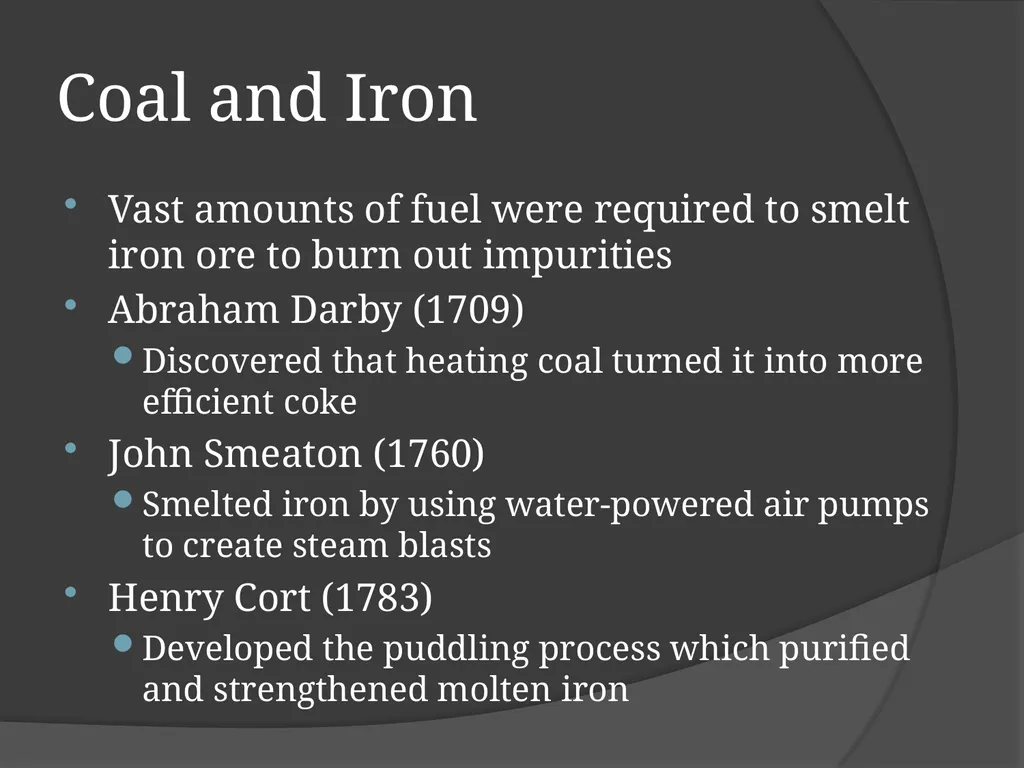
Coal and Iron Vast amounts of fuel were required to smelt iron ore to burn out impurities
Abraham Darby (1709)
Discovered that heating coal turned it into more efficient coke
John Smeaton (1760)
Smelted iron by using water-powered air pumps to create steam blasts
Henry Cort (1783)
Developed the puddling process which purified and strengthened molten iron<br>
Abraham Darby (1709)
Discovered that heating coal turned it into more efficient coke
John Smeaton (1760)
Smelted iron by using water-powered air pumps to create steam blasts
Henry Cort (1783)
Developed the puddling process which purified and strengthened molten iron<br>
31
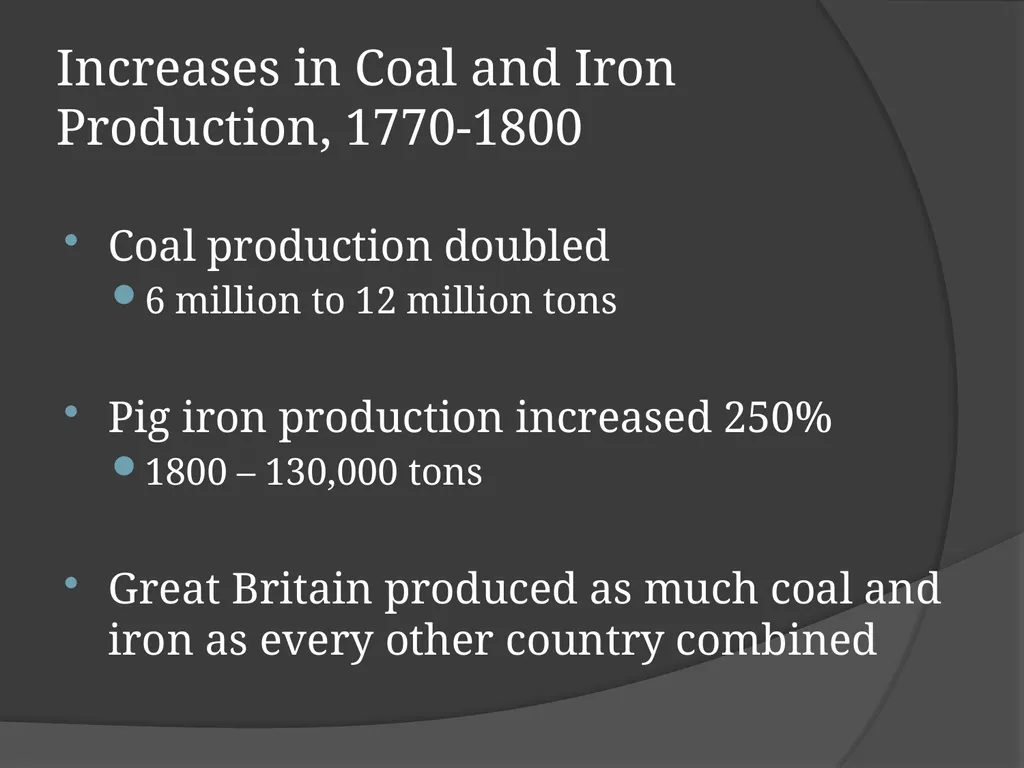
Increases in Coal and Iron Production, 1770-1800 Coal production doubled
6 million to 12 million tons
Pig iron production increased 250%
1800 – 130,000 tons
Great Britain produced as much coal and iron as every other country combined<br>
6 million to 12 million tons
Pig iron production increased 250%
1800 – 130,000 tons
Great Britain produced as much coal and iron as every other country combined<br>
32
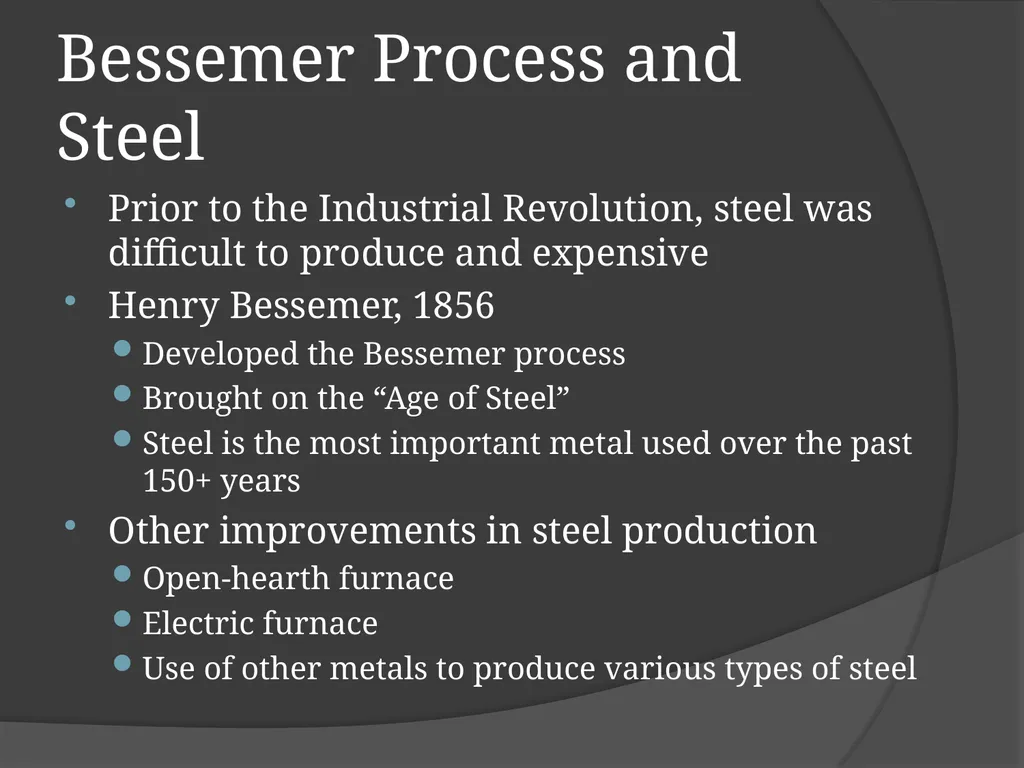
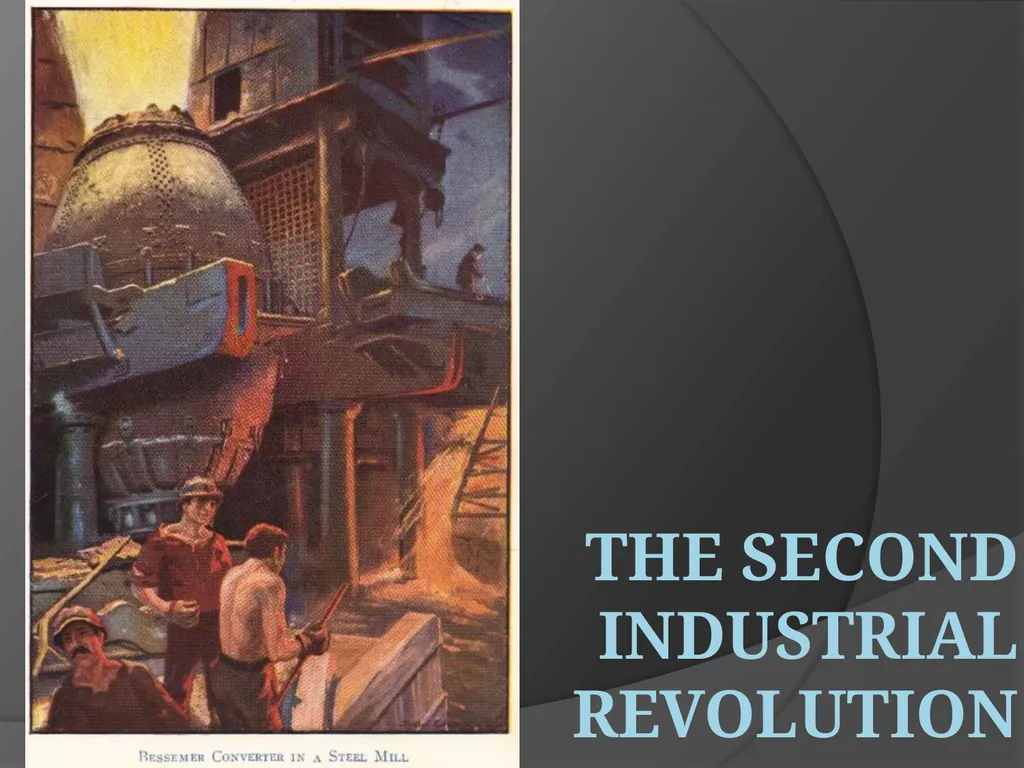
Bessemer Process and Steel Prior to the Industrial Revolution, steel was difficult to produce and expensive
Henry Bessemer, 1856
Developed the Bessemer process
Brought on the “Age of Steel”
Steel is the most important metal used over the past 150+ years
Other improvements in steel production
Open-hearth furnace
Electric furnace
Use of other metals to produce various types of steel<br>
Henry Bessemer, 1856
Developed the Bessemer process
Brought on the “Age of Steel”
Steel is the most important metal used over the past 150+ years
Other improvements in steel production
Open-hearth furnace
Electric furnace
Use of other metals to produce various types of steel<br>
33
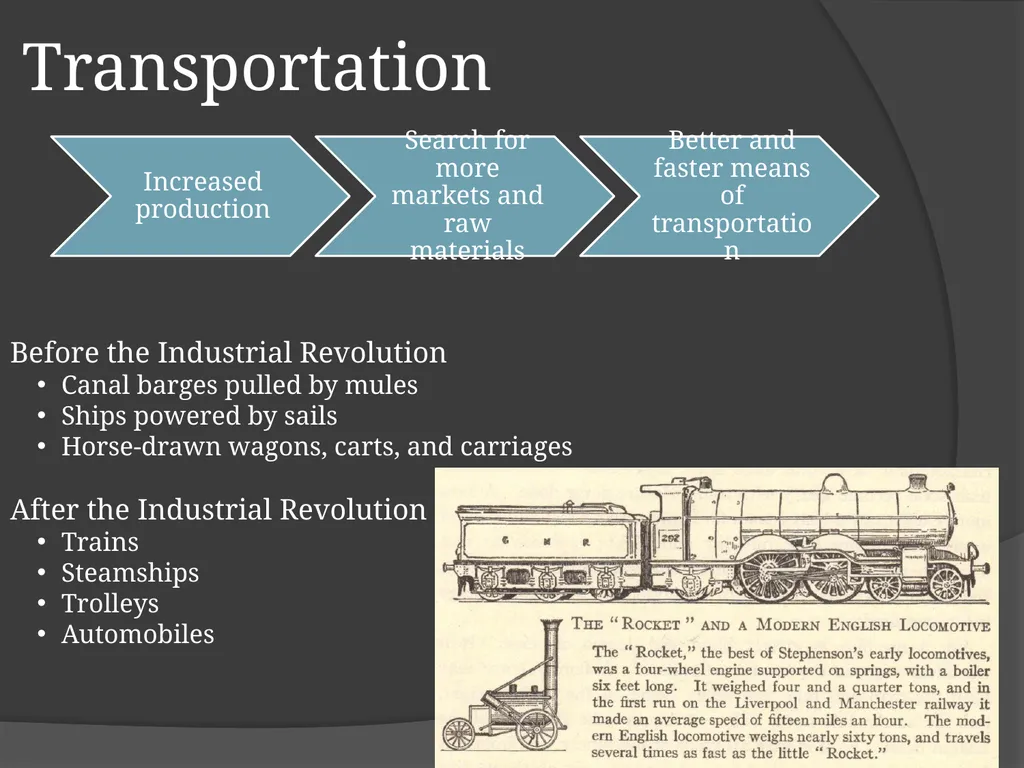
Transportation Before the Industrial Revolution
Canal barges pulled by mules
Ships powered by sails
Horse-drawn wagons, carts, and carriages
After the Industrial Revolution
Trains
Steamships
Trolleys
Automobiles<br>
Canal barges pulled by mules
Ships powered by sails
Horse-drawn wagons, carts, and carriages
After the Industrial Revolution
Trains
Steamships
Trolleys
Automobiles<br>
34
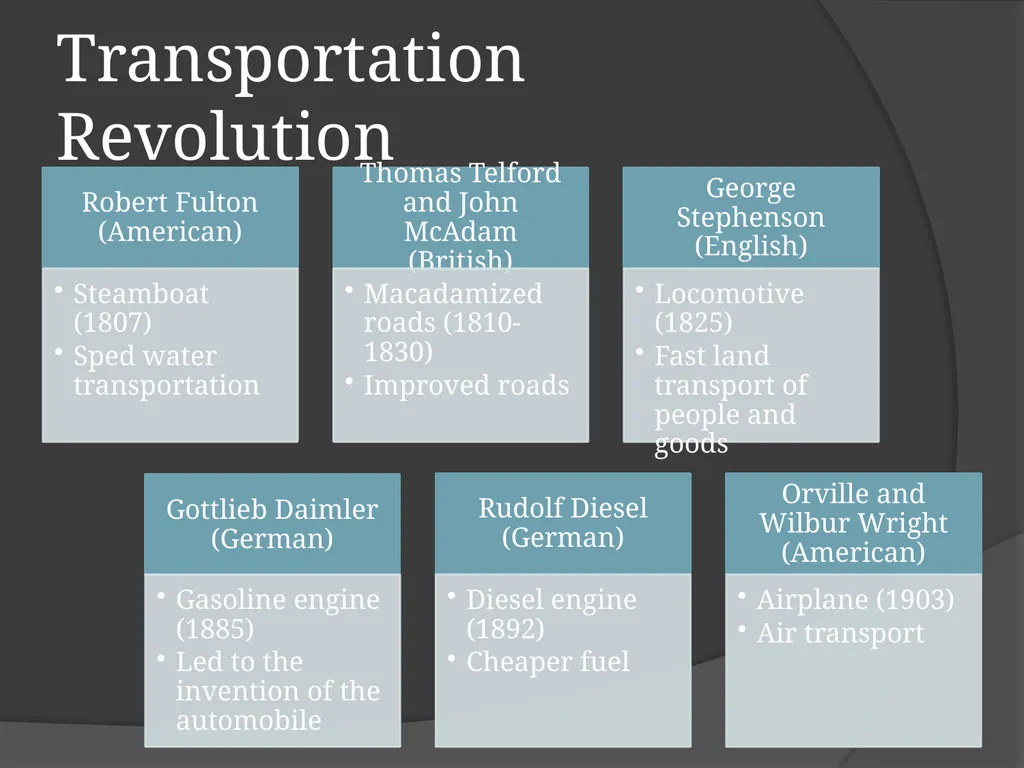
Transportation Revolution<br>
35
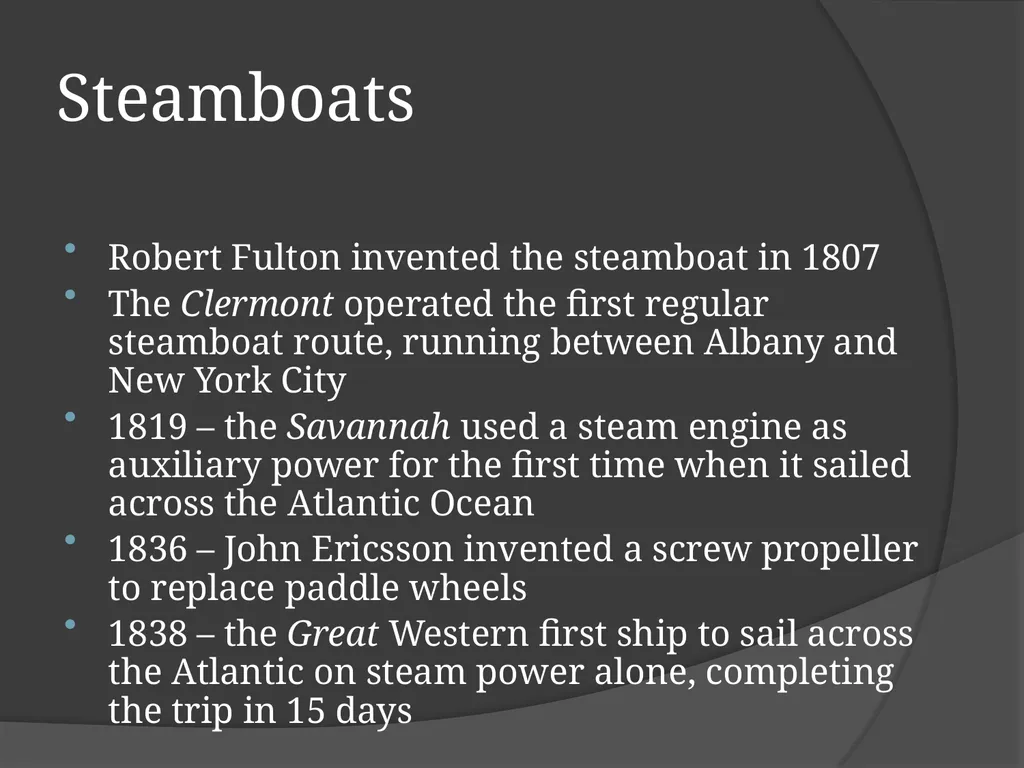
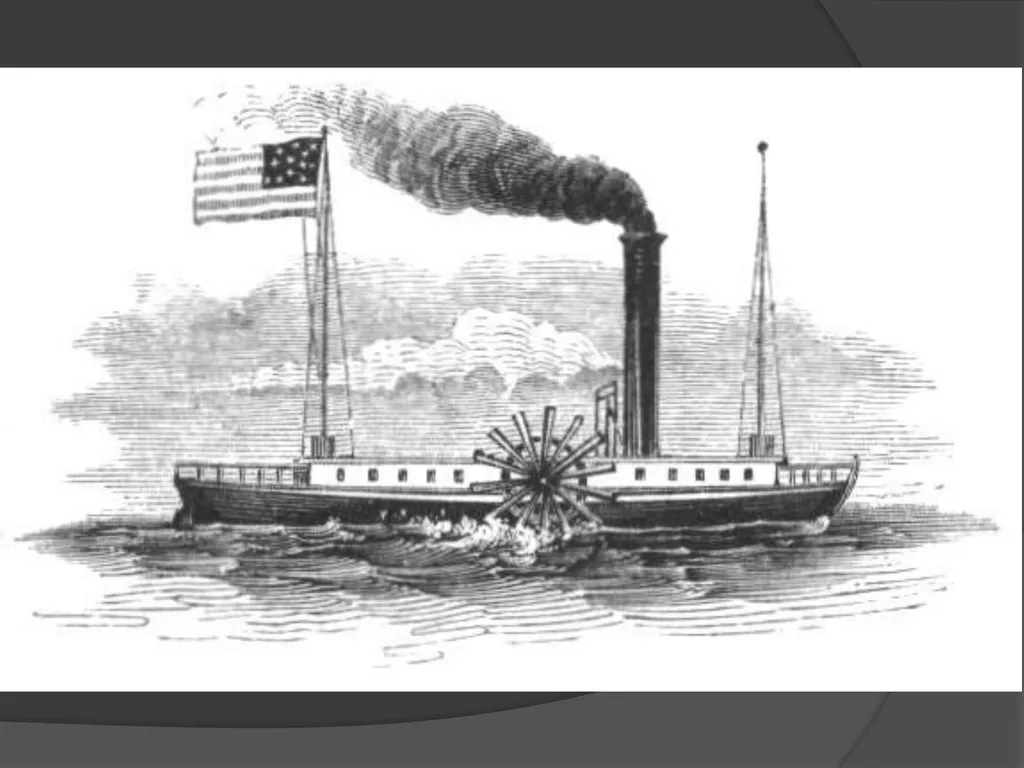
Steamboats Robert Fulton invented the steamboat in 1807
The Clermont operated the first regular steamboat route, running between Albany and New York City
1819 – the Savannah used a steam engine as auxiliary power for the first time when it sailed across the Atlantic Ocean
1836 – John Ericsson invented a screw propeller to replace paddle wheels
1838 – the Great Western first ship to sail across the Atlantic on steam power alone, completing the trip in 15 days<br>
36
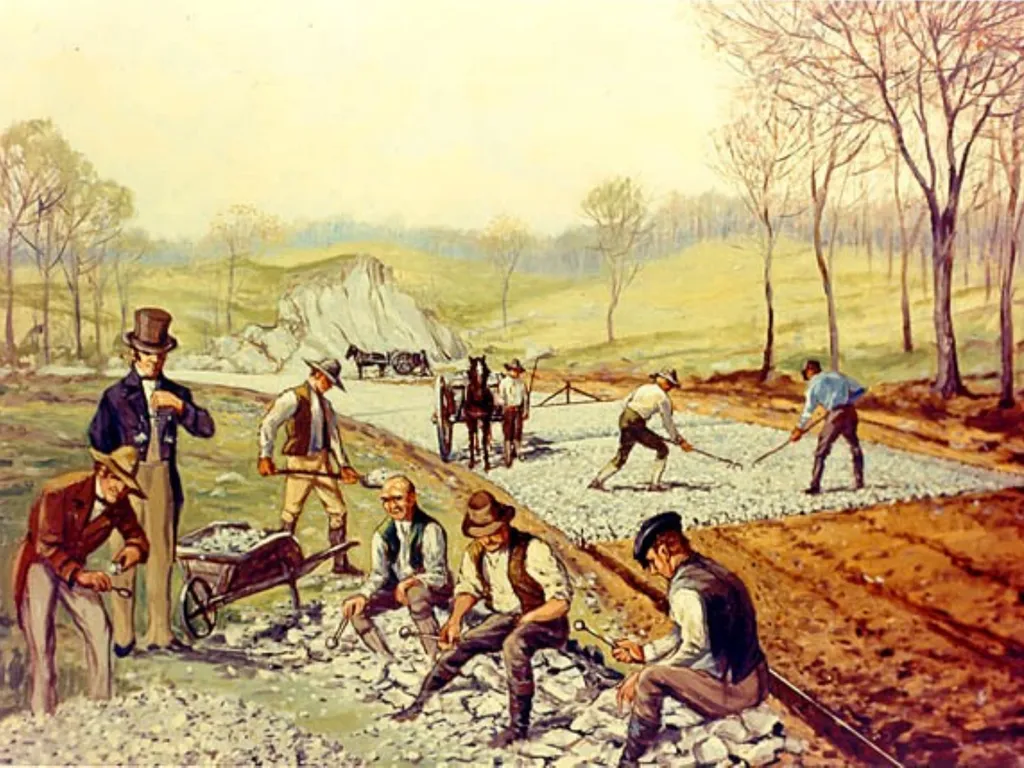
Macadamized Roads Strong, hard roads invented by Thomas Telford and John McAdam
Improvement over dirt and gravel roads
Macadamized roads have a smooth, hard surface that supports heavy loads without requiring a thick roadbed
Modern roads are macadamized roads, with tar added to limit the creation of dust<br>
Improvement over dirt and gravel roads
Macadamized roads have a smooth, hard surface that supports heavy loads without requiring a thick roadbed
Modern roads are macadamized roads, with tar added to limit the creation of dust<br>
37
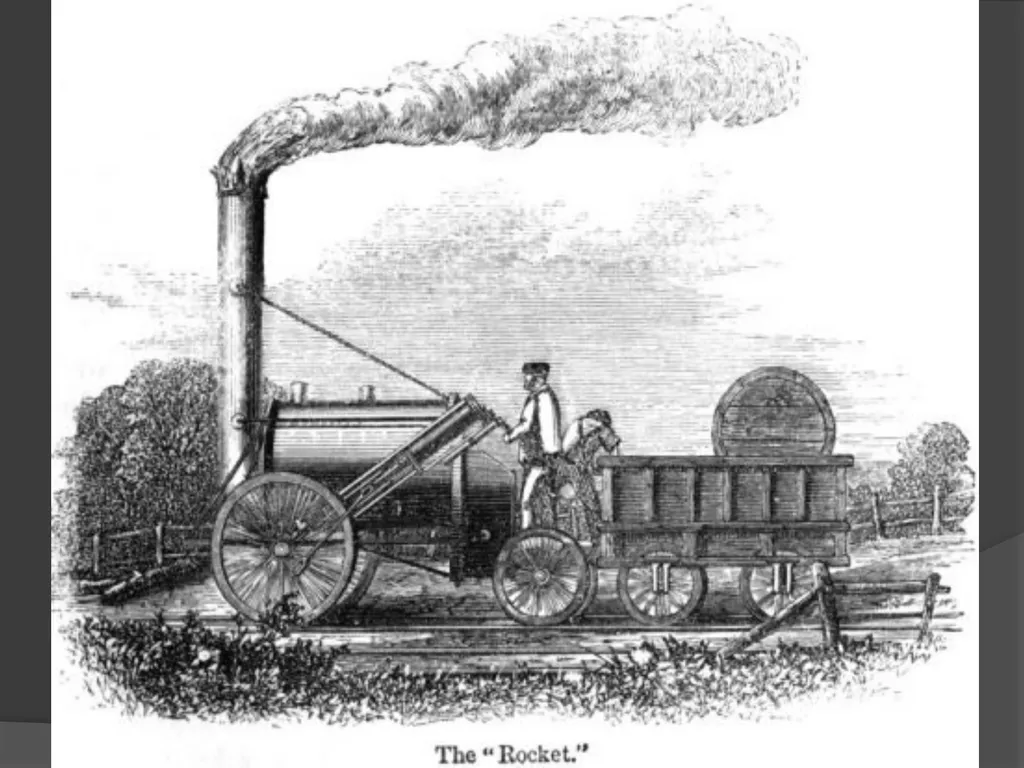
Railroads 1830 – Stephenson’s “Rocket” train traveled the 40 miles between Liverpool and Manchester in 1 ½ hours
1830-1870 – railroad tracks went from 49 miles to over 15,000 miles
Steel rails replaced iron rails
1869 – Westinghouse’s air brake made train travel safer
Greater train traveling comfort – heavier train cars, improved road beds, and sleeping cars<br>
1830-1870 – railroad tracks went from 49 miles to over 15,000 miles
Steel rails replaced iron rails
1869 – Westinghouse’s air brake made train travel safer
Greater train traveling comfort – heavier train cars, improved road beds, and sleeping cars<br>
38
Communications Revolution<br>
39
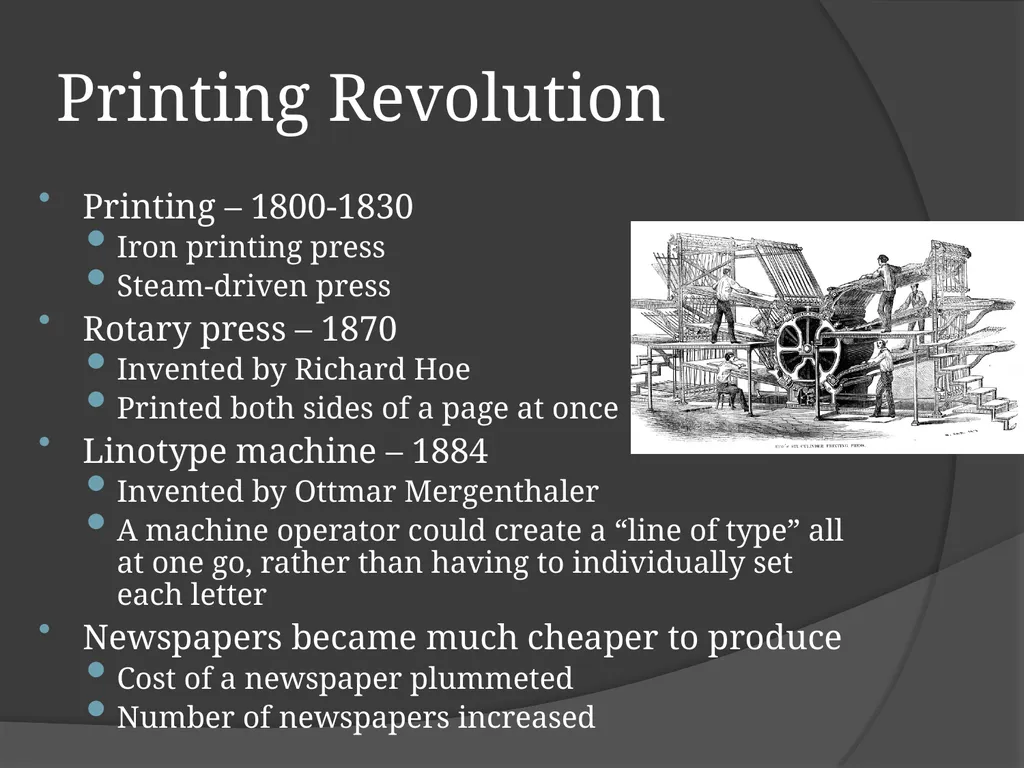
Printing Revolution Printing – 1800-1830
Iron printing press
Steam-driven press
Rotary press – 1870
Invented by Richard Hoe
Printed both sides of a page at once
Linotype machine – 1884
Invented by Ottmar Mergenthaler
A machine operator could create a “line of type” all at one go, rather than having to individually set each letter
Newspapers became much cheaper to produce
Cost of a newspaper plummeted
Number of newspapers increased<br>
40
Review Questions What was the Industrial Revolution?
Describe at least three developments of the Industrial Revolution.
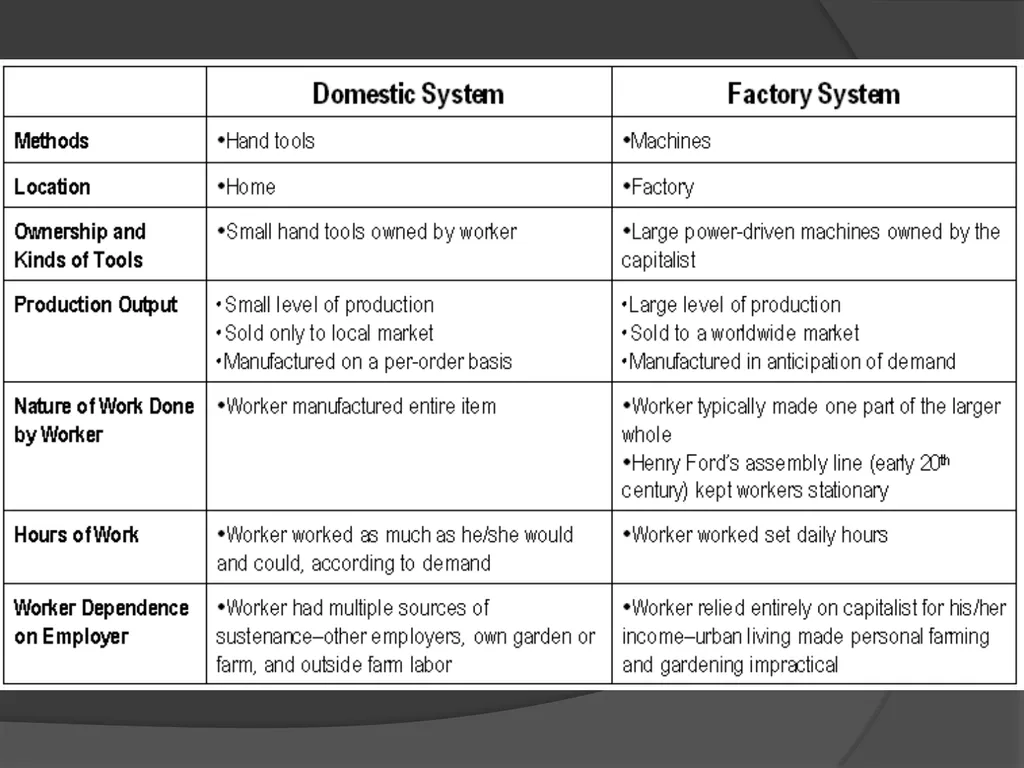
Compare and contrast the domestic and factory methods of production.
Why did the Industrial Revolution begin in England?
Explain why one invention or development leads to another.<br>
Describe at least three developments of the Industrial Revolution.
Compare and contrast the domestic and factory methods of production.
Why did the Industrial Revolution begin in England?
Explain why one invention or development leads to another.<br>
41
Review Questions Explain how developments in the textile industry sparked the Industrial Revolution.
Describe at least three developments in the area of transportation.
Describe at least three developments in the field of communications.
Considering the conditions necessary for industrialization to occur, how well equipped is the undeveloped world for becoming industrialized? Are modern undeveloped nations in a better or worse position than 18th- and 19th-century England?<br>
42
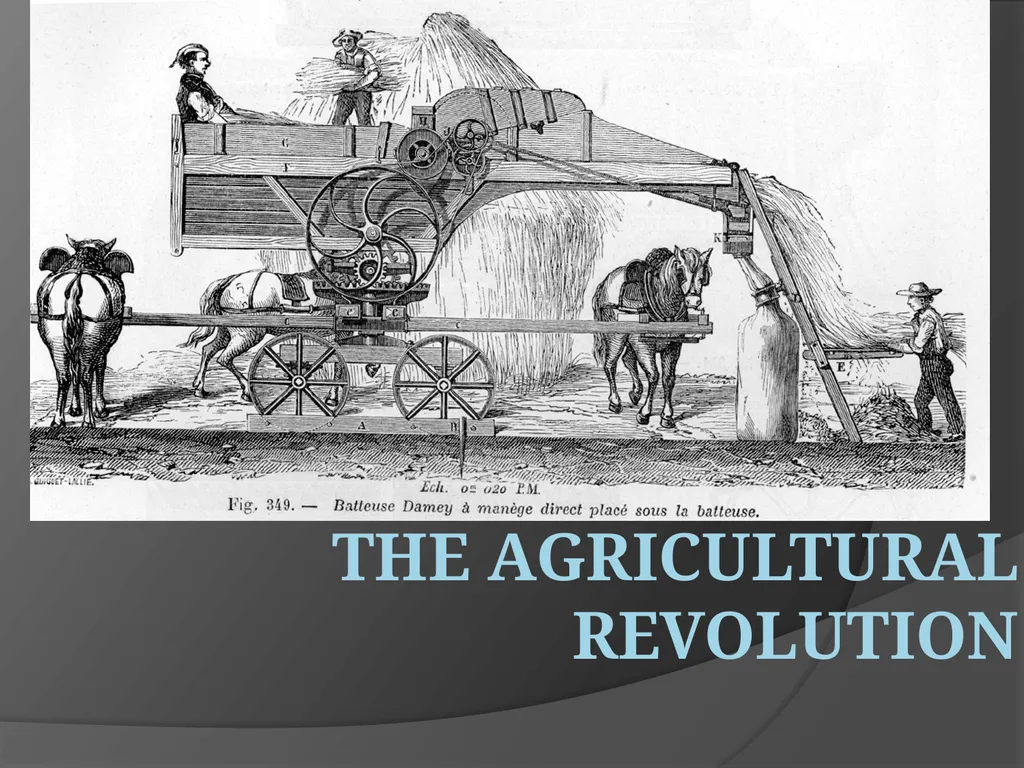
The Agricultural Revolution<br>
43
The Agricultural Revolution Agricultural methods had not changed much since the Middle Ages
Tools – hoe, sickle, wooden plow
Three-field system – farmers left 1/3 of the land fallow each year to restore fertility to the soil
Open-field system – unfenced farms with few improvements made to the land
No significant surplus – only enough food was made to feed the population<br>
Tools – hoe, sickle, wooden plow
Three-field system – farmers left 1/3 of the land fallow each year to restore fertility to the soil
Open-field system – unfenced farms with few improvements made to the land
No significant surplus – only enough food was made to feed the population<br>
44
Agriculture and Industry The Industrial Revolution brought machinery to farms
The use of farm machinery meant that fewer farm workers were needed
Displaced farm workers moved to the cities to find work in factories
This is called rural-to-urban migration
Growing populations in urban cities required farmers to grow more crops
Food to eat
Raw materials (like cotton) for textile factories<br>
45
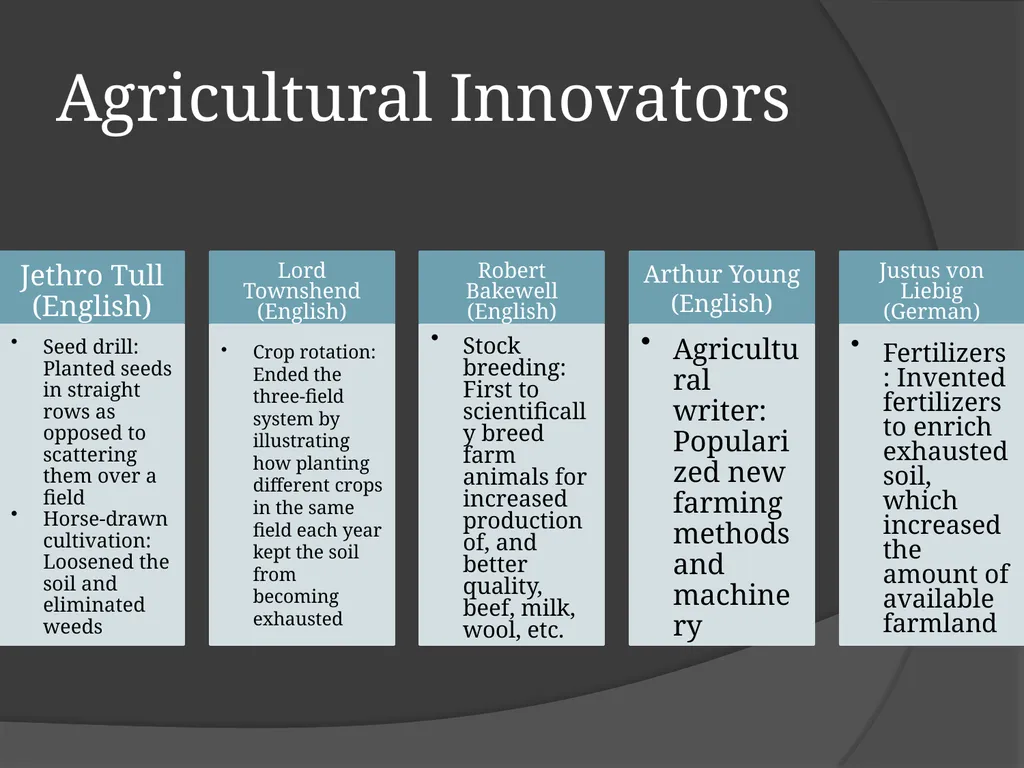
Agricultural Innovators<br>
46
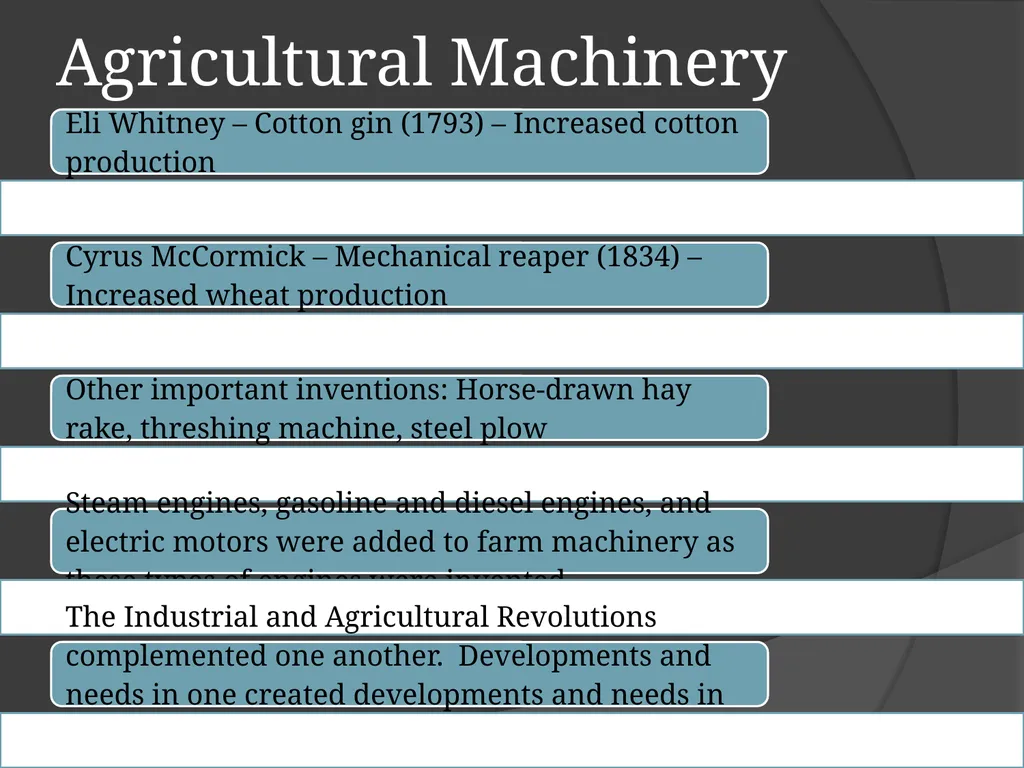
Agricultural Machinery<br>
47
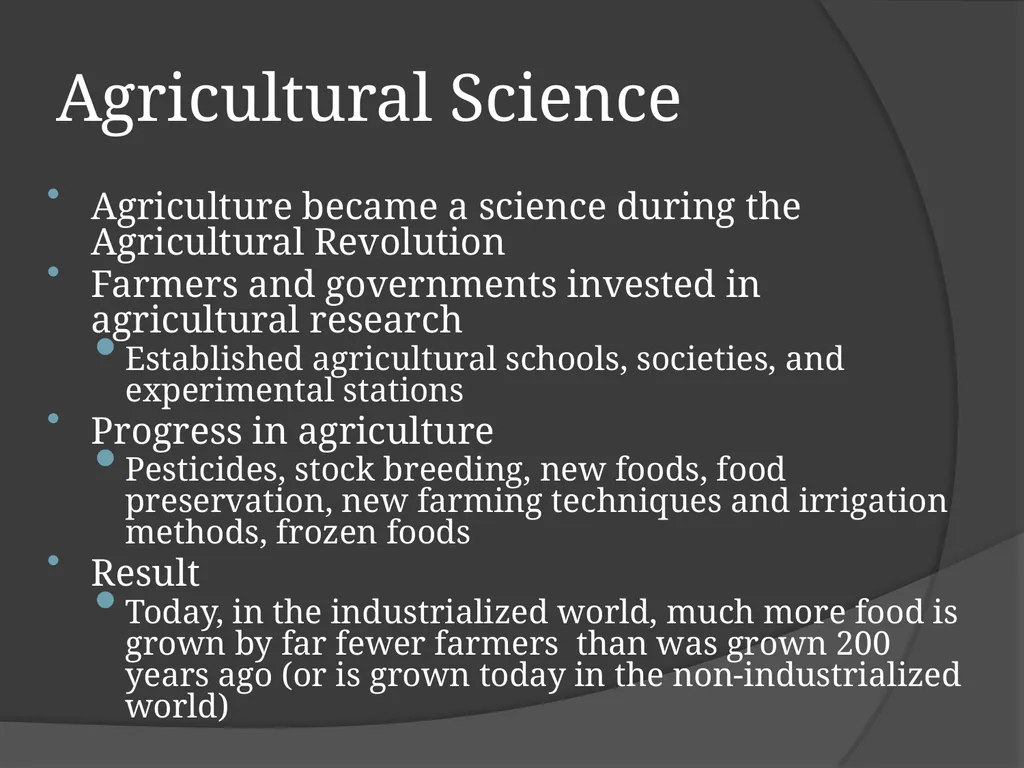
Agricultural Science Agriculture became a science during the Agricultural Revolution
Farmers and governments invested in agricultural research
Established agricultural schools, societies, and experimental stations
Progress in agriculture
Pesticides, stock breeding, new foods, food preservation, new farming techniques and irrigation methods, frozen foods
Result
Today, in the industrialized world, much more food is grown by far fewer farmers than was grown 200 years ago (or is grown today in the non-industrialized world)<br>
48
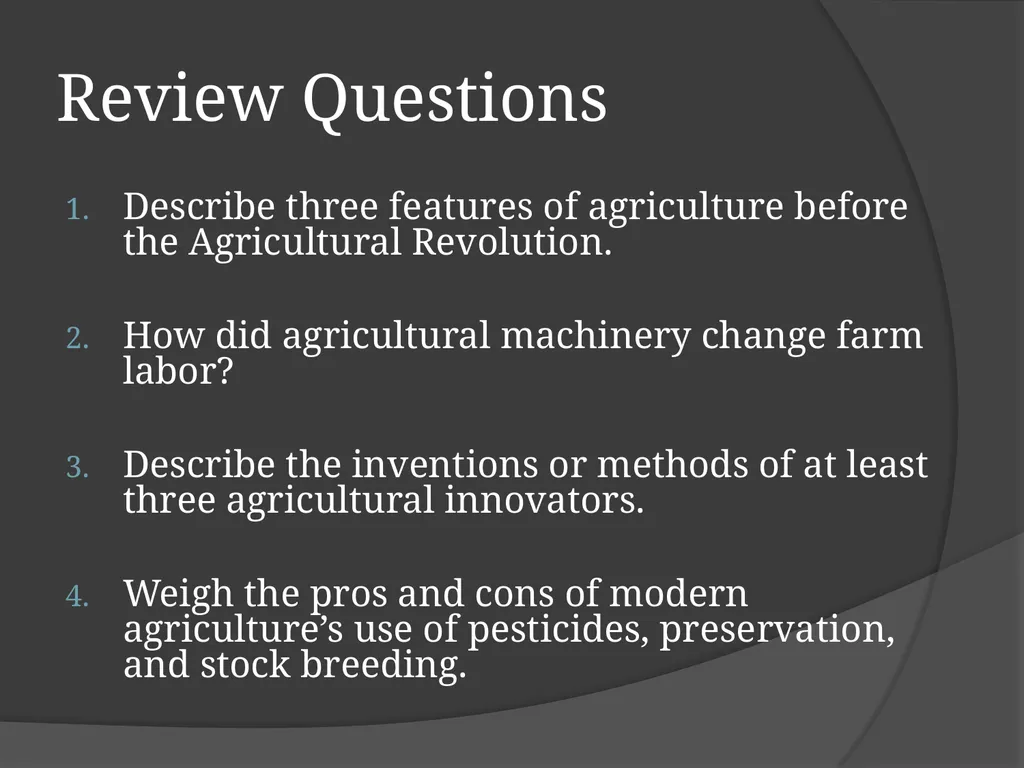
Review Questions Describe three features of agriculture before the Agricultural Revolution.
How did agricultural machinery change farm labor?
Describe the inventions or methods of at least three agricultural innovators.
Weigh the pros and cons of modern agriculture’s use of pesticides, preservation, and stock breeding.<br>
How did agricultural machinery change farm labor?
Describe the inventions or methods of at least three agricultural innovators.
Weigh the pros and cons of modern agriculture’s use of pesticides, preservation, and stock breeding.<br>
49
The Second Industrial Revolution<br>
50
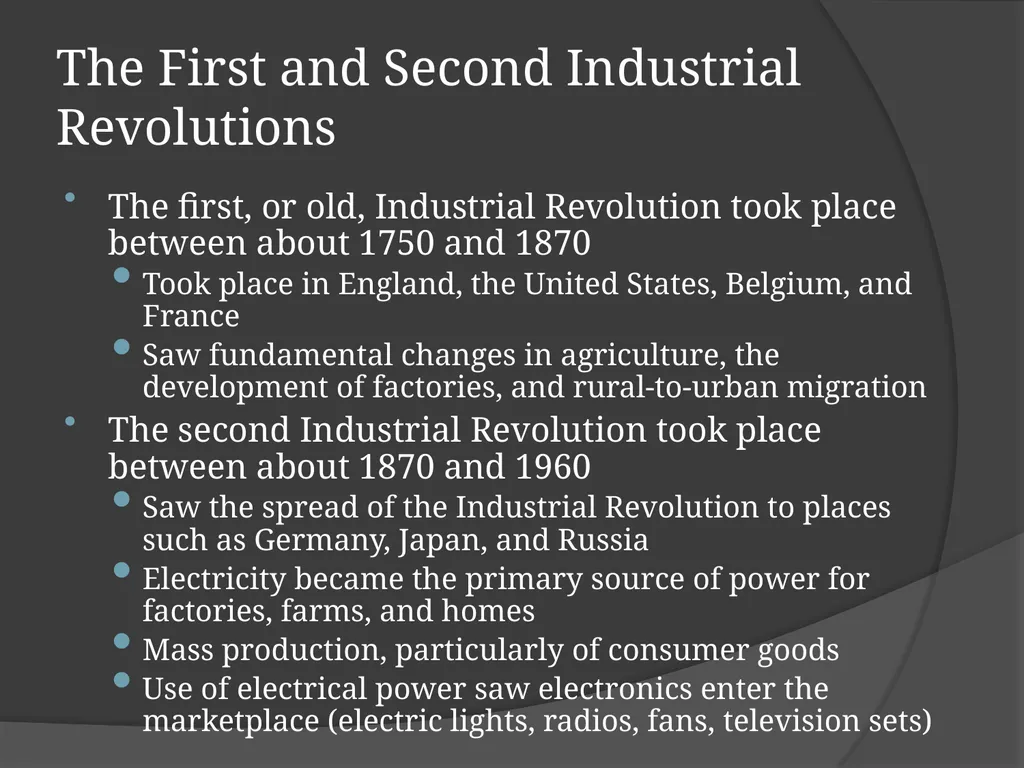
The First and Second Industrial Revolutions The first, or old, Industrial Revolution took place between about 1750 and 1870
Took place in England, the United States, Belgium, and France
Saw fundamental changes in agriculture, the development of factories, and rural-to-urban migration
The second Industrial Revolution took place between about 1870 and 1960
Saw the spread of the Industrial Revolution to places such as Germany, Japan, and Russia
Electricity became the primary source of power for factories, farms, and homes
Mass production, particularly of consumer goods
Use of electrical power saw electronics enter the marketplace (electric lights, radios, fans, television sets)<br>
51
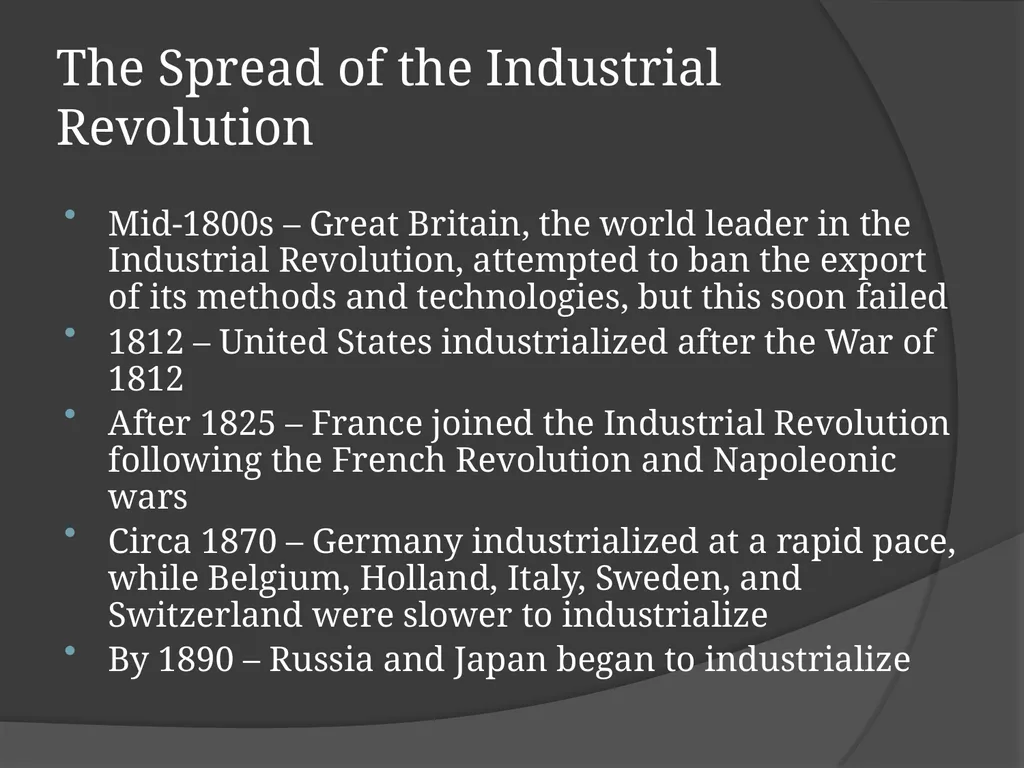
The Spread of the Industrial Revolution Mid-1800s – Great Britain, the world leader in the Industrial Revolution, attempted to ban the export of its methods and technologies, but this soon failed
1812 – United States industrialized after the War of 1812
After 1825 – France joined the Industrial Revolution following the French Revolution and Napoleonic wars
Circa 1870 – Germany industrialized at a rapid pace, while Belgium, Holland, Italy, Sweden, and Switzerland were slower to industrialize
By 1890 – Russia and Japan began to industrialize<br>
52
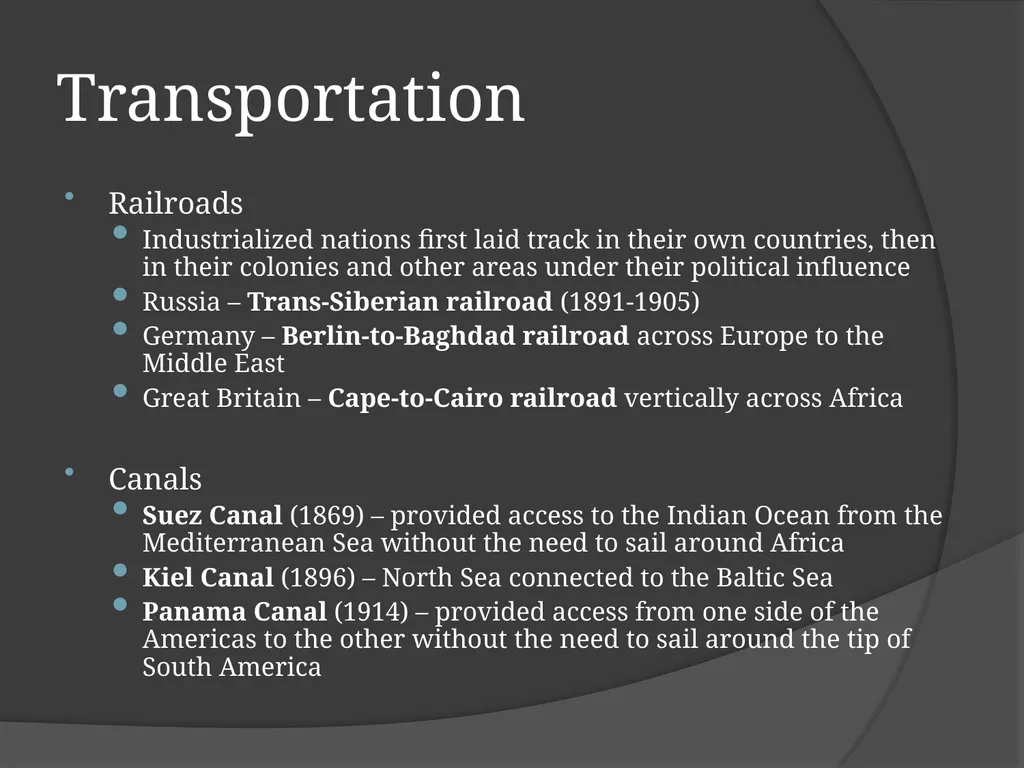
Transportation Railroads
Industrialized nations first laid track in their own countries, then in their colonies and other areas under their political influence
Russia – Trans-Siberian railroad (1891-1905)
Germany – Berlin-to-Baghdad railroad across Europe to the Middle East
Great Britain – Cape-to-Cairo railroad vertically across Africa
Canals
Suez Canal (1869) – provided access to the Indian Ocean from the Mediterranean Sea without the need to sail around Africa
Kiel Canal (1896) – North Sea connected to the Baltic Sea
Panama Canal (1914) – provided access from one side of the Americas to the other without the need to sail around the tip of South America<br>
53
Transportation Automobiles
Charles Goodyear – vulcanized rubber, 1839
Gottlieb Daimler – gasoline engine, 1885
Henry Ford – assembly line, 1908-1915
Airplanes
Orville and Wilbur Wright – airplane, 1903
Charles Lindbergh – first non-stop flight across the Atlantic, 1927
20th-century – growth of commercial aviation<br>
Charles Goodyear – vulcanized rubber, 1839
Gottlieb Daimler – gasoline engine, 1885
Henry Ford – assembly line, 1908-1915
Airplanes
Orville and Wilbur Wright – airplane, 1903
Charles Lindbergh – first non-stop flight across the Atlantic, 1927
20th-century – growth of commercial aviation<br>
54
Review Questions Compare and contrast the First and Second Industrial Revolutions.
When did the United States begin to industrialize?
Explain how trains and canals aided transportation, citing at least one example for each.
What contributions did Charles Goodyear, Gottlieb Daimler, and Henry Ford make to automobile production?<br>
When did the United States begin to industrialize?
Explain how trains and canals aided transportation, citing at least one example for each.
What contributions did Charles Goodyear, Gottlieb Daimler, and Henry Ford make to automobile production?<br>
55
The Results of the Industrial Revolution<br>
56
Results of the Industrial Revolution<br>
57
Economic Changes:
Expansion of World Trade Increased production meant that industrialized nations produced more than could be consumed internally
Sought new foreign markets
Bought many raw materials from foreign markets
New iron, steam-powered ships, along with other technological advances, made international trade (and travel) cheaper, safer, and more efficient<br>
Sought new foreign markets
Bought many raw materials from foreign markets
New iron, steam-powered ships, along with other technological advances, made international trade (and travel) cheaper, safer, and more efficient<br>
58
Economic Changes: Expansion of World Trade – Free Trade and Tariffs Free trade – trade without barriers or tariffs – was initially used
As nations competed for markets, protective tariffs were put in place to limit foreign competition within an industrialized nation and its colonies
Motivation was to protect businesses in the home country and colonies, but this often meant people in the home country or colonies paid inflated prices for goods<br>
59
Economic Changes: Factory System Possible Due to Standardized Parts Eli Whitney is popularly credited with the invention of interchangeable parts in the late 1700s
But interchangeable parts had already been used in Europe
Before the late 1700s, each part of an item (like a musket) was made individually by a single person, with each part made to fit the whole
Standardized, or interchangeable, parts were created en masse to make a lot of duplicate products (such as hundreds of muskets)
Manufacturers decided upon standard sizes for their goods and created large quantities of components
Such as deciding that a musket barrel should be two feet long and making 100 duplicate musket barrels, then deciding that triggers for these muskets should be two inches tall and making 100 2-inch triggers
Standardized parts could be kept in a set location in a factory
As a worker assembled an article, he or she would take whatever parts were needed from a bin of standardized (interchangeable) parts<br>
60
Economic Changes: Factory System Perfected with the Assembly Line Developed by Henry Ford between 1908 and 1915
Brought the work to the worker instead of the worker to the work
Product moves along a conveyor belt, with each worker contributing labor along the way to create the finished product<br>
Brought the work to the worker instead of the worker to the work
Product moves along a conveyor belt, with each worker contributing labor along the way to create the finished product<br>
61
Economic Changes: Factory System – Assembly Line Brings Division of Labor Assembly lines bring the work to the worker, saving time
Each worker specializes in one part
An automobile worker may spend 30 years in a factory only ever putting passenger-side doors on motor vehicles
Focusing on one aspect of production can be repetitive but can also make a worker an expert at that particular aspect<br>
Each worker specializes in one part
An automobile worker may spend 30 years in a factory only ever putting passenger-side doors on motor vehicles
Focusing on one aspect of production can be repetitive but can also make a worker an expert at that particular aspect<br>
62
Economic Changes:
Factory System Manufacture comes from the Latin manu and facere, meaning to make by hand
But during the Industrial Revolution, the meaning of manufacturer switched from the person who made an article by hand to the capitalist who hired workers to make articles
Workers no longer owned the means of production (simple hand tools)
Instead, the newer means of production (expensive machinery) were owned by the capitalist<br>
63
Economic Changes:
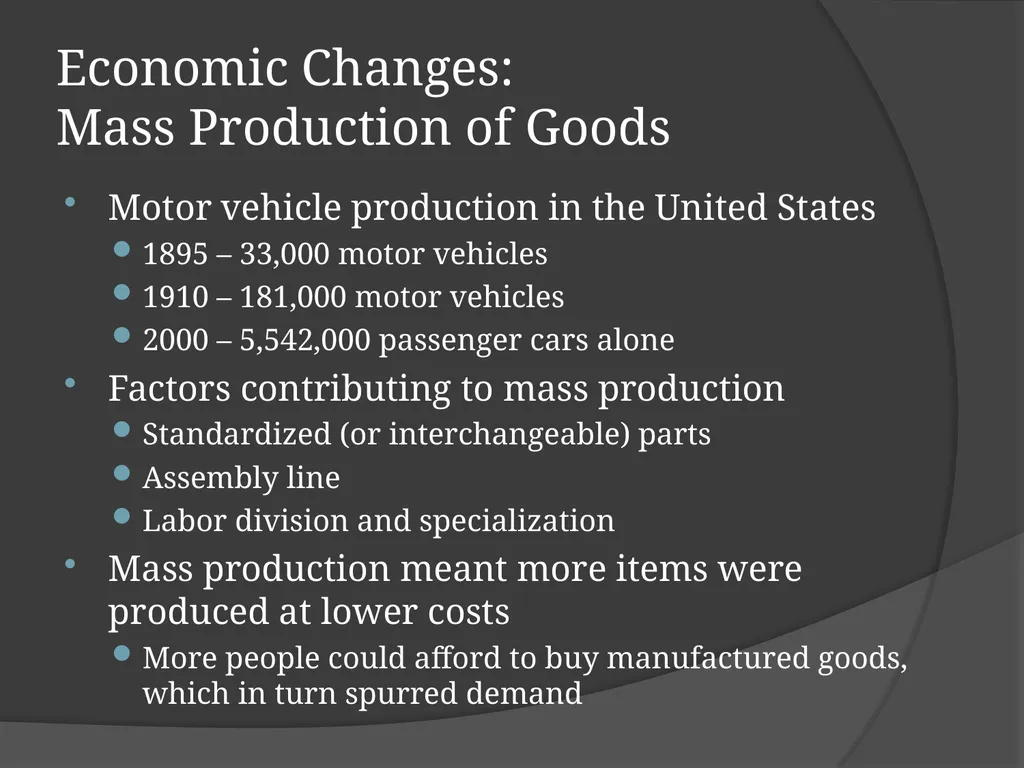
Mass Production of Goods Motor vehicle production in the United States
1895 – 33,000 motor vehicles
1910 – 181,000 motor vehicles
2000 – 5,542,000 passenger cars alone
Factors contributing to mass production
Standardized (or interchangeable) parts
Assembly line
Labor division and specialization
Mass production meant more items were produced at lower costs
More people could afford to buy manufactured goods, which in turn spurred demand<br>
64
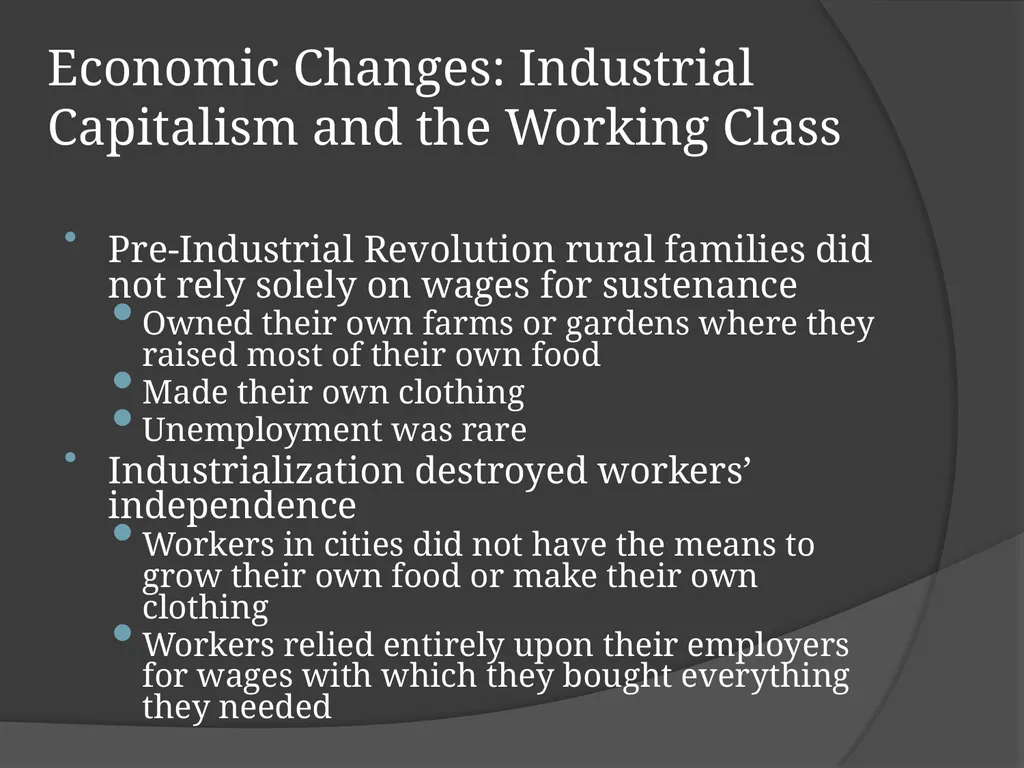
Economic Changes: Industrial Capitalism and the Working Class Pre-Industrial Revolution rural families did not rely solely on wages for sustenance
Owned their own farms or gardens where they raised most of their own food
Made their own clothing
Unemployment was rare
Industrialization destroyed workers’ independence
Workers in cities did not have the means to grow their own food or make their own clothing
Workers relied entirely upon their employers for wages with which they bought everything they needed<br>
65
Economic Changes:
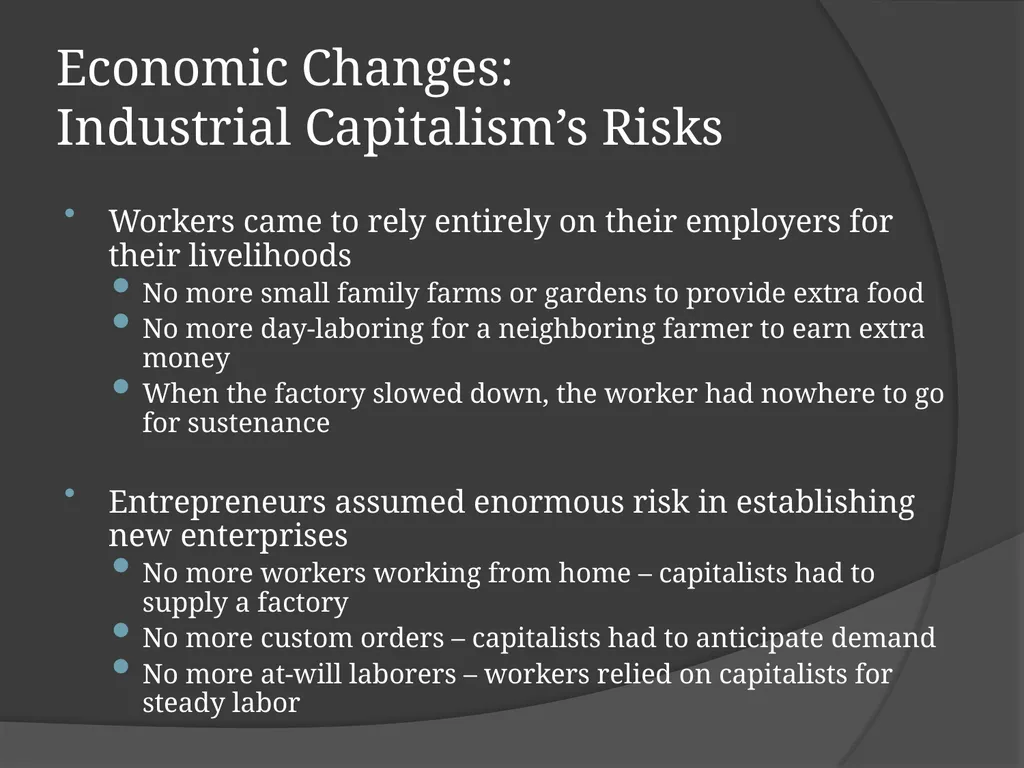
Industrial Capitalism’s Risks Workers came to rely entirely on their employers for their livelihoods
No more small family farms or gardens to provide extra food
No more day-laboring for a neighboring farmer to earn extra money
When the factory slowed down, the worker had nowhere to go for sustenance
Entrepreneurs assumed enormous risk in establishing new enterprises
No more workers working from home – capitalists had to supply a factory
No more custom orders – capitalists had to anticipate demand
No more at-will laborers – workers relied on capitalists for steady labor<br>
66
Economic Changes:
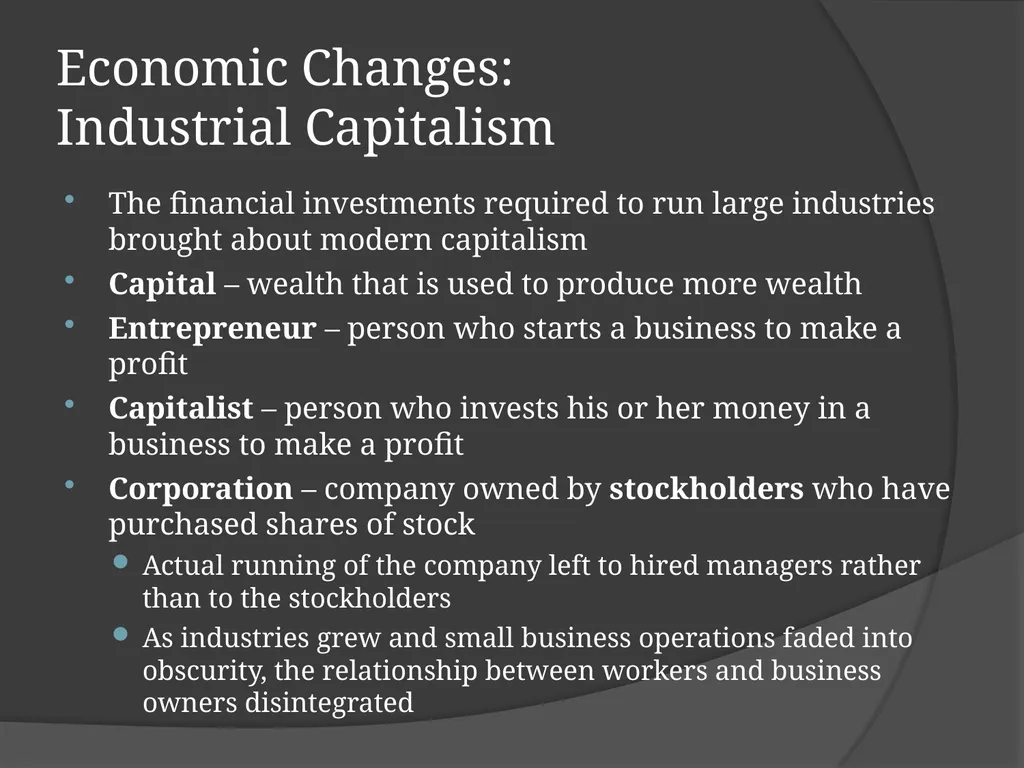
Industrial Capitalism The financial investments required to run large industries brought about modern capitalism
Capital – wealth that is used to produce more wealth
Entrepreneur – person who starts a business to make a profit
Capitalist – person who invests his or her money in a business to make a profit
Corporation – company owned by stockholders who have purchased shares of stock
Actual running of the company left to hired managers rather than to the stockholders
As industries grew and small business operations faded into obscurity, the relationship between workers and business owners disintegrated<br>
67
Economic Changes:
Industrial Capitalism’s Problems Small manufacturers cannot compete with large corporations
Consumers must buy from large corporations
Workers have had to fight for decent wages and working conditions
Large corporations can influence the government<br>
Consumers must buy from large corporations
Workers have had to fight for decent wages and working conditions
Large corporations can influence the government<br>
68
Economic Changes:
Increased Standard of Living Mass production made manufactured goods less expensive, so more people could afford them
Standard of living wasn’t raised for everyone – factories paid low wages, and many immigrants and rural-to-urban migrants lived poorer lives than their parents and grandparents had lived<br>
Standard of living wasn’t raised for everyone – factories paid low wages, and many immigrants and rural-to-urban migrants lived poorer lives than their parents and grandparents had lived<br>
69
Economic Changes:
Unemployment Overproduction
Also called under-consumption
Mass production anticipates demand – if goods don’t sell, a manufacturer produces less and lays off workers
Recession
Overproduction across many industries with widespread lay-offs
Depression
Long-lasting recession<br>
Also called under-consumption
Mass production anticipates demand – if goods don’t sell, a manufacturer produces less and lays off workers
Recession
Overproduction across many industries with widespread lay-offs
Depression
Long-lasting recession<br>
70
Political Changes:
Decline of Landed Aristocracy Before the Industrial Revolution – power was in the hands of the landed aristocracy and monarchs
Landed aristocracy refers to lords, dukes, etc., who owned the land
Although vassalage was gone by the 18th century, the working relationship between lords and peasants remained the same
Peasants either worked the land for lords or rented land from them
Wealth was based on agriculture, which meant that those who owned the most land were the wealthiest
Landed aristocracy owned and controlled the most land, making this the wealthiest and highest-ranking socio-economic group
Industrial Revolution – factories became more valuable than land
Wealth of the aristocracy dwindled
Growing middle class, with wealth based in industry, wanted more political power<br>
71
Political Changes:
Decline of Landed Aristocracy
Case Study: The Corn Laws<br>
72
Political Changes: Growth and Expansion of Democracy The middle class grew during the Industrial Revolution
Gained more rights
The working class effectively began with the Industrial Revolution
The working class fought for rights in the workplace
The working class demanded and earned a voice in government<br>
Gained more rights
The working class effectively began with the Industrial Revolution
The working class fought for rights in the workplace
The working class demanded and earned a voice in government<br>
73
Political Changes: Increased Government Involvement in Society Government actions to help workers
Legalization of unions
Established minimum wage
Standards for working conditions
Forms of social security
Government actions to help consumers
Regulation and inspection of goods and foodstuffs
Government actions to help businesses
Laws to stop or limit monopolies
Some governments took control of vital industries<br>
74
Political Changes: Increased Power of Industrialized Nations With wealth came power
Imperialism expanded
Imperialistic, industrialized nations built up their navies to gain and protect assets<br>
Imperialism expanded
Imperialistic, industrialized nations built up their navies to gain and protect assets<br>
75
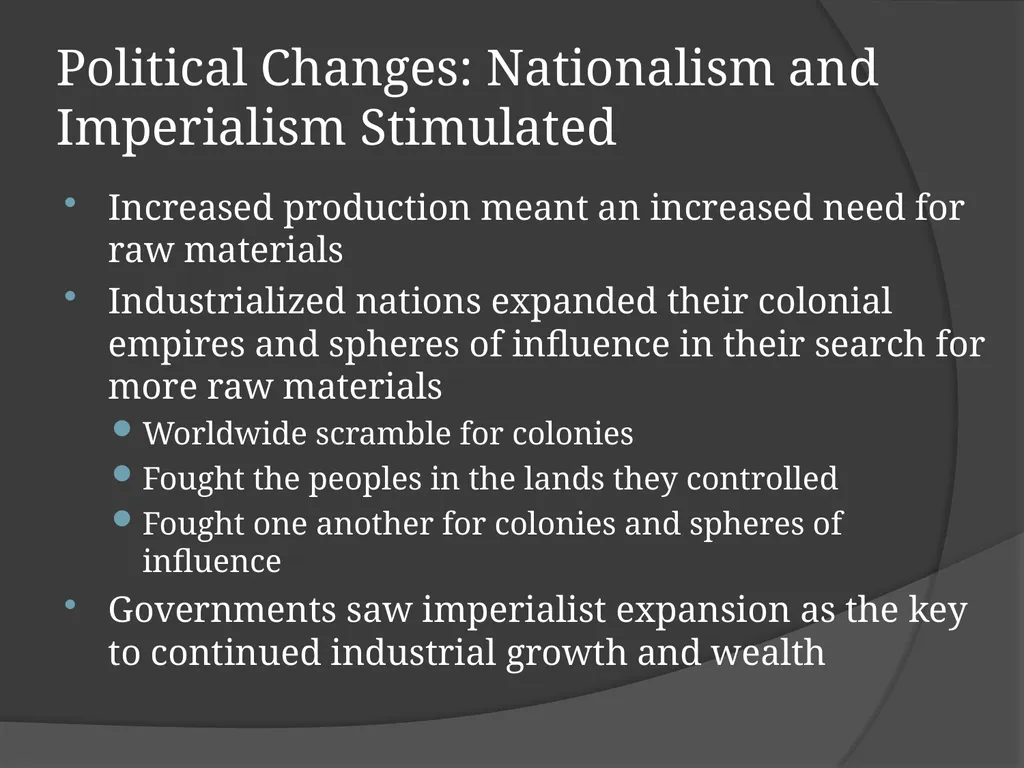
Political Changes: Nationalism and Imperialism Stimulated Increased production meant an increased need for raw materials
Industrialized nations expanded their colonial empires and spheres of influence in their search for more raw materials
Worldwide scramble for colonies
Fought the peoples in the lands they controlled
Fought one another for colonies and spheres of influence
Governments saw imperialist expansion as the key to continued industrial growth and wealth<br>
76
Political Changes:
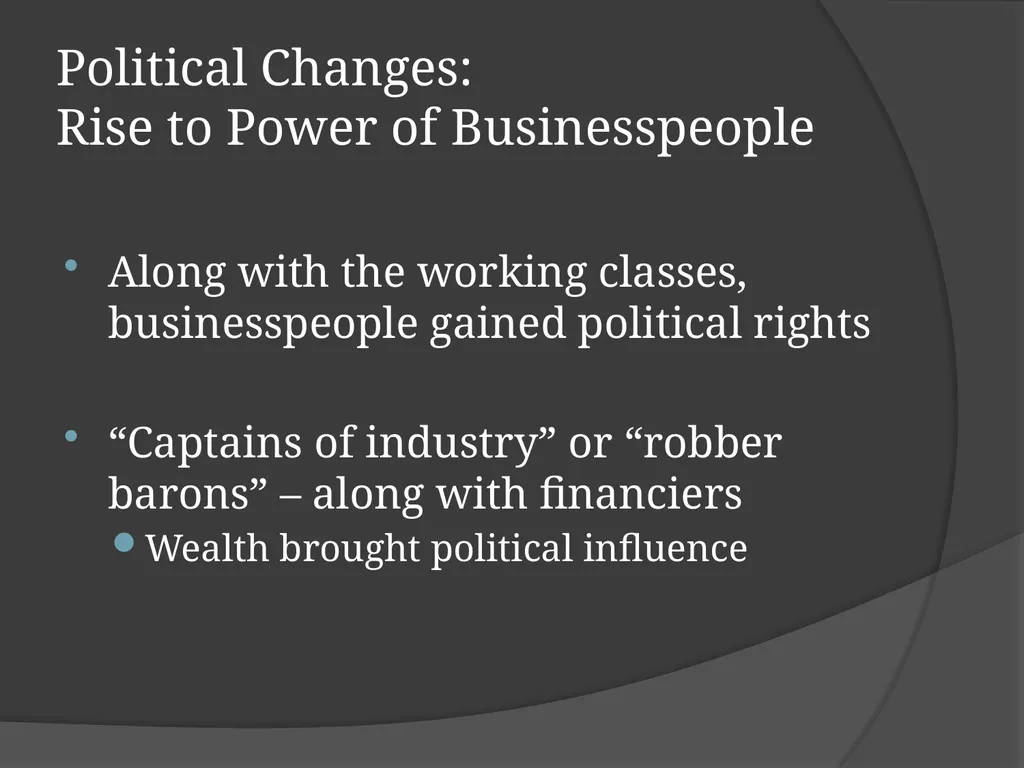
Rise to Power of Businesspeople Along with the working classes, businesspeople gained political rights
“Captains of industry” or “robber barons” – along with financiers
Wealth brought political influence<br>
“Captains of industry” or “robber barons” – along with financiers
Wealth brought political influence<br>
77
Social Changes:
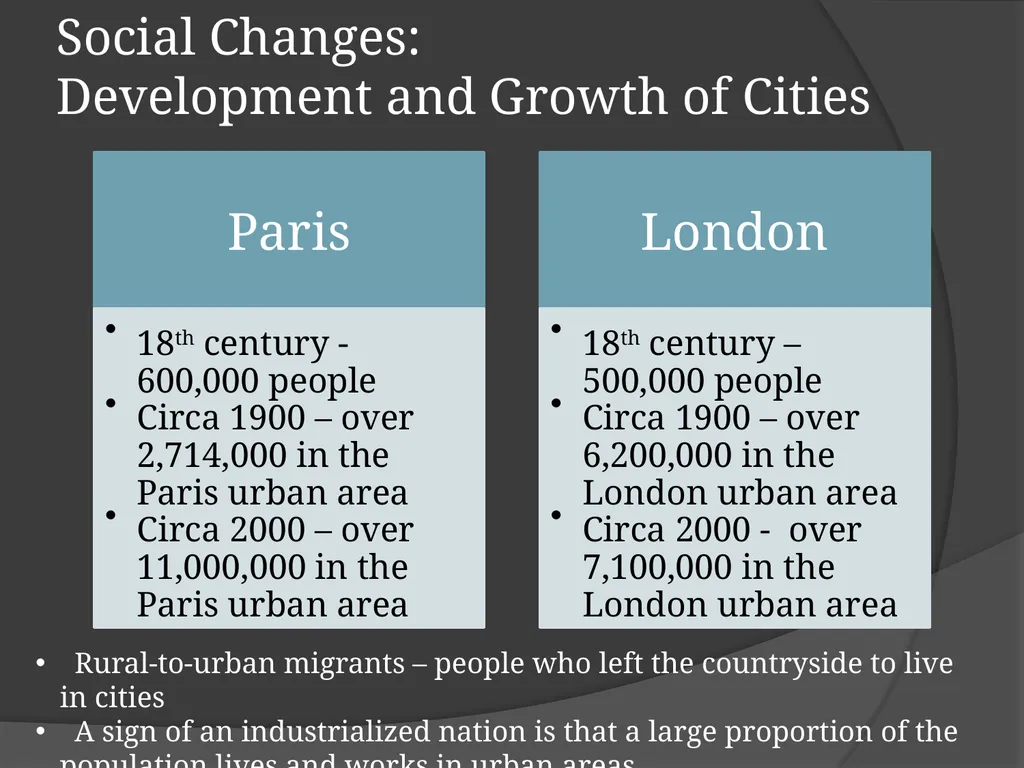
Development and Growth of Cities Rural-to-urban migrants – people who left the countryside to live in cities
A sign of an industrialized nation is that a large proportion of the population lives and works in urban areas<br>
A sign of an industrialized nation is that a large proportion of the population lives and works in urban areas<br>
78
Social Change: Development and Growth of Cities
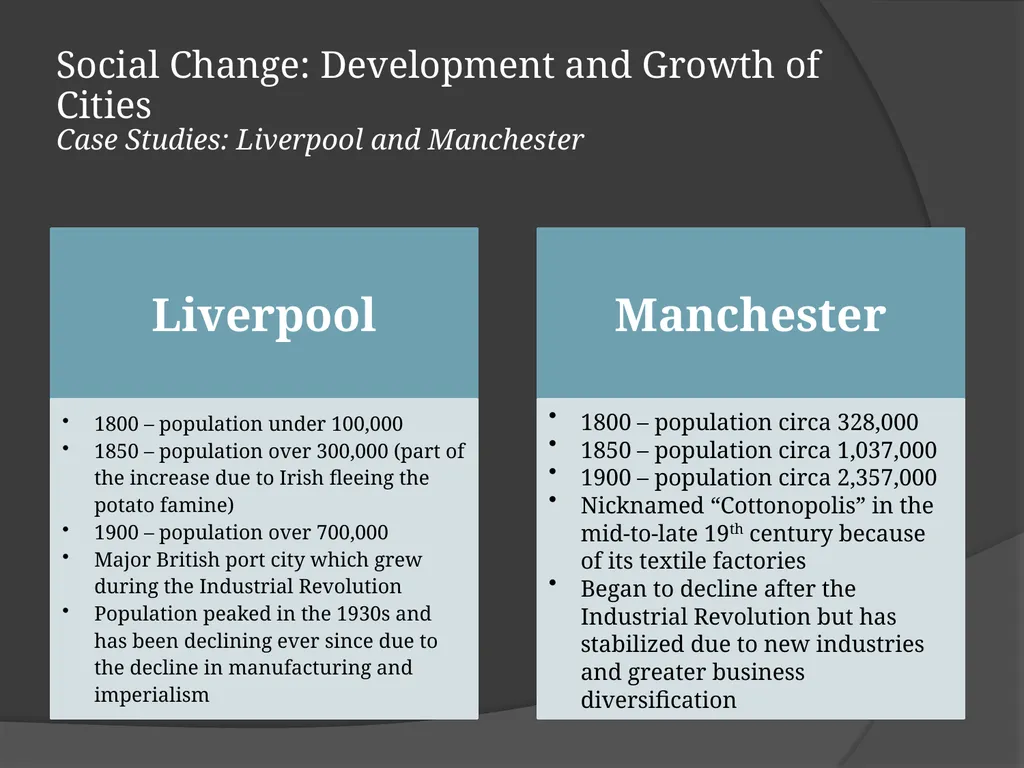
Case Studies: Liverpool and Manchester<br>
79
Social Changes: Improved Status and Earning Power of Women Initially, factory owners hired women and children because they worked for lower wages
This brought many women, otherwise impoverished, to cities to work in factories
Governments limited the work of children and, at times, of women
Women gained economic power and independence
Before industrialization, it was almost impossible for a woman to remain single and live on her own
Factories and urban centers attracted women in large numbers
Women fought for and eventually gained political rights<br>
80
Social Changes:
Increase in Leisure Time Labor-saving devices invented and produced
Vacuum cleaners
Washing machines
Refrigerators
Entrepreneurs and inventors developed new forms of entertainment
Moving pictures
Amusement parks
Birth of the weekend
Traditionally, Western nations had Sunday (the Christian day of rest) as the only day off from work
Saturday was added (after the struggles of Jewish labor unionists) to accommodate the religious observances of Jewish factory workers (whose Sabbath, or Shabbat, runs from Friday at sundown to Saturday at sundown)<br>
81
Social Changes:
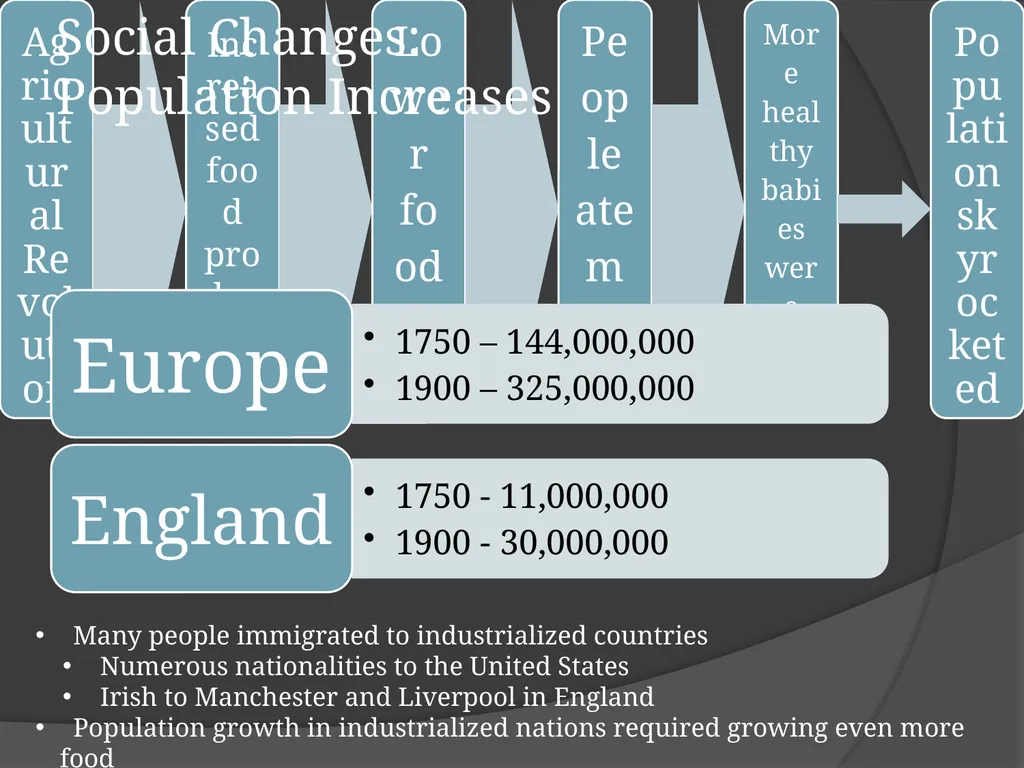
Population Increases Many people immigrated to industrialized countries
Numerous nationalities to the United States
Irish to Manchester and Liverpool in England
Population growth in industrialized nations required growing even more food<br>
Numerous nationalities to the United States
Irish to Manchester and Liverpool in England
Population growth in industrialized nations required growing even more food<br>
82
Social Changes: Problems Monotony of assembly lines and factory life
Loss of craftsmanship in manufactured goods
War became more deadly as weapons became more technologically advanced and were mass produced
Economic insecurity – workers relied entirely on their jobs for sustenance<br>
Loss of craftsmanship in manufactured goods
War became more deadly as weapons became more technologically advanced and were mass produced
Economic insecurity – workers relied entirely on their jobs for sustenance<br>
83
Social Changes:
Science and Research Stimulated Scientific and technological discoveries became profitable instead of simply beneficial
Companies and governments were willing to invest in research and development
Patent law
Came into its modern form under England’s Queen Anne (reigned 1702-1714)
Inventors have the exclusive right to produce their new inventions for a period of time<br>
Companies and governments were willing to invest in research and development
Patent law
Came into its modern form under England’s Queen Anne (reigned 1702-1714)
Inventors have the exclusive right to produce their new inventions for a period of time<br>
84
Review Questions Describe the economic, political, and social changes which resulted from the Industrial Revolution.
What risks did workers face from the factory system of production?
How did women benefit from the Industrial Revolution?
Imagine that you are a government official in a developing nation. What lessons for your country might you take away from a study of the Industrial Revolution? What pitfalls might you want to avoid?<br>
85
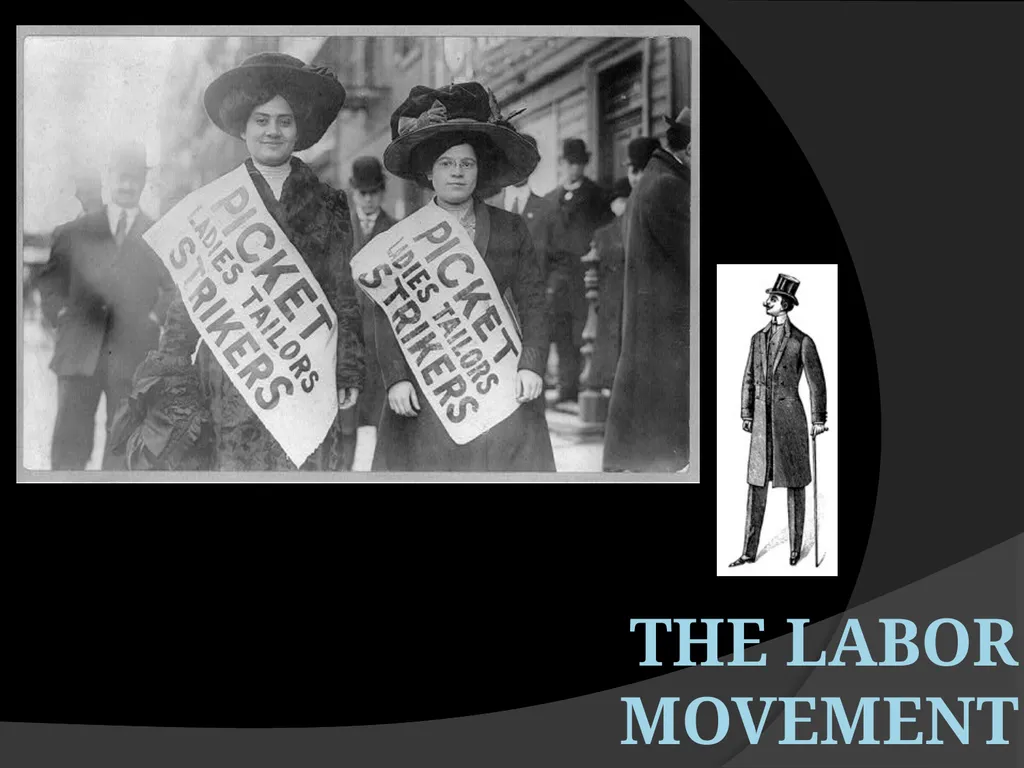
The Labor Movement<br>
86
Changing Employee-Employer Relationships Domestic system
Workers and employers knew each other personally
Workers could aspire to become employers
Factory system
Workers no longer owned the means of production (machinery)
Employers no longer knew workers personally
Factories often run by managers paid by the corporation
Relationships between employers and employees grew strained<br>
87
Problems of the Factory System Factories were crowded, dark, and dirty
Workers toiled from dawn to dusk
Young children worked with dangerous machinery
Employment of women and children put men out of work
Women and children were paid less for the same work
Technological unemployment – workers lost their jobs as their labor was replaced by machines<br>
Workers toiled from dawn to dusk
Young children worked with dangerous machinery
Employment of women and children put men out of work
Women and children were paid less for the same work
Technological unemployment – workers lost their jobs as their labor was replaced by machines<br>
88
Poor Living Conditions Factories driven solely by profit
Businesses largely immune to problems of workers
Factory (also company or mill) towns
Towns built by employers around factories to house workers
Workers charged higher prices than normal for rent, groceries, etc.
Workers often became indebted to their employers
Created a type of forced servitude as workers had to stay on at their jobs to pay their debts
Considered paternalistic by workers
Some employers had workers’ interests at heart
But workers wanted to control their own lives<br>
89
Slum Living Conditions Factory towns – often built and owned by factories
Not a strange concept to rural-to-urban migrants who were used to living on a lord’s estate or property
Full of crowded tenements
Few amenities
Tenements – buildings with rented multiple dwellings
Apartment buildings with a more negative connotation
Overcrowded and unsanitary
Workers were unsatisfied both inside and outside the factories<br>
90
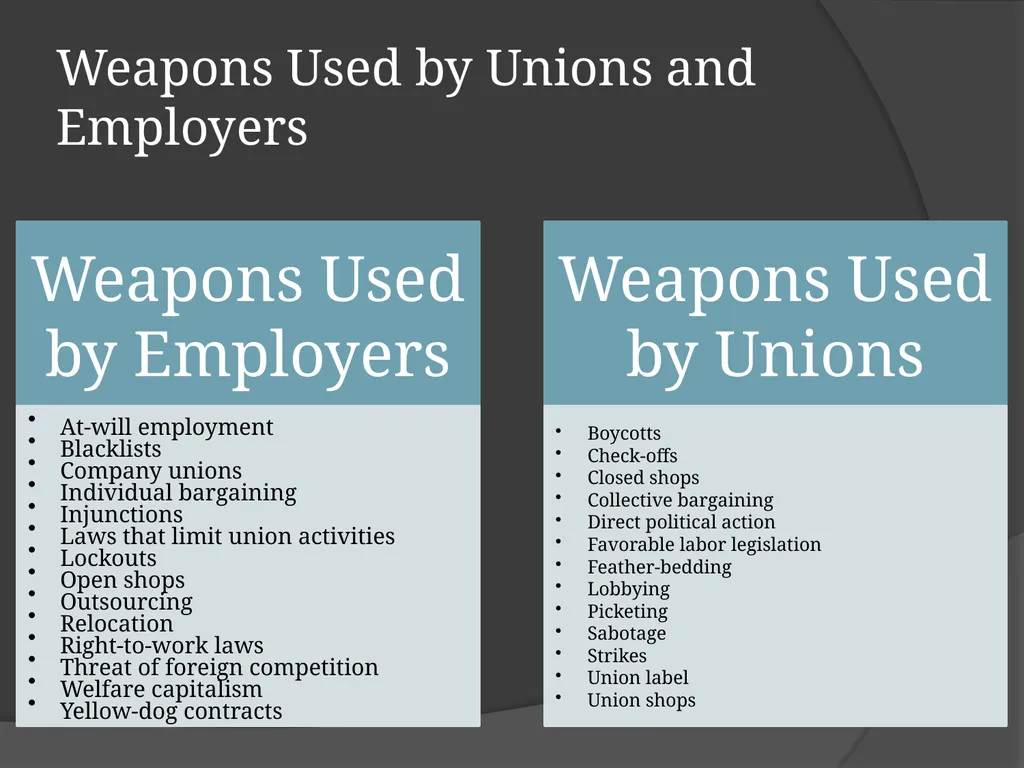
Rise of Labor Unions Before labor unions, workers bargained individually – “individual bargaining”
Before factories, a worker could bargain for better wages and working conditions by arguing his or her particular skills
But in factories, work is routine and one worker can easily replace another
With labor unions, workers bargained together as a group, or collective – “collective bargaining”
Organized groups of workers elected leaders to bargain on their behalf
Used tools (such as strikes) to gain rights<br>
91
Weapons Used by Unions and Employers<br>
92
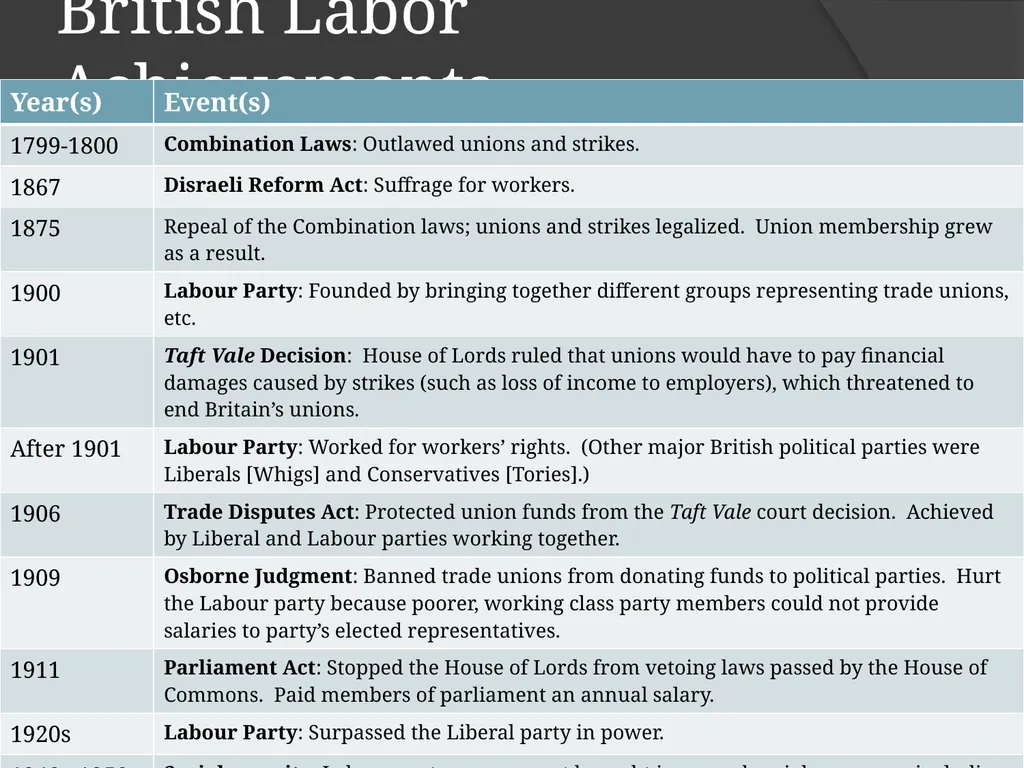
British Labor Achievements<br>
93
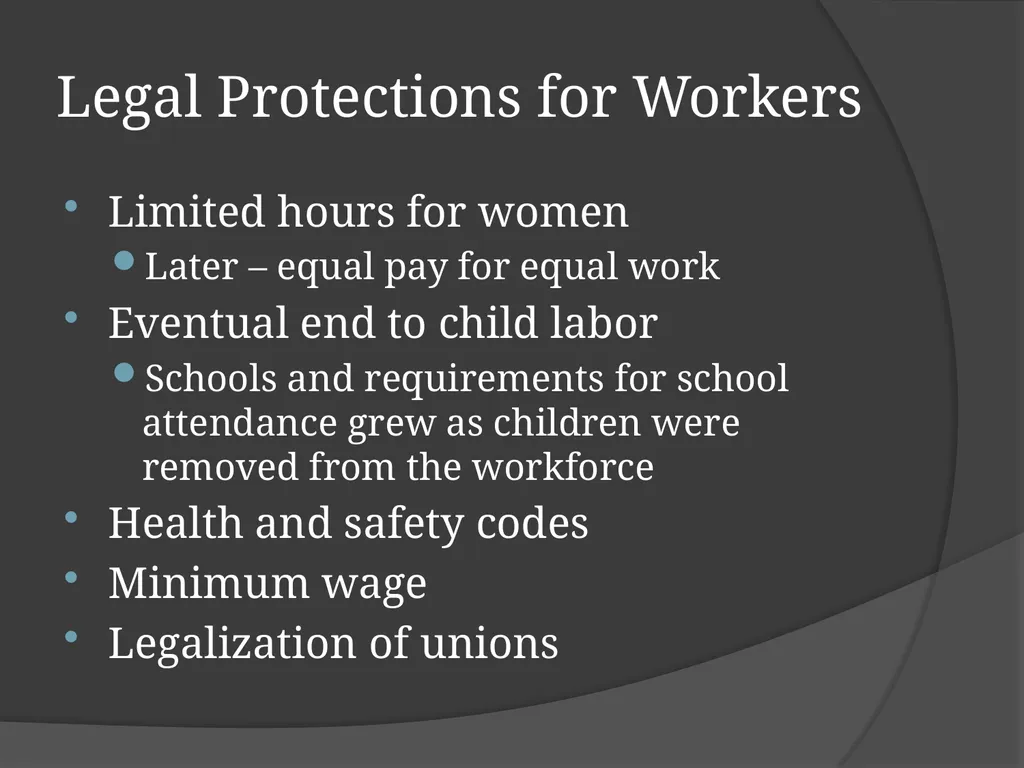
Legal Protections for Workers Limited hours for women
Later – equal pay for equal work
Eventual end to child labor
Schools and requirements for school attendance grew as children were removed from the workforce
Health and safety codes
Minimum wage
Legalization of unions<br>
Later – equal pay for equal work
Eventual end to child labor
Schools and requirements for school attendance grew as children were removed from the workforce
Health and safety codes
Minimum wage
Legalization of unions<br>
94
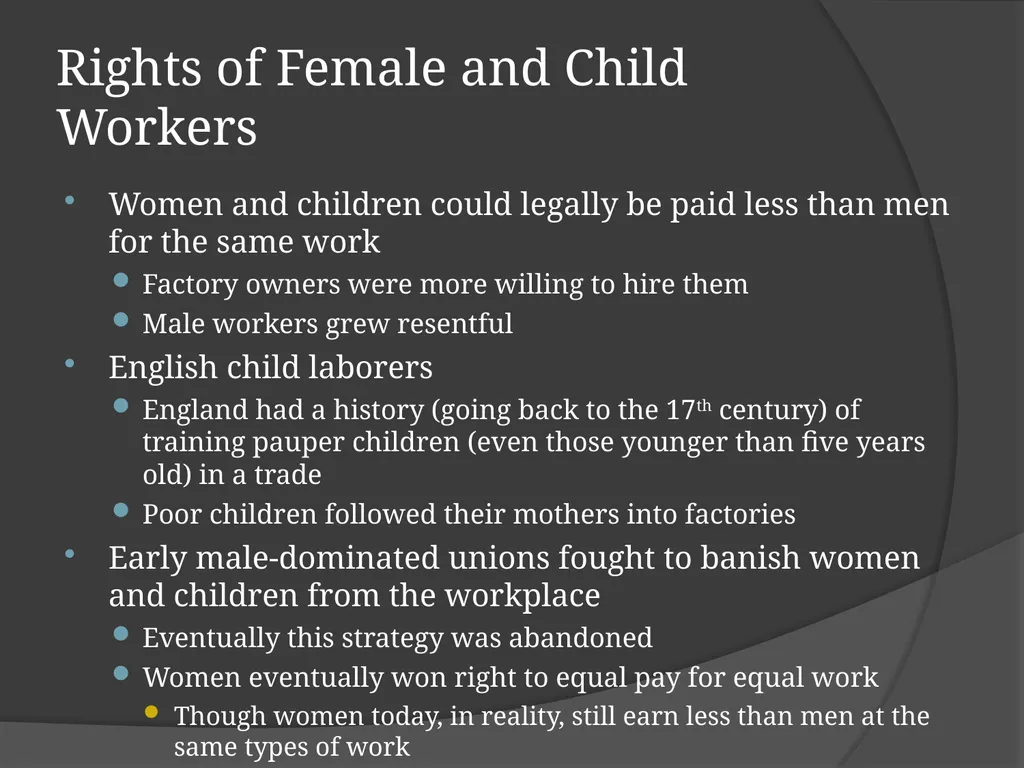
Rights of Female and Child Workers Women and children could legally be paid less than men for the same work
Factory owners were more willing to hire them
Male workers grew resentful
English child laborers
England had a history (going back to the 17th century) of training pauper children (even those younger than five years old) in a trade
Poor children followed their mothers into factories
Early male-dominated unions fought to banish women and children from the workplace
Eventually this strategy was abandoned
Women eventually won right to equal pay for equal work
Though women today, in reality, still earn less than men at the same types of work<br>
95
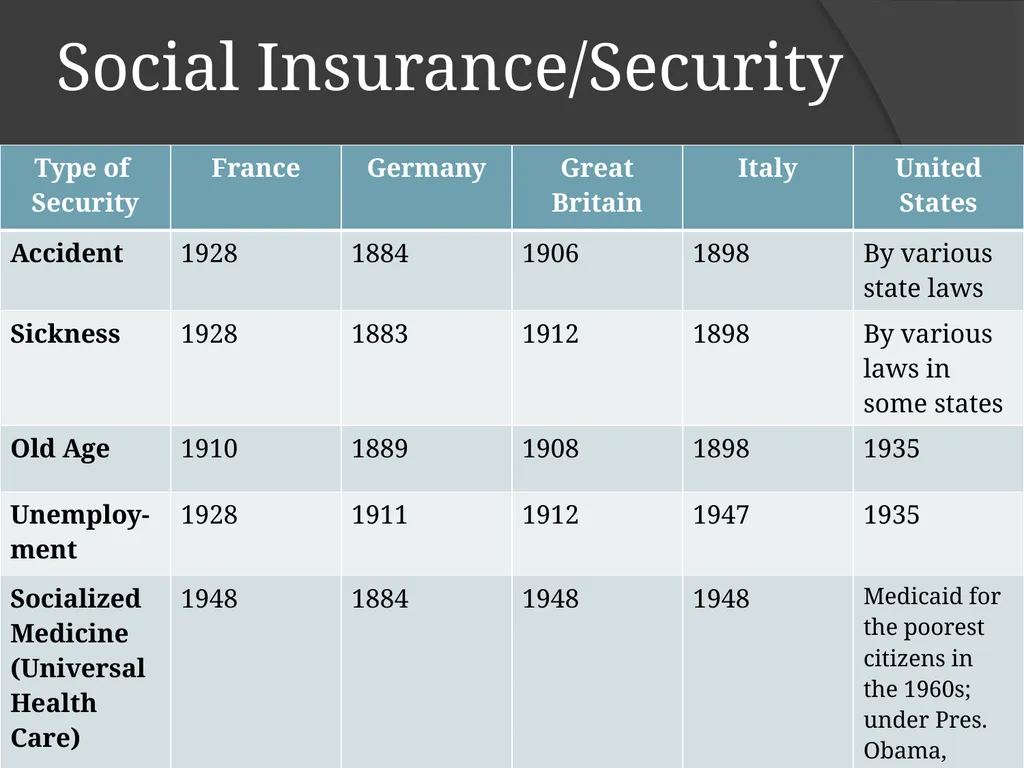
Social Insurance/Security<br>
96
Review Questions How and why did employer-employee relationships change during the Industrial Revolution?
Describe living conditions in factory towns.
Describe the weapons used by employers and unions.
Why was the establishment of yearly wages for members of parliament important to the British Labour party?
What are the advantages and disadvantages of unions for workers and consumers?<br>
Describe living conditions in factory towns.
Describe the weapons used by employers and unions.
Why was the establishment of yearly wages for members of parliament important to the British Labour party?
What are the advantages and disadvantages of unions for workers and consumers?<br>
97
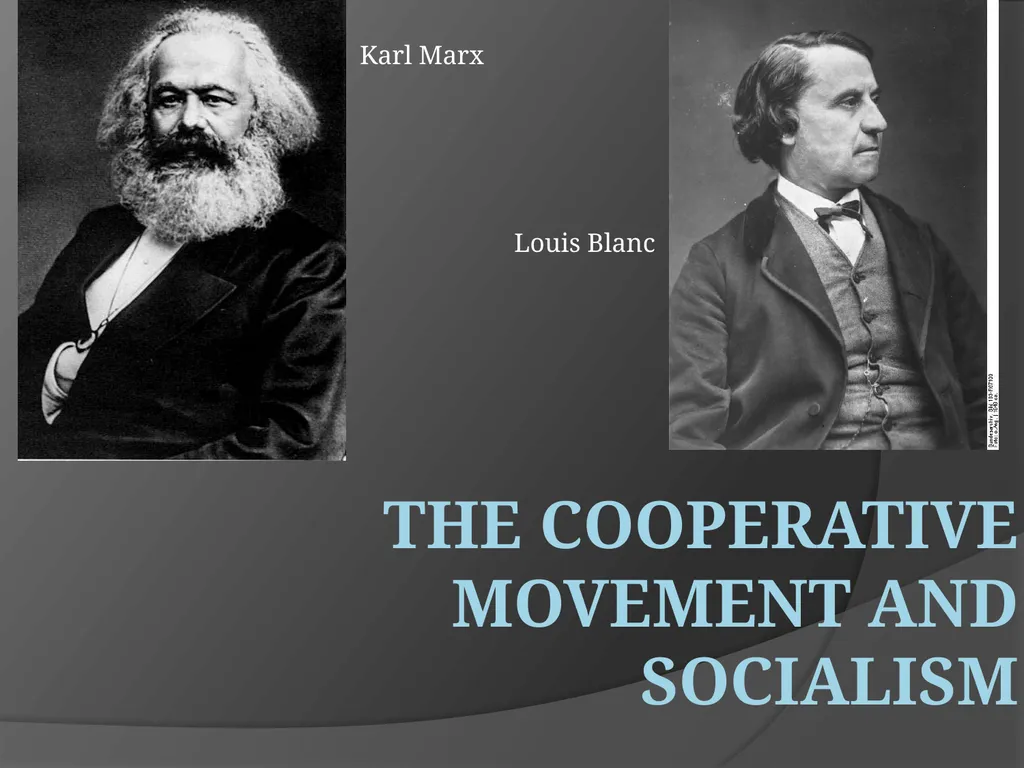
The Cooperative Movement and Socialism Karl Marx Louis Blanc<br>
98
Cooperatives First cooperative – 1844 in Rochdale, England
Formed to fight high food costs
30 English weavers opened a grocery store with $140
Bought goods at wholesale
Members of cooperative bought goods at cost
Non-members paid “retail”
Profits split among members
By 1857 – over 1000 members and £100,000 in annual profits
Growth of cooperatives
Spread to other industries – banking, building, insurance, printing, etc.
By 1900 – 20% of Great Britain’s population had joined a cooperative
Concept spread internationally<br>
99
Socialism Socialists – viewed the capitalist system as inherently wrong
Belief that capitalism is designed to create poverty and poor working conditions because of its end goal of earning maximum profits for investors
Socialism – government owns the means of production
Belief that if the government (“the people”) owns the means of production, these factories and industries will function in the public (as opposed to private) interest<br>
100
Early Socialist Movement First socialists were Utopians
Strove to create a fair and just system
Community divided tasks and rewards equitably
Robert Owen
Charles Fourier
Claude Saint-Simon
Louis Blanc<br>
Strove to create a fair and just system
Community divided tasks and rewards equitably
Robert Owen
Charles Fourier
Claude Saint-Simon
Louis Blanc<br>
101
Robert Owen (1771-1858) Utopian socialist
Owned a textile factory in New Lanark, Scotland
Set up a model community in New Harmony, Indiana
Decreased working hours
Improved working conditions and employee housing
Shared management and profits with employees
Proved that a socialist-based company could be profitable<br>
Owned a textile factory in New Lanark, Scotland
Set up a model community in New Harmony, Indiana
Decreased working hours
Improved working conditions and employee housing
Shared management and profits with employees
Proved that a socialist-based company could be profitable<br>
102
Charles Fourier (1772-1837) French philosopher
Coined the term féminisme
Advocated concern and cooperation as the means to create social harmony
Considered poverty to be the main cause of society’s problems
Envisioned workers (paid at least a minimum wage) living in “phalanxes” – communities living in a large shared structure<br>
Coined the term féminisme
Advocated concern and cooperation as the means to create social harmony
Considered poverty to be the main cause of society’s problems
Envisioned workers (paid at least a minimum wage) living in “phalanxes” – communities living in a large shared structure<br>
103
Claude Henri de Saint-Simon 1760-1825
As a young man he was in the Thirteen Colonies as part of the French assistance effort during the American Revolution
French socialist philosopher
Believed all human beings naturally greedy and eager to obtain wealth and higher social positions
These tendencies were to be eradicated through education
Advocated an end to inheritances
Movement of wealth from rich, powerful families to the state, which is an instrument of the people<br>
104
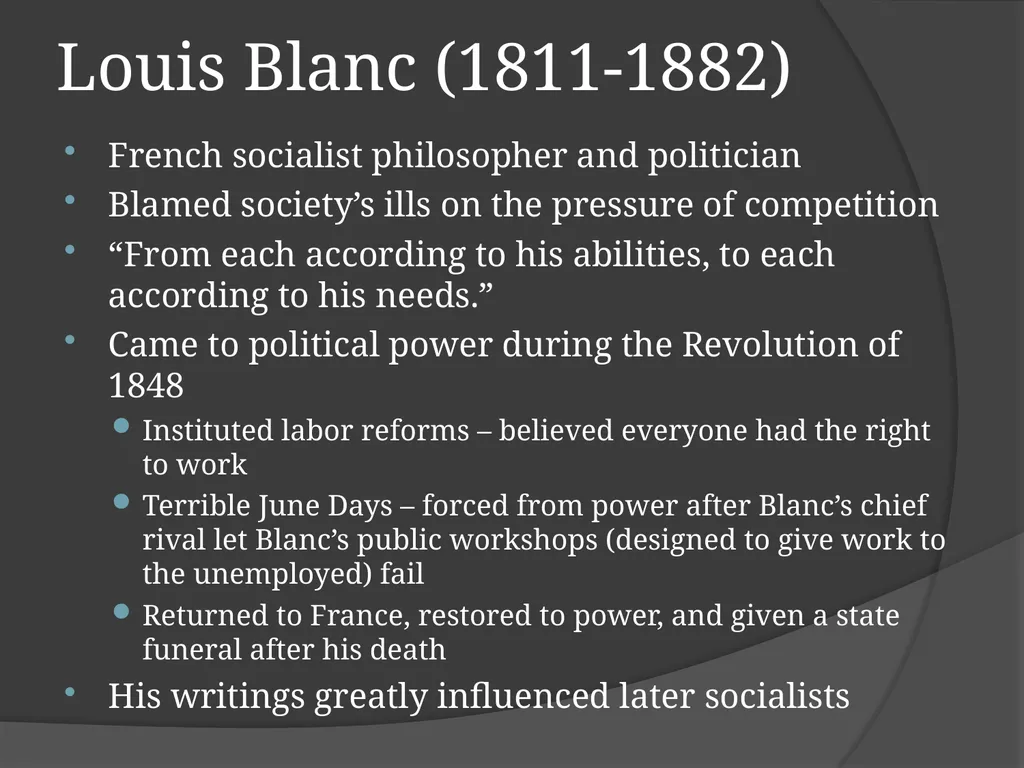
Louis Blanc (1811-1882) French socialist philosopher and politician
Blamed society’s ills on the pressure of competition
“From each according to his abilities, to each according to his needs.”
Came to political power during the Revolution of 1848
Instituted labor reforms – believed everyone had the right to work
Terrible June Days – forced from power after Blanc’s chief rival let Blanc’s public workshops (designed to give work to the unemployed) fail
Returned to France, restored to power, and given a state funeral after his death
His writings greatly influenced later socialists<br>
105
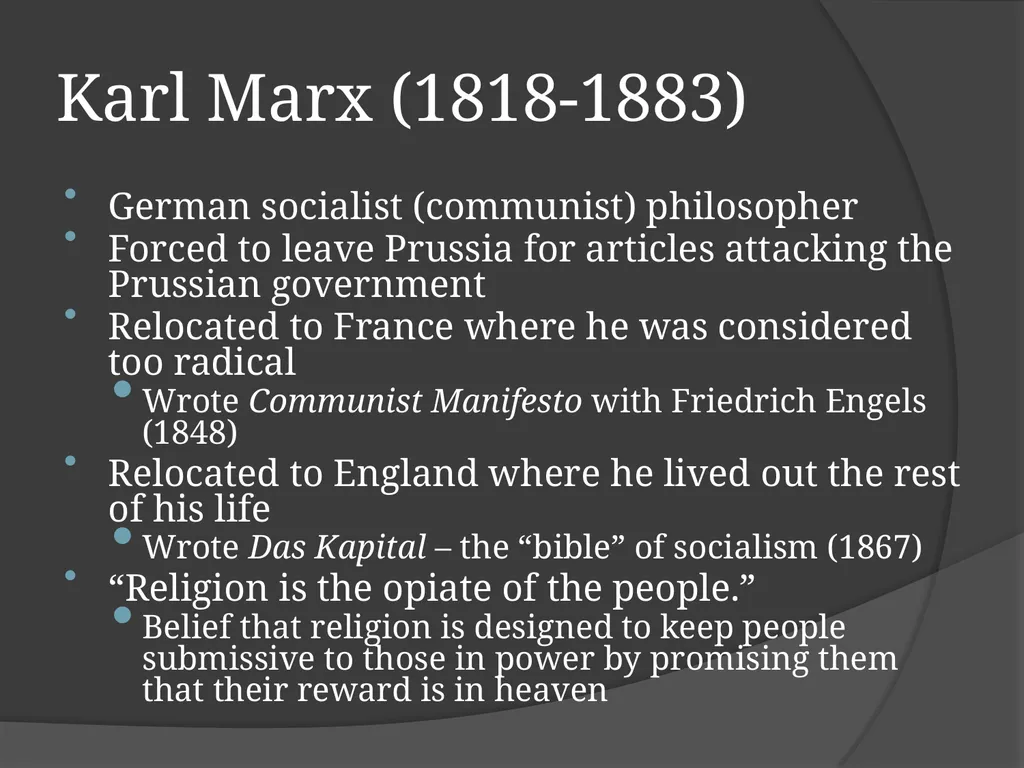
Karl Marx (1818-1883) German socialist (communist) philosopher
Forced to leave Prussia for articles attacking the Prussian government
Relocated to France where he was considered too radical
Wrote Communist Manifesto with Friedrich Engels (1848)
Relocated to England where he lived out the rest of his life
Wrote Das Kapital – the “bible” of socialism (1867)
“Religion is the opiate of the people.”
Belief that religion is designed to keep people submissive to those in power by promising them that their reward is in heaven<br>
106
Marxism – Communism<br>
107
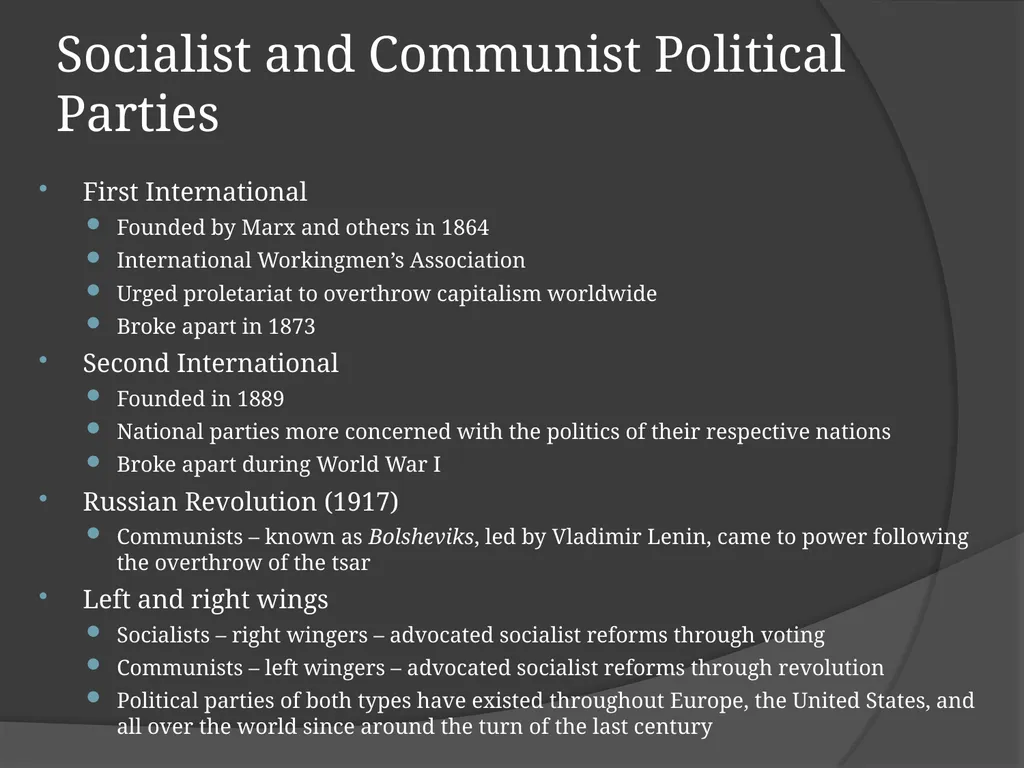
Socialist and Communist Political Parties First International
Founded by Marx and others in 1864
International Workingmen’s Association
Urged proletariat to overthrow capitalism worldwide
Broke apart in 1873
Second International
Founded in 1889
National parties more concerned with the politics of their respective nations
Broke apart during World War I
Russian Revolution (1917)
Communists – known as Bolsheviks, led by Vladimir Lenin, came to power following the overthrow of the tsar
Left and right wings
Socialists – right wingers – advocated socialist reforms through voting
Communists – left wingers – advocated socialist reforms through revolution
Political parties of both types have existed throughout Europe, the United States, and all over the world since around the turn of the last century<br>
108
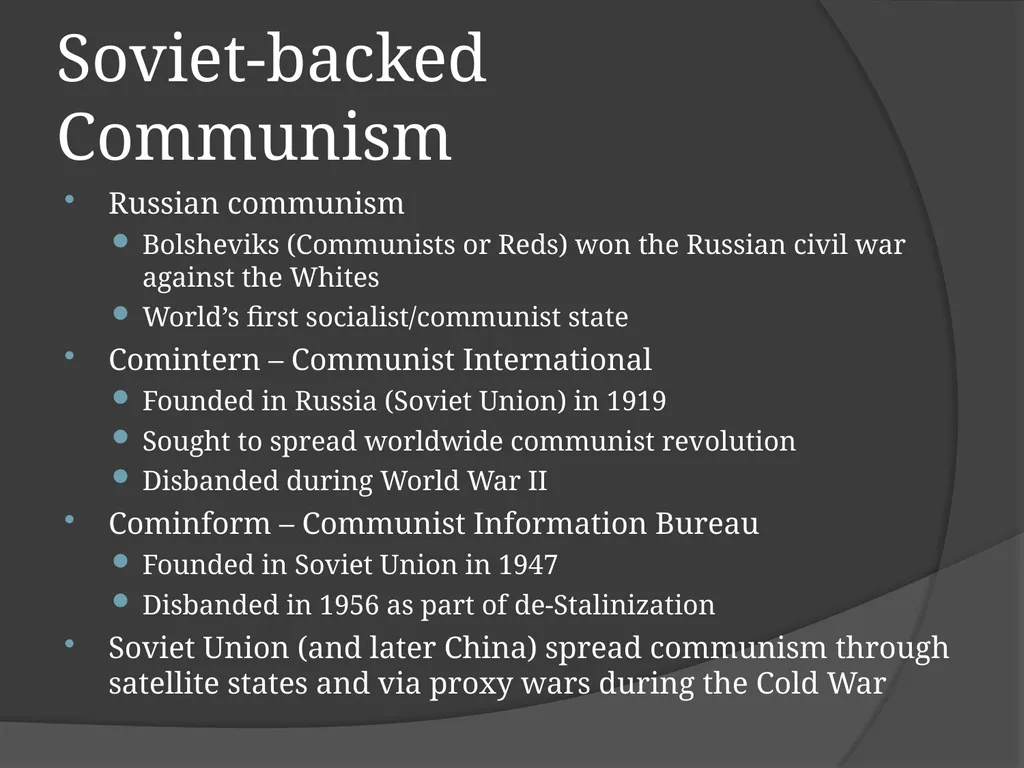
Soviet-backed Communism Russian communism
Bolsheviks (Communists or Reds) won the Russian civil war against the Whites
World’s first socialist/communist state
Comintern – Communist International
Founded in Russia (Soviet Union) in 1919
Sought to spread worldwide communist revolution
Disbanded during World War II
Cominform – Communist Information Bureau
Founded in Soviet Union in 1947
Disbanded in 1956 as part of de-Stalinization
Soviet Union (and later China) spread communism through satellite states and via proxy wars during the Cold War<br>
109
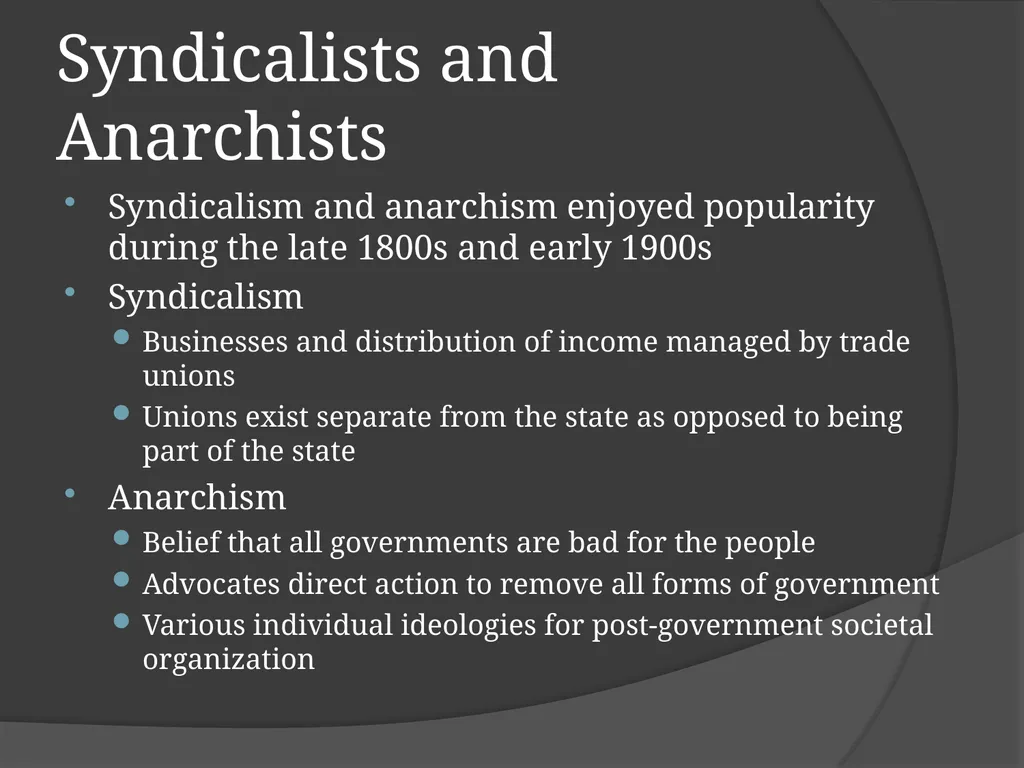
Syndicalists and Anarchists Syndicalism and anarchism enjoyed popularity during the late 1800s and early 1900s
Syndicalism
Businesses and distribution of income managed by trade unions
Unions exist separate from the state as opposed to being part of the state
Anarchism
Belief that all governments are bad for the people
Advocates direct action to remove all forms of government
Various individual ideologies for post-government societal organization<br>
110
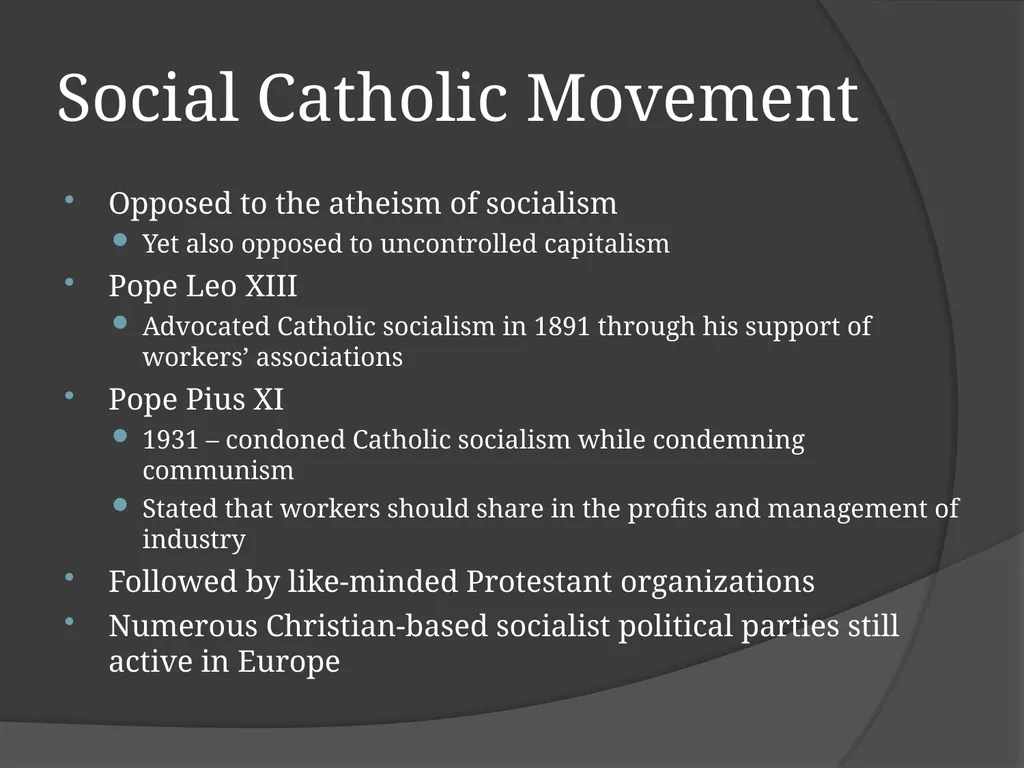
Social Catholic Movement Opposed to the atheism of socialism
Yet also opposed to uncontrolled capitalism
Pope Leo XIII
Advocated Catholic socialism in 1891 through his support of workers’ associations
Pope Pius XI
1931 – condoned Catholic socialism while condemning communism
Stated that workers should share in the profits and management of industry
Followed by like-minded Protestant organizations
Numerous Christian-based socialist political parties still active in Europe<br>
111
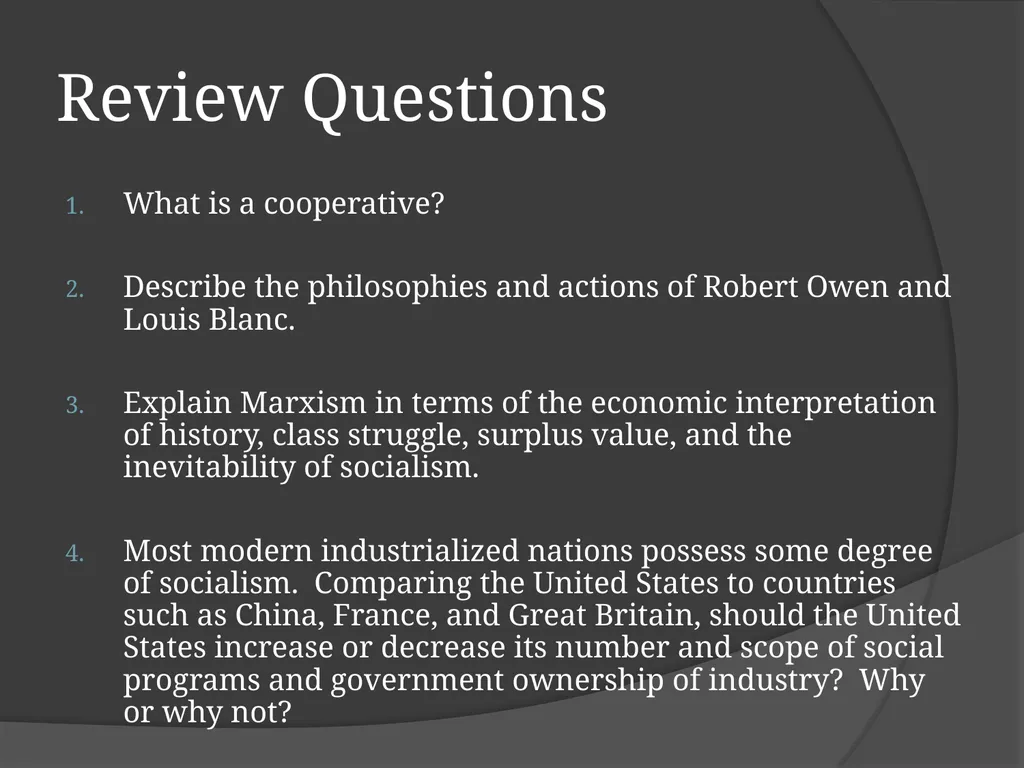
Review Questions What is a cooperative?
Describe the philosophies and actions of Robert Owen and Louis Blanc.
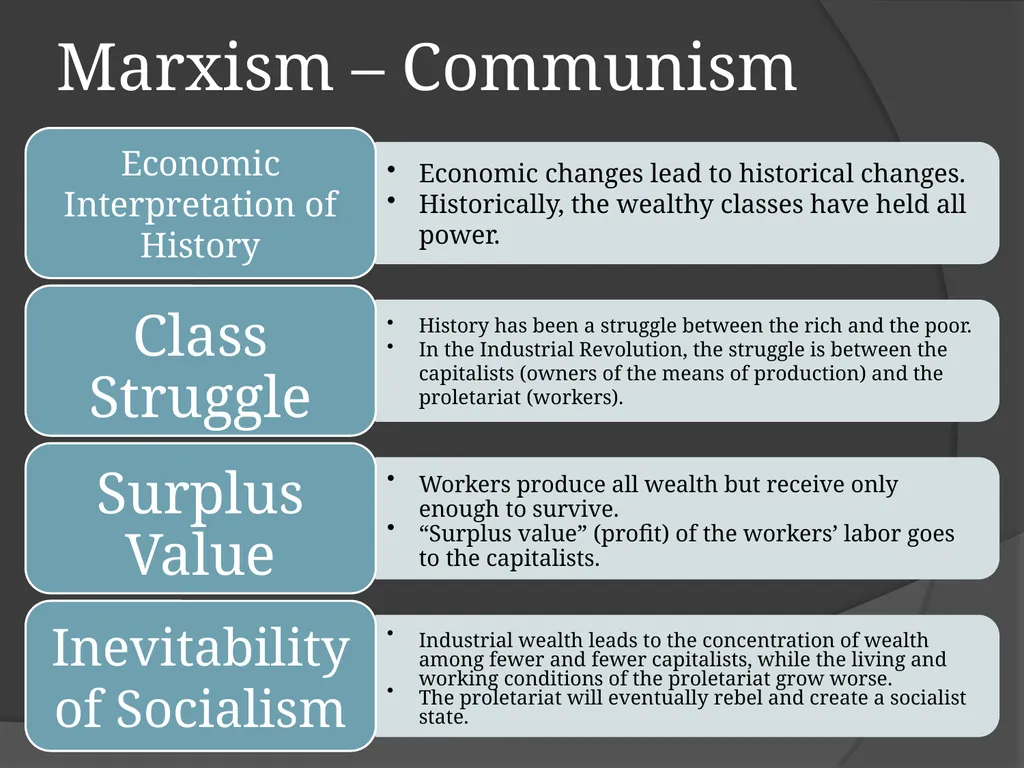
Explain Marxism in terms of the economic interpretation of history, class struggle, surplus value, and the inevitability of socialism.
Most modern industrialized nations possess some degree of socialism. Comparing the United States to countries such as China, France, and Great Britain, should the United States increase or decrease its number and scope of social programs and government ownership of industry? Why or why not?<br>