04
ROOTS OF THE LEAN STARTUP Lean manufacturing revolution in the Toyota production system.
Lean manufacturing/Production involves the following:
Know your customer
Eliminate waste
Shrink batch size
Just-in-time production
Acceleration of cycle times<br>
05
DEFINING KEYWORDS Startup – A human institution to create a new product or service under conditions of extreme uncertainty.
Entrepreneur – Everyone from young visionaries with little backing to seasoned visionaries with larger companies.
Product – Anything that a customer experiences as a part of interaction with the company.<br>
06
PRINCIPLES OF LEAN STARTUP Entrepreneurs are everywhere
Entrepreneurship is management
Validate Learning
Build – Measure – Learn
Innovative Accounting<br>
07
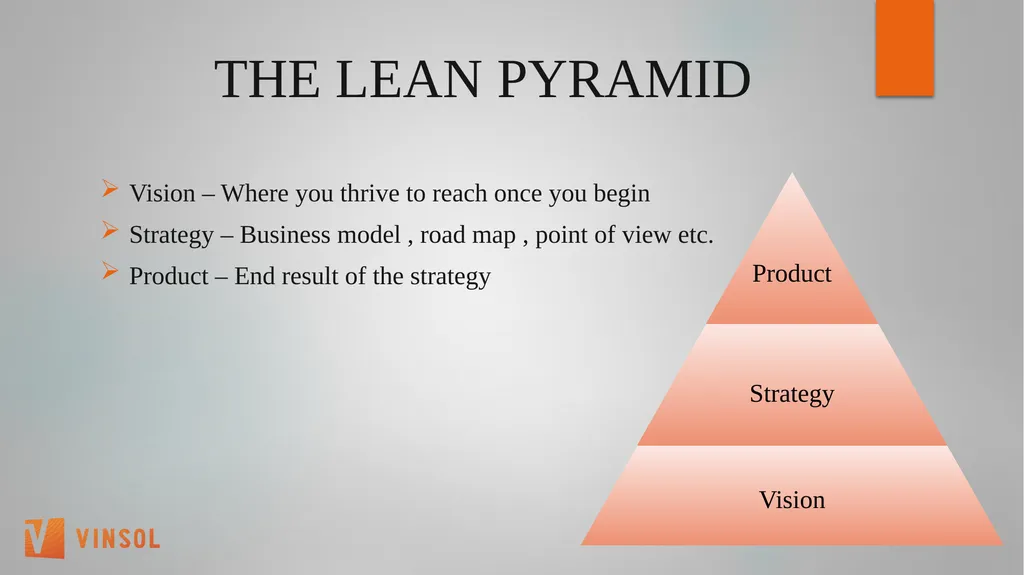
THE LEAN PYRAMID Vision – Where you thrive to reach once you begin
Strategy – Business model , road map , point of view etc.
Product – End result of the strategy<br>
08
A STARTUP’S VISION Destination in mind – Creating a thriving business.
The First Question – “Should this product be build?”
Measure progress
Evaluate performance locally
Always drive a new project and avoid complex plans
Break down the larger vision and start with small experiments to gather customer responses<br>
09
EXPERIMENTATION An EXPERIMENT is the first product
How to Experiment ?
Define a clear hypothesis using the Leap of faith assumptions
Use ‘Genchi Genbutsu’ approach for better understanding
Look for Antilogs and Analogs
Start by building an MVP
Identify and eliminate waste
Example : Zappos , VLS<br>
10
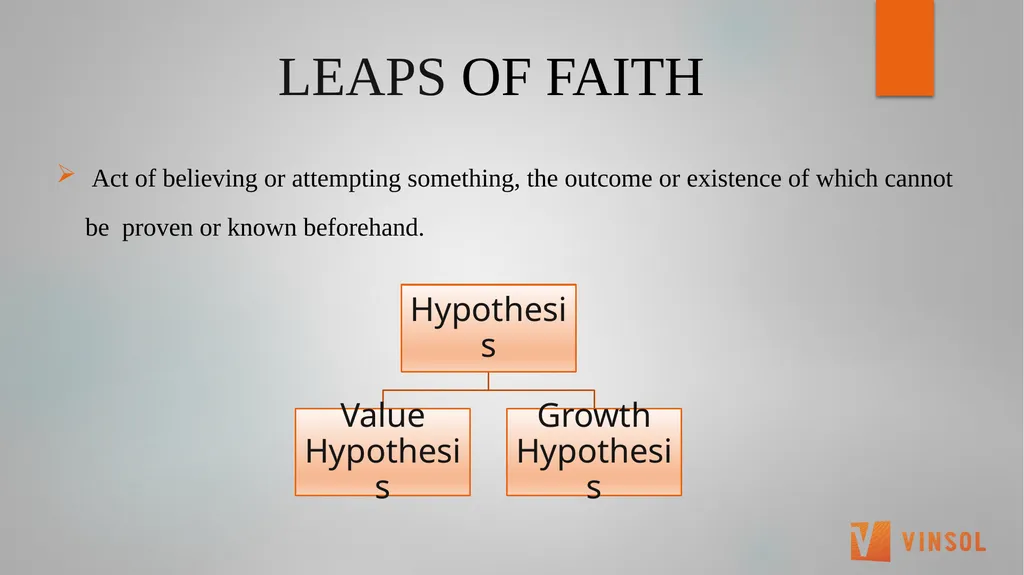
LEAPS OF FAITH Act of believing or attempting something, the outcome or existence of which cannot be proven or known beforehand.<br>
11
GENCHI GENBUTSU Key principle in the Toyota production system
Go and look out for yourself
Facilitates early contact with potential customers
Increases the chance that actual issues and unplanned events will be observed first hand
Example : Toyota’s Minivan<br>
12
ANALOGS AND ANTILOGS Analog : Proof that something has been tried and works well in the market
Antilog : Proof that something doesn’t work in the market
Look for Antilogs and Analogs, if possible
Try to come up with alternatives to Antilogs
Address high risk assumptions first
Example :
Analog for iPod : Sony’s Walkman
Antilog for iPod : Napster<br>
13
MINIMUM VIABLE PRODUCT Version of product that enables a full turn of the Build – Measure – Learn loop with a minimum amount of effort and the least amount of development time.
Has core features which allow the product to be deployed.
Helps in avoiding building a product that the customers do not want.
Can be deployed to Early Adopters that are thought to be more likely to provide feedback.<br>
14
THE QUALITY PRINCIPLE (MVP) If we do not know who the customer is, we do not know what quality is.
Try not to presuppose what attribute of the product will the customer consider as worthwhile
Learn what the customers care about
Remove any feature, process or effort that does not contribute directly to the learning that you seek
Example : 3D Avatars in IMVU<br>
15
PROBLEMS IN BUILDING AN MVP Legal issues
Fear of competition
Branding Risks
Fear of failure<br>
16
WHAT IS WASTE ? The major wastes as per the Lean Methodology are :
Waiting
Defects
Overproduction
Improper use of skills<br>
17
The effort that is not absolutely necessary for learning what your customer wants can be eliminated.
Work Smart, not just hard
Identify value creating efforts
Identify and eliminate waste VALUE VS WASTE<br>
18
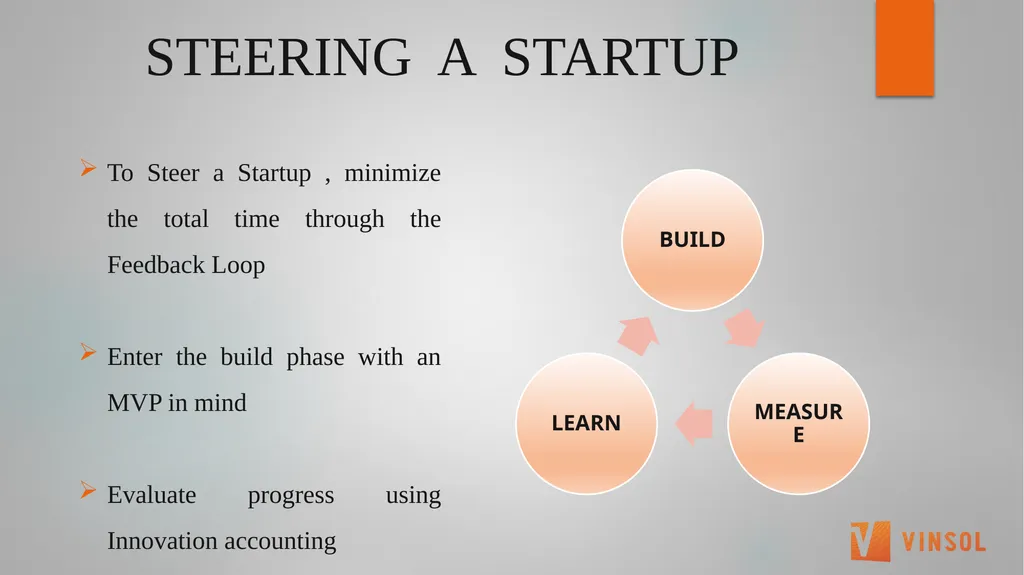
STEERING A STARTUP To Steer a Startup , minimize the total time through the Feedback Loop
Enter the build phase with an MVP in mind
Evaluate progress using Innovation accounting<br>
19
INNOVATION ACCOUNTING To evaluate and improve outcomes, focus on how to measure progress, how to set up milestones and prioritize work.
Learning milestones :
Establishing the baseline
Tuning the engine
Pivot or Persevere<br>
20
SPLIT TESTS AND METRICS Split Tests : Experiment where different versions of the product are offered to the client simultaneously. Example : Grockit
Choose the right metrics to evaluate progress.
Do not be mislead by VANITY METRICS
A metric should be :
Actionable
Accessible
Auditable<br>
21
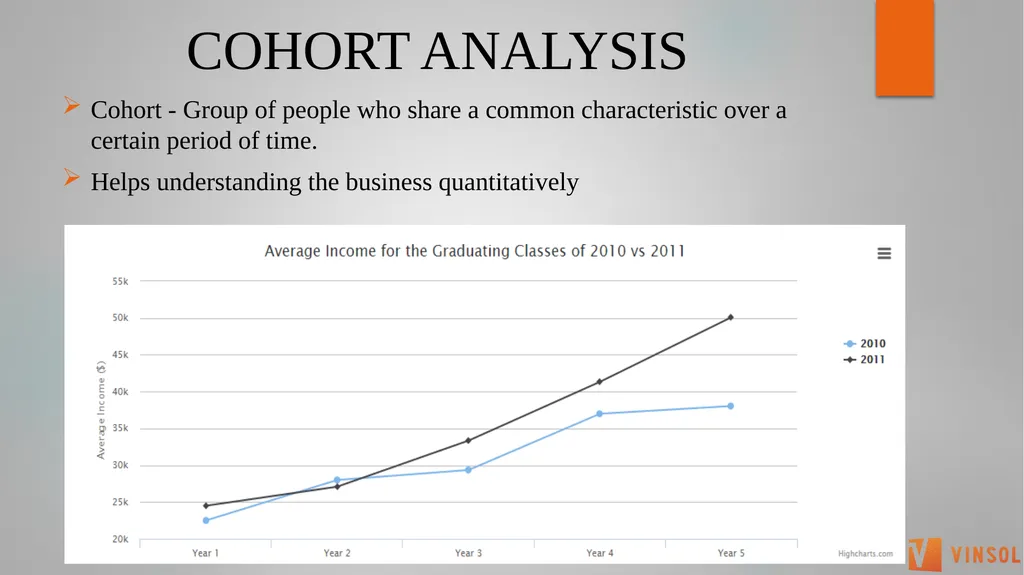
COHORT ANALYSIS Cohort - Group of people who share a common characteristic over a certain period of time.
Helps understanding the business quantitatively<br>
22
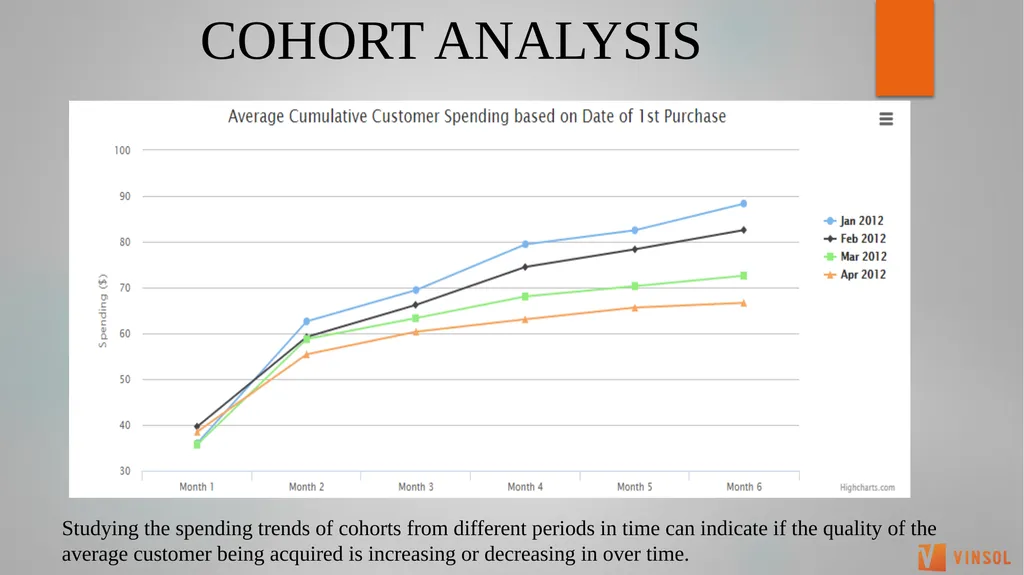
COHORT ANALYSIS Studying the spending trends of cohorts from different periods in time can indicate if the quality of the average customer being acquired is increasing or decreasing in over time.<br>
23
PIVOT OR PERSEVERE Pivot is a special kind of structured change designed to test a new fundamental hypothesis.
When to PIVOT ?
A start-up's runway is the number of pivots it can still make
PIVOTS require courage
The PIVOT or PERSEVERE meeting
Example : Wealthfront<br>
24
CATALOG OF PIVOTS Zoom-in Pivot - Flickr
Zoom-out Pivot - Facebook
Customer Segment Pivot - Wealthfront
Customer Need Pivot - Starbucks<br>
25
ACCELERATE When accelerating a Startup, it’s important to keep the following in mind :
Keep the batches small
Aim for sustainable growth
The FIVE WHYS
Keep Innovating<br>
26
BATCHING Batch size – Work that moves from one stage to the next at a time.
Problems with Large batches :
Detecting and fixing bugs becomes difficult
Efficiency decreases
The Large-Batch Death Spiral problem<br>
27
ONE ENVELOPE AT A TIME Adopt the Single-piece Flow strategy
Produces finished products faster
Quality problems can be identified much sooner
Overhead Reduces
Toyota became world’s largest automaker in 2008 using this approach<br>
28
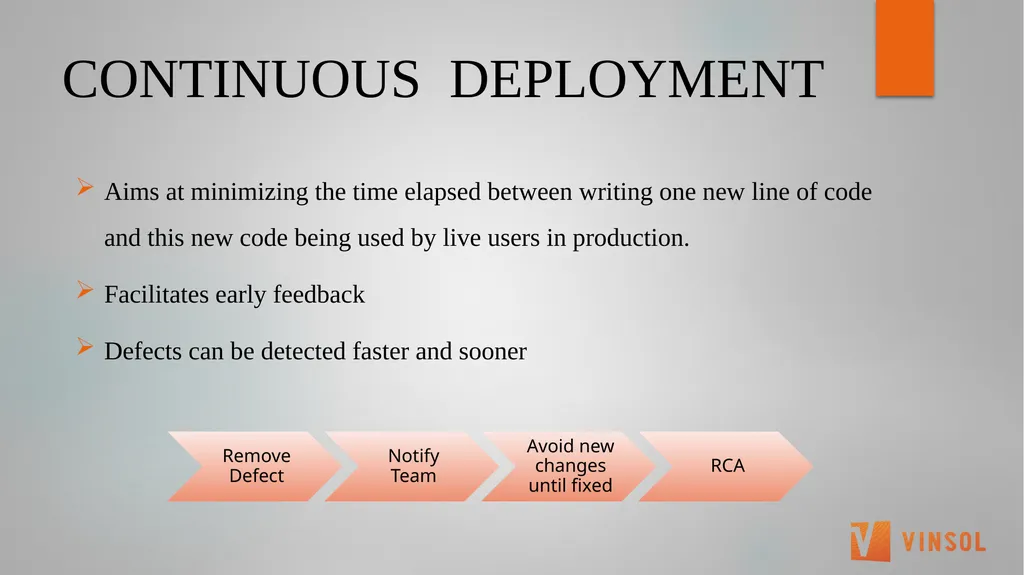
CONTINUOUS DEPLOYMENT Aims at minimizing the time elapsed between writing one new line of code and this new code being used by live users in production.
Facilitates early feedback
Defects can be detected faster and sooner<br>
29
SUSTAINABLE GROWTH * New customers come from the actions of past customers
How past customers drive sustainable growth :
Word of Mouth
As a side effect of product usage
Through funded advertising
Through repeated purchase or use<br>
30
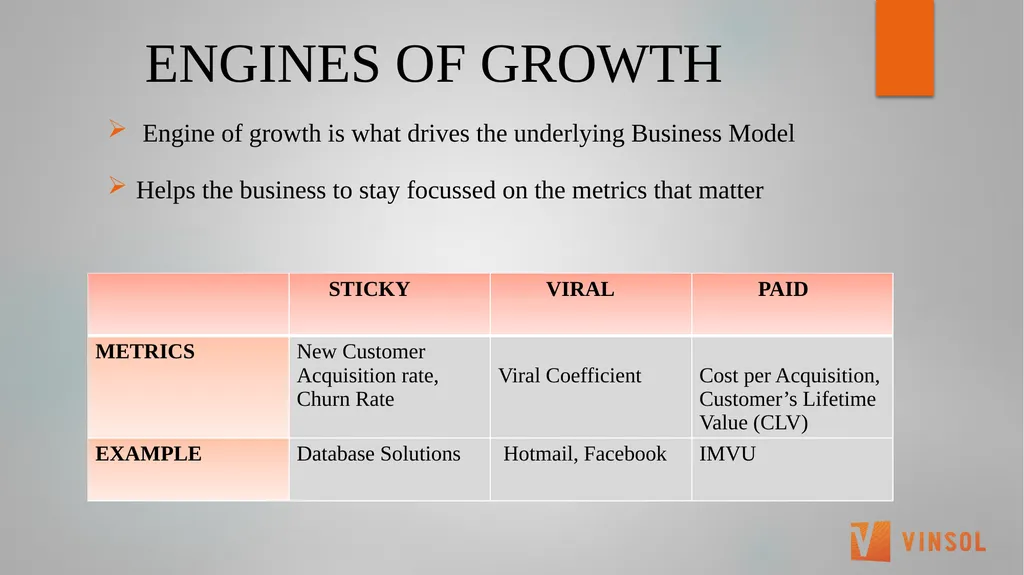
ENGINES OF GROWTH Engine of growth is what drives the underlying Business Model
Helps the business to stay focussed on the metrics that matter<br>
31
THE FIVE WHYS Iterative question-asking technique used to explore the cause-and-effect relationships underlying a particular problem.
Benefits of the Five Whys :
Achieving better quality
Automatic Speed regulator
Building a more adaptive organization
One of the simplest tools; easy to complete analysis without statistics<br>
32
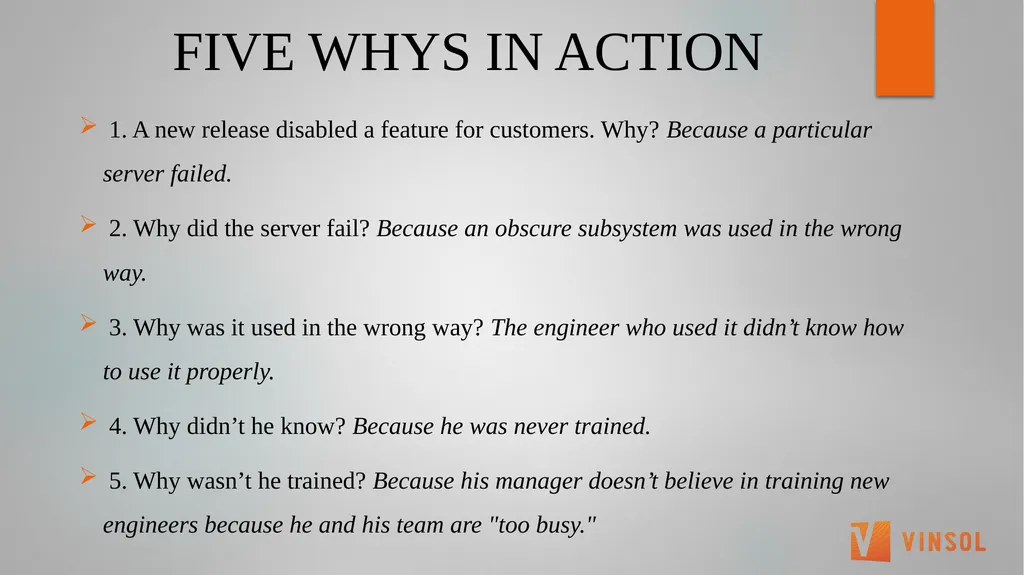
FIVE WHYS IN ACTION 1. A new release disabled a feature for customers. Why? Because a particular server failed.
2. Why did the server fail? Because an obscure subsystem was used in the wrong way.
3. Why was it used in the wrong way? The engineer who used it didn’t know how to use it properly.
4. Why didn’t he know? Because he was never trained.
5. Why wasn’t he trained? Because his manager doesn’t believe in training new engineers because he and his team are "too busy."<br>
33
INNOVATION Innovation teams must be structured correctly in order to succeed.
The Structural attributes for a startup are :
Scarce but Secure Resources
Independent Development Authority
Personal Stake in the Outcome<br>
34
THE INNOVATION SANDBOX Any team can Split-Test in a specific segment
One team goes through the whole experiment
Time Limits for experiments
Not affecting more than a certain number of customers
Experiment evaluation to be done on actionable metrics
Use the same metrics throughout the experiment
Monitor customers and metrics during experiment<br>
35
When changing to lean expect changes.
With LEAN you will have growth, a better product and
happier teams.
THANK YOU!
http://vinsol.com<br>