
The Learner Characteristics Inventory Stephanie
Description: The Learner Characteristics Inventory Stephanie Thompson Alternate Assessment Specialist 2019-2020 School Year Agenda Purpose and Use of the Learner Characteristics Inventory (LCI) Overview of the LCI The Eleven Learner Characteristics A
Related Topics
Download Presentation
"The Learner Characteristics Inventory Stephanie" is the property of its rightful owner. Permission is granted to download and print the materials on this website for personal, non-commercial use only, and to display it on your personal computer provided you do not modify the materials and that you retain all copyright notices contained in the materials. By downloading content from our website, you accept the terms of this agreement.
Presentation Transcript
slide1. The Learner Characteristics Inventory Stephanie Thompson
Alternate Assessment Specialist
2019-2020 School Year<br>
slide2. Agenda Purpose and Use of the Learner Characteristics Inventory (LCI)
Overview of the LCI
The Eleven Learner Characteristics
A Summary of Students with the Most Significant Intellectual Disabilities
Analyzing LCI Data
Additional Resources 2<br>
slide3. Purpose and Use of Learner Characteristics Inventory The LCI is used to describe the population of students who take an alternate assessment based on the alternate achievement standards (Content Connectors).
The LCI will be completed and analyzed at the local level to assist districts in ensuring only the students with the most significant intellectual disabilities are participating in the alternate assessment.
LCI data can be used by districts in comparing similarities and differences in their students taking the alternate assessment with those students in other districts in the state taking the same assessment. 3<br>
slide4. Overview of the lci The LCI includes eleven indicators ranging from communication and language use to current descriptions of reading and mathematics.
The LCI will be completed annually as the student is found eligible to participate in the alternate assessment.
When completing the LCI, educators should select the response that BEST describes the student and/or services the student is receiving for each indicator. 4<br>
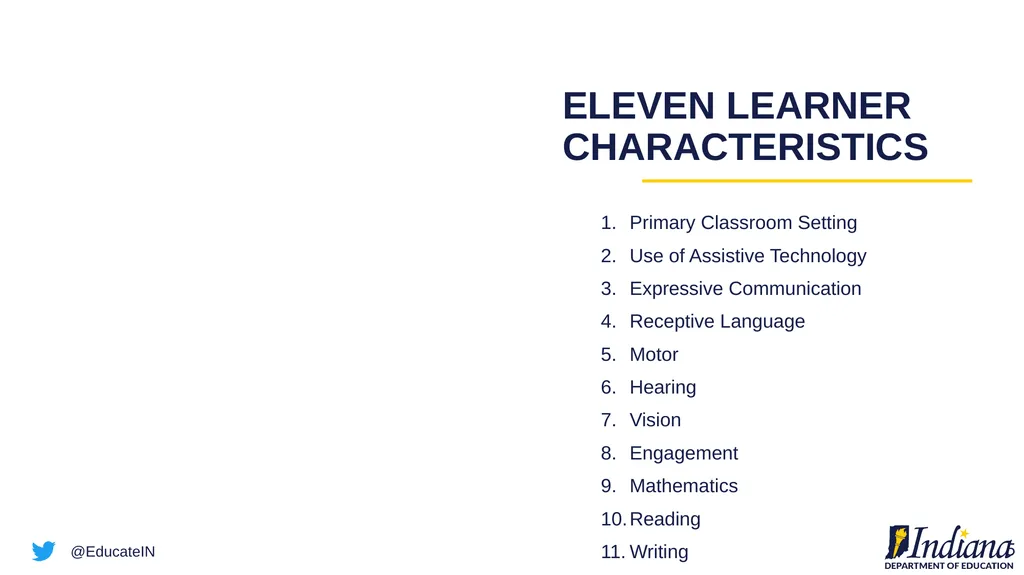
slide5. Eleven Learner Characteristics Primary Classroom Setting
Use of Assistive Technology
Expressive Communication
Receptive Language
Motor
Hearing
Vision
Engagement
Mathematics
Reading
Writing 5<br>
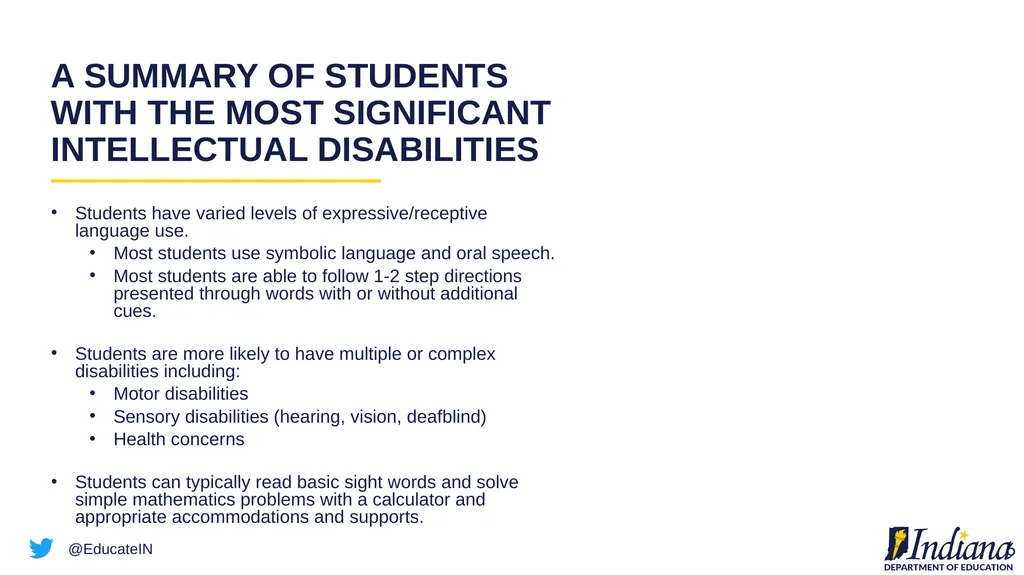
slide6. A Summary of Students with the Most Significant Intellectual Disabilities Students have varied levels of expressive/receptive language use.
Most students use symbolic language and oral speech.
Most students are able to follow 1-2 step directions presented through words with or without additional cues.
Students are more likely to have multiple or complex disabilities including:
Motor disabilities
Sensory disabilities (hearing, vision, deafblind)
Health concerns
Students can typically read basic sight words and solve simple mathematics problems with a calculator and appropriate accommodations and supports. 6<br>
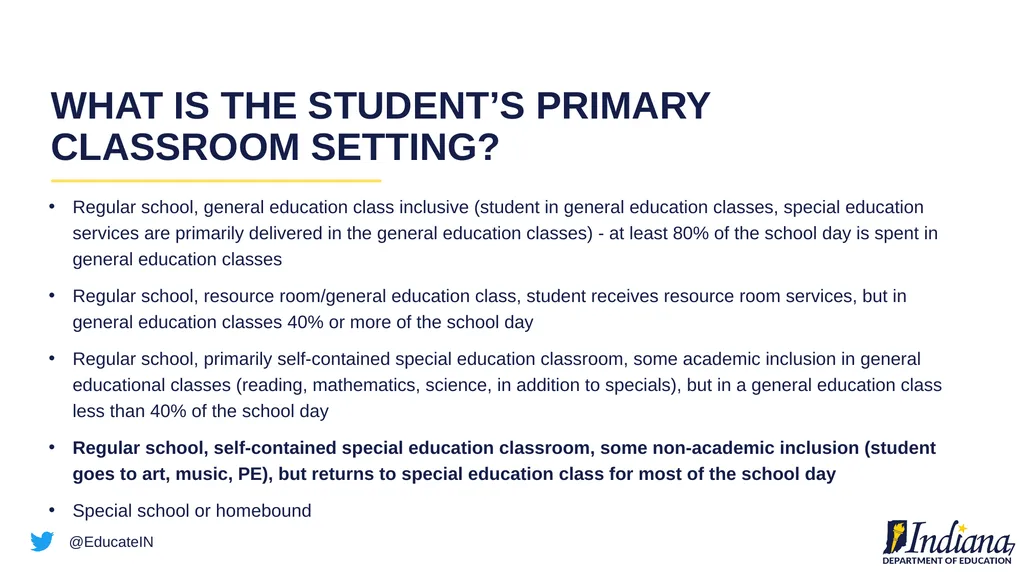
slide7. What is the student’s primary classroom setting? Regular school, general education class inclusive (student in general education classes, special education services are primarily delivered in the general education classes) - at least 80% of the school day is spent in general education classes
Regular school, resource room/general education class, student receives resource room services, but in general education classes 40% or more of the school day
Regular school, primarily self-contained special education classroom, some academic inclusion in general educational classes (reading, mathematics, science, in addition to specials), but in a general education class less than 40% of the school day
Regular school, self-contained special education classroom, some non-academic inclusion (student goes to art, music, PE), but returns to special education class for most of the school day
Special school or homebound 7<br>
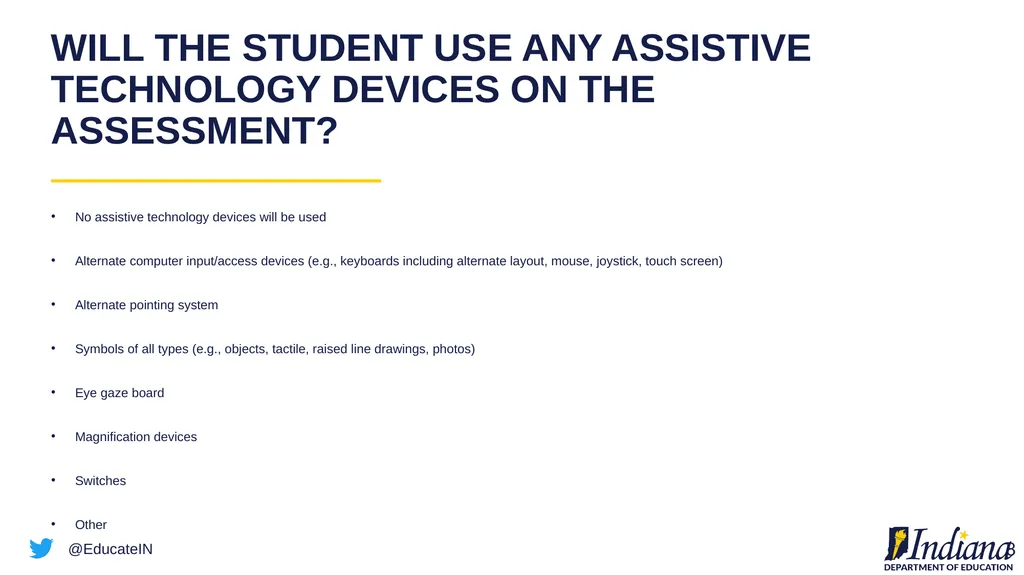
slide8. Will the student use any assistive technology devices on the assessment? No assistive technology devices will be used
Alternate computer input/access devices (e.g., keyboards including alternate layout, mouse, joystick, touch screen)
Alternate pointing system
Symbols of all types (e.g., objects, tactile, raised line drawings, photos)
Eye gaze board
Magnification devices
Switches
Other 8<br>
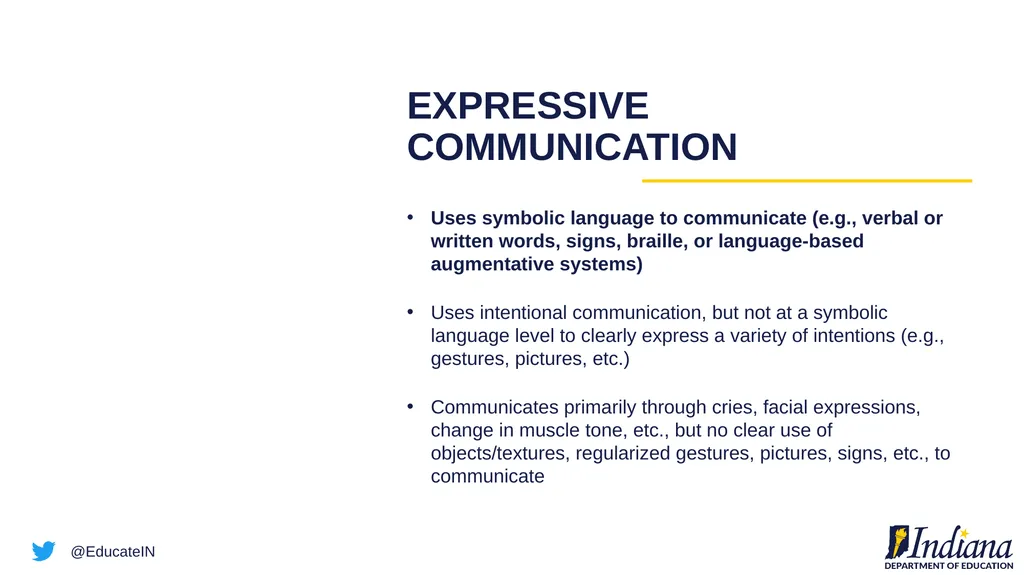
slide9. Expressive Communication Uses symbolic language to communicate (e.g., verbal or written words, signs, braille, or language-based augmentative systems)
Uses intentional communication, but not at a symbolic language level to clearly express a variety of intentions (e.g., gestures, pictures, etc.)
Communicates primarily through cries, facial expressions, change in muscle tone, etc., but no clear use of objects/textures, regularized gestures, pictures, signs, etc., to communicate<br>
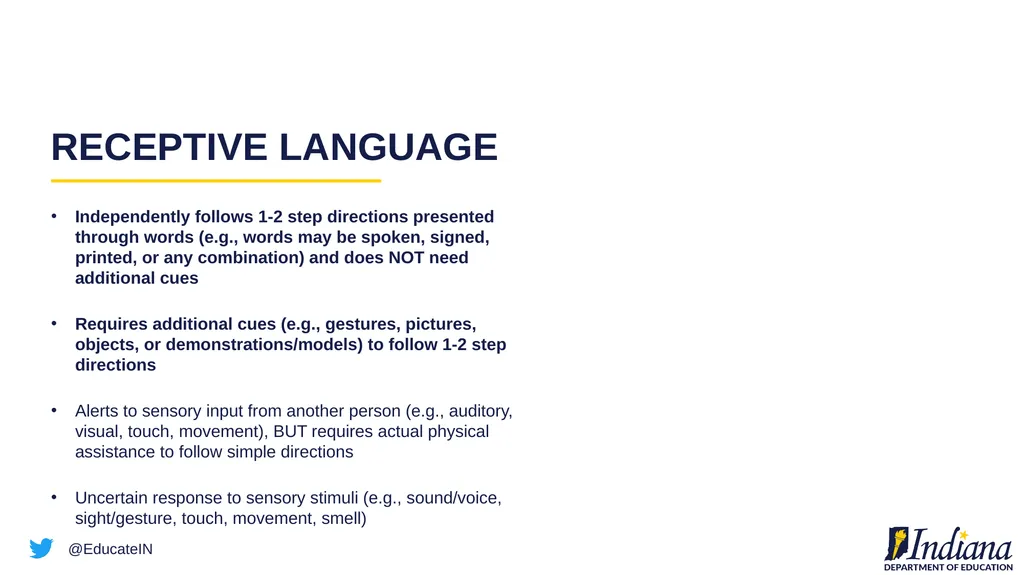
slide10. Receptive Language Independently follows 1-2 step directions presented through words (e.g., words may be spoken, signed, printed, or any combination) and does NOT need additional cues
Requires additional cues (e.g., gestures, pictures, objects, or demonstrations/models) to follow 1-2 step directions
Alerts to sensory input from another person (e.g., auditory, visual, touch, movement), BUT requires actual physical assistance to follow simple directions
Uncertain response to sensory stimuli (e.g., sound/voice, sight/gesture, touch, movement, smell)<br>
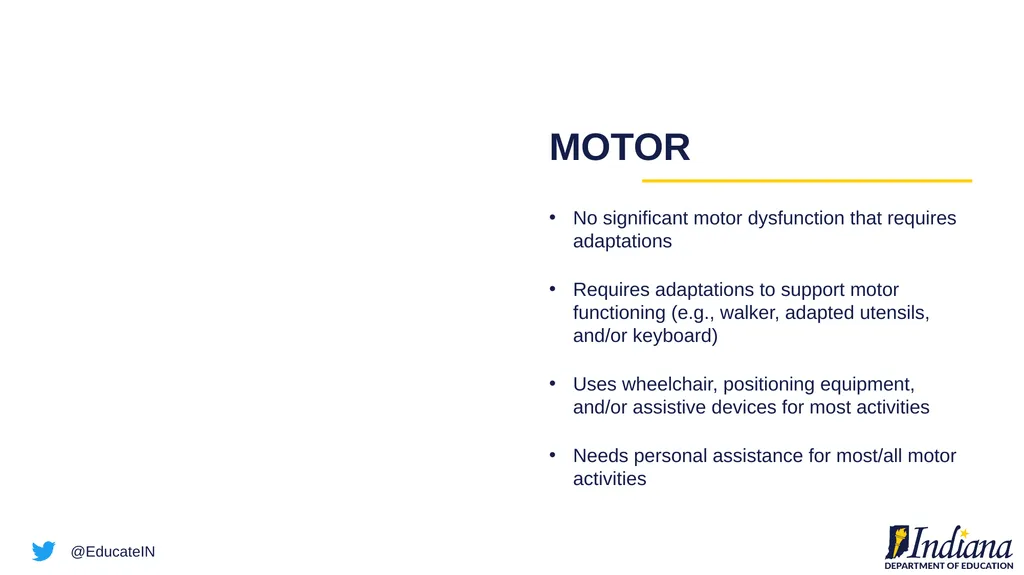
slide11. Motor No significant motor dysfunction that requires adaptations
Requires adaptations to support motor functioning (e.g., walker, adapted utensils, and/or keyboard)
Uses wheelchair, positioning equipment, and/or assistive devices for most activities
Needs personal assistance for most/all motor activities<br>
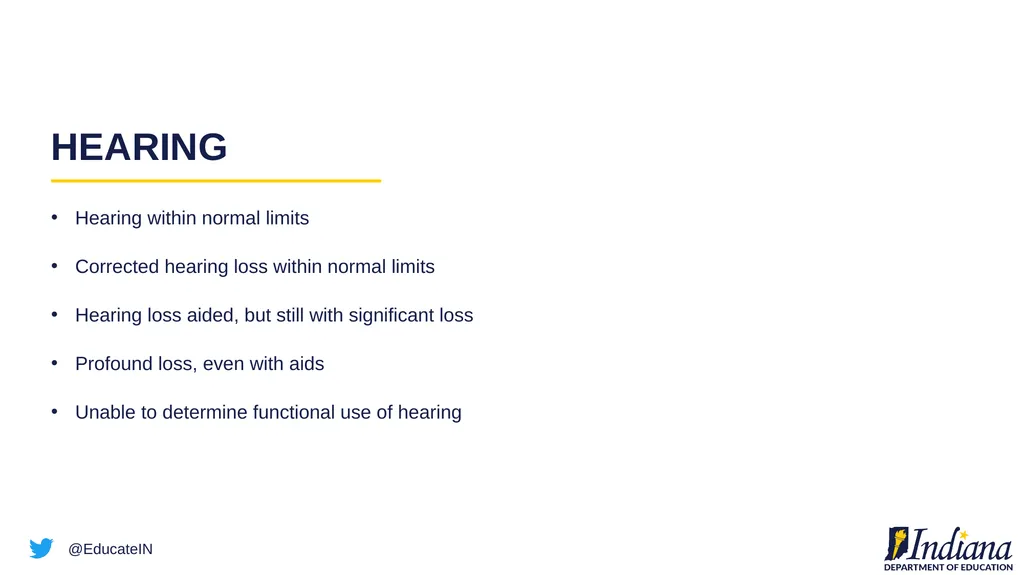
slide12. Hearing Hearing within normal limits
Corrected hearing loss within normal limits
Hearing loss aided, but still with significant loss
Profound loss, even with aids
Unable to determine functional use of hearing<br>
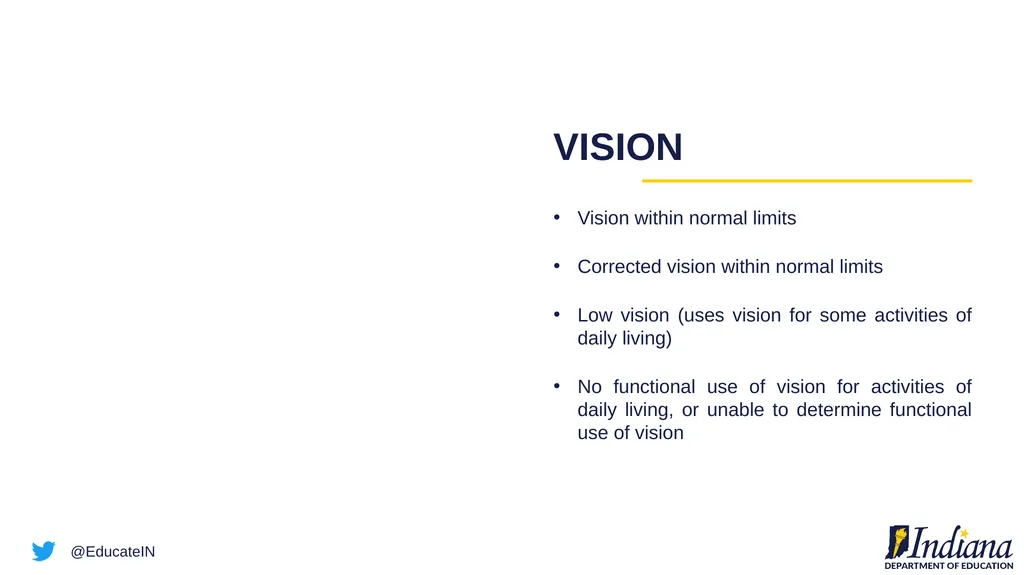
slide13. Vision Vision within normal limits
Corrected vision within normal limits
Low vision (uses vision for some activities of daily living)
No functional use of vision for activities of daily living, or unable to determine functional use of vision<br>
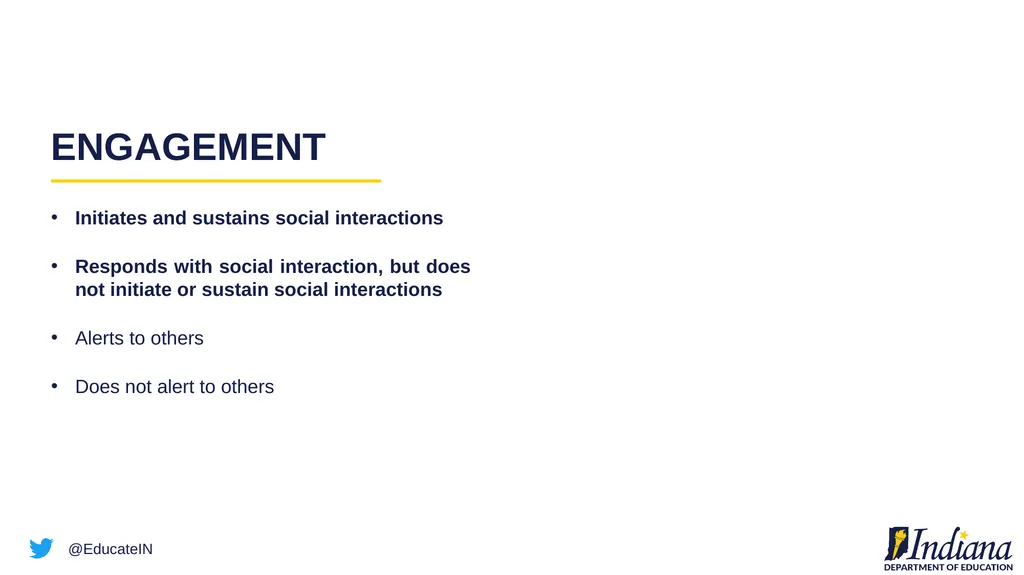
slide14. Engagement Initiates and sustains social interactions
Responds with social interaction, but does not initiate or sustain social interactions
Alerts to others
Does not alert to others<br>
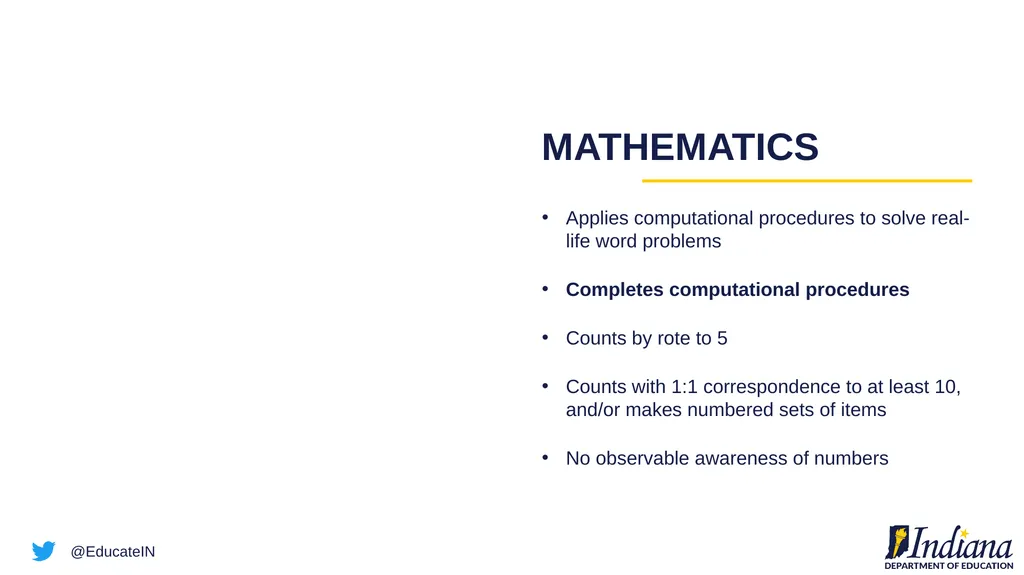
slide15. Mathematics Applies computational procedures to solve real-life word problems
Completes computational procedures
Counts by rote to 5
Counts with 1:1 correspondence to at least 10, and/or makes numbered sets of items
No observable awareness of numbers<br>
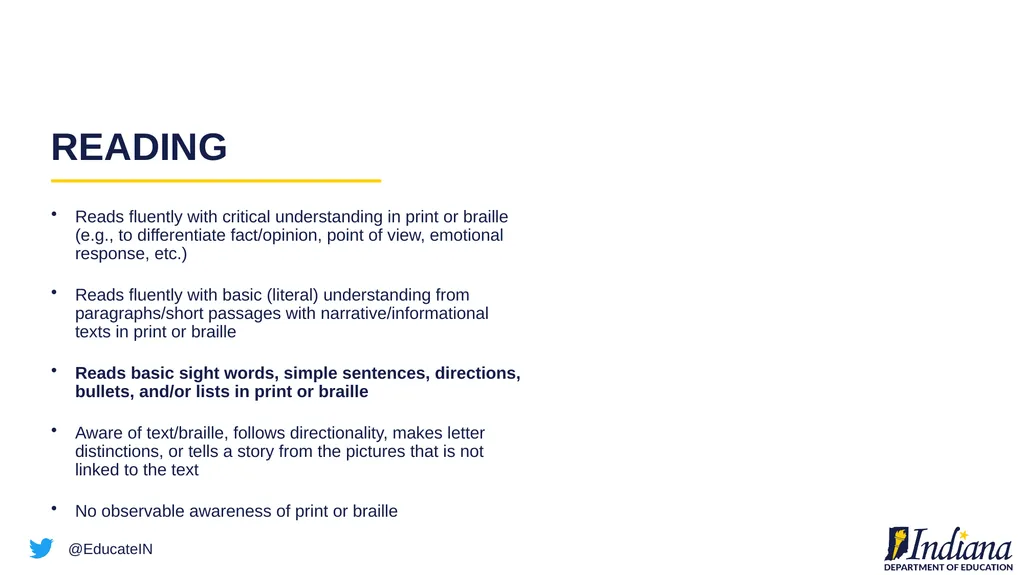
slide16. Reading Reads fluently with critical understanding in print or braille (e.g., to differentiate fact/opinion, point of view, emotional response, etc.)
Reads fluently with basic (literal) understanding from paragraphs/short passages with narrative/informational texts in print or braille
Reads basic sight words, simple sentences, directions, bullets, and/or lists in print or braille
Aware of text/braille, follows directionality, makes letter distinctions, or tells a story from the pictures that is not linked to the text
No observable awareness of print or braille<br>
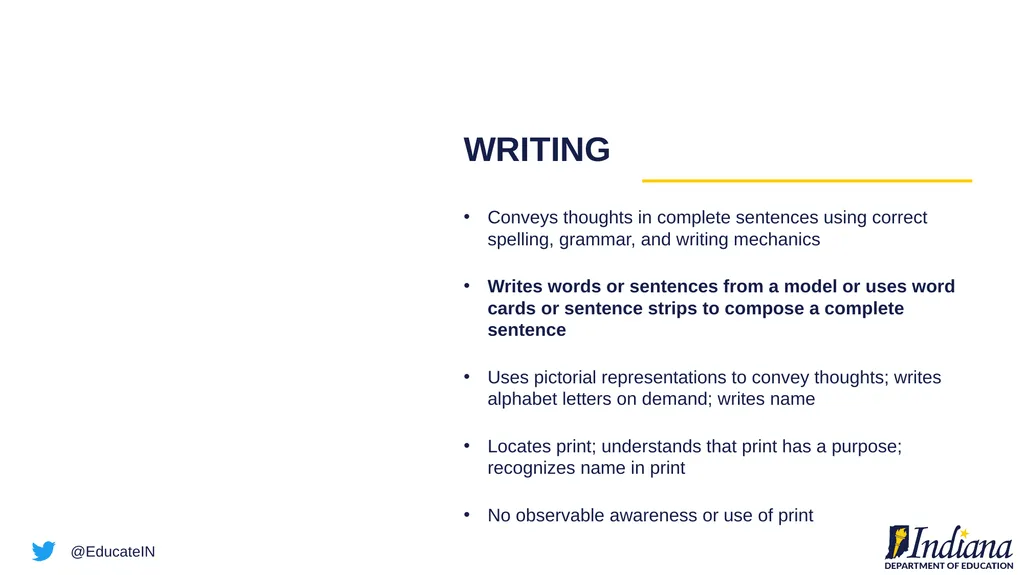
slide17. Writing Conveys thoughts in complete sentences using correct spelling, grammar, and writing mechanics
Writes words or sentences from a model or uses word cards or sentence strips to compose a complete sentence
Uses pictorial representations to convey thoughts; writes alphabet letters on demand; writes name
Locates print; understands that print has a purpose; recognizes name in print
No observable awareness or use of print<br>
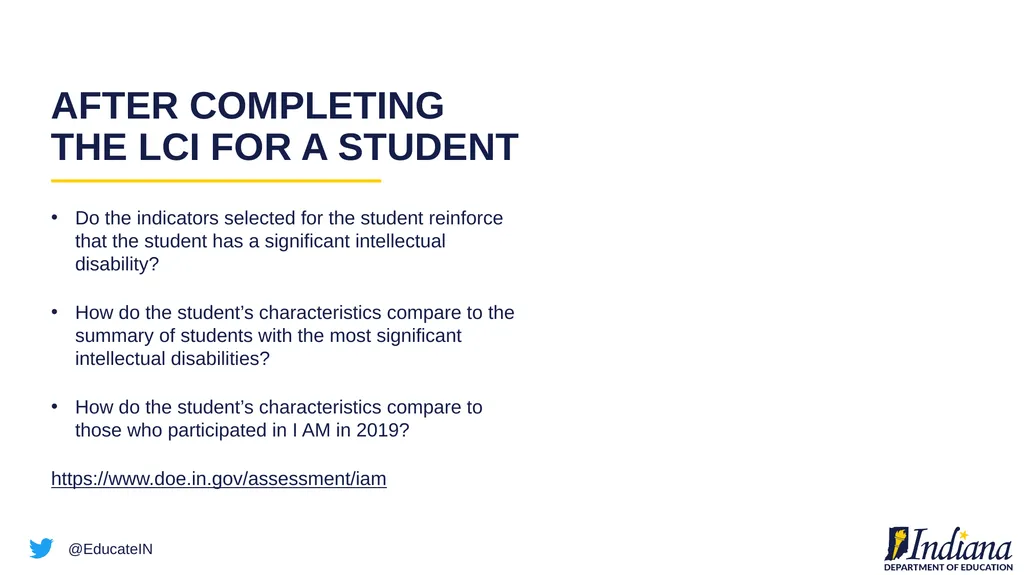
slide18. After Completing the LCI for a Student Do the indicators selected for the student reinforce that the student has a significant intellectual disability?
How do the student’s characteristics compare to the summary of students with the most significant intellectual disabilities?
How do the student’s characteristics compare to those who participated in I AM in 2019?
https://www.doe.in.gov/assessment/iam<br>
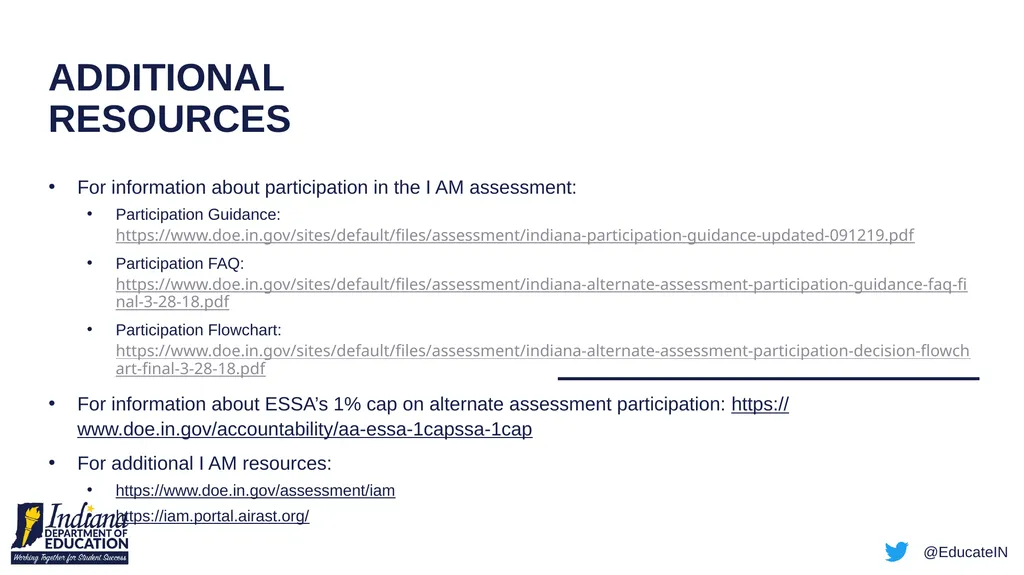
slide19. Additional Resources For information about participation in the I AM assessment:
Participation Guidance: https://www.doe.in.gov/sites/default/files/assessment/indiana-participation-guidance-updated-091219.pdf
Participation FAQ: https://www.doe.in.gov/sites/default/files/assessment/indiana-alternate-assessment-participation-guidance-faq-final-3-28-18.pdf
Participation Flowchart: https://www.doe.in.gov/sites/default/files/assessment/indiana-alternate-assessment-participation-decision-flowchart-final-3-28-18.pdf
For information about ESSA’s 1% cap on alternate assessment participation: https://www.doe.in.gov/accountability/aa-essa-1capssa-1cap
For additional I AM resources:
https://www.doe.in.gov/assessment/iam
https://iam.portal.airast.org/<br>
slide20. Questions? If you have questions about transitioning a student off the alternate assessment please contact Sarah Mohr at 317-232-9153 or smohr@doe.in.gov. Stephanie Thompson 317-234-5601 sthompson2@doe.in.gov
INassessments@doe.in.gov<br>
Alternate Assessment Specialist
2019-2020 School Year<br>
slide2. Agenda Purpose and Use of the Learner Characteristics Inventory (LCI)
Overview of the LCI
The Eleven Learner Characteristics
A Summary of Students with the Most Significant Intellectual Disabilities
Analyzing LCI Data
Additional Resources 2<br>
slide3. Purpose and Use of Learner Characteristics Inventory The LCI is used to describe the population of students who take an alternate assessment based on the alternate achievement standards (Content Connectors).
The LCI will be completed and analyzed at the local level to assist districts in ensuring only the students with the most significant intellectual disabilities are participating in the alternate assessment.
LCI data can be used by districts in comparing similarities and differences in their students taking the alternate assessment with those students in other districts in the state taking the same assessment. 3<br>
slide4. Overview of the lci The LCI includes eleven indicators ranging from communication and language use to current descriptions of reading and mathematics.
The LCI will be completed annually as the student is found eligible to participate in the alternate assessment.
When completing the LCI, educators should select the response that BEST describes the student and/or services the student is receiving for each indicator. 4<br>
slide5. Eleven Learner Characteristics Primary Classroom Setting
Use of Assistive Technology
Expressive Communication
Receptive Language
Motor
Hearing
Vision
Engagement
Mathematics
Reading
Writing 5<br>
slide6. A Summary of Students with the Most Significant Intellectual Disabilities Students have varied levels of expressive/receptive language use.
Most students use symbolic language and oral speech.
Most students are able to follow 1-2 step directions presented through words with or without additional cues.
Students are more likely to have multiple or complex disabilities including:
Motor disabilities
Sensory disabilities (hearing, vision, deafblind)
Health concerns
Students can typically read basic sight words and solve simple mathematics problems with a calculator and appropriate accommodations and supports. 6<br>
slide7. What is the student’s primary classroom setting? Regular school, general education class inclusive (student in general education classes, special education services are primarily delivered in the general education classes) - at least 80% of the school day is spent in general education classes
Regular school, resource room/general education class, student receives resource room services, but in general education classes 40% or more of the school day
Regular school, primarily self-contained special education classroom, some academic inclusion in general educational classes (reading, mathematics, science, in addition to specials), but in a general education class less than 40% of the school day
Regular school, self-contained special education classroom, some non-academic inclusion (student goes to art, music, PE), but returns to special education class for most of the school day
Special school or homebound 7<br>
slide8. Will the student use any assistive technology devices on the assessment? No assistive technology devices will be used
Alternate computer input/access devices (e.g., keyboards including alternate layout, mouse, joystick, touch screen)
Alternate pointing system
Symbols of all types (e.g., objects, tactile, raised line drawings, photos)
Eye gaze board
Magnification devices
Switches
Other 8<br>
slide9. Expressive Communication Uses symbolic language to communicate (e.g., verbal or written words, signs, braille, or language-based augmentative systems)
Uses intentional communication, but not at a symbolic language level to clearly express a variety of intentions (e.g., gestures, pictures, etc.)
Communicates primarily through cries, facial expressions, change in muscle tone, etc., but no clear use of objects/textures, regularized gestures, pictures, signs, etc., to communicate<br>
slide10. Receptive Language Independently follows 1-2 step directions presented through words (e.g., words may be spoken, signed, printed, or any combination) and does NOT need additional cues
Requires additional cues (e.g., gestures, pictures, objects, or demonstrations/models) to follow 1-2 step directions
Alerts to sensory input from another person (e.g., auditory, visual, touch, movement), BUT requires actual physical assistance to follow simple directions
Uncertain response to sensory stimuli (e.g., sound/voice, sight/gesture, touch, movement, smell)<br>
slide11. Motor No significant motor dysfunction that requires adaptations
Requires adaptations to support motor functioning (e.g., walker, adapted utensils, and/or keyboard)
Uses wheelchair, positioning equipment, and/or assistive devices for most activities
Needs personal assistance for most/all motor activities<br>
slide12. Hearing Hearing within normal limits
Corrected hearing loss within normal limits
Hearing loss aided, but still with significant loss
Profound loss, even with aids
Unable to determine functional use of hearing<br>
slide13. Vision Vision within normal limits
Corrected vision within normal limits
Low vision (uses vision for some activities of daily living)
No functional use of vision for activities of daily living, or unable to determine functional use of vision<br>
slide14. Engagement Initiates and sustains social interactions
Responds with social interaction, but does not initiate or sustain social interactions
Alerts to others
Does not alert to others<br>
slide15. Mathematics Applies computational procedures to solve real-life word problems
Completes computational procedures
Counts by rote to 5
Counts with 1:1 correspondence to at least 10, and/or makes numbered sets of items
No observable awareness of numbers<br>
slide16. Reading Reads fluently with critical understanding in print or braille (e.g., to differentiate fact/opinion, point of view, emotional response, etc.)
Reads fluently with basic (literal) understanding from paragraphs/short passages with narrative/informational texts in print or braille
Reads basic sight words, simple sentences, directions, bullets, and/or lists in print or braille
Aware of text/braille, follows directionality, makes letter distinctions, or tells a story from the pictures that is not linked to the text
No observable awareness of print or braille<br>
slide17. Writing Conveys thoughts in complete sentences using correct spelling, grammar, and writing mechanics
Writes words or sentences from a model or uses word cards or sentence strips to compose a complete sentence
Uses pictorial representations to convey thoughts; writes alphabet letters on demand; writes name
Locates print; understands that print has a purpose; recognizes name in print
No observable awareness or use of print<br>
slide18. After Completing the LCI for a Student Do the indicators selected for the student reinforce that the student has a significant intellectual disability?
How do the student’s characteristics compare to the summary of students with the most significant intellectual disabilities?
How do the student’s characteristics compare to those who participated in I AM in 2019?
https://www.doe.in.gov/assessment/iam<br>
slide19. Additional Resources For information about participation in the I AM assessment:
Participation Guidance: https://www.doe.in.gov/sites/default/files/assessment/indiana-participation-guidance-updated-091219.pdf
Participation FAQ: https://www.doe.in.gov/sites/default/files/assessment/indiana-alternate-assessment-participation-guidance-faq-final-3-28-18.pdf
Participation Flowchart: https://www.doe.in.gov/sites/default/files/assessment/indiana-alternate-assessment-participation-decision-flowchart-final-3-28-18.pdf
For information about ESSA’s 1% cap on alternate assessment participation: https://www.doe.in.gov/accountability/aa-essa-1capssa-1cap
For additional I AM resources:
https://www.doe.in.gov/assessment/iam
https://iam.portal.airast.org/<br>
slide20. Questions? If you have questions about transitioning a student off the alternate assessment please contact Sarah Mohr at 317-232-9153 or smohr@doe.in.gov. Stephanie Thompson 317-234-5601 sthompson2@doe.in.gov
INassessments@doe.in.gov<br>