The Liberal arts core at Loyola University
Description: The Liberal arts core at Loyola University Maryland What is the Liberal arts core? A liberal arts education requires students to take courses in the: Humanities Social sciences Mathematical sciences Natural sciences Jesuit ideology of Cura
Related Topics
Download Presentation
"The Liberal arts core at Loyola University" is the property of its rightful owner. Permission is granted to download and print the materials on this website for personal, non-commercial use only, and to display it on your personal computer provided you do not modify the materials and that you retain all copyright notices contained in the materials. By downloading content from our website, you accept the terms of this agreement.
Presentation Transcript
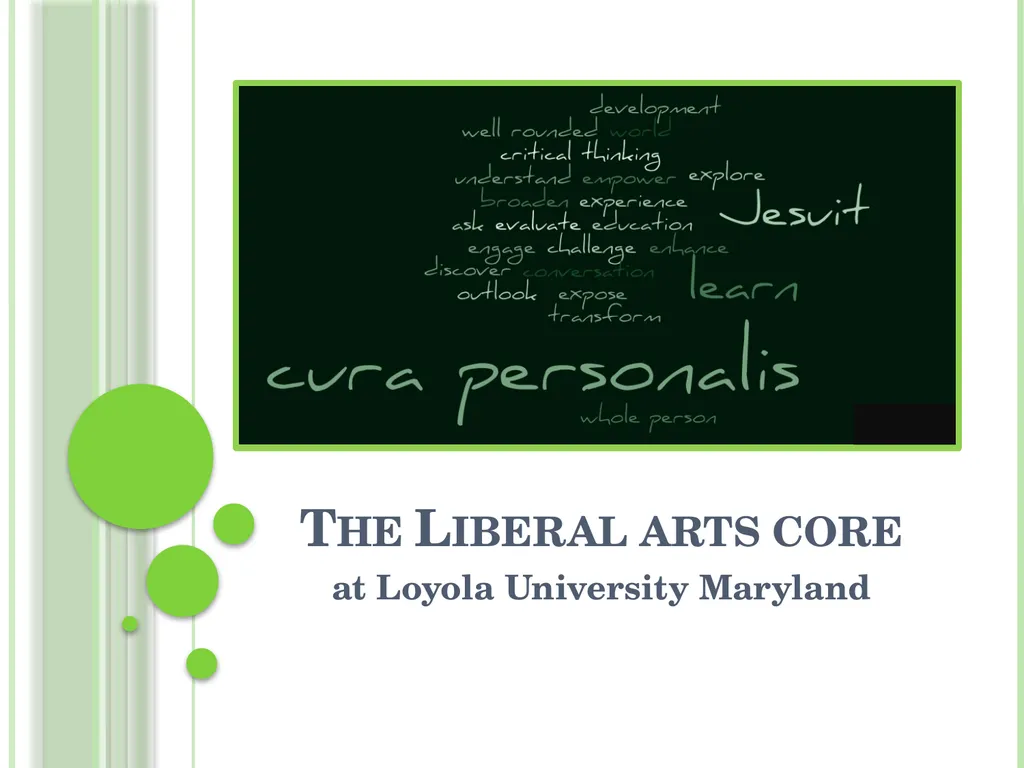
slide1. The Liberal arts core at Loyola University Maryland<br>
slide2. What is the Liberal arts core? A liberal arts education requires students to take courses in the:
Humanities
Social sciences
Mathematical sciences
Natural sciences
Jesuit ideology of “Cura Personalis”
Development of the whole person
Well-rounded individuals
Loyola students take 15 core courses in the liberal arts, plus the diversity-justice requirements<br>
slide3. The Core at a Glance Effective Writing (WR 100)
Encountering the Past (HS 100)
The Art of Reading (EN 101)
Choice of 200-level History OR 200-level English
World or Classical Language (Intermediate II Level)
Social Sciences (2)
Fine Arts
Math
Natural Science
Math/Natural Science/Computer
Intro to Philosophy (PL 201)
Theology Matters (TH 201)
Choice of 202-299 Philosophy OR 202-299 Theology
Ethics
2 Diversity and Justice courses<br>
slide4. EFFECTIVE WRITING WR 100 (3 CR.)
Students should take this course during their first year at Loyola
Preparation for university-level writing in all Loyola courses
Students develop a full writing process – planning, drafting, revising, and editing – as they learn how to compose the critical research essay<br>
slide5. HISTORY Students take one 100-level history course:
HS 100: Encountering the Past
Students can choose to take a 200-level history OR a 200-level English.<br>
slide6. literature Students take one 100-level English literature course:
EN 101 The Art of Reading
Students can choose to take a 200-level history OR a 200-level English.<br>
slide7. World/Classical language Students must reach the Intermediate II level (104) of a world or classical language to fulfill the core
This may take students anywhere from one to four semesters depending upon the placement test score
Students who place higher than the 104 level on Loyola’s language placement exam may be exempt from the language core requirement, pending confirmation from Loyola’s Modern Language department after a proctored, on-site placement exam. Those students will need to complete 1 additional free elective in lieu of the language core.
World and classical languages offered at Loyola:
Spanish French
Greek Chinese
Italian Latin
German Arabic<br>
slide8. SOCIAL SCIENCE Students take two social science courses
Social science courses include 100-level courses in psychology, sociology, political science, and economics
In some majors, students take specific social science courses to fulfill the core:
Business Majors, Accounting, and Econ – EC102 & EC103
Education – ED205 & one additional social science core
Forensic Studies – PY101 & SC100
Global Studies – EC102 & EC103
Political Science – PS101 & PS102
Psychology – PY101 & one 200-level PY
Sociology – SC100 & SC201<br>
slide9. Fine arts Students take one fine arts course selected from:
AH109: Non-Western Art
AH110: Survey of Art – Paleolithic to Gothic
AH111: Survey of Art – Renaissance to Modern
DR250: Intro to Theatre History
DR251: Experience of Theatre
DR252: Intro to Theatrical Production
MU201: Music Fundamentals
MU 202: Class Piano
MU203: The Art of Listening
MU204: Western Musical Traditions
PT270: Digital Photography
SA224: Two-Dimensional Design
SA227: 3-D Design in Art and Engineering
Be careful! Only the specific courses listed above fulfill the core requirement in fine arts<br>
slide10. Mathematics & Statistics Students take one course in mathematics or statistics to fulfill the core requirement: MA109 MA113, MA 115, MA117, MA118, MA151, MA251, ST110, ST210, or ST265
Students are placed into a math course based on their math placement test results
MA005 is a 1-credit course designed to help students with MA109 course material
In some majors, students take specific math courses to fulfill the core<br>
slide11. Math core requirement by major Business, Account., Econ.– MA151 or MA251
Biology – MA251, MA252, ST210, or ST265
Chemistry – MA251
Computer Science – MA251
Data Science – MA251
Elementary Education – ST110 or ST210
Engineering – MA251
Forensic Studies – ST110 or ST210 or ST265
Global Studies – ST110 or ST210
Mathematics, Statistics – MA251
Physics – MA251
Psychology – ST110, ST210, or ST265
Sociology – ST110, ST210, or ST265
Speech Language Pathology – ST110 or ST210<br>
slide12. Natural science Students take one course in a natural science to fulfill the core requirement
Natural sciences:
Biology
Chemistry
Physics
In some majors, students take specific natural science courses to fulfill the core<br>
slide13. Natural science core requirement by major Biology – BL150/BL151
Chemistry – CH101/CH105
Computer Science (BS) – PH201/PH291
Elementary Education – PH116
Engineering – PH201/PH291
Forensic Studies – BL150/BL151
Mathematics & Statistics – BL150/BL151, BL201/BL202, PH201/PH291, or CH101
Physics – PH201/PH291
Psychology – BL105 or BL152/153
Speech Language Pathology – 1 course in Biology<br>
slide14. Math/natural science/computer science Students may choose to take another math course, another natural science course, a computer studies course, EC220, or EG101 to fulfill this requirement
In some majors, this core requirement is fulfilled by taking a specific course:
Business Admin., Accounting, Econ.– EC220
Biology – BL152/BL153
Chemistry – CH102/CH106
Computer Science (BA) – CS151
Computer Science (BS) – PH202/PH292
Data Science – CS151
Elementary Education – PH117
Engineering – EG101
Forensic Studies – BL152/BL153
Math/Statistics – MA252
Physics – PH202/PH292
Speech Language Pathology – 1 course in Chemistry or Physics<br>
slide15. PHILOSOPHY Students take PL201: Foundations of Philosophy.
Students can choose to take a 202-299 philosophy OR a 202-299 theology.
PL201 provides a foundation for the study of philosophy with regard to its historical beginnings and central themes
The 200-level philosophy courses allow students to focus on a particular philosophical perspective (i.e. love, art, education, humanity and divinity, culture, etc.)<br>
slide16. theology Students take TH201: Theology Matters
Students can choose to take a 202-299 philosophy OR a 202-299 theology.
TH201 provides an introduction to Jewish and Christian scripture
The 200-level theology courses allow students to focus on a particular area (i.e. scripture, history, or culture)<br>
slide17. ethics The ethics core requirement is fulfilled by an ethics course in either philosophy (PL301-319) or theology (TH301-319)
The ethics core must be completed in the opposite area than the 202-299 philosophy/theology core.
If a student takes a philosophy course from 202-299, they must complete the ethics core in theology (TH300-319).
If a student takes a theology course from TH202-299, they must complete the ethics core in philosophy (PL300-319).<br>
slide18. Diversity and Justice Students take two designated diversity and justice core, major or elective courses to fulfill this requirement
Diversity and justice courses focus on:
Global awareness
Justice awareness
Domestic diversity awareness
Diversity and justice courses can be found for each specific semester in Self Service under “Course Types,” then “Diversity-Justice”
Students who plan well should be able to find diversity and justice requirements within a core or major course
The diversity and justice requirements must be completed at Loyola<br>
slide19. Questions? Please contact the Academic Advising and Support Center (AASC) at Loyola University Maryland with any questions concerning the liberal arts core curriculum:
Telephone: 410-617-5050
Email: aasc@loyola.edu
Location: Maryland Hall, Room 138<br>
slide2. What is the Liberal arts core? A liberal arts education requires students to take courses in the:
Humanities
Social sciences
Mathematical sciences
Natural sciences
Jesuit ideology of “Cura Personalis”
Development of the whole person
Well-rounded individuals
Loyola students take 15 core courses in the liberal arts, plus the diversity-justice requirements<br>
slide3. The Core at a Glance Effective Writing (WR 100)
Encountering the Past (HS 100)
The Art of Reading (EN 101)
Choice of 200-level History OR 200-level English
World or Classical Language (Intermediate II Level)
Social Sciences (2)
Fine Arts
Math
Natural Science
Math/Natural Science/Computer
Intro to Philosophy (PL 201)
Theology Matters (TH 201)
Choice of 202-299 Philosophy OR 202-299 Theology
Ethics
2 Diversity and Justice courses<br>
slide4. EFFECTIVE WRITING WR 100 (3 CR.)
Students should take this course during their first year at Loyola
Preparation for university-level writing in all Loyola courses
Students develop a full writing process – planning, drafting, revising, and editing – as they learn how to compose the critical research essay<br>
slide5. HISTORY Students take one 100-level history course:
HS 100: Encountering the Past
Students can choose to take a 200-level history OR a 200-level English.<br>
slide6. literature Students take one 100-level English literature course:
EN 101 The Art of Reading
Students can choose to take a 200-level history OR a 200-level English.<br>
slide7. World/Classical language Students must reach the Intermediate II level (104) of a world or classical language to fulfill the core
This may take students anywhere from one to four semesters depending upon the placement test score
Students who place higher than the 104 level on Loyola’s language placement exam may be exempt from the language core requirement, pending confirmation from Loyola’s Modern Language department after a proctored, on-site placement exam. Those students will need to complete 1 additional free elective in lieu of the language core.
World and classical languages offered at Loyola:
Spanish French
Greek Chinese
Italian Latin
German Arabic<br>
slide8. SOCIAL SCIENCE Students take two social science courses
Social science courses include 100-level courses in psychology, sociology, political science, and economics
In some majors, students take specific social science courses to fulfill the core:
Business Majors, Accounting, and Econ – EC102 & EC103
Education – ED205 & one additional social science core
Forensic Studies – PY101 & SC100
Global Studies – EC102 & EC103
Political Science – PS101 & PS102
Psychology – PY101 & one 200-level PY
Sociology – SC100 & SC201<br>
slide9. Fine arts Students take one fine arts course selected from:
AH109: Non-Western Art
AH110: Survey of Art – Paleolithic to Gothic
AH111: Survey of Art – Renaissance to Modern
DR250: Intro to Theatre History
DR251: Experience of Theatre
DR252: Intro to Theatrical Production
MU201: Music Fundamentals
MU 202: Class Piano
MU203: The Art of Listening
MU204: Western Musical Traditions
PT270: Digital Photography
SA224: Two-Dimensional Design
SA227: 3-D Design in Art and Engineering
Be careful! Only the specific courses listed above fulfill the core requirement in fine arts<br>
slide10. Mathematics & Statistics Students take one course in mathematics or statistics to fulfill the core requirement: MA109 MA113, MA 115, MA117, MA118, MA151, MA251, ST110, ST210, or ST265
Students are placed into a math course based on their math placement test results
MA005 is a 1-credit course designed to help students with MA109 course material
In some majors, students take specific math courses to fulfill the core<br>
slide11. Math core requirement by major Business, Account., Econ.– MA151 or MA251
Biology – MA251, MA252, ST210, or ST265
Chemistry – MA251
Computer Science – MA251
Data Science – MA251
Elementary Education – ST110 or ST210
Engineering – MA251
Forensic Studies – ST110 or ST210 or ST265
Global Studies – ST110 or ST210
Mathematics, Statistics – MA251
Physics – MA251
Psychology – ST110, ST210, or ST265
Sociology – ST110, ST210, or ST265
Speech Language Pathology – ST110 or ST210<br>
slide12. Natural science Students take one course in a natural science to fulfill the core requirement
Natural sciences:
Biology
Chemistry
Physics
In some majors, students take specific natural science courses to fulfill the core<br>
slide13. Natural science core requirement by major Biology – BL150/BL151
Chemistry – CH101/CH105
Computer Science (BS) – PH201/PH291
Elementary Education – PH116
Engineering – PH201/PH291
Forensic Studies – BL150/BL151
Mathematics & Statistics – BL150/BL151, BL201/BL202, PH201/PH291, or CH101
Physics – PH201/PH291
Psychology – BL105 or BL152/153
Speech Language Pathology – 1 course in Biology<br>
slide14. Math/natural science/computer science Students may choose to take another math course, another natural science course, a computer studies course, EC220, or EG101 to fulfill this requirement
In some majors, this core requirement is fulfilled by taking a specific course:
Business Admin., Accounting, Econ.– EC220
Biology – BL152/BL153
Chemistry – CH102/CH106
Computer Science (BA) – CS151
Computer Science (BS) – PH202/PH292
Data Science – CS151
Elementary Education – PH117
Engineering – EG101
Forensic Studies – BL152/BL153
Math/Statistics – MA252
Physics – PH202/PH292
Speech Language Pathology – 1 course in Chemistry or Physics<br>
slide15. PHILOSOPHY Students take PL201: Foundations of Philosophy.
Students can choose to take a 202-299 philosophy OR a 202-299 theology.
PL201 provides a foundation for the study of philosophy with regard to its historical beginnings and central themes
The 200-level philosophy courses allow students to focus on a particular philosophical perspective (i.e. love, art, education, humanity and divinity, culture, etc.)<br>
slide16. theology Students take TH201: Theology Matters
Students can choose to take a 202-299 philosophy OR a 202-299 theology.
TH201 provides an introduction to Jewish and Christian scripture
The 200-level theology courses allow students to focus on a particular area (i.e. scripture, history, or culture)<br>
slide17. ethics The ethics core requirement is fulfilled by an ethics course in either philosophy (PL301-319) or theology (TH301-319)
The ethics core must be completed in the opposite area than the 202-299 philosophy/theology core.
If a student takes a philosophy course from 202-299, they must complete the ethics core in theology (TH300-319).
If a student takes a theology course from TH202-299, they must complete the ethics core in philosophy (PL300-319).<br>
slide18. Diversity and Justice Students take two designated diversity and justice core, major or elective courses to fulfill this requirement
Diversity and justice courses focus on:
Global awareness
Justice awareness
Domestic diversity awareness
Diversity and justice courses can be found for each specific semester in Self Service under “Course Types,” then “Diversity-Justice”
Students who plan well should be able to find diversity and justice requirements within a core or major course
The diversity and justice requirements must be completed at Loyola<br>
slide19. Questions? Please contact the Academic Advising and Support Center (AASC) at Loyola University Maryland with any questions concerning the liberal arts core curriculum:
Telephone: 410-617-5050
Email: aasc@loyola.edu
Location: Maryland Hall, Room 138<br>