
The mathematical structure of multiplying

Description: The mathematical structure of multiplying fractions (From 2.1 Arithmetic procedures) KS3 Mastery PD Materials: Exemplified Key Ideas Materials for use in the classroom or to support professional development discussions Summer 2021 About
Related Topics
Download Presentation
"The mathematical structure of multiplying" is the property of its rightful owner. Permission is granted to download and print the materials on this website for personal, non-commercial use only, and to display it on your personal computer provided you do not modify the materials and that you retain all copyright notices contained in the materials. By downloading content from our website, you accept the terms of this agreement.
Presentation Transcript
slide1. The mathematical structure of multiplying fractions (From 2.1 Arithmetic procedures) KS3 Mastery PD Materials: Exemplified Key Ideas
Materials for use in the classroom or to support professional development discussions Summer 2021<br>
slide2. About this resource These slides are designed to complement the 2.1 Arithmetic procedures Core Concept document and its associated Theme Overview document 2 Operating on number, both found in the Secondary Mastery Professional Development pages.
These slides re-present the key examples from the Core Concept document so that the examples can be used either directly in the classroom or with a group of teachers. There are prompt questions alongside the examples, and further clarification in the notes.
These slides do not fully replicate the Core Concept document, so should be used alongside it. Reference to specific page numbers, and to other useful NCETM resources, can be found in the notes for each slide.
This slide deck is not designed to be a complete PD session, rather it is a selection of resources that you can adapt and use as needed when planning a session with a group of teachers.<br>
slide3. About this resource The slides are structured as follows:
The big picture:
Where does this fit in?
What do students need to understand?
Why is this key idea important?
Prior learning
Misconceptions
Exemplified key ideas
Reflection questions
Appendices:
Key vocabulary
Representations and structure
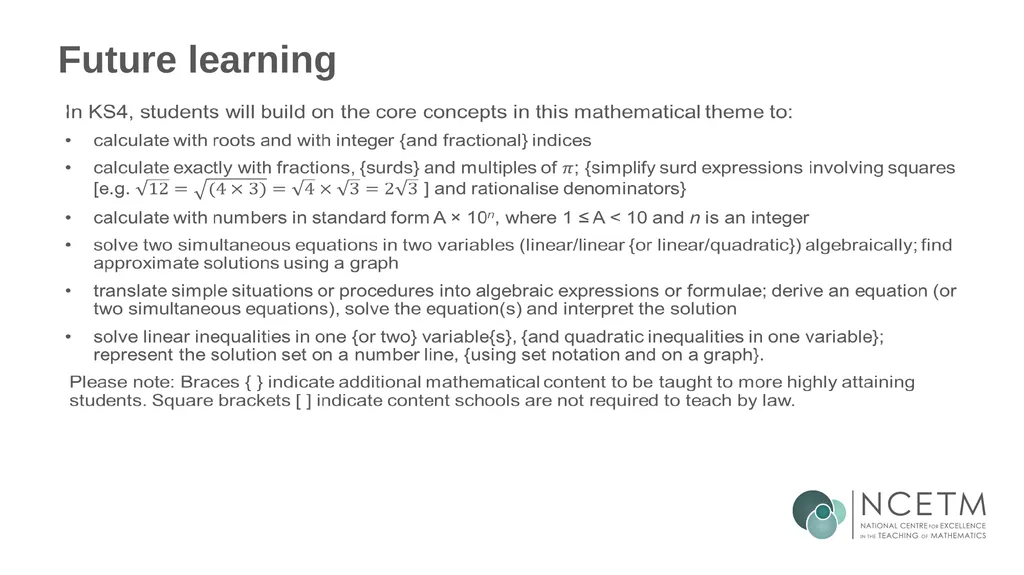
Future learning
Useful links The exemplified key idea slides have the following symbols to indicate how they have been designed to be used: Into the classroom
The examples are presented on these slides so that they could be used in PD, but also directly in the classroom. The notes feature suggested questions and things teachers might consider when using with students. PD discussion prompts
These slides look at the examples in more detail, with question prompts to promote discussion among maths teachers. The notes feature reference to further information and guidance within the Core Concepts document.<br>
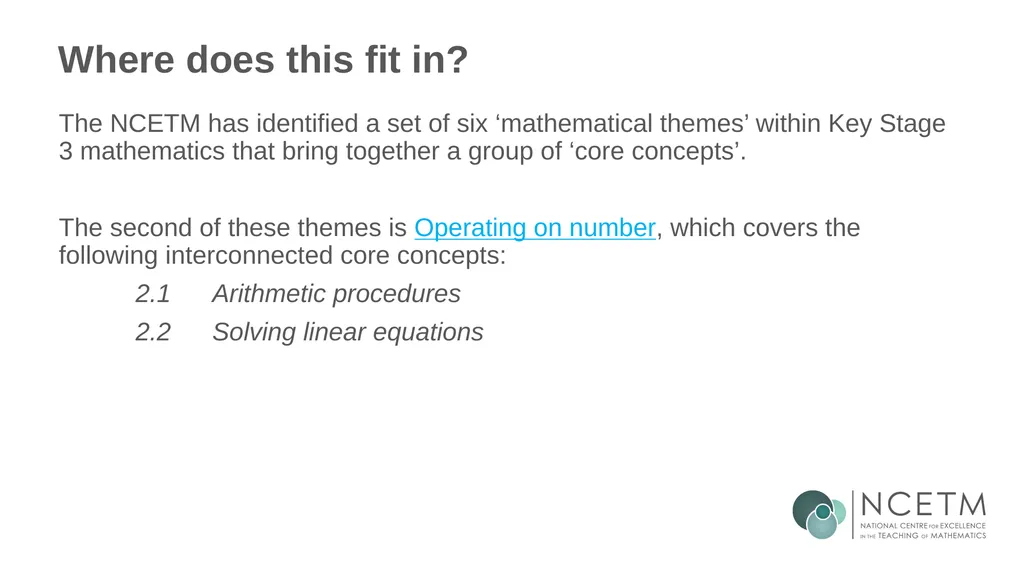
slide4. Where does this fit in? The NCETM has identified a set of six ‘mathematical themes’ within Key Stage 3 mathematics that bring together a group of ‘core concepts’.
The second of these themes is Operating on number, which covers the following interconnected core concepts:
2.1 Arithmetic procedures
2.2 Solving linear equations<br>
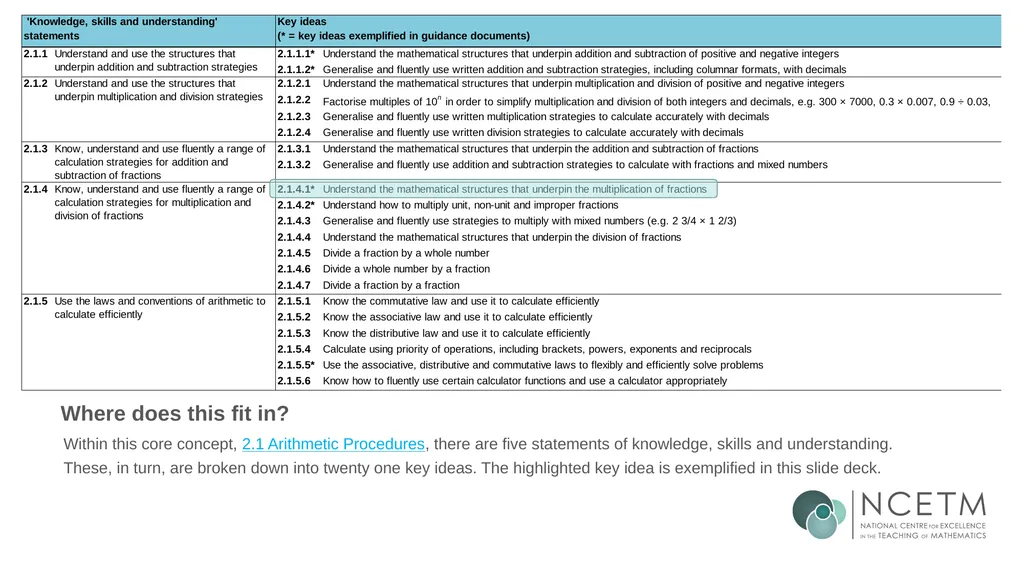
slide5. Where does this fit in? Within this core concept, 2.1 Arithmetic Procedures, there are five statements of knowledge, skills and understanding.
These, in turn, are broken down into twenty one key ideas. The highlighted key idea is exemplified in this slide deck.<br>
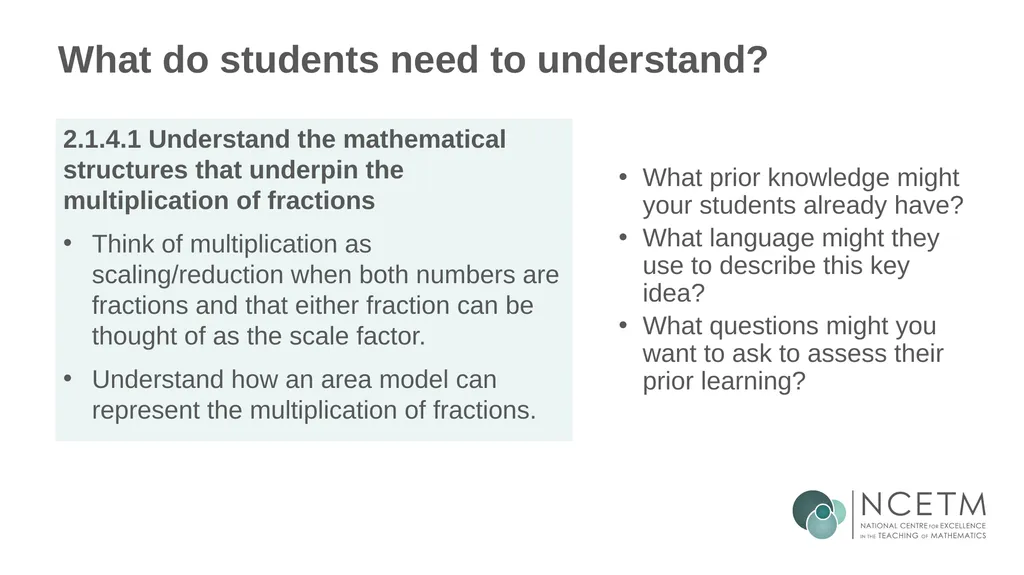
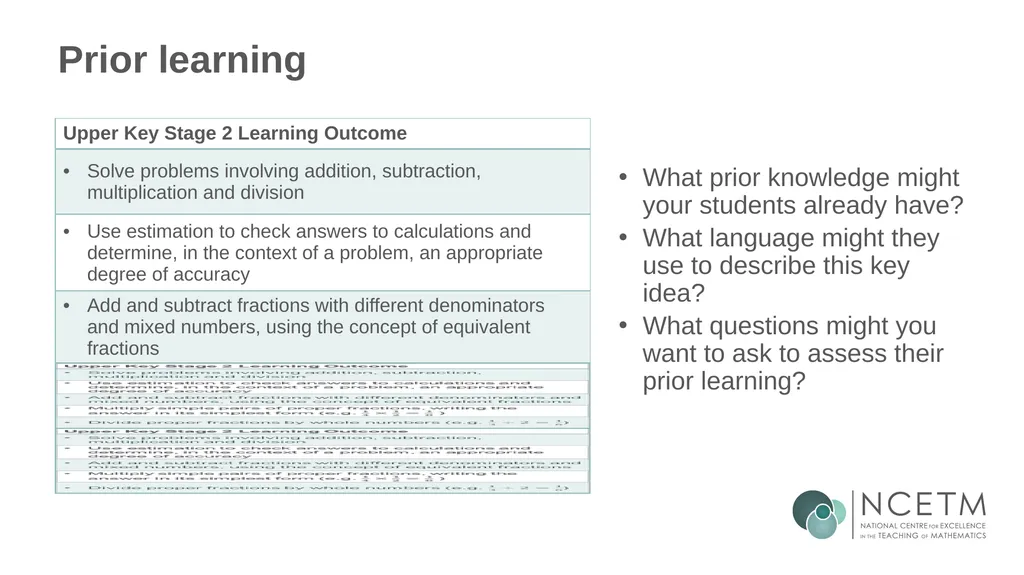
slide6. What do students need to understand? What prior knowledge might your students already have?
What language might they use to describe this key idea?
What questions might you want to ask to assess their prior learning? 2.1.4.1 Understand the mathematical structures that underpin the multiplication of fractions
Think of multiplication as scaling/reduction when both numbers are fractions and that either fraction can be thought of as the scale factor.
Understand how an area model can represent the multiplication of fractions.<br>
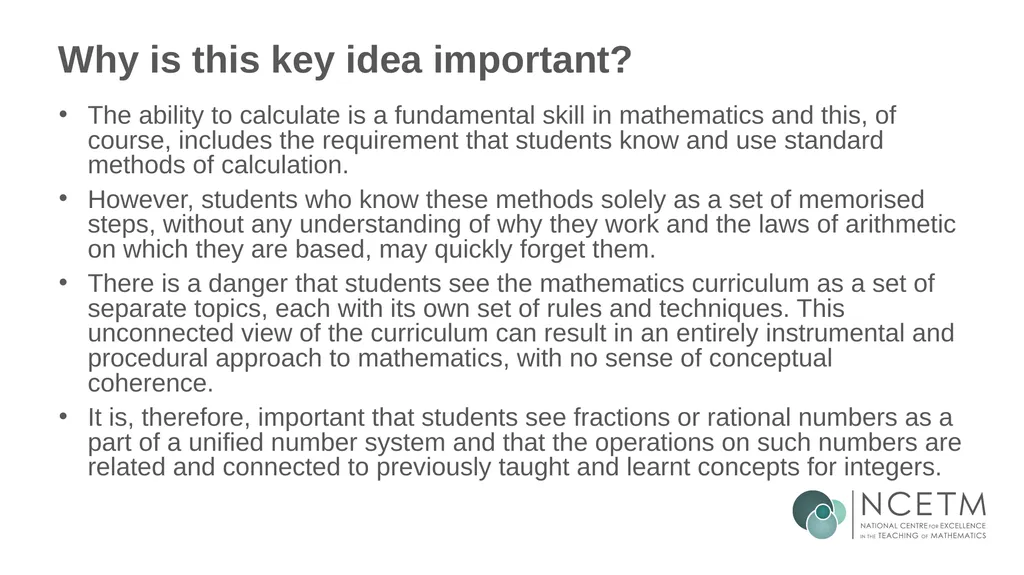
slide7. Why is this key idea important? The ability to calculate is a fundamental skill in mathematics and this, of course, includes the requirement that students know and use standard methods of calculation.
However, students who know these methods solely as a set of memorised steps, without any understanding of why they work and the laws of arithmetic on which they are based, may quickly forget them.
There is a danger that students see the mathematics curriculum as a set of separate topics, each with its own set of rules and techniques. This unconnected view of the curriculum can result in an entirely instrumental and procedural approach to mathematics, with no sense of conceptual coherence.
It is, therefore, important that students see fractions or rational numbers as a part of a unified number system and that the operations on such numbers are related and connected to previously taught and learnt concepts for integers.<br>
slide8. Prior learning What prior knowledge might your students already have?
What language might they use to describe this key idea?
What questions might you want to ask to assess their prior learning?<br>
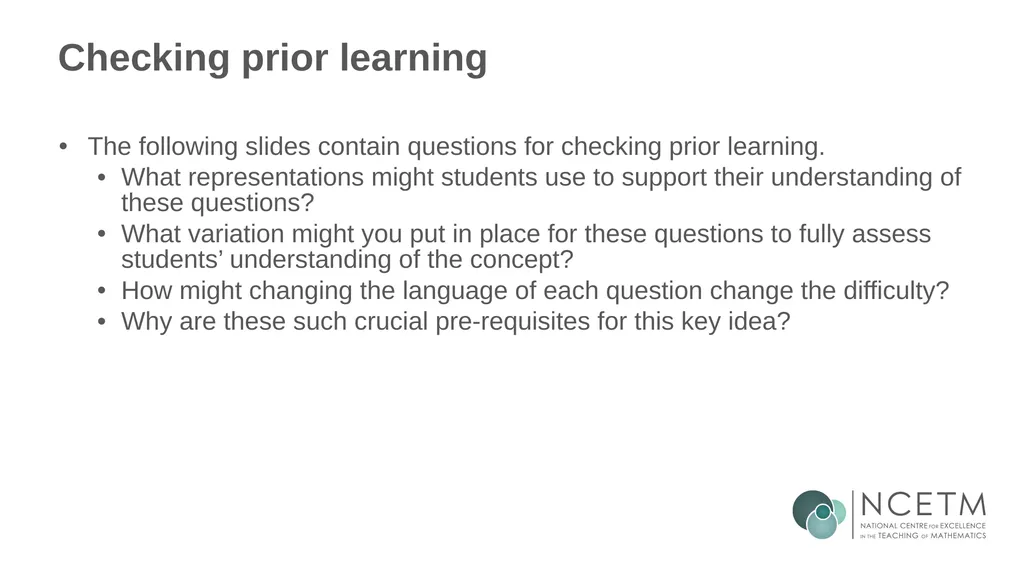
slide9. Checking prior learning The following slides contain questions for checking prior learning.
What representations might students use to support their understanding of these questions?
What variation might you put in place for these questions to fully assess students’ understanding of the concept?
How might changing the language of each question change the difficulty?
Why are these such crucial pre-requisites for this key idea?<br>
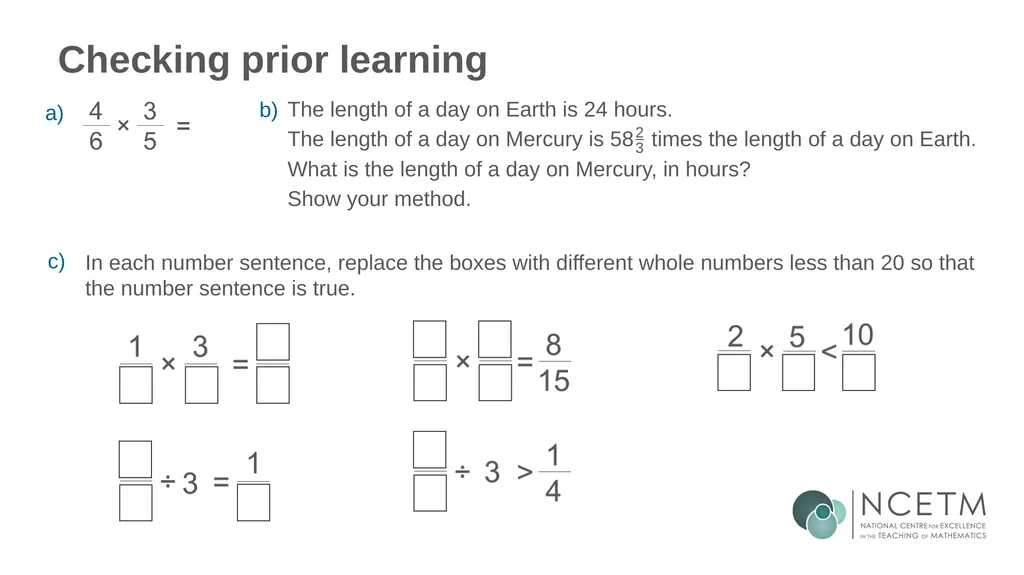
slide10. Checking prior learning In each number sentence, replace the boxes with different whole numbers less than 20 so that the number sentence is true. b) a) c)<br>
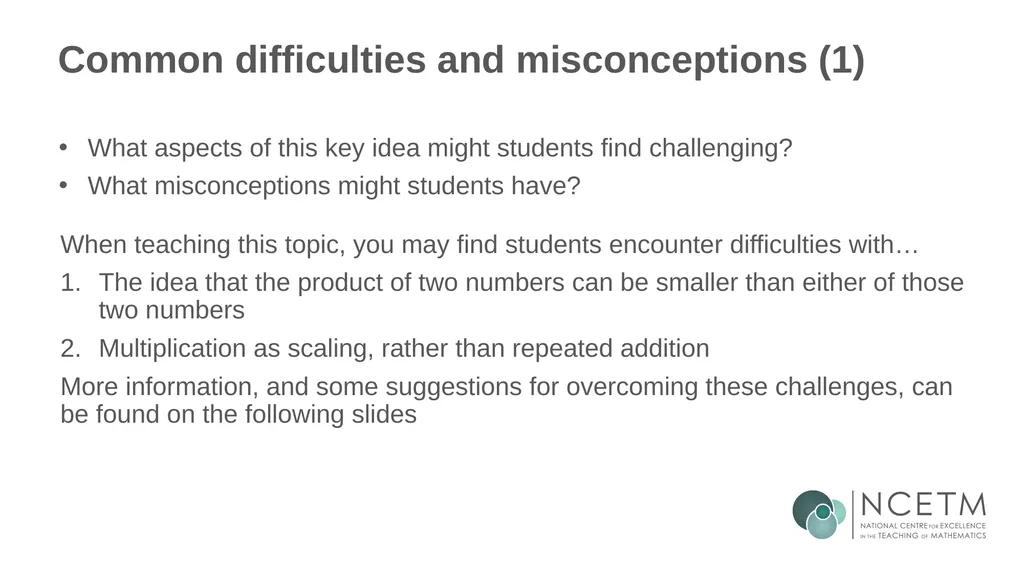
slide11. Common difficulties and misconceptions (1) What aspects of this key idea might students find challenging?
What misconceptions might students have? When teaching this topic, you may find students encounter difficulties with…
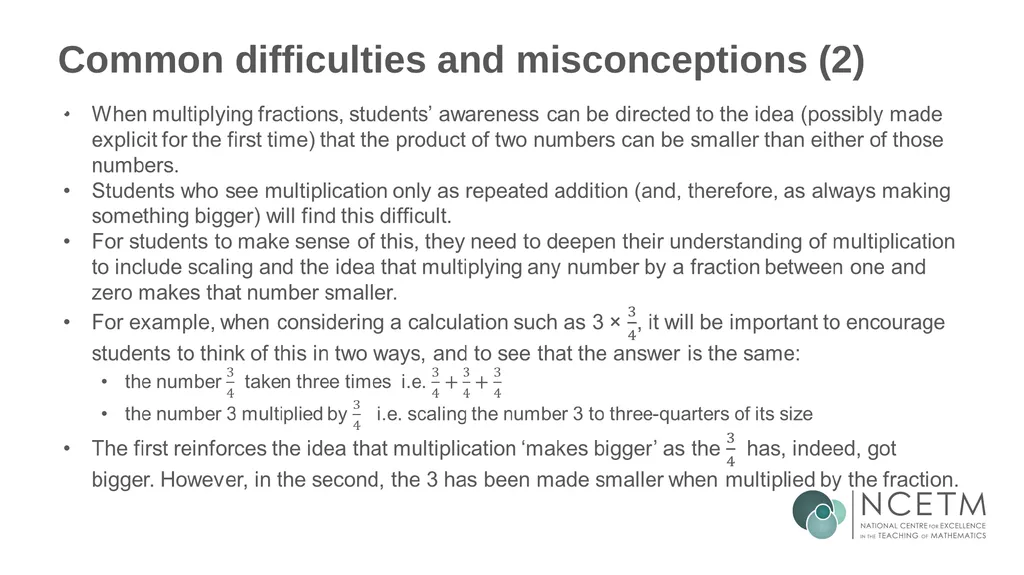
The idea that the product of two numbers can be smaller than either of those two numbers
Multiplication as scaling, rather than repeated addition
More information, and some suggestions for overcoming these challenges, can be found on the following slides<br>
slide12. Common difficulties and misconceptions (2)<br>
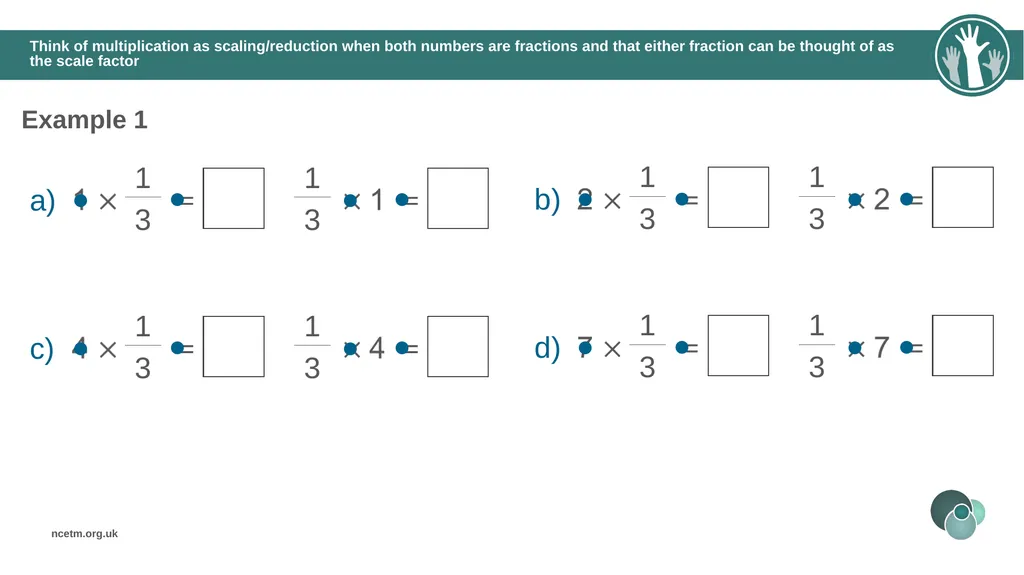
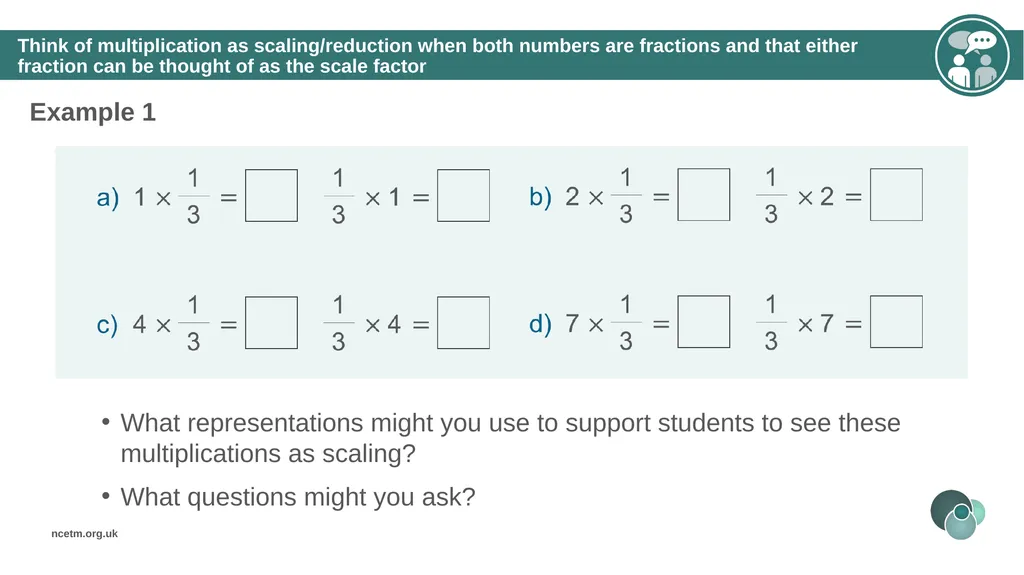
slide13. Think of multiplication as scaling/reduction when both numbers are fractions and that either fraction can be thought of as the scale factor Example 1 a) c) b) d)<br>
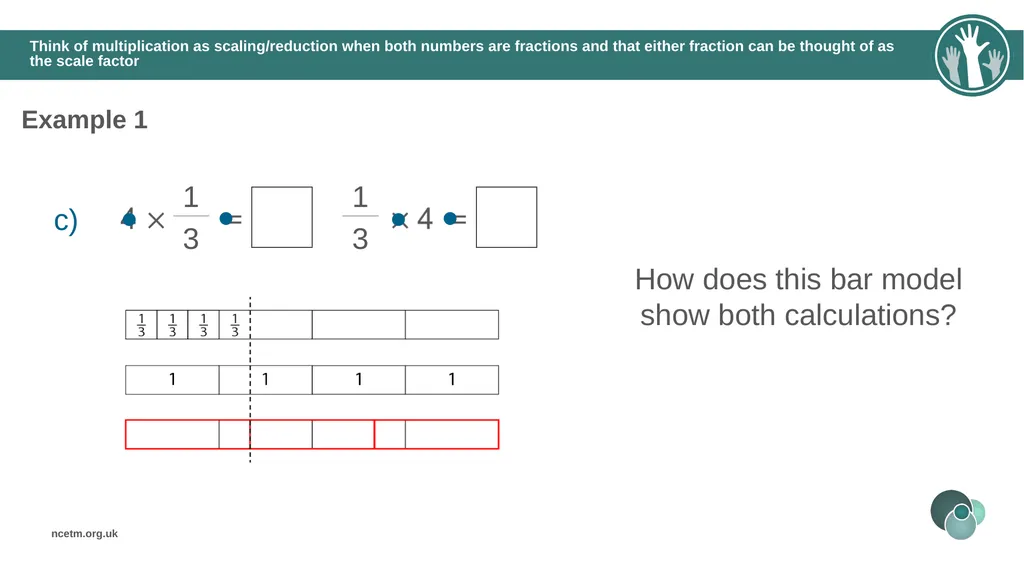
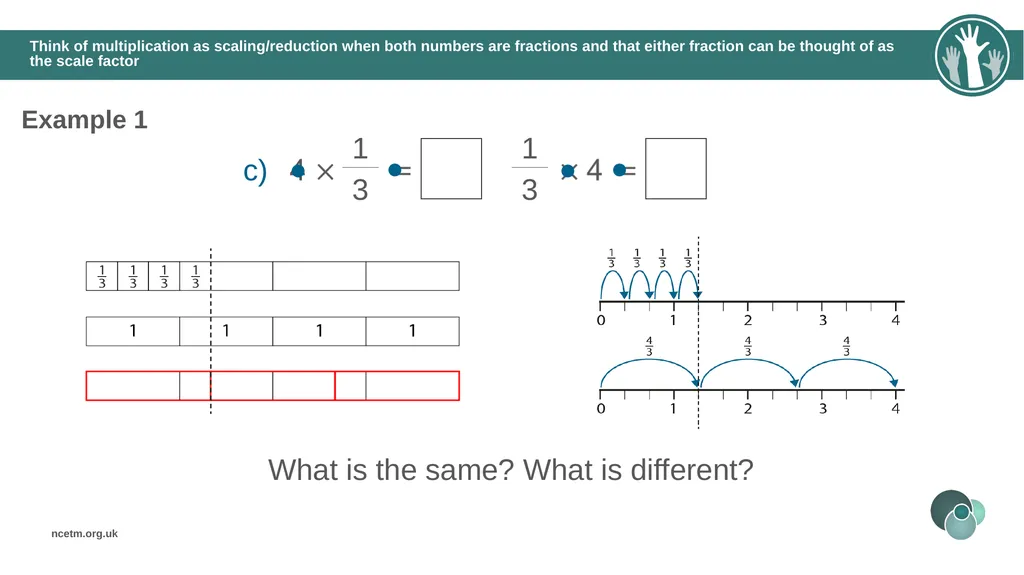
slide14. Think of multiplication as scaling/reduction when both numbers are fractions and that either fraction can be thought of as the scale factor Example 1 c) How does this bar model show both calculations?<br>
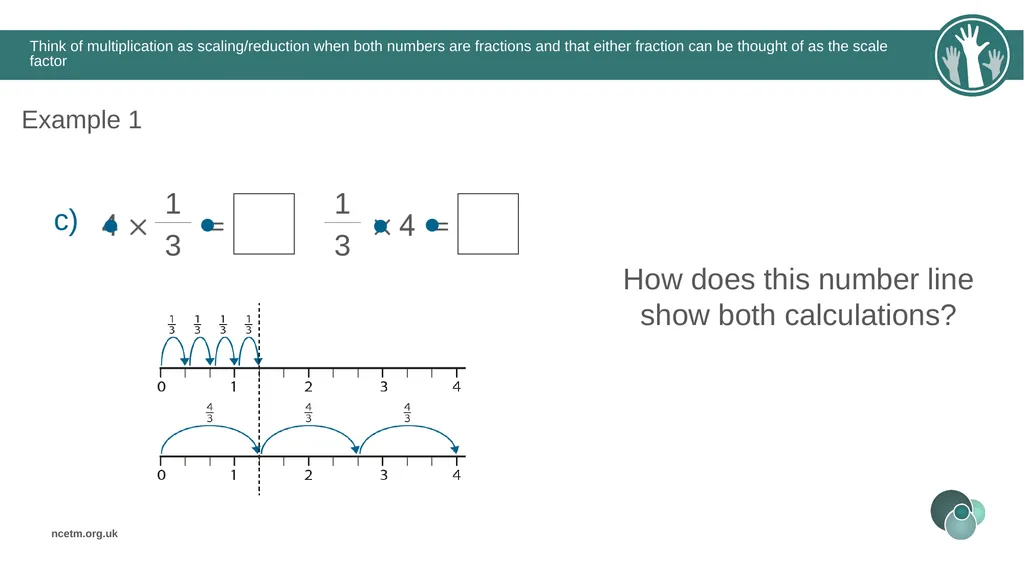
slide15. Think of multiplication as scaling/reduction when both numbers are fractions and that either fraction can be thought of as the scale factor Example 1 c) How does this number line show both calculations?<br>
slide16. Think of multiplication as scaling/reduction when both numbers are fractions and that either fraction can be thought of as the scale factor Example 1 c) What is the same? What is different?<br>
slide17. Think of multiplication as scaling/reduction when both numbers are fractions and that either fraction can be thought of as the scale factor Example 1 What representations might you use to support students to see these multiplications as scaling?
What questions might you ask?<br>
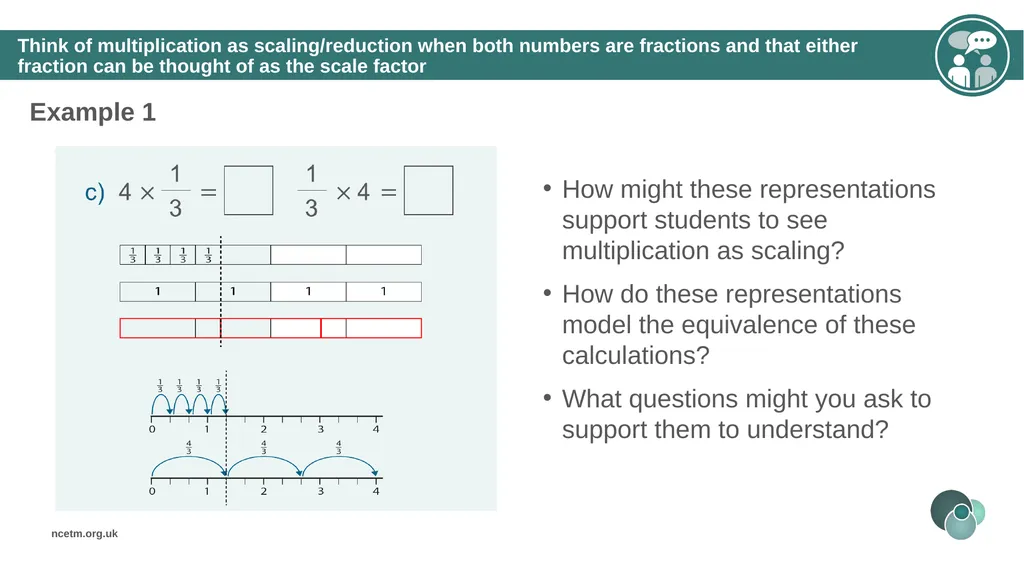
slide18. Think of multiplication as scaling/reduction when both numbers are fractions and that either fraction can be thought of as the scale factor Example 1 How might these representations support students to see multiplication as scaling?
How do these representations model the equivalence of these calculations?
What questions might you ask to support them to understand?<br>
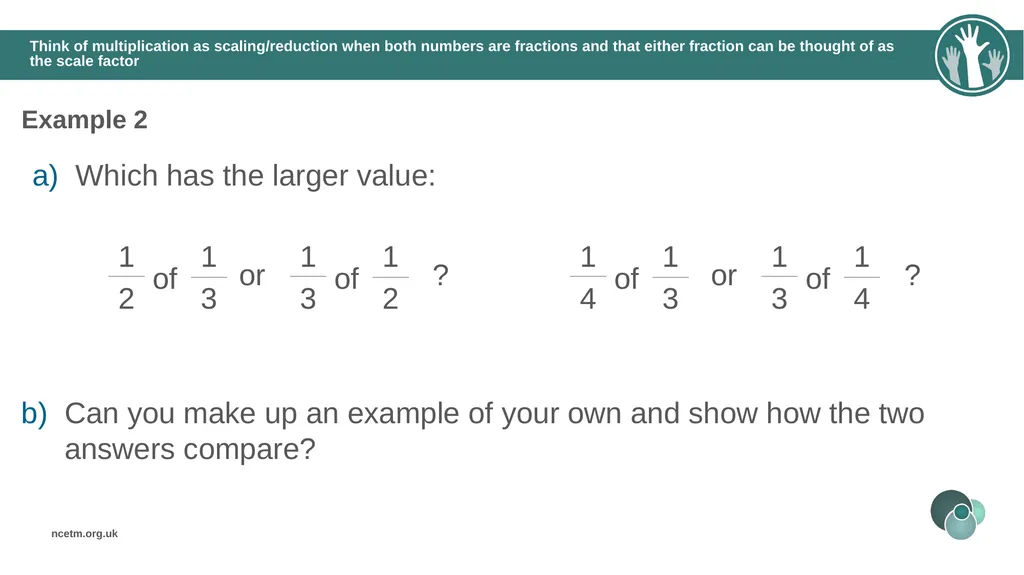
slide19. Think of multiplication as scaling/reduction when both numbers are fractions and that either fraction can be thought of as the scale factor Example 2 Which has the larger value: Can you make up an example of your own and show how the two answers compare? or ? or ?<br>
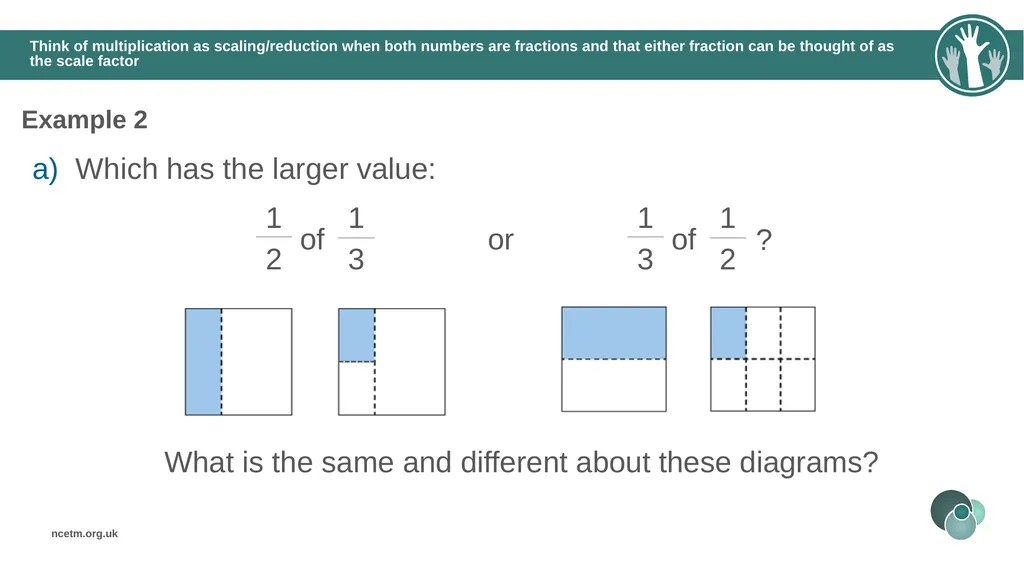
slide20. Think of multiplication as scaling/reduction when both numbers are fractions and that either fraction can be thought of as the scale factor Example 2 Which has the larger value: or ? What is the same and different about these diagrams?<br>
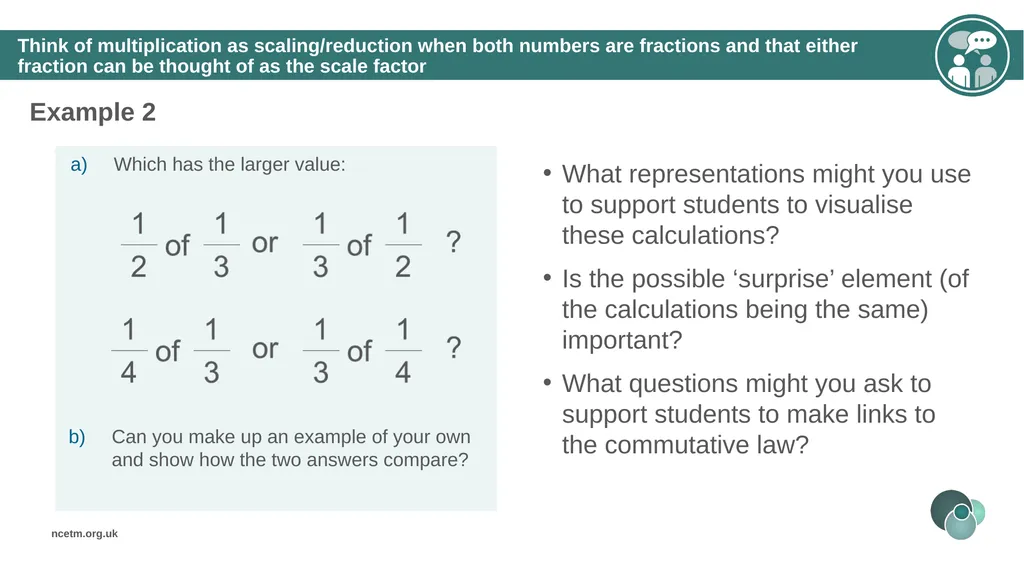
slide21. Think of multiplication as scaling/reduction when both numbers are fractions and that either fraction can be thought of as the scale factor Example 2 What representations might you use to support students to visualise these calculations?
Is the possible ‘surprise’ element (of the calculations being the same) important?
What questions might you ask to support students to make links to the commutative law? Which has the larger value: Can you make up an example of your own and show how the two answers compare?<br>
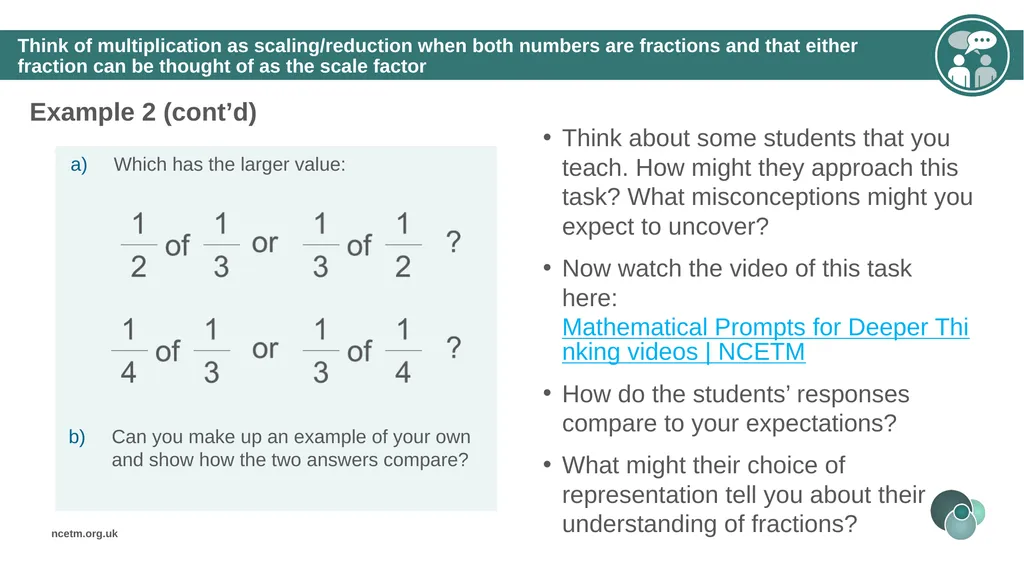
slide22. Think of multiplication as scaling/reduction when both numbers are fractions and that either fraction can be thought of as the scale factor Example 2 (cont’d) Think about some students that you teach. How might they approach this task? What misconceptions might you expect to uncover?
Now watch the video of this task here: Mathematical Prompts for Deeper Thinking videos | NCETM
How do the students’ responses compare to your expectations?
What might their choice of representation tell you about their understanding of fractions? Which has the larger value: Can you make up an example of your own and show how the two answers compare?<br>
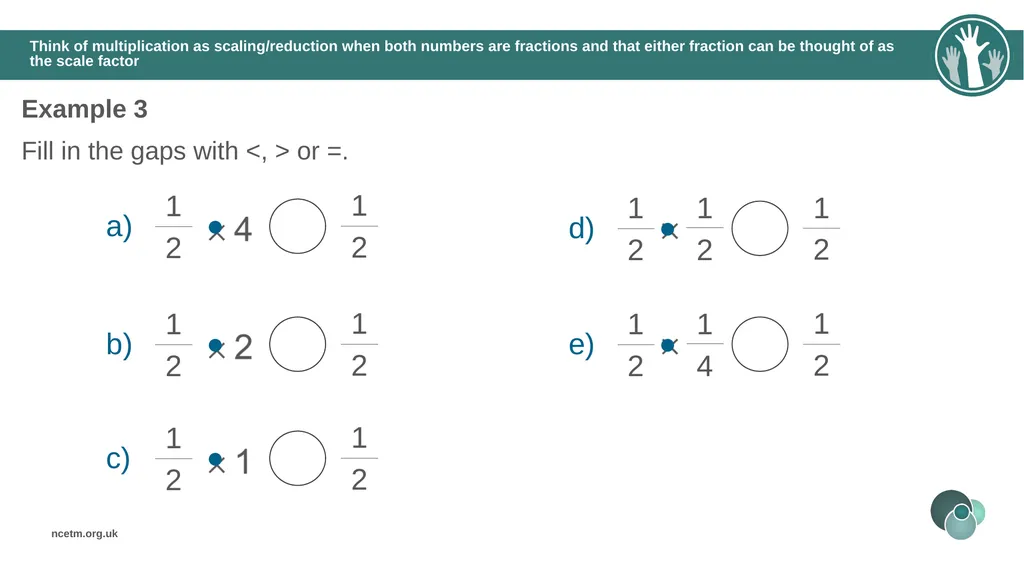
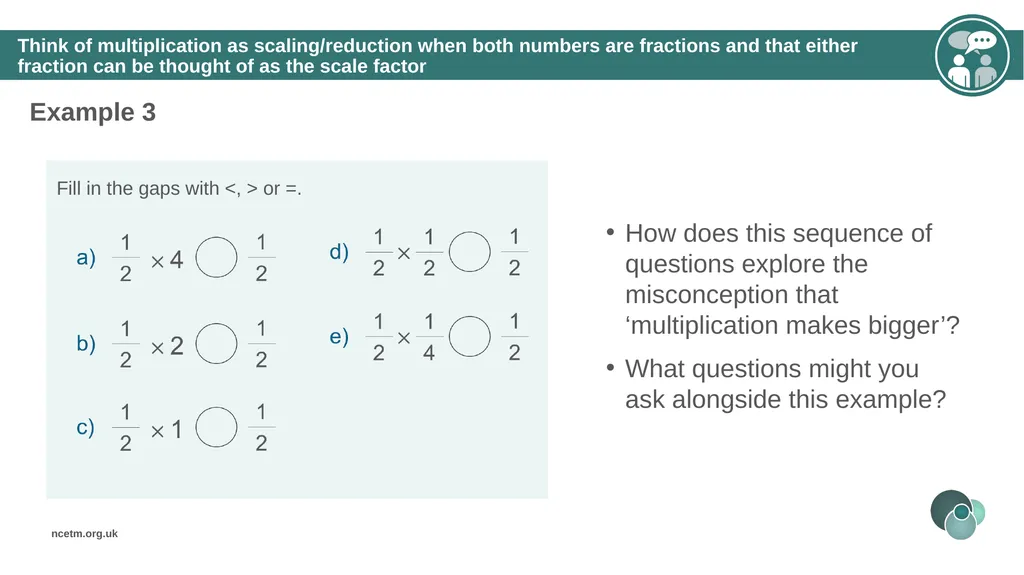
slide23. Think of multiplication as scaling/reduction when both numbers are fractions and that either fraction can be thought of as the scale factor Example 3 Fill in the gaps with <, > or =.<br>
slide24. Think of multiplication as scaling/reduction when both numbers are fractions and that either fraction can be thought of as the scale factor Example 3 How does this sequence of questions explore the misconception that ‘multiplication makes bigger’?
What questions might you ask alongside this example? Fill in the gaps with <, > or =.<br>
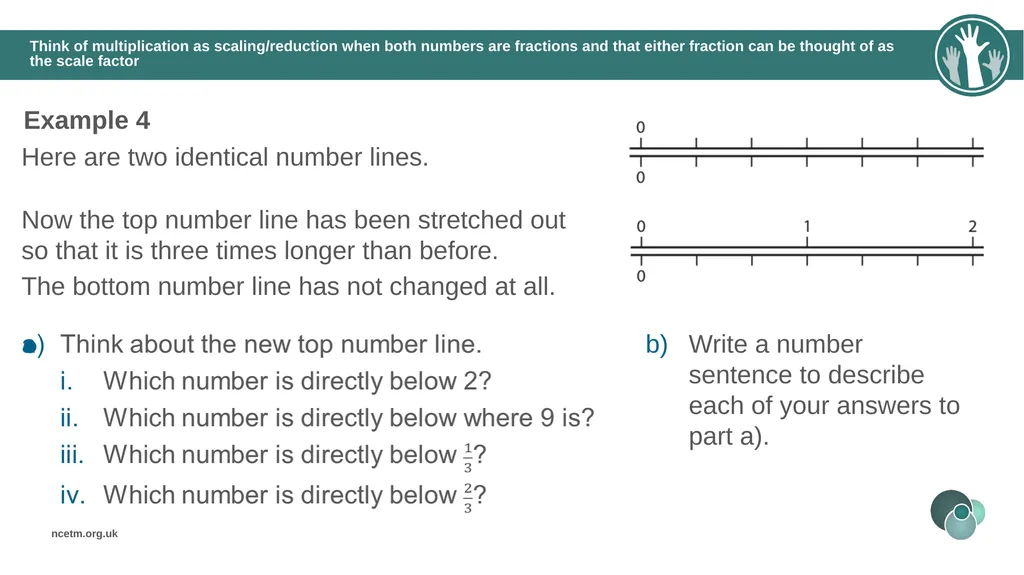
slide25. Here are two identical number lines.
Now the top number line has been stretched out so that it is three times longer than before.
The bottom number line has not changed at all. Think of multiplication as scaling/reduction when both numbers are fractions and that either fraction can be thought of as the scale factor Example 4 Write a number sentence to describe each of your answers to part a).<br>
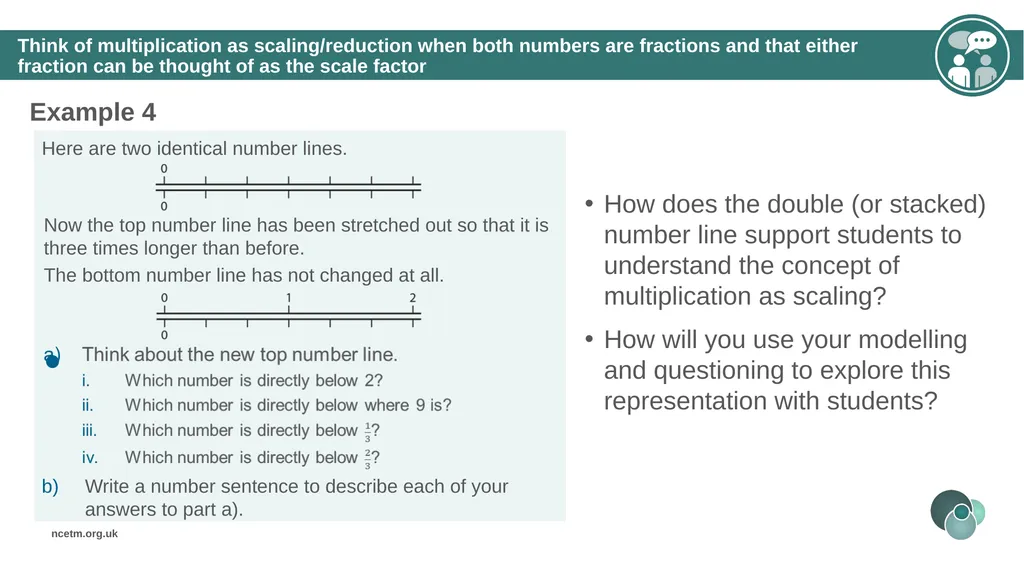
slide26. Think of multiplication as scaling/reduction when both numbers are fractions and that either fraction can be thought of as the scale factor Example 4 How does the double (or stacked) number line support students to understand the concept of multiplication as scaling?
How will you use your modelling and questioning to explore this representation with students? Here are two identical number lines. Write a number sentence to describe each of your answers to part a). Now the top number line has been stretched out so that it is three times longer than before.
The bottom number line has not changed at all.<br>
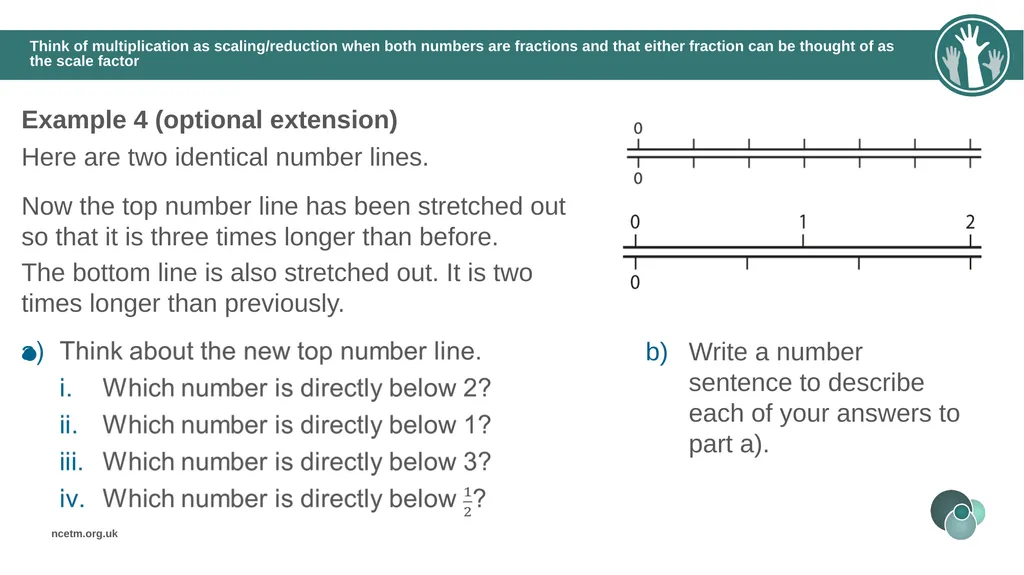
slide27. Here are two identical number lines.
Now the top number line has been stretched out so that it is three times longer than before.
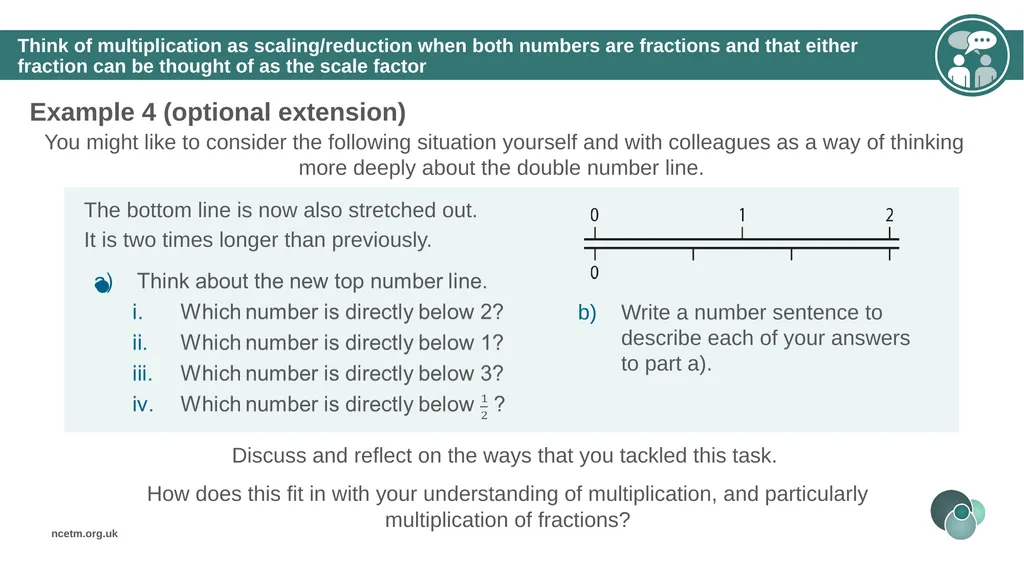
The bottom line is also stretched out. It is two times longer than previously. Think of multiplication as scaling/reduction when both numbers are fractions and that either fraction can be thought of as the scale factor Example 4 (optional extension) Write a number sentence to describe each of your answers to part a).<br>
slide28. Think of multiplication as scaling/reduction when both numbers are fractions and that either fraction can be thought of as the scale factor Example 4 (optional extension) Discuss and reflect on the ways that you tackled this task.
How does this fit in with your understanding of multiplication, and particularly multiplication of fractions? The bottom line is now also stretched out.
It is two times longer than previously. Write a number sentence to describe each of your answers to part a). You might like to consider the following situation yourself and with colleagues as a way of thinking more deeply about the double number line.<br>
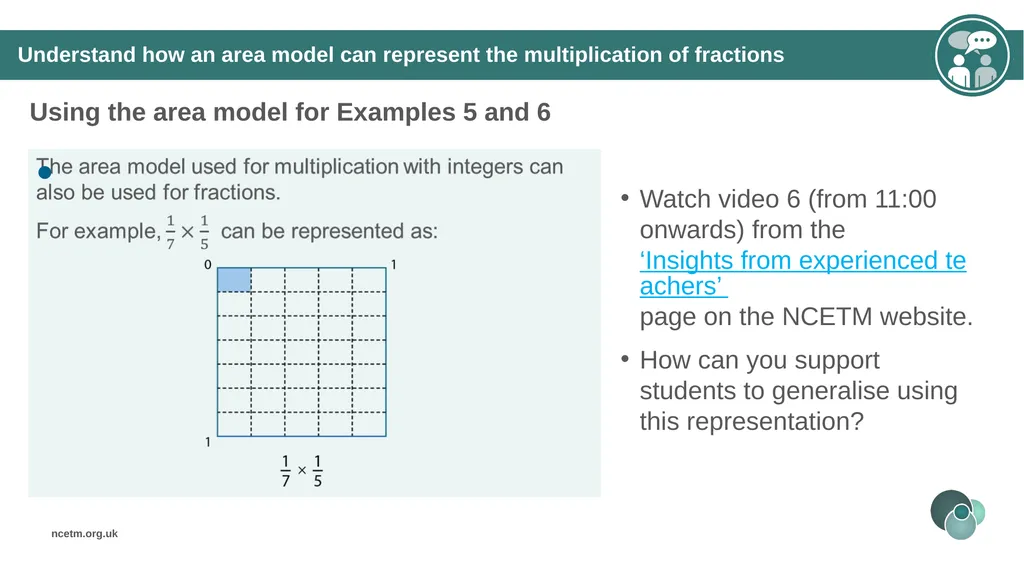
slide29. Using the area model for Examples 5 and 6 Watch video 6 (from 11:00 onwards) from the ‘Insights from experienced teachers’ page on the NCETM website.
How can you support students to generalise using this representation? Understand how an area model can represent the multiplication of fractions<br>
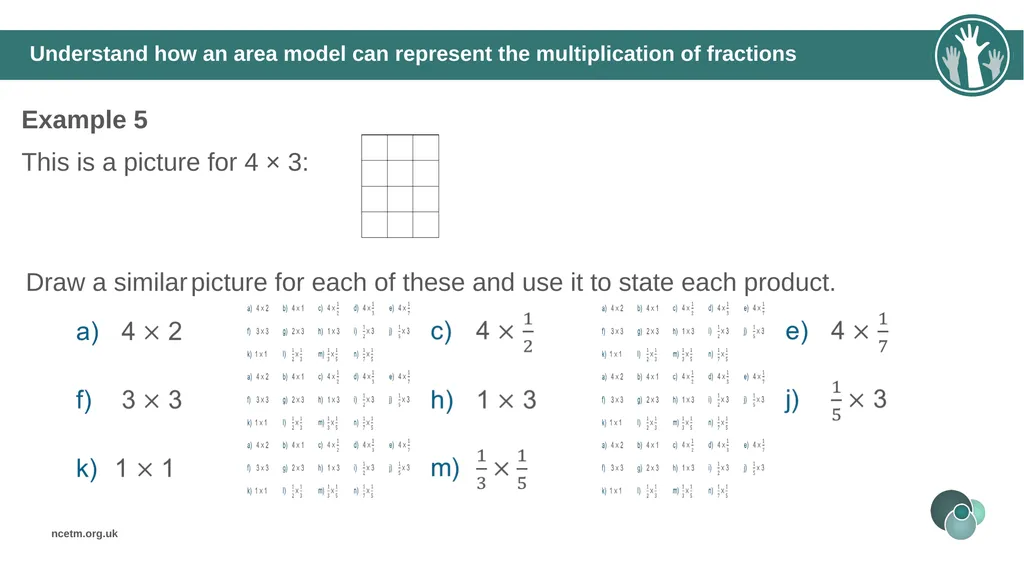
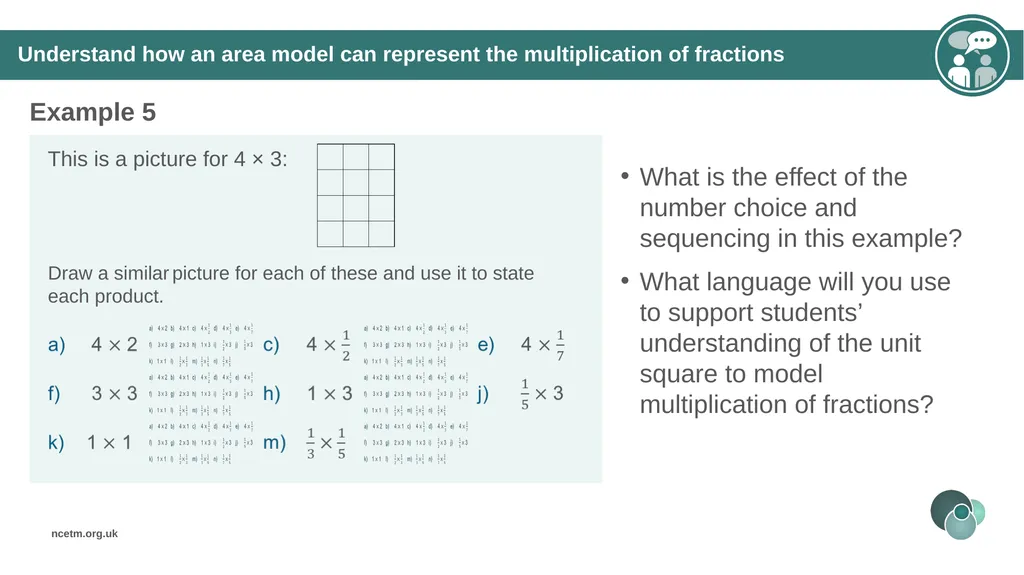
slide30. Understand how an area model can represent the multiplication of fractions Example 5 This is a picture for 4 × 3: Draw a similar picture for each of these and use it to state each product.<br>
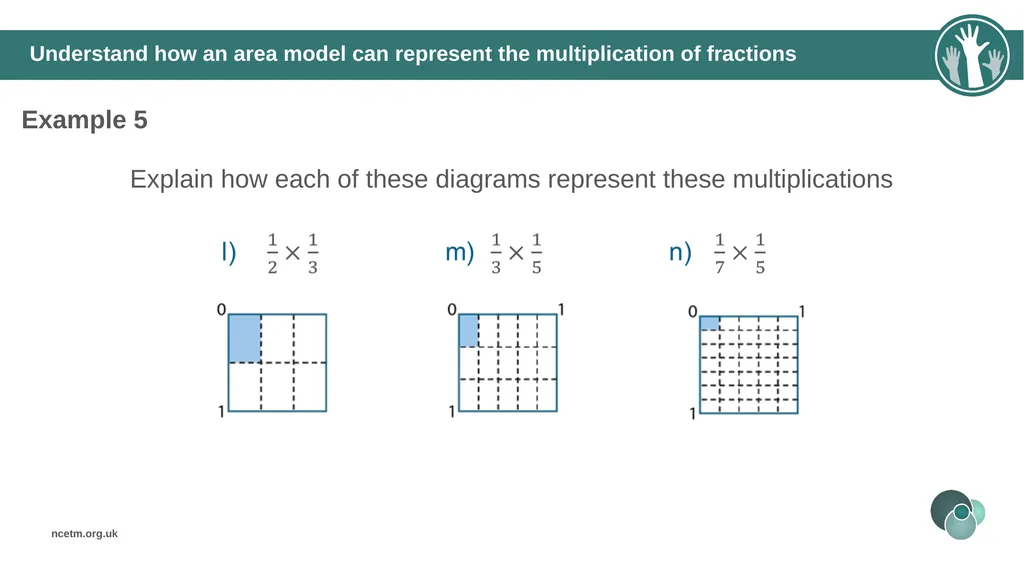
slide31. Understand how an area model can represent the multiplication of fractions Example 5 Explain how each of these diagrams represent these multiplications<br>
slide32. Example 5 What is the effect of the number choice and sequencing in this example?
What language will you use to support students’ understanding of the unit square to model multiplication of fractions? This is a picture for 4 × 3: Draw a similar picture for each of these and use it to state each product. Understand how an area model can represent the multiplication of fractions<br>
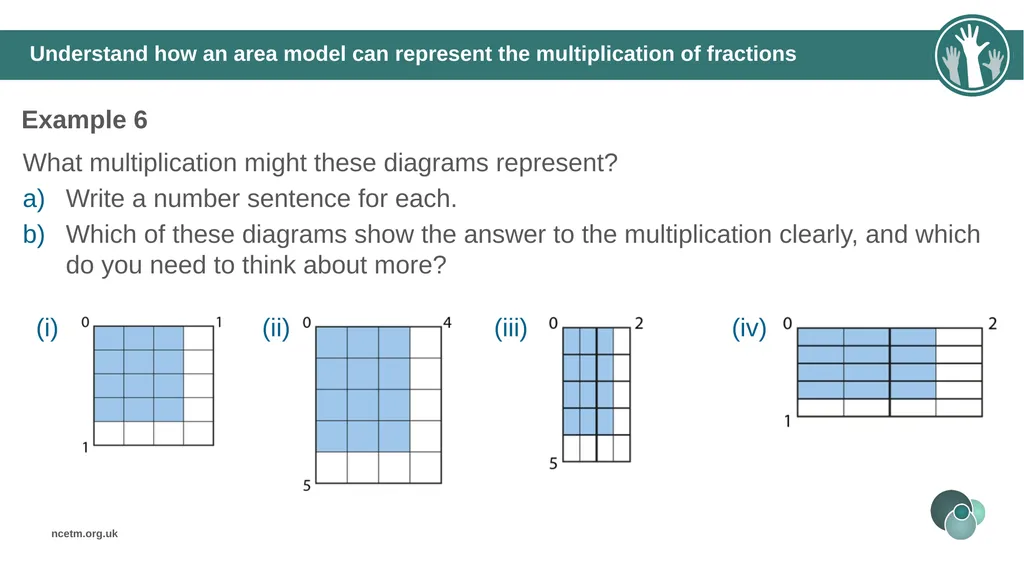
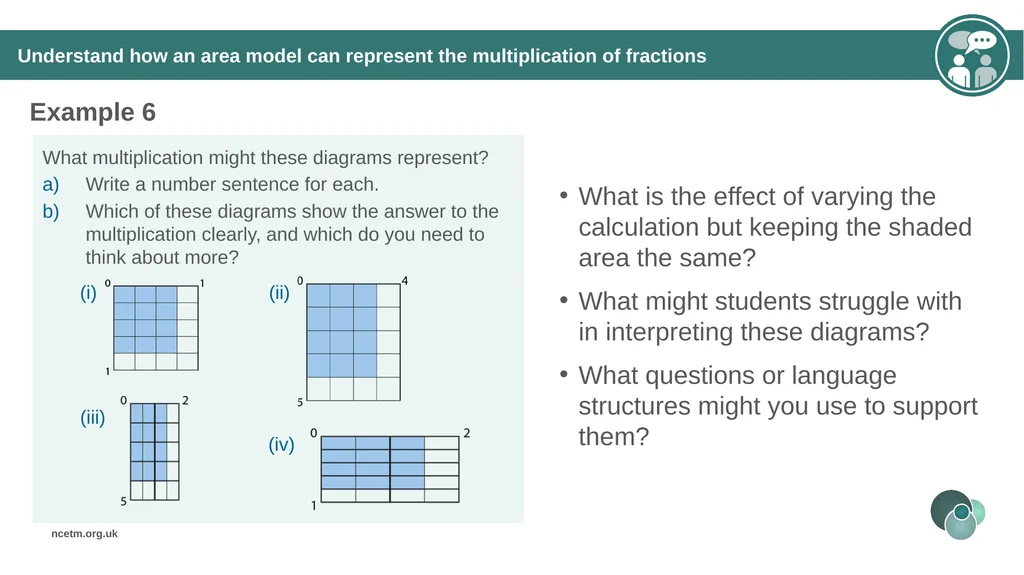
slide33. Understand how an area model can represent the multiplication of fractions Example 6 What multiplication might these diagrams represent?
Write a number sentence for each.
Which of these diagrams show the answer to the multiplication clearly, and which do you need to think about more? (i) (ii) (iii) (iv)<br>
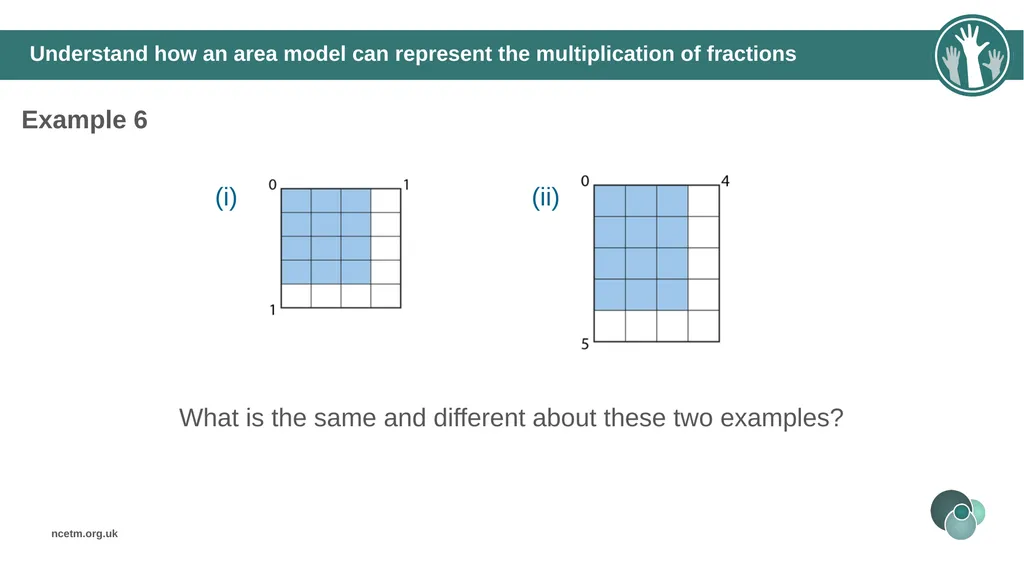
slide34. Understand how an area model can represent the multiplication of fractions Example 6 (i) (ii) What is the same and different about these two examples?<br>
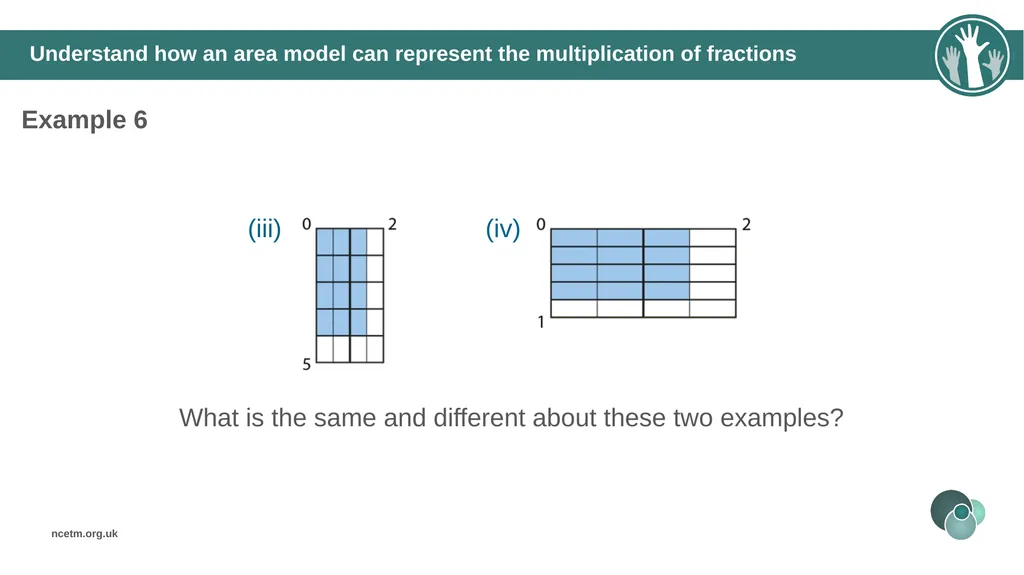
slide35. Understand how an area model can represent the multiplication of fractions Example 6 What is the same and different about these two examples? (iii) (iv)<br>
slide36. Understand how an area model can represent the multiplication of fractions Example 6 What is the effect of varying the calculation but keeping the shaded area the same?
What might students struggle with in interpreting these diagrams?
What questions or language structures might you use to support them? What multiplication might these diagrams represent?
Write a number sentence for each.
Which of these diagrams show the answer to the multiplication clearly, and which do you need to think about more? (i) (ii) (iii) (iv)<br>
slide37. Reflection questions What other mathematical concepts will be supported by students’ stronger understanding of this key idea?
What mathematical language will you continue to use to support pupils to make connections with other areas?
Which representations might you continue to use to further develop students’ understanding?<br>
slide39. Appendices You may choose to use the following slides when planning or delivering a PD session. They cover:
Key vocabulary
Representations and structure
Future learning
Library of links<br>
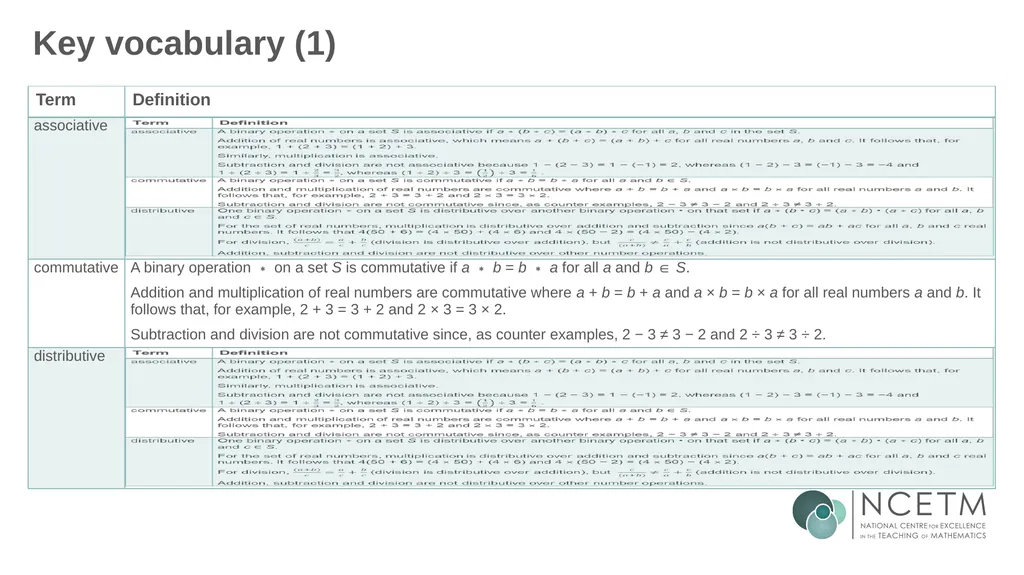
slide40. Key vocabulary (1)<br>
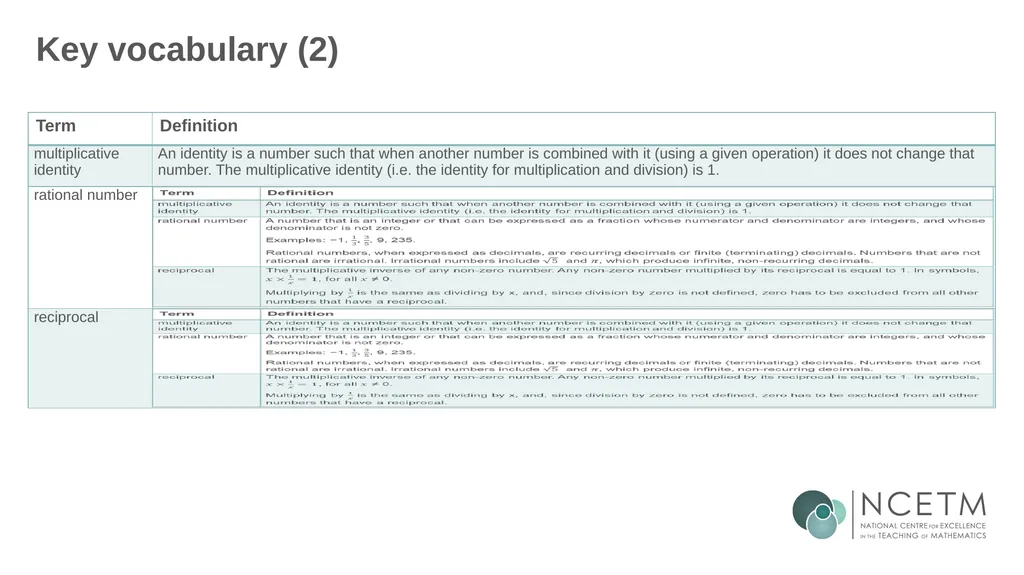
slide41. Key vocabulary (2)<br>
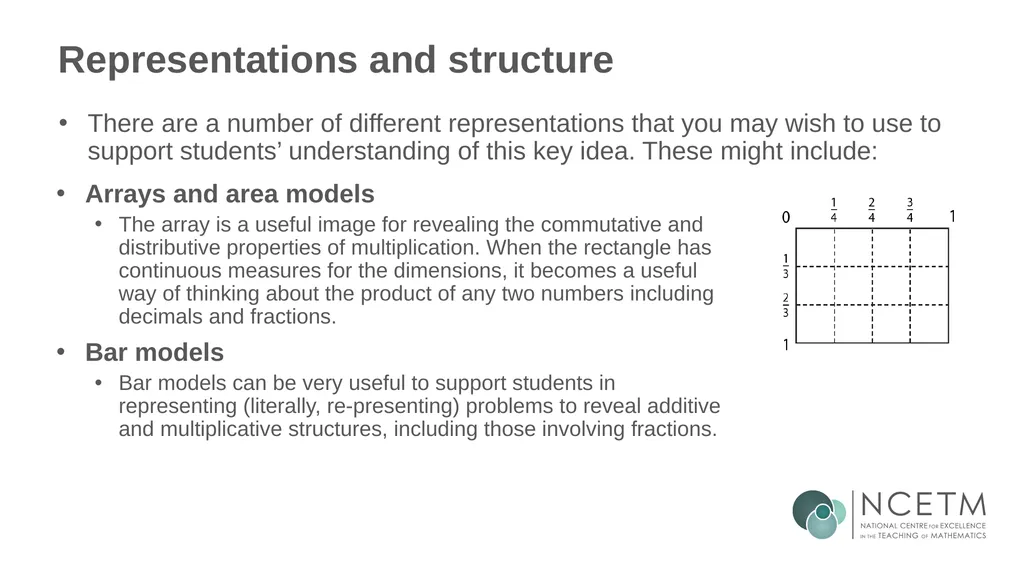
slide42. Representations and structure There are a number of different representations that you may wish to use to support students’ understanding of this key idea. These might include: Arrays and area models
The array is a useful image for revealing the commutative and distributive properties of multiplication. When the rectangle has continuous measures for the dimensions, it becomes a useful way of thinking about the product of any two numbers including decimals and fractions.
Bar models
Bar models can be very useful to support students in representing (literally, re-presenting) problems to reveal additive and multiplicative structures, including those involving fractions.<br>
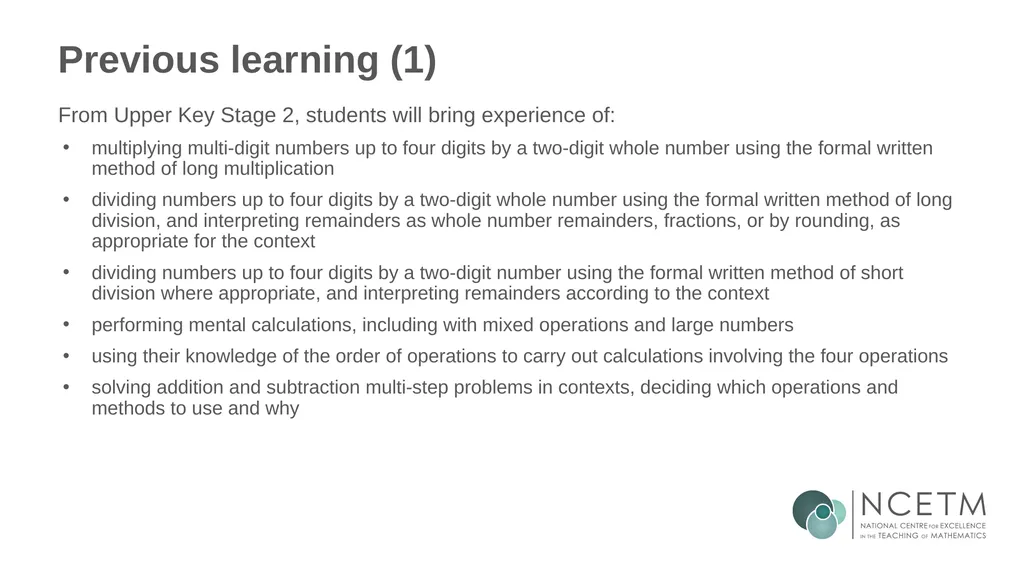
slide43. Previous learning (1) From Upper Key Stage 2, students will bring experience of:
multiplying multi-digit numbers up to four digits by a two-digit whole number using the formal written method of long multiplication
dividing numbers up to four digits by a two-digit whole number using the formal written method of long division, and interpreting remainders as whole number remainders, fractions, or by rounding, as appropriate for the context
dividing numbers up to four digits by a two-digit number using the formal written method of short division where appropriate, and interpreting remainders according to the context
performing mental calculations, including with mixed operations and large numbers
using their knowledge of the order of operations to carry out calculations involving the four operations
solving addition and subtraction multi-step problems in contexts, deciding which operations and methods to use and why<br>
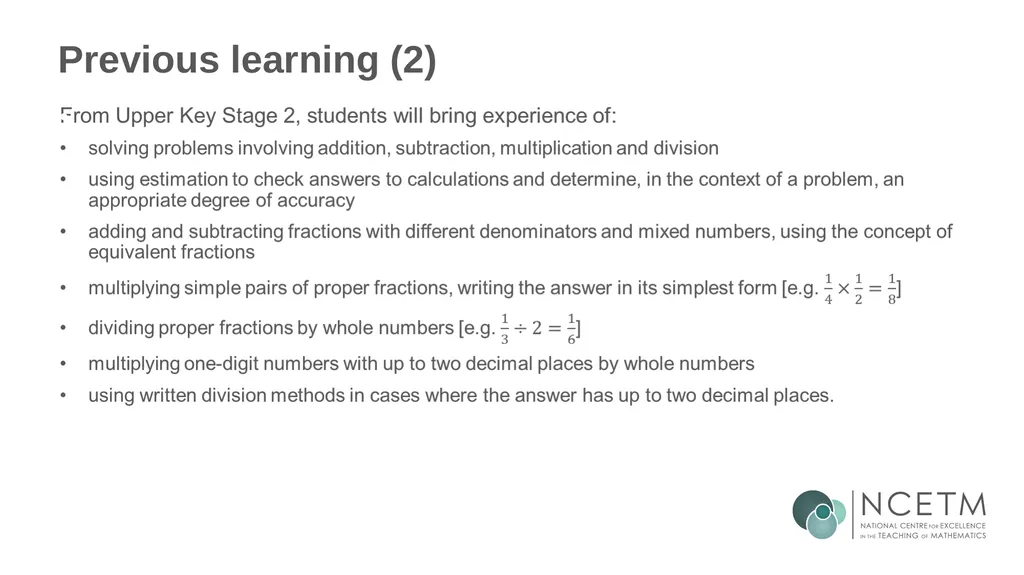
slide44. Previous learning (2)<br>
slide45. Future learning<br>
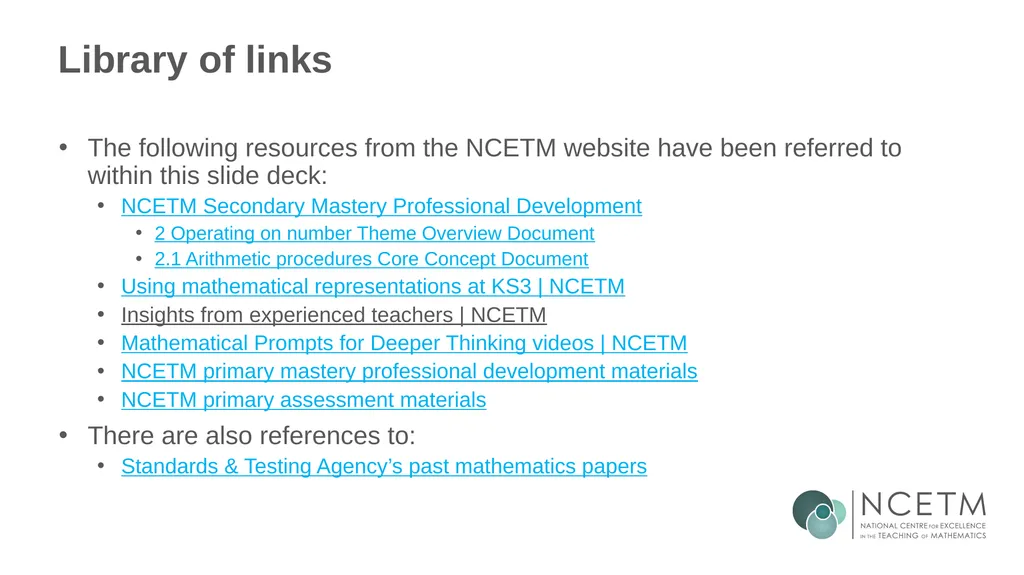
slide46. Library of links The following resources from the NCETM website have been referred to within this slide deck:
NCETM Secondary Mastery Professional Development
2 Operating on number Theme Overview Document
2.1 Arithmetic procedures Core Concept Document
Using mathematical representations at KS3 | NCETM
Insights from experienced teachers | NCETM
Mathematical Prompts for Deeper Thinking videos | NCETM
NCETM primary mastery professional development materials
NCETM primary assessment materials
There are also references to:
Standards & Testing Agency’s past mathematics papers<br>
Materials for use in the classroom or to support professional development discussions Summer 2021<br>
slide2. About this resource These slides are designed to complement the 2.1 Arithmetic procedures Core Concept document and its associated Theme Overview document 2 Operating on number, both found in the Secondary Mastery Professional Development pages.
These slides re-present the key examples from the Core Concept document so that the examples can be used either directly in the classroom or with a group of teachers. There are prompt questions alongside the examples, and further clarification in the notes.
These slides do not fully replicate the Core Concept document, so should be used alongside it. Reference to specific page numbers, and to other useful NCETM resources, can be found in the notes for each slide.
This slide deck is not designed to be a complete PD session, rather it is a selection of resources that you can adapt and use as needed when planning a session with a group of teachers.<br>
slide3. About this resource The slides are structured as follows:
The big picture:
Where does this fit in?
What do students need to understand?
Why is this key idea important?
Prior learning
Misconceptions
Exemplified key ideas
Reflection questions
Appendices:
Key vocabulary
Representations and structure
Future learning
Useful links The exemplified key idea slides have the following symbols to indicate how they have been designed to be used: Into the classroom
The examples are presented on these slides so that they could be used in PD, but also directly in the classroom. The notes feature suggested questions and things teachers might consider when using with students. PD discussion prompts
These slides look at the examples in more detail, with question prompts to promote discussion among maths teachers. The notes feature reference to further information and guidance within the Core Concepts document.<br>
slide4. Where does this fit in? The NCETM has identified a set of six ‘mathematical themes’ within Key Stage 3 mathematics that bring together a group of ‘core concepts’.
The second of these themes is Operating on number, which covers the following interconnected core concepts:
2.1 Arithmetic procedures
2.2 Solving linear equations<br>
slide5. Where does this fit in? Within this core concept, 2.1 Arithmetic Procedures, there are five statements of knowledge, skills and understanding.
These, in turn, are broken down into twenty one key ideas. The highlighted key idea is exemplified in this slide deck.<br>
slide6. What do students need to understand? What prior knowledge might your students already have?
What language might they use to describe this key idea?
What questions might you want to ask to assess their prior learning? 2.1.4.1 Understand the mathematical structures that underpin the multiplication of fractions
Think of multiplication as scaling/reduction when both numbers are fractions and that either fraction can be thought of as the scale factor.
Understand how an area model can represent the multiplication of fractions.<br>
slide7. Why is this key idea important? The ability to calculate is a fundamental skill in mathematics and this, of course, includes the requirement that students know and use standard methods of calculation.
However, students who know these methods solely as a set of memorised steps, without any understanding of why they work and the laws of arithmetic on which they are based, may quickly forget them.
There is a danger that students see the mathematics curriculum as a set of separate topics, each with its own set of rules and techniques. This unconnected view of the curriculum can result in an entirely instrumental and procedural approach to mathematics, with no sense of conceptual coherence.
It is, therefore, important that students see fractions or rational numbers as a part of a unified number system and that the operations on such numbers are related and connected to previously taught and learnt concepts for integers.<br>
slide8. Prior learning What prior knowledge might your students already have?
What language might they use to describe this key idea?
What questions might you want to ask to assess their prior learning?<br>
slide9. Checking prior learning The following slides contain questions for checking prior learning.
What representations might students use to support their understanding of these questions?
What variation might you put in place for these questions to fully assess students’ understanding of the concept?
How might changing the language of each question change the difficulty?
Why are these such crucial pre-requisites for this key idea?<br>
slide10. Checking prior learning In each number sentence, replace the boxes with different whole numbers less than 20 so that the number sentence is true. b) a) c)<br>
slide11. Common difficulties and misconceptions (1) What aspects of this key idea might students find challenging?
What misconceptions might students have? When teaching this topic, you may find students encounter difficulties with…
The idea that the product of two numbers can be smaller than either of those two numbers
Multiplication as scaling, rather than repeated addition
More information, and some suggestions for overcoming these challenges, can be found on the following slides<br>
slide12. Common difficulties and misconceptions (2)<br>
slide13. Think of multiplication as scaling/reduction when both numbers are fractions and that either fraction can be thought of as the scale factor Example 1 a) c) b) d)<br>
slide14. Think of multiplication as scaling/reduction when both numbers are fractions and that either fraction can be thought of as the scale factor Example 1 c) How does this bar model show both calculations?<br>
slide15. Think of multiplication as scaling/reduction when both numbers are fractions and that either fraction can be thought of as the scale factor Example 1 c) How does this number line show both calculations?<br>
slide16. Think of multiplication as scaling/reduction when both numbers are fractions and that either fraction can be thought of as the scale factor Example 1 c) What is the same? What is different?<br>
slide17. Think of multiplication as scaling/reduction when both numbers are fractions and that either fraction can be thought of as the scale factor Example 1 What representations might you use to support students to see these multiplications as scaling?
What questions might you ask?<br>
slide18. Think of multiplication as scaling/reduction when both numbers are fractions and that either fraction can be thought of as the scale factor Example 1 How might these representations support students to see multiplication as scaling?
How do these representations model the equivalence of these calculations?
What questions might you ask to support them to understand?<br>
slide19. Think of multiplication as scaling/reduction when both numbers are fractions and that either fraction can be thought of as the scale factor Example 2 Which has the larger value: Can you make up an example of your own and show how the two answers compare? or ? or ?<br>
slide20. Think of multiplication as scaling/reduction when both numbers are fractions and that either fraction can be thought of as the scale factor Example 2 Which has the larger value: or ? What is the same and different about these diagrams?<br>
slide21. Think of multiplication as scaling/reduction when both numbers are fractions and that either fraction can be thought of as the scale factor Example 2 What representations might you use to support students to visualise these calculations?
Is the possible ‘surprise’ element (of the calculations being the same) important?
What questions might you ask to support students to make links to the commutative law? Which has the larger value: Can you make up an example of your own and show how the two answers compare?<br>
slide22. Think of multiplication as scaling/reduction when both numbers are fractions and that either fraction can be thought of as the scale factor Example 2 (cont’d) Think about some students that you teach. How might they approach this task? What misconceptions might you expect to uncover?
Now watch the video of this task here: Mathematical Prompts for Deeper Thinking videos | NCETM
How do the students’ responses compare to your expectations?
What might their choice of representation tell you about their understanding of fractions? Which has the larger value: Can you make up an example of your own and show how the two answers compare?<br>
slide23. Think of multiplication as scaling/reduction when both numbers are fractions and that either fraction can be thought of as the scale factor Example 3 Fill in the gaps with <, > or =.<br>
slide24. Think of multiplication as scaling/reduction when both numbers are fractions and that either fraction can be thought of as the scale factor Example 3 How does this sequence of questions explore the misconception that ‘multiplication makes bigger’?
What questions might you ask alongside this example? Fill in the gaps with <, > or =.<br>
slide25. Here are two identical number lines.
Now the top number line has been stretched out so that it is three times longer than before.
The bottom number line has not changed at all. Think of multiplication as scaling/reduction when both numbers are fractions and that either fraction can be thought of as the scale factor Example 4 Write a number sentence to describe each of your answers to part a).<br>
slide26. Think of multiplication as scaling/reduction when both numbers are fractions and that either fraction can be thought of as the scale factor Example 4 How does the double (or stacked) number line support students to understand the concept of multiplication as scaling?
How will you use your modelling and questioning to explore this representation with students? Here are two identical number lines. Write a number sentence to describe each of your answers to part a). Now the top number line has been stretched out so that it is three times longer than before.
The bottom number line has not changed at all.<br>
slide27. Here are two identical number lines.
Now the top number line has been stretched out so that it is three times longer than before.
The bottom line is also stretched out. It is two times longer than previously. Think of multiplication as scaling/reduction when both numbers are fractions and that either fraction can be thought of as the scale factor Example 4 (optional extension) Write a number sentence to describe each of your answers to part a).<br>
slide28. Think of multiplication as scaling/reduction when both numbers are fractions and that either fraction can be thought of as the scale factor Example 4 (optional extension) Discuss and reflect on the ways that you tackled this task.
How does this fit in with your understanding of multiplication, and particularly multiplication of fractions? The bottom line is now also stretched out.
It is two times longer than previously. Write a number sentence to describe each of your answers to part a). You might like to consider the following situation yourself and with colleagues as a way of thinking more deeply about the double number line.<br>
slide29. Using the area model for Examples 5 and 6 Watch video 6 (from 11:00 onwards) from the ‘Insights from experienced teachers’ page on the NCETM website.
How can you support students to generalise using this representation? Understand how an area model can represent the multiplication of fractions<br>
slide30. Understand how an area model can represent the multiplication of fractions Example 5 This is a picture for 4 × 3: Draw a similar picture for each of these and use it to state each product.<br>
slide31. Understand how an area model can represent the multiplication of fractions Example 5 Explain how each of these diagrams represent these multiplications<br>
slide32. Example 5 What is the effect of the number choice and sequencing in this example?
What language will you use to support students’ understanding of the unit square to model multiplication of fractions? This is a picture for 4 × 3: Draw a similar picture for each of these and use it to state each product. Understand how an area model can represent the multiplication of fractions<br>
slide33. Understand how an area model can represent the multiplication of fractions Example 6 What multiplication might these diagrams represent?
Write a number sentence for each.
Which of these diagrams show the answer to the multiplication clearly, and which do you need to think about more? (i) (ii) (iii) (iv)<br>
slide34. Understand how an area model can represent the multiplication of fractions Example 6 (i) (ii) What is the same and different about these two examples?<br>
slide35. Understand how an area model can represent the multiplication of fractions Example 6 What is the same and different about these two examples? (iii) (iv)<br>
slide36. Understand how an area model can represent the multiplication of fractions Example 6 What is the effect of varying the calculation but keeping the shaded area the same?
What might students struggle with in interpreting these diagrams?
What questions or language structures might you use to support them? What multiplication might these diagrams represent?
Write a number sentence for each.
Which of these diagrams show the answer to the multiplication clearly, and which do you need to think about more? (i) (ii) (iii) (iv)<br>
slide37. Reflection questions What other mathematical concepts will be supported by students’ stronger understanding of this key idea?
What mathematical language will you continue to use to support pupils to make connections with other areas?
Which representations might you continue to use to further develop students’ understanding?<br>
slide39. Appendices You may choose to use the following slides when planning or delivering a PD session. They cover:
Key vocabulary
Representations and structure
Future learning
Library of links<br>
slide40. Key vocabulary (1)<br>
slide41. Key vocabulary (2)<br>
slide42. Representations and structure There are a number of different representations that you may wish to use to support students’ understanding of this key idea. These might include: Arrays and area models
The array is a useful image for revealing the commutative and distributive properties of multiplication. When the rectangle has continuous measures for the dimensions, it becomes a useful way of thinking about the product of any two numbers including decimals and fractions.
Bar models
Bar models can be very useful to support students in representing (literally, re-presenting) problems to reveal additive and multiplicative structures, including those involving fractions.<br>
slide43. Previous learning (1) From Upper Key Stage 2, students will bring experience of:
multiplying multi-digit numbers up to four digits by a two-digit whole number using the formal written method of long multiplication
dividing numbers up to four digits by a two-digit whole number using the formal written method of long division, and interpreting remainders as whole number remainders, fractions, or by rounding, as appropriate for the context
dividing numbers up to four digits by a two-digit number using the formal written method of short division where appropriate, and interpreting remainders according to the context
performing mental calculations, including with mixed operations and large numbers
using their knowledge of the order of operations to carry out calculations involving the four operations
solving addition and subtraction multi-step problems in contexts, deciding which operations and methods to use and why<br>
slide44. Previous learning (2)<br>
slide45. Future learning<br>
slide46. Library of links The following resources from the NCETM website have been referred to within this slide deck:
NCETM Secondary Mastery Professional Development
2 Operating on number Theme Overview Document
2.1 Arithmetic procedures Core Concept Document
Using mathematical representations at KS3 | NCETM
Insights from experienced teachers | NCETM
Mathematical Prompts for Deeper Thinking videos | NCETM
NCETM primary mastery professional development materials
NCETM primary assessment materials
There are also references to:
Standards & Testing Agency’s past mathematics papers<br>