
THE OECM PARS II / EVM ROADSHOW Enhancing Earned
MS
Published · 34 slides · 0 views

1 / 1
Description
THE OECM PARS II EVM ROADSHOW Enhancing Earned Value (EV) Analysis Using Project Assessment Reporting System (PARS II) Presented by: Melvin Frank Team Lead, Project Management Systems Office of Engineering and Construction Management U.
Related Topics
Share
Embed code
Download this presentation From Below
"THE OECM PARS II / EVM ROADSHOW Enhancing Earned" is the property of its rightful owner. Permission is granted to download and print the materials on this website for personal, non-commercial use only, and to display it on your personal computer provided you do not modify the materials and that you retain all copyright notices contained in the materials. By downloading content from our website, you accept the terms of this agreement.
Presentation Transcript
01
THE OECM PARS II / EVM ROADSHOW
Enhancing Earned Value (EV) Analysis
Using
Project Assessment & Reporting System (PARS II) Presented by:
Melvin Frank
Team Lead, Project Management Systems
Office of Engineering and Construction Management
U. S. Department of Energy
April 3-4, 2012 Achieving Management and Operational Excellence<br>
Melvin Frank
Team Lead, Project Management Systems
Office of Engineering and Construction Management
U. S. Department of Energy
April 3-4, 2012 Achieving Management and Operational Excellence<br>
02
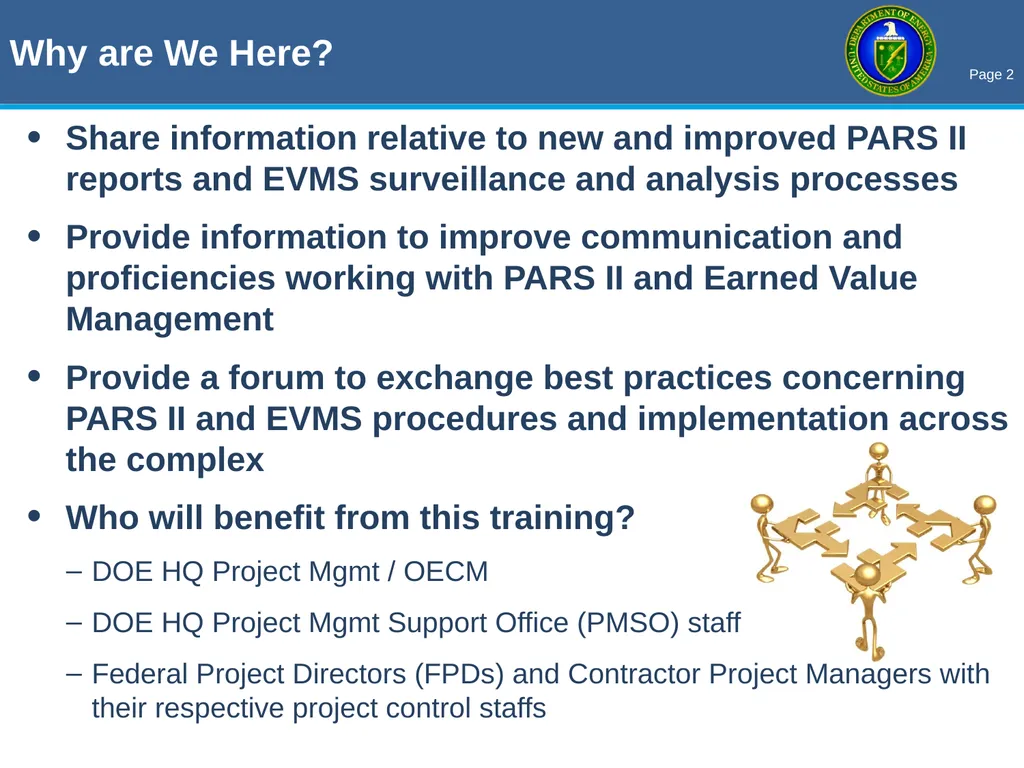
Share information relative to new and improved PARS II reports and EVMS surveillance and analysis processes
Provide information to improve communication and proficiencies working with PARS II and Earned Value Management
Provide a forum to exchange best practices concerning PARS II and EVMS procedures and implementation across the complex
Who will benefit from this training?
DOE HQ Project Mgmt / OECM
DOE HQ Project Mgmt Support Office (PMSO) staff
Federal Project Directors (FPDs) and Contractor Project Managers with their respective project control staffs Why are We Here?<br>
Provide information to improve communication and proficiencies working with PARS II and Earned Value Management
Provide a forum to exchange best practices concerning PARS II and EVMS procedures and implementation across the complex
Who will benefit from this training?
DOE HQ Project Mgmt / OECM
DOE HQ Project Mgmt Support Office (PMSO) staff
Federal Project Directors (FPDs) and Contractor Project Managers with their respective project control staffs Why are We Here?<br>
03
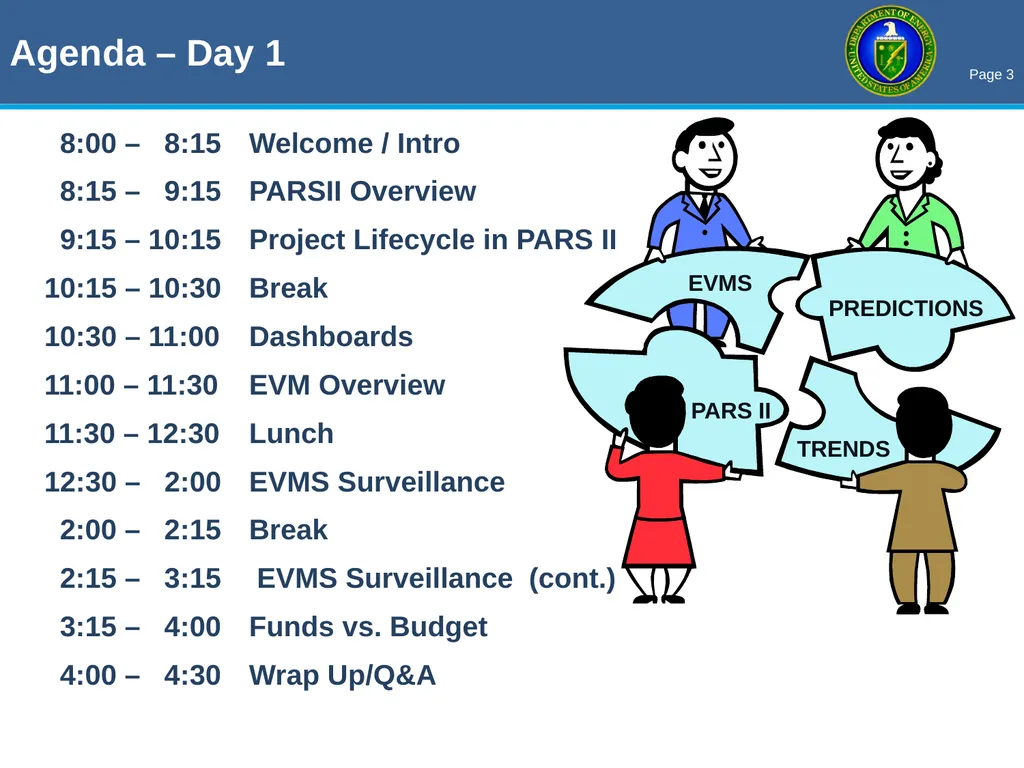
Agenda – Day 1 8:00 – 8:15 Welcome / Intro
8:15 – 9:15 PARSII Overview
9:15 – 10:15 Project Lifecycle in PARS II
10:15 – 10:30 Break
10:30 – 11:00 Dashboards
11:00 – 11:30 EVM Overview
11:30 – 12:30 Lunch
12:30 – 2:00 EVMS Surveillance
2:00 – 2:15 Break
2:15 – 3:15 EVMS Surveillance (cont.)
3:15 – 4:00 Funds vs. Budget
4:00 – 4:30 Wrap Up/Q&A EVMS PREDICTIONS TRENDS PARS II<br>
8:15 – 9:15 PARSII Overview
9:15 – 10:15 Project Lifecycle in PARS II
10:15 – 10:30 Break
10:30 – 11:00 Dashboards
11:00 – 11:30 EVM Overview
11:30 – 12:30 Lunch
12:30 – 2:00 EVMS Surveillance
2:00 – 2:15 Break
2:15 – 3:15 EVMS Surveillance (cont.)
3:15 – 4:00 Funds vs. Budget
4:00 – 4:30 Wrap Up/Q&A EVMS PREDICTIONS TRENDS PARS II<br>
04
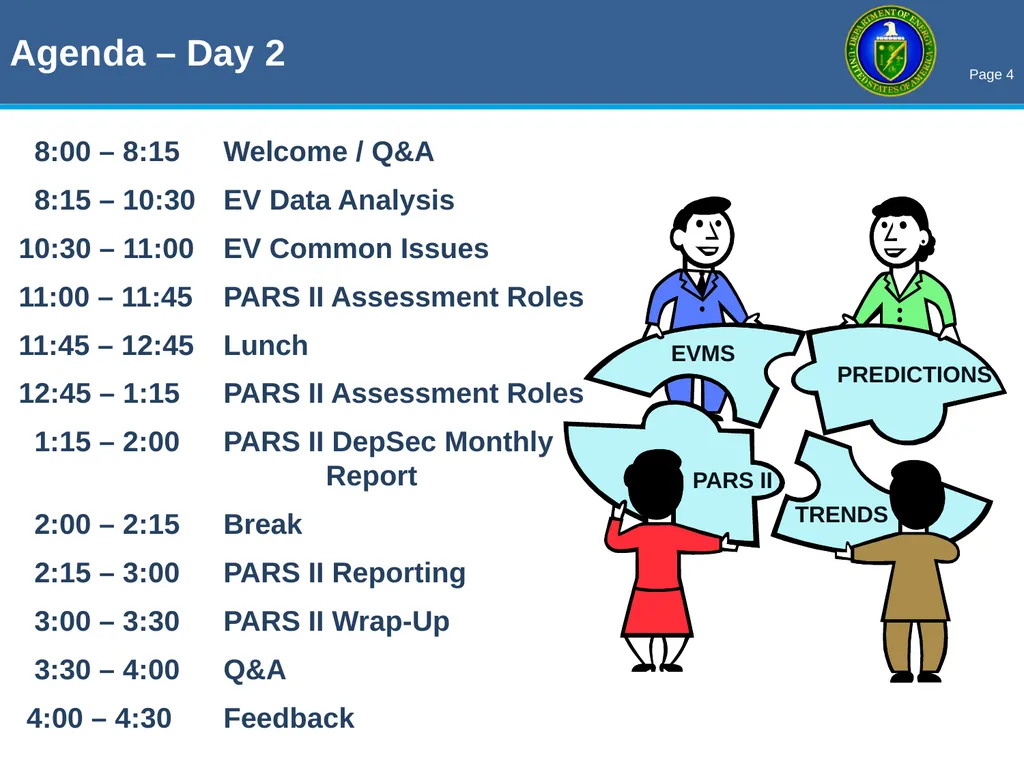
Agenda – Day 2 8:00 – 8:15 Welcome / Q&A
8:15 – 10:30 EV Data Analysis
10:30 – 11:00 EV Common Issues
11:00 – 11:45 PARS II Assessment Roles
11:45 – 12:45 Lunch
12:45 – 1:15 PARS II Assessment Roles
1:15 – 2:00 PARS II DepSec Monthly Report
2:00 – 2:15 Break
2:15 – 3:00 PARS II Reporting
3:00 – 3:30 PARS II Wrap-Up
3:30 – 4:00 Q&A
4:00 – 4:30 Feedback EVMS PREDICTIONS PARS II TRENDS<br>
8:15 – 10:30 EV Data Analysis
10:30 – 11:00 EV Common Issues
11:00 – 11:45 PARS II Assessment Roles
11:45 – 12:45 Lunch
12:45 – 1:15 PARS II Assessment Roles
1:15 – 2:00 PARS II DepSec Monthly Report
2:00 – 2:15 Break
2:15 – 3:00 PARS II Reporting
3:00 – 3:30 PARS II Wrap-Up
3:30 – 4:00 Q&A
4:00 – 4:30 Feedback EVMS PREDICTIONS PARS II TRENDS<br>
05
THE ROAD TEAM Cathe Mohar – PARS II Administrator
Karen Urschel – EVM Professional
Igor Pedan – Dekker, Ltd. (PARS II developers) PARSII / EVM<br>
Karen Urschel – EVM Professional
Igor Pedan – Dekker, Ltd. (PARS II developers) PARSII / EVM<br>
06
PARS II<br>
07
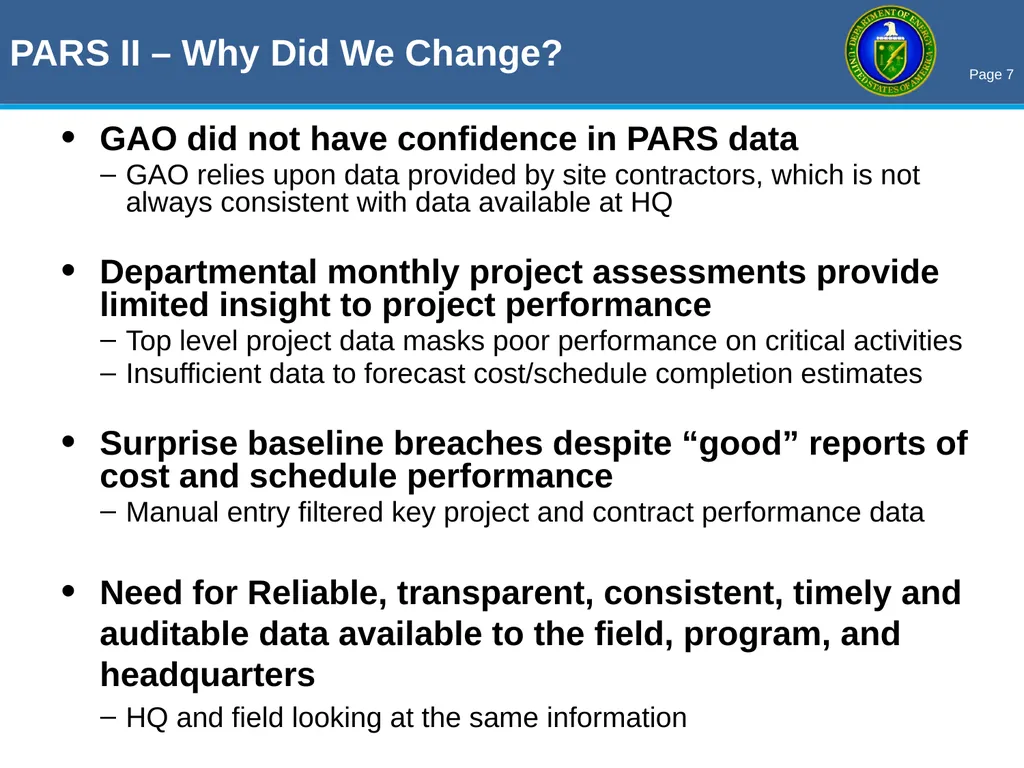
PARS II – Why Did We Change? GAO did not have confidence in PARS data
GAO relies upon data provided by site contractors, which is not always consistent with data available at HQ
Departmental monthly project assessments provide limited insight to project performance
Top level project data masks poor performance on critical activities
Insufficient data to forecast cost/schedule completion estimates
Surprise baseline breaches despite “good” reports of cost and schedule performance
Manual entry filtered key project and contract performance data
Need for Reliable, transparent, consistent, timely and auditable data available to the field, program, and headquarters
HQ and field looking at the same information<br>
GAO relies upon data provided by site contractors, which is not always consistent with data available at HQ
Departmental monthly project assessments provide limited insight to project performance
Top level project data masks poor performance on critical activities
Insufficient data to forecast cost/schedule completion estimates
Surprise baseline breaches despite “good” reports of cost and schedule performance
Manual entry filtered key project and contract performance data
Need for Reliable, transparent, consistent, timely and auditable data available to the field, program, and headquarters
HQ and field looking at the same information<br>
08
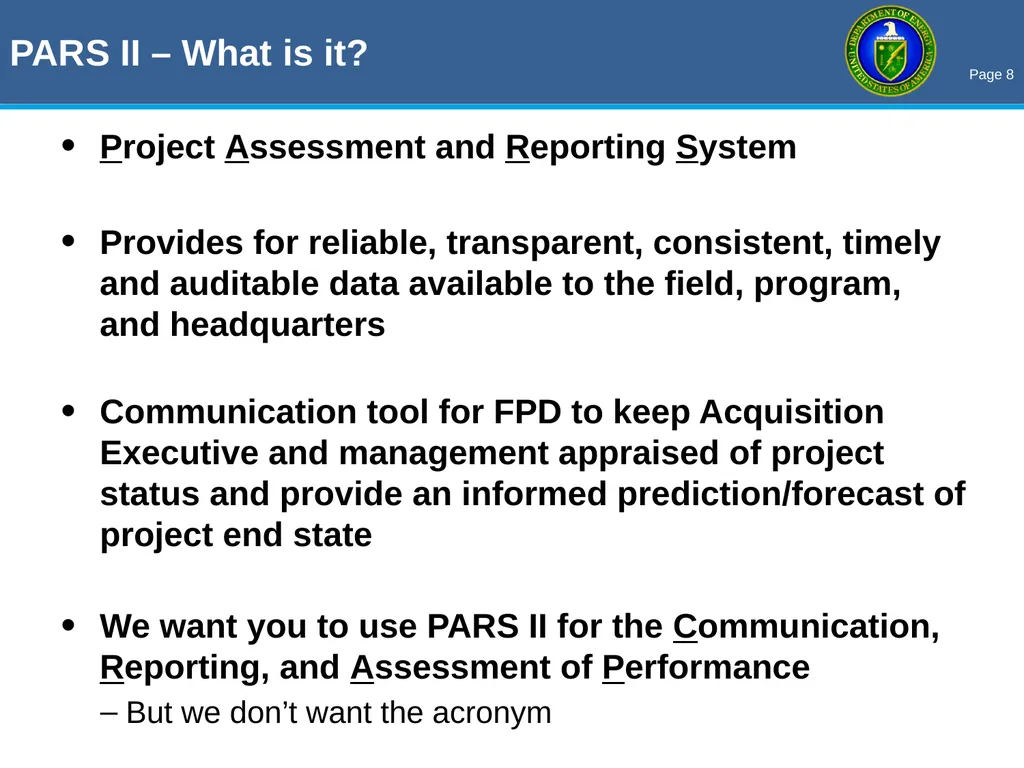
PARS II – What is it? Project Assessment and Reporting System
Provides for reliable, transparent, consistent, timely and auditable data available to the field, program, and headquarters
Communication tool for FPD to keep Acquisition Executive and management appraised of project status and provide an informed prediction/forecast of project end state
We want you to use PARS II for the Communication, Reporting, and Assessment of Performance
But we don’t want the acronym<br>
Provides for reliable, transparent, consistent, timely and auditable data available to the field, program, and headquarters
Communication tool for FPD to keep Acquisition Executive and management appraised of project status and provide an informed prediction/forecast of project end state
We want you to use PARS II for the Communication, Reporting, and Assessment of Performance
But we don’t want the acronym<br>
09
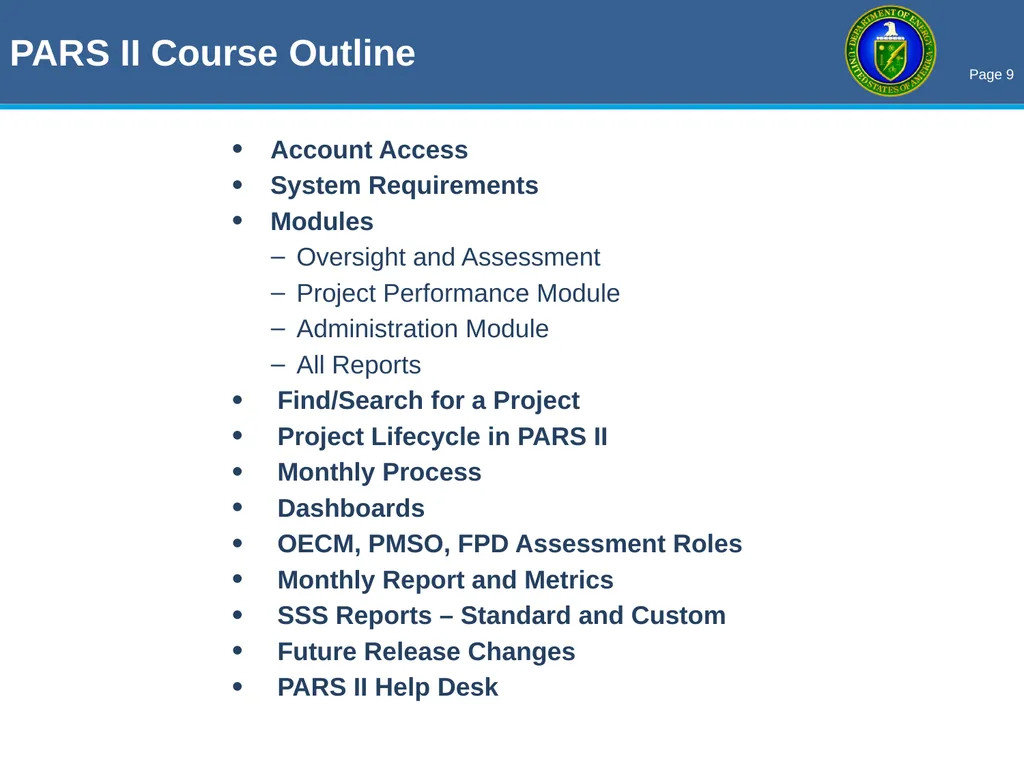
PARS II Course Outline Account Access
System Requirements
Modules
Oversight and Assessment
Project Performance Module
Administration Module
All Reports
Find/Search for a Project
Project Lifecycle in PARS II
Monthly Process
Dashboards
OECM, PMSO, FPD Assessment Roles
Monthly Report and Metrics
SSS Reports – Standard and Custom
Future Release Changes
PARS II Help Desk<br>
System Requirements
Modules
Oversight and Assessment
Project Performance Module
Administration Module
All Reports
Find/Search for a Project
Project Lifecycle in PARS II
Monthly Process
Dashboards
OECM, PMSO, FPD Assessment Roles
Monthly Report and Metrics
SSS Reports – Standard and Custom
Future Release Changes
PARS II Help Desk<br>
10
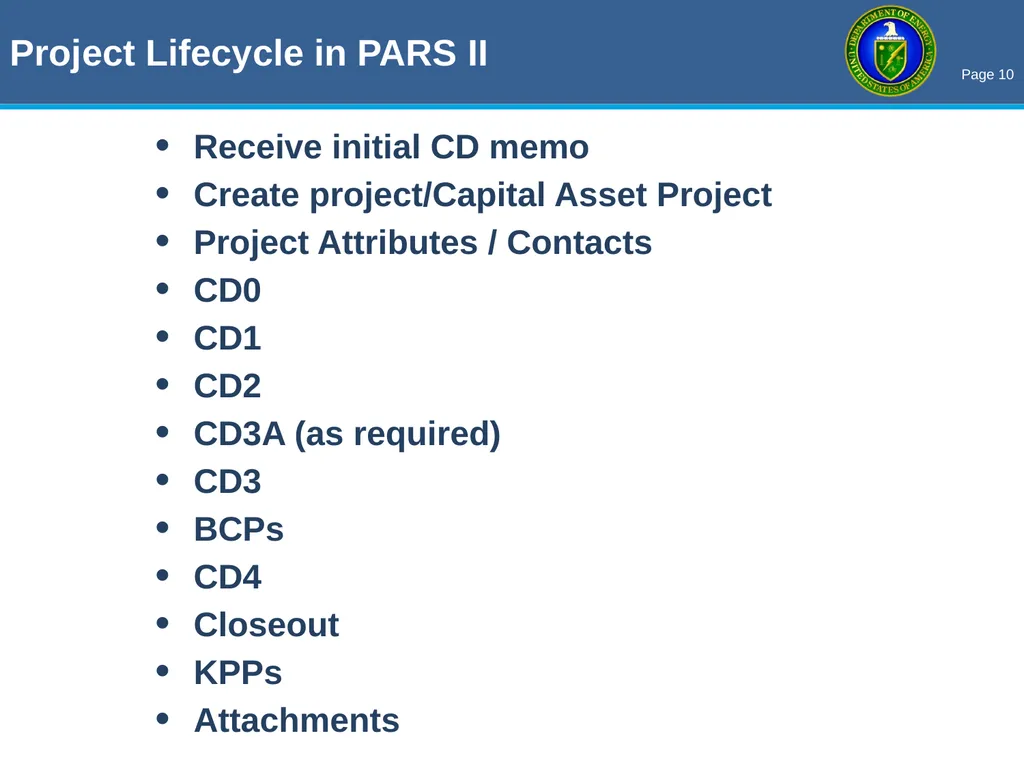
Project Lifecycle in PARS II Receive initial CD memo
Create project/Capital Asset Project
Project Attributes / Contacts
CD0
CD1
CD2
CD3A (as required)
CD3
BCPs
CD4
Closeout
KPPs
Attachments<br>
Create project/Capital Asset Project
Project Attributes / Contacts
CD0
CD1
CD2
CD3A (as required)
CD3
BCPs
CD4
Closeout
KPPs
Attachments<br>
11
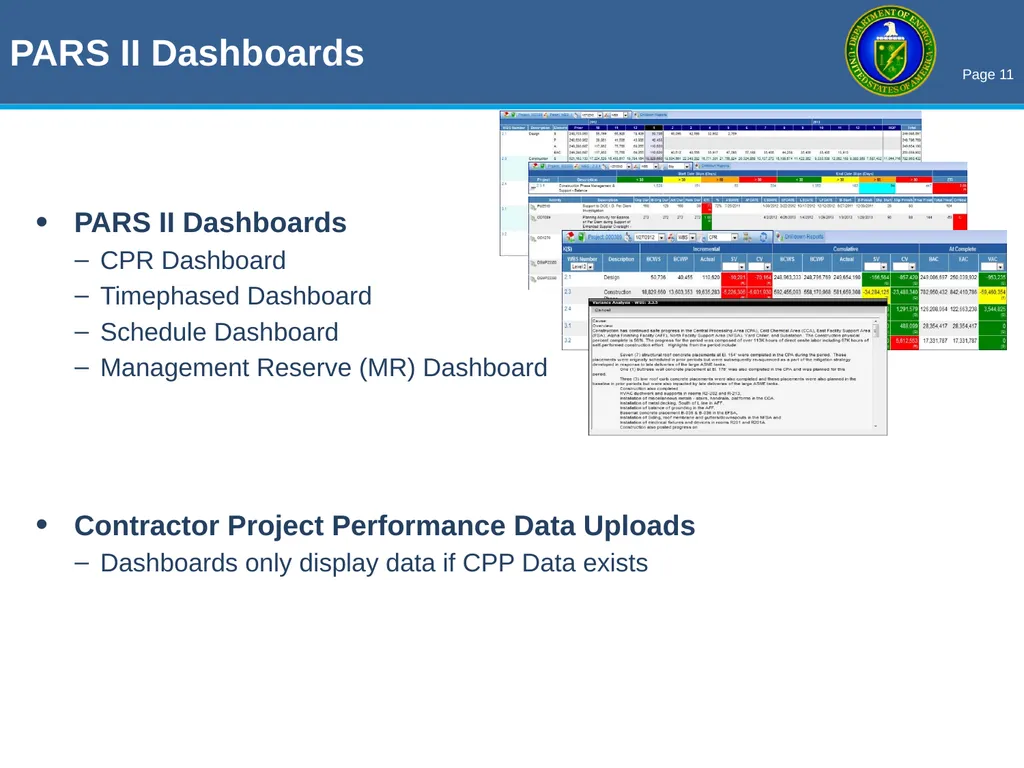
PARS II Dashboards PARS II Dashboards
CPR Dashboard
Timephased Dashboard
Schedule Dashboard
Management Reserve (MR) Dashboard
Contractor Project Performance Data Uploads
Dashboards only display data if CPP Data exists<br>
CPR Dashboard
Timephased Dashboard
Schedule Dashboard
Management Reserve (MR) Dashboard
Contractor Project Performance Data Uploads
Dashboards only display data if CPP Data exists<br>
12
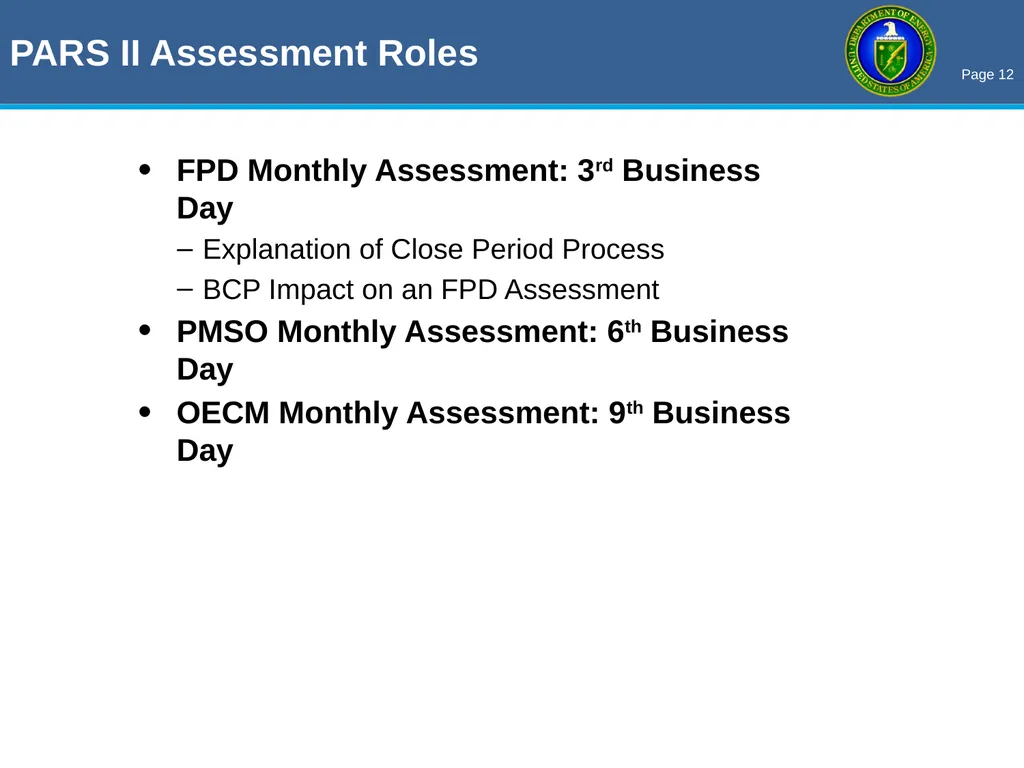
PARS II Assessment Roles FPD Monthly Assessment: 3rd Business Day
Explanation of Close Period Process
BCP Impact on an FPD Assessment
PMSO Monthly Assessment: 6th Business Day
OECM Monthly Assessment: 9th Business Day<br>
Explanation of Close Period Process
BCP Impact on an FPD Assessment
PMSO Monthly Assessment: 6th Business Day
OECM Monthly Assessment: 9th Business Day<br>
13
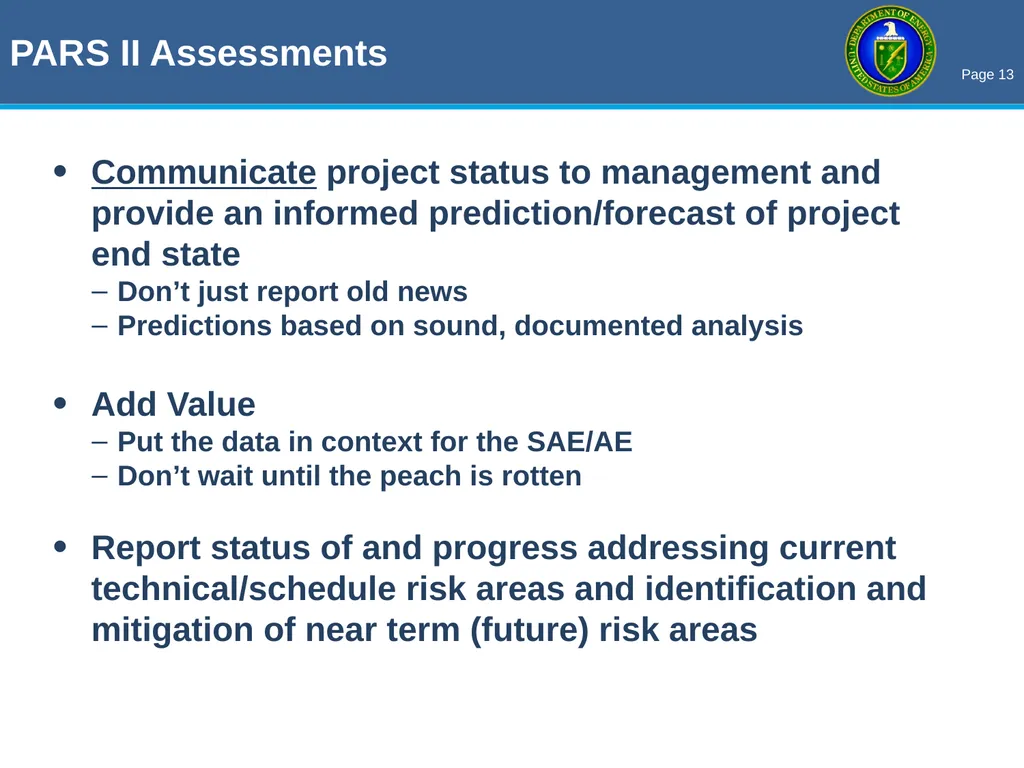
PARS II Assessments Communicate project status to management and provide an informed prediction/forecast of project end state
Don’t just report old news
Predictions based on sound, documented analysis
Add Value
Put the data in context for the SAE/AE
Don’t wait until the peach is rotten
Report status of and progress addressing current technical/schedule risk areas and identification and mitigation of near term (future) risk areas<br>
Don’t just report old news
Predictions based on sound, documented analysis
Add Value
Put the data in context for the SAE/AE
Don’t wait until the peach is rotten
Report status of and progress addressing current technical/schedule risk areas and identification and mitigation of near term (future) risk areas<br>
14
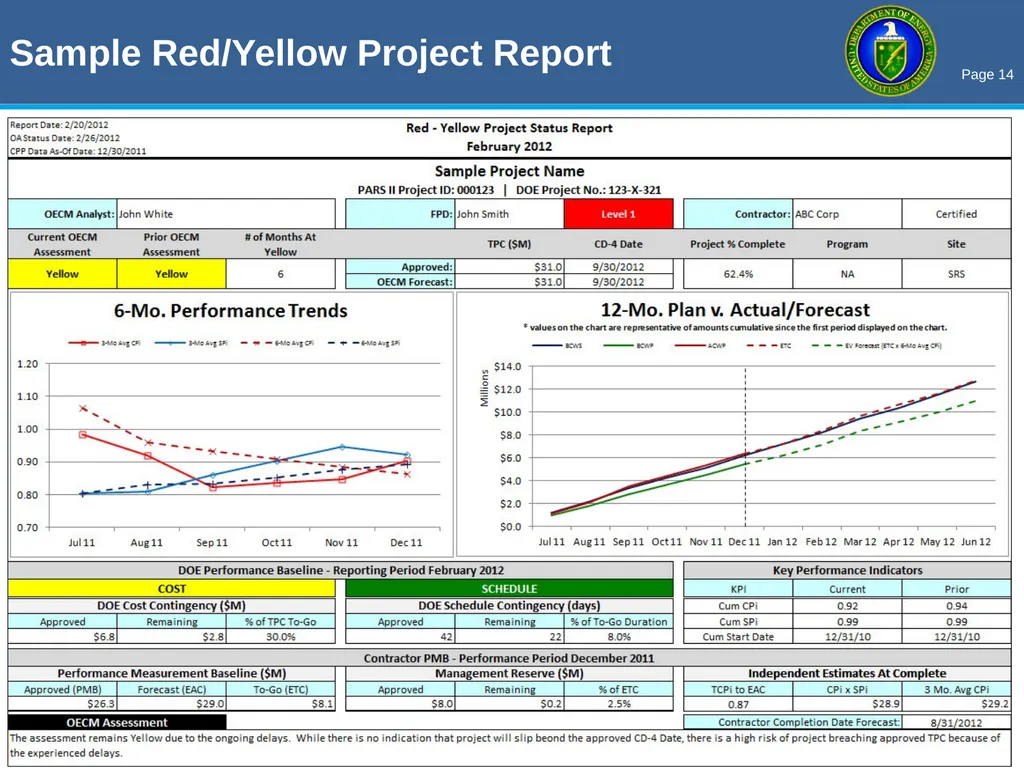
Sample Red/Yellow Project Report<br>
15
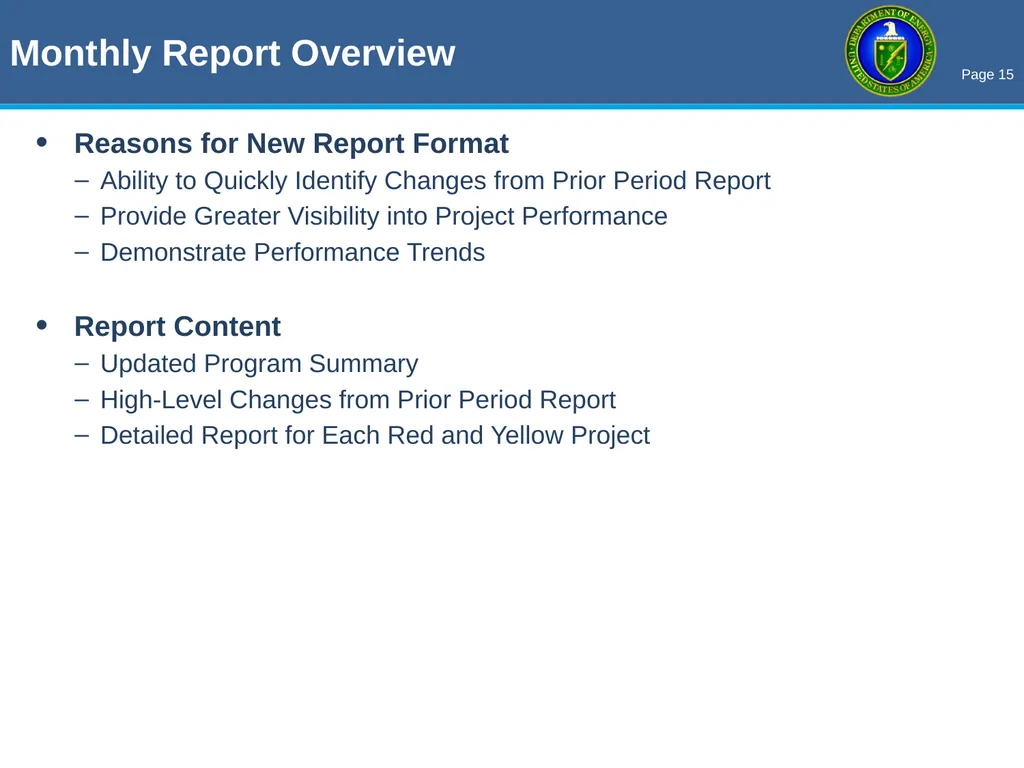
Monthly Report Overview Reasons for New Report Format
Ability to Quickly Identify Changes from Prior Period Report
Provide Greater Visibility into Project Performance
Demonstrate Performance Trends
Report Content
Updated Program Summary
High-Level Changes from Prior Period Report
Detailed Report for Each Red and Yellow Project<br>
Ability to Quickly Identify Changes from Prior Period Report
Provide Greater Visibility into Project Performance
Demonstrate Performance Trends
Report Content
Updated Program Summary
High-Level Changes from Prior Period Report
Detailed Report for Each Red and Yellow Project<br>
16
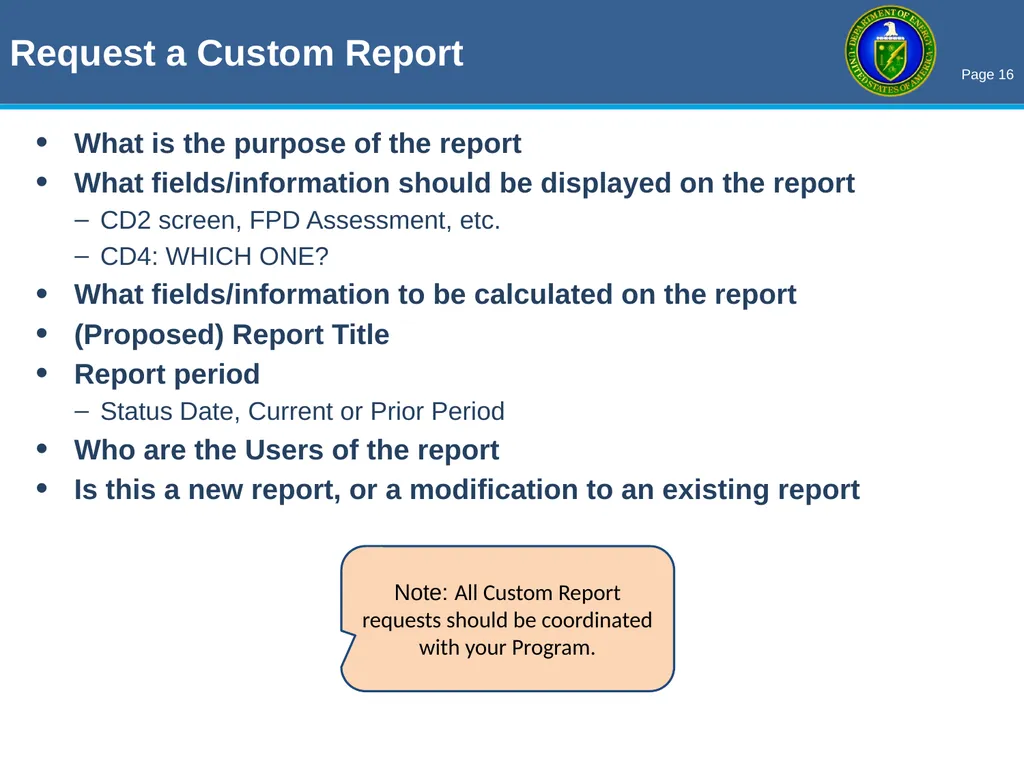
Request a Custom Report What is the purpose of the report
What fields/information should be displayed on the report
CD2 screen, FPD Assessment, etc.
CD4: WHICH ONE?
What fields/information to be calculated on the report
(Proposed) Report Title
Report period
Status Date, Current or Prior Period
Who are the Users of the report
Is this a new report, or a modification to an existing report Note: All Custom Report requests should be coordinated with your Program.<br>
What fields/information should be displayed on the report
CD2 screen, FPD Assessment, etc.
CD4: WHICH ONE?
What fields/information to be calculated on the report
(Proposed) Report Title
Report period
Status Date, Current or Prior Period
Who are the Users of the report
Is this a new report, or a modification to an existing report Note: All Custom Report requests should be coordinated with your Program.<br>
17
PARS II Help Desk The Helpdesk does not have the authority to change OA data within PARS II. Requests/Questions submitted are forwarded to OECM.
Password Reset
CPP Upload Issues
Workstation Configuration
Project Find/Search
The more information that you provide, the faster the issue can be resolved. The hours of operation for the PARS II Helpdesk are 8am-5PM, M-F.
Email - I-Manage.Eas@hq.doe.gov
301-903-2500 (option 4, then option 5)
866-834-6246 (option 4, then option 5)<br>
Password Reset
CPP Upload Issues
Workstation Configuration
Project Find/Search
The more information that you provide, the faster the issue can be resolved. The hours of operation for the PARS II Helpdesk are 8am-5PM, M-F.
Email - I-Manage.Eas@hq.doe.gov
301-903-2500 (option 4, then option 5)
866-834-6246 (option 4, then option 5)<br>
18
PARS II Information and Documentation PARS II User Guide
http://energy.gov/sites/prod/files/maprod/documents/PARS_II_User_Guide.pdf
PARS II SOP (Standard Operating Procedures)
http://energy.gov/sites/prod/files/PARS_II_SOP_Version_1.1_2011_08_11.pdf
PARS II Change Request Form
http://energy.gov/sites/prod/files/maprod/documents/PARS_II_Change_Request_Form.pdf
PARS II Training Schedule
http://energy.gov/sites/prod/files/PARS_II_Training_Schedule_1.pdf
PARS II Training Course Registration
http://energy.gov/management/pars-ii-course-registration<br>
http://energy.gov/sites/prod/files/maprod/documents/PARS_II_User_Guide.pdf
PARS II SOP (Standard Operating Procedures)
http://energy.gov/sites/prod/files/PARS_II_SOP_Version_1.1_2011_08_11.pdf
PARS II Change Request Form
http://energy.gov/sites/prod/files/maprod/documents/PARS_II_Change_Request_Form.pdf
PARS II Training Schedule
http://energy.gov/sites/prod/files/PARS_II_Training_Schedule_1.pdf
PARS II Training Course Registration
http://energy.gov/management/pars-ii-course-registration<br>
19
EVMS<br>
20
What is an Earned Value Management System? An integrated set of
Documented Management Processes
Management Information Systems
Culture (People – Roles / Responsibilities)
Provides reliable and accurate project and program information
Used to support project management as a decision making tool and a critical component of risk management.<br>
Documented Management Processes
Management Information Systems
Culture (People – Roles / Responsibilities)
Provides reliable and accurate project and program information
Used to support project management as a decision making tool and a critical component of risk management.<br>
21
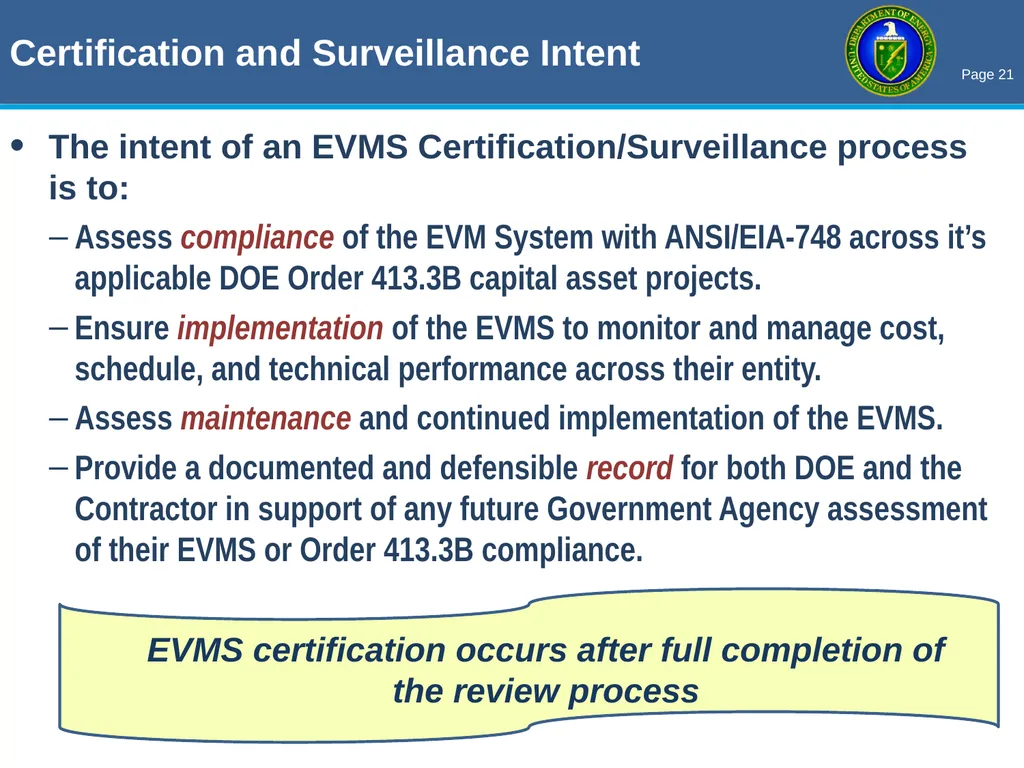
Certification and Surveillance Intent The intent of an EVMS Certification/Surveillance process is to:
Assess compliance of the EVM System with ANSI/EIA-748 across it’s applicable DOE Order 413.3B capital asset projects.
Ensure implementation of the EVMS to monitor and manage cost, schedule, and technical performance across their entity.
Assess maintenance and continued implementation of the EVMS.
Provide a documented and defensible record for both DOE and the Contractor in support of any future Government Agency assessment of their EVMS or Order 413.3B compliance. EVMS certification occurs after full completion of the review process<br>
Assess compliance of the EVM System with ANSI/EIA-748 across it’s applicable DOE Order 413.3B capital asset projects.
Ensure implementation of the EVMS to monitor and manage cost, schedule, and technical performance across their entity.
Assess maintenance and continued implementation of the EVMS.
Provide a documented and defensible record for both DOE and the Contractor in support of any future Government Agency assessment of their EVMS or Order 413.3B compliance. EVMS certification occurs after full completion of the review process<br>
22
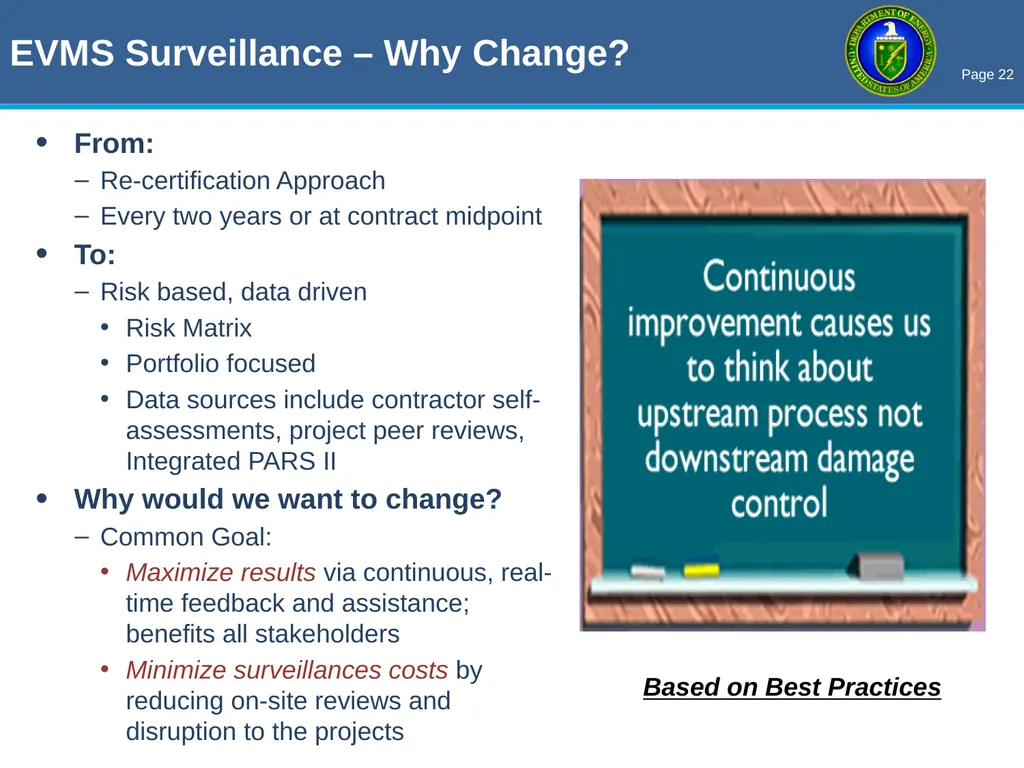
EVMS Surveillance – Why Change? From:
Re-certification Approach
Every two years or at contract midpoint
To:
Risk based, data driven
Risk Matrix
Portfolio focused
Data sources include contractor self- assessments, project peer reviews, Integrated PARS II
Why would we want to change?
Common Goal:
Maximize results via continuous, real-time feedback and assistance; benefits all stakeholders
Minimize surveillances costs by reducing on-site reviews and disruption to the projects Based on Best Practices<br>
Re-certification Approach
Every two years or at contract midpoint
To:
Risk based, data driven
Risk Matrix
Portfolio focused
Data sources include contractor self- assessments, project peer reviews, Integrated PARS II
Why would we want to change?
Common Goal:
Maximize results via continuous, real-time feedback and assistance; benefits all stakeholders
Minimize surveillances costs by reducing on-site reviews and disruption to the projects Based on Best Practices<br>
23
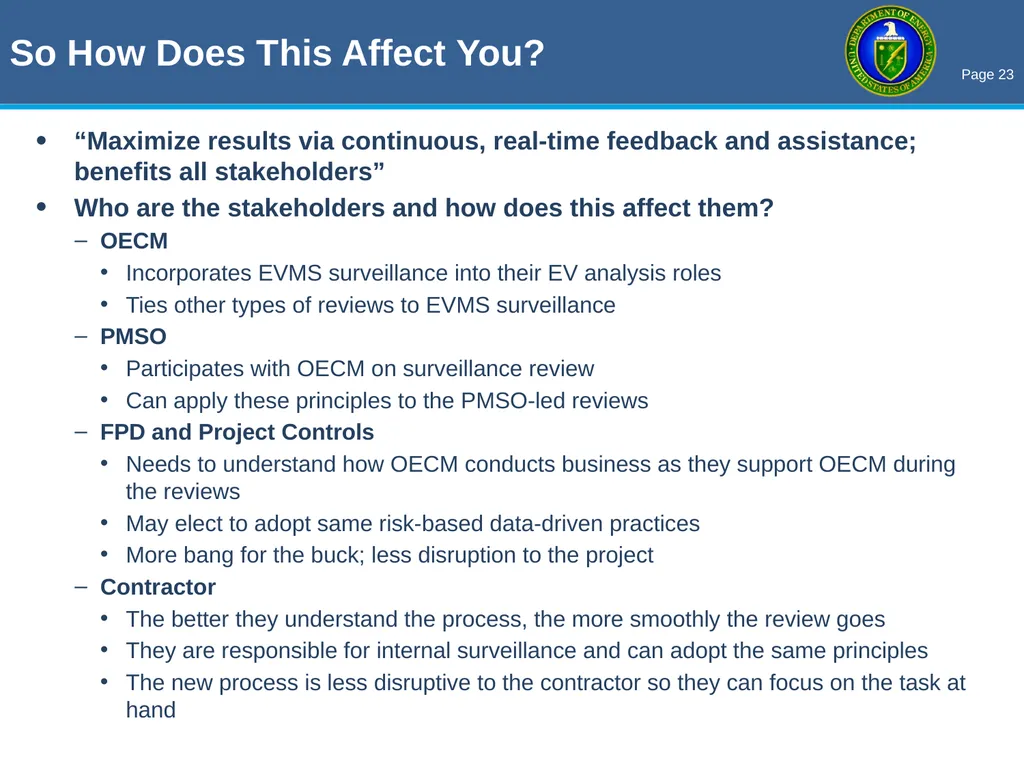
So How Does This Affect You? “Maximize results via continuous, real-time feedback and assistance; benefits all stakeholders”
Who are the stakeholders and how does this affect them?
OECM
Incorporates EVMS surveillance into their EV analysis roles
Ties other types of reviews to EVMS surveillance
PMSO
Participates with OECM on surveillance review
Can apply these principles to the PMSO-led reviews
FPD and Project Controls
Needs to understand how OECM conducts business as they support OECM during the reviews
May elect to adopt same risk-based data-driven practices
More bang for the buck; less disruption to the project
Contractor
The better they understand the process, the more smoothly the review goes
They are responsible for internal surveillance and can adopt the same principles
The new process is less disruptive to the contractor so they can focus on the task at hand<br>
Who are the stakeholders and how does this affect them?
OECM
Incorporates EVMS surveillance into their EV analysis roles
Ties other types of reviews to EVMS surveillance
PMSO
Participates with OECM on surveillance review
Can apply these principles to the PMSO-led reviews
FPD and Project Controls
Needs to understand how OECM conducts business as they support OECM during the reviews
May elect to adopt same risk-based data-driven practices
More bang for the buck; less disruption to the project
Contractor
The better they understand the process, the more smoothly the review goes
They are responsible for internal surveillance and can adopt the same principles
The new process is less disruptive to the contractor so they can focus on the task at hand<br>
24
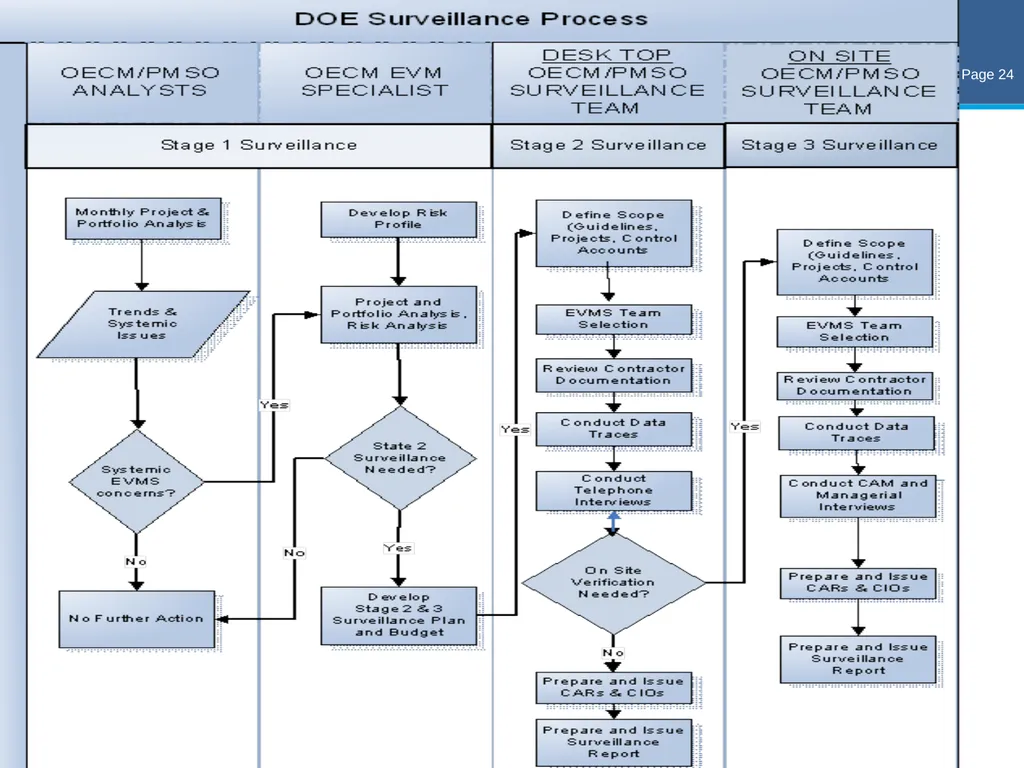
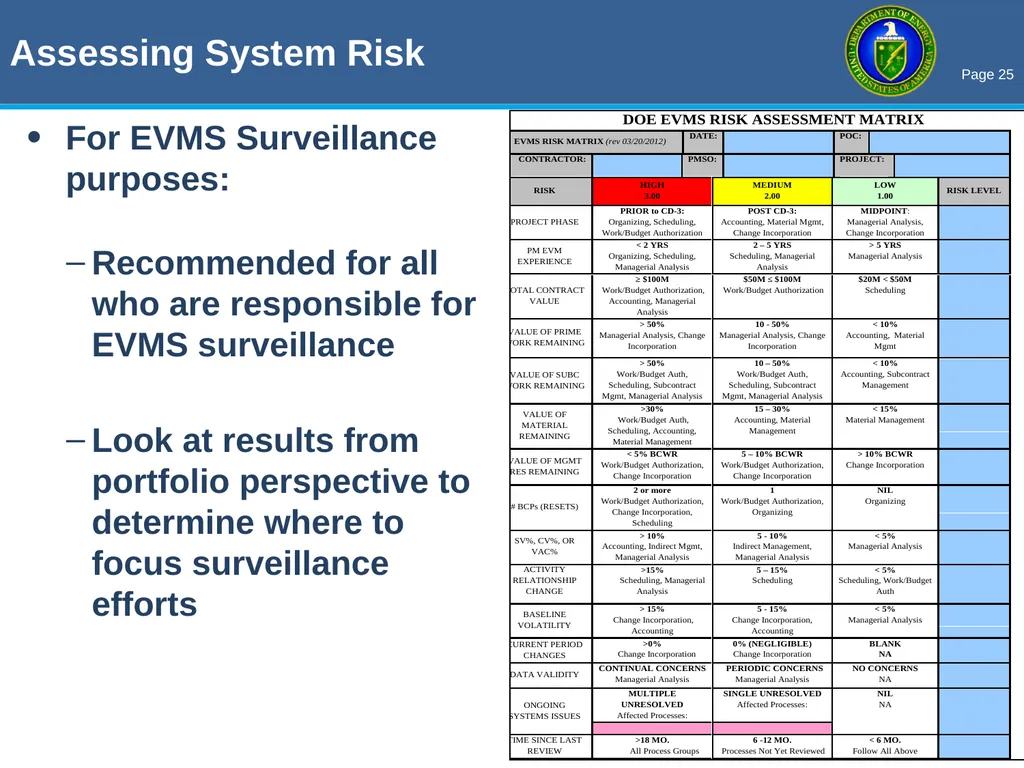
Assessing System Risk For EVMS Surveillance purposes:
Recommended for all who are responsible for EVMS surveillance
Look at results from portfolio perspective to determine where to focus surveillance efforts<br>
Recommended for all who are responsible for EVMS surveillance
Look at results from portfolio perspective to determine where to focus surveillance efforts<br>
25
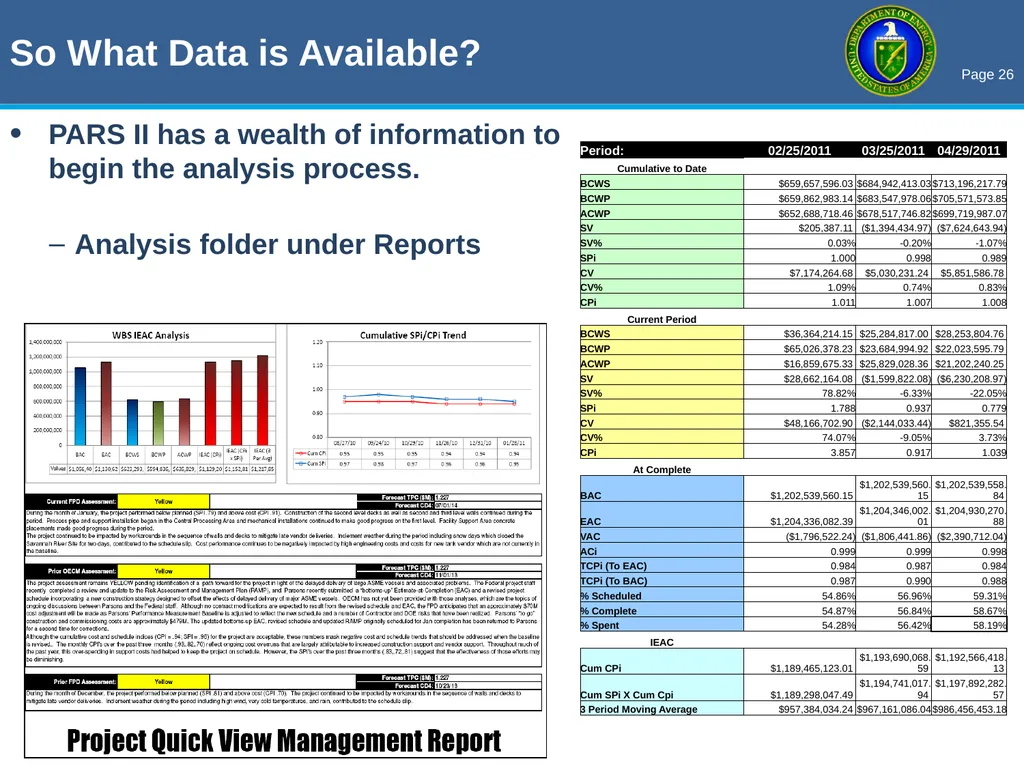
So What Data is Available? PARS II has a wealth of information to begin the analysis process.
Analysis folder under Reports<br>
Analysis folder under Reports<br>
26
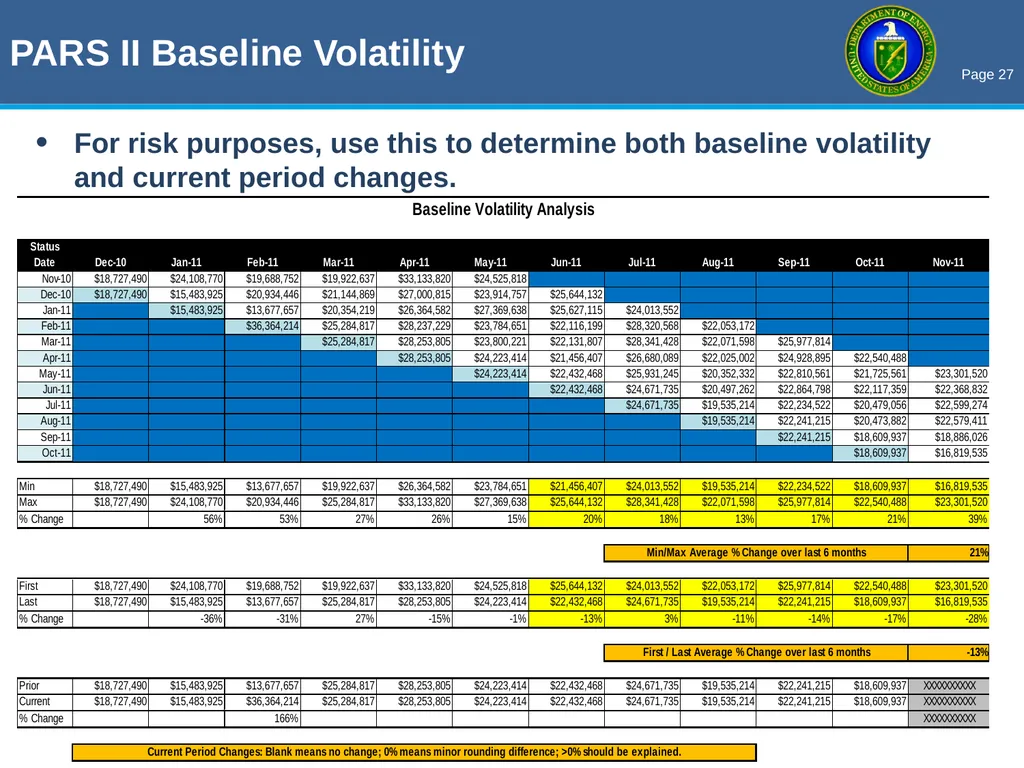
PARS II Baseline Volatility For risk purposes, use this to determine both baseline volatility and current period changes.<br>
27
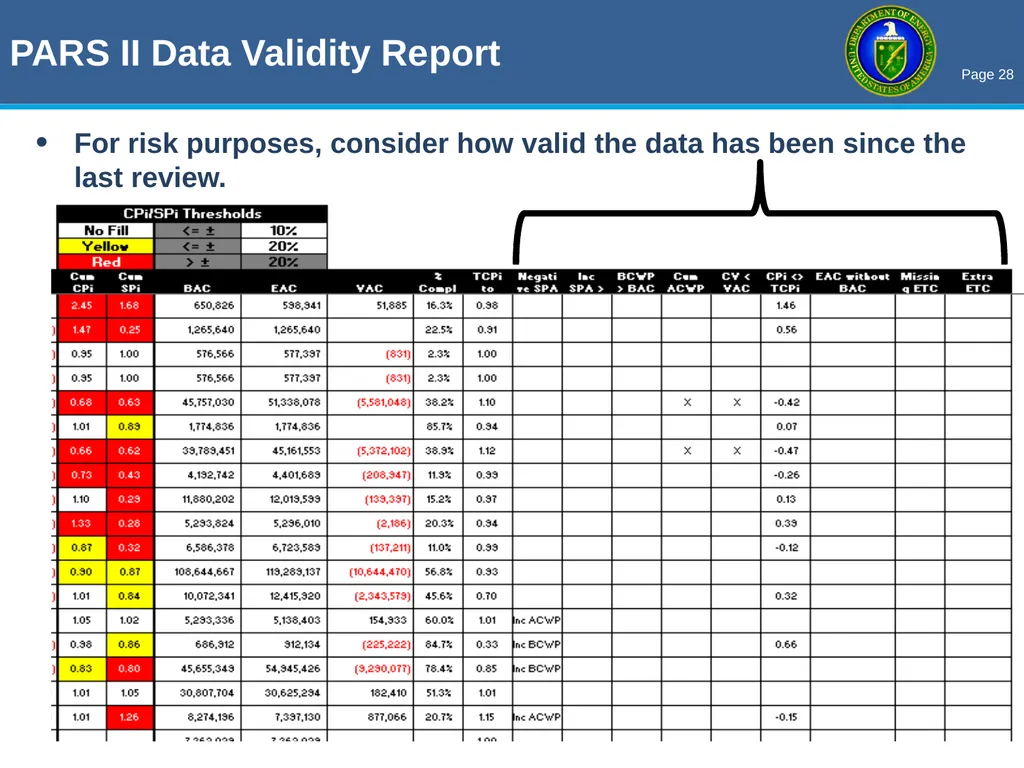
PARS II Data Validity Report For risk purposes, consider how valid the data has been since the last review.<br>
28
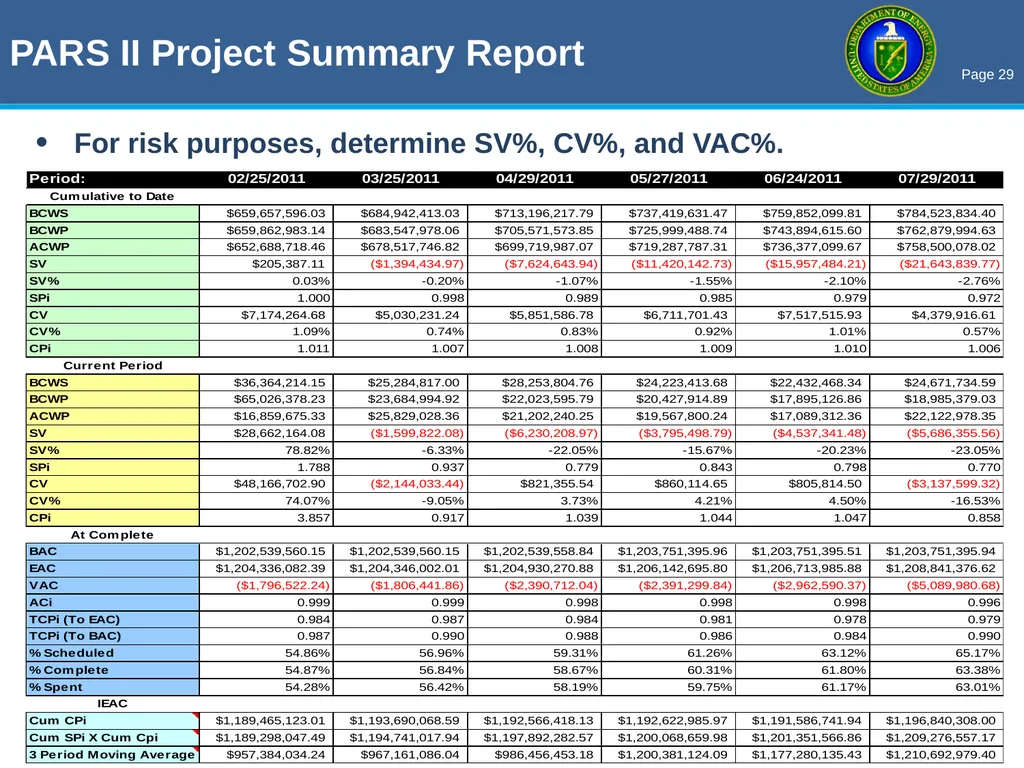
PARS II Project Summary Report For risk purposes, determine SV%, CV%, and VAC%.<br>
29
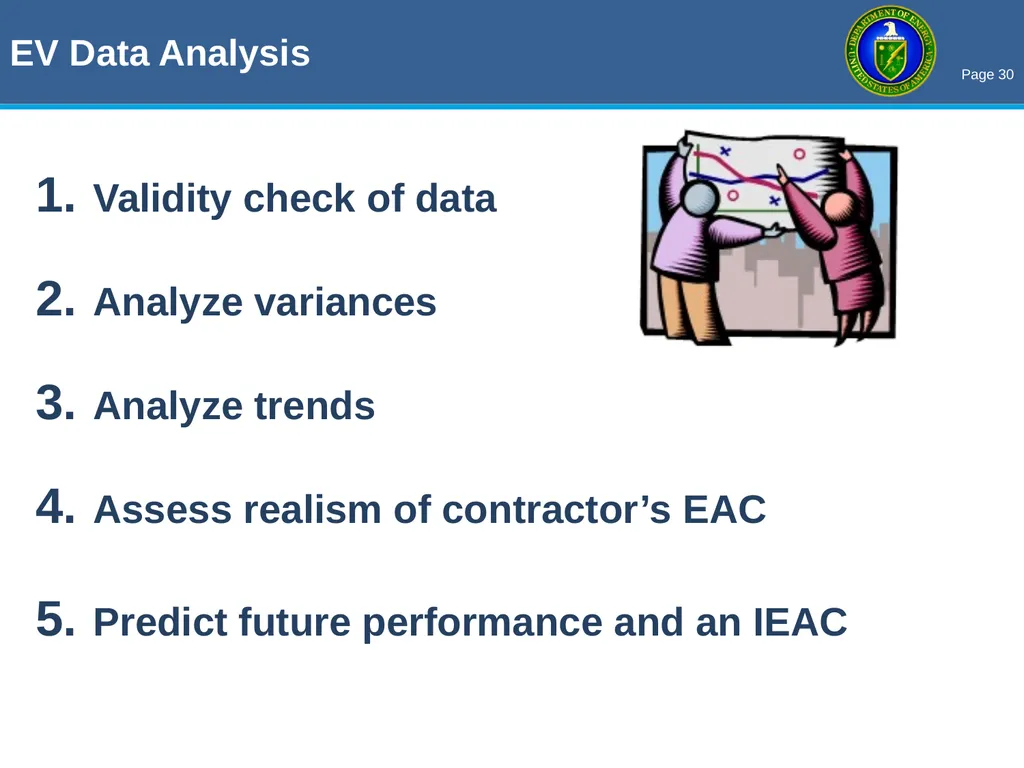
EV Data Analysis Validity check of data
Analyze variances
Analyze trends
Assess realism of contractor’s EAC
Predict future performance and an IEAC<br>
Analyze variances
Analyze trends
Assess realism of contractor’s EAC
Predict future performance and an IEAC<br>
30
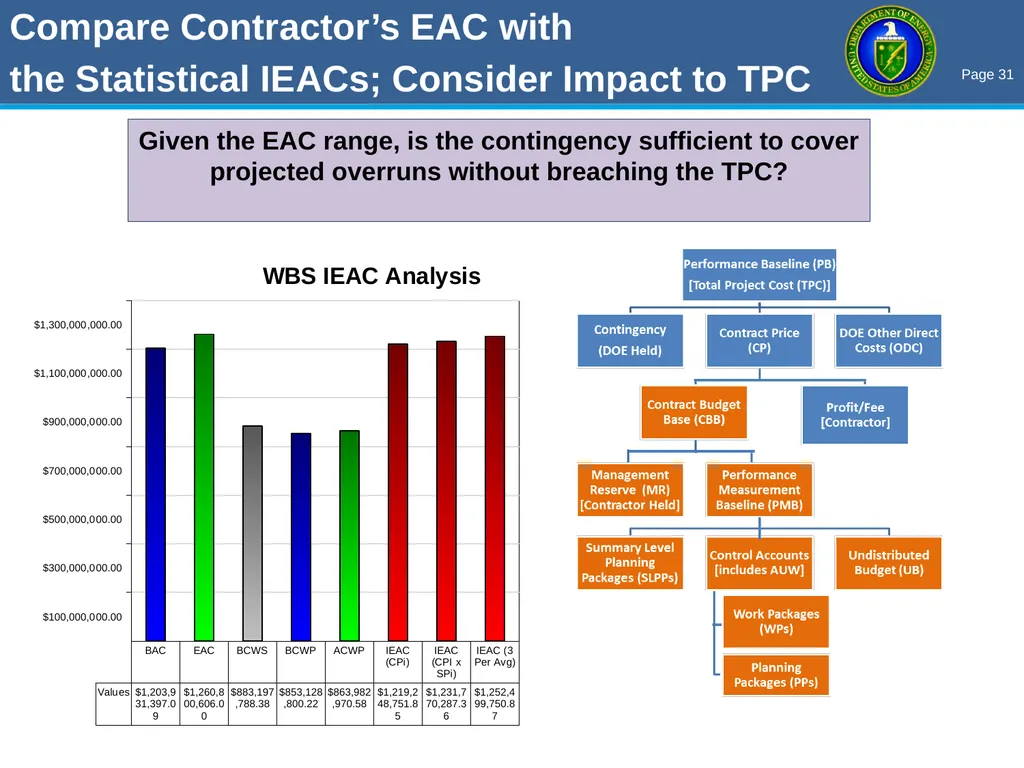
Compare Contractor’s EAC with
the Statistical IEACs; Consider Impact to TPC Given the EAC range, is the contingency sufficient to cover projected overruns without breaching the TPC?<br>
the Statistical IEACs; Consider Impact to TPC Given the EAC range, is the contingency sufficient to cover projected overruns without breaching the TPC?<br>
31
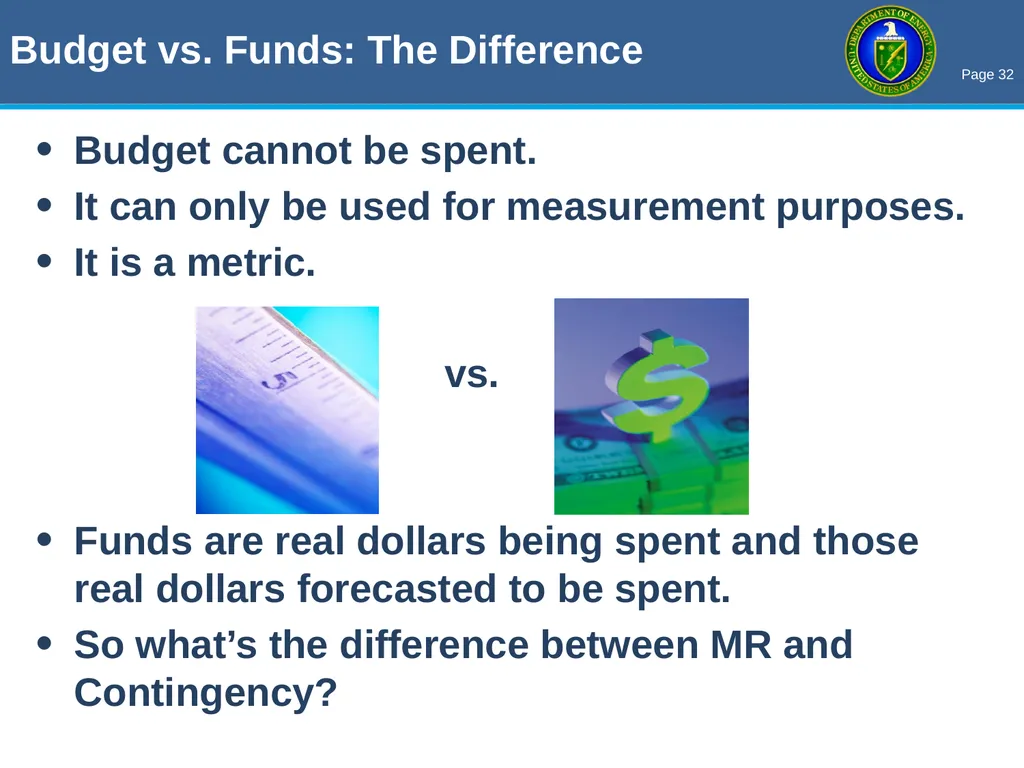
Budget vs. Funds: The Difference Budget cannot be spent.
It can only be used for measurement purposes.
It is a metric.
vs.
Funds are real dollars being spent and those real dollars forecasted to be spent.
So what’s the difference between MR and Contingency?<br>
It can only be used for measurement purposes.
It is a metric.
vs.
Funds are real dollars being spent and those real dollars forecasted to be spent.
So what’s the difference between MR and Contingency?<br>
32
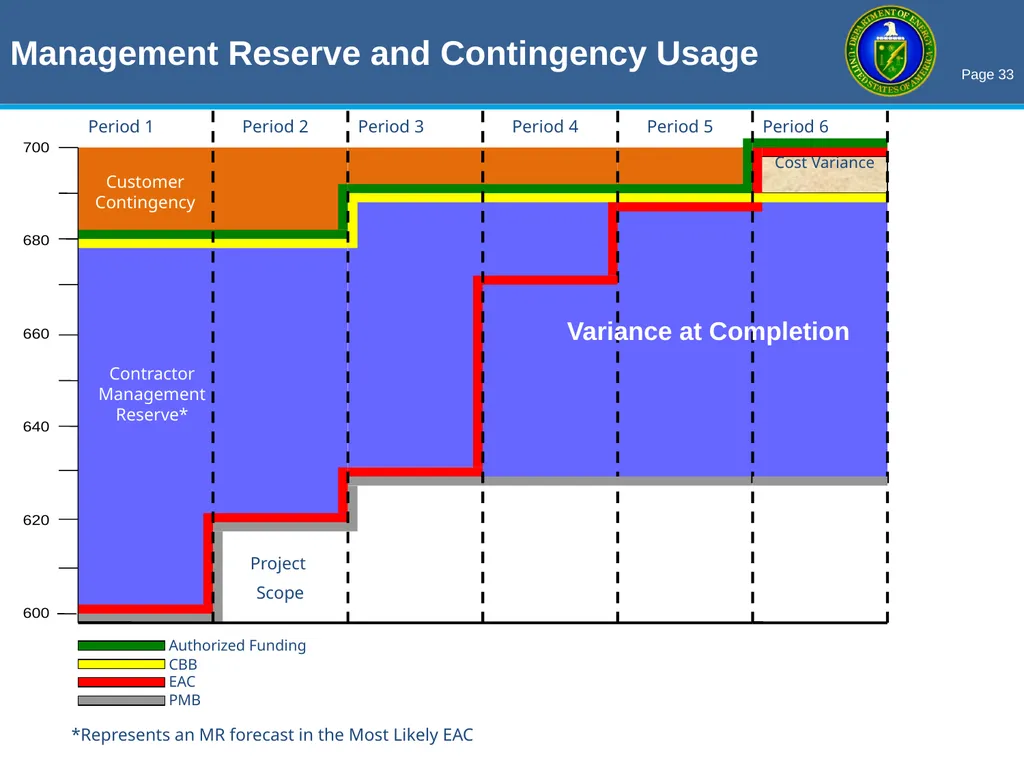
Management Reserve and Contingency Usage Variance at Completion<br>
33
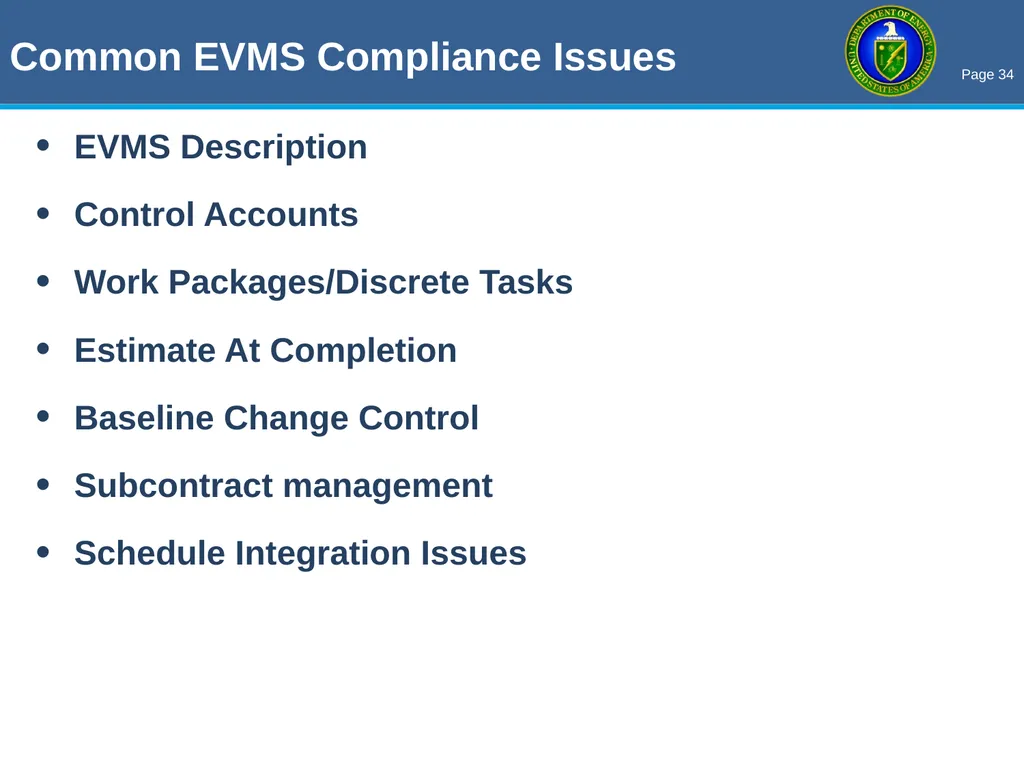
EVMS Description
Control Accounts
Work Packages/Discrete Tasks
Estimate At Completion
Baseline Change Control
Subcontract management
Schedule Integration Issues Common EVMS Compliance Issues<br>
Control Accounts
Work Packages/Discrete Tasks
Estimate At Completion
Baseline Change Control
Subcontract management
Schedule Integration Issues Common EVMS Compliance Issues<br>