
The old book, geom.pptx is from intro.ppt
MS
Published · 49 slides · 0 views

1 / 1
Description
The old book, geom.pptx is from intro.ppt Image-based Modeling, Long QUAN, Springer-Verlag, 2010. My perspective Part I What is computer vision? What is 3D reconstruction? From pixels to 3D points Structure from motion A quasi-dense
Related Topics
Share
Embed code
Download this presentation From Below
"The old book, geom.pptx is from intro.ppt" is the property of its rightful owner. Permission is granted to download and print the materials on this website for personal, non-commercial use only, and to display it on your personal computer provided you do not modify the materials and that you retain all copyright notices contained in the materials. By downloading content from our website, you accept the terms of this agreement.
Presentation Transcript
01
The old book, geom.pptx is from intro.ppt Image-based Modeling,
Long QUAN,
Springer-Verlag,
2010.<br>
Long QUAN,
Springer-Verlag,
2010.<br>
02
My perspective Part I
What is computer vision?
What is 3D reconstruction?
From pixels to 3D points
Structure from motion
A quasi-dense approach
From 3D points to objects
Small-scale objects
Smooth surfaces, Hairs, Trees
Large-scale buildings
Façade, Buildings, Cities
Part II
Large-scale automatic 3D mapping
Conclusions<br>
What is computer vision?
What is 3D reconstruction?
From pixels to 3D points
Structure from motion
A quasi-dense approach
From 3D points to objects
Small-scale objects
Smooth surfaces, Hairs, Trees
Large-scale buildings
Façade, Buildings, Cities
Part II
Large-scale automatic 3D mapping
Conclusions<br>
03
3 Overview Introduction to projective geometry
1 view geometry (calibration, …)
2-view geometry (stereo, motion, …)
3- and N-view geometry
Autocalibration (metric reconst.)
Application<br>
1 view geometry (calibration, …)
2-view geometry (stereo, motion, …)
3- and N-view geometry
Autocalibration (metric reconst.)
Application<br>
04
4 Basic geometric concepts to understand Affine, Euclidean geometries (inhomogeneous coordinates)
projective geometry (homogeneous coordinates)
plane at infinity: affine geometry
absolute conic: Euclidean geometry<br>
projective geometry (homogeneous coordinates)
plane at infinity: affine geometry
absolute conic: Euclidean geometry<br>
05
5 Introduction to projective geometry Intuitive ideas from projective geometry
(Formal definition of projective spaces)<br>
(Formal definition of projective spaces)<br>
06
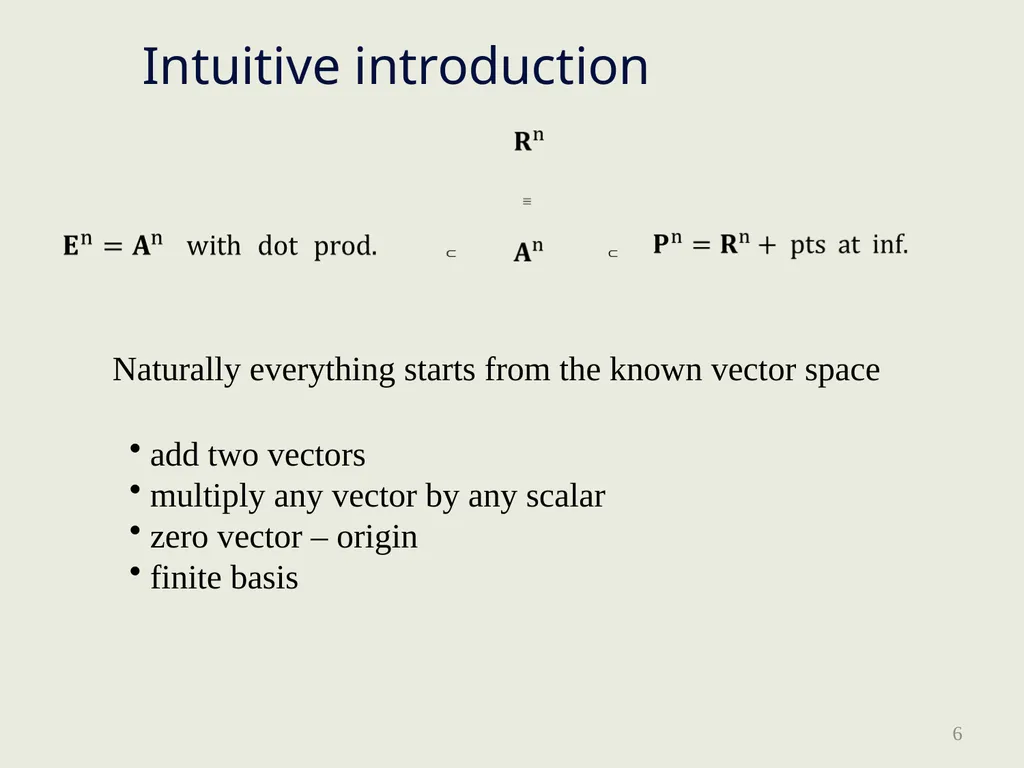
6 Naturally everything starts from the known vector space add two vectors
multiply any vector by any scalar
zero vector – origin
finite basis Intuitive introduction<br>
multiply any vector by any scalar
zero vector – origin
finite basis Intuitive introduction<br>
07
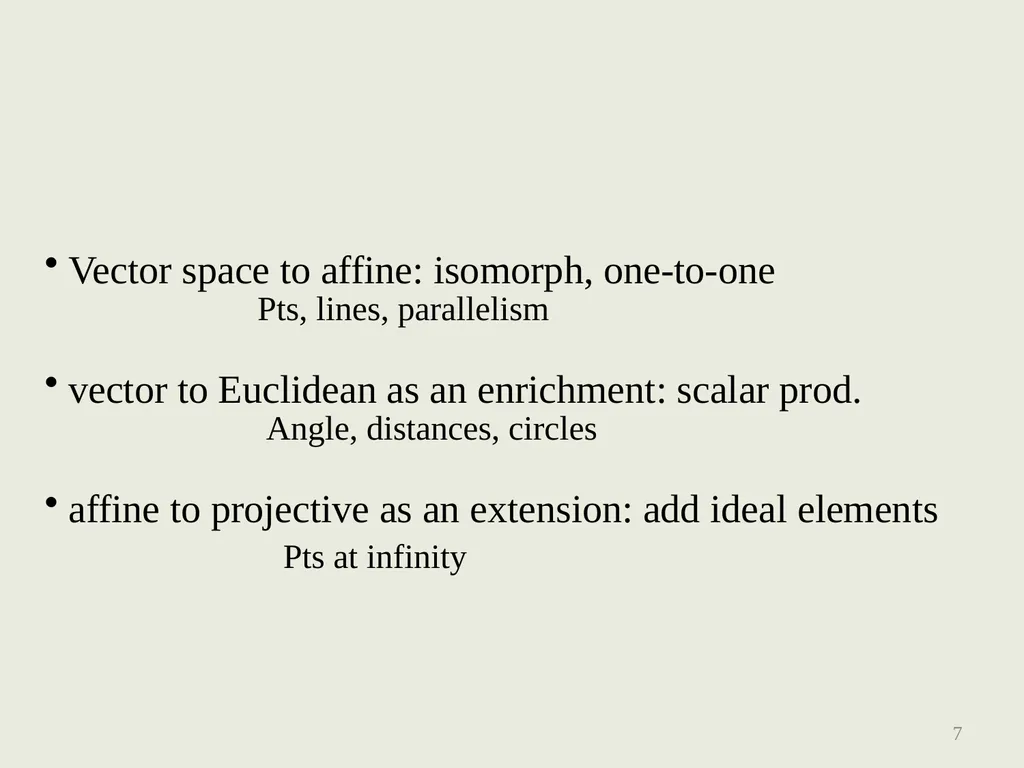
7 Vector space to affine: isomorph, one-to-one
vector to Euclidean as an enrichment: scalar prod.
affine to projective as an extension: add ideal elements Pts, lines, parallelism Angle, distances, circles Pts at infinity<br>
vector to Euclidean as an enrichment: scalar prod.
affine to projective as an extension: add ideal elements Pts, lines, parallelism Angle, distances, circles Pts at infinity<br>
08
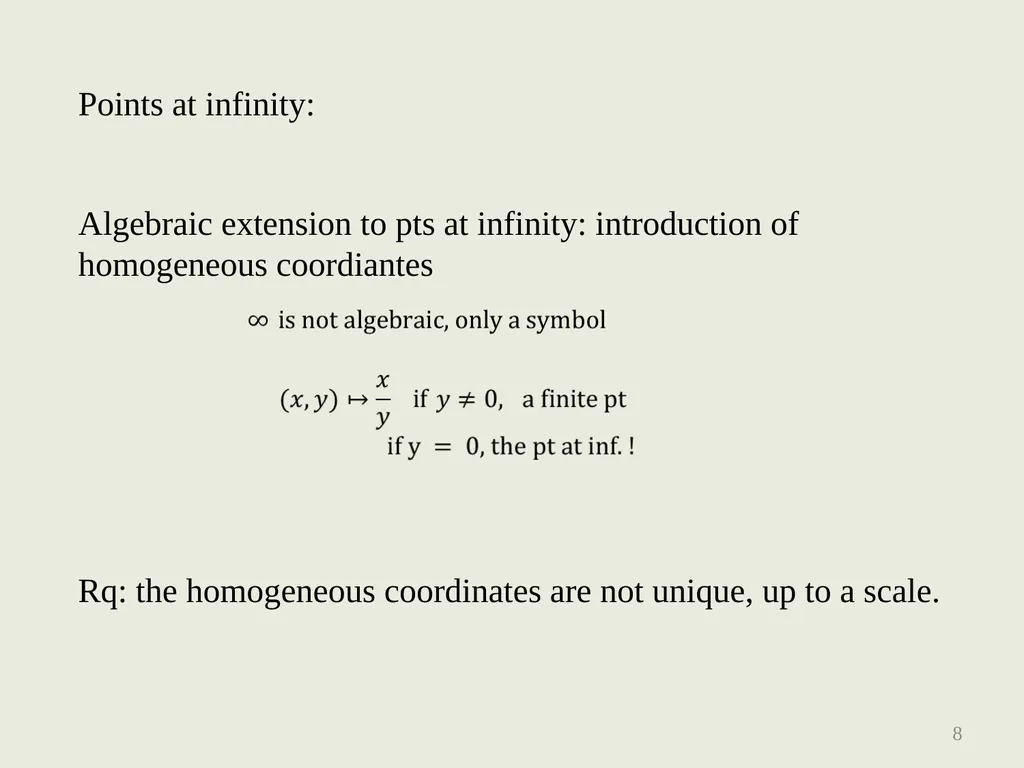
8 Algebraic extension to pts at infinity: introduction of homogeneous coordiantes Points at infinity: Rq: the homogeneous coordinates are not unique, up to a scale.<br>
09
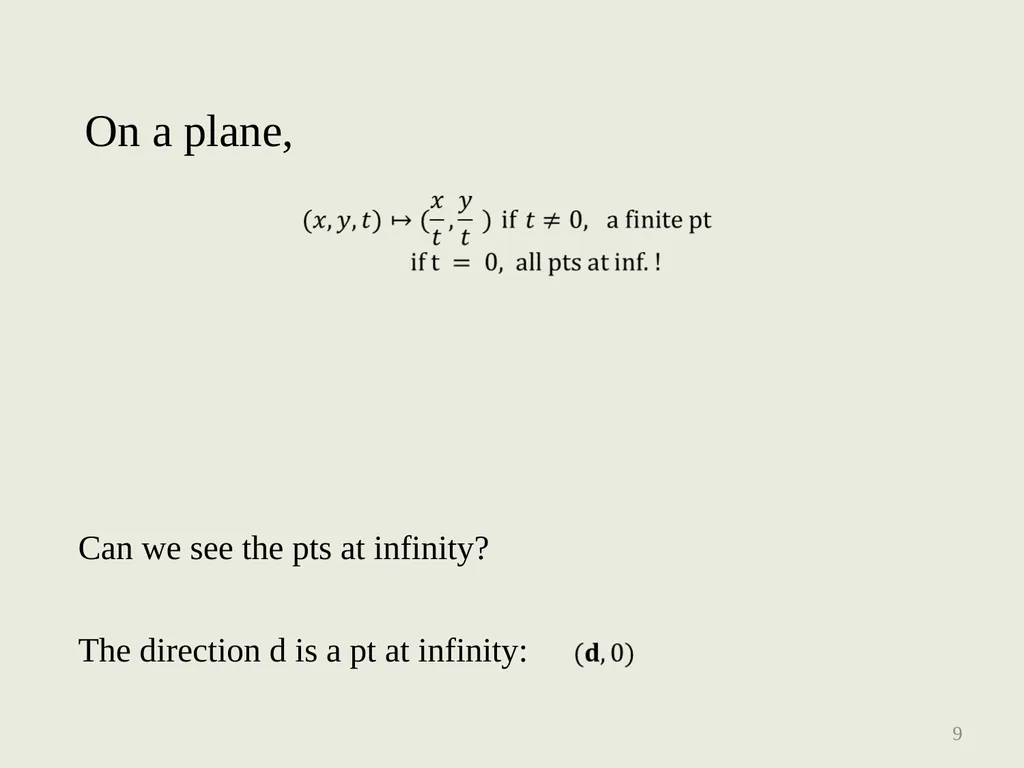
9 The direction d is a pt at infinity: On a plane, Can we see the pts at infinity?<br>
10
10 a projective space is an affine space + some pts at infinity a projective space is a space of ‘homogeneous coordinates’ or Provisional summary<br>
11
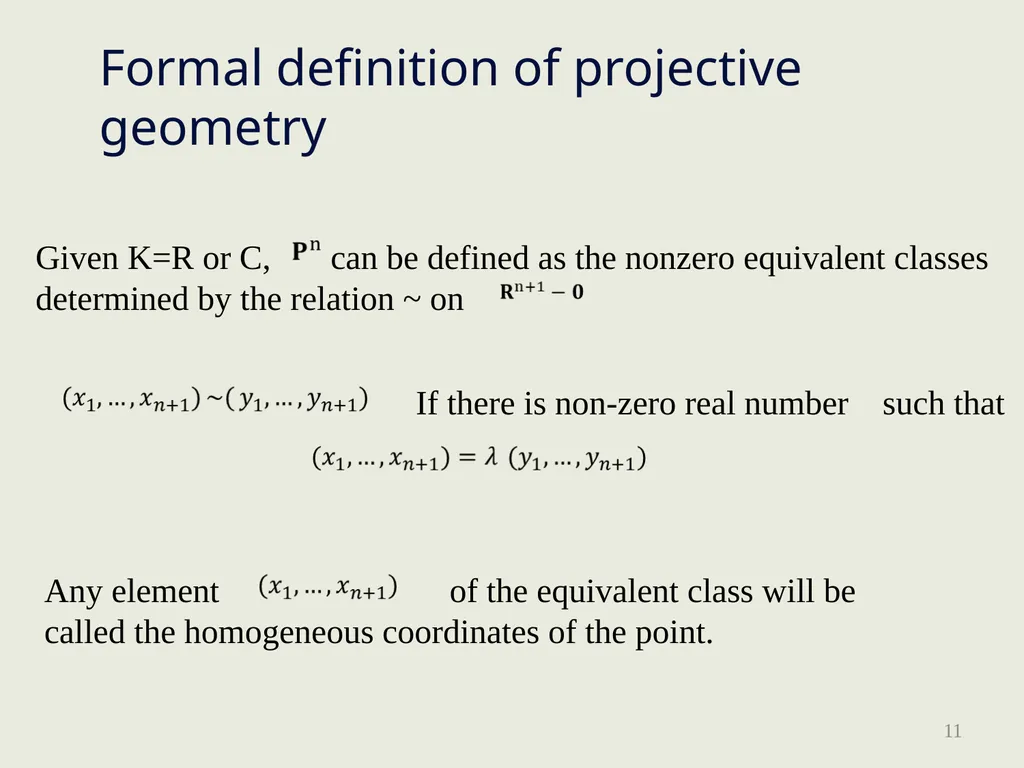
11 Formal definition of projective geometry Given K=R or C, can be defined as the nonzero equivalent classes determined by the relation ~ on If there is non-zero real number such that Any element of the equivalent class will be called the homogeneous coordinates of the point.<br>
12
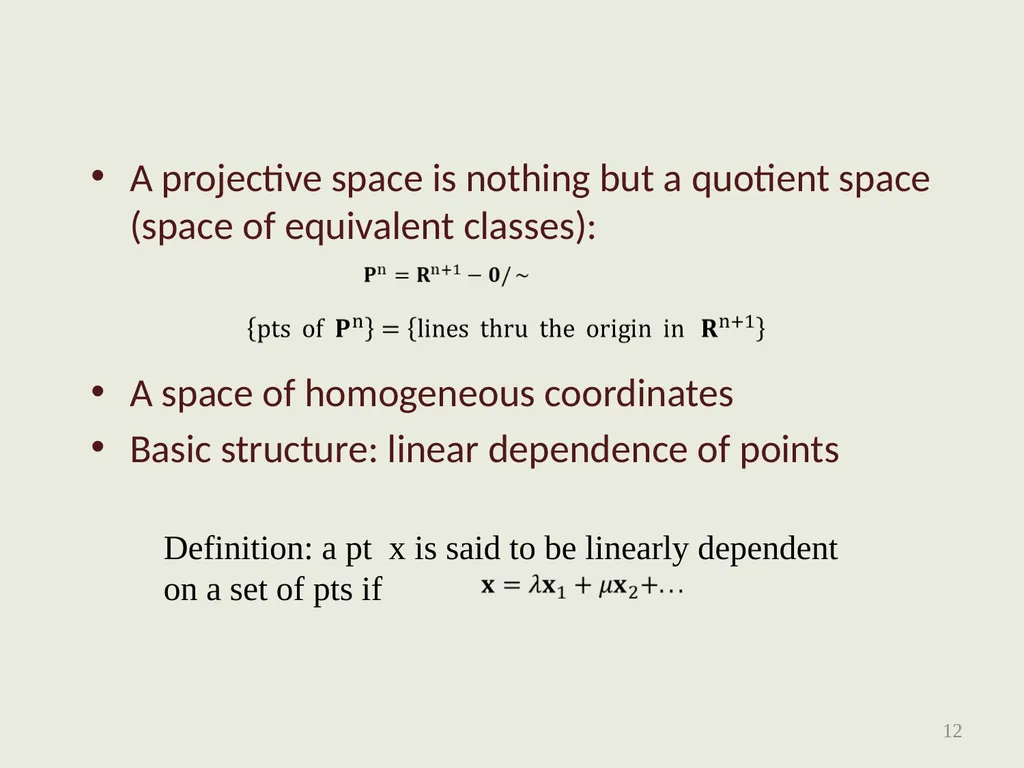
12 Definition: a pt x is said to be linearly dependent on a set of pts if A projective space is nothing but a quotient space (space of equivalent classes):
A space of homogeneous coordinates
Basic structure: linear dependence of points<br>
A space of homogeneous coordinates
Basic structure: linear dependence of points<br>
13
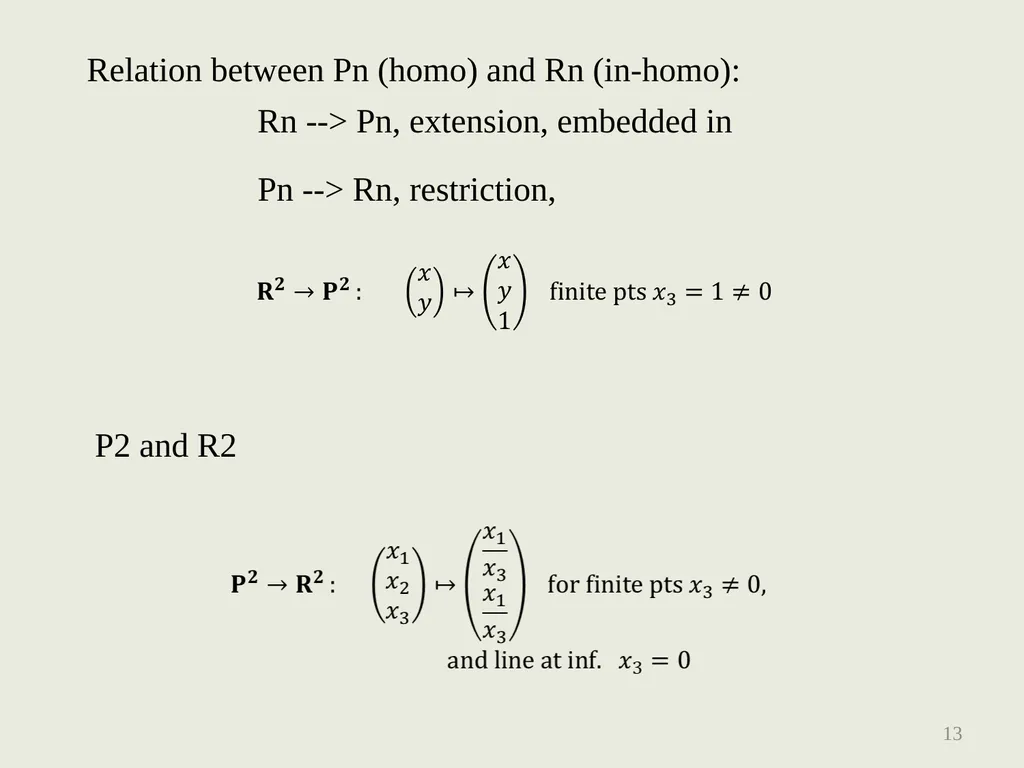
13 P2 and R2 Relation between Pn (homo) and Rn (in-homo): Rn --> Pn, extension, embedded in Pn --> Rn, restriction,<br>
14
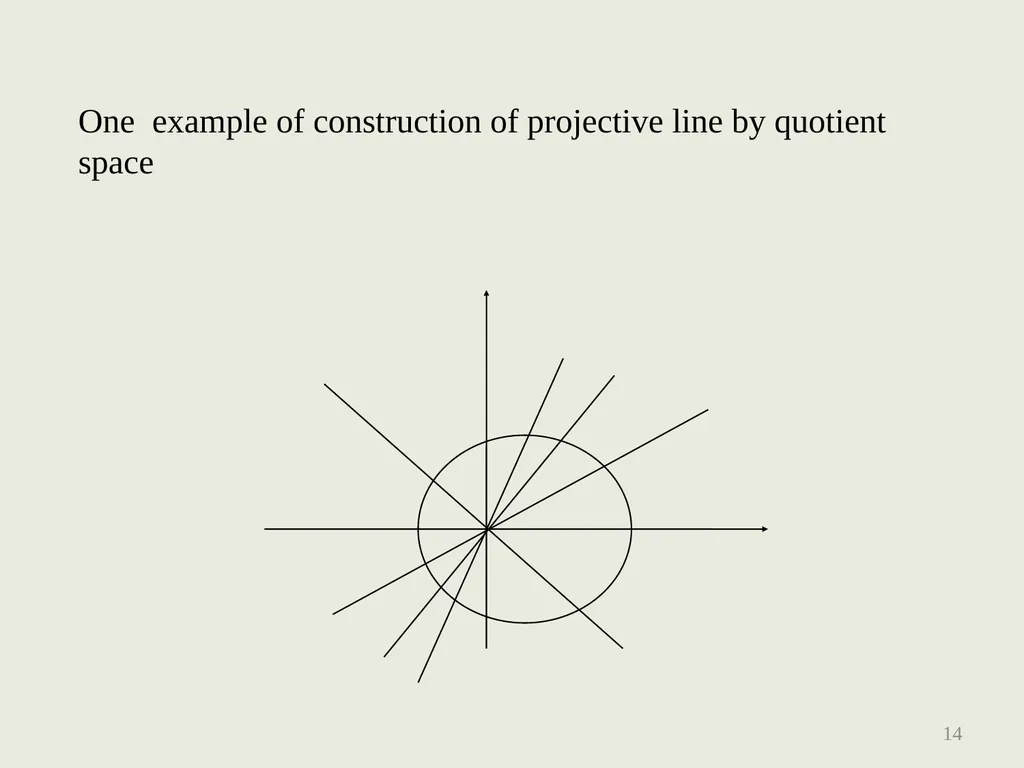
14 One example of construction of projective line by quotient space<br>
15
15 Examples of projective spaces Projective plane P2
Projective line P1
Projective space P3<br>
Projective line P1
Projective space P3<br>
16
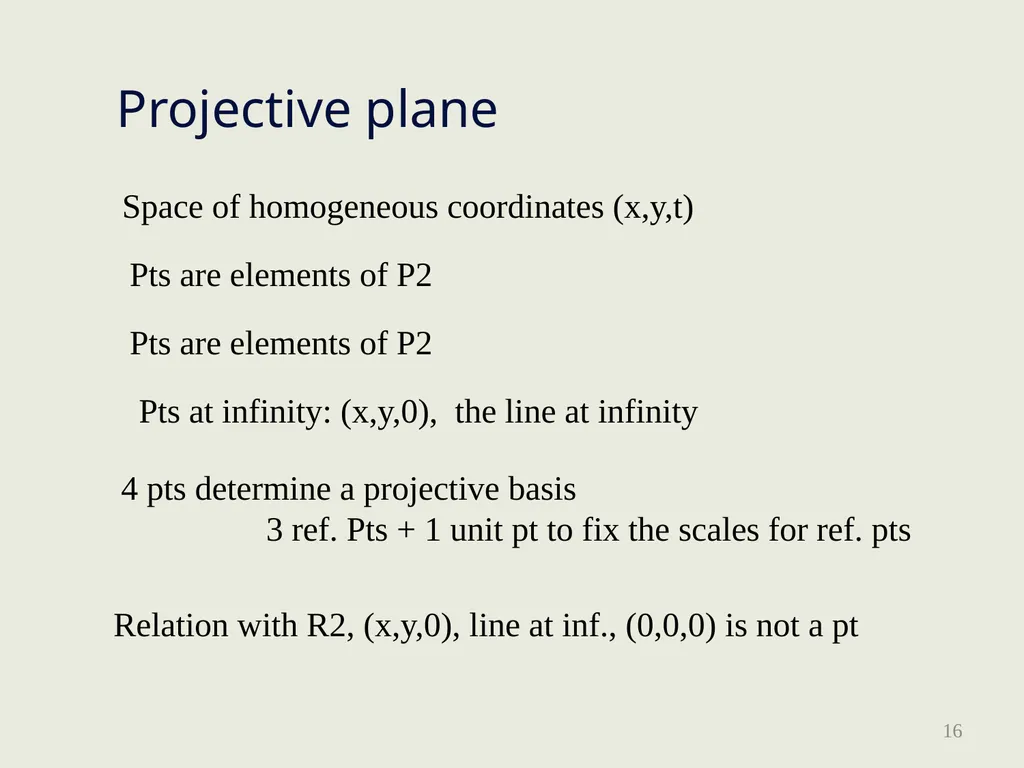
16 Pts are elements of P2 Projective plane 4 pts determine a projective basis
3 ref. Pts + 1 unit pt to fix the scales for ref. pts Relation with R2, (x,y,0), line at inf., (0,0,0) is not a pt Pts at infinity: (x,y,0), the line at infinity Space of homogeneous coordinates (x,y,t) Pts are elements of P2<br>
3 ref. Pts + 1 unit pt to fix the scales for ref. pts Relation with R2, (x,y,0), line at inf., (0,0,0) is not a pt Pts at infinity: (x,y,0), the line at infinity Space of homogeneous coordinates (x,y,t) Pts are elements of P2<br>
17
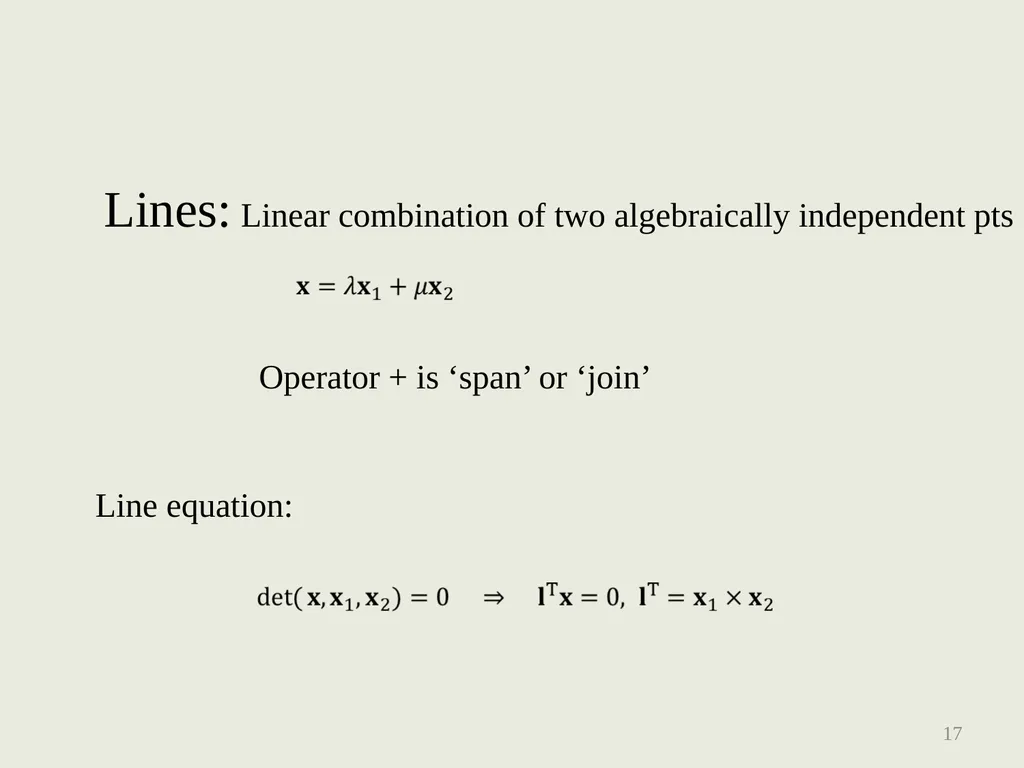
17 Line equation: Lines: Linear combination of two algebraically independent pts Operator + is ‘span’ or ‘join’<br>
18
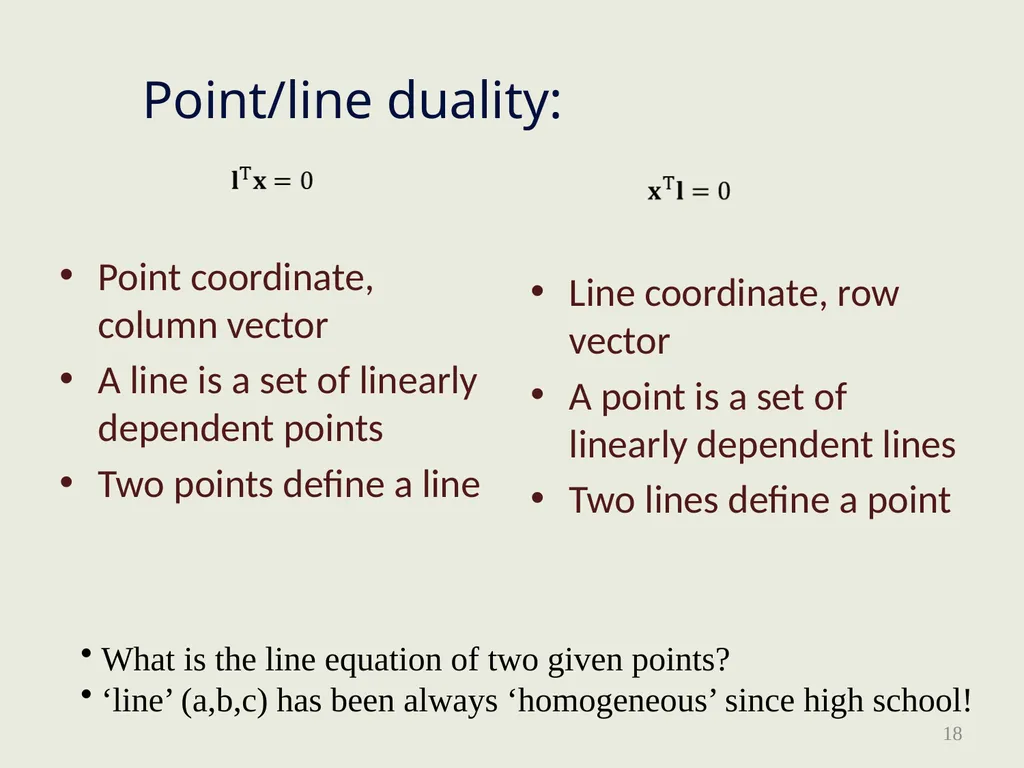
18 Point/line duality: Point coordinate, column vector
A line is a set of linearly dependent points
Two points define a line Line coordinate, row vector
A point is a set of linearly dependent lines
Two lines define a point What is the line equation of two given points?
‘line’ (a,b,c) has been always ‘homogeneous’ since high school!<br>
A line is a set of linearly dependent points
Two points define a line Line coordinate, row vector
A point is a set of linearly dependent lines
Two lines define a point What is the line equation of two given points?
‘line’ (a,b,c) has been always ‘homogeneous’ since high school!<br>
19
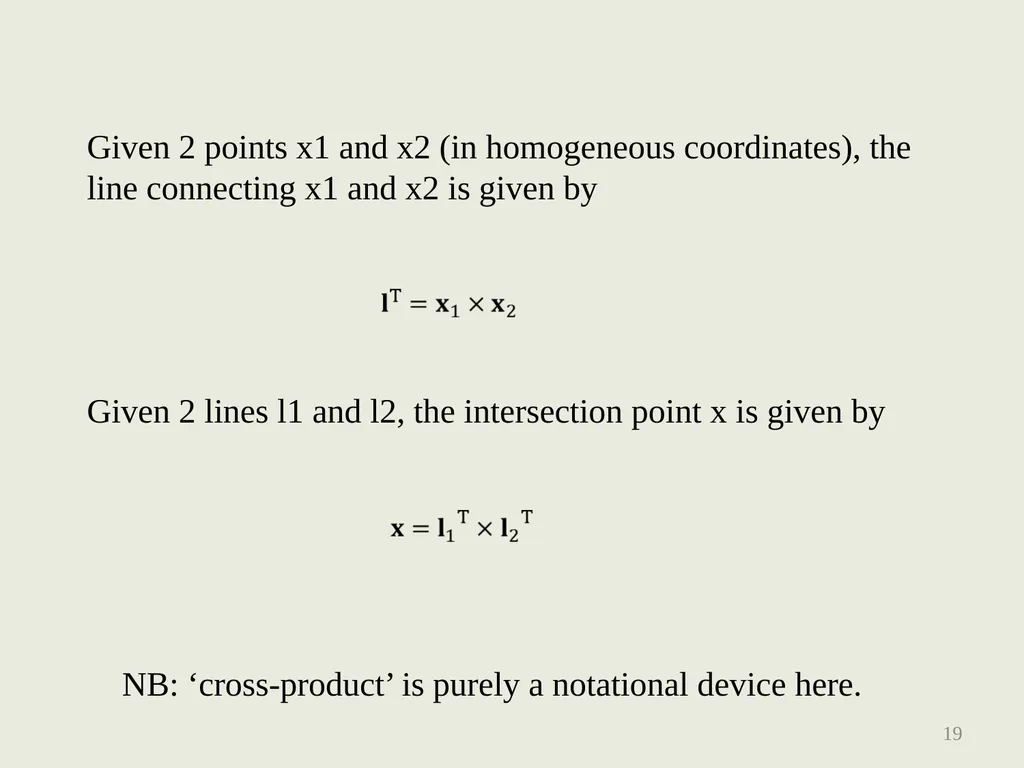
19 Given 2 points x1 and x2 (in homogeneous coordinates), the line connecting x1 and x2 is given by Given 2 lines l1 and l2, the intersection point x is given by NB: ‘cross-product’ is purely a notational device here.<br>
20
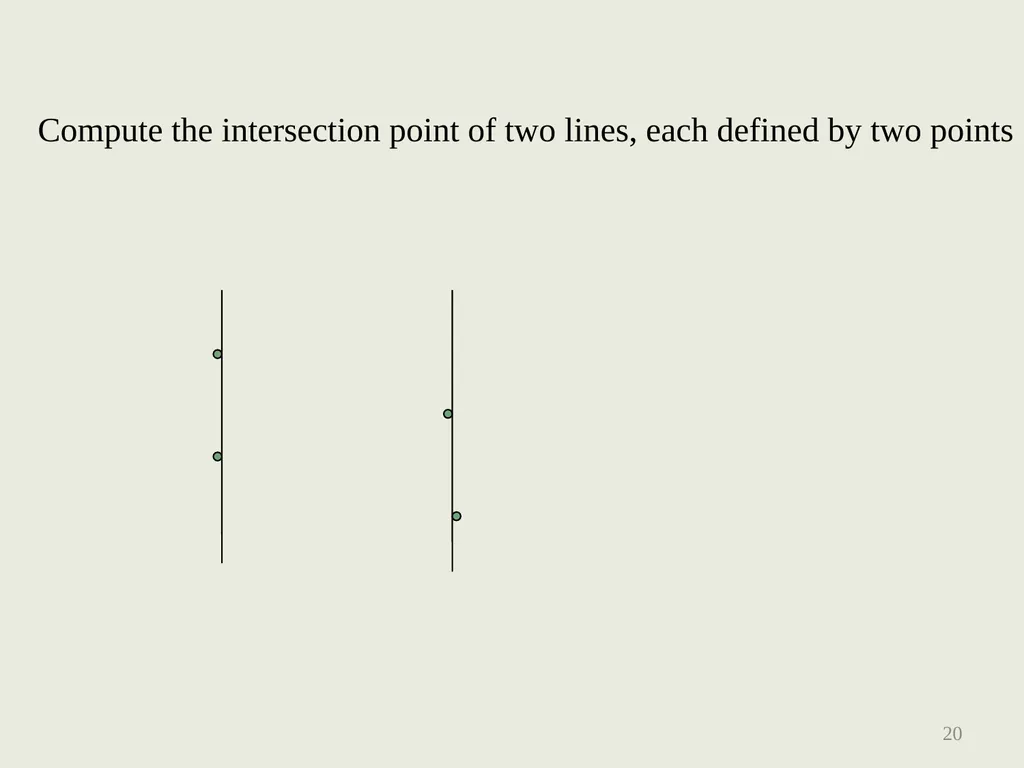
20 Compute the intersection point of two lines, each defined by two points<br>
21
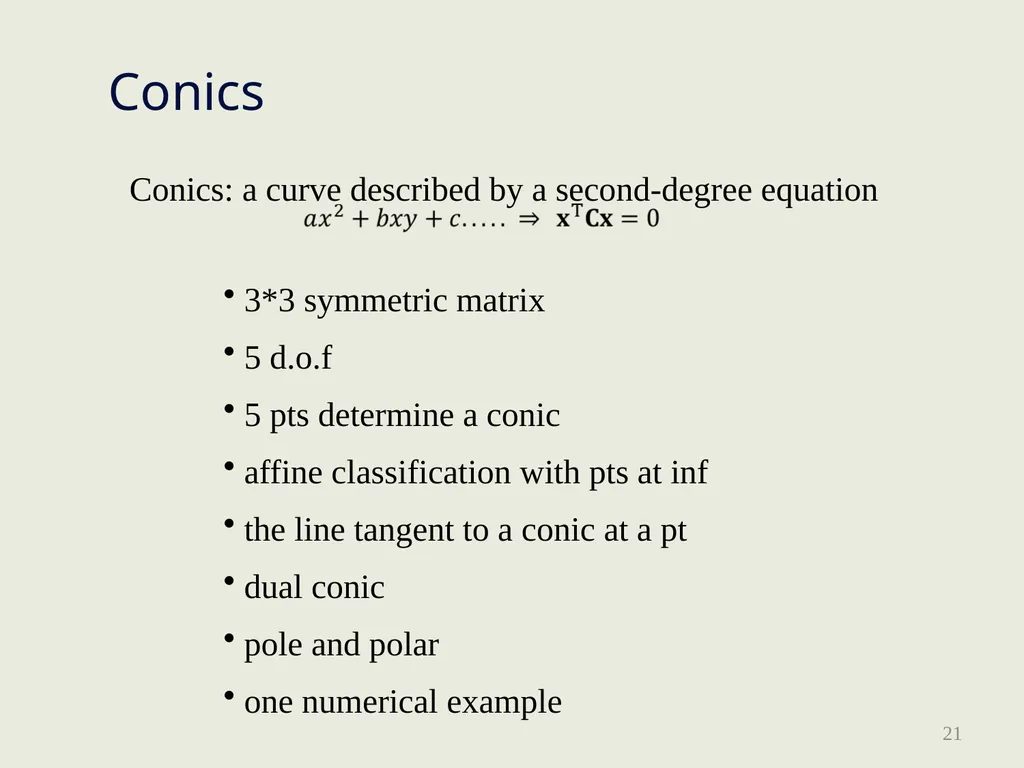
21 Conics: a curve described by a second-degree equation 3*3 symmetric matrix
5 d.o.f
5 pts determine a conic
affine classification with pts at inf
the line tangent to a conic at a pt
dual conic
pole and polar
one numerical example Conics<br>
5 d.o.f
5 pts determine a conic
affine classification with pts at inf
the line tangent to a conic at a pt
dual conic
pole and polar
one numerical example Conics<br>
22
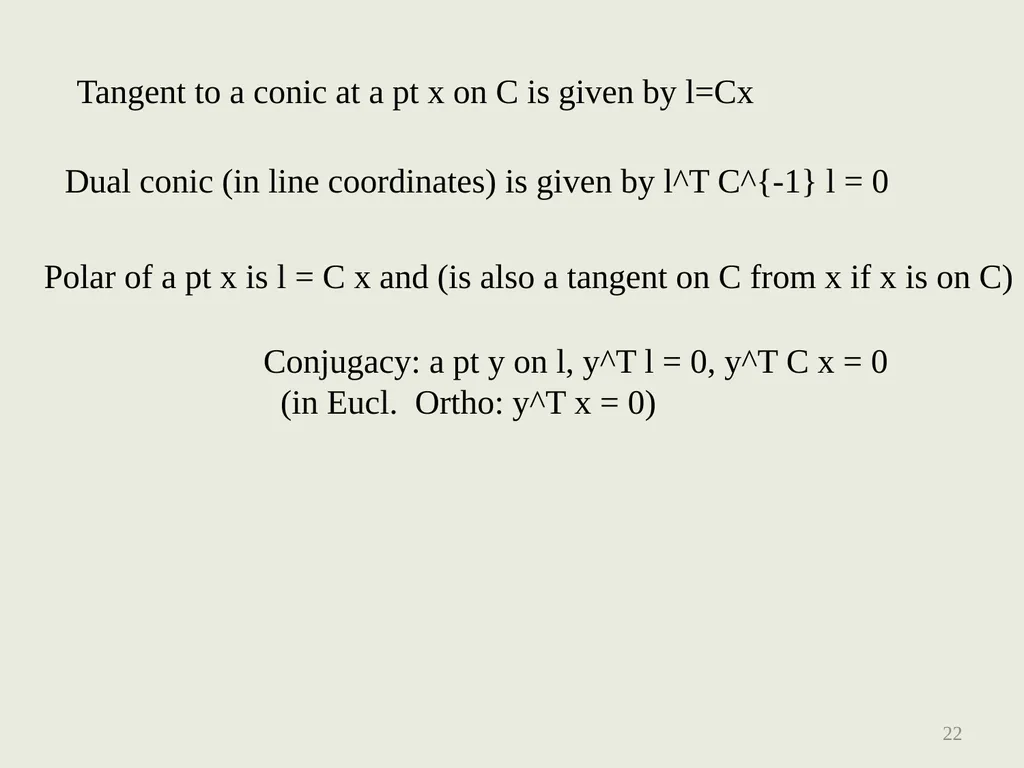
22 Tangent to a conic at a pt x on C is given by l=Cx Dual conic (in line coordinates) is given by l^T C^{-1} l = 0 Polar of a pt x is l = C x and (is also a tangent on C from x if x is on C) Conjugacy: a pt y on l, y^T l = 0, y^T C x = 0
(in Eucl. Ortho: y^T x = 0)<br>
(in Eucl. Ortho: y^T x = 0)<br>
23
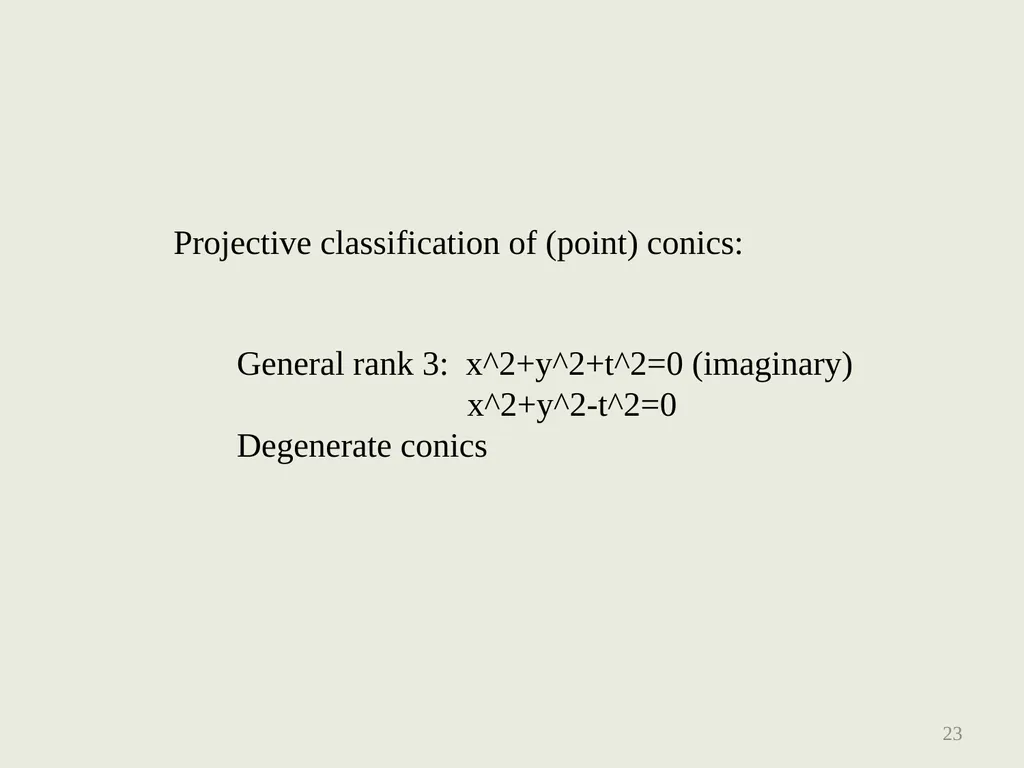
23 Projective classification of (point) conics: General rank 3: x^2+y^2+t^2=0 (imaginary)
x^2+y^2-t^2=0
Degenerate conics<br>
x^2+y^2-t^2=0
Degenerate conics<br>
24
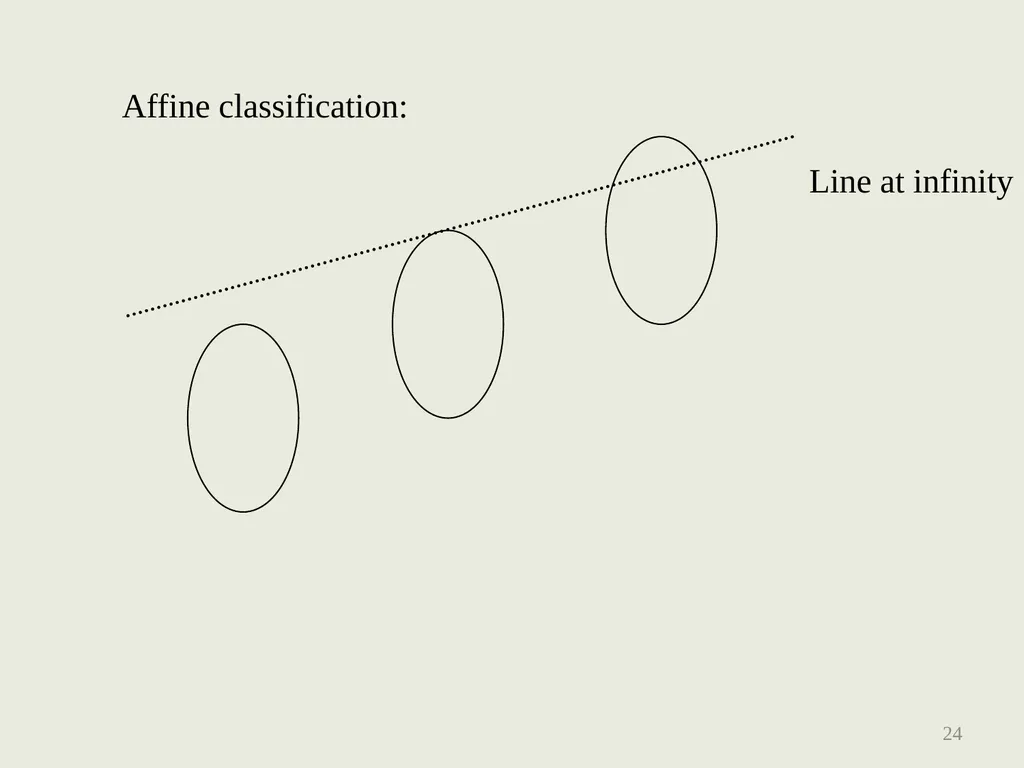
24 Line at infinity Affine classification:<br>
25
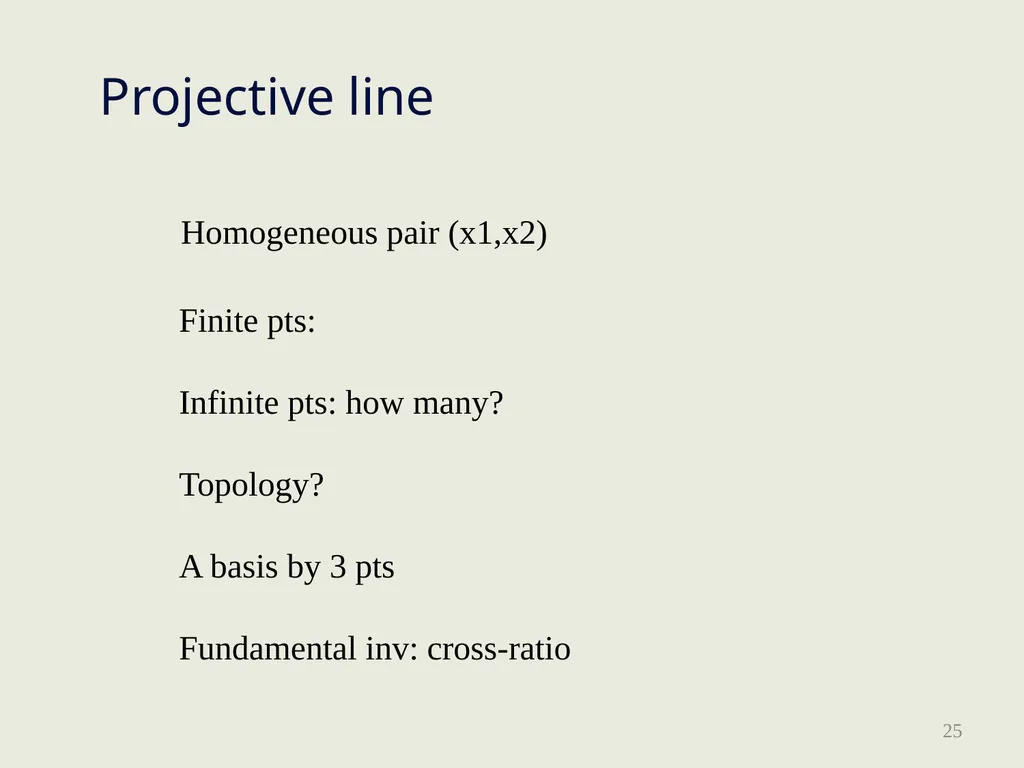
25 Projective line Finite pts:
Infinite pts: how many?
Topology?
A basis by 3 pts
Fundamental inv: cross-ratio Homogeneous pair (x1,x2)<br>
Infinite pts: how many?
Topology?
A basis by 3 pts
Fundamental inv: cross-ratio Homogeneous pair (x1,x2)<br>
26
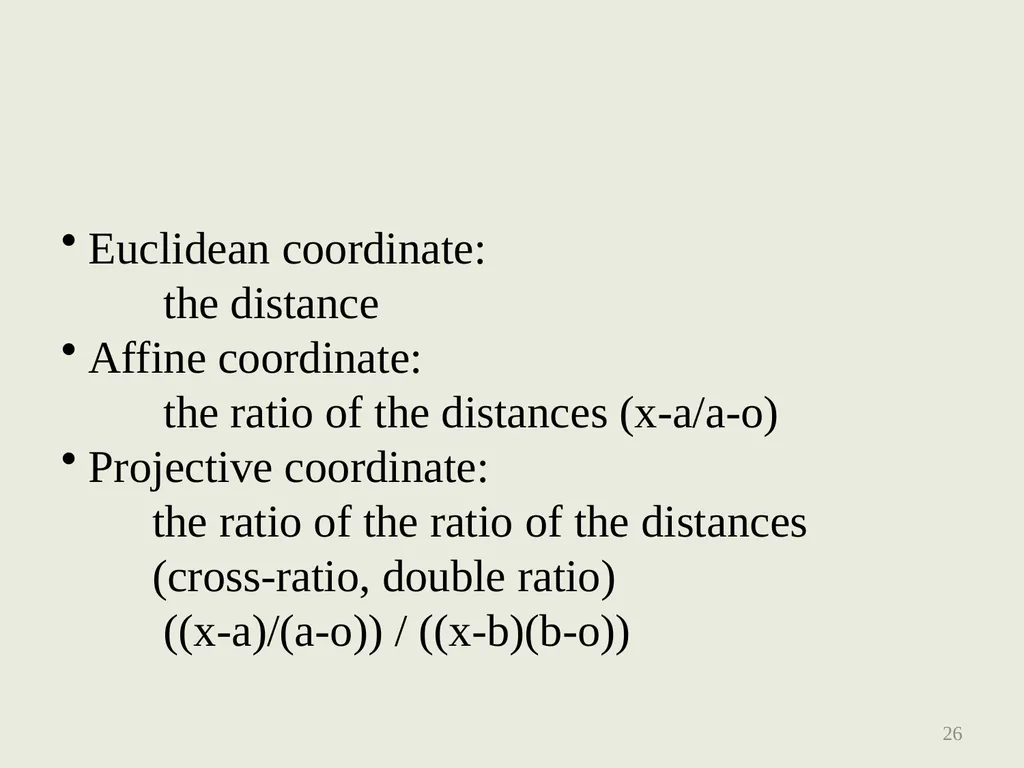
26 Euclidean coordinate:
the distance
Affine coordinate:
the ratio of the distances (x-a/a-o)
Projective coordinate:
the ratio of the ratio of the distances
(cross-ratio, double ratio)
((x-a)/(a-o)) / ((x-b)(b-o))<br>
the distance
Affine coordinate:
the ratio of the distances (x-a/a-o)
Projective coordinate:
the ratio of the ratio of the distances
(cross-ratio, double ratio)
((x-a)/(a-o)) / ((x-b)(b-o))<br>
27
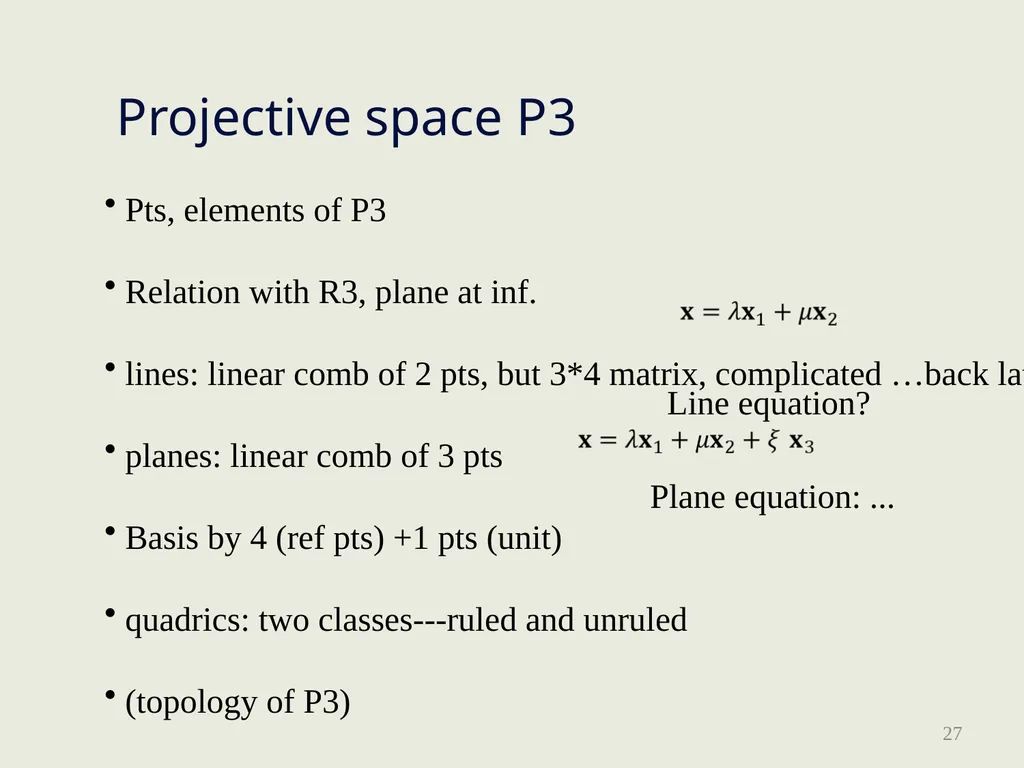
27 Pts, elements of P3
Relation with R3, plane at inf.
lines: linear comb of 2 pts, but 3*4 matrix, complicated …back later
planes: linear comb of 3 pts
Basis by 4 (ref pts) +1 pts (unit)
quadrics: two classes---ruled and unruled
(topology of P3) Plane equation: ... Line equation? Projective space P3<br>
Relation with R3, plane at inf.
lines: linear comb of 2 pts, but 3*4 matrix, complicated …back later
planes: linear comb of 3 pts
Basis by 4 (ref pts) +1 pts (unit)
quadrics: two classes---ruled and unruled
(topology of P3) Plane equation: ... Line equation? Projective space P3<br>
28
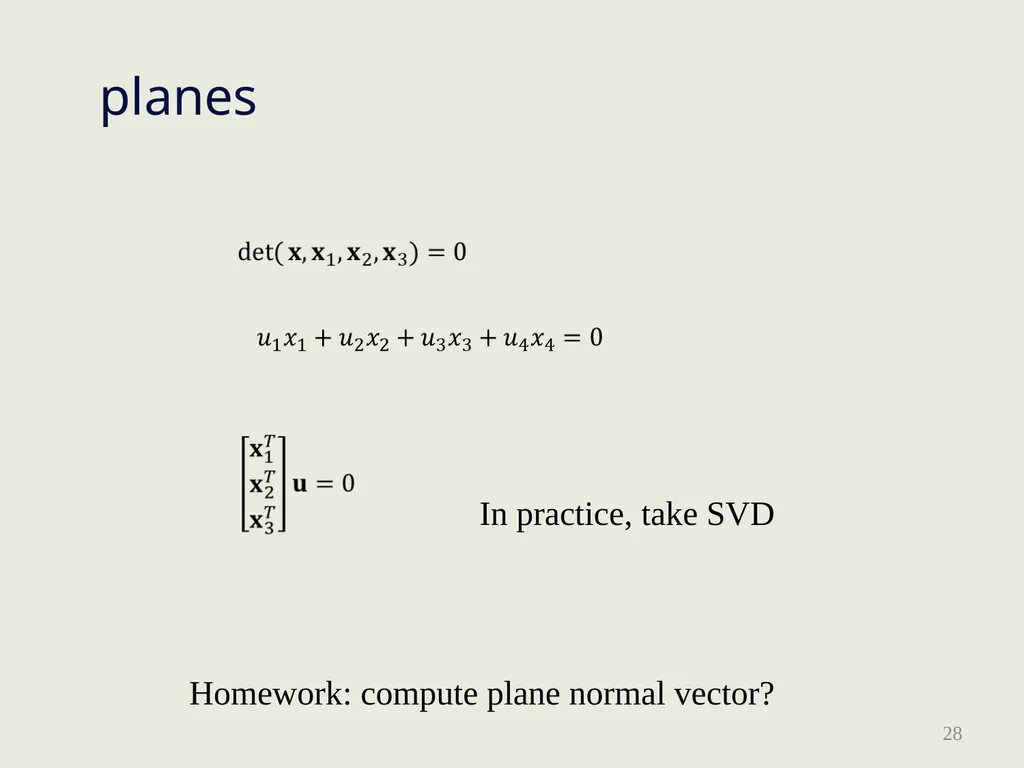
28 planes In practice, take SVD Homework: compute plane normal vector?<br>
29
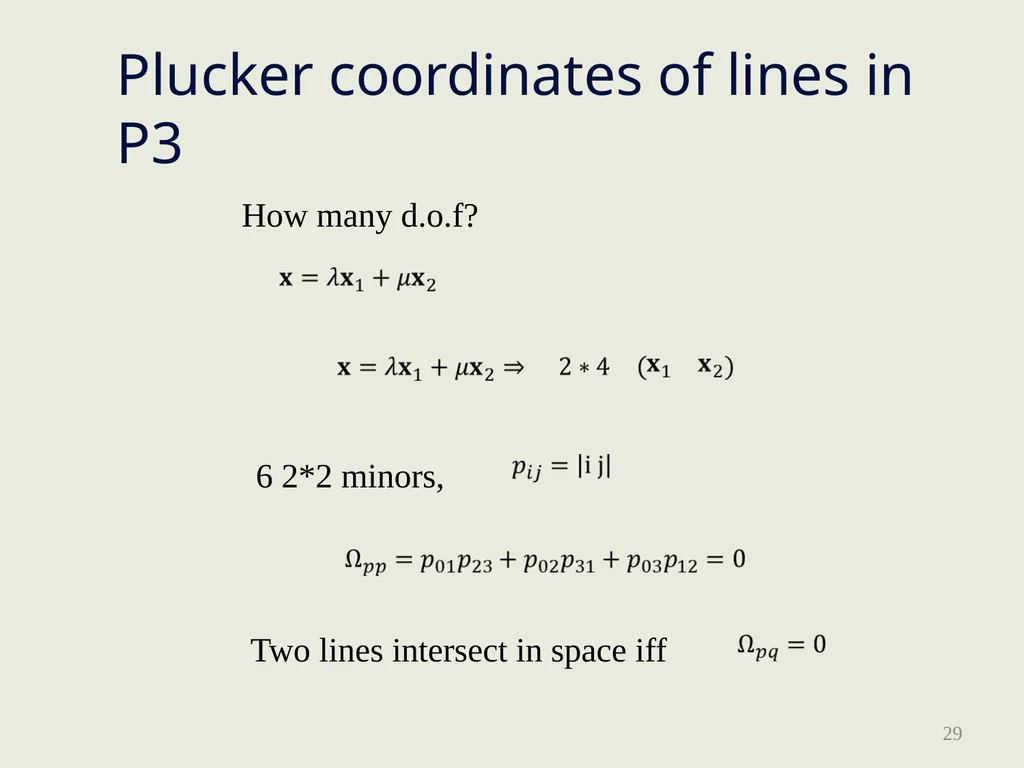
29 How many d.o.f? 6 2*2 minors, Two lines intersect in space iff Plucker coordinates of lines in P3<br>
30
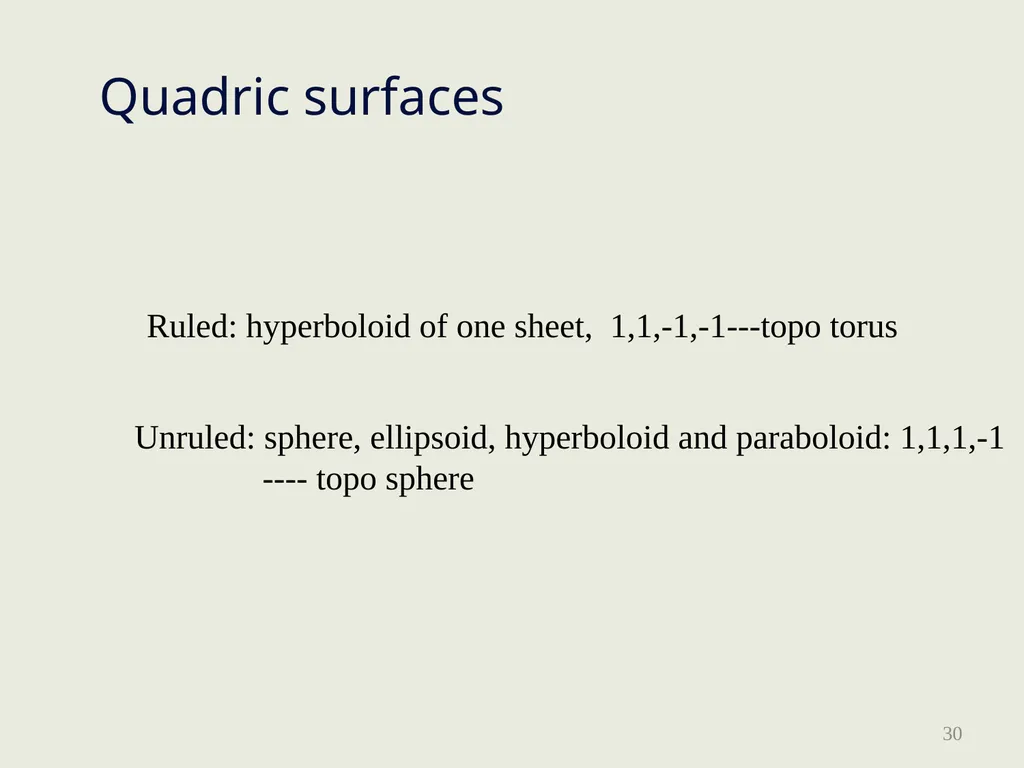
30 Quadric surfaces Ruled: hyperboloid of one sheet, 1,1,-1,-1---topo torus Unruled: sphere, ellipsoid, hyperboloid and paraboloid: 1,1,1,-1
---- topo sphere<br>
---- topo sphere<br>
31
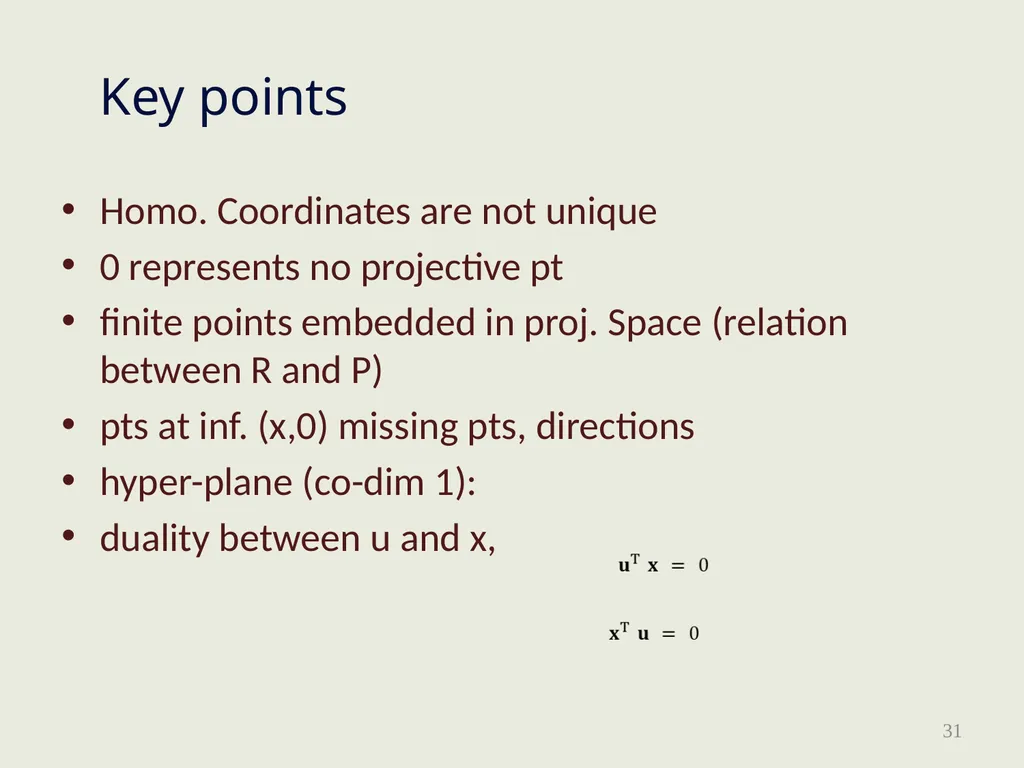
31 Key points Homo. Coordinates are not unique
0 represents no projective pt
finite points embedded in proj. Space (relation between R and P)
pts at inf. (x,0) missing pts, directions
hyper-plane (co-dim 1):
duality between u and x,<br>
0 represents no projective pt
finite points embedded in proj. Space (relation between R and P)
pts at inf. (x,0) missing pts, directions
hyper-plane (co-dim 1):
duality between u and x,<br>
32
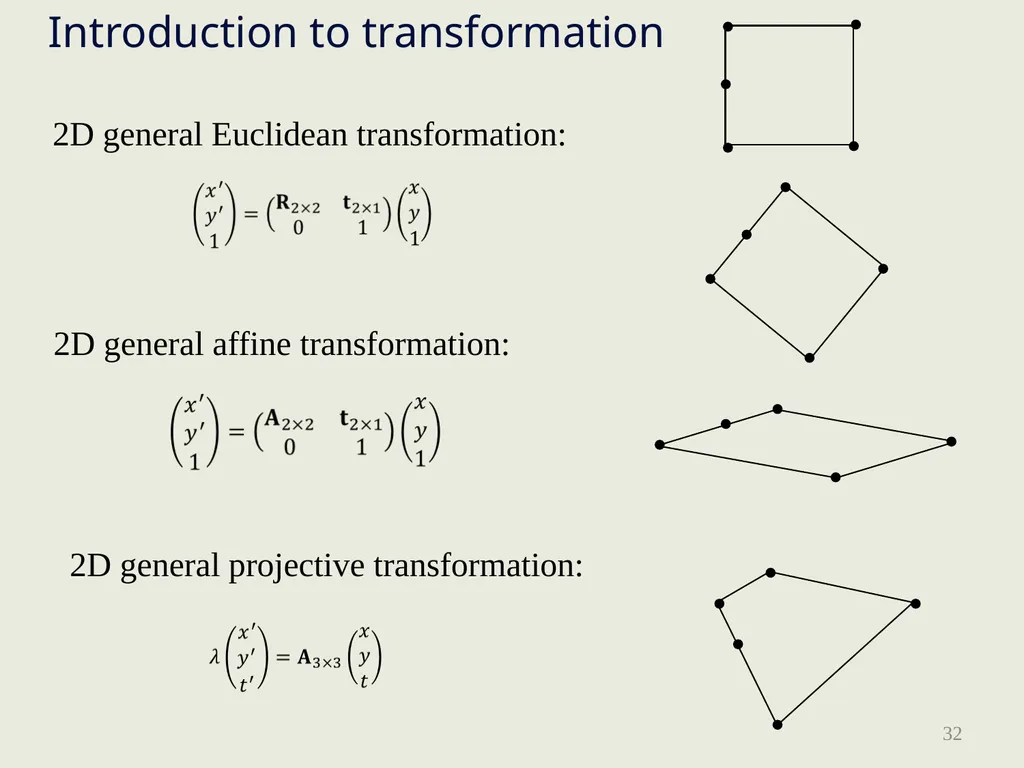
32 2D general Euclidean transformation: 2D general affine transformation: 2D general projective transformation: Introduction to transformation<br>
33
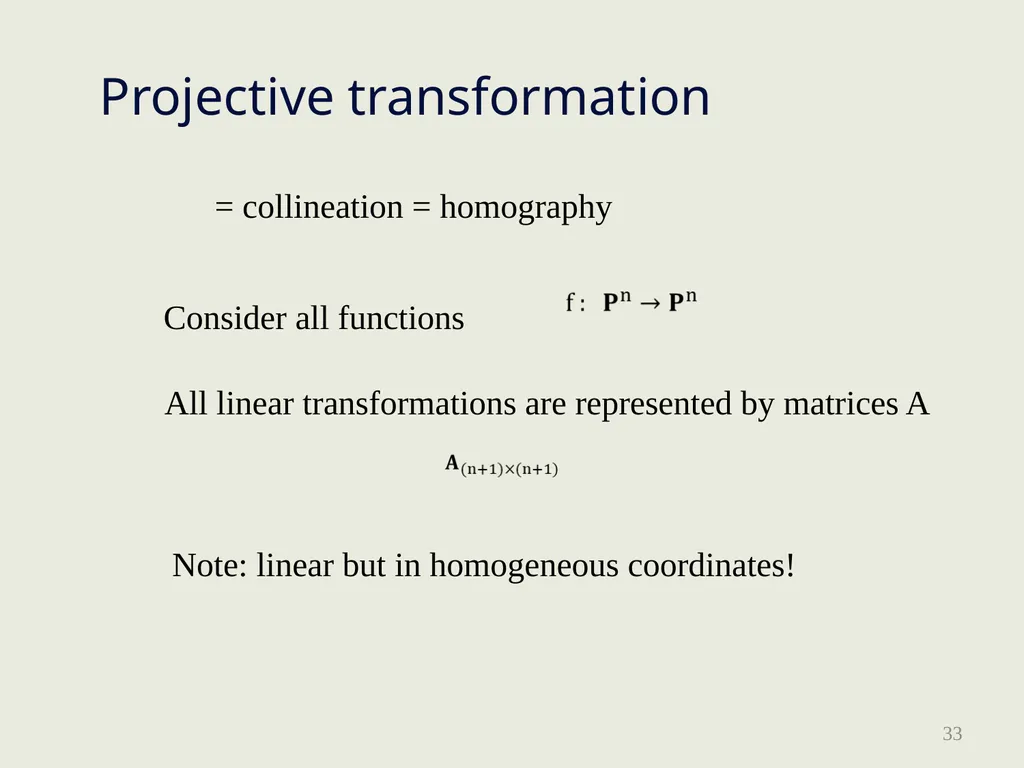
33 Projective transformation = collineation = homography Consider all functions All linear transformations are represented by matrices A Note: linear but in homogeneous coordinates!<br>
34
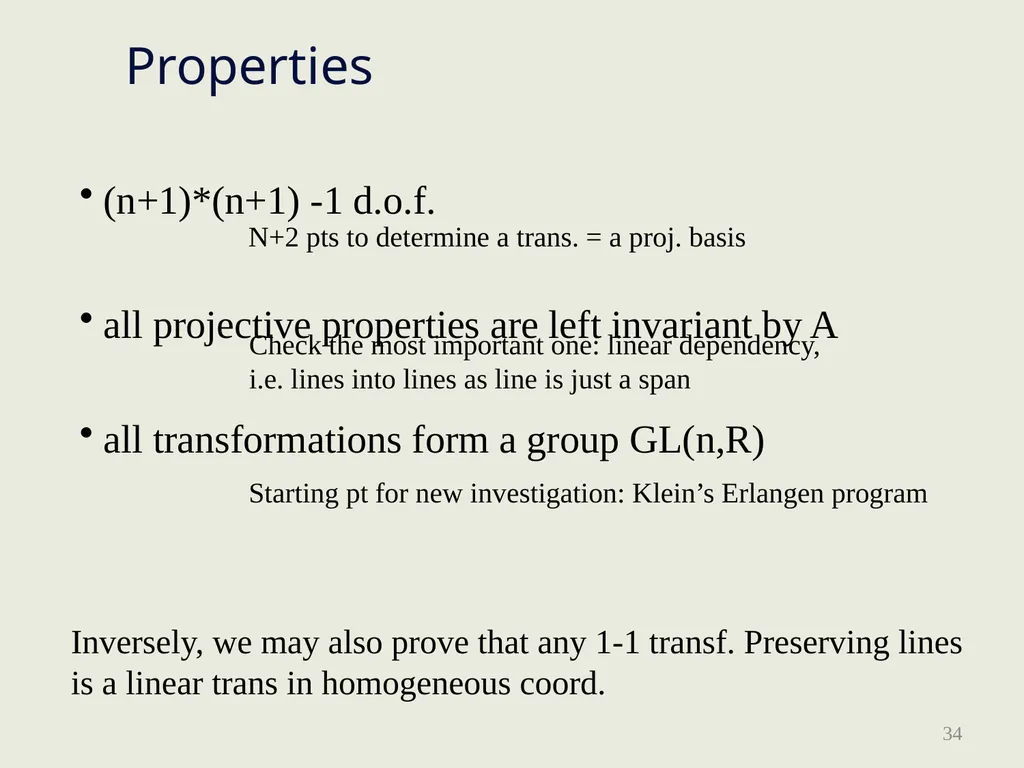
34 (n+1)*(n+1) -1 d.o.f.
all projective properties are left invariant by A
all transformations form a group GL(n,R) Check the most important one: linear dependency,
i.e. lines into lines as line is just a span Starting pt for new investigation: Klein’s Erlangen program Inversely, we may also prove that any 1-1 transf. Preserving lines
is a linear trans in homogeneous coord. Properties N+2 pts to determine a trans. = a proj. basis<br>
all projective properties are left invariant by A
all transformations form a group GL(n,R) Check the most important one: linear dependency,
i.e. lines into lines as line is just a span Starting pt for new investigation: Klein’s Erlangen program Inversely, we may also prove that any 1-1 transf. Preserving lines
is a linear trans in homogeneous coord. Properties N+2 pts to determine a trans. = a proj. basis<br>
35
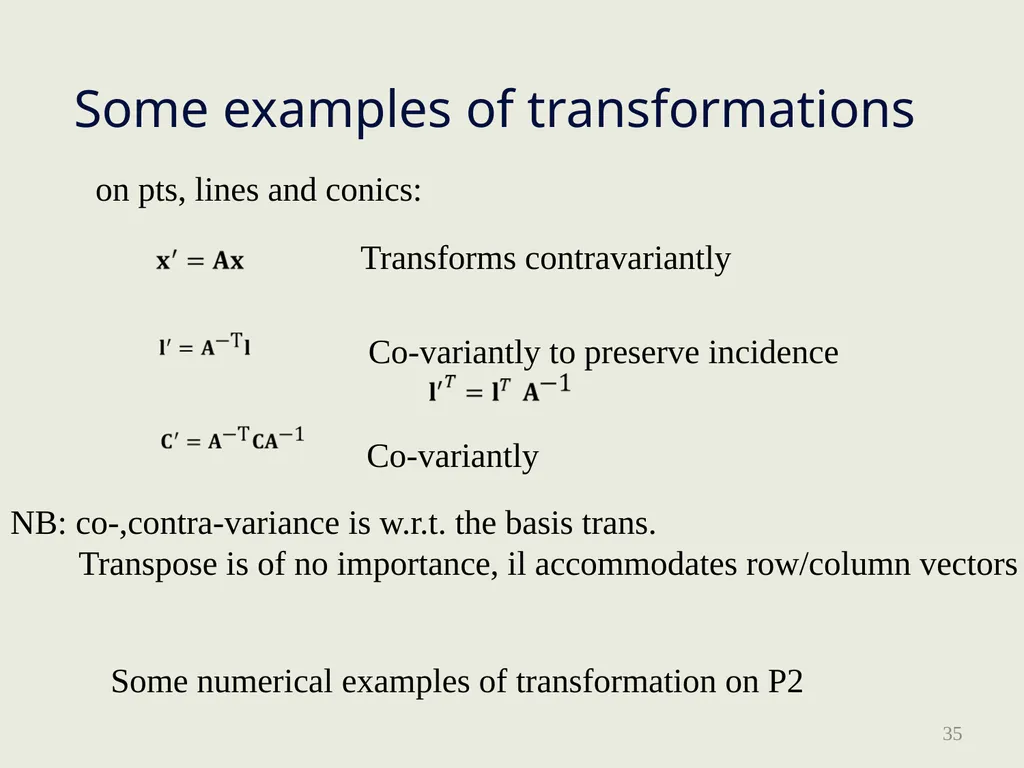
35 on pts, lines and conics: Transforms contravariantly Co-variantly to preserve incidence Co-variantly NB: co-,contra-variance is w.r.t. the basis trans.
Transpose is of no importance, il accommodates row/column vectors Some numerical examples of transformation on P2 Some examples of transformations<br>
Transpose is of no importance, il accommodates row/column vectors Some numerical examples of transformation on P2 Some examples of transformations<br>
36
36 How to compute canonical or standard coordinates?--- affine case Given 4 pts, x1, x2, x3, x4, find the affine coord of x4 w.r.t. x1, x2 and x3:<br>
37
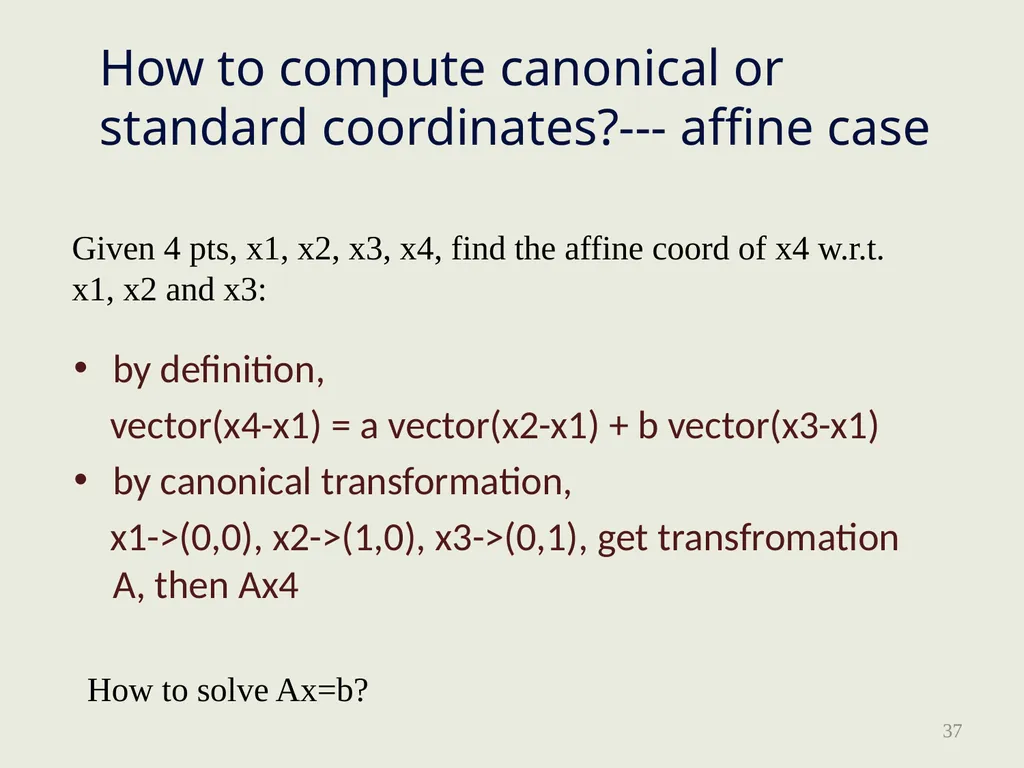
37 How to compute canonical or standard coordinates?--- affine case by definition,
vector(x4-x1) = a vector(x2-x1) + b vector(x3-x1)
by canonical transformation,
x1->(0,0), x2->(1,0), x3->(0,1), get transfromation A, then Ax4 Given 4 pts, x1, x2, x3, x4, find the affine coord of x4 w.r.t. x1, x2 and x3: How to solve Ax=b?<br>
vector(x4-x1) = a vector(x2-x1) + b vector(x3-x1)
by canonical transformation,
x1->(0,0), x2->(1,0), x3->(0,1), get transfromation A, then Ax4 Given 4 pts, x1, x2, x3, x4, find the affine coord of x4 w.r.t. x1, x2 and x3: How to solve Ax=b?<br>
38
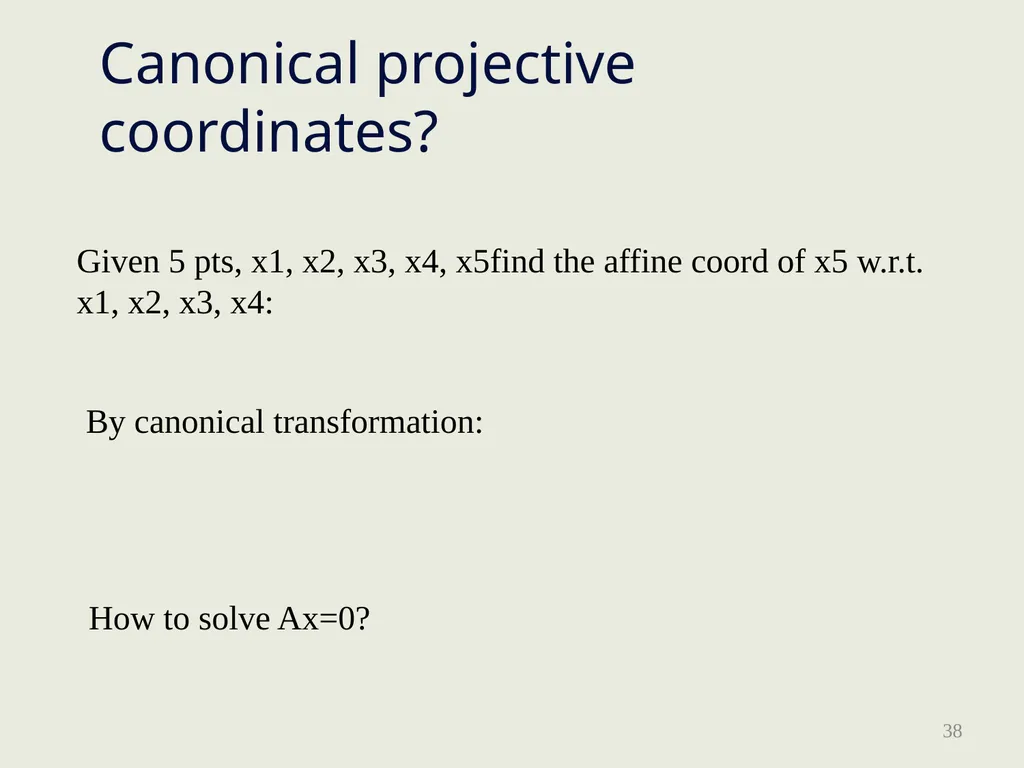
38 Canonical projective coordinates? Given 5 pts, x1, x2, x3, x4, x5find the affine coord of x5 w.r.t. x1, x2, x3, x4: By canonical transformation: How to solve Ax=0?<br>
39
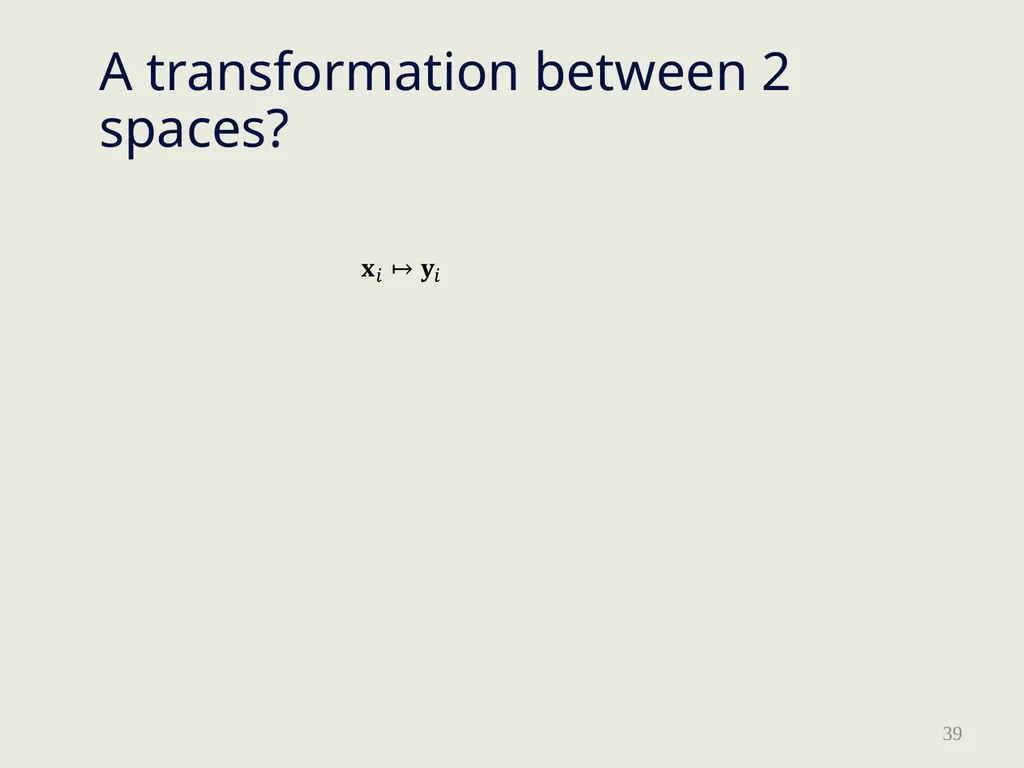
39 A transformation between 2 spaces?<br>
40
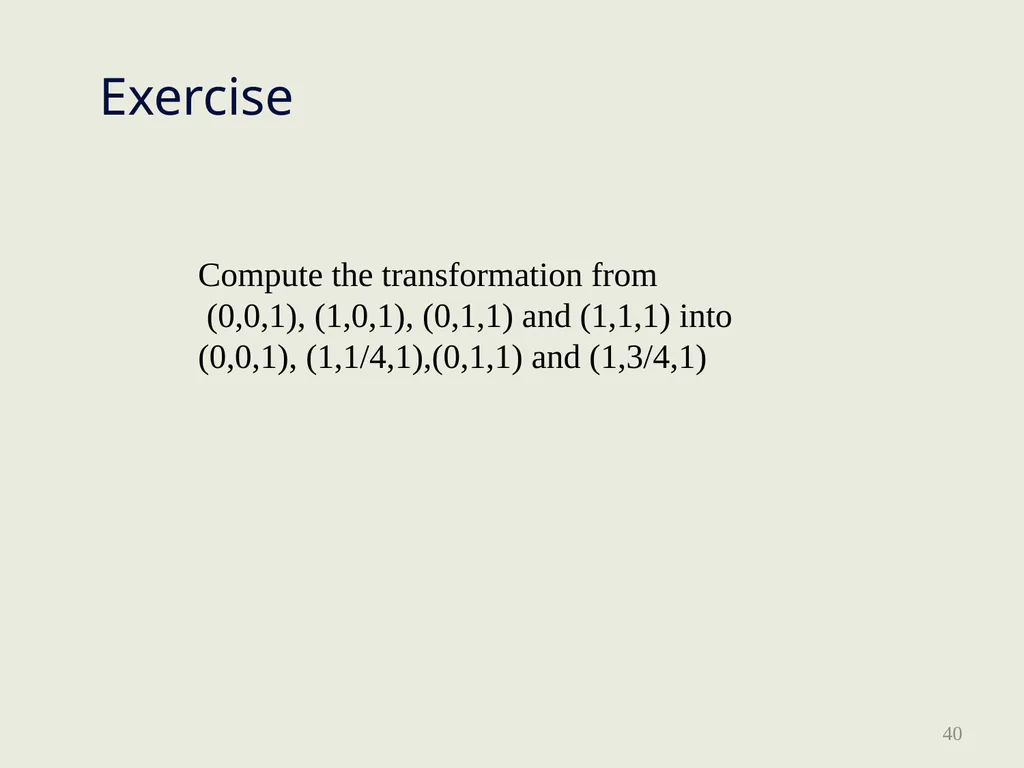
40 Exercise Compute the transformation from
(0,0,1), (1,0,1), (0,1,1) and (1,1,1) into
(0,0,1), (1,1/4,1),(0,1,1) and (1,3/4,1)<br>
(0,0,1), (1,0,1), (0,1,1) and (1,1,1) into
(0,0,1), (1,1/4,1),(0,1,1) and (1,3/4,1)<br>
41
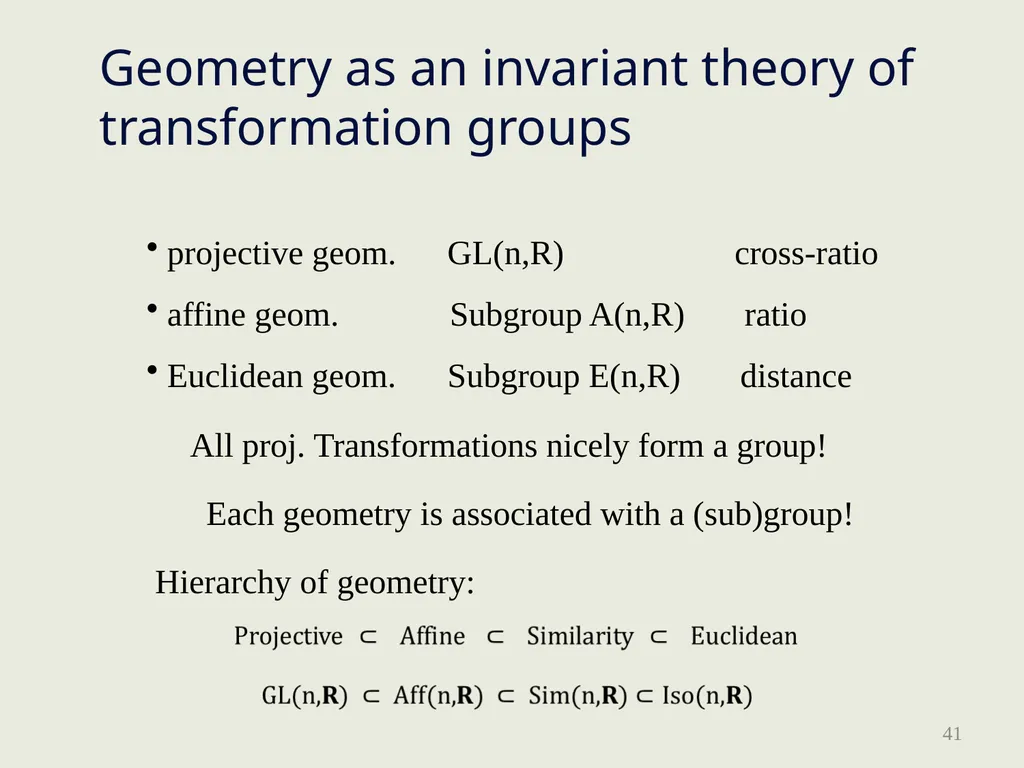
41 Geometry as an invariant theory of transformation groups projective geom. GL(n,R) cross-ratio
affine geom. Subgroup A(n,R) ratio
Euclidean geom. Subgroup E(n,R) distance Hierarchy of geometry: All proj. Transformations nicely form a group! Each geometry is associated with a (sub)group!<br>
affine geom. Subgroup A(n,R) ratio
Euclidean geom. Subgroup E(n,R) distance Hierarchy of geometry: All proj. Transformations nicely form a group! Each geometry is associated with a (sub)group!<br>
42
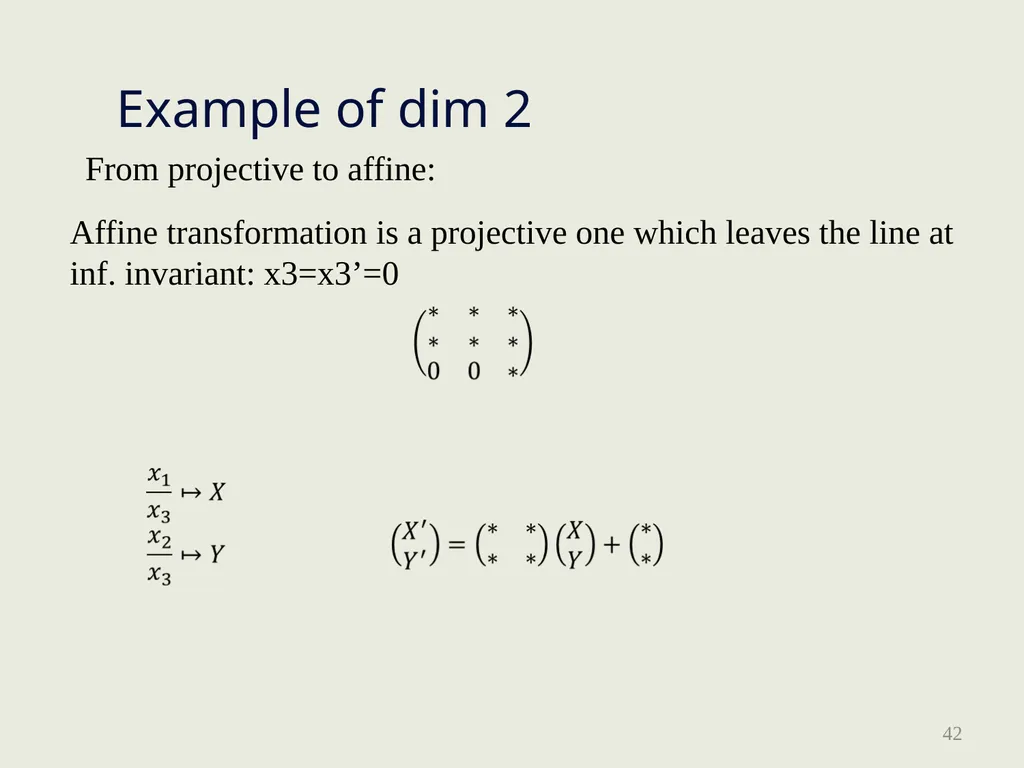
42 Affine transformation is a projective one which leaves the line at inf. invariant: x3=x3’=0 Example of dim 2 From projective to affine:<br>
43
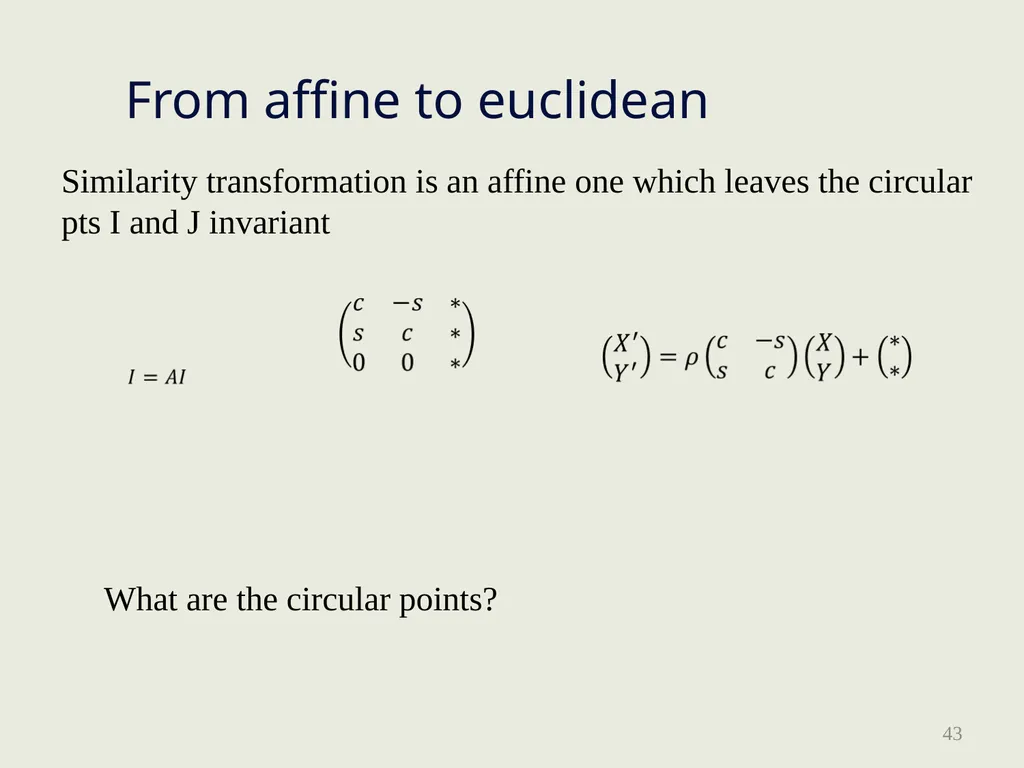
43 Similarity transformation is an affine one which leaves the circular pts I and J invariant What are the circular points? From affine to euclidean<br>
44
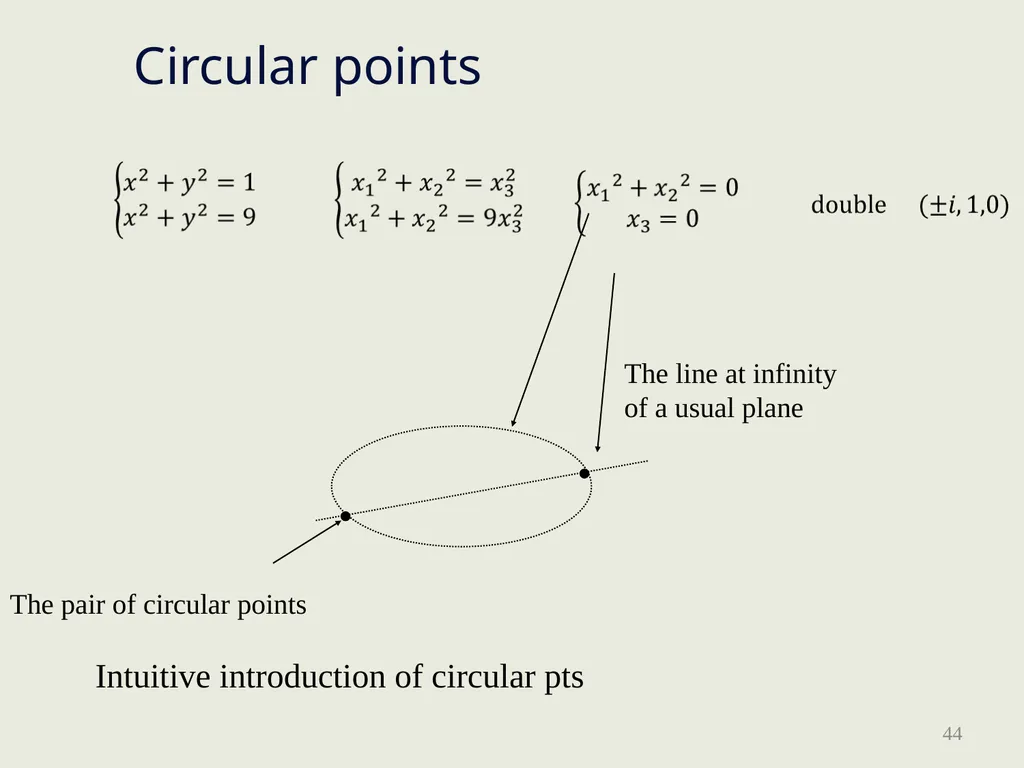
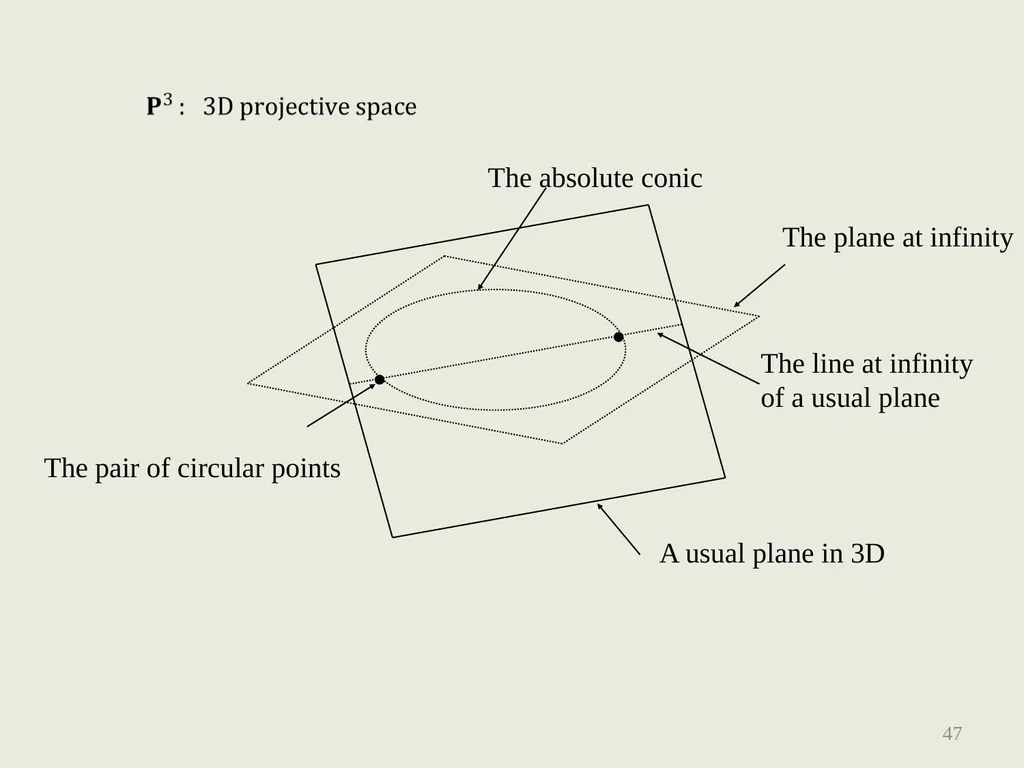
44 Intuitive introduction of circular pts The pair of circular points The line at infinity
of a usual plane Circular points<br>
of a usual plane Circular points<br>
45
45 Affine transformation leaves the plane at inf. invariant Similarity (euclidean) leaves the absolute conic (globally, not point-wise) invariant What is the absolute conic? Example of transformation in P3<br>
46
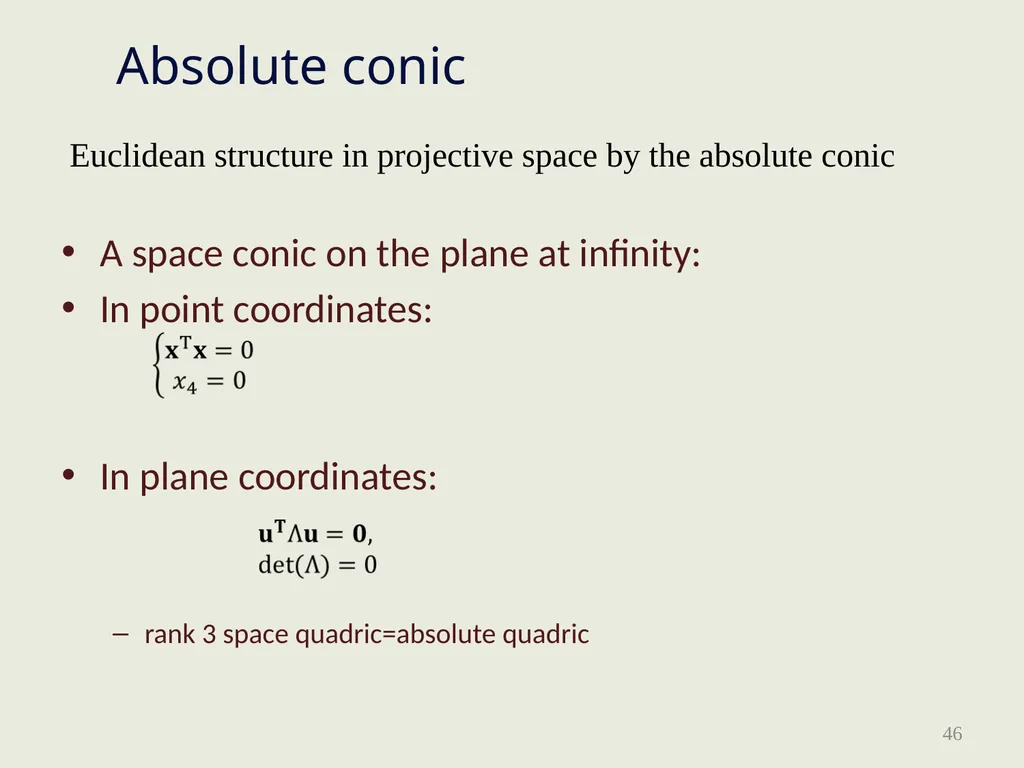
46 Absolute conic A space conic on the plane at infinity:
In point coordinates:
In plane coordinates:
rank 3 space quadric=absolute quadric Euclidean structure in projective space by the absolute conic<br>
In point coordinates:
In plane coordinates:
rank 3 space quadric=absolute quadric Euclidean structure in projective space by the absolute conic<br>
47
47<br>
48
48 Key message from projective geometry for vision ‘abstract camera’ is a projective transformation from P3 to P2, so 3*4 matrix
the intrinsic parameters of the camera are the image of the absolute conic!<br>
the intrinsic parameters of the camera are the image of the absolute conic!<br>
49
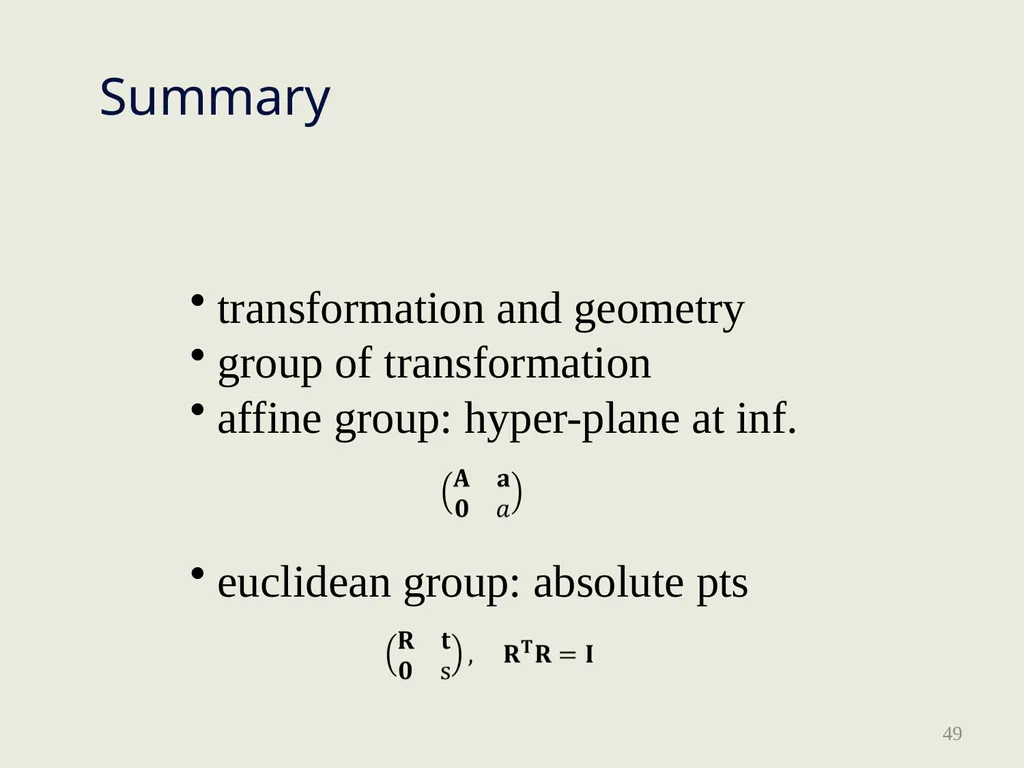
49 Summary transformation and geometry
group of transformation
affine group: hyper-plane at inf.
euclidean group: absolute pts<br>
group of transformation
affine group: hyper-plane at inf.
euclidean group: absolute pts<br>