The passive: impersonal and personal structures, let, allow make Opinions Verbs like believe, consider, know, expect, and think are used to report generalised opinions instead of the opinions of a particular personal or group. Used in
"The passive: impersonal and personal structures," is the property of its rightful owner. Permission is granted to
download and print the materials on this website for personal, non-commercial use only, and to display it
on your personal computer provided you do not modify the materials and that you retain all copyright
notices contained in the materials. By downloading content from our website, you accept the terms of this
agreement.
Presentation Transcript
01
The passive: impersonal and personal structures, let, allow & make<br>
02
Opinions Verbs like believe, consider, know, expect, and think are used to report generalised opinions instead of the opinions of a particular personal or group.
Used in media.
When are let, allow & make used?
Let and allow: PERMISSION
Make: to express that someone is forced to do something.<br>
03
Impersonal & Personal Structures They are used because they do not sound as weak as ‘They/ People say…’ to report a generalised opinion.
Examples:
Active (A) and passive (P) voice:
A: They say today’s youth are lazy.
P- impersonal: It is said that today’s youth are lazy.
P-personal: Today’s youth are said to be lazy.
What are the changes?<br>
04
Impersonal & Personal Structures Verbs:
believe
know
expect
say
report
suppose
think
claim
suspect
understand<br>
05
Impersonal Passive Structure We form the impersonal passive structure with:
It + passive verb + that + clause (sentence)
Examples:
Active Voice: Many people believe that the factory will close.
Passive Voice: It is believed that the factory will close.<br>
06
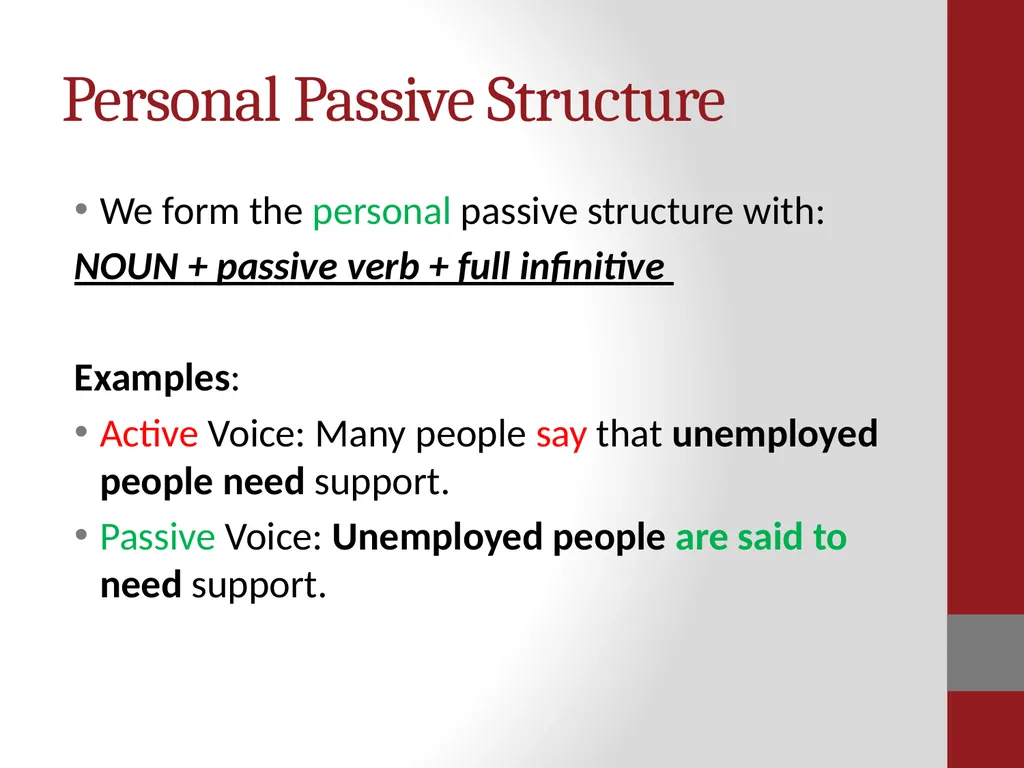
Personal Passive Structure We form the personal passive structure with:
NOUN + passive verb + full infinitive
Examples:
Active Voice: Many people say that unemployed people need support.
Passive Voice: Unemployed people are said to need support.<br>
07
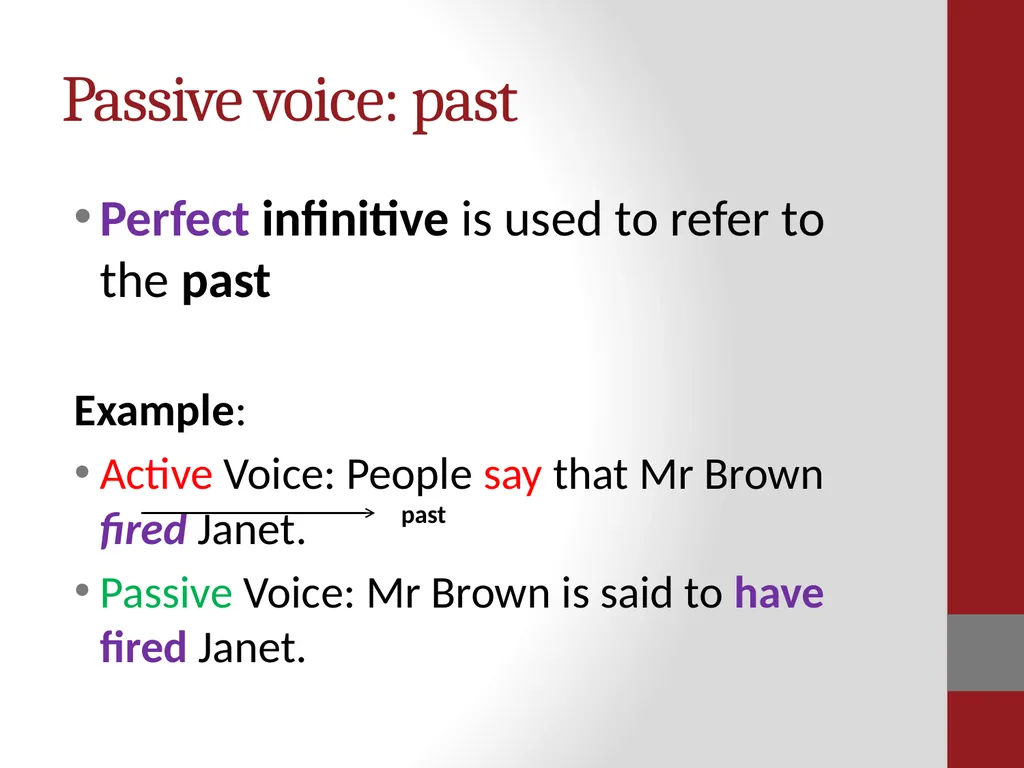
Passive voice: past Perfect infinitive is used to refer to the past
Example:
Active Voice: People say that Mr Brown fired Janet.
Passive Voice: Mr Brown is said to have fired Janet. past<br>
08
let/ allow/ make LET :
LET + object + bare infinitive
ALLOW :
ALLOW + object + full infinitive
Used to say that we give permission for someone to do something.
LET can only be used in the active voice. In the passive voice: BE ALLOWED TO
Examples:
The manager let us take a break. (active voice)
The manager allowed us to take a break. (active voice)
We were allowed to take a break. (passive voice)<br>
09
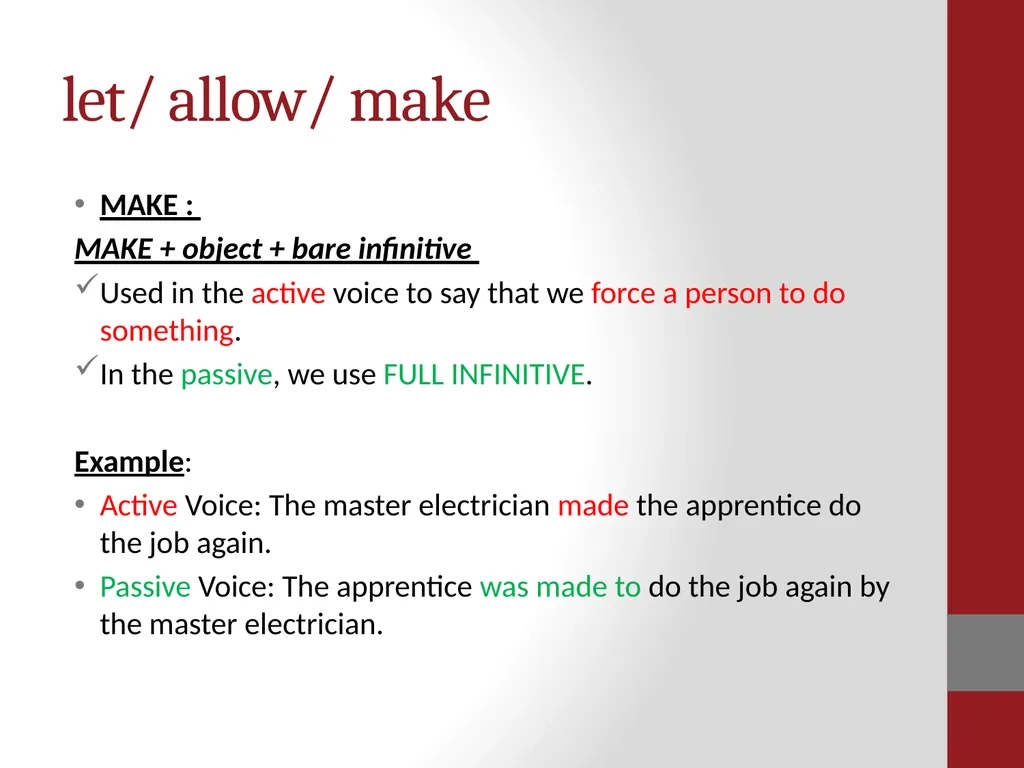
let/ allow/ make MAKE :
MAKE + object + bare infinitive
Used in the active voice to say that we force a person to do something.
In the passive, we use FULL INFINITIVE.
Example:
Active Voice: The master electrician made the apprentice do the job again.
Passive Voice: The apprentice was made to do the job again by the master electrician.<br>
10
Practice! They will let me stay.
They have allowed me to stay.
They made me stay.
Answers:
I will be allowed to stay.
I have been allowed to stay.
I was made to stay.<br>
11
Exercise: rewrite the sentences in impersonal and personal structures. People say that 86% of workers at smaller companies are happy.
People think pilots are among the top ten highest paid UK jobs.
People know that Henry Ford had five failed businesses before he became a success.
Sources report that, on average, professionals born after 1982 get a different job every thirteen months.
People believe that in 1989, 75% of Britain’s wealthiest people had inherited their fortune.<br>
12
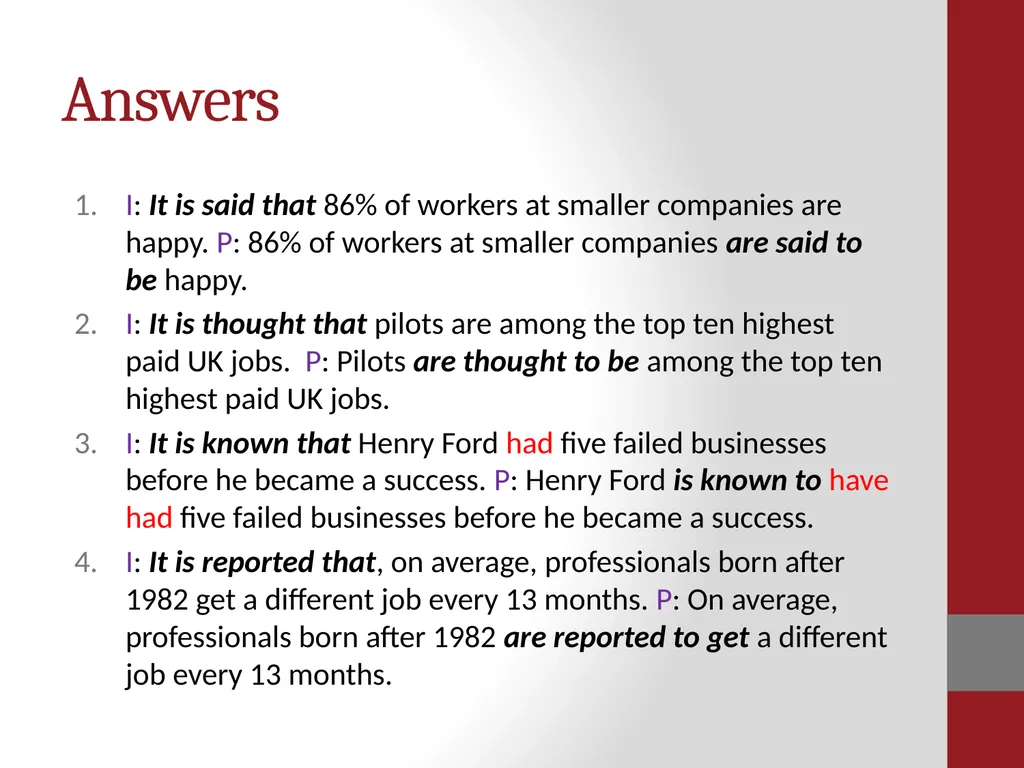
Answers I: It is said that 86% of workers at smaller companies are happy. P: 86% of workers at smaller companies are said to be happy.
I: It is thought that pilots are among the top ten highest paid UK jobs. P: Pilots are thought to be among the top ten highest paid UK jobs.
I: It is known that Henry Ford had five failed businesses before he became a success. P: Henry Ford is known to have had five failed businesses before he became a success.
I: It is reported that, on average, professionals born after 1982 get a different job every 13 months. P: On average, professionals born after 1982 are reported to get a different job every 13 months.<br>
13
I: It is believed that in 1989, 75% of Britain’s wealthiest people had inherited their fortune. P: In 1989, 75% of Britain’s wealthiest people are believed to have inherited their fortune.<br>