
The Permanent Establishment Concept Taxand Asia
SN
Published · 68 slides · 0 views

1 / 1


Description
The Permanent Establishment Concept Taxand Asia Junior School 2019 July 29-31, 2019 CONTENTS PAGE Permanent Establishment Basic rule PE Specific PE Exclusions Construction PE Service PE Agency PE Challenges to PE concept 2 Taxability of
Related Topics
Share
Embed code
Download this presentation From Below
"The Permanent Establishment Concept Taxand Asia" is the property of its rightful owner. Permission is granted to download and print the materials on this website for personal, non-commercial use only, and to display it on your personal computer provided you do not modify the materials and that you retain all copyright notices contained in the materials. By downloading content from our website, you accept the terms of this agreement.
Presentation Transcript
01
The Permanent
Establishment
Concept Taxand Asia Junior School 2019 July 29-31, 2019<br>
02
CONTENTS PAGE Permanent Establishment
Basic rule PE
Specific PE
Exclusions
Construction PE
Service PE
Agency PE
Challenges to PE concept 2<br>
Basic rule PE
Specific PE
Exclusions
Construction PE
Service PE
Agency PE
Challenges to PE concept 2<br>
03
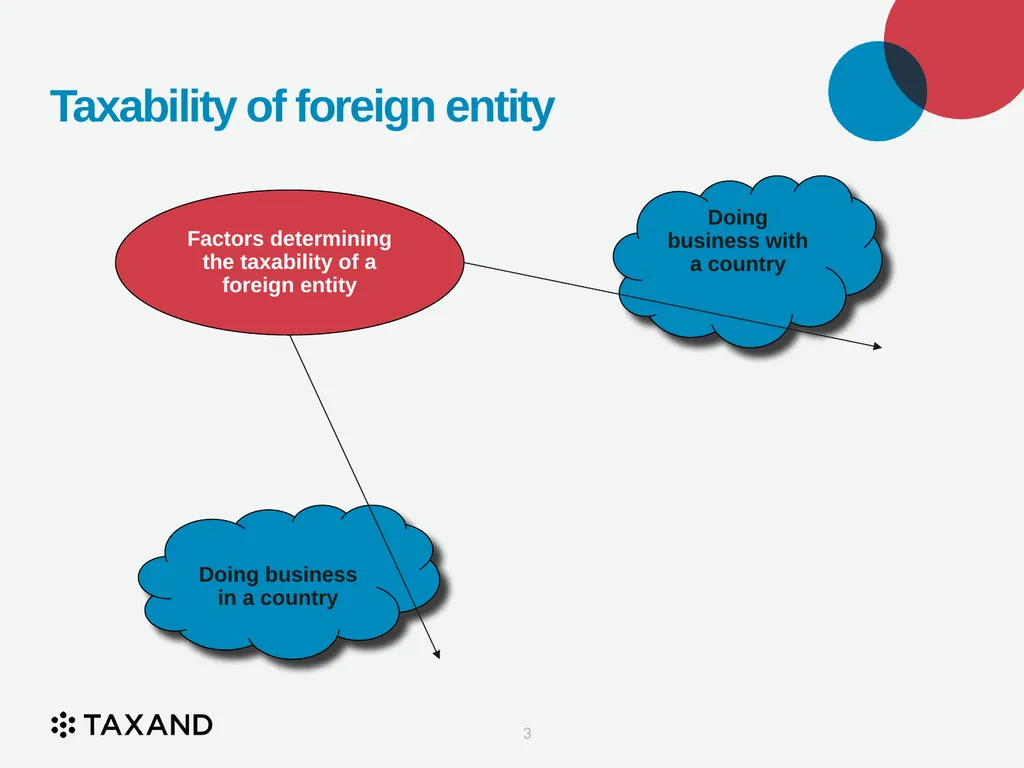
Taxability of foreign entity Doing business with a country Doing business in a country Factors determining the taxability of a foreign entity 3<br>
04
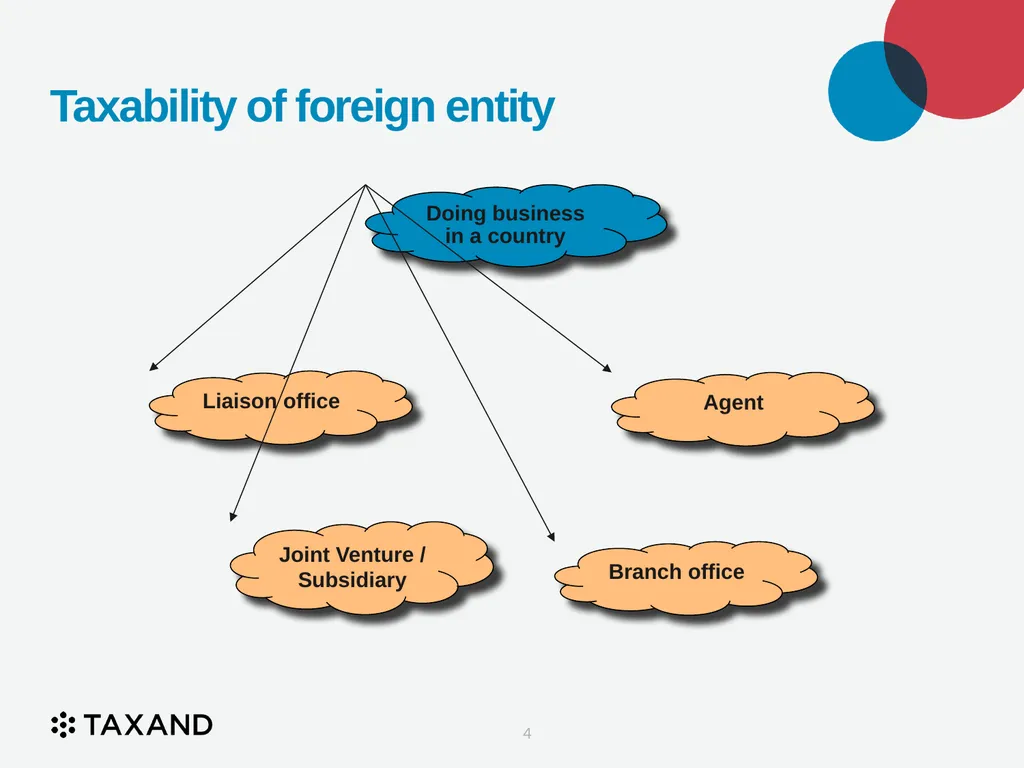
Taxability of foreign entity 4<br>
05
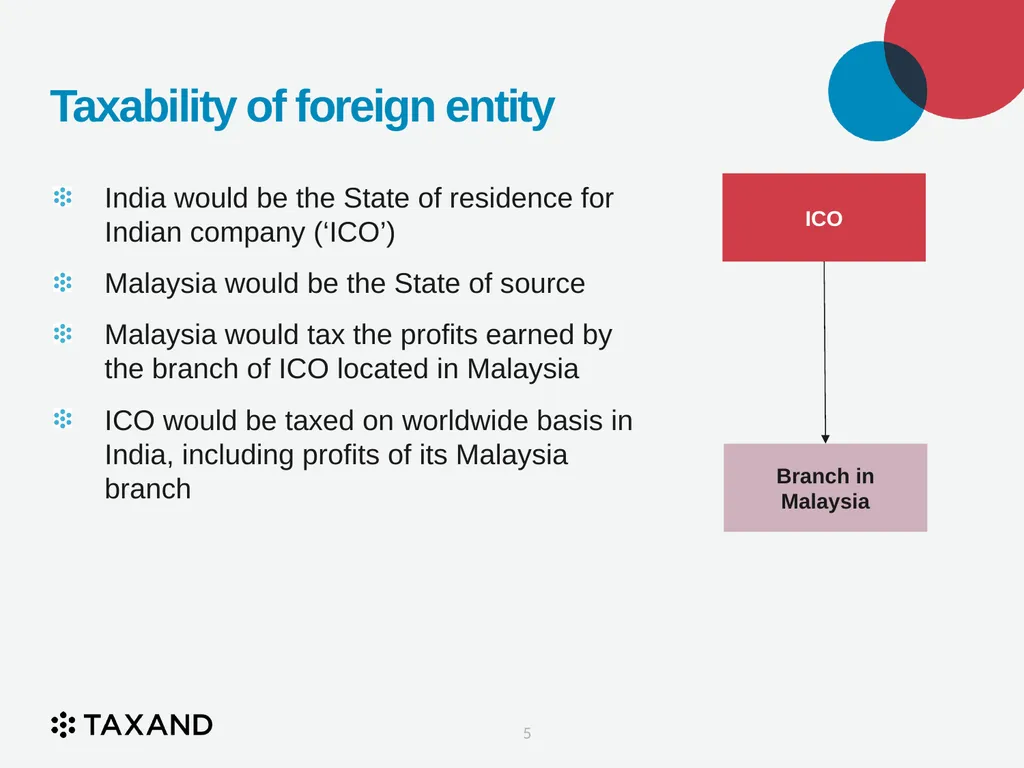
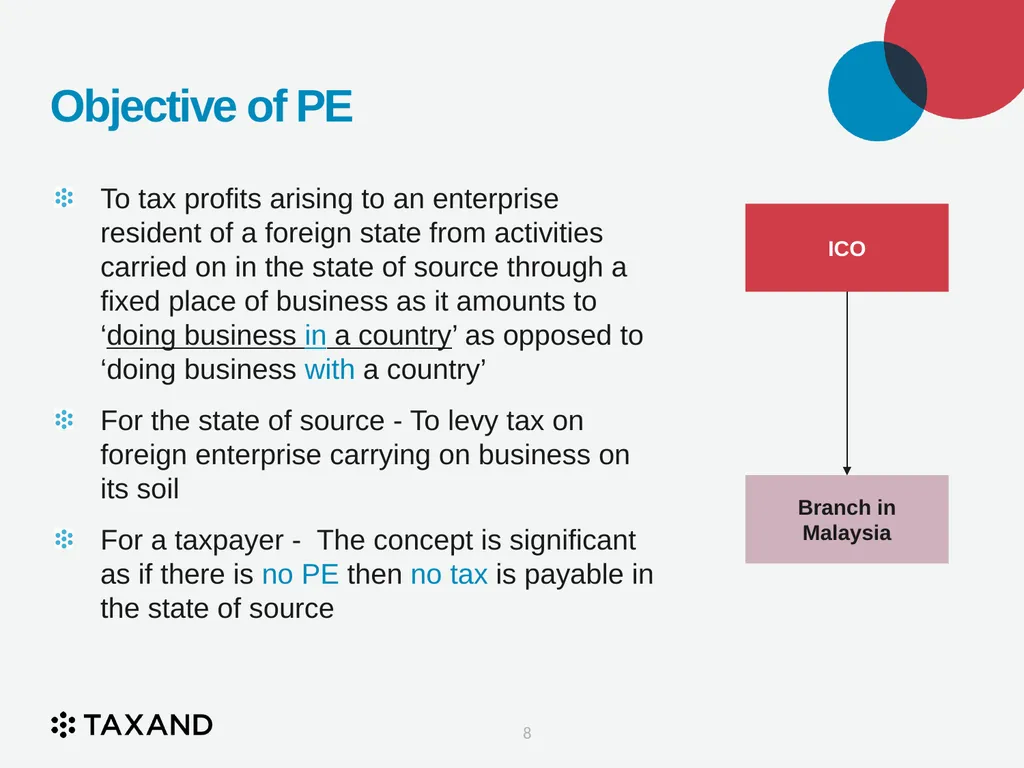
Taxability of foreign entity India would be the State of residence for Indian company (‘ICO’)
Malaysia would be the State of source
Malaysia would tax the profits earned by the branch of ICO located in Malaysia
ICO would be taxed on worldwide basis in India, including profits of its Malaysia branch 5<br>
Malaysia would be the State of source
Malaysia would tax the profits earned by the branch of ICO located in Malaysia
ICO would be taxed on worldwide basis in India, including profits of its Malaysia branch 5<br>
06
Concept of PE PE is a taxable presence that an enterprise of one contracting State has in another contracting State
PE is a compromise between a State of source and State of residence for purposes of taxation of business profits
PE does not necessarily give rise to a legal presence 6<br>
PE is a compromise between a State of source and State of residence for purposes of taxation of business profits
PE does not necessarily give rise to a legal presence 6<br>
07
Role of PE concept in treaties Main use: Determine taxing right in State of residence of enterprise
Assess business activity in State of source
Determine taxing right in State of source (potential source)
Is there a PE?
Profit Allocation/Attribution
Allocation/Attribution factors 7<br>
Assess business activity in State of source
Determine taxing right in State of source (potential source)
Is there a PE?
Profit Allocation/Attribution
Allocation/Attribution factors 7<br>
08
Objective of PE To tax profits arising to an enterprise resident of a foreign state from activities carried on in the state of source through a fixed place of business as it amounts to ‘doing business in a country’ as opposed to ‘doing business with a country’
For the state of source - To levy tax on foreign enterprise carrying on business on its soil
For a taxpayer - The concept is significant as if there is no PE then no tax is payable in the state of source 8<br>
For the state of source - To levy tax on foreign enterprise carrying on business on its soil
For a taxpayer - The concept is significant as if there is no PE then no tax is payable in the state of source 8<br>
09
OECD Model – Article 5 (2010 Version) Article 5(1) Basic rule PE
Article 5(2) Specific PE
Article 5(3) Construction, Building and Installation Projects and Service PE (UN Model)
Article 5(4) Exclusions; Anti-fragmentation rule
Article 5(5) Dependent agent
Article 5(6) Independent agent
Article 5(7) Subsidiary (Controlled company)
Article 5(8) Definition of “closely related” 9<br>
10
Article 5(1) – Basic rule PE The term PE has been defined as under:
a fixed place of business, through which the business of an enterprise is wholly or partly carried on 10 “ ”<br>
a fixed place of business, through which the business of an enterprise is wholly or partly carried on 10 “ ”<br>
11
Points of discussion The definition presupposes
Existence of a place of business (i.e., facility, machinery)
The place of business must be fixed (distinct place/ degree of permanence); and
Through which the business is carried on (dependence on the enterprise [personnel] conduct). 11<br>
Existence of a place of business (i.e., facility, machinery)
The place of business must be fixed (distinct place/ degree of permanence); and
Through which the business is carried on (dependence on the enterprise [personnel] conduct). 11<br>
12
Points of discussion – place of business Any premises, facilities or installations, used for carrying on the business of the enterprise, whether or not they are exclusively used for that purpose
May also exist without a premises like a pitch in a market place, customs depot (storage for dutiable goods) machinery, a pipeline, and even a racehorse 12<br>
May also exist without a premises like a pitch in a market place, customs depot (storage for dutiable goods) machinery, a pipeline, and even a racehorse 12<br>
13
Points of discussion – fixed place Fixed place of business refers to a link between the place of business and a specific geographical point
Length of time immaterial
Equipment need not be fixed on soil
Fixed place must be at the disposal of the enterprise
Immaterial if rented
No formal legal right required
A fixed place of a business owned by an enterprise but placed at the disposal of a third party – Would such a fixed place result in a PE? 13<br>
14
Points of discussion – business carried on Business should be carried through such a place of business wholly or partly
Where a place of business which was at the outset designed for a short / temporary period only, but turns out to be for a longer duration, then it becomes a fixed place of business – Would this result in a PE and since when? 14<br>
Where a place of business which was at the outset designed for a short / temporary period only, but turns out to be for a longer duration, then it becomes a fixed place of business – Would this result in a PE and since when? 14<br>
15
Points of discussion – others Whether length of time is relevant in determining permanence?
No consistent interpretation
GR: At least six months
EX: Recurrent; business conducted wholly/exclusively 15<br>
No consistent interpretation
GR: At least six months
EX: Recurrent; business conducted wholly/exclusively 15<br>
16
Points of discussion – others Letting and leasing
Leasing of facilities, equipment and buildings
If no fixed place of business is maintained, no PE
Leasing of containers
A painter spending three days a week in a large office building of its main client for a period of two years
Mobile offices 16<br>
Leasing of facilities, equipment and buildings
If no fixed place of business is maintained, no PE
Leasing of containers
A painter spending three days a week in a large office building of its main client for a period of two years
Mobile offices 16<br>
17
Points of discussion – others A PE comes into existence, when the enterprise commences its business activities through a fixed place of business
A PE ceases to exist with the disposal of fixed place of business or with the cessation of any activity through it
Activity includes winding up activities, repairs, maintenance 17<br>
A PE ceases to exist with the disposal of fixed place of business or with the cessation of any activity through it
Activity includes winding up activities, repairs, maintenance 17<br>
18
Points of discussion – others Whether time spent to establish fixed place of business should be excluded?
No, provided the activity is substantially different from the activity intended for the PE
What about temporary interruption of operations of an enterprise?
No effect, provided operations are regularly conducted
If a fixed place of business is leased to another enterprise, whether PE will cease to exist?
Yes, unless lessor continues activity in another PE 18<br>
19
Article 5(2) – Specific PE A Place of management
A Branch
An Office
A Factory
A Workshop
A Warehouse and
A mine, an oil or gas well, a quarry or any other place of extraction of natural resources Whether such inclusions per se would result in a PE? 19<br>
A Branch
An Office
A Factory
A Workshop
A Warehouse and
A mine, an oil or gas well, a quarry or any other place of extraction of natural resources Whether such inclusions per se would result in a PE? 19<br>
20
Points of discussion – place of management Place of management exists in the State where control and management of an enterprise reside
Control and management have generally been construed as the ‘head and brain’ of the enterprise 20<br>
Control and management have generally been construed as the ‘head and brain’ of the enterprise 20<br>
21
Points of discussion – branch Branch is generally construed to be an office or other establishment of a company / corporation incorporated under the laws of a country other than the one in which the branch is located
A branch or other fixed place of business connotes a place of business of the non-resident enterprise – something physically and separately identifiable 21<br>
A branch or other fixed place of business connotes a place of business of the non-resident enterprise – something physically and separately identifiable 21<br>
22
Points of discussion – office Office has various meaning depending upon its context
Office does not include a liaison office or a representative office
Whether country manager’s place of residence which was used as office address could be construed as office? 22<br>
Office does not include a liaison office or a representative office
Whether country manager’s place of residence which was used as office address could be construed as office? 22<br>
23
Points of discussion – factory/workshop Factories and workshops are places where goods are manufactured or processed
Farms and shipyards are not regarded as factories 23<br>
Farms and shipyards are not regarded as factories 23<br>
24
Points of discussion – warehouse A warehouse in common parlance means a place where goods or materials, not for immediate sale, are stored
Whether a warehouse in which a business of letting facilities for storage etc. to third parties is carried on will constitute a PE? 24<br>
Whether a warehouse in which a business of letting facilities for storage etc. to third parties is carried on will constitute a PE? 24<br>
25
Points of discussion – mine, oil well, etc. Mine is not defined and therefore meaning is taken as defined under the laws governing the mining activities of the State applying the Treaty
Any other place of extraction of natural resources are interpreted broadly – includes on or offshore drilling of hydrocarbon
Exploration activities not mentioned; parties free to agree
Will be deemed PE only if conducted after a certain period of time 25<br>
Any other place of extraction of natural resources are interpreted broadly – includes on or offshore drilling of hydrocarbon
Exploration activities not mentioned; parties free to agree
Will be deemed PE only if conducted after a certain period of time 25<br>
26
Article 5(3) – Construction projects As per OECD Model Convention,
a building site or
construction or installation project
if it lasts more than twelve (12) months
As a tax treaty is a matter of negotiation between two countries, this period may vary 26<br>
a building site or
construction or installation project
if it lasts more than twelve (12) months
As a tax treaty is a matter of negotiation between two countries, this period may vary 26<br>
27
Article 5(3) – Construction projects (UN Model) As per UN Model Convention, a building site, construction, assembly or installation project constitutes a PE only if it lasts more than six (6) months
Extends to the following:
Assembly projects
Supervisory activities in relation, to building sites, construction, assembly project 27<br>
Extends to the following:
Assembly projects
Supervisory activities in relation, to building sites, construction, assembly project 27<br>
28
Building projects Includes not only the construction of buildings but also the construction of roads, bridges or canals, the renovation (including more than mere maintenance or redecoration) of buildings, roads, bridges, or canals, the laying of pipelines, and excavating and dredging
Where there exists an office or a workshop to cater to various projects in the State of Source and such an office or workshop operate for a period exceeding twelve months then, notwithstanding the fact that these individual projects do not constitute PE, being in operation for less than prescribed time limit, such an office or workshop would constitute a PE 28<br>
Where there exists an office or a workshop to cater to various projects in the State of Source and such an office or workshop operate for a period exceeding twelve months then, notwithstanding the fact that these individual projects do not constitute PE, being in operation for less than prescribed time limit, such an office or workshop would constitute a PE 28<br>
29
Points of discussion Can planning and supervision of building works constitute a building site?
Yes, if on-site
How to calculate the period prescribed in treaties for constituting the same as a PE?
Whether time spent by sub-contractor is to be considered for determining the time spent by the main contractor? 29<br>
Yes, if on-site
How to calculate the period prescribed in treaties for constituting the same as a PE?
Whether time spent by sub-contractor is to be considered for determining the time spent by the main contractor? 29<br>
30
Installation projects Installation project includes installation related to construction projects, installation of new equipment, such as complex machine in an existing building or outdoors
Whether installation of computer network or ERP package would constitute a PE? 30<br>
Whether installation of computer network or ERP package would constitute a PE? 30<br>
31
Service PE (UN Model, 5[3][b]) UN Model: The term permanent establishment also encompasses:
The furnishing of services, including consultancy services, by an enterprise through employees or other personnel engaged by the enterprise for such purpose
If activities of that nature continue within a Contracting State for a period or periods aggregating more than 183 days in any 12-month period commencing or ending in the fiscal year concerned 31<br>
32
Service PE The permanence element of a PE is replaced by a test of minimum length of time in the case of Service PE as in case of Construction PE - [UN Model: 6 months; OECD Model: 12 months]
It is important to evaluate the requirements of Article 12 before examining the service PE clause
The number of days calculation is based on man days 32<br>
It is important to evaluate the requirements of Article 12 before examining the service PE clause
The number of days calculation is based on man days 32<br>
33
Place of provision of services The persons rendering the services and the persons availing the services may be in different locations
For example:
The employee is present in the state where the services are being rendered (i.e., Enterprise X in State X provides services to Enterprise Y in State Y)
The employee is not present in the state where the services are being rendered (i.e., An employee of Enterprise X in State X is present in State Z for rendering services to Enterprise Y in State Y
The employee is present neither in the state where the services are being rendered nor in the state where the services are utilised (i.e., an Employee of Enterprise X in State X who is present in State Z for rendering services to Enterprise Y of State Y and the services are to be utilised in State Y) 33<br>
34
OECD view According to OECD, a State should not have source taxation rights on income derived from the provision of services performed by a non-resident outside that State 34<br>
35
Other Personnel According to OECD, the business of an enterprise is carried on mainly by the entrepreneur or persons who are in paid employment relationship with the enterprise. These personnel include employees and other persons receiving instructions from the enterprise
The interpretation of ‘other persons’ referred to above is based on the principle of noscitur a sociis
Some issues arising in interpreting ‘other persons’ are:
Whether non-individuals are included
Whether employees of another enterprise included
Should the personnel be dependent on the enterprise
Is there an overlap between service PE and agency PE or are they mutually exclusive 35<br>
36
Article 5(4) – Exclusions Following activities are not regarded as PEs:
Use of facilities solely for storage, display or delivery of goods or merchandise (Note: UN Model does NOT include delivery)
Maintenance of stock of goods solely for storage, display or delivery
Maintenance of stock of goods solely for purpose of processing by another enterprise
Maintenance of fixed place of business solely for purpose of purchasing goods, or collecting information
Maintenance of a fixed place of business solely for the purpose of carrying on, for the enterprise, any other activity
Maintenance of a fixed place of business solely for any combination of activities in subparas. (a) to (e)
Such activity or, in the case of (f), the overall activity of the fixed place of business, is of a preparatory or auxiliary character (generalised exception) 36<br>
37
Points of discussion When is an activity mere “preparatory or auxiliary” in nature?
An activity that has a preparatory character is one that is carried on in contemplation of the carrying on of what constitutes an essential and significant part of the activity of an enterprise as a whole.
An activity that has an auxiliary character generally corresponds to an activity that is carried on to support, without being part of, the essential and significant part of the activity of the enterprise as a whole
Remote to the realisation of profits such that it is difficult to allocate profits 37<br>
38
Points of discussion If the activities of fixed base are identical with the general purpose and object of its parent, then such cannot be regarded as preparatory and auxiliary in nature
Cannot be a management office – management is essential part
After sales organisations? Pipes and cables?
Whether after sales service would result in a PE?
Whether display of goods or merchandise at an exhibition would constitute to be a PE?
If goods are sold at the termination of exhibition, then would it be constituted as PE? 38<br>
39
Points of discussion Whether a call centre activity would constitute to be preparatory and auxiliary activity?
Where an enterprise has two or more activities but all are in the nature of preparatory and auxiliary in character, whether they would constitute to be a PE? 39<br>
Where an enterprise has two or more activities but all are in the nature of preparatory and auxiliary in character, whether they would constitute to be a PE? 39<br>
40
Anti-Fragmentation Rule Para. 4 will not apply to a fixed place of business that is used or maintained by an enterprise if the same enterprise or a closely related enterprise carried on business activities at the same place or at another place in the same Contracting State and:
That place or other place constitutes a PE for the enterprise or the closely related enterprise; or
The overall activity from the combination of the activities carried on by the two enterprises at the same place or by the same enterprise or closely related enterprises at the two places, is not of a preparatory or auxiliary character
The business activities constitute complementary functions that are part of a cohesive business operation
Purpose: To prevent the fragmentation of a cohesive business into several small operations to argue that each is merely is a preparatory or auxiliary activity 40<br>
41
Art. 5(8) – “Closely Related” A person or enterprise is closely related to an enterprise if, based on all the relevant facts and circumstances, one has control of the other or both are under the control of the same persons or enterprise
A person or enterprise shall be closely related to an enterprise if:
One possesses directly or indirectly more than 50% of the beneficial interest in the other (or if a company, more than 50% of the aggregate vote and value of the company’s shares or of the beneficial equity interest in the company); or
Another person or enterprise possesses directly or indirectly more than 50% of the beneficial interest (or if a company, more than 50% of the aggregate vote and value of the company’s shares or of the beneficial equity interest in the company) in the person and the enterprise or in the two enterprises 41<br>
42
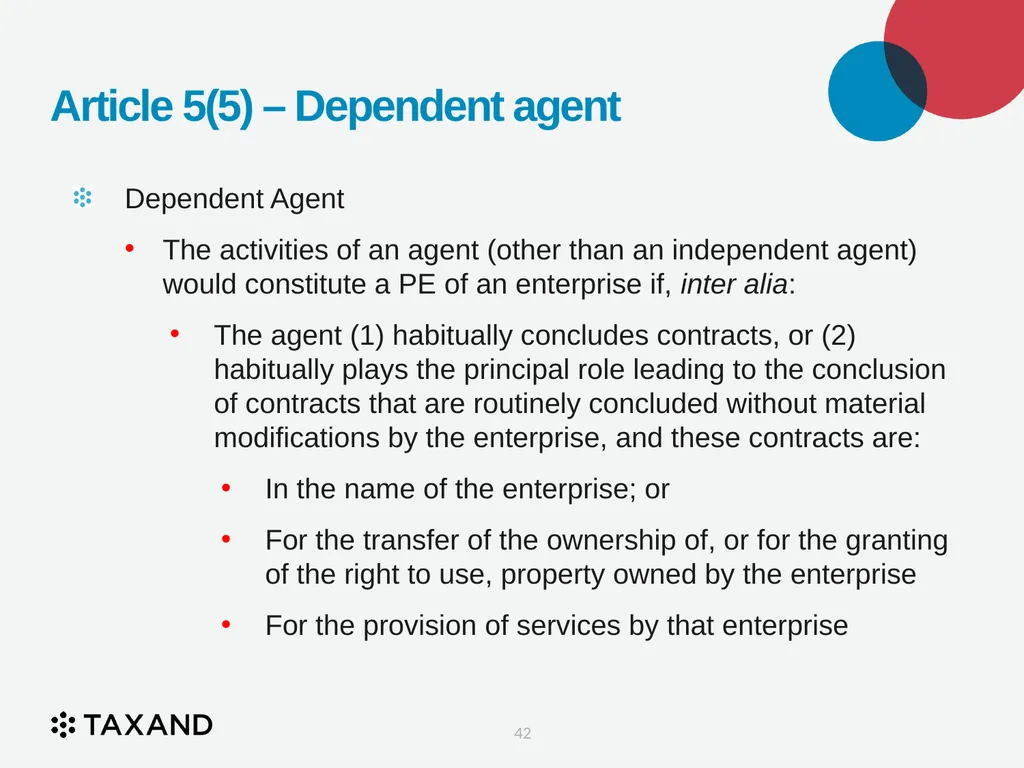
Article 5(5) – Dependent agent Dependent Agent
The activities of an agent (other than an independent agent) would constitute a PE of an enterprise if, inter alia:
The agent (1) habitually concludes contracts, or (2) habitually plays the principal role leading to the conclusion of contracts that are routinely concluded without material modifications by the enterprise, and these contracts are:
In the name of the enterprise; or
For the transfer of the ownership of, or for the granting of the right to use, property owned by the enterprise
For the provision of services by that enterprise 42<br>
43
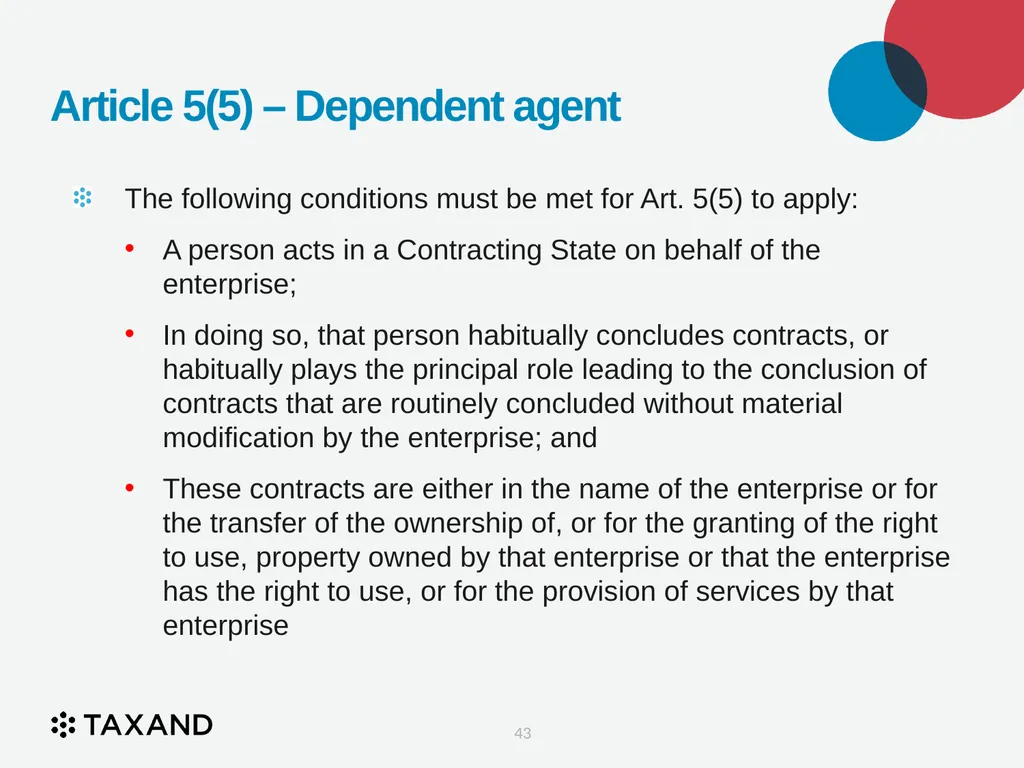
Article 5(5) – Dependent agent The following conditions must be met for Art. 5(5) to apply:
A person acts in a Contracting State on behalf of the enterprise;
In doing so, that person habitually concludes contracts, or habitually plays the principal role leading to the conclusion of contracts that are routinely concluded without material modification by the enterprise; and
These contracts are either in the name of the enterprise or for the transfer of the ownership of, or for the granting of the right to use, property owned by that enterprise or that the enterprise has the right to use, or for the provision of services by that enterprise 43<br>
44
Article 5(5) – Dependent agent Art. 5(5) will not apply:
If activities by the person on behalf of the enterprise are covered by the independent agent exception under Art. 5(6); or
The activities are preparatory or auxiliary 44<br>
If activities by the person on behalf of the enterprise are covered by the independent agent exception under Art. 5(6); or
The activities are preparatory or auxiliary 44<br>
45
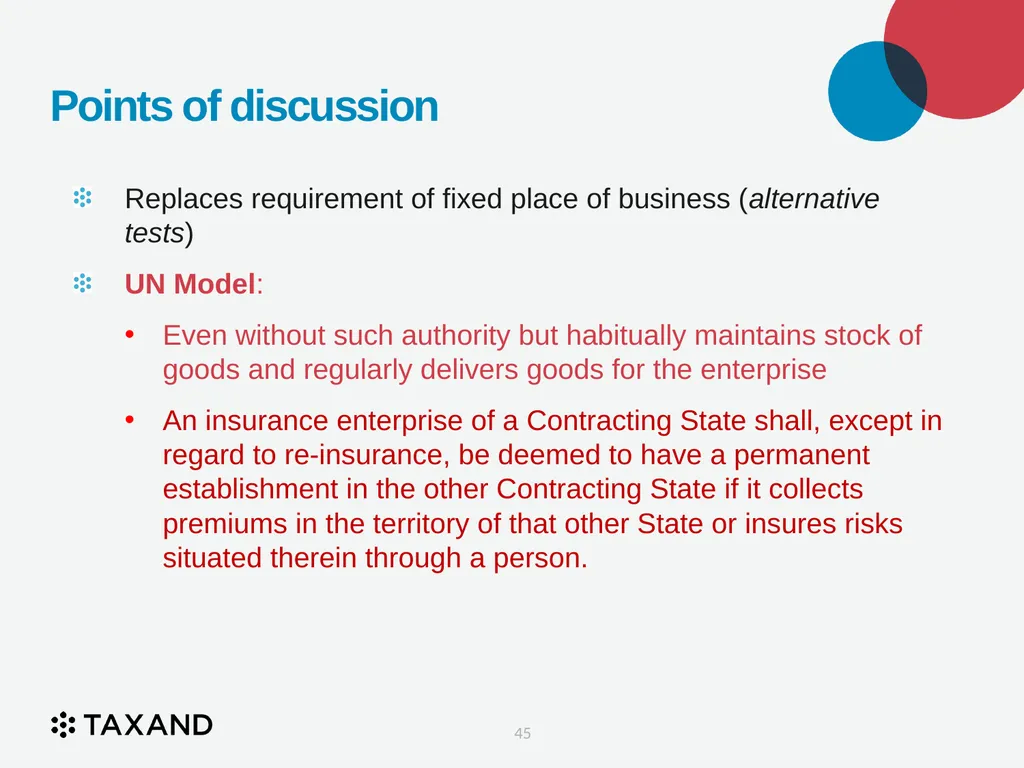
Points of discussion Replaces requirement of fixed place of business (alternative tests)
UN Model:
Even without such authority but habitually maintains stock of goods and regularly delivers goods for the enterprise
An insurance enterprise of a Contracting State shall, except in regard to re-insurance, be deemed to have a permanent establishment in the other Contracting State if it collects premiums in the territory of that other State or insures risks situated therein through a person. 45<br>
46
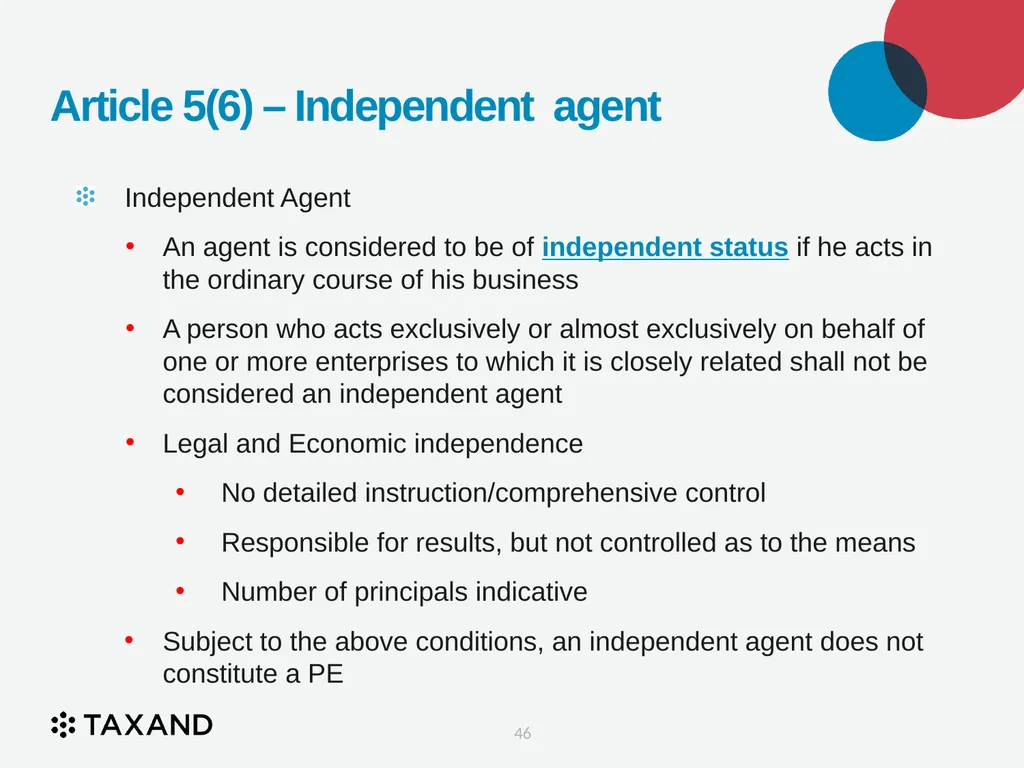
Article 5(6) – Independent agent Independent Agent
An agent is considered to be of independent status if he acts in the ordinary course of his business
A person who acts exclusively or almost exclusively on behalf of one or more enterprises to which it is closely related shall not be considered an independent agent
Legal and Economic independence
No detailed instruction/comprehensive control
Responsible for results, but not controlled as to the means
Number of principals indicative
Subject to the above conditions, an independent agent does not constitute a PE 46<br>
47
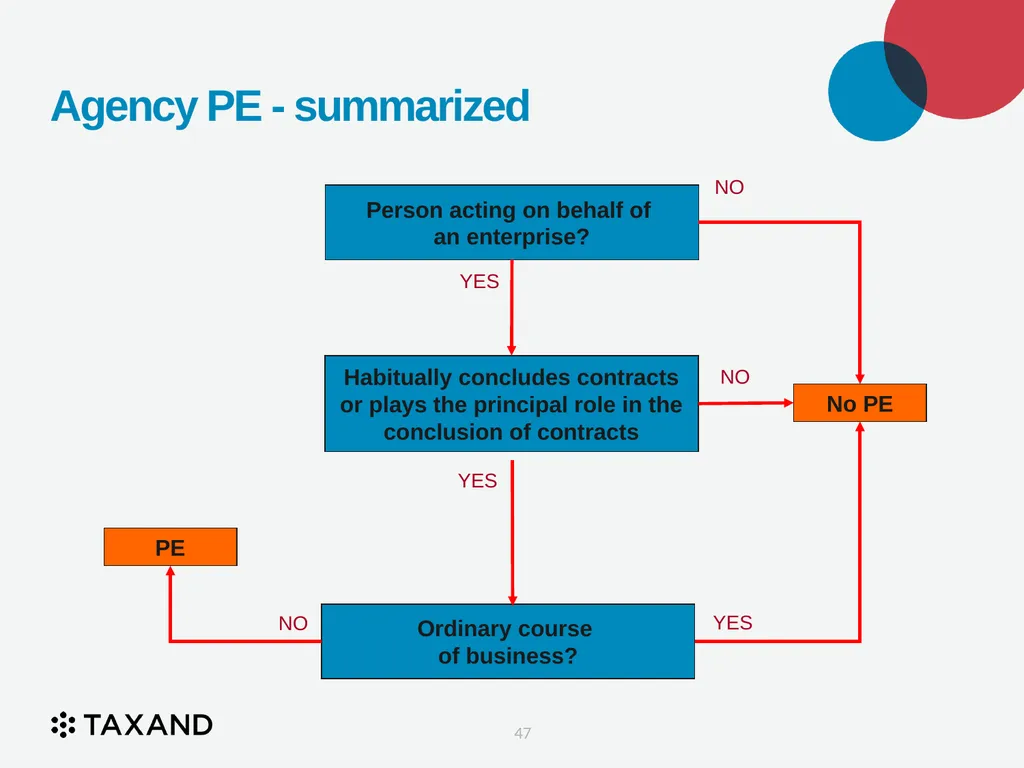
Agency PE - summarized No PE NO YES NO Person acting on behalf of
an enterprise? YES NO Habitually concludes contracts or plays the principal role in the conclusion of contracts Ordinary course
of business? PE YES 47<br>
48
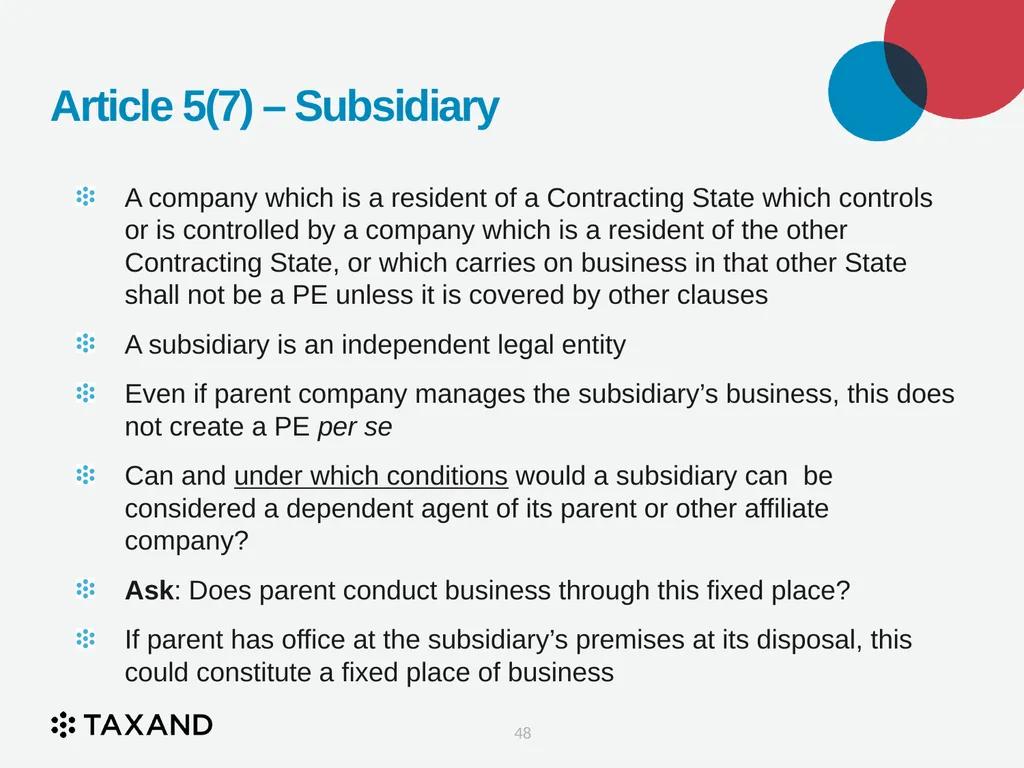
Article 5(7) – Subsidiary A company which is a resident of a Contracting State which controls or is controlled by a company which is a resident of the other Contracting State, or which carries on business in that other State shall not be a PE unless it is covered by other clauses
A subsidiary is an independent legal entity
Even if parent company manages the subsidiary’s business, this does not create a PE per se
Can and under which conditions would a subsidiary can be considered a dependent agent of its parent or other affiliate company?
Ask: Does parent conduct business through this fixed place?
If parent has office at the subsidiary’s premises at its disposal, this could constitute a fixed place of business 48<br>
49
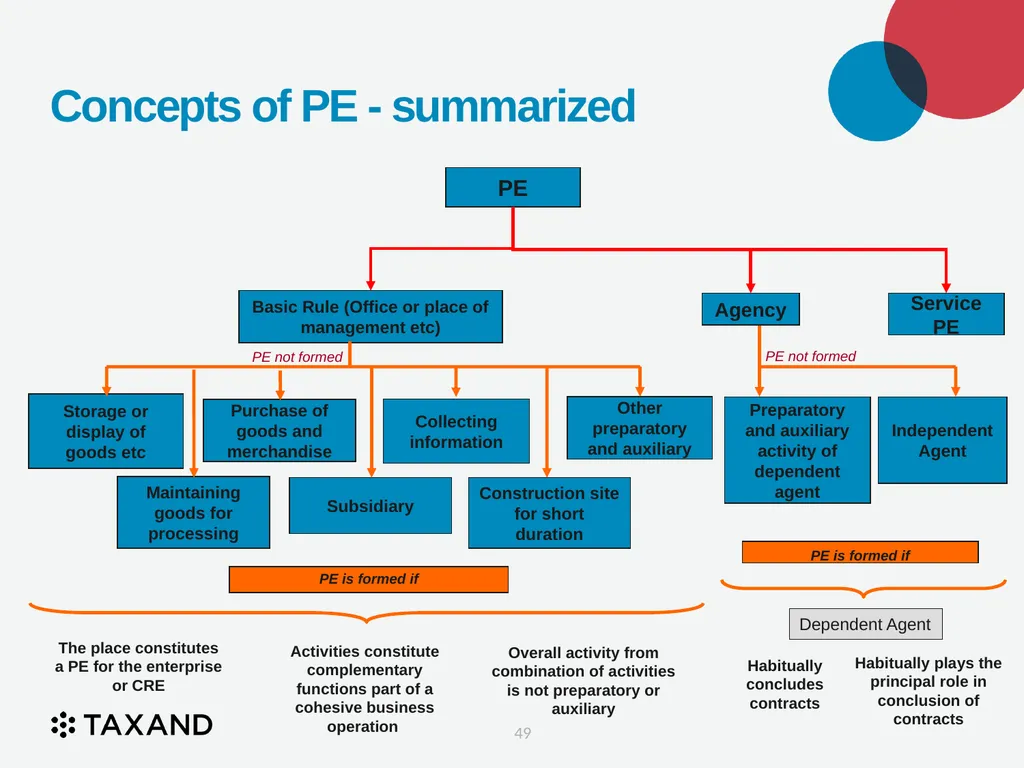
Concepts of PE - summarized PE Basic Rule (Office or place of management etc) Agency Other preparatory and auxiliary Preparatory and auxiliary activity of dependent agent Habitually concludes contracts The place constitutes a PE for the enterprise or CRE Overall activity from combination of activities is not preparatory or auxiliary PE is formed if Storage or display of goods etc Habitually plays the principal role in conclusion of contracts PE not formed Collecting information PE is formed if PE not formed Maintaining goods for processing Independent Agent Dependent Agent Subsidiary Service PE 49 Purchase of goods and merchandise Activities constitute complementary functions part of a cohesive business operation Construction site for short duration<br>
50
Challenges
to PE<br>
51
Challenges to Basic Rule PE Challenge in determining basic rule PE due to emergence of e-commerce
Websites, electronic hubs and computer mainframes are located in different jurisdictions
Commercial activities, transactions and managerial decisions may be at altogether different jurisdictions
Concept of ‘place of business’ evolving and expanding
India’s reservation to OECD Commentary: IT equipment, websites, tangible or intangible properties could constitute PE; website hosted on a particular server at a particular location could be considered a place of business 51<br>
52
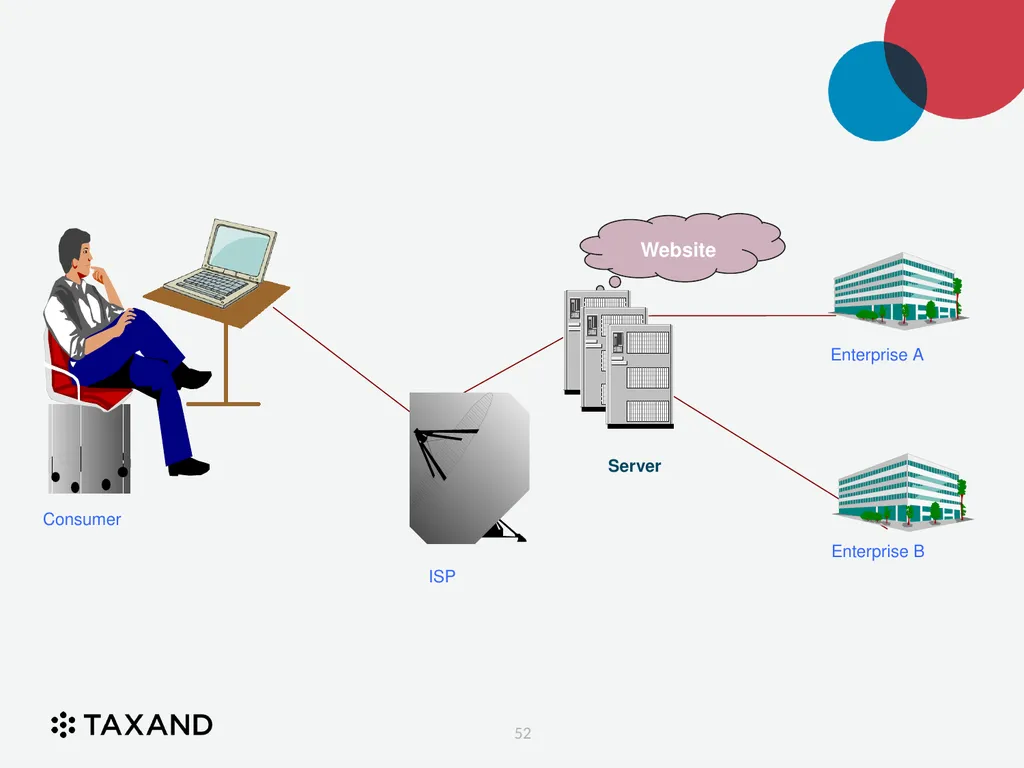
ISP Server Consumer Website Enterprise A Enterprise B 52<br>
53
E-Commerce E-commerce involves the performance of business activities through information and communication technologies, connecting value chains, between businesses and between businesses and customers
E-commerce dissolves the link between an income-producing activity and a specific location; persons engaged in e-commerce could be located anywhere in the world and their customers will be ignorant of, or indifferent to, their location
Allows non-resident entities to reap considerable gains from sales in another jurisdiction without establishing physical presence sufficient to constitute a PE
Need to shift emphasis from ‘location of value-creation’ approach to a more comprehensive approach which considers the place of consumption
Need to shift parameter from ‘type of presence’ to ‘type of economic activity’ 53<br>
54
Websites According to OECD, data and software which is used by, or stored on an equipment located in a country may not necessarily form a PE
For example, an internet web site, which is a combination of software and electronic data, does not in itself constitute a tangible property and also does not have a location. Hence, it can not constitute a "place of business“, and consequentially, a PE
A website would fail the following tests even if the website is to be hosted on a particular server at a particular location:
The locus test
The permanence test
The disposal test 54<br>
55
Server A dedicated server which is owned/ leased by an enterprise of one state in another state would constitute a PE for the enterprise
Where foreign enterprises host their websites on third party servers, the OECD does not consider the server to constitute a PE since neither the server nor its location is at the disposal of the foreign enterprise
India does not agree with the above limitation and holds that, depending on the facts, a foreign enterprise may be considered to have a PE by the virtue of it hosting its website on a particular server in India
Under such a scenario, foreign enterprises having internet website hosted on servers located in India owned by third party service providers may constitute PE 55<br>
56
VIRTUAL PE<br>
57
NEED Globalization & centralization, sustained and supported by technology
International tax law is faced with the following primary issues
Accommodating and controlling new, increasingly virtual business models
Allocation of profits and losses to specific activities and locations
Attribution of taxing authority to specific jurisdictions
Growing role of intangible assets in business operations
Rationale of fixed place test (regarded as evidence of economic allegiance to the source country) increasingly doubted
E-commerce activity possible with no substantive presence – only offices undertaking activities (purchase, storage) – falling within preparatory and auxiliary<br>
58
NEED No need for branch offices, in-country staff – interaction can be done remotely
People replaced by software<br>
People replaced by software<br>
59
NEED There is increasing fear that e-business would frustrate tax authorities all over the world in obtaining their fair share of tax since e-business is not confined to physical boundaries
Tendency of enterprises to locate head office operations in tax havens/ low tax jurisdictions<br>
Tendency of enterprises to locate head office operations in tax havens/ low tax jurisdictions<br>
60
BEPS ACTION PLAN 1 Addressing the tax challenges of the Digital Economy
With the rapid penetration of digitization, it is impossible to ring-fence the digital economy from rest of the economy for tax purposes
Digital economy and its business models present some key features which are potentially relevant from a tax perspective viz mobility, reliance on data, network effects, the spread of multi-sided business models
Digital economy raises the following broader tax challenges for policy makers:
Nexus - Reduced need for physical presence raises question whether current rules to determine nexus with a jurisdiction are appropriate
Data - Data is a primary input into process of value creation in<br>
61
BEPS ACTION PLAN 1 digital economy and possibility to gather and use information from various sources creates problem as to how to attribute value to such data Characterization – Development of new digital products or means of delivering services creates uncertainties in relation to characterization of payments made in context of new business models, cloud computing in particular
Collection of VAT - Absence of an effective international framework to ensure VAT collection in the jurisdiction of consumption as well as a significant administrative burden in managing tax liabilities generated by high volume of low value transactions<br>
Collection of VAT - Absence of an effective international framework to ensure VAT collection in the jurisdiction of consumption as well as a significant administrative burden in managing tax liabilities generated by high volume of low value transactions<br>
62
BEPS ACTION PLAN 1 Task Force on Digital Economy (‘TFDE’) discussed and analyzed potential options to address broader tax challenges, and recommended the following:
Modify list of exceptions to the definition of Permanent Establishment (‘PE’) to ensure that it is not possible to benefit from the ‘preparatory or auxiliary’ activities exception
Apply principles of International VAT/ GST Guidelines and introduce collection mechanisms included therein to address issue in collection of VAT /GST on cross-border transactions, particularly in case of B2C transactions
Other options analyzed by TFDE but not recommended at this stage include:
New nexus based rules on significant economic presence
Withholding tax on certain types of digital transactions<br>
63
BEPS ACTION PLAN 1 Equalization levy to ensure ‘equal treatment’ of foreign and domestic suppliers
Aforesaid options could, however, be introduced by countries in their domestic laws, provided they respect existing treaty obligations, or in their bilateral tax treaties<br>
Aforesaid options could, however, be introduced by countries in their domestic laws, provided they respect existing treaty obligations, or in their bilateral tax treaties<br>
64
BEPS ACTION PLAN 7 Action 7: Prevent the artificial avoidance of PE status
Develop changes to the definition of PE to prevent the artificial avoidance of PE status, including
Use of commissionaire arrangements instead of traditional distributor models
Use of preparatory and auxiliary exemptions – artificial fragmentation of operations among multiple group entities
Thus:
Where the activities of an intermediary in a country are intended to result in the regular conclusion of contracts to be performed by a foreign enterprise, the enterprise should be considered to have a taxable presence
The exceptions under Article 5(4) are modified to ensure that the exceptions are restricted to activities that are of a “preparatory or auxiliary” character 64<br>
65
BEPS Action Plan – PE Avoidance Action 7: Prevent the artificial avoidance of PE status
Thus:
It is not possible to avoid PE status by fragmenting a cohesive operating business into several operations in order to argue that each part is merely engaged in preparatory or auxiliary activities that benefit from the exceptions of Article 5(4)
The changes to the definition of PE in this report will be among the changes proposed for inclusion in the multilateral instrument that will implement the results of the work on treaty issues mandated by the BEPS Action Plan 65<br>
66
Thank you.<br>
67
ABOUT TAXAND Taxand provides high quality, integrated tax advice worldwide. Our tax professionals, more than 400 tax partners and over 2,000 tax advisors in over 40 countries - grasp both the fine points of tax and the broader strategic implications, helping you mitigate risk, manage your tax burden and drive the performance of your business.
We're passionate about tax. We collaborate and share knowledge, capitalising on our expertise to provide you with high quality, tailored advice that helps relieve the pressures associated with making complex tax decisions.
We're also independent- ensuring that you adhere both to best practice and to tax law and that we remain free from time consuming, audit based conflict checks. This enables us to deliver practical advice, responsively.<br>
68
ABOUT TAXAND Taxand is the world’s largest independent tax organisation with more than 400 tax partners and over 2,000 tax advisors in over 40 countries. Taxand focuses on delivering high quality, integrated tax advice, free from conflict creating audit work. Taxand advisors work together to deliver global tax services for clients. Taxand is a global organisation of tax advisory firms. Each firm in each country is a separate and independent legal entity responsible for delivering client services.
© Copyright Taxand Economic Interest Grouping 2017 Registered office: 1B Heienhaff, L-1736 Senningerberg – RCS Luxembourg C68 www.taxand.com<br>
© Copyright Taxand Economic Interest Grouping 2017 Registered office: 1B Heienhaff, L-1736 Senningerberg – RCS Luxembourg C68 www.taxand.com<br>